Russian President Vladimir Putin, speaking at a session of the Valdai Discussion Club, acknowledged a decline in the real incomes of our compatriots.
He noted that the issue was being resolved in cooperation with the trade unions, RIA Novosti reports.
This dialogue continues. We see that people’s nominal incomes are growing, but real incomes have become slightly lower. Bearing in mind the state of the Russian economy, we can solve these problems and should do so in accordance with the existing plans of the Russian government.
Vladimir Putin, President of the Russian Federation
The head of state also said that it was necessary to fight for wage increases. At the same time, he addressed his appeal to both Russians and “ordinary citizens” of the United States and Europe.
Since the start of the special operation by Russian troops in Ukraine, people have experienced a loss of income and savings. Putin also noted earlier that many Russians were at risk of layoffs.
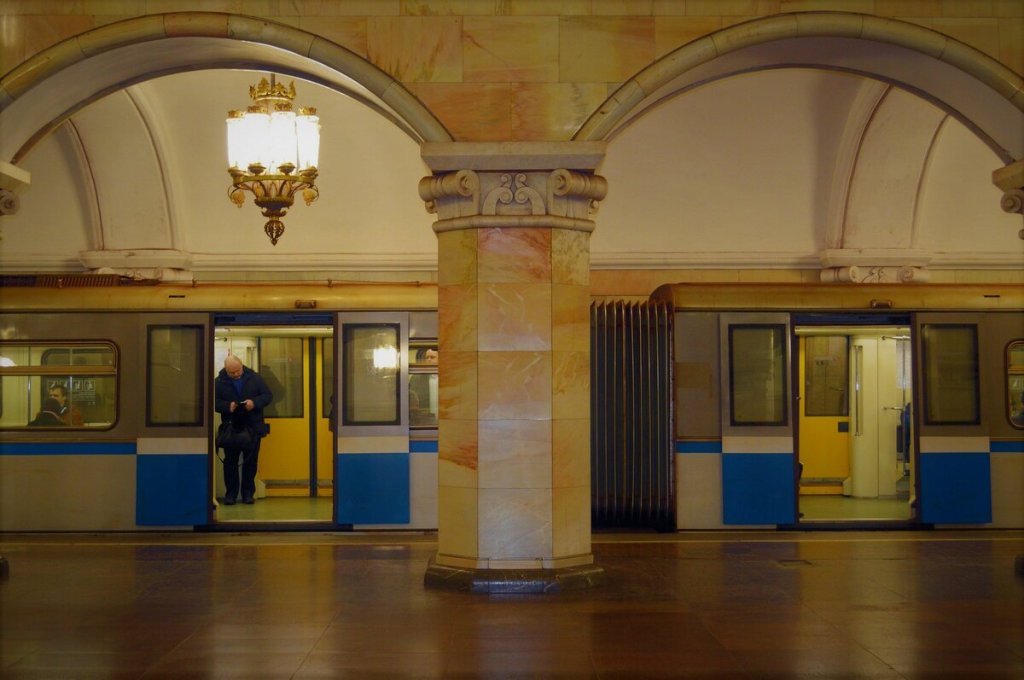
“There are more than 485 air fresheners in operation: they were installed in the air ducts of the climate control system. They spread the fragrance around the car every ten minutes. The fragrance is called ‘Moscow Metro,'” explain the metro’s press service , stressing that all the aromas were safe, hypoallergenic, and complied with regulations.
In 2019, during a vote on the project’s implementation, ninety percent of passengers surveyed said they would prefer an air-freshened carriage to a regular one. Muscovites especially wanted the smell of cherry blossoms in the subway.
What attracts people [to the shot bar Fedya, the Wildfowl!]? The irony and the simplicity, but at the same time the pleasant crowd. Here you can meet people who, the day before, dined on sets [sic] of scallops and dill sauce at designer restaurants, but they are glad to eat belyash and kvass at Fedya’s. Every other table orders kebabs (from 325 rubles) and drinks tinctures and macerations. Security guards monitor everything: if you swear loudly, they will politely ask you to leave.
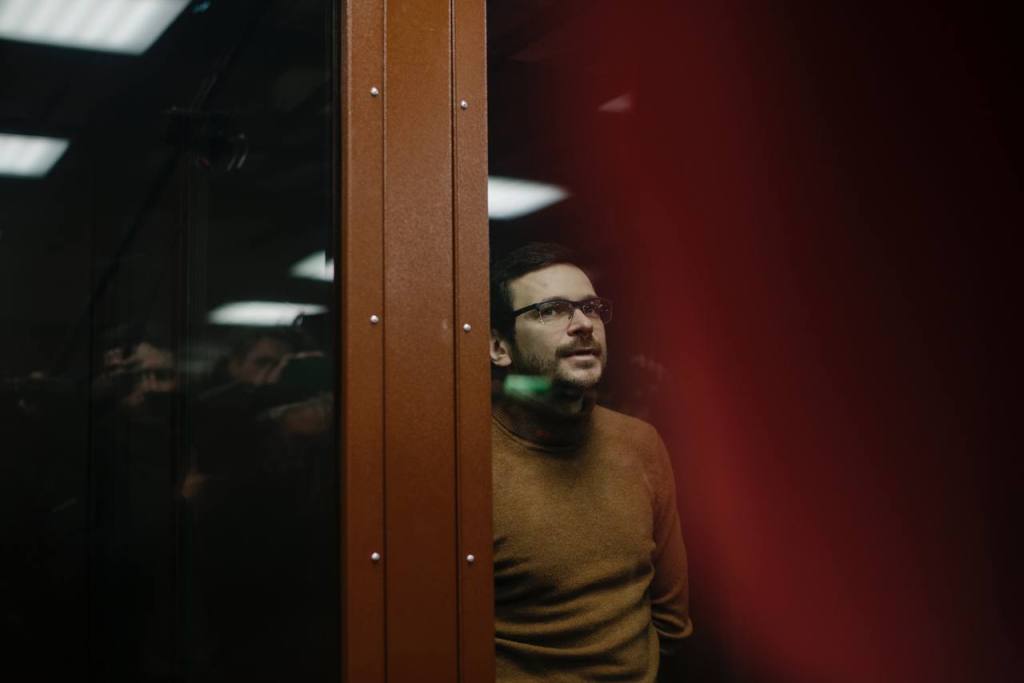
This is a translated excerpt from Russian opposition politician Ilya Yashin’s closing statement, which he delivered at his show trial in Moscow earlier today. Charged with “spreading false information about the Russian military,” Yashin faces up to ten years in prison if convicted, which he almost certainly will be. ||| TRR
Ilya Yashin
Taking advantage of this podium, I would also like to address Russian President Vladimir Putin, the person who is responsible for this massacre, who signed the law on military censorship, and by whose will I am in prison.
Vladimir Vladimirovich!
Seeing the consequences of this monstrous war, you have probably already understand yourself what a grave mistake you made on February 24. Our army has not been greeted with flowers. We are called executioners and occupiers.
The words “death” and “destruction” are now firmly associated with your name.
You have brought terrible misfortune to the Ukrainian people, who will probably never forgive us. But you are waging war not only against Ukrainians, but also against your compatriots.
You have sent hundreds of thousands of Russians into the inferno of battle. Many of them will never return home, turned into dust. Many will be crippled and go crazy from what they have seen and experienced. For you, they are just casualty statistics, numbers in columns. But many families the face unbearable pain of losing husbands, fathers and sons.
You have deprived Russians of their home.
Hundreds of thousands of our fellow citizens have left their homeland because they do not want to kill and be killed. People are running away from you, Mr. President. Haven’t you noticed that?
You have undermined the foundations of our economic security. By putting industry on a war footing, you have sent our country back in the wrong direction. Tanks and guns are again a priority, and poverty and disenfranchisement are again our realities. Have you forgotten that such a policy has already led our country to collapse before?
Although my words might sound like a voice crying in the wilderness, I urge you, Vladimir Vladimirovich, to stop this madness immediately. You must acknowledge that the policy towards Ukraine has been mistaken, withdraw troops from its territory, and proceed to settle the conflict diplomatically.
Remember that every new day of war means new victims. Enough is enough.
Source: Ilya Yashin, Facebook, 5 December 2022. Photo by Zlata Milyavskaya. Translated by the Russian Reader
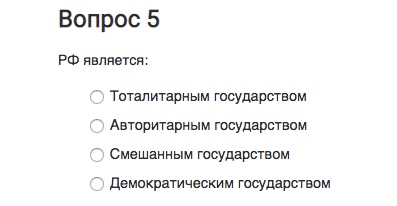
Four and half years ago, I had to renew my Russian permanent residence permit. The procedure had changed considerably since the last time I’d applied for the permit. Among the changes were two written exams that applicants were now required to pass — a Russian language exam and a Russian civics exam. I decided to study for them by doing practice exams which I found online. One of the civics question was “Question 5,” screenshotted above. It’s a multiple choice question. The examinee must decide whether the “RF” (the Russian Federation) is a) a totalitarian state, b) an authoritarian state, c) a hybrid state, or d) a democratic state. To be honest, I no longer remember whether this particular question came up in the actual exam, which I passed with flying colors. But I thought that you, my readers, might find it productive to ponder this question while reading the following three items, ripped straight from this week’s headlines in the Russian media. At the end of this post, you’ll see what the “right” answer was (in 2018, at least) and the answer I tried to give when taking the online practice quiz. ||| TRR
The Ministry of Culture of the Russian Federation has identified 17 priority topics for state financial support of film production in 2023.
The procedure and conditions for selection competitions in 2023 will be announced at the end of December 2022.
“We publish a list of topics before the start of competitions for financing production, hoping that filmmakers will take into account the priorities of state support for film production when developing projects. The Ministry of Culture continues to support such important topics for society as the protection of family values, patriotic education, preservation of the traditions of Russia’s regions, the success of domestic science, and popularization of the professions of engineer and teacher. Given modern realities, we consider it necessary to focus as well on countering attempts to falsify history and modern manifestations of the ideology of Nazism, to talk about the heroism and dedication of Russian soldiers during the special operation and the work of front-line brigades and volunteers,” said Olga Lyubimova, Minister of Culture of the Russian Federation.
Some priority topics have been established pursuant to the Decrees of the President of the Russian Federation: “On the Approval of the Foundations of State Policy for the Preservation and Strengthening of Traditional Russian Spiritual and Moral Values,” dated 09.11.2022, No. 809; “On the Announcement of the Decade of Childhood in the Russian Federation,” dated 29.05.2017, No. 240; “On the Announcement of the Decade of Science and Technology in the Russian Federation,” dated 25.04.2022, No. 231; and “On Holding the Year of the Teacher and Mentor in the Russian Federation,” dated 27.06.2022, No. 401.
The list of priority topics includes:
1. Russia’s culture. The preservation, creation and dissemination of traditional values.
2. The decade of childhood. Families and children, their protection and support.
4. Historical cinema. History lessons, memory lessons. Countering attempts to falsify history. Russia’s peacekeeping mission of Russia. Russia’s historical victories. The eightieth anniversary of the Victory in the Great Patriotic War. The Soviet soldier’s mission of liberation Generational conflict, generational continuity.
5. Russia as a modern, stable and secure state that provides opportunities for growth and self-realization.
6. The heroes among us. Stories of modern Russia’s outstanding individuals. Popularizing the teaching profession. School and college as important stages in social adaptation and personal orientation. The role of teachers and mentors in shaping the individual.
7. Motivating young people to master manual trades and engineering jobs. Improving the social status of the manual worker and the engineer, of research and innovation.
8. Film chronicle. The current state, culture and traditions of Russia’s regions. Development of the Far East and the Arctic. The life of small towns and villages, life in the provinces. Little Russia as a historical region of Russia.
9. Adaptations of works of Russian classical literature, including with the use of animation.
10. Films about outstanding figures in history, culture, science and sports. Popularizing the medical profession. Films about sporting achievements and victories.
11. Countering modern manifestations of the ideology of Nazism and fascism. Popularizing heroism and the dedication of Russian soldiers during the special military operation.
12. Popularizing service in the Russian Armed Forces of Russia. Society’s unanimous support of the army (front-line brigades and volunteers). Strengthening the status of the military profession as based on historical events and recent history.
13. The spiritual, moral and patriotic education of Russian citizens. Countering extremism. Images and models of behavior and creative motivation for modern youth. Spiritual leaders. The volunteer movement in Russia and the CIS countries as an international popularization of volunteerism.
14. The neocolonial policy of the Anglo-Saxon world. The degradation of Europe. The formation of a multipolar world.
15. Society without borders: the self-realization of people with disabilities. Volunteering in Russia. Active longevity.
16. Films about teenagers. Formation of values in life and guidelines while growing up. Disorientation in public space, information overload, forming one’s own way of thinking.
17. Modern society. Moral and ethical choice. Civic engagement. Social unity.
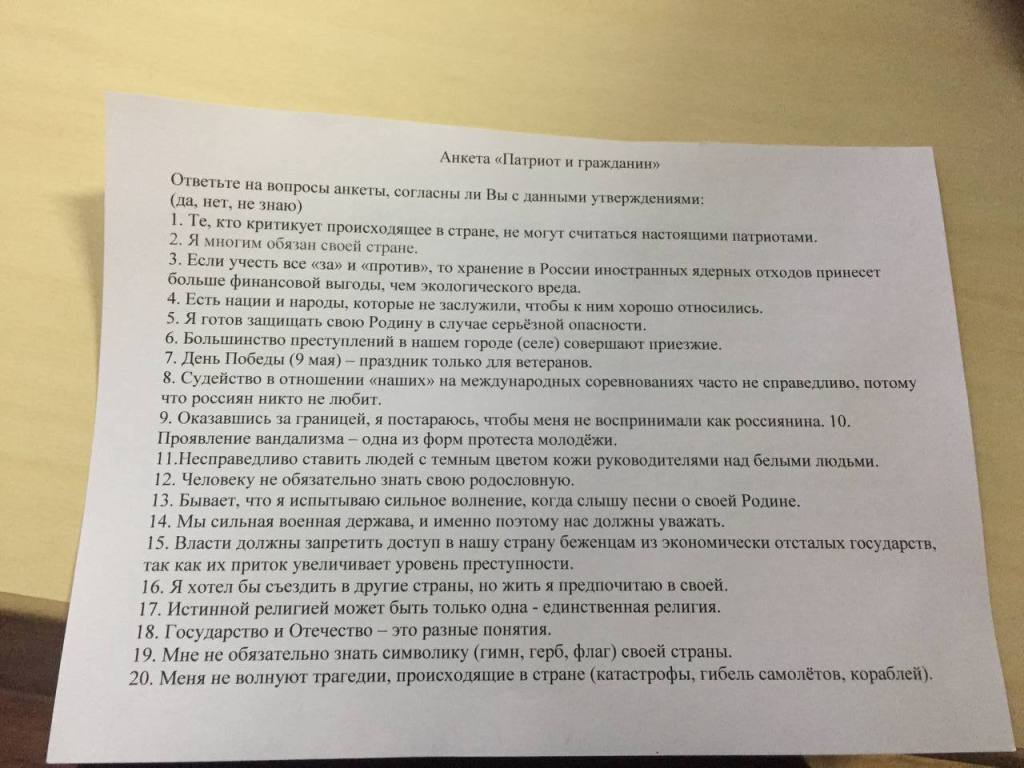
At a secondary school in the Leningrad Region, the Agalatovo Education Center, students were quizzed about racism, Russophobia and the emotions provoked by songs about the Motherland. A photo of the questionnaire, entitled “Patriot and Citizen,” was sent to Rotunda by the parents of one of the schoolchildren. Here are some of statements the children had to evaluate by answering “yes,” “no,” or “I don’t know.”
🇷🇺 Those who criticize what is happening in the country cannot be considered real patriots. 🇷🇺 I owe a lot to my country. 🇷🇺 Sometimes I get very excited when I hear songs about my Motherland. 🇷🇺 We are a strong military power, and that is why we should be respected. 🇷🇺 If I go abroad, I will try not to be seen as Russian. 🇷🇺 I am ready to defend my Motherland in case of serious danger. 🇷🇺 Most of the crimes in our city (village) are committed by outsiders and immigrants.
🇷🇺 Our athletes are often judged unfairly at international competitions, because no one likes Russians. 🇷🇺 If we take into account all the pros and cons, the storage of foreign nuclear waste in Russia brings more financial benefits than it does environmental harm. 🇷🇺 There are nations and peoples who do not deserve to be treated well. 🇷🇺 Vandalism is one of the forms of youth protest. 🇷🇺 It is unfair to put people with dark skin in charge of white people. 🇷🇺 There can be only one true religion.
🤦 The school confirmed to Rotunda that they had conducted such a survey. They agreed to communicate with us only by mail. In a written response signed by the vice principal, they claimed that the questionnaire was needed “as background for a faculty meeting.” The school did not answer questions about how correctly or adequately the questionnaire was worded. Rotunda was unable to contact the school’s principal, Svetlana Sergiyenko. She is a supporter of the United Russia party and has run for election several times on the party’s ticket.
📌 The questionnaire itself seems to have been found by the educators on the internet. In 2014, Belarusian media reported that a similar survey (only with Belarus instead of Russia) was conducted in schools in Minsk.
There is a belief that the Russian elite under President Vladimir Putin has only ever been interested in money. Yet Putin’s militant, anti-liberal, anti-Western, isolationist, paternalistic, and harshly authoritarian regime has always had an ideology.
This ideology is not systematized, but it does exist, and snippets of it can be found throughout Putin’s speeches, articles, and interviews. Now the war in Ukraine has necessitated a more articulated ideology, however.
The initiative to systematize and codify Putinism has led to a presidential decree listing Russia’s “traditional spiritual and moral values,” as well as the development of a new ideological curriculum for colleges.
It is no longer enough to indoctrinate children in kindergartens and schools. It is now time to unify the worldviews of college students, and, by extension, those of their professors, whose ranks will inevitably be purged. A similar course taught during the Soviet era was known as “Scientific Communism.”
The name for this new curriculum is “Fundamentals of Russian Statehood,” though it might as well be called “Scientific Putinism.” It is composed of four units: “History” – historical policy as the imposition of a mythologized official version of history, which is one of the instruments for manipulating the mass consciousness of Russians; “Cultural Codes” or the “traditional spiritual and moral values,” around which Putin has ordered federal and regional governments to unify; “Russia and the World” — a justification of isolationism, anti-Westernism, and jingoism; and “Vision for the Future,” which sets out what the state hopes to achieve beyond victory in Ukraine and the destruction of the “fifth column.”
The curriculum justifies the cult of the eternal leader and doubles down on the idea that Russia is fighting the forces of evil in Ukraine in an effort to “de-satanize” the country. However, at the same time, Scientific Putinism lacks key components such as development goals or a vision for Russia’s future, focusing as it does almost exclusively on the past.
During Dmitry Medvedev’s presidency, there were teams working on a future-oriented ideology and making road maps based on the idea that Russia would fast-track the modernization of the state and society. Putin’s ideology, however, is one that fundamentally opposes modernization.
Putin has successfully convinced a significant portion of the population that Russia must regain its status as a great power, and that Russia is under attack by both the liberal West and traitors at home. As the regime has grown more authoritarian, its ideology has also become more archaic, its propaganda more obtrusive, and any hopes of modernization have dwindled.
An ideology that consists of historical, cultural, and religious myths, bogus traditions, and resentment seeks to legitimize an authoritarian regime and delegitimize those who oppose it.
Such an ideology makes it possible to label nonconformists as enemies, and to divide people into “us” and “them.” The division into “us” and “them” doesn’t just provide a marker for self-identification, it also serves to convince the public that there is a certain majority from which they should not stray.
In the past, the only requirement for being part of the “us” was passive, silent, conformist support. Today, however, this is not enough: Russians must surrender their very bodies to be cannon fodder in the supreme leader’s holy war against the “satanic” forces of the West. This is no longer authoritarianism; it is totalitarianism.
Imperialism and colonialism are key components of Putinism and key factors in the war. There is nothing new about this ideology; it comes almost verbatim from Stalinism and from earlier Eurasian and Slavophile narratives.
The war is being passed off as striving to restore historical fairness, as defensive and preventive, and as liberation. According to Putin, the land of the empire must be “returned and reinforced.”
In just a few years, the regime has evolved from a cult of the victory of 1945 to a cult of war itself, and Putin has managed to persuade a large segment of Russian society that the “special military operation” of 2022 is a natural continuation of World War II. In essence, it is an existential war between Russian and Western civilizations.
Putin has started to refer to Russia as an entire civilization. The state is not just sacred and worthy of the ultimate sacrifice; it is also a separate and superior civilization with a “thousand-year history” and its own special path.
Within this history, cultural codes are being passed down from generation to generation as part of the country’s political DNA. This state-civilization has its own pantheon of heroes unchanged from the Soviet era: Alexander Nevsky, Ivan the Terrible, Peter the Great, Joseph Stalin, and Yuri Gagarin.
This state-civilization has always been under attack by enviers and foes, making its state of permanent conflict critical, and not simply limited to the battlefield. The state must win in all aspects — in culture and in sports, in the construction of Olympic facilities, and in the war against Ukraine and the West.
To defend the sovereignty of this state-civilization, the Kremlin is counting on the security services, or siloviki, who have been given additional funding and are reinforced by spin doctors and so-called “journalists” in the Kremlin’s service.
The Culture Ministry, the communications watchdog Roskomnadzor, and the Russian Orthodox Church are becoming de facto siloviki themselves, enjoying as they do the right to block or ban media, restrict the sales of books by authors who oppose the war, and decide who can perform on theater stages.
The ideology has become corporeal, bolstered by political and military acts, such as the annexation of Crimea and the “special military operation.” In short, the special ideological operation is ongoing, and it seems to be faring rather better than the military one.
This article was originally published by the Carnegie Endowment For International Peace.
Back in the summer of 2018 I tried to answer Question 5 truthfully, replying that the Russian Federation was an “authoritarian state.” But the right answer, then, was “democratic state,” as it turned out. Again, I don’t remember now whether this question was on the actual civics exam that I took, but there were several other “ideological” questions like it, which I would have answered “incorrectly,” thus jeopardizing my chances to get a residence permit, if I hadn’t been schooled in advance by the practice quizzes I’d found online. ||| TRR
Oleg GrigorievPit
Digging a pit?
I was.
Fell in the pit?
I fell.
Down in the pit?
I am.
Need a ladder?
I do.
Wet in the pit?
It's wet.
How's the head?
Intact.
So you are safe?
I'm safe.
Well, okay then, I'm off!
Putin last week took part in a meeting with the mothers of soldiers killed in the war in Ukraine. The title “soldiers’ mother” carries a lot of influence in Russia — and Putin was famously humiliated by a group of soldiers’ relatives in his early years as president. Unsurprisingly, Friday’s meeting included only those trusted to meet Putin and the gathering passed off without awkward questions. Putin — who now rarely communicates with anyone outside of his inner circle — once again demonstrated a complete detachment from reality.
The Russian authorities have been nervous of organizations of soldiers’ mothers since the mid-1990s. During the first Chechen war (1994-1996), in which the Russian army was humiliated, the Committee of Soldiers’ Mothers was one of the country’s leading anti-war forces and held the state and the military to account.
For Putin personally, any encounter with soldiers’ mothers stirs unhappy memories of one of the most dramatic incidents of his first year in the Kremlin. In August 2000, the inexperienced president was subjected to a grilling by the wives and mothers of sailors who died in the Kursk submarine disaster. The transcript of the meeting immediately appeared in the press and a recording was played on Channel One, which was then owned by Kremlin eminence grise Boris Berezovsky. Presenter Sergei Dorenko subsequently claimed that, after the broadcast, Putin called the channel and yelled that the widows were not genuine and that Berezovsky’s colleagues “hired whores for $10.” Ever since that encounter, the Russian president has avoided in-person meetings, favoring stage-managed gatherings with hand-picked members of the public.
This time, of course, there were no surprises. The Kremlin carefully selected the soldiers’ mothers who were invited to attend. At least half of those at the meeting turned out to be activists from the ruling United Russia party and members of pro-Kremlin organizations.
The most striking speech at the event was close to parody. It was given by Nina Pshenichkina, a woman from Ukraine’s Luhansk Region whose son was killed in 2019. Pshenchkina later became a member of the Public Chamber of the so-called Luhansk People’s Republic and has attended almost every official funeral and official celebration. She told Putin that her son’s last words were: “Let’s go, lads, let’s crop some dill” (in this context, “dill” is an insulting nickname for Ukrainians).
Putin’s speech was also striking. First, he told the assembled mothers that Ukrainians were Nazis because they kill mobilized Russians soldiers who did not wish to serve on the front line. Then he embarked on a long, strange discussion about why we should be proud of the dead. “We are all mortal, we all live beneath God and at some point we will all leave this world. It’s inevitable. The question is how we live… after all, how some people live or don’t live, it’s not clear. How they get away from vodka, or something. And then they got away and lived, or did not live, imperceptibly. But your son lived. And he achieved something. This means he did not live his life in vain,” he said to one of the mothers.
Why the world should care
It would be an error to assume that Putin has completely abandoned rational thought. However, it is instructive to watch him at meetings like this, which provide a window onto the sort of information he consumes. At this meeting with fake soldiers’ mothers he quoted fake reports from his Defense Ministry and, seemingly, took it all seriously.
Source: The Bell & The Moscow Times email newsletter, 28 November 2022. Written by Peter Mironenko, translated by Andy Potts, and edited by Howard Amos. Photo, above, by the Russian Reader
Five persons unknown abducted and tortured Dmitry Karimov, a 22-year-old resident of Krasnoobsk (Novosibirsk Region), in order to get him to confess to burning a banner in support of the Special Military Operation. The young man told the Telegram channel “Caution, News” [which has 1,443,493 subscribers] about the incident.
According to Karimov, on the morning of October 14, five men in mufti attacked him and pushed him into a vehicle. “I was screaming, calling for help, and they used a cattle prod on me,” he said, adding that they immediately accused him of setting fire to the banner, a crime which he did not commit.
Then, according to Karimov, the men took him to the forest, handcuffed him, strangled him, threatened to shoot him, and offered to convey to his parents his last words if he did not confess to the arson. Karimov confessed under duress. He was taken home, where a search took place, during which the security forces seized electronic devices and a jacket.
The detainee was then taken to the police station. Karimov said that during the interrogation he tried to tell the truth, but he was threatened with being sent to the war in Ukraine, and due to fear and coercion, he confessed.
The detainee’s mother Ekaterina Mikhasyonok said that her son is a third-category disabled person: he has been diagnosed with an organic lesion of the central nervous system, and has hearing and speech problems. She added that when her son did not return from school, she began looking for him. At about nine in the evening, she went to the police station, where she was told that Karimov was there.
Karimov was charged with “intentional destruction or damage to property by arson” (per Article 167.2 of the Criminal Code) and released on his own recognizance.
Russian President Vladimir Putin on Thursday named several supporters of the war in Ukraine to the presidential Human Rights Council in a shake-up of the body which appeared to purge members who have publicly expressed doubts about the war.
War correspondent Alexander Kots and two other prominent supporters of the war were added to the council, while 10 members, including the well-known television host Nikolai Svanidze, found themselves removed from the body.
Kots, a journalist for the Komsomolskaya Pravda tabloid who also runs the popular Telegram channel Kotsnews, has risen to prominence during Russia’s invasion of Ukraine as he has been embedded with Russian forces throughout the war.
While he has reported on Ukraine since 2014, he has faced repeated accusations of being a mouthpiece for the Kremlin since the start of Russia’s 2022 invasion, most notably for his claim that the massacre of Ukrainian civilians in the town of Bucha was staged by Kyiv.
Also added to the body on Thursday were Yulia Belekhova of the All-Russian People’s Front, an organization that raises money to support pro-Kremlin separatist forces in Ukraine’s Donbas region, as well as Elena Shishkina, a member of the Free Donbas party in the self-proclaimed Donetsk People’s Republic.
The 10 members removed from the body include Svanidze, who has increasingly voiced his concerns over Russia’s invasion and who called for curbs on the death penalty in the Donetsk region in an open letter to Putin in August.
Prominent rights activist Igor Kalyapin and leading anti-xenophobia researcher Alexander Verkhovsky were also removed from the council in Thursday’s shake-up.
Russia’s Human Rights Council, which was established by presidential decree in 2004 to guarantee and protect human rights in Russia, has been criticized for failing to challenge Putin as members have been ousted and replaced with more Kremlin-friendly figures over the years.
The council has been chaired by journalist and war supporter Valery Fadeyev since 2019.
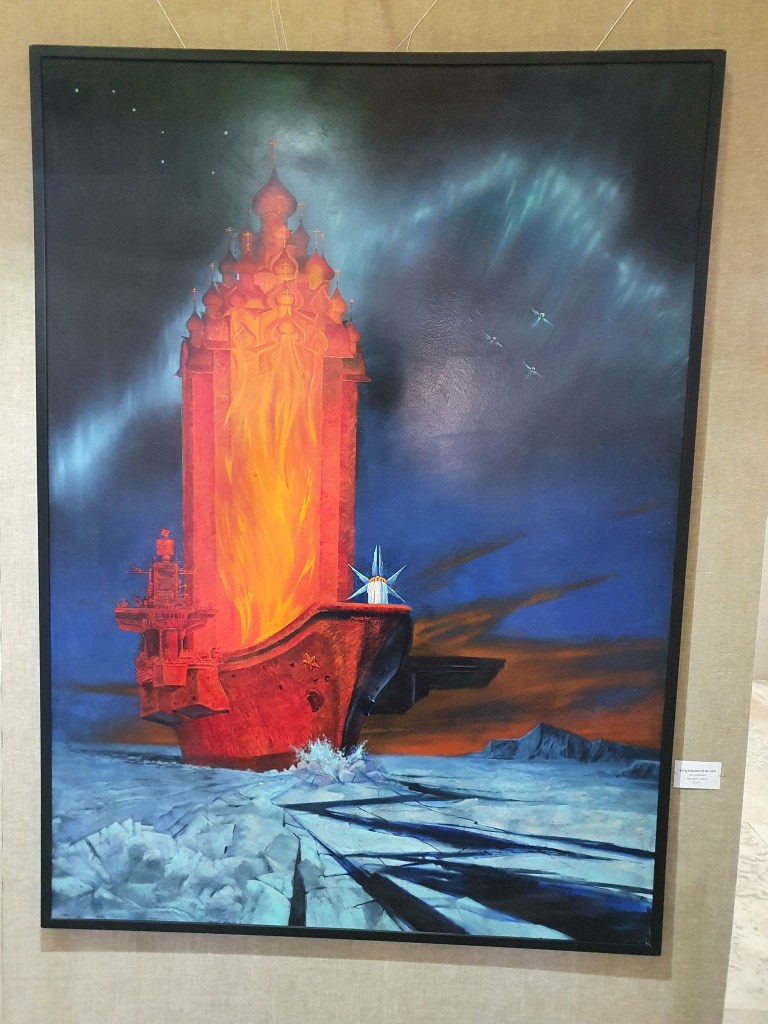
“Russian angel carrier, Artillery Museum, Saint Petersburg.” Source: Pavel Pryanikov, Facebook, 6 November 2022
Alexander Kharichev, head of the Presidential Department for Supporting the Work of the State Council, and three other experts have published a scholarly article entitled “Perception of basic values, factors, and structures of Russia’s socio-historical development, as based on research and testing.” As part of the study, seventy people from the student bodies of Moscow State University and the Higher School of Economics and the teaching staff of a conference in Sevastopol [sic] were interviewed. Among the metaphors of the future they proposed was the burnt second volume of Dead Souls; among the concepts of the modern state, “the Motherland with a laser sword”; among the concepts of the future, “Russia as the world’s ‘guardian of good” and “Pasty” [sic: “Pirozhok”]. The authors concluded that the dominant value for the Russian family is the people of Russia, which itself is a “family of families.”
Mr. Kharichev’s co-authors were Andrei Shutov, dean of the faculty of political science at Moscow State University; Andrei Polosin, doctor of political science and head of Rosatom’s regional interaction department; and Ekaterina Sokolova, deputy executive director for strategy and forecasting at the Expert Institute for Social Research. The article was published in October in the Journal of Political Studies.
The study was conducted by means of group discussions from March to May. The seventy participants answered questions about what Russian statehood is, what would happen to the country in ten years, what our future is, and a number of others.
Based on the discussions, the researchers formed a five-level “pentabasis”: person—family—society—state—country. Dominant values were formed for each level. For the country, [this dominant value] is patriotism; for the state, it is trust in the institutions of power; for the family, it is the people of Russia; for society, it is harmony; for the person, it is creativity. “The thesis was voiced that European society is individualistic, whereas our main value is family + family with friends, which leads to the emergence of the thesis ‘family as a level.’ The dominant value: the people of the Russian Federation as a family of families. Stimulating the birth rate and the concept of a ‘big family,’ the article says [just as incoherently in the original as in this translation].
Metaphors of Russia’s future. “The state as a novel” (written collectively by citizens, it has alternative endings); “the Russian future as the second part of Dead Souls, burned by Gogol,” “the state as the Firebird.”
Concepts of the modern state. “[The] Motherland with a laser sword” (a source of pride for the Russian spirit and a guide to the future), “the friendly service state.”
Messianic concepts of the future state. “Russia as a ‘prophet country’ (opposed to the Grand Inquisitor), “Russia as the world guardian, the ‘guardian of good.'”
Idealistic concepts of the future state. “Wondrous City” ([i.e., promoting] inclusivity, coexistence, acceptance of others as equals; “in no case to be confused with the term ‘tolerance'”), “Pasty” (harmoniously combines different things).
Mechanistic concepts of the future state. “Kaleidoscope” (a multifaceted future), “a medium-sized magnet state” (generates a field for a particular community).
The study participants concluded that the person in the “Russia of the Future” is “proud of his country, influential and highly employable, financially secure, [and] free within certain community rules.” According to the authors of the article, the ideas of self-realization in the Russian Federation are very different from those common in the Western world.
“In the Russian case, self-realization or mission means that an individual contributes to the country’s development. Capitalizing [on one’s] mission is an optional stage,” the authors write.
What are we fighting for? Russia is a huge, rich country. We don’t need foreign territories; we have plenty of everything. But there is our land, which is sacred to us, on which our ancestors lived and on which our people live today. And which we will not surrender to anyone. We are defending our people. We are fighting for all of our own people, for our land, for our thousand-year history.
Who is fighting against us? We are fighting against those who hate us, who ban our language, our values, and even our faith, who spread hatred towards the history of our Fatherland.
A part of the dying world is against us today. It consists of a bunch of crazy Nazi drug addicts, the common people they have drugged and intimidated, and a large pack of barking dogs from the western kennel. They are joined by motley pack of grunting piggies and narrow-minded philistines from the disintegrated western empire with saliva running down their chins due to degeneration. They have no faith and ideals, except for the harmful vices they have contrived and the standards of doublethink they impose, which deny the morality bestowed on normal people. Therefore, by rising up against them, we have gained sacred power.
Where are our former friends? We have been abandoned by some frightened partners — and I could not give a flying crap about them. That means they were not our friends, but just random fellow travelers, clingers, and hangers-on.
Cowardly traitors and greedy defectors have bugged out for the back of beyond — may their bones rot in a foreign land. They are not among us, but we have become stronger and purer.
Why were we silent for a long time? We were weak and devastated by hard times. And now we have shaken off the sticky sleep and dreary gloom of the last decades, into which the death of the former Fatherland had plunged us. Other countries have been waiting for our awakening, countries raped by the lords of darkness, slaveholders and oppressors who dream of their monstrous colonial past and long to preserve their power over the world. Many countries have long disbelieved their nonsense but are still afraid of them. Soon they will wake up once and for all. And when the rotten world order collapses, it will bury all its arrogant priests, bloodthirsty adepts, mocking henchmen, and tongue-tied mankurts under the multi-ton pile of its own debris.
What is our weapon? There are various weapons. We have the capacity to dispatch all our enemies to a fiery hell, but that is not our mission. We listen to the Creator’s words in our hearts and obey them. These words give us a sacred purpose. The goal is to stop the supreme ruler of hell, no matter what name he uses – Satan, Lucifer, or Iblis. For his goal is destruction. Our goal is life.
His weapon is an elaborate lie.
But our weapon is the Truth.
That is why our cause is just.
That is why the victory will be ours!
Happy Holidays!
Source: Dmitry Medvedev, Telegram, 4 November 2022. Mr. Medvedev, the former Russian president, has 910,612 subscribers on Telegram. For reactions to his National Unity Day post, see Asya Rudina, “‘Iblis crept up unnoticed’: Bloggers on Dmitry Medvedev’s creative work,” Radio Svoboda, 7 November 2022 (in Russian). Translated by Your Answer Needs Demented Examples Xavier, with a little assistance from the Russian Reader. For an alternative vision of Russian patriotism, also prompted by the November 4 National Unity Day holiday, see Kirill Medvedev (no relation), “‘If There Is No People, There Is No Left Either’: Progressive History and Patriotism from Below,”Posle, 2 November 2022. I can endorse neither of these visions, alas. ||| TRR
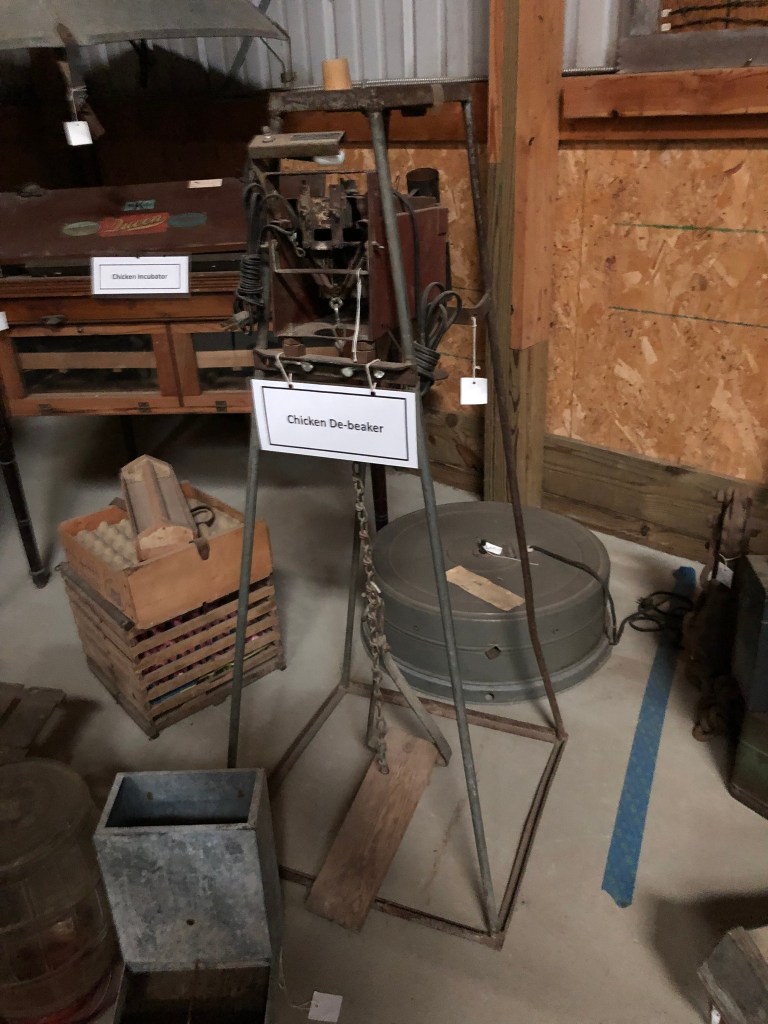
This tool is called a chicken debeaker. It does exactly what you would expect with a name like that…it partially removes the beaks of chickens in order to reduce cannibalism, egg cracking, and feather pecking. This debeaker would be plugged into an electrical outlet which would heat the opening, like a hot guillotine. The chicken would then be held in place by a human with their beak in the opening. The human would then close the opening by stepping on the foot pedal on the ground thus trimming off a portion of the chicken’s beak. Debeaking is a common practice today in many egg laying facilities although the ethics of this practice has been called into question by many opponents of debeaking.
Source: Murray County Historical Museum, Facebook, 18 October 2022. Lightly edited to eliminate typos.
These handsome kids aren’t studying Russian.
We are announcing a contest for the most interesting story about how you learn Russian!
To enter, you need to publish a post or shoot a video in which you talk in Russian how and why you started learning Russian. You can tell us what difficulties you have encountered and what funny stories have happened to you during your acquaintance with the “great and mighty” language. If you have something to share, then we are waiting for your post.
Be sure to tag the Rossotrudnichestvo account and add the hashtags #ILearnRussianRS #RussianHouse #Rossotrudnichestvo.
The contest will run from October 15 to November 15. On November 22, we will announce three winners on our social media accounts. They receive an annual subscription to the electronic and audiobook service ru.bookmate.com.
The Federal Agency for the Commonwealth of Independent States Affairs, Compatriots Living Abroad, and International Humanitarian Cooperation (Russian: Федеральное агентство по делам Содружества Независимых Государств, соотечественников, проживающих за рубежом, и по международному гуманитарному сотрудничеству), commonly known as Rossotrudnichestvo (Russian: Россотрудничество), is an autonomous Russian federal government agency under the jurisdiction of the Russian Ministry of Foreign Affairs. It is primarily responsible for administering civilian foreign aid and cultural exchange. Rossotrudnichestvo operates in Central Asia, Latin America and Eastern Europe (but mostly in the Commonwealth of Independent States).
The agency was created from its predecessor agency by Presidential decree, signed by Russian President Dmitry Medvedev on 6 September 2008, with the aim of maintaining Russia’s influence in the Commonwealth of Independent States, and to foster friendly ties for the advancement of Russia’s political and economic interests in foreign states.
According to OECD estimates, 2019 official development assistance from Russia increased to US$1.2 billion.
Rossotrudnichestvo was assessed by expert observers to be organising and orchestrating synchronous pro-Russian public rallies, demonstrations, and vehicle convoys across Europe in April 2022 in support of the Russian invasion of Ukraine. Demonstrations were held simultaneously in Dublin (Ireland), Berlin, Hanover, Frankfurt (Germany), Limassol (Cyprus), and Athens (Greece).
Show me the power child, I’d like to say That I’m down on my knees today Yeah it gives me the butterflies, gives me away ‘Til I’m up on my feet again
Oh I’m feeling Oh I’m feeling
Show me the power child, I’d like to say That I’m down on my knees today And yeah it gives me the butterflies, gives me away ‘Til I’m up on my feet again
A court in St. Petersburg has put sixty-year-old accountant Irina Tsybaneva under house arrest for leaving a note that read “Death to Putin” on the grave of the Russian president’s parents. The woman was able to steal up to the gravestone, which is guarded, but she was unable to leave the cemetery unnoticed. The police and the prosecutor’s office asked the court to send Tsybaneva to a pretrial detention center, calling the crime “audacious,” but the court found that this was too harsh a pretrial restraint. Mediazona has delved into the details of the case and found out what role the news played in the Petersburg woman’s spontaneous actions.
“I just saw a [TV] program, at that time very serious, there was some news, and something just…,” said Tsybaneva, trying to explain her actions, while standing in the defendant’s cage at the Primorsky District Court in Petersburg.
Tsybaneva has been charged with desecrating the burial place of deceased persons due to political or ideological enmity. It is alleged that she went to the grave of the parents of Russian President Vladimir Putin and left a note there that included the following phrase: “You raised a freak and a murderer.”
“And how often do you go and write notes to everyone [sic] while watching the news?” the prosecutor asked her.
“Never. I watched the news and realized that everything is quite scary, everything is very sad, a lot of people have been killed.”
“We had the coronavirus, everyone was depressed. Did you also write something to someone then?”
“What for? No, of course not,” said Tsybanev, smiling.
“Well, I don’t know. You watched the news and decided to write.”
“Yes, under the influence of the news.”
“Are the media to blame for your actions?”
“That’s the upshot.”
Irina Tsybaneva. Photo courtesy of Mediazona
Before the war in Ukraine, Tsybaneva, who is employed as an accountant in Petersburg, was not particularly interested in politics. Even after the Russian invasion, she practically never raised the topic of war raised in conversations with relatives, her son Maxim told Mediazona.
“She went to concerts, festivals, theaters, and museums. She traveled a lot both in Russia and abroad,” the man added. “At one time, she was a big fan of bard music. I don’t know how it is now, but it’s probably still the case. She went to the Grushinsky Festival many times. She was a prominent figure in Trofim‘s fan club.”
Tsybaneva spent a lot of time with her six grandchildren. (Her daughter and her son each have three children.) She moved to St. Petersburg in the 1980s from the Tver Region, working as an engineer and then as an accountant in various companies.
On October 6, the eve of the Russian president’s birthday, Tsybaneva went to the Serafimovskoe Cemetery, where Mr. Putin’s parents are buried.
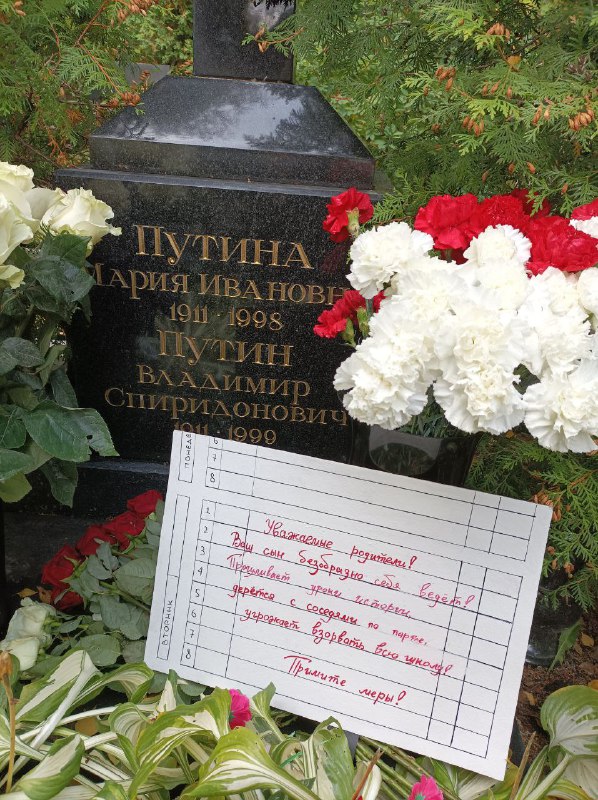
Security had already been beefed up at the cemetery and specifically at the graves of Vladimir and Maria Putin, probably due to the fact that, in late September, a small poster in the guise of a school pupil’s class journal appeared on their headstone. It read as follows: “Dear parents! Your son has been behaving disgracefully! Skipping history lessons, fighting with his desk mates, and threatening to blow up the whole school! Take action!”
“Dear parents! Your son has been behaving disgracefully! Skipping history lessons, fighting with his desk mates, and threatening to blow up the whole school! Take action!” Photo courtesy of Feminist Anti-War Resistance
A week later, a court in Petersburg jailed the activist Anastasia Filippova for ten days on charges of disobeying a policeman. As reported by Bumaga, Filippova’s relatives linked her arrest with the poster. Yesterday, a court overturned her arrest, and she was released from the special detention center.
Despite the beefed-up security and the police officers on duty at the cemetery, Tsybaneva was able to walk up to the grave of the Putins.
“They got distracted there, and she somehow left the note. It transpired that there are a lot of cameras there,” Maxim Tsybanev said, adding that his mother was able to photograph the note on her phone, which was later seized, however.
The contents of the note were made public today during Tsybaneva’s pretrial restraints hearing. “Parents of the maniac, move him in with you. He has caused so much pain and trouble, the whole world is begging for his death [illegible]. Death to Putin, you raised a freak and a murderer,” Tsybaneva’s message read.
In a linguistic analysis, a copy of which was submitted as part of the written request for pretrial restraints in court today, experts concluded that the note contains a “negative assessment of Russian President Vladimir Putin” addressed to his parents. But how exactly the police identified the person who left the note is unknown. In court, the prosecutor cited an “ongoing investigation.”
The leaflet containing the appeal to Putin’s late parents was found the same day by a cemetery guard, who immediately informed the police. On Monday, October 10, they were already knocking on Tsybaneva’s door.
“She wouldn’t open it for a long time, but eventually a policeman promised to pry it open, and she opened it. At three p.m. yesterday she was taken to the 35th police precinct. For some reason, they kept her waiting there for a long time. Finally, around nightfall, she telephoned and said that there would be a search. We immediately went to her house, but she wasn’t there,” Maxim Tsybanev told Mediazona.
The accountant was placed in the temporary detention center and a criminal case was opened against her for abusing the burial place of deceased persons due to political or ideological enmity. If she is convicted, Tsybaneva could face up to five years in prison.
During the couple of days that Tsybaneva was in custody, the police were able to conduct a DNA examination, which confirmed that the traces of skin found on the note were hers. Handwriting analysis also indicated that it was Tsybaneva who wrote it. In addition, a picture of the note was found on her phone.
“I immediately admitted that I had written [the note], and that there was no need to do these analyses,” Tsybaneva said in court.
Police investigators and the prosecutor’s office asked that Tsybaneva be sent to a pretrial detention center.
“She is suspected of a crime whose danger to public consists in insulting the memory of the dead, the deceased, and the feelings of the living towards the dead,” the prosecutor argued.
She called the crime committed by the accountant “audacious” and, given Tsybaneva’s impressionability and the impact the news has on her, she argued that it was better for the woman to be in custody.
The defense lawyers were able to convince the court that the restraint measure requested by the state was too harsh. Consequently Judge Dmitry Lozovoy put Tsybaneva under house arrest for twenty-eight days, forbidding her to use the internet, telephone and mail.
“Given the actions committed, this is too harsh, but given current situation in the country, it is quite good,” said her son Maxim, commenting on the judge’s decision.
Source: Dimitri Ozerkov, Instagram, 2 October 2022
— I imagine that the calls to boycott (or not participate in) Manifesta by a number of artists in connection with the events in the Crimea must have been nerve-wracking for you.
— The calls for a boycott were addressed not to the Hermitage, but to the Manifesta Foundation. They came mostly from artists who had not been invited to participate. But [Manifesta 10 chief curator Kasper] König’s project involves a number of important international artists, whom neither the left nor the right can suspect of collaborationism. Manifesta is an event that is free from censorship, but that operates according to Russian laws. Everyone is free to decide independently what is important to them: being involved in an art project or voicing their political stance in another way.
— Is it possible to be an artist and not be a citizen?
— “A poet you may not be / But be a citizen you must.” [Ozerkov here quotes an oft-quoted line from “Poet and Citizen,” a poem by the 19th-century Russian poet Nikolai Nekrasov.] I believe that you can be a professional in your field and have a civic stance. But they are completely different things. If an artist is leftwing, it doesn’t alway mean they’re a good professional. If you oppose the authorities and their individual decisions, this does not instantly make you a good artist. Exceptions are rare. Those who try to combine these concepts, in my opinion, are trying to compare apples and oranges. If, for example, you perform music and stop playing because there are lies and war in the world, then your civic stance prevents you from continuing to be an artist. But it’s always your choice. It seems to me that in a modern liberal capitalist society, some people have the right to make art, and others have the right to look at it, regardless of what is going on in their heads regarding politics.
Source: “Dimitri Ozerkov on Manifesta,” DW, undated, although presumably published in the spring or summer of 2014. Translated by the Russian Reader
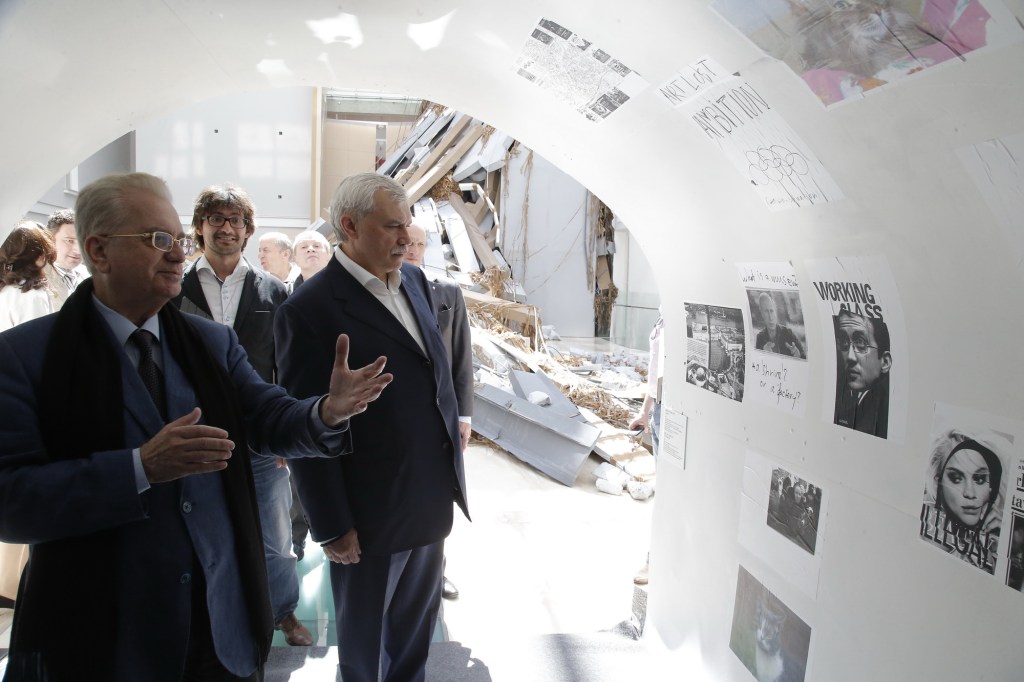
Hermitage director Mikhail Piotrovsky shows then-Petersburg Governor Georgy Poltavchenko the main exhibition at Manifesta 10, General Staff Building, State Hermitage Museum, St. Petersburg, 6 July 2014. Dimitri Ozerkov, who now suddenly wants nothing to do with Russia and its bad ways, is the younger chap standing behind the two Putinist satraps beaming like a kid in a candy shop. Manifesta 10 took place hard on the heels of Russia’s illegal annexation of Crimea and its “proxy” invasion of Eastern Ukraine in the spring of 2014. I found this photo in my archives the other day. Unfortunately, I have no idea who took it or where it was originally published. Governor Poltavchenko’s visit to Manifesta 10 was well documented in the local and Russian press at the time, although, curiously, most of the photos in those press accounts have gone missing. ||| TRR
The show must go on and will go on.
At a press conference in London this morning, Kasper König, curator of the controversial Manifesta 10, and professor Mikhail Piotrovsky, director of the State Hermitage Museum in St. Petersburg—where the biennial will be held this summer—restated they won’t allow current events in Russia and the Ukraine to interfere with the show.
“We operate in the territory of art, which has its own rules,” Piotrovsky said at the press conference. “We have to show that there are things that are more important than politics.”
Fifty-seven artists, including eight Russians, are to be exhibited at the main show, which will unfold between the Winter Palace and the newly opened General Staff Building.
Since the passing of the federal law last June forbidding “gay propaganda”, the 10th anniversary edition of the self-labeled “roving European biennial of contemporary art” has been under fire for what is seen as a tacit endorsement of the Russian government. A first petition launched by Irish artist Noel Kelly asked the Manifesta Foundation to reconsider its choice of St. Petersburg—a potentially dramatic decision for Manifesta, as €3,000,000 of its €4,500,000 total budget comes directly from the host.
Criticism intensified with the events in Crimea. Another petition asked König to suspend the event until the departure of Russian troops from the Ukraine. The St. Petersburg–based artists collective Chto Delat publicly withdrew in March, following Manifesta’s public statement that the biennial would stay in the former Russian capital. “Neither curator nor institution are capable of rising to the challenge of a dramatically evolving political situation,” the group wrote on its blog, “and we cannot be held hostage by its corporate policies.” The Polish artist Pawel Althamer and his collaborator also withdrew.
The Ukraine [sic] was little discussed at this morning’s press conference. König described Manifesta’s relationship with Chto Delat as “friendly, productive, and a continuous discussion” and the exhibition as a “birthday present to the Hermitage,” which celebrates its 250th anniversary this year.
Both König and Piotrovsky insisted on how unpopular contemporary art is in Russia, arguing that exhibiting artists rarely shown in the country was in itself a strong act. “It’s political in a larger context,” said König, who is stringing together heavy hitters such as Joseph Beuys, Bruce Nauman, Gerhard Richter, the Ukrainian photographer Boris Mikhailov, as well as Karla Black and Susan Philipsz.
LGBT politics are entering the show with the work of the American-French painter Nicole Eisenman, whose work will be shown alongside that of Maria Lassnig and Marlène Dumas in the world-famous “Matisse Rooms” at the Winter Palace.
But König is avoiding everything that could be interpreted as overt. To Dumas, who wanted to make a series of portraits of famous gay men, he said: “OK, but this a bit simplistic.” The series, which features the likes of Oscar Wilde and Tchaikovsky, is now presented as being “of famous men.”
As if to justify what could be described as a rather tame approach given the political situation, Piotrovsky concluded: “There is a very strong trend to isolation in Russia, and all boycotts only make Russia more isolated, and closed. At the Hermitage our historical mission is to keep the doors open.”