All the swindlers are fleeing Russia:
They have property in the West.
The bandits and sodomites are fleeing
And all those killed by their conscience.

The Judases are running, all going there,
Where there is no love, where there is no Christ.
Where there are gay parades and Nazis,
Liberals and globalists.

God is cleansing Holy Russia,
He protects it himself like his own daughter!
He will not let the evil ones torment us,
May God grant that we keep our faith.
Only an ignoramus doesn't understand
Russia as the last hope.

Let the enemy shout that Putin is bad
And under him all in Russia is bad.
If the whole herd of fleas is mad,
Evidently our Putin has done everything right!
Yesterday, during a dinner conversation, I was asked why I’d been silent, why I hadn’t been writing anything about the war. Was it because I was afraid of going to jail, or was it something else? These questions were posed point blank albeit sympathetically.
I’ve been asking myself this question for many months. On the one hand, it’s stupid to deny that watching as my acquaintances are given devastating prison sentences does not affect me in any way. It makes an impression, of course.
On the other hand, I wonder what would I write or say now if the level of state terror had remained at least at pre-war levels. I realize that I would still write or say nothing. I can hardly squeeze this text out of myself. I’m just explaining myself because yesterday was not the first time I’ve been asked why I haven’t been writing anything about the war.
I feel that words have lost their meaning.
One of the ideologues of the war, who constantly makes allegations about the “genocide of the Russian language,” writes bezpilotnik, obezpechenie, na primer, and ne obezsud’te. [Instead of the correct spellings bespilotnik, obespechenie, naprimer, and ne obessud’te — meaning, respectively, “drone,” “provisions,” “for example,” and “don’t take it amiss.”] No one corrected him for a year. Compared to him, I’m a total expert on the Russian literary language, but I don’t have the words to stop cruise missiles or send soldiers home, while his bezpilotnik turns residential buildings into ruins in a second.
I do not know what words to find for a mother who, conversing with her POW son, regularly interjects “bitch” and “fuck.” Or for a mother who, as she sees off her son, smiles at the camera and says what actually matters is that she didn’t raise him to be a faggot, and basically, if push comes to shove, she has another child. Moreover, the supplies of such people are really endless.
Now, sadly, only the Ukrainian Armed Forces can “explain” anything. I am not trained in military affairs. So I am silent.
Separately on Friday, police briefly detained Yevgeny Levkovich, a reporter for Radio Svoboda, RFE/RL’s Russian service, at his home in Moscow, and charged him with “discrediting the army,” according to newsreports and Facebookposts by Levkovich.
[…]
In Moscow, police detained Levkovich for about five hours at the Teply Stan police station and charged him under Article 20.3.3 of the Administrative code for allegedly discrediting the army; convictions for that offense can carry a fine of up to 50,000 rubles (US$613).
Levkovich wrote on Facebook that his trial was scheduled for Monday, but he did not plan to attend because he did not “see the point” in contesting the charge.
Radio Svoboda wrote that the charge was likely related to Levkovich’s posts on social media, but did not say whether authorities had specified any posts prompting the charge. On his personal Facebook page, where he has about 36,000 followers, Levkovich recently wrote about Russia’s war on Ukraine.
These are the numbers. I want to do something so that people don’t get caught, and even more actively support those who do get caught. But in the first case, it is unclear what these people are reading, and where the safety recommendations should be published so that they are accessible to such people. And we are already working on the second case, but we lack the human resources.
Those arrested for radical anti-war protest are heroes, although sometimes the charges are completely trumped-up. In any case, all of them deserve support. Solidarity Zone regularly writes about such political prisoners, publishes addresses where you can send them letters, and raises funds to pay their lawyers. Sign up to get news of what is happening to these people and, if possible, get involved in supporting them.
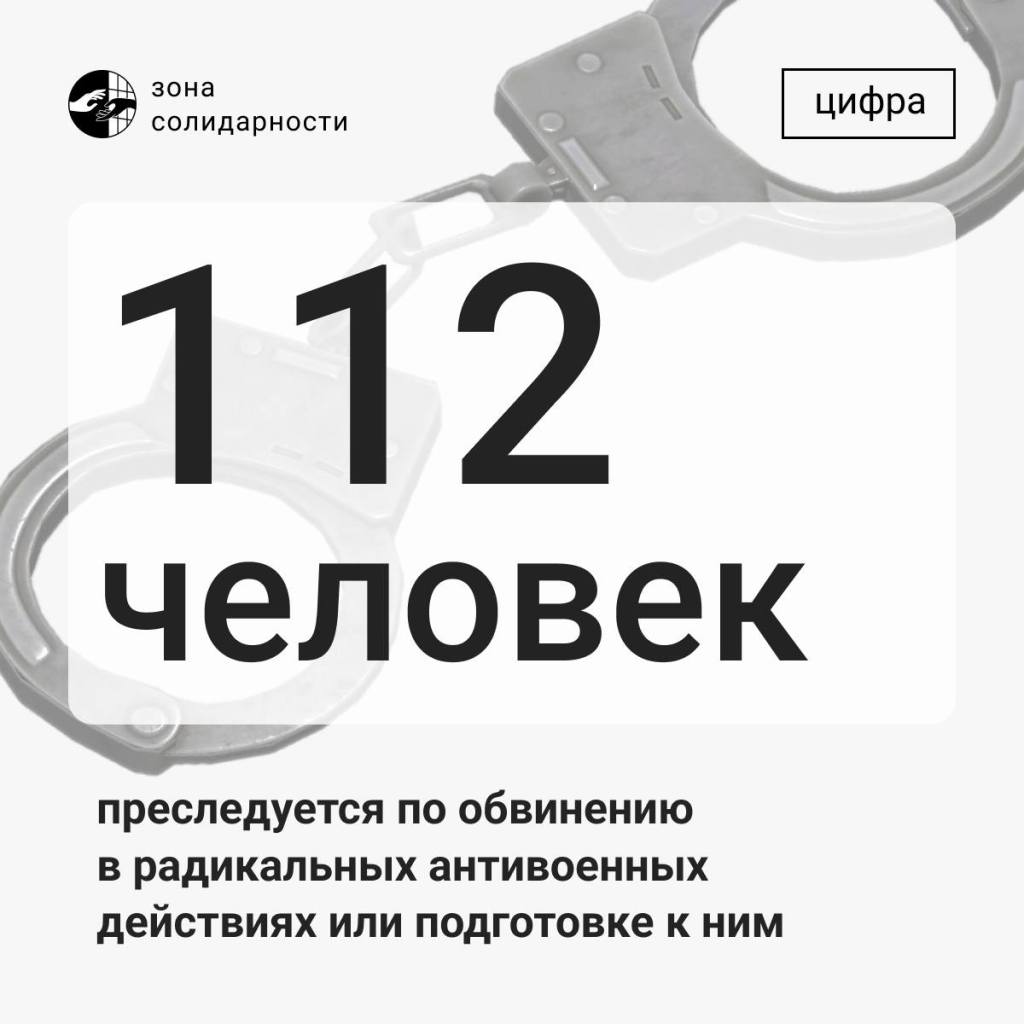
112 people are being prosecuted on charges of carrying out or planning radical anti-war acts.
Solidarity Zone counted how many people have been criminally charged with setting fire to military enlistment offices, sabotaging the railroads and other militant anti-war actions, or planning them, in the year following [Russia’s] full-scale invasion of Ukraine.
What police investigators allege these people have done to warrant criminal prosecution:
1 — “other”
7 — torched vehicles marked with the letter Z
17 — planned arsons of military enlistment or other government offices
36 — sabotaged the railways
51 — torched military enlistment or other government offices
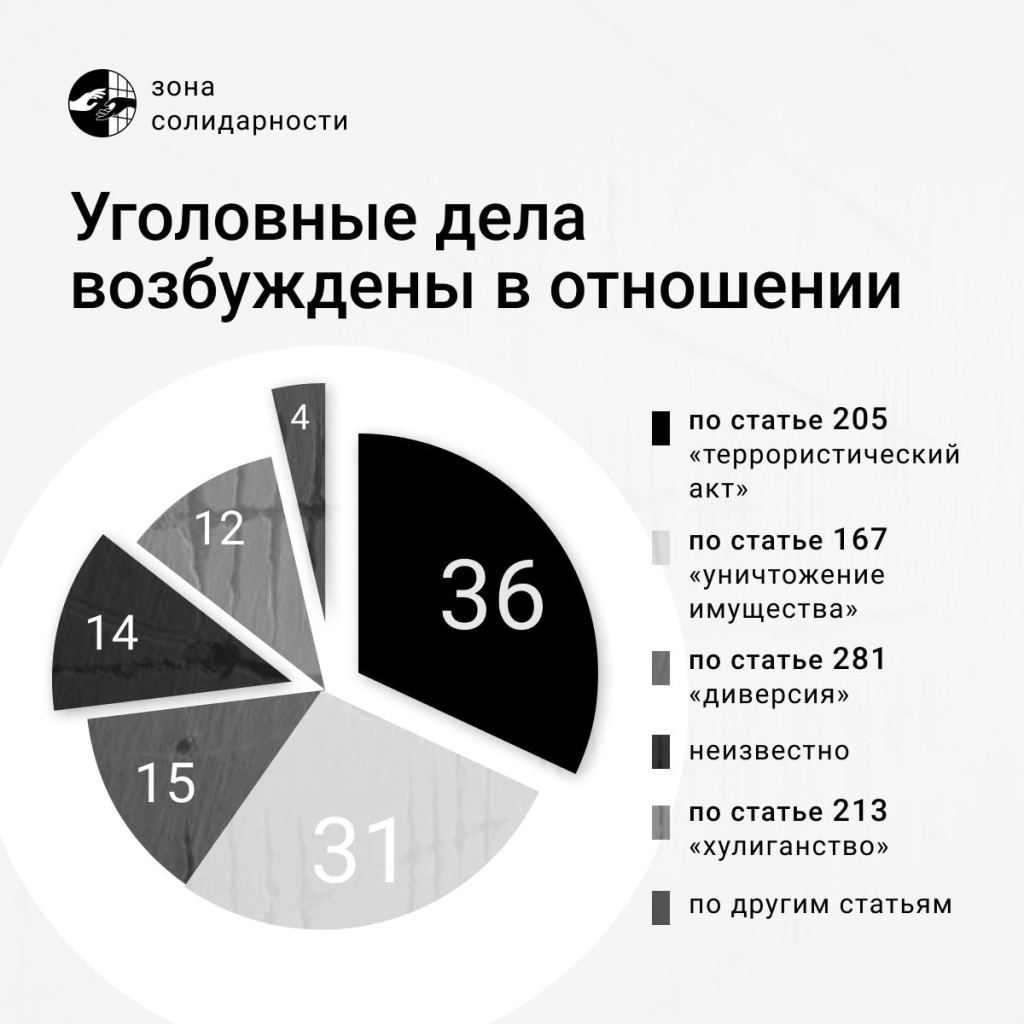
Articles of the Russian criminal code under which these people have been charged:
36 — Article 205: Terrorist Act
31 — Article 167: Destruction of Property
15 — Article 281: Sabotage
14 — Unknown
12 — Article 213: Disorderly Conduct
4 — Other Criminal Code Articles
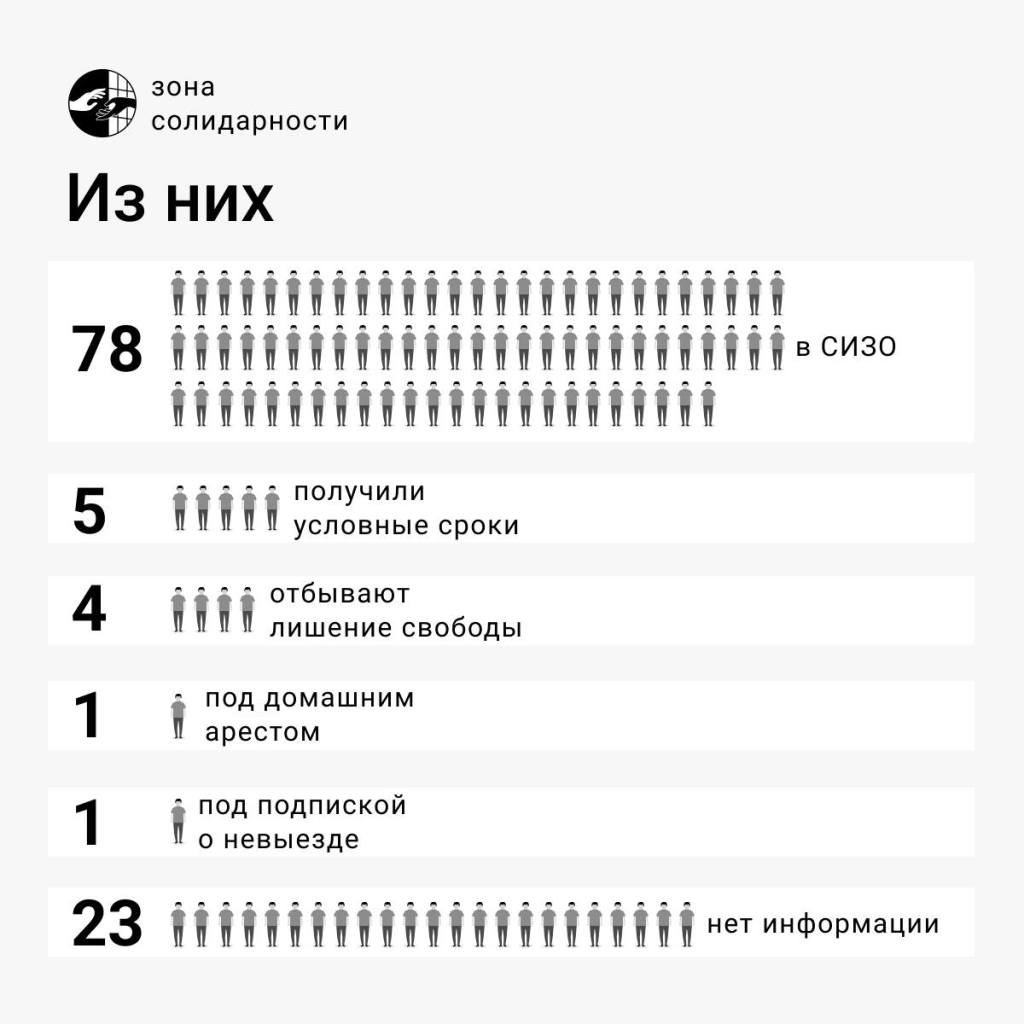
Of these people:
78 are being held pretrial detention centers (remand prisons).
5 have been sentenced to parole.
4 are serving prison sentences.
1 is under house arrest.
1 has been released on their own recognizance pending trial.
There is no information about 23 of them.
Our statistics are incomplete because the Russian authorities do not always report new criminal cases. Sometimes we only get reports that people have been detained, with no mention of their names or the charges against them, and these reports are thus extremely hard to verify.
Our statistics do not include people who were killed by the security forces during arrest or people prosecuted on administrative charges.
Source: Solidarity Zone (Facebook), 24 February 2023. Translated by the Russian Reader. Here, by way of comparison, are OVD Info’s statistics for numbers of people criminally (as opposed to administratively) prosecuted for “non-radical” anti-war actions since 24 February 2022:
Total defendants: 465 in 77 regions (we include occupied Crimea and Sevastopol in our data because we monitor activities of repressive Russian government authorities that operate there).
Women among the defendants: 90 (19%)
Minors among the defendants: 6 (1%)
(Section 3, Article 207.3 of the Criminal Code) Prosecuted for “spreading fakes about the Russian army” (ie talking about the war in an unsanctioned manner): 141 (30%)
(Section 3, Article 280.3 of the Criminal Code) Prosecuted for “discrediting the Russian army”: 54 (12%)
Convicted: 119 (26%)
Imprisoned upon conviction: 26 people
In pre-trial detention: 108 people
Under house arrest: 17 people
Convicted and given a non-custodial sentence: 62 people
It thus follows that a total of 577 Russians have faced criminal prosecution for anti-war actions of all kinds (violent and nonviolent) since the start of their country’s invasion of Ukraine. As Ivan Astashin, a former political prisoner himself, argues, above, all these people are, indeed, heroes. It’s another matter that they constitute a statistically insignificant segment of the world’s ninth most populous country. Again, by way of (invidious) comparison, at least 1,003 Americans have been charged with crimes for their alleged involvement in the 6 January 2020 riot at the US capitol.
I would argue that those who were forced to leave Russia due to Putin’s unleashing of illegal aggression against Ukraine could file a class action lawsuit against the Russian Federation or the ruling elite of the Russian Federation demanding compensation for the moral anguish and economic harm suffered as a result of these events. The Russian federal authorities must fully compensate them for expenses incurred by forced relocation, such as the cost of airplane and other tickets, accommodation in hotels and rented accommodation abroad, and other expenses. Compensation could also include the irreparable losses suffered by citizens within the country due to forced relocation — for example, the loss of a job or a business. Compensation for emotional suffering is a separate issue.
Payments could be made from the Russian federal budget, through the sale of the property of officials directly responsible for unleashing the war, or at the expense of business income from entrepreneurs who have directly supported the illegal aggression. Naturally, compensation for this damage is possible only after full payment of the reparations necessary to restore Ukraine’s economy and civil infrastructure. What do you think about this? #nowar#netvoine
[two selected comments + one response by the author]
Zmey Gurevich A difficult question. It’s true that the monstrous war forced me to leave Russia. But to my incredible surprise, I have have become happy here [in emigration]. Perhaps it’s immoral to be happy when rivers of blood overflow their banks. It’s been eating at me. But the painful departure has led me a new happiness. Some vital knots have been untied… No, I have nothing to bill [the Russian authorities] for. My friends empathize with me and ask me how things are going here. I can’t tell them the truth. I am ashamed. But my departure has turned into a happy time for me. I don’t know what will happen next.
Vlad Shipitcyn Zhenya! Did you go to at least one protest rally against Putin in Russia over [the last] 22 years? No, you didn’t. Did you ever stand on the stand on the street holding a [protest] placard? No. So no one owes you anything, not a kopeck. You too are responsible for both the regime and the war. You let them happen. So calm down.
Evgeny Krupitsky Hi! Yes, I am responsible for this war: it happened due to my connivance, indifference and cowardice. And I said it right away: https://www.youtube.com/watch?v=GsAFChc2HSI And my protest was that on March 6, exactly a year ago, I left the Russian Federation having abandoned everything, because I felt sick and ashamed. Okay, maybe it’s not such a big deal in terms of significance and courage, but I am proud of my little protest. I know you went to the rallies long before the start of the war, that you were detained, beaten and fined, and I respect and admire you for that! But someone will say that they suffered more than you did, that they did more to prevent this war, etc. We need to consolidate, rather than argue about who is more to blame!
Evgeny Krupitsky, “My take on what’s happening (2 April 2022) #nowar #netvoine”
Some people in Russia are living a normal life, but they feel the lack of real normality, and this causes them discomfort. Others live with a sense of catastrophe, but they feel the absence of a real catastrophe, and this also causes discomfort. Consequently, everyone is on edge. The sensible approach is to live normally with a sense of disaster. But this useful attitude is hard to achieve, and if you don’t have it, then I do not even advise you to start. When it takes shape, it will no longer be relevant.
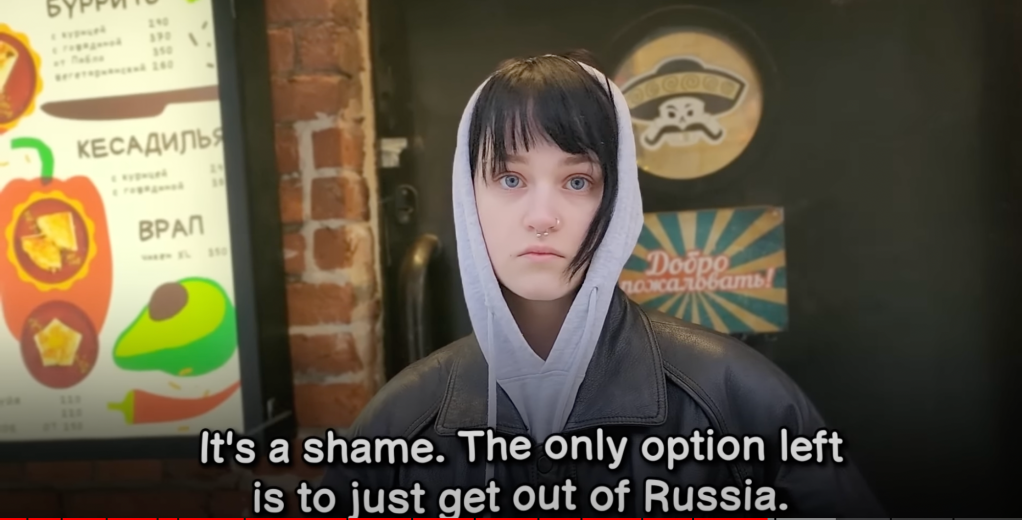
The four members of this “countryside hub” are among hundreds of Russian opposition activists of various political leanings who have fled their country to Georgia throughout the past year. Some left in the months prior to Moscow’s invasion of Ukraine last February as repression grew to unprecedented levels in the Putin era. Others came after the war began, realizing that with their dissenting opinions, they could no longer live in what they deem a fascist totalitarian state.
In Tbilisi, they have created or joined new anti-war resistance organizations, which operate on Western grants and employ hundreds of volunteers. Working around the clock, these groups offer services in real time to Ukrainians refugees as well as Russian activists and military deserters fleeing their respective countries. The help comes in the form of evacuation routes, therapeutic services, legal guidance, shelters and resettlement plans.
[…]
From her volunteering as an election monitor in Russia’s 2011 elections to offering pro-bono legal support to activists arrested during protests in subsequent years, Burakova’s career followed a linear trajectory. Degrees in political science and law equipped her with the legal know-how to aid political opponents, and now exiles, over how to wrestle with and escape an authoritarian system that often invents new laws to persecute citizens. As of 2022, “discrediting the Russian army” is now an offense that has landed countless people in prison for sharing anti-war posts on social media.
[…]
“To conduct these types of congresses and host mock parliamentary votes on Russia’s future while in exile just looks a bit cringe-ova,” Burakova tells me, using the popular English word that has been appropriated into the Russian language. Her husband Egor Kuroptev shares the sentiment.
M., one of my smartest interlocutors, arrived from Moscow Time. “Well, what is your final conclusion? Why?” he asked me. I told him that now I see three points that we simply missed, that ended up in our blind spot. The first point is that of course everyone worked hard during these years, enthusiastically; everyone had an articulated mission in life, etc. But it was seemingly taken as a natural given that each of us was the client of someone a few floors above us. Now everyone looks back and discovers that their mission has been burned for a long time, and their belonging to one or another Moscow (or regional) clan shines forth in their biography. For some reason, it was automatically believed that, in the nineties, we operated in a world in which, when difficulties arose, we should turn to “the man from Kemerovo” (in the words of Grebenshchikov’s song). In the noughties, however, all this was allegedly vanquished. In reality, nothing was “vanquished”: it was simply transformed into large-scale state clans. That is why now everyone who was engaged in charity, book publishing, media development, etc., has suddenly shifted the emphasis in their reflections on life: wait a second, I worked for Abramovich (or Gusinsky, or Potanin, etc.). The system consisted entirely of a network of clients.
The second point: the language of pragmatic communication. It was a completely abusive language. The smash-mouth jargon permeated everything. Roughly speaking, the country was governed in the language of American rappers (i.e., the Solntsevo mob). All communications! Not only the special communications among those in power, but also all communications in the liberal, academic realm, in civil society. The cynical jargon of abuse reigned everywhere, and it was absolutely acceptable even in highly cultured milieux. And we did not see what consequences this would have.
The third point: “populism.” The automatic perception of the “common people” [narod], which had its origins in the late-Soviet and perestroika periods, was a colossal mistake. It was tacitly assumed, first, that there was a “common people”; second, that the “common people” would determine their own fate; and third, that the “common people” naturally triumph over evil because they themselves are good. It was this “populism” that served as the basis for the compromise with the state when it began to take institutional shape in Yeltsin’s wake.
All three of these points were “organic” in some sense. They were a part of ontology: they were taken for granted without any reflection and criticism. And all three played a fatal role in the process of “slowly boiling the frog alive.”
I had problems,
I had gone way too far.
The lower depths of the deepest hell
Didn't seem so deep to me.
I called my mom,
And Mom was right.
She said, "Straightaway you've got to call
The man from Kemerovo."

He is a man of few words, like de Niro.
Only a wacko would argue with him.
You can't pull one over on him,
He knows all the insides and outs.
The sky could crash to the ground,
The grass could stop growing,
He would come and silently fix everything,
The man from Kemerovo.

Adam became a refugee,
Abel got on a mobile connection,
Noah didn't finish what he was building,
Got drunk and fell face down in the mud.
The history of humankind
Wouldn't be so crooked,
If they had thought to get in touch
With the man from Kemerovo.

I got a call from Kyiv,
I got a call from Kathmandu,
I got a call from the opening of the plenum —
I told them I would not come.
You have to drink two liters of water at night,
To have a fresh head in the morning.
After all, today I'm going to drink
With the man from Kemerovo.
Only one conclusion follows from Stalin’s death: woe is the country where tyrants die natural deaths while still in power.
Source: Roman Osminkin (Twitter), 5 March 2023. Translated by the Russian Reader. Mr. Osminkin’s remarks were occasioned by the social media commemoration of the anniversary of Stalin’s death, yesterday, which often as not consisted of replicating the meme “That one croaked, and this one will croak too.” This means, apparently, that the entire “plan” of the “Russian anti-war movement” and the “anti-Putin opposition” consists in waiting for the current Russian tyrant to die a natural death. It’s a frank admission to be sure. ||| TRR
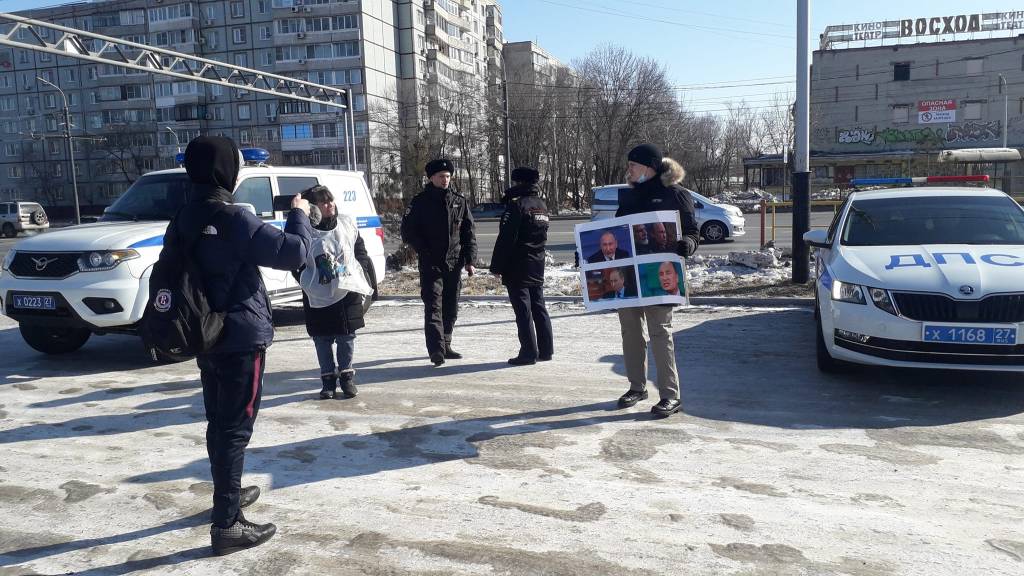
On February 23, Nikolai Zodchii was detained by police in Khabarovsk for appearing in public with these images of Vladimir Putin, which had originally appeared in broadcasts on state-run Channel One. Thanks to the indomitable VB for the snapshot and the heads-up, and for his personal fortitude in dismal circumstances. ||| TRR
When contacted by the media, the Kommunalnik health resort, located in the Omsk Region, refused to comment on reports of the death of a female Russian national during a speed pancake-eating contest.
Earlier, it was reported that a female contestant at a speed pancake-eating competition in the Omsk Region had choked to death. Currently, the exact cause of death is unknown, but the contestant’s death has been confirmed by law enforcement agencies. The 38-year-old female Russian national [rossiyanka] died before the ambulance arrived.
The celebration at which the pancake-eating competition took place was held at the Kommunalnik health resort in the Omsk Region on Saturday, February 25.
A spokesperson for the health resort refused to comment on reports of the death of the female Russian national and the absence of an ambulance team at the competition site.
In December 2022, it was reported that a 61-year-old resident of the Moscow Region had died after choking on a pancake.
Russians had been warned against overeating pancakes during Shrovetide. According to specialist Boris Mendelevich, overeating pancakes cooked with large amounts of oil is harmful to the body. In addition, heavy food can cause complications in the gastrointestinal tract.
Russia must ensure its security and maintain strategic stability.
President Vladimir Putin said this in an interview for the program “Moscow. Kremlin. Putin” on the TV channel Rossiya 1.
Source: Oleg Zubritsky, “Putin talks about the need to preserve the country and its security,” Kartoteka, 26 February 2023. Translated by TRR. Believe it or not, that was the entire article, which earned its author a well-deserved byline. See the last patch in this crazy quilt, below, for more detail about what Putin said.
Riot police officers in St. Petersburg detained 131 teenagers over a mass brawl that occurred in the Galereya shopping center, the media reports.
The publication [sic], citing police sources, indicated that the PMC Redan teenage subculture was involved in the incident.
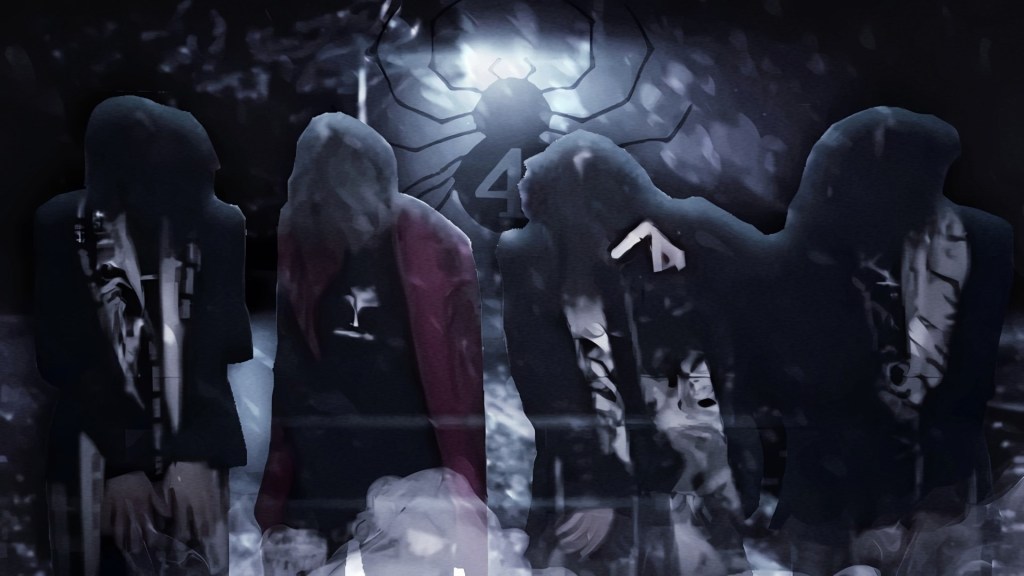
It is reported that other minors attacked a teenager in clothes embossed with a spider, which is the symbol of PMC Redan. One teenager was injured during the brawl.
Riot police arrived at the scene and detained 131 individuals. The Galereya shopping center was closed for entry, and shoppers were released only after police checked them.
Earlier, it was reported that Novosibirsk law enforcement officers had staged a dragnet to detain teenagers devotees of the PMC Redan subculture. The raid took place in the eponymous [sic] Galereya shopping center.
According to the head of the Safe Internet League, PMC Redan (as well as anime in general) is a “depressive-aggressive subculture,” and animeshniks themselves espouse violence and are willing to use it.
Such subcultures emerge, [Ekaterina] Mizulina argues, because teenagers have too much free time, as well as due to the manipulations of irresponsible bloggers and provocateurs who are encouraged by foreign states to engage in them.
In this regard, Mizulina suggests that “it is interesting to package the right meanings for children,” ideologically attack “all these spiders”, and also introduce control over social networks and the media — namely, to prohibit the coverage of “such topics.”
“No one has done more to popularize this local phenomenon than the media and social networks. […] Redan cells are growing like mushrooms after rain from Vladivostok to Kaliningrad,” Mizulina writes.
At the same time, it has been the state-run media that has written most about the activities of the so-called PMC Redan. Before them, information about teenage animeshniks strolling through shopping malls in telltale clothes appeared mainly on local community social media pages.
Source: Alexei Paramonov, “Ekaterina Mizulina urges media ban on PMC Redan,” Kartoteka, 26 February 2023. Translated by TRR. Fontanka.ru published this long, strange tirade-cum-report about the clash between riot police and teenagers at the Galereya shopping center in Petersburg (which is a stone’s throw from our house), on the one hand, and between “redans” and “ofniks,” on the other. If you donate one hundred dollars to this website, I’ll translate and publish that article here, although it left me hardly less befuddled about what happened in my old neighborhood this past weekend than before I’d read it.
The Cheryomushkinsky Court of Moscow placed house arrest on the leader of the Redan youth group
The Cheryomushkinsky Court of Moscow sent one of the leaders of the youth informal group “PMC Redan” under house arrest, reports TASS.
He is accused of attacking a teenager in the metropolitan metro – under part 2 of article 213 of the Russian Criminal Code (Hooliganism with the use of weapons or objects used as weapons), the court noted. The maximum penalty is imprisonment for up to seven years.
According to the agency, initially the investigators demanded that the accused be sent to a pre-trial detention center, but the court did not agree with this. Earlier, the Cheryomushkinsky court sent three more accomplices to the crime under house arrest.
On February 23, a teenager who was a member of the PMC Redan was beaten at the Lubyanka metro station. Teenagers wear long dark hair and spider badges on their clothes. They were inspired by the Genea Redan gang from the Hunter x Hunter manga. The symbol of this group is a spider with the number four. It is specified that young people oppose football fans, natives from the Caucasus and migrants.
Russian President Vladimir Putin has acknowledged the possibility of Russia facing a breakup in the future, with its population to be divided into separate nations, the country’s news agency TASS reported on Feb. 26.
Putin’s interview with Rossiya 1 TV channel marks the first time that the Russian dictator has publicly commented on the potential disintegration of Russia.
According to him, “if the West manages to make the Russian Federation collapse and to assume control of its fragments,” the Russian people may not survive as a nation.
“If we go down this path (of Russia’s collapse — ed.), I think that the fate of many peoples of Russia, and first of all, of course, the Russian people, may change drastically,” Putin said.
“I even doubt that such an ethnic group as the Russian people will survive as it is today, with some Muscovites, Uralian and others remaining instead.”
In addition, the Russian president claimed that “these plans are set out on paper.”
“But it’s all there, it’s all written, it’s all on a piece of paper,” Putin said.
“Well, now that their attempts to reshape the world exclusively for themselves after the collapse of the USSR have led to this situation, well, of course, we’ll have to respond to this.”
“They have one goal of liquidating the former Soviet Union and its main part, the Russian Federation. And later, [after liquidating Russia] they will probably admit us to the so-called family of civilized peoples, but only by parts, each part separately,” he said.
Ukraine’s National Security and Defense Council Secretary Oleksiy Danilov earlier said that the West has not yet made a final decision on what to do with Russia and does not understand how the full-scale war unleashed by Russia against Ukraine should end. However, the world should prepare for the collapse of Russia.
Previously, Ukrainian Defense Minister Oleksii Reznikov said that after the war is over, Russia will disintegrate into separate statelets, while Ukraine will retain its sovereignty and independence.
DDT frontman Yuri Shevchuk has released the video “Motherland, Come Home.” In the new single, he calls on his country to stop the war and go about its own business. The video was shot by Shevchuk in collaboration with producer and composer Dmitry Yemelyanov.
Yuri Shevchuk wrote the poem “Motherland, Come Home” in the summer of 2022, a few months after Russia had launched its invasion of Ukraine. In the run-up to the invasion’s anniversary, the rocker set it to music and recorded the song. “Don’t go crazy, this is not your war,” Shevchuk urges listeners.
Yuri Shevchuk & Dmitry Yemelyanov, “Motherland, Come Home”
Shevchuk has repeatedly spoken out against the war in Ukraine. He has consistently taken a pacifist stance and opposed all wars, including the military operations in Chechnya, South Ossetia, and anywhere else in the world.
In 2022, Shevchuk was fined fifty thousand rubles after he was found guilty of “discrediting” the actions of the Russian army. The occasion for the fine was an anti-war statement he made in May at a concert in Ufa. After the outbreak of the war in Ukraine, concerts by his band, DDT, in Russia have often been postponed or canceled “due to technical difficulties.”
In the summer of 2022, the media reported the existence of a list of “banned” Russian artists who had opposed the war in Ukraine, including the bands DDT, B2, Aquarium, and Pornofilms, the rappers Face and Oxxxymiron, and the solo performers Zemfira, Monetochka, and Vasya Oblomov. There were more than fifty names on the list. Many of the musicians have already faced the cancellation of concerts, and some have been designated “foreign agents” by the Russian Justice Ministry.
Никотиновый вдох, Распальцованный взгляд, Я ещё не подох, Ещё мои шланги горят.
A nicotine breath, A swaggering look, I’m not dead yet, My hoses are still on fire.
Этой лютой весной Суета с тишиной Пульс неровный несут. Пульс неровный несут Моё сердце на суд.
This fierce spring Helter-skelter and silence, The pulse is uneven. The pulse is uneven My heart is on trial.
Опустело село, Пьёт Рязань из Днепра, От венков расцвело, В рыжей глине – дыра.
The village is deserted, Ryazan drinks from the Dnieper, The wreaths have burst into blossom, There is a hole in the red clay.
Маята, как сорняк Телевизор в печи, У державы стояк. У державы стояк, Воют бабы в ночи.
The torment is like a weed The TV’s like a furnace, The empire has a boner. The empire has a boner, Women howl in the night.
Тёмен век мой. Господи, как всё случилось? Рваный лик твой – Укололась и забылась. Не сходи с ума, Это не твоя война. Ждут грачи в полях весной. Родина, вернись домой!
My age is dark. My God, how did it happen? Your ragged face, Pricked and forgotten. Don’t go crazy, This is not your war. Rooks wait in the fields in spring. Motherland, come home!
Безнадёги иной Я не переживал, Коллективной виной – Сделал шаг и пропал.
Other doom and gloom Didn’t bother me, But with collective guilt I took a step and went MIA.
Давит воздух густой, Но тебя не забыть, Мертвецов напоить. Мертвецов напоить Родниковой водой.
The air is thick, But I can’t forget you, Get the dead drunk. Get the dead drunk On spring water.
Голоса белены Тянут мысль одну: Ты вернёшься с войны, Вновь попасть на войну.
Voices are faded white They dredge up one thought: You’ll come back from the war To go to war again.
И летят облака, Разбиваясь в дали, О крутые бока Нашей плоской Земли.
And the clouds are flying, Crashing in the distance On the craggy sides Of our flat Earth.
Тёмен век мой. Господи, как всё случилось? Рваный лик твой – Укололась и забылась. Не сходи с ума, Это не твоя война. Ждут грачи в полях весной. Родина, вернись домой!
My age is dark. My God, how did it happen? Your ragged face, Pricked and forgotten. Don’t go crazy, This is not your war. Rooks wait in the fields in spring. Motherland, come home!
Source: Yuri Shevchuk & DDT, “Motherland, Come Home,” Reproduktor. Translated by the Russian Reader
Found archival photo of a Young Pioneer on Mozhaiskaya Street in Leningrad, 1982. Thanks to VG for posting this find on their now-locked Facebook page
“A Calendar of Revolutionary Names. April: Arlen (“Army of Lenin”), Vilenin (“V.I. Lenin”), Viulen (“V.I. Ulyanov-Lenin”), Lublen (“Love Lenin”), Marenlenst (“Marx, Engels, Lenin, Stalin”), Motvil (“We’re from V.I. Lenin”), etc.
VICE News (YouTube), “Nationalism or Nothing: Life in Modern Russia,” 10 Feburary 2023: “President Vladimir Putin’s ongoing invasion of Ukraine, has led to a tightening of dictatorial powers within Russia. Free-speech is virtually non-existent and the public realm is now dominated by outspoken nationalists, who want more war, not less.” Thanks to Marxmail for the heads-up
Source: 1420 by Daniil Orain (YouTube), “Do you support Putin? 100 Russians,” 28 January 2023. A huge thanks to Tiina Pasanen and Outi Salovaara for the heads-up.
My name is Daniil Orain. I’m a YouTuber from Russia, and I run the channel 1420. In my videos, I try to create a montage of everyday Russians and a transparent representation of what they believe.
Since the start of the conflict in Ukraine, people from all over the world have come to my channel to try and understand how Russians think.
Before I started the channel about 2 years ago, I had some skewed thoughts about the world.
At the time, I was working as a software engineer with a three-hour commute, and my perspectives changed when I began to watch on-the-street interviews with people in faraway cities during those rides. Those videos showed me how people from different places and cultures thought, and they played a big part in my self-education.
I started to wonder: Why isn’t there something like this on YouTube but with people from Russia, like me? That’s when my friend and I created 1420.
People often ask me for the story behind the channel’s name, but there’s no secret meaning. It’s just the name of the school we went to together. Our whole goal with the channel was to go out on the streets of Moscow and ask people questions that interested us — things like, “Do you believe in God?” or, “What do you think about Americans?”
When the conflict in Ukraine began, we suddenly saw a huge increase in viewers.
Our increase came from around the world — not just Europe and America, which had been our main audience. With the increase in viewership, I decided to double down and try to publish videos daily.
To get enough material for a full video, we have to ask a large number of people. Given the nature of our topics at the moment, a lot of people decline to participate.
When shooting the Zelenskyy video, for example, we had 124 people decline to answer. Only 28 people agreed. Even when they do agree, they often hold back from giving their full thoughts.
Making these videos is risky, but we haven’t had any problems so far.
Unlike with TikTok and Instagram, access to YouTube is still normal in Russia. In the videos, I’ve always muted certain words (but kept the subtitles) to avoid censorship.
For example, you’re not allowed to say “war” when referring to the situation in Ukraine. We have to say “secret operation” instead. So if someone does say “war,” we mute that word.
Some people in the comments have accused me of being a Russian propaganda channel, so I’ve had to find new ways to show that I’m not. For example, in one recent video, we blurred the faces and changed the voices of the people in it so that they could be honest without fear of repercussions. Also, we started showing longer continuous clips of the interviews so that the viewers didn’t think we purposely cut them to tell a certain narrative.
I have seen a change in how people view not only our channel since the war started — but also our participants.
Just recently, the comments on my YouTube videos said things like, “Russians are just like us.” But as the situation in Ukraine has progressed, they now tend to be more like: “Russians are brainwashed.”
I’m glad people are watching the videos because I know from my experience how helpful YouTube can be. We’re lucky to be able to learn online.
You’ll notice that in my videos, there’s a pretty clear divide between the answers coming from people who grew up in Soviet times and the younger people. When the older generations were growing up, they got their education only from books or teachers — they didn’t have access to the world like people my age do. The position that I’m in, running this channel, wouldn’t have even existed back then.
Today, you can learn things from websites, videos, and even comments.
Just last week, on one of my own videos, one viewer wrote: “You are not scared, not because you are fearless, but because you just haven’t been scared yet.”
That blew my mind. I know what I’m doing is risky, but maybe I don’t feel worried about it because I’ve never actually been that worried. But at the same time, I’m just the storyteller. A lot of people direct-message me asking for my opinion on various topics, but I don’t answer them.
I see my role as being the person who helps tell people’s stories, and I’ll continue to do so to show how and what Russians feel.
I was at an interview on TV Rain last week. We were supposedly going to discuss the Oscars, but suddenly we touched on what is an important topic, I think — how to behave appropriately during the war and amid everything else that is happening now.
I often read comments about how I smile all the time, but there is a war going on. About how I joke on the air, but now is not the time for jokes — Navalny is in prison. Why did I post this or that photo? It’s too glamorous and frivolous. Now is not the time for such things.
The complaints are understandable, but I totally reject the point they’re trying to make. It seems to me that the most destructive, the most incorrect thing we can do now is to don dark clothes, wring our hands and publicly suffer in front of our audience. By no means am I saying that there is no point in suffering in this situation. There is. The war is the most terrible event that has ever happened to us. It is absolutely incomprehensible how to go on living when your country has attacked and is destroying innocent people and destroying their lives forever as the scumbags on Russian national TV hoot and holler for joy. Everyone who is reading this post has experienced all this, I am sure, and of course you have been suffering. And those whom Putin came up with the idea of bombing with missiles and killing have been suffering even more.
Only one thing remains to us: to take all these terrible emotions, all these experiences, and turn them into concrete actions. Not cry on camera, not get hysterical, but to try and stop this horror as soon as possible. Today is better than tomorrow. Tomorrow is better than the day after tomorrow, etc. Each of us knows best of all what we ourselves are capable of doing and how to do it. The main thing is not to give in to despair. Despondency, despair and indifference are exactly what Putin wants from us. Don’t give him that.
I’ve attached a bit of the interview. And a frivolous photo to boot.
Source: Maria Pevchikh, Instagram, 31 January 2023. Translated by the Russian Reader
[…]
And where you find a hero, you always find tragedy. The hero is always a vehicle for suffering, pain, rupture and tragedy. There are no happy heroes: all heroes are necessarily unhappy. The hero equals misfortune.
Why? Because being both eternal and temporary, dispassionate and suffering, heavenly and earthly is the most unbearable experience for any being. It is a condition that you wouldn’t wish on your enemy.
Ascetics, martyrs, and saints took the place of heroes in Christianity. There are likewise no happy monks or happy saints. All of them are profoundly unhappy as individuals. But according to another heavenly account, they are blessed. Just as those who weep, those who are exiled, those who suffer slander, and those who hunger and thirst are blessed in the Sermon on the Mount. Blessed are the unhappy.
A person is made a hero made by an idea aimed skyward that crashes to the ground. A person is made a hero by suffering and misfortune, which tear him apart, which torment, torture, and harden him, and it has always been thus. This can happen during war or an agonizing death, but it can also happen without war, and without death.
The hero looks for his own war, and if he does not find it, he goes into a monk’s cell, to live as a hermit, and fights there with the real enemy. Because true warfare is spiritual warfare. Arthur Rimbaud wrote about this in Illuminations: “Spiritual combat is as brutal as battle between men.” (Le combat spirituel est aussi brutal que la bataille d’hommes.) He knew what he was talking about.
One hero, as the Neoplatonist Proclus says, is equal to a hundred or even thousands of ordinary souls. He is greater than a human soul because he makes every soul live vertically. This is the heroic dimension to the origins of the theater and, in fact, the ethics of our faith. It is the most important thing, which we should not lose, which we should cherish in others and nurture in ourselves.
Our job is to become deeply, fundamentally and irreversibly unhappy, no matter how scary that sounds. It is the only way we can find salvation.
Source: Alexander Dugin, “The Hero: The Metaphysics of Unhappiness,”Katehon, 3 February 2023. Translated by An Unhappy Translator. Thanks to Pavel Pryanikov for the heads-up
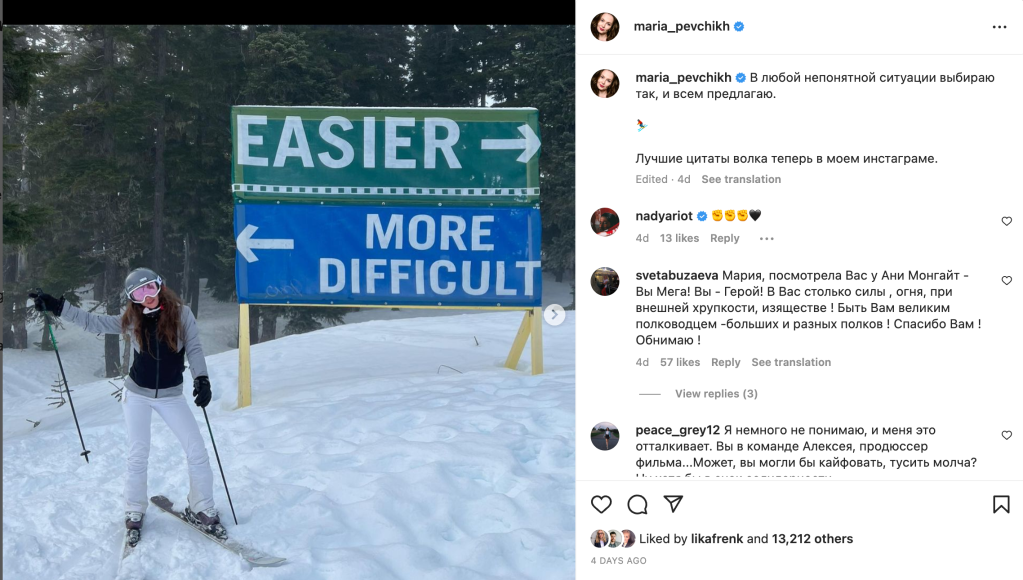
Maria Pevchikh: “In any puzzling situation this is what I choose and suggest that everyone else choose.” Source: Instagram
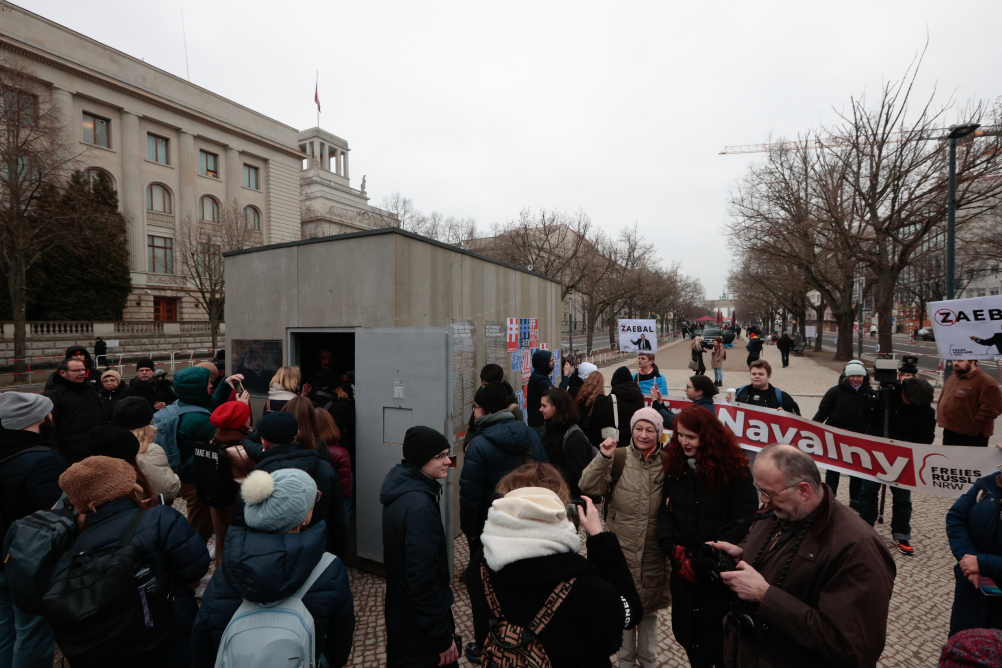
Now every employee of the Russian embassy in Germany has to think about Navalny on their way to work because they will see a replica of the solitary confinement cell where Alexei has been confined for the eleventh time.
Not only embassy employees see this solitary confinement cell. It is seen by Berlin residents, tourists and journalists. It is seen by readers of the world’s major media outlets. Millions of people see it — and thus learn about the torture chamber in which Navalny is being held. Some will tell their friends about the project, others will join the Free Navalny campaign, while still others will put pressure on local politicians contemplating compromise with Putin. Circles radiate all over the world from this one site.
It is in your power to make these circles spread even wider. Help us achieve freedom for Navalny and for the whole of Russia — support our campaign at acf.international/#donate.
Free Navalny!
Thank you for being on our side!
The Navalny Team
“Navalny has now been in prison for 745 days.”
Source: FBK (Anti-Corruption Foundation) email newsletter, 2 February 2023. Translated by the Russian Reader
Maria Pevchikh is an investigator and associate of Alexei Navalny.
0:00 Let’s go! 0:37 Why we met in London 5:13 How the film Navalny is saving Navalny’s life 9:36 Dud in the Internet’s homeland 13:03 How to turn a photo of a hallway into an investigation 16:17 What is going on with Navalny now? 20:26 The second largest house in the UK is owned by a Russian oligarch 25:30 But why can’t a Russian oligarch buy a house in London? 29:48 The UK is fighting Putin but harboring thieves: is that normal? 37:22 Who are you and where are you from? 42:31 Where did you get the money to study in London? 44:02 What’s wrong with Moscow State University’s sociology faculty 47:19 What did your father do for a living? 48:41 A crash course about British universities (eight lectures a week) 53:16 Alexander Dugin was Maria’s thesis advisor: how did that come about? 1:00:03 Does Putin listen to Dugin? 1:03:05 What Medvedev was like thirteen years ago 1:05:20 “My cat was hit by a car, please sort it out”: what British MPs do 1:08:22 Gadaffi’s son was at university with you 1:14:35 Where did you work before becoming an investigator? 1:16:32 Do you have a flat in London? 1:17:47 How did you meet Navalny? 1:22:50 Why didn’t you mention Skabeyeva and Popov’s mortgage? 1:27:28 How are drones able to fly over Putin’s and Medvedev’s residences? (A question from Nikolai Solodnikov) 1:33:14 Where did you get the conductor Gergiev’s bank statements? 1:36:32 Is it okay to pay a bribe to avoid mobilization? 1:40:54 What is your beef with Fridman? 1:48:13 Is Galitsky an accomplice of the regime? 1:57:18 Can we detest someone for being afraid? 1:58:26 Why does Popular Politics have such sensational headlines? 2:04:08 Is it okay to call a program guest a “fat beast”? 2:08:21 The rude tweet about Durov 2:10:21 Does radicalism prevent the Anti-Corruption Foundation from becoming popular? 2:16:09 Roman Abramovich is a master of reinventing himself 2:24:13 How soft power works 2:29:52 If Abramovich had ended the war would you have forgiven him? 2:31:38The “List of the 6,000”2:33:59 Why have you called for sanctions against Sobchak? 2:35:35 Why have you called for sanctions against Venediktov? 2:44:00 What did Oleg Kashin do wrong? 2:46:34 Why were the designers of a facial recognition system removed from the “List of the 6,000”? 2:51:01 Is your father an accomplice of the regime? 2:55:49 How do you do your work without Navalny? 2:57:18 Why were your supporters’ data hacked? 3:05:38 “Carry out a mission in the fight against Putin and get points”: what is that about?! 3:07:53 How do people who work for the regime change sides? 3:15:51 Do you see yourself as a politician? 3:19:44 Do you have a plan for Russia’s future? 3:25:09 Won’t the dictatorship in Russia survive without Putin? 3:30:20 Do you have a UK passport? 3:35:51 What exactly have you done over the past year to overthrow Putin? 3:41:21 “Compromisers” 3:52:07 Russia without Putin 3:56:58 What does it mean to be strong?
Source: vDud (YouTube). Annotation translated by the Russian Reader. Thanks to Tiina Pasanen for bringing this remarkable video to my attention and persuading me to watch it despite my initial misgivings. When I assembled the first part of this mash-up, a few days ago, I had no idea that Pevchikh and Dugin were so closely connected in real life. For another perspective on the sociology faculty at Moscow State University during roughly the same period as Pevchikh describes, see Oleg Zhuravlyov and Danail Kondov, “Towards a History of the Conflict in the Moscow State University Sociology Department” (2008). ||| TRR
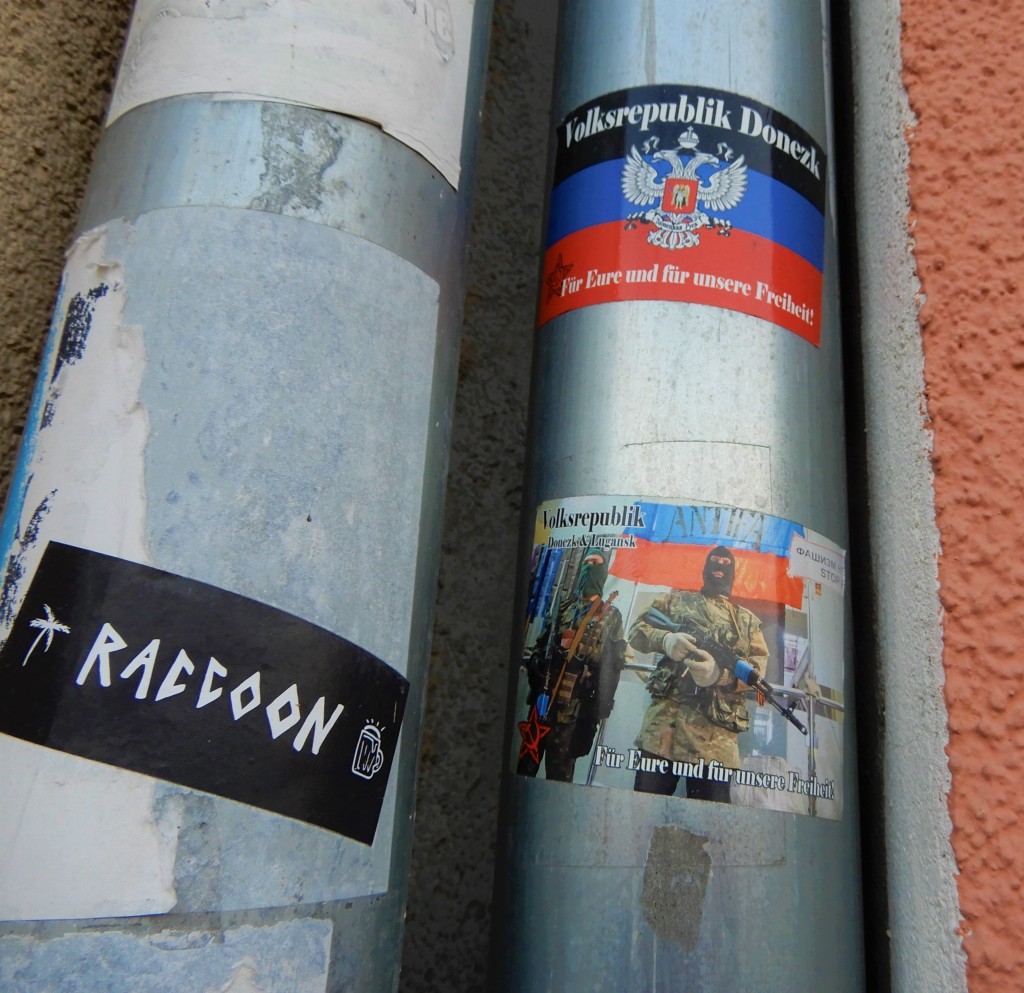
“Donetsk People’s Republic. For your and our freedom!” Berlin-Friedrichshain, 6 February 2023. Photo by the Russian Reader
State Duma deputy Andrei Kolesnik proposes reinstating the death penalty for treason
A proposal has been made in the Russian State Duma to revive the death penalty for those who have left the country and commenced criticizing the Russian authorities. The initiative was launched by deputy Andrei Kolesnik.
In an interview with Moscow Region Today [see translation below], the parliamentarian noted that an exception could be made for those who have simply left the country. According to him, traitors are those who have left and at the same time are waging an information war against Russia.
Security Council deputy chair Dmitry Medvedev said that Russians who fled the country and wish its destruction should be treated in accordance with the law, but the rules of wartime should also be remembered.
Following Nevzorov, Belotserkovskaya has been sentenced in absentia to nine years in prison for spreading fake news. State Duma deputy Andrei Kolesnik commented on this practice of “absentee sentences.”
“Okay, some people merely fled Russia. There are a lot of yellow bellies. They can stay there and work. But when a person works against Russia, it is called an information war. It’s more serious than a weapon, sometimes. Evil tongues are scarier than a gun,” the deputy said in an interview with Moscow Region Today.
However, Kolesnik stressed that the “traitors to the Motherland” had been punished according to the law: there is evidence, i.e., publications. But the deputy noted that he himself would have dealt with them more harshly.
“This is my personal opinion, although maybe I will voice it in parliament. If a person has committed serious crimes against Russia, then the sentence might be different. And this sentence could be enforced in the place where he (“traitor to the Motherland” — ed.) is located. Combat is currently underway. So, they should behave more carefully,” the deputy said.
When our correspondent asked whether he was talking about the death penalty, Kolesnik replied as follows.
“The [death penalty] can be employed for treason. We currently have a moratorium on the death penalty, although it exists in our laws. The decision to lift the moratorium is made not by the State Duma, but by the court. Although many people in the State Duma are leaning in this direction,” the deputy said.
Earlier, State Duma deputy [Maxim Ivanov] said that the unemployed could be sent to the SMO zone.
One day, I hope, someone will explain to me why “progressive” Russians find the English words speak, speaker, speech, etc., so sexy and exciting that they have to incorporate them needlessly into Russian every chance they get.
Do they know that, in English, these words are less evocative than three-day-old bread, duller than dishwater?
In this case, hilariously (and awkwardly, too: “speak” appears after chas, generating an awkward phrase that translates as “hour of speak” or “speak hour,” although it’s supposed to be a play on the idiomatic phrase chas pik, meaning “rush hour”), the word “speak” adorns Sergei Medvedev’s reflections on the “imperialist mindset.”
Indeed.
Thanks to TP for this gem of Rusglish.
Below, you can watch the actual interview (in Russian, not Rusglish — well, almost), which, if for no other reason, is interesting because it was posted almost three months before Russia invaded Ukraine. ||| TRR
Historian and writer Sergei Medvedev is the program’s guest.
In an interview with Nikita Rudakov, he explained:
Why the idea of Russia’s “civilizational superiority” is so popular
Why propaganda encourages the ideological complexes of Russians
How the elite of the 2000s is trying to turn back history.
00:00 Chas Speak: Sergei Medvedev 01:40 The imperialist mindset and the idea of Russia’s greatness 06:10 Is there no place for nationalism in the imperialist mindset? 08:05 “Russia colonized itself” 14:03 The superiority of big ideas: why didn’t the USA become an empire? 21:02 The ideological complexes of Russians 25:41 “We rise from our knees via military achievements and parades on Red Square” 26:50 “Lukashenko does with us what he will”: Russia and Belarus 30:56 “Russia wants to live in the myth of 1945” 34:40 “We were unable to create a nation state”
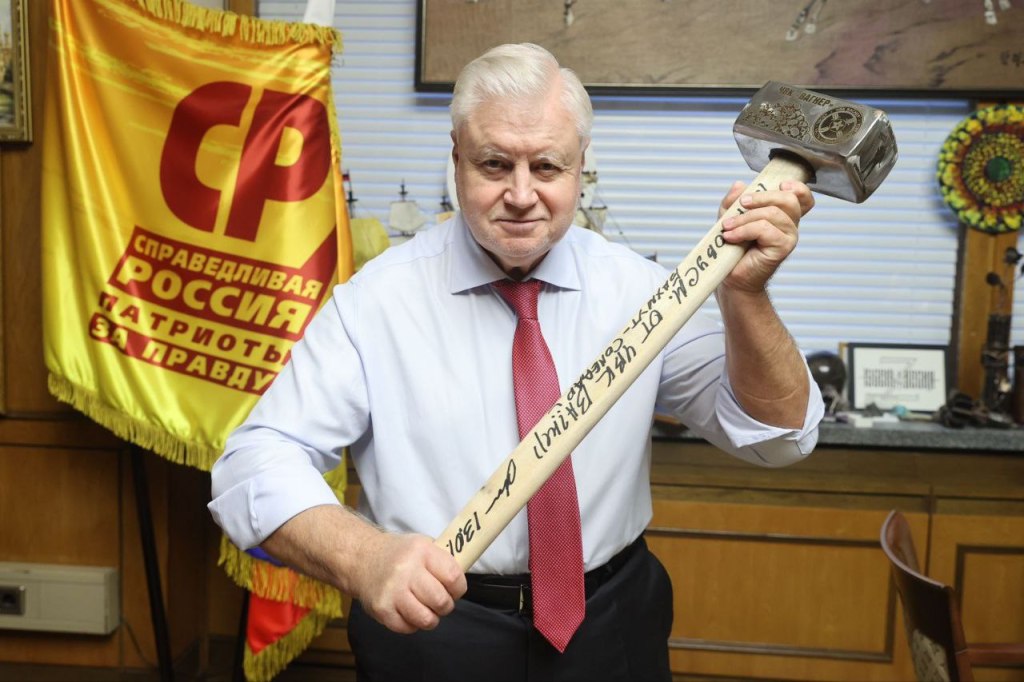
Sergei Mironov receives sledgehammer as gift from Yevgeny Prigozhin: “Together we will punch a hole in the Nazi ideology”
Sergei Mironov, leader of the party A Just Russia and a State Duma deputy, thanked Wagner Group founder Yevgeny Prigozhin for the sledgehammer, which the businessman sent as a gift to the politician. “With its [the tool’s] help, together we will punch a hole in the Nazi ideology, which has set itself the goal of destroying our country. May all our enemies finally realize that they will not succeed,” Mironov wrote on his Telegram channel, adding the hashtag #the_sledgehammer_rules.
The sledgehammer presented to Mironov has a mound of skulls depicted on it and bears the Wagner Group’s trademark stamp. The tool gained notoriety after the death of ex-Wagner fighter and former convict Yevgeny Nuzhin. He was brought back to Russia from Ukrainian captivity and executed with a sledgehammer.
In the early noughties, Oskar Kuchera was the star of Muz TV, a popular music TV channel. Twenty years later, he vigorously criticizes Ukraine, and supports Putin and the Russian army. We met and talked.
0:00 Opening 0:42 Why did Kuchera agree to the interview? 4:47 When people of my generation found out about Kuchera 9:36 A place where it is convenient to work for remote work 12:41 “Soldiers”: a serial about the army in which there was no war 14:40 “I knew what would happen in September 2021.” How? 20:16 Why did Russia start the war? 36:25 Is it okay to bomb infrastructure? 37:08 Are there Nazis in Ukraine? 39:29 The ultra-right is fighting on Russia’s side: Can Russia be denazified? 51:58 “The geopolitical right to be friends with Ukraine” What the heck is that? 59:09 Russia is meddling in Ukraine’s affairs, although it has problems of its own. Is that normal? 1:11:27 Crimea 1:15:30 Why America’s and Europe’s help bad? 1:21:54 Why do you enthusiastically follow the news from the US? 1:25:31 Why does your son have a US passport? 1:27:47 “The Stars Converge” on NTV. What happened? 1:32:17 Did you put up with it for three years for the money? 1:37:13 Why is it a bad thing to flee the war? 1:43:43 How can you support the army but oppose the war? 1:50:15 How would you react if your children were conscripted? 1:51:39 Why do you support Putin? 1:55:12 “I believe we’ll stroll the streets of Berlin and Paris again.” Do you want to conquer Europe? 2:01:51 Germans supported their army in 1939–1945. Were they right? 2:04:25 Is Zelensky bolder than Putin? 2:11:52 Why does Putin lie so often? 2:20:16 Is it normal to support the regime and have real estate in a NATO country? 2:26:32 Why do you need a Telegram channel about politics? 2:29:45 Oh 2:33:56 What future do you see for children? 2:38:21 Does it suit you that you don’t know anything about Putin’s personal life? 2:47:10 Could you have imagined, twenty years ago, that someday you spend three whole hours excusing Putin and the regime?
Source: “The supporter of Russian troops,”vDud (Yuri Dud), YouTube, 16 January 2023, with English subtitles. Annotation translated by TRR. As of today (21 January 2023), the interview has garnered almost sixteen million views.
After an interview with Yuri Dudyu [sic]* (recognized as a foreign agent), the actor and TV presenter Oscar Kuchera fell into a new avalanche of fame. The release of a three-hour conversation, where the actor, including expressing his position on the situation in Ukraine, provoked thousands of posts on social networks. For the most part, the characteristics for Kuchera were not complimentary. On January 18, in an interview with a RIA Novosti correspondent, he told what he thinks about this.
“I did not expect that there would be such an amount of support. And the fact that I support our guys is something I can only be proud of. Well, it’s better to be a fool than a scoundrel,” says Kuchera.
He noted that before the interview, he agreed with Dud to discuss work on Muz-TV and the TV series Soldiers, music and citizenship. In the published three-hour talk, the first three topics are given a few minutes. The rest of the time, Kuchera confusedly explained why he was against military operations, but for the military, who are now in Ukraine.
“But it turned out what happened. Probably, I should have got up and left, but I am a passionate person. So I’m responsible for everything myself, ”the artist complained.
The audience ridiculed Kuchera for his incoherent and illogical speech, as well as for his position. The TV presenter said that he supported Russia, but did not deny that his son was born in Miami and received an American passport. Commentators immediately stated that they recognized their elderly relatives in the hero. The facial expression of Yuri Dud during a conversation with Kuchera also became a meme.
* The Ministry of Justice added Yuri Dud to the list of foreign media agents
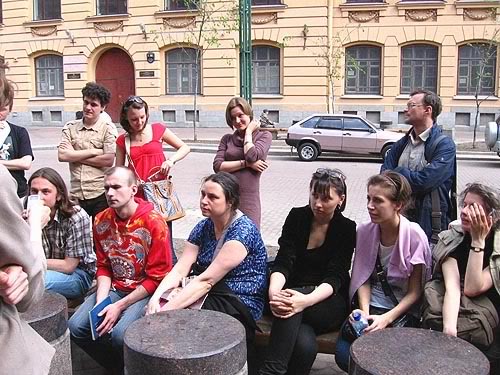
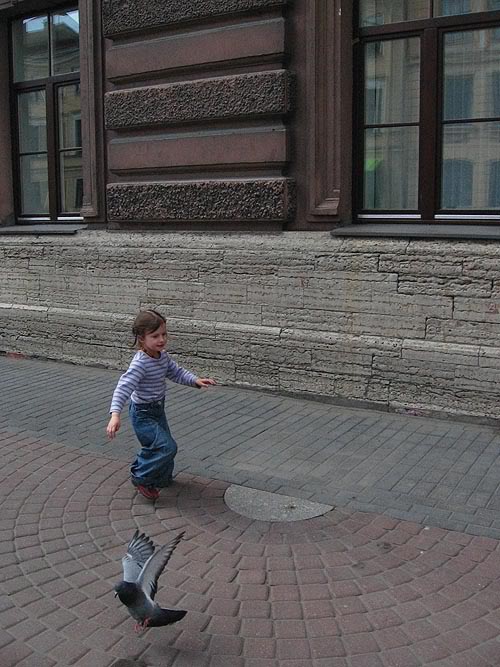
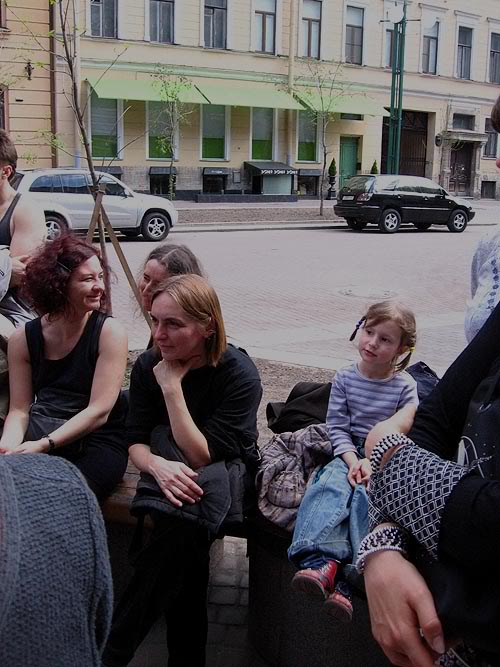
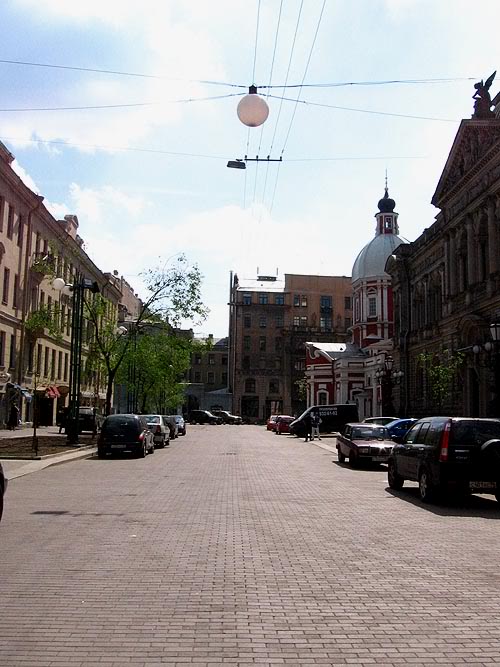
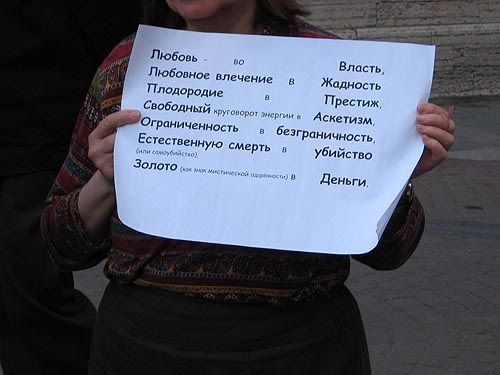
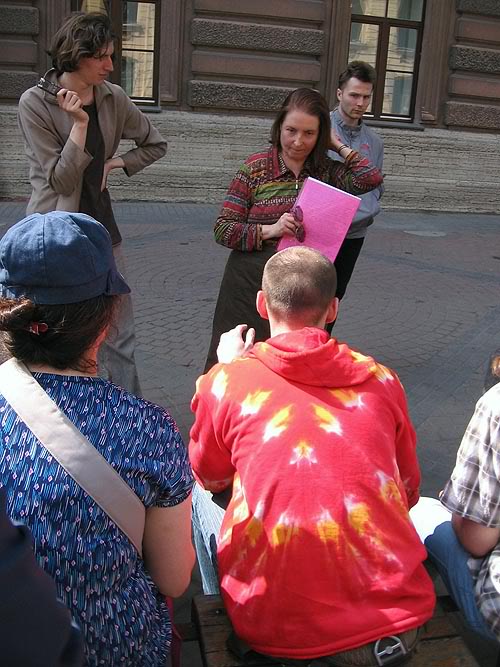
These are scenes from a May 2008 session of Petersburg’s Street University, a grassroots undertaking that I helped launch in response to the Putin regime’s sudden, underhanded shutdown of the nearby European University in February 2008. I unearthed these snapshots from my long-dormant Photobucket account, about whose existence I was reminded by an email from the service that I found by accident in my spam folder whilst working on this post earlier this morning. I think it’s a nice illustration of the point made, below, by Armen Aramyan, who must have been nearly the same age as Tasya, the little girl in the second and third pictures, when I took them. If the war can be stopped and Russian society can be salvaged in the foreseeable future, however, it will require a lot more than creative “sociology,” the right combination of critical theories, the power of (“progressive”) positive thinking, and hypervigilant discursive gatekeeping. At minimum, it will require a massive manifestation. This would be different in kind and magnitude from the current instances of grassroots resistance that Mr. Aramyan enumerates below, which are almost entirely the work of lone individuals, not the actions of a seriously mobilized grassroots or, much less, of a more or less widespread and vigorous “anti-war movement.” ||| TRR
Hi, this is Armen Aramyan!
On Monday, iStories published a column by its editor, Roman Anin, in which he laments the moral degradation that “has engulfed not only the so-called elites, but also society.” He claims that the majority of Russians support military aggression, and that the political system is in such decline that we can make predictions about Russia’s future by invoking the discourse of primatology.
“Human DNA is 99% the same as the DNA of chimpanzees, whose entire polity revolves around the alpha male. While the alpha male is young and strong, he keeps the whole pack at bay, manages the distribution of resources, mates with all the females, and severely punishes those who question his authority. But as soon as the alpha male begins to age and show signs of weakness, a fierce war to take his place ensues. […] In my opinion, the Russian political system today is not much different from the power arrangements in chimpanzee troops.”
There is no grassroots resistance in the Russia about which Anin writes. There is no torching of military enlistment offices, no teachers who refuse to conduct propaganda lessons, no activists who assist Ukrainians in getting out of Russia. There are no people prosecuted for speaking out and acting against the authorities. There are only big shots who divvy up the loot behind closed doors.
But activists and anti-war resistance do exist, and [some] sociologists have claimed that the pro-war segment of Russian society is a small minority that is averse to political action of any kind.
Why do we continue to encounter such remarks?
I would suggest calling the worldview that informs such remarks Naive Anti-Putinism, or NAP.
NAP sees Russia as a fringe country. The processes in it can be explained only through allusions to fantasy novels, such as dubbing Russia “Mordor,” from The Lord of the Rings, or referencing the Harry Potter universe. (Have the images from fantasy novels run out and we are now on the Planet of the Apes?) Russia is so unique that there are processes taking place in it that don’t exist anywhere else (with the possible exception of North Korea). This Russia suffers from a patriarchal regime and a total absence of democratic institutions. (That is, power belongs to individual groups and their leaders, who do not rely on any institutions). The enlightened achievements of European democracies have not yet reached Russia, and so now we are doomed to live amidst an endless Games of Thrones (to invoke yet another fantasy novel comparison). In this system, all that remains for us is to analyze what intrigues the different Kremlin clans are pursuing.
Resistance, grassroots movements, the struggle for democracy, and revolution are impossible in this reality. So, all that naive anti-Putinists are capable of doing is resorting to moral critiques delivered from a superior position and continuing to admonish us that the common folk in Russia are bad, having failed to accept the enlightened achievements of European democracies. If there is no democracy [in Russia], [that is because] the ordinary folk simply don’t want it. That is NAP’s entire explanatory arsenal.
Naive Anti-Putinism does not envision the possibility of change in Russia, much less revolution or the destruction of Putin’s elite. It is a readymade scheme that enables certain groups in society to make peace with reality and continue to watch the new season of Game of Thrones.
For example, if you are a businessman or an IT worker who relocated [to another country] after the war’s outbreak and invested all your resources in adapting to a new place (most likely — quite successfully), you probably don’t really want to figure out how to build democracy in Russia and support the grassroots resistance.
But you can also imagine another situation: you are a researcher who has spent a great deal of time and effort investigating how the power elite throws bags of money around. Probably, at some point, you might imagine that there is nothing else besides this cynical redistribution of the loot.
But if we want to end the war and build democracy in Russia, we need to think differently. Even if we imagine that this is impossible right now, do we really think that democracy is altogether impossible in Russia? And if it is possible, what would it look like in reality? What movements would be needed to make it happen? How would they gain power? How would this power be redistributed and how to make sure that it is not abused? These are the questions that should concern all of us members of the anti-war movement on a daily basis.
Centuries of class, colonial, and gender oppression led to the emergence of strong theories elucidating the structure of power in modern societies. The crises of the nineteenth century spurred the elaboration of theories about class and capitalism. Representattives colonized peoples, as well as their allies in the West, formulated theories about how imperialism and colonialism function. Activists and theorists of women’s movements offered accounts of how gender dominance operates in modern societies.
If we reject the entire legacy of critical theory, as many NAPpers do, then we need to propose something else. But this something is definitely not primatology or allusions to Harry Potter. But one might have to read other books to to find this something else.
P. S. But also do not assume that the animal kingdom — and in particular the political systems of primates — is so primitive. Usually, reducing people to animals is a conservative move whose purpose is to show that human relations are grounded in competition and the struggle for survival, in which the strongest win. I recommend reading this essay by the anthropologist David Graeber, in which he argues that this is not at all the case.
Source: Armen Aramyan, DOXA Anti-War Newsletter #313 (10 January 2023). Mr. Aramyan is one of the editors of the online anti-war magazine DOXA. In April 2021, he and three other editors of the then-student magazine were sentenced to two years of “correctional labor” (i.e., community service) over a video questioning whether it was right for teachers to discourage students from attending rallies protesting opposition leader Aleksei Navalny’s incarceration. Translated by the Russian Reader