There Are No Exceptions to the State of Exception

Sergey Abashin
Facebook
February 2, 2021

I have always said that many practices that are later transferred to Russian citizens are first tested out on “migrants.” Mechanisms for securing human rights and ordinary social rights and living conditions first stop functioning for migrants. They were the first to get what amounted to criminal punishments for administrative violations. They were the first to be stripped of their rights as workers. They were the first to be subjected to a universal system of total electronic surveillance. It is hard not to notice, for example, the link between the concept of “illegals” and the concept of “foreign agents.” It is symbolic that people illegally detained in Moscow for coming out to protest an anti-constitutional regime are now being transported to Sakharovo, a place where foreign nationals are imprisoned, often illegally. It’s very simple: there can be no human rights and rule of law if even one group is (initially with the public’s general consent) excluded from the protection of these laws and rights. Sooner or later, the exceptions will apply to everyone else.

Darya Apahonchich
Facebook
February 1, 2021

Re: the police search

THIS MESSAGE (MATERIAL) WAS CREATED AND (OR) DISTRIBUTED BY A FOREIGN MASS MEDIA OUTLET PERFORMING THE FUNCTIONS OF A FOREIGN AGENT, AND (OR) A RUSSIAN LEGAL ENTITY, PERFORMING THE FUNCTIONS OF A FOREIGN AGENT

While have never been a neat freak, I have never let things get like this. I had collected the posters for the Museum of Political History, and now I am sorting them out. Thank you for your words of support and anger: they help a lot. The children are still with relatives: I want to clean the place up before they come back. In the meantime, I have restored our SIM cards and bought new phones for myself and my daughter.

You ask how you can help? Stop by if you’re going to be near Vladimirskaya subway station today or tomorrow: we’ll drink coffee and rummage through my things. I’ve also been asked whether I need money to buy computers. [The police confiscated all the electronic devices in Apahonchich’s flat.] Of course, they’re obliged to return them, but in practice they often take their time doing it. They might turn them over in six months or give them back broken.

And I want to say a huge thank you to the advocates who were on duty in the help groups. Yesterday I watched how these wonderful, brave people work, and I was filled with admiration for them.

I am very worried about all the victims [of the mass arrests on Sunday, January 31].

I’m writing my [Sberbank] card number down here. If I get more money than I need for new computers, I will transfer the surplus to Mediazona and OVD Info.

4276 5500 7321 7849

Although I look rumpled (I didn’t sleep for almost two days), I’m in good spirits.

Svetlana Prokopyeva
Facebook
February 1, 2021

More than two years ago, I wrote a column about how the law enforcement system in our country had turned into a system of repression, and the state’s monopoly on violence had been turned against ordinary citizens who had grievances with the regime. As an example, I cited the arrest of Artyom Milushkin, the organizer of an authorized rally against corruption. On his way to the rally, he was thrown face-first into the mud by two men, who didn’t identify themselves. It later transpired that they were police officers.

It seems like such a minor thing today, doesn’t it?

And it is not surprising, given that the official response to my opinion piece was a criminal case against me, not an attempt to explain or discuss anything.

Of course, I was not the first to catch this trend, but it seems that I was the first to get such a clear and abrupt response. It was my text, the ideas I expressed, and my individual judgment that were declared the corpus delicti. My criminal case seems to have marked a watershed: we can no longer have our own opinions. People are tried for their opinions. Don’t ask questions.

What is happening on the streets today shows how cohesively the state repressive machine has crystallized. I don’t know what kind of orders those dashing fellows in helmets receive before going to disperse the guys and gals, but it is clear from the confident swings of their billy clubs that they see the enemy before them. The regime they serve has declared war on those who accuse it of theft and murder, although it seems that they already constitute a majority.

This is the death certificate for public politics in Russia, which was the point of my column “Crackdowns for the State.” For publishing it, I was found guilty of “condoning terrorism” (punishable under Article 205.2 of the Russian criminal code) and fined 500,000 rubles. I have an appeals hearing tomorrow at 10 a.m., but I don’t think we’ll be able to overturn the verdict, especially at a time like now.

I wrote that column in the belief that dialogue was possible, that it was not only necessary, but a real possibility, that it was still possible to prevent and stop what was happening, to force the authorities to think hard. Unfortunately, I no longer have that feeling.

(The photo, above, shows me halfway to the paddy wagon, but I never made it there because “Sorry, we didn’t figure out right away [that you were a journalist].”)

Translated by the Russian Reader

Shohista Karimova: Convicted of Someone Else’s Crime

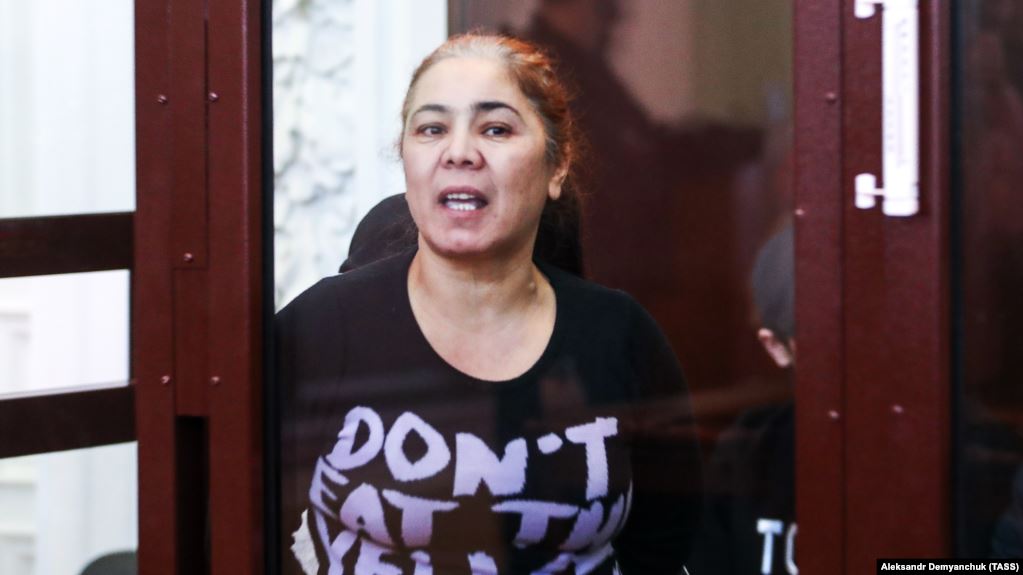
Shohista Karimova. Photo courtesy of RFE/RL

Shohista Karimova: Convicted of Someone Else’s Crime
Natalia Sivohina
Zanovo
December 6, 2020

Tomorrow, December 7, a court hearing will be held in the Moscow suburb of Vlasikha on the appeal of the verdict against of Shohista Karimova. The name of this middle-aged woman from Uzbekistan, who worked as a food prep worker in the Moscow Region, surfaced in the media in connection with the criminal case into the 3 April 2017 terrorist attack in the Petersburg subway—and, most likely, it was immediately forgotten. Journalist Natalia Sivohina recalls Karimova’s story.

On 3 April 2017, an explosion occurred in the Petersburg subway on a train traveling between the stations Sennaya Ploshchad and Tekhnologichesky Institut, killing 16 passengers and injuring about a hundred.

The security forces voiced several conflicting explanations of the tragedy, but soon reported that the perpetrators had been found.

In the dock were eleven people, migrant workers from Tajikistan, Kyrgyzstan, and Uzbekistan. According to investigators, they were members of an Islamist organization.

On 5 April 2017, relatives of one of the future defendants in the case of the Petersburg Eleven, Muhamadusup Ermatov, reported him missing. As he later told human rights activists and journalists, he had been kidnapped. The kidnappers (presumably FSB officers) put a plastic bag over Ermatov’s head, beat him up, intimidated him verbally, tasered him, and demanded that he give the testimony they wanted to hear.

Other defendants in the subway bombing case also claimed they had been subjected to the same “investigative methods.” The evidence obtained under torture was the basis of the sentences the defendants received on charges of terrorism. Karimova, the only woman among the defendants, was sentenced to 20 years in prison.

Karimova worked as a food prep worker in a café near Moscow. According to the case file, she “provided the [terrorist group] with means of communication.” As she said later, she lent a phone to her coworker and, later, co-defendant Abror Azimov. That was the extent of her alleged involvement in the bombing.

When FSB officers came to her house, the Uzbek national meekly complied with all their demands: she held the detonator in her hands, leaving her fingerprints on it, and let them take DNA swabs of her mouth and scalp.

Karimova trusted the authorities and hoped to the last that the truth would out. In the end, however, she was found guilty of possessing a bomb on Tovarishchesky Lane in Petersburg, a city to which she had never been before she was arrested.

Karimova had come to Russia to help her daughter. She worked for 25 thousand rubles a month [approx. 400 euros a month in 2017] and sent money home to her family. The verdict sent her into shock: her terrible screaming during the reading of the verdict was included in journalistic accounts of that day. But few journalists wrote anything about Karimova’s own story.
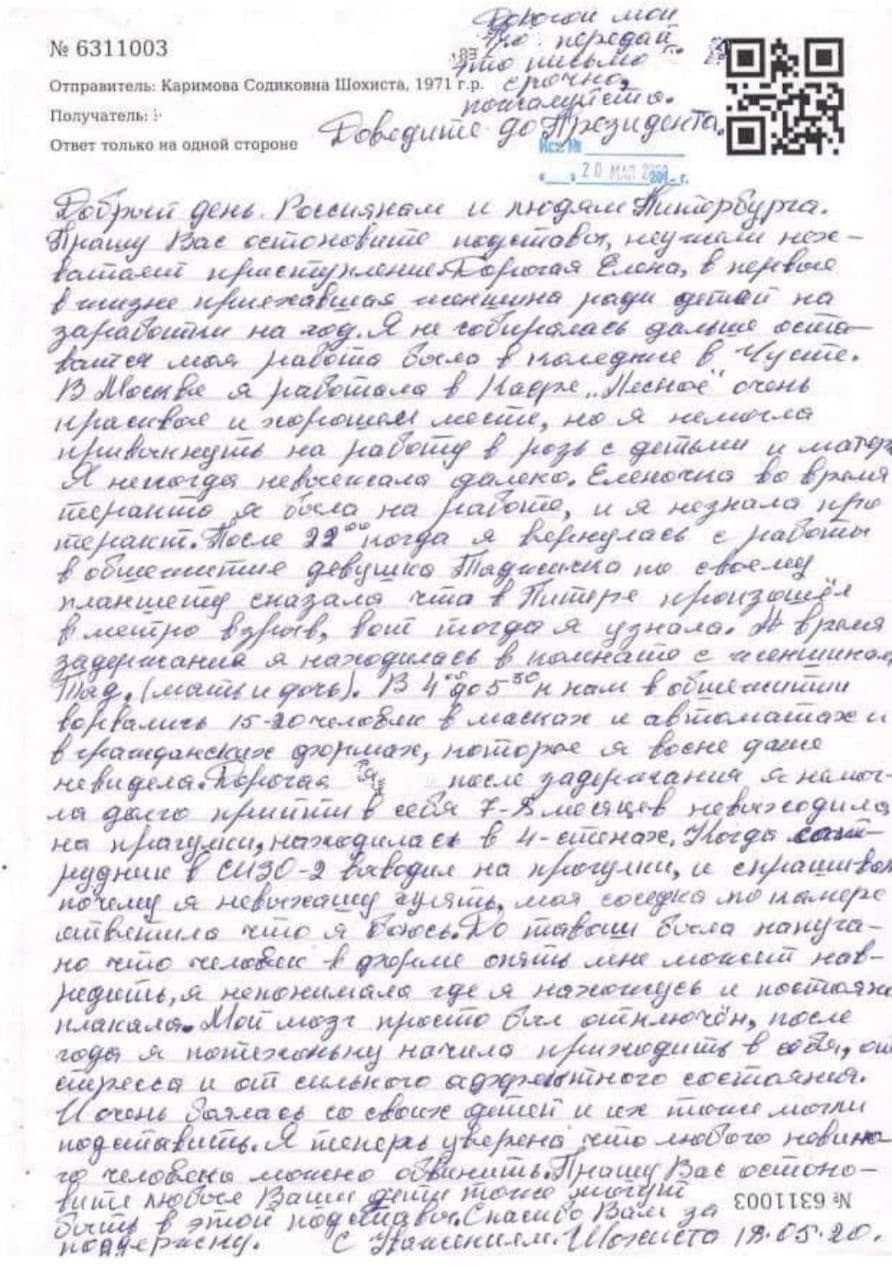
Screenshot of a letter, quoted below, sent by Shohista Karimova from prison, dated 18 May 2020

“When a guard at Pre-Trial Detention Center No. 2 asked why I didn’t go out for a walk, my cellmate replied that I was afraid. I was so afraid that a man in the uniform might hurt me—I was scared and cried constantly. My brain was just turned off. After a year, I started to recover from the stress and the extreme emotional state. And I was very afraid for my loved ones: they could have been framed as well,” Karimova wrote in a letter to a friend, adding, “I now believe that any innocent person can be charged [with a crime they did not commit].”

What the Defense Says
I spoke with Karimova’s lawyer, Viktor Drozdov.

How did you end up taking Shohista’s case? How did it all begin?

I received a call from a person who had previously been in prison and knew the law enforcement system firsthand, and then from other human rights defenders. They asked me to work pro bono on the case, whose defendants were initially represented by court-appointed lawyers. We met and talked, and I agreed to serve as Shohista’s defense counsel.

The tragedy in April 2017 and the media coverage that followed it had attracted my attention. I followed the case quite closely, comparing various reports. It raised a lot of questions, and I decided to find answers to them. I found them.

You have appealed the apparently wrongful verdict. Why do you think it is important to go all the way in this trial?

The defense lawyer’s job is to debunk the prosecution (during trial) and the illegality of the sentence (as now, on appeal), and always be ready to defend their client in subsequent phases in the process. What does “going all the way” mean? The real end came long ago: the justice system was completely “bankrupted” by this trial. It has neither been willing nor able to respond to any of the defense’s arguments.

Does Shohista believe in the possibility of getting justice? What does she think about the upcoming appeal?

Until recently, she had great faith in Putin. She wrote him letters to which she received no response. I don’t ask her that question now. Shohista is painfully aware of the circumstances that caused her to end up in prison completely unexpectedly and absurdly. She knows perfectly well and shares my position on her defense, which is that by defending her, I am defending the Russian justice system, first of all, and her future  depends on it.

Shohista is a hostage to the political interests of people who are now quite powerful.

I have started naming these people on my little Telegram channel. They all were involved or somehow complicit in the #Metro17 case.

After the verdict, Shokhista wrote a letter to Judge Andrei Morozov, congratulating him on finally pacifying Russian society by “finding the terrorists” and wishing him health and happiness.

How many lawyers are currently defending Karimova?

Two: the lawyer Sergei Shostak, who joined the defense at my request, also pro bono, and fully shares my position, and me.

Despite the obvious inconsistencies in the trial of the Petersburg Eleven and the defendants’ complaints of torture, the case did not fall apart in court, and the defendants received huge sentences. Why do you think this happened?

The answer, perhaps, can be found in the verdict itself and in the way the trial was run. The text of the verdict does not cite any of the arguments the defense made, nor does it analyze the events of 3 April 2017 themselves. The court point-blank refused (sic!) to examine the [bombed] subway car as material evidence or the improvised explosive devices, entered into evidence by the prosecution, nor did it uphold any significant defense motion on the merits of the charge. And it allowed the illegal presence of unidentified and unmarked masked persons armed with firearms in the courtroom.

The court was neither independent nor fair. I personally feel very sorry for the judges. They did something vile.

Can ordinary people help defendants in political cases?

“Ordinary people” cannot do anything. But I believe in the capabilities of my fellow citizens—caring, thoughtful, and ready to tell the truth. The internet, petitions, collective appeals, and publicity can help—especially publicity.

* * *

The obvious inconsistencies in the case and testimony by the defendants that they had been subjected to hours of torture during the investigation did not prevent the trial court from finding them guilty and sentencing them to long terms in prison.

So far, there has been no massive grassroots campaign demanding a normal investigation of the case of the Petersburg Eleven. The medieval division into “friends” and “foes” has been firmly established in Russian society. Actually, this is nothing new: this is what usually happens amidst the wreckage of social institutions that have become obsolete.

First, people are evaluated by skin color, then people from the “wrong” ethnic groups are imprisoned: all this happened relatively recently by the standards of history. The country that conquered fascism interrogates hundred-year-old veterans who sacrificed their health and strength in that long-ago war with fascism. The so-called prosecution throws random people behind bars—disempowered construction workers, maintenance men, and kitchen workers from the former fraternal republics. So-called public opinion equates the concepts of “immigrant” and “terrorist.” The so-called state turns into a madman fleeing from its own shadow.

Zanovo Media will keep you updated about the plight of Shohista Karimova and the other defendants in the trial of the Petersburg Eleven.

_____________________

Earlier today, Natalia Sivohina posted the following on her Facebook page by way of prefacing her article: “Recently, I posted a link to the website Zanovo, and today I published my first article there. The article is about Shohista Karimova, who worked as kitchen prep in the Moscow Region and was a defendant in the case of the terrorist attack in Petersburg. This ordinary, very nice woman visited our city for the first time after her arrest. No one knows the current whereabouts of the people actually involved in the crime committed in April 2017. But it is now quite clear to me that the defendants in the case of the Petersburg Eleven are random people who incriminated themselves under torture. Alas, this is the case in today’s Russia, which likes to rant about the ‘fight against fascism.’ Knowing about this case makes me uneasy. I felt quite scared when I wrote this article and talked to Shohista’s lawyer. But, you know, there are things that you can’t keep quiet about, because they concern everyone. Please, if you haven’t heard anything about  Karimova, read this article about her. The hearing of the appeal against her verdict is scheduled for tomorrow. I really want to hope for the best.”

Translated by the Russian Reader. Please read my previous posts on the presumed terrorist attack in the Petersburg subway, the case against its alleged “financers and planners,” its roots in the Islamophobia that has infected Russia under Putin, and the shocking lack of local and international solidarity with the eleven Central Asian migrant workers scapegoated and convicted in the case:

Against Xenophobia and Islamophobia (The Lost Portraits of Bradford)

Thanks to my wonderful British “cousin” AC for bringing my attention to this lovely, sweet, humane and profoundly democratic 2019 BBC TV documentary about a now-defunct photo portrait studio in Bradford and its incredible archive of the city’s changing human face. It’s welcome tonic to my soul as the leading liberal lights in my adopted former “homeland” of Russia indulge in yet another orgy of Islamophobia over horrible crimes committed in completely different countries.

I wish they would watch this documentary and take its message to heart. It might surprise them to learn that not all “westerners” are rabid racists, xenophobes, and Islamophobes. People can learn to live together, learn “conviviality” and unlearn “post-imperial melancholia,” as the great Paul Gilroy (a world-famous contemporary scholar whose works are totally absent in Russian translation, unsurprisingly) has called them. |||| TRR

Thirty years ago, thousands of portraits from a small studio in Bradford were saved from a skip. They form a unique collection of photographs that records the changing face of a British industrial city in the middle of the 20th century. Many of the people in the portraits were new arrivals from the Asian subcontinent, eastern Europe and the Caribbean, attracted by the offer of work in wool mills. The names of these people are a mystery – only their faces survive.

A small studio, Belle Vue, in the middle of Bradford, built a business on taking portraits of the newly-arrived migrants. Photographer Tony Walker used a battered Victorian camera to take images of his customers, which were often sent back to relatives in the countries they’d left behind.

Working alongside staff from museums in Bradford, presenter Shanaz Gulzar identifies and tracks down the people in the portraits, and uncovers dramatic social change and the hidden stories behind the portraits.

Bayan Mirzakeyeva: Where Do You Begin?

Anti-University
Facebook
August 7, 2020

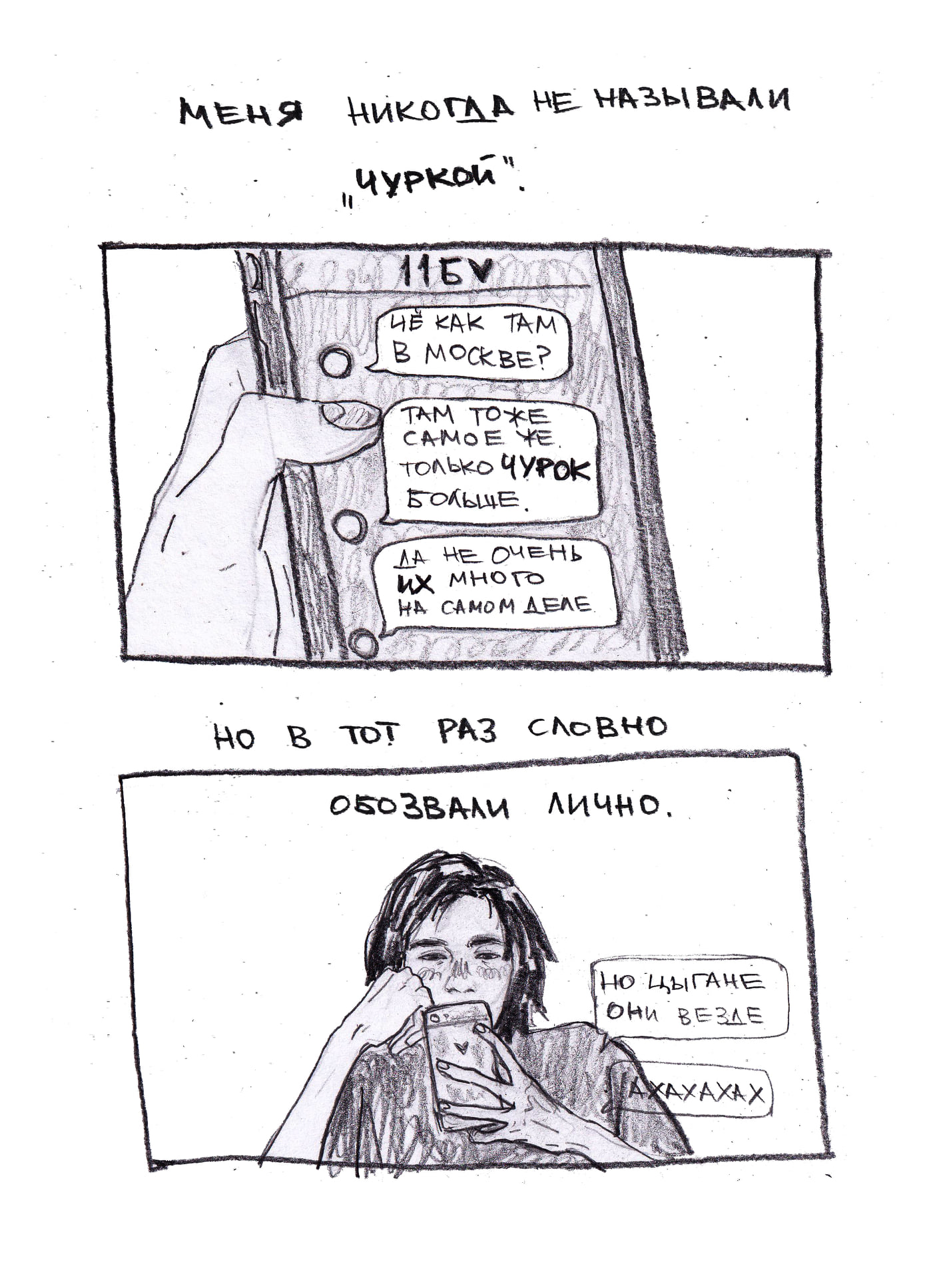
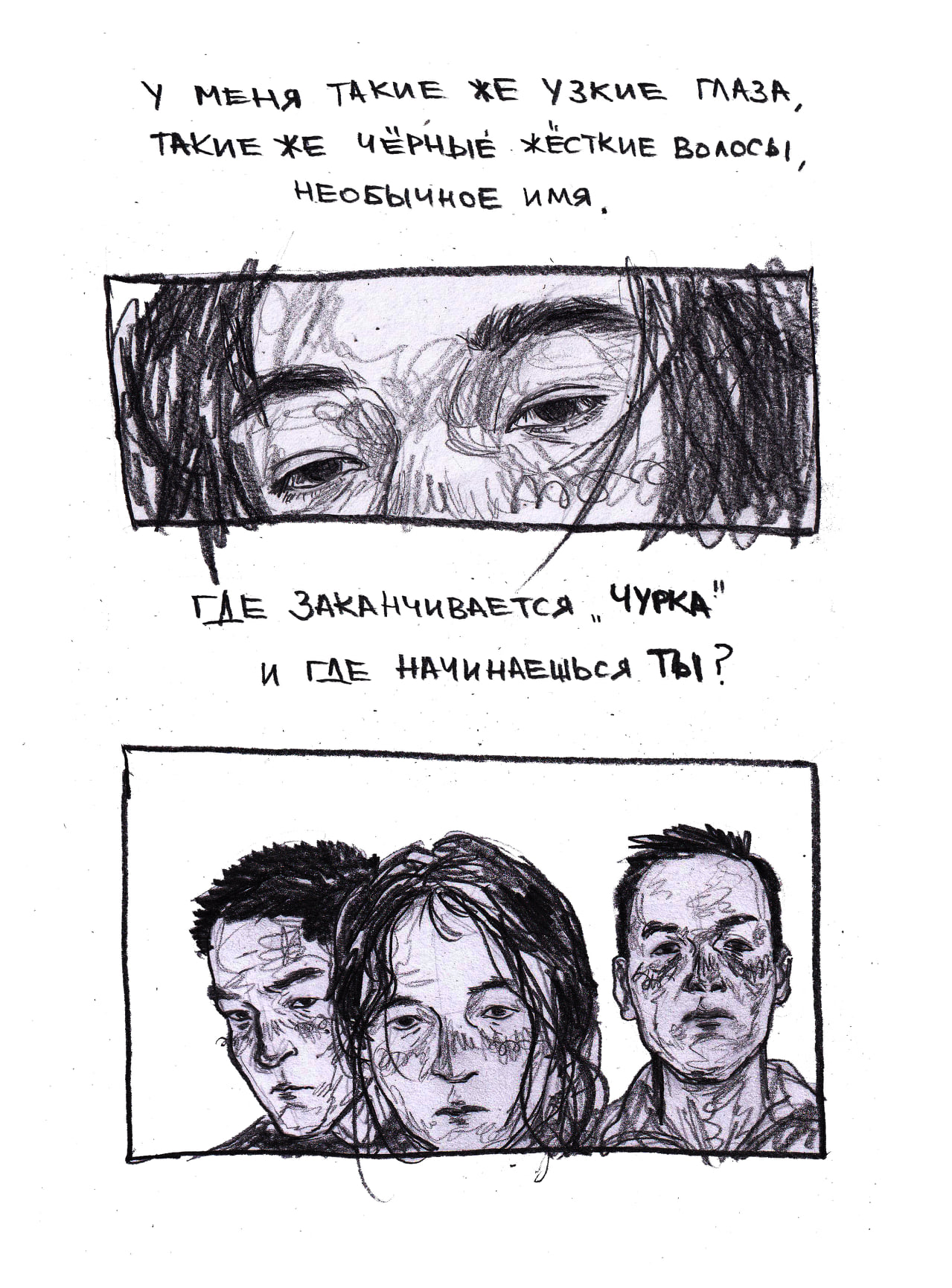
“My name is Bayan Mirzakeyeva. I am 21 years old, and I am an ethnic Kazakh from Almaty. I have been living and studying in St. Petersburg at the Architectural University for several years. It was here, in Russia, that I realized that I was “non-white” and learned about this condescending and contemptuous attitude towards myself. Since almost no one around me talks about racism and migration, I wanted to make my own statement. I posted these pictures on social networks and have faced different reactions, from support to aggression and rejection. This was expected, but it has been a kind of impetus for me to continue working with this problem.”

Bayan sent us her illustrations, and we are publishing them for you.

Come and talk about racism and migration at the open events that we are doing together with the Viadrinicum Summer School. Details here: https://www.facebook.com/AntiUniversityMSK/posts/626498341315382

churka 1

I had never been called a “wog” [churka].

“So what’s it like in Moscow”?

“It’s the same old same old. Only there are more wogs.”

“There aren’t that many of them, actually.”

But this time it was if I had been called that name personally.

“But the Gypsies are everywhere.”

“Ha-ha-ha.”

churka 2

But how do I differ from those who are called “wogs”?

Am I different because I finished high school with honors?

Because I got a scholarship to university?

Because I speak Russian without an accent?

churka 3

I have the same narrow eyes, the same coarse black hair. An unusual name.

Where does “wog” end and where do you begin?


Thanks to Sofiko Arifdzhanova for the heads-up. Translated by the Russian Reader

Mardikor

“Every Day We Go Out on the Road”: A Documentary About the Lives of Female Mardikors Has Been Made in Tajikistan
Fergana
July 2, 2020

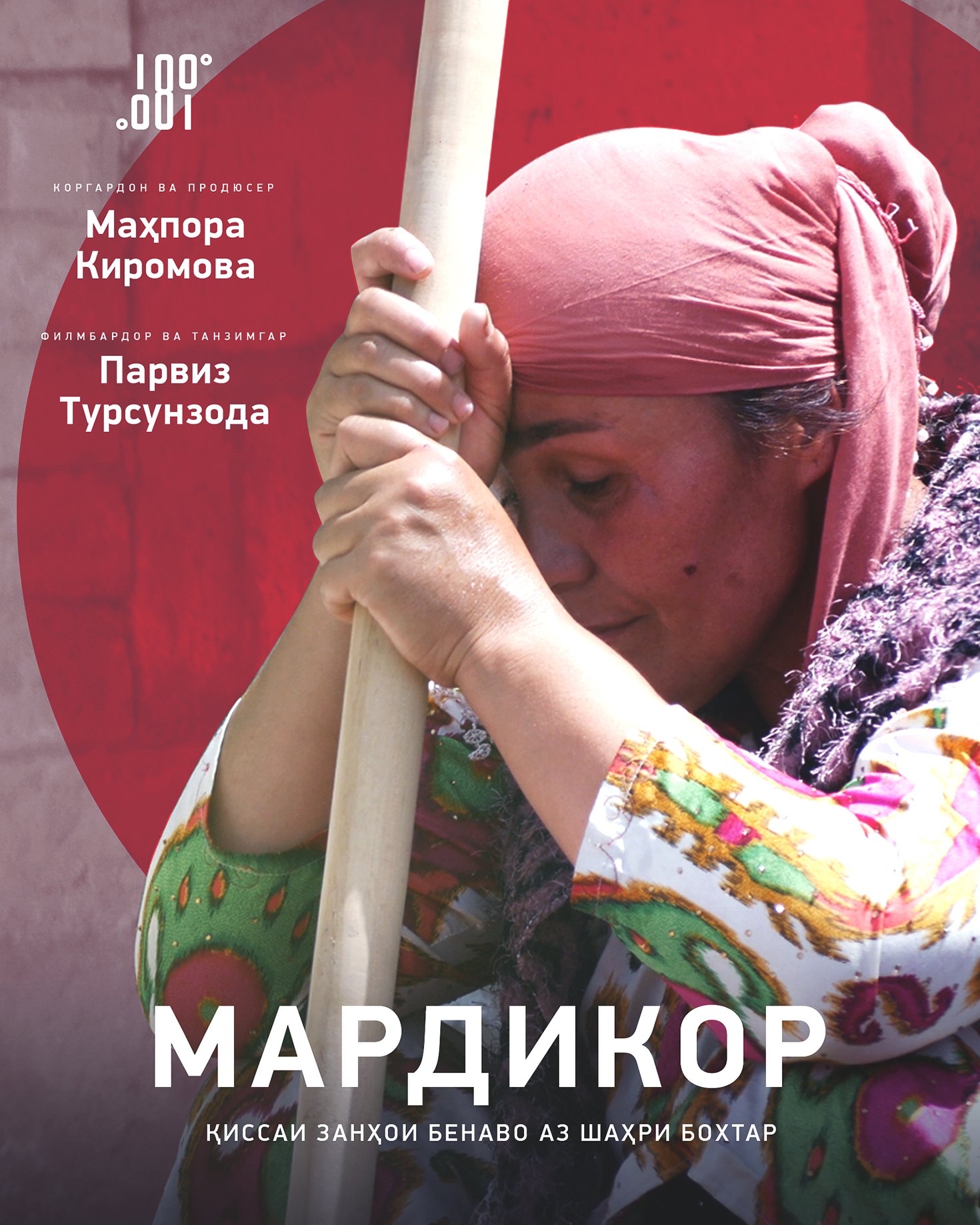
Tajik journalists have made the documentary film Mardikor [“Day Laborer” or “Handywoman,” as the filmmakers themselves have translated the term], which details the plight of female day laborers in the city of Bokhtar, 100 kilometres from Dushanbe. The picture was created as part of MediaCAMP (Central Asia Media Program), implemented by Internews with financial support from USAID, writes Asia-Plus.

Pop-up mardikor markets exist in all the cities and major towns of Tajikistan. But whereas earlier only men offered their services there, women’s markets have also recently appeared. Women who are divorced or left without the support of husbands who have gone to work abroad are willing to undertake any hard work for the sake of two or three dollars a day.

“The short film Mardikor tells the story of these women, most of whom are the abandoned wives of migrant workers. Their husbands do not return from the Russian Federation for years on end and do not send money to support their families. The majority of unemployed women at this labor market do not even have a school-leaving certificate. More than half are mothers with many children,” says the film’s director Mahpora Kiromova.

Thanks to Sergey Abashin for the heads-up. Film poster (below) courtesy of Mahpora Kiromova’s Facebook page. Translated by the Russian Reader

mardikor

Food Couriers Strike in Moscow

cs-2Food couriers striking outside the offices of Delivery Club in Moscow on June 5, 2020. Photo by Mitya Lyalin. Courtesy of RTVI
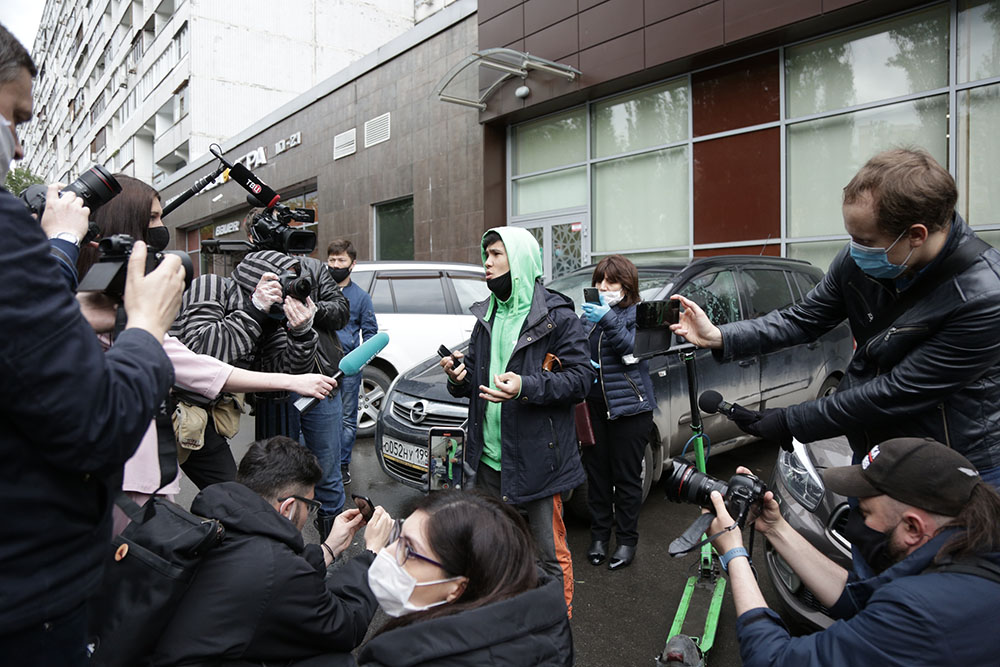
“Bring Back the Old Rules”: Couriers at Delivery Club in Moscow Strike
RTVI
June 5, 2020

Couriers at the food delivery service Delivery Club in Moscow held a strike on June 5. According to them, working conditions at the company have recently taken a turn for the worse. For example, the company has started giving couriers long-distance orders, as well as frequently fining them. The workers walked out in protest. Our correspondent followed the industrial action and listened to the protesters’ demands.

Around forty couriers, nearly all of them wearing the company’s bright green raincoats, came to Delivery Club’s offices this afternoon. The couriers did not chant slogans. They wanted to speak with company management. Although they were not deterred by heavy rain and waited for over two hours, no one from Delivery Club management came out to speak with them.

In a conversation with RTVI, one of the protesters expressed his dismay.

“We have gathered here to get them to cancel the excessive fines against us. Take me: I deliver on foot. I used to get orders within a three-kilometer range, but now they’ve been sending me as far away as five kilometers. Think for yourself how a foot courier can walk so many kilometers and how long that takes,” he said.

According to him, this can cause him to arrive an hour late to a customer’s home or office.

“Then the customer gives us a funny look. But if we fail to take the orders, the company fines us,” he explained.

“Courier Strike at Delivery Club.” TV 360° live-streamed the June 5 industrial action in Moscow.

Another courier said that he and his fellow strikers wanted the company to go back to the old rules, under which workers were able to make all their deliveries on time and none of them was fined.

“Delivery drivers make 3,000 to 5,000 rubles [approx. 40 to 65 euros] for 14 to 16 hours of work, if they do 30 orders. Foot couriers make three to three and half thousand rubles max. At the end of our shifts, management can issue six or seven fines. Each fine amounts to 300 rubles, so that comes to 1,800 rubles [approx. 23 euros],” another young man said.

The couriers say that in the past, when orders were issued within the areas where they chose to work, they were always on time, because they knew, for example, where they could shorten their routes.

“We had everything worked out. Now the situation has changed. We bring people cold food, and I don’t think Delivery Club wants its reputation to suffer. I would like to go back to the old rules,” a female courier said.

The delivery drivers also have problems. They told RTVI about Delivery Club’s clumsy system for compensating their petrol costs. For example, they can be ordered to pick up food from a restaurant far away from their original location, but Delivery Club does not compensate them for their travel there. They are compensated only for travel from the restaurant to the customer, which, according to them, is a small amount of money.

On June 4, TV 360° aired this short but informative report about the upcoming strike.

The couriers coordinated their actions in community Telegram chats. A day before the strike, the Telegram channel Rasstriga, citing one of the couriers, reported the upcoming strike, forcing Delivery Club to announce that they were verifying the report. A spokesperson for the company said that during the period of self-isolation there had been more orders, and consequently the average earnings of their couriers and drivers had increased.

cs-1A striking Delivery Club courier speaking to reporters. Photo by Mitya Lyalin. Courtesy of RTVI
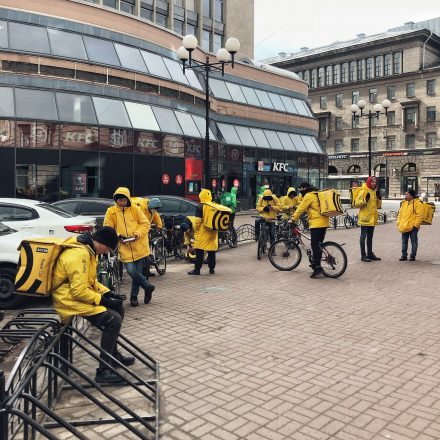
The same day, a video message from couriers in the Moscow suburb of Khimki was posted on Rasstriga. One of the speakers compared the work of delivery drivers to that of taxi drivers. According to him, they had to travel all over the city.

“We all have families, and we all have children to feed as well,” another courier added.

On the morning of June 5, Delivery Club issued a statement saying that the dissatisfaction of couriers could have been sparked by an experiment with increasing the size of delivery areas. However, the company added, the test was only carried out for a few days, and was terminated before there were reports of an impending strike. Now, according to the company, all unfair fines for couriers had been canceled, and the company had begun returning money previously paid in fines to the couriers.

Ivan Weiss, the head of the Union of Couriers of Russia, also spoke about the problems of delivery people. In a conversation with TV 360°, he said that many couriers and drivers were fined unfairly.

Weiss gave an example.

“A person starts work at 2:15 p.m., and they already have several unfulfilled orders from 2:05 p.m., and so they end up getting fined 1,500 rubles. There is no limit to the indignation a person feels when they need to earn this money.”

Weiss also spoke about the expanded delivery areas. According to him, a foot courier can be asked to pick up an order five or six kilometers away. Weiss also said that while he supported the couriers at Delivery Club, holding an outdoor protest during the self-isolation period could backfire on them.

Translated by the Russian Reader. If you want to learn more about the lives of food delivery people in Russia’s major citiesd, check out the recent photo reportage, “In the Imperial City,” by the well-known Petersburg documentary photographer Mikhail Lebedev, who has gone to work as a courier during the pandemic, and journalist Yana Kuchina, published by Takie Dela on May 24, 2020. Here’s a sneak preview.

016c_08-440x440-c

“Since the beginning of the self-isolation regime, the number of couriers has increased more than fivefold. Every day, 50 to 100 new people appear on the delivery chat. People are losing their jobs, and the delivery service is the easiest way to find a new source of income.”

Do Black Lives Matter in Russia?

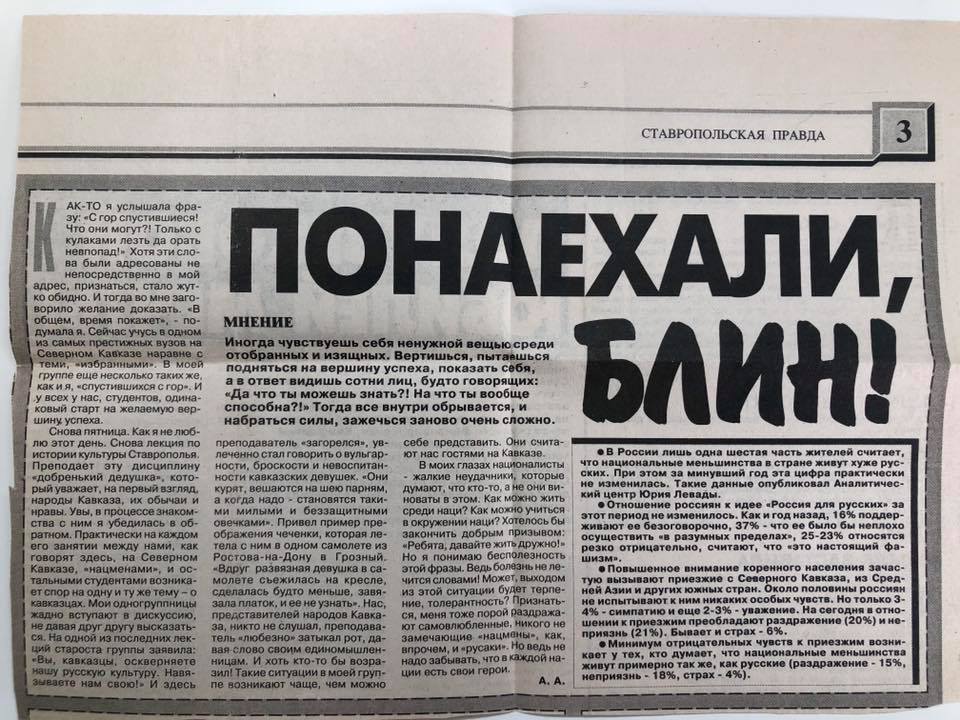
ponaexaliAnush Avetisyan’s opinion piece in the Stavropol Pravda newspaper. The sidebar contains a summary of polling data on (the mostly negative) Russian attitudes towards ethnic minorities and migrants. Courtesy of Anusha Avetisyan’s Facebook page
Anush Avetisyan
Facebook
June 5, 2020

I haven’t written about racism, the death of George Floyd, or the protests all these days. It hurts me to think and talk about it. No matter how childish it sounds, I would have liked to have been on the scene at that moment and saved Floyd by getting personally involved. When I was a second-year student of journalism, I needed such help. I couldn’t breathe, either. I was suffocated by constant reminders that I was an “other,” that I and my kind had “ruined the neighborhood,” that I was “desecrating Russian culture,” and that I was a “blackass.” (Sorry!)

I had thought that once I found myself among educated people, I would finally forget what discrimination and nationalism were. But no. Even more often was I forced to hear comments like “Why are so you normal, when all wogs act like they’ve just come down from the mountains?”

Maybe because you have a lot of prejudices?

I was the only person in my class to graduate from school with distinction, and the teacher decided to congratulate me by saying the following to my schoolmates: “Look, you lot should be ashamed. Even she, a NON-RUSSIAN, could do it!”

During lectures on the cultural history of Stavropol Territory, my female university classmates were eager to prove that Caucasians were originally not from the Caucasus, and that “national minorities” (as they called all non-Russians) had no place in Russia. My classmates would ask me mockingly why I didn’t cover my head with a scarf and celebrate Ramadan. This proved not only that they were ignorant of the history and culture of other countries, but also that they viewed all people with dark hair and thick eyebrows as an undifferentiated black mob of non-Russians with cultures, traditions, and values they found incomprehensible.

When I got a job on the radio, the editor tried to make me lose my “Caucasian accent.” I still don’t understand how I could have had one, since we spoke Russian at home all our lives. Unfortunately, my dad does not know Armenian, as he grew up in Petersburg.

As my colleague Fatima Tlis has correctly pointed out, I could not and cannot even imagine that my schoolteacher, my classmates, and my employers would take to the streets to protest the fact that nationalism made it hard for me and others like me to breathe in Russia. Would the ethnic Russian population have protested the death of a Caucasian, Tajik, or Armenian at the hands of the police?!

The problem of racism exists here in the United States, but it was in this country that I first felt at home. This can be said by many immigrants from all over the world, by people of various nationalities. Here “others” are accepted and given the same opportunities.

I found this copy of an opinion column in the Stavropol Pravda that I wrote as a second-year journalism student in my grandmother’s personal belongings. She trusted me with her innermost secrets. Among letters from her son, audiotapes of her daughter singing, and postcards from her beloved granddaughters, I found my cri de coeur, neatly clipped from the newspaper. My grandmother, the closest person in the world to me, knew how important the subject was to me, how much anguish I feel when faced with injustice.

#GeorgeFloyd #BlackLivesMatter

Anush Avetisyan is a journalist at Voice of America and lives in Washington, DC. Thanks to Sergey Abashin for the link. Translated by the Russian Reader


Little Kyrgyzstan

Moscow’s Little Kyrgyzstan (2017)

Since the collapse of the Soviet Union in 1991, the Russian Federation has become one of the most important destinations for immigration in the world, second only to the United States and equal to Germany. Unlike Europe, however, the majority of people going to Russia aren’t political refugees and asylum seekers, but economic migrants looking for employment opportunities.

Most of the migrants are from the former Soviet space, with Central Asia at the forefront of this massive human flow. Tens of thousands leave the republics of Kyrgyzstan and Tajikistan every year to find seasonal employment in Russia’s main cities. Many stay for years, others never return, but their remittances form an important share of their country’s economy. The World Bank estimates that, in 2014, money sent back home by migrants represented 36% of Tajikistan’s GDP, and 30% of Kyrgyzstan’s.

Moscow’s Little Kyrgyzstan presents the story of ten immigrants from Kyrgyzstan living in Moscow, showing the diverse reality of millions of immigrant workers in Russia in their own words. It also broaches various themes that affect their everyday lives, such as the overbearing and corrupt Russian bureaucracy, harassment from the police, and anti-immigrant sentiment among the general population. It looks into the effect of the current economic crisis in Russia on the lives of migrant workers and the changes that followed Kyrgyzstan’s entry into the Kremlin-led Eurasian Economic Union in August 2015.

To provide context, the stories of the ten characters are punctuated by comments from two leading Russian experts on migration—Dmitry Poletaev and Valery Solovei—as well as an exchange between participants to a round table in Moscow on the need to introduce a visa regime for Central Asian migrants to Russia.

Credits:
Franco Galdini, Producer & scriptwriter
Chingiz Narynov, Director
Susannah Tresilian, Narrator
Soundtrack by Salt Peanuts

For more on the story visit:
https://thediplomat.com/2017/03/a-glimpse-into-moscows-little-kyrgyzstan/

_________________

Thanks a billion to Bermut Borubaeva for the heads-up. The extraordinary challenges faced by Central Asian migrants in Russia have been an abiding theme of this website over the nearly thirteen years of its existence and will continue to be in the future. // TRR

Muruzi House

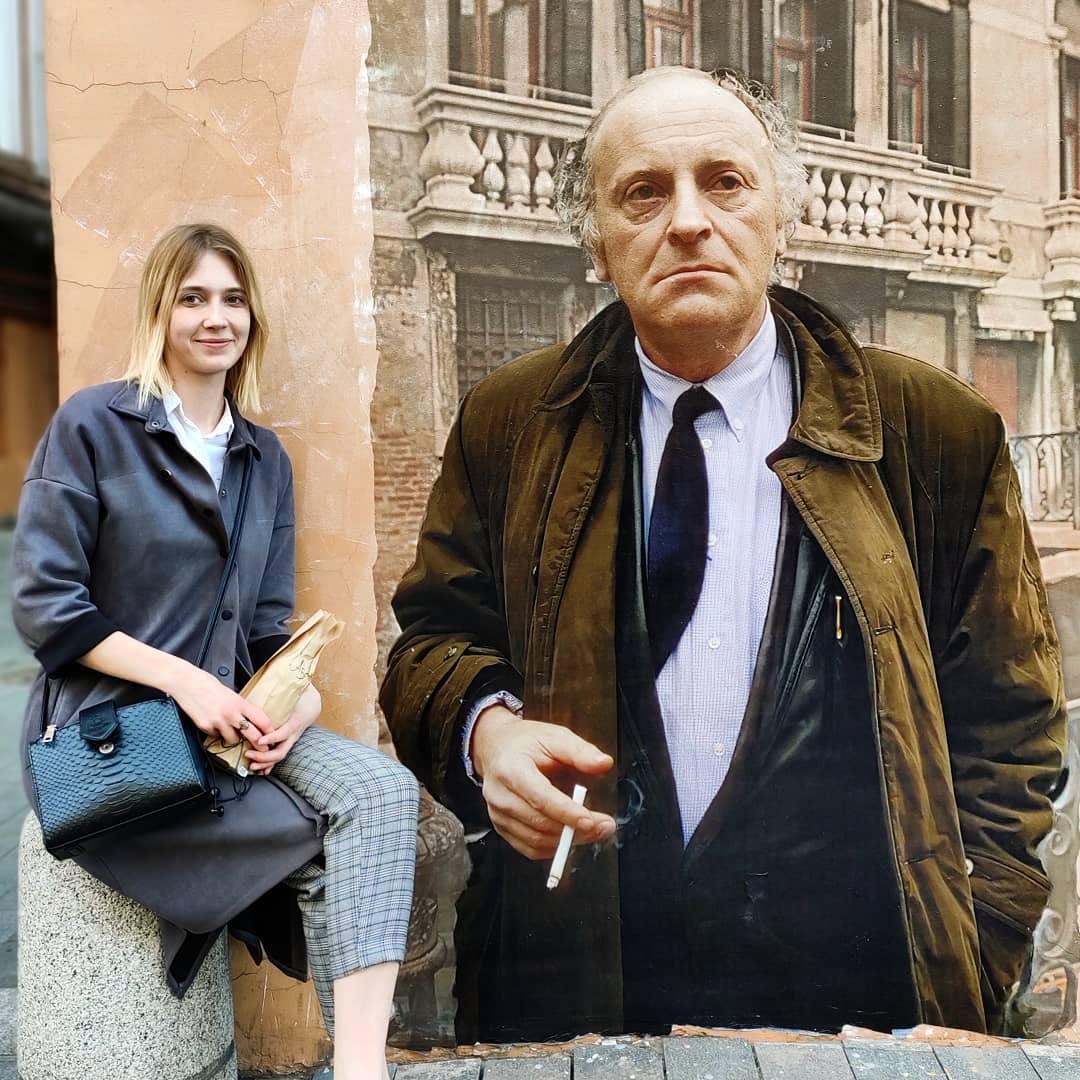
brodThe young woman (left) and the late Russian-American poet Joseph Brodsky (right) have nothing to do with the story, told below, of a Central Asian female migrant, working as a residential building caretaker in Petersburg, and her temporarily misplaced daughter. In recent days, however, this “graffiti” portrait of the Nobel laureate, which was quickly painted over, has been the talk of Brodsky’s hometown. The brutal conditions in which Central Asian migrant workers live in Petersburg and other Russian cities are virtually never the talk of the town, although it is their poorly paid drudgery that makes it possible for the “natives” to lead such rich spiritual and intellectual lives, chockablock with fine poetry and heated debates about “street art” and aesthetics. Photograph courtesy of the Instagram page Dom Muruzi

George Losev
Facebook
May 28, 2020

While I was at work, I found a little girl outside the entrance of a residential building. She was calling for her mother, her mommy. She was lost. Although the girl could speak Russian, she was unable, of course, to say where she lived and when she had last seen her mommy. But she was enjoying playing with a broken plastic motorcycle.

I couldn’t go to the police. Who knew what problems with papers the little girl’s family had? In any case, the police would shake down the girl’s mother and father and rob them.

An old lady in the neighborhood with whom I organized an ACSC (ad-hoc committee for saving the child) agreed with my assessment. During the ten minutes of our existence as a committee, we couldn’t come up with anything. Fortunately, the mother—a local building caretaker—showed up and fetched her daughter.

How disgusting it is to live in a society where you can’t go to the police, because the police are robbers and looters with blank stares.

George Losev is a housing authority electrician and revolutionary leftist activist in Petersburg. Translated by the Russian Reader

The Rain Came Down


TV Rain, April 8, 2020. “Three years after the first terrorist attack in the Petersburg subway, the court sent eleven people to prison—an entire terrorist network. We studied the evidence, talked to witnesses in Russia and Kyrgyzstan, and realized that there are too many secrets and questions left in the case. We assembled our own jury to decide whether the case should be reopened.”

People Freaked Out in a Good Way
Ilya Ershov spoke with TV Rain reporter Yevgenia Zobnina about her documentary film on the strange investigation of the April 3, 2017, terrorist attack in the Petersburg subway.
Open Space

Why did you decide to tackle this topic?

I was working as a correspondent for TV Rain in Petersburg and spent the whole day [of April 3, 2017] outside the Tekhnologicheskii Institut subway station. The most amazing thing was what happened afterward. The entire city raised money [for the victims and their families], government-organized rallies were held, and then somehow everyone abruptly forgot about it . Then there were fragmentary reports that the culprits had been caught. Next there was the trial. On the first day, reporters came running to film and photograph those eleven [defendants]. That was it. And then there was the verdict. There has been a good trend in journalism, on YouTube, of returning to the sore spots in our history. It seemed to me that this story should also be told.

Were there things you found out when shooting the film that didn’t end up in the film?

There was this thing with one of the relatives of the Azimov brothers, who had been corresponding on WhatsApp with unknown numbers. The investigation used some of them as evidence of [the brothers’] connection with terrorists. One of the relatives said, This is my number, I exist, I live in Ukraine, I am not a terrorist. If Ukraine had not gone into quarantine, we could have found more witnesses there.

How many people refused to talk to you?

It was a big problem for the relatives of the defendants to give their relatives’ contacts, because everyone is scared. None of the relatives turned us down. They were happy that someone was interested in their lives. They say that if their relatives were terrorists, the local security service would not have left them alone. But they came once, took their information, and never showed up again.

zobninaYevgenia Zobnina. Photo courtesy of her Facebook page

How openly were Kyrgyzstan’s human rights defenders ready to communicate with you? Were they and the relatives [of the defendants] under pressure from the local security services?

It was a great surprise for me to talk with Sardorbek, a lawyer at the [Kyrgyz] human rights organization Justice. He says that they know how to assert their rights. In Kyrgyzstan, there are laws that enable one to defend one’s rights. When they found out about the disappearance of their relatives, the Azimov family practically lived in the offices of the human rights defenders for several days, and no one came and tried to take them away. But we did not find any attempts by [the governments of] Kyrgyzstan and Uzbekistan to stand up for their citizens.

Have the Russian authorities reacted to the film?

We made official inquiries even as we were making the film, but we didn’t get any answers. This film was made for society, not for the state.

What kind of reactions have their been to the film in general?

People have freaked out in a good way. Their reaction has been, “Wow, why is it like that in our country?”

You staged a jury trial in the film? Are such trials the future?

There should be jury trials at some stage. But there will never be a jury trial in this case. [On the day the verdict in the real trial was announced] Putin came to Petersburg: how could those people have not been convicted? In the film, the jury was there to keep us from turning into accusers of the FSB. We thought it vital to turn this into a conversation about what was wrong with the case. Jury trials are demonstrative. Every detail of a case is examined carefully, because both sides understand that they are facing people who do not understand anything about it. The verdict depends on how you explain the evidence. When we begin to explain what happened in the investigation of the terrorist attack, everything immediately becomes clear.

Thanks to Ilya Ershov for the heads-up and for permission to translate and publish this interview here. Translated by the Russian Reader. Please read my previous posts on the terrorist attack, the case against its alleged financiers and planners, its roots in the Islamophobia that has infected Russia under Putin, and the shocking absence of local and international solidarity with the eleven people convicted and sentenced to long prison terms in the case: