NUMB3RS (Wages of War)

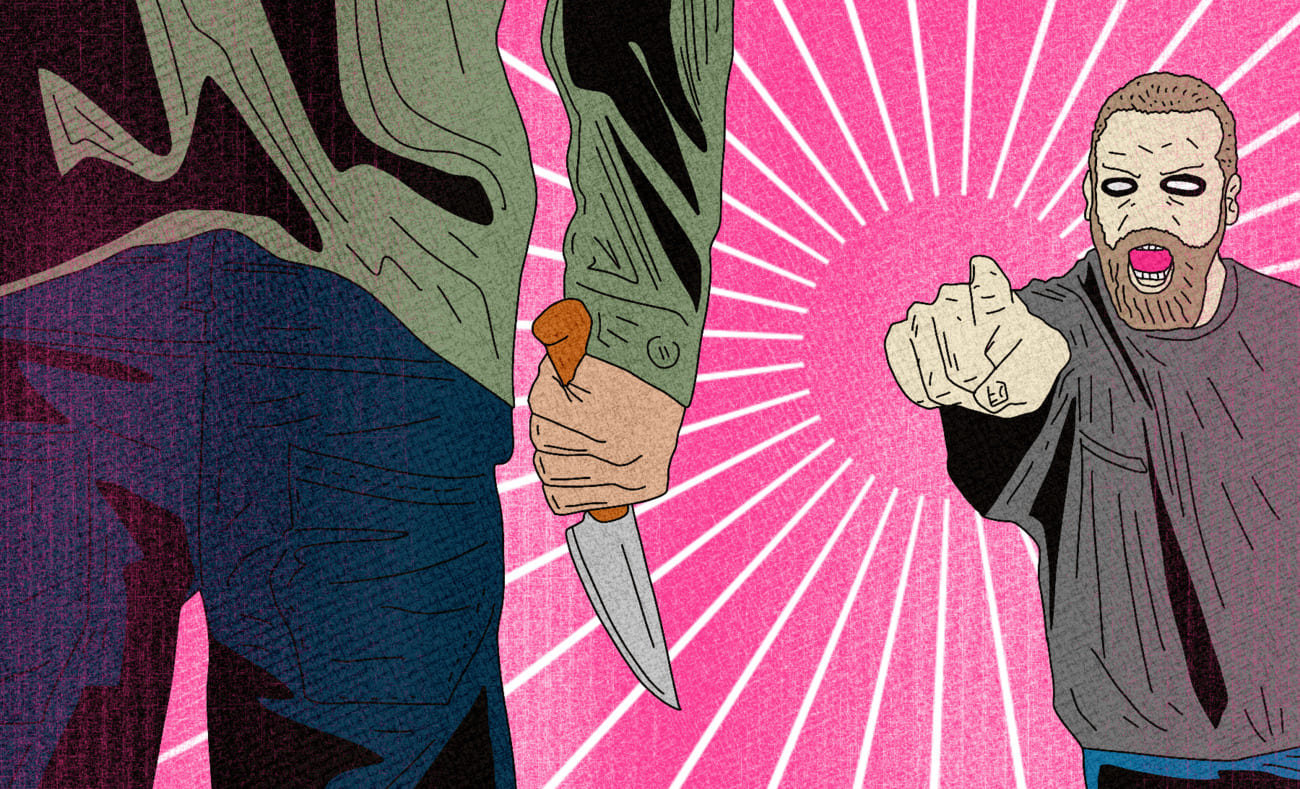
Illustration by Danny Berkovskii for Mediazona. Source: New Tab

Aided by a team of volunteers, journalists at Mediazona and the BBC’s Russian Service have identified 41,731 Russian soldiers killed in the war in Ukraine using open sources. This number includes employees of the Wagner mercenary group, but it does not include those who fought on Russia’s side in military units fielded by the self-proclaimed Donetsk and Luhansk “people’s republics,” the BBC noted in an article published on Friday, 12 January.

According to the article, more than 1,100 Russian military personnel killed in the war were under 20 years of age. Since the State Duma approved amendments to the relevant laws, in April 2023, thus permitting 18-year-old high school graduates to sign military service contracts, 48 Russians born in 2004 and five born in 2005 (who were thus “barely 18 years old” when they enlisted) have perished in the war.

As of 11 January, 2,377 airborne troops, 913 marines, 537 members of the Russian National Guard’s special forces, 450 members of the GRU’s special forces, 206 military pilots, and 77 FSB and FSO officers have been killed in combat operations.

The BBC points out that the number of casualties among those who voluntarily signed a contract to serve in the Russian armed forces has increased in recent months. Thus, volunteers, prisoners, and private mercenary company “recruits” now account for 37 percent of all confirmed losses 0n the Russian side. Another 12 percent of the identified casualties were draftees (of whom 5,005 died in Ukraine and 62 in Russia).

Source: Yevgeny Zhukov, “Journalists have confirmed the deaths of 41,700 Russian soldiers in Ukraine,” Deutsche Welle Russian Service, 13 January 2024. Translated by the Russian Reader

According to Ukrainian intelligence, the Russian forces in Ukraine currently consist of 462,000 military and 35,000 National Guard troops, responsible for the functioning of the occupation regime. This number of troops allows the Russians to carry out rotation — to withdraw units and subdivisions and bring them to the front line.

Source: Monique Camarra, “Jan 13: E-Stories,” EuroFile, 12 January 2024


When looking for a new advertising/PR agency in Ukraine in autumn 2023, PepsiCo made it a condition for a potential partner to exclude any mention of the war, or support for Ukraine and its army in future communications, according to a brief seen by B4Ukraine.

“NO: mention of war, hostilities, aggression, military personnel (from Brand side), Armed Forces of Ukraine. NO: support Ukraine and the army. NO: negative connotation, creating a feeling of ‘unsafe,’” states the “Pepsi restrictions” section of the brief.

The B4Ukraine Coalition contacted Pepsi offices in Ukraine and the US to ask for comment on this article but at the time of publication had not received any response.

In the meantime, the October 17 message on PepsiCo’s Instagram page announced that “PepsiCo volunteers distributed food kits to 1,200 families in the city of Borodyanka, whose homes were destroyed.” The message does not specify who exactly brutally destroyed the homes of these people.

Perhaps because PepsiCo’s Russia net profit increased by 333% to $525 million last year and the company paid about $115 million in taxes to the Kremlin? Treating such contributions as support for the economy of the aggressor state, Ukraine’s National Agency on Corruption Prevention (NACP) in September included PepsiCo in the list of international sponsors of war.

PepsiCo produces soft drinks, juices, chips, snacks, dairy products and other food products under the main brands Chester’s, Chipsy, Lay’s, Mirinda, Pasta Roni, Pepsi, Propel, Sandora, 7Up, Simba, Snack a Jacks, Sonric’s, Tropicana, etc.

The company has 19 factories, about 20,000 employees, 40,000 agricultural workers, and 600 open vacancies in Russia, according to the NACP.

The company announced the cessation of advertising activities and the production of some beverages in Russia in March 2022, while still allowing other products, such as infant formula and baby food to be sold, in order, as PepsiCo put it, “stay true to the humanitarian aspect of its business.” Yet in fact, the company continues the production and distribution of chips, snacks, and soft drinks. According to Bloomberg, PepsiCo’s revenue rose 16% in Russia and profits quadrupled, and the soda maker said operations in Russia accounted for 5% of consolidated net revenue for 2022, up from 4% a year earlier.

Now the iconic Pepsi cola is sold under the Evervess-Cola brand, although regular Pepsi Cola is still easy easily purchasable in Russian supermarkets due to the so-called parallel imports, when goods are imported without the manufacturer’s permission.

At the beginning of September last year, PepsiCo came under fire over its Russian business when the firm’s products were dropped by the Finnish parliament and Scandinavian Airlines’ operator SAS, and already on September 21, ironically, [a] Russian missile damaged a PepsiCo plant near Ukraine’s capital Kyiv.

A global [c]oalition of civil society organizations, B4Ukraine, is calling on PepsiCo to exit Russia ASAP and for the US government to issue a business advisory, warning US businesses of the growing legal, reputational, and financial risks of doing business under military control in Russia.

Source: “‘No support for Ukraine and its army’: PepsiCo restricts mentions of war in its PR,” B4Ukraine. Thanks to Monique Camarra (EuroFile) for the heads-up.


The war has markedly changed the Russian economy. Moscow has had to adjust its policy to fund its armed conflict against Kyiv, maintaining its military apparatus and police force, and integrating the territories it has annexed from Ukraine. These priorities have necessitated significant spending commitments that collectively threaten Russia’s economic stability. The Kremlin will spend six percent of GDP (more than eight percent when combined with spending on national security) on the war in 2024. This is more than the 3.8 percent of GDP that the United States spent during the Iraq war, although it falls short of the prodigious sums the Soviet Union allocated during the years of stagnation and its invasion of Afghanistan (18 percent of GDP).

Military spending has even eclipsed social spending—currently less than five percent of GDP—for the first time in Russia’s post-Soviet history. This pivot toward a militarized economy threatens social and developmental needs. The four annexed regions of Ukraine have already received the equivalent of $18 billion, and in 2024 almost $5 billion is expected to be transferred from the federal budget to regional budgets. No other regions in Russia receive this level of investment, which only increases interregional inequality. Rather than restore dilapidated housing in Russia, the Kremlin prefers to spend money on building houses and roads in annexed territories, to replace the houses and roads that Russian troops destroyed during their brutal invasion.

Russian industry has been transformed, with defense sectors now overshadowing civilian industries. The defense sector’s enterprises are now operating at a fever pitch and, as a consequence, any surge in demand is likely to force prices to rise because of the sector’s inability to increase supply. The military sector is receiving a disproportionately high amount of government spending, and it is also siphoning off labor from the civilian workforce, leading to an abnormally low unemployment rate of 2.9 percent. Before the war, Russia’s unemployment rate typically stood at around four to five percent. The military and public sectors now employ 850,000 more people than in late 2022–23. The invasion of Ukraine also prompted about 500,000 Russians to emigrate in 2022, driving shortages of qualified specialists and blue-collar workers.

Meanwhile, living standards have risen across Russia, and the percentage of Russians living below the poverty line has dropped to 9.8 percent, the lowest since 1992. Naturally, there are regional variations, and areas that have sent a significant number of their men to fight in Ukraine—including Altai Krai, the Altai Republic, Buryatia, Chechnya, and Dagestan—have witnessed the fastest income growth in low-income groups. This relative increase in prosperity can be expected to continue as Moscow disburses funds to the families of the deceased and wounded.

Overall, the Kremlin wishes to maintain an illusion of normality and even increasing prosperity for its citizens. The distortions in the labor market have pushed up salaries in military industry, as well as in civilian manufacturing, because of the need to compete to attract workers from well-paying military plants. Moscow is, meanwhile, making high payments to soldiers and people mobilized to fight in Ukraine, which are driving consumption. At the same time, thanks to a supply of cheap credit, the government is handing out subsidized mortgages, that are, for the moment, shielding families from economic reality.

Source: Alexandra Prokopenko, “Putin’s Unsustainable Spending Spree: How the War in Ukraine Will Overheat the Russian Economy,” Foreign Affairs, 8 January 2024


Elsewhere there are signs that the invasion of Ukraine may have disrupted the Russian economy more severely than the frothy party scene suggests. The Olivier salad, a mayonnaise-drenched confection of root vegetables, sausage and boiled eggs, is a staple at every table during the holidays. This winter the price of eggs suddenly rocketed (no one is quite sure why, but it may have been because farms were short of labour since so many workers have been conscripted or left the country). In some regions people cannot afford a box of six eggs and have to buy them individually. One pensioner even raised this with Putin during the president’s annual end-of-year call-in with the public. Putin promised to look into it.

Source: Kate de Pury, “Gucci is cheap and eggs are pricey in Russia’s surreal economy: War spending has Russians partying like it’s 2021. But some are also stockpiling dollars,” 1843 Magazine (The Economist), 10 January 2024


In the two years that have passed since the start of Russia’s large-scale invasion of Ukraine, residents of Ukraine have become less likely to use the Russian language, according to a press release on the outcome of research done by the Ludwig Maximilian University of Munich in cooperation with the University of Bath and the Technical University of Munich, which was published on Wednesday, 10 January.

Language plays a leading role in the identity of post-Soviet Ukraine, the authors of the study say. Many Ukrainians are fluent in both Ukrainian and Russian. And yet, only a few years ago, 50 to 60 percent of the country’s residents called Ukrainian their principal language of communication. After the Maidan protests in late 2013, sparked by then-Ukrainian President [Viktor] Yanukovych’s refusal to sign an association agreement with the EU, and Russia’s subsequent  annexation of Crimea in 2014, more Ukrainians abandoned Russian.

[…]

The researchers explore this trend in a study published in the journal Communications Psychology. Using artificial intelligence and statistical analysis, they examined more than four million messages posted by 63,000 Ukrainian users on the social network X (formerly Twitter) between January 2020 and October 2022.

According to the study’s authors, users began switching from Russian to Ukrainian even before the large-scale Russian invasion, but this trend increased dramatically after the war began. In their opinion, this change in user behavior was a political reaction to events. Users wanted to distance themselves from both support for the war and Russia as such, so they started using Ukrainian en masse.

Source: Sergei Gushcha, “Ukrainians use Russian less since war began,” Deutsche Welle Russian Service, 10 January 2024. Translated by the Russian Reader


The full-scale war in Ukraine, which began almost two years ago, has led to increased violence in Russia itself. Military personnel with PTSD and criminals recruited into combat return from the front and maim and kill people in civilian life. Sometimes conversations about the war even end in violence. Mediazona and New Tab have uncovered over thirty criminal convictions for assaults and murders that occurred during quarrels about the “special military operation.” (The courts use the official wording for the war as mandated by the authorities.)

In Berdsk, Novosibirsk Region, draftee Khuler Mongush stabbed Nikolai Berezutsky, a passerby. The latter had asked Mongush why he was going to Ukraine. Saying that he was going there “to defend the Motherland,” the mobilized man attacked Berezutsky. Mongush was sentenced to eight years in prison for murder.

In the Irkutsk Region, farmer Maxim Khalapkhanov was drinking with an acquaintance, who began ridiculing the state of the Russian army during the war. Khalapkhanov eventually got angry and killed the acquaintance with a knife, whose handle was decorated in the colors of the Russian flag, and drew the letter Z on his stomach with a fireplace poker. Khalapkhanov was sentenced to seven years in a high-security penal colony.

Anton Rakov, a resident of Orenburg, was drinking with a new acquaintance. They began arguing about the war. Rakov did not like what his interlocutor was saying and killed him. While his victim breathed his final breaths, Rakov recorded a video with the dying man in the background, shouting, “This is what will happen to anyone who disagrees with me!”

Viktor Konnov of Zlatoust beat up a friend who said something nice about Ukraine, while Ivanovo resident Mikhail Vitruk received two and a half years in a penal colony for beating up his girlfriend, who allegedly called him a “Nazi” while they were watching the news.

In 2020, Mikhail Taskin attempted to shoot three people over a parking space and was sentenced to nine years in a penal colony, whence he was freed by the Wagner Group. Taskin spent several months in combat, where he lost a leg, eventually returning to his native village of Nerchinskiy Zavod in the Transbaikal Territory. In August 2023, he got into a fight at a local cafe. Taskin mocked the waitresses and promised to “hump all of them.” The incident ended in a brawl, and the police detained five people, but not Taskin was not among them. His sister and the local authorities argued that the disabled man had been assaulted by “opponents of the war.” But the news website Regnum discovered that two of the detainees were certainly not against the war because they had been involved in patriotic campaigns in the region.

It is not only drinking buddies and casual acquaintances who quarrel and fight over the war. Mediazona and New Tab turned up no less than seven court rulings in cases where the defendants and the victims were members of the same family. Vladimir Tofel from Petropavlovsk-Kamchatsky killed his nephew during an argument about the war. Yuri Makarkin stabbed his son, while Anna Cheremnova, a resident of the Altai Territory, stabbed her husband.

The experts asked for comment by Mediazona and New Tab argue that these are signs of a deep split within society, and the policy of the authorities does not help society to overcome this fissure. On the contrary, the hysterical rhetoric of propaganda only heightens the degree of intolerance, and people are increasingly willing to maim and kill each other.

Source: WTF (Mediazona) newsletter, 10 January 2024. Translated by the Russian Reader

All the Tabs Open in Chrome


Yekaterina Duntsova, who wants to run for president, said the Kremlin should end the conflict in Ukraine, free political prisoners and undertake major reform to halt the slide towards a new era of “barbed wire” division between Russia and the West.

Nearly 32 years since the 1991 fall of the Soviet Union stoked hopes that Russia would blossom into an open democracy, Duntsova, 40, said she was afraid as she spoke to Reuters in Moscow.

Source


In opinion polls, Russians voice support for the Putin regime’s action in Ukraine. And yet, many Russia would like the war to end, and the dynamics of recruiting “contract” soldiers does not demonstrate that a large number of people are ready to rise up “to fight the West in Ukraine.” What are the real sentiments of Russians? What do they think about the war and how do they justify it?

  • Lev Gudkov, deputy director, research director, Levada Center, “The war and collective identity,” (online)
  • Andrei Kolesnikov, senior researcher at the Carnegie Russia Eurasia Center in Berlin, “A semi-mobilized society in a hybrid totalitarian regime” (online)
  • Svetlana Erpyleva, Humboldt Fellow, Research Center for Eastern European Studies at the University of Bremen; researcher, Public Sociology Lab and the Centre for Independent Sociological Research, “Accepting the inevitable: how Russians justify the war in Ukraine”

Source. Annotation translated by the Russian Reader


Viktor Filinkov, convicted in the Petersburg portion of the high-profile Network Case, turned twenty-nine in early November. It was his third birthday in the penal colony, and for the first time he was not given any special “gift” there. Previously, surprises had been waiting for him that were even hard to imagine—for example, a new uniform with a piece of razor inside it. Filinkov has been imprisoned for six years total. During this time, he has seen a lot, including being threatened with dispatch to a war zone, but he quickly put a stop to such “jokes.” Now he is housed in the high-security wing along with other “repeat offenders.” And he constantly files suits against the penal colony. We talked to his girlfriend and public defender Yevgenia Kulakova, who loves him with all her heart and helps defend his rights behind bars.

Source. Excerpt translated by the Russian Reader, who looks forward to the day when he can see his friend and heroine Jenya Kulakova again and meet his hero Viktor Filinkov in person.


Putin noted that visitors from Tajikistan can stay in Russia for an extended period—fifteen days—without registering with the immigration authorities. They can also apply for a work permit that is valid for up to three years.

In addition, Putin announced the expansion of the quota for university students and postgraduates from Tajikistan—from 900 to 1,000 individuals.

The head of the Russian Federation added that the state would allocate 200 million rubles annually from this year for purchasing textbooks for Russian-speaking schools in Tajikistan.

Various regions of Russia have recently imposed restrictions on migrant labor. There have also been proposals to introduce such bans everywhere for visitors from countries where the Russian language is not recognized at the state level. In Tajikistan, Russian is enshrined in the constitution as the language of interethnic communication.

Due to the unstable financial situation, migrant workers have been leaving Russia. Up to a third of Tajik and Uzbek nationals may leave the country.

Source. Translated by the Russian Reader


As of February 24, 2022, Russian President Vladimir Putin declared the beginning of what he dubbed the “special military operation” and the Russian Armed Forces invaded Ukrainian territory. What the Russian authorities assumed would be a swift operation soon became a drawn-out, full-fledged war. Many events occurred over the course of the first year of war, keeping Russians in suspense, forcing them to detach themselves from the situation, giving them hope, and then driving them to despair. When we conducted our first interviews in spring 2022, many thought the war would not last long.

Since then, it has become clear that the war will be with us for a while. The daily life of Russian citizens has been invaded time and again by dramatic events. The Russian retreat from the occupied territories, the annexation of new regions, the bombing of Kiev, the first Crimean Bridge explosion, and the “partial mobilization”— to name just a few. Have these events changed the average Russian’s view of the war, and if so, how? How did residents of the Russian Federation perceive the “special military operation” more than half a year later? These questions are the focus of the report you see before you.

There are several research teams monitoring changes in Russian perceptions of the war through opinion polls (for example, Russian Field and Chronicles). The work they are doing is very important. However, like any research method, surveys have their drawbacks—there are some things they simply will not show. For example, surveys do not always allow us to understand a respondent’s attitude towards sensitive or hot-button topics, as sometimes people have a tendency to hide their true views. But more importantly, for Russians largely removed from the political process, perceptions of such politically-charged issues as the “special military operation,” war, and military conflict do not fit neatly into the standardized set of coherent positions that a survey is capable of capturing. These perceptions may be complex and contradictory, and in this case, in-depth interviews and long conversations with people allow us to better understand the idiosyncrasies of each viewpoint. To our knowledge, we are the only team that systematically monitors Russian perceptions of the war using qualitative (interview) rather than quantitative (survey) methods.

We released our first analytical report in September 2022. You can read it here (in Russian) and here (in English). In it, we presented the results of our qualitative study through interviews conducted over several months after the start of the war, in March, April, and May 2022. Our interviewees held a variety of opinions on the military conflict—there were those who supported the hostilities in one way or another (war supporters), those who condemned military aggression (war opposers), and those who tried to avoid giving any explicit assessment of the situation (undecided). We compared these three groups of respondents with each other: how they perceive the armed conflict, what emotions they associate with it, and how they consume information, assess the victims of the conflict, discuss the situation with loved ones, reflect on the consequences of the war, and so on. We have also published the results of this research in analytical media outlets, a few examples of which can be found herehere, and here, as well as in scientific journals, such as those found here (in Russian) and here.

The paper you are currently reading is the second analytical report we have published and a continuation of this research. It is based on qualitative sociological interviews with Russian citizens conducted in fall 2022, from 7 to 9 months after the outbreak of the war. We wanted to determine how Russian perceptions of the war had changed during this period. This time, we excluded subjects who consistently opposed the war from the sample and decided to focus our study on the specifics of perceptions held by Russian citizens who did not have an unambiguous anti-war stance.

Source


In audio intercepts from the front lines in Ukraine, Russian soldiers speak in shorthand of 200s to mean dead, 300s to mean wounded. The urge to flee has become common enough that they also talk of 500s — people who refuse to fight.

As the war grinds into its second winter, a growing number of Russian soldiers want out, as suggested in secret recordings obtained by The Associated Press of Russian soldiers calling home from the battlefields of the Kharkiv, Luhansk and Donetsk regions in Ukraine.

The calls offer a rare glimpse of the war as it looked through Russian eyes — a point of view that seldom makes its way into Western media, largely because Russia has made it a crime to speak honestly about the conflict in Ukraine. They also show clearly how the war has progressed, from the professional soldiers who initially powered Vladimir Putin’s full-scale invasion to men from all walks of life compelled to serve in grueling conditions.

“There’s no f—— ‘dying the death of the brave’ here,” one soldier told his brother from the front in Ukraine’s Kharkiv region. “You just die like a f—— earthworm.”

The prospect of another wave of mobilization lingers, even as Moscow has been trying to lure people into signing contracts with the military. Russia’s annual autumn conscription draft kicked off in October, pulling in some 130,000 fresh young men. Though Moscow says conscripts won’t be sent to Ukraine, after a year of service they automatically become reservists — prime candidates for mobilization.

Source


Twenty months ago, after Vladimir Putin had launched his full-scale invasion of Ukraine, many high-ranking Russians believed that the end was near. The economy faced disaster, as they saw it, and the Putin regime was on the brink of collapse.

Today, the mood has changed dramatically. Business leaders, officials and ordinary people tell me that the economy has stabilized, defying the Western sanctions that were once expected to have a devastating effect. Putin’s regime, they say, looks more stable than at any other time in the past two years.

Restaurants in Moscow are packed. “The restaurant market is growing, not only in Moscow, but throughout Russia, facilitated by the development of domestic tourism,” said a top Russian restaurateur. “And the quality of food is also changing for the better. Sure, panic struck the industry in early 2022, but it quickly passed.”

Source


Due to Helsinki’s decision to temporarily close the border with Russia, Finnish resident Yevgeny doesn’t know when he will be able to see his father again. He and other Russian-speaking residents of Finland are trying to get through to the authorities to convince them to open at least one border crossing.

Source. Annotation translated by the Russian Reader


Unprecedented dragnets for conscripts have been taking place in Moscow. The capital’s military enlistment offices have launched a large-scale “single-day” conscription campaign, dispatching people with serious illnesses and visitors from other regions to the army. The Russian conscripts have not yet been sent to Ukraine for full-scaled combat. But the number of lawsuits against draft commissions has tripled compared to 2022 and is approaching a thousand cases. The BBC tells how conscription is taking place in the Russian capital, which lawyers describe as lawlessness.

Source. Excerpt translated by the Russian Reader


Maria Andreeva, whose husband has been fighting in Ukraine for more than a year, is also waging a battle in Moscow: to get him home.

She is not alone.

A growing movement of Russian women is demanding the return from the front of their husbands, sons and brothers who were mobilised after a decree by President Vladimir Putin in September last year.

Initially, the movement pledged loyalty to what the Kremlin calls its “special military operation” (SVO) but what they regard as the perfunctory response they have received is hardening some of their opinions.

Source


The Udege language is so phonetically rich that linguists have devised several Cyrillic-based alphabets for it in an attempt to capture this wealth. Udege has both an inclusive and exclusive first-person plural pronoun (“we”), and the terms describing spatial relationships have parallel meanings in the home and beyond its confines. The language of the Udege people reflects their idea of the equality of time and space, and the starting point for the speaker is either a river or a hearth. Linguist Elena Perekhvalskaya acquaints us with the Udege language.

Source. Excerpt translated by the Russian Reader, who was told the other day by a prominent Udege civil rights activist that the number of native speakers of Udege is now eleven.


In reality, as the testimony of numerous witnesses shows, the armed conflicts between the Russian state and the subjugated peoples of Siberia demonstrate that Russian colonization differs little from European colonialism in Africa, Asia, and the Americas. The only apparent difference was how the colonizers treated the people they conquered. While the Spanish Conquistadors committed large-scale massacres in their pursuit of gold, the Siberian Cossacks were more interested in extracting lucrative tributes from locals. These tributes, paid in the form of furs collected by the legendary hunters of the conquered peoples, became a major source of wealth for the tsars. The legend that indigenous peoples were such expert hunters they could “shoot a squirrel in the eye” persists to this day.

Source


Irina Gurskaya, a human rights activist and volunteer, arrived in Cologne from Penza a year ago. More precisely, she did not come willingly but fled to Germany on a humanitarian visa. At the age of sixty, the pensioner had to leave her home, fearing for her life. The reason for Irina’s intimidation and harassment by the security forces in Penza was that she had helped Mariupol residents taken to Penza to return to their homeland or leave for safe countries.

Source. Excerpt translated by the Russian Reader


We don’t know whether there will be a stalemate on the battlefield moving into 2024, or more dramatic changes in the frontline like we saw in May and November 2022. It remains to be seen whether a more ambitious mobilization campaign will be attempted after the presidential elections in March 2024. It would face the same problems as those I have described here. Utter lack of capacity and resources among the commissariat, informal institutionalized ways of avoiding or undoing the will of the centre to recruit. Massive labour shortages which make industry hostile. A counter-productive administrative system of coercive command. Active and passive agency of the vast majority to avoid the draft. There are various indirect signs that the authorities collectively fear the results of having to implement further mobilization.

The botched first mobilization created an atmosphere of bitterness, fear and hostility to the state’s conduct regarding the war. It would be a mistake to say that mobilization in 2022 broke the social contract between state and people, because there was none to begin with. If the war continues, Russian society will become ‘insurgent’. Not literally, but figuratively, people will become more actively resistant to recruitment to the meatgrinder. No monetary offers, nor spreadsheet autocracy will be effective.

Source


Despite decades under Putin’s rule, it is too simplistic to assert that authoritarianism in Russia has eliminated activism, especially in relation to everyday life. Instead, we must build an awareness of diverse efforts to mobilize citizens to better understand how activism is shaped by and, in turn, shapes the regime.
 
Varieties of Russian Activism focuses on a broad range of collective actions addressing issues from labor organizing to housing renovation, religion, electoral politics, minority language rights, and urban planning. Contributors draw attention to significant forms of grassroots politics that have not received sufficient attention in scholarship or that deserve fresh examination. The volume shows that Russians find novel ways to redress everyday problems and demand new services. Together, these essays interrogate what kinds of practices can be defined as activism in a fast-changing, politically volatile society.
 
An engaging collection, Varieties of Russian Activism unites leading scholars in the common aim of approaching the embeddedness of civic activism in the conditions of everyday life, connectedness, and rising society-state expectations.

Source


The Bolshoy Kinel River flows among the forests of the Orenburg Region. Its name derives from the Bulgar word kin, meaning “wide.” When the ancient Bulgars first encountered it, they saw a wide, full-flowing river and decided to settle there. But nowadays the river is gradually disappearing: the banks have shoaled, the bottom is silted up, and the springs that feed it are clogged. And yet, the Bolshoy Kinel is only source of water for several towns. Its tributaries are also drying up. In 2021, the Turkhanovka River, which flows through the entire length of the city of Buguruslan, completely disappeared. It was a tragedy for the townspeople. The local residents joined together and together cleared the river of debris—and the water returned. It transpired that there are many people living in the town who feel a great love for their land. I spoke with them. And, as I gathered their stories, I saw how everyone’s small deeds, like rivulets, combine into one big, important cause—just as the Turkhanovka River flows into the Bolshoy Kinel, the Bolshoy Kinel into the Samara, the Samara into the Volga, and the Volga into the Caspian Sea.

Source. Excerpt translated by the Russian Reader. Photo by Darya Aslanyan for Takie Dela


There’s an idea about how children learn to read that’s held sway in schools for more than a generation — even though it was proven wrong by cognitive scientists decades ago. Teaching methods based on this idea can make it harder for children to learn how to read. In this podcast, host Emily Hanford investigates the influential authors who promote this idea and the company that sells their work. It’s an exposé of how educators came to believe in something that isn’t true and are now reckoning with the consequences — children harmed, money wasted, an education system upended.

Source


Both sides of the author’s family were remarkable. His maternal grandfather, Alfred Wiener, was a prominent German Jew who created the most extensive archives documenting the Holocaust; Alfred’s wife and daughters were deported to a concentration camp. The author’s paternal grandmother was transported to a gulag in Siberia. A tale of survival, eloquently told.

Source


A lyrical excavation of trauma and healing in the midst of early motherhood – the debut work of an endlessly inventive poet whose work ‘fizzes with energy, physicality, and the levitating openness of song’.

Source


It was snowing heavily when Yulia walked across the only open border between Ukraine and Russia last month, carrying her two cats and dragging a large suitcase behind her.

She had left her village on the edge of Russian-occupied Melitopol, a city in Ukraine’s Zaporizhzhia region, more than 24 hours earlier, paying a Russian ‘carrier’ with a minivan around $250 (nearly £200) to take her to the border-crossing in Ukraine’s northern Sumy region.

Walking across the two-kilometre no-man’s land was the final step in a long journey that is not without risk. Just two weeks earlier, a Russian volunteer who was transporting Ukrainians to the Sumy checkpoint was detained and tortured by Russian security personnel.

It was Yulia’s second attempt at the crossing. The first time, in early autumn, she was turned back at the border because she did not have a Russian passport and her name was flagged in a Russian state database as she had been questioned by the security services twice: once for tearing down Russian propaganda posters and then for arguing with a neighbour about life during the Soviet Union.

Source


If you’d like to see any of the Russian-language articles excerpted here translated in full and published on this website, make a donation in any amount to me via PayPal, indicating which article you’d like me to translate, and I’ll make it happen. ||| TRR

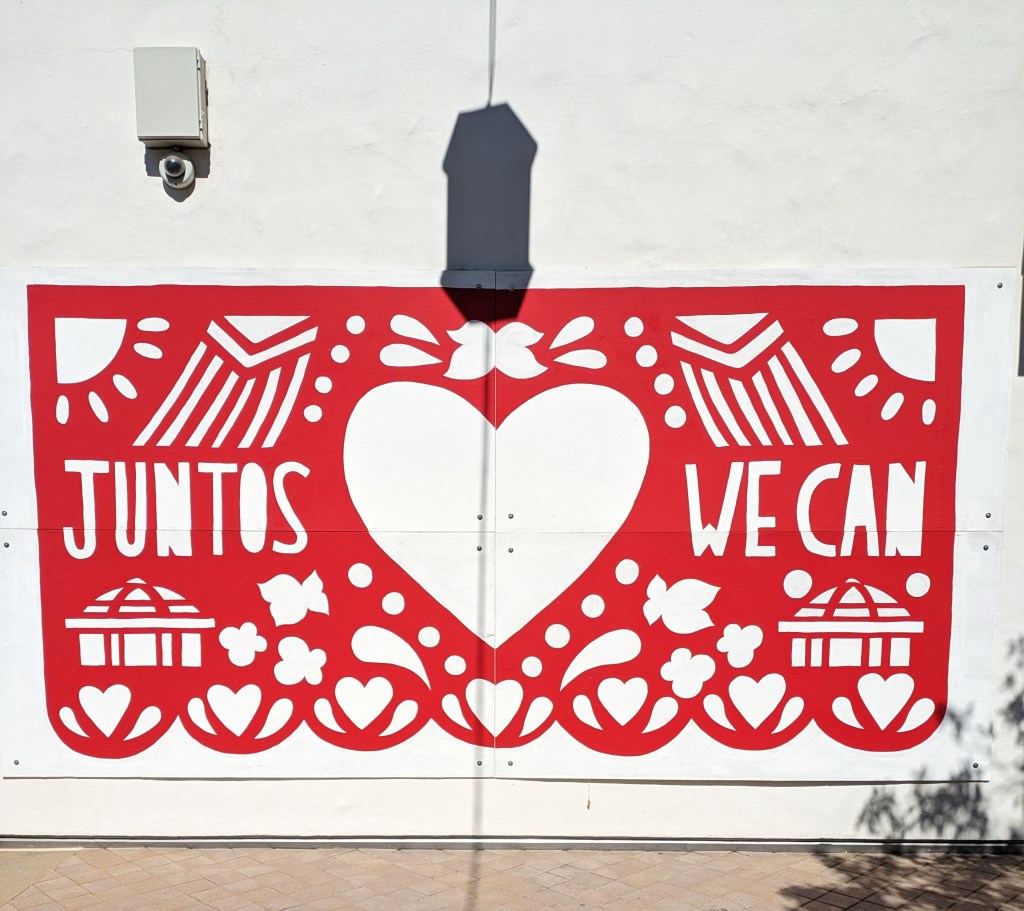
Together

“[Together] we can”: a mural at San Diego State University, 21 October 2023. Photo by the Russian Reader

While the emergence and flowering of Spanglish in the US is no surprise, the fact that Rusglish has taken root in Russia itself should give us pause for thought. The affliction is particularly fierce among the country’s creatives and journalists.


“Запускать свой бизнес в ритейле — задача не из лёгких. Особенно если нет релевантного опыта. Отличным решением может стать развитие бизнеса в партнёрстве с более опытным игроком по модели франчайзинга“.

“Launching your business in retail is not an easy task. Especially if there is no relevant experience. A great solution could be to develop a business in partnership with a more experienced player on the franchise model.”

Source: Emailed invitation to a “business breakfast” from the business daily Delovoi Peterburg, 23 October 2023. All the bolded words are in Rusglish in the original.


Sixteen years ago today, I launched this website by translating and posting the artist and writer Pavel Pepperstein’s reflections on “post-socialism” as “ecosocialism.” They are cheeky and provocative and non-intuitive and thus, in retrospect, emblematic of the stories and viewpoints from today’s Russia that I knew were roundly ignored in English-language media and that I wanted badly to make available to the wider world.

I had no idea, then, that this adventure would last sixteen years or that, as of today, this blog would balloon to 2,500 entries. I did, however, have more than a presentiment that things were going badly in the Motherland and would probably get much, much worse. While I have never tried to avoid staring into this burgeoning (and, now, almost total) political darkness, I also have always been determined to focus on the anti-Putinist, non-Putinist, and “a-Putinist” side of public opinion, cultural production, and politics.

What this has meant, practically speaking, is that even sixteen years later and amidst a terrible war that has, seemingly, riveted the world’s attention to the Russian regime and its enemies, I am often the only English-language media outlet to cover certain stories from the deep Russian grassroots in the so-called provinces, especially stories involving non-violent and direct action anti-regime and anti-war protests. I have commented many times in the past why such stories are ignored.

Whatever the case, though, my focus on extraordinary “ordinary” Russian battlers from the back of beyond, that is, on people who are remote from the Moscow-Petersburg opposition elites (even when they might even live in one of the two capitals) has meant that, sixteen years later, I’m still struggling to get over the million-views hump, and my admittedly modest attempts at fundraising have mostly fallen flat. There is not much place for people like me and my Russian heroes in a profoundly anti-democratic and celebrity-mad world like ours.

This is not a preface to a tearful farewell. Although changes in my paid-work life mean that, for the immediate future, I won’t be posting here as often as I’d like, the value of the Russian Reader as an archive of a Russia that, perhaps, will never come to be, is still enough that I plan to keep it here and available to you all for as long as I’m able.

But it has become increasingly hard for me to report stories like the one below about Olga Nazarenko, an incredibly fierce anti-war protester from Ivanovo who died under extremely murky circumstances two weeks ago. What is hardest of all is the now almost overwhelming sense I have that these stories matter to almost no one, neither inside Russia nor outside of it. ||| TRR


A Russian anti-war protester who became a symbol of resistance to the Kremlin has died following a mysterious fall.

Local media said Olga Nazarenko died in hospital after a “fall from a height” two weeks ago that was described as an accident.

Several Kremlin opponents have been killed in falls and an anti-war activist in Rostov, southern Russia, also died this year in police custody from alleged torture.

On Facebook, tributes blamed Ms Nazarenko’s enemies for her death.

“Cursed are the cannibals who devour our finest,” one person wrote. Another said: “Our unbending Olga. Did they kill you?”

Friends also speculated she had fallen from a tree.

Ms Nazarenko was well-known for her stubborn anti-war protests and had featured in several opposition media reports and videos.

She had staged weekly one-person protests, despite being regularly detained by the police. She had also been attacked in the street and had lost her job as an associate professor at a local medical university because of her protests.

Hundreds of thousands of Russians have fled since the Kremlin banned anti-­war protests but Ms Nazarenko, who was married with an adult daughter and a young son, told the US-funded Radio Free Europe/Radio Liberty that she felt it was her duty to stay.

Source: James Kilner, “Kremlin gets blame as anti-war activist Olga Nazarenko dies after mystery fall,” Irish Independent (msn.com), 22 October 2023

Discourse

“My supervisors would prefer the text to be British English. Is that possible?”


What makes the Expanding Circle Englishes real rather than abstract varieties? This article highlights that it is culture that makes the specifics of an English variety whereas linguistic features might be shared by a number of other varieties Russian English as a linguistic entity is based on the specifics of Russian culture and mentality revealed on all language levels, lexical and phonetic levels being the most noticeable. The negative attitude towards the concept of Russian English can be accounted for by a) the theoretical confusion of the variety with its only one lectal subtype (taking the basilect for the variety), while any variety is a complex and a continuum of several lects; b) scholars’ understanding of a dynamic and functional variety characteristic of a speech community as an interlanguage of an individual with a fossilized level of language competence, and c) ignoring the fact that any variety expresses the cultural mentality in real life discourse. Change in the attitude in the speech community occurs with the gradual overcoming of these misunderstandings, which takes a fairly long time.


“We would prefer to use British English vs. American if possible.” 


Make (Blank) Great Again

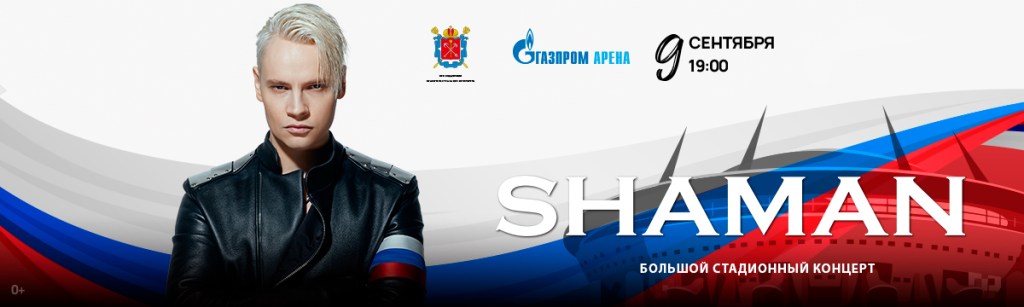
This ad for a “big stadium concert” by the Russian nationalist pop singer Shaman, scheduled for 7 p.m., September 9, at Petersburg’s Gazprom Arena, showed up this morning (for the second or third time in the last mont) in the weekly email newsletter I get from Bileter.ru, a Russian online retail ticket vendor. The aesthetic here is both strikingly fascistic/nationalistic and pointedly un-Russian. I would say it’s almost American in its inspiration, if I didn’t know better. ||| TRR


This showed up in my mailbox today too:

За последние две недели в редакции произошли изменения. У нас теперь новый руководитель редакции, а потому скоро вы ощутите изменения, которые make Inc. great again.

Here’s my translation:

There have been changes to [our] editorial board over the past two weeks. We have a new editorial director now, and so you will soon feel the changes that [will?] make Inc. great again.

These days, all “progressive” Russians are fluent in English, supposedly, and this is often how they signal their “progressive” values to each other: by shouting out their true reactionary colors in Rusglish.

In this case, the progressive reactionaries hale from Inc. Russia, “a magazine for entrepreneurs [that] focuses on small and medium-sized businesses, advanced technologies, and the people behind it all.” Founded in the US in 1979, the Russian edition has been in existence since 2016.

The passage that I quoted and translated, above, led off Inc. Russia‘s weekly email newsletter.

Immediately after Russia’s brutal, unprovoked invasion of Ukraine, the Russian Inc.ers were openly dismayed by the sudden turn of events in their otherwise entrepreneurially progressive country—without, however, ever going so far as to oppose the war explicitly. This dismay and confusion gradually and visibly diminished as the war continued. Now, apparently, Inc. Russia has come full circle: they are determined to show that they and their readers live in nearly the best of all possible entrepreneurial worlds. They’ve definitively stopped paying any mind to their country’s breakneck plunge into fascism, much less to the war itself.

And yet the new realities occasionally puncture Russian Inc.‘s otherwise now-placid surface, as in this news item published on their website earlier today:

English to become optional in the subway

It may become option to duplicate information in subways in English. The Transport Ministry has published a law bill addressing the matter. The Moscow subway stopped duplicating [station] names back in 2021, while Nizhny Novgorod and Kazan do not plan to give up English until instructions are received.

As reported by Kommersant, the Transport Ministry has published a draft law on amendments to the orders regulating the “standard rules” for the use of subways, monorails, funiculars, and suspended cable cars.

Carriers are currently required to duplicate all information on diagrams, signs, inscriptions, and station announcements in English. The Transport Ministry proposes doing away with this obligation, leaving the decision to the regions.

The proposal was prompted by “numerous appeals from citizens and [regional governments], due to the considerable informational burden on passengers and taking into account the socio-political situation.”

Moscow’s Metro, Central Circle, and Monorail stopped announcing stations in English back in 2021, after a drop in the number of tourists due to the pandemic and “passenger complaints about additional information.”

Oleg Yaushev, director of the Nizhny Novgorod Metro, said that none of the city’s residents had complained about the English dubbing in the city’s subway, so the company does not plan to remove it.

“We installed this information system relatively recently and spent a lot of money on it. Why remove it now? Tourists who are native English speakers travel to the city. The language is widely spoken, and we welcome them. Of course, if there is a directive to remove everything and leave it only in Russian, we will comply. But it’s not worth freaking out about it,” he said.

Kazan’s Metroelectrotrans also expressed its willingness to execute the order, “if it is issued.” However, local residents there have also not petitioned the company to cancel the dubbing of station names in English.

Source: Inc. (Russia), 14 August 2023. Translated by the Russian Reader


Russian streaming service Amediateka (thanks to the good offices of sanctions busters HBO) keeps its viewers comfortably ensconced in an alternate reality dominated by the Great Satan’s pop culture:

The second season of the sports series “Winning Time: The Rise of the Lakers Dynasty” recounts the period between 1980 and 1984. It deals with the rivalry with the Boston Celtics, as well as with the personal lives of the players, which prove no less emotional and striking than their play on the court. Jerry Buss wants to get his sons involved in working with the Lakers, Magic Johnson learns to be a good father, and Larry Bird plunges into family squabbles. Won’t this prevent the lads from becoming NBA champions?

Source: Amediateka email newsletter, 14 August 2023. Translated by the Russian Reader


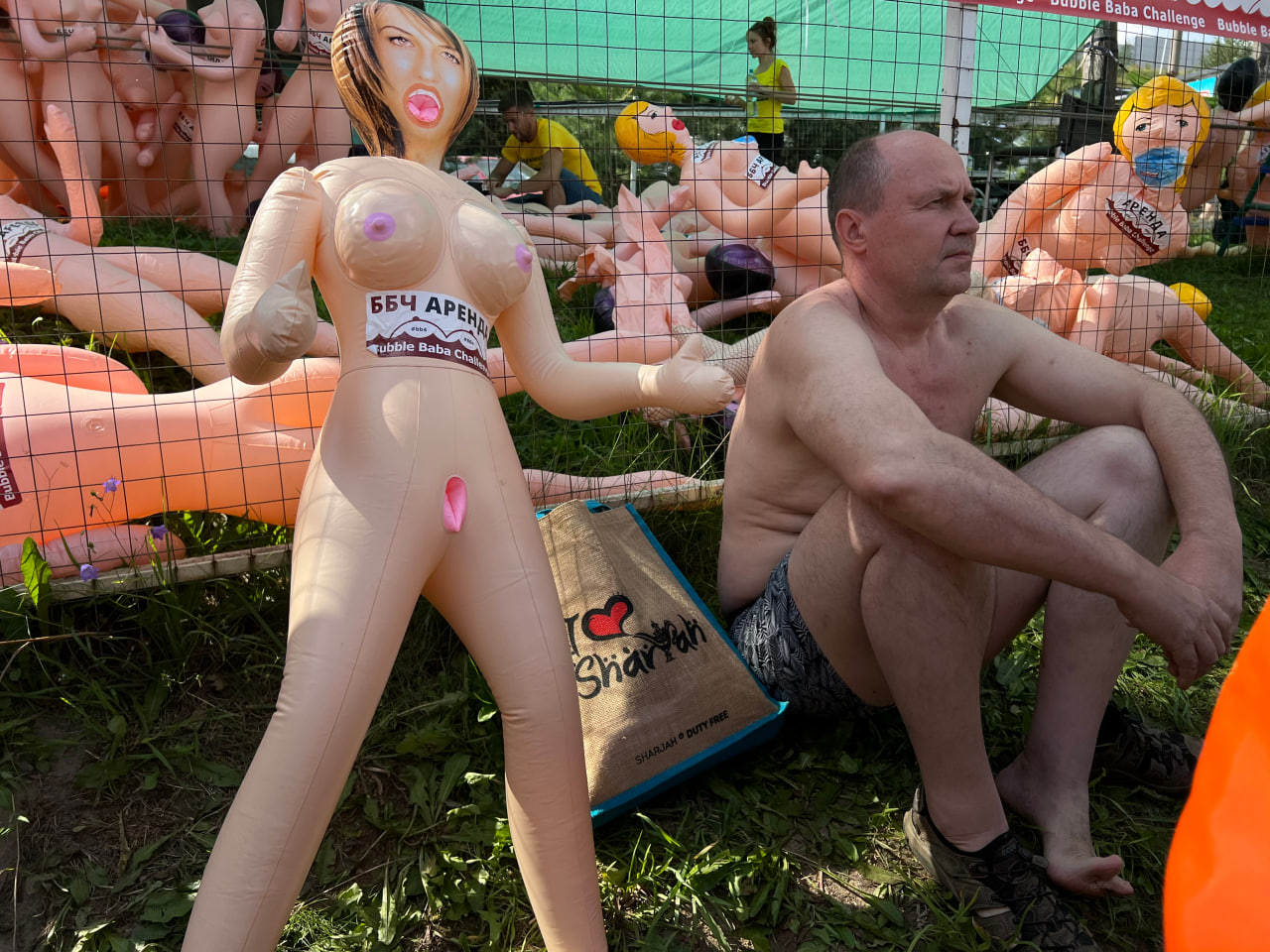
Finally, here is yet another reflection of the Russian petite bourgeoisie’s (and, hence, Russian officialdom’s) peculiar love-hate, cargo-cultish relationship with the “collective west” (i.e., the United States) and the English language.

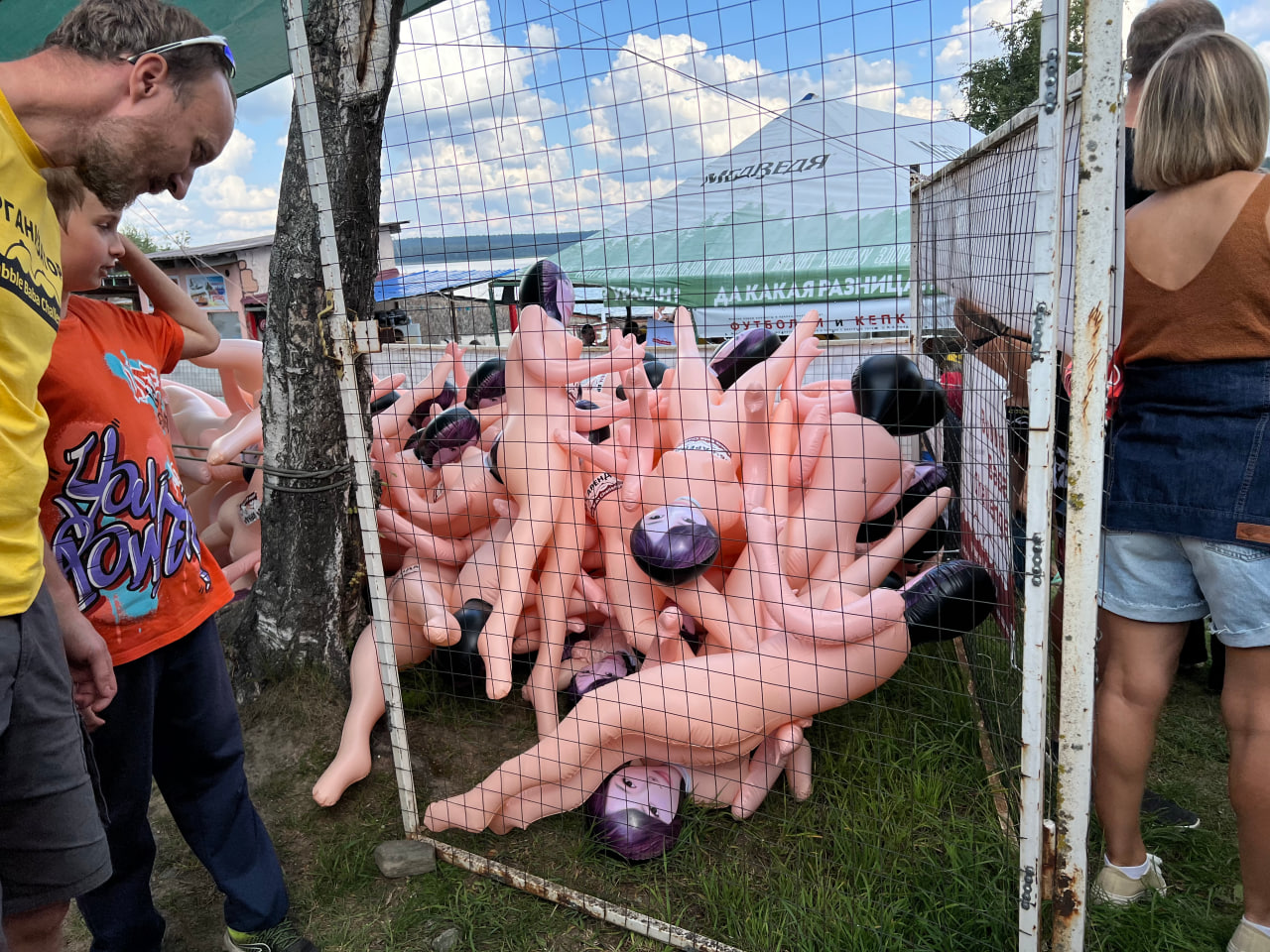
This past weekend, reports Bumaga, local sporting enthusiasts took part in the Bubble Baba Challenge — 2023 [sic, in English], “an event held in the rapids of [the] Vuoksi River whereby contestants race in the water using sex dolls as flotation devices.” The event took place in Kiviniemi, aka Losevo, in the occupied Karelian Isthmus, approximately 60 miles north of Petersburg.

Photos by Pavel Daisi for Bumaga (@paperpaper_ru)

Explainer

Source: Ukraine DAO Updates (Telegram), 5 August 2023. Thanks to Monique Camarra (EuroFile) for the heads-up.


Intensified air attacks on the Ukrainian capital following a drone strike on the Kremlin that Russia blamed on Kyiv forced Iryna, Svitlana, and Olya to spend their Ukrainian-language transition class in a cafeteria opposite the National Opera instead of the usual venue nearby, which was closed once the air alert went off.

The three women, hailing from Sevastopol, Enerhodar, and Donetsk — cities in Ukraine’s south and east occupied in various stages of Russia’s aggression — spent 90 minutes together with more than a dozen students, most of them women and also displaced, trying to elevate their Ukrainian and, as some said, to “break free” from their Russian.

Iryna has a son in the Ukrainian Army. She left her native Crimea, she said, because she “couldn’t live next to the Black Sea fleet firing missiles at our country.” She wants to switch to Ukrainian to “relieve herself of a sense of guilt.”

Svitlana came to Kyiv just two months ago. Her husband stays in Enerhodar, where he works at the Zaporizhzhya power station, Europe’s largest nuclear plant, captured by Russians at the beginning of their invasion. She is learning Ukrainian to “forget the months of occupation.”

Olya left Donetsk in 2014, the year a separatist war fomented by Moscow broke out in that region and neighboring Luhansk, hoping to return within several months. Now, after eight years away from her home in the Donbas, she is switching to Ukrainian because she decided to “focus on the future.”

Millions of similar stories make up the most rapid shift away from using the Russian language in Ukraine’s recent history. The number of Ukrainians who use Ukrainian exclusively or most of the time in their everyday life increased from 49 percent in 2017 to 58 percent in 2022, and the corresponding number for Russian dropped from 26 percent to 15 percent, according to a study conducted in December 2022 by prominent Ukrainian political scientist Volodymyr Kulyk and the Kyiv International Institute of Sociology.

The trend is even stronger in the public sphere, with 68 percent opting for Ukrainian and only 11 percent for Russian at work and during education. The transition is most significant in the south and east of the country, traditionally more Russian-speaking than western and central Ukraine, where switching to Ukrainian became the widespread sign of resistance to the occupiers.

The reality behind these numbers is more complex due to the nature of Ukrainian bilingualism, with almost everyone passively knowing both Ukrainian and Russian and many speaking their mixture, Surzhyk, minority languages such as Crimean-Tatar or Hungarian, and new trends, most notably the five-million-strong population of refugees who are developing new language practices abroad. But while many Ukrainians continue to use both languages in everyday life despite the anger at Russia that the invasion has ignited, the rapid shift from Russian to Ukrainian is apparent everywhere in Ukraine: in the streets, social media, bookstores, and, perhaps most significantly, private spaces.

Many in Ukraine celebrate the ongoing language shift, but the process, accelerated by Russia’s renewed attempts to erase Ukrainian culture and sow divisions in the country it is attacking, is far from painless.

[…]

Source: Aleksander Palikot, “‘It Will Perish When I’m Gone’: Russian Language Usage Plunges In Wartime Ukraine,” Radio Free Europe/Radio Liberty, 20 May 2023


Max Glebov, Guardians of Chaos: Invasion Armada

Mark Rich went from being a street kid in the ruins of a megalopolis on a fringe planet to being the commander of a joint squadron of two races, but the enemy has not been standing still all this time either. It looks as if the Swarm will be the first to build a ship the likes of which no one in the galaxy has seen for almost seventy years, and its newest battleship will serve as. the flagship of a revived Invasion armada.

Source: LitRes. Translated, from the Russian, by the Russian Reader. Thanks to today’s LitRes email flyer for the heads-up.

“Russia Isn’t a Fascist State, Because a Fascist State is Totalitarian, While Russia Is Democratic” (At the Sasha Skochilenko Trial)

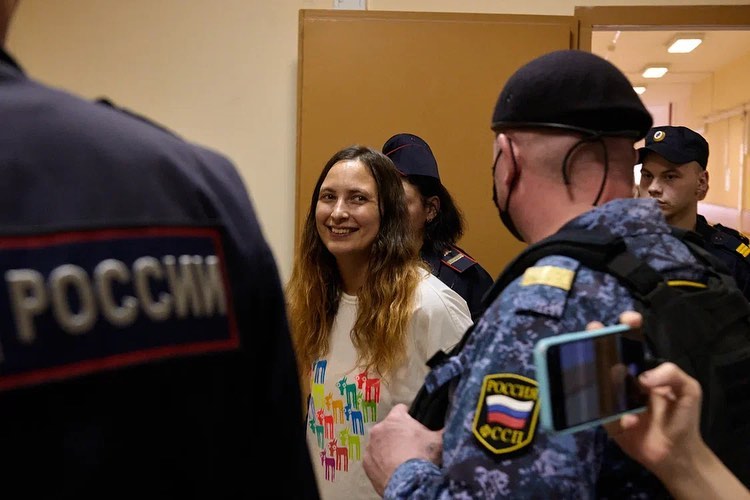
Sasha Skochilenko, facing ten years in prison for anti-war price tags. Vasileoostrovsky District Court, St. Petersburg, 18 July 2023

Today’s hearing lasted almost nine hours!

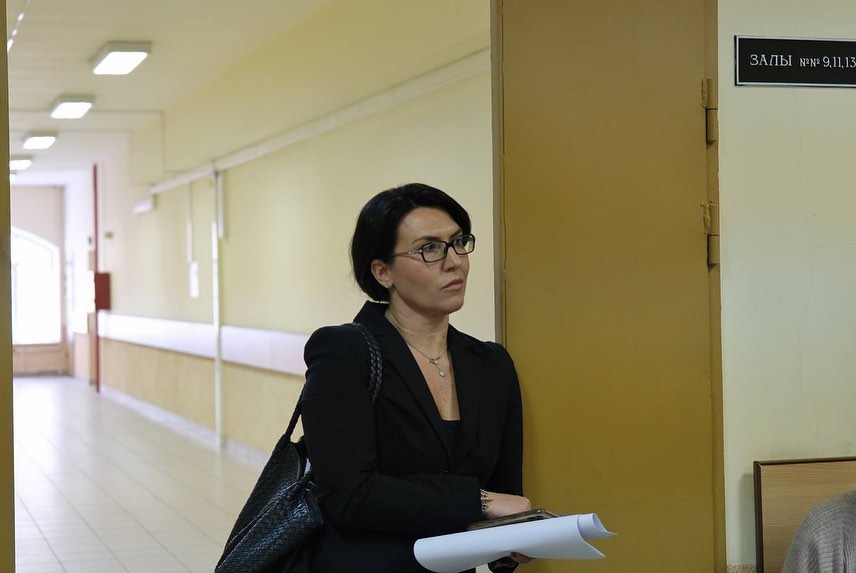
It was finally possible to resume the cross-examination of Olga Safonova, on whose linguistic analysis of the price tags the prosecution’s case is largely based. At the last hearing it transpired that Safonova is actually a political science specialist who is brought in to provide linguistic (!) expertise on “political” issues. Moreover, she has already admitted that she cannot judge whether the information on price tags was “knowingly false,” although she wrote just the opposite in her expert analysis.

The cross-examination of Safonova took up most of the hearing, and it involved the lawyers, the independent expert Svetlana Drugoveyko-Dolzhanskaya, Sasha [Skochilenko] herself, and Prosecutor Gladyshev. (The defense requested that Gladyshev be recused for a number of reasons—including because he distorted the facts about Sasha’s income—but the motion was denied.) Safonova had a visibly hard time answering questions about the content of individual price tags and the linguistic terms she employs, and how she was able to identify motives of “political enmity” in the texts she analyzed. In fact, experts cannot assess an author’s motives, but Safonova refused to confirm this outright. “Just stay that this is not within your competence,” the lawyer Novolodsky asked her. “I won’t,” she replied.

Olga Safonova, expert witness for the prosecution. Vasileoostrovsky District Court, St. Petersburg, 18 July 2023

This was not the only occasion for laughter at today’s hearing. During a discussion of the texts on the price tags, Safonova also claimed that Russia is not a fascist state, since “a fascist state is totalitarian, while Russia is democratic.” She also asked that the defense not “examine every word [said or written] by expert witnesses with a magnifying glass, for crying out loud!” (She said this, I would like to remind you, at a criminal trial that could send Sasha to prison for ten years.)

As always, we want to say a huge thank-you to the journalists who have been covering Sasha’s case, and to everyone who came out to support Sasha! The next hearing will be held on September 14, after the judge’s vacation. Safonova will be summoned to court again. In addition, the court ordered the linguist Grishanina, the co-author of the expert analysis, forcibly delivered to the hearing.

P.S. We will have more to say about today’s hearing, so stay with us!

Photos courtesy of Andrei Bok and others

#freesashaskochilenko

Source: Sasha Skochilenko (Facebook), 18 July 2023. Translated by the Russian Reader

On This Day, or, Cyka Blyat

Don’t turn off your TV set. Keep watching the “most exciting World Cup ever.” While you do that, actual Russians and some non-Russians (i.e., Oleg Sentsov) are suffering horribly for the near-absolute power Russia’s Emperor of Ice Cream and his retinue have acquired over the last twenty years.

It was this same power (and the money that comes with it) that made it possible for the Emperor of Ice Cream and his pals to buy off FIFA’s bid committee and win the right to host the 2018 World Cup. They invoked this same power to spend more on preparations for the World Cup than any other host country has ever spent.

But instead of doing what enlightened despots have been known to do on such occasions — declaring amnesties, pardons, and ceasefires during Olympic Games and other such celebrations and great sporting events — the Emperor of Ice Cream’s repressive and imaginative secret services have seemingly notched up their civil war against their own people while you stay glued to your TV set, pretending it is possible to separate sports from politics.

Tell that to Yuri Dmitriev, rearrested and recharged for a crime for which he had recently been acquitted. Tell that to the Penza-Petersburg “terrorists,” all of them tortured by the FSB (KGB) into forcing them to give the testimony the FSB wanted to hear, never mind that it is total nonsense, the sick fantasies of the FSB itself, which sees or, rather, pretends to see a “terrorist” hiding under every rock. Tell that to Oleg Sentsov, a Ukrainian filmmaker and resident of Crimea, sentenced to 20 years in a maximum security correctional facility in Russia’s Far North for the thought crime of opposing Russia’s occupation of Crimea.

Source: Thomas Campbell (Facebook), 29 June 2018


“The amount of pollution caused by idling cars is incredible.”

Nigel Havers, “PM,” BBC Radio 4, 29.06.17

Source: Thomas Campbell (Facebook), 29 June 2017. As a blogger quoted on Dictionary.com notes, ‘While there is no exact English translation, the Russian phrase cyka blyat (сука блять in the Russian alphabet) is roughly equivalent to the English “fucking shit” or “bitch whore.” Cyka means “bitch” while blyat is a multifunctional vulgarity along the lines of “shit” or “fuck.” Together, cyka blyat is used to express uncontrollable anger, similar to dropping a series of F-bombs in English.’


It’s frightening how “natural” absolutely neo-Nazi-like racialism has come to seem to so many folks in the Former East. It really beggars the imagination. What went wrong?

And it’s all reproduced and disseminated, whether in private conversation or more impersonal forums like Facebook, with such aplomb and confidence, as if literally no else in the world has thought or could think otherwise. Even broaching, in the most primitive way possible, the idea that races are a “construct” used to dominate some “races” while advantaging others, not something “natural,” will only expose you to instant derision.

What “race” is this bird? Is it white or black? In fact, it’s black, white, and several shades in between. Obviously, this is an absurd conversation, since we superior beings don’t attribute “race” to birds.

But we do attribute it to each other, missing somehow that the whole point, the only point, is power. Natural’s not in it.

Source: Thomas Campbell (Facebook), 29 June 2017


One of the keys to successfully translating contemporary Russian avant-garde poetry into English is having absolutely no sense of colloquial English. The translations should sound leaden, awkward, and dull, as if they had been written by a manager in the Flint, Michigan, water department trying to justify his criminal negligence in an impenetrable and evasive letter to the EPA, to wit:

I feel fear.

I am afraid of something, but I don’t know what.

Wherever you were, you must get

from wherever it was

to the place from which you left.


Why do you assume that your toothache corresponds to the fact

that you hold your cheek.

“Try our Piter Burger”

Source: Thomas Campbell (Facebook), 29 June 2016


A mace in the backseat of someone’s decked out ride.

Source: Thomas Campbell (Facebook), 29 June 2016


I’m totally wired.

Source: Thomas Campbell (Facebook), 29 June 2016


Russia’s cultural capital, where nice young men like this one are beat up in broad daylight by fascists, and the police protect the fascists.

Photo by Sergey Chernov

Source: Thomas Campbell (Facebook), 29 June 2013


More fascists at today’s LGBT Pride event in Petersburg, as photographed by the intrepid Sergey Chernov. He reports that a few of the fascists brought small children with them so that it would be possible to charge the LGBT activists with violating Petersburg’s fascist-inspired law against “gay propaganda” amongst minors.

Photo by Sergey Chernov

Source: Thomas Campbell (Facebook), 29 June 2013


Fascists posing as “Cossacks” at today’s LGBT Pride event in downtown Petersburg, where all the gay activists were arrested by the police, unlike the 200 or 300 fascists, who apparently enjoy near or complete immunity for crimes that would get anyone else arrested. Photo by one of the few faithful friends of freedom left in Petersburg, Sergey Chernov.

Photo by Sergey Chernov: “St. Petersburg LGBT Pride event: fascists.”

Source: Thomas Campbell (Facebook), 29 June 2013


Photo by Sergey Chernov: “St. Petersburg annual LGBT Pride event: stoned, beaten and arrested. Central St. Petersburg, today.”

Source: Thomas Campbell (Facebook), 29 June 2013

The Translator

This is the fantasy:

At a pinch he could do the same in French, but French specialists were two a penny, and, in any case, Russian was his thing. He loved the Cyrillic alphabet, the byzantine grammar, the soporific, sensuous sound of the Russian language. And once, he had loved a Russian woman.

[…]

“Let’s get some sleep,” said Hyde. “Tomorrow… sorry, make that today, you need to be on top form. The briefing book is right here.” Hyde tapped the file on the table. “Are you up to speed on the current jargon? Post-truth and alternative facts and all of that? What’s fake news in Russian?”

Feykoviye novosti,” Clive said without missing a beat. “But the purists are up in arms. Feykoviye is not a Russian word. It’s an anglicization. They think it should be lozhniye novosti. Lying news.”

[…]

Then he focused on the job in hand. The mental preparation was always the same, a limbering up of the mind, a rigorous testing of himself. He went through various linguistic exercises, tossing English words and phrases into the air like tennis balls, then hitting them across the net in Russian. It was natural, effortless; he felt completely at ease in either language.

[…]

“Clive was member of our Russian book club on the fourteenth floor of the UN,” Marina said, looking at Hyde.

“I was,” said Clive, looking straight at Marina and taking in every detail of a face he had done his best to forget for over a decade. He had also forgotten the particular musicality of her English, which gave her away as a foreigner. Now and then her “o” was slightly too long and her “r” was a little too hard, and sooner or later she would forget an article,* just as she had a moment ago. Her English was almost perfect. But not quite. It was all part of her infinite charm.

[…]

“Alexei had this thing about grammar. Said I had to speak clean Russian. Clean… That was his pet word. ‘Use the instrumental and not the fucking accusative.’”

[…]

After making love, they would lie in bed and smoke and talk about their favourite writers. They showed off to each other, Marina reciting Pushkin, Clive quoting Shakespeare, and then vice versa, switching effortlessly from English to Russian and back again. They chucked proverbs and abstruse words at each other until they dissolved in laughter.

Source: Harriet Crawley, The Translator (London: Bitter Lemon Press, 2023). Cover image courtesy of Bitter Lemon Press

* But check out the abuse and misuse of articles on display here, of all places:

HARRIET CRAWLEY, “THE TRANSLATOR”. IN CONVERSATION WITH SIR RODRIC BRAITHWAITE

  • Tuesday, 2 May 2023, 7:00 pm —8:30 pm
  • 5a Bloomsbury Square, London, WC1A 2TA, United Kingdom

Join us to hear Harriet Crawley discuss her latest novel, a love story and political thriller, with the former British ambassador to Russia, Sir Rodric Braithwaite. The Times has included The Translator in its list of “the best new thrillers”, and the reviews praise author’s descriptions of the everyday life in Moscow, her ability to create suspense, and the political relevance of the plot at the time when the Russian state has once again become a major geopolitical threat.

[…]

The Translator tells a story of two interpreters, one British and one Russian, who embark on a quest to protect vital communication infrastructure connecting the UK and the US from sabotage by Russian special operations forces.

Source: Pushkin House. The emphasis is mine. ||| TRR


While this is a bit closer to the often harsh reality:

Kill the Translator: A Song of Inadequacy


He’s the mad dog of letters, the scrivener of sin.

He stays up nights with dictionaries and gin.

He studies Icelandic with a six-fingered Finn.

            He’s the translator.


He trampled your iambs, desecrated your prose.

He mangled your message and stepped on your toes.

His syntax is suspect, his Swahili a pose.

            Maim the translator.


Your essay’s in tatters, your short story in ruins.

He rendered 'tomato' as 'the mating of loons'.

And tomorrow he’ll english your poem out of tune.

            Harm the translator.


It matters quite little whether he’s stout, thin, or black,

Venetian, Guatemalan, or from Hackensack:

Send him Derrida by mail, and an ounce of crack.

            Suicide the translator.


Stop the presses in Cape Town and summon the cops.

Make a pass at his mother, toss a spear at his pop.

And dare he protest, quote him Lacan till he drops.

            Crush the translator.


Rip his Oxford to shreds, set his grammars on fire.

Break all his pencils, call Nabokov a liar.

Instead of advances, blow him curses by wire.

            Unhinge the translator.


He’s a cheat and a fraud and the foe of good sense.

Promise him the heavens, but repay him in pence.

'Traduttore traditore,' they say, and hence:

            Kill the translator.

Source: The Russian Reader, St. Petersburg, October 1996. The poem was inspired by an incident (one of dozens) in my early career when I was paid a pittance to translate the catalogue for a show of contemporary Russian art in Finland. A few months later, I got a notice from the Finnish tax authority which made it plain that, officially at least, I had been paid several times that amount by the host museum, but the Russian curators had pocketed the difference, thinking I would be none the wiser.

If you don’t want this website and its free, unique, eye-opening content to be maimed, harmed, crushed, suicided, killed, or unhinged, show your support today by liking, commenting, sharing, or donating (via Stripe or PayPal — you’ll find the forms and links in the sidebar). It’s vital for me to know that there are actual people out there who value my unpaid labor of love, which is now in the midst of its sixteenth year. I’ve received only $137 in donations so far this year, alas. That’s not enough financial support for me for to keep doing this much longer, considering that last year, for example, my overhead costs alone were $1,620 (for internet, hosting, and online subscriptions), against only $1,403 in donations for the entire year. ||| TRR

Fourth Graders in TV’s “Bordertown” Reject Russian

Esikatselukuva
The Russian language has been popular for years at the Lauritsala School in Lappeenranta.
Earlier this year, it was still uncertain whether Russian classes could be set up due to a shortage of applicants.
In February, nine-year-old Aleksi Liuttu told Yle that he would be ready for Russian lessons.

In Lappeenranta, there has been insufficient enrollment to offer the Russian language as as elective starting in the fourth grade.

This is a rare situation, because for at least the last nine years, schoolchildren in Lappeenranta have been able to study Russian as an elective A2 language from the fourth grade.

Yle reported in February that the Russian language’s popularity in primary schools has plummeted rapidly in several cities. The decline was evident in the languages chosen by third-graders this spring, about a year after Russia began its invasion of Ukraine.

Spanish was the most popular language

No French groups will be formed in Lappeenranta this year either. Instead of Russian and French, fourth-grade students in Lappeenranta can elect to study Spanish and German as A2 languages.

Spanish was by far the most popular language. This was the first time that Spanish was offered as an elective in all primary schools in Lappeenranta. The language elective will be implemented in five schools, whereas previously it could only be pursued in two schools.

German groups will start at seven schools. There were almost equal numbers of those who chose French and Russian, but they were so scattered around the city that it was impossible to set up a group at any one school.

A language group is established when at least ten pupils have elected to study the same language.

Source: Tanja Hannus, “Historical situation in Lappeenranta: no Russian language class set up for fourth graders,” Yle, 29 March 2023. Translated, from the Finnish, by the Russian Reader. Thanks to my own fabulous Lappeenranta Finnish teacher Tiina Pasasen for the heads-up.