Today, we woke up to a rocket blast. The sound was so loud that it seemed to come from our building’s entryway. The windows shook, the parrot screeched, and the Doberman dashed into the bathroom. Good morning.
The blast had thundered in absolute silence: there had been no warnings on the online message boards. I even wrote to the neighborhood chat, asking whether this was the consequence of the U.S. refusing to provide us with intelligence or not. People suggested that there had been an alert, it had just lasted over eleven hours.
I got the engraved collar out of the closet. I don’t use it much: the color is too bright and it soils easily. But it has Hector’s name and my phone number printed on it in very big letters and numbers. I put it on him during heavy shelling. If there’s a blast nearby and the dog runs away from me in fear, I have a better chance of finding him.
We went outside. In the middle of the courtyard stood a young woman holding a baby in her arms. The baby was wrapped in a warm blanket, while the mother was wearing a robe and slippers. It was cold.
Having seemingly sized up my silent question, she made excuses in a recitative.
“He was frightened by the explosions, I couldn’t calm him down, he falls asleep better in the fresh air, I was scared to go out on the balcony because of the windows, so we ran out here.”
I offered to hold her baby while she went inside to get dressed.
The woman became anxious and clutched her bundle even more tightly, her hands reddened from the cold.
“No, no, God forbid!”
The maternal instinct is the strongest. That’s the way the world works.
I often remember a terrible story that happened in Kharkov. A gas cylinder exploded in an ordinary block of flats. It was December 2012. A man had brought the cylinder into his family’s flat, where he lived with his wife, three daughters, and tiny grandson. The cylinder exploded, the fire was fierce, and only one of the girls survived by some miracle.
I was working as a field journalist at the time. We were shooting a routine report nearby, and after our editor called, we rushed to the scene. We were the first to arrive, before the ambulances.
I won’t describe the horror we saw. Charred toys scattered around a yard were not a familiar sight in Kharkov thirteen years ago.
I will always remember what the eldest daughter did. Her name was Luba, and she was barely in her twenties. She was able to escape a room engulfed in flames onto the balcony. She was holding her seven-year-old sister Sasha with one hand, while with the other she clutched her ten-month-old son Klim to her chest.
Yes, I do remember their names.
Luba was screaming. People heard her and saw her, but they had no time to do anything. That young woman and very young mom jumped from the tenth floor — on her back. That was how she had tried to save her baby.
God, how strong her maternal instinct must have been to have stepped into the abyss like that, trying to save her baby.
I think about it often.
My daughter and I were chatting on the phone the other day as she was going home from work. She’s in Israel now, and we usually call each other when she’s on the bus home. Right as we were talking, Sashka read aloud the news that terrorists had planted bombs on buses in Tel Aviv.
“Get off the bus now!” I shouted into the phone.
It was another three minutes to the next stop.
In those three minutes, in those one hundred and eighty seconds, I didn’t just turn gray, age, and die. I killed and dismembered every terrorist on the planet, and I torched their homes, their cities, and their families.
Yes, it was maternal instinct.
Tomorrow is the eighth of March. The world has different ways of marking this day. In some places, the day is about gender equality and emancipation, while in other places it’s about the arrival of spring, a new hairdryer, and a teddy bear. But either way, it’s about women. There will be lots of flowers and lots of cards.
I also want to send a card to all the women of the world. With flowers, from Ukraine.
There’s nothing more monstrous than the “picture” on card. It shows Anya, my neighbor, and her only child, Artyom.
P.S. Whoever can, please pass my card on to the women in the American Congress who applauded their leader yesterday. Tell them that after their tumultuous applause and cheering about “billions of dollars saved,” a young woman stands in the middle of a courtyard in the Ukrainian city of Kharkov. Wearing a robe and slippers, she rocks her baby in the cold. He was frightened by the Russian missile which struck the neighboring courtyard.
Source: Anna Gin (Facebook), 7 March 2025. Translated, from the Russian, by the Russian Reader. Anna Gin is a blogger, writer, and journalist who lives in Kharkov (Kharkiv). You can also follow her on Telegram. Thanks to Alya Legeyda for the heads-up.
Brut America, “French Senator criticizes Trump,” YouTube, 7 March 2025
French politician Claude Malhuret critiqued the United States’ shifting stance on Ukraine and targeted President Donald Trump in his remarks during a general session of the French Senate on Tuesday.
Source: YouTube. Thanks to Olga Klymenko and Nancy Ries for the heads-up.
Monsieur le Président,
Monsieur le Premier ministre,
Mesdames et Messieurs les Ministres,
Mes chers Collègues,
L’Europe est à un tournant critique de son histoire. Le bouclier américain se dérobe, l’Ukraine risque d’être abandonnée, la Russie renforcée.
Washington est devenu la cour de Néron, un empereur incendiaire, des courtisans soumis et un bouffon sous kétamine chargé de l’épuration de la fonction publique.
C’est un drame pour le monde libre, mais c’est d’abord un drame pour les États-Unis. Le message de Trump est que rien ne sert d’être son allié puisqu’il ne vous défendra pas, qu’il vous imposera plus de droits de douane qu’à ses ennemis et vous menacera de s’emparer de vos territoires tout en soutenant les dictatures qui vous envahissent.
Le roi du deal est en train de montrer ce qu’est l’art du deal à plat ventre. Il pense qu’il va intimider la Chine en se couchant devant Poutine, mais Xi Jinping, devant un tel naufrage, est sans doute en train d’accélérer les préparatifs de l’invasion de Taïwan.
Jamais dans l’histoire un président des États-Unis n’a capitulé devant l’ennemi. Jamais aucun n’a soutenu un agresseur contre un allié. Jamais aucun n’a piétiné la Constitution américaine, pris autant de décrets illégaux, révoqué les juges qui pourraient l’en empêcher, limogé d’un coup l’état-major militaire, affaibli tous les contre-pouvoirs et pris le contrôle des réseaux sociaux.
Ce n’est pas une dérive illibérale, c’est un début de confiscation de la démocratie. Rappelons-nous qu’il n’a fallu qu’un mois, trois semaines et deux jours pour mettre à bas la République de Weimar et sa Constitution.
J’ai confiance dans la solidité de la démocratie américaine et le pays proteste déjà. Mais en un mois, Trump a fait plus de mal à l’Amérique qu’en quatre ans de sa dernière présidence. Nous étions en guerre contre un dictateur, nous nous battons désormais contre un dictateur soutenu par un traître.
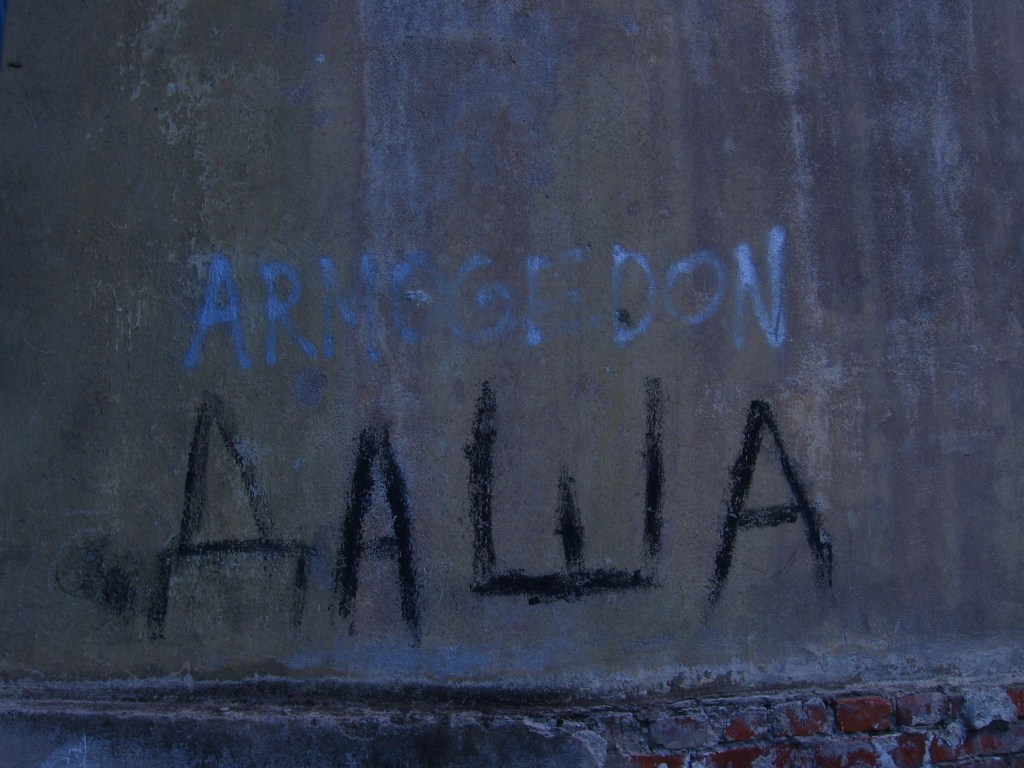
“Armogedon Dasha,” Kronstadt, Russia, summer 2006. Photo by the Russian Reader
If one starts from the premise that the United States was engaged in a peace process, then what we saw Americans do yesterday makes no sense. The same goes if we begin from the assumption that present American leadership is concerned about peace generally, or cares about American interests as such. But it is not hard to see another logic in which yesterday’s outrages do come into focus.
It would go like this: It has been the policy of Musk-Trump from the beginning to build an alliance with Russia. The notion that there should be a peace process regarding Ukraine was simply a pretext to begin relations with Russia. That would be consistent with all of the publicly available facts. Blaming Ukraine for the failure of a process that never existed then becomes the pretext to extend the American relationship with Russia. The Trump administration, in other words, ukrainewashed a rapprochement with Russia that was always its main goal. It climbed over the backs of a bloodied but hopeful people to reach the man that ordered their suffering. Yelling at the Ukrainian president was most likely the theatrical climax to a Putinist maneuver that was in the works all along.
This, of course, might also seem illogical, and at an even higher level. The current American alliance system is based upon eighty years of trust and a network of reliable relationships, including friendships. Supporting Russia against Ukraine is an element of trading those alliances for an alliance with Russia. The main way that Russia engages the United States is through constant attempts to destabilize American society, for example through unceasing cyberwar. (It is telling that yesterday the news also broke that the United States has lowered its guard against Russian cyber attacks.) Russian television is full of fantasies of the destruction of the United States. Why would one turn friends into rivals and pretend that a rival is a friend? The economies of American’s present allies are at least twenty times larger than the Russian economy. And Russian trade was never very important to the United States. Why would one fight trade wars with the prosperous friends in exchange for access to an essentially irrelevant market? The answer might be that the alliance with Russia is preferred for reasons that have nothing to do with American interests.
In the White House yesterday, those who wished to be seen as strong tried to intimidate those they regarded as weak. Human courage in defense of freedom was demeaned in the service of a Russian fascist regime. American state power was shifted from the defense of the victim to the support of the aggressor. All of this took place in a climate of unreason, in which actual people and their experiences were cast aside, in favor of a world in which he who attacks is always right. Knowledge of war was replaced by internet tropes, internalized to the point that they feel like knowledge, a feeling that has to be reinforced by yelling at those who have actually lived a life beyond social media. A friendship between Donald Trump and Vladimir Putin, a masculine bond of insecurity arising from things that never happened, became more important than the lives of Ukrainians or the stature of America.
There was a logic to what happened yesterday, but it was the logic of throwing away all reason, yielding to all impulse, betraying all decency, and embracing the worst in oneself on order to bring out the worst in the world. Perhaps Musk, Trump, and Vance will personally feel better amidst American decline, Russian violence, and global chaos. Perhaps they will find it profitable. This is not much consolation for the rest of us.
Foreign Ministry Spokeswoman Maria Zakharova’s comment on Zelensky’s voyage to Washington, D.C. (March 1, 2025)
Leader of the neo-Nazi regime Zelensky’s visit to Washington D.C. on February 28 is an epic political and diplomatic failure of the Kiev regime.
The Russian Side has repeatedly made it clear at all levels that Zelensky is a corrupt individual who lost his grip on reality and is unable to reach and honour agreements.
The Kiev regime refused to continue talks on a political and diplomatic settlement in the spring of 2022, using lies and fake claims to justify continued hostilities and keep receiving Western military and financial aid.
With his outrageously rude behaviour during his stay in Washington, Zelensky re-affirmed his status of the most dangerous threat to the international community as an irresponsible figure that can stir up a big war. It must be clear to everyone that this kind of attacks coming from a terrorist leader are quite unambiguous.
This cynical individual will stoop to anything in pursuit of his goals and is obsessed with preserving the power he has usurped. That is why he:
has destroyed the opposition,
built a totalitarian state,
ruthlessly sending millions of his fellow citizens to death.
Under the increasingly deteriorating political situation, this figure is unable to show a sense of responsibility and is therefore obsessed with continuing the war and rejects peace, which means death to him.
Unprecedented in history of international politics and diplomacy, a dressing down given to Zelensky by the US president in the White House is also indicative of the political weakness and extreme moral degradation of the European leaders who continue to support the maniac head of the Nazi regime who has lost touch with reality.
As before, we continue to operate on the premise that a truly just and durable peace is not possible unless the root causes of the Ukraine crisis are completely eliminated.
The main ones among them include:
the West breaking its promises not to expand NATO and the alliance’s absorption of Europe’s entire geopolitical space all the way up to Russia’s borders,
the Kiev regime’s systematic elimination of everything about Russia, including language, culture, and church, just like the German Nazis did in the past.
The demilitarisation and denazification of Ukraine, as well as recognition of existing realities on the ground remain Russia’s unchanged objectives.
The sooner Kiev and the European capitals come to realise this, the closer to a peaceful settlement of the Ukraine crisis we will be.
Rick Wilson: “And I truly believe that Donald Trump will very soon offer military aid to Russia. I believe this in my heart of hearts. I want every single one of you people who think, ‘Oh, this was such a brave moment of diplomacy,’ when Donald Trump starts offering Russia intelligence, and weapons, and support, and protection, I want you to tell me if you think you still live in the America you voted for.”
— I read about your wedding to Yana last year. Tell me, are you happy?
— Yes. But happy in what sense? I don’t feel like I’m in a happy period in my life as a human being. But I’m very happy with Yana. We didn’t even plan to get married: we just had to get married for the paperwork. We are now traveling a lot between countries and applying for visas, and it’s much easier to explain why Yana has to travel with me and I with her by showing them a marriage certificate than by telling them a long story about how we’re from Russia, where gay marriage doesn’t exist. Anyway, we got married, and it as if nothing has changed in our lives: we love each other just as much, and we have the same joint budget.
But the morning after the wedding, I woke up and looked at Jana and realized that she really drives me crazy.
And then Yana woke up and started looking at me funny. Basically, we went around for a week looking daggers at each other, and then we went to psychotherapists, each to her own, and found out that, despite the fact that getting married was a purely formal act to us, it meant a lot to our subconscious minds. That’s why all kinds of shit had started to come out of our heads, which had been building up there all our lives, as it transpired.
For example, after we got married, Yana suddenly moved from the category of “my lady love” to the category of “my family.” I have completely different requirements for my family. Yana looked at me and thought, “I never wanted to get married. Marriage is a trap, it’s the worst thing that can happen.” Because of her family history, she had come to the opinion that there was basically nothing worse than marriage. When we realized what was coming out of us, we just talked to each other and calmed down. Everything fell into place. Now my therapist says we should definitely learn to fight because it’s a good way to find a new common ground, to talk about things, to release emotions. We just haven’t fought yet.
— How many years have you been together?
— Three years. We’ve argued, we’ve been pissed at each other sometimes, but we’ve never really fought. My therapist says this is potentially the weakest point in our marriage, because people in real families should fight and yell at each other periodically. I agree with her. My sister and I or my mom and I sometimes yell at each other so hard that glass shatters. So now we’re learning how to fight.
— Don’t you think that the very fact that you were able to get married is a privilege for people from Russia?
— Of course I do. There is a huge number of people living in Russia who are no less deserving than me and who cannot get married because of their orientation. Of course, it’s very unfair. I’m aware of that, and I’m very grateful to the people who have given their lives, among other things, to make it possible for me to have a same-sex marriage in the United States and for that marriage to be recognized around the world by countries which agree on the simple fact that all people are equal and all people have the right to a family.
— You don’t feel guilty about that?
— No, because I remember that my goal hasn’t changed.
My goal is to get married on Red Square.
I believe that it will happen sooner or later. Every person should have the right to a family, every person should have the right to call their loved one a relative. This, by the way, should not necessarily be bound up with sexual orientation or gender identity. I think a lot about single women or men for whom the most important person in their life is a male or female friend with whom they would like to share a household, bequeath property to them, and identify them as their nearest and dearest. That is, the very mechanism of civil partnerships would be useful not only for LGBT people.
— In interviews you gave long ago, you said that people in Russia generally didn’t care who you slept with. Has propaganda succeeded in turning LGBTQ+ people into enemies?
— I’m not in Russia at the moment, so I can’t see what is happening there now. But I am glad that for every snitch and provocateur who goes to a gay club to turn people in to the cops, there are hundreds of people who know that their friends, brothers and sisters, and coworkers are not hetero- or cisgender people, and yet do not go to the authorities and snitch on them. But of course this is a very difficult time, because, pardon the expression, all sorts of scum who derive power and joy from the fact that they can take away another person’s life feel quite free and easy in Russia now, because a group of people with whom they can do as they pleased has been pointed out to them, and the state will only pat them on the heads for doing it.
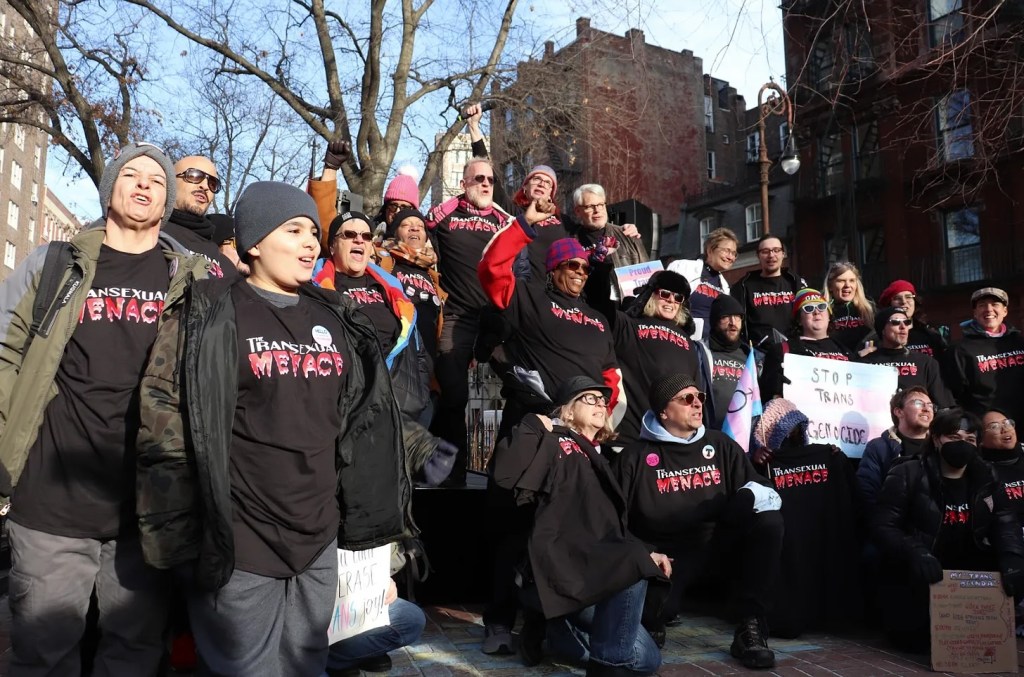
Protestors at Christopher Street Park pose for a photo. Photo: S. Baum/Erin in the Morning
This weekend at Stonewall, trans pasts and trans futures collided. The crowd of over 300 people at Christopher Street Park cheered on as the two kids took the stage, all smiles as they were wrapped in the pink, white and blue. They were led by Denise Norris, co-founder of The Transexual Menace, a direct action group which began organizing against trans exclusion in 1993.
In 1969, the Stonewall uprising spilled out from the iconic gay bar and into the streets — including that same park, a small patch of pavement and grass across the road. Many see this as the birthplace of the LGBTQ liberation movement as we know it today.
Now, a new generation has joined the fight.
“Even in our middle school, which supposedly accepts everyone, we face hate from many of our classmates,” one of the kids told the crowd.
They passed the mic to their friend. “They’re saying, ‘Oh, this school is progressive. And we don’t stand up for hate, and homophobia, and transphobia,’” the other youngster added. “Well, maybe they should do something about it.”
But Saturday’s rally was living proof of trans histories, resilience and joy. One protestor held a sign reading: “We are older than your laws and we will outlive them. There are queer and trans kids, adults and elders in the future.”
People gathered at Christopher Street Park in New York City to protest the Trump Administration’s repression of trans people on Feb. 22, 2025. Photo: S. Baum/Erin in the Morning
The area in and around Stonewall, including the park, was incorporated into the National Parks Service in 2016 as a historical monument of the West Village enclave where trans, queer and gender nonconforming youth made their home for decades. But after Trump’s return to office, even the NPS webpage for Stonewall saw the word “transgender” removed.
“Before the 1960s, almost everything about living openly as a lesbian, gay, bisexual (LGB) person was illegal,” the new website now reads, the “T” conspicuously missing. “The Stonewall Uprising on June 28, 1969 is a milestone in the quest for LGB civil rights.”
Norris spoke about organizing the event within her own intergenerationally trans family, including her nephew, Garrett. Now in his twenties, Garrett is working with his aunt to cultivate a national network, encouraging trans people and their allies everywhere to take autonomous action.
“If you don’t want to be transgressive, if you’re not here to make the systemic change that we need in this society so trans people have space to be equal — not merely acceptable — you might as well be the ‘transgender happy friends,’” Norris told Erin in the Morning at the rally. “The battle is not about if we are going to be passable or acceptable to the oppressor. It doesn’t matter if you’re ‘passing,’ they’re still going to come for you.”
The Transexual Menace, whose blood-stained logo is a campy, tongue-in-cheek nod to “The Rocky Horror Picture Show,” cut its teeth mobilizing against trans exclusion from queer spaces and causes in the 1990s. Where some gay and lesbian organizations sought to align themselves with more white, heteronormative, upper class sensibilities, the Transexual Menaces — “Stone Butch Blues” author Leslie Feinberg among them — refused to center respectability politics in their actions, Norris said.
At the rally, speakers showcased a tour de force of trans life spanning generations. Dr. Carla Smith, CEO of The NYC LGBT Community Center, told the crowd how she brought along her wife and grandchild. Jay Walker, a founding member of groups like the Reclaim Pride Coalition and Gays Against Guns, led the protestors in chants. Bernie Wagenblast, the much-beloved voice of New York City subways, was also spotted among the masses.
“We’re criminalizing trans people for existing and decriminalizing those that commit actual crimes, like Donald Trump and his 1,500 insurrectionists,” Toress said in her speech.
She could be heard from outside the metal gates of Christopher Street Park, which are adorned with archival images of trans and gender nonconforming youth — smiling, hugging, protesting. It was these street queens and butches of color that are said to have “thrown the first brick at Stonewall,” a common phrase used to characterize the much-mythologized riots. Protestors left bricks beneath the photographs in their honor.
How bad can it get? When we strip away US president Donald Trump’s insults and temper fits, what can he actually do?
First, he can withdraw US military aid to Ukraine – which he has been talking about doing since long before the US presidential election. If the European states got their act together, which is possible, the effects of this would be constrained.
At the “Russian troops out” march in London, 22 February 2025
US diplomats have reportedly threatened to block Ukraine’s access to the Starlink communication system on which its drones rely, potentially giving asymmetrical advantage to Russia.
Second, Trump can cancel sanctions. The latter would bring him into conflict with the Countering America’s Adversaries Through Sanctions Act of 2017, which was specifically designed to compel the president to lift sanctions only with Congress approval. Of course Trump could play fast and loose with the law, which he has done and is doing in other respects, and/or Congress could go along with him.
The cancellation of sanctions would be bad. But let’s not lose sight of the fact that the sanctions were never very effective, in large part because previous US governments, under both Trump and Biden, sought to limit their effect on the oil market and the world economy.
Third, Trump can shift narratives. I broadly agree with people who say we should judge Trump and his cohorts by their actions, not by the constant stream of often incoherent words. Yes, but. Nazi salutes normalise Nazism; speculation about expelling the Palestinian population from Gaza normalises ethnic cleansing; and slandering the Ukrainian president as a “dictator” who started the war in his country reinforces Russian propaganda.
On the third anniversary of Russia’s all-out invasion – and the eleventh year of its military attack on Ukraine, and the long chains of suffering it has caused – these are real dangers. It’s not clear how they will play out.
Tomorrow in Ukraine, Russian soldiers will attack Ukrainians. Russian drones and bombs and rockets will target Ukrainian homes. A criminal war of aggression will continue.
Tomorrow in Saudi Arabia, Russian officials will discuss the future of Ukraine with a handful of Americans, delegated by a president who sympathizes with the Russian view of the war. The Russians will have the luxury of talking about Ukraine without the presence of Ukrainians.
The headlines are about “peace negotiations.” But what is really going on? How should we think about this unusual encounter in Saudi Arabia?
Here are ten suggestions, drawn from years on working on relations among the three countries, and from some recent personal observations at the Munich Security Conference.
1. Be critical of the words on offer. Question the word “peace.” The term used in the media is “peace negotiations.” The United States and Russia are not at war. Russia is at war with Ukraine, but Ukraine is not invited to these talks. Russian authorities, for their part, do not generally speak of peace. They present the talks with the United States as a geopolitical coup, which is not the same thing. The highest Russian officials have repeatedly stated that their war aims in Ukraine are maximalist, including the destruction of the country. Informed observers generally take for granted that Russia would use a ceasefire to distract the United States and Europe, demobilize Ukraine, and attack again. This is not a plan that the Russians are working very hard to disguise. It is a simple point, but always worth making: there could indeed be peace tomorrow in Ukraine, if Russia simply removed its invasion force.
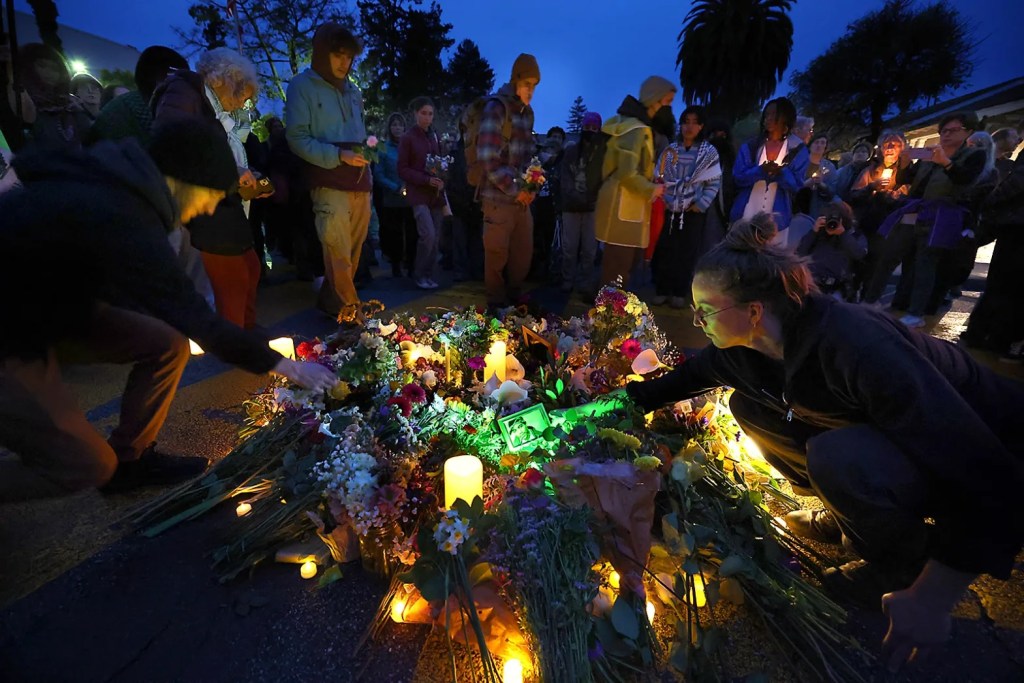
Hundreds of community members add flowers, candles and photographs on Sunday to an altar for healing for local civil rights activist Thairie Ritchie at the Black Lives Matter mural in front of Santa Cruz City Hall. Ritchie tried to self-immolate at the site on Jan. 20 just hours after President Donald Trump took his oath of office and the local Martin Luther King Jr. Day march brought hundreds of people past the mural. Ritchie was treated on scene and then airlifted to an out-of-area burn center where he is now being treated. Photo: Shmuel Thaler/Santa Cruz Sentinel
A light, misty rain fell over Santa Cruz Sunday afternoon as hundreds gathered in the downtown area to honor the life and pray for the recovery of a prominent local activist who set himself on fire in front of City Hall less than two weeks prior.
Thairie Ritchie, a well known Santa Cruz community organizer, reportedly self-immolated Jan. 20 atop the Black Lives Matter mural on Center Street in downtown Santa Cruz, only a few yards from the city’s power center. According to police scanner recordings from that day, first responders around the 5 p.m. hour were at the corner of Locust and Center streets in response to a “male who set himself on fire.” The response was triggered only a few hours after the annual Martin Luther King Jr. Day march had finished inside the neighboring Civic Auditorium and President Donald Trump had taken his oath of office for the second time in Washington.
Ritchie’s family, friends and acquaintances quietly poured into the open-air patio of Bike Church Santa Cruz on Sunday, the second day of Black History Month, with many carrying flowers as they embraced one another with tears in their eyes. The smell of incense and burning sage was carried by the crisp winter air as the sun set behind a gray curtain of clouds that covered the more than 300 people that had assembled to collectively process the incident.
Inside space had been cleared to set up a vigil for Ritchie, 29, with photos, candles and seating along with cookies and other snacks. Pens and paper were passed around for visitors to write private notes that many hope he will soon read as his recovery begins.
Ayo Banjo, a friend of Ritchie and the designated media contact for the event, said that Ritchie was awake Sunday and recovering in an intensive care unit. He said “a lot” of Ritchie’s body was covered in burns but declined to share a percentage, adding that the recovery process is estimated to take about six months.
“He (Ritchie) means a lot to us because he was all about community and everybody here from all different walks of life, all different races, all different genders, all different places, come together because we celebrate his representation,” said Banjo. “He is the example of what I think makes America, America. The ability to bring everyone together around issues that are beyond us and bigger than us. And I think that message has to be communicated.”
Today, there was one happy man in the Kremlin. Vladimir Putin banked his legacy on an all-out war that, at one point, looked all but lost for him. But he waited long enough to see the tides change in his favor.
Three years in and hundreds of thousands of deaths after, the U.S. president is calling Putin, offering peace talks on Russia’s terms.
Hi, my name is Oleksiy Sorokin, I’m the deputy chief editor of the Kyiv Independent, and this is the latest issue of our Russia-themed newsletter.
Today we will talk about how Russia is about to win the war.
It’s a topic of debate when authoritarian Russia began morphing into a totalitarian state, but Feb. 24, 2022, is a point that finalized this transformation. A point of no return.
The all-out war was supposed to be quick. It was supposed to be a victory of a new world order and of a new Russia, once again a force that would decide the fate of the world, a force that people would fear.
Taking Kyiv, installing a new Russian-controlled government, and forcing Ukraine to recognize Crimea, Donetsk, and Luhansk as Russian was to be achieved within months, if not days.
The country Putin attempted to subjugate, however, was fiercely resisting. Something that Russian political and military leadership didn’t expect and didn’t prepare for.
Yet, over and over, Russian President Putin was bailed out by the West.
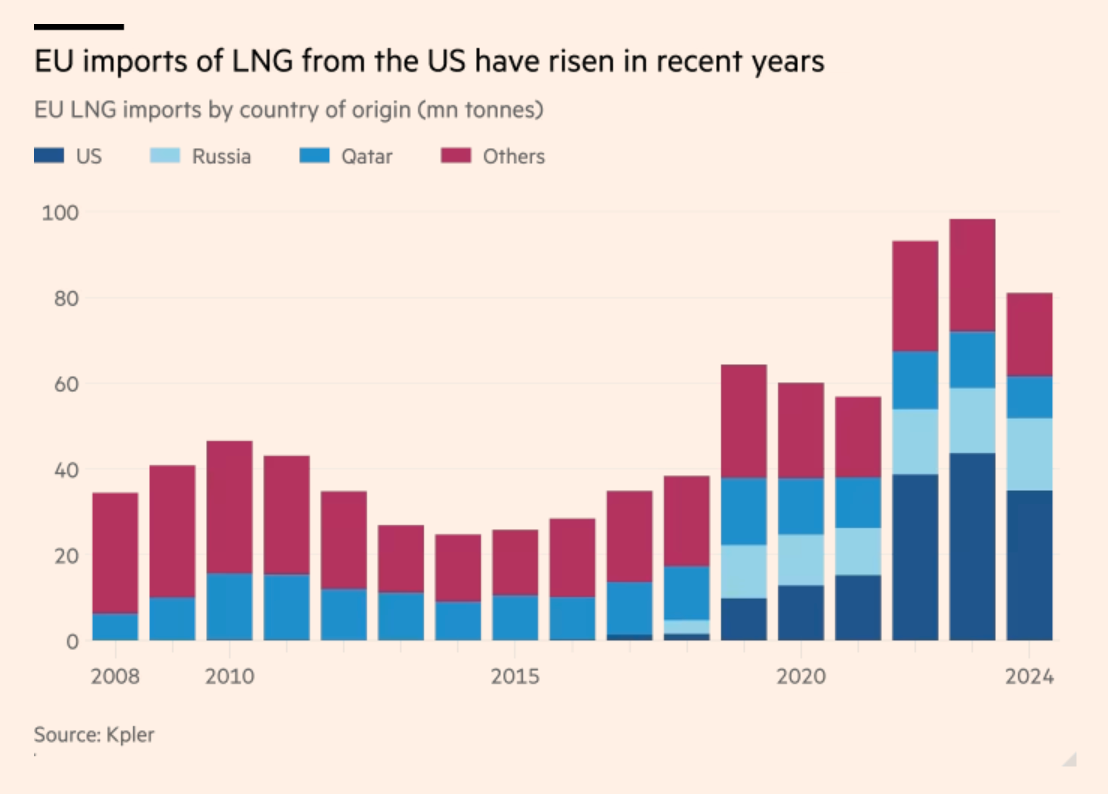
In 2022, Russia was making fortunes on selling off its energy resources to the West. When Russian troops were murdering civilians of Mariupol and nearing Kyiv, Moscow’s war chest was being replenished by Europeans.
The slow phasing out of Russian energy resources in the West allowed Russia to iron out its pivot to the East, building a formidable shadow fleet to transport its energy resources to anyone willing to buy.
When Russia began to lose ground and prepare for a Ukrainian counteroffensive, the U.S. was slowing down military shipments, giving Moscow further breathing room.
Seeing that the West was unwilling to support Ukraine to the fullest and was willing to allow Russia to continue, Russia, well, continued.
Russian leadership doubled down, increasing attacks on Ukraine, making committing war crimes a state policy, and simultaneously choking all forms of dissent at home.
Ukrainian civilians and prisoners of war were tortured and often murdered, and children from occupied territories were abducted.
Domestically, Russia outlawed speaking against the war, with people receiving hefty prison terms for criticising the invasion.
For the majority, however, the state made sure their economic well-being and daily routines remained unchanged, allowing ignorance to flourish. The Russian economy was doing fine.
All this made Putin confident. He knew that time played in his favor. The U.S. would surrender, and Europe would be in no position to object. He was right.
While on the campaign trail, Donald Trump had made it clear that he has little interest in continuing to support Ukraine’s fight against Russia.
His comments of ending the war in “24 hours” were a figure of speech, but it was clear that some sort of peace plan would be presented by the incoming administration.
Russia listed its demands, Ukraine listed theirs. Both waited. The fighting went on along the front line.
Russia was in a better position to negotiate. The West’s unwillingness to truly stop Russia, especially if it meant causing any sort of inconvenience at home, allowed it to regroup and begin a major offensive, ongoing to this day.
What came next was too good to be true… for Russia.
On Feb. 11, U.S. Defense Secretary Pete Hegseth began his European tour. Off the bat, he made public the U.S. position concerning the upcoming peace talks.
Hegseth said, “Returning to Ukraine’s pre-2014 borders is an unrealistic objective,” and that NATO membership for Ukraine is not an option, effectively agreeing with Russia’s demands.
Then, Trump called Putin.
“We both reflected on the great history of our nations and the fact that we fought so successfully together in World War II, remembering that Russia lost tens of millions of people,” said Trump following the call, parroting the Kremlin’s favorite line of the huge sacrifice Russia undertook in a war that ended 80 years ago, and how it is for whatever reason relevant today.
“As we both agreed, we want to stop the millions of deaths taking place in the war with Russia/Ukraine. President Putin even used my very strong campaign motto of ‘common sense’,” Trump added.
“We agreed to work together, very closely, including visiting each other’s nations. We have also agreed to have our respective teams start negotiations immediately, and we will begin by calling President Zelensky of Ukraine, to inform him of the conversation,” he went on.
The next day, Trump proposed to return Russia to G7, the intergovernmental political forum of the most developed democratic countries from which Moscow was kicked out following the start of its war in 2014.
Russian officials and pro-war public figures were openly excited about Trump’s moves.
“The movement that has begun is the result of the heroic work of our fighters and the principled position of Vladimir Putin, who speaks of openness to negotiations but firmly defends Russia’s national interests,” said lawmaker Evgeniy Revenko, deputy head of Putin’s United Russia party.
“Zelensky’s days are numbered, and Trump’s arrival at the Victory Parade in Moscow no longer seems like a fantasy,” he added.
“The phone call between Putin and Trump will go down in the history of world politics and diplomacy. It is not a breakthrough yet, but perhaps the first step towards one. I am sure that in Kyiv, Brussels, Paris, and London, they read Trump’s lengthy commentary on his conversation with Putin with horror and cannot believe their eyes,” said Russian Senator Aleksey Pushkov.
I can’t believe I’m saying this, but I agree with Mr. Pushkov.
Following the call, the Kremlin said, “We, of course, understand that our main counterpart in this process is Washington.”
And here we are today. It took three years, but Russia is where it wanted to be from the start — at a table with the U.S. deciding the fate of the world without the world’s consent.
Putin will push for more, seeking to squeeze the most out of Washington, and give nothing in return.
Russia would demand to keep the territories it controls, and most likely try to take the ones it doesn’t. According to Russia’s new constitution, Russia sees Ukrainian Crimea, and four oblasts — Donetsk, Luhansk, Zaporizhzhia and Kherson — as its own. Russia doesn’t have full control of any of the four.
With NATO off the table, other demands might be thrown at Trump, reducing Kyiv’s army or legalizing Russian language and influence in Ukraine.
Whether the U.S. will agree, and most importantly, whether Kyiv and the EU will go by the agreements that Moscow and Washington are set to achieve behind their backs, remains to be seen. There’s a strong chance that they won’t.
But overall, the sun is now much brighter for Putin than it was just a few days ago.
Eleven years of fighting against Ukraine, three years of all-out war and thousands of war crimes committed, Putin isn’t a pariah anymore. His worldview is on track to become mainstream, and it’s the leader of the free world who is leading him back to the table.
Russians refuse to sell insulin and other vital medicines to Ukrainians without Russian passports, reports Ukrainian intelligence (Ukrainska Pravda, February 7th)
How can Ukraine solve the problem of documents from the occupied territories? Human rights defenders share their vision with international partners (Zmina, February 7th)
A janitor, a cook, an informer — who is being tried for collaborating with the enemy? (Kharkiv Human Rights Protection Group, February 6th)
Russian FSB carry out new terror raids and arrests by quota in occupied Crimea (Kharkiv Human Rights Protection Group, February 6th)
Human rights and humanitarian legal norms: 2024 review (Crimea Human Rights Group, 5 February)
Viktor Dzytsiuk was almost tortured to death in occupied Donbas. Now Russia is continuing his torment (Kharkiv Human Rights Protection Group, February 5th)
ZMINA took part in a discussion on the cultural decolonisation of Crimea (Zmina, February 4th)
Russian FSB uses shoddily faked video to charge 63-year-old woman abducted from occupied Ukraine with ‘terrorism’ (Kharkiv Human Rights Protection Group, February 3rd)
Ukrainian Holocaust survivor: Hitler wanted to kill me as a Jew. Putin is trying to kill me because I’m Ukrainian (Kharkiv Human Rights Protection Group, February 3rd)
How Ukraine lost faith in the Red Cross and UN (Kyiv Independent, January 22nd)
Prison medicine: ways to humanize it (Kharkiv Human Rights Protection Group, February 7th)
UN monitors report sharp increase in executions of Ukrainian POWs, and point to Russian officials’ effective incitement to kill (Kharkiv Human Rights Protection Group, February 7th)
The Centre for Civil Liberties Participated in the First World Congress on Enforced Disappearances (Centre for Civil Liberties, February 6th)
“I Urge You to Make Every Effort to Release Ukrainian Prisoners of War And Unlawfully Detained Civilians ” Maksym Butkevych at the UN Security Council (Centre for Civil Liberties, February 6th)
Saturday 15 February, 11.0 am — 4.0 pm, Conference: End the Russian invasion and occupation. National Education Union, Mabledon Place, London, WC1H 9BD. Register here.
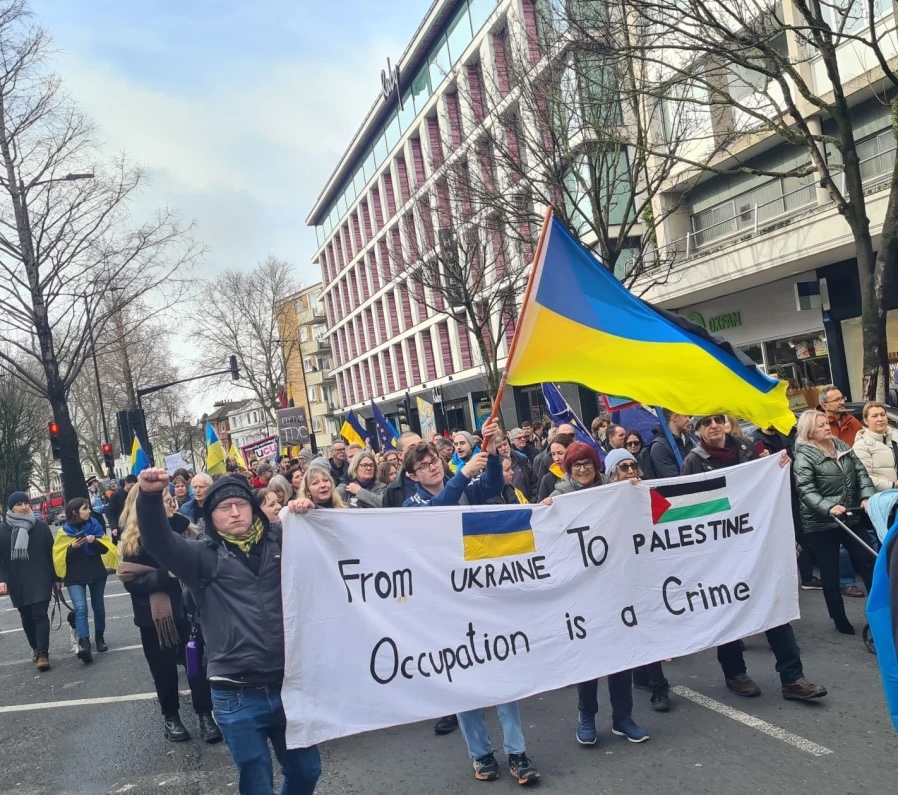
Saturday 15 February, 11.0 am – Palestine solidarity demo. To join the Ukraine-Palestine solidarity contingent, with our banner, “From Ukraine to Palestine – Occupation is a crime”, meet outside Banqueting Hall, corner of Whitehall and Horseguard Avenue, London SW1A
This bulletin is put together by labour movement activists in solidarity with Ukrainian resistance. To receive it by email each Monday, email us at 2022ukrainesolidarity@gmail.com. To stop the bulletin, reply with the word “STOP” in the subject field. More information at https://ukraine-solidarity.org/. We are also on twitter, Bluesky, Facebook and Substack, and the bulletin is stored online here.
Russia’s full-scale invasion of Ukraine in 2022 prompted a refugee crisis in Europe. News footage showed people piling onto trains and into cars, desperate to escape the threat of bombs and Russian occupation. In Kharkiv, a taxi driver named Sergii told me how in those chaotic early days of war, he had helped evacuate people as Russian missiles turned his bustling neighbourhood of Saltivka into a ghost town.
“I survived by praying to God,” Sergii said, pointing to the icon of the Virgin Mary dangling from his cab’s rearview mirror. “I helped people with no money get out of Saltivka, because people with money had already left.” He narrowly avoided death himself, he added, explaining a rocket had destroyed his apartment as he went out to his cab to retrieve the mobile phone he’d left on the front seat.
Nearly seven million people have now fled Ukraine. The majority have settled in European countries, many of which responded to the war by waiving visa requirements for Ukrainian refugees. Around 250,000 came to the UK, which decided not to fully lift restrictions but to instead introduce two emergency visas: the Ukraine Family Scheme and the Homes for Ukraine scheme.
At their outset, both visas granted Ukrainian nations the right to live, work and study in the UK for up to three years. Now, as the third anniversary of Russia’s invasion rolls around, anybody who arrived in the early days of the war is about to see their right to remain expire.
Yet this week, many Ukrainians faced the prospect that they may never be able to return to their homes. US President Trump announced he had spoken to his Russian counterpart, Vladimir Putin, to begin peace negotiations that risk handing over occupied regions of Ukraine to Russian control.
Residents of Ukrainian towns and cities previously liberated from Russian control, such as Bucha and Izium, have spoken about the reign of terror and cruelty they endured under occupation, including torture, rape, summary executions and false imprisonment. Should the peace deal go ahead on Putin’s terms, Ukrainian refugees in the UK face an increasingly uncertain future, with those whose homes are in the occupied territories potentially unable to return.
But even before the announcements from the White House and the Kremlin, the UK’s visa schemes have long presented problems for the vulnerable Ukrainians they are supposed to support.
“Before the full-scale invasion, I had a normal life,” Nastya*, aged 24, told openDemocracy “I worked in a supermarket and a fabric factory. Everything was absolutely good. And then on 22 February 2022, the war started.”
At the time, Nastya lived in Uzhorod, a city near the Slovakian border. As missiles battered the country’s major cities and the Russian forces occupied cities such as Izium and Mariupol, committing war crimes in Bucha and Irpin, she decided to flee with her husband.
“It was a stressful time,” she admitted. “I did not know what the future would be and my family were scattered around the world, some in England, some in Germany and some in Ukraine.”
Nastya and her then-husband travelled to Germany, where her mother was living, before coming to the UK on the Ukraine Family Scheme in August 2022. “It was hard to get a job in Germany, especially as I don’t speak German,” she explained. “I didn’t want to live on benefits, I wanted to support myself and live independently. I had heard in the UK there were opportunities for work, so I relocated.”
Nastya and her husband’s visas took only a few days to be approved, and the pair moved in with her sister-in-law in Leeds, where Nastya found a job in a local factory. “The work was hard and physical with lots of heavy lifting but I was earning some money which is good,” she said.
After three months in the UK, Nastya discovered she was pregnant with her first child. It was happy news, but it came as her marriage was falling apart. “It was quite difficult,” she said. ‘My husband was very sad and there were a lot of horrible moments. I decided to separate from him and go to Germany to be with my mother to have the baby.”
Nastya gave birth to a beautiful baby girl, who shares her bright brown eyes and dark hair. While she had wanted to be with her own mother during the birth, as a newly single mum Nastya was keen to return to the UK, where her father and grandmother were living, to get a job, support her daughter, and start a new life.
She had assumed that as she had the right to live and work in the UK, her daughter would be able to join her on the same family visa scheme.
But what Nastya did not realise is that while she was caring for her newborn in Germany, the Conservative government had been quietly restricting Ukrainians’ right to enter the UK. The family visa scheme had been closed and Ukrainians were no longer allowed to sponsor fellow refugees to arrive on the Homes for Ukraine visa.
Now, if Nastya wanted to come to the UK, she would have to leave her daughter behind.
War in Europe
When the Homes for Ukraine scheme was launched in 2022, members of the British public could open their homes to Ukrainian refugees in exchange for an initial monthly payment of £350 from their local council, while Ukrainians who successfully applied for the scheme were granted the right to live, study and work in the UK for three years.
But in February 2024, the then-Tory government brought in a series of changes. It halved the length of time a new Ukrainian applicant would be able to stay in the UK to 18 months, and amended the rules so that only people with British citizenship can sign up to become hosts. At the same time, it cancelled the family visa scheme, meaning Ukrainian nationals living in the UK can no longer sponsor family members to join them.
These changes have effectively made it impossible for Ukrainian nationals in the UK to help loved ones to settle here to escape the war. Now, Ukrainians wanting to come to the UK are reliant on there being an available British citizen who will take them in. But this, too, has suffered changes that have made it a less appealing prospect for many hosts.
In November, the Labour government announced all British citizens signed up to the Homes for Ukraine scheme will be paid £350 a month, regardless of how long they have been hosting. Households who have been hosting for more than a year are currently paid £500 a month.
Even before this announcement, the number of hosts was in decline, according to openDemocracy’s analysis of government data. In the third quarter of 2023, 100,061 households in England received the monthly ‘thank you’ payment, but by the third quarter of Q3 2024, this had fallen to 48,533 households, the lowest number since the full-scale war began.
This decrease in hosts was also apparent in our review of Homes for Ukraine Facebook pages. While at the start of the war, posts from Ukrainians looking for sponsors received multiple comments from potential hosts, these days they often garner no responses or are met with ‘jokes’, with one commenter saying: “I’d rather be in Mykolaiv than London”. Others respond telling those who wish to relocate to the UK from another European country, like Nastya, that the scheme is not for them: “People in the UK would prefer to sponsor people who are in Ukraine and need to be saved from war.”
“Instead of putting more and more administrative barriers in front of people fleeing war, the UK government must show it can match the solidarity and empathy shown by the people of the UK,” said Alena Ivanova, committee member of the Ukraine Solidarity Campaign, which is organising a march to the Russian embassy in London to mark the third anniversary of the full-scale invasion.
“We know that the vast majority of Ukrainians in the UK are vulnerable women, small children and elderly people who carry significant trauma as a result of Russia’s brutal war. The least we as a country can do is not put them further at risk and increase their anxiety but help them settle and rebuild their lives,” Ivanova added.
Those who arrived in the UK through either the Homes for Ukraine or Ukraine Family Visa scheme in the early days of the war are about to see their right to remain expire. But with the conflict ongoing, they can extend their visas via the Ukraine Permission Extension Scheme.
While this extension is undoubtedly needed, the process for obtaining it is fraught – and may put vulnerable people at risk of falling out of the system.
People needing an extension can apply only when they have 28 days or less left on their right to remain, which may impact their ability to work or be housed, with landlords and employers nervous about accepting Ukrainians who may not have the legal right to be in the country. Those who miss the extension window are at risk of becoming undocumented and therefore will be considered to be in the UK illegally. Although the war means it is unlikely these people will be deported, they would be unable to work or access housing, and are at risk of being removed in the future.
And applications for extensions can only be made from within the UK – a problem for women like Nastya in Germany, or for anyone visiting family in Ukraine.
Polling by the Office for National Statistics found that while the majority of Ukrainians are aware of the visa changes and the need to apply for an extension, a small minority of mainly vulnerable refugees, such as the elderly or young, are not.
Uncertainty is also built into the extension scheme. People will be able to extend their right to stay in the UK by only 18 months, half the three years they were initially granted. If they stay for the full term, a Ukrainian refugee’s total residency in the UK will have been four and a half years – six months short of the five years that a person must have continuously lived here to be eligible for the right to settle permanently.
There is also uncertainty for those British nationals hosting Ukrainians. If their guest is granted an extension, their host will need to reapply for thank you payments.
openDemocracy asked the UK government how it plans to deal with the temporary nature of the visas should the conflict continue for another 18 months. We also asked what plans they have in place should a peace deal cede Ukrainian territory to Russia, with those fleeing the occupied regions unable to return home. They did not respond.
‘I feel loneliness’
Nastya had always planned to return from Germany to the UK with her daughter. Here, she could work and have her own home where she, her daughter and her new partner, who is also Ukrainian, could live as a family.
Now, the changes to the visa schemes have cut her and her daughter off, leaving her living in limbo. She and her daughter face a choice: living in Germany where she struggles to find work and faces eviction from her refugee accommodation in the coming year, or returning to Ukraine which endures daily bombardment by Russian bombs and drones.
“In Germany, I face going into a refugee camp, which is no place to raise a child,” Nastya warned. “My mother lives in a separate city and so we cannot see each other regularly.”
Worse, the heartbreak of being separated from her father and grandmother has been devastating.
“They have never had the chance to meet their granddaughter and great-granddaughter,” she said, the pain of separation clear in her voice. “I have not been in touch with them face to face, and they would really like to meet. I want to see my father and grandmother and it is impossible.”
The changes to the visa schemes have left women like Nastya experiencing a double displacement. First, the full-scale invasion forced them from their homes in Ukraine. Now, changing government policy has separated them from family members in the UK.
“I have cried a lot,” said Nastya. “I feel loneliness, it is so hard that I can’t put it into words. I am crying a lot but I don’t want to blame anyone. If I would receive a visa for my daughter it would be really nice and I would be able to meet my family.”
Nastya has some hope. Last month, the Labour government partially reversed the changes made by the previous administration, allowing Ukrainians to bring their children to join them in the UK, a change described as a “welcome step in the right direction,” by Mubeen Bhutta, British Red Cross director of policy, research and advocacy. The charity has supported Nastya and her family.
“Our teams have supported people who had been unable to reunite with young children,” she said. “We’ve seen their pain and suffering and know this will mean a lot to families who have been torn apart. However, even with these changes many family members will remain separated.
“It is still very difficult for displaced Ukrainians to help elderly parents or partners find safety in the UK. It is vital that the government addresses these obstacles and helps more Ukrainians reunite with their loved ones.”
Nastya, who has a legal right to be in the UK, can now apply for an extension and for her daughter to join her. Her partner, however, must find a British national to sponsor him.
“It is really hard to be a refugee,” she said. “It is impossible to see a future for Ukraine. It would be really nice to go to the UK to work, to rent a flat, to pay taxes. This is what I need, simple things to be satisfied. I want my daughter to be happy, to have a good education.”
The Center for European Policy Analysis (CEPA) has called for increased economic pressure on Russia as well as secondary sanctions on companies supporting its war efforts in a new report, released Monday, timed with the Munich Security Conference kickoff. The public policy institution states that the former U.S. administration’s foreign policy had been too cautious, resulting in a “war of attrition that neither side can win.”
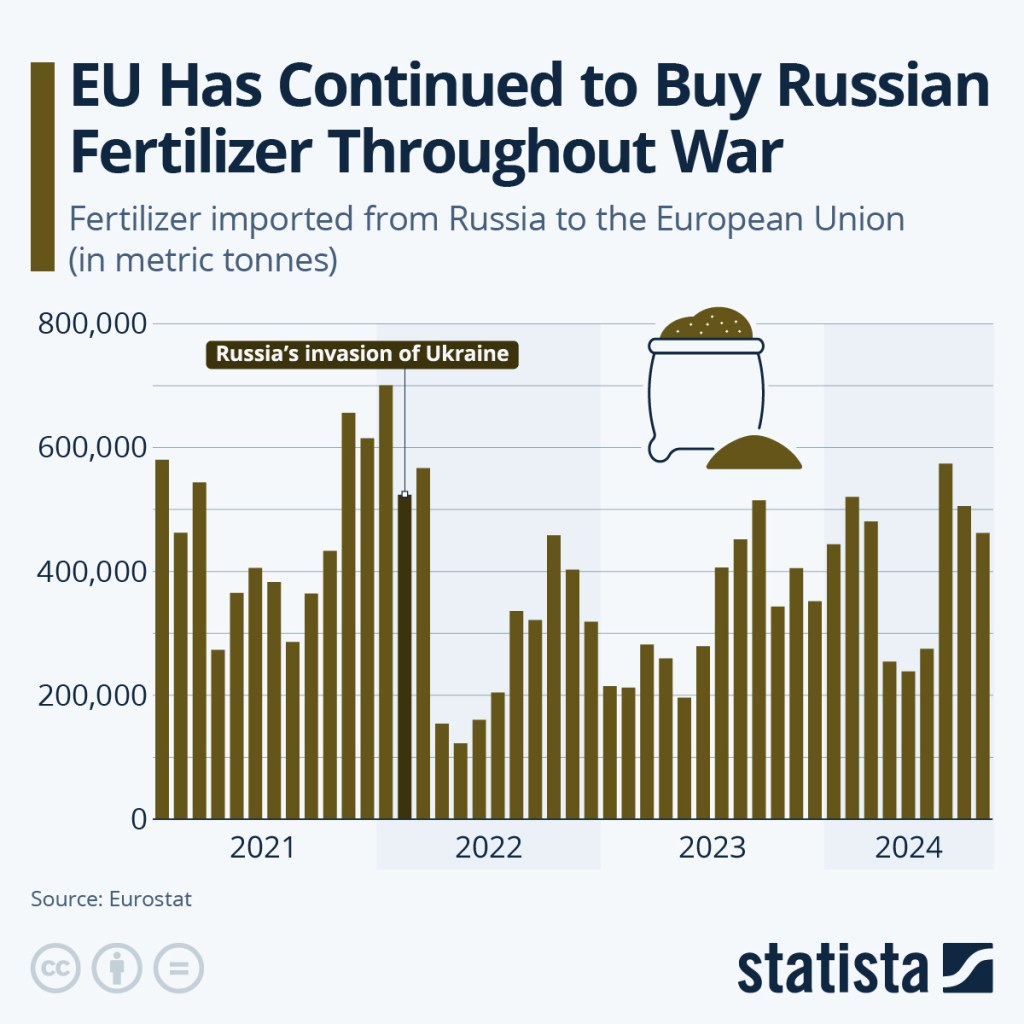
Despite heavy sanctions on gas and oil, the EU has continued to buy commodities such as fertilizer from Russia since its invasion of Ukraine in February 2022. Data from Eurostat shows that some 3.9 million tonnes of Russian fertilizers were imported to the EU in 2023 and 3.7 million tonnes were imported in the first nine months of 2024. In July 2024, 574,000 tonnes of fertilizers were imported to the EU, up 50 percent from July 2021, the summer before the war.
Last month, the European Commission finally proposed raising tariffs on fertilizers from the current 6.5 percent in proportion to the value to 100 percent in three years. If implemented, this means Russian fertilizers will likely continue to be imported until 2026. The proposed tariffs would bring a tonne of nitrogenous fertilizers to the sum of €315 and other fertilizers up to €430 per tonne. The measure is intended to support domestic production, allow for diversification of supply and cut off a financial flow to Russia’s economy. Until now, the EU has been resistant to placing sanctions on agricultural products from Russia due to global food security concerns.
While the proposal includes protective measures, European farmers warn of the risks associated with increased production costs as well as concerns over whether domestic production will be able to meet demand in time.
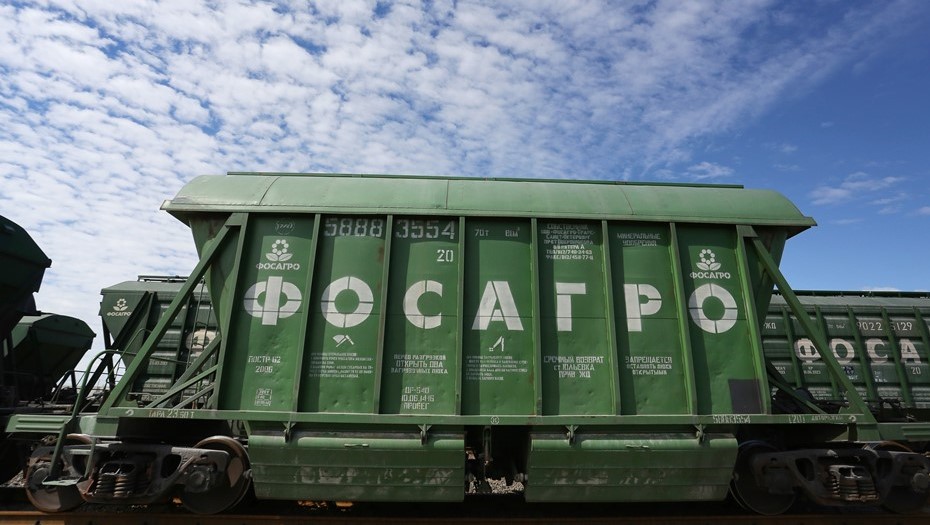
Every day Russian fertilisers move from the Vainikkala border crossing point to the Port of HaminaKotka in southeast Finland, where the major Russian fertiliser company Fosagro [sic] operates.
For food security reasons, the EU has allowed the import of Russian fertilisers since Moscow invaded Ukraine. This is why a freight train owned by North Rail Oy, a subsidiary of the Finnish logistics company Nurminen Logistics, makes daily transports of Russian fertilisers from the eastern border to the southeastern port.
These fertiliser-filled trains continue to run despite Russia’s nearly three-year war in Ukraine and the European Commission’s recent decision to impose import tariffs on Russian fertilisers in the bloc.
The Kremlin is now generating record-high revenues from fertiliser exports. Seven of the world’s ten largest fertiliser exporters are Russian companies, which collectively earned an estimated $1.4 billion last year.
Fosagro, with its presence in Kotka, is one of the world’s largest producers of phosphate-based fertilisers. It is backed by Andrei Guryev, a Russian oligarch and Vladimir Putin ally. He stepped down from the company’s leadership in 2022 after the EU sanctioned his son. Later, both the US and UK imposed sanctions on Guryev himself.
According to business magazine Forbes, Guryev and his family still own nearly half of Fosagro.
Yle asked how a sanctioned fertiliser oligarch’s exports are still flowing via Finland.
While Finnish Customs director general Sami Rakshit declined to comment on individual companies, he said that if a sanctioned individual holds a controlling stake in a company, the sanctions will also apply to the company.
At the same time, if Customs cannot demonstrate that the product, person, or company is subject to sanctions, the agency will not intervene.
“Fertiliser transport through the Port of Kotka is possible primarily for food security reasons,” Rakshit told Yle.
“When sanctions are being circumvented, shell company arrangements are often complex, making it very difficult to identify the true beneficiaries,” he added.
Russian connections
At the Port of HaminaKotka, Finnish firms Rauanheimo and Fertilog load the fertiliser onto ships. According to information obtained by Yle, Fertilog’s subcontractors employ Russian-background Finnish citizens and workers from the Baltic states.
The chairman of Fertilog Group’s board is Aleksei Sladkov, a Russian national living in Austria. The rest of the company’s leadership also has Russian-sounding names, though Yle does not know their nationality or whether they hold Finnish citizenship.
Fertilog has stated that it accounted for ten percent of the Finnish port’s traffic in 2020.
Most of the Russian fertilisers passing through Kotka are exported to North African countries and South America. Some also travel to other European countries, as long as they are not subject to sanctions.
In addition to Finland, Russia also exports fertilisers through Estonia and other Baltic countries.
In communicating with Fertilog via email, the company said its focus is on business and does not take a position on politics.
“We only handle fertilisers that are not subject to sanctions,” the company said via email.
The firm also claimed to have invested 80 million euros in the HaminaKotka port over the past 15 years.
“We’re a significant taxpayer and job creator in Kotka, both directly and indirectly,” the company stated.
According to Fertilog, the fertilisers they handle are exported to developing countries, where they play a crucial role in global food security, as well as to EU countries, where they contribute to the EU’s preparedness and security supply.
PhosAgro is a Russian chemical holding company producing fertilizer, phosphates and feed phosphates. The company is based in Moscow, Russia, and its subsidiaries include Apatit, a company based in the Murmansk Region and engaged in the extraction of apatite rock. The company is Europe’s largest producer of phosphate-based fertilisers.
Ownership history
The original owner of PhosAgro’s assets (most notably Apatit, a Soviet-era mining company) was exiled Russian billionaire Mikhail Khodorkovsky via his company, Menatep. In 2003, Khodorkovsky was arrested for tax evasion and fraud; the charges against him were ostensibly connected to Menatep’s purchase of shares in Apatit. However, some have seen the charges as punishment for publicly clashing with Vladimir Putin.
During Khordorkovsky’s trial, the state seized Menatep’s stake in Apatit. In 2004, Andrey Guryev, who at the time ran Apatit on behalf of Khodorkovsky’s Menatep and was also a Russian senator [sic], wrote a message to Khodorkovsky in prison to convince him to sell his remaining 50% stake in PhosAgro to Guryev. Khodorkovsky sold his shares to Guryev for a low price.
In July 2011, PhosAgro raised $538 million in a London IPO.
In 2012, PhosAgro paid $344 million at a state tender to buy back a 26.7% share in Apatit, bringing the company’s ownership to 76%.
As of 2012, Andrey Guryev and his family owned 5.47% of PhosAgro via various trusts.
PhosAgro is 19.35% owned by Vladimir Litvinenko, who oversaw Vladimir Putin’s plagiarized doctoral thesis in 1996.
In 2022, the company’s revenue amounted to 164 billion rubles.
In early 2015, current CEO Andrei Guryev Jr, Andrey Guryev’s son, was reported as saying, “PhosAgro is the most profitable phosphate fertilizer company in the world.”
PhosAgro is structured so that Guryev and his family are recipients of a trust, rather than outright ownership in their names, though Evgenia Guryev, Guryev’s wife, owns 4.82% of PhosAgro in her own name.
In July 2016, Forbes estimated his net worth at US$4.3 billion.
He is vice president of the Russian Union of Chemists.
[…]
Guryev is married to Evgenia and they have two children, Andrey Guryev, Jr. and Yulia Guryeva-Motlokhov. Andrey Guryev, Jr, is CEO of PhosAgro. Yulia Guryeva-Motlokhov is married to hedge fund manager Alexei Motlokhov, they have twin sons, and live next door in Highgate.
The Guryevs own Witanhurst in Highgate, London’s second largest house after Buckingham Palace, through an offshore company registered in the British Virgin Islands. He owns the five-storey penthouse of St George Wharf Tower in London. Guryev has never given an interview to the press.
Guryev owned a yacht, Alfa Nero, through an offshore company which is planned to be auctioned off in Antigua and Barbuda due to his sanctions.
Hi, everyone! The Russian Federation put me on the wanted list today. Why? Because first I taught Russian to foreign students and because of that I became a “foreign agent,” and then, apparently, because I didn’t fulfill the requirements of the law on “foreign agents”: I drew anti-war comics on [“foreign agent”] report forms to the Justice Ministry.
(A story in the guise of a Russian language lesson)
“The accusative case is the object case: it answers the questions whom and what. For example, whom do we love? What do we love? A friend, mom, a city. Whom do we hate? What do we hate? The weather, the rain, the snow.”
I point out the window. A disgusting Petersburg sleet is coming down outside, and the class laughs. We often joke about the the city’s atrocious weather. All my students hail from warm countries: Uzbekistan, Tajikistan, and Azerbaijan. Adults between the ages of twenty and fifty, they are people who are commonly called migrant workers. Tired, in black jackets, they apologize verbosely. They know Russian slang because they learn it on the street, at the market, and at work, but they don’t know what a noun is, because they have had little schooling even in their native languages and have been working since they were children.
“Remember we were talking about the dative case, the case of the addressee? To whom do we give something? To whom do we say something? To a sister, to a friend.’
(Here I want to make an aside about the verticality and horizontality of Russian grammatical cases, but I stop myself because I realize it’s superfluous, although I find the explanation felicitous: the dative case is horizontal, while the accusative case is hierarchical and vertical.)
I say this to my students, but my dean is sitting at the back of the classroom, listening attentively, and next to him sits an FSB officer whom my rector dragged into my class. The FSB officer is also listening attentively. It’s hard to say whether I hate anything in my life more than this situation and those two.
“Unlike the dative case — the case of the second subject in an exchange, where I talk to someone, for example, to a person or to a friend (the person is involved in the exchange: they hear and understand me) — the accusative case indicates the object of an action: I eat a pizza, I read a book.”
A few days earlier, my rector had telephoned me and asked me to ask one of my students to come in, ostensibly for a test. I asked him why this was necessary, if the woman had already taken the entrance exam. He said that an FSB officer would come to my lesson, because the student was person of interest to him, but that she should not know the FSB officer would be there.
I said that it was not part of my job description, that I never lie and would never lie to a student. I also told the rector that my class was a class, not an FSB office, and that I was opposed to anyone being spied on in my class, to which the rector replied that he had the right to come to my class with whomever he saw fit and that he would telephone the student himself.
‘What endings can we use in the accusative case? For masculine nouns, we use the zero ending if it is an object (a what?), for example, ‘I know this film’, ‘I read the text’, or -a/-ia if it is a person (a whom?), for example, ‘I know the [male] teacher’ [uchitelia], ‘I see the [male] student’ [studenta]. For feminine nouns, the ending is always -u, for example, ‘I see the book [knigu], ‘I see the [female] student [studentku].
I don’t see the student in class. I haven’t seen her all week since that phone call and I don’t know what to do. Should I call her and tell her that the dean wants to talk to her and that the FSB is interested in her? If I called her on my mobile phone, then the FSB would be interested in me. All week I have been trudging round the city: it’s autumn, November, the weather is disgusting, my feet are wet, I’m working ten hours a day, I don’t see my children, I don’t see the sun. How come I took it all on myself, this job, this workload? Why do I have to bear it alone? Who’s to blame? I guess it’s my fault. But I can’t afford not to work even on my birthday. And then there’s this student. God, what am I going to say to her? Flee the country? Maybe they’ll just ask her questions. It’s not like they’re going to bring a paddy wagon to the university to arrest her…
“What? Yes, there’s no difference between objects and persons: sister [sestru], girlfriend [podrugu], teacher [uchitel’nitsu], street [ulitsu], hand [ruku].
Why are the two of us — two women in a patriarchy — again getting screwed over for everything? Men have invented the patriarchy, that drug for their delicate egos which comes with wars, exploitation, violence, and control. It messes with your head and then blames you for everything being wrong.
“Yes, that’s right. Oyatullo, please come up with sentences using the verbs ‘read,’ ‘write,’ and ‘see’ with nouns in the accusative case.”
When I came to work today, the dean and the FSB guy were already in the classroom. While I was still thinking what to do, everything had already happened, so I started the lesson. Why aren’t future language teachers warned that their profession will involve this? There was pogrom at my last job, a year ago. They came from the FSB, from the migration service. They blocked the doors from the inside, tore my folders with the students’ documents inside, yelled at me and at the students, and those courses were shut down. Then a year passed, and I found a new job: the cultural capital of Russia, beautiful St. Petersburg, Liteiny Prospekt, the Yusupov mansion, stucco, gold, chandeliers, cold, dust, red carpets, students in their jackets and hats. It was sad but mentally manageable. It seemed like things would be decent now, but no, the cops have shown up here too. Now things are just as they should be, the whole nine yards.
“Okay, great! Now let’s do some exercises from the textbook.”
The thing I hate, the vertical in the back row, is slowly segueing into a diagonal. The FSB guy is sitting next to the radiator. You can tell by his flushed mousey face that he’s spent a lot of time outside today and now, in this warm room, he’s gone limp and snuggled up against the wall.
“Page 218, exercise 8, Munisa, please!”
I’ve been working here for a few months now. I have been telling the students about grammar, and they have been telling me about nationalism. They’ve told me about a lot of things — for instance, about the cop who confiscated one’s student’s sack of apples when he realized she didn’t have the money to pay him a bribe; about how they hid in cement bags; about how the neighborhood beat cop visits them once a month to collect 3,000 rubles from each their flats, just because he can; about how landlords refuse to let flats to them; about what people say to them on the street.
“Okay, now let’s turn the page.”
The FSB guy at the back desk is asleep, while the dean sits with his eyes half closed. I think that’s probably what the peak of your career looks like: when you have an FSB officer asleep in your class. Or, depending on how you look at it, maybe it’s the bottom of your career. I also think that it would be good if he kept sleeping like that. Sleeping Beauty slept for a hundred years, so there are historical precedents. That would suit me just fine. I try to keep my voice down.
“Let’s use these same verbs now in the future tense and at the same time we’ll practice the perfect and imperfect aspects of the verb.”
On the wall of my shabby office, just opposite the blackboard, the phrase “Dasha is a rube” was written in black, but then corrected to “Dasha is a nube” in green.
The student for whom the ambush at the back desk was arranged enters the classroom. She is older than me, thin, and wears a hijab, and she has come with her grown-up son. I quickly think that this is better, that it is good she is not alone. The dean briskly rushes up and tells me and my students to move to another classroom and finish our lesson there.
We leave with our books and notebooks. We walk along the red carpet, past a portrait of the patriarch in a golden frame, past a poster against corruption (I remember how once a student tried to bribe me right under this poster), past some oil landscape paintings, past stands with pictures of the father the rector, his son the assistant rector, and his mother the dean. Then we pass the security guard who calls my students “blacks.”
How shameful.
“Okay, let’s finish this page.”
I stopped by the classroom after class. The student and her son were already leaving, and they looked very upset. I never found out what had happened there or what the FSB had wanted with her, and I never saw her again.
This job of mine ended a few months later because of the [2018] FIFA World Cup. Private universities were prohibiting from offering “pre-university” courses. Formally, this was done to reduce the number of students from Central Asia, but in fact it was done so that there would be fewer migrant workers from Central Asia in Russia’s capital cities during the World Cup, because the superpower Russia hinges not only on power but also on provincialism. What would foreigners from the first world see when they came to Russia? Other foreigners, but from the third world?
My lousy work schedule ended a little later, when I was able to find a normal job, that is, several jobs. A little later still, my quasi-marriage ended, because I couldn’t fool myself anymore, and later still my life in St. Petersburg ended in political persecution and emigration.
And only a prolonged feeling of guilt remained with me in the wake of it all: about how I should have behaved, where that woman is now, and whether she is doing well.
Dear friends, thank you for the words of support. Yesterday, I realized that, although I had know that sooner or later I might be put on [Russia’s] wanted list, I wasn’t ready for it.
I probably used to joke about it, and I still do. For example, there are my children: their parents are wanted because one of them insulted the feelings of religious believers, while the other taught foreign students and submitted incorrect reports to the Justice Ministry.
An illustration of Nikolai Chernyshevsky’s mock execution on Mytninskaya Square in Petersburg, 31 May 1864. Source: Istoriia.RF
But this grotesque discrepancy between the gravity of the “crimes” and the sanctions masks what I see as a modern Russian form of mock execution. Remember how Chernyshevsky was put through this? He had a signboard bearing the words “state criminal” hung on his chest, and his sword was broken above his head.
In addition to that, he was sent into exile, banned from publishing books and living in the capital cities, placed under constant surveillance, and so on.
It’s a pity I don’t have a sword to break.
You know, when it happens to you, the feelings which arise are complicated. If it were only about my relations with the authorities, it would be easier. But it automatically implies that I cannot go back to Russia, and although I had not planned on doing this in the near future, yesterday I realized that it hurts me a lot.
I was on the bus when I got the call from Varya.
“I have to tell you so you don’t find out about this on the new,” she says to me.
“So, what happened?”
“You’ve been put on the wanted list. Are you okay?
(I’m not okay: I’m crying. I forgot I could cry like that.)
“Dasha, where are you now?”
“I’m on the bus, Varya. I missed my bus and the driver of another bus has let me ride for free.”
“He let you on because you could explain everything so well in German?”
“No, because he found out I was Russian. He said he was Serbian and loved Russia.”
(Varya laughs.)
“You tell him that his beloved Russia has put you on the wanted list.”
“Varechka, I still don’t have a ticket and I have to get to my destination, so I won’t tell him about this.”
As I rode in the bus, I thought that I should write down this conversation and that I too, like my Serbian driver, love Russia. I love Kamchatka, Siberia, and St. Petersburg — all three of my homelands, and I miss the people dear to me and the places dear to me, the people and places which nourished me and brought me up, teaching me to be freedom-loving and independent.
So I am sorry that thing are like this, that my country does not want to see me but puts me on the wanted list as if it wanted to see me. I would like our friendship to be mutual.


 Foreign Ministry Spokeswoman Maria Zakharova’s comment on Zelensky’s voyage to Washington, D.C. (March 1, 2025)
 Leader of the neo-Nazi regime Zelensky’s visit to Washington D.C. on February 28 is an epic political and diplomatic failure of the Kiev regime.
 The Kiev regime refused to continue talks on a political and diplomatic settlement in the spring of 2022, using lies and fake claims to justify continued hostilities and keep receiving Western military and financial aid.
 has destroyed the opposition,
 The sooner Kiev and the European capitals come to realise this, the closer to a peaceful settlement of the Ukraine crisis we will be.