
How bad can it get? When we strip away US president Donald Trump’s insults and temper fits, what can he actually do?
First, he can withdraw US military aid to Ukraine – which he has been talking about doing since long before the US presidential election. If the European states got their act together, which is possible, the effects of this would be constrained.
US diplomats have reportedly threatened to block Ukraine’s access to the Starlink communication system on which its drones rely, potentially giving asymmetrical advantage to Russia.
Second, Trump can cancel sanctions. The latter would bring him into conflict with the Countering America’s Adversaries Through Sanctions Act of 2017, which was specifically designed to compel the president to lift sanctions only with Congress approval. Of course Trump could play fast and loose with the law, which he has done and is doing in other respects, and/or Congress could go along with him.
The cancellation of sanctions would be bad. But let’s not lose sight of the fact that the sanctions were never very effective, in large part because previous US governments, under both Trump and Biden, sought to limit their effect on the oil market and the world economy.
Third, Trump can shift narratives. I broadly agree with people who say we should judge Trump and his cohorts by their actions, not by the constant stream of often incoherent words. Yes, but. Nazi salutes normalise Nazism; speculation about expelling the Palestinian population from Gaza normalises ethnic cleansing; and slandering the Ukrainian president as a “dictator” who started the war in his country reinforces Russian propaganda.
On the third anniversary of Russia’s all-out invasion – and the eleventh year of its military attack on Ukraine, and the long chains of suffering it has caused – these are real dangers. It’s not clear how they will play out.
Putin is no doubt thrilled by Trump’s outburst against Ukraine and against Zelensky. He is pushing for the maximum. For now, he is happy to continue sending wave upon wave of young men to die in the scorched earth of eastern Ukraine, and negotiate at a later stage. The Russian economy – which was never going to collapse due to sanctions, as so many commentators irresponsibly claimed in 2022 – can keep going for now.
Putin wants to hold out for a complete military defeat for Ukraine. He knows that the Ukrainian population is exhausted. There are no more volunteers to go to the front, only conscripts. There are great strategic and economic pressures on Putin; he will hope to use Trump to ease these. Perhaps the worst case scenario is the US, Russia and the European powers stitching up a “peace” deal that gives the Kremlin’s militarism a new lease of life.
When Trump first returned to the presidency, there were signs that he would push for a ceasefire, rather than a peace treaty marking Ukraine’s defeat and even break-up. Trump’s outbursts last week suggest he may be moving towards the latter.
But we are still far from the point at which Ukraine would be forced to sign such a treaty, which would surely have to acknowledge that Crimea, and all of Donetsk, Luhansk, Zaporizhzhia and Kherson, are Russian territory, as the Russian constitution now stipulates.
The Ukrainian government always has the option of walking away. The Ukrainian people, however war-weary, will not accept humiliation.
Not only in Ukraine, but more widely, it’s not only what dictators do that matters. What society does matters too.
Putin’s focus on Ukraine meant that he had to abandon his closest ally in the Middle East, Bashar al-Assad, in the face of popular opposition that he had brutally suppressed for more than a decade. Powerful social movements have in the last two months thrown Putin’s allies in Georgia and Slovakia, and the pro-European but Putinesque regime in Serbia, into crisis. The advance of this new type of 21st-century fascism we are facing is not uniform or uni-directional.
When I make these arguments, some friends and comrades tell me I am being naively optimistic. I don’t accept that. I know fascism when I see it, and I’ve seen it in Russia’s onslaught on Ukraine for the last three years. I have seen how the Israeli government has implemented the fascist right’s genocidal programme in Gaza. All this didn’t start with Trump.
Moreover, I see history as a more complicated process than it might appear to be while it’s happening.
If we are to take seriously the emotions we feel at the deaths and suffering caused by war, we shouldn’t indulge ourselves with foolish optimism – nor with panic and despair.
How to understand Trump in the wider sense? For a start, he is a symptom of the long-term decline of the US empire.
The US economy was 40-50% of the global total after the second world war, now it’s under 25%. In the 1970s, when the US was forced into a humiliating withdrawal from Vietnam, China, India and Brazil were “developing nations” still largely at the mercy of the imperialist metropole. The US wars of the 1990s and 2000s, in Iraq, Afghanistan and elsewhere, were murderous attempts by this failing empire to maintain its grip.
Today, rivalry from China is seen as a key underlying motivation of Trump’s Russia policy (i.e. that he wants to pull Russia out of China’s sphere of influence).
The US’s economic and strategic decline takes on social forms: a country with more guns than people, the rise of Christian nationalism, and the election as president of a man with the political style of a street thug.
The assault on the legal system and state institutions, the alliance with billionaire oligarchs, the encouragement for extreme right wing violence (e.g. pardons of 6 January rioters) are all what they look like. Forms of fascism.
When Trump returned to the White House at first, I think I underestimated the murderous nature of his ideology. I thought he was more pragmatic, more of a plaything of big capital. Last week’s outburst can’t be dismissed, though. Trump really admires Putin, and hates democracy, in Ukraine and everywhere else.
Trump instinctively warms to Israel’s extremist government and its genocidal assault on Gaza. He has made clear to Netanyahu that he is happy for the Gaza ceasefire to break down and a new round of genocidal attacks to begin – although, as I understand it, whether and how this will happen will be more Netanyahu’s decision than Trump’s.
What does all this mean for the labour movement and other social movements in the UK and other western European countries?
First, I think we need to separate, analytically, two strands of Trump’s policy. The first is his ideological kinship with dictators and mass murderers like Putin and Netanyahu. The second, related but not the same, is his assault on the alliance between the US and the western European powers.
In the UK media, it is this assault, and the existential threat it poses to NATO, that brings howls of outrage from Labour politicians and liberal commentators – very often the same people who have tolerated Israel’s multiple war crimes (with a few whispered words of criticism), who have slandered all who oppose them as anti-semites, and who re-hash the extreme right’s disgusting anti-migrant rhetoric.
What these Labour politicians and liberals fear is that the whole illusion of the “democratic” post-war order is crashing. For Palestinians, and before them Iraqis, Vietnamese and many others, this “democracy” was always a phantom, an ideological covering for brute imperialist force. I think the post-war order is crashing, and the “democratic” illusion is crashing with it – but I don’t look back on that illusory “democracy” with the same western-centric fondness.
Our democracy in Europe – valuable as it is, and vital as it is to defend every bit of it tooth and nail – has always been married with the violence of empire. Look at the treatment of migrants trying to throw themselves on the mercy of that democracy.
In Ukraine, the UK and French governments are preparing to step in militarily to a void that may be left by the withdrawal of US aid. Right now, we in the labour movement and civil society are on the same side of the war as they are, but fighting with independent aims.
We should continue to build our own kinds of solidarity, supporting Ukrainian resistance, supporting Ukrainian communities, supporting anti-war direct action in Russia.
□ This isn’t a comprehensive analysis. I wrote it for self-clarification as much as anything – and thank friends who discussed it with me. Comments welcome. SP, 23 February 2025
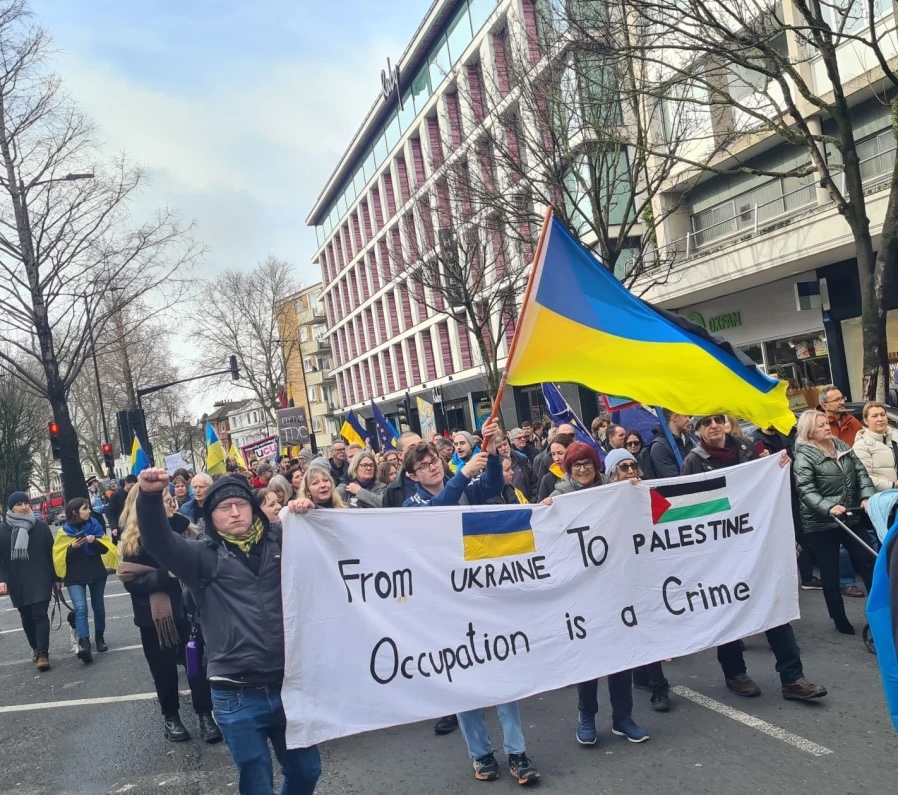
□ For the last year, a group of us in London have carried the banner in the photo, with its slogan “From Ukraine to Palestine, occupation is a crime”, on the demonstrations against Israel’s war on Gaza. Yesterday, the banner was out again, on a march organised by Ukrainian community groups, trade unions and the Ukraine Solidarity Campaign, calling for Russian withdrawal from Ukraine. Internationalist solidarity between struggles is an essential starting point.
Source: “Trump backs Putin against Ukraine. History turns darker,” People and Nature, 23 February 2025. Thanks to Simon Pirani for permission to repost his reflections here.
For three years, 14-year-old Miroslava Mullens has watched from afar as her mother’s Ukrainian homeland has been torn apart by Russian bombardments and unceasing war. On Sunday, the Peninsula teenager protested on the third anniversary of the Russian invasion by taking to the streets of San Francisco with a handmade sign, and a message.
“Kids are dying, families are being split apart, but even through all that, the Ukrainian people are staying strong,” Mullens said as she marched along the Embarcadero. “Even through the pain, they are doing all they can, unbroken.”
The Los Altos high schooler was one of thousands of protesters who marked the anniversary Sunday afternoon by reflecting on the losses Ukraine has endured as the fighting enters its fourth year. She said she was on a mission to keep shining a spotlight on the war — despite President Trump’s recent rhetoric falsely suggesting that Ukraine was to blame for the invasion on its eastern border.
Many present noted that the grim milestone arrives at an inflection point in the war. Trump in recent weeks has offered tough criticism of the Ukrainian president, Volodymyr Zelenskyy, while entering into peace talks that exclude Ukraine. Meanwhile, the country’s path to European Union and NATO membership appears increasingly uncertain.
Sunday’s march was not just about showing solidarity with the Ukrainian people, but also about recognizing its global importance as Trump unravels decades of U.S. policy, said Martinez resident Michele Keck.
“If we can’t keep Ukrainian sovereignty, it puts the rest of Europe in trouble,” Keck said.
Russia invaded Ukraine on Feb. 24, 2022, marking an escalation in hostilities between the two countries that began with Russia’s military takeover of the Crimean territory in 2014. The war has decimated Ukraine’s infrastructure and sent millions of people fleeing into neighboring European countries, with the UN’s Human Rights Monitoring Mission in Ukraine reporting that tens of thousands of civilians have been killed or injured.
“No one was thinking that in so little amount of time there would be a full-scale war raging in Europe,” said Eugene Zuser, a native of Kharkiv in northeast Ukraine who has lived in the Bay Area for five years.
The U.S. has admitted more than 200,000 Ukrainians since the invasion. While the Department of Homeland Security under former President Joe Biden offered the refugees temporary protected status until 2026, the Trump administration last week paused all immigration applications filed by migrants from Ukraine allowed into the U.S. under Biden-era programs, CBS News reported.
One such refugee, Anna Horenkova, held back tears Sunday afternoon as she described fleeing her home along Ukraine’s eastern border with Russia after the start of the war. Her hometown, decimated by Russian bombs, was flattened into “nothing,” she said.
“When you see your family dying, you can’t imagine,” Horenkova said. “What we can do is donate and tell everyone, ‘Please listen to us. We can’t fight alone.’”
In this week’s bulletin: Fractured futures of Ukraine IDPs/Trump, Putin & Ukraine/ 11 years of Crimea occupation/ Ukraine’s anarchists/ Russian on trial for killing Ukrainian POW/ allegations of Russian torture/ deliberate destruction of Ukraine’s cultural heritage
News from the territories occupied by Russia:
Seventh year of life-threatening torture in Russian-occupied Donbas for supporting Ukraine (Kharkiv Human Rights Protection Group, February 21st)
Olha Skrypnyk: Eleven years of the occupation of Crimea (Crimea Human Rights Group, 21 February)
Russian on trial for killing Ukrainian POW with his commander confirming ‘order to not take prisoners’ (Kharkiv Human Rights Protection Group, February 19th)
Russia sentences Mariupol mother of four to 14 years on ‘terrorism’ and ‘treason’ charges (Kharkiv Human Rights Protection Group, February 18th)
Russia passes 10-year sentence over two years after abducting and torturing 20-year-old Kherson student (Kharkiv Human Rights Protection Group, February 17th)
Life Under Occupation (Alterpravo, January 2025)
The situation at the front, and peace talks:
Weekly war summary: AFU counter attacks near Pokrovsk (The Insider, 22 February)
Wyborcza reports on Ukrainian border guards fighting on the front line (Eastern Frontier Initiative, 21 February)
The Betrayal of Ukraine: Week 2 (Russian Reader, February 17th)
News from Ukraine – general:
Russia’s weaponization of elections in Ukraine given unexpected boost by President Trump (Kharkiv Human Rights Protection Group, February 20th)
Russians destroy ancient wooden church in Andriivka – photos (Ukrainska Pravda, February 20th)
A coalition of Human Rights Organizations held a meeting on legislative changes for war victims (Zmina, February 20th)
Fractured Futures: Ukraine’s Internally Displaced (Commons.com, February 19th)
Medicine, heating, reforms: How Trump’s aid freeze hit Ukraine (The Insider, February 18th)
War-related news from Russia:
‘You could call me a partisan.’ Ruslan Siddiqi recounts his anti-war actions (People and Nature, February 19th)
How Russian servicemen bribe their way off the front line (iStories, 17 February)
Ukraine removed from rewritten history of WWII as Russia tries to justify its full-scale invasion (Kharkiv Human Rights Protection Group, February 17th)
Xenophobia and Schools (Posle, February 12th)
Analysis and comment:
Trump backs Putin against Ukraine. History turns darker (People and Nature, February 23rd)
About the organization of anarchists in Ukraine: point of view of a member of a local action collective (Takku, February 23rd)
Statement of Ukrainian Non-Governmental Organizations on the Impossibility of Holding Democratic Elections without the Sustainable Peace (Kharkiv Human Rights Protection Group, February 21st)
The US sees China as its main global rival (Michael Karadjis, Facebook, February 19th)
Conspiracy of American and Russian imperialism behind Ukraine’s back (Lis-Isl, February 17th)
Hanna Perekhoda: The fight for freedom in Ukraine is intimately linked to the global struggle against fascist forces (Cross-border Talks, February 16th)
Ukraine’s defeat and the fall of Western power (Owen Jones Battlelines, February 14th)
Research of human rights abuses:
Four women’s stories of torture in Russian captivity (Ukrainska Pravda, February 20th)
90% without documents: report on prisoners deported to Russia (Zmina, February 14th)
International solidarity:
A fundraiser for Roman Nasryev’s cassation! (Solidarity Zone, FB, February 21st)
Permanent settlement for refugees! (Ukraine Solidarity Campaign, February 20th)
Members of the European Parliament showed solidarity by writing 150 letters to Ukrainian political prisoners (Zmina, February 20th)
Upcoming events:
Monday 24 February – Monday 3 March. Call for a week of action by Solidarity Collectives. Details of events here.
Wednesday-Thursday 26-27 March. Left solidarity with Ukraine conference in Brussels, supported by the European Network for Solidarity with Ukraine
This bulletin is put together by labour movement activists in solidarity with Ukrainian resistance. To receive it by email each Monday, email us at 2022ukrainesolidarity@gmail.com. More information at https://ukraine-solidarity.org/. We are also on Twitter, Bluesky, Facebook and Substack, and the bulletin is stored online here.
For further reading:
• Masha Gessen, “They invented a new language for war,” New York Times, 22 February 2025
• Timothy Snyder, “The reality of Ukraine,” Thinking about..., 24 February 2025
• Artem Chekh, “This is our country, and we have no other,” New York Times, 23 February 2025
