Solidarity with Ukraine (and Its Opposite)

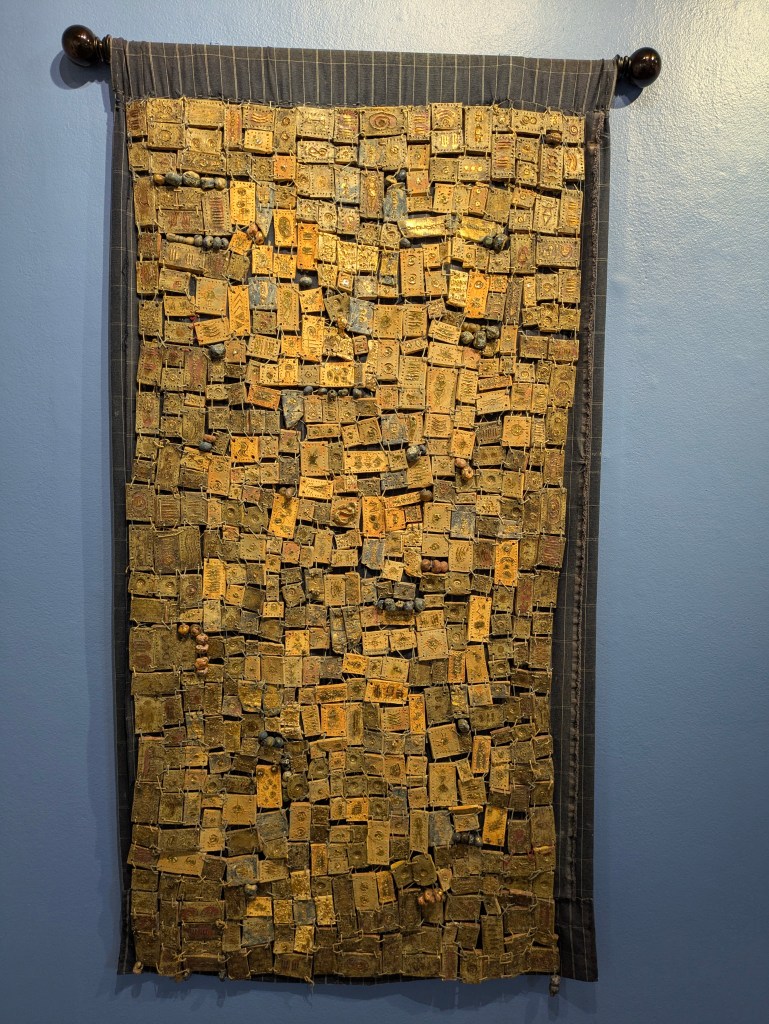
Coeleen Kiebert, Ode to the Women of Ukraine, May They Return to Quilt Their Beauty Again Soon, 2021. Ceramic, indigo linen. Pajaro Valley Arts, Watsonville, California, 26 April 2025. Photo by the Russian Reader


News from Ukraine Bulletin 144 (28 April 2025)

In this week’s bulletin: Solidarity With Ukraine conference speechesreports and draft declarationMobilise to free abducted children/ More evidence of Russian torturetargeting of civiliansabduction of children/ Putin’s foreign mercenaries

News from the territories occupied by Russia:  

Donbas hostages savagely tortured for ‘confessions’ in 2019 sentenced in Russia to 24 years (Kharkiv Human Rights Protection Group, April 25th)

Huge sentences and videoed ‘repentance’ in Russia’s mounting terror in occupied Zaporizhzhia oblast (Kharkiv Human Rights Protection Group, April 24th)

“Relatives said: people like you should be killed.” The story of a woman who survived torture and fled occupied Mariupol twice (Ukrainska Pravda, April 24th)

Crimean resident jailed for “discrediting the Russian army” is freed (Crimea Human Rights Group, 23 April)

Crimean Tatar Mejlis rejects any international recognition of Crimea as Russian, chairman says (Kyiv Independent, April 22nd)

Horrific sentences demanded against five Ukrainians abducted from Russian-occupied Melitopol (Kharkiv Human Rights Protection Group, April 22nd)

The situation at the front:

The weekly war summary (The Insider, 26 April)

‘Wiping out neighborhood after neighborhood’ Russia pounds Ukraine’s Pokrovsk, forcing civilians to flee under fire. For many, it’s not the first time. (Meduza, April 21st)

News from Ukraine:

Russia returns body of abducted Ukrainian journalist Victoria Roshchyna with scars from torture (Kharkiv Human Rights Protection Group, April 25th)

Nine people killed and 42 injured in Russian drone attack on bus in Marhanets, Dnipropetrovsk Oblast – photos (Ukrainska Pravda, April 23rd)

‘Please don’t use my name’ A report by journalist Shura Burtin on the growing war weariness among Ukrainians (Meduza, March 27th)

War-related news from Russia:

Russia’s deserters: “A raging meat grinder” (Meduza, 24 April)

Despite Putin’s denials, Russia’s military has welcomed foreign mercenaries from at least 48 nations — (iStories, April 23rd)

Darya Kozyreva gets real prison term for Taras Shevchenko poem and opposition to Russia’s war against Ukraine (Kharkiv Human Rights Protection Group, April 22nd)

The Lost Army: War veterans could pose a problem for Putin’s Russia, just like they did for interwar Germany (The Insider, April 21st)

Olga Menshikh: “A Society Sick with Fear Cannot Be Happy” (Russian Reader, April 20th)

Analysis and comment:

What Trump’s plan might look like, in maps (Meduza, 24 April)

Russia’s selective ‘terrorism’ in war against Ukraine and in fraternizing with the Taliban (Kharkiv Human Rights Protection Group, April 23rd)

In memory of Cooper Andrews, Finbarr Cafferkey and Dmitry Petrov (Solidarity Collectives, 19 April)

Research of war crimes and human rights abuses:

Meeting with Representatives of Ukrainian Roma in Brussels (Kharkiv Human Rights Protection Group, April 25th)

Experts of the Committee on the Elimination of Racial Discrimination Commend Ukraine’s Presence Despite the Prevailing Circumstances, Raise Questions on the Treatment of Ukraine’s Indigenous Peoples and the Roma Population (UNHCR, April 24th)

A reliable tool in the hands of human rights defenders: how the KHPG database works (Kharkiv Human Rights Protection Group, April 23rd)

International solidarity:

Mobilise to free the Ukrainian children abducted by Russia (Labour Hub, April 27th)

“My soul is in this project of ours” (Solidarity Zone, 24 April)

Building Global Solidarity with Ukraine (Ukraine Solidarity Campaign, April 23rd)

Justice without borders: the ZMINA and TDC advocacy trip to Chile (Zmina, April 18th)

Free Denys Matsola and Vladyslav Iskra Zhuravlov (Solidarity Collectives, 16 April)

Solidarity With Ukraine conference in Brussels, 26-27 March. Contributions heremedia coverage heredraft conference declaration here, with call for amendments

Upcoming events:

Wednesday 7 May, 3 – 5pm, War and Peace in UkraineClerici Building G.21, Headington Campus, Oxford Brookes University, Oxford.

Sunday 1 June, 1.0pm, Marble Arch, London, March for the children of Ukraine  


This bulletin is put together by labour movement activists in solidarity with Ukrainian resistance. To receive it by email each Monday, email us at 2022ukrainesolidarity@gmail.com. To stop the bulletin, reply with the word “STOP” in the subject field. More information at https://ukraine-solidarity.org/. We are also on TwitterBlueskyFacebook and Substack, and the bulletin is stored online here

Source: Ukraine Information Group


KYIV, Ukraine (AP) — A peace proposal by the Trump administration that includes recognizing Russian authority over Crimea shocked Ukrainian officials, who say they will not accept any formal surrender of the peninsula, even though they expect to concede the territory to the Kremlin, at least temporarily.

Giving up the land that was illegally annexed by Russia in 2014 is also politically and legally impossible, according to experts. It would require a change to the Ukrainian constitution and a nationwide vote, and it could be considered treason. Lawmakers and the public are firmly opposed to the idea.

“It doesn’t mean anything,” said Oleksandr Merezkho, a lawmaker with Ukrainian President Volodymyr Zelenskyy’s party. “We will never recognize Crimea as part of Russia.”

Unlike a territorial concession, a formal surrender would permanently relinquish Crimea and abandon the hope that Ukraine could regain it in the future.

The Ukrainian public largely understands that land must be ceded as part of any armistice because there is no way to retake it militarily. Polls indicate a rising percentage of the population accepts such a trade-off.

But much of the public messaging about land concessions has suggested that they are not necessarily permanent, as when Kyiv Mayor Vitalii Klitschko told the BBC recently that Ukraine may need to temporarily give up land as part of a peace deal.

Saying otherwise would effectively admit defeat — a deeply unpopular move, especially for Ukrainians living under Russian occupation who hope to be liberated and reunited with their families one day. It also would call into question the sacrifices made by tens of thousands of Ukrainian service members who have been killed or wounded.

U.S. President Donald Trump underscored the Crimea proposal in an interview published Friday in Time magazine: “Crimea will stay with Russia. Zelenskyy understands that, and everybody understands that it’s been with them for a long time.”

Asked by reporters on Sunday if Zelenskyy was ready to give up Crimea, Trump said, “Oh, I think so. Crimea was 12 years ago. That was President Obama that gave it up without a shot being fired.

His comments offered the latest example of the U.S. leader pressuring Ukraine to make concessions to end the war while it remains under siege. Trump has also accused Zelenskyy of prolonging the war by resisting negotiations with Russian President Vladimir Putin.

Crimea, a strategic peninsula along the Black Sea in southern Ukraine, was seized by Russia years before the full-scale invasion that began in 2022. The Russian takeover followed large protests that ousted former Ukrainian President Viktor Yanukovych, who had refused to sign an association agreement with the European Union.

In the lead-up to peace talks, Ukrainian officials told the Associated Press for months that they expect Crimea and other Ukrainian territory controlled by Russia to be among Kyiv’s concessions in the event of any deal. But Zelenskyy has said on multiple occasions that formally surrendering the land has always been a red line.

Elements of Trump’s peace proposal would see the U.S. formally recognizing Crimea as Russian and de facto accepting Moscow’s rule over occupied Ukrainian territories, according to a senior European official who spoke on condition of anonymity to discuss sensitive diplomatic discussions.

Whether the U.S. formally recognizes Crimea as Russian is out of Zelenskyy’s hands. But many obstacles prevent the Ukrainian president from doing so, even under immense pressure. He cannot unilaterally sign any such proposal, and he could be reprimanded by future governments for even attempting it, experts said.

Ukraine began to accept that it would not regain its lost territories after the failure of the country’s 2023 summer counteroffensive. From then on, the Ukrainian military concentrated on defending the territory it still held.

In return for territorial concessions, Ukraine wants robust security guarantees that ideally would include NATO membership or concrete plans to arm and train its forces against any future Russian invasion with the pledged support of allies. One scenario envisions European boots on the ground, which Russia rejects.

Zelenskyy has said negotiations over occupied Ukrainian territory will be drawn out and will not likely occur until a ceasefire is in place. In late March, he told reporters after a call with Trump that the U.S. president “clearly understands that legally we will not recognize any territories.”

He said giving up territory would be “the most difficult question” and “a big challenge for us.”

Formal recognition of Crimea would also amount to political suicide for Zelenskyy. It could expose him to legal action in the future, said Tymofiy Mylovanov, president of the Kyiv School of Economics and a former economics minister.

Signing a potentially unconstitutional document could be interpreted as high treason, Mylovanov said.

The Ukrainian government cannot act either. It has no constitutional means to accept a violation of its territorial integrity, and altering the territorial makeup of the country requires a nationwide referendum.

If Ukrainian lawmakers were even to entertain the idea of surrendering Crimea, it would trigger a long, drawn-out legal debate.

“That’s why Russia is pushing it, because they know it’s impossible to achieve,” Mylovanov said.

“Anything related to constitutional change gives so much policy and public communication space to Russia,” he added. “This is all they want.”

Soldiers on the front line say they will never stop fighting, no matter what the political leadership decides.

“We lost our best guys in this war,” said Oleksandr, a soldier in the Donetsk region, who spoke on the condition that only his first name be used in line with military protocols. “We won’t stop until all Ukrainian lands are free.”

Source: Samya Kullab, “Shocked by US peace proposal, Ukrainians say they will not accept any formal surrender of Crimea,” Associated Press, 27 April 2025. The emphasis is mine — TRR.


Coeleen Kiebert, Ode to the Women of Ukraine, May They Return to Quilt Their Beauty Again Soon, 2021 (detail). Pajaro Valley Arts, Watsonville, California, 26 April 2025. Photo by the Russian Reader

Kyle

Three years ago, one man saved my family and me. He knew nothing about us except that I was a journalist, that I had left Russia because of the war, that I had children, and that we had nowhere to go. Kyle and his wife Katie decided to take us in and give us shelter. We finally had a dot on the map where we were welcome. That was how we ended up in the United States, after traveling through five or six countries in the first three months of the war.

We still live in the house into which Kyle and Katie welcomed us. All these three years, I have felt the kind of care and involvement from them which you don’t normally expect from strangers. A few days after we arrived, Katie’s mom sent us a dinner consisting of food to which we were accustomed. And Kyle was always trying to help. He paid our utilities for a long time, and he gave my husband odd jobs.

Yesterday, Elon Musk fired Kyle and two hundred other employees at the research institute where they work.

“DOGE struck like a thief in the night. Too cowardly to fire us in person, virtually everyone at NIOSH learned they were laying us off via a summary overnight email,” Kyle writes on his Facebook page.

NIOSH is the National Institute for Occupational Safety and Health, which was established by Congress over fifty years ago. It researched health and safety hazards, recommended essential standards for occupational safety and health, and investigated workplace disease outbreaks. For many years, the Institute also monitored the health of 9/11 first responders and tracked occupational illnesses among firefighters and miners.

Kyle himself worked as pulmonary toxicologist at NIOSH. He studied the effects of inhaled toxicants on the lungs and other organs.

“Since 2017, I’ve studied the effects of micronized copper-treated lumber sawdust, Corian/alumina trihydrate, various 3D printer emissions, and, most recently, engineered stone dust. That last material, engineered stone, is currently responsible for a global outbreak of silicosis, a progressive and ultimately fatal lung disease. Truly a public health crisis with profound impacts on exposed workers,” Kyle writes in his post.

DOGE sent the institute’s employees a mass layoff notice at five a.m. Tuesday morning. The brief letter announced that NIOSH was being eliminated “to improve efficiency.”

“To be clear, nothing about these firings was efficient,” Kyle retorts. “This was not trimming the fat, or even a decimation, but a wholesale execution of the institute. Only a skeleton crew now remains, presumably to help sell off instruments and other assets before being fired themselves. Is it efficient to stop millions of dollars’ worth of studies in their tracks, never to be completed? The breadth of institutional knowledge lost is hard to fathom (not speaking of myself here; I have been lucky to be trained by true giants in the field). Were there inefficiencies at NIOSH? Of course, the same as with any large organization, and I would have been happy to see improvements in those areas. Unfortunately, the costs of what happened today will compound over the next several decades, yielding sick and dying workers—husbands, mothers, sons, and daughters. I hope it was worth it. For what? A billionaires’ tax break?

“Ultimately, I think I will be okay, although the prospect of job hunting in a field saturated with thousands of newly jobless scientists is daunting—especially as the current sole breadwinner and with a child on the way. What I know for certain is that somewhere today, a worker is being exposed to something that will eventually kill him, and there will be no one there to figure out why he died.”

///

On April fifth, people all across the United States will take to the streets in protest. Despite Trump’s threats to deport all disloyal people “to their country of origin,” I will be there too. What is more, I will be at a protest rally helping the organizers as a volunteer. Americans have been good to me, so I cannot fade into the woodwork when their accomplishments are under attack and their world is crumbling. I will stand with those who are willing to defend their values.

Source: Julia Khazagaeva (Facebook), 2 April 2025. Translated by the Russian Reader, who thanks the author for her kind permission to publish her text in translation on this website.

Sunday Reader No. 2: Outliers


This week’s edition of BBC Radio 4’s obituaries program featured appreciations of the KGB defector Oleg Gordievsky and the composer Sofia Gubaidulina. ||| TRR

Oleg Gordievsky, Renee Goddard, Professor Richard Fortey, Sofia Gubaidulina

Matthew Bannister on Oleg Gordievsky, the KGB agent who defected to Britain and became a valued source of secret intelligence during the 1970s and 80s.

Renee Goddard, the actress and TV commissioner who fled Nazi persecution only to be interned in Britain.

Professor Richard Fortey, the palaeontologist who used his expertise in trilobites to tell stories about the origins of life on earth. Bill Bryson pays tribute.

Sofia Gubaidulina, the composer whose large scale religious works attracted criticism from the Soviet authorities.

Source: Last Word, BBC Radio 4, 28 March 2025


Nacimiento-Fergusson Road is a stunning drive located on the Pacific coast of the U.S. state of California, regarded as one of the best motorcycling roads in central California.

Nacimiento-Fergusson Road

Where is the Nacimiento-Fergusson Road?

The road is located in Monterey County, in the US state of California, running across the eastern slope of the Santa Lucia range within Los Padres National Forest.

Continue reading “Sunday Reader No. 2: Outliers”

Twenty-Five Years

25 years ago, on March 26, 2000, Vladimir Putin won the Russian presidential election, making him the official successor of Boris Yeltsin, who had resigned three months earlier. Putin, who was prime minister at the time and had served as acting president after Yeltsin’s resignation, won 53.4 percent of the vote in what is widely considered the last truly competitive presidential election in Russia to date. Over the next 25 years, Putin would only tighten his grip on power. To comply with the constitutional limit of two consecutive terms, he switched to the role of prime minister in 2008 while his ally Dmitry Medvedev occupied the presidency. After amending the constitution to extend presidential terms from four to six years starting in 2012, Medvedev made way for Putin to run in the 2012 presidential election. Putin won 63.6 percent of the vote, securing a third term in Russia’s highest office.

After winning re-election again in March 2018, Putin once again faced hitting the constitutional term limit in 2024. To address what became widely known as “the 2024 problem”, Putin proposed wide-ranging amendmen[t]s to the constitution in January 2020, which included a change to presidential term limits. While making the rules stricter on paper by limiting Russian citizens to two presidential terms in their lifetime — disallowing the shuffling between positions that Putin had employed in 2008 and 2012 — the amendmen[t] was designed to disregard past or current terms, effectively erasing Putin’s first four terms. The new rule paved the way for Putin to run again in 2024 and to seek re-election in 2028 if he so chooses, which could keep him in power until 2036.

If Putin remains in power beyond 2030, he would become Russia’s longest-serving leader, surpassing Joseph Stalin, who led the Soviet Union for 29 years between 1922 and his death in 1953.

Source: Felix Richter, “Putin’s Grip on Power,” Statista, 25 March 2025


Tequilajazzz frontman Evgeny Fedorov explains to Konstantin Eggert, the presenter of DW’s #Trendy, why Putin is a genuinely grassroots president, what Fedorov’s wealthy fans asked him to play at company parties, and how Russian chanson masqueraded as Russian rock.

Konstantin Eggert: You and I are speaking in Vilnius, where your manager had to look for quite a long while for a venue for your gig because many people turned him down. Does this bother you?

Evgeny Fedorov: Of course it makes me sad. We realize that, in our case, it is unfair. There are artists playing both sides of the fence who are traveling around the world to make money. We are vocal opponents of the war and everything that has been happening in Russia. So it’s a little bit offensive to us, but we realize that this is the price the times make us pay and nothing can be done about it.

— How easy is it for an artist in exile to survive?

— It’s gotten harder. I can’t say that we were a big box-office band. Our music is specific: we’ve always had a fairly modest audience, and we’re used to it. Business wise, we are now cut off from the Russian market and can’t tour Siberia and the Far East. It’s not a big deal, because on 25 February 2022 I personally announced on social media that we would stop doing concerts in the Russian Federation. It was a deliberate (not hysterical) step on our part. We have been coping with these difficulties. We have a small but very loyal, attentive, smart fan base. As it turned out, a significant number of them left the country with us, and so I see in the audience the same people who used to come out for our concerts in St. Petersburg and Moscow.

— In one interview, you spoke about the muteness that overcame you when the full-scale invasion began. Is that muteness completely gone now?

— No, it’s not gone. It has become obvious that I have to reinvent myself, to devise a new language, both creatively and literally. It’s just inappropriate even to remember now some of the things I wrote songs about. I have to change a lot, and this applies to all areas of my life.

Konstantin Eggert interviews musician Evgeny Fedorov, Deutsche Welle Russian Service, 26 March 2025 (in Russian)

— What do you mean that you have to change? You once said that writing protest songs wasn’t your thing.

— I’m not good at it. I tried to voice my rage and grief, all the emotions that were overwhelming me, but it sounded stupid and unnatural. Despite the fact that they were my emotions, I couldn’t express them adequately in songs. We wrote only one [protest] song, “A Machine Full of Evil.” These were the first lines I wrote down in a notebook after the war started. I was watching a war newsreel from Ukraine, and this line came to my mind: “A machine full of evil was crawling.” It’s the only song on the subject where it’s quite obvious to everyone what it’s about. We don’t use any Aesopian language in it.

— Do you think that most people in Russia are just running this “evil machine”?

— No, of course not. I see a huge number of people who were not able to leave [Russia] for various reasons. Some of them deliberately stayed behind to try and destroy the system and to help each other survive. But I’m still horrified to see what a humungous number of people wholeheartedly support this crap.

Tequilajazzz, “A Machine Full of Evil” (2023)

— Among them are people with whom you have collaborated — [Vyacheslav] Butusov, [Konstantin] Kinchev, and a considerable portion of today’s Z-patriots from the cultural realm. Did you already feel at that time that this could happen? Or are those people just interested in the money?

— Almost none of them was a surprise to me. They had obviously been drifting in that direction. You could see that they were going over to that side, they had got their own personal confessors. […] The guys were fusing with the regime, it was out in the open for everyone to see, and nobody surprised me. You know, I had a dream a couple of times that Putin and I were in an office. He says, “Zhenka, sit down, I’m going to take care of business and then we’ll go fishing.” Something like that. I remember the nasty delight I felt in the dream. How cool, I’m hanging out with Putin himself! That courtier’s joy of being near power. I woke up, horrified to discover that I had it in me too, that no one was immune.

The more popular an artist is, the more often they are in the regime’s domain. I have friends who played at ex-President Medvedev’s dacha. I realize that if my music had suddenly appealed to Putin and I had been invited, I cannot rule out that a metamorphosis would have happened to me, and that I would suddenly have been possessed by this despicable joy of being around powerful people. I thank God and our firmness, which we have maintained all these years, and our aesthetic commitments and our ethical commitments, too, that we escaped the danger.

We played company parties three times in our lives. Each time it was a former fan of ours who, as a university student, used to pogo at our gigs, but then had struck it very rich, and so for his birthday or for his company’s birthday he had engaged our band and asked us to play our most hardcore alternative songs. It was always quite funny, because it was obviously the wrong music for a company party. It was just that the guy had bought himself the kind of hardcore show which he couldn’t permit himself to attend now, because he was a “big man,” surrounded by security guards, and so on. But God spared us from all those parties organized by the presidential administration and all those people who were trying to craft the new imperialist mindset.

— Is Putin a people’s president?

— I wish I could joke about it, but I look at people, how they relate to him, and everything that is happening now, and it seems that he is in fact a people’s president, because this type of president did not “go viral” for nothing and enjoys such popularity. It means that he resonates with the people, so that means he is a people’s president.

— What resonates?

— The jokes, the quips, the anecdotes. The man thinks in memes from Soviet movies. He knows how to speak this language and this appeals to people. I remember that my normal, sane friends, when Putin started making all those jokes, squealed with delight: “What a great joke he made!” I said, Guys, what’s wrong with you, it’s a purely cop joke, filled with contempt for people and the belief that no one is without sin, that “everyone shits somewhere,” that everyone is dirty, and if they aren’t, they should be made dirty. I think his practice is based on that.

— And even the war, all the Cargo 200s coming home, doesn’t change that?

— Those people are certain they are fighting for a just cause, they have been convinced of it. We all grew up completely convinced we were the kindest and most generous [people in the world], that we couldn’t be wrong. It’s a very cozy room from which it’s hard to escape and realize that we [do not do] the most magnanimous things. And when we save nations, we are just saving a lane for business.

— In January 2000, when Radio Liberty journalist Andrei Babitsky was abducted in Chechnya, I realized the new regime were the enemies of the media, and therefore the enemies of everything else that was decent. Did you have a moment when you realized that this was a catastrophe?

September 1999, the apartment building bombings. It was quite obvious this was regime change, that [the bombings] had been necessary to bring that person to power. I lived with that horror for twenty years, trying to resist, not allowing myself to flirt with Russian chanson, with underworld things, with what Russian rock later turned into — this fusion of the guitars, the image, and the courtyard songs of Russian chanson with all the paraphernalia of chthonic values — with vodka, herring, the banya, and so on.

— You once said that the need for protest songs ended in the 90s and the bourgeois era of just being creative dawned. Was it a good time for you?

— It’s generally normal for people to do creative work and sing love songs. The need to write protest songs is not normal. We liked the fact that rock and roll was no longer a genre persecuted by the KGB and that it was safe to play. We sang about ugly things, often without delving into lofty matters. Our music is about different aspects of human life, both lofty and absolutely ordinary, even shameful. That’s normal. What is happening now is not normal.

— If you look at the last thirty years, what Russian music, literature or cinema has stuck with you?

— A few Boris Grebenshchikov albums for sure. Now I’m just cut off. I can’t listen to anything that I liked three years ago. I turn on my favorite album and realize I can’t listen to it because it takes me back to a life which no longer exists. I’ve become an “anti-old fart.” Because old farts listen to the music of their youth and choose to stay in their time bubble. My bubble has burst. I’m listening to the stuff teenagers and young adults listen to, to weird experimental stuff that doesn’t sound like what I used to enjoy.

I’m reading a lot of hundred-year-old émigré prose right now, which has suddenly become timely. It’s interesting to compare [my experiences with] the experiences of people who left [Russia] between 1918 and 1920. There is this sense of horror at the darkness that surfaced and deluged everything, the mundane details, the executions, the horror at this outbreak of self-righteous darkness, spewing saliva, blood, and shit… The horror is quite comparable.

— Let’s imagine that tomorrow Putin falls, we make peace with Ukraine and give them back the occupied territories, and the political prisoners are released. Would you be willing to go home?

— I don’t want to see those mugs. Where will all these cops, FSO officers, and the people who are in league with them go? A huge number of my friends in Russia are in a terrible situation. What is it like for those people who are on our side, but who are [in Russia]? How do they survive? How do they each struggle in their own way, often just on an aesthetic level? I have a quite pessimistic view of the future. I don’t believe that any of this will change quickly, if it didn’t change in the few years of freedom that Russia had, which people didn’t savor, but decided to go back to the Brezhnev-era twilight.

Source: Konstantin Eggert, “Fedorov: People in the Russian Federation have been convinced they are fighting for a just cause,” Deutsche Welle Russian Service, 26 March 2025

Tequilajazz, One Hundred Fifty Billion Steps (LP, 1999)

Evgeny Fedorov is a Russian musician, composer, and producer. Having played and composed music from a young age, he is a well-known and highly regarded figure in the Russian alternative rock scene. Since late August 2024, he has been in ICORN residence in Stockholm after openly criticising Russia’s war in Ukraine.

Evgeny Fedorov joined his first band Объект Насмешек (‘Object of Ridicule’) in 1986 and became very popular in the final years of communism, touring and performing across the USSR until the band broke up in 1991.

In 1993, Fedorov formed another band Tequilajazzz for which he continues to be the lead singer and bass player. The band has recorded and released numerous critically acclaimed albums and has toured all over the world.

In addition to Tequilajazzz, Fedorov has been involved in several other music projects, including Optimystica Orchestra and Zorge, and has composed music for Russian films and TV series.

After openly criticising Russia’s full-scale invasion of Ukraine in February 2022, Fedorov was harassed and threatened with legal action by the Russian government. He was publicly condemned on state-controlled Russian television.

At the end of August 2024, Evgeny Fedorov began an ICORN residency in Stockholm. He continues his work from Kulturhuset Stadsteatern.

Stockholm ICORN City of Refuge

Stockholm has hosted writers and artists at risk since 1998 and has been an ICORN City of Refuge since the network was established in 2006. Since 2012, Kulturhuset Stadsteatern has been managing Stockholm’s ICORN programme, so far hosting 12 ICORN residents, including Faraj Bayrakdar, Arya Aramnejad, and Zahra Hussaini.

Currently, Stockholm offers three ICORN residences simultaneously. Alongside Evgeny Fedorov, music artist Mun Mun from Myanmar and poet and short story writer Raafat Hekmat from Syria are also continuing their work from Stockholm and Kulturhuset Stadsteatern.

Source: “Musician Evgeny Fedorov in ICORN residence in Stockholm,” International Cities of Refuge Network, 17 March 2025


Russia ranks poorly in transparency, corruption, and democracy in many international indexes. Researchers at The Economist ranked it 150th out of 167 countries in its Democracy Index last year, highlighting the country’s lack of political diversity and frequent election manipulation. Russia also received a worrying score for corruption in NGO Transparency International’s most recent annual report, where it ranked 154th out of 180.

The Kremlin regime’s repression and journalistic censorship are also reflected in a ranking on global press freedom, with Reporters Without Borders placing the country 183rd out of 208 last year—a score that is hardly surprising, considering that Russia still regularly imprisons journalists, including on the grounds of “espionage.” The government also restricts access to the internet and critical content online.

Source: Anna Fleck, “Freedom, Corruption, Democracy: Russia’s Poor Record,” Statista, 26 March 2025

Sunday Reader No. 1: Noodles

Hand Pulled Noodles: How To Make Classic Uyghur Laghman From Scratch | Beef Edition

Laghman noodle recipe: all purpose flour 250 gr • two pinches of salt • water 110ml

Laghman sauce: beef 237 gr • sunflower/corn oil 110ml • onion 1x • long green paprika 3x • sweet red paprika 1/2 • tomato 2x, 218 gr • ginger powder 1/2 tsp • ground Szichuan pepper 1 tsp • salt 1tsp • soy sauce 1tbsp • water 110ml

Source: Dolan Chick (YouTube), 20 December 2020


Riot police disperse protesters in Baymak, Bashkortostan, on 17 January 2024. Photo: Anya Marchenkova/AFP via Getty Images via Foreign Policy

On Wednesday, a local court in the Orenburg region handed out prison sentences to four participants of peaceful rallies in support of Indigenous activist Fayil Alsynov.

Up to 5,000 people gathered in Bashkortostan’s southeastern Baymak district in January last year to protest the imprisonment of Alsynov, a prominent Indigenous rights and environmental campaigner. The protests were followed by sweeping arrests.  

Aydar YusupovIlnaz MakhmutovZaki Ilyasov and Vallyam Mutallapov, who will spend from three to four years in a penal colony, are among more than 80 men and women facing criminal prosecution in the “Baymak case,” the largest political trial in Russia’s history.  

To mark the first anniversary of the Baymak events, Kremlin-installed authorities in Bashkortostan released a propaganda film “The Anatomy of Bashkir Nationalism. The Baymak Tragedy” produced by state-aligned journalist Timur Valitov.

In her piece for From the RepublicsBashkort social researcher Iliuza Mukhamedianova considers why regional authorities invested in the film and aired it during prime time, as well as how carefully crafted smear campaign against the protesters could impact Bashkortostan’s civil society.


Kremlin-Funded Propaganda Fuels Destabilization in Bashkortostan

By Iliuza Mukhamedianova

25 minutes. That’s how much time the creators of “The Anatomy of Bashkir Nationalism” dedicate to speaking about the local national organization “Bashqort.” This is almost a third of the entire movie.

But why pay such close attention to an organization dismantled back in 2020, long before the protests in Baymak?

Perhaps, that’s the easiest way to construct an image of an almighty enemy.

In the film, “Bashqort” — an organization that aimed to reinstate Bashkortostan’s sovereignty and preserve the Bashkort language and culture — is portrayed as the ultimate evil. The filmmakers place sole responsibility for the Baymak protests on “Bashqort” members, accusing them of “extremism” and collaboration with “foreign enemy states.”

Demonizing an organization that no longer exists helps to absolve Bashkortostan’s authorities of responsibility, legitimizes their actions, and justifies their brutal response to the protests.

The film also glances over the fact that protests in Baymak were not organized by a single group like “Bashqort” or one individual but were instead a grassroots action, an organic reaction to the sentencing of activist Fayil Alsynov.

Neither does the film mention who killed protester Rifat Dautov or who tortured the many Baymak detainees. And that’s truly a shame because these are the questions we, the people of Baymak, would like to have answered.

The Baymak protests would not have gained momentum without extensive media coverage — the authorities understand this well.

Continue reading “Sunday Reader No. 1: Noodles”

Closer to the Edge: Plagiarism Disguised as Gonzo Journalism

A screenshot of Closer to the Edge’s homepage (22 March 2025)

Plagiarizing other people’s reporting and translating and bravery, as Closer to the Edge has done with Russian dissident and political prisoner Alexander Skobov’s closing statement and just-concluded trial, is despicable. I looked at the “About” page on their Substack and discovered this bit of sophistry as an explanation of their journalistic highway robbery:

As for sources—sure, we could lace every article with footnotes and hyperlinks, but let’s be real: a name and a citation don’t mean much in a world where half of Washington is reading scripts written by billionaires and lobbyists. Sources can be biased, corrupt, cherry-picked, or outright fabricated, and if you need proof of that, just look at the gibbering circus act that is the modern Republican Party. These are people who think “alternative facts” are a valid concept and that the guy who bankrupted a casino somehow knows how to fix the economy. You think they care about good sourcing?

Besides, bogging our writing down with a mess of citations and academic formalities would wreck the flow faster than a Senate hearing on TikTok. Our job isn’t to hand-hold people through a bibliography—we’re here to tell the story as it is, from the trenches, with all the blood, chaos, and absurdity intact. If you want a research paper, head to JSTOR. If you want the truth with its teeth bared, you’re in the right place.

It’s telling that Closer to the Edge is clueless about the egregious circumstances of Skobov’s actual trial. They paint a vivid picture of Skobov confronting the judges and other shameless Putinist law enforcement officials directly in the courtroom: “On March 21, 2025, the 67-year-old Soviet-era dissident walked into a Russian courtroom, stared down the agents of Vladimir Putin’s dictatorship, and set himself ablaze in words.”

In fact, Skobov took part in the trial via video link from an empty courtroom in Syktyvkar, while the judges meted out their verdict against him over a thousand kilometers away in Skobov’s hometown of St. Petersburg, without looking Skobov in the eye or even breathing the same air as he breathed.

So much for “tell[ing] the story as it is, from the trenches.” ||| TRR

Alexander Skobov: “We Are Witnessing a Disgusting Attempt at a Purely Imperialist Collusion Between Two Predators”

Alexander Skobov. Photo: Mediazona

Today, the 1st Western District Military Court sentenced 67-year-old dissident Alexander Skobov to 16 years in prison and fined him 300,000 rubles (just over $3,500). Skobov, who first faced criminal prosecution in the USSR, was convicted under charges of “participation in the activities of a terrorist community” (for his involvement with the Free Russia Forum, a Russian opposition conference abroad) and “justification of terrorism” (for his social media posts and articles). Mediazona publishes Skobov’s closing statement from today’s trial—a passionate speech in which he continues to openly support Ukraine, defies persecution and denounces judges as accomplices of Putin’s war crimes.


I will not dwell on the fact that the investigation has branded the organisation I have the honour of belonging to, the Free Russia Forum, as a terrorist community. There has been no official ruling from any government body recognising the Free Russia Forum as such. For now, it is merely an “undesirable organization.”

But I have little interest in all this petty mumbling. I prefer to speak about what truly matters. What matters here is the platform of the Free Russia Forum, a platform I was directly involved in shaping, and one that distinguishes the Free Russia Forum from most other opposition organisations.

Let me remind you that this platform is built on three principles. First: we stand for the unconditional return to Ukraine of all its internationally recognised territories occupied by Russia, including Crimea. Yes, Крим це Україна. [Crimea is (part of) Ukraine — TRR.]

Second. We support all those who are fighting to achieve these goals—including citizens of the Russian Federation who have voluntarily joined the Armed Forces of Ukraine. 

And third. We recognise any form of war against Putin’s tyranny inside Russia, including armed resistance. Of course, we are deeply disgusted by the methods of ISIS, when innocent people are targeted, as was the case in Crocus City.

But are the Kremlin’s war propagandists a legitimate target? The Free Russia Forum has not formally debated this issue or adopted any resolutions on it, so what I say next reflects my personal position alone.

I believe that propagandists such as TV host Vladimir Solovyov deserve the same fate as Hitler’s chief propagandist Julius Streicher, who was hanged by the Nuremberg Tribunal. Until these outcasts of the human race are brought before a new Nuremberg Tribunal—and as long as this war continues—they remain legitimate military targets. 

For me, the comparison between Putin’s and Hitler’s propagandists is not mere rhetoric. Much of my public writings has been devoted to proving the inherently Nazi nature of Putin’s regime—a regime with which peaceful coexistence is fundamentally impossible. 

I appeal now, as I have before, first and foremost to Europe, which should remember the origins of the current European system. Since 1945, Europe has been building a world in which predators no longer prevailed, a world based on the principles of law, justice, freedom, and humanity. Europe had achieved much on this path and seemed to have rid itself of massacres and territorial redistributions forever.

Europe once believed that this safe and prosperous world was securely protected by a great powerful ally across the ocean. Today, this world is being torn to splinters by two scoundrels on both sides: the Kremlin and Washington. People with pro-fascist values have come to power in the United States. 

We are witnessing a disgusting attempt at a purely imperialist collusion between two predators. An even more despicable collusion than the Munich Betrayal of 1938. If Putin’s annexations are legalised, it will spell disaster for civilization. Europe, you have been betrayed. Wake up and go fight for your world!

Death to the Russian fascist invaders! Death to Putin, the new Hitler, murderer and scoundrel! Glory to Ukraine! Glory to the heroes!

I usually end my speeches with these words. But today I will be further asked whether I plead guilty.

Well, I am the accuser here.

I accuse Putin’s corpse-stinking clique of planning, unleashing, and waging an aggressive war. Of committing war crimes in Ukraine. Of orchestrating political terror in Russia. Of corrupting my people.

And now, I ask the servants of Putin’s regime present here, mere cogs in the repressive machine: do you find yourselves guilty of complicity in Putin’s crimes? Do you repent?

And with that, I’ve said all I needed to say.

Source: “‘I am the accuser here—I accuse Putin’s corpse‑stinking clique’: Closing statement of dissident Alexander Skobov, sentenced to 16 years in prison,” Mediazona, 21 March 2025


A Russian military court sentenced Soviet-era dissident Alexander Skobov to 16 years in prison on charges of justifying terrorism and being a member of a terrorist organization, the exiled news outlet Mediazona reported Friday.

Skobov, 67, was arrested in April on allegations that he justified an attack on the Russian-built Crimea Bridge in an online post and was a member of the Lithuania-based liberal opposition platform Free Russia Forum, which Russian authorities have outlawed as “undesirable.”

A military court in St. Petersburg convicted Skobov on both charges and sentenced him to serve his time in a maximum-security prison.

Prosecutors had requested an 18-year sentence for Skobov, whose health had deteriorated significantly during pre-trial detention.news

In a defiant last statement in court, Skobov condemned both Russian and U.S. leaders as “predators” engaged in an “imperialist conspiracy” in Ukraine.

“Death to the Russian fascist invaders! Death to Putin, the new Hitler, the murderer and scoundrel! Glory to Ukraine!” Mediazona quoted Skobov as saying.

“I’m the one blaming you here. I accuse Putin’s ruling clique, which stinks of corpses, of preparing, unleashing and waging an aggressive war,” Skobov added.

Russia’s Justice Ministry designated Skobov as a “foreign agent” in March 2024. He is among the few outspoken critics of Russia’s full-scale invasion of Ukraine to remain inside the country despite the risk of facing criminal charges under wartime censorship laws.

A dissident since the late 1970s, Skobov was convicted twice and subjected to punitive psychiatric treatment for “anti-Soviet propaganda.”

Source: “Military Court Jails Soviet-Era Dissident Skobov 16 Years for ‘Justifying Terrorism,’” Moscow Times, 21 March 2025

Desperate for Your Love

Montserrat Caballé Festival

7 p.m., 28 March 2025, Oktyabrsky Concert Hall

Duration: 2 hours

Performers: MONTSERRAT MARTÍ CABALLE (soprano), OSCAR ENCINAS (tenor), LUCÍA GARCÍA (soprano), CARLOS COSÍAS (tenor), OLGA PUDOVA

A Russian premiere!

THE MONSERRAT CABALLÉ FESTIVAL

On 28 March 2025, the Oktyabrsky Concert Hall will host a magnificent musical celebration, the first Monserrat Caballé Festival, dedicated to the great Spanish opera singer.

Specially for this event, renowned artists from Spain — relatives, friends, and students of the legendary opera diva — will come to Russia for one evening only! For their one and only performance they have chosen the beautiful St. Petersburg, our country’s musical capital, and the Oktyabrsky Concert Hall, where a distinct atmosphere always reigns.

Monserrat Caballé, whose name has come to symbolize impeccable vocals and subtle artistry, has left an indelible mark on world culture. Having performed over 100 opera roles and almost 1,000 different musical works, she has forever remained in the hearts of not only connoisseurs of exquisite classical music but also fans of musicals and fans of pop rock for performances like the title song from the album Barcelona, the international mega hit she recorded with Queen lead signer Freddie Mercury. Monserrat adored Russia and often visited our country to give concerts. The Caballé family thus decided to hold the first music festival named after her in our country.

The Monserrat Caballé Festival is meant to preserve the superstar’s historical legacy and introduce the public to today’s talents, the most popular performers continuing the Spanish school of opera’s rich traditions.

Among the performers are the great singer’s daughter, MONTSERRAT MARTÍ CABALLÉ (soprano), and the famous Spanish voices OSCAR ENCINAS (tenor), LUCÍA GARCÍA (soprano), and CARLOS COSÍAS (tenor). OLGA PUDOVA, a guest soloist at the Bolshoi and Mariinsky theaters, a phenomenal coloratura soprano who has already conquered Europe’s principal opera stages, is a special guest from Russia.

The artists will be accompanied by OLGA PUDOVA, well known to Russian and international audiences, and the famous conductor MIKHAIL GOLIKOV, People’s Artist of Kabardino-Balkaria. Creative teams from St. Petersburg and Moscow will also be involved in the concert.

The Monserrat Caballe Festival is not only a tribute to the legendary singer but also a grand exuberant celebration, aimed at a wide range of spectators and embracing all generations and the most varied musical tastes.

Don’t miss the opportunity to gift yourself an unforgettable evening full of vivid emotions, beautiful melodies and Spanish passion!

Source: Bileter.ru. Translated by the Russian Reader


On 20 October 2012, during her tour in Russia, Caballé suffered a stroke in Yekaterinburg and was quickly transferred to the Hospital de Sant Pau in Barcelona.

Source: “Montserrat Caballé” (Wikipedia)


In his Literary Life, [Joseph] Brodsky’s friend Lev Loseff explained the background of “A Halt in the Desert,” a poem about the destruction of a beautiful old building: “One night Brodsky watched the first stages in the razing of the Greek Orthodox church from the apartment of his friends, two sisters from a Tatar family,” and called the poem “a meditation on the symbolic significance of what has just happened: Russia has broken with its Christian and Hellenistic cultural heritage.”  Brodsky writes:

So few Greeks live in Leningrad today
that we have razed a Greek church, to make space
for a new concert hall, built in today’s
grim and unhappy style. . . .
it is sad that from this distance now
we see, not the familiar onion domes,
but a grotesquely flattened silhouette.

The deliberately created “fresh ruins” and “open altar wounds” recall the recent wartime devastations.  The biblical allusion in “Thou who doest sow” suggests the threat of retribution in Hosea 8:7, “they have sown the wind and they shall reap the whirlwind.”  Brodsky concludes by hopelessly asking:

What lies ahead?  Does a new epoch wait
for us?  And if it does, what duty do we owe?–
What sacrifices must we make for it?

Loseff claimed that Brodsky condemns “the collective guilt of a nation that produced this regime, that refused to accept the historical alternative, the heritage of Greece and Greek democracy.”  But the Russians did not refuse to accept the heritage of Greece.  They were not consulted and had no choice.  An atheistic Communist system had been imposed on them by deadly force after the Revolution of 1917 and brutally maintained by all successive regimes.  It was now the poet’s responsibility to preserve this culture.

Source: Jeffrey Meyers, “Brodsky’s Travels: From Leningrad to Venice,” Fortnightly Review, 8 November 2020

Anna Gin: A Card to All the Women of the World on International Women’s Day

Today, we woke up to a rocket blast. The sound was so loud that it seemed to come from our building’s entryway. The windows shook, the parrot screeched, and the Doberman dashed into the bathroom. Good morning.

It was an Iskander: there was no mistaking it.

The blast had thundered in absolute silence: there had been no warnings on the online message boards. I even wrote to the neighborhood chat, asking whether this was the consequence of the U.S. refusing to provide us with intelligence or not. People suggested that there had been an alert, it had just lasted over eleven hours.

I got the engraved collar out of the closet. I don’t use it much: the color is too bright and it soils easily. But it has Hector’s name and my phone number printed on it in very big letters and numbers. I put it on him during heavy shelling. If there’s a blast nearby and the dog runs away from me in fear, I have a better chance of finding him.

We went outside. In the middle of the courtyard stood a young woman holding a baby in her arms. The baby was wrapped in a warm blanket, while the mother was wearing a robe and slippers. It was cold.

Having seemingly sized up my silent question, she made excuses in a recitative.

“He was frightened by the explosions, I couldn’t calm him down, he falls asleep better in the fresh air, I was scared to go out on the balcony because of the windows, so we ran out here.”

I offered to hold her baby while she went inside to get dressed.

The woman became anxious and clutched her bundle even more tightly, her hands reddened from the cold.

“No, no, God forbid!”

The maternal instinct is the strongest. That’s the way the world works.

I often remember a terrible story that happened in Kharkov. A gas cylinder exploded in an ordinary block of flats. It was December 2012. A man had brought the cylinder into his family’s flat, where he lived with his wife, three daughters, and tiny grandson. The cylinder exploded, the fire was fierce, and only one of the girls survived by some miracle.

I was working as a field journalist at the time. We were shooting a routine report nearby, and after our editor called, we rushed to the scene. We were the first to arrive, before the ambulances.

I won’t describe the horror we saw. Charred toys scattered around a yard were not a familiar sight in Kharkov thirteen years ago.

I will always remember what the eldest daughter did. Her name was Luba, and she was barely in her twenties. She was able to escape a room engulfed in flames onto the balcony. She was holding her seven-year-old sister Sasha with one hand, while with the other she clutched her ten-month-old son Klim to her chest.

Yes, I do remember their names.

Luba was screaming. People heard her and saw her, but they had no time to do anything. That young woman and very young mom jumped from the tenth floor — on her back. That was how she had tried to save her baby.

God, how strong her maternal instinct must have been to have stepped into the abyss like that, trying to save her baby.

I think about it often.

My daughter and I were chatting on the phone the other day as she was going home from work. She’s in Israel now, and we usually call each other when she’s on the bus home. Right as we were talking, Sashka read aloud the news that terrorists had planted bombs on buses in Tel Aviv.

“Get off the bus now!” I shouted into the phone.

It was another three minutes to the next stop.

In those three minutes, in those one hundred and eighty seconds, I didn’t just turn gray, age, and die. I killed and dismembered every terrorist on the planet, and I torched their homes, their cities, and their families.

Yes, it was maternal instinct.

Tomorrow is the eighth of March. The world has different ways of marking this day. In some places, the day is about gender equality and emancipation, while in other places it’s about the arrival of spring, a new hairdryer, and a teddy bear. But either way, it’s about women. There will be lots of flowers and lots of cards.

I also want to send a card to all the women of the world. With flowers, from Ukraine.

There’s nothing more monstrous than the “picture” on card. It shows Anya, my neighbor, and her only child, Artyom.

P.S. Whoever can, please pass my card on to the women in the American Congress who applauded their leader yesterday. Tell them that after their tumultuous applause and cheering about “billions of dollars saved,” a young woman stands in the middle of a courtyard in the Ukrainian city of Kharkov. Wearing a robe and slippers, she rocks her baby in the cold. He was frightened by the Russian missile which struck the neighboring courtyard.

Source: Anna Gin (Facebook), 7 March 2025. Translated, from the Russian, by the Russian Reader. Anna Gin is a blogger, writer, and journalist who lives in Kharkov (Kharkiv). You can also follow her on Telegram. Thanks to Alya Legeyda for the heads-up.

Claude Malhuret: A French Lesson

Brut America, “French Senator criticizes Trump,” YouTube, 7 March 2025

French politician Claude Malhuret critiqued the United States’ shifting stance on Ukraine and targeted President Donald Trump in his remarks during a general session of the French Senate on Tuesday.

Source: YouTube. Thanks to Olga Klymenko and Nancy Ries for the heads-up.


Monsieur le Président,

Monsieur le Premier ministre,

Mesdames et Messieurs les Ministres,

Mes chers Collègues,

L’Europe est à un tournant critique de son histoire. Le bouclier américain se dérobe, l’Ukraine risque d’être abandonnée, la Russie renforcée.

Washington est devenu la cour de Néron, un empereur incendiaire, des courtisans soumis et un bouffon sous kétamine chargé de l’épuration de la fonction publique.

C’est un drame pour le monde libre, mais c’est d’abord un drame pour les États-Unis. Le message de Trump est que rien ne sert d’être son allié puisqu’il ne vous défendra pas, qu’il vous imposera plus de droits de douane qu’à ses ennemis et vous menacera de s’emparer de vos territoires tout en soutenant les dictatures qui vous envahissent.

Le roi du deal est en train de montrer ce qu’est l’art du deal à plat ventre. Il pense qu’il va intimider la Chine en se couchant devant Poutine, mais Xi Jinping, devant un tel naufrage, est sans doute en train d’accélérer les préparatifs de l’invasion de Taïwan.

Jamais dans l’histoire un président des États-Unis n’a capitulé devant l’ennemi. Jamais aucun n’a soutenu un agresseur contre un allié. Jamais aucun n’a piétiné la Constitution américaine, pris autant de décrets illégaux, révoqué les juges qui pourraient l’en empêcher, limogé d’un coup l’état-major militaire, affaibli tous les contre-pouvoirs et pris le contrôle des réseaux sociaux.

Ce n’est pas une dérive illibérale, c’est un début de confiscation de la démocratie. Rappelons-nous qu’il n’a fallu qu’un mois, trois semaines et deux jours pour mettre à bas la République de Weimar et sa Constitution.

J’ai confiance dans la solidité de la démocratie américaine et le pays proteste déjà. Mais en un mois, Trump a fait plus de mal à l’Amérique qu’en quatre ans de sa dernière présidence. Nous étions en guerre contre un dictateur, nous nous battons désormais contre un dictateur soutenu par un traître.

Continue reading “Claude Malhuret: A French Lesson”