Know Your Rights: A California Story

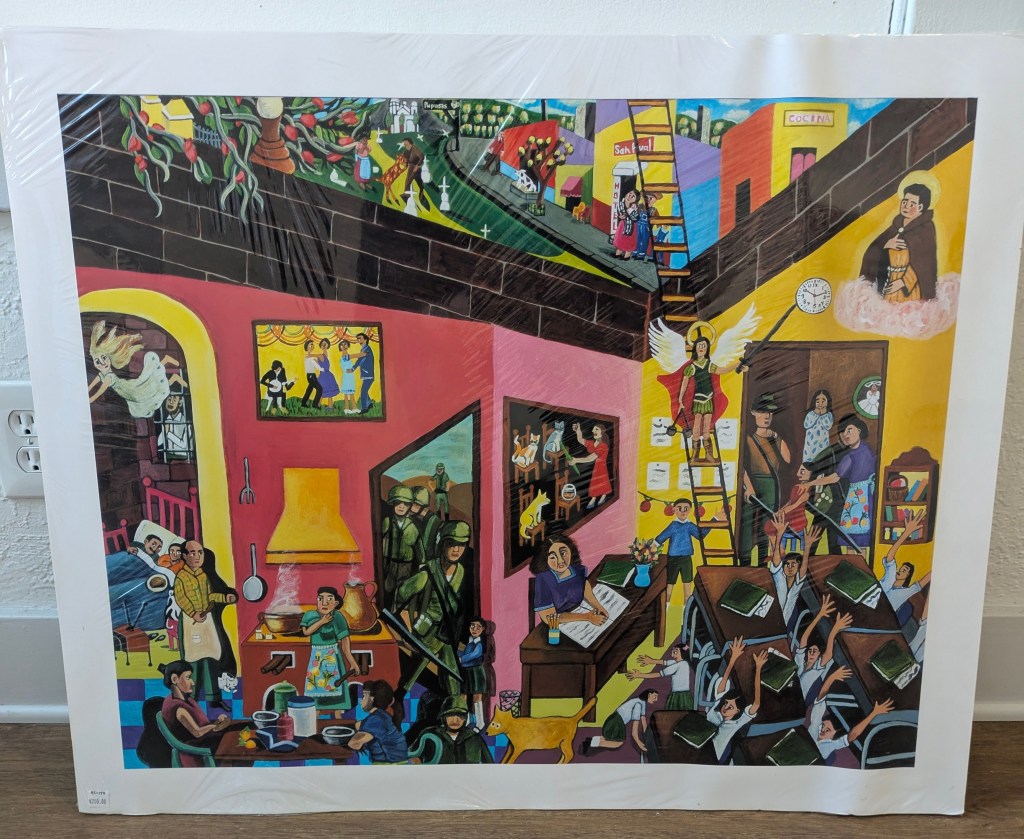
Myra Eastman, “The Great Migration: El Salvador to Santa Cruz — Classroom”
Pajaro Vallery Arts, Watsonville, Calif., 26 January 2025

Know Your Rights: Cards, Graphic Lit, Educational Resources, and CA State Ed  

pdf | bit.ly/uscit-kyr 

Know Your Rights / I Speak CARDS
Asian Task Force “I Speak” Cards

Disability Rights Group

CLINIC “I Am Exercising My Rights” card

DHS Indigenous Language Identification Sticker

Immigrant Legal Resource Center

Limited English Proficiency

USDA Food and Nutrition Services I Speak Statement Cards

 
Online KYR Graphic Literature
Carnegie Corporation of New York: Great Immigrants, Great Americans comic series

Federal Trade Commission Consumer Advice “How Pedro and Miriam Learned About Notario Fraud” 

Immigration Legal Resource Center: Anti-Fraud Comics https://www.ilrc.org/resources/anti-fraud-comics
Immigrant Defense Project Shareable Infographics https://www.immigrantdefenseproject.org/infographics/#0-know-your-rights
Midnight Special Law Collective: KYR Comix

New York Immigration Coalition “I’m Speaking” comic book

Resilience Force: A Guide for The Resilience Worker

 
Know Your Rights Education Resources
ACLU of Southern California KYR: My School, My Rights

Colorin Colorado How to Support Immigrant Students and Families: Strategies for Schools and Early Childhood Programs

iAmerica Know Your Rights

Immigrant Legal Resource Center

Immigration Institute of the Bay Area

KQED

Immigrant Justice

Immigrant Defense Project

Informed Immigrant

Intercultural Development Research Association: 10 Strategies for How Schools Should Respond to Help Children Impacted by ICE Raids

National Education Association: Know Your Rights: Immigration & Schools     

National Immigration Law Center

New York Immigration Coalition

US Committee for Refugees and Immigrants


California State Education Resources
California Department of Education: Chief Deputy Superintendent: David Schapira
Reminder of Obligation to Protect Immigrant Families’ Rights to Access Public Education

  • The letter from the California Department of Education (CDE) reminds schools of their obligation to protect the rights of immigrant families to access free public education, regardless of immigration status. It highlights the U.S. Supreme Court’s Plyler v. Doe ruling and California laws ensuring non-discrimination and safe school environments. The letter includes resources for training staff, legal guidance, and mental health support.
  • https://drive.google.com/file/d/1Gc-Oki1v_07XznU0UBWNW85gqX7rjEG_/view

CA Office of the Attorney General:
Promoting a Safe and Secure Learning Environment for All: Guidance and Model Policies to Assist California’s K-12 Schools in Responding to Immigration Issues

What to do if an immigration-enforcement officer comes to your school?

Cal School News: Safe Haven Districts

Santa Clara County Office of Education: Know Your Rights Education & Immigration Resource Guide for Staff, Educators & Principals

Source: CATESOL Discussion Board, 27 January 2025


With the inauguration of President Trump at hand, Monterey County officials and community stakeholders showed a united front in their support of all immigrants who live, work and attend school in the region at a press conference.

On Jan. 15, Salinas Mayor Dennis Donohue, Monterey County Sheriff Tina Nieto and Monterey County Supervisors Luis Alejo, Kate Daniels and Chris Lopez joined leaders in education, agriculture, hospitality, health and social services to announce the passage of a resolution on Tuesday affirming the county’s commitment to protecting immigrants’ rights and launch a public “Know Your Rights” campaign.

The resolution reestablished the county as a “Welcoming County” for immigrants and refugees, reaffirming key provisions of various state laws including the California Values Act (Senate Bill 54) and is the product of an Ad Hoc Committee formed by the board of supervisors in December.

Monterey County’s resolution came the same day the Salinas City Council, at their first meeting of 2025, issued a statement reminding residents the city has been a “Welcoming City” since June 2017.

The city “is steadfast in our dedication to serving the entire community, ensuring public safety and fostering trust regardless of immigration status, citizenship status or nationality, said Mayor Dennis Donohue at the Tuesday council meeting.

The majority of immigrants in California are documented residents, according to California’s Public Policy Institute, in 2022, 83% of immigrants were either citizens or had some other legal residency status.

While California has 1.8 million immigrants that were undocumented in 2022, according to Pew Research, it is down from 2.8 million in 2007.

Many undocumented individuals live in “mixed-status” households, which includes people with legal status.

According to the California Immigration Data Portal, in 2021, more than 3.3 million people in California and one in five children lived in such “mixed-status” households.

After recent immigration enforcement in Kern County spurred online rumors of similar activity occurring locally that turned out to be false, Sheriff Nieto told the crowd outside the Monterey County Government Center on Wednesday, that her office had been fielding phone calls from concerned residents.

“My family’s afraid to go to the store, my family’s afraid to send their children to school, my family’s afraid to go outside of the house,” said Nieto, describing some of the calls to law enforcement. “I want to assure you that here in Monterey County, the sheriff’s office and your chiefs of police know what the rules are and understand with the Trust Act is, and we’re going to follow those rules.”

Enacted in 2014, the Transparency and Responsibility Using State Tools (TRUST) Act (AB 4) defines the circumstances in which local law enforcement agencies may comply with immigration detainer requests.

Monterey County Office of Education Superintendent Deneen Guss said she wanted to reassure parents that schools are safe spaces for students.

“Our administrators, our educators, and our school staff are dedicated to creating welcoming environments where students and their families feel seen, heard and safe,” Guss said. “I want to assure parents that under current federal laws, schools are considered protected areas and are generally prohibited from voluntarily granting access to campus, by immigration officers, in the absence of a judicial warrant or a court order.”

“I urge you to please keep sending your children to school every day and to also create an emergency plan, including designating someone who can care for your child if needed,” she added.

During the pandemic, workers in agriculture and the service industry were lauded as “essential workers” as many continued to work onsite while workers in other industries got to work remotely and shelter-in-place.

Executive Director for the Monterey County Farm Bureau Norm Groot said local workers in the county’s $4.3 billion agriculture industry should still be considered essential.

“Our fresh food supply and local economy are fully dependent on this workforce and we consider this a national security priority in a time of agricultural labor shortages — farming depends on a stable and reliable workforce not one under threat,” Groot said. “[The county agriculture industry] depends on 55,000 farm workers to harvest our crops each year — primarily immigrants.”

“We appreciate the farmworkers’ vital contributions to the national food supply as essential workers,” he said.

The second largest industry in the county, hospitality, employs 25,000 people.

Rick Aldinger from the Monterey County Hospitality Association said the local immigrant workforce are “hardworking individuals” and “part of the fabric of our local communities” and thanked Supervisors Alejo and Lopez for spearheading the county’s Ad-Hoc Committee.

“Huge progress has been made in a very brief period of time,” Aldinger said. “Avenues of communication have been established among key players and industry leaders and a comprehensive portfolio of resources has been put together that will help our workforce navigate, whatever might lie ahead.”

Individual rights under state and federal law is also something employers with an immigrant workforce must also understand.

“We are trying to not only educate our immigrant workforce but also trying to educate the employers and what their rights are,” Groot said. “It’s a much larger circle than just saying we need to inform immigrants what their rights are.”

“We are trying to work through that and understand how much information we have to push out at this point — it really depends on what happens after next Monday,” Groot said, referring to President Trump’s inauguration, “and how many Executive Orders we’re going to start seeing.”

Source: Roseann Cattani, “‘Know Your Rights’: Salinas, Monterey County officials show united front for immigrants,” The Californian (Salinas, Calif.), 20 January 2025

Archipelagos

Western free society is seriously sick too. The symptoms pop up here and there, but one of the most disgusting is the massive support for the alleged “people of Palestine”—that is, Hamas—in this whole monstrous story. I really don’t understand HOW it has been possible, after the atrocities of October 7, after the taking of hostages, including children, to pretend that this was a minor trifle? That the ruthless Jews suddenly out of the blue started tormenting the unfortunate residents of the Gaza Strip?

After all, bolstered by this wave of international support, Hamas thinks it has won. This will lead to fresh terrorist attacks, of course.

Source: Boris Akunin (Facebook), 16 January 2024. Translated by the Russian Reader. Boris Akunin’s wit and wisdom have been featured in previous posts on this weblog.


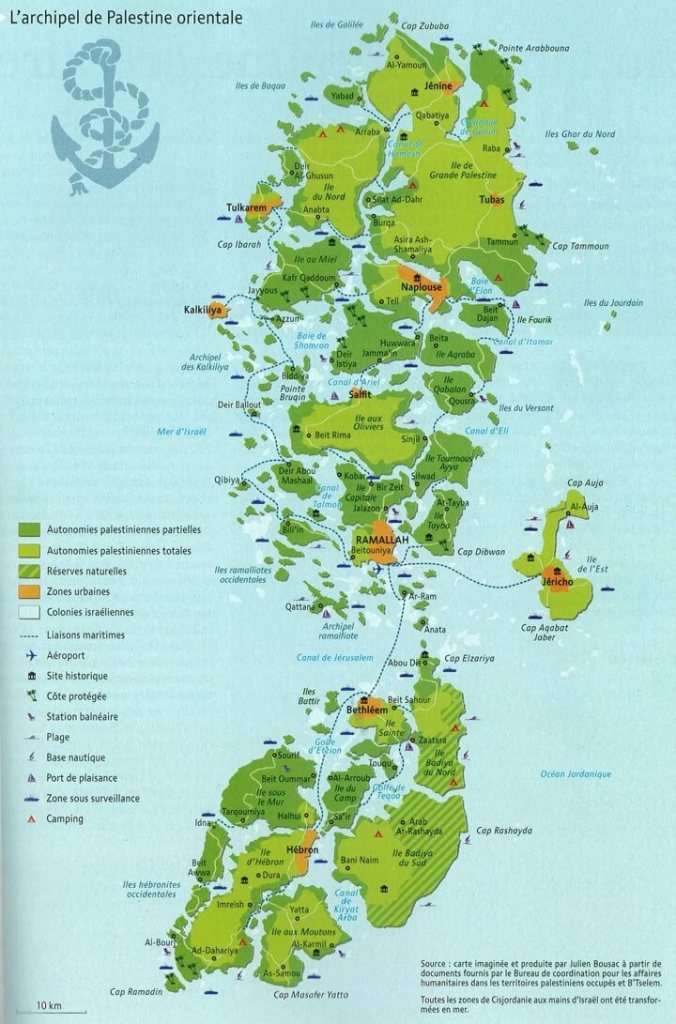
The map above shows what Palestine’s West Bank would look like if all non-Palestinian land suddenly turned into water.

All that would remain would be an archipelago of small islands with the sea of Israel to the west and the Jordanian ocean to the east.

The map is designed to show just how broken up Palestinian land in the West Bank really is. And while originally published in French, it is quite clear in the main point it’s trying to make.

Here are some key points about the map:

  1. Regions of Palestinian Authority:
    • The map shows areas of partial and total Palestinian autonomy, marked in different shades of green. The darker green areas represent total autonomy, while the lighter green areas represent partial autonomy.
  2. Israeli Settlements:
    • Areas in blue indicate Israeli settlements.
  3. Urban Zones:
    • Orange areas represent urban zones.
  4. Protected and Historical Sites:
    • Natural reserves and protected coasts are marked, along with historical sites.
  5. Geographical Representation:
    • The map depicts the West Bank as a series of islands, which illustrates the fragmented nature of Palestinian territories due to the division created by Israeli settlements, roads, and checkpoints.
  6. Symbols:
    • Various symbols denote airports, historical sites, protected coasts, beaches, and camping areas. There are also symbols indicating maritime connections, which, in the context of the map, seem to suggest metaphorical “water” crossings between different areas of Palestinian control.
  7. Geographic Features:
    • Names of regions and cities such as Ramallah, Nablus, Hebron, Bethlehem, and Jericho are mentioned, providing a sense of the location and distribution of these areas.

The map’s creation by Julien Bousac aims to highlight the challenges faced by Palestinians due to the fragmentation of their territories. The fictional archipelago metaphorically represents how the West Bank is divided and isolated, illustrating the complex political and social landscape of the region.

For books on this topic have a look at:

Source: “Palestine’s West Bank Archipelago,” Brilliant Maps, 17 June 2024


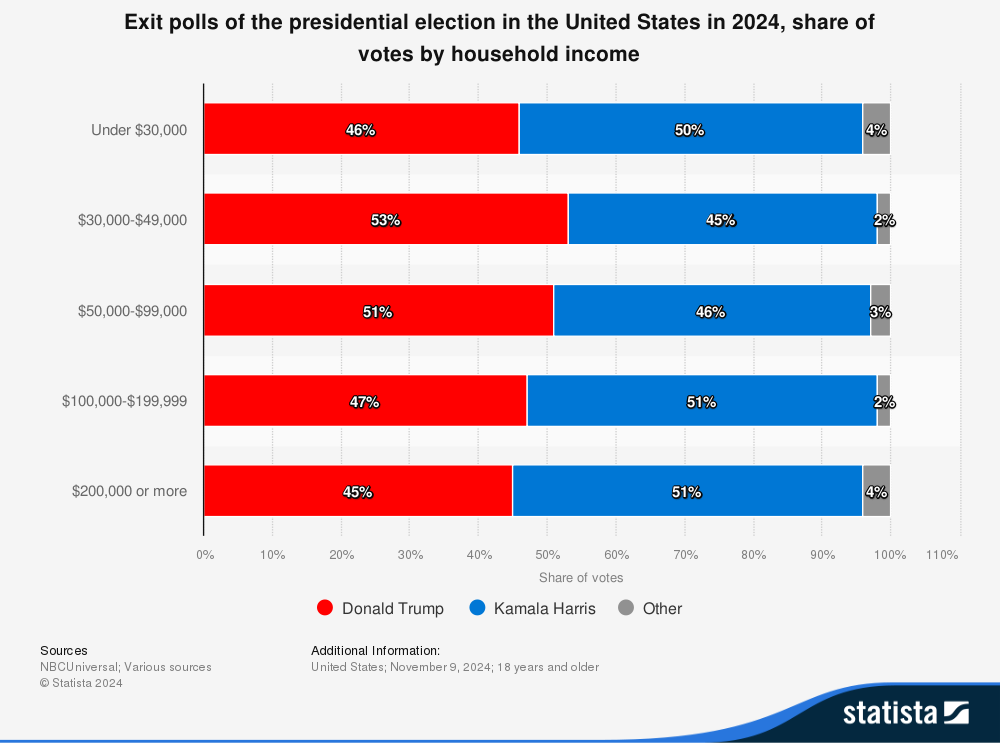
Red America and Blue America have become two different and mutually antagonistic countries sharing the same geographic space. They barely talk to each other, don’t understand one another — and while Blue America happens to be aware that both itself and Red America exist in a larger, infinitely complex world that needs both of them to be one whole for its survival, just as both of them need that larger world for theirs, Red America is not interested in and indeed is hostile to anything and anyone that is not itself and, while generally tending to be poor and perennially gripped by bitterness and resentment, derives its existential satisfaction almost exclusively from making Blue America feel bad — “owning the libs,” as Red America calls it.

Source: Mikhail Iossel (Facebook), 18 January 2024. The emphasis is mine. ||| TRR


Source: Statista


A really good series. I don’t know to what degree it straight up deserves а rating of eight, but it has interesting and fairly unique ideas, and the lead actress is pretty and acts well. We’ll see what the next episodes are like, but on the basis of the first one we can say [that the show] has fine potential. If it develops in a good direction, it could turn out to be decent.

Source: Ororo.TV. Translated by the Russian Reader

Andrei Kureichik: The Empty Shell of War (World Premiere)

The Fortunoff Video Archive for Holocaust Testimonies, and Yale’s Program in Theater, Dance, and Performance Studies, invites you to the premiere reading of Andrei Kureichik’s new play The Empty Shell of War.

The play, featuring performance by Rachel Botchan and D. Zisl Slepovitch, is directed by Shilarna Stokes.

When: January 19, 2025
Time: 4:00 PM
Location: Slifka Center, Yale University

Registration requested in advance. Please click on this link to register.

About the Play 

The Empty Shell of War offers a gripping exploration of war’s psychological scars. This monodrama follows the journey of a young Jewish girl from a Belarusian shtetl, surviving unimaginable horrors during World War II. Grounded in authentic testimonies from Belarusian survivors of the Holocaust archived at the Fortunoff Video Archive, the play reveals stories of courage, compassion, and survival. The play is a response to the policy of Holocaust denial pursued by Lukashenko’s dictatorial regime in Belarus. This will be the world premiere of the play.

About the Playwright 

Andrei Kureichik is a renowned Belarusian playwright, director, and publicist living in exile. Author of over 30 plays performed globally, his works include the groundbreaking Insulted.Belarus, a centerpiece of the global theater solidarity movement. His plays have been translated into 39 languages and honored with awards like the 2023 Best Foreign Play of the Season in Los Angeles and the European Parliament’s Sakharov Prize for Freedom of Speech. A Yale World Fellow, Fortunoff Fellow and Lecturer, Kureichik also teaches “Art and Resistance” at Yale University.

CREATIVE TEAM 

D. ZISL SLEPOVITCH (composer, woodwinds, sound design) is a native of Minsk, Belarus, a New Yorker since 2008. He is a Jewish music scholar (Ph.D., Belarusian State Academy of Music), composer, a multi-instrumentalist klezmer, classical, and improvisational musician (woodwinds, keyboards, vocals); a music and Yiddish educator. Slepovitch is a founding member of the critically acclaimed groups Litvakus and Zisl Slepovitch Ensemble, a regular contributor to the National Yiddish Theatre Folksbiene, a Musician-in-Residence at Yale University’s Fortunoff Video Archive for Holocaust Testimonies, a pianist and music coordinator at Stephen Wise Free Synagogue in New York. Slepovitch’s credits include “Defiance” movie, “Eternal Echoes” album (Sony Classical), “Rejoice” with Itzhak Perlman and Cantor Yitzchak Meir Helfgot (PBS), and “Fiddler on the Roof in Yiddish” (off-Broadway).

SHILARNA STOKES is a Senior Lecturer and Associate Research Scholar in the program of Theater, Dance, and Performance Studies at Yale. She has directed over thirty plays and musicals in theaters throughout the United States, and has received numerous awards, residencies, and fellowships for her directing work. Her current book project, “Playing the Crowd: Mass Pageantry in Europe and the United States,” examines large-scale political pageants performed in England, the US, Russia, France, and Germany. She is a graduate of Yale (BA in Theater Studies and Comparative Literature), Columbia University School of the Arts (MFA in Directing), and the Columbia Graduate School of Arts and Sciences (PhD in Theatre).

RACHEL BOTCHAN is an award-winning performer with extensive Off-Broadway and regional theater experience and a variety of stage, TV and film credits, She is known for her dynamic range and transformative portrayals. She is an award-winning audio book narrator with many titles for Recorded Books and Audible. She is a graduate of NYU Tisch School of the Arts where she received the Seidman Award for excellence in Drama.

PANEL DISCUSSION

Following the performance, a Q&A and Panel Discussion exploring the play’s themes and historical context will be led by scholar of Holocaust and Genocide Studies, Vesta Svendsen (Brown University).

VESTA SVENDSEN is a PhD student in History at Brown under Dr. Omer Bartov, studying the role of trauma in Belarus ’post-Soviet national identity formation. She originates from Brest, Belarus and was raised between Belarus and New Orleans. Vesta holds a BA from Tulane University in Russian Studies and an MA from Yeshiva University in Holocaust and Genocide Studies. In 2023, Vesta was a Summer Graduate Student Research Fellow at the US Holocaust Memorial Museum, studying western Belarus. Throughout her MA studies, Vesta engaged in part-time psychoanalytic training to broaden her understanding of transgenerational trauma. As an interviewer for the USC Shoah Visual History Archive, she gathers testimony from Russian-speaking Holocaust survivors and is currently translating a Russian-language Holocaust memoir. Vesta is a member of the Coordination Council of the Belarusian democratic forces. She possesses language skills in Russian, Belarusian, Ukrainian, French, Polish, and Yiddish.

Source: Stephen Naron, “Premiere reading of new play The Empty Shell of War at Slifka Center on January 19, 2025,” Fortunoff Video Archive for Holocaust Testimonies, 10 January 2025

Victims Too

For years, survivors of Assad and Russia’s chemical attacks in Syria were silenced. Today, we uncovered shocking evidence that many of these witnesses were forcibly taken to Moscow and pressured to lie – part of an extensive cover-up by the Russian state.

Now, with Assad no longer in power, these survivors are free to speak. In this video, they reveal the horrific reality of the chemical attacks – scenes of unimaginable suffering, children foaming at the mouth, and entire families wiped out.

As someone living in Ukraine, I’ve witnessed Russia’s war crimes firsthand – from white phosphorus to targeted civilian attacks. The patterns of brutality are clear, stretching from Syria to Ukraine.

This story exposes the disinformation campaign that echoed globally, amplified by figures like Aaron Maté and platforms like RT. But the truth matters now more than ever.

Watch as the survivors share their experiences and shed light on the true scale of Russia’s actions – crimes that continue to affect lives across multiple continents.

Source: Caolan Robertson (YouTube), 5 January 2025. Thanks to Michael Karidjis for the heads-up.


“Muskovites [sic] celebrating the New Year on Teatralnaya Square.” Photo: Yevgeny Messman/TASS (via Moscow Times)

Victimhood can be a tricky thing. Nobody doubts that ordinary Ukrainians are victims of this war. Russia’s political opposition, in exile, prison or dead, are also viewed as victims. But what of the country’s silent majority? What of the millions who stayed in Russia, kept their heads down and focused on living their ordinary lives, rather than the war and the online space it occupied?

Many things have changed in Russia since 2022. But one of the main constants has been the average Russian citizen’s desire for peace and ending the war. The majority have not been militantly opposed to or cheering the war effort on. Instead, they have been focused on living in the present, trying to salvage what remains of normality and longing for its imminent return – what some are calling the silent majority.

They are not happy with the war or satisfied with the current situation and have few ways of expressing that. Many do feel guilt on a certain (very private) level.

One thing hard not to notice in Russia throughout the conflict is how that silent majority has simply hunkered down and carried on. The war is very much in the background now. When I leave my building every morning, the same middle-aged man is defrosting his car, mothers are walking with strollers and children are heading to the local school.

When you eavesdrop on their conversations or stop to say hello, they sound normal – not like indoctrinated quasi-fascists, as some scholars are suggesting. They sound like any other school child whose teacher is just trying to get through the copious material thrown at them by the school director. The mothers just want their children to grow up in safety and comfort. Cheering on an expensive war pushing up the price of baby food is hardly a means of achieving that.

The war may come to an end in 2025. Negotiations are likelier than at any point since early 2022. And make no mistake, a peace agreement is inevitable. When the war ends, however, on whatever terms, Russia and its population of 146 million will still be there. It will not disappear or suddenly go away. The man defrosting his car as I write these words is not likely to have a huge epiphany when it does. His life has hardly changed since 2022. The increased number of women publicly wearing hijabs in our city is not doing so as a passive sign of resistance.

By living here, watching life unfold how it does, the more one cannot help but think something that many in the West will find unpopular. The war is not their fault. Tens of millions of innocent Russians are victims too. Their freedoms have been curtailed, their movements and opportunities restricted. Did they deserve that by virtue of where they were born? A classic liberal would argue not.

Like millions across the world, the average Russian is just trying to feed and raise their families, and get through the month. Many colleagues in academia have questioned from the comforts of the West, their tenured positions and with nothing to lose why many Russians do nothing to oppose the regime. What they neglect when arguing from their moral high ground is that those people I spoke of earlier do have a lot to lose being critical online. They have about as much power to topple the regime and change its course on the war, as the average Westerner does.

There will be blame to go around. Russian officials and the security apparatus, who carried out the decisions to invade Ukraine and suppress its own population, are obvious contenders. On the Ukrainian side, President Volodymyr Zelensky and his generals will have to answer for decisions they made. Kyiv’s Western allies clearly could have done more to support Ukraine, yet did not. 

Russia’s silent majority will not want to be blamed and they must not be. They personally did not harm anybody or choose the war. Unlike routine acts of everyday life, the war was not their personal fault or responsibility. Collective guilt is too controversial; thousands protested, millions left and staying silent was, in its own way, an act of defiance by refusing to enter the discourse. Guilt by association is also not a tenable position. Not every Soviet citizen was responsible for the Stalinist Terror. Not every Russian citizen can be responsible for the war, especially not on the basis that they refused to cheer on Ukraine and their own country’s defeat.

Blaming those who are faultless will only cause resentment where there was none to begin with. In the long term, it will not make the world safer or more peaceful. Then comes one of liberal democracy’s sore spots that Ukraine, Georgia and even Moldova will have to reckon with on its European journeys: those people in the silent majority will still have a right to have an opinion – as will the pro-Russian segments of their populations. Dismissing these views or people will not make them, nor those in power, more rational.

If the West were serious, it would try to reach out to Russia’s silent majority, who can be won over. The Russian population at large do not hold the same positions as those in and around the Kremlin currently. Most of the population wants Russia to be an open, peaceful country, especially to the West. Make no mistake, westerners, their companies, money and popular culture will be welcomed back with open arms one day. Moreover, this part of Russian society will want to be welcomed back, too. Not doing so only will push the Kremlin into a closer alliance with the likes of China and North Korea.  

Moreover, it is absolutely naive to assume that Russia’s social and economic problems will be fixed automatically by the sudden absence of Putin and the return of democracy. Although it stands a much better chance, we have been here before and there is no guarantee of success. Democracy will need to involve this silent majority beyond Moscow and the big cities – felt on the local level – seen to be actually working and fixing the people’s problems. If not, that silent majority will simply resign themselves, remaining disillusioned and ambivalent.

Gleb Pavlovsky once predicted what the end of the Putin regime would look like: it would collapse in a day and be replaced by something exactly the same. He may be proven right. If he is, that is the fault of those in power, not Russian society.

Source: Anonymous, “Russia’s Silent Majority Are Victims Too,” Moscow Times, 1 January 2025. This is not a parody, apparently, although it reads like one. ||| TRR


Pretrial Detention Center No. 2 in Taganrog (Rostov Region) was a place where, until 2022, minors, women, and mothers with children were detained. After the outbreak of full-scale war in Ukraine, Russian security forces cleared the detention center to make room for Ukrainian army soldiers and other prisoners of war, including the defenders of the Azovstal steel plant.

Pretrial Detention Center No. 2 gained a reputation as a gruesome torture camp for Ukrainian detainees. Many POWs in other detention centers are threatened with being sent to Taganrog and so forced not to oppose the prosecution. Few people have come forward to talk about the torture.

The story of Ukrainian Dmytro Lisovets was one of the first indications that the detention center in Taganrog had been turned into a torture camp. Lisovets had tried to flee with his family from occupied Mariupol, but failed to get through a filtration point in the Rostov Region. A former member of Ukrainian volunteer units, Lisovets was sent to the Taganrog detention center without being assigned any procedural status.

Lisovets’s lawyer told Mediazona that the Russian authorities “don’t pull any punches with the Ukrainians in this detention center”: “They burst into the cells in masks and beat everyone indiscriminately.” His client was also beaten and tortured in order to force him to admit that he had been involved in the hostilities. Consequently, Lisovets was sentenced to sixteen years in prison.

Once they were detained at Taganrog pretrial detention center, the Ukrainians were completely cut off from the outside world. According to one of the lawyers defending the prisoners, they were not allowed to talk to their clients in private, only in the presence of a police investigator. Moreover, the detention center staff forced the detainees to sign papers waiving their right to communicate with their defense lawyers.

The detainees were able to talk about the torture only after they had been transferred to other pretrial detention facilities.

“We were thrown from the back of KamAZ trucks—our hands tied and eyes blindfolded—and forced to line up against the wall under a hail of blows, where the beatings continued with hands, feet, batons and electric shockers,” one of the captured Ukrainians told his lawyers.

He also said that “at the offices” (that is, during interrogations) he would be bound with a leather belt, placed on the floor, and have a sandbag placed on his chest to make it harder for him to breathe. He would then be beaten with a rubber truncheon and tortured with a stun gun. “It was during such ‘procedures’ that [the Russians] extracted confessions of ‘war crimes,'” the Ukrainian wrote.

There were also mass beatings, including during rare walks outside in the yard. “At every turn of the walking route, a special forces soldier was stationed and was obliged to hit [the prisoners] with a stick,” said one of the convicts. Some officers were “humane” and did not beat wounded prisoners ands prisoners ofter fifty. “The attitude toward us in captivity depended on who was on duty in the prison. There were wardens who would beat all the prisoners,” said Yuriy Hulchuk, an Ukrainiian marine who spent time in Pretrial Detention Center No. 2.

There was no decent food in the detention center either. One of the defense lawyers of the Ukrainian prisoners, speaking on condition of anonymity, said that once a day the wardens “would feed them cabbage broth and quarters of black or white bread.” Ukrainian military officer Artem Serednyak was detained at the Taganrog detention center from September 2022 to the summer of 2023, during which time he lost twenty-two kilograms.

One of the prisoners calls Pretrial Detention Center No. 2 “hell with all its demons,” where it is scary to return: “Even the definition of ‘concentration camp’ would be too mild for Pretrial Detention Center No. 2,” he said. Human rights activists say that there was also sexualized violence against prisoners at the detention center: for example, prisoners had rubber truncheons shoved up their anus.

It was not only military personnel who were locked up in the detention center. For example, Ukrainian journalist Victoria Roshchyna, who was detained by the Russians in the occupied part of Donetsk Region, was sent to the Taganrog pretrial detention center for a year. She died last year: presumably, she was about to be exchanged for Russian prisoners. She did not have time to provide details about her life in the detention center. It is only known that Roshchyna was held in solitary confinement from May to September 2024.

The Russian authorities have not reacted in any way to the reports of torture. Russian human rights commissioner Tatyana Moskalkova visited the pretrial detention facilities where Ukrainian prisoners are held, but she did not report poor detention conditions either. Human rights activists say that the administrators of the detention centers would get ready for such inspections. “[T]hey prepared for this day: everyone was given new clothes, the grass was painted, the lawns were trimmed, and so on. They even gave them [the Ukrainian prisoners] biscuits, which they were extremely happy about, because the usual diet was very meagre,” [Irina Soboleva], one of the lawyers defending Ukrainian prisoners, says.

Source: “There is a torture prison for Ukrainians in Taganrog,” WTF? newsletter (Mediazona), 9 January 2025. Translated by the Russian Reader


In the age of forever war, the use of mercenaries, paramilitary forces, and irregular troops have become increasingly common on the battlefield. But now Russia is resorting to luring unwitting civilians from Yemen and other countries across Asia with little to no military experience to fight alongside its troops in the war in Ukraine.

As reported by Ali Younes, a recruitment network run by a high-ranking Yemeni political and military official with ties to the Houthi government is tricking young Yemeni men desperate for jobs into signing employment contracts for work in Russia, only for them to find once they arrive that they cannot leave and are forced into military training camps and sent to the frontlines.

As the war in Ukraine approaches its fourth year with no end in sight, Russia has turned to recruiting unwitting young men from Yemen and other Arab countries to fight alongside its troops on the front lines. The men are lured under false pretenses, they tell Drop Site News, with promises of lucrative jobs and opportunities for migration, unaware that they are being forcibly recruited as mercenaries to fight in a foreign war despite having little to no military experience.

Two men who fell victim to the scheme told Drop Site they found out they were being sent to fight with the Russian army in the Ukraine war only once they had landed in Russia. Drop Site obtained a copy of an employment contract, corroborating photos and video, and spoke with a human rights organization that has documented the practice.

Mohamad, a Yemeni national who declined to give his last name for security reasons, said he was working in a restaurant in Oman in July when he was approached by Abdul Wali Al Jabri, a high-ranking Yemeni political and military official. Mohamad said they told him about job opportunities in Russia with a good salary and a hefty signing bonus and that he would be working for a civilian company according to his skills. He was eventually convinced to sign up through a company that recruits laborers in Yemen and Oman owned by Al Jabri, who is a general in the Yemeni armed forces of the Houthi government and a member of parliament in Sanaa.

Mohamad said the agreement between the Yemeni recruits and Al Jabri was a monthly salary of $2,500 with a signing bonus of $20,000. A copy of an employment contract written in both Arabic and English obtained by Drop Site lists the Al Jabri General Trading & Investment Co. SPC and Abdul Wali Al Jabri as the company representative. The contract outlines the company’s role in arranging for jobs in Russia “in the military, security, or civil field, based on…qualifications, experience, and capabilities” and says the contract ends after the signee “obtains Russian citizenship.” Mohamad said he was never told that he would be sent to fight for the Russian army in Ukraine and there is no indication in the contract.

Al Jabri has a fee built into the contract, whereby the signee is obliged to pay him $3,000 upon getting employed in Russia. Al-Jabri did not respond to repeated messages of inquiry from Drop Site for this story. However, Al Jabri did respond to questions posed by Tawfik Alhamidi, a Yemeni lawyer and human rights defender based in Geneva, Switzerland who runs the SAM Organization for Rights and Freedoms, and has documented the forced recruitment of poor young Yemeni men into Russia’s war with Ukraine.

Al-Jabri defended the practice to Alhamidi, saying he owns a “travel company” and that people in Yemen have asked him to “arrange for them to travel to Russia and join the army in order to obtain Russian citizenship and earn money to spend on their families back in Yemen.”

He dismissed criticism, adding that “he obtained a Russian approval for the Yemeni men to travel to Russia with good salaries but some political parties in Yemen who are currently fighting Ansar Allah [the Houthis] became worried that they might lose their soldiers to go fight with Russia and therefore created a social media storm over this issue.”

In September, Mohamad traveled to the Russian city of Nizhny [sic] via Dubai. He shared a video of himself with Drop Site on the plane, holding his boarding passes. He and a group of around 20 Yemeni men stayed in Nizhny for 24 hours before being shipped to the city of Rostov, a command base for the Russian army near the frontlines with Ukraine. They also discovered that their salaries were just $300 a month with a meager signing bonus.

Mohamad said that in both Nizhny and Rostov the Yemeni men were met by Russian soldiers. Mohamad said that they were forced to sign another contract, written in Russian, that obliged them to serve in the Russian military. “We were forced to sign contracts in the Russian language that we didn’t understand to serve in the Russian military,” Mohamad said. “We were very afraid.”

He said that in Rostov his group protested to the Russian officers that they didn’t want to fight in the war and demanded to go back to Yemen but they were prevented and ended up being forced to stay in Russia for months where they were forced into military training camps. Mohamed also shared a photo of a Yemeni recruit in full military fatigues and combat gear holding an assault rifle and another of a dog tag written in Cyrillic.

“We were trained by an Arabic-speaking Egyptian Russian military officer who told us that we are in Russia to fight for the Russian army and that we will be deployed to the front lines and not working as civilians,” Mohamad said. He said in the camp he met many men from Iraq, Syria, and Sudan and elsewhere receiving military training. Mohamed was finally able to return to Yemen at the end of October and he spoke to Drop Site from Sanaa.

Another video shared by Mohamed [sic] with Drop Site shows a group of about 10 Yemeni men inside a tent with wooden bunk beds in Nizhny. In the video, one man says, “We came from the sultanate of Oman for civilian work, everyone according their skills,” pointing to each one in turn, he adds, “This man is a metalworker, this man works with hydraulics, this man is an electrician, this man is a driver, this man works with electrical equipment. We are all civilians who work civilian jobs.” He goes on to say they were taken from the airport to Nizhny and they were “terrorized by armed soldiers and forced to sign contracts.” Pointing to a pile of camo backpacks on the floor, he says they were being taken to a training camp. “We are civilians and we know nothing of this,” he says in the video and calls on the Yemeni government to help them. “We are sons of Yemen and we fell into a trap.”

Drop Site also communicated via WhatsApp messages with Jalal, another Yemeni man recruited by the same network who is currently deployed as a soldier fighting for Russia in Ukraine. He told Drop Site he was lured into coming to Russia to escape poverty with the promise of a large salary and signing bonus as well as Russian citizenship. He said he ultimately decided to stay and fight in the war in the hope that he could earn enough money to be able to return to Yemen with savings as well as to possibly obtain Russian citizenship.

Alhamidi characterizes the recruitment practice as exploitative and a human rights violation.

“Dire poverty conditions in Yemen enabled human trafficking and recruitment networks to proliferate and lure young men to go to Russia under false promises of civilian work and high salaries,” Alhamidi told Drop Site, adding that Yemen’s laws contain many loopholes that [allow] Yemeni nationals to join foreign armies as mercenaries without being criminalized. “This has enabled powerful men in Yemen with connections to the Houthi government and Russia to mislead hundreds of young men into traveling to Russia to fight in Ukraine.”

report by SAM published in November based on interviews with several Yemeni nationals who who were recruited by Al-Jabri and traveled to Russia titled, “With False Promises of Jobs and Attractive Salaries: Recruitment Networks Force Yemeni Youth into the Russia-Ukraine War,” found that: “The forced recruitment of Yemeni youth into the Russian-Ukrainian war through coercive networks constitutes a clear violation of international humanitarian law and human rights and rises to the level of human trafficking… The organization reported that once recruits arrive in Russia, they are subjected to severe abuses, including being forced to fight under harsh and inhumane conditions, being deprived of food and medical care, and suffering injuries or death from indiscriminate shelling on the battlefronts.”

According to Alhamidi, Al Jabri has traveled to Russia numerous times and has obtained visas to Russia for thousands of Yemenis to lure them into traveling there and forcing them into military training camps, though it is unclear how many have actually made the trip.

Similar recruitment networks in other countries have lured unwitting civilians to Russia with promises of work or other opportunities and then forced them to serve in the Russian army. One human trafficking network in India sent dozens of Indian nationals to Russia for combat training before being deployed to the front. Citizens of Nepal and Sri Lanka have also been illegally recruited in similar ways to fight for Russia in Ukraine.

Source: Ali Younes, “Russia is luring unwitting Yemeni civilians to fight in Ukraine,” Drop Site, 10 January 2025

A Monterey Story: The Western Flyer

Elkhorn Slough, as seen from the Carneros Creek watershed. The Western Flyer is moored in the marina at Moss Landing, where the slough flows into Monterey Bay (near the smokestacks on the center right). Photo by the Russian Reader

I have never directly acknowledged the fact that, since May 2021, this weblog has come to you from Monterey-by-the-Sea, California, where I have happily found many things to do that have nothing to do with Russia and the heavy, steady flow of bad news from there. I want to share that happiness with you by way of saying goodbye to 2024 and thanking you for sticking with the Russian Reader this past year.

The distinctly Monterey story, told below in four short but fascinating videos, is a fascinating, inspiring, and happy one. I hope you enjoy it as much I did. See you next year! ||| The Russian Reader


Western Flyer Foundation Channel, “The Western Flyer with Nick Offerman”

The Western Flyer sails again! Come aboard with Emmy-award-winning actor and comedian Nick Offerman for a fun new look at the life, near-death, and resurrection of the famous old fishing boat in John Steinbeck’s The Log from the Sea of Cortez (1951). From the coast to the deep sea and from the tide pool to the stars, the nonprofit Western Flyer Foundation stirs curiosity using a blend of science and art inspired by John Steinbeck, Ed Ricketts, and their 1940 journey on the Western Flyer.

Learn more about the vessel’s history, adventures, and exciting future or marine science and education at http://www.westernflyer.org.

Source: Western Flyer Foundation Channel (YouTube), 27 February 2024


CBS Mornings, “John Steinbeck’s ‘Western Flyer’ gets brought back to life”

After writing “The Grapes of Wrath,” author John Steinbeck explored the Gulf of California in a famous boat called the Western Flyer. Since then, the boat has inspired adventurers and scientists for generations, but the original ship was nearly lost. CBS News’s Jeff Glor reports on the person determined to give it new life.

Source: CBS Mornings (YouTube), 23 December 2023


KBTC Public Television, “The Western Flyer”

Art and science come together in the restoration of a famous fishing boat.

Source: KBTC Public Television (YouTube), 8 January 2019


Western Flyer Foundation Channel, “The boat John Steinbeck and Ed Ricketts made famous. Western Flyer: The Next Chapter”

Almost lost forever, the iconic vessel that carried the acclaimed novelist John Steinbeck (who penned Of Mice and Men, Grapes of Wrath and more) and marine biologist Ed Ricketts to the Sea of Cortez on an epic scientific mission gets new life and a new mission.

Source: Western Flyer Foundation Channel (YouTube), 13 March 2018

Russia Shoots Down Santa Claus

“Happy New Year, Russians!”: Santa Claus Shot Down Over Moscow by Russia’s Ded Moroz (Grandfather Frost)

Source: Kolokol XXI (Telegram), 27 December 2024 + Yandex Video. Thanks to Sergey Abashin for the heads-up.


Pro-Kremlin Telegram channels on Friday circulated a New Year’s video depicting Russian air defense systems shooting down Santa Claus’ reindeer sleigh.

The video, first shared by the Pul N3 Telegram channel, begins with Santa flying over central Moscow to the tune of “We Wish You a Merry Christmas.”

“Hi, Russians! Here are your presents,” says Santa Claus, sipping a Coca-Cola as the camera zooms in on his sleigh, which is loaded with rockets bearing NATO logos.

“Happy New Year,” Santa says before a missile shoots into his sleigh, causing it to explode mid-air.

Ded Moroz and Russian airpower. Image courtesy of Moscow Times

The scene then shifts to a military control room where a Russian serviceman and Ded Moroz — Russia’s version of Santa Claus — monitor the action on a screen as a traditional Russian folk tune plays.

“Is it done?” Ded Moroz asks the headset-wearing serviceman.

“Yes, it’s done. The target was destroyed,” the serviceman replies.

“Good. We don’t need any kind of foreign stuff [in our skies],” Ded Moroz says, embracing the serviceman. “Happy New Year!”

The video’s release comes just days after an Azerbaijani passenger plane crashed in western Kazakhstan, with reports suggesting it was shot down by a Russian surface-to-air missile.

Source: Pro-Kremlin Media Share Video Showing Russian Missile Shooting Down Santa’s Sleigh,” Moscow Times, 27 December 2024

The White Helmets: Dispatch from Aleppo

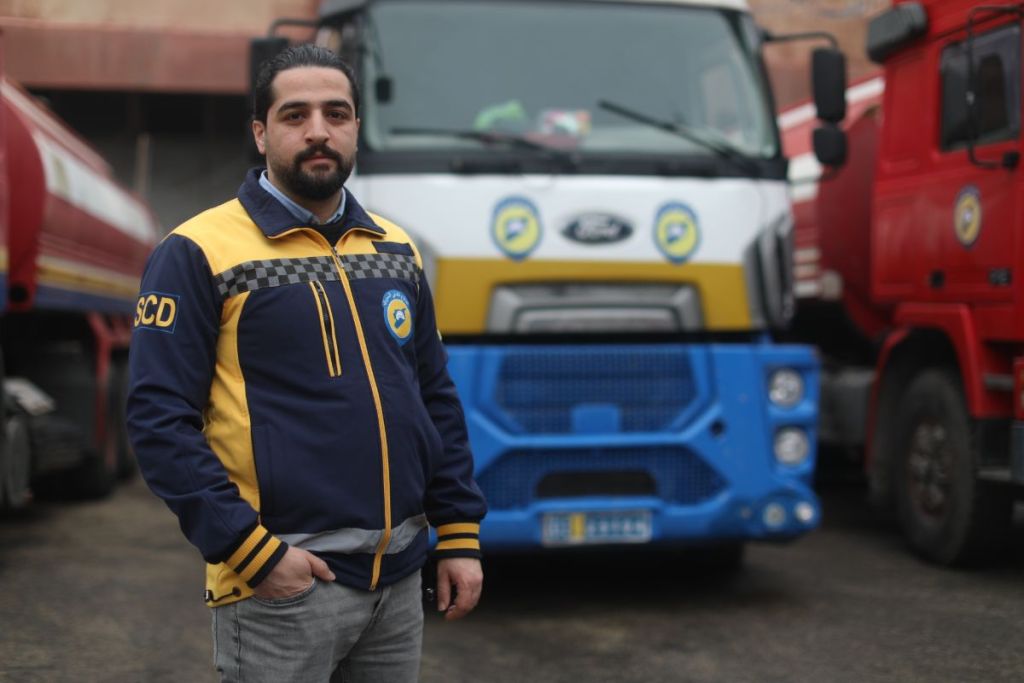
This is an update from Khaled Khatib from the White Helmets’ team in Aleppo.

I never thought I’d return to Aleppo. 

When I was forcibly displaced in 2015, it felt like I was losing everything: my home, my city, and the place where I grew up and became the person I am today. Like my teammates in the White Helmets, I had devoted myself to saving lives, documenting atrocities, and showing the world the truth about Syria. We risked everything, believing that if the world saw our pain, it would act. 

You might have seen part of that story in the Oscar-winning documentary The White Helmets, which I helped film. I hoped it would be a turning point, that it would compel action to protect civilians and stop the horrors we were living through. But no action came, and instead of protection, we were bombed and displaced. 

The years that followed were some of the hardest of my life. The grief was overwhelming. But my teammates from across Syria helped me find strength again. Together, we continued our work in northwest Syria, responding to emergencies and supporting communities. We leaned on each other and built a strong organization that has saved over 128,000 lives from the rubble of airstrikes. 

Now, after all these years, Syria is free of Assad, and I’m back home.  

Khaled in Aleppo

The city has changed. It’s strange to hear the quiet, with no sounds of bombs and planes overhead. People are trying to rebuild their lives, but the scars of war are everywhere. Entire neighborhoods remain in ruins, infrastructure is shattered, and essential services like water and electricity are barely functioning. 

The White Helmets have returned too. We’re here in Aleppo, working tirelessly to clear rubble, remove unexploded ordnance, and respond to emergencies.  

For me, this return is deeply personal. Aleppo is where I joined the White Helmets as an 18-year-old, where I grew into the person I am today, and where I learned that our humanity transcends everything else. I’ve carried with me the importance of saving lives without discrimination and the power of storytelling to preserve the truth, and these lessons are what kept me going.  

But the challenges we face are immense. Scaling up operations is critical to clear rubble, reopen roads, and ensure the safe return of displaced families. Not just in Aleppo, but also in places like Homs and Ghouta, where years of destruction have left communities struggling to recover. 

This work depends on people like you. 

Your support will help us expand our teams, secure lifesaving equipment, and rebuild the infrastructure that families need to return home safely. Together, we can restore Aleppo and all of Syria, paving the way for hope and recovery. 

Make a tax-deductible gift today to help us scale up our operations and rebuild the lives and futures of those scarred by war. Every contribution makes a difference.

Thank you for standing with us through it all. With your support, we can rebuild not just cities but hope for a better future. Syria’s recovery is only just beginning. 

With gratitude, 

Khaled Khatib

The White Helmets, officially known as the Syria Civil Defence, is a Syrian-led grassroots humanitarian organization working to save lives and uplift communities in areas most affected by conflict and disaster in Syria. We are registered in Türkiye as Beyaz Baretliler Derneği, the Netherlands as Stichting White Helmets Foundation, Canada as les Casques Blancs, and the United States as The White Helmets, Inc.

The White Helmets, Inc., is a registered 501(c)(3) non-profit organization and all donations in the United States are tax-deductible. Our EIN is: 93-4720959. 40 West 37th St., Suite 1000, New York, NY 10018

Source: Emailed appeal from the White Helmets, 24 December 2024

News from Ukraine Bulletin 127

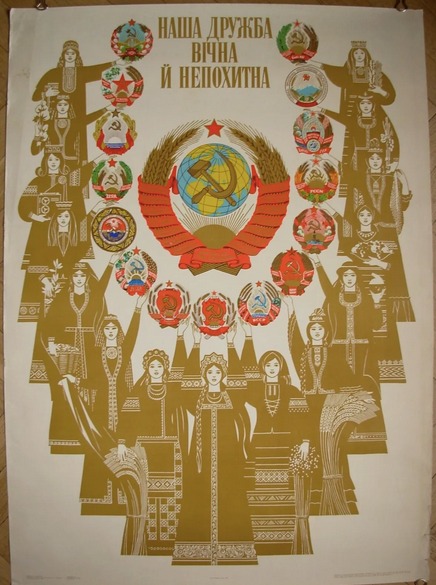
“Our friendship is eternal and unshakable” Ukrainian poster, 1983
Courtesy of Soviet Visuals

In this week’s bulletin: Ukraine labour relations under martial lawDemocracy uprising in the Caucasus/ ‘Swift peace deal’ questioned/ Ukraine: resisting arbitrariness from above/ Russian torture and denial of medical treatment

News from the territories occupied by Russia:  

Russia confirms revenge sentences against savagely tortured Crimean Tatar cousins, seized with Nariman Dzhelyal (Kharkiv Human Rights Protection Group, December 20th)

Abducted Kherson activist sentenced for ‘spying for Ukraine’ while in Russian captivity denied vital medical treatment (Kharkiv Human Rights Protection Group, December 19th)

Russia churns out surreal ‘terrorism’ sentences against Ukrainian POWs for defending Ukraine (Kharkiv Human Rights Protection Group, December 17th)

20-year-old from Mariupol sentenced to 11 years for argument opposing Russia’s war against Ukraine   (Kharkiv Human Rights Protection Group, December 16th)

Human rights defenders: Ukrainian citizens under occupation need support (Zmina, December 13th)

Forced reality (Alter Pravo, October 2024)

Life Under Occupation (Alter Pravo, October 2024) 

The situation at the front:

Battlefield developments: ‘Enter Pyongyang’ (Meduza, 19 December)

News from Ukraine – general:  

Joint appeal of representatives of the coalition “Ukraine. Five in the Morning” and the Initiative “Tribunal for Putin” (Tribunal for Putin, December 21st)

Legal regulation of labour relations in the conditions of martial law in Ukraine (Science Open, December 20th

When a Scalpel Becomes a Kitchen Knife: How Ukrainian Courts Skillfully Distort ECtHR Practice (Kharkiv Human Rights Protection Group, December 18th)

Ukraine: Inadmissible evidence in examinations (Kharkiv Human Rights Protection Group, 18 December)

Do today’s HACC decisions comply with European practice? (Kharkiv Human Rights Protection Group, December 18th)

Can a huge bail replace justice? (Kharkiv Human Rights Protection Group, December 18th)

Impact of War on Education and Neoliberal Reforms  (Ukraine Solidarity Campaign, December 17th)

“We cannot allow this to happen to our children.” Discussion on “No Child of Ukraine Should Be Left Alone with the Experience of War” (Center for Civil Liberties, December 16th)

Groups of Resistance: How Ukrainians Protect Their Interests from ‘Arbitrariness from Above’  (Commons.com, November 27th)

War-related news from Russia:

Russian anarchist jailed for arson commits suicide on first day of sentence (Novaya Gazeta Europe, 20 December)

St Petersburg: The Terror Scam Gig Economy (The Russian Reader, 20 December)

Duma broadens ‘treason’ charges against anybody opposing Russia’s aggression against Ukraine (Kharkiv Human Rights Protection Group, December 18th)

LGBT+ activism in Russia: “Rainbow extremism” (Posle.Media, 18 December)

Legislators equate criticism of Russia’s war against Ukraine with ‘terrorism and extremism’ (Kharkiv Human Rights Protection Group, December 16th)

Analysis and comment:

Uprising for democracy in the Caucasus (Tempest, December 21st) 

Those Demanding a Swift ‘Peace Deal’ for Ukraine Don’t Understand How Complex This War Really Is  (Byline Times, December 19th)

Russian Gas Giant Given Access to Global LNG Summit (DeSmog, December 13th)

Caucasus: Resisting local authoritarianism and multipolar imperialisms (CrimethInc, 11 December)

Research of human rights abuses:

Ukrainian children deported to Russia: ‘The development of Russian identity’ (Meduza, 20 Dec)

Kyrylo Budanov met with human rights defenders (Zmina, December 20th)

The European Parliament demands Russia immediately release ill Crimean political prisoners: resolution, proposed by ZMINA, was adopted (Zmina, December 19th)

Russia ignores the needs of Ukrainian political prisoners for medicines and medical care: ZMINA met with Henry Marsh  (Zmina, December 19th)

Human rights defenders call on parliamentarians not to adopt draft laws No. 11538 and No. 11539 (Zmina, December 19th)

ZMINA at the #IBelong forum: challenges on citizenship during the war (Zmina, December 17th)

Over 16,000 Ukrainian civilians held captive in Russia – Ukraine’s ombudsman (Ukrainska Pravda, December 16th)

Upcoming events:

Saturday 18 January 2025, 12:00 midday. National March for Palestine. Assemble BBC, Portland Place, London. Unite the Struggles, Ukraine Information Group and others will march with our banner, “From Ukraine to Palestine, Occupation is a Crime”. Details of assembly point in the new year on our web site or by email. 

Saturday 15 February 2025 11AM — 4PM, Conference: End the Russian invasion and occupation. National Education Union, Mabledon Place, London, WC1H 9BD. Register here.

This is the last News from Ukraine bulletin for 2022. The next one will appear on Monday 6 January. With best wishes for 2025 to our readers

This bulletin is put together by labour movement activists in solidarity with Ukrainian resistance. To receive it by email each Monday, email us at 2022ukrainesolidarity@gmail.com. To stop the bulletin, reply with the word “STOP” in the subject field. More information at https://ukraine-solidarity.org/. We are also on TwitterBlueskyFacebook and Substack, and the bulletin is stored online here

The Terror Scam Gig Economy

Petersburg police have arrested a 24-year-old freight handler who threw a Molotov cocktail at a military recruitment office (voenkomat). He had been hoodwinked by scammers whom he had contacted himself.

The Petrograd District Court remanded Daniil Pavlov in custody to a pretrial detention center, Rotunda’s correspondent reports. Pavlov faces ten to twenty years’ imprisonment on charges of “terrorism” (per Article 205 of the Russian Federal Criminal Code). The pretrial restrictions hearing took place in closed chambers.

Baza writes that in early December Pavlov had been unable to log onto the Gosuslugi (municipal and state services) app, and instead of the number for customer support he found the scammers’ number on the internet. They asked him to move the conversation to Telegram and told him that they had hacked the young man’s account. According to RIA Novosti, Pavlov then wired 800,000 rubles [approx. 7,400 euros] to these persons unknown.

“Customer service” told Pavlov that he had to throw a Molotov cocktail at the military recruitment office on Tchaikovsky Street* [in Petersburg’s Liteiny District]. He thus intended to assist in the apprehension of certain “bad guys,” journalists explain.

RIA Novosti writes that he was promised a payment of two million rubles [approx. 18,500 euros] for the job. As soon as the young man threw the flammable mixture, he was detained by police.

📌 Daniil Pavlov lived in [the Petersburg suburb of] Sestroretsk and was employed as a freight handler. Judging by his subscriptions on VKontakte, the young man enjoyed anime and computer games. His girlfriend told Rotunda that they had been planning to get married.

* Tchaikovsky Street in Petersburg is named after the Russian revolutionary Nikolai Tchaikovsky, not the Russian composer Pyotr Tchaikovsky.

Source: Rotunda (Telegram), 18 December 2024. Translated by the Russian Reader


“Just join in!”

🍍🍍🍍🍍 WOW News: the number of pineapples needed to enter prize drawings has dropped! Hurry up and hunt for pineapples and get closer to winning! You still have time to take part in drawings for a flat in Moscow, cars and tours abroad.

It’s simple:

√ Go to the promotion page.

√ Search for pineapples on the product pages in the Ozon app.* The products marked with pineapples change daily. You can also get pineapples for purchases of 500 rubles or more. Pineapples are awarded for redeemed items.

√ Double your pineapples when paying for purchases outside Ozon with the Ozon Bank card (more details in the terms and conditions of the promotion).

*The promotion is available only in app versions 17.40 and up.

Source: Email flyer from news@news.ozon.ru, 18 December 2024. Translated by the Russian Reader


Alleged video footage of the arson attack in Bolshoi Kamen, Maritime Territory, Russia

A resident of Bolshoy Kamen (Maritime Territory) attempted to torch a building after he fell prey to scammers, writes the Telegram channel Mash.

After the 23-year-old male was detained, he told police that telephone scammers from Ukraine had persuaded him to take out a bank loan. He later realized he had been conned.

Sometime later the con men again telephoned the local resident. Identifying themselves as members of the secret services, they asked the young man to torch town hall and a bank branch, saying these actions would allegedly repay the detained man’s [sic] debt.

“They sent him instructions on how to assemble a Molotov cocktail and gave him subsequent orders over the telephone,” Mash writes.

Heeding these recommendations [sic], the young man broke a window in the bank branch and set fire to it. According to Telegram channels, he also attempted to torch town hall. The flames also engulfed fire department vehicles.

The fire in the first building was extinguished quickly, but what happened at the other two locations [lokatsii] is not reported.

Earlier in Blagoveshchensk, four people attempted to torch a military recruitment office and were handed prison sentences of up to seventeen years.

Source: Ekaterina Vasilenko, “Bolshoy Kamen man torches bank branch and town hall on orders of con artists from Ukraine,” Gazeta.ru, 14 December 2024. Translated by the Russian Reader


[…]

Meanwhile, Russia’s Federal Security Services (FSB) published a video of the suspect’s interrogation.

In the footage, a dark-haired man wearing handcuffs with what appears to be a visible rip in his coat is seen speaking directly to the camera.

He is heard saying in Russian that he had been offered a reward of $100,000 and a European passport in exchange for killing Kirillov.

The FSB added that on Ukraine’s instructions, he arrived in Moscow and received a homemade explosive device.

It is unclear whether the suspect’s confession was made under duress.

[…]

Source: Amy Walker, “Russia detains Uzbek man over general’s killing in Moscow,” BBC News, 18 December 2024

Open Season

This just came in the mails.

REMEMBER RUSSIAN ‘GUN-RIGHTS ADVOCATE’ [ 😉 ] AND CONVICTED FELON MARIA BUTINA? Who doesn’t? Welp, here she is w/ your Daily Irony Supplement — and it’s a massive dose! See, as of Jan. 20 she’ll likely get a pardon and move back Stateside to improve on her spying career (hey, how could she do worse?); but in the meantime, she’s trying to get *Americans* (et al.) to go the *other* way, i.e. move to Moscow — y’know, like Our Guy Ed Snowden & his new roommate, Bashar al-Assad, who just *love* it there, right?

[WARNING: Do not watch this video immediately after a meal.]

Source: Mark H. Teeter (Facebook), 18 December 2024


The Gated Community, “Mariia” (from LP The Honor and Glory of The Gated Community, 2023)