One Good Turn Deserves Another

Media Identify Prigozhin Firms as Developers of Judicial Quarter in Petersburg
According to Kommersant, Firms Affiliated with Businessman Yevgeny Prigozhin and Concord Management and Consulting Are Project Subcontractors
Grigory Dubov
RBC
December 26, 2018

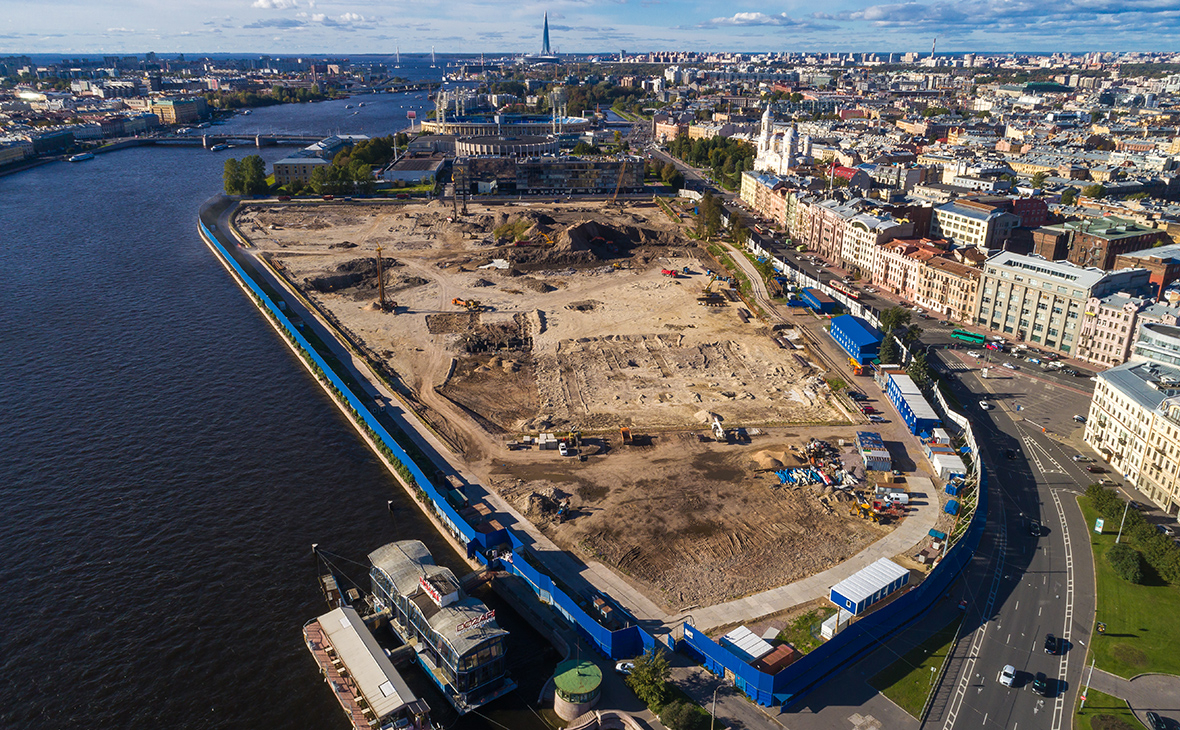
755458040463897Judicial district construction site in Petersburg. Photo courtesy of Stanislav Zaburdayev/TASS and RBC

Firms affiliated with businessman and restaurateur Yevgeny Prigozhin will build the judicial quarter in Petersburg, a project costing 35.7 billion rubles [approx. 455 million euros] that will include residential buildings for the Russian Supreme Court and Boris Eifman’s Dance Palace, report sources quoted by Kommersant newspaper familiar with the project, which has been designed by the Russian Presidential Property Management Department and construction industry insiders.

The sources say the subcontractor was selected in the summer of 2018 without tendering. The newspaper’s sources claim firms affiliated with Prigozhin have launched the process of awarding commercial tenders and have been requesting bids from major construction companies for the construction of individual buildings without advance payment. One of the Prigozhin-affiliated companies engaged in sending out bid and tender requests is Lizena, a firm founded in 2014.

In 2016, the Russian Presidential Property Management Department pledged it would build two office buildings for the Supreme Court and Judicial Department, the Dance Palance, and four residential buildings containing a total of 600 apartments within four years in Petersburg. Construction was supposed to have begun in 2017, and the opening of the facility was scheduled for 2020. In May 2017, the Presidential Property Management Department declared the project top secret and obliged future contractors to maintain secrecy.

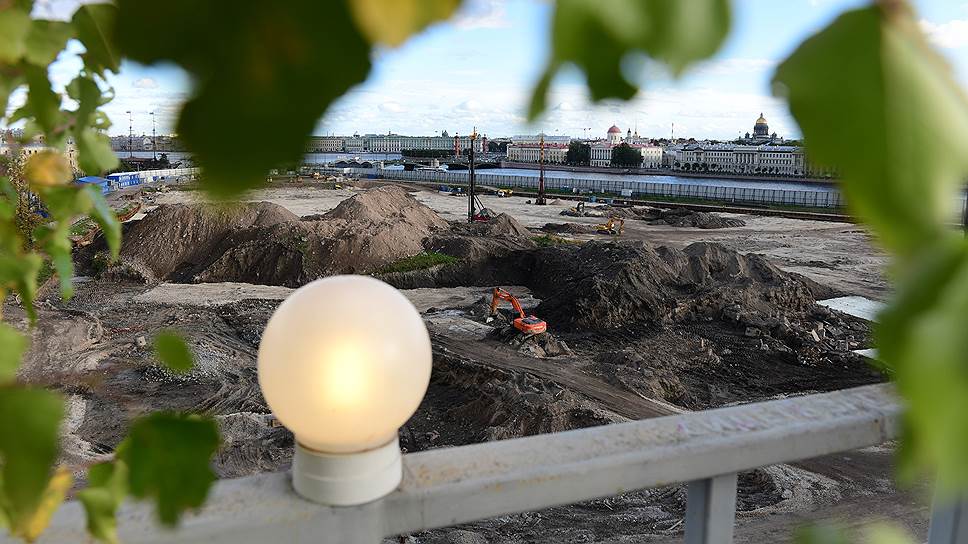
judicial quarterThe future judicial quarter in Petersburg is currently a giant sandbox. Photo courtesy of Alexander Koryakov/Kommersant

Construction was not begun, however. In September 2018, the Presidential Property Management Department acknowledged the deadlines it had set would be missed. As Kommersant wrote, the department failed to spend the 22.3 billion rubles allocated on the project. The funds were reallocated for 2021, when completion of construction has been planned. As transpired in December, an advance payment in the amount of more then 9.2 billion rubles was postponed from 2018 to 2021; no advances are envisaged in 2019 and 2020. As of December 1, according to the Federal Targeted Investment Program, builders in Petersburg had started to dig foundation pits for the residential complex. There was no information about the Supreme Court’s residence and the Dance Palace.

In March, the US Department of Justice imposed sanctions against Prigozhin and his companies Concord Management and Consulting, and Concord Catering. In February, Prigozhin and twelve other Russian nationals, as well as a number of legal entities, were indicted for interfering in the 2016 US elections. Included in the indictment was Prigozhin’s Internet Research Agency, which was abolished [sic] in 2016. RBC’s sources identified the IRA as the “troll factory” that, according to the US Department of Justice, had tried to influence US voters since 2014. President Putin called the charges made against Prigozhin by US officials “laughable.”

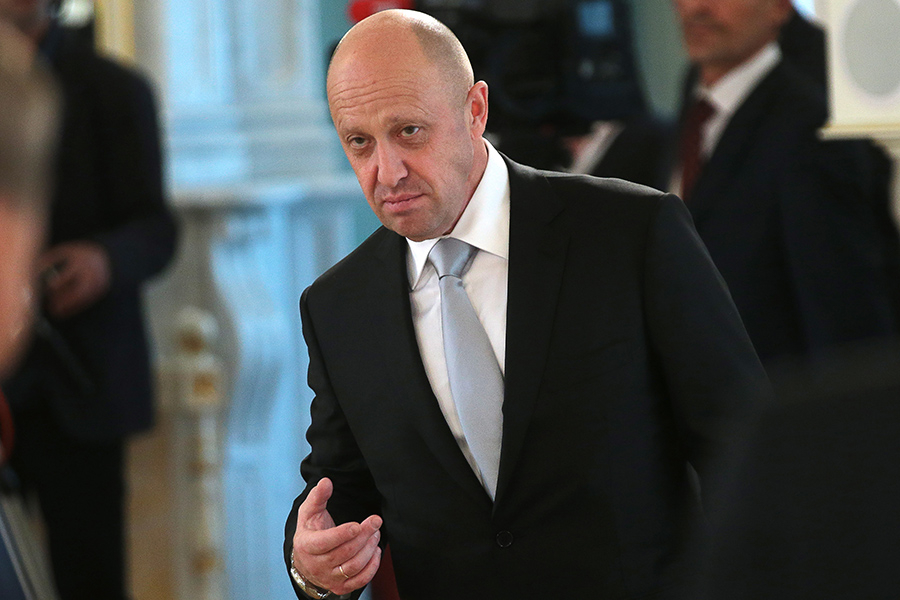
prigozhinYevgeny Prigozhin. Photo courtesy of Mikhail Metzel/TASS and RBC

A number of media outlets have also identified Prigozhin as “Putin’s chef.”

At his press conference on December 20, Putin said, “All my chefs are officers of the Federal Protection Service (FSO). All of them are military men. I have no other chefs.”

Translated by the Russian Reader

Judgement Day: Russia’s Rabid Crackdown on Jehovah’s Witnesses

yuri zalipayevIs Russian Jehovah’s Witness Yuri Zalipayev an “extremist”? Should he be imprisoned for five years for exercising his right to freedom of conscience, as guaranteed by the Russian Constitution? Photo courtesy of jw-russia.org

Not Everyone Shall Be Guaranteed the Freedom of Conscience: How Russia Has Been Persecuting Jehovah’s Witnesses
Marina Muratova
OVD Info
August 23, 2018

Believe what you will, but do not do it openly is how the freedom of religion should now be interpreted in Russia. The authorities have sent over fifty people to court for praying and reading the Bible together. Jehovah’s Witnesses have had their homes searched and been arrested like people suspected of grave offenses. The grounds for these actions is the argument that the practice of their faith is a “continuation of the activities of an extremist organization.” OVD Info investigated the charges.

Everyone shall be guaranteed the freedom of conscience, the freedom of religion, including the right to profess individually or together with others any religion or to profess no religion at all, to freely choose, possess and disseminate religious and other views, and act according to them.
—Article 28, Constitution of the Russian Federation

Russia vs. the Jehovah’s Witnesses
23 criminal cases in 18 regions of Russia, 53 people charged, 13 suspects. 31 people released on their own recognizance, 9 people under house arrest, 26 people in remand prisons. Several people assaulted by police during searches of their homes, the doors of those homes kicked down in nearly all cases. Nighttime interrogations, confiscated electronic devices, papers, and money, blocked bank accounts.

On April 20, 2017,  the Russian Supreme Court shut down the Administrative Center of Jehovah’s Witnesses in Russia for violating the law against “extremism.” All 395 official chapters of the Jehovah’s Witnesses in Russia were banned. The EU’s mission to Russia said the ruling could lead to arrests. That is what has happened.

The Charges
Believers gather to pray and read the Bible, meaning they continue the work of a banned organization, according to Russian police investigators. There are few exceptions: nearly all the Jehovah’s Witness who have been detained have been charged with violating Russian Criminal Code Article 282.2 (“organization of and involvement in the work of an extremist organization”).

Danish national and Jehovah’s Witness Dennis Christensen was, among other things, charged with financing extremist activities. The prosecutor submitted to the court records,  allegedly showing that money was transferred from the account of the Jehovah’s Witnesses after the church was shut down. It transpired the transactions in question had been executed by the bank itself after the Jehovah’s Witnesses had been dissolved as a legal entity. Another Jehovah’s Witness, Yuri Zalipayev, stands accused of inciting assaults on Russian Orthodox Christians and Muslims. Zalipayev’s defense attorney is sure police investigators cooked up their evidence and then tried to conceal the frame-up.  Arkadya Akopyan, a 70-year-old tailor, has also been charged with insulting Muslims and |Russian Orthodox Christians. There is no audio or video evidence, only a witness’s testimony.

arkadya akopyanIs Russian Jehovah’s Witness Arkady Akopyan an extremist? Photo by Diana Khachatryan. Courtesy of Takie Dela

Police Searches of Homes
Russian law enforcement authorities usually conduct searches simultaneously in the flats of several Jehovah’s Witnesses early in the morning. Jehovah’s Witness have often reported violations on the part of police during these searches. In the case of the Polyakov family in Omsk, the security services busted down the door to their flat, prevented the Polyakovs from telephoning relatives, and smashed Mr. Polyakov’s face. (Doctors recorded his injuries only two days later.) When the Polyakovs attempted to voice their disagreement with the actions of police  in the official search report, police wrested the form from their grasp.  During searches and interrogations in Penza, a police investigator forced six female Jehovah’s Witness detainees to strip naked.  In Saratov Region, the security forces mistakenly sawed off the door of the wrong flat. In another flat the same day, the police discovered banned literature in the sleeve of a child’s overcoat. Jehovah’s Witnesses believe the police planted it there.

In the city of Shuya, Ivanovo Region, police interrogated a 10-year-old girl, and the list of items confiscated during the police search of her family’s flat included sheet music and a pupil’s grade book from a music school. In Kabardino-Balkaria, one group of security officers stormed a flat through the balcony, although the flat’s female occupant had opened the front door to another group of security officers. In Birobidzhan, 150 law enforcement officers took part in numerous searches carried out on the same day: the operation was codenamed “Judgement Day.” Police have seized digital gear, books, Bibles, diaries, photographs, and bank cards during the raids. The raids and subsequent interrogations have lasted several hours.

Jehovah’s Witnesses have not only been detained in their homes. Police caught up with Andrei Stupnikov of Krasnoyarsk at an airport at four in the morning as he and his wife were checking into a flight to Germany. A court later jailed Stupnikov, since he could have received political asylum, as the judge put it. Alexander Solovyov was detained when he stepped off a train after returning to Perm from holiday.

Custodial Measures
Most of the Jehovah’s Witnesses who have been charged with criminal offenses have been incarcerated in remand prisons.  The defense attorney representing Sergei Klimov of Tomsk told OVD Info that Klimov spent two months in a solitary confinement cell measuring 1.7 meters by 2.8 meters, allegedly, because it was impossible to find room for him in an ordinary cell. On August 8, at an appeals hearing, Klimov was left in police custody, but he was transferred out of solitary into gen pop.

After time spent in remand prisons, several Jehovah’s Witnesses have been released and placed under house arrest. Konstantin Petrov of Magadan spent 64 days in jail, while several Jehovah’s Witnesses in Orenburg spent 78 days in jail each.

Vitaly Arsenyuk, a resident of the town of Dzhankoy in northern Crimea, was charged with engaging in illegal missionary work, a violation of Article 5.25 Part 4 of the Russian Federal Administrative Offenses Code. After the first hearing in his case, in June 2017, Arsenyuk died of a heart attack.

Some Jehovah’s Witnesses have spent months in pretrial custody. Danish national Dennis Christensen has spent over a year in a remand prison. No one has yet been sentenced to hard prison time, but the courts have been indulgent to Jehovah’s Witnesses only on rare occassions. In 2017, a court acquitted Vyacheslav Stepanov and Andrei Sivak of Sergiev Posad, who had been charged with inciting hatred or enmity on the strength of a video recording of worship services. In May, an appellate court freed 55-year-old Alam Aliyev. On August 9 and 10, a court in Kamchatka overturned earlier decisions remanding Mikhail Popov in custody and placing his wife Yelena under house arrest.

Community Property
In all regions of Russia, buildings constructed or purchased by Jehovah’s Witnesses have generally been seized and turned over to the state. In Petersburg’s Resort District, the state took possession of a complex valued at around two billion rubles [approx. 25 million euros], a complex from which the authorities had received hefty tax payments for many years. Over the course of seventeen years, state inspectors never found a single violation at the complex, but now the local courts refuse to recognize the rights of Jehovah’s Witnesses to the property or the official deeds to the complex.

Reactions
The EU delegation to the OSCE, the Parliamentary Assembly of the Council of Europe (PACE), the Russian Presidential Human Rights Council, and human rights activists have spoken out against Russia’s persecution of Jehovah’s Witnesses.

Dennis Christensen’s arrest led to the initiation of legal proceedings at the European Court of Human Rights (ECHR) in Strasbourg. On May 15, 2015, the Kingdom of Denmark was admitted as a third party to the case of Christensen v. Russian Federation.

In response to the complaint filed with the ECHR, Russian envoys at the ECHR and UN claimed Jehovah’s Witnesses still had the right to practice their religion despite the dissolution of their congregations. It was at this same time, in the spring of this year, that the number of arrests of Jehovah’s Witnesses in Russia went through the roof.

The International Memorial Society has already recognized 29 Russian Jehovah’s Witnesses as political prisoners. A total of fifty Jehovah’s Witnesses have been subjected to persecution by the authorities.

  • Oryol: Dennis Christensen, Sergei Skrynnikov
  • Omsk: Sergei and Anastasia Polyakov
  • Penza: Vladimir Alushkin, Vladimir Kulyasov, Denis Timoshin, Andrei Magliv, and four more unnamed people
  • Tomsk: Sergei Klimov
  • Saratov: Konstantin Bazhenov, Felix Makhammadiyev
  • Village of Shirokoye, Saratov Region: Alexei Budenchuk
  • Magadan: Sergei Yerkin, Yevgeny Zyablov, Konstantin Petrov
  • Khabarovsk: Ivan Puyda, Vladimir Moskalenko
  • Naberezhnye Chelny: Ilkham Karimov, Konstantin Matrashov, Vladimir Myakushin, Aidar Yulmetiev
  • Orenburg: Vladimir Kochnev, Alexander Suvorov, Vyacheslav Kolbanov
  • Polyarny, Murmansk Region: Roman Markin, Viktor Trofimov
  • Shuya, Ivanovo Region, Dmitry and Yelena Mikhaylov, Svetlana Shishina, Alexei A., Svetlana P.
  • Vladivostok: Valentin Osadchuk
  • Nakhodka: Dmitry and Yelena Barmakin
  • Krasnoyarsk: Andrei Stupnikov
  • Perm: Alexander Solovyov
  • Sol-Iletsk, Orenburg Region: Boris Andreyev
  • Village of Perevolotsky, Orenburg Region: Anatoly Vichkitov
  • Kostroma: Sergei and Valeria Rayman
  • Vilyuchinsk, Kamchatka Territory: Mikhail and Yelena Popov
  • Beryozovsky, Keremovo Region: Sergei Britvin, Vadim Levchuk
  • Maysky, Kabardina-Balkaria: Arkadya Akopyan
  • Lensk, Yakutia: Igor  Ivashin
  • Pskov: Gennady Shpakovsky
  • Birobidzhan: Alam Aliyev
  • Yelizovo, Kamchatka Territory: Konstantin Bazhenov
  • Belgorod: Anatoly Shalyapin, Sergei Voykov

This list was supplied to us by the European Association of Jehovah’s Christian Witnesses and defense attorney Artur Leontiev.

Freedom of Conscience
OVD Info asked attorney Artur Leontiev, who has been handling the defense of Sergei Klimov and Andrei Stupnikov, as well as the case of the property owned by the Jehovah’s Witnesses in St. Petersburg, to comment on the persecution of the Jehovah’s Witnesses.

“Law enforcement agencies have been criminally prosecuting believers for ordinary, peaceful professions of faith, as when they gather in small groups to read and discuss the Bible, watch videos on biblical topics, and so forth. The security forces got it into their heads that this constituted a continuation of the activities of an organization dissolved by the court. However, the believers who have been charged with these crimes had nothing to do with the legal entities that were dissolved and were not parties to the proceedings in the Russian Supreme Court.

“Believers’ phones were tapped, their letters were vetted, and they were followed. The security service thus amassed a fair amount of operational material. I think the heads of the various agencies decided to use it to improve their conviction rates, all the more so since the peaceable Jehovah’s Witnesses were easy targets. They have always tried to be law-abiding. Even now they do not regard themselves as criminals. They evince no aggression, imagining the injustice that has befallen them is a misunderstanding that will soon be cleared up. Actually, they are faced with a choice: refuse to practice their religion or be prepared to endure all the delights of criminal prosecution. However, the law enforcers doing the dirty work in the locales often understand what is really going on, but they are guided by the principle of ‘I have my orders, and I have a family to feed.’

“The complaint (Administrative Center of Jehovah’s Witnesses in Russia and Kalin v. Russian Federation, Case No. 10188/17) has been filed with the ECHR and accepted for review, the parties have exchanged comments, and the case has been expedited. Complaints have also been filed with the ECHR for each particular instance of criminal prosecution of Jehovah’s Witnesses.

“It is vital, however, the Russian legal system kicked into gear and operated not on the basis of expediency, but according to the law. Whatever you feel about the Jehovah’s Witnesses, they have the same right to their beliefs and the same right to a fair trial as other Russians.”

Translated by the Russian Reader

Everyone Wants to Like and Be Liked

Mail.ru Group Speaks Out against Punishments for Likes and Reposts
Company Proposes Changing the Law and Law Enforcement Practice
Olga Churakova and Yekaterina Bryzgalova
Vedomosti
August 6, 2018

Mail.ru Group не раз критиковала громкие законодательные инициативы, касающиеся интернетаMail.ru Group has repeatedly criticized high-profile law bills and laws affecting the internet. Photo by Yevgeny Yegorov. Courtesy of Vedomosti

Mail.ru Group, which owns the largest social networks in Russia, VK and Odnoklassniki [“Classmates”], has harshly condemned the practice of filing criminal charges against social media users for likes and reposts on social networks.

“Often the actions of law enforcement authorities have been clearly disproportionate to the potential danger, and their reaction to comments and memes in news feeds are inordinately severe,” reads a statement on the company’s website. “We are convinced laws and law enforcement practices must be changed. We believe it necessary to grant amnesty to people who have been wrongly convicted and decriminalize such cases in the future.”

Recently, the number of convictions for posts and reposts on social networks has reached a critical mass, explained a Mail.ru Group employee. Most of the convicitions are not only unjust but also absurd. He would not explain what specific corrections the company was going to propose.

“We believe current laws need to be adjusted, and we are going to make pertinent proposals,” VK’s press service told Vedomosti.

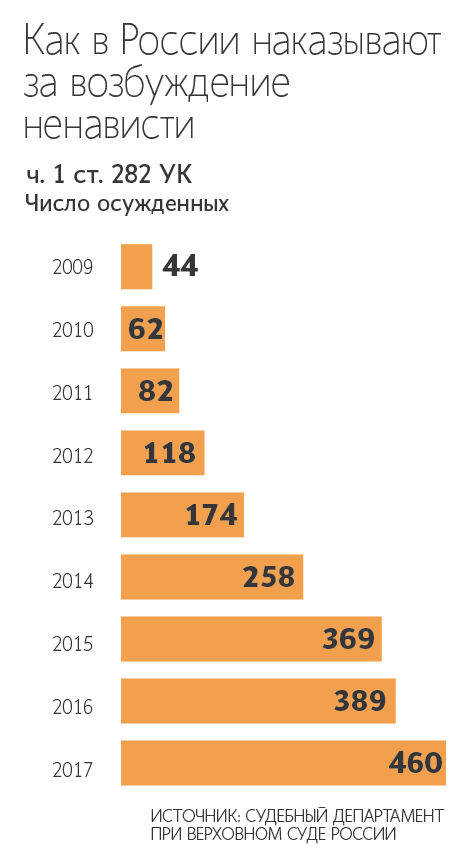
Mail.ru Group has repeatedly criticized high-profile laws and law bills affecting the internet. In 2013, for example, the company opposed an anti-piracy law. In 2015, it teamed up with Yandex to criticize the “right to be forgotten” law. In 2016, it opposed a law bill that proposed regulating messengers and search engines.  But punishing people for likes and reposts has become a political issue. Members of the opposition and social activists have often been the victims of Criminal Code Article 282, amended in 2014 to allow prosecution of people for incitment to hatred or enmity while using the internet.

Communist Party MP Sergei Shargunov addressed the problem during the President’s Direct Line in June of this year.

“If Article 282 were taken literally, certain zealots would have to convict Pushkin, Tolstoy, Dostoevsky, and Mayakovsky, and have their works removed,” he said.

Putin agreed it was wrong to reduce such cases to absurdity. Subsequently, he tasked the Russian People’s Front (ONF) and the Prosecutor General’s Office with analyzing how the notions of “extremist community” and “extremist crime” were employed practically in law enforcement.

fullscreen-1tgt

“Prosecutions for Incitement to Enmity (Criminal Code Article 282 Part 1) in Russia. Numbers of People Convicted, 2009–2017. Source: Trials Department, Russian Supreme Court.” Courtesy of Vedomosti

An Agenda for the Autumn
On June 25, Shargunov and Alexei Zhuravlyov, leader of the Rodina [“Motherland”] party, tabled draft amendments in the Duma that would decriminalize “extremist” likes and reposts. The MPs proposed transferring the violation described in Criminal Code Article 282 Part 1 to the Administrative Offenses Code, where infractions would be punishable by a fine of up to 20,000 rubles or 15 days in jail, while leaving only Part 2 of Article 282 in the Criminal Code. Part 2 stipulates a punishment of up to six years in prison for the same actions when they are committed with violence, by a public official or by an organized group. The government, the Supreme Court, and the State Duma’s legal department gave the draft amendments negative reviews, pointing out that the grounds for adopting them were insufficient. A spokesman for Pavel Krasheninnikov, chair of the Duma’s Committee on Legislation, informed us the committee would start working on the amendments when MPs returned from summer recess.

The ONF, which held a meeting of experts in July, has begun drafting a report for the president. The legal community, the General Prosecutor’s Office, the Interior Ministry, telecommunications watchdog Roskomnadzor, and the Russian Supreme Court must send their proposals to the Kremlin’s control directorate before September 15.

Leonid Levin, chair of the State Duma’s Committee on Information Policy, agreed there was a problem.

“The law is repressive, and there is no misdemeanor offense, although the Supreme Court issued an opinion that different cases should not be treated identically,” he said.

While there has been no lack of proposals, no one is in a hurry to abolish the law completely. A source in the Kremlin said dissemination of prohibited information should be punished. But a way of relaxing the law must be devised and, most important, a means of avoiding random convictions, he added.

A Demand for Liberalization
Recently, VK had been under pressure from the public due to the huge number of criminal prosecutions for posting pictures and reposts, said Pavel Chikov, head of the Agora International Human Rights Group. He argued the statement issued by Mail.ru Group was an attempt to defend the company’s reputation. According to the so-called Yarovaya package of amendments and laws, since January 1, 2018, VK has been obliged to provide law enforcement agencies with information about its users upon request, but the question of the legality of providing information having to do with people’s private lives remains open, since under Russian law a court order is required for this, Chikov noted.

Political scientist Abbas Gallyamov argued political decentralization and moderate opposition were now fashionable.

“Even the most cautious players sense the dictates of the age and have been trying to expand the space of freedom. Mail.ru Group is trying to be trendy,” he said.

Gallyamov predicted that, as the regime’s popularity ratings decline, the screws would be loosened, and the number of people advocating liberalization would grow.

Part of the political elite realizes many things have gone askew, agreed political scientist Alexander Kynev. A number of people hoped the circumstances could be exploited to push the idea of moderate liberalization. This could be a way of showing the regime was ready to talk, he argued.

“A lot will depend on what the autumn brings, on the results of regional elections. Now it would appear to be a topic that is up for discussion, but there are no guarantees. There are people in the government interested in having the topic discussed, but this doesn’t mean a decision has been taken,” Kynev said.

Translated by the Russian Reader

Valery Rashkin: The Return of the Oprichniki

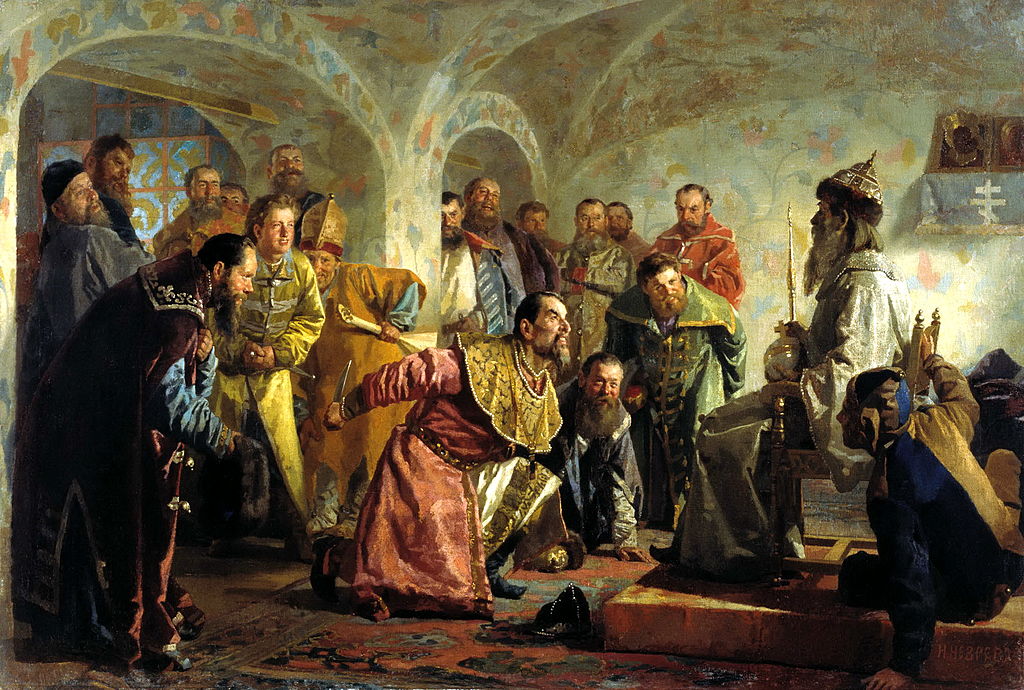
1024px-0NevrevNV_Oprichniki_BISHNikolai Nevrev, Oprichniki, 1870s. Oil on canvas, 102 cm x 152 cm. Courtesy of the Kyrgyz National Museum of Fine Arts. Image courtesy of Wikimedia Commons

Pillaging the Opposition
Valery Rashkin
Echo of Moscow
June 21, 2018

The Russian Supreme Court has ruled law enforcement and secret service officers can confiscate without a court order personal property used in the commission of terrorist and “extremist” crimes. The items that can be confiscated include computers, cell phones, and office equipment. This means personal property can be seized without payment of compensation and made the property of the state.

Can you believe it? The times of Ivan the Terrible have resurfaced. Courtesy of the state, Russia’s siloviki have been transformed into oprichniki and robbers. The ruling is completely unlawful, considering what passes for “extremist” crimes. Such criminal cases are usually frame-ups. They are so absurd they make you laugh and shudder at the same time.

The state has mandated law enforcers to hark back to the old system of remuneration (kormlenie, literally, “feeding”): the more “extremism” charges you file, the more iPhones and computers you can get your hands on. It is tantamount to legalized enrichment at the opposition’s expense. Moreover, even if the person who was criminally prosecuted is pardoned, their property will not be returned.

Don’t write nasty things about the regime on the VK social network, my dears, or the regime will fleece the living daylights out of you. Given the importance and high cost of electronic communications devices in our day and age, that is what it amounts to. The top brass, apparently, has decided that if people aren’t afraid of going to jail, they will intimidate them with the threat of robbery. I wonder who hatched this humiliating plan.

The rationale of hitting people in their wallets, enacted several years ago when fines for involvement in “unauthorized” demonstrations were increased precipitously, has gone beyond legal boundaries. Nothing of the sort exists in European countries: after a criminal investigation is wrapped, the accused has their property restored to them, nor are people are tried as felons for writing posts on social networks.

Naturally, the new dispensation is useless when it comes to deterring terrorists. The risks undertaken by an individual who rigs an explosive device and plots a terrorist attack are completely incommensurable with the risks taken by someone who posts a link to a book banned by the Prosecutor General or a satirical picture. In the first case, the criminals knowingly risk their lives and could not care less what happens to their property, while in the second case people do not even realize they are breaking the law.

Considering the vagueness of the anti-“extremist” laws and the way they are liberally interpreted and employed by law enforcement, the confiscation of property belonging to so-called extremists will only exacerbate the confrontation between the security services and ordinary Russians.

The advantages of the new measure are questionable, while the harm it will cause is obvious.

Valery Rashkin is a Communist MP in the Russian State Duma. Thanks to Elena Zaharova for the heads-up. Translated by the Russian Reader

The Policemen’s Ball

DSCN6837At €2.50, the official licensed sticker album of the 2018 World Cup is a steal. Russian officials also plan to steal the civil rights of their own citizens during the month-long tournament. Photo by the Russian Reader
Restrictions on Movement and Freedom of Assembly during the 2018 FIFA World Cup
Denis Shedov and Natalya Kovylyayeva
OVD Info
May 25, 2018

Russia welcomes the 2018 FIFA World Cup with Presidential Decree No. 202, which places restrictions on the movements of people and the staging of public rallies in cities hosting the matches. According to the decree, “enhanced safety measures” will be enforced from May 25 until July 25 (although the first match, between Russia and Saudi Arabia, will not be played until June 14). Denis Shedov and Natalya Kovylyayeva studied the decree specially for OVD Info.*

The restrictions will be introduced on May 25, 2018. They will be enforced in the cities and regions hosting 2018 World Cup matches: Moscow, Petersburg, Volgograd Region, Sverdlovsk Region, Nizhny Novgorod Region, Samara Region, Rostov Region, Kaliningrad Region, Krasnodar Territory, the Republic of Tatarstan, and the Republic of Mordovia.  Additionally, the decree also applies to certain neighboring regions where, in particular,  competing teams will be accommodated: Moscow Region, Leningrad Region, Kaluga Region, Voronezh Region, Stavropol Territory, and the Republic of Chechnya.

It is worth noting Decree No. 202 applies absolutely to everyone who is located in the regions listed during the period the decree is in force. In this light, OVD Info felt it was vital to discuss these changes.

Monitored and Restricted Areas
The decree introduces “monitored and restricted areas,” which will either be entirely off limits to people or will have restricted access. These areas include training grounds (including at other stadiums), team headquarters, hotels where teams and referees are staying, cargo inspection points, the broadcast center at Crocus Expo in Moscow, fan festival venues, press centers, and parking lots for special transport. You will be able to enter these “monitored areas” only after security guards have conducted a thorough inspection of all your belongings.

In addition, there will be special pedestrian security zones, so-called last miles, consisting of areas of one to two kilometers in radius around the stadiums where the matches will be held. Aside from World Cup transport, only residents of nearby buildings, equipped with special passes, will have access to these zones. To obtain the passes you need your internal passport and the papers for your car and your flat. Information about these zones has been posted on the official municipal websites of the cities hosting matches and published in local periodicals.

  • During the 2014 Winter Olympics in Sochi, the city was off limits to cars from other cities, i.e., cars not registered in Sochi, with the exception of vehicles owned by the secret services and vehicles that had received accreditation as municipal maintenance and 2014 Winter Olympics support vehicles. Vehicles registered in Sochi were restricted from traveling in “monitored areas.” 

Mandatory Registration for Everyone
Upon arrival in a city, you must register with the local immigration authorities within three days. This rules applies to everyone except those who are registered to live permanently in the particular city. Additionally, special rules for registering domiciles and temporary stays will be introduced in the cities where World Cup matches are scheduled.

Russian nationals and foreign nationals must register with the police within 72 hours of arriving. Usually, during “normal” times, Russian nationals have the right to spend up to 90 days in another Russian region without registering, while foreign nationals have seven days to register. Decree No. 202 specifies that the party hosting the visitor, i.e., the hotel, spa, holiday home, etc., must notify the proper authorities of the arrival of foreign nationals within 24 hours, as stipulated by Russian federal law.

Immigration authorities in the regions mentioned in the decree will be open for business daily during the World Cup, including weekends and holidays. There are several ways of registering your stay in another city:

  • Submitting an application to the management of the hotel, hostel, camping ground or youth hostel where you are staying, or the management company, proprietor or landlord, if you are staying in a private flat.
  • Reporting to the local immigration authorities yourself.

Foreign nationals must personally present their papers to the regional office of the Interior Ministry (i.e., the police) or a multi-service center, or their official hosts must do it for them. It is forbidden to register via the post office or a government services website.

Arriving foreign nationals are obliged to provide notification of their arrival, a copy of their identity card (e.g., passport or either ID), a copy of their Russian visa, and a copy of their migration card. This rule applies to all foreign nationals, regardless of their nationality and status in Russia. If the host party is a legal entity, this organization must supply the authorities with a complete set of documents.

Private individuals who act as hosts need only present their Russian internal passports, proving they are permanent residents, a copy of their passports, and a copy of their ownership deed to the dwellings where they will house foreign nationals.

If these rules are violated, Russian nationals will be obliged to pay an administrative fine. In Moscow and Petersburg, the fine will range from three to five thousand rubles, while in the regions it will range from two to three thousand rubles. Foreign nationals who violate these rules can be expelled from Russia.

Restrictions on Freedom of Assembly
According to the decree, from May 25 to July 25, 2018, assemblies, rallies, demonstrations, marches, and pickets that have nothing to do with the 2018 FIFA World Cup can be held only in places, along routes, and at times approved by the authorities. The authorities can also determine the number of attendees and the duration of the event.

Decree No. 202 was first enforced during last year’s Confederations Cup, also hosted by Russia. A large number of activists involved in group protests and solo pickets were apprehended at that time. Some of the people detained during solo pickets were subjected to “explanatory discussions” by the police, while others were written up for violating the rules for holding public events and fined as much as 20,000 rubles.

  • In May 2017, five activists from the local headquarters of opposition leader Alexei Navalny were detained for setting up a campaign booth on the main square in Kazan. Law enforcement said the action had not been authorized by the authorities. All the detainees were sentenced to ten to twelve days in jail, as well as 35 hours of community service.
  • During the Navalny-inspired anti-corruption rallies that took place in a number of cities on June 12, 2017, including Petersburg, Moscow, and Sochi, police detained protesters on the basis of Paragraph 11 of the decree, as paraphrased above. Although in Krasnodar, where the rally against corruption had been authorized, no one was apprehended, despite the special security regime.
  • During the protest rally “Farewell to the Communications Ministry,” in Moscow in June 2017, a teenager was detained when he tried to leave flowers outside the ministry due to restrictions on freedom of speech in Russia, including the possible blockage of the Telegram messenger service. The arresting officer cited the presidential decree restricting rallies during the Confederations Cup and the 2018 World Cup when he detained the boy. The teenager was taken into a police station for questioning before being released.
  • In mid-June 2017, fifteen people holding solo pickets against Moscow’s massive “renovation” program were detained outside the entrance to the State Duma.
  • Several activists who held solo pickets in support of mathematician Dmitry Bogatov and demanded an end to the prosecution of nationalist Dmitry Demushkin were detained on June 24, 2017, in Moscow.
  • Solidarity Party activist Mikhail Lashkevich was detained on July 4, 2017, while holding a solo picket demanding the people behind opposition leader Boris Nemtsov’s assassination be found. The police admitted he had a right to carry out a solo picket and released him from Basmanny Police Precinct in Moscow without writing him up. Subsequently, Roman Petrishchev, another Solidarity Party activist, was detained for a solo picket.
  • In early July 2017, five activists of Protest Moscow were detained in different parts of the city while they held solo pickets against censorship. All of them were charged with violating the rules for holding public events, punishable under Article 20.2 Part 5 of the Administrative Offenses Code.
  • On July 5, 2017, the well-known democracy activist Ildar Dadin was detained during a solo picket outside FSB headquarters in Moscow, since his protest had not been authorized by law enforcement. On July 7, 2017, the Meshchansky District Court found him guilty of violating the “rules of solo pickets” and fined him 20,000 rubles.

In May 2017, Alexander Pomazuyev, a lawyer with Navalny’s Anti-Corruption Foundation (FBK) asked that Paragraph 11 of the decree be declared null and void in a suit he filed with the Russian Supreme Court. Pomazuyev claimed he had been denied the right to hold a solo picket. He also argued the presidential decree infringed on civil liberties guaranteed by the Russian Constitution, including the right to free speech and freedom of assembly. The court threw out Pomazuyev’s suit, thus rubber-stamping the restrictions on rallies and pickets during the Confederations Cup and the 2018 FIFA World Cup.

In February 2018, organizers of the Boris Nemtsov Memorial March in Nizhny Novgorod wrote an open letter to FIFA president Gianni Infantino asking him to protect freedom of assembly in Russia in the run-up to the World Cup. The football functionary did not react to the letter, apparently.

“Although the decree restricts certain rights only from May 25 to July 25, 2018, even the smallest pickets have been turned down by the authorities on the grounds of the terrorist threat,” the march organizers wrote on their Facebook page.

Commentary by Lawyer and Human Rights Activist Alexander Peredruk
Yes, Presidential Decree No. 202, dated May 9, 2017, definitely violates people’s constitutionally guaranteed rights to freedom of assembly in Russia.

If you want to hold a public rally from May 25 to July 25, 2018, at a venue of your choosing, there is no guarantee you will pull it off. The authorities could turn you down on the grounds the venue you have chosen was not vetted by the Interior Ministry and the FSB. 

As last year showed, when several applications to hold rallies were filed simultaneously, the authorities would reject all the applications. However, when the applications were filed, the authorities had not yet determined what venues could be used. They drew up a list of permissible venues only after looking over the first applications. It was thus a “complete coincidence” that the venues indicated in the applications that were submitted to the local authorities were not on the list of permissible venues. 

In other words, the rejections were perfunctory and practically groundless. The authorities were not interested in conducting a proportionality test, in striking a balance between public and private interests.

In addition, questions are raised about the legitimacy of the division between public sporting events, which are permitted during this period, and public political events, which are virtually banned. Russian citizens are thus subject to discrimination.

During the 2014 Winter Olympics in Sochi, a local man, David Hakim, was detained while holding a solo picket in defense of the convicted environmentalist Yevgeny Vitishko. (Hakim was jailed for four days for his “crime.”) Agora used his case to challenge the president’s Olympic decree in the Russian Constitutional Court. However, the court refused to examine whether the decree complied with the Constitution, since it had expired by the time the complaint was examined. 

* If you are worried about how Presidential Decree No. 202 will affect foreign fans traveling to Russia for the World Cup, you shouldn’t be. They are required to purchase special “fan IDs” that will exempt them from most if not all of the decree’s strictures. // TRR

Denis Shedov is a lawyer with the Memorial Human Rights Center in Moscow. Natalya Kovylyayeva is a journalist. Translated by the Russian Reader

Monetizing Russia’s Migration Maze?

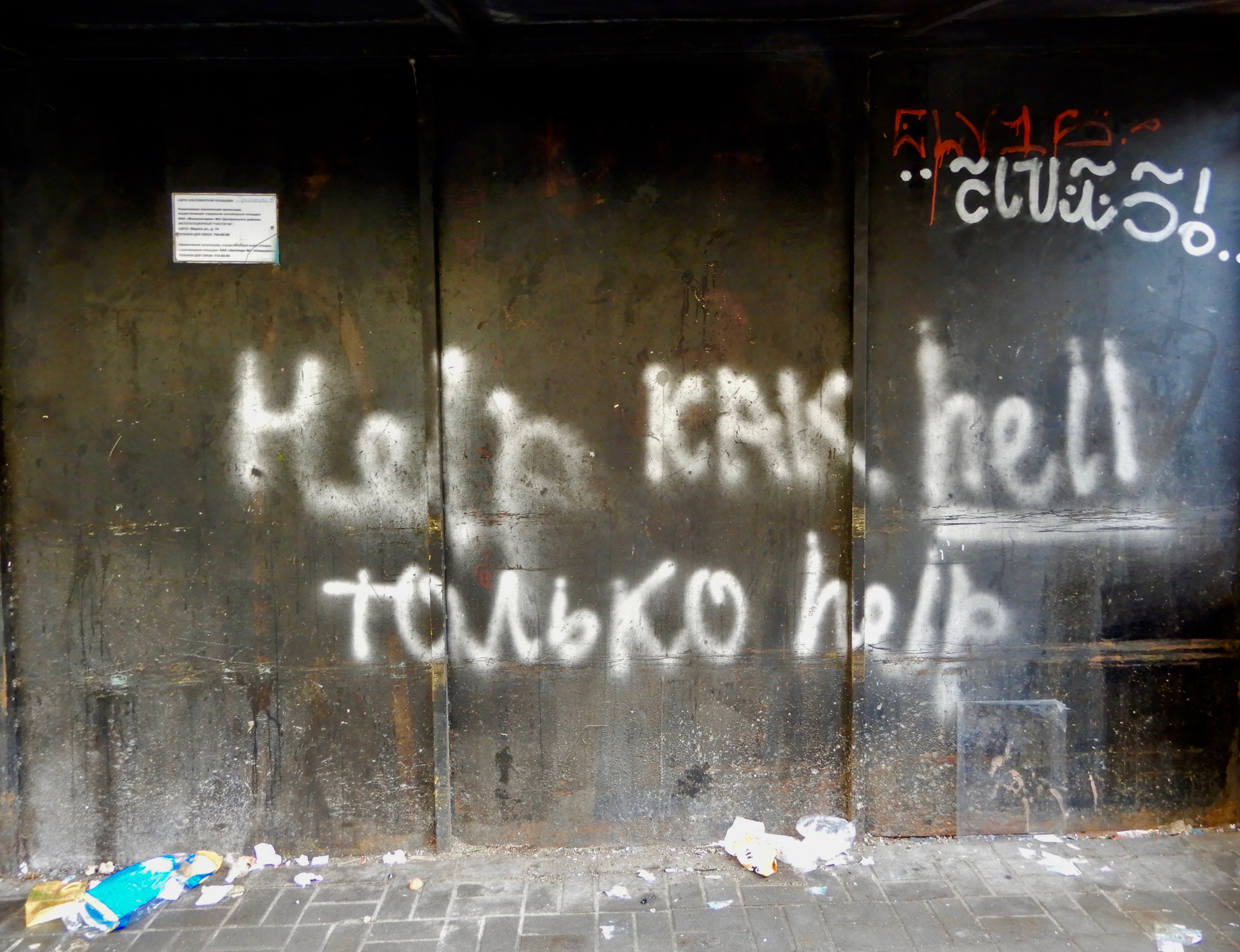
DSCN5633.jpg“Help is like hell, only it’s help.”

Punishment Minus Expulsion
Interior Ministry Develops Individual Approach to Migrant Workers
Anna Pushkarskaya
Kommersant
April 27, 2018

The Russian Interior Ministry has published draft amendments to the Administrative Offenses Code that would permit judges not to expel people from Russia who violated immigration regulations by allow them to take into account mitigating circumstances and substitute monetary fines for expulsion. The individual approach has already been enshrined in several articles of the Administrative Offenses Code by decision of the Russian Constitutional Court, but the police are willing to make it the “general rule for the assignment of administrative penalties.” Meanwhile, the Russian Justice Ministry has reported to the Council of Europe on measures it has taken in response to the complaints of stateless persons, although the rulings of the European Court of Human Rights (EHCR) and the Russian Constitutional Court on these cases have not yet been implemented, experts have noted.

The draft amendments to the Administrative Offenses Code, which would give judges the ability to replace administrative punishment with less harsh penalties, depending on the specific circumstances of the case, have been posted by the Interior Ministry for public discussion until May 4. The police drafted them on the basis of a February 17, 2016, ruling by the Constitutional Court. The ruling was rendered in the case of Moldovan national Mihai Țurcan, who was expelled from Russia for failing to notify the Federal Migration Service he was registered in Moscow Region. (This requirement is stipulated by Article 18.8 Part 3 of the Administrative Offenses Code, and it also applies to stays in Moscow, St. Petersburg, and Leningrad Region.)

Expulsion entails a five-year ban on entering the Russian Federation and reapplying for a residence permit. Courts did not consider the complainant’s work experience and payment of taxes as grounds for mitigating his punishment. The Constitutional Court ruled that these immigration regulations were unconstitutional and obliged legislators to individualize penalties for single violations of the controversial regulation by taking into account the length of an alien’s stay in the country, whether or not s/he has family in Russia, payment of taxes, and law-abiding behavior. Since December 2016, Article 18.8 Part 3 has allowed authorities to avoid explusion except in cases in which the documents confirming the alien’s right to stay have been lost or are lacking. In April 2017, the Constitutional Court’s approach was enshrined in the “General Rules for the Assignment of Administrative Penalties” (Article 4.1 of the Administrative Offenses Code), which deals with violations at official sporting events, for which foreign fans can get off, under mitigating circumstances, with a fine of 40,000 to 50,000 rubles and a ban on visiting stadiums for a period of one to seven years.

In October 2017, First Deputy Prime Minister Igor Shuvalov instructed authorities to extend the approach to all cases of compulsory explusion. If the court concludes that expulsion is an excessive stricture on the right to a private life and is disproportionate to the objectives of administrative penalties, it can be substituted by a fine of 40,000 to 50,000 rubles [approx. 530 euros to 660 euros]. Courts may already opt not to order expulsion in accordance with the clarifications issued by the Russian Supreme Court and Russian Constitutional Court, but now the factors courts should take into account are supposed to be incorporated in the wording of the law, noted lawyer Sergei Golubok. Lawyer Olga Tseitlina told Kommersant the draft amendments are quite important, because courts have, in practice, ignored marital status and other vital circumstances.

At the same time, the Russian Justice Ministry has sent a letter to the Council of Europe’s Committee of Ministers, asking it to recognize that the EHCR’s rulings on complaints filed by stateless persons have been implemented. The virtually indefinite detention of complainants in special Russian Interior Ministry facilities on the basis of rulings by Russian courts and the conditions of their detention in custody were ruled violations of the European Convention on Human Rights. The Justice Ministry reported that compensation had been paid to the complainants. They are now no longer subject to expulsion and deportation, and can “fix their migration status.” Moreover, the State Duma has passed, in their first reading, the admendments to the Administrative Offenses Code drafted by the Interior Ministry to settle the problem, the Justice Ministry reported four years after the ECHR issued its ruling. The Justice Ministry referred to the Constitutional Court’s ruling in the Mskhiladze case. In May 2017, the court also ordered that the Administrative Offenses Code be amended.

The ruling has not been implemented, noted Golubok and Tseitlin, who represented Mr. Mskhiladze. The ECHR’s decision in the case of another of Tseitlina’s clients, Roman Kim, has not been implemented, either, she told Kommersant.

“He has no legal status and de facto cannot apply for [Russian] citizenship or a [Russian] residence permit, since he cannot expunge his conviction due to his unemployment, but he is unemployed because legally no one can hire him,” said Tseitlina.

She stressed the general measures required by the ECHR and the Constitutional Court have not been implemented, either, since no changes have been made to Russian federal laws.

Thanks to anatrrra for the heads-up. Translation and photo by the Russian Reader

How a Petersburger Trucker Has Decided to Sue Plato

How a Petersburger Trucker Has Decided to Sue Plato
Venera Galeyeva
Fontanka.ru
October 16, 2017

After getting his first fine for non-payment of fees under the Plato road tolls system, a Petersburg trucker has challenged it in court. The case could become an important precedent. 

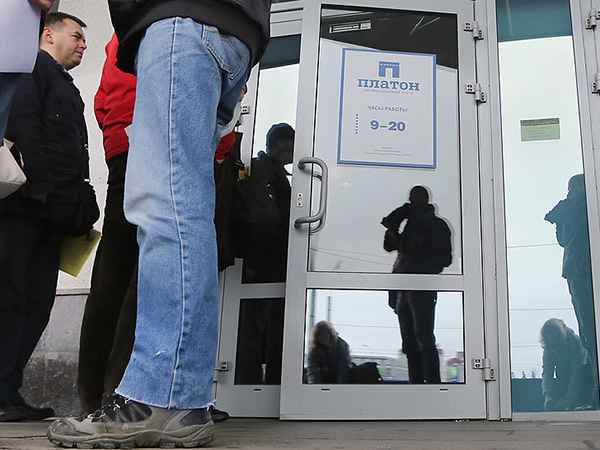
Центр обслуживания пользователей "Платон".
Truckers gathered outside Plato’s central office. Courtesy of Fontanka.ru

Individual entrepreneur Yuri Bubnov has two freight trucks, one of which is on the road, a MAN-produced box truck he uses to deliver consumer goods to Moscow and Vladimir. As a matter of principle, he has not registered the truck with the Plato road tolls system, has not put a transponder on the truck, and does not pay the new Plato fees. In 2015, he was one of the few people who took part in a road rally of truckers from Petersburg to Moscow. His runs take him past Plato sensors outside Tosno and in Tver, Klin, and Novgorod Region.

A sensor mounted on the Pokrov–Elektrogorsk segment of the M7 Federal Highway finally reacted to Bubnov’s truck on September 28. On October 6, the traffic police issued Bubnov a fine of 5,000 rubles for failure to pay his Plato road toll fees. Ironically, the very same day, the Russian government approved a fourfold increase in fines for non-payers. On October 14, Bubnov sent a letter to the Odintsovo City Court in Moscow Region challenging the decision to issue the fine and petitioning the court to move the venue for hearing the case to the Kalinin District Court in Petersburg, the plaintiff’s place of residence. The truck is registered in Bubnov’s wife’s name, so she will be acting as a defender in the case: “I consider the ruling in the administrative case unfounded and illegal, which I shall prove during the trial.” Yet Bubnov could pay a discounted fine of 2,500 rubles by October 26 and live peacefully.

Truckers have tried before to challenge the issuing of fines for failure to pay Plato road tolls, but for formal reason,s e.g., the paperworks was not drawn up properly, the truck’s owner was not behind the wheel during the alleged violation, and so on. Bubnov’s case if fundamentally different. He wants to challenge the law itself and is willing to give up at least a year of his life to do it.

Bubnov expounds his position.

“According to the Russian Federal Civil Code, damage must be paid be jointly by everyone everyone involved in causing damage. However much damage you caused that is how you pay,” he says.

[Bubnov has in mind the government’s original stated rationale for introducing the Plato road tolls system. Since cargo trucks, allegedly, cause more wear and tear on federal highways than other vehicles, the argument went, they should pay additional fees, based on the number of kilometers traveled, to compensate for this damage and thus provide more money for repairing major roads.—TRR]

“In addition, the damage I caused has to be proven. And, according to the Russian Federal Tax Code, payments cannot be arbitrary and should reflect the economic essence of the matter. Empty, my vehicle weighs 7,800 kilograms. The maximum weight of a loaded eighteen-wheeler is 44 tons. Obviously, we cause different amounts of wear and tear on the road. Why, then, should I pay the same amount as the driver of a loaded eighteen-wheeler?”

In May 2016, the Russian Federal Consitutional Court ruled the Plato road tolls system legal. Later, however, Constitutional Court Judge Gadis Gadzhiyev issued a dissenting opinion in which, among other things, he suggested clarifying the purpose of the fee, because, economically speaking, Plato is not compensation for damage, but a payment imposed on owners of heavy trucks for using the roads.

“As currently formulated, the Plato system is at odds with Russian federal laws,” says Bubnov. “By itself, travel on public roads is not an offense. There is a Russian federal government decree in which the maximum loads for different types of vehicle are set. The weight of my vehicle is legal.”

Bubnov also invokes an argument that truckers protesting Plato have made since 2015. If a toll is introduced for driving on a certain section of road, drivers should be provided with an alternative free detour. Otherwise, all federal highways would become toll roads for truckers.

Bubnov already has several legal victories under his belt. He has always served as his own defense counsel, and recently he has voluntarily defended his colleagues from different regions in court. On September 20, 2017, he won the so-called tachograph case, in which a trucker had been accused of violating work safety laws. A similar case is now being tried in Altai Territory.

If Bubnov’s appeal, as appended to his complaint against the Plato road tolls system fine, is rejected, first he will have to go to Odintsovo City Court, then to the Moscow Regional Court to appeal the ruling, and then to the Presidium of the Moscow Regional Court and, finally, to the Russian Federal Supreme Court and the Presidium of the Supreme Court. Bubnov plans to go to the bitter end with the final decision. According to his calculations, the whole process may take at least a year. If his petition is granted, the first three sets of hearings will be held in Petersburg. Bubnov plans on going the entire distance himself, without a lawyer.

“Essentially, Yuri Bubnov’s claims are correct,” says Irina Metel, executive director of the Northwest Carriers and Forwarders Union. “In practice, however, any case requires the assistance of a very competent laywer.”

“We are ready to support Yuri Bubnov in court,” says Maria Pazukhina, head of the OPR (Association of Russian Carriers) regional branch in Murmansk. “We have challenged fines before, but only on formal grounds, for example, due to incomplete lists of evidence or instances where agencies not empowered to do so tried to punish carriers. Yuri’s case is fundamentally different. In my view, the current authorities are unlikely to rule that Plato should be abolished. The OPR has been trying to detect the system’s faults in order to reveal its corruption and inefficiency. But so far we have not launched legal proceedings like this.”

“I’d been waiting for this fine for a year and a half, and I finally got it,” Bubnov told Fontanka.ru. “It’s good it came now, while the sensors have not been turned on everywhere. If the system were up and running normally, it would be harder to challenge the fine. The chances of a ruling in my favor are few, but what if suddenly the case is assigned to a judge who is about to retire and has nothing to lose, and he makes a ruling in accordance with the laws?”

FYI
According to Dmitry Pronchatov, assistant director of the Federal Road Agency, since the Plato road tolls system was launched, carriers have paid over 33.3 billion rubles [approx. 494 million rubles] into the road maintenance and construction fund. Over 900,000 vehicles have been registered in the system. The monies have been used to finance the construction of seven bridges and repairs on twenty-four emergency pipelines, as well as over a thousand kilometers of roads in forty cities and regions. Owners of twelve-ton trucks must pay 1.9 rubles for each kilometer of travel on federal highways.

Translated by the Russian Reader. Thanks to Comrade Koganzon for the heads-up

You’ll Have Your Day in Court, But Keep Your Mouth Shut

dzersud1
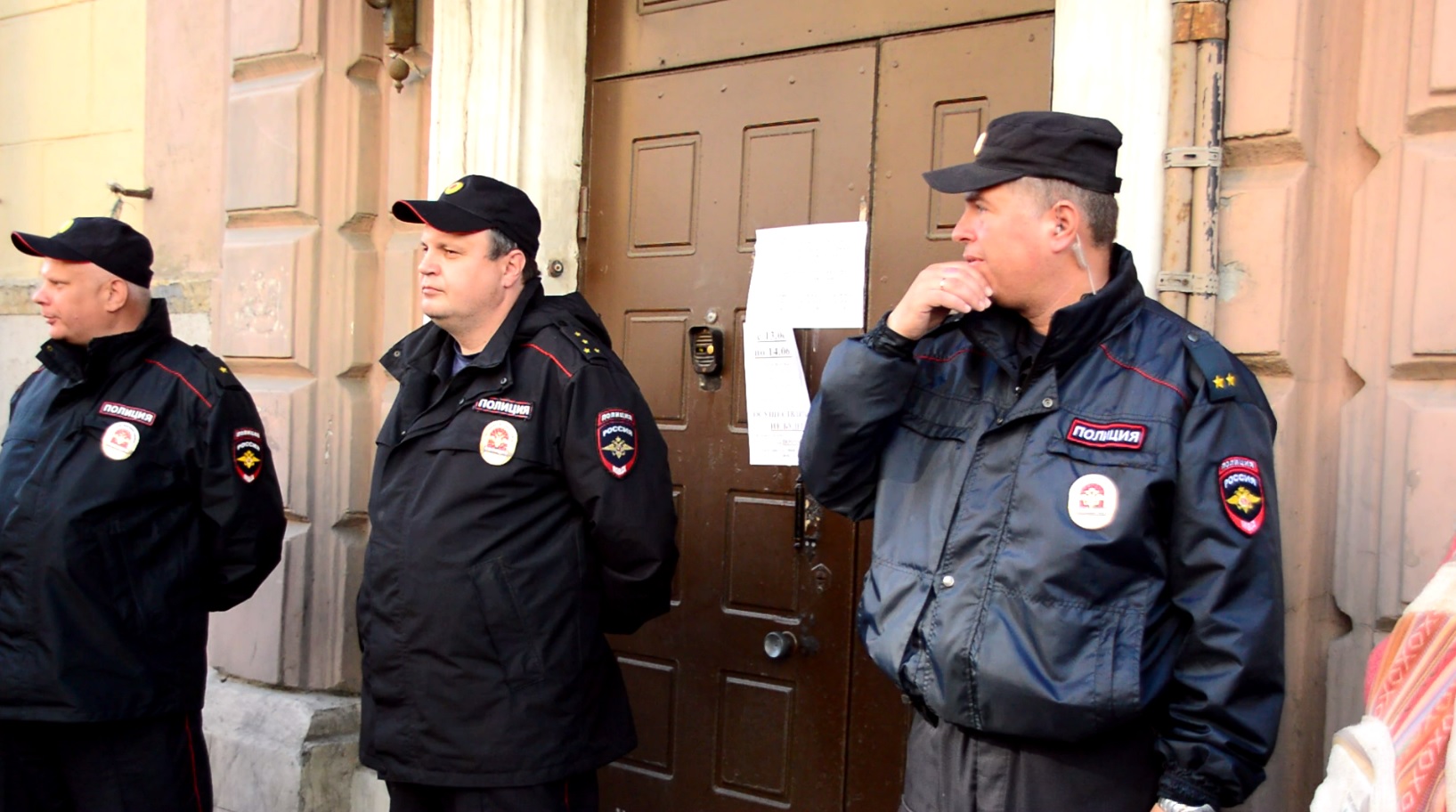
Police guarding the entrance to the Dzherzhinsky District Court, in downtown Petersburg, on the morning of June 13, 2017. Many of the people detained during the previous day’s anti-corruption protest rally on the nearby Field of Mars were brought to this courthouse for their administrative (misdemeanor) hearings after spending the night in police custody. According to media reports and eyewitness accounts, most of the six hundred and fifty some detainees, who had in fact merely been exercising their constitutional rights to assembly and free speech on a site deliberately designated by the mayor’s office, several years ago, as the city’s “Hyde Park,” have been sentenced to several days in jail and heavy fines. Photo courtesy of zaks.ru

Supreme Court Rules Courts Have Right to Deprive People of Right to Speak during Administrative Hearings
Echo of Moscow
June 13, 2017

A plenary session of the Russian Supreme Court ruled today that courts have the right to deprive people of the right to speak during administrative [misdemeanor] hearings. As Interfax reported, the move was requested by the Prosecutor General’s Office, which had argued it would speed up administrative proceedings and prevent the misuse of procedural rights. This argument was made in a statement by the Prosecutor General’s Office issued after the plenary session, at which Deputy Prosecutor General Leonid Korzhinyok was present. In an interview with Echo, Ivan Pavlov, a lawyer and head of the Team 29 association of lawyers and journalists, said the Prosecutor General’s Office’s motives were clear.  According to Pavlov, the office, headed by Yuri Chaika, realizes the judicial system simply cannot cope with the number of detainees under the standard procedure, as stipulated by law. Pavlov added that, unlike laws, rulings by plenary sessions of the Supreme Court take effect immediately, so today’s ruling can be applied from now on. The Supreme Court’s plenary ruling “On the Use of Procedural Coercive Measures during Administrative Hearings” renders the court system meaningless. Such was the opinion voiced to Echo by Elena Lukyanova, professor of constitutional and municipal law at the Higher School of Economics. She added that a broad public discussion of the issue would be needed to force an overturning of the ruling.

Translated by the Russian Reader. Thanks to Alexei Kouprianov for the heads-up

Nikolay Mitrokhin: God-Given “Extremists”

God-Given “Extremists”
Nikolay Mitrokhin
Takie Dela
April 26, 2017

I met Jehovah’s Witnesses in the mid 1990s in the former Soviet Central Asian republics. I was researching the region’s religious life. When I arrived at each regional capital, I would survey all the prominent communities in turn. The Witnesses were different in one respect from other western-inspired Christian communities. There were lots of them and they were everywhere.

Like now, many were certain back then the Witnesses were a product of the perestroika era’s freedoms. This, however, was not the case. The Witnesses were a legacy of the Soviet Union.

An American Salesman’s Religion

The Witnesses are a typical American eschatological religious group. Put crudely, they believe the world will end soon, during their lifetimes. They believe in one God, Jehovah, a name used during Christianity’s first century. On Judgment Day, Jehovah will destroy sinners and save the elect. The Witnesses reject the Christian doctrine of the Trinity (God the Father, God the Son, and the Holy Spirit). They do not consider Christ God, but they revere him. The day of his death is the only holiday they celebrate.

“A History of the Jehovah’s Witnesses in Russia,” a display in the museum at the Administrative Center of the Jehovah’s Witnesses in Russia, located in St. Petersburg. Photo courtesy of Alexander Demyanchuk/TASS

A completely and regularly revised theology has produced a set of permissions and prohibitions aimed at maintaining the way of life and behavior of a decent traveling salesman from the lower middle classes.

The Witnesses are allowed the moderate use of alcohol (immoderate use is cause for expulsion) and the use of contraceptives. Premarital sex and smoking are forbidden. The Witnesses must not “rend to Caesar what is Caesar’s”: they are forbidden from being involved in elections, engaging in politics, honoring state symbols, and serving in the army. They are most roundly criticized by outsiders for forbidding blood transfusions and organ transplants. The Witnesses suddenly had something to say when the AIDS epidemic kicked off. They support blood substitutes.

Something like family monasteries—”administrative centers”—have been organized for the most ardent followers. The schedule in the centers is strict, but the conditions are relatively comfortable. The Witnesses can live and work in them, practically for free, for as little as a year or as along as their entire lives.

Waiting for the world’s imminent end is an occupation common to many religious groups, from Russian Old Believers to the Mayan Indians. Such groups isolate themselves from a sinful world, some by retreating into the wilderness, others, by restricting their contact with outsiders.

OLYMPUS DIGITAL CAMERA
The cover of a 1928 Russian-language edition of The Watchtower. When the Russian edition was founded in 1925, it was originally entitled The Guard Tower, but in 1964 the name was changed to The Watchtower. Photo courtesy of Boris Alexeyevich/Wikipedia

The Witnesses differ from similar movements in terms of how they disseminate and maintain their doctrine. The method is based on the commercial practice of distributing magazines in the nineteenth century. Essentially, the entire organization meets twice weekly to read its main journal, The Watchtower, which is produced by church elders in Brooklyn and then translated and disseminated in dozens of languages. Members pay a nominal fee for subscribing to and reading the journal, fees that are scrupulously collected and sent along the chain: from local groups to the regional office, then to the national headquarter and, finally, to the head office in Brooklyn. Free distribution of the magazine and going door to door asking people whether they want to talk about God are aimed at the same thing: increasing the audience who subscribes to and collectively reads the magazine.

Ninety-five percent of today’s public find these religious activities strange and ridiculous, although from a sociological viewpoint they barely differ from going to political party meetings, networked sales of cosmetics, visiting sports clubs, getting a tattoo, the Russian Healthy Lifestyle Movement (ZOZh) or stamp collecting.

If you believe the Jehovah’s Witnesses’ own figures, they operate in 240 countries, which is more than belong to the UN.  At the same time, the organization is numerically quite compact, albeit growing rapidly. It has a total of 8.3 million members.

A Religion for Soviet Individuals

The story of how the Witnesses took root in the Soviet Union has been well told in a book published three years ago by Emily Baran, Dissent on the Margins: How Soviet Jehovah’s Witnesses Defied Communism and Lived to Preach About It. Polish and Romanian peasants and market traders adopted the doctrine of the Witnesses at the turn of the 1920s and 1930s, and before the war they unexpectedly were made Soviet citizens when the Soviet Union occupied parts of Poland and Romania.

The Soviet authorities did not tolerate large groups who maintained constant links with foreign countries, so it decided to send the core group of Witnesses, five thousand people, to Siberia. A considerable number were sent to the camps, while the rest were exiled. The crackdown was a misfortune for the victims, but it was a godsend for the exotic doctrine.

The Moscow Jehovah’s Witness community worshiping at the velodrome in the city’s Krylatskoye District, 2000. Photo courtesy of Alexander Fomin/PhotoXPress.ru

As early as the 1950s, the largest communities of Witnesses had emerged in the main place of exile, Irkutsk Region. In the 2000s, the official websites of Irkutsk Region and the neighboring Republic of Buryatia claimed the Jehovah’s Witnesses were a traditional religious community in the region. Irkipedia provides the following figures for 2011: “Around 5,500 people in Irkutsk Region are members of the Jehovah’s Witnesses religious organization. Around 50 of their assemblies operate in Irkutsk Region, each of them featuring 80 to 150 members. The assemblies are united into three districts: Usolye-Sibirskoye, Irkutsk, and Bratsk.”

The camps proved a suitable place for proselytizing, the radically minded youth, especially Ukrainian speakers, eager listeners, and the half-baked amnesty of political prisoners, an excellent means of disseminating the doctrine nationwide. As early as the late 1950s, all over northern Kazakhstan, former members of the Ukrainian Insurgent Army (UPA), who were banned from returning home, and former Russian criminals, who had taken jobs as farm machinery operators and welders, were digging dugouts in the steppes to hide DIY printing presses for printing The Watchtower.

Why did peasants, traders, brawny lads from the working classes, graduates of provincial technical schools, mothers of large families, and pensioners need to become Jehovah’s Witnesses? I have the same explanation as the preachers do: to radically change their selves and their lifestyles. The everyday frustrations of ordinary people, their perpetually predetermined lives, and their uselessness to anyone outside their narrow family circle (in which there is so often so little happiness) are things that torment many people. Prescriptions for effectively transfiguring oneself are always popular. However, they usually don’t work, because it is hard to stick to the program.

Jehovah’s Witnesses in Minsk, 2015. Photo courtesy of Vasily Fedosenko/Reuters/Pixstream

Like other religious groups, the Witnesses offer their members a disciplinary model for joint action. You can sit at home, chewing through your miserly pension, and watching TV, or you can feel like a “pioneer” again (the title given to missionaries who proselytize on the streets and door to door), do the right thing, hang out with other enthusiastic people like yourself, and make friends with young people. You are a young bricklayer. You are facing a lifetime of laying bricks, but your soul yearns for change and career growth. After spending six months in the Jehovah’s Witnesses, our bricklayer might be leading a grassroots group, and two years later he might have made a decent career in the organization. His wife is satisfied. Her husband doesn’t drink, their circle of friends has expanded, and during holidays the whole family can go visit other Witnesses in other parts of Russia. The children grown up in a circle of fellow believers with a sense of their own uniqueness. Free evenings are spent on the work of the organization, but that is better than drunken quarrels, and better than what most “ordinary” Soviet and post-Soviet folks are up to in the evenings.

Wholehearted Atheists

In 2006, I interviewed Vladimir Saprykin, a former employee of the Soviet Communist Party Central Committee’s Propaganda Department. His career had kicked off with a vigorous campaign against the Witnesses in Karaganda Region. I was able to get a glimpse into a period when the Party was on the warpath against the Witnesses. In the early 1960s, literally hundreds of people were sent to the camps as part of the campaign against religion per se.

Âèäû Ñàíêò-Ïåòåðáóðãà
The Jehovah’s Witness Congress Hall in St. Petersburg. Photo courtesy of PhotoXPress

Saprykin had campaigned against the Witnesses wholeheartedly and passionately, and that passion still burned in him fifty years after the events in question. He had dreamed of making them “completely free,” of “returning them to their essence.” He was backed up then by a whole group of provincial demiurges from among the local intelligentsia. They had collectively tried to re-educate the local group of Witnesses through debate, and then they had intimated them and pressured their relatives. Subsequently, they had tried to buy them off before finally sending the group’s core to prison with the KGB’s backing.

Their rhetoric is surprisingly similar to the declarations made by the Witnesses’ current antagonists.

“We stand for individual freedom of choice in all domains, including religion. […] So read, compare, think, disagree, and argue! Critical thinking is in inalienable sign of a person’s freedom. Let’s not abandon our freedom so easily.”

This is not an excerpt from a statement by a libertarian group, but an excerpt from a declaration published by a group of Russian Orthodox clergymen attached to the Holy Martyr Irenaeus of Lyons Center for Religious Studies. It was these clergymen who have now got the Jehovah’s Witnesses banned.

In the early 1960s, the KGB and such local enthusiasts managed to deliver several serious blows to the infrastructure of the Jehovah’s Witnesses in the Soviet Union. Successive leaders of the organization and hundreds of grassroots leaders and activists were arrested and convicted, and archives, correspondence, and printing presses were seized.

“Is there an end to your suffering? Take a copy for free in your own language.” Tuchkovo, Moscow Region. Photo courtesy of Alexander Artemenkov/TASS

This, however, did not lead to the eradication of the Jehovah’s Witnesses. Besides the three regions where they had constantly been active—Western Ukraine, Moldova, and Irkutsk Region—groups and organizations emerged in the sixties and seventies throughout nearly the entire Soviet Union from Arkhangelsk Region to the Maritime Territory, and from Turkmenistan to Uzbekistan.

The movement was spread by ex-camp convicts, labor migrants from regions where the doctrine was strongly espoused, and missionaries.

Soviet construction sites, new cities, and workers’ dorms were propitious environments for the spread of new religious doctrines. The young people who arrived to work there were cut off from their usual lifestyles, family ties, and interests. They wanted something new, including self-education and self-transfiguration—to gad about in suits and have their heads in the clouds. Most of these cadres were promoted through the ranks by the Communist Youth League and other authorities, but there were plenty of pickings for the religious organizations.

By the way, in 1962, Saprykin campaigned to get not just anyone to leave the Witnesses, but Maria Dosukova, a chevalier of the Order of Lenin, a longtime Party member, a plasterer, and an ethnic Kazakh. During an assembly at her construction company, Dosukova had refused to support a resolution condemning the religious organization in which several people in her work team were members.

Kingdom Hall of the Jehovah’s Witnesses in Sochi, 2007. Photo courtesy of Natalya Kolesnikova/PhotoXPress

After Krushchev’s resignation, the systematic arrests of the Witnesses stopped, although some were sent to prison as a warning to the others.  Everyone else was subject to the decree, issued by the Supreme Soviet of the RSFSR, on March 18, 1966, “On Administrative Responsibility for Violating the Legislation on Religious Cults.” You could be fined fifty rubles—a week’s pay for a skilled worker—for holding a religious circle meeting in your home. In his book About People Who Never Part with the Bible, religious studies scholar Sergei Ivanenko records that, during the seventies and eighties, attempts to combat the Witnesses by fining them and tongue-lashing them at assemblies were just as useless. 

Wholehearted Anticultists

Perestroika legalized the Jehovah’s Witnesses throughout the post-Soviet space. This freedom did not last for long, however. The new states of Central Asia and the Transcaucasia followed the Soviet Union’s path in their treatment of the Witnesses, achieving similar outcomes.

In Russia, the Witnesses were officially registered in March 1991 and had no serious problems for a long time. They built their central headquarters, Bethel, in the village of Solnechnoye near St. Petersburg, as well as several dozen buildings for prayer meetings.  Of course, due to their activity, relative openness, and American connections, the Witnesses (along with the Hare Krishna, the Mormons, the Scientologists, and the Pentecostals) were targeted by the various hate organizations that emerged in Russia in the late 1990s, including the Cossacks, neo-Nazis, and professional anticultists.

Protest rally against the activity of Jehovah’s Witnesses in St. Petersburg, 1997. Photo courtesy of TASS

Anticultism was imported to Russia by the ex-Moscow hippie Alexander Dvorkin, who emigrated to the US in the 1970s and got mixed up in Orthodox émigré circles there. In the early 1990s, he left his job at Radio Liberty and returned to Russia, where he made a successful career at the point where the interests of the Moscow Patriarchate and Russian law enforcement agencies intersect. The above-mentioned Irenaeus of Lyons Center is, basically, Dvorkin himself.

Professor Dvorkin has worked for several years at St. Tikhon’s Orthodox University of the Humanities. Until 2012, he was head of the department of sectology. In 2009, he headed the council for religious studies forensic expertise at the Russian Federal Justice Ministry. (He now holds the post of deputy chair). It is curious that Justice Minister Alexander Konovalov is also a St. Tikhon’s alumnus and is quite proud of that fact.

005-5.jpg
Professor Alexander Dvorkin. Photo courtesy of Yevgeny Mukhtarov/Wikipedia

By supporting the Justice Ministry’s campaign to ban the Jehovah’s Witnesses, the Russian Supreme Court has not only put the “sectarians” in a difficult position but also the Russian authorities. In Russia, the Witnesses have over 400 local organizations and around 168,000 registered members. Only full-fledged members are counted during registration, but a fair number of sympathizers are also usually involved in Bible readings, The Watchtower, and other religious events. We can confidently say the ban will affect at least 300,000 to 400,000 Russian citizens. Labeling them “extremists” does not simply insult them and provoke conflicts with their relatives, loved ones, and acquaintances. In fact, this means abruptly increasing the workload of the entire “anti-extremism” system the Russian authorities have been setting up the past twenty years.  The soldiers of the Russian National Guard will find it easy to raid prayer meetings and spread-eagle these “extremists” on the floor. However, given the scale of the organization, they will have to do this a lot and often. And, as experience shows,  there won’t be much point to what they are doing.

Not a single country in the world has forcibly dissolved the Jehovah’s Witnesses, and it is hard to imagine that these 400,000 people will all emigrate or otherwise disappear. Even now, as news of the ban has spread, the Jehovah’s Witnesses have received completely unexpected support from all manner media and numerous public figures, including Russian Orthodox priests. Given these circumstances, the successful state campaign to discredit, dissolve, and brush a major religious community under the rug is doomed to failure.

Marquee being taken down from the Surgut office of the Jehovah’s Witnesses in connection with their ban in Russia, April 24, 2017. Photo courtesy of Alexei Andronov/Ura.Ru/TASS

The authorities will have to decide. Either they will sanction the mass arrests of the organizations leaders and activists and send hundreds and thousands of people to the camps, which ultimately will facilitate the growth of the movement’s reputation and dissemination, as in Soviet times, or they will pinpoint those who, according to the Interior Ministry and the FSB, are “especially dangerous” while turning a blind eye to the actual continuation of the organization’s work.

I would like the country’s leadership to have second thoughts and find a legal way to rescind the Supreme Court’s decision. There is little hope of that, however.

Translated by the Russian Reader

“Extremism” Ruling Against Jehovah’s Witnesses: The Popular Will?

OLYMPUS DIGITAL CAMERA Was it the “popular will” that 500 hectares of land be reclaimed in the Neva Bay right off Petersburg’s Vasiliyevsky Island and developed into densely built high-rise estates, causing untold amounts of environmental and aesthetic damage? No, it wasn’t. In fact, locals were bitterly opposed to the project and they mounted a loud resistance back in the day. But their will was roundly ignored by Petersburg city hall and developers. Under the present authoritarian regime, “popular will” is a friendly phantom, at best, an irritant, at worst. Photo by the Russian Reader

The Russian Supreme Court has gone ahead and banned the Jehovah’s Witnesses and ordered their property confiscated. This is a colossal insult to hundreds of thousands of law-abiding Russian citizens. A huge new underground has been generated. Massive crackdowns for their faith, new political prisoners, and mass immigration are around the corner. The Russian authorities and Moscow Patriarch Kirill, who is personally responsible for this operation, have curious ideas about the joy of Easter.
—Nikolay Mitrokhin, Facebook, April 21, 2017

Perhaps this is what is most disheartening about the recent legal battle. The state may be the central actor, but its actions reflect the popular will of Russians who, by and large, have decided that Witnesses have no place in their society.
—Emily Baran, “Jehovah’s Witnesses Ban Spells End for Russia’s Religious Diversity,” Moscow Times, April 24, 2017

When did Russians decide this? Did they hold a referendum recently? Are most Russians even aware of how the Justice Ministry has used the Russian Supreme Court to declare the Jehovah’s Witnesses “extremists,” allegedly, at the insistence of the Russian Orthodox Church’s Patriarch Kirill? I very much doubt it.

Professor Baran only mentions actions by state or quasi-state actors, such as the central press in Soviet and post-Soviet times. Yet they were and have been somehow acting on behalf of the “popular will,” a symbiosis she makes no real attempt to prove in her op-ed piece for the Moscow Times, as quoted above.

As for real popular sentiment, I imagine there are as many Americans as Russians who have reflexively negative attitudes toward Jehovah’s Witnesses. Just think of all the jokes about JWs you have heard in your lifetime that cast them in a negative or ridiculous light, or how many times you have seen their likenesses figuring as the villains on TV medical dramas who refuse proper care for desperately sick children? Then why aren’t they banned in the US? At worst, the American “popular will” sees them as outsiders and obscurantists, at best, as an annoyance.

I can imagine that tenure-track professors in the US have a hard time understanding how disempowered and disconnected the grassroots are in a country that now has the world’s largest income inequality gap, and a long, brutal history of minorities, including Jehovah’s Witnesses, getting hammered by the powers that be while putative “majority” either did not mind, looked the other way or did not even notice.

But does Tennessee, where Professor Baran teaches, have an utterly different history when it comes to protecting the rights of its minorities?

The Russian Supreme Court’s decision to declare the Jehovah’s Witnesses extremist is completely despicable in every possible way, but Russians who bother to care about minorities and “minority” interests (like the environment, civil and social rights, corruption, labor rights, migrant rights, and historical preservation and sound urban planning) are often too few and far between to fight every battle and put out every fire. And many of those fighters are themselves currently under the state’s gun. The same Justice Ministry that has gone after Russia’s Jehovah’s Witnesses like a pit bull has also been branding NGOs, research institutes, and grassroots organizations “foreign agents” like it was at a fire sale.

That is no excuse for the judicial execution the Russian state has just performed on the Jehovah’s Witnesses, but it was a decision made at the top by the political, ecclesiastical and judicial elites, including the ROC’s Patriarch Kirill. It was not the state’s response to a nonexistent, utterly imaginary “popular will.” {TRR}