Hearing of the Justice Ministry’s case against the Jehovah’s Witnesses of Russia in Russian Supreme Court, April 5, 2017, Moscow. Photo courtesy of the Jehovah’s Witnesses of Russia
Supreme Court Refuses to Recognize Jehovah’s Witnesses as Victims of Political Repression Court Examining Justice Ministry’s Suit to Have Organized Declared “Extremist”
Yelena Mukhametshina Vedomosti
April 5, 2017
The Supreme Court has begun its consideration of the Justice Ministry’s suit against the Administrative Center of Jehovah’s Witnesses in Russia. The ministry has asked the organization to be declared extremist, to ban its work, and to close it.
The Administrative Center of Jehovah’s Witnesses in Russia had tried to file a counterclaim, asking that the Justice Ministry’s actions be declared illegal. It also asked the court to rule that the ministry’s actions against the Jehovah’s Witnesses were political repression and to throw out the Justice Ministry’s suit. However, the judge refused to take the counterclaim into consideration.
The Justice Ministry has filed its suit to close not only the Administrative Center but also all of the religious organization’s branches and affiliates in Russia.
“The true goal is political repression against religious organizations, in particular, the Jehovah’s Witnesses,” said a defense counsellor.
He recalled that the Jehovah’s Witnesses were also banned in Soviet times. In the early 1990s, however, the authorities admitted that members of the Jehovah’s Witnesses had been victims of political repression, and they were subsequently rehabilitated.
Three hundred and ninety-five local chapters of the Jehovah’s Witnesses have asked to be named co-defendants, since their work would be stopped if the Administrative Center were deemed an “extremist” organization. Each of these chapters, which could be deemed “extremist,” has the right to ask Justice Ministry officials why they want to ban them, said a defense counsellor. The court turned down the request. They also requested the case files from administrative cases, in particular, cases in which the authorities claimed to have seized “extremist” matter. A defense counsellor said there were witnesses who had seen matter that had previously been recognized as “extremist” planted in places where searches had taken place. This motion was also denied. The next hearing in the case will be on Thursday.
In October of last year, Moscow’s Tverskaya District Court issued a warning to the Administrative Center of Jehovah’s Witnesses in Russia for “extremist” activity. In January of this year, Moscow City Court upheld the legality of the warning. In March, the Justice Ministry filed a lawsuit in the Supreme Court asking that the Administrative Center of Jehovah’s Witnesses in Russia be recognized as an “extreme” organization and that its activities be banned after inspections allegedly revealed violations of anti-“extremist” laws. At the same time, an order was issued to suspend the work of both the Administrative Center and all local chapters until the court had made its final decision. In turn, the Jehovah’s Witnesses indicated the ban would affect four hundred registered local religious organizations and 2,777 religious groups in Russia, amounting to 175,000 followers. The Supreme Court had already upheld the closure of local chapters of the Jehovah’s Witnesses in Oryol, Belgorod, Samara, and other cities.
Today, a trial began whereby the Russian authorities intend to ban the Jehovah’s Witnesses. The whole world understands it is shameful to persecute people for religious beliefs, but not the Russian authorities, who habitually could not care less about their reputation. If we speak in terms of the “public good,” then in the coming years, as terrorist attacks continue, crime rates remain high, and corruption has become total, law enforcement agencies will be busy “interdicting” the religious activities of the organization’s 170,000 active members. (This figure does not included the tens, if not hundreds of thousands of sympathizers, family members, and people involved in some way.)
There is no doubt the entire attack on the Jehovah’s Witnesses has been undertaken by Justice Minister Alexander Konovalov to curry favor with Russian Orthodox Patriarch Kirill. It could be stopped with a single phone call. And yet this ban won’t really help the ROC in any way. Moreover, it will cause it serious problems, which even part of the church leadership understands. However, Kirill and his ideological confederates, having long ago taken the bit between their teeth, are speeding the church’s carriage over bumps and gullies.
Supreme Court Chief Justice Accused of Persecuting Dissidents during Soviet Times He convicted human rights activist Felix Svetov, whose daughter Zoya Svetova had her apartment searched by the FSB yesterday
Alexei Obukhov Moskovsky Komsomolets
March 1, 2017
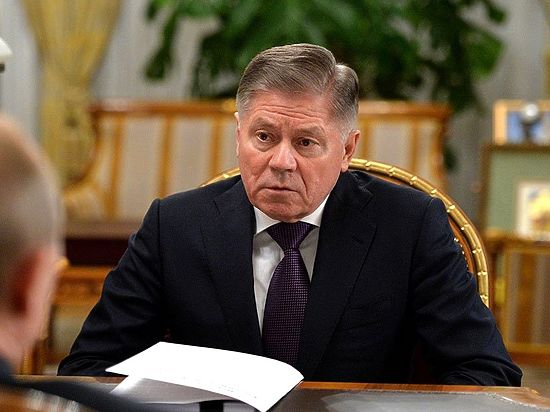
Memorial has published documents relating to the case of journalist and human rights activist Zoya Svetova’s father, Felix Svetov, who was convicted in the Soviet for his human rights works. His trial, in 1986, was presided over by Vyacheslav Lebedev, who has been chief justice of the Russian Federal Supreme Court since 1989.
Chief Justice Vyacheslav Lebedev. Photo courtesy of Kremlin.ru
According to Memorial, Svetov was found guilty because he had made “defamatory” allegations that “innocent people [were] thrown into prison” and accusations that the authorities did not observe socialist laws and violated the rules of the Criminal Procedure Code.
Ultimately, Lebedev, who was then deputy head judge of Moscow City Court, sentenced Svetov to five years of exile.
Memorial published the information in connection with the search conducted this past Tuesday in the apartment of Felix Svetov’s daughter Zoya Svetova, an employee of Open Russia, which is headed by Mikhail Khodorkovsky. A similar search had taken place before Svetov’s trial in 1986.
Yet investigators have claimed that the hours-long search, which in particular involved confiscating the computers of Svetova’s children, the well-known journalists and brothers Filipp, Tikhon and Timofei Dzyadko, was carried out as part of the case against Khodorkovsky’s company Yukos, launched back in 2003. Svetova herself has suggested the real reason for the search was her work on the Moscow Public Monitoring Commission.
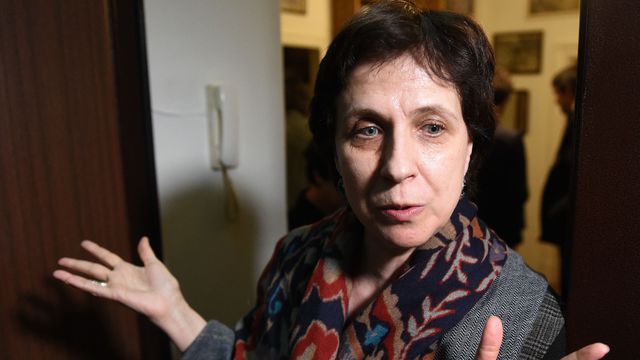
Memorial added that, in 1984, Lebedev handed down a guilty verdict to human rights activist Elena Sannikova. She was convicted of “anti-Soviet agitation and propaganda.”
_________________________
Moskovsky Komsomolets Deletes Article on Supreme Court Chief Justice’s Involvement in Persecuting Soviet Dissidents Meduza
March 1, 2017
On March 1, an article entitled “Supreme Court Chief Justice Accused of Persecuting Dissidents during Soviet Times” vanished from the website of newspaper Moskovsky Komsomolets. The article was published on Wednesday afternoon and was accessible on the site for a few hours.
No reasons have been given for its deletion. A copy of the article has been cached in Google Search results. Moskovsky Komsolets editor-in-chief Pavel Gusev told Meduza he was unaware of why the the article had been deleted and was hearing about the matter for the first time.
The article discusses Memorial’s publication of documents relating to a police search of the home of Felix Svetov and Zoya Krakhmalnikova, parents of Zoya Svetova, which took place in 1982.
Among other things, Memorial’s Facebook post points out that the presiding judge in Svetov’s case, which was heard in the mid 1980s, was Vyacheslav Lebedev, who would become chief justice of the Russian Federal Supreme Court in 1989.
FSB investigators searched journalist Zoya Svetova’s home for over ten hours on February 28, 2017, allegedly, as part of the Yukos affair. Svetova works for Mikhail Khodorkovsky’s Open Russia, but claims she knows nothing about Yukos’s business.
Translated by the Russian Reader. Thanks to Comrades AK and JM for the heads-up
Russia: ‘Deeply alarming’ raid targets human rights activist and journalist Zoya Svetova Amnesty International
28 February 2017
After Russian criminal investigators searched the flat of Zoya Svetova, a prominent journalist and human rights activist, this morning, Sergei Nikitin, Director of Amnesty International Russia, said:
“Today’s search of Zoya Svetova’s flat is deeply alarming. She is one of Russia’s most respected journalists and human rights activists – it is unclear what she might have to do with the criminal investigation against YUKOS.”
“This search seems like a blatant attempt by the authorities to interfere with her legitimate work as a journalist and perhaps a warning for her and others of the risks of human rights work and independent journalism in Russia.”
Zoya Svetova previously worked for Reporters without Borders and Soros Foundation in Russia.
The search was conducted by 12 officers from Russia’s Investigative Committee that probes serious crime. According to Svetova’s lawyer, it was linked to a case of alleged embezzlement and tax fraud by the former YUKOS oil company head Mikhail Khodorkovsky. One of the most prominent critics of the Kremlin, Khodorkovsky served 10 years in jail and in 2011, after being convicted of another offence and sentenced to a new term of imprisonment, he was declared a prisoner of conscience by Amnesty International.
In December 2016 Russian Investigative Committee officers raided the apartments of seven Open Russia activists as well as the movement’s offices in Moscow and Saint Petersburg. The Investigative Committee claimed it was seeking evidence of money laundering by former YUKOS executives with links to Khodorkovsky.
The Partisans of Suna Karelian pensioners have gone into the woods to save a pine forest from logging
Alexei Vladimirov Fontanka.ru
October 26, 2016
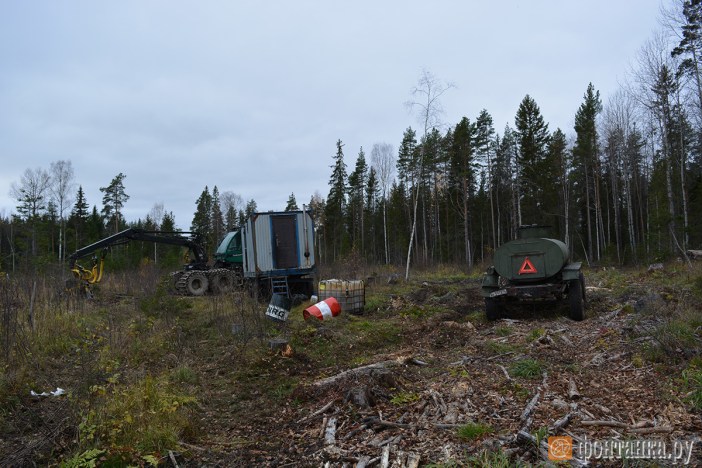
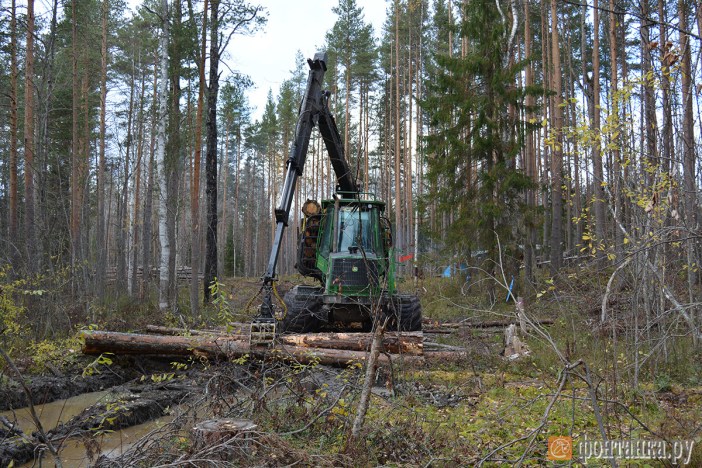
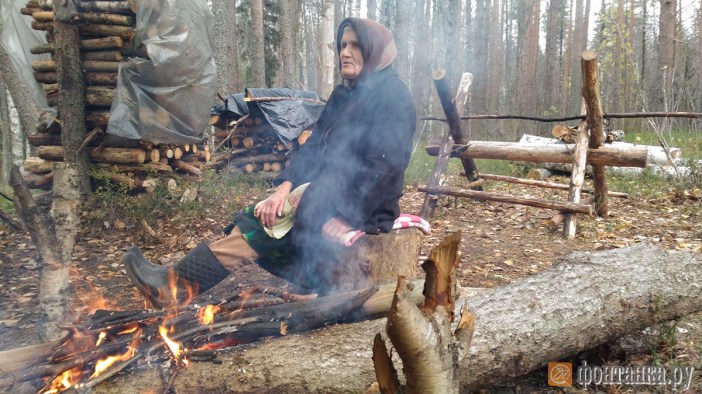
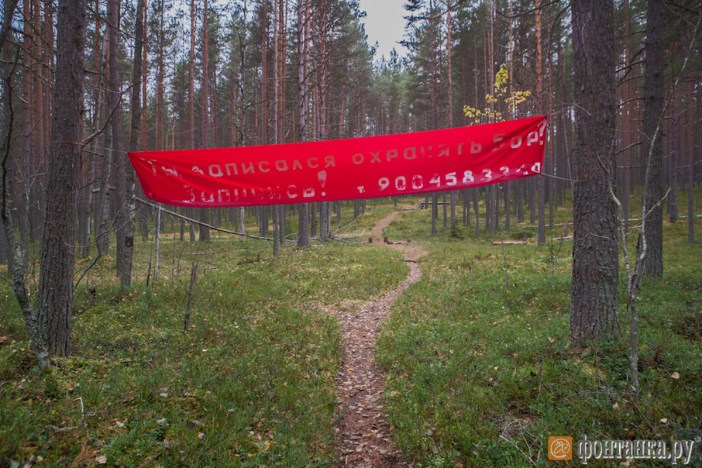
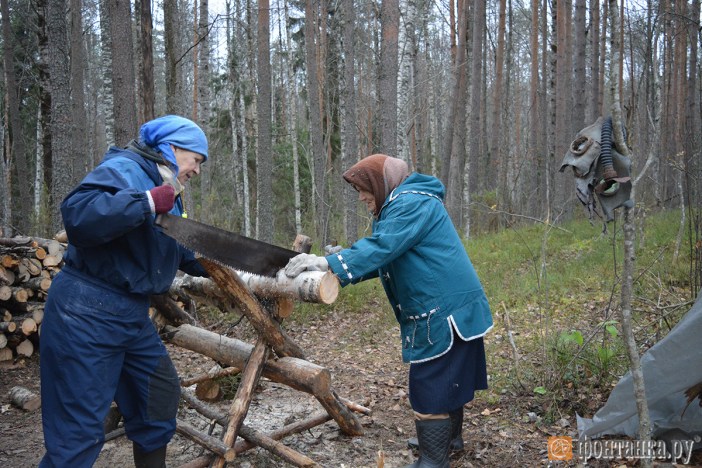
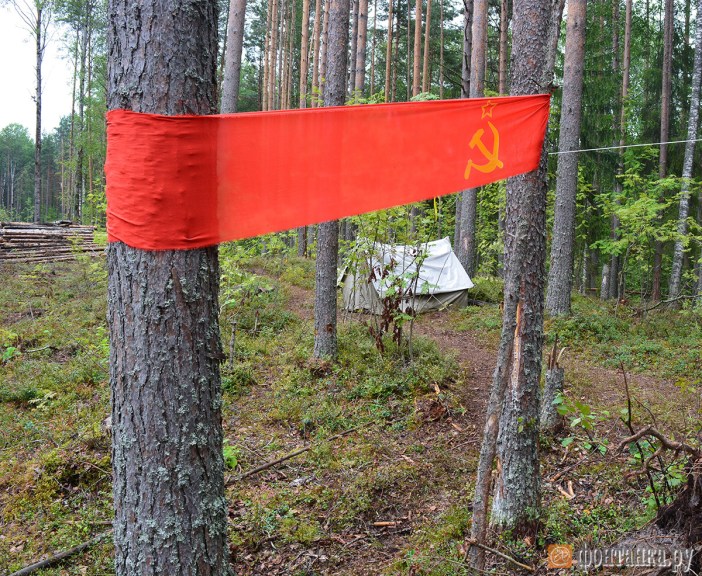
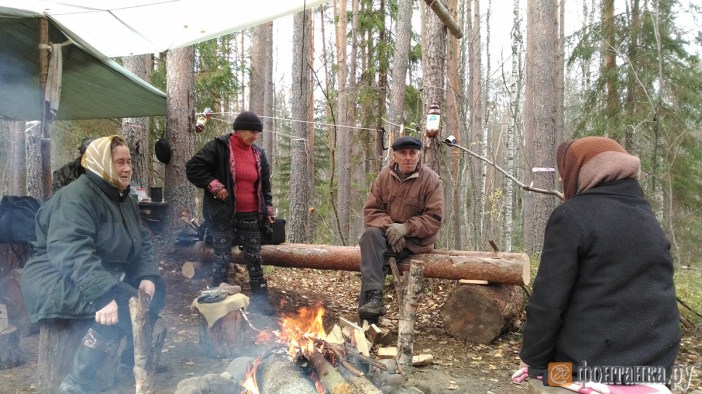
Residents of the small village of Suna in Karelia’s Kondopoga District, mainly pensioners, have rebelled against the authorities, loggers, and a mining company that plans to develop a sand and gravel quarry in the scenic pine wood alongside their village. The area resembles the front lines during a war. The loggers have brought in their equipment, but have been stopped in their tracks by the pensioners, who have set up camp there. The pensioners have been keeping a 24-hour vigil in the woods for four months. Local journalists have dubbed them the “partisans of Suna.”
“Extremist” Pensioners
The conflict flared up much earlier. Saturn Nordstroy, a company specializing in the development of sand and gravel beds in Karelia, had its eye on a plot of land in the vicinity of Suna and decided to open a sand quarry there. The Karelian Nature Management and Ecology Ministry supported the idea. Permissions were received, an auction was held, and the company was awarded a license in 2011 to extract sand and gravel at the site for a period of twenty years. However, neither the officials nor the businessmen suspected they would encounter vigorous resistance from local residents, mainly pensioners, who have strongly opposed the quarry development plan and exercised their inalienable right to a decent life.
There is a pine forest on the site where the businessmen have decided to dig the quarry, the only one in the whole area, a place where the locals harvest berries, mushrooms, and medicinal herbs. The wild plants are a good supplement to their tiny pensions. Once upon a time, the village of Suna was known throughout the Soviet Union for the nearby poultry farm, also called Suna. The farm was considered one of the best in the country, but in the “fat years” of the noughties, it was shut down. This has meant a slow death for the surrounding settlements. Young people have left the area in search of work, while the old people have stayed in the village to live out their lives. The money to index their pensions could not be found, but the prime minister has told them to “hang on.”
The locals learned a quarry would be dug near their village only at the presentation of the development plan. Opponents of the logging of Suna Forest planned to hold a people’s assembly on May 14, but they were forced to abandon the idea. On the eve of the assembly, police visited one resident of Suna, pensioner Nina Shalayeva. According to the elderly woman, the police all but accused her of extremism.
In the autumn of last year, the Center for Extremism Prevention (Center “E”) began investigating the pensioners. One of them had rashly said it would be a good idea to block the Kola Federal Highway, which runs from St. Petersburg to Murmansk, since the village is located a kilometer and a half from the highway. That would get Moscow’s attention right away. Naturally, someone snitched to the proper authorities. Law enforcement and the secret services reacted instantly. The settlements along the Kola Highway were mobbed with large numbers of law enforcement officers, from riot police to the highway patrol. To stop the protest rally in its tracks, the pensioners were threatened with criminal charges for extremism.
“The deputy head of the Kondopoga police was polite. He gave me a warning for extremism and left. I had run into him in the spring, when I had also been accused of organizing an unsanctioned rally. The local beat cop said they had learned we were planning to block the highway, and that I was organizing the whole thing. What kind of organizer am I? There was also an FSB officer from Kondopoga. He asked to talk with me privately. He said flat out that they had specially trained people who did not like to be bothered. They would arrive, break all of us, and imprison us, despite our age,” recounted Nina Shalayeva, an anti-quarry activist.
Then the villagers suddenly had a bit of luck. In the spring of 2015, scientists from Petrozavodsk State University discovered a valuable species of lichen in the Suna Forest, Lobaria pulmonaria. It is listed in the Red Book of Russia as an endangered species: destroying species listed in the Red Book is not only forbidden by law, but is even considered a criminal offense. The scientists’ find occasioned an inspection by the prosecutor’s office in the area of the planned digging. Consequently, the Karelian Interdistrict Environmental Prosecutor’s Office issued a warning to the director of Saturn Nordstroi about the inadmissibility of violating the law while extracting sand and gravel from the South Suna Quarry. The pensioners now had grounds to sue.
Litigation
The plaintiffs demanded “the license issued to Saturn Nordstroy LLC be terminated and the company prohibited from engaging in all exploratory and economic activity that may lead to the destruction of protected plant species and their habitat in the pine forest near the village.” In April of this year, the Petrozavodsk City Court partly granted the claim lodged by the residents of Suna. The company was forbidden from carrying out exploratory and other work detrimental to endangered species discovered in the forest. However, the court could find no grounds for terminating the license for subsoil extraction issued to the company.
However, the Karelian Supreme Court has overturned the Petrozavodsk City Court’s ruling. The case is currently under investigation by the Russian Supreme Court. The pensioners think the case will be heard in December or thereabouts.
The Partisans of Suna
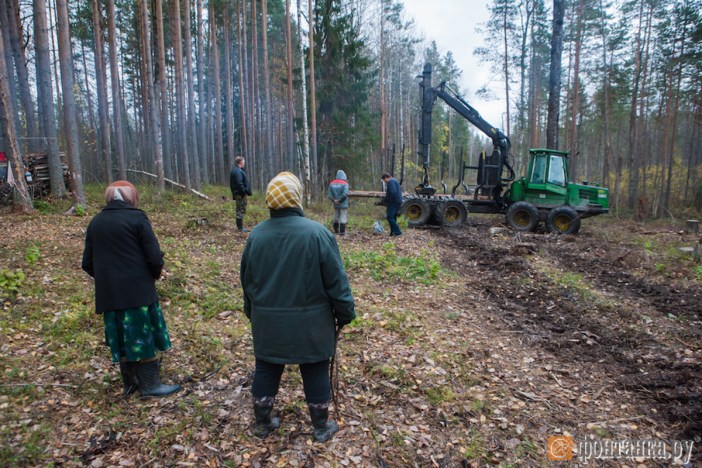
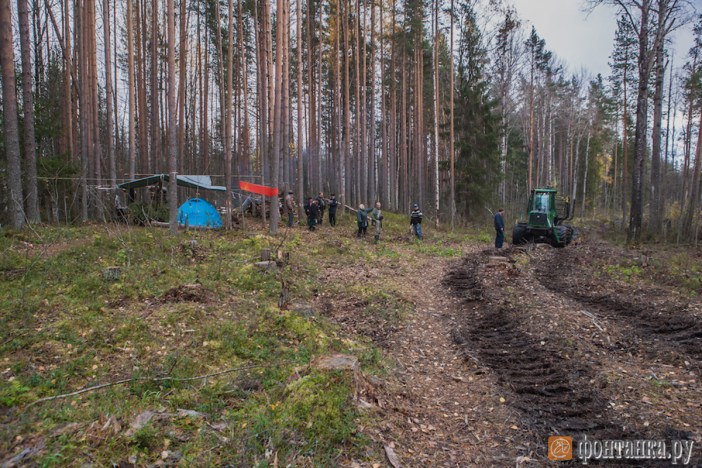
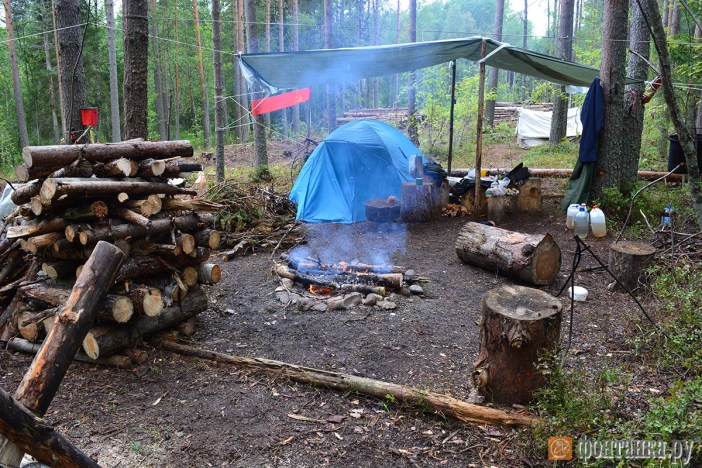
Immediately after the Karelian Supreme Court’s ruling, logging equipment was moved into Suna Forest. People formed a human shield to block the road to the loggers. The whole village came running to see what the noise and fracas were about. The villagers told police, businessmen, and officials of various ranks they would not surrender the forest: they would have to chop them down with it. Arriving on the scene, the police warned the pensioners they would be forced to detain them if they did not leave the logging site, because they were interfering with the work of the loggers. The pensioners set up camp and kicked off a round-the-clock vigil in the forest.
The Partisans of Suna
“Medvedev said we had to be patient. We are patient. Just don’t take away the last thing we have! I don’t know what price we’ll have to pay, but we are not going to give up this forest, because we won’t survive without it. The [Karelian] Supreme Court’s ruling made us sad. However, it is only the latest step in the case, albeit one not in our favor at the moment. We will defend our rights!” said pensioner Tatyana Romakhina.
The logging equipment retreated, and a “pre-election” calm set in until October 7.
On the morning of October 7, the engines of the forestry equipment could again be heard droning in Suna Forest. The first on the scene was Nina Shalyaeva. She stopped the harvester.
“When I went to my shift in the forest, I saw that a harvester was running. I stood in front of their equipment and said that my fellow villagers would be right behind me, and we wouldn’t let them cut down the trees. They promised the police would come and take me to Petrozavodsk. However, after we talked, they stopped logging and drove off the lot,” said Shalyaeva.
Karelia’s Suna Forest has become something like Khimki Forest. District police officer Vitaly Ivanov, summoned by the loggers, interviewed the locals, wrote down their internal passport data, and said that if the actions of the loggers were ruled legal, the defenders of Suna Forest who impeded the logging would be forcibly removed from the allotment. In turn, the pensioners promised the entire village would rise in rebellion. The loggers conversed with the pensioners rather unceremoniously. They demanded to see papers [prohibiting them from doing their work] and told them in harsh tones to go back to the village. Everyone’s nerves were on edge. The loggers were irritated by the annoying, unplanned downtime, while the pensioners were annoyed by police’s actions. They could not understand why the police had asked them to produce their passports, written down the information in them, and tried to drive them out of the woods. In the end, the loggers retreated. Fortunately, things did not come to blows.
The partisans’ campNina Makkoyeva“You’ve signed up to defend the forest!”
Meanwhile, the controversy over the forest has spread beyond Karelia. Major publications and national TV channels have covered the “partisans of Suna.” In Petrozavodsk, a grassroots movement has been organized to help the pensioners. Young people have begun standing watch in the woods along with the old people. Residents of Murmansk Region have sent them a winter-proof tent.
The pensioners are still on watch in the woods and getting ready for winter, while officials and businessmen are looking for ways to resolve the conflict.
An “Artificially Simulated” Conflict?
After a long silence, the Government of Karelia finally organized a round table on the issue. Officials believe the controversy surrounding the Suna Forest has been “artificially simulated.”
“We organized a meeting to discuss the situation with the development of a sand and gravel quarry in the South Suna subsoil resources allotment, and the reasons why the license holder has been hindered from engaging in legal activities, and to work out a solution to the conflict that has emerged. A situation around Suna Forest really has emerged, and it is our job to figure what caused this artificially simulated social conflict. I would like to draw the attention to the people involved in the process that the question of the legality of the license holder’s activities has been considered in court, and the rulings, which have entered into force, were in their favor. Multiple studies have not established evidence that endangered plant species are being destroyed. Thus, the license holder has all legal grounds to engage in their business activities,” Alexei Pavlov, first deputy minister for nature management and ecology in Karelia, said at the outset of the round table.
Igor Fedotov, director of Saturn Nordstroy LLC, was of the same opinion.
“Everything is too seriously organized. When we presented the project in Yanishpole in May of last year, the experts told us someone was stage-managing this drama. Everyone accuses me of wanting to come in, dig everything up, destroy everything, and do nothing [for the area]. So let me do something. I want to do something good for Suna. I can donate the material I am going to be extracting. The district needs it: they do not have good sand. I can help out the local council, which is gasping for breath, just like every district in Karelia. We are building a road to the quarry, and it will still be there [after we are gone]. I am not planning to build anything there. The local residents will be the better for it. And the reforestation of the area will begin,” said Fedotov.
No decisions were made at the round table, however. Talks have been rescheduled for October 26.
All photos courtesy of Alexei Vladimirov and Fontanka.ru. Translated by the Russian Reader. Thanks to Comrade VZ for the heads-up
Alexei Gaskarov and his wife Anna Gaskarova, October 27, 2016. Photo by Anatrrra
Bolotnaya Square Defendant Alexei Gaskarov Released from Prison
Ekaterina Fomina Novaya Gazeta
October 27, 2016
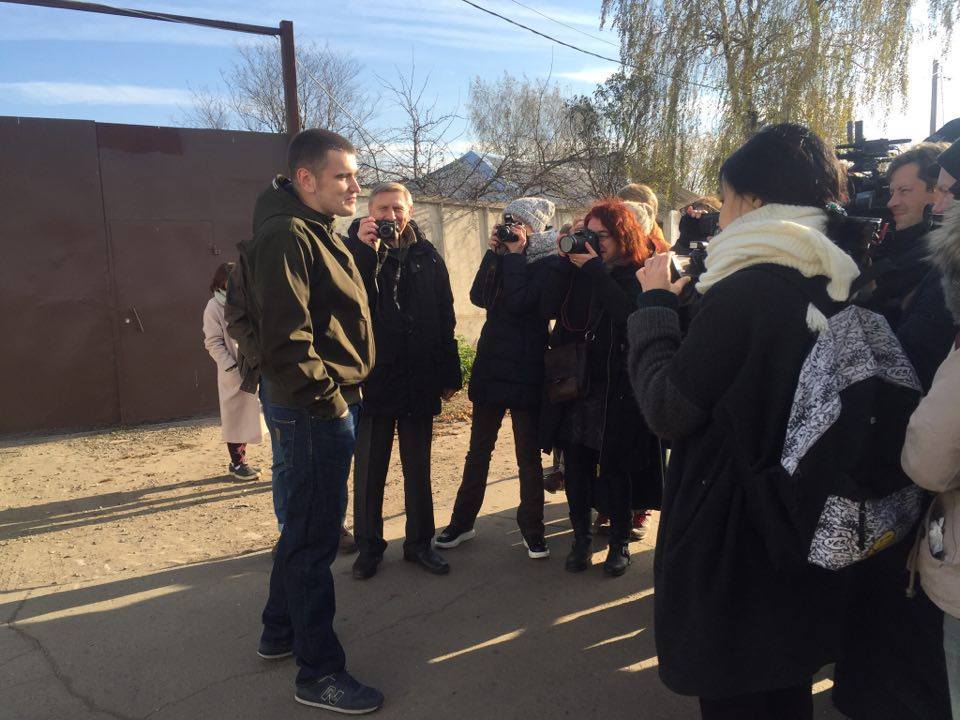
Alexei Gaskarov was released from Penal Colony No. 6 in Novomoskovsk today. He had served his entire sentence: three and a half years in a medium-security penal colony. Gaskarov was twice denied parole.
“I don’t think it was possible to change anything under these circumstances. I said at the trial that if our way runs through prison, we have to go. Personally, everyone who went to prison lost a lot. But if you compare that with the public interest, someone had to go through it, someone had to have this piece of ‘good’ luck,” Gaskarov said after his release.
Alexei Gaskarov (left). Photo courtesy Ekaterina Fomina/Novaya Gazeta
“The risks are clear, but I don’t think there is an alternative. I don’t think that the path, the values that were professed on Bolotnaya Square can be put on the back burner. Yes, these are complicated times, and we have to wait them out somewhere, but I don’t think you can impact this vector by intimidating people. When I was in prison I read about a hundred history books. Everyone had to go through this. We are just at this stage,” he added.
Alexei Gaskarov. Photo courtesy Ekaterina Fomina/Novaya Gazeta
“The point of my attitude is this: don’t be afraid, guys. Our little undertakings will merge into a river that will lead us to the right path. Prison is not the end of life,” Gaskarov concluded.
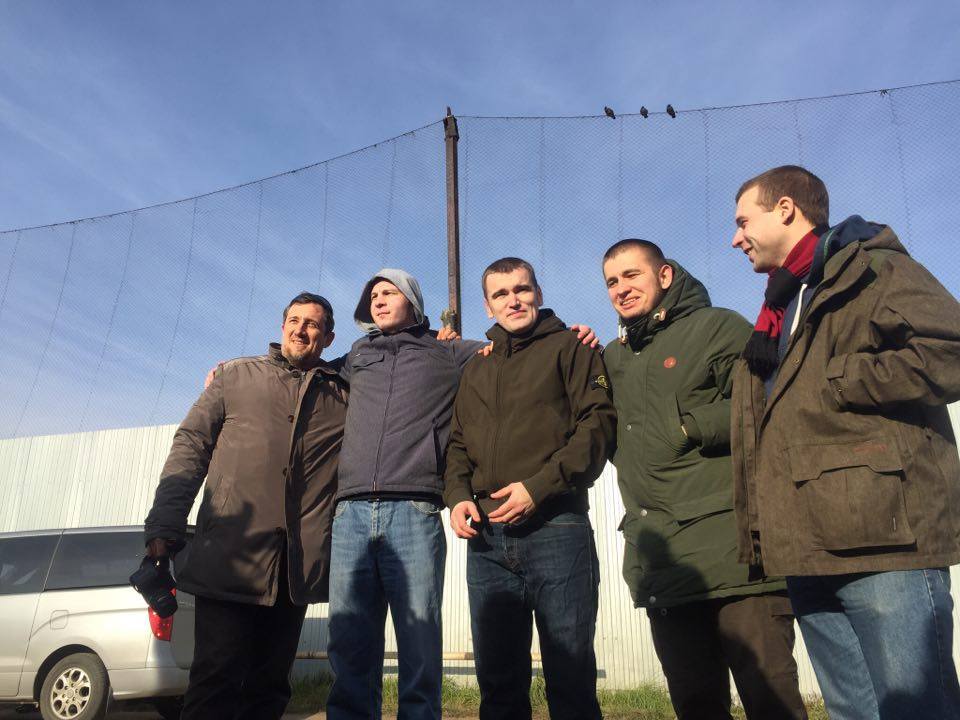
Prisoners of Bolotnaya: Alexander Margolin, Vladimir Akimenkov, Alexei Gaskarov, Alexei Polikhovich, and Ilya Gushchin. Photo courtesy of Ekaterina Fomina/Novaya Gazeta
Gaskarov was accused of involvement in “rioting” and being violent towards police officers. However, Gaskarov claimed he had himself been assaulted on Bolotnaya Square. During the mass arrests, an unidentified policeman pushed him to the ground, beat him with his truncheon, and kicked him.
In October, citing a judgment by the European Court of Human Rights, the Russian Supreme Court ruled that the arrest and imprisonment of Bolotnaya Square defendants Ilya Gushchin and Artyom Savyolov had been illegal. Earlier, in June, after a complaint had been filed with the European Court of Human Rights, the Supreme Court declared the arrest of Leonid Kovyazin, a defendant in the same case, illegal.
Anarchist Dmitry Buchenkov awaits trial in a pre-trial detention facility. According to police investigators, he was violient toward lawful authorities and “tried to destroy a portapotty.” Buchenkov himself claims he was not in Moscow during the so-called March of the Millions.
Maxim Panfilov is also awaiting trial. He was charged four years after the opposition rally on Bolotnaya Square in Moscow—in April 2016. He is the thirty-sixth defendant in the Bolotnaya Square case. In October, Panfilov was declared mentally incompetent.
Women in Petersburg Celebrated February 23 by Paving the Way to a Church with “Dead” Bodies Rosbalt
February 24, 2016
Photo courtesy of protest organizers
A protest action against discrimination and the [proposed decriminalization of] battery and homicide threats took place outside St. Nicholas Maritime Cathedral in Petersburg. Feminists thus marked Fatherland Defenders Day.
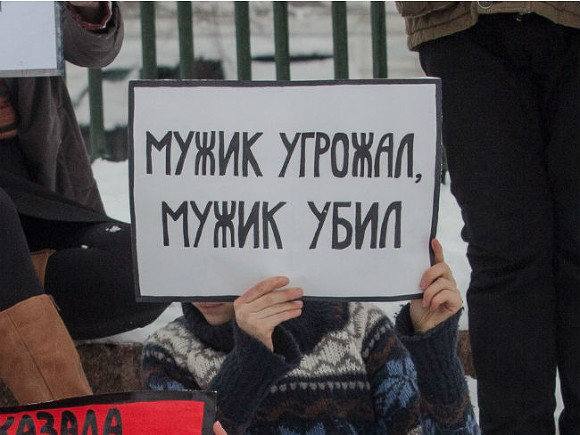
During the performance, two men laid out young women, who depicted the fatal victims of beatings, on the steps leading to the church. At the end of the protest action, the protesters raised placards bearing slogans such as “My man made threats, my man killed me,” “Who will defend us from the defenders of the fatherlands?” “I said no: he broke my arm,” “97% of abuse cases never make it to court,” and “Thank you, legislators, for our happy deaths.”
Photo courtesy of protest organizers“My man threatened me, my man killed me.” Photo courtesy of protest organizers
The organizers told Rosbalt they were protesting against the [proposed] removal of battery and homicide threats from the Russian Criminal Code.
“The decision as to whether women can find protection from law enforcement agencies or not is being made by legislators and priests who do not suffer from beatings by their partners. How is this possible? Do the lives and health of the country’s citizens not interest the government? Every fourth woman in Russia faces domestic violence,” the organizers noted.
According to them, it is extremely difficult for women to file battery complaints. And most often the perpetrator is not duly published: the charges are limited to a misdemeanor.
Whereas “women put up with violence their whole lives and often die at the hands of their partners.”
“We believe such a law is a crime,” noted the organizers.
Photo courtesy of protest organizer
The Way to the Church
Russian women marked February 23 by paving the way to a church with dead bodies.
The women were thus protesting the [proposed] exclusion of battery and homicide threats from the Criminal Code, a measure actively lobbied by the Russian Orthodox Church.
[President Putin] urged [lawmakers] not to delay passage of the law, which would decriminalize such articles of the Criminal Code as battery, homicide threats, and willful failure to pay alimony. (Kommersant, February 16, 2016)
Translated by the Russian Reader. Thanks to Comrade SJ and the Nihilist for the heads-up
__________
Russian Supreme Court proposes to decriminalize minor offences RAPSI
July 31, 2015
MOSCOW, July 31 (RAPSI) – Russia’s Supreme Court suggested decriminalizing minor offenses such as battery, the threat of homicide, failure to pay alimony or child support, RAPSI learnt in the court on Friday.
In a meeting with President Vladimir Putin, Supreme Court Chairman Vyacheslav Lebedev proposed that minor crimes such as battery and petty theft be decriminalized and classified as administrative offenses [misdemeanors]. He said this would reduce the number of cases sent to court by 300,000 annually.
A bill, which the Supreme Court has drafted, would decriminalize petty crimes such as battery, the use of forged documents, the threat of homicide and failure to pay alimony or child support. Penalties for these offenses would only include fines, correctional labor or community service.
Justice Vladimir Davydov said at the plenary meeting that this would free up half of all investigators to deal with serious crimes and would help over 300,000 people avoid criminal penalties and negative consequences for employment, education and the issuance of passports or loans.
A deputy prosecutor general said he supported the idea, adding that approval would allow investigators, who claim to be too busy with petty crimes, to investigate more serious crimes.
Petty crimes accounted for 46 percent of all cases sent to court last year.
__________
Putin suggests decriminalization of Russian Penal Code TASS
December 3, 2015
Russian President Vladimir Putin has asked Russian lawmakers to support a proposal to decriminalize a number of articles of the Russian Penal Code.
“I am asking the Russian State Duma to support the proposal of the Russian Supreme Court to decriminalize some articles of the Russian Penal Code and transfer some of the crimes that pose no great threat to the public or society to the category of administrative offenses but with one major reservation: the offense will be classified as a crime if it is committed for a second time,” Putin said in the annual state of the nation address to the Russian Federal Assembly (parliament) on Thursday.
The head of state clarified that practically every second criminal case, which is taken to court today, is linked to minor and inconsiderable offenses while people, including youth, are sent to prison.
“The confinement and the fact of criminal conviction affect their future fate and often encourage them to commit further crimes,” the president concluded.
Russian penitentiaries have around 660,000 inmates. According to the Federal Penitentiary Service, 55% of them are recidivists. Approximately 25% of the offenders serve prison sentences for minor offenses and crimes of medium gravity; 1,800 people have been convicted for terrorism and extremism.
Excessive acts of law enforcement agencies destroy business climate in Russia
Putin said excessive acts of law enforcement agencies destroy the business climate in Russia.
“That is a direct destruction of the business climate. I am asking the investigation and prosecution authorities to pay a special attention to it,” he said.
The President said that in 2014 nearly 200,000 criminal cases on economic crimes were initiated in Russia. Of this number 46,000 reached the court and 15,000 cases “collapsed” in courts.
“It turns out that only 15% of cases ended with verdicts,” Putin said.
He added that most of the defendants in these cases – about 83% – fully or partially lost their businesses.
“That means that there were bullied, robbed and released,” the head of state said.
He called on prosecutors to make a wider use of their authorities to monitor the quality of the investigation.
The president also recalled the discussions on additional powers of prosecutors.
Today, a supervisory authority has the authority to cancel decisions on initiation of criminal proceedings, to dismiss indictments or not to uphold the charges in court.
“We need to use what we have more intensively. After that we will be able to analyze what is happening in practice,” he said.
According to Putin, detention at the stage of investigation of economic crimes should be used as a last resort and preference should be given to such methods as pledge, subscription on parole and house arrest.