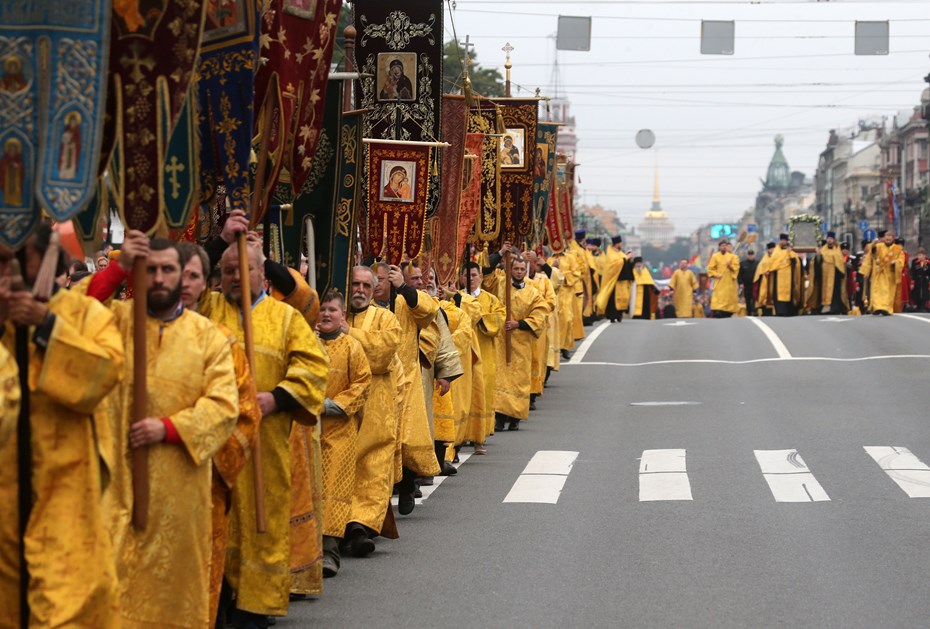
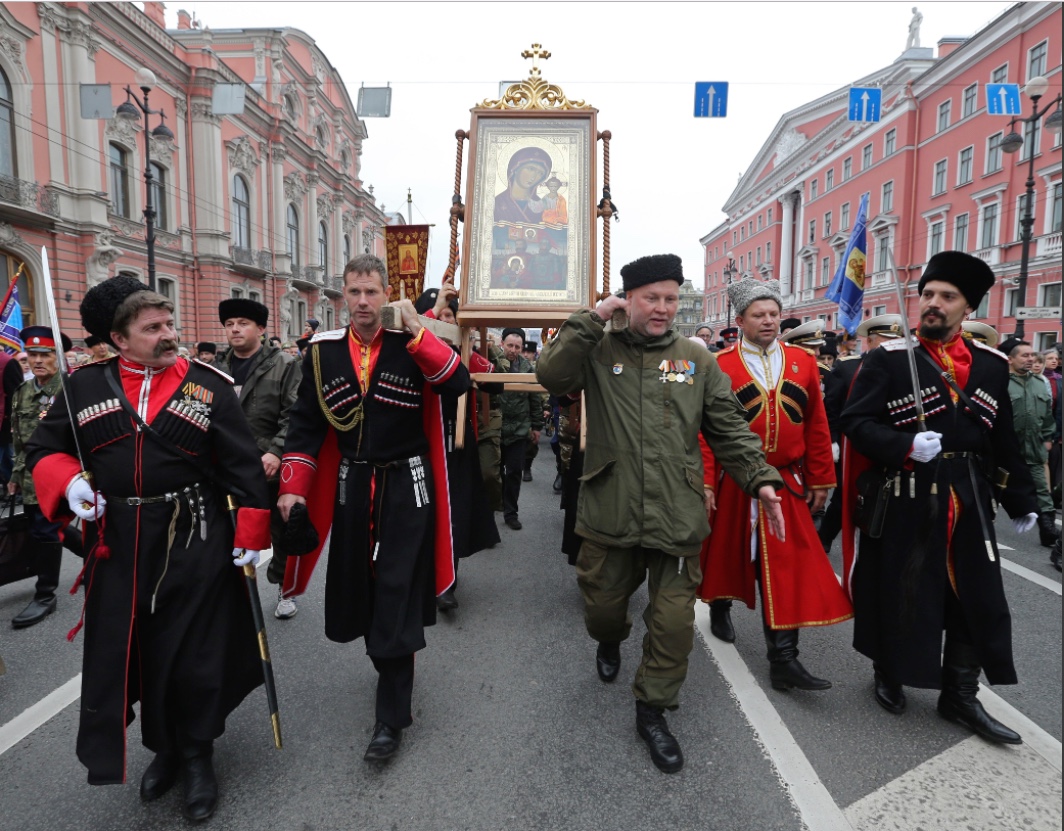
Religious procession in Petersburg, September 12, 2017. Photo courtesy of Alexander Demyanchuk/TASS
Legislative Assembly Speaker Vyacheslav Makarov Calls Russia God’s Last Hope on Earth Delovoi Peterburg
September 12, 2017
As reported on Fontanka.ru on Tuesday, September 12, Vyacheslav Makarov, speaker of the Saint Petersburg Legislative Assembly, called Russia God’s last hope while addressing participants of a religious procession that had marched down Nevsky Prospect.
“Russia has its own special mission in the world. The meaning of Russia’s existence is to solve problems that no other country can solve. Russia is a world power, God’s last hope on earth! That is why the Lord invisibly protects Russia from enemies and safeguards its little world for a salvational outcome in order to protect our country in its heavenly and earthly dimensions,” Vyacheslav Makarov said.
Religious procession in Petersburg, September 12, 2017. Photo courtesy of Alexander Demyanchuk/TASS
He noted the adversities that have ravaged Russia are bound up, among other things, with the murder of the tsar and his family.
“Exactly one hundred years separate us from events that radically changed our Fatherland, a great, multi-ethnic country, events that plunged it into the madness of civil war, in which children rebelled against their parents, and brother fought against brother. And the subsequent losses and sorrows, trials and tragedies through which the people passed were predestined by the destruction of the state, the murder of the tsar and his children, and militant atheism,” said Makarov.
Religious procession in Petersburg, September 12, 2017. Photo courtesy of Alexander Demyanchuk/TASS
In turn, Petersburg Governor Georgy Poltavchenko noted that Alexander Nevsky had chosen the right way for building the state, had repelled outside aggressors, and had helped the Russian people maintain its identity through Orthodoxy.
Today, Petersburg held a citywide religious procession in honor of the Day of the Translation of the Relics of Alexander Nevsky. The sacred procession went down Nevsky Prospect from Kazan Cathedral to the Alexander Nevsky Monastery. According to the regional directorate of the Interior Minister, over 100,000 people took part in the event.
I met Jehovah’s Witnesses in the mid 1990s in the former Soviet Central Asian republics. I was researching the region’s religious life. When I arrived at each regional capital, I would survey all the prominent communities in turn. The Witnesses were different in one respect from other western-inspired Christian communities. There were lots of them and they were everywhere.
Like now, many were certain back then the Witnesses were a product of the perestroika era’s freedoms. This, however, was not the case. The Witnesses were a legacy of the Soviet Union.
An American Salesman’s Religion
The Witnesses are a typical American eschatological religious group. Put crudely, they believe the world will end soon, during their lifetimes. They believe in one God, Jehovah, a name used during Christianity’s first century. On Judgment Day, Jehovah will destroy sinners and save the elect. The Witnesses reject the Christian doctrine of the Trinity (God the Father, God the Son, and the Holy Spirit). They do not consider Christ God, but they revere him. The day of his death is the only holiday they celebrate.
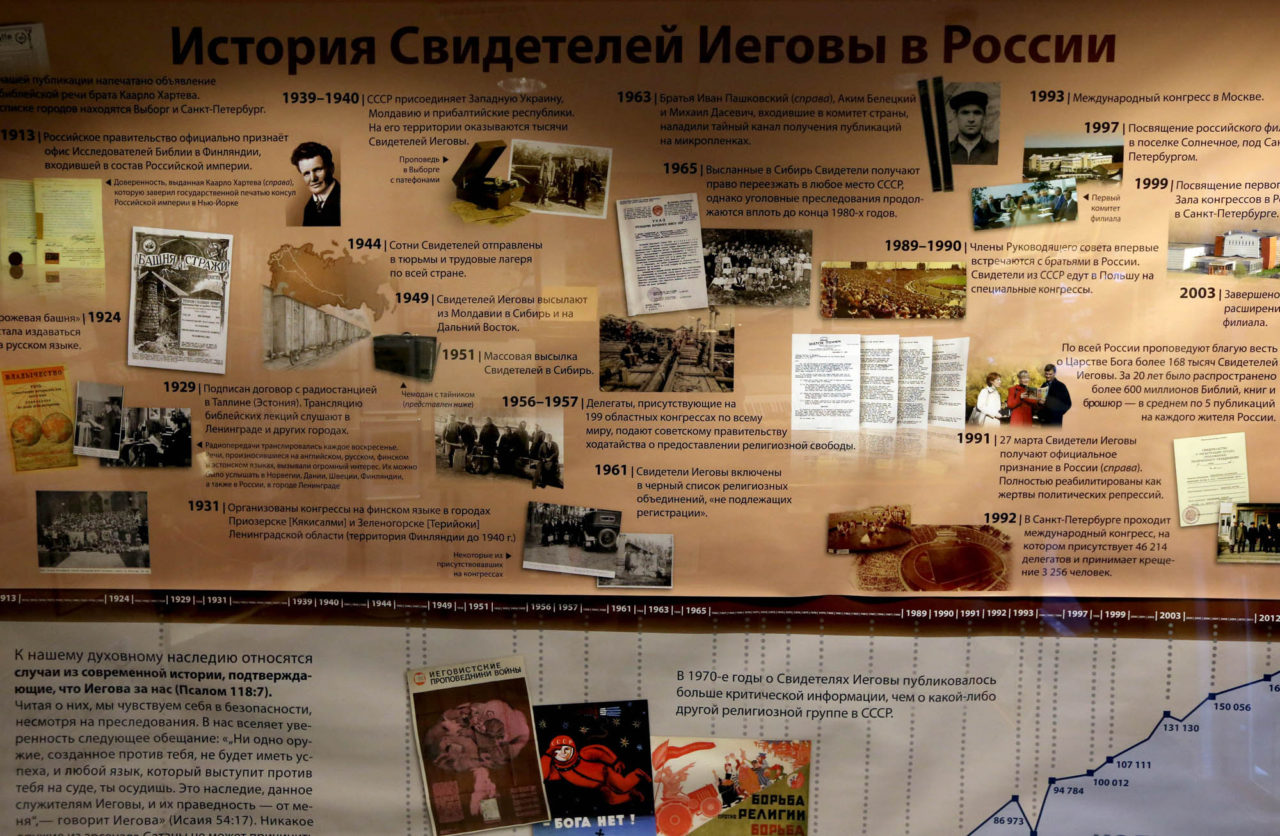
“A History of the Jehovah’s Witnesses in Russia,” a display in the museum at the Administrative Center of the Jehovah’s Witnesses in Russia, located in St. Petersburg. Photo courtesy of Alexander Demyanchuk/TASS
A completely and regularly revised theology has produced a set of permissions and prohibitions aimed at maintaining the way of life and behavior of a decent traveling salesman from the lower middle classes.
The Witnesses are allowed the moderate use of alcohol (immoderate use is cause for expulsion) and the use of contraceptives. Premarital sex and smoking are forbidden. The Witnesses must not “rend to Caesar what is Caesar’s”: they are forbidden from being involved in elections, engaging in politics, honoring state symbols, and serving in the army. They are most roundly criticized by outsiders for forbidding blood transfusions and organ transplants. The Witnesses suddenly had something to say when the AIDS epidemic kicked off. They support blood substitutes.
Something like family monasteries—”administrative centers”—have been organized for the most ardent followers. The schedule in the centers is strict, but the conditions are relatively comfortable. The Witnesses can live and work in them, practically for free, for as little as a year or as along as their entire lives.
Waiting for the world’s imminent end is an occupation common to many religious groups, from Russian Old Believers to the Mayan Indians. Such groups isolate themselves from a sinful world, some by retreating into the wilderness, others, by restricting their contact with outsiders.
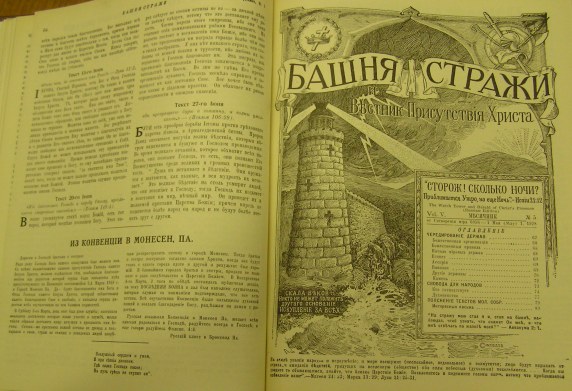
The cover of a 1928 Russian-language edition of The Watchtower. When the Russian edition was founded in 1925, it was originally entitled The Guard Tower, but in 1964 the name was changed to The Watchtower. Photo courtesy of Boris Alexeyevich/Wikipedia
The Witnesses differ from similar movements in terms of how they disseminate and maintain their doctrine. The method is based on the commercial practice of distributing magazines in the nineteenth century. Essentially, the entire organization meets twice weekly to read its main journal, The Watchtower, which is produced by church elders in Brooklyn and then translated and disseminated in dozens of languages. Members pay a nominal fee for subscribing to and reading the journal, fees that are scrupulously collected and sent along the chain: from local groups to the regional office, then to the national headquarter and, finally, to the head office in Brooklyn. Free distribution of the magazine and going door to door asking people whether they want to talk about God are aimed at the same thing: increasing the audience who subscribes to and collectively reads the magazine.
Ninety-five percent of today’s public find these religious activities strange and ridiculous, although from a sociological viewpoint they barely differ from going to political party meetings, networked sales of cosmetics, visiting sports clubs, getting a tattoo, the Russian Healthy Lifestyle Movement (ZOZh) or stamp collecting.
If you believe the Jehovah’s Witnesses’ own figures, they operate in 240 countries, which is more than belong to the UN. At the same time, the organization is numerically quite compact, albeit growing rapidly. It has a total of 8.3 million members.
A Religion for Soviet Individuals
The story of how the Witnesses took root in the Soviet Union has been well told in a book published three years ago by Emily Baran, Dissent on the Margins: How Soviet Jehovah’s Witnesses Defied Communism and Lived to Preach About It. Polish and Romanian peasants and market traders adopted the doctrine of the Witnesses at the turn of the 1920s and 1930s, and before the war they unexpectedly were made Soviet citizens when the Soviet Union occupied parts of Poland and Romania.
The Soviet authorities did not tolerate large groups who maintained constant links with foreign countries, so it decided to send the core group of Witnesses, five thousand people, to Siberia. A considerable number were sent to the camps, while the rest were exiled. The crackdown was a misfortune for the victims, but it was a godsend for the exotic doctrine.
The Moscow Jehovah’s Witness community worshiping at the velodrome in the city’s Krylatskoye District, 2000. Photo courtesy of Alexander Fomin/PhotoXPress.ru
As early as the 1950s, the largest communities of Witnesses had emerged in the main place of exile, Irkutsk Region. In the 2000s, the official websites of Irkutsk Region and the neighboring Republic of Buryatia claimed the Jehovah’s Witnesses were a traditional religious community in the region. Irkipediaprovides the following figures for 2011: “Around 5,500 people in Irkutsk Region are members of the Jehovah’s Witnesses religious organization. Around 50 of their assemblies operate in Irkutsk Region, each of them featuring 80 to 150 members. The assemblies are united into three districts: Usolye-Sibirskoye, Irkutsk, and Bratsk.”
The camps proved a suitable place for proselytizing, the radically minded youth, especially Ukrainian speakers, eager listeners, and the half-baked amnesty of political prisoners, an excellent means of disseminating the doctrine nationwide. As early as the late 1950s, all over northern Kazakhstan, former members of the Ukrainian Insurgent Army (UPA), who were banned from returning home, and former Russian criminals, who had taken jobs as farm machinery operators and welders, were digging dugouts in the steppes to hide DIY printing presses for printing The Watchtower.
Why did peasants, traders, brawny lads from the working classes, graduates of provincial technical schools, mothers of large families, and pensioners need to become Jehovah’s Witnesses? I have the same explanation as the preachers do: to radically change their selves and their lifestyles. The everyday frustrations of ordinary people, their perpetually predetermined lives, and their uselessness to anyone outside their narrow family circle (in which there is so often so little happiness) are things that torment many people. Prescriptions for effectively transfiguring oneself are always popular. However, they usually don’t work, because it is hard to stick to the program.
Jehovah’s Witnesses in Minsk, 2015. Photo courtesy of Vasily Fedosenko/Reuters/Pixstream
Like other religious groups, the Witnesses offer their members a disciplinary model for joint action. You can sit at home, chewing through your miserly pension, and watching TV, or you can feel like a “pioneer” again (the title given to missionaries who proselytize on the streets and door to door), do the right thing, hang out with other enthusiastic people like yourself, and make friends with young people. You are a young bricklayer. You are facing a lifetime of laying bricks, but your soul yearns for change and career growth. After spending six months in the Jehovah’s Witnesses, our bricklayer might be leading a grassroots group, and two years later he might have made a decent career in the organization. His wife is satisfied. Her husband doesn’t drink, their circle of friends has expanded, and during holidays the whole family can go visit other Witnesses in other parts of Russia. The children grown up in a circle of fellow believers with a sense of their own uniqueness. Free evenings are spent on the work of the organization, but that is better than drunken quarrels, and better than what most “ordinary” Soviet and post-Soviet folks are up to in the evenings.
Wholehearted Atheists
In 2006, I interviewed Vladimir Saprykin, a former employee of the Soviet Communist Party Central Committee’s Propaganda Department. His career had kicked off with a vigorous campaign against the Witnesses in Karaganda Region. I was able to get a glimpse into a period when the Party was on the warpath against the Witnesses. In the early 1960s, literally hundreds of people were sent to the camps as part of the campaign against religion per se.
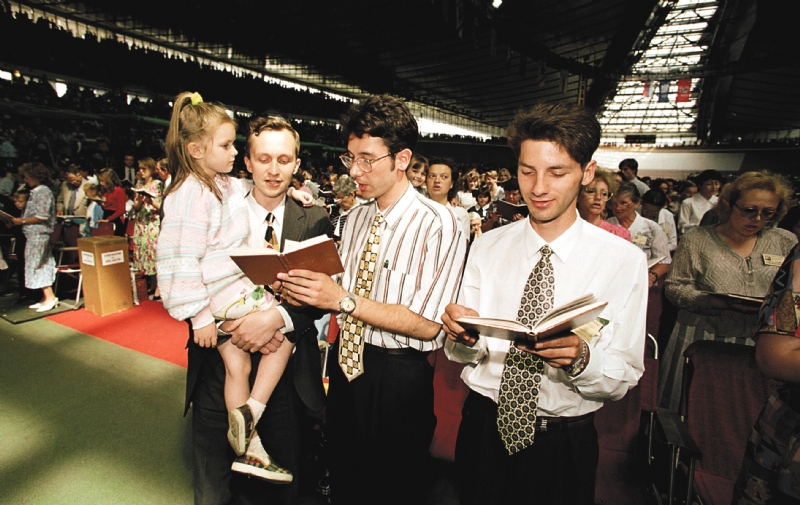
The Jehovah’s Witness Congress Hall in St. Petersburg. Photo courtesy of PhotoXPress
Saprykin had campaigned against the Witnesses wholeheartedly and passionately, and that passion still burned in him fifty years after the events in question. He had dreamed of making them “completely free,” of “returning them to their essence.” He was backed up then by a whole group of provincial demiurges from among the local intelligentsia. They had collectively tried to re-educate the local group of Witnesses through debate, and then they had intimated them and pressured their relatives. Subsequently, they had tried to buy them off before finally sending the group’s core to prison with the KGB’s backing.
Their rhetoric is surprisingly similar to the declarations made by the Witnesses’ current antagonists.
“We stand for individual freedom of choice in all domains, including religion. […] So read, compare, think, disagree, and argue! Critical thinking is in inalienable sign of a person’s freedom. Let’s not abandon our freedom so easily.”
This is not an excerpt from a statement by a libertarian group, but an excerpt from a declaration published by a group of Russian Orthodox clergymen attached to the Holy Martyr Irenaeus of Lyons Center for Religious Studies. It was these clergymen who have now got the Jehovah’s Witnesses banned.
In the early 1960s, the KGB and such local enthusiasts managed to deliver several serious blows to the infrastructure of the Jehovah’s Witnesses in the Soviet Union. Successive leaders of the organization and hundreds of grassroots leaders and activists were arrested and convicted, and archives, correspondence, and printing presses were seized.
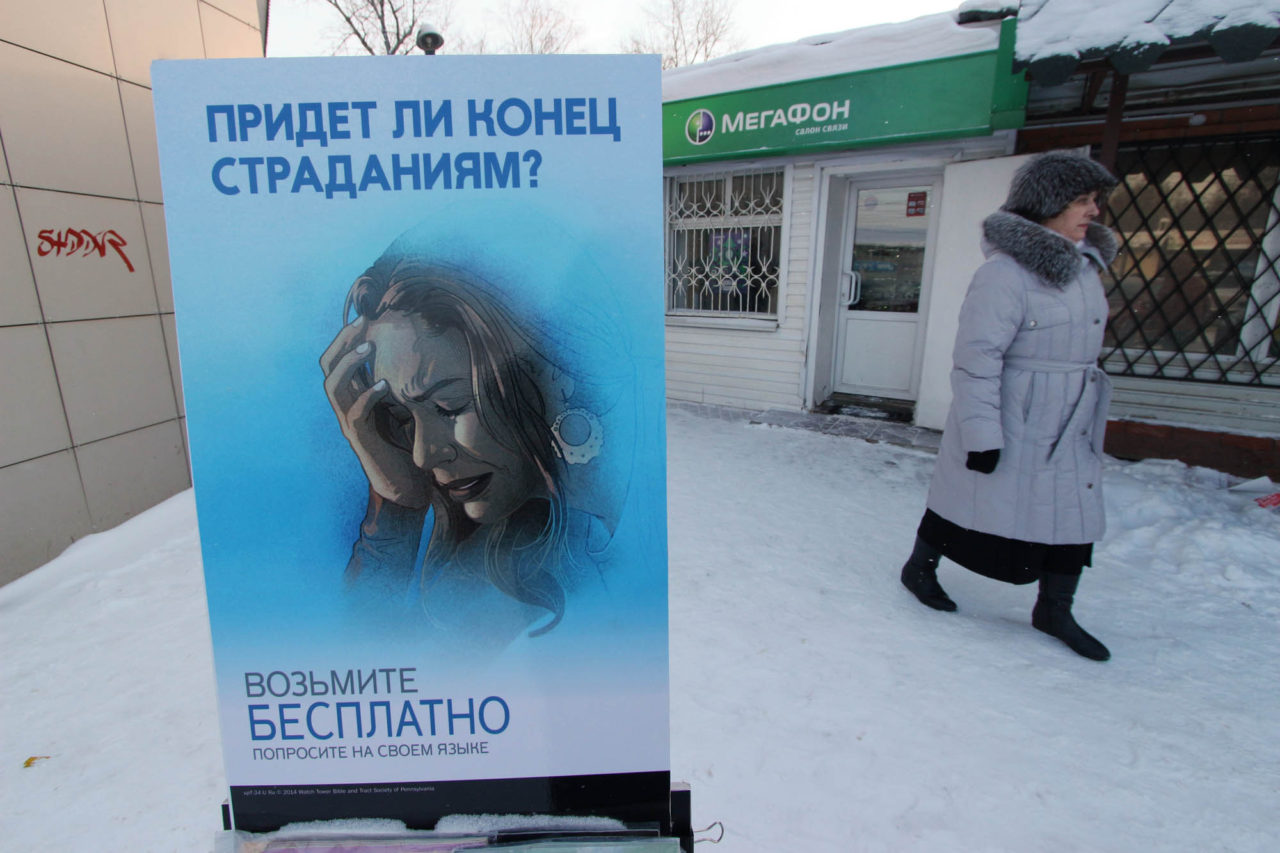
“Is there an end to your suffering? Take a copy for free in your own language.” Tuchkovo, Moscow Region. Photo courtesy of Alexander Artemenkov/TASS
This, however, did not lead to the eradication of the Jehovah’s Witnesses. Besides the three regions where they had constantly been active—Western Ukraine, Moldova, and Irkutsk Region—groups and organizations emerged in the sixties and seventies throughout nearly the entire Soviet Union from Arkhangelsk Region to the Maritime Territory, and from Turkmenistan to Uzbekistan.
The movement was spread by ex-camp convicts, labor migrants from regions where the doctrine was strongly espoused, and missionaries.
Soviet construction sites, new cities, and workers’ dorms were propitious environments for the spread of new religious doctrines. The young people who arrived to work there were cut off from their usual lifestyles, family ties, and interests. They wanted something new, including self-education and self-transfiguration—to gad about in suits and have their heads in the clouds. Most of these cadres were promoted through the ranks by the Communist Youth League and other authorities, but there were plenty of pickings for the religious organizations.
By the way, in 1962, Saprykin campaigned to get not just anyone to leave the Witnesses, but Maria Dosukova, a chevalier of the Order of Lenin, a longtime Party member, a plasterer, and an ethnic Kazakh. During an assembly at her construction company, Dosukova had refused to support a resolution condemning the religious organization in which several people in her work team were members.
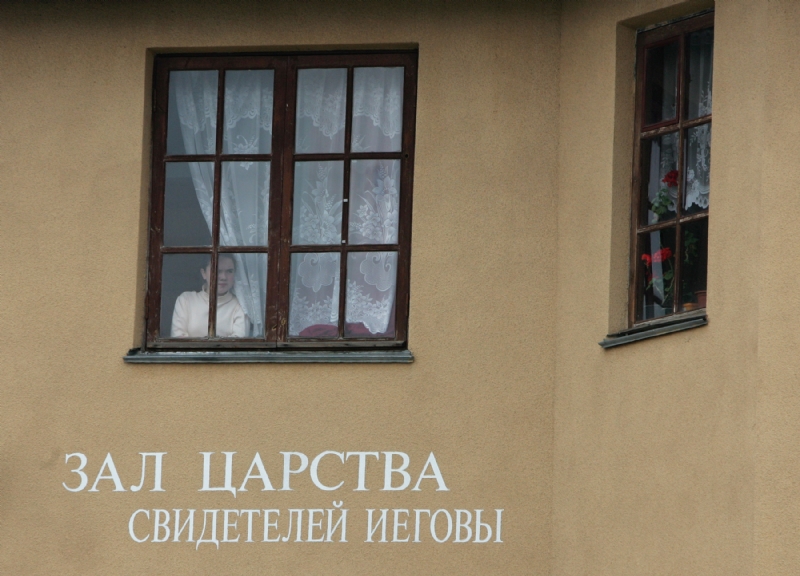
Kingdom Hall of the Jehovah’s Witnesses in Sochi, 2007. Photo courtesy of Natalya Kolesnikova/PhotoXPress
After Krushchev’s resignation, the systematic arrests of the Witnesses stopped, although some were sent to prison as a warning to the others. Everyone else was subject to the decree, issued by the Supreme Soviet of the RSFSR, on March 18, 1966, “On Administrative Responsibility for Violating the Legislation on Religious Cults.” You could be fined fifty rubles—a week’s pay for a skilled worker—for holding a religious circle meeting in your home. In his book About People Who Never Part with the Bible, religious studies scholar Sergei Ivanenko records that, during the seventies and eighties, attempts to combat the Witnesses by fining them and tongue-lashing them at assemblies were just as useless.
Wholehearted Anticultists
Perestroika legalized the Jehovah’s Witnesses throughout the post-Soviet space. This freedom did not last for long, however. The new states of Central Asia and the Transcaucasia followed the Soviet Union’s path in their treatment of the Witnesses, achieving similar outcomes.
In Russia, the Witnesses were officially registered in March 1991 and had no serious problems for a long time. They built their central headquarters, Bethel, in the village of Solnechnoye near St. Petersburg, as well as several dozen buildings for prayer meetings. Of course, due to their activity, relative openness, and American connections, the Witnesses (along with the Hare Krishna, the Mormons, the Scientologists, and the Pentecostals) were targeted by the various hate organizations that emerged in Russia in the late 1990s, including the Cossacks, neo-Nazis, and professional anticultists.
Protest rally against the activity of Jehovah’s Witnesses in St. Petersburg, 1997. Photo courtesy of TASS
Anticultism was imported to Russia by the ex-Moscow hippie Alexander Dvorkin, who emigrated to the US in the 1970s and got mixed up in Orthodox émigré circles there. In the early 1990s, he left his job at Radio Liberty and returned to Russia, where he made a successful career at the point where the interests of the Moscow Patriarchate and Russian law enforcement agencies intersect. The above-mentioned Irenaeus of Lyons Center is, basically, Dvorkin himself.
Professor Dvorkin has worked for several years at St. Tikhon’s Orthodox University of the Humanities. Until 2012, he was head of the department of sectology. In 2009, he headed the council for religious studies forensic expertise at the Russian Federal Justice Ministry. (He now holds the post of deputy chair). It is curious that Justice Minister Alexander Konovalov is also a St. Tikhon’s alumnus and is quite proud of that fact.
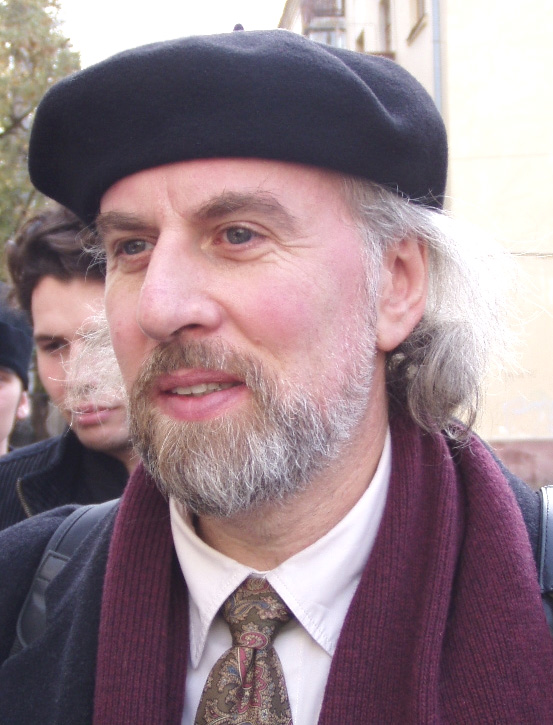
Professor Alexander Dvorkin. Photo courtesy of Yevgeny Mukhtarov/Wikipedia
By supporting the Justice Ministry’s campaign to ban the Jehovah’s Witnesses, the Russian Supreme Court has not only put the “sectarians” in a difficult position but also the Russian authorities. In Russia, the Witnesses have over 400 local organizations and around 168,000 registered members. Only full-fledged members are counted during registration, but a fair number of sympathizers are also usually involved in Bible readings, The Watchtower, and other religious events. We can confidently say the ban will affect at least 300,000 to 400,000 Russian citizens. Labeling them “extremists” does not simply insult them and provoke conflicts with their relatives, loved ones, and acquaintances. In fact, this means abruptly increasing the workload of the entire “anti-extremism” system the Russian authorities have been setting up the past twenty years. The soldiers of the Russian National Guard will find it easy to raid prayer meetings and spread-eagle these “extremists” on the floor. However, given the scale of the organization, they will have to do this a lot and often. And, as experience shows, there won’t be much point to what they are doing.
Not a single country in the world has forcibly dissolved the Jehovah’s Witnesses, and it is hard to imagine that these 400,000 people will all emigrate or otherwise disappear. Even now, as news of the ban has spread, the Jehovah’s Witnesses have received completely unexpected support from all manner media and numerous public figures, including Russian Orthodox priests. Given these circumstances, the successful state campaign to discredit, dissolve, and brush a major religious community under the rug is doomed to failure.
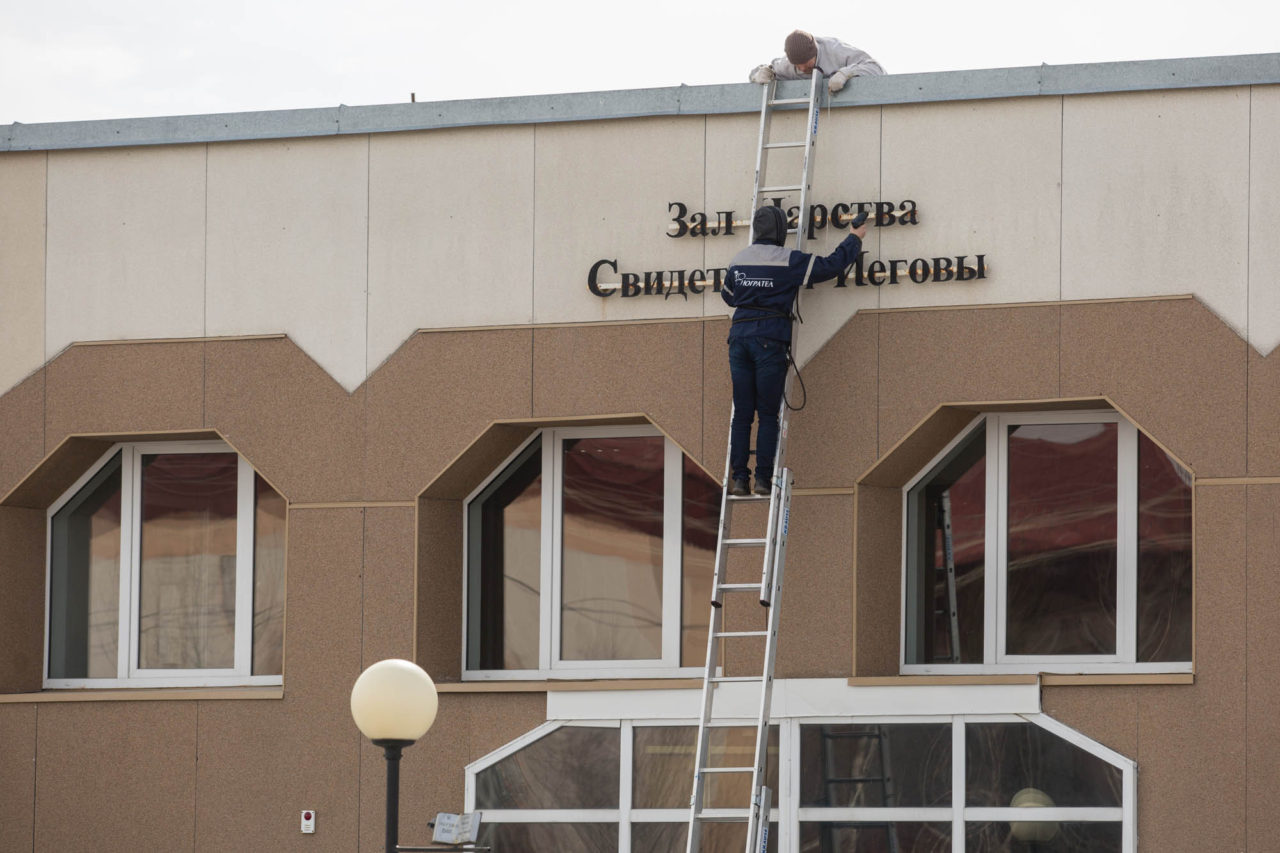
Marquee being taken down from the Surgut office of the Jehovah’s Witnesses in connection with their ban in Russia, April 24, 2017. Photo courtesy of Alexei Andronov/Ura.Ru/TASS
The authorities will have to decide. Either they will sanction the mass arrests of the organizations leaders and activists and send hundreds and thousands of people to the camps, which ultimately will facilitate the growth of the movement’s reputation and dissemination, as in Soviet times, or they will pinpoint those who, according to the Interior Ministry and the FSB, are “especially dangerous” while turning a blind eye to the actual continuation of the organization’s work.
I would like the country’s leadership to have second thoughts and find a legal way to rescind the Supreme Court’s decision. There is little hope of that, however.
Was it the “popular will” that 500 hectares of land be reclaimed in the Neva Bay right off Petersburg’s Vasiliyevsky Island and developed into densely built high-rise estates, causing untold amounts of environmental and aesthetic damage? No, it wasn’t. In fact, locals were bitterly opposed to the project and they mounted a loud resistance back in the day. But their will was roundly ignored by Petersburg city hall and developers. Under the present authoritarian regime, “popular will” is a friendly phantom, at best, an irritant, at worst. Photo by the Russian Reader
The Russian Supreme Court has gone ahead and banned the Jehovah’s Witnesses and ordered their property confiscated. This is a colossal insult to hundreds of thousands of law-abiding Russian citizens. A huge new underground has been generated. Massive crackdowns for their faith, new political prisoners, and mass immigration are around the corner. The Russian authorities and Moscow Patriarch Kirill, who is personally responsible for this operation, have curious ideas about the joy of Easter. —Nikolay Mitrokhin, Facebook, April 21, 2017
Professor Baran only mentions actions by state or quasi-state actors, such as the central press in Soviet and post-Soviet times. Yet they were and have been somehow acting on behalf of the “popular will,” a symbiosis she makes no real attempt to prove in her op-ed piece for the Moscow Times, as quoted above.
As for real popular sentiment, I imagine there are as many Americans as Russians who have reflexively negative attitudes toward Jehovah’s Witnesses. Just think of all the jokes about JWs you have heard in your lifetime that cast them in a negative or ridiculous light, or how many times you have seen their likenesses figuring as the villains on TV medical dramas who refuse proper care for desperately sick children? Then why aren’t they banned in the US? At worst, the American “popular will” sees them as outsiders and obscurantists, at best, as an annoyance.
I can imagine that tenure-track professors in the US have a hard time understanding how disempowered and disconnected the grassroots are in a country that now has the world’s largest income inequality gap, and a long, brutal history of minorities, including Jehovah’s Witnesses, getting hammered by the powers that be while putative “majority” either did not mind, looked the other way or did not even notice.
But does Tennessee, where Professor Baran teaches, have an utterly different history when it comes to protecting the rights of its minorities?
The Russian Supreme Court’s decision to declare the Jehovah’s Witnesses extremist is completely despicable in every possible way, but Russians who bother to care about minorities and “minority” interests (like the environment, civil and social rights, corruption, labor rights, migrant rights, and historical preservation and sound urban planning) are often too few and far between to fight every battle and put out every fire. And many of those fighters are themselves currently under the state’s gun. The same Justice Ministry that has gone after Russia’s Jehovah’s Witnesses like a pit bull has also been branding NGOs, research institutes, and grassroots organizations “foreign agents” like it was at a fire sale.
That is no excuse for the judicial execution the Russian state has just performed on the Jehovah’s Witnesses, but it was a decision made at the top by the political, ecclesiastical and judicial elites, including the ROC’s Patriarch Kirill. It was not the state’s response to a nonexistent, utterly imaginary “popular will.” {TRR}
The fantastic story of how a small Moscow monastery has contrived to sue the state and take over a huge wing of the Fisheries Research Institute forces us to take a closer look at at a church official who has long remained partly in the shadows, Mother Superior Ksenia (Chernega), abbess of the selfsame St. Alexius Convent that sued the state and, simulaneously, head of the Moscow Patriarchate’s legal department. Chernega is not entirely unknown to the public. She has often been quoted in official reports of restitution of large pieces of real estate to the Russian Orthodox Church (ROC). However, as holder of a “boring” post, she has not been particularly prominent in the public eye.
And that’s too bad. Chernega is not only one of the most influential women in the ROC (in 2013, she took fourth place in an internal church rating) but also a successful raider who skillfully manipulates clerics and laymen alike. The adjudged research institute, a huge building that incorporated part of the foundations and a wall of a demolished church, is the most striking but hardly the largest victory in her career. The 46-year-old Oksana Chernega (her name until 2009, a name she still uses in secular contexts) is probably the longest-serving staff member of the Moscow Patriarchate’s legal office. She has worked there since 1993, while also working in secular law schools, achieving professorial rank. She became a leading authority on church law in the early 2000s. Generations of politicians and MPs have come and gone, but Chernega has the whole time testified at hearings of the relevant parliamentary committees and governmental review boards, lobbying the laws the ROC has wanted passed.
Her main achievement has been the law, signed by President Medvedev in late 2010, “On the Transfer of Religious Assets in State or Municipal Ownership to Religious Organizations.” It is this law under which movable and immovable property has been transferred to the ROC the past six years. Yet the Church has behaved capriciously, taking only what looks good or has real value. The Perm Diocese is unlikely to restore to its former use the huge military institute that took over what used to be its seminary: there are catastrophically few people who want to go into the priesthood, and the poor diocese is incapable of maintaining the enormous premises. But how sweet it is to get a huge building on the river embankment in the city center as a freebie. Whatever you do with it you’re bound to make money.
But not everything has been had so smoothly. The property the ROC has set its sights on has owners, and they are capable of mounting a resistance. That is when Chernega takes the stage. When she announces the Church has set its sights on a piece of real estate, it is usually a bad sign. The day before yesterday, it was St. Isaac’s Cathedral, yesterday it was the Andronikov Monastery, today it is the Fisheries Research Institute. What will it be tomorrow? Anything whatsoever.
On the eve of March 8 [International Women’s Day] and amidst the debates on feminism in Russia, it would seem that Chernegas has pursued a successful, independent career as a woman in the Church. But it’s not as simple as all that.
It is well known in ecclesiastical circles that Chernega acts in tandem with a notable priest, Artemy Vladimirov. He is not only confessor at the St. Alexius Convent but is also well known throughout the Church. A graduate of Moscow State University’s philolology department and rector of All Saints Church (a neighbor of the convent and the reclaimed fisheries institute), Vladimirov is a glib preacher who specializes in denouncing fornication; he is, therefore, a member of the Patriarchal Council on Family and Motherhood. The council has become a haven for the Church’s choicest monarchistically inclined conservatives, including Dmitry Smirnov, who has led an aggressive campaign against Silver Rain radio station, Konstantin Malofeev, Igor Girkin‘s ex-boss and, concurrently, an expert on web-based pedophilia, and the wife of Vladimir Yakunin, former director of Russian Railways, a billionaire, and former KGB officer.
Vladimirov vigorously espouses monarchist views and has made a huge number of basically stupid public statements, such as the demand to remove a number of works by Chekhov and Bunin from the school curriculum and a call to campaign against Coca-Cola. Such radicalism is not rare in the ROC, however, Since the late 1990s and the publication of the novel Celibacy by church journalist Natalya Babasyan, Vladimirov has served as a clear example for many observant and quasi-observant Orthodox believers of where the line should be drawn in interactions between a priest and his flock, especially his young, female parishioners.
Because of this reputation, Vladimirov has remained in the background even during periods when the grouping of monarchists and Russian nationalists to which he has belonged has had the upper hand in the ROC. But if you can’t do something directly, you can do it indirectly, and Oksana Chernega has come in very handy in this case. As is typical of a young woman in the modern ROC, she is utterly dependent on her confessor. During the late 1980s and early 1990s, Orthodox fundamentalists and monarchist heterosexuals developed a curious lifestyle. Young and handsome, usually university grads with the gift of gab, and often married, many of them newly arrived in the Church, they formed small “communities” consisting of young women, communities with unclear or flexible status in terms of ecclesiastical law.
In theory, a convent is established by order of a bishop, and a married or elderly priest is appointed as the convent’s confessor. He does not live on the convent’s grounds and is present there during “working hours,” when he has to serve mass and take confession from the women who inhabit the convent. As part of the so-called Orthodox revival, a monk or a young priest who had “complicated” relations with his wife would first form a group of female “adorers” in the church, later organizing them into a “sisterhood” and then a “convent community,” which he would settle in a building reclaimed from local authorities, sometimes the site of a former convent, sometimes not. He would immediately take up residence there himself in order to “revive Orthodoxy” and denounce fornicators and homosexuals in the outside world. The record holder in this respect was Archimandrite Ambrosius (Yurasov) of the Ivanovo Diocese, who built a huge convent in Ivanovo, where he officially lived in the same house as the mother superior and yet never left the apartments of the rapturous Moscow women whom he had pushed to come live with him after they had bequeathed their dwellings to the convent.
For those who did not want to leave the capital even nominally, historical buildings in the city center were found. That, for example, was the story of the ultra-fundamentalist Abbot Kirill (Sakharov), who took over St. Nicholas Church on Bersenevka opposite the Kremlin. There, according to a correspondent of mine, “the Old Believer girls creatively accessorized their robes with manicures.” In Petersburg, the so-called Leushinskaya community, led by the main local monarchist Archpriest Gennady Belobolov, has been “restoring” a church townhouse for twenty years. However, the archpriest himself lives on site, while his wife raises their children somewhere else in town. It is a good arrangement for a young man from the provinces: come to the capital, occupy a large building in the city center under a plausible pretext, and shack up there with attractive and spiritually congenial sisters in the faith while putting on shows at press conferences stacked with selected reporters and confessing pious female sponsors who are thrilled by their pastor’s superficial strictness and inaccessibility.
So in this system of interwoven personal and political interests how could one not help out a dear friend? The affairs of the alliance between Vladimirov and Chernega, especially when it comes to dispensing other people’s property, are so broad and varied that observers sometimes wonder whether it isn’t time for police investigators to have a crack at them.
Where do you think the part of the church community sympathetic to Belovolov’s plight would want to transfer such a managerially gifted and cultured pastor, a pastor capable of creating a little museum and one who knows a thing or two about restoration? To St. Isaac’s Cathedral, of course, and the post of sexton, the chief steward of the church and its property. What would Chernega, who is coordinating the legal aspects of transferring such a huge chunk of public property, have to do with this? Formally, of course, nothing, and it isn’t a sure bet that the appointment will take place, just as it’s not a sure bet the ROC will get its hands on the entire cathedral.
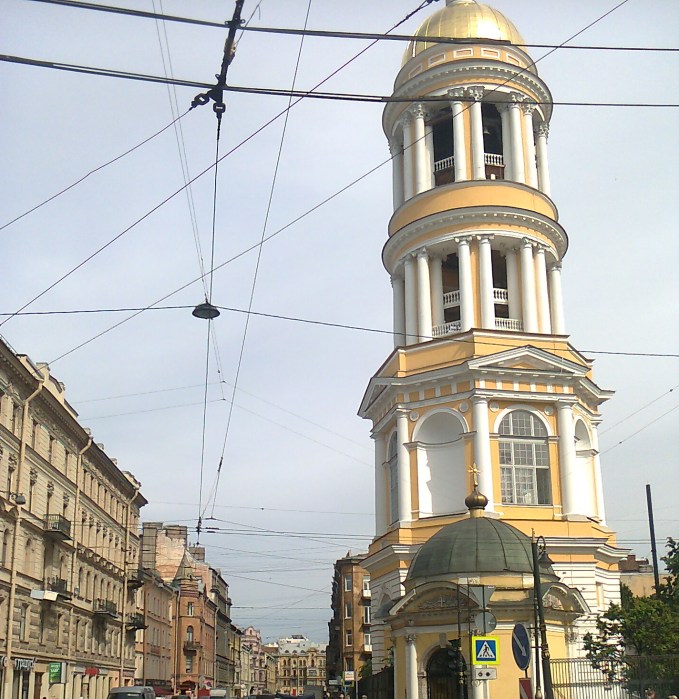
Belfry of Our Lady of Vladimir Cathedral, Petersburg, 15 June 2016. Photo by TRR
How to Understand the Russian Orthodox Church
Grigory Lourié Ekho Moskvy
February 24, 2017
There are people whom the Russian Orthodox Church (ROC) has succeeded in surprising. This group now includes not only its own parishioners but also utterly innocent folks. Their terms of reference for the ROC were at odds with reality. That is the sort of thing that happens with terms of reference, even when they emerged in the pure souls of first-year seminary students or, on the contrary, in the elastic souls of museum directors. It even happens that officials of a secular state, who by constitution are not supposed to have souls at all, conceive false terms of reference for the ROC.
We won’t discuss the question of how the ROC is “actually” organized. Our objective is modest: describing the terms of reference by which we can predict all of the ROC’s actions as a corporation, both internally and externally—meaning what makes it tick.
Attentive analysts have already conceived one model. It is correct albeit too crude, and so it leads to lots of mistakes. It is only around 60% accurate. But we shall start with it, and then we will modify it to make it 100% accurate.
I am referring to the so-called business model, which imagines the ROC as a corporation with a monopoly on the business of religious ritual. Its unattainable paragon is Gazprom. Like Gazprom, it wants to be ubiquitous from bottom to top, from the flats of poor people to the Kremlin and international politics. Like Gazprom, it is involved in the international rivalry over natural monopolies. (The Ecumenical Patriarchate of Constantinople, its main competitor, grabbed it by the throat and forced it to release Ukraine.) Like Gazprom, the ROC is not in the business of historical preservation. You can put the religious ritual businessman into a museum, but you cannot turn him into a museum curator. The controversy surrounding the potential transfer of St. Isaac’s Cathedral to the ROC is on a par with Gazprom’s attempt to build a skyscraper on the spot where the Swedish fortresses Landskrona and Nyenskans had once stood.
The business model, however, is at odds with the ROC’s other qualities. Real money likes silence, but the ROC likes money and hullabaloo at the same time. Its bishops enjoy a luxury worth of African chieftains, not modest millionaires. The inefficiency of slave labor is a scientific fact, but rank-and-file ROC clerics say that slavery was outlawed in Russia in the nineteenth century, but not for Russian priests. Finally, run-of-the-mill businesses do not defend their turf either with religious processions led by storm troopers or round dances featuring “pale boys with burning eyes,” whatever their age or sex.
These things are symptomatic of the emergence of archetypal regressive groups within the business. As described by British psychoanalyst Wilfred Bion, all three such so-called basic assumption groups find a place in our precise portrait of the ROC.
Screenshot of an announcement posted on the VK social network page of Andrei Kormukhin, coordinator of the fascist Russian Orthodox lay movement Sorok sorokov (SS). (The name of the movement should be translated as “Multitude,” rather than “Forty by Forty” or “Forty Forties,” as you might find in other Anglophone articles on right-wing extremism in the ROC.) The poster invites Petersburgers to take part in a religious procession at St. Isaac’s Cathedral on 19 February 2017. It urges them to “join the right ranks,” and not a “faggot” [sic] or people wearing blue ribbons, the symbol adopted by Petersburgers opposed to the earlier Gazprom skyscraper project on the Neva River and now plans to hand over St. Isaac’s Cathedral to the ROC. In Russia, “blue” also connotes “gay.” Courtesy of Fontanka.ru
The model takes the shape of a living being, consisting of a fleshy body and the two halves of a thin exoskeleton. The body is the leadership from top to bottom, their subordinates, and the few believers who ask the clergy for advice on how they should live. In Bion’s terms, this is the dependency group. Junior members of the group are infantile and irresponsible vis-à-vis senior members, while the latter are narcissistic and sadistic toward their juniors. Sadomasochism provides everyone with a bit of happiness, even the most abject. The narcissism, typical of the group’s leaders, is often coupled with homosexuality. (This is a medical fact.) You cannot do without it, but not everyone can be allowed to engage in it. So it is a product of elite consumption and a means of climbing the career ladder.
The exoskeleton is the only thing visible from afar, from the vantage point of secular society. The skeleton is thin but sturdy, although it looks shabby, since it is constantly exfoliating.
The first section consists of the storm troopers. Bion labels them the fight-flight group. They are always itching for a fight, and always on the lookout for enemies. There are not enough enemies, so they have fight each other and, sometimes, the leadership. The old layers of chitin thus peel away, even as the exoskeleton accumulates new layers.
The other section of the exoskeleton consists of idealists. They wait and they hope. They know everything about the leadership, but they believe in the Church. Not, however, in the Church that has canons and the examples of the saints, which show how bad church leaders need to be replaced and, most importantly of all, which oblige the faithful to do this. No, they believe in their own church, where “things have always been this way.” Bion call these groups pairing groups. They resemble married couples who go on hoping that Someone with a capital “s” will be born to give their lives meaning, but for the time being they wait and are barely alive. Some grow weary and leave the group, but they are replaced by new members.
Russia’s cultural figures thus “dialogue” with this combative creature, while the country’s officials stumble over themselves trying to sate its appetites, hoping it will cover their own ugliness with its beauty. You cannot even say who are the most inveterate idealists in this case. Judging by their persistent belief in beauty, it must be the government officials.
Religion is one of the forms of spiritual oppression, lying everywhere on the masses of the people, who are oppressed by eternal work for others, need and isolation. The helplessness of the exploited classes in their struggle with the exploiters just as inevitably generates faith in a better life beyond the grave as the helplessness of the savage in his struggle with nature produces faith in gods, devils, miracles, etc. To him who works and is poor all his life religion teaches passivity and patience in earthly life, consoling him with the hope of a heavenly reward. To those who live on the labor of others religion teaches benevolence in earthly life, offering them a very cheap justification for all their exploiting existence and selling tickets to heavenly happiness at a reduced price. Religion is opium for the people.
Milonov No Hindrance to Atheists
Svyatoslav Afonkin ZakS.Ru
February 5, 2017
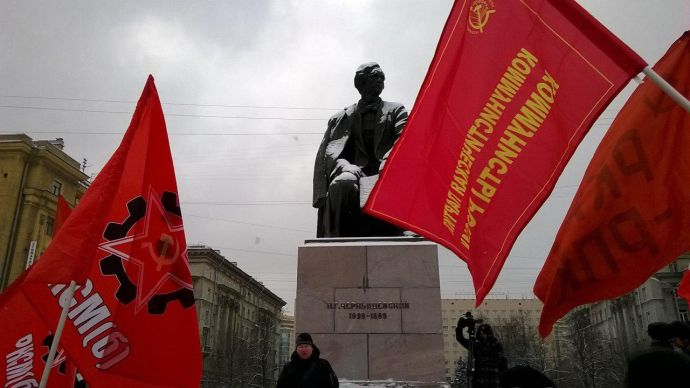
The ninety-ninth anniversary of the 1918 Bolshevik decree separating church and state was marked by a small group of ardent leftists protesting the current clericalization of the Russian state and Russian society. On February 5, over a hundred people attended a picket on Chernyshevsky Square in southern Petersburg. For two hours, they fiercely criticized both the Russian Orthodox Church (ROC) and the relationship that has been built between the ROC and the Putin regime.
Members of various low-profile leftist movements gathered at the monument to Russian philosopher and revolutionary Nikolai Chernyshevsky. The protesters held the flags of the Rot Front, the United Communist Party, the Workers Revolutionary Communist Party, and Communists of Russia. Even truckers from the Association of Russian Carriers (OPR) came to condemn the ROC’s increasing appetite for property. Members of the Communist Party of the Russian Federation, which holds seats in the municipal, regional and national parliaments, ignored the event, for which they were roundly condemned by their non-systemic counterparts on the podium.
Unlike liberal opponents of plans to transfer ownership of St. Isaac’s Cathedral Museum to the ROC, the protesters made no attempt to be diplomatic and did not mince their words. Some speakers declared the ROC “satanic” and compared it to Islamic State, an organization that has been banned in Russia.
For ten minutes, Ivan Lokh, leader of the Witnesses of Foucault’s Pendulum, an atheist community, fiercely and emotionally denounced the ROC’s desire to exterminate science and culture. He then quoted Chernyshevsky, whose monument was the focal point of the entire rally.
“Religion’s purpose is to inure the unfortunate and hungry to the notion they must perpetually be hungry and rejoice in their plight. That’s what religion is!” proclaimed the activist.
ROC leaders are themselves not inclined to the asceticism they popularize among the oppressed classes, and this can only indicate that the highest ranks of ROC clergymen do not believe in God, said Lokh.
“We see the indecent luxury in which ROC hierarchs live. They do not fear their own God. They don’t fear Him, because they know for certain He doesn’t exist. This is the most obvious proof He really doesn’t exist!” the activist shouted to the applause of the crowd.
During breaks between speakers, the rally’s organizers asked protesters to carefully observe those in attendance in order to weed out provocateurs. The event’s moderator explained to ZakS.Ru that anti-clerical rallies have frequently been visited by people wanting to disrupt them. In addition, MP Vitaly Milonov’s public promise to interfere with the picket had forced protesters to be vigilant.
Semyon Borzenko, a member of the city committee of the unregistered United Communist Party’s regional branch, thrilled the crowd when he called for abolishing the federal law on transferring property to the ROC, which has led to the destruction of numerous museums. Borzenko also said atheists should campaign for the adoption of two law bills, drafted by local municipal deputy Irina Komolova during the previous sitting of the St. Petersburg Legislative Assembly. The first would protect the feelings of atheists, while the second would strip the ROC of its “totally unjustified tax breaks.” According to Borzenko, the “indecent luxury” mentioned by Ivan Lokh was a consequence of the fact the ROC did not pay taxes, unlike every other organization.
Nikolai Perov, leader of the regional branch of the Communists of Russia, focused his criticism on the “Zyuganovites,” who had welcomed the possible transfer of St. Isaac’s Cathedral to the ROC.
“It’s a crying shame that certain members of the communist movement, who sit in parliament, have retreated from the [Bolshevik] decree and Leninist principles. Shame on Zyuganov! Shame on [CPRF Petersburg Legislative Assembly member] Alexander Rassudov! Shame on [State Duma member and filmmaker] Vladimir Bortko! There’s not a single scientifically minded person left in the CPRF!” stated Perov.
Despite the concerns of organizers, the rally came off without any provocations or crackdowns on the part of law enforcement. Towards the end of the rally, human rights activist Dinar Idrisov (recently denounced by “soldier of Christ” and city parliament speaker Vyacheslav Makarov for insulting the feelings of believers) handed out pamphlets entitled “The Museum Belongs to the City.” Like a week ago, opponents of transferring St. Isaac’s to the ROC had their pictures taken, placards in hand, this time standing next to the monument to Nikolai Chernyshevsky.
Translated by the Russian Reader. Photos courtesy ofZakS.Ru
P.S. Thank God for the truly militant godless, Russian society’s only real bulwark against the militant godless masquerading as god-fearing soldiers of Christ for the tax breaks, luxurious lifestyle, and other perks that come from collaborating with the regime to befuddle and disempower ordinary people. The other bulwark against the maskers is the fact, of course, that the vast majority of Russians are de facto godless, whatever they might say about themselves when surveyed by FOM or some other all-seeing blind eye of the de facto atheist pollocracy. TRR
I realize everyone is already sick to death of the topic of St. Isaac’s Cathedral, and that today is a weekend day to boot. But I’ve been mulling this text over in my head for three days and struggling with the desire to write it down. I’ve been persuading myself there are lots of smart people aroiund who will write what needs to be written. But I can’t get the arguments out of my head, so I’ve given in to my desire.
***
Folks, especially non-Petersburgers, who note melancholically, “Just give it back to the Church. Can’t you spare it?” really amuse me.
Well, no, we can’t spare it.
1. The ROC [Russian Orthodox Church] is not the Vatican, and all comparisons of St. Isaac’s Cathedral with St. Peter’s Basilica are irrelevant in this context. The ROC not only doesn’t know how to preserve architectural landmarks. It doesn’t want to preserve them. It wants to use them, and it preserves them the same way you maintain your apartment, for example. Imagine you’ve decided to put in parquet floors or throw out old furniture. Who is going to stop you? It’s your own business. You can figure out yourself what’s best for you: the new parquet or the old linoleum. This is basically how many church leaders and believers look at it. They believe an icon, however timeworn and whatever the destructive effects shifts in humidity, vibrations, etc., have on it, it should be in a church, not in a museum. Yes, it is has to be handled carefully and respectfully, yet it can be carried in a outdoor religious procession and venerated by parishioners kissing it. If something has happened to it, it means it was God’s will. A new copy of the icon will have to be ordered. I’m not exaggerating. I’m trying to explain that notions of “humanity’s heritage” and “universal value” are empty phrases for most members of the church community. They don’t understand how church property can be the business of unbelievers. Moreover, from their perspective, the right government should be Orthodox. It should maintain churches the way it maintains hospitals and schools.
The problem is not that we know of numerous cases in which the ROC has treated architectural landmarks and museum communities barbarically. The problem is the Church’s leadership has not publicly condemned any of these incidents. It doesn’t condemn them, because it doesn’t consider them important or it even approves them. So it will happen again and again, and heritage preservation authorities are basically powerless.
This is an answer to the exclamation, “Give back to the Church what was taken from it in 1917!”
Parents are given the right to raise their children. But if they treat them irresponsibly, hit them, don’t get them medical care when they’re ill, don’t feed them, etc., society acknowledges the need to restrict the rights of such parents. A hundred years ago, however, this would not have occurred to anyone. But our notions of violence, the value of human life, and children’s rights have changed. Our notions of culture and its right to protection have also changed. The ROC does not guarantee the safety and security of architectural landmarks in the sense regarded as normal in modern society. We cannot hand architectural landmarks over to the Church, at least not until the Church changes.
2. Why should the ROC be the main user of St. Isaac’s Cathedral? If we leave aside money and “historical justice,” the only reason could be to hold services on a full scale—not in the chapel, but in the central nave, for example, with the museum closed on feast days and so on. But think about it. Since the Patriarch can force [Petersburg Governor Georgy Poltavchenko] to give back a church, then of course the Patriarch could also obtain the best conditions for church services. Meaning this is not the issue.
The issue, of course, is money and “status.”
So we have a public museum. We know everything about it: how much money it earns, how much money it spends and what it spends its money on, and how much it pays in taxes. And we have the Church. We don’t know anything about it, and that will go on being the case. No, we do know one thing: it doesn’t pay taxes. So we won’t be able to find out whether the Church has the money for routine repairs and restoration work or not. Going back to my first point, the Church might not think that restoration is necessary. So the city will always have to have the necessary sum of money for repairs on hand. Plus there are the taxes, the taxes the cathedral museum pays now and won’t be paying in the same amount after the cathedral’s transfer to the Church. All this means that the “free” entrance with which the church community has been tempting us, will be free for everyone except Petersburgers. Every Petersburger will pay (via the city’s budget), regardless of whether he or she has visited the cathedral or not.
It would be nifty, beautiful, and right if entry to St. Isaac’s Cathedral were free to everyone. But we can’t afford it. A normal family doesn’t sell its only home to buy a Mercedes to show off to the neighbors, but drives a car it can afford or takes public transport. Similarly, Petersburgers cannot afford, for the time being, We should recognize this and live within our means.
P.S. I’ve come across a reference to Clamoring Stones: The Russian Church and Russian Culture Heritage at the Turn of the Millennium (2006), a book by the archaeologist and art historian Alexander Musin. It is about how restitution of church property has taken place and the consequences this has had for Russia’s cultural heritage. I haven’t read it yet. I haven’t even found where I can buy it. But I think it’s a must read. (Here’s a review.)
Several hundred people rallied outside a St. Petersburg landmark cathedral on January 13 to protest plans to give it to the Russian Orthodox Church.
The local governor this week announced the city was transferring the iconic St. Isaac’s Cathedral to the Orthodox Church, sparking a rash of protests in the former imperial city.
Protesters flocked to Isaakiyevskaya Square near St. Isaac’s to protest the move on the evening of January 13. The cathedral is a UNESCO World Heritage site and has been an important museum since Russia’s 1917 Bolshevik Revolution. More than 3.5 million tourists visit it every year.
“The Church should know its place!” one placard read.
Police confiscated one poster but did not otherwise block the protest.
TASS reported that activists have gathered as many as 160,000 signatures on a petition to revoke the local government’s decision to give away the cathedral.
The signatures include people from Moscow, Yekaterinburg, and Krasnodar as well as St. Petersburg, TASS said.
The church takeover of the landmark is part of a growing trend toward social conservatism in Russia. President Vladimir Putin has appealed to traditional values and urged citizens to eschew Western liberalism.
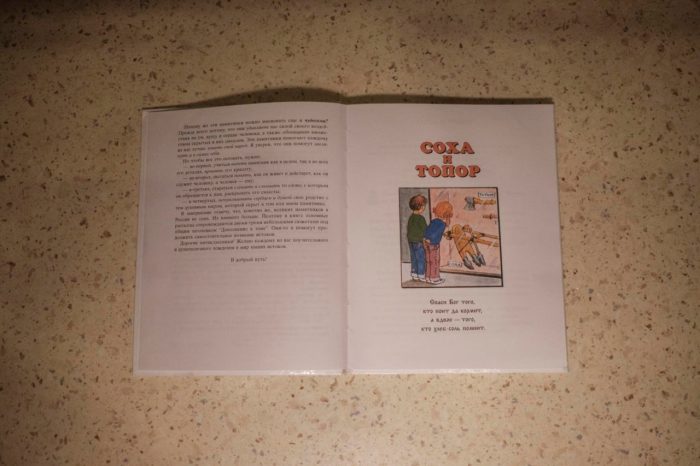
“The Plough and the Ax”: pages from the fifth-form textbook “Roots.” Photo courtesy of Anton Carliner/SCHSCHI and Takie Dela
“What Can We Learn from the Plough and the Ax?”
Alexandra Koksharova Takie Dela
December 13, 2016
Parents of pupils at a Moscow school have complained to the Prosecutor General’s Office that their children are being indoctrinated with a religious ideology. Takie Dela spoke with Inna Gerasimova, who was behind the complaint.
***
After coming home from school at the start of the school year, Inna’s 11-year-old son Yegor asked, “Mom, do we really have to have icons at home?”
“No, where did you get that idea?”
Yegor took the textbook Roots (Istoki), which he had just been issued, from his backpack.
The textbook’s author addresses schoolchildren as follows.
“You do know, of course, that icons guide the Russian individual on weekdays and holidays, on long journeys and in times of war. People turn to them in joy and in sorrow, and miraculous icons are especially revered.”
“I can’t remember our ever having taken icons on a journey,” chuckled Yegor.
Inna is an atheist, and there were no icons in their home. She tried to explain to Yegor that all this was not obligatory, of course, although he was well aware of it himself.
Yegor Gerasimov is a fifth former at School No. 2065 in New Moscow. Nearly half of his classmates are from Muslim families, and there are also children from Jewish and Catholic families. In September 2015, a subject entitled “Fundamentals of the Spiritual and Moral Culture of the Peoples of Russia” (abbreviated ODNKNR in Russian) was introduced to the mandatory school curriculum. The Roots textbook is used in sixty-two Russian regions. According to Hieromonk Gennady (Voitishko), head of the information service of the Russian Orthodox Church’s Synodal Department for Religious Education and Catechesis, the Roots program is “a kind of prototype of secular ethics that takes regional specifics and traditions into account.” Officials argue that ODNKNR is not an attempt to indoctrinate children religiously, but the parents at School No. 2065 have formed a quite different impression.
***
It was at a parents’ assembly in August that Inna found out her son would have a new subject at school beginning this year. The head teacher was then unable to explain what exactly fifth formers would be learning during this class, but the subject’s name, Roots, did not arouse suspicion amongst the parents. They were amazed only when they saw the textbook for the subject. Initially, they tried to find out from the head teacher how such a thing could have got into the school. The head teacher promised to get to the bottom of it. Then they sent letters to the school’s headmaster, complaining about religious indoctrination and asking that the textbook be changed. The headmaster responded to all of the letters by explaining that there had been no choice: the education department had issued the program, and there was nothing to be done. The school could not switch textbooks.
Inna decided that her complaint that the textbook was not secular had be to well founded, and so she undertook a painstaking analysis of Roots. She collated its content with laws and regulations. She counted the number of times such words and phrases as “God” (60), “miracles” (66), “evil spirits,” and so on were mentioned in the book. Among other things, although the textbook has a total of 126 pages, a third of those pages are taken up by illustrations.
The parents’ main complaint against Roots is that the textbook lacks any academic component whatsoever. Alexander Kamkin, the book’s author, does not cite specific sources, and historical events and cultural landmarks are described by evoking either infernal or divine forces. For example, in a chapter dealing with Solovki, the construction of the Solovki Special Purpose Camp (SLON) and the destruction of the monastery are characterized as the advent of a “great evil.”
“Disaster struck in 1920. […] The monastery was closed, its shrines were descecrated and destroyed, and its churches were defiled.”
Kamkin does not specify who exactly desecrated and defiled the shrines. The only historical personage in this chapter is Moscow Patriarch Alexy II, who visited Solovki in 1992.
If that were not enough, Kamkin suggests that fifth formers take a new look at the Moscow Kremlin.
“Look carefully, not only with your eyes but also feel with your heart, with your soul. Don’t you think that the Kremlin’s Cathedral Square resembles a gigantic all-Russian candleholder?”
The textbook opens with the topic of “The Plough and the Ax,” which takes up five lessons.
“The children took a quiz on the topic ‘What can we learn from the plough and the ax?’ After lessons in programming, chemistry, and biology, how can you talk for five lessons in a row about the plough and the ax? Every other sentence in the textbook says that only God makes all things possible, only with his help do things get done, that ‘prayer and effort make all things right.’ This ‘proverb’ is quoted in the textbook,” says Inna.
At the next parents’ assembly, the head teacher suggested that disgruntled parents turn in the textbooks, but the remaining children could continue using Roots in class. It was then that the parents of all twenty-four children in the class wrote formal requests, addressed to the school’s headmaster, asking that the class be exempted from studying the subject. The textbooks were then confiscated from the fifth formers, but they kept studying the subject all the same. This incident took place in only one class of fifth formers, but the other four fifth-form classes at the school kept using the textbook. There was no difference, however. Inna knows the course curriculum by heart and says that the assignments the teacher now gives her son are the same as in the textbook.
“The instructor cannot do nothing about it. He is 100% dependent on the system, on the education department, like everyone else,” says Inna.
Inna sent a complaint, signed by all the parents whose children are in the class, to the prosecutor’s office. There was no response for one and a half months. Then the complaint was first sent down to the education department before being sent back to the headmaster.
***
“We don’t mind our children learning something new about Orthodoxy,” explains Inna, “but not from this textbook, because one cannot speak only of Orthodoxy while saying nothing about the fact that paganism once existed, and that nowadays Islam exists alongside Christianity, and that basically we live in a multi-ethnic country. It’s wrong to present one religion so onesidedly while engaging in manipulation when it comes to a textbook for children. We aren’t against religion. We’re against pitching the subject matter in this way, in which Orthodoxy is discussed as the only possible religion.”
Victoria Lomasko Truckers, Torfyanka, and Dubki: Grassroots Protests in Russia, 2015–2016
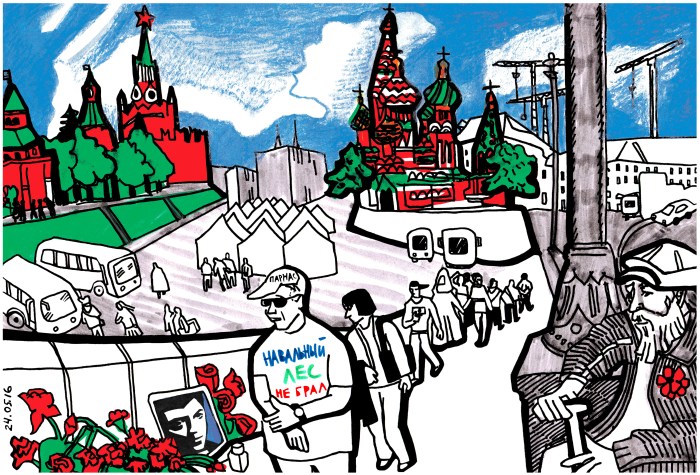
In late February 2015, politician Boris Nemtsov, a leader of the Russian opposition, was gunned down near the Kremlin.
Grassroots activists immediately set up a people’s memorial, made up of bouquets, photos, drawings, and candles, at the scene of the crime, on Bolshoi Moskvoretsky Bridge. For over a year, they have been taking shifts guarding the memorial from members of various nationalist movements and bridge maintenance workers, who routinely haul away the flowers and photos as if they were trash.
Slogan on man’s t-shirt: “Navalny didn’t steal the timber.” May 24, 2016
“The assaults on the memorial occur like pogroms in a Jewish shtetl: it’s the luck of the draw,” these two people on vigil at the memorial told me. “They pick a time when the people on duty have let down their guard, like three or four in the morning.”
Woman: “People will take to the barricades only when food runs out in the stores.” Slogan on her shirt: “The ‘Russian world’ has no use for science and education.’” Rally in defense of science and education, June 6, 2015
Headed by opposition leaders and attended by thousands of people, the 2012 rallies and marches for fair elections and a “Russia without Putin!” ended with the show trials of 2013 and 2014 against opposition leaders (Alexei Navalny and Sergei Udaltsov) and rank-and-file protesters (the so-called prisoners of May 6).
In 2015 and 2016, the Marches of the Millions have given way to small-scale rallies and protests. People far removed from politics have tried to defend their own concrete rights.
I made these drawings at a rally in defense of the Dynasty Foundation. An NGO founded to support scientific research and science education in Russia, it had been declared a “foreign agent” by the Justice Ministry.
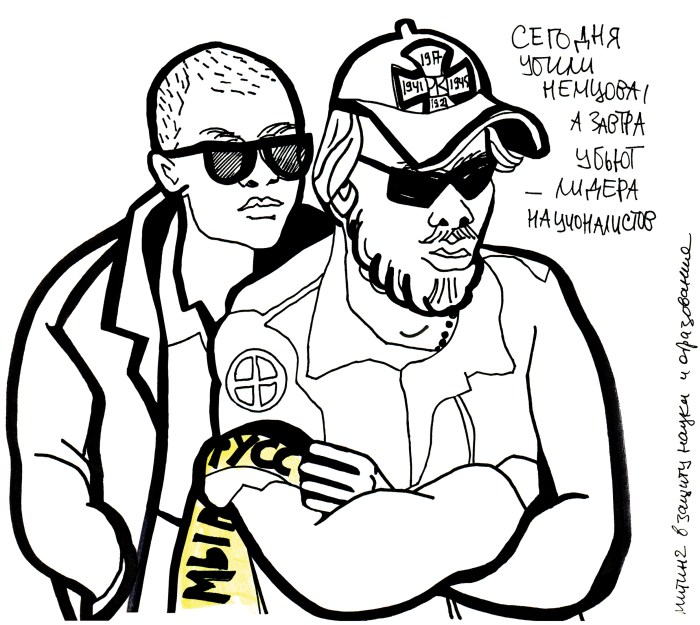
“Today, they killed Nemtsov. Tomorrow, they’ll kill a nationalist leader.” Rally in defense of science and education
Torfyanka
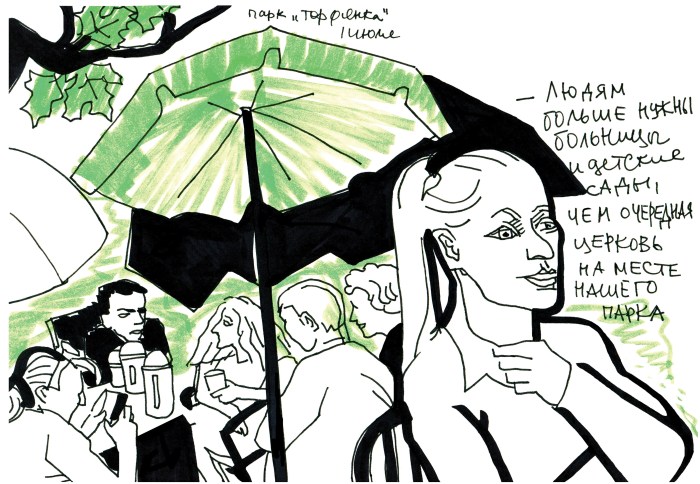
In June 2015, residents of Moscow’s Losiny Ostrov (Moose Island) District came together to stop construction of a church in their local park, Torfyanka. The building had been planned as part of the Russian Orthodox Church’s 200 Churches Program.
“People need hospitals and kindergartens more than another church on the site of our park.” Torfyanka Park, July 1, 2015
Residents set up a tent camp in the park and stood watch in shifts to keep construction equipment from entering the site. They also filed a lawsuit, asking the court to declare the public impact hearing on the construction project null and void. The hearing had been held without their involvement. Continue reading “Victoria Lomasko: Truckers, Torfyanka, and Dubki”→
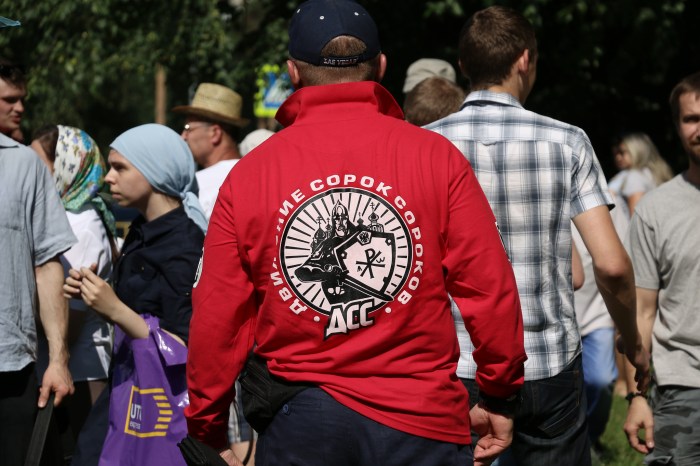
Member of the Russian Orthodox fascist movement Multitude (Sorok sorokov) during a “prayer meeting” at Torfyanka Park in Moscow on June 27, 2016. Photo courtesy of anatrrra
Police Search Homes of Torfyanka Park Defenders Grani.ru
November 14, 2016
Defenders of Moscow’s Torfyanka Park have had their flats searched by police. Olga Romanova, founder of the Imprisoned Russia project, reported the searches on her Facebook page.
According to Romanova, police visited the home of attorney Marina Verigina, who has been consulting the activists, and her husband Vladimir Grechaninov. Law enforcement officers broke into their apartment.
Police cordoned off Natalya Fyodorova’s stairwell and did not let her neighbors act as witnesses to the search, explaining they had brought their own witnesses with them. Fyodorova was loaded into a paddy wagon along with her disabled mother, her husband Boris, and her 18-year-old daughter. The door to the Fyodorovs’ apartment was cut down with a metal grinder.
After the search of his home, Pavel Alexeev was put in the paddy wagon with his underage son Alexander. Evgeny Lebedev and his wife were loaded into the paddy wagon with their underage daughter.
Police likewise searched the home of activist Vladislav Kuznetsov and his wife Svetlana Kuznetsova. Kuznetsov’s forehead was injured while he was detained. He was then handcuffed and a scarf was wrapped around his head.
In addition, Konstantin Yatsyn and his father Yuri Yatsyn were detained. It has been reported that several more families of Torfyanka’s defenders were incommunicado.
Natalya Kutlunina, a member of the Communist Party, has reported that her apartment has been searched as well. Law enforcement officers arrived there at six in the morning. Kutlunina is out of town, and the apartment was searched with her son present.
“The search lasted three hours,” wrote Kutlunina. “They confiscated placards, Party literature, my son’s and my husband’s laptops, and my younger son’s mobile phone.”
Meanwhile, OVD Info has reported that the search at the Verigina and Grechaninov household was still underway after 6:30 in the evening. Yet since lunch time law officers had refused to let lawyer Sergei Shank into the apartment, despite the fact he produced a warrant.
The people detained during the searches were taken to the Russian Investigative Committee’s Northwest Moscow District Office. According to RBC, each activist was escorted by fifteen to twenty police officers, and the arrests were filmed by employees of the national TV channel NTV.
All the detainees were interrogated as witnesses in a case opened up under Article 148 of the Criminal Code (insulting the feelings of religious believers) before being released.
OVD Info claims violation of Paragraph 1 of the article, which stipulates a maximum punishment of one year in a penal colony, is at issue in the case. Meanwhile, after his interrogation, activist Evgeny Lebedev wrote on the For Torfyanka Park! VK community page that a case had been opened under Article 148.3 (obstructing the activities of religious organizations), which carries a maximum penalty of a year of corrective labor or three months in jail.
Orthodox clerics want to build a church in Torfyanka. Local residents are opposed to their plans, and they have been protesting them since June 2015. The decision to permit construction of the church was made illegally. In the autumn of 2015, the Moscow Town Planning and Land Commission acknowledged this and canceled the permit, demanding that the construction site at the park be dismantled. However, this still has not been done.
Moreover, the park’s defenders have been assaulted several times by Russian Orthodox militants. In the early hours of February 13, militants from the Multitude (Sorok sorokov) movement attempted to start building the church without authorization, but they were stopped by police.
In the early hours of March 3, a camp set up activists maintaining a 24-hour vigil in the park was demolished with assistance from the police. Law enforcement officers drove the environmentalists from their tent and pushed them aside as persons unknown arrived in a GAZelle minivan, loaded up the tent and the activists’ personal belongings, and drove off. It transpired that the minivan belonged to the Losiny Ostrov (Moose Island) District Council.
In the early hours of August 29, police detained twelve people, claiming that activists had been trying to break the fence around the proposed construction site.
Ekaterina Schulman, political scientist
This is a bad story, and it is bad because of the numbers of people involved. Nine people have been detained. The police came to their homes at six in the morning and took them to the Investigative Committee on suspicion they have violated Article 148.1 of the Criminal Code (“Public actions expressing clear disrespect for society and committed to insult the feelings of religious believers”), for which the maximum penalty is a year in prison. Meaning that it is a minor offense. Why is the Investigative Committee involved at all? They supposedly deal with serious and very serious crimes in Russia, no? All the detainees are neighbors, husbands and wives, meaning the police carpet-bombed a neighborhood that had been protesting construction of a new church in a park. What is the magnitude of their crime, which did not involve violence? What, are they terrorists? If charges of insulting religious believers have been filed in connection with a complaint, then investigate the case the usual way. Dear Investigative Committee, as a law enforcement agency you are not in the best position nowadays, and if you think you are going to strengthen it by suddenly arresting a dozen ordinary Russians for the glory of the Russian Orthodox Church, you have another think coming. If you haven’t noticed, the trend now in Russia is against exacerbation, incitement, and extremism, and for keeping people calm during the economic crisis. The FSB at least pulled some terrorists from its sleeve who wanted to blow up shopping malls. People understand that, but what was your bright idea for cheering up the media scene? Source: Facebook
Translated by the Russian Reader. Thanks to Nikolay Mitrokhin for the heads-up
__________
The Thermals, “A Pillar of Salt”
We were born to sin
We were born to sin
We don’t think we’re special sir
We know everybody is
We’ve built too many walls
Yeah, we’ve built too many walls
And now we gotta run
A giant fist is out to crush us
We run in the dark
We run in the dark
We don’t carry dead weight long
We send them along to heaven
I carry my baby
I carry my baby
Her eyes can barely see
Her mouth can barely breathe
I can see she’s afraid
She could see the danger
We don’t want to die or apologize
For our dirty God, our dirty bodies
Now, I stick to the ground
I stick to the ground
I won’t look twice for the dead walls
I don’t want a white pillar of salt
I carry my baby
I carry my baby
Her eyes can barely see
Her mouth can barely breathe
I can see she’s afraid
That’s why we’re escaping
So we won’t have to die, we won’t have to deny
Our dirty God, our dirty bodies



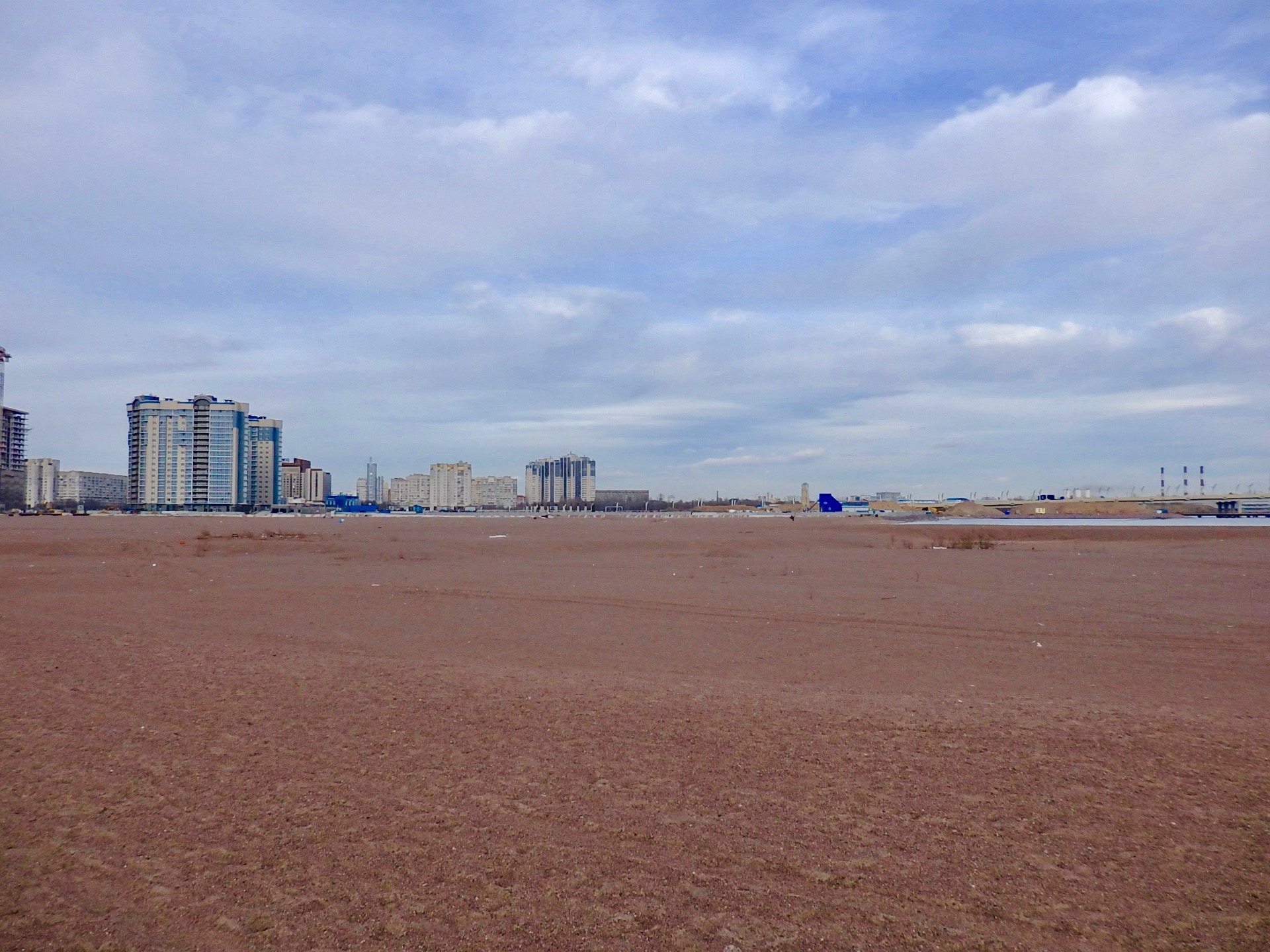 Was it the “popular will” that 500 hectares of land be reclaimed in the Neva Bay right off Petersburg’s Vasiliyevsky Island and developed into densely built high-rise estates, causing untold amounts of environmental and aesthetic damage? No, it wasn’t. In fact, locals were bitterly opposed to the project and they mounted a loud resistance back in the day. But their will was roundly ignored by Petersburg city hall and developers. Under the present authoritarian regime, “popular will” is a friendly phantom, at best, an irritant, at worst. Photo by the Russian Reader
![Screenshot of an advertisement posted on the VK social network page of Andrei Kormukhin, coordinator of the astroturfed Russian Orthodox lay movement Sorok Sorokov (SS), which can be translated as "Multitude." The poster invites Petersburgers to take part in a religious procession at St. Isaac's Cathedral on 19 February 2017. It urges them to "join the right ranks," and not a "faggot" [sic] or people wearing blue ribbons, the symbol adopted by Petersburgers opposed to the Gazprom skyscraper project on the Neva and now plans to hand over St. Isaac's to the ROC. In Russia, "blue" also connotes "gay." Courtesy of Fontanka.ru](https://therussianreader.com/wp-content/uploads/2017/02/40.jpg?w=486)

 Grigory Lourié