Mikola Dziadok: What We Can Learn from the Moscow Protests

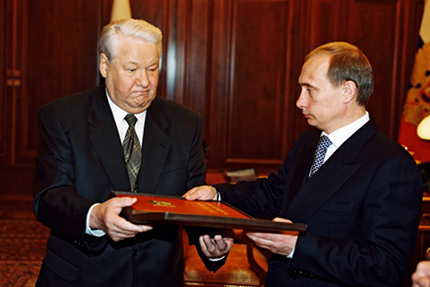
riotgOlga Misik, 17, reading the Russian Constitution aloud to riot cops during a July 27 “unauthorized” opposition protest rally in Moscow at which nearly 1,400 protesters were detained by regular police and Russian National Guardsmen. Photo courtesy of the Independent

Mikola Dziadok
Facebook
August 4, 2019

Lessons of the Moscow Protests

Yesterday, Moscow witnessed one of the largest protest rallies in recent memory. There were huge numbers of arrests.

Estimates of the protesters range from 1,500 to 10,000. 1,001 of them were detained. Since Belarus and Russia constantly exchange know-how in crushing protests and, as genuine autocracies, invest huge resources in doing it, we really should study the methods used in Moscow to make our own subsequent uprising more effective.

The first thing that catches the eye is that the Russian authorities were seriously and thoroughly prepared. There are really smart people in high places who imagined what was going to happen and how to deal with it as effectively as possible. They did not just send a mob of riot cops onto the streets to beat up and disperse everyone. Instead, they employed a whole set of well-designed, complementary measures.

Here is a list of the lessons we can learn.

1. The cops are afraid of being deanonymized. During yesterday’s protest rally, unlike previous protests, the riot cops wore masks because cops who did not hide their faces on July 27 have been subsequently deanonymized in huge numbers and harassed on social media. They fear for their own safety, meaning the longer things drag on, the more they are cognizant of their own mortality and physical vulnerability. This is a good thing.

It was also curious that the agitprop cop using a bullhorn to persuade protesters to disperse appealed to national unity: “Citizens, do not disturb the peace. Russian National Guardsmen are on duty to ensure your safety. Most of them are your sons. Do not disturb the peace and break the law.”

In the future, we will hear tons of this kind of spiel in Minsk from the “moderate opposition,” from the negotiators and compromisers of all stripes who will pop up like earthworms from the moist soil as soon as Lukashenko’s throne goes wobbly. This is a separate issue, however.

2. The Russian authorities are not shy about employing the resources at their disposal. Helicopters were employed in addition to tens of thousands of personnel. Private companies were pressured into going over to the bad guys.

  • The car-sharing service YouDrive banned customers from leaving cars inside the Garden Ring.
  • Cell phone providers turned off mobile Internet services.
  • Wi-Fi was turned off in restaurants and cafes near the protest area.

3. The regime has deployed heavy forces on the digital front.

  • There have been DDOS attacks on the main opposition websites.
  • Pro-regime trolls have been mobilized on group pages and in comments on social media. They have been working overtime cobbling together battle scenes, the reactions of “ordinary citizens,” and so on.

4. As usual, the authorities want to prevent the protests from radicalizing. Random passersby had their bags checked: the police were looking for cans of mace and anything that could be used as a weapon. The high-risk category, from the police’s viewpoint, is middle-aged men, which speaks for itself.

5. When protesters are detained, their mobile phones are confiscated for two weeks under the pretext they are physical evidence in a criminal case. Later, the authorities try to hack them using equipment supplied to authoritarian countries by Israeli and Chinese companies. Encrypt your mobile devices! Update their operating systems before it is too late.

6. The authorities have been filing criminal charges against the protesters mercilessly and without hesitation. The only point is intimidating real and potential protesters. How I am going to move from my cozy home and family to a prison cell for many long years? they ask themselves.

Conclusions

Decentralized protests have been effective. Generally, despite facing equal numbers of people, the regime has to deploy more resources to crush such protests than it does to put paid to centralized protests.

But legal defenses have not been effective. Do you want to not give defense lawyers and children’s ombudsmen access to detainees? Do you want to beat up detainees who are not resisting, refuse them medical care, and forcibly fingerprint them? It is easy as pie. The dogs in uniform are not guardians of law and order. They guard the privileges of the elites along with their power and property. There are thus no obstacles to direct, flagrant, and sustained law-breaking.

The logical conclusion is it is stupid and short-sighted for protesters to try and keep themselves and their protests on the right side of the law,  appealing endlessly to the law as a supreme value and, moreover, outing protesters who break the law as “provocateurs,” one of the favorite hobbies of the legal opposition. It is like trying to win a fight without breaking rules drawn up by your enemy. So it is quite pretty to read the Russian Constitution out loud to riot policemen, but it is also naive, pretentious, and frivolous. They care a thousand times more about their discounted apartments and bonuses than they care about the Constitution.

This does not mean, of course, we should engage in violence left and right. We simply have to remember we have an a priori right to self-defense.

It is worth pointing out that Sergey Kusyuk, a former deputy commander in Ukraine’s Berkut riot police, who was noted for the extreme cruelty with which he treated protesters at the Euromaidan in Kyiv before fleeing the country, has been spotted among the police putting down the protest in Moscow. The Russian regime knows what it is doing: it hires people who have burned all their bridges. Kusyuk has nowhere to run, nowhere to hide. If the current Russian regime collapses, he and his kind can expect to be killed or imprisoned for life. So, he will claw and bite the regime’s enemies until the bitter end. Accordingly, people who are just as willing to fight to the bitter end, but for the good guys, can face these monsters down.

The conclusion is simple: get ready to fight.

Translated by the Russian Reader
Ivan Davydov: Unimaginable

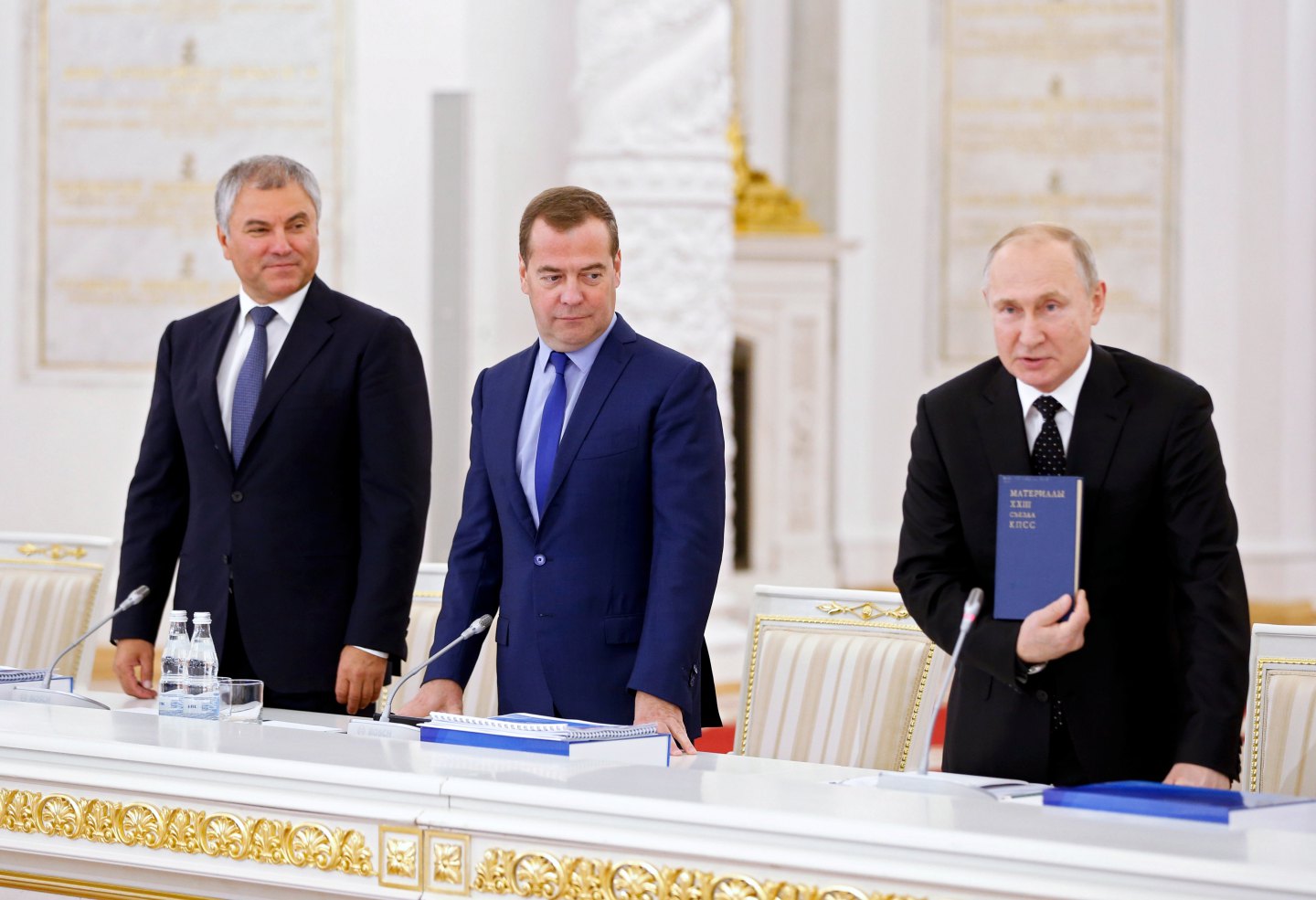
volodinVyacheslav Volodin, Dmitry Medvedev, and Vladimir Putin at a meeting of the State Council, June 26, 2019. Photo by Dmitry Astakhov. Courtesy of Sputnik, Reuters, and Republic
What Russia Cannot Imagine
Ivan Davydov
Republic
July 18, 2019

Any periodical would love to get their hands on a star author. Who even thought a few days ago that something called the Parliament Gazette was published in Russia? Yet State Duma Speaker Vyacheslav Volodin has just published an article there entitled “The Living, Evolving Constitution.” Everyone who follows politics has read it and many have ventured to summarize it. Volodin praises the Russian Constitution and its spirit while arguing certain things in it should be amended.

This is not the first time Volodin has done this. Last year marked the Constitution’s twenty-fifth birthday. The speaker hinted that it was obsolete in parts. Valery Zorkin, Chief Justice of the Russian Constitutional Court, voiced similar thoughts, and Prime Minister Dmitry Medvedev weighed in with a programmatic article entitled “The Constitution at Twenty-Five: Balancing Freedom and Responsibility.”

The little booklet keeps them up at night. They sense it is at odds with reality. They are eager to amend it.

Renaissance Men
Medvedev wrote about the possibility of amending the Constitution. The amendments were needed in order to “update the status of the authorities.” Don’t ask me what that means: the prime minister himself would probably not be able to tell you.

Zorkin spoke of “pinpoint” amendments aimed at restoring the balance between the executive and legislative branches. Nineteen years into Putin’s reign, the Chief Justice of the Constitutional Court suddenly noticed the executive branch had brought the legislative branch to heel.

Volodin’s article has the same bent.

“In my analysis of the Constitution, I pay special mind to the lack of a needed balance in how the legislative and executive branches function. Discrete, pinpoint constitutional innovations might really be necessary in this case,” he writes.

Actually, the speaker has only one proposal: the Duma should have more levers for controlling what the government does.

“It is advisable to further elaborate the rules concerning the government’s accountability to parliament on issues raised by the State Duma, including the evaluation of the performance of specific ministers. It would also be a good thing (this is only my opinion) to further weigh the question of the State Duma’s involvement in selecting ministers in the Russian federal government,” he writes.

It is as if we have gone back to the early twentieth century, no? It was a romantic time. The public enthusiastically discussed “A Manifesto for Improving the State Administration,” published on October 17, 1905. The Constitutional Democrats (Kadets) had the upper hand in the first Duma, and Pavel Milyukov would soon take to the podium to demand an accountable government. Prince Sergei Urusov would soon make his famous speech.

“People with the educations of quartermasters and policemen and the convictions of rioters are deciding the country’s fate,” he said.

His words have lost none of their timeliness, to the woe of our poor fatherland.

No, the man at the podium is Vyacheslav Volodin, a well-educated intellectual whose mind is on a par with the pillars of the Renaissance. He wrote his dissertation about dispending feed to livestock, but his arguments about balancing the branches of government are no worse than what you would hear from a political scientist, although, of course, the irrepressible lover of bad jokes inside all of us would note the parallels between cattle and politicians.

Volodin is at the podium, so we must read between the lines. He could not care less about achieving a “higher quality of interaction and coherence in the government’s work.” The speaker has a different goal, one that is easily discerned.

The Eternal Present
Like everyone else who has spoken about possible amendments to the Constitution,  the speaker is looking to the future. He is looking towards 2024 when the regime will have to figure out how to maintain Putin’s grip on supreme power. It would be unseemly just to reelect him one more time. You do not expect any of the folks occupying important government posts to worry about decency, but the issue does indeed bother them.

Political junkies are regularly excited by rumors of transition scenarios, some of them quite intricate. People in the know, citing anonymous but terribly reliable sources, suddenly claim that a State Council will be established.

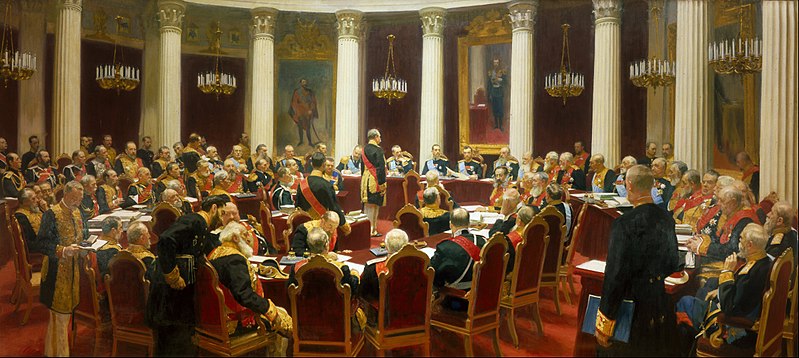
They must have seen Ilya Repin’s famous monumental painting, which made an impression on them.

800px-Ilya_Repin_-_Ceremonial_Sitting_of_the_State_Council_on_7_May_1901_Marking_the_Centenary_of_its_Foundation_-_Google_Art_ProjectIlya Repin, Ceremonial Sitting of the State Council on 7 May 1901 Marking the Centenary of its Foundation, 1903. Oil on canvas, 4.4 m by 8.77 m. Courtesy of Wikimedia Commons

Or they let slip that Russia and Belarus will finally be totally unified.

But the State Council—not the meaningless, powerless State Council that has convened since 2000, but a genuine, proper State Council that would replace all other executive authorities—still convenes only in Repin’s painting, while the would-be tsar of Belarus his own plans and his own heir. He even took him on a pilgrimage to Valaam to show him off to our would-be tsar and thus quash any funny ideas in the latter’s head.

And then Bloomberg, a source at we cannot sneeze, writes that the Kremlin is planning large-scale electoral reforms. Supposedly, in the 2021 parliamentary elections, 75% of MPs will be elected not via party lists but in single-mandate constituencies. United Russia’s candidates will run as independents. (We have heard this before.) The regime will have total control of parliament. (As if it does not have it now.). Putin will again lead the ruling party and be appointed the prime minister. The powers of the presidency will be curtailed. It will not matter who is elected to this clownish post because Russia will be run by the prime minister.

We have been through this before. There was no need to amend the Consitution. The regime did as it liked anyway.

Rumors spread by an international news agency are one thing, but rumors backed by a programmatic article written by the Speaker of the Duma are another. The picture comes into focus. The regime has come up with a plan, apparently. We can thus say with some accuracy what the future holds for us.

The future will be the same as the present, despite certain formal shakeups that have no bearing on the real lives of ordinary Russians and leave the regime’s domestic and foreign policies intact. The regime will undergo fundamental changes, as it were, but the same people will be in power.

What future lies in store for us? No future at all, a future as dull as the eyes of Russia’s leader.

The Ruling Dynasty’s Motto
On the one hand, all of this stuff is interesting, as it were. You feel like Sherlock Holmes, perusing a boring article with a magnifying glass and figuring out what it has to do with keeping Putin in power. You imagine how the Russian state machine will function after it undergoes a minor facelift. The prime minister will control both the parliament and the government while the president visits summer camps and publishes articles in small-circulation newspapers about what the world will be like in a hundred years. Medvedev would be great for the job, and this would solve the problem of finding another heir.

On the other hand, haven’t we been through this already?

The takeaway message is that none of these schemes accounts for regime change. Our powers that be can draw whatever blueprints they like showing one set of cogs engaging another set of cogs, setting into motion our mighty state, which churns smoke like the aircraft carrier Admiral Kuznetsov and terrifies the rest of the world with its smell if not its military might.

What they cannot imagine is completely different people at the helm. This is what cannot be imagined in Russia at all.

Neither Volodin, his ghostwriters, and his commentators can entertain the thought power could change hands. Political power in modern Russia has nothing to do with procedures and institutions. You can dream up whatever procedures you like and mold institutions by the bucketful from dung and twigs. Political power in today’s Russia is about people, the small group of people, whose names we all know, led by Vladimir Putin.

Any imitation of change is permissible so long as it makes real change impossible.  This is the perfect way of summing up Volodin’s article and political reforms in Russia, although “reforms” should be encased in quotation marks, which are the most important signifiers in Russian political discourse.

“Changing to prevent change” would be an excellent motto for the current ruling dynasty, a dynasty consisting of one man whom he and his entourage inexplicably imagine is immortal.

Moscow as a Mirror
Even yesterday’s loyal supporters see clearly what pass this dynasty has brought us to. They have no plans of winding up their act and exiting the stage.

What comes to mind is the slightly over-discussed topic, in recent days, of the upcoming elections to the Moscow City Duma. Moscow mirrors what happens all over Russia, and it is not a funhouse mirror. In recent days, authorities in the capital have flagrantly and impudently barred independent candidates from running in the elections. They have not attempted to hide the forgeries and falsifications they have used when “verifying” the signatures of voters on the petitions submitted by the candidates.

The independent candidates are young people who can sometimes seem too radical and sometimes seem a bit ridiculous, for idealists always seem a bit ridiculous. Oddly, however, they are open to dialogue. They are keen to accomplish something real in politics and bring about gradual changes in public life.

I wanted to write “perestroika” instead of “changes,” but the word has too much baggage, so the heck with it.

The people who run Moscow, just like the people who run Russia, cannot get their heads around a simple truth. The country’s only real defense, its only chance at survival (and this applies to everyone, including the political bosses) are these slightly ridiculous idealists, who are willing to pull up their sleeves, work, and talk to people. They could try and clean up all the messes the people who run things have made.

But the powers that be toss them out of legal politics like naughty puppies in a sneering show of force that demonstrates they do not understand that destroying room for legal politics is a road to ruin. They do not realize that in this serial’s next episode it will not be ridiculous idealists who take to the streets, playing volleyball at “unauthorized” protest rallies and waiting for the green light to cross the street during banned protest marches, but starved pragmatists whose program will consist of smashing windows and crushing skulls.

All of the tricky plans for keeping Putin in power will come to naught. There will be no Putin, and there will be no power. Maybe there will be an endless remake of the Donetsk People’s Republic, but there is no certainty even that much will happen.

However, by way of toning things down a bit and leaving my readers with a smile on their face, I will close by quoting from Medvedev’s article about the Russian Constitution, which I mentioned earlier.

“While recognizing and protecting human rights, the Russian Constitution limits the claims made on the defense of these rights by not recognizing as rights those that are at odds with Russian society’s traditional values. The idea of human rights is thus given a new interpretation in relation to other constitutions, marking out a particular, original, nonstandard approach to the way human rights are regarded.”

Now, what are you going to do about that?

Translated by Thomas Campbell


Let’s Give In to Russian Blackmail

nod-constitution day-1“The Russian Constitution: The Basic Law or Legal Sabotage?” Front page of a newspaper handed out on the streets of Petersburg by memberx of NOD (National Liberation Movement) on December 12, 2018, celebrated as Constitution Day in Russia. This article argues that Russia’s current constitution, adopted in 1993, was drafted by CIA agents working under the cover of USAID. Their goal, allegedly, was to colonize Russia by subjugating its sovereignty to international law.

___________________________

Don’t Let Russia Leave the Council of Europe
Yuri Dzhibladze and Konstantin Baranov
oDR
December 13, 2018

Those who wish to punish the Kremlin for its aggressive actions in Ukraine and elsewhere are missing the target: it is not the Russian government, but the Russian public who will suffer if the country leaves the Council of Europe.

After the Kerch Strait incident, proponents of pushing Russia out of the Council of Europe seem to have got additional justification for their position in a discussion that rages in the Council’s Parliamentary Assembly (PACE). In fact, the potential costs of this departure appear to be too high and far-reaching—not only for the Russian society, but for the whole of Europe.

More than four years since its delegation has been deprived of voting and participation rights in the PACE, Russia is now a step away from leaving the Council of Europe – either at its own initiative or as a result of expulsion for non-payment of its membership fees. In recent months, the situation has reached a deadlock due to an uncompromising position of both the Russian authorities and their critics in the PACE.

Those who wish to punish the Kremlin for its aggressive actions in Ukraine and elsewhere miss the target: it is not the Russian government, but the Russian public who would suffer the most should the country leave the Council of Europe. Since 1996, when Russia joined the organisation, for millions living in the country (including nationals of other states), the European Court of Human Rights (ECtHR) has been an ultimate hope for justice, which they cannot find in Russia. In this period, almost 2,500 judgements have been delivered to Russia. In 2017 alone, the state paid over 14.5 million euros as just satisfaction to victims. The judgments have had a significant positive impact on Russian laws and judicial practice, despite their implementation being far from ideal and counting to roughly one-third of cases. Should Russia depart from the Council of Europe, the scope of human rights problems in the country will grow exponentially, including a threat of speedy reinstatement of the death penalty.

The potential consequences would go far beyond the deterioration of the internal situation. This move would not resolve the issue of the annexed Crimea or put an end to the armed conflict in Donbass. On the contrary, expelling the violating country would demonstrate the weakness of the European system of protection of human rights and the rule of law in dealing with such gross violations.

What is more, Russia’s withdrawal would definitely worsen conditions of citizens of Ukraine and other countries who are held in Russian prisons and face unfair trials, torture and inhuman and degrading treatment. It would also result in a denial of the protection of the European Convention on Human Rights (ECHR) to inhabitants of Russia-controlled Crimea. It would eliminate effective guarantees from deportation for refugees and asylum seekers from Syria, Afghanistan and Central Asia. Finally, the practice of expulsion of a member state might trigger other countries to leave the Council and deter Belarus from returning to a special observer’s status at the PACE.

Politicians should assume full responsibility for making the choice that may define Europe’s future and work towards a solution that would preserve the common European legal framework and space for critical dialogue aimed at promoting human rights, democracy and the rule of law on the entire territory of Europe, including Russia.

We do not demand to “give in to blackmailing.” Lifting all restrictions on the Russian delegation in the PACE would be indeed unprincipled. However, finding a reasonable solution, in our view, would be a courageous decision to take responsibility and to advance the core values of the organisation by allowing the critical dialogue to continue. Amending the PACE rules of procedure – restricting national delegations’ rights only within the Assembly itself and not depriving them of the voting rights in elections of non-PACE mandates—including ECtHR judges, Commissioner for Human Rights and Secretary General—appears such a legally sound and reasonable solution.

Threats by Russian officials to leave the Council of Europe are not just a bluff to raise the bargaining stakes. There are many influential people in the Russian political establishment in favour of isolationist policies who actually want the country to withdraw. If a reasonable solution is not found before next spring, Russia’s authorities will not wait for the official discussion of its potential expulsion at the Committee of Ministers in June 2019 and will announce the withdrawal from the Council before.

It should be clear to everyone: Russia’s departure from the Council of Europe would not stop human rights violations and halt the authoritarian backslide in our country, or prevent the Kremlin’s aggressive behaviour in the international arena. Instead, it would put an end to a difficult struggle of Russian civil society to make Russia an important part of Europe on the basis of shared norms and values of democracy, rule of law and respect for human rights. It will turn a large territory in Europe into a legal “grey zone” for decades to come.

The authors represent a group of Russian human rights defenders who recently issued a Memorandum on the crisis in relations between the Council of Europe and the Russian Federation.

About the authors

Yuri Dzhibladze is a founder and president of Moscow-based Centre for the Development of Democracy and Human Rights and advocacy coordinator at the EU-Russia Civil Society Forum. He has worked on human rights, democracy, and international organisations since the late 1980s.

Konstantin Baranov is member of the Coordinating Council and international advocacy coordinator at the Youth Human Rights Movement, an international NGO enjoying participatory status with the Council of Europe. He is an expert on the protection of civil society space and fundamental freedoms in Russia and the post-Soviet area.

NB. This article was originally published by oDR under a Creative Commons Attribution 4.0 International licence

___________________________

When will Russia stop behaving like the enemy of Western Europe?
Dima Vorobiev, I worked for Soviet propaganda
Quora
Answered Feb 18

Russia is not the enemy of the Western Europe. The disruptive policy of President Putin is aimed at (1) weakening the political and military dominance of the US in Europe and/or (2) full or partial acceptance by the West of the following list of Russia’s political objectives:

  • Recognition of Crimea as Russian territory
  • Total freeze on expansion of NATO. No membership for Sweden, Finland, Ukraine or Georgia.
  • No NATO bases in the Baltics, Poland, Czech republic and Slovakia, Romania and Bulgaria. Removal of the American anti-ballistic bases in Central Europe.
  • Finlandization of Georgia, Ukraine and guarantees of such arrangement for Belarus, in case it gets a pro-Western government in the future.
  • Guarantees of unhindered land connection through Lithuania between the Russian heartland and the exclave of Kaliningrad. The unhindered transit through the Suwalki gap would be very useful for Russia as a gauge of the level of determination on the part of NATO in the case of a swift escalation in tensions.
  • Recognition of Russia’s right to permanent military presence in the Mediterranean (through bases in Syria and possibly in Libya or other places)
  • Repeal of all sanctions against Russian oligarchs, their companies and sectoral interests.

If the West won’t agree to such a new global security arrangement, the current confrontation will continue, with variations only in the level of tensions. Because of the technological gap, the Russian military-industrial complex will increasingly depend on China for high-tech components for our weapons systems. Russian economy will also be more and more streamlined to accommodate the needs of Chinese manufacturing.

This stalemate can continue for many years, unless one of the following happens:

  1. Unexpected massive deterioration of economy in Russia.
  2. Low-probability, high-impact catastrophe in the US or Europe that makes the West seek help from Russia
  3. Power shift in Russia with full revision of national policy. (Highly unlikely with President Putin still in power).

Yuri Shchekochikhin to Vladimir Putin, March 25, 2002

shchekochikhinYuri Shchekochikhin (June 9, 1950–July 3, 2003)
Oleg Pshenichny
Facebook
June 19, 2018

A letter from Yuri Shchekochikhin to Vladimir Putin. Thanks to Dmitry Nosachev for the heads-up.

I heard with my own ears how arrogantly young journalists then spoke of him. They claimed he was paranoid. They claimed he was obsessed with the mafia and the KGB’s machinations. They all but called him a clown. I won’t point fingers. There is no need.

_______________________________________________

March 25, 2002

To: Vladimir Vladimirovich Putin, President of the Russian Federation

Dear Vladimir Vladimirovich,

I was extremely surprised that, at a time when the whole world has been busy fighting terrorism, the Russian Federal Security Service (FSB) has been busy with little old me, thus violating Article [98] of the Russian Federal Constitution, which guarantees the immunity of State Duma members.

You will remember the Three Whales Scandal, I hope. It was a big surprise to me that, after the hearing of the State Duma’s Security Committee and my article in Novaya Gazeta on the subject, Pavel Zaytsev, the special investigator who had been handling this criminal case, was summoned for questioning by the FSB—not to find out the truth about how the mafia was organized, but only because of me, deputy chair of the State Duma’s Security Committee and a member of its Commission on Combating High-Level Corruption in Government.

I would not have attached much importance to the incident were it not for one circumstance.

Several years ago, Vyacheslav Zharko, a junior field agent in the St. Petersburg Tax Police, gave me documents showing that ships were entering the Russian Navy’s bases in Lebyazhy and Lomonosov[] without being inspected by customs and border control.

There were several signatures on the documents authorizing this financial escapade, including that of the then Deputy Prime Minister [Oleg] Soskovets and yours, Vladimir Vladimirovich.

[Mikhail] Katyshev, who at the time was the First Deputy Prosecutor General, gave orders to open a criminal case and set up an operational investigative group in the Prosecutor General’s Office after reading the documents submitted by Zharko.

It was this criminal case that led to the arrest of Dmitry Rozhdestvensky, head of Russian Video. Unfortunately, however, due to political motives, the investigative team, led by [Vladimir] Lyseiko, dealt only with the embezzlement of funds by Media Most, “forgetting” about the evidence relating to Russian Video’s Marine Department.

During the investigation of this criminal case, I had to fly to St. Petersburg on several occasions to arrange for Zharko’s protection and security, since his life was in real danger. [Georgy] Poltavchenko, then head of the St. Petersburg Tax Police, and [Viktor] Cherkesov, then head of the FSB’s Petersburg office, were simply afraid to help the young field agent in investigating the high-profile criminal case. I was quite surprised it was Zharko who was summoned from St. Petersburg to handle the arrest of [Vladimir] Gusinsky.

I don’t want to bother you with the details of the criminal case, although I imagine you are familiar with them. It is a different matter that concerns me. In December 2001, Zharko, who had transferred from the Tax Police to the Main Intelligence Directorate (GRU) of the Russian Defense Ministry, was detained at Sheremetyevo 1 Airport on trumped-up charges of using a counterfeit passport and illegally crossing the border, put under arrest at the behest of the Deputy Prosecutor General, and remanded in custody to Lefortovo Prison. The arrest, especially an arrest sanctioned by such a top-ranking official, on charges of committing a crime that carries a punishment of up to two years in prison, and the subsequent change in his pretrial status, as ordered by Prosecutor General Vladimir Ustinov, would seem incredible were it not for one circumstance. While Zharko was jailed in Lefortovo Remand Prison, FSB field agents tried to “crack” [kololi] him (I use the word “crack” deliberately) while figuring out whether he had in his possession documents bearing your signature and relating to the criminal case. What especially angered me was that the officers attempted to force Zharko to confess that he and I were mixed up with Boris Berezovsky. During their conversations, it was said that I received $50,000 a month from Berezovsky, part of which I gave to Zharko, who in turn gave some to Mikhail Katyshev.

Vladimir Vladimorovich, I have spoken with Berezovsky once and only once in my life. It was in the State Duma building. It just happened.

Most important, however, I don’t like it that I, deputy chair of a State Duma committee, have been targeted by the FSB. I don’t like it that my phones have been bugged and that someone has been trying hard to find means to discredit me.

Vladimir Vladimirovich, I don’t think this letter will end up in your hands. I once sent you a letter about Mr. [Nazir] Khapsirokov, one of the most notorious characters investigated by the Commission on Combating Corruption, during the last sitting of the State Duma. It was when he was appointed deputy head of your administration. In that letter, I wrote to you that you wanted to put together a team while a pack of dogs was circling you. After receiving a reply from a clerk in your administration, I realized the pack had encircled you once and for all, and that it was stronger than the team. Therefore, I am sending a copy this letter to the chair of the State Duma and the head of the Yabloko Party faction in the State Duma, of which I am a member.

Respectfully,

Yuri P. Shchekochikin
Deputy Chair, State Duma Security Committee
Member, State Duma Commission on Combating High-Level Corruption in Government
Member, State Duma (Yabloko Party Faction)

It is widely believed Mr. Shchekochikhin was poisoned to death. Thanks to Sergey Abashin for the heads-up. Translated by the Russian Reader. Photo courtesy of Pinterest

Plato Re-Elaborated

rus yachts.jpg

That city would not lack a yacht club, would not lack

a soccer club. Noting the absence of smoke from the brick

factory chimneys, I’d know it was Sunday,

and would lurch in a bus across town, clutching a couple of bucks.


I’d twine my voice into the common animal hoot-

ing on that field where what the head begins is finished by the foot.

Of the myriad laws laid down by Hammurabi

the most important deal with corner kicks, and penalty kicks to boot.


—Joseph Brodsky, “Plato Elaborated,” trans. George L. Kline, New Yorker, March 12, 1979, p. 40


***********************

It would be nice, wouldn’t it, to be a regular guy, to immerse oneself in enjoying life, in a pleasant job, and forget that a dictatorship for life has taken root in our country? It would be nice, wouldn’t it, to forget the dictatorship wages war against neighboring countries? It would be nice, wouldn’t it, to forget it has destroyed all constitutional rights, the freedom of speech, secularism, the right to a pension, the right to one’s native language, and the right to forget things and be happy?

—Sergey Abashin, Facebook, June 24, 2018

Photo and translation by the Russian Reader

The Policemen’s Ball

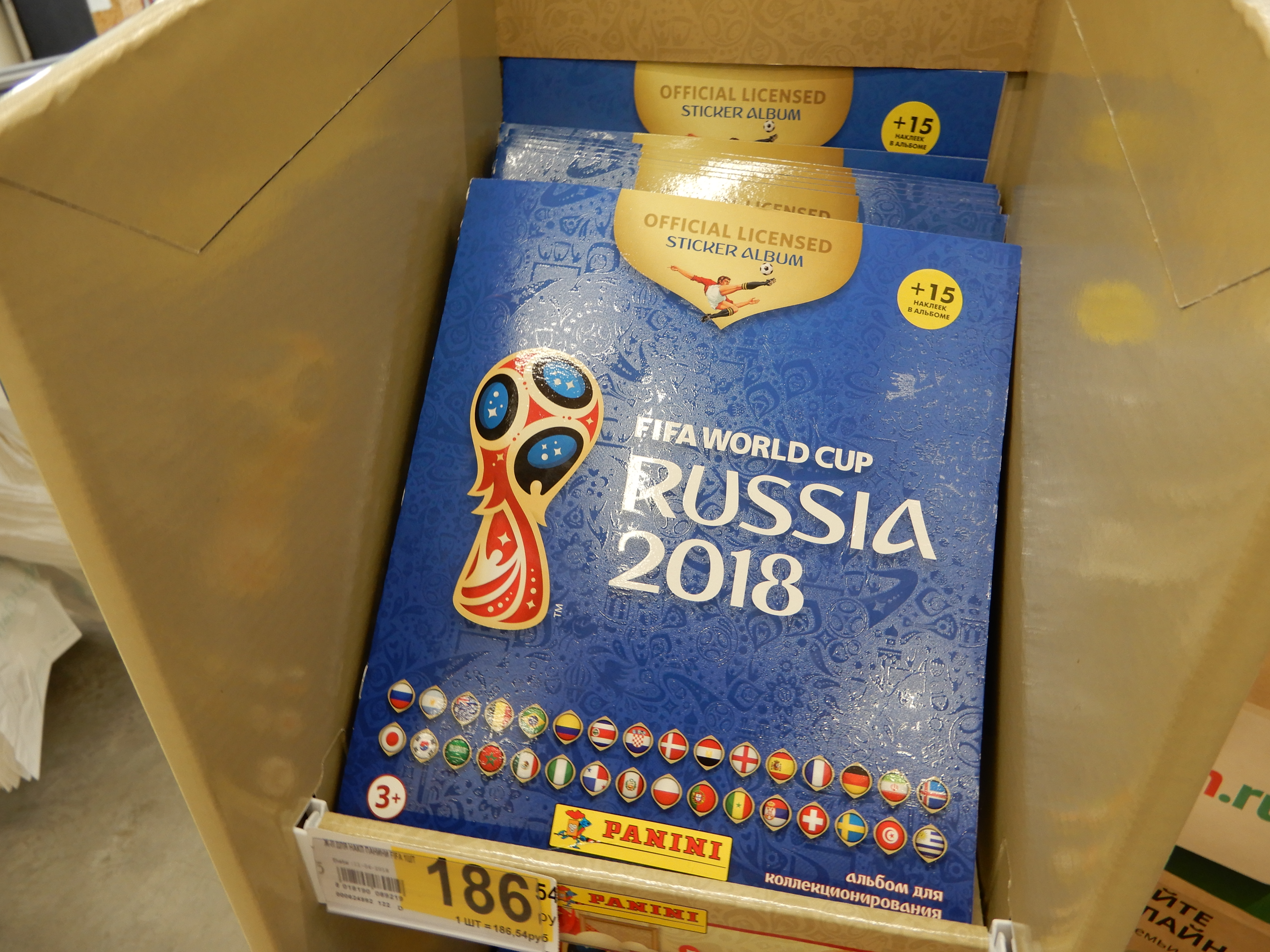
DSCN6837At €2.50, the official licensed sticker album of the 2018 World Cup is a steal. Russian officials also plan to steal the civil rights of their own citizens during the month-long tournament. Photo by the Russian Reader
Restrictions on Movement and Freedom of Assembly during the 2018 FIFA World Cup
Denis Shedov and Natalya Kovylyayeva
OVD Info
May 25, 2018

Russia welcomes the 2018 FIFA World Cup with Presidential Decree No. 202, which places restrictions on the movements of people and the staging of public rallies in cities hosting the matches. According to the decree, “enhanced safety measures” will be enforced from May 25 until July 25 (although the first match, between Russia and Saudi Arabia, will not be played until June 14). Denis Shedov and Natalya Kovylyayeva studied the decree specially for OVD Info.*

The restrictions will be introduced on May 25, 2018. They will be enforced in the cities and regions hosting 2018 World Cup matches: Moscow, Petersburg, Volgograd Region, Sverdlovsk Region, Nizhny Novgorod Region, Samara Region, Rostov Region, Kaliningrad Region, Krasnodar Territory, the Republic of Tatarstan, and the Republic of Mordovia.  Additionally, the decree also applies to certain neighboring regions where, in particular,  competing teams will be accommodated: Moscow Region, Leningrad Region, Kaluga Region, Voronezh Region, Stavropol Territory, and the Republic of Chechnya.

It is worth noting Decree No. 202 applies absolutely to everyone who is located in the regions listed during the period the decree is in force. In this light, OVD Info felt it was vital to discuss these changes.

Monitored and Restricted Areas
The decree introduces “monitored and restricted areas,” which will either be entirely off limits to people or will have restricted access. These areas include training grounds (including at other stadiums), team headquarters, hotels where teams and referees are staying, cargo inspection points, the broadcast center at Crocus Expo in Moscow, fan festival venues, press centers, and parking lots for special transport. You will be able to enter these “monitored areas” only after security guards have conducted a thorough inspection of all your belongings.

In addition, there will be special pedestrian security zones, so-called last miles, consisting of areas of one to two kilometers in radius around the stadiums where the matches will be held. Aside from World Cup transport, only residents of nearby buildings, equipped with special passes, will have access to these zones. To obtain the passes you need your internal passport and the papers for your car and your flat. Information about these zones has been posted on the official municipal websites of the cities hosting matches and published in local periodicals.

  • During the 2014 Winter Olympics in Sochi, the city was off limits to cars from other cities, i.e., cars not registered in Sochi, with the exception of vehicles owned by the secret services and vehicles that had received accreditation as municipal maintenance and 2014 Winter Olympics support vehicles. Vehicles registered in Sochi were restricted from traveling in “monitored areas.” 

Mandatory Registration for Everyone
Upon arrival in a city, you must register with the local immigration authorities within three days. This rules applies to everyone except those who are registered to live permanently in the particular city. Additionally, special rules for registering domiciles and temporary stays will be introduced in the cities where World Cup matches are scheduled.

Russian nationals and foreign nationals must register with the police within 72 hours of arriving. Usually, during “normal” times, Russian nationals have the right to spend up to 90 days in another Russian region without registering, while foreign nationals have seven days to register. Decree No. 202 specifies that the party hosting the visitor, i.e., the hotel, spa, holiday home, etc., must notify the proper authorities of the arrival of foreign nationals within 24 hours, as stipulated by Russian federal law.

Immigration authorities in the regions mentioned in the decree will be open for business daily during the World Cup, including weekends and holidays. There are several ways of registering your stay in another city:

  • Submitting an application to the management of the hotel, hostel, camping ground or youth hostel where you are staying, or the management company, proprietor or landlord, if you are staying in a private flat.
  • Reporting to the local immigration authorities yourself.

Foreign nationals must personally present their papers to the regional office of the Interior Ministry (i.e., the police) or a multi-service center, or their official hosts must do it for them. It is forbidden to register via the post office or a government services website.

Arriving foreign nationals are obliged to provide notification of their arrival, a copy of their identity card (e.g., passport or either ID), a copy of their Russian visa, and a copy of their migration card. This rule applies to all foreign nationals, regardless of their nationality and status in Russia. If the host party is a legal entity, this organization must supply the authorities with a complete set of documents.

Private individuals who act as hosts need only present their Russian internal passports, proving they are permanent residents, a copy of their passports, and a copy of their ownership deed to the dwellings where they will house foreign nationals.

If these rules are violated, Russian nationals will be obliged to pay an administrative fine. In Moscow and Petersburg, the fine will range from three to five thousand rubles, while in the regions it will range from two to three thousand rubles. Foreign nationals who violate these rules can be expelled from Russia.

Restrictions on Freedom of Assembly
According to the decree, from May 25 to July 25, 2018, assemblies, rallies, demonstrations, marches, and pickets that have nothing to do with the 2018 FIFA World Cup can be held only in places, along routes, and at times approved by the authorities. The authorities can also determine the number of attendees and the duration of the event.

Decree No. 202 was first enforced during last year’s Confederations Cup, also hosted by Russia. A large number of activists involved in group protests and solo pickets were apprehended at that time. Some of the people detained during solo pickets were subjected to “explanatory discussions” by the police, while others were written up for violating the rules for holding public events and fined as much as 20,000 rubles.

  • In May 2017, five activists from the local headquarters of opposition leader Alexei Navalny were detained for setting up a campaign booth on the main square in Kazan. Law enforcement said the action had not been authorized by the authorities. All the detainees were sentenced to ten to twelve days in jail, as well as 35 hours of community service.
  • During the Navalny-inspired anti-corruption rallies that took place in a number of cities on June 12, 2017, including Petersburg, Moscow, and Sochi, police detained protesters on the basis of Paragraph 11 of the decree, as paraphrased above. Although in Krasnodar, where the rally against corruption had been authorized, no one was apprehended, despite the special security regime.
  • During the protest rally “Farewell to the Communications Ministry,” in Moscow in June 2017, a teenager was detained when he tried to leave flowers outside the ministry due to restrictions on freedom of speech in Russia, including the possible blockage of the Telegram messenger service. The arresting officer cited the presidential decree restricting rallies during the Confederations Cup and the 2018 World Cup when he detained the boy. The teenager was taken into a police station for questioning before being released.
  • In mid-June 2017, fifteen people holding solo pickets against Moscow’s massive “renovation” program were detained outside the entrance to the State Duma.
  • Several activists who held solo pickets in support of mathematician Dmitry Bogatov and demanded an end to the prosecution of nationalist Dmitry Demushkin were detained on June 24, 2017, in Moscow.
  • Solidarity Party activist Mikhail Lashkevich was detained on July 4, 2017, while holding a solo picket demanding the people behind opposition leader Boris Nemtsov’s assassination be found. The police admitted he had a right to carry out a solo picket and released him from Basmanny Police Precinct in Moscow without writing him up. Subsequently, Roman Petrishchev, another Solidarity Party activist, was detained for a solo picket.
  • In early July 2017, five activists of Protest Moscow were detained in different parts of the city while they held solo pickets against censorship. All of them were charged with violating the rules for holding public events, punishable under Article 20.2 Part 5 of the Administrative Offenses Code.
  • On July 5, 2017, the well-known democracy activist Ildar Dadin was detained during a solo picket outside FSB headquarters in Moscow, since his protest had not been authorized by law enforcement. On July 7, 2017, the Meshchansky District Court found him guilty of violating the “rules of solo pickets” and fined him 20,000 rubles.

In May 2017, Alexander Pomazuyev, a lawyer with Navalny’s Anti-Corruption Foundation (FBK) asked that Paragraph 11 of the decree be declared null and void in a suit he filed with the Russian Supreme Court. Pomazuyev claimed he had been denied the right to hold a solo picket. He also argued the presidential decree infringed on civil liberties guaranteed by the Russian Constitution, including the right to free speech and freedom of assembly. The court threw out Pomazuyev’s suit, thus rubber-stamping the restrictions on rallies and pickets during the Confederations Cup and the 2018 FIFA World Cup.

In February 2018, organizers of the Boris Nemtsov Memorial March in Nizhny Novgorod wrote an open letter to FIFA president Gianni Infantino asking him to protect freedom of assembly in Russia in the run-up to the World Cup. The football functionary did not react to the letter, apparently.

“Although the decree restricts certain rights only from May 25 to July 25, 2018, even the smallest pickets have been turned down by the authorities on the grounds of the terrorist threat,” the march organizers wrote on their Facebook page.

Commentary by Lawyer and Human Rights Activist Alexander Peredruk
Yes, Presidential Decree No. 202, dated May 9, 2017, definitely violates people’s constitutionally guaranteed rights to freedom of assembly in Russia.

If you want to hold a public rally from May 25 to July 25, 2018, at a venue of your choosing, there is no guarantee you will pull it off. The authorities could turn you down on the grounds the venue you have chosen was not vetted by the Interior Ministry and the FSB. 

As last year showed, when several applications to hold rallies were filed simultaneously, the authorities would reject all the applications. However, when the applications were filed, the authorities had not yet determined what venues could be used. They drew up a list of permissible venues only after looking over the first applications. It was thus a “complete coincidence” that the venues indicated in the applications that were submitted to the local authorities were not on the list of permissible venues. 

In other words, the rejections were perfunctory and practically groundless. The authorities were not interested in conducting a proportionality test, in striking a balance between public and private interests.

In addition, questions are raised about the legitimacy of the division between public sporting events, which are permitted during this period, and public political events, which are virtually banned. Russian citizens are thus subject to discrimination.

During the 2014 Winter Olympics in Sochi, a local man, David Hakim, was detained while holding a solo picket in defense of the convicted environmentalist Yevgeny Vitishko. (Hakim was jailed for four days for his “crime.”) Agora used his case to challenge the president’s Olympic decree in the Russian Constitutional Court. However, the court refused to examine whether the decree complied with the Constitution, since it had expired by the time the complaint was examined. 

* If you are worried about how Presidential Decree No. 202 will affect foreign fans traveling to Russia for the World Cup, you shouldn’t be. They are required to purchase special “fan IDs” that will exempt them from most if not all of the decree’s strictures. // TRR

Denis Shedov is a lawyer with the Memorial Human Rights Center in Moscow. Natalya Kovylyayeva is a journalist. Translated by the Russian Reader

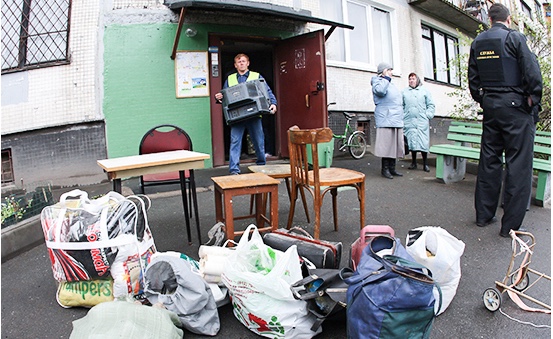
Eviction Addiction

1. Everyone shall have the right to a home. No one may be arbitrarily deprived of his or her home.

2. The bodies of state authority and local self-government shall encourage housing construction and create conditions for exercising the right to a home.

3. Low-income people and other persons mentioned in law and in need of a home shall receive it gratis or for reasonable payment from the state, municipal and other housing stocks according to the norms fixed by law.

Article 40, Constitution of the Russian Federation

Photo courtesy of Alexander Drozdov/Interpress/TASS

Head of Federal Bailiffs Service Assesses Legality of Justice Ministry Proposal to Confiscate Debtors’ Dwellings
Vladislav Gordeyev
RBC
January 10, 2017

A draft bill, proposed by the Justice Ministry, that would in some cases permit the confiscation of a debtor’s only dwelling, does not violate Russians’ constitutional right to housing, said Arthur Parfenchikov, director of the Federal Bailiffs Service (FSSP).

“The proposed legislation stipulates guaranteed housing during forfeitures, but within the established norms,” he wrote on his Twitter page.

He tweeted in response to remarks made by ex-children’s rights ombudsman Pavel Astakhov, who had written, “The Russian Constitution guarantees everyone’s right to housing. There is nothing in it about the obligation to pay debts, only taxes.”

In addition, Astakov called the draft bill “quite controversial,” since it could “make people homeless who don’t have any means as it is.”

Parfenchikov also noted the law was being adopted “in accordance with the provisions of the Constitution,” and “the Justice Ministry [was] implementing the mandate of the Constitutional Court, which ordered [it] to establish this procedure several years ago.”

As published on the Federal Portal for Draft Regulatory Acts, the draft bill stipulates a debtor’s only dwelling can be sold if two conditions are met. First, if its floor area is twice the size of the legally approved norm for the debtor and his family. Second, if its value is twice the value of the dwelling due to him by law.

Moreover, the debtor must have no money and other property that could be sold to repay his debts.

The controversy surrounding the bill has been underway since November 2016, when it was posted for public comment. The Justice Ministry has proposed making the relevant amendments to the Civil Procedure Code, which currently includes a ban on confiscating a debtor and his family’s only dwelling. Exceptions are made only for real estate that has been mortgaged.

According to the Housing Code, the legal norm for the provision of living space is set individually by the regions. In Moscow, for example, the current norm is 18 square meters per person.

“At the present time, the rights of creditors (claimants) are violated, since there is a ban on the forfeiture of residences (or their parts) if they are the only suitable dwellings available to debtors and members of their family living with them in the residences owned by them. In addition, a difficult situation has arisen around debts for child support payments, and the rights of minors to living quarters are also violated when their parents divorce,” it says in the one of the documents accompanying the draft bill, as posted on the Federal Portal for Regulatory Draft Acts.

Translated by the Russian Reader

_________

Since the otherwise odious Pavel Astakhov has suddenly reverted to his previous incarnation as a social liberal and passionate defender of human rights, I would like to dedicate this song to him. TRR

Fleecing Foreigners Makes Us Happy, but Gays Make Us Sad

happiness
Image on the website of the Happiness pastry shop chain. The text reads, “OUR PRINCIPLES: Love, Quality, Care, Interest, Communication.”

Happiness Coffee and Pastry Shop Chain Introduces Surcharge for Foreigners
Paperpaper.ru
August 23, 2016

There is an additional fee for groups of foreigners at the Happiness (Schastie) coffee and pastry shop on St. Isaac’s Square in Petersburg. A Paperpaper.ru editor discovered this while visiting the establishment. A surcharge of ten percent is added to the final bill.

The reasons for the surcharge are not spelled out either in the menu or on the bill. As the establishment’s manager explained to Paperpaper.ru, the surcharged was introduced at the “director’s personal orders.” Besides, the manager assured us that a line explaining the practice would soon appear in the menu.

The surcharge was confirmed by phone calls to the Happiness outlets on St. Isaac’s Square and Rubinstein Street.

The chain’s management informed Paperpaper.ru that the surcharge was indeed enforced in all of its outlets, but only vis-a-vis groups consisting wholly of foreigners. The rule has been in effect since November 2015. According to the chain’s rules, waiters warn customers that a ten-percent service charge will appear on their bill. Management also confirmed to Paperpaper.ru that the rule would be spelled out in the menu.

Article 62.3 of the Russian Federal Constitution states, “Foreign nationals and stateless persons shall enjoy in the Russian Federation the rights and bear the obligations of citizens of the Russian Federation, except for cases envisaged by federal law or international agreement of the Russian Federation.”

In addition, Article 19 of the Constitution guarantees “equality of rights and freedoms of human and citizen, regardless of sex, race, nationality, language, origin, property and official status, place of residence, religion, convictions, membership of public associations, and also of other circumstances.”

_________

central

Message on the home page of the Central Barbershop website: “The services in our barbershops are provided in strict keeping with in-house standards of service [sic], operating procedures, and service [sic]. You can be refused a service if it does not according with the company in-house standards. It is prohibited in the barbershop to bring or imbibe alcoholic beverages, for the female sex to be present, [and] for member of a non-traditional orientation [sic[ to be on the premises.” Curiously, all this discrimination is absent from the English-language version of the same page, which only blandly states, “Men’s barber services are performed in accordance with European and American requirements.”

Petersburg Barbershop Refuses to Serve Homosexuals
Paperpaper.ru
September 6, 2016

The Petersburg barbershop chain Central Barbershop has refused to serve homosexuals, according to its website. Women are also forbidden from being in its barbershops.

“The issue concerns me, since there are lots of gays and lesbians around. I had a bad experience of interacting with this group of people, and I would not like to see them in my salons. It is terrible they are everywere. But this is not homophobia, because homosexualists [sic] have their own places, and they can go there,” said Mikhail Korets, founder of the barbershop chain.

According to Korets, his employees will politely refuse to serve gays, citing a lack of time or available barbers. He compared this kind of refusal with the work of security guards at nightclubs, which do not let people into their establishments by saying there is no room.

According to Yuri Gavrikov, head of local LGBT organization Equality (Ravnopravie), the Petersburg barbershop chain is involved in discriminating against people. He compared the chain’s decision with racial discrimination in the US during the 20th century.

Translated by the Russian Reader. Thanks to Comrade VZ for the heads-up on the English-language website of the fascist barbers.

Shredding the Russian Constitution in Broad Daylight

"Irina Yarovaya" tears up Russian Constitution, Petersburg, July 4, 2016. Photo: David Frenkel
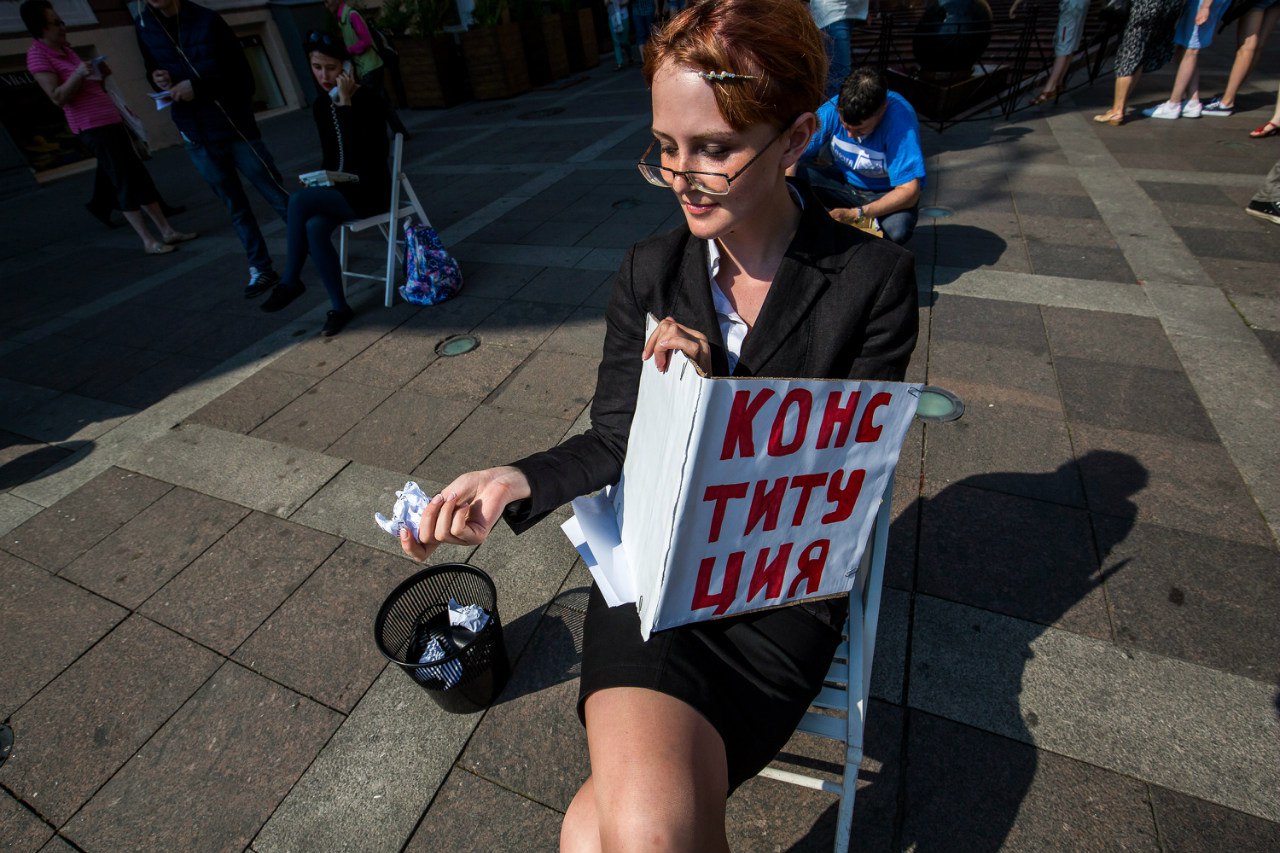
Russian MP “Irina Yarovaya” shreds Russian Constitution. Downtown Petersburg, July 3, 2016. Photo: David Frenkel

“Irina Yarovaya” Shreds Russian Constitution in Downtown Petersburg
Spring Movement (Dvizhenie “Vesna”)
July 4, 2016

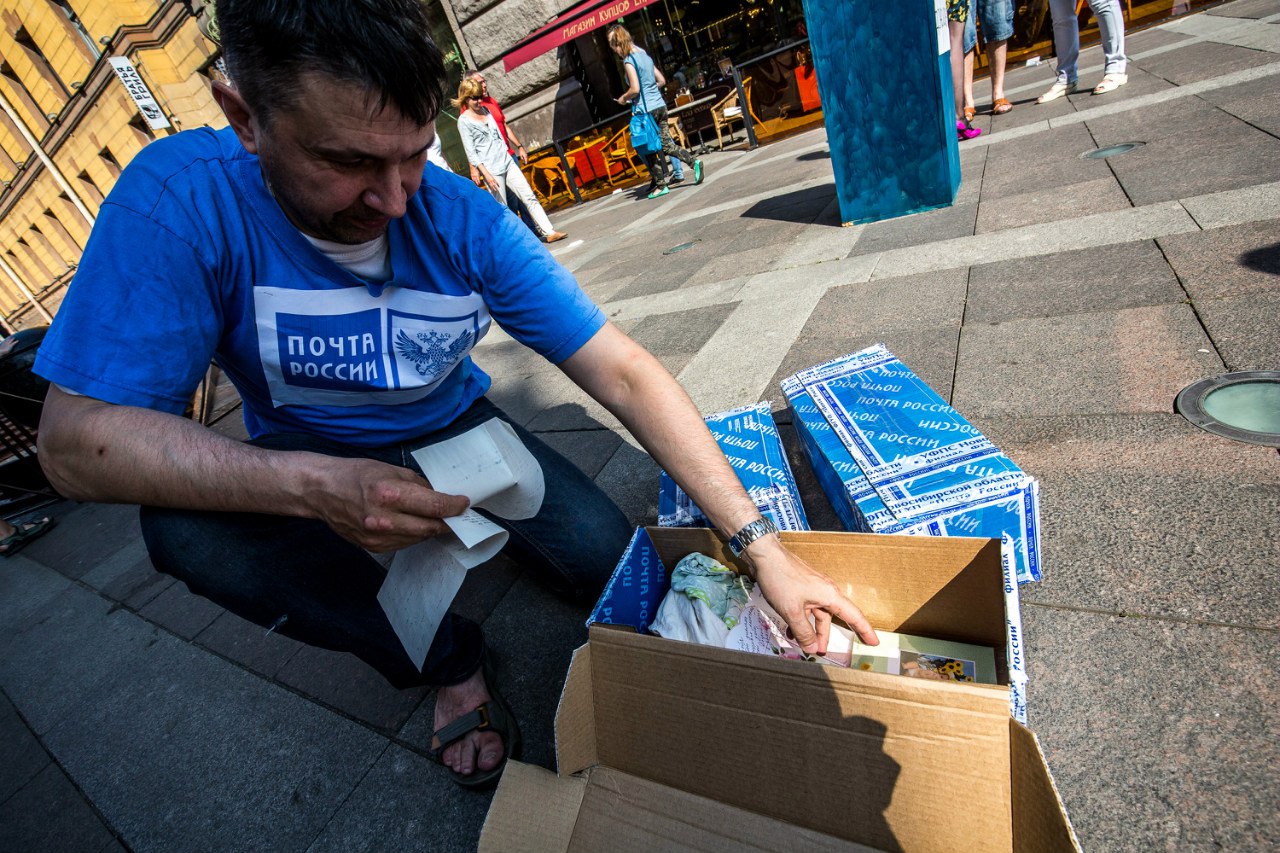
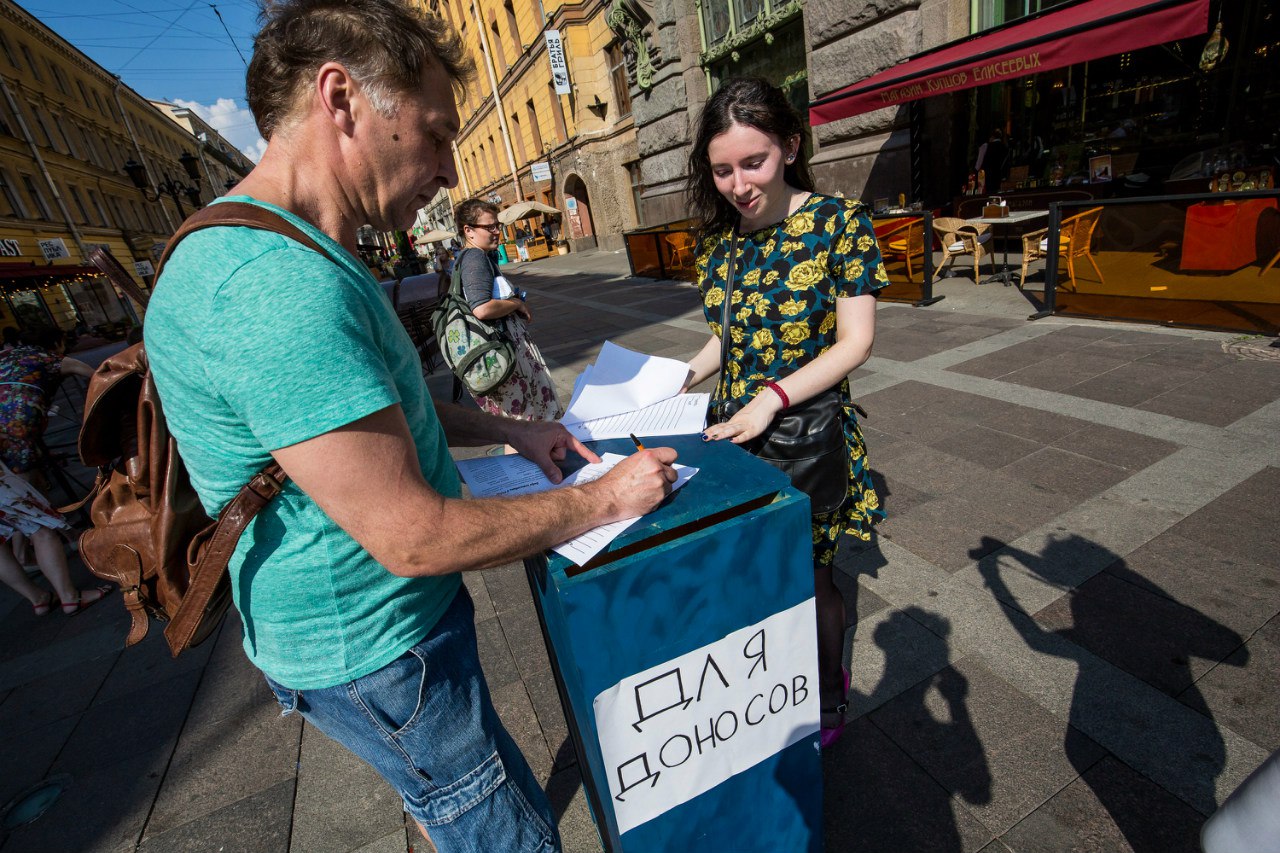
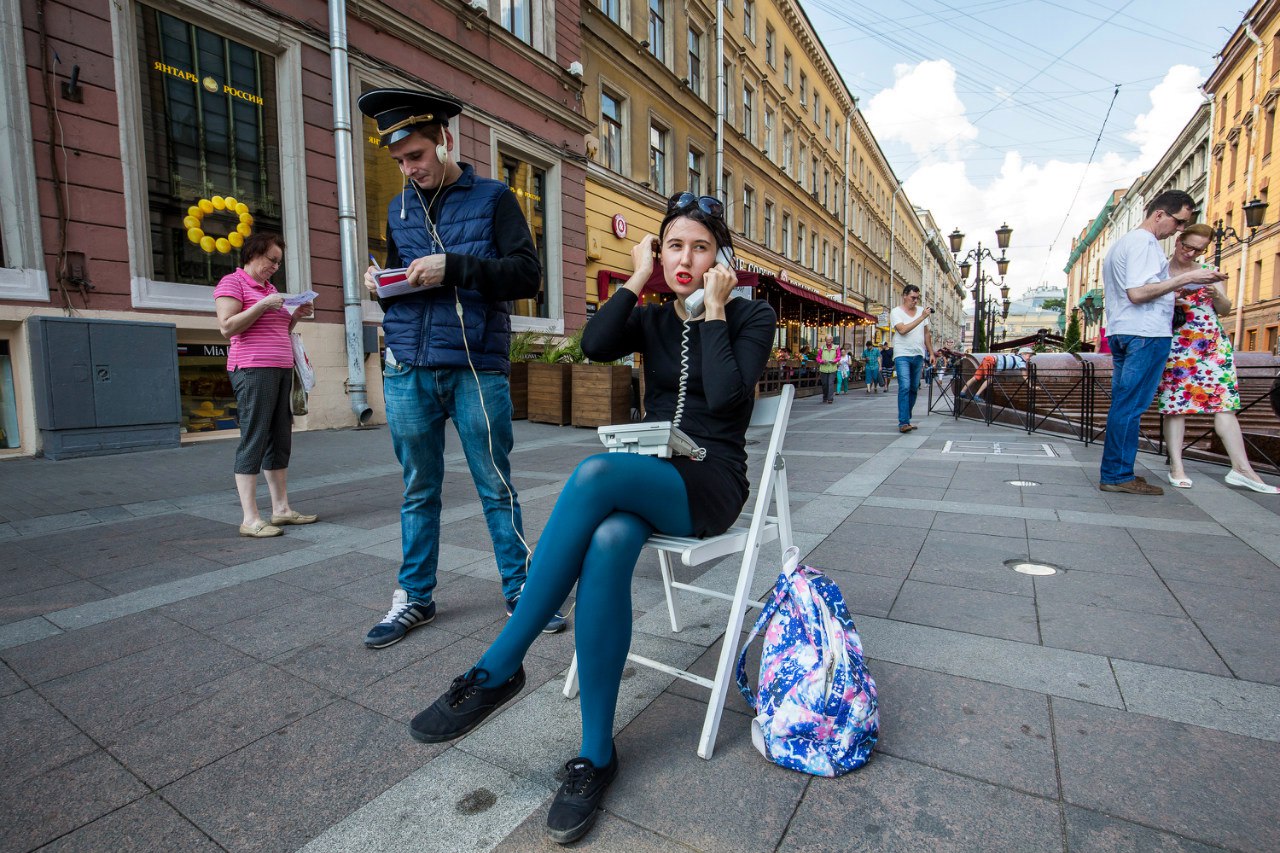
This past Sunday, “Irina Yarovaya” shred the Russian Constitution on Nevsky Prospect in Petersburg. The people’s deputy was joined by characters from her package of “anti-terrorist” laws, who had come to life for the occasion: a postal worker vetting packages, a secret policeman wiretapping a light-minded young lady’s telephone conversations, and an involved ordinary citizen encouraging passersby to write denunciations on their friends, neighbors, and coworkers.

lVjF3a3vanA
“Postal worker” vets suspicious parcels. Downtown Petersburg, July 3, 2016. Photo: David Frenkel

The activists of the Spring Movement thus attempted to draw the attention of their fellow Petersburgers to the flagrantly repressive amendments to the Russian Criminal Code, tabled by a group of MPs led by Irina Yarovaya and now approved by both houses of the Russian parliament, the State Duma and the Federation Council.

wd2SOVlwiHc
Passerby fills out “denunciation” form. Downtown Petersburg, July 3, 2016. Photo: David Frenkel

The package of amendments will not only deal a blow to our country’s constitutional foundations but will also require huge financial subsidies during tough economic times. The screws will be tightened at our expense, at the price of impassable roads, hospitals and kindergartens that will never be built, and pension savings that the state has been confiscating once again. No scientific progress, no innovations, and no quality education are in the cards for our country: only Yarovaya and her hardcore approach to lawmaking.

wQ0izA6I8HA
“Secret policeman” wiretaps an unsuspecting young lady’s phone conversation. Downtown Petersburg, July 3, 2016. Photo: David Frenkel

If the president signs the Yarovaya package into law, “non-informing” will be criminalized, “inducing, recruiting or otherwise involving” others in the “organization of mass disturbances” will be punishable by prison terms, punishment for “extremist” posts on the web and monitoring of personal correspondence will become harsher, and postal workers will be obliged to vigorously vet parcels for prohibited items.

Translated by the Russian Reader. All photos by David Frenkel

Ivan Pavlov: Ripping Up the Russian Constitution

Vladimir_Putin_with_Boris_Yeltsin-Russian-Constitution
“Before leaving the Kremlin, the first Russian president handed over a copy of the Russian constitution, used to swear in the head of state, and the Presidential Emblem to Mr Putin as a symbolic gesture.” “Boris Yeltsin handed over power to Acting President Vladimir Putin in the Kremlin,” December 31, 1999, kremlin.ru

Article 6

1. The citizenship of the Russian Federation shall be acquired and terminated according to federal law; it shall be one and equal, irrespective of the grounds of acquisition.

2. Every citizen of the Russian Federation shall enjoy in its territory all the rights and freedoms and bear equal duties provided for by the Constitution of the Russian Federation.

3. A citizen of the Russian Federation may not be deprived of his or her citizenship or of the right to change it.
—The Constitution of the Russian Federation, “Chapter 1: The Fundamentals of the Constitutional System”

_________

The Constitution Does Not Count: How the Duma Has Planned to Strip Russians of Citizenship
Ivan Pavlov
RBC
June 22, 2016

Anti-terrorism legislation is a legal grey zone in any country. The balance between protecting public security and preserving civil rights is elusive and unsteady. However, Russian MPs, already inclined to shoot from the hip, have surpassed themselves this time by having a go at no less than the foundations of the Russian Federation’s constitutional system.

One of the measures included in the packet of “anti-terrorist” amendments tabled by a group of MPs led by Irina Yarovaya (which should be adopted in its second reading on June 24) would strip Russians of their citizenship. This punishment would be meted out for terrorist and extremist crimes, joining the civil service in other countries, and working with international organizations in which Russia is not involved.

This list, I am sure, will expand as a matter of political necessity.

Previously, a person could waive his or her citizenship only on their own behest by making a written statement. Now the actions listed above have been made equivalent to this personal initiative. The relevant amendments, if adopted, would be incorporated into the law “On Citizenship.”

Depriving a person of his or her citizenship is banned by Chapter 1, Article 6 of the Russian Constitution. Chapter 1 is entitled “The Fundamentals of the Constitutional System,” meaning the ban is among our country’s most basic laws. A Constitutional Convention would have to be called to amend them. Trying to push through a initiative like this via ordinary legislative procedure looks surprisingly brazen even amid the Sixth Duma’s other legislative feats.

The wording of the bill merits special attention.

“Citizenship of the Russian Federation is terminated on the basis […] of the person’s freely declared intent, as expressed in the commission of acts stipulated by this Federal Law.”

The rationale of legislators is extremely farfetched in this case. The point is not to comply with the Basic Law but to come up with a way of bypassing the mandatory prohibition established by the Constitution.

To get a sense of how crooked this end-around would be, imagine similar wording for bypassing the moratorium on the death penalty: “The person’s voluntary departure from life on the basis of his freely declared intent, as expressed in the commission of certain acts.” This is a case when Lenin’s adage (“technically correct, but basically mockery”) applies.

Against this backdrop, the possibilities for interpreting the proposed rule broadly do not appear so dramatic, but they do exist, and they are dangerous.

“Renunciation of Russian Federation citizenship, as expressed in the commission of acts, is not allowed if the Russian Federation citizen has no other citizenship and no guarantees of obtaining it.”

What would be meant by these guarantees in practice? Anything whatsoever: relatives or even just contacts abroad, employment in foreign organizations, etc. We end up with yet another legal cudgel against “foreign agents” and the “fifth column.”

“Work in international organizations (associations) in whose activities the Russian Federation is not involved, without the consent of the authorities, unless otherwise stipulated by an international treaty of the Russian Federation”: this language provides unprecedented scope for stripping undesirables of Russian citizenship.

It is not just a matter of NGOs, although employees of Amnesty International, Greenpeace, and similar organizations risk being the first to be run over by this steamroller. Any commercial company can be construed as an international organization: all that matters is that its operations extend to several countries.

The new legislative initiative is another step toward isolating Russia from the rest of the world.

Ivan Pavlov is an attorney at law and director of Team 29. Translated by the Russian Reader