Guerillas Gone Mental: Why the Russian Secret Services Forced Kristina Snopp and Her Husband to Leave Russia

Refusing to Cooperate with the FSB and Pictures of Putin: The Story of a Couple Seeking Political Asylum in Georgia
Sofia Rusova
OVD Info
August 22, 2018

Kristina Snopp and her husband, Denis. Photo courtesy of Ms. Snopp and OVD Info

A young married couple from Krasnodar Territory have applied for political asylum in Georgia. So far, they have had two interviews with the immigration service. The couple are certain that if they weresent back to Russia they would face criminal charges and prison sentences. Sofia Rusova discovered how a reporter at a municipal newspaper and her bike mechanic husband attracted the notice of local FSB agents and the police.

Refusing to Cooperate with the FSB
“I am Kristina Snopp,  and I am afraid to return to Russia.”

This was how the 32-year-old reporter from Tuapse prefaced her asylum request to the Georgian authorities. Snopp and her husband, Denis Snopp, are currently living in a refugee center in Georgia. Snopp made the decision to leave Russia after she learned her posts on the social media network VK had been examined for “extremism” and “insulting religious believers.”

Snopp never wanted to be involved in politics. She was never a member of a political party, permitting herself to have opinions only on a few issues like religion, the environment, and Russia’s foreign policy. If she did attend protest rallies,  they mainly had to do with ecological issues. Like many residents of Tuapse she protested construction of a bulk shipping terminal by the company EuroChem in 2011.

Back in 2014, Snopp received a call on her mobile phone from an FSB officer who introduced himself as Denis. He wanted to talk with her.

“For around two hours, he grilled me about the people with whom I interacted. Moreover, he asked personal questions about my beliefs, what organizations I was involved with, and why,” Snopp recounts.

“I’m a very inquisitive person. I’m really interested in world religions and, at the time, I was hanging out with people from different confessions, with the Hindus (yogis),  Muslims, Protestants, and pagans in our area. FSB agent Denis was really interested in information about people who practiced religions other than Russian Orthodoxy. He suggested I cooperate with the FSB in combating ‘cults.’ I turned him down. Denis copied down my details and said we should stay in touch, and I should contact him if I found out something new. He told me people in Russia should be religious believers, moreover they had better be Russian Orthodox Christians, since it was the ‘state religion and the most correct religion,’ as he put it. Denis also asked me questions about my political views. I replied I was basically uninterested in politics.”

As the saying goes, if you are not interested in politics, politics is interested in you. Roughly a month after the first informal meeting, the FSB agent came to the offices of the newspaper Chernomorye segodnya [Black Sea Today], where Snopp worked, and tried to make contact with her coworkers.

Chernomorye segodnya
In 2012, Snopp officially began working at Chernomorye segodnya, the local newspaper. After Russia’s conflict with Ukraine, the editorial policies of national media outlets changed radically. This change also affected the tiny newspaper in Tuapse. When she publicly criticized Putin’s foreign policies on social networks, local internet forums, and in discussions with friends, Snopp attracted the close scrutiny of her editors and once again came to the attention of Tuapse’s intelligence services.

“I was concerned about it, since I believed Russia’s actions were mean and unfair to Ukraine. Moreover, I had friends in Ukraine, who wrote to me on social networks about the real state of affairs there, about the presence of Russian troops in Crimea and Donbass, and the lawlessness they were perpetrating even as President Putin denied it was happening. I published posts on my page on VK in which Putin was compared with Hitler,” Snopp says.

Her editors at Chernomorye segodnya knew about Snopp’s stance on Russia’s military actions in Ukraine. When she labeled it annexation outright, her editor, Alexei Chamchev, said, “Then, what are you doing here? Leave the country.”

According to Snopp,  her job became more and more emotionally complicated. The newspaper published numerous commissioned articles meant to defame specific people, as well as articles that openly encouraged hatred of Ukrainians and praised Russian politicians. Snopp would refuse to work on these articles. She mainly wrote about daily news, and cultural and religious events.

Devastated Tuapse 
In 2015, under a pseudonym, Snopp published articles about environmental conditions in Tuapse on the website Proza.ru and VK. She wrote about environmentally harmful industrial facilities, the increase in incidences of cancer and high levels of unemployment in the city, and how city hall hushed up the problems.

“At press conferences, I would post straight, tough questions to regional ecologists who argued that all the indicators were well within the norms. My boss knew about it, of course. When I arrived in Tuapse as a student in 2001, the city was still beautiful and thriving. Lots of tourists visited the city. Gradually, the industrial estates expanded so much they literally consumed all the beauty of those places. The ugly oil tanks, the industrial buildings, the fumes, steam, and chemical dust produced by the factories, and the oil waste pouring into the river and the sea have disfigured and poisoned my beloved city. There is a lot to say about the harm caused to the locals,” says Snopp.

Dismissal from the Newspaper
There were no actual reasons to fire Snopp from her  job at the newspaper, but immediately after the 2016 New Year’s holiday, she was urged to quit her job on her own, as it were.

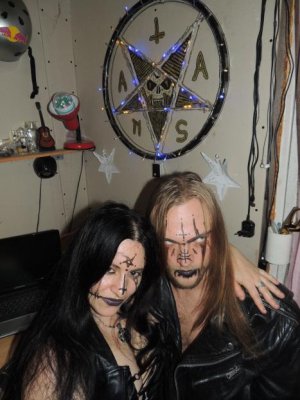
kristina_d.rThe photograph that supposedly led to Kristina Snopp’s dismissal from her job. Courtesy of Ms. Snopp and OVD Info

The ostensible cause for her dismissal was a playful, artsy photo shoot in which Snopp and her husband, dressed in black leather, portrayed Satanist metalheads, an inverted pentagram hanging in the background.

“The editor told me privately the real reason I was fired was something else. People in city hall had long been advising him to get rid of such a politically unreliable reporter,” says Snopp.

Krasnodar
After her dismissal from the newspaper in Tuapse, Snopp and her husband moved to Krasnodar. Snopp thought she would have no trouble finding work in the big city. At first, she looked for jobs in journalism. She had dozens of interviews and completed various assignments, but she was constantly turned down.

Snopp decided to write for her own pleasure while earning money another way. She got a job as a shop clerk at a tobacco chain store. Soon, however, the proprietor got a phone call from an anonymous caller who informed him Snopp was a member of an “extremist” organization. She was fired.

In February 2018, police officers telephoned Snopp’s relatives and her husband’s relatives, demanding they provide them with the couple’s exact address.

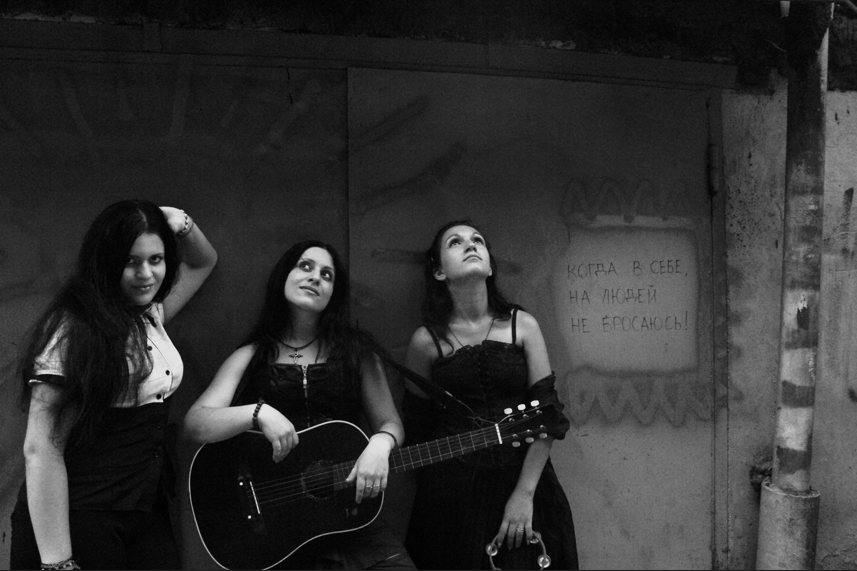
“On February 14, police showed up at Denis’s workplace. They wanted to see me as well. Denis called, and I went there. We were not given an official written summons. Nothing was explained to us. We were told we would have to go to the Interior Ministry’s main office for Krasnodar Territory.  Police Captain Denis Polyantsev assured us both it was no big deal. He just needed information from us. However, Polyantsev joked I could have been as famous as Nadezhda Tolokonnikova, meaning my amateur punk rock group Guerillas Gone Mental, which I founded in 2012. According to Polyantsev, it was the group that had provoked suspicions of ‘extremism,'” says Snopp.

guerillas gone mentalA photo of Kristina Snopp’s punk rock group Guerillas Gone Mental. Courtesy of the band’s VK page

The couple were delivered to the Center for Extremism Prevention (Center “E”), whose officers asked about posts Snopp had published three years earlier on a social media page that had been deleted. Among the posts was a demotivator in which Putin was compared with Hitler, and parallels were drawn between Nazi Germany’s annexation of the Sudetenland in 1938 and Russia’s annexation of Crimea in 2014. Questions were also asked about post critical of the Russian Orthodox Church (ROC), for example, a demotivator in which an ROC priest blesses a missile dubbed Satan.

“I regarded these posts and cartoons more as political satire, the reaction of a concerned citizen to events in Russia. I had no intention of insulting anyone. Nevertheless, the Interior Ministry’s forensic examiners decided that by posting the cartoons I had incited hatred toward the president, Russian patriots, and Russian Orthodox Christians. I was shown a thick folder containing screenshots of my posts from various years and forensic findings I was not allowed to read,” says Snopp.

foto_s_cherepomA photo of Kristina Snopp holding what looks to be a skull. According to a police forensic examination, the skull was real. Photo courtesy of Ms. Snopp and OVD Info 

A photograph of Snopp holding a skull, taken in a cemetery during an amateur goth style photo shoot she published on her VK page, also caused suspicion among police officers. Polyantsev told Snopp forensic experts who examined the photos determined it was a real human skull. However, the online album containing the photos was captioned, and the captions clearly explained the skull was a fake. To be more precise, it was a piggy bank, purchased for 500 rubles at a souvenir stand in the railway station market in Tuapse.

Snopp says Polyantsev constantly put pressure on the couple during their questioning. He cited facts from her life and the lives of her relatives, suggesting he knew everything about them.

“Alas, my husband and I were so out of it that we went to the meeting without lawyers. We didn’t think about it from a legal viewpoint. We did not ask for copies of the summons, the forensic examinations or our own testimony. Basically, we had no written proof of what happened to us. However, the Russian police operate this way quite often, aware most people are illiterate when it comes to the law and lose their cool in these circumstances. Besides, we did not have the money to pay the fee the lawyer initially requested,” recounts Snopp.

Almost a month later, Polyantsev telephoned Snopp again. He informed her that the case file, containing her posts on VK, had been sent to Tuapse. She would need to go meet a police investigator on March 20, 2018, a meeting at which she would be given an official summons. Snopp realized if she signed for receipt of the summons, she would also be made to sign a form releasing her on her own recognizance and would probably be charged with several crimes, including “extremism.”

Snopp left Russia on March 18, the day of the last presidential election. Soon afterwards, her husband,  who had stayed on in Krasnodar to work, got a call from Polyantsev, who told him that if he did not tell investigators where his wife was, he would be accused of harboring a criminal. Several days later, Denis Snopp left Russia as well.

When they arrived in Georgia, Kristina and Denis Snopp applied for political asylum. They have had their second interview with immigration officials.

Translated by the Russian Reader


Judgement Day: Russia’s Rabid Crackdown on Jehovah’s Witnesses

yuri zalipayevIs Russian Jehovah’s Witness Yuri Zalipayev an “extremist”? Should he be imprisoned for five years for exercising his right to freedom of conscience, as guaranteed by the Russian Constitution? Photo courtesy of jw-russia.org

Not Everyone Shall Be Guaranteed the Freedom of Conscience: How Russia Has Been Persecuting Jehovah’s Witnesses
Marina Muratova
OVD Info
August 23, 2018

Believe what you will, but do not do it openly is how the freedom of religion should now be interpreted in Russia. The authorities have sent over fifty people to court for praying and reading the Bible together. Jehovah’s Witnesses have had their homes searched and been arrested like people suspected of grave offenses. The grounds for these actions is the argument that the practice of their faith is a “continuation of the activities of an extremist organization.” OVD Info investigated the charges.

Everyone shall be guaranteed the freedom of conscience, the freedom of religion, including the right to profess individually or together with others any religion or to profess no religion at all, to freely choose, possess and disseminate religious and other views, and act according to them.
—Article 28, Constitution of the Russian Federation

Russia vs. the Jehovah’s Witnesses
23 criminal cases in 18 regions of Russia, 53 people charged, 13 suspects. 31 people released on their own recognizance, 9 people under house arrest, 26 people in remand prisons. Several people assaulted by police during searches of their homes, the doors of those homes kicked down in nearly all cases. Nighttime interrogations, confiscated electronic devices, papers, and money, blocked bank accounts.

On April 20, 2017,  the Russian Supreme Court shut down the Administrative Center of Jehovah’s Witnesses in Russia for violating the law against “extremism.” All 395 official chapters of the Jehovah’s Witnesses in Russia were banned. The EU’s mission to Russia said the ruling could lead to arrests. That is what has happened.

The Charges
Believers gather to pray and read the Bible, meaning they continue the work of a banned organization, according to Russian police investigators. There are few exceptions: nearly all the Jehovah’s Witness who have been detained have been charged with violating Russian Criminal Code Article 282.2 (“organization of and involvement in the work of an extremist organization”).

Danish national and Jehovah’s Witness Dennis Christensen was, among other things, charged with financing extremist activities. The prosecutor submitted to the court records,  allegedly showing that money was transferred from the account of the Jehovah’s Witnesses after the church was shut down. It transpired the transactions in question had been executed by the bank itself after the Jehovah’s Witnesses had been dissolved as a legal entity. Another Jehovah’s Witness, Yuri Zalipayev, stands accused of inciting assaults on Russian Orthodox Christians and Muslims. Zalipayev’s defense attorney is sure police investigators cooked up their evidence and then tried to conceal the frame-up.  Arkadya Akopyan, a 70-year-old tailor, has also been charged with insulting Muslims and |Russian Orthodox Christians. There is no audio or video evidence, only a witness’s testimony.

arkadya akopyanIs Russian Jehovah’s Witness Arkady Akopyan an extremist? Photo by Diana Khachatryan. Courtesy of Takie Dela

Police Searches of Homes
Russian law enforcement authorities usually conduct searches simultaneously in the flats of several Jehovah’s Witnesses early in the morning. Jehovah’s Witness have often reported violations on the part of police during these searches. In the case of the Polyakov family in Omsk, the security services busted down the door to their flat, prevented the Polyakovs from telephoning relatives, and smashed Mr. Polyakov’s face. (Doctors recorded his injuries only two days later.) When the Polyakovs attempted to voice their disagreement with the actions of police  in the official search report, police wrested the form from their grasp.  During searches and interrogations in Penza, a police investigator forced six female Jehovah’s Witness detainees to strip naked.  In Saratov Region, the security forces mistakenly sawed off the door of the wrong flat. In another flat the same day, the police discovered banned literature in the sleeve of a child’s overcoat. Jehovah’s Witnesses believe the police planted it there.

In the city of Shuya, Ivanovo Region, police interrogated a 10-year-old girl, and the list of items confiscated during the police search of her family’s flat included sheet music and a pupil’s grade book from a music school. In Kabardino-Balkaria, one group of security officers stormed a flat through the balcony, although the flat’s female occupant had opened the front door to another group of security officers. In Birobidzhan, 150 law enforcement officers took part in numerous searches carried out on the same day: the operation was codenamed “Judgement Day.” Police have seized digital gear, books, Bibles, diaries, photographs, and bank cards during the raids. The raids and subsequent interrogations have lasted several hours.

Jehovah’s Witnesses have not only been detained in their homes. Police caught up with Andrei Stupnikov of Krasnoyarsk at an airport at four in the morning as he and his wife were checking into a flight to Germany. A court later jailed Stupnikov, since he could have received political asylum, as the judge put it. Alexander Solovyov was detained when he stepped off a train after returning to Perm from holiday.

Custodial Measures
Most of the Jehovah’s Witnesses who have been charged with criminal offenses have been incarcerated in remand prisons.  The defense attorney representing Sergei Klimov of Tomsk told OVD Info that Klimov spent two months in a solitary confinement cell measuring 1.7 meters by 2.8 meters, allegedly, because it was impossible to find room for him in an ordinary cell. On August 8, at an appeals hearing, Klimov was left in police custody, but he was transferred out of solitary into gen pop.

After time spent in remand prisons, several Jehovah’s Witnesses have been released and placed under house arrest. Konstantin Petrov of Magadan spent 64 days in jail, while several Jehovah’s Witnesses in Orenburg spent 78 days in jail each.

Vitaly Arsenyuk, a resident of the town of Dzhankoy in northern Crimea, was charged with engaging in illegal missionary work, a violation of Article 5.25 Part 4 of the Russian Federal Administrative Offenses Code. After the first hearing in his case, in June 2017, Arsenyuk died of a heart attack.

Some Jehovah’s Witnesses have spent months in pretrial custody. Danish national Dennis Christensen has spent over a year in a remand prison. No one has yet been sentenced to hard prison time, but the courts have been indulgent to Jehovah’s Witnesses only on rare occassions. In 2017, a court acquitted Vyacheslav Stepanov and Andrei Sivak of Sergiev Posad, who had been charged with inciting hatred or enmity on the strength of a video recording of worship services. In May, an appellate court freed 55-year-old Alam Aliyev. On August 9 and 10, a court in Kamchatka overturned earlier decisions remanding Mikhail Popov in custody and placing his wife Yelena under house arrest.

Community Property
In all regions of Russia, buildings constructed or purchased by Jehovah’s Witnesses have generally been seized and turned over to the state. In Petersburg’s Resort District, the state took possession of a complex valued at around two billion rubles [approx. 25 million euros], a complex from which the authorities had received hefty tax payments for many years. Over the course of seventeen years, state inspectors never found a single violation at the complex, but now the local courts refuse to recognize the rights of Jehovah’s Witnesses to the property or the official deeds to the complex.

Reactions
The EU delegation to the OSCE, the Parliamentary Assembly of the Council of Europe (PACE), the Russian Presidential Human Rights Council, and human rights activists have spoken out against Russia’s persecution of Jehovah’s Witnesses.

Dennis Christensen’s arrest led to the initiation of legal proceedings at the European Court of Human Rights (ECHR) in Strasbourg. On May 15, 2015, the Kingdom of Denmark was admitted as a third party to the case of Christensen v. Russian Federation.

In response to the complaint filed with the ECHR, Russian envoys at the ECHR and UN claimed Jehovah’s Witnesses still had the right to practice their religion despite the dissolution of their congregations. It was at this same time, in the spring of this year, that the number of arrests of Jehovah’s Witnesses in Russia went through the roof.

The International Memorial Society has already recognized 29 Russian Jehovah’s Witnesses as political prisoners. A total of fifty Jehovah’s Witnesses have been subjected to persecution by the authorities.

  • Oryol: Dennis Christensen, Sergei Skrynnikov
  • Omsk: Sergei and Anastasia Polyakov
  • Penza: Vladimir Alushkin, Vladimir Kulyasov, Denis Timoshin, Andrei Magliv, and four more unnamed people
  • Tomsk: Sergei Klimov
  • Saratov: Konstantin Bazhenov, Felix Makhammadiyev
  • Village of Shirokoye, Saratov Region: Alexei Budenchuk
  • Magadan: Sergei Yerkin, Yevgeny Zyablov, Konstantin Petrov
  • Khabarovsk: Ivan Puyda, Vladimir Moskalenko
  • Naberezhnye Chelny: Ilkham Karimov, Konstantin Matrashov, Vladimir Myakushin, Aidar Yulmetiev
  • Orenburg: Vladimir Kochnev, Alexander Suvorov, Vyacheslav Kolbanov
  • Polyarny, Murmansk Region: Roman Markin, Viktor Trofimov
  • Shuya, Ivanovo Region, Dmitry and Yelena Mikhaylov, Svetlana Shishina, Alexei A., Svetlana P.
  • Vladivostok: Valentin Osadchuk
  • Nakhodka: Dmitry and Yelena Barmakin
  • Krasnoyarsk: Andrei Stupnikov
  • Perm: Alexander Solovyov
  • Sol-Iletsk, Orenburg Region: Boris Andreyev
  • Village of Perevolotsky, Orenburg Region: Anatoly Vichkitov
  • Kostroma: Sergei and Valeria Rayman
  • Vilyuchinsk, Kamchatka Territory: Mikhail and Yelena Popov
  • Beryozovsky, Keremovo Region: Sergei Britvin, Vadim Levchuk
  • Maysky, Kabardina-Balkaria: Arkadya Akopyan
  • Lensk, Yakutia: Igor  Ivashin
  • Pskov: Gennady Shpakovsky
  • Birobidzhan: Alam Aliyev
  • Yelizovo, Kamchatka Territory: Konstantin Bazhenov
  • Belgorod: Anatoly Shalyapin, Sergei Voykov

This list was supplied to us by the European Association of Jehovah’s Christian Witnesses and defense attorney Artur Leontiev.

Freedom of Conscience
OVD Info asked attorney Artur Leontiev, who has been handling the defense of Sergei Klimov and Andrei Stupnikov, as well as the case of the property owned by the Jehovah’s Witnesses in St. Petersburg, to comment on the persecution of the Jehovah’s Witnesses.

“Law enforcement agencies have been criminally prosecuting believers for ordinary, peaceful professions of faith, as when they gather in small groups to read and discuss the Bible, watch videos on biblical topics, and so forth. The security forces got it into their heads that this constituted a continuation of the activities of an organization dissolved by the court. However, the believers who have been charged with these crimes had nothing to do with the legal entities that were dissolved and were not parties to the proceedings in the Russian Supreme Court.

“Believers’ phones were tapped, their letters were vetted, and they were followed. The security service thus amassed a fair amount of operational material. I think the heads of the various agencies decided to use it to improve their conviction rates, all the more so since the peaceable Jehovah’s Witnesses were easy targets. They have always tried to be law-abiding. Even now they do not regard themselves as criminals. They evince no aggression, imagining the injustice that has befallen them is a misunderstanding that will soon be cleared up. Actually, they are faced with a choice: refuse to practice their religion or be prepared to endure all the delights of criminal prosecution. However, the law enforcers doing the dirty work in the locales often understand what is really going on, but they are guided by the principle of ‘I have my orders, and I have a family to feed.’

“The complaint (Administrative Center of Jehovah’s Witnesses in Russia and Kalin v. Russian Federation, Case No. 10188/17) has been filed with the ECHR and accepted for review, the parties have exchanged comments, and the case has been expedited. Complaints have also been filed with the ECHR for each particular instance of criminal prosecution of Jehovah’s Witnesses.

“It is vital, however, the Russian legal system kicked into gear and operated not on the basis of expediency, but according to the law. Whatever you feel about the Jehovah’s Witnesses, they have the same right to their beliefs and the same right to a fair trial as other Russians.”

Translated by the Russian Reader

Smile! You’re on Hidden Camera

sure we can

Center “E” Surveilled Belgorod Family or Nine Months via Camera Hidden in Flat
OVD Info
August 24, 2018

In Belgorod, officers of the Center for Extremism Prevention (aka Center “E”) watched a married couple for nine months using a camera hidden in their flat, reports TV Rain, citing defense attorney Anton Omelchenko.

The couple was suspected of involvement with the Jehovah’s Witnesses. A court gave Center “E” permission to use the camera for three months on three occasions.

“Law enforcement agencies put hidden cameras in homes to record people playing. Criminal charges were filed as a result. One of the cases in Belgorod simply slayed me: a married coupled in a one-room flat who were under surveillance for nine months round the clock. Everything was really noted in the case files. The couple would watch TV and say something negative about the regime, and the field officers would immediately write down, ‘Criticized regime.’ There was a complete transcript of the entire surveillance. I also found this shocking,” Omelchenko told the TV channel.

Since their case has not yet been heard in court, Omelchenko did not name the couple who were under surveillance. It is known they have left Russia.

Photo and translation by the Russian Reader

Mind What You Post Online, or You’ll Be Sent to the Loony Bin

watchingThey’re watching your every word.

Police Investigators Request Compulsory Psychiatry Treatment for Joke on VK Social Network
OVD Info
20 August 2018

Police investigators in Petersburg have asked a court to commit Eduard Nikitin, a disabled man charged with arousing enmity by posting a joke on the VK social network, to compulsory psychiatric treatment, writes Interfax news agency.

Petersburg’s Nevsky District Court is currently hearing the case in closed chambers.

The charges against Nikitin were filed in 2017. He was accused of violating Article 282 of the Russian Federal Criminal Code for posting a caricature and joke on his personal page on the VK (Vkontakte) social network in 2015.

“He was given a psychiatric evaluation. Police investigators have asked the court not to criminally prosecute him, but to have him committed to compulsory treatment,” Maxim Kamakin, the accused man’s attorney, explained to Interfax.

Forensic examiners discovered “extremism” in a joke in which a character doubts the positive changes after an election, as well as in the use of the word vatnik in a caricature.

“This is the first time I have heard of charges like this being filed for a joke, albeit not the most decent joke and a political one to boot,” Kamakin added.

Nikitin said he was summoned by police investigators as part of an enquiry in 2016. Subsequently, the investigators did not contact him for over a year. In late 2017, however, Nikitin received notification of criminal proceedings.

Photo and translation by the Russian Reader

Network: Parents versus the FSB

Network: Parents of Anarchists versus the FSB
Alexei Polikhovich and Ksenia Sonnaya
OVD Info
July 30, 2018
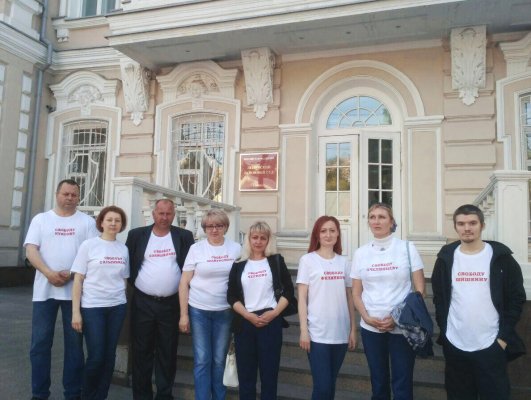
Members of the Parents Network. Photo courtesy of OVD Info

Eleven antifascists from Penza and Petersburg have been charged in the case against the alleged “terrorist community” known as the Network. Many people have got used to news of the violence, threats, and electrical shock torture used against the suspects in the case, but the accused themselves and their loved ones will probably never grow inured to such things. The parents of the accused came together in a committee known as the Parents Network. They have been trying to do something to help their loved ons.

The Russian Federal Security Service (FSB) claims the Network is an international organization. Aside from Penza and Petersburg, secret cells were, allegedly, established in Moscow and Belarus. Yet no one has been arrested either in Russia’s capital or abroad. Meanwhile, the Parents Network is definitely an international organization. Aside from Penza, Petersburg, Moscow, and Novosibirsk, the committee has members in Petropavlovsk, the city in Kazakhstan where Viktor Filinkov’s mother lives.

Members of the Parents Network have appeared at two press conferences, in April and May of this year. They have established a chatroom on Telegram where they discuss new developments in the case, exchange opinions, share impressions of hearings and interrogations, and give each other support. In addition, the parents try and force reactions from Russian government oversight and human rights bodies. They write letters to Russia’s human rights ombudsman and the Presidential Human Rights Council, and file complaints with the Investigative Committee and the Russian Bar Association.

OVD Info spoke with members of the Parents Network.

Tatyana Chernova, Andrei Chernov’s mother, shop clerk
All this kicked off in March at the next-to-last custody extension hearing in Penza.

I went to see Ilya Shakursky. I knew reporters and human rights advocates would be there. I just approached the people who had come to the hearing and asked for help. One of those people was Lev Ponomaryov, leader of the movement For Human Rights. He responded and proposed meeting in Moscow.

I didn’t know any human rights activists. I didn’t know where to go or to whom to turn, since I’d never dealt with this. When I’d discuss it with my daughter, she would scold me, telling me we had to wait or we might make things worse.

My husband and I went to see Lev Ponomaryov. We said we didn’t know what to do. We had a lawyer. Our lawyer did his job, while we, the parents, didn’t know how to help. We were told to take a pen and sign up, that the first thing to do was unite with all the other parents. I found their telephones numbers and gradually called all of them.
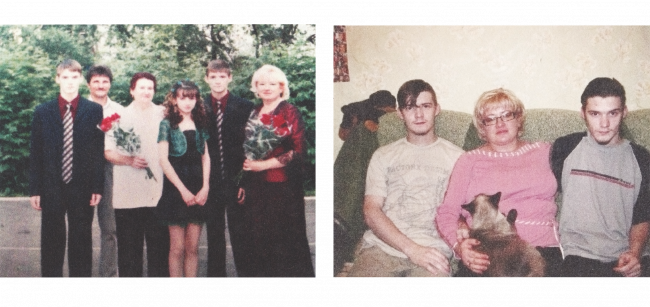
Andrei Chernov’s family

I couldn’t get hold of Lena Shakurskaya. I sent her an SMS, saying I’m so-and-so’s mom, I want to talk, if you want to talk, write. She called me right back. Everyone was probably waiting for it. We shared a misfortune, and it brought us together. Our first meeting was at Lev Ponomaryov’s office. Lena came to Moscow for the meeting. It was only there she heard the whole truth. Mikhail Grigoryan, Ilya’s former lawyer, had been telling her a different story. The Pchelintsevs met her. They told her what was going on. Lena was made sick by what she found out.

We try to have each other’s backs. The blows are such that it’s hard to take. Yes, I have friends. But I can call Sveta Pchelintseva or Lena Bogatova, say, knowing they’ll know where I’m coming from, because this is part of our personal lives.

Yelena Bogatova, Ilya Shakursky’s mother, shop clerk
We had a lawyer, Mikhail Grigoryan. He warned me against communicating with the relatives of the other lads. He said each of us had to defend their own son. Nothing good would come of fraternizing. I listened to him.

In March, I saw Andrei Chernov’s mom. Again, at Grigoryan’s insistence, I didn’t go up to her or chat with her. Later, I had doubts. I wanted to talk to someone. God was probably reading our minds: it was then Tatyana Chernova sent me an SMS. We got in touch on the phone. I went to Moscow without telling the lawyer. We met with human rights activists. We discussed how to talk about the kids.

It’s really rough when you’re on your own in these circumstances, but now we are together. You realized you’re not alone and our boys are not alone. What we do is mainly for them. We put on these t-shirts when we go to hearings so they can see we are fighting. We have gone to all the hearings together so they see we’re all together.

At first, I was a “cooperative” mom. I was friendly with the investigator. We would talk. He said unflattering things about the other parents. Grigoryan would ask me to meet with Ilya to “talk sense” into him. The investigator would talk to me, telling me that if I was a good mom, I would get the message through his head, that is, if we had a good relationship, as I had told him. Then I would get to see Ilya for ten minutes.

Yelena Bogatova and Ilya Shakursky

In February, when Ilya signed a statement saying he had not been tortured, his uncle and I persuaded him to sign the paper. We didn’t understand a thing, of course. Grigoryan said Ilya had to sign the paper. He said he was working for us and Ilya shouldn’t be obstinate, but should sign everything he asked him to sign.

Ilya stared at me.

“Mom, what are you doing?” he said. “I’m not guilty of anything.”

“Sign it or things will get worse for you, and I’ll have it worse. I won’t see you again,” I said to him.

I was selfish, drowning in my own grief. I pushed my son into doing it because I felt sorry for myself. The FSB used me. Yes, you can see him, but make him to sign this. Hold his hand.

It’s psychologically easier for me now. I feel strong inside. I have the confidence to keep going and try and rescue the boys from the paws of the FSB. I don’t have any friends per  se anymore. At first, they would call and ask about things, but then they would do it less and less often. I don’t know, maybe they’re afraid of the FSB. They’re afraid of calling me once too much because they know my phone is bugged.

On the other hand, I have a sense of how many friends Ilya has. I communicate with the Parents Committee and Ilya’s friends, who are not afraid of anything. We talk on the phone. They visit Ilya’s grandma and help. They water the garden and go to the store, just like Timur and his friends.

Natalya, Viktor Filinkov’s mom, businesswoman
It was like a bolt out of the blue. Viktor’s wife, Alexandra, wrote to me. I was ready to go see him that very minute, but I was told it would be better for me not to show up in Russia for the time being. I live in Petropavlovsk in northern Kazakhstan, which is not far from Omsk. It’s sixty kilometers to the Russian border.

Then I could not wait any longer. I said I was going to Petersburg, come what may. Everyone was surprised I was allowed to see him. I was the first parent allowed to see their child. But it was so little time. It was so hard to talk to him through the glass.

“Mom, I’ve been tortured,” he said.

I could see he had a scar. He told me to stay strong and be reasonable about what was happening.
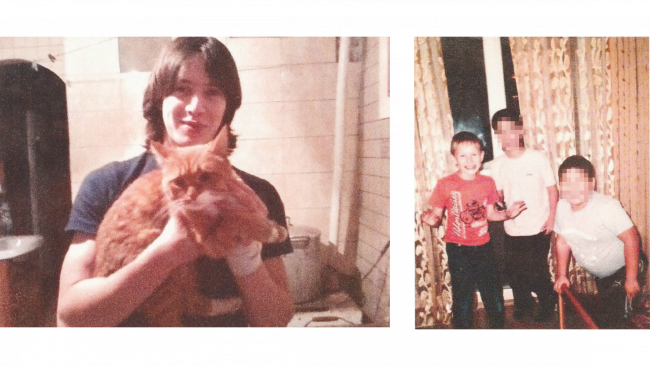
Viktor Filinkov

I’d never been interested in politics. Now, though, I’m interested. I’m interested in Russian politics and Kazakhstani politics, and I read all the news straight through. I read about what incidents happened where, who was tortured where, who has been framed, who has been protected. I read everything about what’s happened to antifascists and anarchists everywhere.

I think about why I don’t live in Russia, in Petersburg. I cannot move right now. It’s complicated to do the paperwork, register as an immigrant, and get a temporary resident permit. The thing that causes me the most pain is the thought they could ban me from entering the country.

Nikolai Boyarshinov, Yuli Boyarshinov’s father, artist
It’s a terrible state, which everyone has been through, when you suddenly find out your son has been arrested, and the charges are so absurd. You have no idea at all what to do. It’s a wall against which you beat your head. You quite quickly realize you’re completely powerless.

I joined the Parents Network when it had quite a few members. I was completely crushed then. At first, I imagined it existed for its own sake, to keep from going insane. But then I noticed it got results. By then I had completely recovered from my initial state, so I did things, thought about things, and discussed things. Being involved in the Parents Network was my salvation.

We have a chat page on Telegram. In contrast to the Network, which the FSB concocted, we don’t hide the fact we have a Network. If you think our children organized a criminal Network, then our Network is probably criminal, too.

Our actions get few results, perhaps, but it is this way, bit by bit, that you build up the desire to do something to improve the conditions in which the boys are incarcerated.  Publicity was their salvation, after all. It’s not a matter of getting them released yet. We are still thinking about how to keep them alive.

That was how it happened with my son. I saw him at the first custody extension hearing, a month after his arrest. I saw what he looked liked when he arrived at the courthouse. He looked drab and battered. He had fresh bruises on his head. You could see that it couldn’t go on for long like that. His friends, thirty people or so, came to the next hearing. When he saw everyone, he was happy. A new phase began after that. It was clear that at least they wouldn’t kill him.
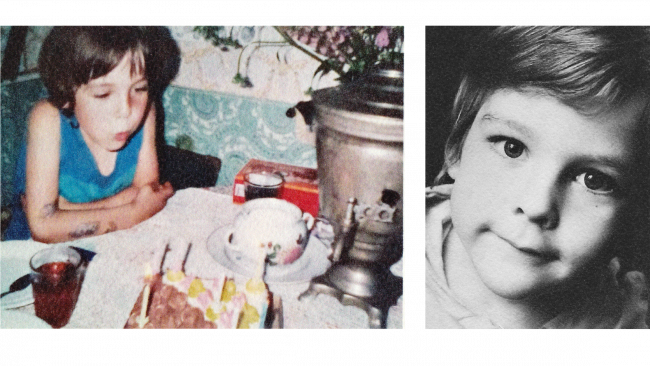

Yuli Boyarshinov in childhood

It was a turning point for me. When everything went public, it saved my son’s life. Yet now I’m afraid the publicity will die down and the boys will again be isolated, and the nightmare will recommence. That’s why I never turn down an interview.

I go out picketing on Fridays. I had doubts when the World Cup was underway. The first day I had the sense I was preventing people from enjoying themselves, but I decided to keep going out. Something unexpected happens each time. A young man came up to me and said he knew nothing about the Network. He walked away, apparently looked in the internet, and came back. I told him about the other boys.

“I don’t share those views,” he said.

“It doesn’t matter now whether you’re leftist or rightist,” I replied. “What matters is that you have views, and that is sufficient grounds to arrest you and charge you with a crime.”

The Parents Network is now like a family. We’ve agreed that when this travesty of justice is over, we will definitely have a reunion with everyone. Everyone has become family. Viktor’s mom lives in Kazakhstan, and his wife had to escape, so when I take care packages to Yuli, I take packages for Viktor, too. I really want to meet all the boys. I’m worried sick about all of them. My wife sometimes reads an article about Dima Pchelintsev or Viktor, and she cries. We feel like they’re our children.

Yelena Strigina, Arman Sagynbayev’s mother, chief accountant 
The first to get together were the people in Penza, the Pchelintsevs and the Chernovs. I joined along the way. The defense lawyers had to sign a nondisclosure agreement, so we had to go public with all our problems.

I live in Novosibirsk. We all stay in touch through a certain banned messenging site. When we were at the hearings in Penza, we made t-shirts emblazoned with the logo “Free [son’s surname].” It might look like a game to outsiders, but we have to stay afloat. It’s important to do something. And to publicize everything that happens.
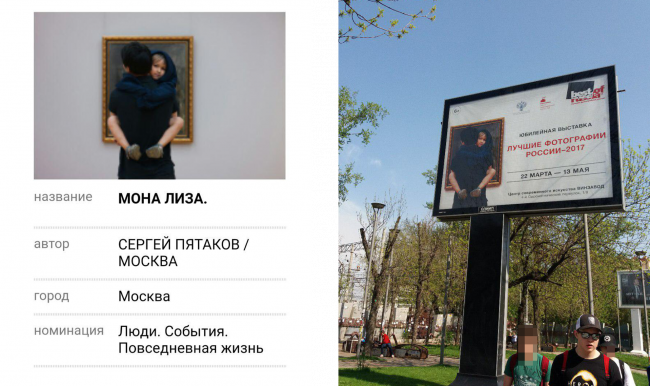

Arman Sagynbayev and his niece. Screenshot from the website of the Best of Russia competition (left); photo of a billboard in Moscow (right)

Arman has a serious chronic illness. There was no point in torturing him. His first testimony was enough to send him down for ten years. He testified against himself more than he did against the others. He was extradited from Petersburg to Penza. Along the way, the men who were transporting him opened the doors when they were in the woods and dragged Arman out. They promised to bury him alive. That was at night. In the morning, he was taken to the investigator for questioning. When people are under that kind of pressure, they would say anything. I would say I’d attempted to invade Kazan and blow up chapels.


Arman Sagynbayev in childhood

I kept the story secret from friends and relatives. But after the film about the case on NTV, everyone called and started looking funny at me. The news even made it to the school that Arman’s little brother attends. Imagine: your brother is a terrorist. It was a good thing honest articles had been published at that point. I would send people links to them. Thanks to those articles, people read a different take on events, and we have been protected from a negative reaction from society.

Svetlana Pchelintsev, Dmitry Pchelintsev’s mother, cardiologist
The Parents Network has empowered us a hundredfold. By joining together, we are no longer each fighting for our own son, we are fighting for all the boys. We love kids we don’t know at all, kids who are complete strangers, as if they were our own kids. Our hearts ache for each of them. I think it’s wonderful. A whole team of parents fighting for all the boys. What can stop parents? Nothing can stop them.

What has happened is terrible. Whether we like or not, we have to go on living while also helping the children. So, when one mom has a moment of weakness, she can telephone another mom, who is feeling the opposite emotions. It’s vital when a person hears that support.
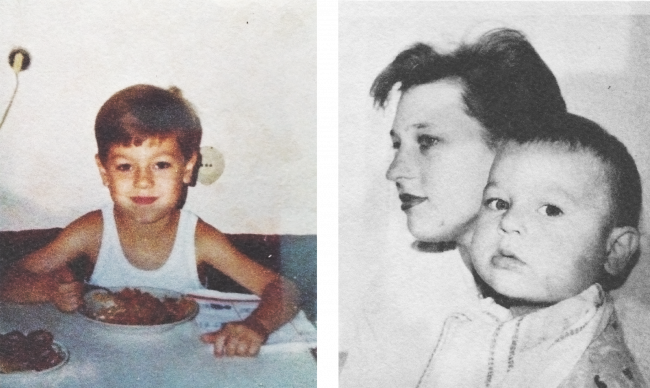

Dmitry Pchelintsev in childhood

Dmitry Pchelintsev, Dmitry Pchelintsev’s father, engineer
We are a committee of parents. What we do is support each other. We live in Moscow, but our son is jailed in Penza. The parents who live in Penza visit our son. Our kids, as it turns out, belong to all of us. We were in Penza and we gave all the children all their care packages at the same time. If we talk with the warden of the remand prison, we speak on behalf of all the kids.

This has helped us and helped our children. We get emotional support. It’s one thing when you sit alone in a closed room and don’t know what’s happening to your child. It’s another thing when all the parents meet and discuss everything. Tiny facts come together into a big picture, and you more or less understand what’s happening.

In my view, publicity is quite effective. This has been borne out by the actions of the case investigator, Tokarev. If it makes Tokarev uncomfortable, if it makes Tokarev angry, it’s a good thing. As he said, “You raised this ruckus in vain. They would have been in prison long ago.” So, what’s bad for him is good for me. I visited the offices of the Investigative Committee in Penza. They couldn’t believe it was possible the FSB would torture people in a remand prison.

Lena, Ilya Shakursky’s mom, said Tokarev always referred to us and the Chernovs as “uncooperative” parents. He complained that, if it weren’t for us, our kids would have been sentenced to two years each in prison and that would have been it. How can a person say such things? You put a man in jail for nothing, and then you sit and clap.

The FSB are Putin’s hellhounds. Putin loosened their leash a little, and they grabbed everyone they could before the presidential election and the World Cup. Now it’s all coming to an end, and he’ll again say, “Heel!” Let’s see where it leads. Perhaps the plug will be pulled, unfortunately.

All photos courtesy of the parents and relatives of the accused and OVD Info. Translated by the Russian Reader.

***************

What can you do to support the Penza and Petersburg antifascists and anarchists tortured and imprisoned by the FSB?

  • Donate money to the Anarchist Black Cross via PayPal (abc-msk@riseup.net). Make sure to specify your donation is earmarked for “Rupression.”
  • Spread the word about the Network Case aka the Penza-Petersburg “terrorism” case. You can find more information about the case and in-depth articles translated into English on this website (see below), rupression.com, and openDemocracyRussia.
  • Organize solidarity events where you live to raise money and publicize the plight of the tortured Penza and Petersburg antifascists. Go to the website It’s Going Down to find printable posters and flyers you can download. You can also read more about the case there.
  • If you have the time and means to design, produce, and sell solidarity merchandise, please write to rupression@protonmail.com.
  • Write letters and postcards to the prisoners. Letters and postcards must be written in Russian or translated into Russian. You can find the addresses of the prisoners here.
  • Design a solidarity postcard that can be printed and used by others to send messages of support to the prisoners. Send your ideas to rupression@protonmail.com.
  • Write letters of support to the prisoners’ loved ones via rupression@protonmail.com.
  • Translate the articles and information at rupression.com and this website into languages other than Russian and English, and publish your translations on social media and your own websites and blogs.
  • If you know someone famous, ask them to record a solidarity video, write an op-ed piece for a mainstream newspaper or write letters to the prisoners.
  • If you know someone who is a print, internet, TV or radio journalist, encourage them to write an article or broadcast a report about the case. Write to rupression@protonmail.com or the email listed on this website, and we will be happy to arrange interviews and provide additional information.
  • It is extremely important this case break into the mainstream media both in Russia and abroad. Despite their apparent brashness, the FSB and their ilk do not like publicity. The more publicity the case receives, the safer our comrades will be in remand prison from violence at the hands of prison stooges and torture at the hands of the FSB, and the more likely the Russian authorities will be to drop the case altogether or release the defendants for time served if the case ever does go to trial.
  • Why? Because the case is a complete frame-up, based on testimony obtained under torture and mental duress. When the complaints filed by the accused reach the European Court of Human Rights in Strasbourg and are examined by actual judges, the Russian government will again be forced to pay heavy fines for its cruel mockery of justice.

***************

If you have not been following the Penza-Petersburg “terrorism” case and other recent cases involving frame-ups, torture, and violent intimidation by the Russian Federal Security Service (FSB) and other arms of the Russian police state, read and republish the recent articles the Russian Reader has posted on these subjects.

Moscow City Court Affirms Anna Pavlikova’s Remand in Custody

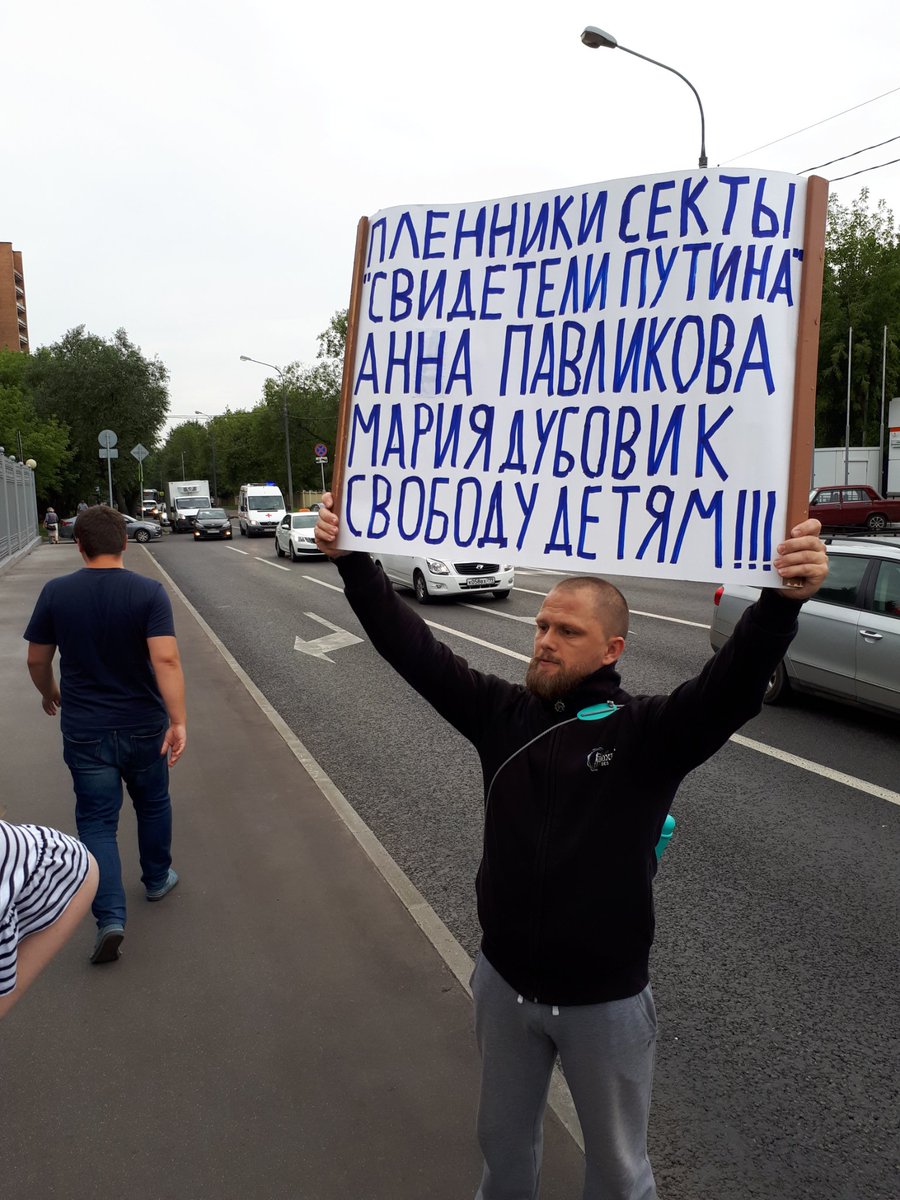
DjB2VnWWwAAuNc9A man picketing outside Moscow City Court, July 26, 2018. His placard reads, “Anna Pavlikova and Maria Dubovik are captives of the cult Putin’s Witnesses. Free the children!” Photo courtesy of Mediazona and Denis Styazhkin
Moscow City Court Affirms Remand in Custody of New Greatness Suspect Anna Pavlikova
OVD Info
July 26, 2018

Moscow City Court rejected an appeal of a lower court’s decision to remand in custody Anna Pavlikova, charged in the New Greatness case, It extended her remand in custody to August 13, writes Mediazona.

Moscow City Court thus shortened the young woman’s term in custody. Previously, the Dorogomilovo District Court had extended Pavlikova’s remand in custody until September 13.

Mediazona reports Pavlikova took part in today’s appeals hearing via video link from the remand prison. In her appeal, defense attorney Olga Karlova had asked the court to rescind the extension of her client’s remand in custody and impose a noncustodial pretrial restraint.

The defense attorney also drew the court’s attention to the fact that four of the people charged in the case are under house arrest, thus violating the principle of equality before the law. Karlova also claimed Pavlikova was not a flight risk, because both her domestic and foreign travel passports had been confiscated.

In May, Karlova had told the lower court her client’s heart problems had worsened in the remand prison. Pavlikova had developed severe tachycardia and cramps in her legs. In June, it transpired she had been transferred to the remand prison’s hospital. In July, Pavlikova was admitted to a civilian hospital for a day to undergo tests.

In May, a hearing to decide whether to extend Pavlikova’s remand in custody took place at the Dorogomilovo District Court. Pavlikova was not taken to the court, but was driven around in a paddy wagon. During the hearing, the judge read aloud parts of the case file  and retired to chambers to make her decision without hearing arguments from the parties to the case. In addition, Pavlikova was not informed of the court hearing. Her lawyer later informed her it had taken place.

In June, the Moscow City Court ruled this was a violation of the procedures for organizing court hearings and returned the case to the lower court.

Ten people have been charged in the New Greatness case. Judging by the case files, New Greatness was an organization established by undercover secret service agents. Six of the suspects are currently in remand prison, while the other four are under house arrest.

All ten suspects have been charged with organizing an “extremist” community (a violation of Russian Criminal Code Article 282.1). However, the prosecution’s case is based on the testimony of three men, none of whom has been arrested. One of them has said he infiltrated the group on the orders of his superiors. The interrogation transcripts of these individuals have mostly been excised from the case files. One of the three individuals drafted the group’s charter, collected money, and rented rooms for meetings.

Law enforcement officers threatened Pavlikova, who was seventeen at the time of her arrest, with violence.

Translated by the Russian Reader

Two More Suspects Detained in Network Case

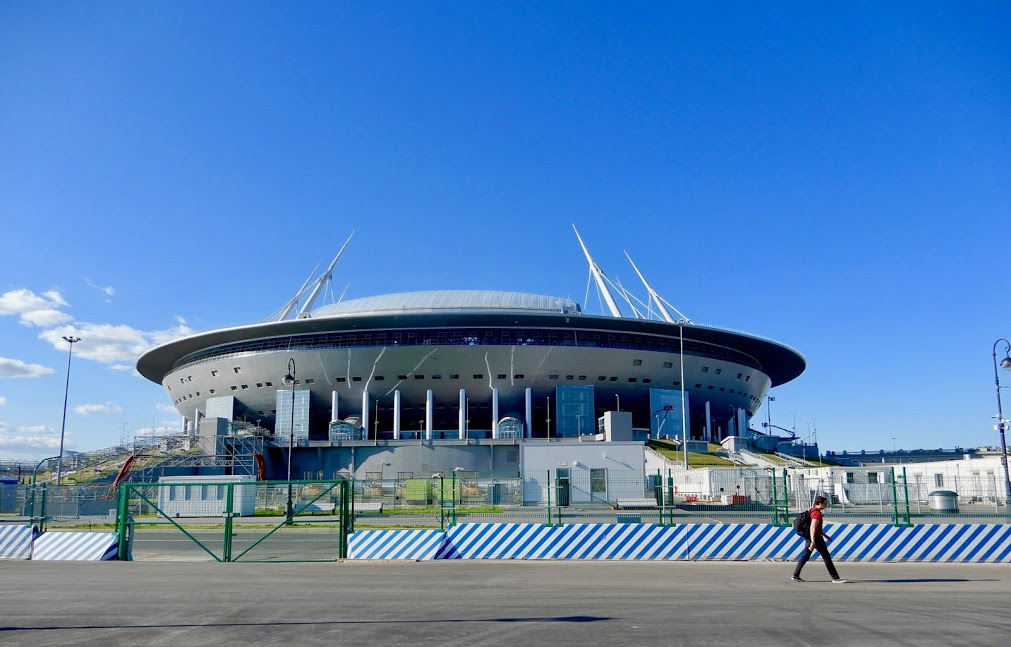
krestovsky stadiumThe members of the wholly mythical terrorist organization the Network have been accused by the FSB of planning to disrupt the March presidential elections and this summer’s World Cup in order to foment rebellion among the hoi polloi. These accusations would be hilarious if they were not served up with heavy helpings of torture, intimidation, and incarceration. Photo of Krestovsky Stadium in Petersburg, a World Cup venue, by the Russian Reader

Two Suspects Detained in Network Case
OVD Info
July 5, 2018

Mikhail Kulkov and Maxim Ivankin, two suspects in the so-called Network Case, have been detained and placed in police custody, OVD Info has learned from Yelena Bogatova, the mother of Ilya Shakursky, another suspect in the case.

The Lenin District Court in Penza has remanded Kulkov and Ivankin in custody until September.

Bogatova had been waiting for a lawyer outside the Penza Remand Prison when Ivankin and Kulkov were brought there. According to her, their parents learned of their arrests on July 4. Their custody hearings took place at 2 p.m. on July 5.

Alexei Kulkov, Mikhail Kulkov’s father, told OVD Info the young men had been detained in Moscow without IDs. Penza’s Lenin District Court has remanded them in custody until September 18. Mr. Kulkov reported that his son and Maxim Kulkin have been charged with organizing a “terrorist community.”  He said he saw the two young men for several minutes in the courthouse as they were escorted down the hallway. He noticed they had black eyes and bruises on their bodies.

Previously, Ivankin and Kulkov were detained in Penza in March 2017 along with antifascist Alexei Poltavets. They were initially charged with drugs possession. According to Poltavets, after they were detained, Russian Federal Security Service (FSB) officers tortured and beat them, demanding they testify against their friends in the antifascist scene. Poltavets later left Russia and had not seen Ivankin and Kulkov since then.

In June 2018, it transpired that Ivankin and Kulkov’s case had been combined with the investigation of the so-called Network, an organization that FSB investigators claim is a terrorist group. Ivankin and Kulkov have been charged with planning to produce or sell drugs in large quantities (Russian Criminal Code Article 228.1 Part 4 Paragraph G and Article 30 Part 3).

In the criminal case files, Ivankin, Kulkov, and Poltavets are identified both by their real names and the pseudonyms Redhead, Ilya, and Boris.

It transpired on July 4 that another suspect in the Network Case, Dmitry Pchelintsev, had been transferred from Penza Remand Prison No. 1, most likely to St. Petersburg.

On May 23, a friend of the accused, Victoria Frolova, was detained at the Russian-Ukrainian border. She was forced to testify against her Penza friends, including Ivankin and Kulkov. In her signed statement, Ivankin and Kulkov are identified as members of the 5.11 (“November Fifth”) cell of the Network. According to FSB investigators, all members of the Network trained with sticks in the woods, practice orienteering and first aid, and learned to set traps.

In the autumn of 2017, five young men were arrested in Penza: Yegor Zorin, Ilya Shakursky, Dmitry Pchelintsev, Vasily Kuksov, and Andrei Chernov. Arman Sagynbayev was detained in St. Petersburg and extradited to Penza. All of them were charged with involvement in a “terrorist” community. The FSB claimed the young young were involved in a terrorist organization known as the Network, whose cells, allegedly, existed in Moscow, Petersburg, Penza, and Belarus. The accused men gave accounts of mental coercion, electrical shock torture, and being hung upside down by FSB officers, as well as their planting weapons in the men’s cars and flats.

Later, several of the suspects renounced their confessions, saying they had been given under torture.

Besides the six suspects jailed in Penza, there are three more young men who have been charged with involvedment in the Network who have been remanded in custody in Petersburg. They are Viktor Filinkov and Igor Shishkin, on whose bodies human rights activists found physical traces of their having been tortured, and Yuli Boyarshinov, originally accused of illegal possession of explosive substances. Later, investigators tried to force him to testifying against the men accused in the Network Case and charged him with the same offenses.

Translated by the Russian Reader

***************

What can you do to support the Penza and Petersburg antifascists and anarchists tortured and imprisoned by the FSB?

  • Donate money to the Anarchist Black Cross via PayPal (abc-msk@riseup.net). Make sure to specify your donation is earmarked for “Rupression.”
  • Spread the word about the Network Case aka the Penza-Petersburg “terrorism” case. You can find more information about the case and in-depth articles translated into English on this website (see below), rupression.com, and openDemocracyRussia.
  • Organize solidarity events where you live to raise money and publicize the plight of the tortured Penza and Petersburg antifascists. Go to the website It’s Going Down to find printable posters and flyers you can download. You can also read more about the case there.
  • If you have the time and means to design, produce, and sell solidarity merchandise, please write to rupression@protonmail.com.
  • Write letters and postcards to the prisoners. Letters and postcards must be written in Russian or translated into Russian. You can find the addresses of the prisoners here.
  • Design a solidarity postcard that can be printed and used by others to send messages of support to the prisoners. Send your ideas to rupression@protonmail.com.
  • Write letters of support to the prisoners’ loved ones via rupression@protonmail.com.
  • Translate the articles and information at rupression.com and this website into languages other than Russian and English, and publish your translations on social media and your own websites and blogs.
  • If you know someone famous, ask them to record a solidarity video, write an op-ed piece for a mainstream newspaper or write letters to the prisoners.
  • If you know someone who is a print, internet, TV or radio journalist, encourage them to write an article or broadcast a report about the case. Write to rupression@protonmail.com or the email listed on this website, and we will be happy to arrange interviews and provide additional information.
  • It is extremely important this case break into the mainstream media both in Russia and abroad. Despite their apparent brashness, the FSB and their ilk do not like publicity. The more publicity the case receives, the safer our comrades will be in remand prison from violence at the hands of prison stooges and torture at the hands of the FSB, and the more likely the Russian authorities will be to drop the case altogether or release the defendants for time served if the case ever does go to trial.
  • Why? Because the case is a complete frame-up, based on testimony obtained under torture and mental duress. When the complaints filed by the accused reach the European Court of Human Rights in Strasbourg and are examined by actual judges, the Russian government will again be forced to pay heavy fines for its cruel mockery of justice.

***************

If you have not been following the Penza-Petersburg “terrorism” case and other recent cases involving frame-ups, torture, and violent intimidation by the Russian Federal Security Service (FSB) and other arms of the Russian police state, read and republish the recent articles the Russian Reader has posted on these subjects.

The Policemen’s Ball

DSCN6837At €2.50, the official licensed sticker album of the 2018 World Cup is a steal. Russian officials also plan to steal the civil rights of their own citizens during the month-long tournament. Photo by the Russian Reader

Restrictions on Movement and Freedom of Assembly during the 2018 FIFA World Cup
Denis Shedov and Natalya Kovylyayeva
OVD Info
May 25, 2018

Russia welcomes the 2018 FIFA World Cup with Presidential Decree No. 202, which places restrictions on the movements of people and the staging of public rallies in cities hosting the matches. According to the decree, “enhanced safety measures” will be enforced from May 25 until July 25 (although the first match, between Russia and Saudi Arabia, will not be played until June 14). Denis Shedov and Natalya Kovylyayeva studied the decree specially for OVD Info.*

The restrictions will be introduced on May 25, 2018. They will be enforced in the cities and regions hosting 2018 World Cup matches: Moscow, Petersburg, Volgograd Region, Sverdlovsk Region, Nizhny Novgorod Region, Samara Region, Rostov Region, Kaliningrad Region, Krasnodar Territory, the Republic of Tatarstan, and the Republic of Mordovia.  Additionally, the decree also applies to certain neighboring regions where, in particular,  competing teams will be accommodated: Moscow Region, Leningrad Region, Kaluga Region, Voronezh Region, Stavropol Territory, and the Republic of Chechnya.

It is worth noting Decree No. 202 applies absolutely to everyone who is located in the regions listed during the period the decree is in force. In this light, OVD Info felt it was vital to discuss these changes.

Monitored and Restricted Areas
The decree introduces “monitored and restricted areas,” which will either be entirely off limits to people or will have restricted access. These areas include training grounds (including at other stadiums), team headquarters, hotels where teams and referees are staying, cargo inspection points, the broadcast center at Crocus Expo in Moscow, fan festival venues, press centers, and parking lots for special transport. You will be able to enter these “monitored areas” only after security guards have conducted a thorough inspection of all your belongings.

In addition, there will be special pedestrian security zones, so-called last miles, consisting of areas of one to two kilometers in radius around the stadiums where the matches will be held. Aside from World Cup transport, only residents of nearby buildings, equipped with special passes, will have access to these zones. To obtain the passes you need your internal passport and the papers for your car and your flat. Information about these zones has been posted on the official municipal websites of the cities hosting matches and published in local periodicals.

  • During the 2014 Winter Olympics in Sochi, the city was off limits to cars from other cities, i.e., cars not registered in Sochi, with the exception of vehicles owned by the secret services and vehicles that had received accreditation as municipal maintenance and 2014 Winter Olympics support vehicles. Vehicles registered in Sochi were restricted from traveling in “monitored areas.” 

Mandatory Registration for Everyone
Upon arrival in a city, you must register with the local immigration authorities within three days. This rules applies to everyone except those who are registered to live permanently in the particular city. Additionally, special rules for registering domiciles and temporary stays will be introduced in the cities where World Cup matches are scheduled.

Russian nationals and foreign nationals must register with the police within 72 hours of arriving. Usually, during “normal” times, Russian nationals have the right to spend up to 90 days in another Russian region without registering, while foreign nationals have seven days to register. Decree No. 202 specifies that the party hosting the visitor, i.e., the hotel, spa, holiday home, etc., must notify the proper authorities of the arrival of foreign nationals within 24 hours, as stipulated by Russian federal law.

Immigration authorities in the regions mentioned in the decree will be open for business daily during the World Cup, including weekends and holidays. There are several ways of registering your stay in another city:

  • Submitting an application to the management of the hotel, hostel, camping ground or youth hostel where you are staying, or the management company, proprietor or landlord, if you are staying in a private flat.
  • Reporting to the local immigration authorities yourself.

Foreign nationals must personally present their papers to the regional office of the Interior Ministry (i.e., the police) or a multi-service center, or their official hosts must do it for them. It is forbidden to register via the post office or a government services website.

Arriving foreign nationals are obliged to provide notification of their arrival, a copy of their identity card (e.g., passport or either ID), a copy of their Russian visa, and a copy of their migration card. This rule applies to all foreign nationals, regardless of their nationality and status in Russia. If the host party is a legal entity, this organization must supply the authorities with a complete set of documents.

Private individuals who act as hosts need only present their Russian internal passports, proving they are permanent residents, a copy of their passports, and a copy of their ownership deed to the dwellings where they will house foreign nationals.

If these rules are violated, Russian nationals will be obliged to pay an administrative fine. In Moscow and Petersburg, the fine will range from three to five thousand rubles, while in the regions it will range from two to three thousand rubles. Foreign nationals who violate these rules can be expelled from Russia.

Restrictions on Freedom of Assembly
According to the decree, from May 25 to July 25, 2018, assemblies, rallies, demonstrations, marches, and pickets that have nothing to do with the 2018 FIFA World Cup can be held only in places, along routes, and at times approved by the authorities. The authorities can also determine the number of attendees and the duration of the event.

Decree No. 202 was first enforced during last year’s Confederations Cup, also hosted by Russia. A large number of activists involved in group protests and solo pickets were apprehended at that time. Some of the people detained during solo pickets were subjected to “explanatory discussions” by the police, while others were written up for violating the rules for holding public events and fined as much as 20,000 rubles.

  • In May 2017, five activists from the local headquarters of opposition leader Alexei Navalny were detained for setting up a campaign booth on the main square in Kazan. Law enforcement said the action had not been authorized by the authorities. All the detainees were sentenced to ten to twelve days in jail, as well as 35 hours of community service.
  • During the Navalny-inspired anti-corruption rallies that took place in a number of cities on June 12, 2017, including Petersburg, Moscow, and Sochi, police detained protesters on the basis of Paragraph 11 of the decree, as paraphrased above. Although in Krasnodar, where the rally against corruption had been authorized, no one was apprehended, despite the special security regime.
  • During the protest rally “Farewell to the Communications Ministry,” in Moscow in June 2017, a teenager was detained when he tried to leave flowers outside the ministry due to restrictions on freedom of speech in Russia, including the possible blockage of the Telegram messenger service. The arresting officer cited the presidential decree restricting rallies during the Confederations Cup and the 2018 World Cup when he detained the boy. The teenager was taken into a police station for questioning before being released.
  • In mid-June 2017, fifteen people holding solo pickets against Moscow’s massive “renovation” program were detained outside the entrance to the State Duma.
  • Several activists who held solo pickets in support of mathematician Dmitry Bogatov and demanded an end to the prosecution of nationalist Dmitry Demushkin were detained on June 24, 2017, in Moscow.
  • Solidarity Party activist Mikhail Lashkevich was detained on July 4, 2017, while holding a solo picket demanding the people behind opposition leader Boris Nemtsov’s assassination be found. The police admitted he had a right to carry out a solo picket and released him from Basmanny Police Precinct in Moscow without writing him up. Subsequently, Roman Petrishchev, another Solidarity Party activist, was detained for a solo picket.
  • In early July 2017, five activists of Protest Moscow were detained in different parts of the city while they held solo pickets against censorship. All of them were charged with violating the rules for holding public events, punishable under Article 20.2 Part 5 of the Administrative Offenses Code.
  • On July 5, 2017, the well-known democracy activist Ildar Dadin was detained during a solo picket outside FSB headquarters in Moscow, since his protest had not been authorized by law enforcement. On July 7, 2017, the Meshchansky District Court found him guilty of violating the “rules of solo pickets” and fined him 20,000 rubles.

In May 2017, Alexander Pomazuyev, a lawyer with Navalny’s Anti-Corruption Foundation (FBK) asked that Paragraph 11 of the decree be declared null and void in a suit he filed with the Russian Supreme Court. Pomazuyev claimed he had been denied the right to hold a solo picket. He also argued the presidential decree infringed on civil liberties guaranteed by the Russian Constitution, including the right to free speech and freedom of assembly. The court threw out Pomazuyev’s suit, thus rubber-stamping the restrictions on rallies and pickets during the Confederations Cup and the 2018 FIFA World Cup.

In February 2018, organizers of the Boris Nemtsov Memorial March in Nizhny Novgorod wrote an open letter to FIFA president Gianni Infantino asking him to protect freedom of assembly in Russia in the run-up to the World Cup. The football functionary did not react to the letter, apparently.

“Although the decree restricts certain rights only from May 25 to July 25, 2018, even the smallest pickets have been turned down by the authorities on the grounds of the terrorist threat,” the march organizers wrote on their Facebook page.

Commentary by Lawyer and Human Rights Activist Alexander Peredruk
Yes, Presidential Decree No. 202, dated May 9, 2017, definitely violates people’s constitutionally guaranteed rights to freedom of assembly in Russia.

If you want to hold a public rally from May 25 to July 25, 2018, at a venue of your choosing, there is no guarantee you will pull it off. The authorities could turn you down on the grounds the venue you have chosen was not vetted by the Interior Ministry and the FSB. 

As last year showed, when several applications to hold rallies were filed simultaneously, the authorities would reject all the applications. However, when the applications were filed, the authorities had not yet determined what venues could be used. They drew up a list of permissible venues only after looking over the first applications. It was thus a “complete coincidence” that the venues indicated in the applications that were submitted to the local authorities were not on the list of permissible venues. 

In other words, the rejections were perfunctory and practically groundless. The authorities were not interested in conducting a proportionality test, in striking a balance between public and private interests.

In addition, questions are raised about the legitimacy of the division between public sporting events, which are permitted during this period, and public political events, which are virtually banned. Russian citizens are thus subject to discrimination.

During the 2014 Winter Olympics in Sochi, a local man, David Hakim, was detained while holding a solo picket in defense of the convicted environmentalist Yevgeny Vitishko. (Hakim was jailed for four days for his “crime.”) Agora used his case to challenge the president’s Olympic decree in the Russian Constitutional Court. However, the court refused to examine whether the decree complied with the Constitution, since it had expired by the time the complaint was examined. 

* If you are worried about how Presidential Decree No. 202 will affect foreign fans traveling to Russia for the World Cup, you shouldn’t be. They are required to purchase special “fan IDs” that will exempt them from most if not all of the decree’s strictures. // TRR

Denis Shedov is a lawyer with the Memorial Human Rights Center in Moscow. Natalya Kovylyayeva is a journalist. Translated by the Russian Reader

Cossacked

18A so-called Cossack lashes protesters with a plaited whip (nagaika) at the He’s No Tsar to Us opposition protest rally at Pushkin Square in Moscow on May 5, 2018. Photo by Ilya Varlamov
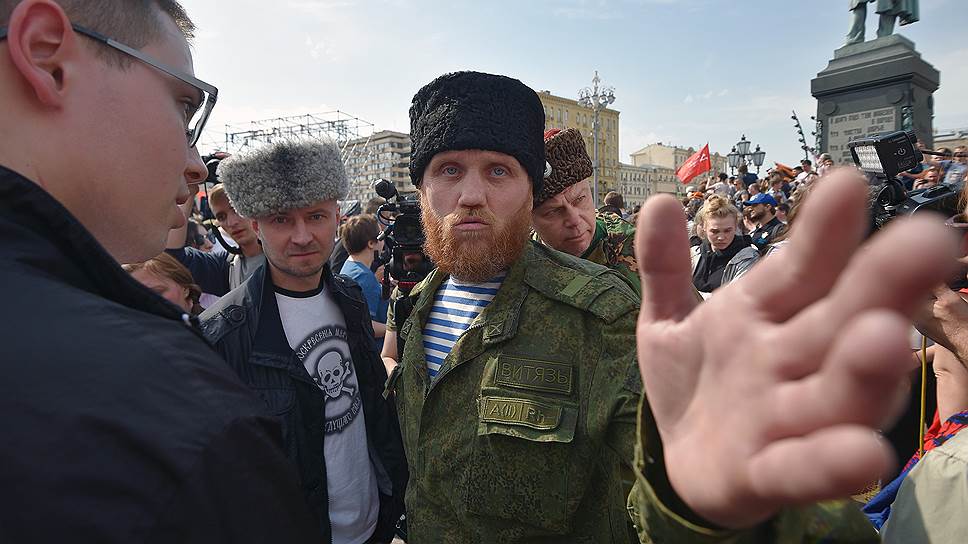
Сossacks Were Not Part of the Plan: Men with Whips Take Offense at the Opposition
Alexander Chernykh
Kommersant
May 8, 2017

The Presidential Human Rights Council (PHRC) plans to find out who the Cossacks were who scuffled with supporters of Alexei Navalny during the unauthorized protest rally on May 5 in Moscow. Meanwhile, the Moscow mayor’s office and the Central Cossack Host claimed they had nothing to do with the Cossacks who attempted to disperse opposition protesters. Kommersant was able to talk with Cossack Vasily Yashchikov, who admitted he was involved in the tussle, but claimed it was provoked by Mr. Navalny’s followers. Human rights defenders reported more than a dozen victims of the Cossacks have filed complaints.

The PHRC plans to ask law enforcement agencies to find out how the massive brawl erupted during the unauthorized protest rally on May 5 in Moscow. PHRC chair Mikhail Fedotov said “circumstances were exacerbated” when Cossacks and activists of the National Liberation Front (NOD) appeared at the opposition rally.

“It led to scenes of violence. We must understand why they were they and who these people were,” said Mr. Fedotov.

“Our main conclusion has not changed: the best means of counteracting unauthorized protest rallies is authorizing them,” he added.

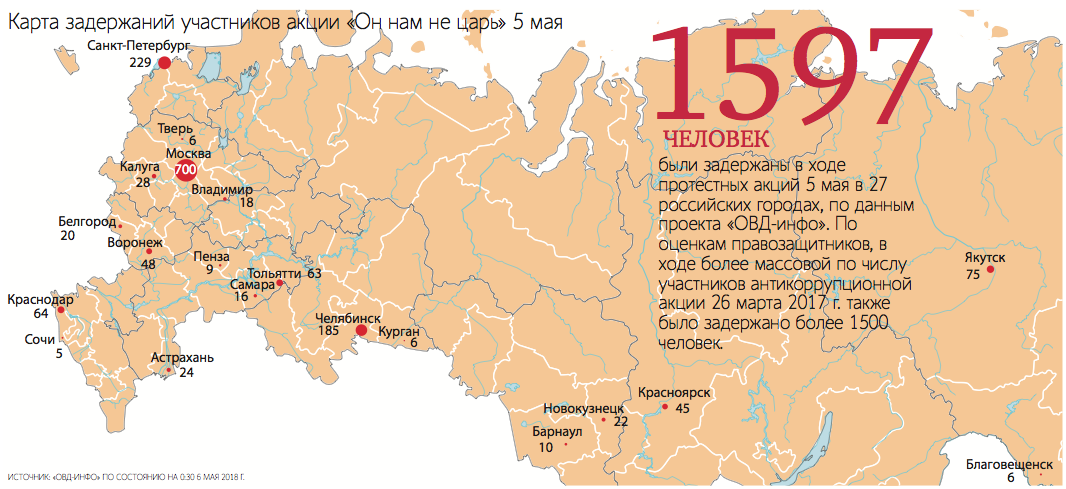
On May 5, unauthorized protest rallies, entitled He’s No Tsar to Us, called for by Alexei Navalny, took place in a number of Russian cities. In Moscow, organizers had applied for a permit to march down Tverskaya Street, but the mayor’s officers suggested moving the march to Sakharov Avenue. Mr. Navalny still called on his supporters to gather at Pushkin Square, where they first engaged in a brawl with NOD activists and persons unknown dressed in Cossack uniforms. Numerous protesters were subsequently detained by regular police. Approximately 700 people were detained in total.

The appearance on Pushkin Square of Cossacks armed with whips has provoked a broad response in Russia and abroad. The Guardian wrote at length about the incident, reminding its readers that Cossacks would be employed as security guards during the upcoming 2018 FIFA World Cup in Russia. The Bell discovered a Central Cossack Host patch on the uniform of one of the Cossacks photographed during the brawl. According to the Bell, which cites documents from the Moscow mayor’s office, the Central Cossack Host was paid a total of ₽15.9 million for “providing security during large-scale events.”

However, Vladimir Chernikov, head of the Moscow Department of Regional Security, stressed, during an interview with Kommersant FM, that on May 5 “no Cossacks or any other organization were part of the plan and the means of providing security.”

Chernikov said police and the Russian National Guard acted impeccably. Spokesmen for the Central Cossack Host also said they had not dispatched any Cossacks to guard Pushkin Square, and that the Cossacks who, wearing their patches, did go to the square, had “voiced their civic stance.”

Bloggers have published information about the Cossacks they have been able to identify from photos and video footage of the rally. One video depicts a bearded man who grabs a placard, bearing the slogan “Open your eyes, you’re the tsar’s slave!”, from a young oppositionist before arguing with Open Russia coordinator Andrei Pivovarov. The Telegram channel BewareOfThem reported the man was Vasily Yashchikov, member of the Union of Donbass Volunteers. Mr. Yashchikov has confirmed to Kommersant he was, in fact, at the rally and was involved in the brawl with opposition protesters. Yet, he claimed, most of the Cossacks at Pushkin Square had nothing to do with the Central Cossack Host, as claimed by the Bell. According to Mr. Yashchikov, the brawlers mainly consisted of nonregistered (i.e., unaffiliated with the Russian government) Cossacks from two grassroots organizations, the First Hundred and the Crimean Regiment. Moreover, they allegedly showed up at the rally independently of one another.

“The rally was discussed in Cossack groups, and someone suggested we go and talk to people,” Mr. Yashchikov told Kommersant. “We have nearly a hundred people in the  Hundred, but only fifteen decided to go. At the square, we met Cossacks from the Crimean Regiment, which is actually not Crimean, but from the Moscow Region. But our organizations are not friendly, so we were there separately.”

He admitted there were several people from the Central Cossack Host at Pushkin Square, but his group did not interact with them, either.

KMO_165050_00034_1_t218_200833So-called Cossacks at the He’s No Tsar to Us opposition rally at Pushkin Square, Moscow, May 5, 2018. Photo by Alexander Miridonov. Courtesy of Kommersant
According to Mr. Yashchikov, the Cossacks came to Pushkin Square to talk with Mr. Navalny’s supporters, but had no intention of being involved in dispersing the rally.

“There were one and half thousand people there [the Moscow police counted the same number of protesters—Kommersant]. There were thirty-five of us at most, and we had only two whips. You could not have paid us to wade into that crowd,” claimed Mr. Yashchikov.

Mr. Yashchikov claimed he managed to have a friendly chat with Mr. Navalny, but opposition protesters were aggressive, he alleged.

“Someone picked on us, asking why we had come there, that it was their city. Another person tried to knock my cap off, while they swore at other Cossacks and blasphemed the Orthodox faith,” Mr. Yashchikov complained. “Well, we couldn’t take it anymore.”

People who attended the rally have denied his claims.

“The Cossacks acted cohesively, like a single team,” said Darya, who was at the rally [Kommersant has not published her surname, as she is a minor]. “They formed a chain and started pushing us towards the riot police, apparently, to make their job easier. The Cossacks kicked me, while they encircled my boyfriend and beat him. They retreated only when they realized they were being film and photographed.”

Darya planned to file a complaint with the police charging the Cossacks with causing her bodily harm. Currently, human rights defenders from Agora, Zona Prava, and Public Verdict have documented more than fifteen assault complaints filed against the Cossacks.

Oppositionists have claimed the police mainly detained protesters, allegedly paying almost no attention to the Cossacks and NOD activists. Kirill Grigoriev, an Open Russia activist detained at the rally, recounted that, at the police station where he was taken after he was detained, he pretended to be a NOD member, and he was released by police without their filing an incident report.

“When we arrived at the Alexeyevsky Police Precinct, a policeman immediately asked who of us was from NOD. I jokingly pointed at myself. He took me into a hallway and asked me to write down the surnames of other members of the organization,” said Mr. Grigoriev.

He wrote down the surnames of ten people, after which everyone on the list was given back their internal Russian passports and released.

*********

Cossacks Confront Navalny Supporters for First Time
Regime Prepares for Fresh Protests, Including Non-Political Ones, Analysts Argue 
Yelena Mukhametshina and Alexei Nikolsky
Vedomosti
May 6, 2018

He’s No Tsar to Us, the unauthorized protest rally in Moscow held by Alexei Navalny’s supporters, differed from previous such rallies. On Tverskaya Street, provocateurs demanded journalists surrender their cameras. By 2:00 p.m., the monument to Pushkin was surrounded by activists of the National Liberation Front (NOD). When protesters chanted, “Down with the tsar!” they yelled “Maidan shall not pass!” in reply. Behind the monument were groups of Cossacks, who had never attended such rallies. In addition, for the first time, the police warned people they intended to use riot control weapons and physical force, and indeed the actions of the security forces were unprecedentedly rough. The riot police (OMON) detained protesters by the hundreds, and Cossacks lashed them with plaited whips.

The Moscow police counted 1,500 protesters at the rally, while organizers failed to provide their own count of the number of attendees. Navalny said the nationwide rallies were a success. His close associate Leonid Volkov argued that “in terms of numbers, content, and fighting spirit, records were broken,” also noting the police’s unprecedented brutality. According to OVD Info, around 700 people were detained in Moscow, and nearly 1,600 people in 27 cities nationwide. Citing the PHRC, TASS reported that 658 people were detained in Moscow.

fullscreen-1sdb.png

“He’s No Tsar to Us, May 5: A Map of Arrests. 1,597 people were detained during protest rallies on May 5, 2018, in 27 Russian cities, according to OVD Info. According to human right activists, during nationwide anti-corruption protests on March 26, 2017, more than 1,500 people were detained. Source: OVD Info.” Courtesy of Vedomosti

PHRC member Maxim Shevchenko demanded the council be urgently convoked due to “the regime’s use of Black Hundreds and fascist militants.” According to a police spokesman, the appearance at the rally of “members of different social groups” was not engineered by the police, while the warning that police would use special riot control weapons was, apparently, dictated by the choice of tactics and the desire to avoid the adverse consequences of the use of tear gas.

According to NOD’s leader, MP Yevgeny Fyodorov, 1,000 members of the movement were involved in Saturday’s rally.

“We wanted to meet and discuss the fact the president must be able to implement his reforms. Because we have been talking about de-offshorization and withdrawing from a unipolar world for five years running, but things have not budged an inch,” said Fyodorov.

NOD did not vet their actions with the Kremlin, the leadership of the State Duma or the Moscow mayor’s office, Fyodorov assured reporters.

On Sunday, the Telegram channel Miracles of OSINT reported that, in 2016–2018, the Central Cossack Host, whose members were at the rally, received three contracts worth nearly ₽16 million from the Moscow Department for Ethnic Policy for training in the enforcement of order at public events. As Vedomosti has learned, according to the government procurement website, the Central Cossack Host received eleven contracts, worth nearly ₽38 million, from the Moscow mayor’s office over the same period.

Gleb Kuznetsov, head of the Social Research Expert Institute (EISI), which has ties to the Kremlin, argued there was no brutality at the rally.

“In Paris, the scale of protests is currently an order of magnitude higher, but no one speaks about their particular brutality. In Russia, so far the confrontation has been cute, moderate, and provincial. The only strange thing is that, in Russia, people who are involved in such protests, which are aimed at maximum mutual violence, are regarded as children. But this is not so. Everything conformed to the rules of the game, common to the whole world. If you jump a policeman, don’t be surprised if he responds with his truncheon,” said Kuznetsov.*

The Russian government has allied itself with the Cossacks and NOD, which are essentially illegal armed formations, argued Andrei Kolesnikov, a senior fellow at the Moscow Carnegie Center.

“This does not bode well. Apparently, in the future, such formations will be used to crack down on protests,” said Kolesnikov.

The authorities are preparing for the eventuality there will be more protests. Even now the occasions for them have become more diverse, and they are spreading geographically, noted Kolesnikov.

Grassroots activism has been growing, and the authorities have realized this, political scientist Mikhail Vinogradov concurred. They are always nervous before inaugurations. In 2012, there was fear of a virtual Maidan, while now the example of Armenia is fresh in everyone’s minds, he said.

“The security services had to flex their muscles before the new cabinet was appointed. Although, in view of the upcoming FIFA World Cup, law enforcement hung the regime out to dry contentwise,” said Vinogradov.

* In September 2017, the Bell reported that state corporations Rosatom and RusHydro were financing EISI to the tune of ₽400 million each, and it could not be ruled out that the so-called social research institute was receiving subsidies from other state companies.

Translated by the Russian Reader

OVD Info: He’s No Tsar to Us in Facts and Figures

traffic sign in spbSlava Ptrk, Traffic Sign in Petersburg, 2018. Photo courtesy of OVD Info

OVD Info, That Was the Week That Was Email Newsletter, Special Edition:
How the He’s No Tsar to Us Protests Played Out Nationwide

Saturday, May 5, 2018, witnessed large-scale, nationwide protests by supporters of Alexei Navalny, who voiced their opposition to Vladimir Putin’s new term as president. This was how the protests went down in facts and figures.

The police behaved roughly. They detained not only demonstrators but also random passerby, children and reporters, and OVD Info’s hotline got more than one call about police brutality. In Moscow, so-called Cossacks joined regular police in dispersing the rally.  The so-called Cossacks beat people using whips, and a man with a raccoon was among the detainees. The Bell discovered the so-called Cossacks had ties with the mayor’s office. In Chelyabinsk, local activists were detained before the protest rally on suspicion of theft, while in Saratov, police detained a 12-year-old boy.

According to the information we have available, a total of 1,600 people were detained in 27 cities. Around 300 spent the night in police stations.*

  • 719 detainees in Moscow were taken to 42 police stations; around 154 people spent the night in custody.
  • 217 detainees in Petersburg were taken to 29 police stations; around 95 people spent the night in custody.
  • 185 people were detained in Chelyabinsk.
  • 75 people were detained in Yakutsk.
  • 64 people were detained in Krasnodar.
  • 63 people were detained in Togliatti, half of them minors.
  • 48 people were detained in Voronezh.
  • 45 people were detained in Krasnoyarsk.
  • 28 people were detained in Kaluga.
  • 24 people were detained in Astrakhan.
  • 22 people were detained in Novokuznetsk.
  • 20 people were detained in Belgorod.
  • 18 people were detained in Vladimir.
  • 16 people were detained in Samara.
  • 10 people each were detained in Barnaul and Blagoveshchensk.
  • 9 people were detained in Penza.
  • 6 people each were detained in Tver and Kurgan.
  • 5 people were detained in Sochi.
  • 2 people each were detained in Kemerovo, Naberezhnye Chelny, and Rostov-on-Don.
  • 1 person each was detained in Yekaterinburg, Nizhny Novgorod, Smolensk, and Tomsk.
*You can view the complete list of detainees, including names and the police stations where they were taken, here.

In the aftermath of the rallies, criminal charges have been filed against one detainee.  In Petersburg, a policeman named Sukhorukov has accused Mikhail Tsakunov of knocking out his tooth “deliberately, motivated by enmity.” Charges were filed under Article 318 Part 2 of the Russian Federal Criminal Code: health- or life-threatening violence against a police office. Tsakunov could be sent to prison for ten years if found guilty. Video footage of the young man’s arrest can be viewed here.

The detainees were tried on Sunday in Petersburg, Vladimir, Krasnodar, Rostov-on-Don, and Chelyabinsk. 

Alexei Navalny was detained on Pushkin Square in Moscow. At the police station, he was written up for two administrative offenses: repeated violation of the procedures for holding public events and failure to obey a police officer’s lawful order. He was not kept in the police station overnight. His court hearing will take place on May 11.

What Did We Do?

We helped detainees in twenty police stations in Moscow and coordinated the rendering of legal aid in Chelyabinsk, Kaluga, and Krasnoyarsk.

In the space of twenty-four hours,* our hotline received 2,156 calls for a total duration of 64 hours and 45 minutes.

  • 5 hours and 24 minutes of that time was taken up by 93 legal consultations.
  • We were called 1,014 times.
  • We called back to verify information 1,142 times.

* From six in the morning on May 5 to six in the morning on May 6.

We do intake not only on our hotline but also using our Law Bot and our Red Button application.

  • 147 people reported being detained through Law Bot.
  • 78 reports of people being detained were received through the Red Button.
  • 1,993 people had installed the bot as of May 3.

43 volunteers helped us gather information on the detentions, putting in approximately 260 hours of work. You can sign up to join our team of volunteers here.

We can help a lot of people, but we need money to do it. Donations keep the 24-hour  hotline running. They pay for legal services. They pay people to write the news and analyze human rights violations in Russia. You can support us here.

Translated by the Russian Reader