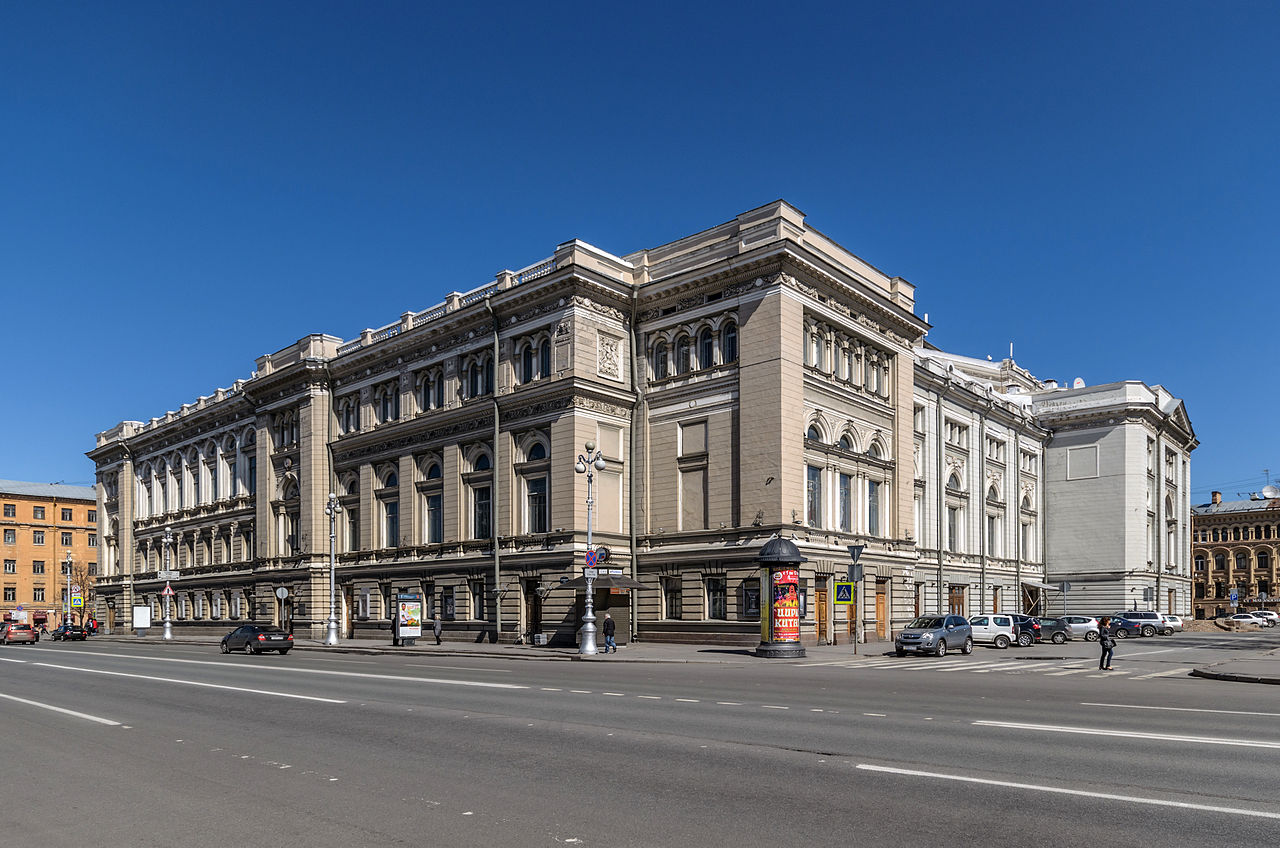
In the background of this photo, you can make out the Galeriya Shopping Center, located in downtown Petersburg. It’s gigantic, covering the land once occupied by five or six graceful tenement buildings and a cultural center and cinema. They were demolished in the mid 1990s, not to make way for the shopping mall, but so a new train station could be built there, cheek by jowl with the existing Moscow Station, because federal and regional officials wanted to build a high-speed train line between Petersburg and Moscow. Millions of dollars were allocated for the project, but ultimately, the train line was never built nor was the new station erected. No one knows what happened to the millions of dollars allocated for the project. They simply vanished into thin air.
The site of the former-future high-speed train station sat vacant for many years behind a tall, ugly construction-site fence. No one could figure out what do to with all that wasteland, which was in the very heart of the city, not in some forgotten outskirts. However, before the money had vanished, and the project was abandoned, construction workers had managed not only to demolish all the tenement buildings on the site but had also dug a foundation pit. Over the long years, this pit filled up with water. Some time after Google Maps had become all the rage, I took a look at our neighborhood via satellite, as it were, and discovered to my great surprise it now had a small lake in it. It was the foundation pit of the former-future high-speed train station, filled to the brim with water.
Good times came to Petersburg in the 2000s, when the country was flush with cash, generated by high oil prices, a flat tax rate of 13%, and runaway corruption. It was then the city’s mothers and fathers (I’m not being ironic: most of Petersburg’s “revival” was presided over by Governor Valentina Matviyenko, a former Communist Youth League functionary who had converted to the gospel of what she herself called “aggressive development”) decided that Petersburg, one of the world’s most beautiful, haunting, enchanting cities, should be extensively redeveloped, despite its status as a UNESCO World Heritage Site, into a mecca of consumerism that would give pride of place to cars and new highways, since cars had become the new status symbol among the city’s rich and poor alike. They also decided that, since other big cities in the world had lots of high-rise buildings, their city, which did not have almost any high-rise buildings, should have lots of them, too.
Basically, they decided to demolish as much of the inner and outer city as they could get away with—and they could get away with a lot, because they had nearly unlimited political power and lots of the country’s money at their disposal—and redevelop it with high-rise apartment buildings, superhighways, big box stores, and shopping and entertainment centers, each one uglier and bigger than the last. Thanks to their efforts, in a mere fifteen years or so they have gone a long way toward turning a Unesco World Heritage Site into an impossible, unsightly mess.
But let’s get back to our miniature inner-city lake. Finally, developers came up with a plan to convert the site into a giant shopping mall. Even better, the architects who designed the mall were clearly inspired by Albert Speer, Hitler’s favorite architect and a leading Nazi Party member, to turn a rather oversized mall into a celebration of kitsch faux-neoclassicism, precisely the sort of thing Speer had championed in his projects. This, indeed, was a bit ironic, because Petersburg, then known as Leningrad, had survived a 900-day siege by the German army during the Second World War. Considered the longest and most destructive siege in history, it killed at least 800,000 civilians, that is, it killed the grandparents and great-grandparents of many of the people who now enjoy visiting this mall, with its distinctly neo-fascist aesthetic.
Along the sides of the street running down towards the photographer from the Albert Speer Memorial Shopping Center, you see lots of shiny new, fairly expensive cars, parked bumper to bumper. In fact, the Albert Speer has a huge underground car park where you can park your car relatively inexpensively (our neighbor lady, a sensible woman, does it), but most Petersburg car owners actually think parking their cars wherever they want—especially either right next to their residential buildings or, worse, in the tiny, labyrinthine, incredibly charming inner courtyards of these eighteenth- and nineteenth-century buildings—is their legal right. It isn’t, but they don’t know it or don’t want to know it. I know they think this way because many Petersburg car owners have told me so.
To my mind, the precipitous rise in personal car ownership in Petersburg has done more to degrade the city’s beauty than all the underinspired colossal high-rises put together, because the city was purposely designed by its original builders, beginning with Peter the Great, to have a good number of intersecting and radiating, awe-inspiring, long and clear sightlines or “perspectives.” Hence, many of the city’s longest avenues are called “prospects,” such as Nevsky Prospect (the title of one of Nikolai Gogol’s best stories) and Moskovsky Prospect. Nowadays, however, you gaze down these “perspectives” only to see traffic jams and hectares of other visual pollution in the shape of signs, billboards, banners, and marquees. It’s not a pretty sight.
On the right of the picture, somewhere near the middle, you should be able to spot a small shop sign with the letters “AM” emblazoned on it. It’s one of the dozens of liquor stores that have popped up in our neighborhood after the Kremlin introduced its countersanctions against US and EU sanctions, which were instituted in response to Russia’s occupation of Crimea and invasion of Eastern Ukraine. The US and EU sanctions targeted individuals and companies closely allied with the regime. Putin’s countersanctions, in a manner that has come to seem typical of how the Russian president for life’s mind works, were targeted against Russian consumers by banning the import of most western produce into the country. An exception was made for western alcoholic beverages, especially wines and beers, and this meant it was suddenly profitable again to get into the liquor business. The upshot has been that you can exit our house, walk in any direction, even putting on a blindfold if you like, and you will find yourself in a liquor store in a matter of minutes, if not seconds.
Last summer, I tried painting a little verbal and photographic sketch of the effect this massive re-alcoholization has had on our neighborhood, along with other, mostly negative trends in the use and abuse of commercial space in the city.
Finally, there is one other thing you should know about all those new, mostly oversized cars parked on the street. Since the average monthly salary in Russia barely crawls above 600 or 700 euros a month, even in a seemingly wealthy city like Petersburg, most of those gas-guzzling, air-polluting status symbols were bought with borrowed money.
Just the other day, in fact, I translated and posted a tiny article, originally published in the business daily Kommersant, about how people in the Voronezh Region currently owed banks approximately two billion euros in outstanding loans. In 2015, the region’s estimated population was around 2,300,000, so, theoretically, each resident of Voronezh Region now owes the banks 870 euros, which I am sure is more than most people there earn in two or three months. Of course, not every single resident of Voronezh Region has taken out a loan, so the real damage incurred by real individual borrowers is a lot worse.
I could be wrong, but I think what I have just written gives you a rough idea of how you go about reading photographs of today’s Russian cities, their visible aspect in general, turning a snapshot into something meaningful, rather than assuming its meaning is obvious, right there on the surface. You don’t just tweet a photo of a new football stadium or fancy restaurant or street jammed with expensive cars and make that stand for progress, when progress, whether political, economic or social, has not occurred yet in Russia, despite all the money that has been sloshing around here the last fifteen years. Instead, you talk about the real economic, political, and social relations, which are often quite oppressive, murky, and criminal, that have produced the visible reality you want to highlight.
Doing anything less is tantamount to engaging in boosterism, whataboutism, Russian Worldism, and crypto-Putinism, but certainly not in journalism. That so many journalists, western and Russian, have abandoned real journalism for one or all of the isms I have listed is the really scary thing. ||| TRR
I wrote a report on this Sunday’s elections. Don’t be lazy and read it to the end. You’ll learn a lot of new things.
Who Elects the Head of Adygea: A Political Portrait of the Republic’s Parliament
As you know, on Sunday, September 10, the State Council of the Republic of Adygea (in Adyghe, the Khase) will elect a new head for the republic. There are three candidates, but the outcome is predetermined. Who would doubt it? Correct me if I’m mistaken, but in the history of modern Russia this was probably the first instance when the outgoing head of a Russian region brought his own kinsman to Moscow so that Putin could view the bride, i.e. his chosen successor. Nor, we must note, were he and his kinsman immediately shown the door. This was probably taken by the petitioners from Adygea as a favorable sign.
Everything kicked off when, in March of last year, as it was about to give up the ghost, the members of the Adgyean parliament’s fifth convocation nearly unanimously voted (fifty yeas, four nays) to abolish direct, popular elections of the republic’s head, adopting a special law and making the relevant amendments to the Adygean Constitution. Having denied Adygeans the right to vote directly for head of the region, the “people’s” elected representatives formally explained their decision as a means of making the electoral process less expensive. However, no one abolished another law, a law of everyday life: cheaper doesn’t mean better.
So elections to the sixth convocation of the Adygean Khase, in 2016, took place with the understanding that it would be the new parliament, not the people, that would be picking the republic’s new head. So, the requirements for sifting out the winners were tougher than usuaul. It was boom or bust, literally, all or nothing. The powers that be backstopped its chosen candidates to the hilt, and the elections took place in a stifling climate of lawlessness, generated by the acting executive branch and the local office of the United Russia party. Functionaries of the Rodina (Motherland) party did everything they could to force the Adygean Central Elections Commission to remove the opposition party’s entire regional list of candidates from the ballot, although the party had a good chance of taking several seats in parliament. The billboards, posters, and flyers of all candidates and parties except United Russia and LDPR were destroyed hours, if not minutes, after they were posted. The vote tallies at the polling stations were skewed, and the votes received by candidates and parties that are not part of the so-called parliamentary grouping (United Russia, CPRF, A Just Russia, and LDPR) were totally nullified. The latter parties divvied up their shares of the vote totals in keeping with quotas that had been agreed in advance in Moscow. So, the current Adygean Khase consists of 38 MPs from United Russia, four MPS each from the CPRF and LDPR, and two MPs from A Just Russia. Two more MPs have to be elected in by-elections on September 10. There is no doubt that one of the two will be a United Russia member. Thus, MPs from United Russia make up 80% of the republic’s parliament, while the CPRF and LDPR have 8% of MPs each, and A Just Russia has 4% of MPs. Now let’s compare these proportion with the spread of MP mandates in the Russian State Duma. United Russia’s MPs occupy 76% of the seats; the CPRF, 9.5%; the LDPR, 8.7%; and A Just Russia, 5.8%. The Duma also has two MPs who are not members of these parties. One of them is a member of the Rodina party, the party that was successfully sent packing in Adygea. The outcomes are quite similiar, don’t you think? It’s as if the same templates had been used.
The lineup of MPs running in the 2017 elections has been thoroughly purged. Anyone who provoked the slightest doubts has been removed from the lists. Only five people who have been MPs for more than three convocations are left, and only nine MPS from the last three convocations are still in the running. Two of them are from the CPRF’s faction (Adam Bogus and Yevgeny Salov), while the rest are from United Russia. The other thirty-four MPs (out of a total of forty-eight) were elected during Aslan Tkhakushinov’s last two terms as head of the republic [he resigned in January 2017, after ten years in office], under the watchful eye of his team. In fact, they are part of his team.
Clearly, they express not the will of the people, but the will of their true masters, the men who got them elected. Thus, the clearly unelectable United Russian candidates Sergei Belokrys (District No. 16) and Rustam Kalashov (District No. 21) got the cherished mandates. During their party’s so-called primaries [the English word is used in Russian], they both took an honorable third place in their districts with 7% and 27% of the vote, respectively. Even more unelectable pawns were kinged after winning spots on United Russia’s party list.
They hardly all have the right to be called people’s representatives, if only because not all the MPs in the Khase’s sixth convocation were elected by the people on the new single voting day. Thus, seven of the winning candidates from United Russia list soon resigned for different reasons, and their mandates were automatically handed over to five new MPs from the party list (Yuri Gorokhov, Yevgenia Dyachkova, Zurab Zekhov, Azamat Mamkhegov, and Murat Shkhalakov). Two more MPs will be selected on September in single-mandate constituencies. LDPR’s list of of winners included party leader Vladimir Zhirinovsky and the party’s regional leader Denis Ogiyenko, neither of whom took their seats in the Adygean parliament. Why Zhirinovsky did this is clear enough, but Ogiyenko works as an aide to an MP in the State Duma, where everything is grown-up and they feed you caviar sandwiches. The two LDPR leaders were replaced as Khase MPs by Valentina Chugunova and Tembot Shovgenov, thus technically bypassing the will of voters.
It is interesting to compare how much the majoritarian MP mandates in the republic’s urban districts and rural districts are worth in terms of votes cast by voters. Thus, Maykop, the capital city, is divided into nine electoral districts, inhabited by a total of 132,890 voters. One majoritarian mandate is thus worth, on average, 14,776 potential votes. The Maykop Municipal District [not to be confused with Maykop per se] has three electoral districts and 46,111 voters, so an MP’s mandate is worth slightly more there: 15,370 votes. The Teuchezh District has only one majoritarian mandate, worth 13,549 votes. The Takhtamukay District is home to 51,840 votes, and so its four majoritarian mandates are worth an average of 12,960 votes. In the Giaginskaya District, the mandates are worth a bit less (12,563 votes on average), while in the neighboring Shovgenovsky District, it is worth 12,482 votes. Adygeysk’s single majoritarian mandate is worth 12,029 votes, while the Koshekhabl District’s two mandates are worth 11,407 votes apiece. The Krasnogvardeyskoye District has the “cheapest” mandates: two at 11,013 votes apiece. But strangers do not roam the homeland of the sweet couple of Aslan Tkhakushinov and Murat Kumpilov [Adygea’s acting head and Tkhakushinov’s chosen successor]. They elect only their own people and only on the advice of their superiors.
It was not entirely accurate to distribute MP mandates generally (whether from majoritarian single-mandate constituencies or party lists) in terms of the number of voters in the districts. The largest number of voters lives in Maykop (39% of all voters in Adygea), and its goes down from there. The Takhtamukay District has 15% of voters; the Maykop District, 13.6%; the Giaginskaya District, 7.4%; the Koshekhabl District, 7%; the Krasnogvardeyskoye District, 6.5%; the Teuchezh District, 4%; the Shovgenovsky District, 3.7%, and the town of Adygeysk, 3.5%. Meanwhile, the MPs from Maykop have only 30% of the mandates in the Khase; Takhtamukay District, 20%; Maykop District, 14%; Giaginskaya District, 6%; Koshekhabl District, 10%; Krasnogvardeyskoye District, 8%; Teuchezh District, 6%; Shovgenovsky District, 4%; and the town of Adygeysk, 2%. The imbalance is obvious.
The sixth convocation of the Adygean Khase has only eight MPs (16.7% of the total number) employed in the state sector. Six MPs (12.5%) are party officials. The remaining MPs (over 70%) run businesses in different sectors of the economy. The largest number of them (21 MPs out of a total of 48) earn their money in construction, commerce (including wholesale commerce), and services. Four MPs (8.3%) get their income from agriculture. Three MPs (6.3%) work in banking and investing, while two MPs each (4.2% each) are involved, respectively, in the hotel and tourism business, logging and extractive industries, and industrial manufacturing. Yet the CRPF and A Just Russia factions are dominated by party officials (four out of six), while members of United Russia have a clear advantage in all other lines of work.
The sixth convocation of the Khase includes two high-profile businessmen with criminal pasts (according to the media): United Russia member Gissa Baste (aka Voloskevich) and non-partisan MP Adam Bogus (aka Mazai), who blocks with the CRPF faction. Several well-known businessmen from United Russia have close ties with different dubious firms and people with criminal pasts. In particular, nine deputies (six from United Russia, two from the LDPR, and one from the CPRF) are involved in the construction business in the Takhtamukay District, run by Azmet Skhalyakho aka the Foreman. According to the media, he earned the nickname not on the fields of his native Takhtumukay District, but by shaking down market traders in Krasnodar during the “wild” 1990s. The notorious prosecutor Murat Tkhakushinov, son of ex-republic head Aslan Tkhakushinov, worked in the same district until recently. The Takhtamukay District’s proximity to Krasnodar, the much lower prices for land in the district than in Krasnodar, and the total control over the black market for land plots by criminal gangs, who have fused with Adygea’s government agencies, have made the construction business in the district quite profitable. Especially if you are not bothered by the legality of particular transactions, do not waste money on pollution treatment facilities, and pay no mind to the quite costly environnmental requirements.
Questions also arise when you take a closer look at the life and times of Vladimir Narozhny, head of the United Russia faction and chair of the republic’s parliament. There are strange blanks in his CV from 1981 to 1991, which for some reason he does not particularly advertise. Judging by occasional references, he ran various agricultural businesses during this period. Currently, he is associated with a number of firms, also involved in agrobusiness, in Adygea and Krasnodar Territory. They have different names and legal addresses, and yet they have the very same Primary State Registration Number and Taxpayer Identification Number. Obsessive thoughts of criminal money laundering schemes come to mind, but I have probably read too many detective novels.
As a final touch to my sketch of the current Adygean Khase, I want to focus on yet another imbalance, which testifies to a deeply embedded problem, if not a chronic disease, that affects the regional authorities in Adygea. I have in mind the distortions in personnel policy that favor the so-called titular ethnic group, the Adyghe. This phenomenon, which I would dub the Adyghization of power in the republic, was especially rampant during Aslan Tkhakushinov’s second term and has kept evolving in the present. I would not argue it has anything to do with ethnic conflicts between two great peoples, the Russians and the Adyghe, but has been caused only by attempts by specific members of the so-called Ulyap clan, who have ruled the republic for the last ten years, to ensure they will stay in power for the indefinite future. This is done both by depriving the Adygean populace of the right to elect the republic’s leaders and local government officials in direct elections, and through a deliberate personnel policy of giving preference to members of the titular ethnic group when filling vacancies in state and municipal agencies—if possible, to members of one’s own clan and numerous kinsmen. This cup has also touched the republic’s legislative branch. Whereas the republic’s population consists of approximately 63% Slavs, 25% Adyghe, 3.5% Armenians, and 8.5% other ethnic groups, the Khase is dominated by members of the titular ethnic group, who hold 28 seats (or 58.33%), while the Slavs are represented by 19 MPs (or 39.58% of seats). There is also one Armenian MP in the parliament, and no one else. I do not insist on introducing ethnic quotas. (God forbid, we have already been through such attempts at achieving parity.) I merely want to draw attention to this obviously non-random outcome as the inevitable side effect of dishonest elections.
“We Are Treated like Schmucks”: How and Why Volga Region Pensioners Have Rebelled against the Regime
Yeveniya Volunkova Takie Dela
April 4, 2017
What Happened?
Certain benefits for pensioners, disabled people, and other beneficiaries were cut in Samara at the beginning of 2017. Monthly payments for housing services and utilities were replaced by compensation for actual expenses. People now have to pay their bills first, then show the authorities the receipts, and only after that, if they have no debts, are they compensated for their expenses. The system has not been put through its paces and does not function, so there have been problems with assembling documents and getting compensation. In addition, a charge for major renovations has been added to the housing maintenance bill, a charge that many people do not pay as a matter of principle. Also, free public transportation for working pensioners has been abolished, and the number of free rides on the subsidized transport pass has been limited to fifty. This lasts many people two weeks; moreover, people complain the “rides” disappear more quickly. The frosting on the cake was the cancellation of monthly cash payments for working pensioners, who number 175,000 in Samara Region. People have lost their supplementary pensions, which ranged from 600 to 1,200 rubles. Non-working pensioners, whose pensions are over 19,500 rubles, have also been stripped of supplementary payments. The Samara administration did not give permission to hold a protest rally on the city’s central square, allowing it only in a remote neighborhood. Despite these precautions, the protesters packed the square.
The fourth large-scale protest by pensioners took place in Samara on April 2. The old folks first rebelled against Samara Region Governor Nikolai Merkushin in early February, when around 300 people attended a protest rally. The number of protesters has grown each time, and yesterday, according to unofficial statistics, around 4,000 people gathered on the square near the Athletics Palace. The protesters told our correspondent Yevegniya Volunkova what they were protesting and how they had succeeded in coming together when the rallies have not been mentioned on television at all.
***
Nina Dmitrievna and Tamara Petrovna
Both women are seventy-nine years old. They heard about the rally from flyers and the internet. Their main complaints are Mordovian produce in the city and a fountain during the plague.
We’re upset about our poverty, the judicial system, and very many other things. But first of all, we want to see Merkushkin replaced. He squanders money and imports everything from Mordovia, including crushed stone, paving tile, and cement. Whatever shop you go to, the produce is all Mordovian. It’s no wonder his nickname is the Mordvin Pasha. During these hard times for the region, he wants to build the best fountain in Europe on the river embankment. Is now the time for it? Replace the pavement and benches, sure, but why the heck do we need a fountain right now? My friends and two children live in poverty, and it’s hard to buy bread. But this stadium [Samara is one of the host cities for the 2018 World Cup — TD], good God, how much money they’ve embezzled, and it’s not clear whether they’ll finish it or not. They took their kickbacks, but there’s no money left to build the thing. If we could see that everything was being done on behalf of the people, we would put up with it, but they have been stealing. Merkhushkin pumped three million into the wall on Samara Square [the Wall of Honor on Glory Square, which cut off a beautiful view of the Volga and Zhiguli Mountains, popularly known as the Wailing Wall — TD). It’s in terribly bad taste! And so much money was spent.
Mikhail Viktorovich
Seventy years old, he heard about the rally from friends. His main complaint: how can he survive on his pension?
How the mean regime deals with veterans! Yesterday, villagers told me their family had a monthly pension of 8,000 rubles [approx. 133 euros] or so. What is that? How can a person survive? Today, I went to get milk and bread. I also bought some biscuits and something to put in a soup. 600 rubles [approx. 10 euros] was gone just like that. Is the governor here? He didn’t show up? Shame on him! He stole kopecks from pensioners. Down with our government! They have not made a single effective move to improve the well-being of veterans.
Irina Olegovna
Sixty years old, she heard about the rally from a girlfriend. Her main complaint is that she has been forced to work to survive.
My monthly pension is 7,700 rubles, and I used to get a veteran’s bonus. I worked as an educator my whole life. Merkushkin took way the 621 rubles I got as a veteran’s bonus. I have no husband and no support. I’m forced to work to survive, but I have a whole passle of ailments. Should I approve his policies? He can go back to his native Mordovia. Besides, he lies and lies and lies. He shamelessly lies that he gives us a pension. I wrote a letter to him asking him to help me find work. Do you think he helped me? He didn’t do a damn thing for me.
Valentina Andreyevna
Sixty-three years old, she found out about the rally from the internet. Her main complaint is shamefully low pensions.
I came out of a sense of solidarity. I don’t receive any discount benefits: my length of service was too short. There should other slogans here: “Decent pensions!” Give us a decent pension and we wouldn’t need discounts. We’ll pay for public transport passes, for apartment maintenance costs, and so on. But it’s impossible to live on our miserly pensions.
Twenty-two years old, he found out about the rally from the internet. His main complaint is bad roads.
I came to the rally to voice my dissatisfaction with Nikolai Merkushkin’s social policies. It’s a pity our pensioners have to stand in the cold, demanding a few miserable kopecks. I’m sick of the state of the roads in this country. I’m tired of the fact the regime treats me hypocritically not only as a disabled person but also as an individual. It treats everything as a resource that can be sent off to war, god knows where. And yet it cannot organize a decent urban infrastructure, a decent life. I think the government needs to revise its policy of restricting the number of rides on public transport one can take if you have a discounted travel pass. I ride public transport all the time and I travel around town more than the authorities think I do.
Emma Viktorovna
Seventy years old, she heard about the rally on the internet. Her main complaint is that the governor was decorated “for his contribution to cosmonautics.”
Merkushkin is impudent. He’s an outsider in Samara. My colleagues, who have worked all their lives at the cosmodrome, were decorated for their service. But why the hell did they did stick an honorary pin on him for his contribution to cosmonautics? He has made no contribution whatsoever to cosmonautics. A persons should be more modest. Yet our colleagues where shown on TV standing off to the side, while he was shown in close-up. How did Samara manage without Merkushkina? Probably, it didn’t manage. But little Nikolai showed up, and it has been once achievement after another since then.
“Roads are Samara’s second misery. The fools in power are the first.” Roads are one of Samara’s worst problems. Photo courtesy of Yevgeniya Volunkova/Takie Dela
Roman
Sixty-five years old, he heard about the rally from his grandson. His main complaint is that the restricted number of trips on the discounted public transport travel pass make it hard for him to travel to the Volga.
Can you deceive people like that? They compare us with Penza, where forty-eight rides is more than enough, supposedly. Samara is a huge city: fifty trips a month is not enough here. When I’m traveling, all my rides get eaten up by he transfers. It’s a huge city. In the summer, I want to go to the Volga to swim. How many transfers is that? Fifty trips runs out in two weeks. Then there are housing services and utilities. We are forced to pay for utilities, but the discounts come later, after we’ve paid. Yet officials have included a fee for major house renovations in our bills. I don’t want to pay it. What am I paying for? I’ve lived half my life in the same building, which is falling apart at the seams. Major renovations have never once been carried out in that building.
Sixty-nine years old, she heard about the rally from reading flyers. Her main complaint is how the money owed to pensioners has been used to pay for the governor’s palaces and the World Cup.
That scumbag Merkushkin took away all our benefits. How did he dare? He built himself palaces on Rublyovka, four palaces at three hundred million each. Does he have a conscience? Today, he was on Channel Two saying he built all the roads for us. The roads are all good, and everything in Samara is good. Only our pensions will have to pay for the World Cup. He’s a real bastard, a scumbag. We should send him packing back to Mordovia, where he can choke on his sons and relatives. Let’s keep coming out for protest rallies and demanding he resign.
Irina Olegovna and Lyubov Andreyevna
Forty-six and seventy-seven, they heard about the rally on the internet. Their main complaint is that the regime embezzles money and treats people like schmucks.
Irina Olegovna: I’m not a pensioner, but I came to stick up for them. I’m outraged by the injustice that flourishes in our country. The authorities have found the right people to rip off: pensioners. They holler about being a super power, that they defeated the fascists. Who beat whom? What’s the standard of living in Germany and the standard of living in Russia? Who did they defeat? Pensioners and sick children?
Young people attended the rally this time to support the pensioners. Photo courtesy of Yevgeniya Volunkova/Takie Dela
Lyubov Andreyevna: We’ve been spat on from all sides. You cannot get in anywhere to talk to anyone, whether it’s housing services and utilities or healthcare. Everywhere they could not care less about us. I’m seventy-seven. I use the internet and I know everything. I was a decision-maker when I was employed, but now I’ve been utterly humiliated. Thank you, Navalny, that you exposed Medvedev. We must send him packing
IO: It’s absolutely clear to everyone that regime embezzles money, and the fact they are silent is additional proof that thievery is going on. What happened to Serdyukov and Vasilyeva are proven facts. There was a trial, and they were let go. They sold off the property of the defense industry and lined their pockets. I don’t understand who needed this demonstrative flogging. They pulled out their dirty underwear, showed it to everyone, and put it away. I’ll be damned!
LA: Because they consider us idiots.
IO: Stupid schmucks!
LA: Stupid schmucks, cows, that’s who we are!
IO: I agree with you completely. But ultimately they have to understand a point of no return will be reached, when it all goes to hell. What, are they waiting until people come after them with pitchforks? The country has already reached the boiling point. What the heck do we need Crimea for when our country is poor? I used to support Putin. He inherited a heavy burden, the country was in ruins. He seemed decent. I believed he’d put the country in shape. But then I realized what was what.
LA: Putin works for the oligarchs, not for himself. And we cows will all die off.
Vasily Petrovich
Eighty-two years old, he found out about the rally from a flyer. His main complaint is that payments have not been made to people who went through the war as children.
Look, I’ve brought a newspaper from 2014. Merkushkin promised to make monthly payments of 1,000 rubles to people who went through the war as children. But he didn’t give us fuck-all. We spent the war on a collective farm. Cold and hungry, we supplied the front and the cities with produce, while we ourselves ate grass and dirt. We survived, we were victorious, and now what? Now we are dying in poverty.
“Stop Making Fools of Russian Dudes!” Protest rally in Samara. Photo courtesy of Yevgeniya Volunkova/Takie Dela
Lydia Nikolayevna
Sixty-eight years old, she heard about the rally on the internet. Her main complaint is that her family has been stripped of all benefits, and that the regime takes people for idiots.
I’m a history teacher, I worked my whole life. Three years ago, my daughter died, leaving me to take care of my granddaughter Lada. She’s thirteen and in the sixth grade. By order of the city administration, the city paid the difference in the housing services and utilities bills for her as an orphan for the whole of 2016. The payment was small, but it made a difference. I’m a veteran of pedagogical work and disabled. We were supposedly divided into two groups: “rich” pensioners, who got 19,000 rubles a month, and poor pensioners. Money was taken away from us under the pretext of giving it to the poor. Money was taken from 175,000 people and then returned, allegedly, but we still haven’t got the money back. I don’t think they took the money in order to give it back. I take my granddaughter to school. I have to transfer, and I use four rides on my discounted travel pass. When they limited the number of trips to fifty, they took us for idiots. They also sucker us out of rides. My friends recorded every trip and noticed that they were shorting us by ten rides. They run out before the month ends, and they kick us off public transport. They’re secretly stealing even from these crumbs, from the fifty rides, as if we couldn’t check how many rides we were getting. I feel ashamed of this regime. We worked honestly our whole lives, and now they’re punishing us, punishing orphaned children and disabled people. It’s disgusting.
Nadezhda
Sixty-one years old, she heard about the rally on the internet. Her main complaint is the thieves in the government.
I have been denied the chance to travel by public transport. I need to drop off and pick up my granddaughter nearly every day. Of course, the number of rides on the travel pass is not enough. It’s just digusting. Why did they decide to limit us? What made them think fifty rides was enough for us? Merkushkin says that somebody made a thousand trips in a month on a seasonal pass. That’s utter rubbish. Even if it’s true, does that mean everyone has to have their benefits slashed? How many crooks and thieves are in the government? How many cases of corruption have been proven? In keeping with Merkushkin’s line of reasoning, all governors should be hauled into the Investigative Committee, no?
Organizing People through Their Wallets
“Let’s Reforge Medvedev’s Palaces into Unlimited Rides for Veterans.” The fifty rides they get on their free transport passes is not enough for residents. Photo courtesy of Yevgeniya Volunkova/Takie Dela
The main organizer of the rallies, Mikhail Matveev, a Communist MP in the Samara Regional Duma, is certain that his best organizer, the person who gets people out to the protest rallies, is Governor Merkushkin himself, the man whose decisions have driven people to the edge.
“Our old ladies don’t just read newspapers and watch TV. They’re not as backwards as they seem. They read social networks and blogs. Young people tell them things. Plus, we leaflet mailboxes and residential building entryways. We printed around 15,000 leaflets for the March 19 rally. The printing was paid for by the party and by ordinary people. It’s not a lot of money, but we don’t have anymore. Residents help us by leafletting for free and printing the leaflets at home on their printers. But the main organizing factor is people’s wallets, and the main organizer is Merkushkin. It used to be that pensioners weren’t aware that the number of trips on public transport was limited, but suddenly they were kicked off buses. The pension checks arrived, they were 700 rubles less, and so on. Dissatisfaction has been growing. We are grateful to Governor Merkushkin for the fact that his blunt propaganda pisses people off. There are all the phrases he tosses off at meetings with constituents, like, ‘It was you who did it so that we did nothing for you,’ and so on. They make the rounds. There will be more protest rallies until we get the pensioners their benefits back and send the governor packing.”
“I Don’t Impose My Opinion”
Maria Bobylyova Takie Dela
April 11, 2017
Just as in Soviet times, schoolteachers are now forced to hold political information lessons, to talk with schoolchildren about the current political conjuncture. But a new generation of savvy schoolchildren has emerged. We talked with two teachers about their political stances and how they argue with pupils.
“We Must Raise Mentally Healthy Children with Traditional Family Values” Thirty years old, Natalya lives in Stavropol, where she teaches history and social studies at school. She supports the current regime and teaches children to think freely, love the Motherland, and practice correct family values.
I support the current regime and the policies of our president. I don’t like everything that is done. For example, I don’t quite understand why the regions are not entirely rational in spending federal money. But basically I’m satisfied with everything, especially our foreign policy. I’m insanely proud that Crimea is now part of Russia. I believe this is historically just. If you look at past wars, about forty percent of them were over Crimea. I believe that when Khrushchev gifted Crimea to Ukraine in 1954, it was a big mistake. Crimea is strategically important to us and we cannot let our enemies make the region a sphere of their influence.
You don’t think it was done illegally?
Why illegally? Ninety-three percent of Crimeans voted in a referendum to join Russia. There was no pressure or coercion.
Are the subsequent sanctions fair?
They are inevitable consequences. If you want to take something, you have to understand there will be consequences. We are paying for them even now. But they’re trivial compared to the benefits: the Black Sea, Sevastopol, and the navy. We didn’t annex Crimea forcibly. We didn’t send in troops. There’s a propaganda campaign against our country underway in the world. We live in the provinces, but we have free access to all sources of information, and that’s good. Generally, having access to information is empowering, and the recent elections in the US have shown that.
You’re happy with the outcome?
Very much so. I supported Trump from the beginning. He didn’t voice such an anti-Russian stance as Clinton did. I don’t like her at all.
You weren’t embarrassed by his sexist attacks?
They’re trifles. He’s such an eccentric, extravagant man. Moreover, this is not only America’s sin but Europe’s as well. Things are far from normal when it comes to morality there. Their so-called tolerance alone suffices. They call it tolerance. I would call it something else.
They didn’t call Trump’s outburts tolerant.
It doesn’t matter. They’re in a state of degradation. Take, for example, all those same-sex marriages. They will cause the death of mankind, although I can’t say I’m against such relationships. Everyone has the right to a private life, and I won’t be the first to cast stones at such people. By the way, this topic really interests my pupils as well. For example, in social studies, we cover the topic of marriage, and we say that it’s a union between a man and a woman. Yet every time in class there is someone who says, “But what about same-sex marriages”?
How do you reply?
That it absolutely contradicts our country’s and our mentality’s moral foundations. And that it will cause mankind’s extinction.
But same-sex couples can also have children.
I believe this is wrong and has a bad effect on the children. If a child grows up seeing this example, he will think he can repeat it, too, and that there’s nothing wrong about it.
You believe homosexuality can be taught?
Yes, to a large extent. Even if there is something innate about it, it can either emerge or not under society’s impact. So society is obliged to beat it in time.
Do you have any LGBT pupils?
Absolutely not. I would have noticed. A girl once came to me for tutoring who didn’t hide the fact she was a lesbian, and she was clearly different from other children.
In what sense?
She openly told me she believed same-sex unions were normal.
What would you do if there were a same-sex couple in your class?
I would definitely tell the parents, as I did in this girl’s case. But her parents were aware: her family had given her a liberal upbringing . If parents consider it normal to raise their child that way, there’s nothing I can do and I won’t intervene, nor do I have the right.
What if you had the right?
I would talk with the teenager and find out the cause of the problem, probably more for myself, so that I would know how to raise my own children later. Because I really wouldn’t like my future child to turn out like that.
What would you do then?
I would have a talk with him. I would take him to a psychologist. I would do everything possible to fix it.
What if nothing helped?
That wouldn’t happen. In adolescence, children don’t have a clear position that cannot be broken. I would break it.
What if you found out a fellow teacher was gay?
It wouldn’t affect my relationship with him, but I wouldn’t let our families become chummy so my own child wouldn’t be exposed to his example. Children really do copy the behavior of adults. We must raise mentally healthy children with traditional family values. There are things we had nothing to do with devising and that we have no right to change: family, patriotism, and decency. What kind of family can there be without children?
As I already said, same-sex couples can and do have children.
How is that? How can two men have a child? Only through a surrogate mother. But I don’t think you’ll find many women willing to bear a child for two gays even for money, not in our country, at least.
What about adoption?
That’s impossible in Russia, thank God. I think it is extremely wrong. Children should be raised in normal, full-fledged, traditional families.
What if you had to choose between an orphanage and same-sex parents?
Who said that an orphanage is necessarily a bad thing? I know many children from orphanages, and they are full-fledged individuals who are grateful to their minders and to the state, which provides them with both real estate [sic] and material support. Many of the children in our school come from orphanages. They are all well adapted both in terms of education and in terms of socialization with other children. Our work involves smoothing out the differences and avoiding bullying and conflicts. We’re good at that here in the Caucasus.
You probably have multiethnic classes?
Yes, and different religions. It’s a very complicated topic, because we have many different ethnic groups. Turkmen, Chechens, Armenians, and even Syrians go to our school. Teachers have to deal with the topic of religions and ethnic groups delicately. Someone puts on Alisa‘s “Sky of the Slavs,” and you’re immediately on the lookout, because the song can provoke very different reactions and feelings from children. You always have to think before speak. Children react instantaneously. You aren’t able to reverse time or take back what you said. But religious topics really interest children.
Alisa, “Sky of the Slavs” (2003, dir. Oleg Flyangolts)
What exactly interests them?
They closely monitor the material well-being of priests, for example, the story about Patriarch Kirill’s watch and all that. They come to me and ask whether it’s true.
What do you tell them?
That I don’t know myself. Like them, I read the same news. But I think when it comes to religious issues there can be no freedom of interpretation. No wonder we have a law against insulting the feelings of believers. Believing or not believing is a personal stance, but there shouldn’t be any blasphemy or mockery. What happened to Pussy Riot is indicative in this sense.
You think the verdict was fair?
One hundred percent fair, of course. If anyone would be able to go into a church and do as he wishes, what would become of us? We need to respect the feelings of believers, especially in our country, where Orthodoxy has always played such an important role. Orthodoxy, autocracy, and nationality: that’s how it was, and it’s still that way to some extent. Yet all religions are respected equally in our great country. I’ve never heard Vladimir Vladimirovich give a single speech in which he called on everyone to become Orthodox.
Do you like Putin?
A lot. He’s a charismatic leader, in my opinion: this is obvious to everyone. He arrived at a complicated moment and immediately won people over. There is something attractive about him. He always finds a way to get out of any complicated situation gracefully. He can joke or scold, but he always comes out the winner. He deserves to be the most influential politician in the world, and he is the most influential politician. The western media accuse him of being an authoritarian, but I would call it authoritarian democracy. It’s not the worse option for Russia.
Do you following the corruption scandals plaguing the regime?
Of course. Be we have to understand that corruption is a mindset in Russia. In my history lessons, I always tell the children about how Peter the Great decided to eradicate corruption and asked Prince Alexander Menshikov’s advice. Menshikov replied, “You’ll run out of rope and be left without subjects.” We know that Menshikov was the biggest embezzler in Peter’s court. So there has always been corruption and there will always be a corruption. Do you think that if Navalny took power he would beat corruption without getting bogged down in it himself? On the other hand, these stories are not always true. They are often just PR campaigns to tarnish someone who has fallen out of favor. Besides, I think corruption thrives partly due to our political passivity and popular legal illiteracy. If you decide to go with the flow, don’t be surprised when you get to the river bed and see what you see. You have to start with yourself.
How do you start?
Don’t give bribes, for example, even it makes things simple and quicker. Obey the law even in those particulars where you imagine you can violate it. However, there is much more order than before. I remember what happend under Yeltsin. [Although she would have been twelve when Putin took power — TRR.] Those were horrible times. I grew up in a village. There were five children in our family, and Mom traded hand-me-downs with the neighbors. We took turns wearing them out. Dad wasn’t paid his wages for months at a time, Mom couldn’t find a job, and Grandma wasn’t paid her pension. We had a garden. We grew what we could, and it was our only means of survival. I remember well how everything changed with Putin’s arrival.
In the material sense as well?
Of course. When I went to work at the school, I got a young specialist’s bonus for three years. Although I didn’t go to work at the school right away. I put in time as an administrator and a real estate agent, and I worked in management. So I have something to compare it with. I have worked at the school for six years and I sense the state’s support. I get a decent wage and I am able to satisfy most of my material needs. I feel calm and confident. I live in a country where there is no Chechen War to which soldiers could be sent.
Soldiers can now be sent to other wars.
If you mean Ukraine, I have no information our troops are fighting there, except for professional or special units. All the rest is western propaganda. I don’t like the war in Ukraine, just as I don’t like any war.
What about Syria?
What about Syria? Yes, we’re fighting there, but it’s not our country. Everything is calm within Russia. There are no longer any separatists sentiments, as there were under Yeltsin, and I am personally grateful to Vladimir Putin for this. Historically, we have been attracted by strong individuals who can establish order by any means. In this sense, I see Putin as a man of his word. He never makes promises he doesn’t keep.
Who is your favorite historical leader?
Peter the Great. Russia flourished under his reign. We got a navy and an empire, and we were victorious in war. Of course, there were excesses, but there is not a single politician in the world who doesn’t have them. Basically, you should always look at things objectively. So when we cover Ivan the Terrible, I always teach the children that besides the bad things there were also good things: centralization, the annexation of Astrakhan and Kazan, and the conquest of Siberia. Expanding territory is a good thing. It means resources, people, culture, borders, and a geopolitical position.
Do you think that Russia has its own way?
I really like the position of the Slavophiles. I like thinking that our history and our people are typified by a certain exclusivity. History proves it. We have never been ready for a single war, but we win all the wars we fight. This makes me proud, and I teach the children to be proud of this, to be proud of their country, its heritage, and its great culture. That’s what real patriotism is about. My pupils and I look at the facts together and learn to analyze rather than just label things and divide them into black and white. My job is to provide the children with full access to all historical information. I never impose readymade conclusions. For example, in the tenth grade we’re now studying the Emperor Paul. My children love him terribly and feel sorry for him. They say he was unloved by his mother, and then he was killed. Although I relate to him coolly, to put it mildly.
Do discussions arise a lot during your classes?
Constantly. I think it’s very important to let children speak. Our job, after all, is to educate individuals, not homogeneous clones. Our country needs strong, independent people who are able to think. Teachers who don’t let children speak undermine their own authority. If you’re not willing to argue, you’re a despot who imposes her own opinion, not a teacher. Children fear and hate you, and I don’t want that. One of the places that history happens is right outside the school building. So I never stop lively discussions, because they teach children to think and analyze. Of course, if a discussion goes on for three classes in a row, I’ll find a way to get back to the lesson plan. But I really like lively discussions. It’s so great when you see individuals growing up right before your eyes.
Are your pupils interested in politics?
Very much so, especially the upperclassmen. They watch the news, ask questions, and argue. Political debates happen both during lessons and recesses. They are interested not only in politics but also in everything that is going on, for example, the recent story of Diana Shurygina really agitated them. But they are also interested in the elections. They can’t wait to vote for the first time.
Do you voice your own political views to them?
I express my viewpoint, but I never impose it. I think children have a right to their own opinions, so I let everyone speak. There are lots of different children among my pupils, and I wouldn’t say all of them support the regime. They read RBC and Life and Meduza. I have a boy in the ninth grade, Yegor, who is an ardent oppositionist, and I find it fairly interesting to discuss things with him. He never descends to demagoguery, but reads and watches lots of things, and supports his opinion with facts. I also watch TV Rain and listen to Echo of Moscow to be familiar with a different point of view and be able to rebut Yegor.
Are you trying to change his mind?
He and I just discuss things: he’s not going to change his mind, nor should he. It’s not my goal to impose my opinion. Although, of course, when my pupils grow up and become patriots, I’m pleased. It happens that a child transfers from another school. He sees everything in a bleak light and is quite unpatriotic. But then he learns to think critically and gradually realizes what a great history Russia has and what a great country it is. When I took over my own class from another history teacher, the children constantly referred to our country as “Russia.” But when, several months later, they said “We” instead of “Russia,” I was so proud I got goosebumps. Fifteen Armenians, three Turkmen, and five Russias are seated in front of you, and they all say “we.” They’re genuine patriots.
“I Feel Lonely, Insecure, and Misunderstood” Olga lives in a regional capital in the central part of European Russia. She is fifty-four years old, and she has taught at a pedagogical college her whole life. Students are admitted to the college after finishing the ninth and eleventh grades, which means that Olga deals with teenagers between the ages of fifteen and eighteen. She is a liberal, but she tries to hide it, because most of the people around here don’t understand her.
I didn’t always have liberal views. When the Soviet Union collapsed and life got bad very fast, I was opposed to it and voted for the Communists. But then there was some trouble in my family and I came face to face with the system and the state. I saw from the inside how the laws and state agencies function in Russia, and my eyes were opened as it were. I realized what mattered is that a person has freedom and should have freedom. People in Russia are fond of saying that what matter is one’s health, while we can put up with the rest. I think that people should not have put up with anything and then they’ll be healthy. But if there is no freedom, health won’t be of any use to them.
Why do you hide the fact you’re in the opposition?
At first, I tried to talk with my colleagues and voice my disagreement with the current regime. They didn’t understand me. They would say, “Aren’t you Russian? Aren’t you a patriot?” Initially, I would argue. I’d say I was in fact a real patriot, and that Pushkin, Akhmatova, Vysotsky et al., were on my side, while they had only one person on theirs. Then I realized it was pointless. They are seemingly decent, pleasant people, but completely alien. Or I’m talking to a colleague who tells me how a friend of hers has made it big. He works in a company that produces asphalt. They’ve learned to dilute the asphalt somehow to produce twice as much so they could sell it under the table. This same colleague of mine claimed to be a patriot, yet she also was a driver and had to drive on those roads. I don’t understand that. I’m surrounded by people who watch the national channels and don’t want to know a thing. They have university degrees, but they watch Kiselyov and Solovyov and listen to them like zombies. So there is no one with whom to talk.
No one at all?
There are one or two people who will hear me out, and I’m grateful for even that much. However, sometimes I’m aware I’m not alone. Recently, during a continuing education course, I was pleasantly surprised by the progressive woman teaching the course. She talked about our regime’s idiocy and that we had to filter what the leadership was sending down to us from above, because we were responsible for the kind of teachers we graduated. She also advised us to watch Dmitry Bykov’s lectures, can you imagine? I was simply amazed there were people like that in our region.
Who do you vote for?
The last time, I just crossed out my ballot so no one would get my vote. I voted for Prokhorov during the last presidential elections, although everyone tried to prove to me he was a pet project of the Kremlin’s. Now they say Navalny is a pet project of the Kremlin’s, although I have a hard time believing it. I read and listen to all the opposition politicians, including Navalny and Yabloko. My day begins with Novaya Gazeta and Echo of Moscow. I don’t watch TV except for RBC’s channel. When I catch Mom watching Channel One, I chew her out. But lately I’ve weaned her off it, thank God.
Do you broadcast your views to your students?
Directly, no, and besides, I can’t do it because I could be punished. Yet if you support the regime you can say anything at all. Like the school principal from Bryansk in that video. I’m 100% sure she was completely sincere. People like that can speak out, but I can’t. All I can do is introduce the younger generation to some works and give them the freedom to speak their minds and think. Making someone think like you is the biggest crime. They should think as they see fit. But our teachers sin by imposing their views. I teach Russian and teaching methods, and my students are future primary school teachers. So I can influence them only though quotations and by asking them to read things. Recently, I asked them to listen to Vasya Oblomov’s song “A Long and Unhappy Life.”
Vasya Oblomov, “A Long and Unhappy Life” (2017)
What political views do your students have?
They have different views, but many of them sincerely upset me. Recently, they asked me whether I would steal food and take it home if I worked in the cafeteria. They think there is nothing wrong about it. Everyone does it and it’s normal. I wonder where a sixteen-year-old gets this view of the world. Obviously, at home, although my past communist views had their origins in school. I remember our teacher telling us we had to be like Volodya Ulyanov [Lenin], and I really wanted to be like him. I would go to the library and ask for a book about Lenin, but the librarian would be surprised and suggest a book of fairytales. Later, when the teacher said I was like the young Volodya, it was the highest praise I could imagine.
Do you experience any pressure from up top in terms of what you can say and what you can’t?
There’s no direct pressure. The fact is we have quite heavy workloads. I think it’s done on purpose so we don’t have time to think and approach the work creatively. I’m buried in papers and forms, and there is no time to do anything worthwhile. Plus I’m forced to work one and a half to two jobs just to earn something, and that isn’t conducive to quality, either. Sometimes, we’re asked to go somewhere. Three years ago, we were ordered to attend a pro-Crimea annexation rally, and although I was against it I went anyway. But I don’t go to May Day demos. They ask me to go, but I say I don’t support the goverenment. They look at me funny and leave me alone.
You’ve never thought about changing jobs?
I have thought about it, and more than once, but it’s not so easy to find a job in our region. I really wanted to leave ten years ago or so, when we were buried in paperwork. But now I think, why the heck should I go? I love my work and I’ve been at it thirty years.
Has your life changed since Putin came to power?
You know, I did alright in the nineties, if it’s possible to say that. We got paid on time, and as for everything else our province is half asleep. But in the noughties I started to feel personally uncomfortable. When the old NTV was dismantled, and the news program Nadmedni was shut down, it made me tense. And then there have been all these strange laws, Crimea, and sanctions. I have no hope at all that anything will change.
So you watched the old NTV and yet voted for Zyuganov?
Yes. I arrived at my liberal views the long way around. On the other hand, if a person doesn’t change, she stagnates. Only there is no point in these changes. I feel lonely, insecure, and misunderstood. I look at the people around me, and they’re in a patriotic euphoria. Ninety percent of them really support the annexation of Crimea. I have always traveled to Crimea and I’ll keep on going to Crimea, because I love it and I have family there. But I try and avoid discussing the topic with them. They’re happy: they got a rise in their pensions. I agree that Crimea has always been ours, but the way it was annexed was wrong.
Does your liberalism extend to all areas of life?
Generally, yes. But there should be moderation in all things. For example, it’s wrong if a young woman with tattoos and a shaven head plans to be a primary school teacher. In any case, I imagine freedom as a certain set of internal constraints. Teaching is a conservative profession, and if you choose it, you have to agree to certain restraints.
What other things should teachers not let themselves do?
Rather, they shouldn’t demonstrate them openly. You remember how in Ostrovsky’s play The Storm, the sister-in-law tells Katerina she can do anything as long it’s hush-hush. If this is what our society is like, you shouldn’t rub someone the wrong way. It’s a private matter for everyone. If I were principal, I would not care less about sexual orientation. But I’m against making it a matter of public record and discussing these topics widely. It’s the same thing with religion.
What about religion?
In our country, if you’re a religious person, you can speak your mind freely and often impose your opinion as well. If you’re not, you are forced to keep your mouth lest you offend, God forbid, the feelings of believers. So I keep my mouth shut. I keep my mouth shut about one thing or another. Basically, I’m a cowardly person.
The So-Called Partners: How the Kremlin Corrupted an Unimaginable Number of People in the West
Alexander Morozov Colta.ru
March 14, 2017
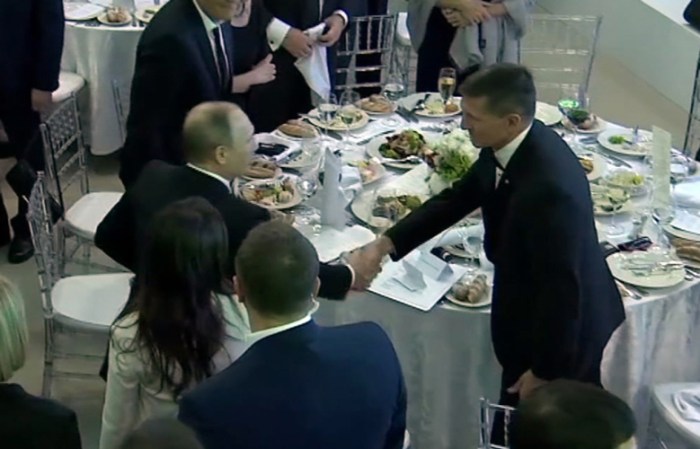
Vladimir Putin and Michael Flynn at TV channel Russia Today’s birthday party, December 2015
Before Crimea, everyone “cooperated” with the Russians. Until mid 2016, there was confusion about this past. The sanctions did not almost nothing to change this mode of cooperation.
But since the elections in the US, quite significant changes have been occurring that are hard to describe accurately and identify. Outwardly, this is encapsulated in the fact that people accused of communicating with the Russians have been losing their posts, and all this comes amidst public scandals. It’s not that people cooperated maliciously, but they were involved in what Russian gangsters call zaskhvar, “getting dirty.”
No one doubted Flynn’s loyalty, but he resigned due to “contacts.” The deputy speaker of the Lithuanian Seimas, Mindaugas Bastys, resigned the other day. He resigned because the Lithuanian secret services refused him access to secret information, although the list of Russians with whom he palled around at different times doesn’t contain anyone special: employees of Russian state corporations in Lithuania, crooked local Russian businessmen, and so on. Recently, the mailbox of an adventurer who has worked for the Kremlin in four countries (Poland, Czech Republic, Slovakia, and Hungary), and the Balkans to boot, was hacked. It transpired that Russian businessman Konstantin Malofeev had discussed or conducted ops of some kind during the elections in Bosnia and Poland.
Malofeev is, seemingly, an extreme example of frankly subversive actions in other countries. Perusing the correspondence and knowing the atmosphere of Russian affairs in Europe, you realize that Malofeev’s strategy and tactics differ not a whit from the actions of dozens and hundreds of similar actors operating outside the Russian Federation. Before Crimea, all of this resembled benign “promotion” of their interests on the part of all those who cooperated with such people. But now retrospection kicks ins. What trouble have those who were involved in the Petersburg Dialogue, the Valdai Club, the Dialogue of Civilizations, and the dozens and hundreds of programs where the Russians either footed the bill, generated incentives or simply provided a one-time service got themselves into? I was told by people from compatriots organizations (who fairly early pulled out of Russian World’s programs) that initially they were fooled by Nikita Mikhalkov’s early cultural projects outside Russia. They sincerely supported his appeal to the descendants of the post-revolutionary emigration. Around 2008, however, they sensed they were getting sucked into a system of ideological support for the Kremlin. Many even continued to travel to Moscow to the compatriots congresses, but inwardly they already felt like observers. They had already decided then that this was a new “Comintern,” and it would be wrong to accept grants from it. But others happily kept on taking the grants and sailed off with the Kremlin for Crimea.
* * *
But all these political, humanitarian and media contacts pale next to the vastness of business collaborations. Millions of people worldwide were involved in Russian money for over a decade. After all, so-called capital flight occurred on a massive scale. This capital was then partly reinvested in Russia through offshores, and partly spent on buying various kinds infrastructure outside of Russia (firms, shares in businesses, real estate, yachts, etc.). This entire giant machine for circulating the Putin corporate state’s money was serviced by millions of people as counterparties, including lawyers, dealmakers of various shapes and sizes, politicians, MPs, movie stars, cultural figures, translators, and so on.
The outcome, when Crimea happened, was a huge spontaneous lobby. This doesn’t mean all these people had literally been bought off, to describe the process in terms of the battle against corruption. People simply “cooperated” and received various bonuses from this cooperation. It is not a matter of recruitment, but a psychological phenomenon. Any of us, having once received money from a rich childhood friend, even if we are critical towards him, would still remain publicly loyal to him. Would you want to shout to the heavens about the atrocities of a man thanks to whom, say, you had earned enough money to buy a new house? You would just keep your lips sealed.
* * *
In other words, for around ten years, beginning approximately in 2004, after the takeover of Yukos, the Russian economy “warmed up” foreign strata whose scale is hard to evaluate. It was not a matter of corruption in the narrow sense of the word. Of course, on their part it was regarded as economic cooperation with a peculiar type of “eastern” economy that involved “pats on the back,” kickbacks, exchanges of various bonuses and preferences, trips to the banya, hunting for wild sheep from helicopters, and so on. But it was not criminal. On their part, it was indulged as a “peculiarity.” Russia is hardly the only economy marked by these ways. It was a partnership in the primary sense. The world’s major companies opened offices and production facilities in Russia. Until recently, it was a privileged economy, included in the BRICS grouping.
Crimea turned all the fruits of this decade-long warming-up into a problem. It is obvious Putin used Crimea to implement an instantaneous mobilization amongst those involved in the partnership. He confronted all the partners with the need to define themselves. Putin’s use of the word “partners,” which he pronounces ironically, has often been thought to relate to the diplomatic lexicon. But in fact Putin has in mind other partners, the millions of people who have received big bonuses for dealing with Russian contracts, Russian money, and various undertakings with Russians for a decade.
* * *
Now these partners have big problems, and we must sadly note that the problems are not due to Crimea as such nor to the regime of sanctions and countersanctions, nor to the ambivalence of having been involved in toxic projects with Russians in the past. The problems lies entirely in the fact that Putin does not want to stop.
This entire massive milieu would sigh in relief if it found out that Putin had “transferred the title to himself” (i.e., focused on Crimea) and called it a day.
But the extreme ambiguity has been maintained and even intensified from 2014 to 2017. It was not Putin who shot down Malaysia Airlines Flight 17, but folks mobilized by Malofeev. It was not Putin who murdered Nemtsov, but Chechen security officials. It was not Putin who hacked the Democratic Party’s servers, but volunteer hackers, who maybe were Russians or maybe not, but they used Russian servers. The attempted coup in Montenegro was not orchestrated by Putin, but by persons unknown. It was not Putin who plotted to destroy Ukraine as a country and establish Novorossiya, but, say, Sergei Glazyev. The pro-Russian rallies in European countries were organized not by Putin, but by a guy named Usovsky, who raised money for the purpose from patriotic Russian businessmen. And so on.
The list now grows with every passing day. Yet the Kremlin doesn’t really distance itself from any of it with a vigor that would be comprehensible to its so-called partners. The Kremlin has not conducted an investigation of any of these events, but has played an ambiguous game that can be clearly read as “covering up” all of “its own” people.
So the ten-year economic warming-up has been transformed before our very eyes into “inducement to conspiracy.” Everyone is now looking back and asking themselves, “Who was it we ‘partnered’ with? Maybe it was Russian intelligence? Or, from the get-go, was it just bait to get us involved in an unscrupulous lobbying scheme?”
* * *
There is tremendously frightening novelty at play here. Everything happening before our eyes with the State Department and pro-Russian politicians in Europe lays bare a complex problem. The boundaries between lobbying, partnership, espionage, propaganda, and corruption have been eroded.
A situation is generated in which it it impossible to tell benign partnership from complicity in a politics that erodes the limits of the permissible. Just yesterday you were a Christian Democrat building a partnership with the Russian Federation, but today you are just a silent accomplice in eroding the norms of Europe’s political culture. You are not just tight-lipped, refusing to evaluate the Kremlin’s actions. On the contrary. “Maintaining fidelity,” so to speak, to the fruits of your past partnership with the Kremlin, you even raise a skeptical voice. “What’s so criminal about Putin’s policies?” And others do the same. “The sanctions have been been ineffective. Frankly, Crimea has always been Russian.”
And if you were somehow able to take in at a glance the entire so-called Kremlin propaganda machine abroad as a combination of the work of Moscow news agencies and little-visited European websites run by left- and right-wing critics of American hegemony who for that reason sympathize with Putin, it would be utterly impossible to get a glimpse of the giant roots the Kremlin has put down in the western economy. It is beyond estimation, just like the transformation or, rather, the corruption not only of its own native population but also huge circles in the west, a task the Kremlin has accomplished in ten years.
Three years ago, I imagined Putin was putting together a kind of right-wing Comintern, and I wrote about it. Now it is often dubbed the “black Comintern.” I think, however, the situation is more complicated and a lot worse. The “Putinist Comintern” is the fairly insignificant and well-visible tip of a much larger process taking place on other floors of European life, where people who are not involved in either ultra-rightist or ultra-leftist politics remain silent about the Kremlin’s actions. Condemning it, they remain loyal nevertheless. They considerately wait for Putin to return to European norms of partnership. These people cannot see and do not want to see that the ambiguity fostered by the Kremlin in the matter of responsibility for murders, paramilitary detachments, mercenaries, and destabilization of small countries is not a temporary phenomenon. It has been conceived that way. And it will continue that way in the future.
Alexander Morozov is a Russian journalist and political analyst. Translated by the Russian Reader
Villanova University basketball team in action. Photo courtesy of Forbes.com
“Russia is neither the juggernaut nor basket case it is varyingly made out to be. A well-reasoned Russia policy begins by quelling one’s hysteria long enough to recognize this and then engaging it accordingly.”
—Mark Lawrence Schrad, “Vladimir Putin Isn’t a Supervillain,”Foreign Policy, March 2, 2017
Try telling a great many people in Russia that the country isn’t a basket case, or that Putin and his regime aren’t a total menace, especially to Russians themselves, as Mark Lawrence Schrad argues in the article I’ve quoted above. They would laugh in your smug face.
I wonder if this useful idiot and assistant professor in political science at Villanova has ever lived in the country long enough to figure this home truth out. Probably not.
Villanova has a great basketball team this year, however. Maybe I should focus on them.
Somehow, I have to stay positive in the midst of the dawning awareness that lots of Anglo-American Slavists would, seemingly, like to work for the KGB if they could. Or are simply too clueless to do their jobs.
At very least, Professor Schrad’s article would have been accepted for publication in Russian Insider as is. TRR
This is what a “non-basket case” looks like in real life, not from one’s office in Philadelphia.
“Arenda” (“For Rent”) is definitely the most popular shop sign in the neighborhood around Voznesensky and Izmailovsky Prospect when I went there the other day to do a couple of errands, and it is complemented by lots of shops that aren’t flying the “Arenda” banner just yet, but which are definitely closed for business forever, like this Chinese restaurant, now known as “Khui” (if you read the fine print on the plasterboard that has replaced the broken glass in the door).
“Fuck.” Photo by TRR
Except for a few parts of central Petersburg where commercial spaces never stay empty for long, even in bad times, this is the visual-economic landscape you would see all over town. It is a landscape of “mixed and uneven development,” to put it charitably.
I don’t see how any self-respecting scholar wouldn’t start with this grassroots reality when analyzing Russia’s current state, rather than with a grab bag of rank speculations, half truths, and outright falsehoods he or she has read in English-language newspapers, magazines, and websites.
But that’s mostly how the new, actually quite fairly hysterical “anti-hysteria”/”anti-Russophobia” school of half-baked journalism and “Russia hands” scholarship operates. Its adepts sit far from Russia and tells Russians how good they’ve got it. TRR
__________________
Exhibit Two: How the Russian Countryside Is Dying
How the Russian countryside is dying.
A sad name for a reportage. But first of all one feels for the people in the reportage, who have worked the land for many years.
I visited the hinterland just yesterday at the request of the workers at the Vegetable Integrated Agricultural Production Company in Tonshalovo, Cherepovets District, Vologda Region. The fact is that everything there has been frozen, and the company has been put on the road to bankruptcy. The prosecutor’s office is looking for the guilty parties, but instead of reading thousands of words, I suggest you watch the video. The inhabitants of our country utter many wonderful, sincere words in the video. What is happening with agriculture nowadays all over Russia is quite sad.
Nettle Info, How the Russian Countryside Is Dying. YouTube video, in Russian. Posted January 23, 2017, by Nettle Info
Translated by the Russian Reader. Thanks to Comrade Koganzon for the heads-up
__________________
Exhibit Three: Russia’s Wildly Corrupt Prime Minister
Russian opposition politician Navalny links PM Medvedev to billion euro property empire Deutsche Welle
March 2, 2017
Navalny alleges Medvedev took bribes from key Russian oligarchs under the guise of donations to charities. In a 49-minute exposé, Navalny even flies drones over lavish properties he alleges were bought with corrupt money.
Russian opposition politician Alexei Navalny accused Prime Minister Dmitry Medvedev of massive corruption in a report accompanied by a Youtube video he posted on Thursday.
The anti-corruption activist alleged Medvedev controls a property empire including mansions, yachts and vineyards financed by bribes from oligarchs to a network of non-profit organisations.
“Based on the documentation disclosed, we can confirm that at least 70 billion rubles (1.3 billion euros or US$1.19 billion) have been transferred in cash and assets to Medvedev’s foundations,” said Navalny, who heads the Anti-Corruption Foundation.
Medvedev “practically openly created a corrupt network of charitable foundations through which he receives bribes from oligarchs and frantically builds himself palaces and vacation homes across the whole country,” the report alleged.
The report was welcomed by Transparency International Russia, a non-profit organization that targets corruption, though it questioned some of its conclusions.
Findings met with skepticism
Navalny has sworn that he will be a candidate in upcoming elections despite being dogged by legal problems
“There are certain doubts in the story of Ilia Yeliseyev, the deputy chairman of the Gazprombank. It is doubtful that Yeliseyev is just a scarecrow. Despite the fact he was a classmate of Medvedev, he is an important figure. He could have earned that fortune himself,” spokesman Gleb Gawrisch told DW.
Gawrisch also said although it looked suspicious it wasn’t actually illegal for Medvedev to use real estate owned by non-profit organizations
“Corrupt officials often use non-profit organizations to hide financial flows and property,” he conceded in a statement to Deutsche Welle.
“The problem is finding out who the ultimate beneficiary is, and we are delighted that the Anti-Corruption Foundation has succeeded in presenting such an extraordinary investigation.”
Navalny, also a lawyer, garnered notoriety for his denunciations against corruption and was sentenced to five years in prison with a suspended sentence for embezzlement, which forbid him from being a candidate in the elections.
His [49]-minute video amassed several hundred thousand views in a few hours on YouTube.
Anti-Corruption Foundation, Don’t Call Him Dimon: Palaces, Yachts, and Vineyards—Dmitry Medvedev’s Secret Empire. YouTube video, with subtitles in English. Posted March 2, 2017, by Alexei Navalny
Navalny said that the foundations receive “donations” from oligarchs and companies, which are then used to purchase lavish properties for Medvedev, who is never registered as the owner.
“The prime minister and his trusted friends have created a criminal scheme, not with companies registered in tax havens as usual, but with non-profit foundations, which makes it virtually impossible to determine the owner of the assets,” he said.
“Medvedev can steal so much and so openly because Putin does the same, only on a bigger scale,” he wrote, presenting his team’s online report.
Navalny said he was able to establish the links to Medvedev by tracing the purchases online.
Medvedev’s spokeswoman dismissed the allegations as promotion for Navalny’s presidential bid.
“Navalny’s material is clearly electioneering in nature,” Natalya Timakova told RIA Novosti state news agency. “It’s pointless to comment on the propagandistic attacks of an oppositional convict,” she added.
_____________
P.S. An acquaintance just told me the average monthly salary at the world-renowned St. Petersburg Conservatory is 11,000 rubles a month (approx. 178 euros), but employees there have not been paid since the end of last year.
And you would still say Russia is not a “basket case,” Mark Lawrence Schrad, assistant professor in political science at Villanova? Could you live on 178 euros a month while also not being sure you would actually be paid that measly sum on time every month?
I imagine that Professor Schrad was paid more than a paltry 178 euros for his wildly misleading article in Foreign Policy.
St. Petersburg Conservatory. Photo courtesy of Wikipedia
Part of the old facilities at the Botkin Infectious Diseases Hospital in Petersburg. Photo courtesy of Dima Tsyrencshikov/The Village
Petersburg Municipal Hospital and Clinic Construction Program on the Skids
Svetlana Zobova Delovoi Peterburg
February 3, 2017
Petersburg Governor Georgy Poltavchenko has botched ex-Governor Valentina Matviyenko’s ambitious program of building 32 healthcare facilities at a cost of upwards of 30 billion rubles. The city lacks a force that could consolidate physicians and builders to campaign against construction delays.
DP has audited all the municipal healthcare facilities that have been built, are under currently construction or are in the planning stages. The circumstances surrounding them are far from ideal. In each specific case, we can speak of certain objective causes as to why a particular clinic has not been completed or is not yet treating patients. But if we look at the issue as a whole, it becomes clear our city has no system for overseeing and managing the sector. Accountability is split between two committees whose specialists, to put it mildly, are not very happy with each other.
Both doctors and builders tell obscene jokes about each other behind each other’s backs and complain of their opponents’ extreme incompetence and their unwillingness to compromise. They cannot work together to finish nearly any of the projects. But no one is ready for a showdown that could reverse the situation and establish new, functioning rules of the game.
The few examples when new hospitals and clinics have been successfully opened either conceal sad stories of protracted construction delays or were overseen by federal officials, and the degree of oversight and accountability were thus on a completely different level. Aside from federal facilities, this study did not take into account facilities that merely underwent renovations, only those that were slated for complete makeovers or new facilities.
DP received quite detailed replies from the city’s Construction Committee and Healthcare Committee about the causes of the delays at dozens of facilities and the complications with bringing operating facilities online. However, there was no answer as to why these processes have been implemented so poorly, with so much anguish and pain.
Good Intentions
To equip the city with the three dozen modern medical facilities it so badly needed, the Matviyenko administration allocated around 30 billion rubles. However, under the current administration, construction companies have been paid less than 10 billion rubles from the budget, completing only a few facilities in fits and starts. Our sources in the Health Committee say the sector’s underfunding has been due to delays in construction.
In some cases, the quality of their work has caught the eye of the prosecutor’s office, while in other cases, expensive medical equipment has been ruined due to mistakes and miscalculations. Deadline overruns have been ubiquitous. It would be wrong to say that the only cause has been poor work on the part of builders and designers. The city authorities have kept on awarding new contracts even to those contractors who have attempted to turn over blatantly shoddy facilities to doctors and brazenly lied.
DP discussed the problem with a dozen head physicians and their deputies, as well as well as contractors and city officials. We got the impression Petersburg has not become Russia’s northern healthcare capital less because of the economic crisis and a lack of financing, and more because of bureaucracy and the complete absence of a genuinely efficient system for managing municipal construction projects. In several instances, it is obvious that if city officials had done nothing at all, it would have been much better, as was the case, for example, with the closure of the maternity hospital on Vavilovykh Street.
Petersburg’s Hospitals
When she departed from Petersburg, Valentina Matviyenko left a legacy of numerous ambitious construction projects, including healthcare facilities. She had planned for the construction or reconstruction of 32 medical facilities by 2016, including new hospital wings, outpatient clinics for children and adults, dentistry clinics, ambulance stations, and specialized early treatment and prevention centers (as per Petersburg Government Decree No. 149, dated 10 February 2011).
As of late 2016, city authorities had built and opened only six facilities on the list. Another four facilities have been built, but their directors, the Construction Committee, and contractors have been bogged down in fierce arguments as to the quality of the construction. The other projected facilities have either been frozen or not assigned a contractor, and their designs are now outdated.
Initially, Governor Poltavchenko seemed inclined to keep improving healthcare in Petersburg. In 2012, he added several dozen future facilities to Matviyenko’s list. Design and construction work on the facilities was to have been completed in 2013–2014.
For example, the new governor promised to rebuild the morgue at the Bureau of Forensic Medicine, design a hospice, build several antenatal clinics, design new wings for the Kashchenko Mental Hospital, and build a TB prevention and treatment clinic in Kolpino.
A little later, Matviyenko and Poltavchenko’s plans were drafted as a program for the healthcare sector. The document originally promised that city officials would arrange for the construction or reconstruction of 29 ambulance stations and medical facilities capable of taking in 36,000 patients a day by 2015.
In reality, the healthcare facilities construction program has been the most disastrous line item in the city’s targeted investment program for several years running. In 2016, none of the medical facilities under construction used 100% of the funds allocated to them in the budget. Certain facilities did not touch literally any of the funds allocated to them.
The prosecutor’s office and the Audit Chamber have highlighted construction delays. The city’s vice-governors for construction policy and Construction Committee chairs have come and gone, but federal officials are still asking the same questions.
At our request, the Construction Committee listed all the medical facilities that have been either built or constructed in the last ten years. According to the officials there, from 2009 to 2011, the three years before Poltavchenko took office, eleven major facilities were brought online. After he arrived in the governor’s office, from 2012 to 2016, another eleven facilities were completed, according to officials, although two are still closed, and the others opened considerably later than they were completed.
The city’s Health Committee provided us with different information. Officials there calculated that 28 facilities had been completed between 2006 and 2016, although Poltavchenko’s program had stipulated either renovating or building 63 facilities from scratch. The difference in figures is due to the fact that officials from the two committees used different timespans. In reality, both lists show outright that the city has got worse at building medical facilities since Poltavchenko’s team came on board.
As health professionals who were well versed in the issues told us, city officials would always ask contractors the same questions during regular on-site debriefings. Why is the facility not under construction? You’ve been working here for five years, but you’re still at stage one. How much of your advance have you gone through? Who produced such a bad design?
Subordinates would be reprimanded, and contractors would be fined and have their contracts torn up, but nothing would change. Construction completion dates would be postponed, and cost estimates would be increased.
By 2016, the list of construction projects had been greatly reduced. Currently, the target invested program lists 14 medical facilities, almost all of them projects from the Matviyenko period that have been subjected to protracted delays.
The construction sector professionals we surveyed estimated that, on average, one and half years are needed to design a large medical facility, while it would take another three years to build the facility. A small ambulance station could be built in a year. In Petersburg, however, actual times to completion are many times longer. It takes five to 15 years to build many facilities.
The Causes Are Plain to See
The Smolny believes that the virtual breakdown of its grand social policy plans has been due to insufficient funding. Thus, in 2017, Petersburg’s most renowned delay-plagued construction project, the Zenit Arena, gobbled up nearly a billion rubles. But this is fibbing, for, in reality, line items for financing the building of facilities that have obviously been abandoned were simply stricken from the budget, because no one was spending any money on them.
In addition, according to the city hall officials we talked to, careless contractors are to blame for construction delays and poorly designed projects, and for not calculating their risks. As you might guess, in this way of seeing the world, officials bear no blame for the fact they are surrounded by bunglers and swindlers.
But there is a more complex view of the issue. A source at one of the city’s largest hospitals told us that the ceremonial communiques and press releases issued by city officials belie the serious friction between the Construction Committee and the Healthcare Committee, as well as between the relevant vice-governors. For while hospitals and clinics are still under construction, the Construction Committee’s budget is replenished. They even purchase medical equipment. But when hospitals start treating patients, the money for that is allocated via the Healthcare Committee. This does not mean, of course, that the Construction Committee deliberately delays building projects. Of course, they want to get delay-plagued facilities off their hands as quickly as possible. But Construction Committee staffers bear no personal accountability for missed deadlines and the poor quality of construction.
A senior official, who has worked in the Healthcare Committee since the Matviyenko administration, says during the past four or five years he and Vice-Governor Olga Kazanskaya have had to wage a “quite serious fight” with the construction bloc in the Smolny. Describing the state of affairs in the Construction Committee, the official spoke of confusion and complained about the frequent change of leadership.
A telling example occurred when we asked Igor Albin, vice-governor for construction, to explain why the Botkin Infectious Diseases Hospital, whichas far back as 2015 he had publicly promised would soon reopen, was still not treating patients. However, he gave us no explanation, shifting the blame for the situation on Healthcare Committee staffers. In turn, they said it was the Construction Committee who was responsible for construction at the Botkin. Off the record [sic], they told us about a long list of defects and unfinished work to which contractors wanted doctors to turn a blind eye, making them sign off on the facility even though it was unfinished. Of course, a dispute like this could go on indefinitely until someone takes responsibility for the entire project.
No Accountability
Our source in the medical community, who spoke out about the construction community in a somewhat biased way, argued that no one except medical professionals had any interest in bringing facilities online. As a consequence, officials failed to make purchase requests for equipment, did not calculate the costs of logistics, and fined the medical facilities.
“There is way too much politicking and money at each stage. Everything is bureaucratized and corrupt in the extreme. What matters is that everything looks right on paper,” said our source.
He was surprised that, under Poltavchenko, the Construction Committee did not “tremble” for failing to execute the annual budget. Under Matviyenko, he claimed, failing to spend funds allocated under the yearly budget was considered an extremely grave offense for officials to commit.
Another senior medical administrator sees the root of the trouble not in corruption per se, but, rather, in the overall “muddle” and the fact that “the system doesn’t function.”
“Every staffer needs to know his function and the consequences that await him in case of failure. Step left, step right, and you can step on a land mine and blow up. Now, though, there is basically no accountability for mistakes, and no one feels personally to blame.”
The Construction Committee has no specific department or expert responsible for medical facilities. A personal curator is usually appointed to oversee each of them. A considerable part of the work is overseen by the Fund for Capital Construction and Reconstruction, which is controlled by the committee. Its longtime head was Andrei Molotkov. It was Molotkov who was criticized by Igor Albin for the numerous missed deadlines and unscrupulous contractors. Ultimately, in April 2016, Molotkov resigned his post, a job that is still vacant.
The Healthcare Committee employs one senior professional builder, Igor Gonchar, head of the Office for Medical Facilities Development. However, he deals with repairing and rebuilding the facilities his committee oversees. Since 2014, the Healthcare Committee has also been tasked with designing healthcare facilities. It was a seemingly reasonable step, meant to reduce the risk of drafting projects that were not suitable for physicians and had to be redone on the fly. In the last three years, however, the Healthcare Committee has not spent nearly 40% of the money allocated to it for design, i.e., 158 million of the 250 million rubles allocated in its budget for survey and design work.
Gonchar gave detailed answers to our questions, explaining that, out of eight planned facilities, the design work had been completed for six of them. Problems had arisen around a large project, estimated to cost 100 million rubles: new wings for Children’s Hospital No. 1. Due to the fact that, last year, changes were made to the law on historic preservation, the specs for facilities adjacent to historic Pozhelayev Park had to be redrafted. Similar difficulties have arisen with another problematic facility, the Dunes Children’s Rehabilitation Center. However, the difficulties having to do with historic preservation were in that case aggravated by the bankruptcy of the design subcontractor, Oboronmedstroy.
A view of the new campus of the Botkin Infectious Diseases Hospital in Petersburg. Photo courtesy of Dima Tsyrencshikov/The Village
Sabotage
One of the most unpleasant consequences of delaying when medical facilities are brought on line is the premature purchase of expensive medical equipment. For when a senior official says a hospital or clinic is about to open, his underlings will willy-nilly have to purchase CT scanners and MRI machines. But then no one is responsible for the fact they have to spend several years in a warehouse, where they are not only of no use to patients but also run through their warranties and sometimes even are damaged due to improper storage conditions.
According to medical professionals, premature equipment purchases are also part of a cynical calculation by officials. They can report the city has already purchased everything a hospital in the midst of construction needs and demand its administrators move into a poorly constructed building.
“In my opinion, the people running the city are not very interested in healthcare, because it involves more political questions,” says Lev Averbakh, executive director of CORIS Assistance LLC (Saint Petersburg) [a private ambulance company]. “I think there no political will for it. No one says, ‘Let’s finish them!’ as with the stadium, for example. Besides, they have begun reducing the number of hospital beds available while changing the regulations. Under the new rules, not as many beds are needed in Petersburg as were required under the old rules.”
Another professional from the field of private medicine argues that Olga Kazanskaya, now the ex-vice-governor for social policy, and Healthcare Committee Chair Valery Kolabutin lack medical training.
Sergei Furmanchuk, co-founder of Hosser [a Petersburg-based company specializing in the design and construction of medical facilities], argues that problems arise when design work is done by people who have never done design work, and they do the construction work as well. He believes that each case has to be examined individually. However, it has to be acknowledged that having a lot of experience and even medical training, unfortunately, is no guarantee of impeccable work, as, for example, in the case of Rosstroyinvest and the Botkin Hospital, Petrokom or Oboronmedstroy, which is currently undergoing bankruptcy proceedings, abandoning several large healthcare facilities unfinished.
Translated by the Russian Reader
P.S. This article, its author, and Delovoy Peterburg obviously have a heavy axe to grind more against one faction of Petersburg city hall (still referred to as “the Smolny,” the headquarters of the Bolsheviks during the 1917 October Revolution). Normally, I would not translate and post this kind of potential journalistic hit job, although it does describe an urgent problem—the collapse of Russia’s post-socialist free healthcare system—more or less objectively, a problem I have touched on elsewhere in my translations of less dodgy printed matter.
But the author does signally fail to point out the role of Putin’s infamous “power vertical” in encouraging the lack of accountability among local officials, whether in Petersburg or Vladivostok.
Petersburg’s current governor, Georgy Poltavchenko, was first appointed outright by President Putin after the latter “upmoted” the city’s previous governor, Valentina Matviyenko, to the Federation Council, which she now chairs, after she had become deeply unpopular for, among other things, trying to ram Gazprom’s infamous Okhta Center skyscraper down the throat of Petersburgers, and flagrantly failing to clean snow from streets and rooftops during one particularly snowy winter, leading to massive residential property damage and a cityscape described by many locals as resembling what the city looked like during the 900-day WWII Nazi Siege.
Poltavchenko was later “freely” “re-elected” to the governorship in an election marked, as usual, by irregularities, running against a field of sock puppets that had been preemptively purged of any real competition.
From the get-go he has seemed more concerned with the matters spiritual and ecclesiastical than really running the city, which has looked especially dingy this winter, when it has become apparent that the previous street maintenance and cleaning system has collapsed altogether, possibly for a lack of poorly paid Central Asian migrant workers to keep it “affordable.”
Is is fair, though, to blame all local failings on the almighty power vertical? Probably not, and that is why I devote so much of this blog to Russians doing it for themselves at the grassroots, often against daunting odds and in the face of outright police repression. But their efforts won’t make a dent in all the issues they are tackling until the country becomes a real federation and power is devolved maximally to the regions, cities, towns, and neighorhoods.
In this light, it amounts to cynical mockery to repeatedly refer to President Putin as a “strong leader,” as the new Fascist Pig in the Poke did during his campaign and now after he has occupied the White Pride House in Washington, DC. Putin is not a strong leader in any sense, but his weakness has been especially apparent in the myriad ways his regime has disempowered Russians at all levels, making it increasingly difficult for them not only to solve but also even discuss the problems that concern them most.
Finally, I should point out that the original article in Russian features a map of the city marked with all the hospitals and other medical facilities built, currently under construction or abandoned under the municipal program described, above, as well as a table with more detailed information about each of these real, abandoned or planned facilities. I was not able to include the map or table in this translation. TRR
A Toilet for the Investigator
Tatyana Voltskaya Radio Svoboda
November 30, 2016
Inside the Café Beirut. Photo courtesy of Tatyana Voltskaya/RFE/RL
Criminal charges have been brought against the co-owner of the Café Beirut in Petersburg; on November 29, police searched her home. In September and October, the café was searched on several occasions by Investigative Committee, Rospotrebnadzor, and Emergencies Ministry officers.
The café believes the only cause of its woes is a casual patron who tried to use the establishment’s toilet last summer, but was turned away.
There is generally nothing wrong about popping into a café to use the toilet. The employees of the Café Beirut say they would never turn away polite, friendly visitors. But when an individual makes noise, swears, and might make a less than pleasant impression on diners, they do not see fit to let him in. Thus, this past July, they turned away a young man who, they say, behaved just this way.
On September 7, investigators, Rospotrebnadzor inspectors, and Emergencies Ministry officers raided the café and searched it. An employee recognized the young investigator leading the raid as the same young man who had unsuccessfully tried to use the Beirut’s toilet in summer.
Another search took place on September 23, resulting in the completely undocumented confiscation of the establishment’s cash register, computer server, order terminal, and charter documents, meaning everything they needed to stay in business. The café was closed for a whole week, but then it opened again, having suffered considerable losses, of course.
But that was not the end of the matter. On November 29, police searched the home of the café’s co-owner Elizaveta Izvozchikova, who has been charged with violating Article 238 of the Criminal Code (“Production, storage, transport or sale of goods and products, works or services that do not meet safety requirements”). According to Izvozchikova, the female investigator who led the search rang at her apartment at seven in the morning.
“She came to my apartment accompanied by an officer of the economic crimes department district office and two official witnesses. They served me with a search warrant, which made it clear to me that criminal charges had been filed against me under Article 238. The article says nothing about harming anyone, only about providing poor-quality services. To file charges under this article, it is sufficient to record violations of some kind, say, sanitation rules. We quickly fixed all the violations for which we had been cited and submitted a report to the Investigative Committee. After all, we opened just recently, in late February of this year. We did a major overhaul and replaced all the plumbing, sewerage, and electrical wires. The basement was in bad shape. Then we restored the historic storefront, made high-quality repairs inside, and installed new equipment in the kitchen. We wanted to do something good for people, feed them tasty food and give them good service. I am a designer by education, and I really wanted to make the café pretty. I am a responsibe person, so I tried to make sure everything was in order: that the fire extinguisher was certified, that the kitchen was clean, that we followed all the rules. But on September 7 we had our first inspection. The investigator from the Investigative Committee forced everyone outside and demanded we sign papers of some of kind without reading them. Otherwise, he threatened us with immediate closure and put a lot of pressure on my manager, who is fairly young.”
Café Beirut co-owner Elizaveta Izvozchikova. Photo courtesy of Tatyana Voltskaya/RFE/RL
I asked what the reason for the first inspection was.
“My internal investigation revealed that our manager had seen the young man who turned out to be an investigator: he had not let him use our toilet. We had guests, he had demanded to use the toilet in a rude way, waving his arms and cursing, so he was not allowed to use the toilet. The second inspection, headed by this investigator, took place on September 23. He confiscated the cash register and a bunch of other things. The investigation was then terminated. Later, however, the decision to terminate the investigation was annulled, the case file was submitted for an additional investigation, and another inspection was organized. Rospotrebnadzor and the Emergencies Ministry cited us for four violations. We immediately fixed two of the problems: we installed a missing washbasin and a germicidal lamp. But the other two violations were simply nonexistent. We were told our doors had to be at least one meter wide, and we had to have a second emergency exit. According to fire safety rules, however, wide doors and a second exit are obligatory only for premises larger than one hundred square meters, and if there are over fifty evacuees, but our place seats only thirty people. We explained everything to them and attached documents to our reports, including the cadastral passport, which shows we have only sixty-three square meters of space. We also requested that everything they had confiscated be returned to us, as they had nothing to do with the inspection. Instead of a response, however, criminal charges have been filed. The charges are based on those same two violations, turned up by the Emergencies Ministry, but I do not believe that the Emergencies Ministry officer was unfamiliar with the rules in question. The third violation consisted in the fact that, according to Rospotrebnadzor, we had no right to worked with unpeeled root vegetables; this requires a separate bath or even a whole room. So we ordered peeled root vegetables, meaning we started using prepared food, which we immediately reported to the authorities. But it made no difference at all. I was summoned for interrogation on November 29, but I refused to answer the questions in order to better familiarize myself with the charge sheet. So I will be going to the Investigative Committee on Monday, December 5. While the inspections were going on, we made huge losses. We were closed for an entire week, and many of our clients even now think we are still closed. Nothing like this has ever happened to any of my colleagues, and I continue to hope for justice. We have not violated any law. We are conscientious taxpayers and entrepreneurs who are trying to run a small business, and we do no harm to anyone,” says Elizaveta Izvozchikova.
Restored historical storefront at the Café Beirut (right). Photo courtesy of Tatyana Voltskaya/RFE/RL
Lawyer Boris Gruzd argues that criminal prosecution has not been used for its intended purpose in this case.
“I think that criminal charges are sometimes filed on insufficient grounds and used for other purposes, as a means of revenge, for dealing with undesirable persons. I think this is one of those cases. It often happens that, even when criminal law has seemingly been violated, it is extremely hard to file criminal charges. An enormous amount of effort is made to turn even obvious crimes into criminal cases. But here criminal charges have been filed out of thin air, so to speak. Because, when criminal charges are filed, aside from violation of the law, another important element is danger to the public. In this case, however, they have found fault with a telegraph pole, as the saying goes. I am sure you could find a dozen such violations in any small business and major state company. What public good has been violated that it is necessary to resort to criminal prosecution? It is a last resort that should be used very selectively and carefully, when other tools do not work. This is a classic case of ‘nightmarizing business.'”
I asked Gruzd whether there was any hope of punishing those who spin such cases out of thin air.
“It is necessary to take steps in this direction. It produces a particularly sharp contrast with the notorious case of the women who was murdered although she called the police because her [ex-]partner had threatened her. But the dispatcher, the best beat cop in the city, told her that if and when she was killed, they would come and describe her corpse. Here, the Investigative Committee, whose remit is grave and especially grave crimes, has pounced on a café. So they have the time and the energy to deal with this nonsense?” notes Gruzd.
Alexander Kobrinsky, a member of the fifth convocation of the St. Petersburg Legislative Assembly, says the persecution of the Café Beirut’s co-owner is not something out of the ordinary in Russia.
“Recently, everyone watched the video in which security guards tried to keep a drunk man, who turned out to be a police officer, from entering a café. A while later, the riot cops arrived and detained the security guards, who were just doing their jobs. But the situation is understandable, because law enforcement officers consider themselves a superior caste, endowed with special rights, including the right to cook up criminal cases as a means of personal revenge. It is quite widespread, since the law allows them to file criminal charges, suspend business operations, and confiscate tools, computers, whatever. Maybe the charges will be dropped a year from now, but getting a business back up on its feet after such shocks is not always possible. That is why, by the way, prohibiting the detention of people involved in commerce and seizure of their property has now been actively discussed. What point have we reached to openly admit that the vast majority of criminal charges filed against businessmen in Russia is based on mercenary motives and revenge! Clearly there are thieves and con men, but it turns out that they constitute the minority of defendants in such cases. Such is the system and such is the law. We see that a completely peculiar set of circumstances has been established in Russia. I don’t know, maybe Putin was speaking sincerely about the investment climate, but there is no longer any way of manually managing hundreds of thousands of these minor strongmen. In Russia, every police capitan, assistant investigator, and junior assistanct prosecutor is a low-level power broker. They are used to living this way: they have been living this way for a quarter of a century. And they do not want to live any other way, no matter what Putin has said,” argues Kobrinsky.
According to Kobrinsky, this mindset—that I am a landlord, and you are my slaves—is very difficult to eradicate. One has the impression that the head of state seemingly has no leverage over Russia’s law enforcement system, that it must be completely dismantled and reassembled anew.
On November 29, Elizaveta Izvozchikova was released on her own recognizance.
Russian MP Oleg Shein in 2009. Photo courtesy of Wikipedia
MP: Astrakhan Region Headed for Deep Social Catastrophe Rosbalt
November 18, 2016
Astrakhan is among the regions undergoing a social catastrophe, argues MP Oleg Shein, who sits on the State Duma’s Committee for Labor, Social Policy, and Veterans Affairs. As the MP told our correspondent, both federal and regional authorities are to blame for the situation.
“Astrakhan Region is currently undergoing a fiscal disaster due to the fact the regional budget has collapsed. This year, it has been slashed by 15%, from 38 to 33 billion rubles. Next year, the regional authorities have proposed cutting the budget by another eight billion rubles. Accordingly, the budget will have shrunk by about 40% in two years. Already this year, financial aid to the poor has been completely eliminated, and subsidies for parents paying fees to kindergartens have been canceled, causing kindergarten fees to increase by one and half times. The upper grades have been eliminated in a number of schools. Schools have gone from eleven grades to nine grades, and this has caused overcrowded classes in the remaining schools. Payroll has been reduced by 7% for public sector employees: doctors, teachers, and cultural workers. Actually, 7% is the average figure; large numbers of people have had their salaries cut much more considerably. So the region really is headed downhill, and the regional government sees no ways of heading off the disaster,” said Shein.
[…]
“The regional authorities—and there is some truth to this—explain what is happening by referring to the loss of tax revenues from the oil industry. Several years ago, the State Duma—or rather, the United Russia party—freed Lukoil from paying taxes on its oil rigs in the Caspian Sea. This year as well, United Russia has voted to transfer the profits from oil production in the Caspian, the income tax revenue, from the regional budget to the federal budget. The regional authorities were really counting on the money, but they have ended up with nothing. But there is a second reason: their completely devil-may-care approach to drafting the regional budget and the loss of the local tax base. Sometimes, the regional government has literally abetted hostile takeovers of local companies, as, for example, happened to the local company Bassol, which supplies 60% of the salt to the Russian market and now pays taxes outside of Astrakhan Region. Paradoxically, the regional government welcomed this,” said Shein.
The MP said that despite its socio-economic difficulties, Astrakhan Region was also marked by high levels of corruption and the waste of money on mega projects like a musical theater and so on.
According to a rating compiled by the sociology department at the Russian Federation Government Financial University, Astrakhan was among the Russian cities with populations of 500,000 or more where the lowest indices for quality of life had been recorded. According to Astrakhanstat, during the period from January 2016 to August 2016, the real disposable income of Astrakhan Region residents was 89.4% of what it had been during the same period last year.
Translated by the Russian Reader. Thanks toValentin Urusovfor the heads-up
“Putin, Help!” Photo courtesy of Go31.ru and 5koleso.ru
Drivers Spell Phrase “Putin, Help!” with Buses in Stary Oskol RBC
September 27, 2016
Drivers at the OskolPasTrans passenger transport company in Stary Oskol have held a flash mob during which they parked their buses to spell out the phrase “Putin, help!” They have published a video of their protest on their own channel on YouTube.
The drivers involved in the protest asked that attention be paid to the actions of local officials, who, according to the drivers, have driven them out of the transport market. In the video, the drivers note that the flash mob’s main goal is an “objective investigation of the local passenger transport market.”
The protesters are also seen toting placards with slogans such as “Governor, help!” “No to corruption,” and “Give us back our property.”
As a female driver in the video recounts, she appealed to the Arbitration Court to protect her interests. On September 6, 2016, the court ruled in favor of her lawsuit, but “attempts by city hall to terminate [the company’s?] contract have continued.”
According to the Belgorod-based new website Go31.ru, OskolPacTrans was the city’s major carrier, but the authorities had concerns about the quality of their services. In the summer of 2016, the Stary Oskol mayor’s office terminated its contract with the carrier, and the drivers were put out of work.

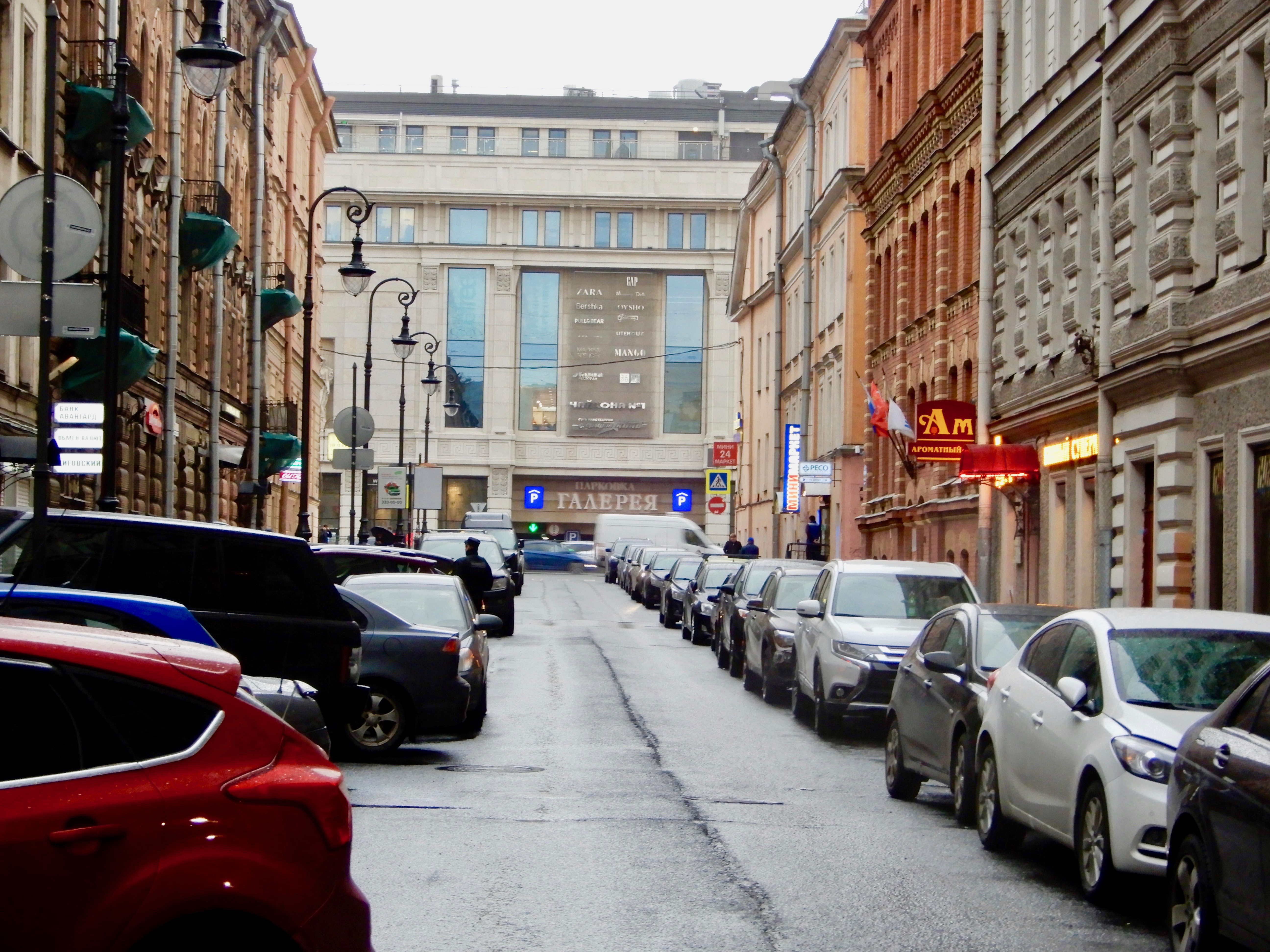

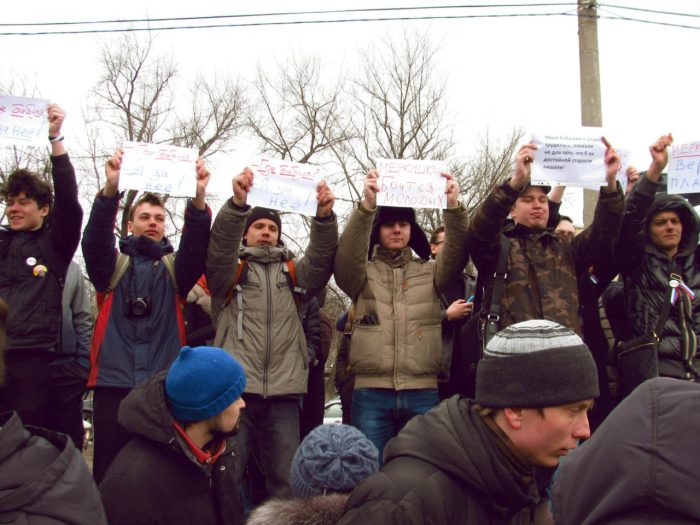
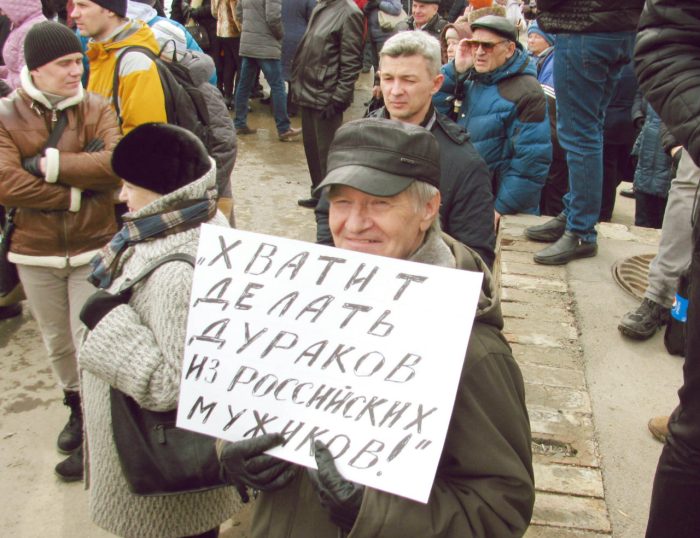

 “I Don’t Impose My Opinion”