The 2016 Elections: Making the Same Mistake Is Fate
Nikolay Mironov Moskovsky Komsomolets
September 19, 2016
It is apparent to almost everyone the country has fallen into a deep pit. (That is the most decent word for describing the situation.) Economic stability (and, along with it, the stability in our lives) is irreversibly over, and it is clear a new (moreover, radically new) economic policy is needed to bring it back. The current, extractive economic policy has run out of steam. Both the regime and society are aware that a crisis has ensued, but for the time being no one is doing anything about it. Meanwhile, the time for reform is running out.
Now, after the elections to the State Duma, as new and old MPs take their seats, 2018 moves into the foreground of the political agenda. In fact, the main issue is not whether Vladimir Putin will seek a fourth term. The main suspense revolves around whether in the near future we can expect a change in the country’s economic and political model. Which transition scenarios are the most likely? The future president’s name is interesting only from this viewpoint. Whether the president is young, mature or elderly, what matters is whether he or she will be able to implement reforms and how they will implement them.
The country’s reserves are running out, and the system acutely, critically needs a reboot. However, launching reforms becomes more complicated with every passing year. The situation has now almost been brought to an extreme. The government obviously is now no longer coping with its obligations to society: the population is rapidly plunging into poverty. The political structure is held together only by the president’s word of honor and good health.
At a critical time for the country’s future, however, the regime has preferred to act tactically rather than strategically. When the oil price was high, it was possible not to think about costs, effective spending, and rampant corruption. When circumstances worsened, the regime also took the easy, well-trodden path of spending reserves, introducing new taxes for the general population, clamping down on small business, reducing social spending, and commercializing health care, education, and research.
Soon, however, it became clear these measures were insufficient for riding out the crisis. So, currently, the mechanism for confiscating “superfluous” money from major businessmen and top officials, previously untouchable, has been set into motion. This is borne out by the alleged anti-corruption campaigns that have been unleashed. In fact, their goal is to collect tribute from certain segments of the elite. But not from all segments, only from the “extended” circles, without affecting the circle of businessmen and administrators closest to the regime.
The system is going down the same road as the Soviet nomenklatura did in the 1980s. Initially, it firmly “brezhnevized” itself, stagnated, and rusted on the inside. Now, experiencing a lack of resources, it attempts to get by with superficial half-measures, in particular, by tempering corruption, which is sucking the country dry, by jailing a limited number of individuals. Ultimately, when the common folk learn of the colossal wealth possessed by middling colonels they are convinced of the regime’s utter corruption, but see no decisive measures being taken and are persuaded the elite has no desire to change anything. Eight billion rubles are seized in anti-corruption official Dmitry Zakharchenko’s flat, and people are paid eight-thousand-ruble pensions! [I honestly don’t know where Mironov got the second set of figures, although, of course, pensions in Russia are usually entirely to low to cope with the rising cost of living. — TRR.] A million times difference! But none of the higher-ups in the Interior Ministry has resigned. This fact alone is enough to shatter confidence in the entire political system.
The problem, however, and it is the main problem, is that the people with power and money—the nomenklatura-slash-oligarchy of our time—do not want to change their position even in the midst of a crisis. They cling to their extreme wealth and privileges. But the realization that change is necessary dawns on them with catastrophic tardiness. It was this way during tsarism’s final days, and under the late-Soviet regime. Instead of launching reforms in timely fashion, the regime has put them off, pushing the situation to the point of no return.
In the recent elections to the State Duma, United Russia, trudging to victory under the leadership of Prime Minister Medvedev, refrained altogether from proposing an anti-crisis plan to the nation, either a strategy of some sort or even a winning tactic. Quotations of Putin and tiresome references to Crimea and the country’s rising from its knees were the entire content of their campaign. The nation responded partly by skipping the elections, partly by voting as they were told, and partly by voting because there was no alternative. But the question of what to do next remains unanswered. Does the regime intend to answer the question, or will all this uncertainty crystallize in 2018?
Meanwhile, Russia finds itself at a crossroads. The first road is the inertial scenari0. Politically, it involves further crackdowns. The unwritten “social compact,” which emerged in the early noughties, has become impracticable since it cannot ensure a comfortable life. So without purging possible rivals and curtailing grassroots activism it will not be possible to painlessly solve the problem of extending the president’s term or transferring power to a chosen successor. So, for example, further censorship of the media will be required, as will the strict administration of what remains of elections, and increased persecution of undesirables, and more frequent trials and more show trials.
In economic terns, this simple plan involves the the “dekulakization” of less than totally loyal oligarchs and wayward officials, who will have to pay for the crisis. Undoubtedly, this will have a temporary effect and make it possible to plug certain holes in the budget. For a country like Russia, however, given the scale of the crisis, the effect will be quite short-lived. When this money runs out as well, reform will be the only option. But I am afraid that by then the last capital will be spent, and there will nothing left to invest in the economy. The chance to change things without radical demolition could be missed. The country will spend the last bits of the Soviet legacy, and exiting the crisis will once again require titanic efforts on the part of the people. Given increased global competition, however, Russia risks never catching up with anyone ever again.
The second scenario, vital for our survival, involves carrying out reforms right now. The government has to support the economy to give it a leg up and get development up and running. I would argue this is impossible without injections from the budget and, consequently, without strategic government planning, facilitating the rational use of the resources we have left. We not should support the economy per se, but those areas of growth that will encourage import substitution and the establishment of competitive production in the non-extractive sector and agriculture.
Where do we get the money? From reserves, tax reform (redirecting the tax burden toward the super wealthy), confiscation of funds acquired through corruption, and capital export controls. This will require quite stringent measures towards the business elite and high-ranking officials. Medium-sized businesses and rank-and-file servants should not be touched, however. Not scapegoats but the genuinely super wealthy should be involved in getting the county out of crisis.
To keep the money meant to bolster the economy from being stolen, we need a perestroika of the political system, because that is where the roots of corruption lies. It comes from secrecy, the regime’s accountability to no one but itself, and officialdom’s bloat and inefficiency. There are no miraculous prescriptions in this case. Throughout the world, free media and judicial, parliamentary, and public control help to temper the appetites of those in charge of the budget. The regular turnover of those in power is also necessary, and the only cure in this case are free and fair elections.
We also need to support the population, which has been rapidly growing poorer during the crisis, and not only from a sense of social justice. When people have no purchasing power, the economy is alway in crisis. Government financial assistance should be used to stimulate consumer demand, ensuring import substitution in those sectors where funds are received from public. Otherwise, the money will be converted to foreign currency and sent abroad. We must protect domestic producers from robbery and extortion. Otherwise, they will hide everything they get from the government and the public abroad. Plus, interest rates on loans to business must be drastically reduced. If all these things are done, tax revenues will start to grow in a few years, and government aid will be recouped.
Strategically, a reboot of the educational system is also needed now in keeping with the country’s development priorities for at least the next twenty years. Science and the national technological base must be supported.
The prescriptions for solving Russia’s problems are self-explanatory. Given the president’s high ratings and United Russia’s overwhelming majority in the Duma, it is high time to carry out large-scale reforms. There is a margin of safety and the required level of support. But everything in Russia is topsy-turvy. In Russia, it is more likely reforms will be launched if the regime’s ratings take a catastrophic nosedive. They will inevitably reach a critical level when the socio-economic situation worsens. You cannot fill your belly with endless tales of patriotism. People, after all, need to eat something, clothe their children, and get medical care.
We could also arrive at a different fork in the road: reforms from above or turmoil from below. Attempts to stop time have always led Russian regimes to ruin, destroying the country in the process. Must things come to this? The populace’s passivity in the face of a purge of the opposition is a temporary and illusory phenomenon. Many local social protests have erupted around the country. Their number is not diminishing, and general discontent has been growing. And things could seriously explode somewhere. Is it our fate to make the same mistake again and again?
I recall the joke about Ivan the Fool. A father had three sons. The eldest went into the yard, where a rake lay on the ground. He stepped on it and was killed. The middle son goes out, and it is the same story. Ivan, the youngest brother, realizes a rake is lying in the yard and he should not step on it, but there is no way around it. Such is life.
Despair as a Sign of the Times The general mood of discouragement has been growing because Russia has shifted into idle, and it is unclear when and how it will end
Nikolay Mironov Moskovsky Komsomolets
September 6, 2016
Pain and despair have seized the country. Russians are losing their jobs. They cannot pay back their debts and feed their children. Due to constant problems and the lack of apparent prospects, families are falling apart. Some make desperate decisions, finally putting an end to their lives. Russia is losing people.
In July, an employee at a sports school in Trans-Baikal Territory committed suicide after he was not paid. In early August, a married couple in Blagoveshchensk, who were up to their eyeballs in debt,. jumped from a fourteenth-floor window, leaving their young child orphaned. This spring, a father of five in Kiselyovsk in Kemerovo Region hung himself because of debts. Large numbers of similar reports have been coming from different parts of the country.
Can you live on a wage of 10,000 to 15,000 rubles a month when prices are rising continuously? [15,000 rubles is currently equivalent to approximately 200 euros. — TRR.] Or on a pension of 8,000 rubles a month? How do you raise children on this kind of money? And what if, God forbid, you have emergency expenses, for example, for expensive medical treatment, whose cost exceeds the family budget many times over? Well yes, Russia has free medical care, so to speak, but we all knew what it is really like.
It has terrible consequences. The wave of cancer patients voluntarily departing from life continues. After a series of well-publicized cases in 2014–2015, the situation has not improved this year. In mid August, a man suffering from the cancer in the Moscow Region committed suicide with explosives. In June, another cancer patient committed suicide in Yaroslavl. Despite numerous similar suicides, the Russian Health Ministry continues to claim there is no link between the suicides of cancer patients and a deficit of pain medication. Just as there is no link, of course, between the despair felt by cancer patients in our country and the state of Russian medical care, which generally gives little chance to defeat the disease to those who have no money.
According to Rosstat, 24,000 to 26,000 people take their lives each year in Russia. But the causes of this and the means of remedying the situation are not discussed seriously. Instead, Rospotrebnadzor (Russian Federal Service for Supervision of Consumer Rights Protection and Human Welfare) have drafted recommendations for reporters on how to cover suicides.
Fewer and fewer people in our country know what they are going to live on tomorrow, how they will pay for rent and medical care. Russia is plunging into poverty. People have lost their sense of stability and security. The government, on the other hand, ignores these problems. It clearly has no strategy or even tactics for solving them.
There are a gazillion “public servants” in Russia, more than in the Soviet Union, but they serve only themselves and their bosses. High-ranking officials and the business clans that have fused with them live in a secure and comfortable world, whereas the common people are forced to survive alone. The civil service has lost its effectiveness. It has turned into a caste of masters and lords from whom we cannot defend ourselves, because they are the power, while we are “cattle.”
Can fear of policemen really be a norm of a civilized life, of a civilized country? Yet lawlessness on the part of the police has remained. All the talk about combating it has been just that—talk. Here is a recent case. Igor Gubanov, a resident of Magnitogorsk, protested against police lawlessness by cutting off two of his fingers. He could find no other way of making himself heard. In January, Gubanov and his wife, who live in a communal flat, were taken to a police precinct where, according to Gubanov, policemen raped his wife. A criminal investigation was launched, but soon the police investigators closed it, accusing the victimized woman of making false charges.
Despair is felt not only by people who have decided to commit shocking acts. The overall mood of discouragement has been increasing due to the fact Russia has shifted into idle and got stuck in the doldrums, and it is unclear when and how it will end.
The national anthem and memories are all that remain of the once-great country: outer space, victories, and prestige. The country’s most recent major achievements happened fifty years ago. The “unbreakable union” has been replaced by “our great power Russia,” but what is next? Great and poor, great and impoverished. Do these notions go together? How long can we live like this?
The Russian welfare state exists only on paper. Such declarations, by the way, have also been inscribed in the constitutions of Latin American, African, and Asian countries. A Brazilian in his favela reads that he lives in an wonderful welfare state, and he is amazed. The same is true of our fellow Russians, with their miserable wages and pensions. True, unlike their brothers from the country “where many wild monkeys live,” they do not live in huts yet. But, as they say, the night is young.
The main problem nowadays is that the country lacks a locomotive capable of pulling it out of crisis. The regime is concerned only with self-preservation. Officialdom is corrupt, inefficient, and lacking any strategic benchmarks. The “elite” (which I put in quotations, because they really are not the best people in the country) have been thoroughly denationalized: they have no stake in developing Russia. Until a normal and non-corrupt state makes the “elite” serve the country, it will never move it forward. In this case, what is wanted is the bloody-mindedness of a Peter the Great, who once put an end to mestnichestvo and forced the boyars and gentry to serve the country, or the statesmanship of Alexander II, who abolished serfdom over the lamentations of the landlords.
Instead, pro-government spin doctors have been increasingly ratcheing up the propaganda machine, searching for enemies, and heavily sugarcoating reality. Jingoism has already bored everyone to death. The people directing the show do not believe in it themselves, and the audience has stopped believing in it as well, despite the sunny ideology foisted on them, because Russia is running in place, and no one is solving its problems. The propaganda spiel that enemies are to blame for everything is still functioning, but even it cannot serve as a perennial explanation for each new outburst of social turmoil and, especially, the government’s extremely poor performance. So fine, Obama is a bad guy, but what does that have to do with indexing pensions?
The only thing the regime can really boast about is reinforcing itself. But it is a regime presiding over a country losing its vitality. As a priority, the self-preservation of the “elite” deprives Russia of the chance to put itself back in motion. Yet the purged political arena, in which there is almost no opposition to speak of, much less plain old independent people who think about their country, has stopped generating leaders. There is only one leader left in the country, and he presides over a multilayered horde of bosses and oligarchs, embezzlers and dolts perched on their estates and thinking only of themselves.
Except for United Russia, a product of the same regime, Russia’s political parties have no weight nationwide. The same goes for grassroots organizations. The media have been muzzled. Those who try and shout louder than the rest face either a harsh crackdown or a trivial payoff. Many people have taken to making oppositional noises in the hope they will be paid to shut up. Imitating protest has become a business, just like imitating patriotism. Amid the mob of clowns and crooks, the reasonable speeches made by the few real patriots who are rooting not for themselves but for their country are drowned out by the overall senseless din.
By eliminating potential enemies, the regime has also destroyed the very possibility of an alternative emerging, of a reboot. The current policies are clearly ineffective, but what and who should replace them? Reasonable prescriptions, for example, for supporting the national non-oil economy and import substitution, restoring consumer demand through social assistance to an impoverished population, ending capital flight, going after offshore companies, and clamping down hard on corruption have been voiced. These ideas, however, have come from second- and third-rank players who can advise the authorities but cannot demand anything from them. So the regime has ignored them year after year, thus exacerbating the crisis.
I am not trying to whip up a frenzy. I would like to say something positive, but the situation is firmly deadlocked. It is clear what reforms are needed. It also clear how to implement them and where to begin: with the “elite,” the civil service, the budget, and the tax system. The only open question is who would be capable of doing all this. We have already talked about the government. Russia’s active middle class is small, and it is extremely demoralized. We are left with the rank-and-file population, who have suffered most from the crisis and seemingly have a stake in launching reforms. But for the time being only a few ordinary people have been willing to take responsibility, allowing the regime quickly to localize protests, as happened with the farmers.
In the current environment, self-organization, society teaming up with honest people in the civil service and law enforcement, could be effective. Those honest people are undoubtedly there, but not in leadership roles. The country needs a grassroots organization, a movement, a party that could unite people and impose its own rules on the authorities. Society has to make the first move itself, which will serve as a signal to the honest people inside the system. We have to get the ball rolling.
Responsibility for what will become of the Motherland and us tomorrow lies with each of us today. As Mahatma Gandhi said, “Be the change that you wish to see in the world.”
All we have to do is not be silent, not relinquish our right to speak and act to someone else, not to count on an unknown savior of the Fatherland showing up. If he has not saved the country already, why would he do it now? And, needless to say, do not be afraid. We have to overcome our isolation to put an end to the senseless suicides, severed fingers, and broken lives, to put an end finally to the shameless plunder of the people and the export of the loot abroad. Even the smallest action, as long as it is collective, carries more weight than the most desperate individual deed.
We can, of course, wait for the moment when the country finally goes to hell in a hand basket, as in Tsarist Russia or the late Soviet Union. But do we really have to go through turmoil and destruction every time we need a new impulse to development? Are victims so necessary to the process of recovery?
The country is at a standstill, and the dump truck of history is rushing toward it. There are two options. Either we start the engine and drive, or we wait to get run over and tossed onto the roadside.
On this bright Saturday evening, when the sun has finally come out in the former capital of All the Russias after a week of nonstop rain, I want to offer you two tales of two completely different modern Russias, situated unhappily side by side, but God only knows for how long and at what cost.
Both stories have their fictional and literary precedents, as is often the case in this overly verbalized country.
The hero of the first tale, Valery Slesarev, will remind you of the characters and real-life heroes and victims in nineteenth-century writer and human rights activist Vladimir Korolenko’s fictional sketches and muckracking newspaper articles, while the nearly unbelievable promises and high-powered wheeler dealers in the second tale will conjure up Ilf and Petrov’s world of con men and grifters during the NEP period. TRR
____________________
Smack Them Upside the Head Tired of waiting for a promised natural gas tie-in pipeline from local authorities, the Yegorevsk Urban District in the Moscow Region asked Obama for gas
Ekaterina Fomina Novaya Gazeta
June 5, 2016
Valery Slesarev. Photo by Ekaterina Fomina
After collecting 531 signatures in support of his effort, pensioner Valery Slesarev called the US Embassy and asked a specific question.
“How can I get a hold of Barack Obama?”
The embassy promised him to call him back and make an appointment.
Lots of people in Yegorevsk know Valery Slesarev. First, he has tuned and fixed TV sets his whole life, and that is deemed a vital service. Second, he has an artificial skull.
As a child, Slesarev was involved in Pavel Popovich’s Young Cosmonauts Club. One of the activities at the club was parachute jumping from towers. During one such jump, the carabiner from a pull rope slammed Slesarev hard in the head. A year later, a tumor was discovered in his brain, and it was decided to operate. Popovich himself got involved by asking for help from America, where an artificial bone was grown personally for the sixteen-year-old boy. The doctors told his mother he would not survive, but the bone up and took hold.
As the years passed, it transpired that, along with the bone, the doctors had implanted something Soviet people were not supposed to have: a faith in justice and the strength to fight for it.
Initially, the life of the young cosmonaut with the artificial skull rolled down different tracks than it might have, like in a small town in West Virginia: steady, nothing out of the ordinary.
“Maybe the Lord in fact saved me then. Eighty percent of my group at the Young Cosmonauts Club died in Afghanistan. We were all combat ready, you see, and those boys were sent straight to the front,” he says today.
Slesarev studied to be a radio technician, but went to work as a TV repairman. The celestial expanses no longer appealed to him, and he had enough to do down on earth as it was. He drove from village to village fixing TV sets and occasionally chopping firewood for old women.
In the nineties, the business where Slesarev worked fell apart, and he started a small business of his own, a tire repair shop. He called it Autocupola, and indeed the blue, two-storey building housing his shop is crowned by conical metal cupolas. The cupolas, he explains, are in honor of his artificial skull. He is proud of the black swans, carved from tires, out in front of the shop and a gingerbread boy with a painted mug.
Slesarev lives in amazing house, also topped with cupolas, only they are in the shape of little bulbs. The local council has even hung a sign on the house designating it a cultural landmark.
For a time, then, Slesarev was an amusing local landmark. In 2005, however, the Moscow Region began installing natural gas mains in the villages of Yegorevsk. The mains were quickly installed in all public buildings, but ordinary people, those selfsame old women for whose sake the whole program was undertaken, were left without gas. Slesarev says he simply could not look at old women swinging wood mauls anymore. Thus began his fight.
Vladychino
Only twenty-eight people are officially registered in Vladychino, a village in the Yegorevsk Urban District, but around a hundred people live there permanently, most of them people the natives have contemptuously dubbed “summerfolk.” Slesarev is one of the summerfolk too. He has land there, inherited from forebear, and his grandmother’s house, which he has managed to restore and preserve. The entire village stopped by to admire it.
As in the neighboring villages, people in Vladychino buy natural gas in cylinders. A fifty-liter cylinder, which costs a thousand rubles to refill, lasts a month. Arranging privately to have a gas line connected to your house costs at least 500,000 rubles [approx. 7,000 euros].
A spontaneous assembly of local residents has been taking place on the bench in front of Slesarev’s house. You might say he mobilized them.
Grandma Valentina, Grandpa Nikolai, Kolya, who has no front teeth and wears a leather jacket, Nikolai Alexandrovich, and Tatyana have formed a semi-circle. They occasionally get sidetracked and swat a mosquito. It is the height of the season.
“Please forgive my appearance. I came from the garden,” says Tatyana, apologizing as it were for her apron.
“TV Rain came to film, and we all dressed like peasants,” says Valentina, dangling her rubber-slippered feet by way of proof.
“Why are we appealing to Obama? We hope that, if not Obama, some other president will respond,” says Valentina.
“I’ll tell you why,” says Nikolai Alexandrovich, who steps forward, dressed in builder’s overalls. “He is a winner of the Nobel Peace Price, and he is on his way out of office in any case. Let him do one good deed at the end of his term by getting gas installed for us.”
The locals gossip. The village of Rakhmanovo got gas when an MP from the Moscow Regional Duma and a member of the Yegorevsk Board of Deputies moved there. Actually, according to the paperwork, gas lines have been laid to Vladychino and all the other villages too: 300 million rubles [approx. 4 million euros at current exchange rates] from the regional budget was spent on the program. A presidential commission even came looking for the gas, but they did not find it. To be hooked up to gas lines under the regional program, a village must have no less than one hundred residents, so Vladychino was lumped together with neighboring Parykino. Now, according to the schedule for gasification, Vladychino and Parykino should get gas lines no later than 2018. But no one believes it will happen, because dates for gasification of the villages have been postponed annually since 2005. Last year, the residents of Vladychino wrote a letter to Putin, but half has many people signed it as did the letter to the US president.
“He’s not going to help. His term is never going to end. He’s president for life,” says Nikolai Alexandrovich.
“God willing he will be president for life!” responds Valentina. “He lifted the country up! As for gas, well, we need it. Maybe he just has not been told about us. Our board of deputies should be the ones helping us, but they don’t do anything for us. This year, they didn’t even spray the bushes for ticks.”
“This writing to Obama thing is all a joke, a way of getting us riled up and forcing us to think,” explained Nikolai Alexandrovich. “But what do you think? Is America Russia’s enemy? I knew you’d say that! I’m not going to try and educate you or persuade you. Who is threatened by Russia? The Americans, however, are already in Estonia. Those are facts, Katya, facts!”
By local standards, Nikolai Alexandrovich is also one of the summerfolk, although he has lived in Vladychino for four years, since retiring. He worked for twenty-six years in security at the Kremlin. Nowadays, he is an elder at Nativity of Christ Church.
“That is war,” continues Nikolai Alexandrovich. “Was it necessary to drop the bombs on Japan? This is a continuation, just as today’s Russia is a continuation of Soviet life in many ways. Your colleagues from TV Rain were spooked. They were worried lest we go to jail for what we said. We won’t go to jail: we speak the truth!”
“The mosquitoes have already devoured us,” a bored Valentina chips in.
“It’s time for me to milk the cows,” says Kolya.
“Why was she caterwauling yesterday from lunchtime on? She was probably thirsty?”
“She has been yelling because of the bull. I haven’t been putting the pull in with her. He’s been laid low. I called the vet, and he told me over the phone to give the bull vodka. I gave him vodka. Then he told me to give it sunflower oil. I did it: same damn nonsense! Now he tells me to go and buy lactic acid.”
Slesarev outside his Autocupola tire repair shop. Photo by Ekaterina Fomina
“Sufferings, Trials, and Humiliations” Since 2005, when Valery Slesarev began his fight to have the villages gasified, he has kept a list entitled “My Sufferings, Trials, and Humiliations.” It includes such entries as “Arrest, searches of homes and shops. Bombing of Autocupola. Arson at Autocupola.”
In 2010, unknown men in masks armed with crowbars broke into his tire shop. They methodically and cold-bloodedly beat up Slesarev and his daughter. A criminal case was opened, of course, but to no avail. The police wrote off the incident as a “workplace fight.”
Slesarev wrote to Vladimir Zhirinovsky that he was being prevented from doing business. Zhirinovsky promised to look into the case. Apparently, he is still looking.
Moscow Region Governor Boris Gromov once visited Yegorevsk. Slesarev was going to the meeting when he was pulled over by traffic cops, allegedly, for driving with dirty license plates. He spent the whole day in the detention center and was released without having to pay any fines.
Governors have come and gone, but the story has not changed. Slesarev had to fight his way into a meeting with current Moscow Region Governor Andrei Vorobyov at the House of Culture. In the auditorium, he was surrounded by police officers in plain clothes.
“When I stood up to ask a question, they made me sit down. They actually grabbed me by the pants and pulled me down, and everyone was laughing,” Slesarev recalls.
Governor Vorobyov noticed the strange man and asked to speak with him personally after the meeting. As Slesarev tells it now, the governor was so outraged that he promised to dismiss the head of the district the very next day. And he did, in fact, dismiss him. Only, at the next elections, Mikhail Lavrov, ex-head of the district, was elected chair of the Yegorevsk Board of Deputies, a position he occupies to this day.
“Vorobyov left, and the bathhouse we guys in the village had built for the gals burnt down. There was a criminal investigation, of course. But they didn’t catch anyone.”
“The Gas Has Come”
This time, it was the head of the Yegorevsk District and his deputies who were meeting with constituents. Slesarev did not know about the meeting, and so we arrive in the village of Yurtsovo a bit late: the event has ended. But we do find Nina Morsh, head of Yurtsovo Area, surrounded by female assistants, next to the Soviet war memorial. Slesarev knows everyone by sight, all the more so because Morsh was previously head of the Yurtsovo Rural Settlement. But late last year, all the municipalities were abolished when when the Yegorevsky District was redesignated as an urban district. The now-abolished Yurtsovo Rural Settlement included thirty-eight villages. Last year, only four of them had gas mains.
Morsh’s assistants immediately cut us off.
“You’re a little late. The head of the district was at the meeting, and he answered everyone’s questions. Residents who wanted to ask questions got definitive answers. You can ask them yourselves.”
Dressed in a suit with a rose on the chest, Morsh drags me along with her.
“Since 2005, a lot of work has been done on gasification,” she tells me, as if she were reading a report. “First, the central village of Yurtsovo and the main municipal institutions, then, in 2010, the entire residential sector.”
She speaks of natural gas affectionately.
“The gas has come,” she says.
The gas has come to Pochinki, Barsuki, Leonovo, and Polbino. And so it will arrive in Vladychino and Parykino, too, Morsh reassures me. The design plans and specifications are already being drafted.
“You cannot jump higher than the budget lets you,” says Morsh by way of explaining why gasification has taken so long. “This has been explained repeatedly to that man, who doesn’t even live in our area. Whatever emotions he may or may not be experiencing, the program has been well implemented. Just look at our governor.”
It is clear as day the village needs gas, but people have been living without it, getting by with cylinders. Some people even stoke wood stoves. Ninety-year-old Grandma Panya, another resident of Vladychino, signed the petition to Obama, but she is afraid of gas.
“That one woman of ours in Moscow, the one who left to be with her lover, was home alone once, but forget to turn off the gas. She died from carbon monoxide poisoning!”
If it had not been for Slesarev, no one would have the heard the voice of the people of Yegorevsk. But that is how his brain operates under his American skull. If the law says people are supposed to have gas piped into their homes, then that is the way it should be, even it means his having to fight hopelessly for it on his lonesome. Slesarev has lived his whole life this way.
Translated by the Russian Reader
___________________
Will Russia Be First to Build Elon Musk’s Hyperloop?
Peter Hobson The Moscow Times
July 6, 2016
In mid June, Shervin Pishevar, co-founder of Hyperloop One, sat under the high, decorated ceiling of a palace in St. Petersburg.
Men in suits lined the large, rectangular table.
“Eighteen heads of sovereign [wealth] funds and President [Vladimir] Putin. $10 trillion in the room,” Pishevar wrote alongside a photo posted on Facebook. “Then Putin called on me.”
So Pishevar, a burly, bearded Silicon Valley entrepreneur, began to speak. He talked about the Hyperloop trains his company plans to build: Transportation pods levitated by magnets inside an airless tube that could travel at speeds 300 kilometers per hour faster than a passenger aircraft, thanks to the low air resistance. Pods that could whisk goods through Russia from China to Europe in the space of hours, or turn St. Petersburg into a suburb of Moscow.
Putin listened attentively. Then, according to Pishevar, he said, “Hyperloop will fundamentally change the global economy.”
By the time Pishevar left Russia, Hyperloop One had signed its first deal with a foreign government, a partnership with Moscow’s City Hall. It had also been asked by Russia’s transport minister to design a 70-kilometer Hyperloop track in the Russian Far East.
With that kind of support, perhaps the first Hyperloop won’t be built in California, but in Russia.
Dreaming of Innovation
At first sight, all that seems strange. Russia, after all, is suffering its deepest economic crisis for nearly two decades. Much of its infrastructure is hopelessly backward. It is a country in which passengers in slippers shuffle between bunk beds in overnight trains that travel at average speeds of just over 50 kilometers an hour. Freight trains, meanwhile, move at a little over 10 kilometers per hour.
But there are a few things working in Hyperloop’s favor.
First, innovation has once again become a buzzword in government. Officials are, at least in theory, keen to diversify away from the oil and gas industry on which the country currently relies. And they are paranoid that Russia could fall so far behind the technological innovation happening elsewhere that it will never catch up.
That fear has sprouted strategic plans for major infrastructure investment and research into the technology of the future. These plans think big: On the agenda are things like quantum computing, neural interfaces and teleportation. Hyperloop, with its science-fiction-movie tube trains, fits perfectly into that vision.
From Moscow to St. Petersburg in 1.5 Hours
Source: Hyperloop One. View in higher resolution here.
Second, Hyperloop has a powerful Russian investor lobbying its interests, a Dagestani tycoon called Ziyavudin Magomedov.
Tall, handsome and worth $900 million, Magomedov is a true techie. According to Forbes, for his 47th birthday party last year, he hosted a robot-themed ball and gifted each guest a book about Elon Musk, the billionaire inventor who in 2013 launched the Hyperloop concept.
Like Putin, he is emphatically excited about the idea.
“It will kill truck and air transportation at a minimum,” he told Forbes.
Magomedov is also supremely well connected. His investment company, Summa Group, spans businesses from real estate to logistics and has handled orders from state companies worth billions of dollars. He has advised the president and allegedly paid for Putin’s press secretary to honeymoon last year on a super yacht in the Mediterranean. One of Russia’s deputy prime minsters, Arkady Dvorkovich, is an old university friend and, conveniently, oversees the country’s policy on transport, innovation and industry policy, though the two deny any favoritism.
Magomedov invested in Hyperloop One through his $300 million venture capital fund, Caspian VC Partners, and set about bringing it to Russia. Bill Shor, the Russian-speaking American who runs Caspian for him, describes him as “very hands on.”
Magomedov has played the role of Hyperloop One’s deal broker. His Summa Group was a co-signatory on the agreement between Hyperloop One and the Moscow Government, which will create a working group aimed at fitting Hyperloop technology into Moscow’s transport system.
He likely also played a major role in pushing for a Hyperloop to span the 70 kilometers between the Chinese industrial center of Jilin and Zarubino, south of Russia’s Vladivostok, where Summa is investing in port facilities.
Both projects have been billed as revolutionary. In heavily congested Moscow, which is currently ploughing huge sums into expanding its transport infrastructure, Hyperloop One says its technology could potentially “give capital region commuters weeks of their lives back.”
The link with Jilin, meanwhile, would carry 10 million tons of cargo a year, zipping containers to port in minutes, says Russian Transport Minister Maxim Sokolov. He wants Hyperloop One to present a design for the track at an investment forum in Vladivostok in September.
Tapping Into China
The third thing playing in Hyperloop’s favor in Russia is that it could unlock vast amounts of Chinese investment.
The Jilin-Zarubino spur is just the beginning. In the longer term, Hyperloop could create “the heart of the transport infrastructure for the Eurasian landmass,” says Shor. The technology will likely be used for freight before it begins to transport passengers. And the route between China and Europe is one of the world’s busiest trade arteries.
The distance between China’s eastern edge and Central Europe is some 7,000 kilometers. Freight currently navigates that distance by train in around three weeks and by sea in roughly two months. In theory, a Hyperloop could span it in six hours.
Beijing has committed tens of billions of dollars to its “One Belt-One Road” plan to create new infrastructure between it and Europe. Russian authorities have their eyes on some of that money.
“It’s like a tube with an air-hockey table. It’s just a low-pressure tube, with a pod in it that runs on air bearings […] I swear it’s not that hard,” said Elon Musk in 2015. Photo: Patricj T. Fallon / Reuters
Sokolov says he will discuss the Jilin Hyperloop with China’s transport minister at a meeting in August and hopes “we’ll take the next step [in this project] together with our Chinese partners.”
Also, the Russian Direct Investment Fund (RDIF), a $10 billion state-backed investment vehicle, invested in Hyperloop One earlier this year. The amount was “very modest,” according to its chief, Kirill Dmitriev. But the RDIF also happens to run a joint investment fund with China worth $2 billion.
China is already helping to pay for a planned trans-Siberian high-speed rail line that could cost more than $200 billion. Hyperloop’s advocates say their technology be cheaper. According to Sokolov, the Jilin-Zarubino line will cost around 30 billion rubles ($450 million)—almost one-third less than a high-speed rail equivalent.
“We must be serious about this idea,” he insists.
Where’s the Money?
But for all the enthusiasm, few in Russia are prepared to put down real investment just yet.
Hyperloop One is working “very closely” with the Transport Ministry, as well as local governments and “some of the largest Russian corporates,” says Shor. These reportedly include Russian Railways and Gazprom, two giant state corporations. But these partners are contributing expertise and access, not money. All the cash is coming from Hyperloop One and Magomedov’s Summa, which Shor says has “invested quite a bit of resources, financial and otherwise.”
Even Putin, who in St. Petersburg promised support to Hyperloop One, wasn’t talking about financial support, his spokesman later clarified.
The problem is that while the Hyperloop concept is compelling, no one has yet worked out how to build one. Russia seems content to wait for the technology to prove itself with other people’s money.
The Local Contender
It might come as a surprise to discover that one of those working on the technology is Russian. Indeed, it turns out that Russian scientists were on to Hyperloop long before Elon Musk.
A century ago, before it was derailed by World War I, scientists in Siberia began working on a similar scheme, says Sokolov. Now, at St. Petersburg’s University of Transport and Communications, the project has been reborn.
Anatoly Zaitsev is an engineer who was briefly transport minister in the 1990s. At his lab on the Baltic coast, his team of around 20 people have equipment that can levitate transport containers. He says he could “absolutely” build a levitation track to Moscow, 650 kilometers away, if you give him $12-13 billion—significantly less than the cost of high-speed rail.
The only part of Musk’s plan Zaitsev says he hasn’t figured out is how to put his levitating pods in a tube. But that’s the simple part, he insists, “like dressing [the train] in a dinner jacket.”
Zaitsev thinks his technology is more developed than that of his rivals, whose plans remain mostly on paper. Both Shor and Sokolov praise his work. But despite that, Zaitsev is largely ignored by the ministers and local governments now courting Hyperloop One.
The reason why ultimately comes down to money. Hyperloop One has raised more than $100 million to fund research, pilot projects and investor outreach.
Another California company, Hyperloop Transportation Technologies, is also rubbing shoulders with big investors. One of its executives has said it is talking with a Russian private investor and is looking at Hyperloop projects in Russia. Its chief, Dirk Ahlborn, also met Putin in St. Petersburg in June.
Elon Musk proposed the Hyperloop concept in 2013 as a mode of transportation between Los Angeles and San Francisco, California.
These companies can fund relentless global expansion, and they benefit from Silicon Valley’s sheen of success. Russian officials can engage with them at no cost to themselves. No wonder, Zaitsev laughs, that “when a foreigner shows up in Russia at the invitation of a resident billionaire, the music and dances start.”
“The Americans are better at getting money,” he says. “I tip my hat to Musk and his followers who so boldly and aggressively offer the world unfinished technology.” By contrast, Zaitsev has enough money to keep his lab operational, and not much more. If Hyperloop is eventually built, it is unlikely to be Russian-made.
Revolution?
But if Hyperloop really is the future of transport, and Putin jumps on board early, it could be a visionary move.
“Russia has a very good chance [of being the first place to develop Hyperloop],” says Shor. If the government acts quickly on regulation, he says it could happen in the next few years. That could put the country at the forefront of a transport revolution.
On the other hand, the whole thing could be a pipe dream. No one knows if the technology can be made cheaply enough to implement.
Russia, meanwhile, still lacks both money and many basics of a modern transport system, says Mikhail Blinkin, head of the transport institute at Moscow’s Higher School of Economics and an advisor to the Transport Ministry.
Fifteen years discussing high-speed rail has led to a single line between Moscow and St. Petersburg that travels less than 200 kilometers per hour. The country has only 5,000 kilometers of modern expressways, says Blinkin—less than tiny South Korea and not even enough to span Russia from east to west.
The government should focus more on practical improvements to the transport infrastructure and less on visions of Hyperloop tubes criss-crossing the country, says Blinkin. Otherwise, he adds, the officials cheerleading Hyperloop are just the latest versions of Marie Antoinette, the aristocrat who saw French peasants without bread, and supposedly said, “Let them eat cake.”
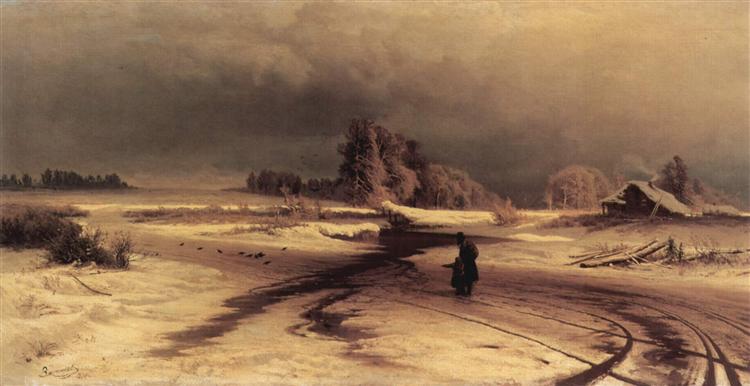
Fyodor Vasilyev, The Thaw, 1871. Oil on canvas, 107 x 53.5 cm. Image courtesy of Wikiart
A Circus, Psychopaths, and a Great Power: We Found Out What You Associate Russia With Guberniya Daily (Petrozavodsk)
June 14, 2016
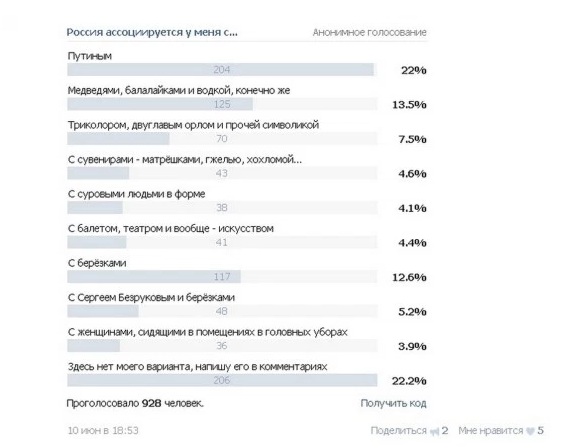
On Friday [June 10], on the eve of Russia Day, we asked what you associate our country with. We suggested more or less decent answers and waited for the results to roll in. Ultimately, we learned that many of you associate our country with “a circus,” “psychopaths,” and “corruption.” And also with Putin. We got the impression that the respondents lived in different countries: some had it all bad, while others, on the contrary, had it all good. That is why a serious discussion, numbering over a hundred comments, broke out below the survey. So let us have a look at what many people associate Russia with.
First, the results of the survey:
“I associate Russia with . . .” Putin: 204 votes, 22%; Bears, balalaikas, and vodka, of course: 125 votes, 13.5%; The tricolor, the double-headed eagle, and other symbols: 70 votes, 7.5%; Souvenirs: matryoshka dolls, Gzhel ceramics, Khokhloma tableware, etc: 43 votes, 4.6%; Stern men in uniform: 38 votes, 4.1%; The ballet, the theater, and the arts generally: 41 votes, 4.4%; Birch trees: 117 votes, 12.6%; actor Sergei Bezrukov and birch trees: 48 votes, 5.2%; Women wearing hats inside: 36 votes, 3.9%; My answer is not listed here; I’ll write it in the comments: 206 votes, 22.4%. A total of 928 people voted on June 10, 2016
As you can see, the answer “Putin” came in first place, “Bears, balalaikas, and vodka,” second, and “Birch trees,” third. It was in the comments that things got complicated.
Here are just a few of your answers (the original spelling and punctuation have been preserved):
I would like to associate it with birch trees. But, alas, I associate it with Krushchev-era blocks of flats [khrushchovki] and Brezhnev-era blocks of flats [brezhnevki] ))
With a complete lack of prospects for a decent life.
A country where happiness is forever in the future.
Where can I answer “with a total f–ing mess”?
With beautiful girls
With bad roads and a country where it is extremely hard to find a good job (even with a university degree)
The Motherland, just the Motherland
With a slave mentality, neo-feudalism, the lack of a future, vatniks,* and a huge ego trip about its “greatness”
Recently, only with “seagulls,” cellos, and Panama hats . . .**
alas, I feel like splitting from here like Peter the Pig, a typical post-Soviet space with khrushchovki and rutted roads and yards that have not been repaired since Soviet times
With psychopaths.(
With people who work and earn less than a living wage.
With corruption, drunkenness, and parasitism . . .
Motherland, history, childhood, family . . .
Minus all the sarcasm and crap written [here]. MOTHERLAND to me is MOM, CHILDHOOD AS A YOUNG PIONEER, THE COMMUNIST YOUTH LEAGUE, BIRCH TREES AND LAKES, SAYING FAREWELL TO KINDERGARTEN IN THE VILLAGE OF SNEZHNOYE, AND THE SIMPLE PRIDE THAT I AM A RUSSIAN
With a strong country!!! And Putin.
Strange that nearly everyone answers in the present tense.=) Or is that how we should answer? Then, apparently, I didn’t understand the question. The country is ancient and large, with a difficult destiny and history. Loving the Motherland . . . in my view you love it no matter who rules it. True, then your love manifests itself differently at different times. What you cannot take away from it is the natural beauty and the people . . . The people in this country are still good. The times are often complicated. But you can get through them by looking at the beauty of nature and the spiritual beauty of people.=) Something like that.
To answer simply and cornily, Russia is the place where I learned to walk and talk. But to answer the question from the viewpoint of a person who is a citizen of Planet Earth: Russia is a multiethnic, multi-party country. It has become the rage in Russia to say what one thinks about Putin, about world politics and foreign policy. I am afraid it will soon become a ritual, like the morning conversation about the weather among the English.
Kickbacks and dog and pony shows.
With the permafrost.
With poverty
* vatnik = “Russian patriot and nationalist (An outspoken follower of Putin, who aims to compensate his meaningless life by glorifying the motherland. This insulting term derives from the name of an iconic Soviet padded uniform jacket issued during WWII.” Source: Multitran.ru
** A reference to Russian Prosecutor General Yuri Chaika (his surname means “seagull” in Russian), recently reappointed to another five-year term despite substantial allegations of corruptions against him and his family, and cellist Sergei Roldugin, implicated as Putin’s bagman in the Panama Files.
Translated by the Russian Reader. Thanks to Comrade VZ for the heads-up
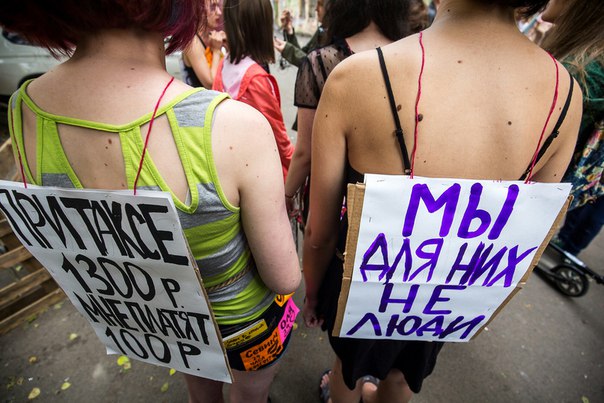
Petersburg female activists have staged the performance Walk to call for a humane attitude towards women involved in the sex industry, the prosecution of pimps, and the decriminalization of prostitutes themselves.
Wearing dresses pasted over with advertising flyers for brothels, and sporting painted bruises and black eyes, the five female performers were marched by a “pimp” through downtown Petersburg.
The young women bore placards on their backs featuring such quotations from real interviews with prostitutes as “I have always been raped, now I’m getting raped for money,” and “We are not human beings to them.”
“My rate is 1,300 rubles an hour. I get paid a 100 rubles.” // “We are not human beings to them.” Photo by David Frenkel
On Arts Square, the young women slipped away from the supervision of their “pimp.” They turned their placards arounds, revealing the inscriptions “Not a commodity,” “Not a thing,” “Not a criminal,” “Not a slave,” and “Human being.”
At this point, the other performers, depicting prosperous citizens who have a contemptuous attitude towards prostitutes and their problems, shouted angrily at the young women and pelted them with dirt.
Rapes, beatings, fear, constant threats to their lives, no protection from law enforcement, a lack of medical care, and endless public scorn: these are the real lives hidden by brightly colored flyers advertising “Masha,” “Sevinch,” “Girls,” “Relaxation,” and “Massages.”
Prostitutes lead closed and stigmatized lives. Our prosperous society is irritated more by the flyers and ads that disfigure our beautiful city than by the slavery and human trafficking occurring behind its disfigured façades.
The recent raid by “defender of morals” Vyacheslav Datsik has returned the subject of sexual slavery, which society and the media persist in calling “sex work” to the public discourse and underscored the fact that society has no sympathy for these women. It only feels contempt for them. If Datsik had forced any other women to walk naked down the street, everyone would have been up in arms. But prostitutes are not people. No one cares about their misfortunes.
Datsik has even seemed like a savior to many people, because he liberated the residents of a building from a brothel. And indeed, although brothels operate outside the law, politicians and policemen are also involved in the profitable business of selling women. So complaints against brothels filed by ordinary people are ignored and drown in bureaucratic rigmarole. However, a new brothel will open to replace the one Datsik, allegedly, shut down. And it will be that way until there is the political will to denounce and prosecute the people who trick and force women into slavery and sell their customers the right to violence. People should realize that the last thing they should do is blame the prostitutes themselves. They should stop seeing these women as criminals.
Pay attention to the slaves who live invisibly in our midst. And don’t call them “workers.” But do call them human beings.
Walking past St. Catherine’s Catholic Church on Nevsky Prospekt, the city’s main drag. Photo by David Frenkel
Walking past the Chamber Concert Hall of the Petersburgh Philharmonic (right) and a poster advertising a “gala concert” celebrating the 140th anniversary of the translation of the Russian Synodal Version of the Bible by the Russian Orthodox Church. Oddly, the concert was held on May 26 at nearby St. Peter’s Lutheran Church. Photo by David Frenkel
Walking past the entrance to the city’s premier hotel, the Grand Hotel Europe. Photo by David Frenkel
Enraged “citizens” pelt the “prostitutes” with dirt.
“Human being.” // “Not a criminal.” // “Not a thing.” Photo by David Frenkel
“Not a commodity.” // “Not a slave.” Photo by David Frenkel
“Igor is married but goes to prostitutes because his wife is not willing to give him the humiliating, painful sex he likes, which one can only endure out of fear or for money.” // “Yulduz does not speak Russian and does not understand how to escape from the brothel. Human trafficking is a global problem.” // “Round-the-clock rape for money. Using another person’s body to masturbate while ignoring their needs is rape.” Flyers handed out to passersby during the performance Walk. Photo by Ksenia Chapkevich
Translated by the Russian Reader. For more on this subject, see my post “Let’s (Not) Talk about Sex,” from December 2014.
The Vicious Circle of Bad Governance
Vladimir Gel’man Vedomosti
May 17, 2016
Why is the quality of governance in Russia and some other post-Soviet countries much worse than we would expect based on their level of socio-economic development? According to numerous international assessments of governance, they are sometimes on a par with the poor and underdeveloped countries of the Third World, lagging behind similar countries in Eastern Europe. They are typified by bad governance, whose symptoms are perversion of the rule of law (the unrule of law), endemic corruption, the low quality of government regulation, and ineffective government policies.
Post-Soviet bad governance appears not as a grab bag of discrete, particular defects but as a consequence of the prevailing political and economic order in these countries. Its most vital feature is the fact that rent extraction is the principal purpose and main content of governance at all levels. So the mechanisms of power and governance tend towards a hierarchy (the “power vertical”) with a single decision-making center that seeks a monopoly position, while the autonomy of economic and political actors within the country vis-à-vis the center is relative and can be arbitrarily altered and/or restricted. In turn, formal institutions (constitutions, laws, etc.) are a byproduct of the allocation of resources within the power vertical. They are meaningful as rules only to the extent they contribute to rent extraction. As part of the power vertical, the government administration is divided into organizations competing for access to rent and informal cliques.
Bad governance is the most important means of maintaining this political and economic order. Since the state is governed merely in order to extract rent, corruption in its various shapes and manifestations is an essential device for achieving these goals, while the poor quality of regulation and perversion of the rule of law contribute to the stability of the power vertical. Bad governance acts as a stable but ineffective balance, which is restored even in instances of deep external shocks such as regime change (e.g., Ukraine and Kyrgyzstan), while the state apparatus proves less and less capable of implementing structural reforms for improving government efficiency.
What are the causes of this state of affairs? What the post-Soviet countries have in common has been a coup d’état from within on the part of rent seekers in the administrative apparatus and influential members of the business world personally associated with them. In an effort to privatize benefits and socialize costs in the process of governing, these players have deliberately and purposefully established and maintained inefficient rules of the game. But since their planning horizons are short-term due to the risks of the regime’s being overthrown and the questionable prospects of a smooth succession, they have behaved, in Mancur Olson’s terms, like “roving” and not “stationary” bandits. They plunder the resources of states at all levels of governance, and the term kleptocracy, previously used to describe African countries, comes across not only as an op-ed writer’s gimmick but also as a fair description of the rule of a number of post-Soviet leaders. (In particular, Karen Dawisha analyzes the Russian regime in these terms.) The end result is a vicious circle. The machinery of bad governance has been reproduced under different rulers, and attempts to overcome it (if such attempts are made) have run into strong resistance and with a few exceptions (such as Georgia during the presidency of Mikheil Saakashvili) have produced modest outcomes in terms of the quality of public administration.
In the work of researchers and the jargon of experts and consultants, bad governance (not only in the post-Soviet countries) has usually been associated with the “poor quality of institutions” and an “unfavorable institutional climate.” Although the poor quality of institutions is an attribute of bad governance, it is merely a consequence of the poor quality of regulation and the absence of the rule of law, and not the cause of the phenomenon. Institutions themselves are the outcome of the balance of forces and the interests of key players. Substituting the diagnosis of a disease with a description of one of its symptoms leads to incorrect courses of treatment. The desire to change only formal institutions by borrowing advanced foreign know-how or cultivating the best specimens on domestic soil without fundamentally rethinking the political and economic order as a whole either produces no improvements or even changes the situation from bad to worse.
The emergence and establishment of authoritarian regimes in the post-Soviet countries has generated an environment that promotes bad governance. The rare examples of high-quality public administration in autocracies may be briefly summarized by Dani Rodrick’s statement that for every Lee Kuan Yew in Singapore there are lots of Mobutus in the Congo. But electoral authoritarian regimes (such as Russia) are the worst option in terms of bad governance. They are typified by the politicization of public administration and economic management, which ranges from mobilizing voters at their workplaces to turning the state apparatus into a political machine for ensuring that voters vote for the ruling groups. As a consequence, a country is unable to develop decent incentives for improving the quality of public administration, in particular, regularly rotating senior personnel and making the upward career mobility of officials depend on achieved outcomes. On the contrary, the power vertical encourages officials to demonstrate political loyalty to the detriment of effective administration.
The paradox of post-Soviet countries is that even political regime change per se does not lead to a rejection of bad governance. On the contrary, it might even exacerbate the disease. Thus, although the fall of the Yanukovych regime in Ukraine in 2014 was followed by the emergence of a competitive democracy, the quality of public administration has not significantly improved since the days of Yanukovych. Often accompanied by a popular mobilization, the conflict among elites preserves the predatory nature of governance, involving rent extraction, even if it does lead to a change of ruling groups. The politicization of government and the economy and the incentivizing of loyalty at the cost of efficiency are inherent to post-Soviet competitive democracies almost to the same extent as electoral authoritarian regimes. However, given a favorable combination of other political conditions, democratization can open up a window of opportunity for the fundamental renewal not only of ruling groups but also the the entire state apparatus by breaking up previous hierarchies and effecting a series of structural transformations that can significantly reduce the detrimental effects of bad governance, if not vanquish it. Only in such cases does regime change not turn into a bad infinity that merely maintains the status quo in government. On the contrary, the entrenchment of ruling groups, limitation of vertical mobility, and restriction of channels for recruiting elites are means of maintaining bad governance: incentives for efficient management of the state and the economy are seriously undermined for the long term.
Although it is unrealistic to expect a rapid rejection of bad governance, numerous experts (e.g., Daniel Treisman) have suggested that as a result of long-term, stable economic growth and a generational change of leaders, the demand for rule of law and increase government efficiency would grow, thereby encouraging a clampdown on bad governance in the course of democratization, within a couple of decades. But how justified are these expectations when it comes to post-Soviet countries? There are no grounds for ruling out a different sequence of events. Governments can continue as before to handle the most serious challenges, avoiding disastrous failures, while maintaining the principles of bad governance unchanged. The emergence of a quasi-hereditary kleptocracy and a succession of corrupt and inefficient governments, focused on the extraction of rent, can put an end to any attempt to limit bad governance. Continuing the medical metaphor, it is worth noting that if a patient burdened by a serious illness not only ignores the advice of his doctors but also leads an unhealthy lifestyle, thus exacerbating his health problems, death is probably inevitable. Unlike individuals, however, states and societies do not die and disappear from the map of the world, however badly they are governed. Dominated by bad governance, they continue their existence, an existence that is often senseless, useless, and hopeless, complicating and worsening the lives of their citizens and increasing the risks for other states and societies.
There Are Still Real Women in the Russian Villages bloger51.com
March 8, 2016
A court has overturned the dismissal of Irina Iskorneva, editor-in-chief of the newspaper Pechenga
A magician friend once told me a joke about his trade. During a performance, an illusionist is doing the trick where he saws a woman in two. Halfway through the trick, someone in the hushed auditorium comments, “Think about what you’re doing, dude. You’re about to make two problems out of one.”
Why have I told his story? Because right around the new year, the Pechenga District administration fired Irina Iskorneva, editor of the local newspaper.
Last year, as regular parishioners of our little blog will recall, Iskorneva wiped the floor with Ivan Tsipilyov, mayor of Zapolyarny. She informed readers about road repairs near Tsipilyov’s house, which went right to his front door.
Tsipilyov found this outrageous. Deeming himself personally insulted and humiliated, he went to court, where he got a kick in the ass. A month later, he got another kick in the ass, this time in the regional court.
The Pechenga District Court confirmed Iskorneva’s version of events.
As the court also pointed out, “Criticism of authorities is an inalienable right of citizens, and every politician agrees to become a target of criticism.”
The court explained in detail how the parties could resolve their conflict.
“In case of disagreement, the criticized party has the right to respond in the very same mass media.”
In November of last year, Irina Iskorneva strongly opposed a 9.3% increase in utilities rates for 2016. (The regional authorities have been using deputies on local councils to set rates higher than the ceiling established by Moscow.)
According to Iskorneva, this was the reason she was dismissed as editor right before the New Year, on December 29.
“Don’t awaken the beast in me. Well, and if you are asking for it be prepared to defend yourself. I will show no mercy,” reads the motto on her profile page on the VKontakte social network.
And so it happened. In mid January, she uncovered the amounts of the bonuses the district’s top official had paid themselves. According to Iskorneva, they had ranged from 70,000 to 200,000 rubles. [That is, from approximately 900 to 2,600 euros—TRR.]
Two court hearings took place in Pechenga District Court on March 2 of this year.
In the first, Iskorneva was listed as the defendant. The district administration was trying to recover damages allegedly caused by Iskorneva in the performance of her duties. The court rejected the suit, thus indicating that the charges were groundless.
Consequently, Iskorneva’s dismissal from her position was also illegal.The court ruled that Iskorneva should be restored to her position as of March 3, 2016, should be compensated for wages forfeited during her forced absence, and should be financially compensated for pain and suffering.
Irina Iskorneva: “Don’t awaken the beast in me. Well, and if you are asking for it be prepared to defend yourself. I will show no mercy,”
When the editor of a municipal newspaper forces two local administrations to bend four times in the last six months, it is cause for respect, at least.
Translated by the Russian Reader. Photos courtesy ofBlogger51 and Barents Observer. Thanks to Comrade VZ for the heads-up
Vyborg Rally Looms over Authorities
Yulia Gilmshina 47News.ru
March 7, 2016
Vyborg residents sacked Gennady Orlov, head of the Vyborg District, right at Peter’s Square. He was given a vote of no confidence for a rise in the cost of heating bills. Local boss Alexander Petrov was chided over his son. But the authorities did not come out to talk to the people.
On Sunday, March 6, eighty-thousand-strong Vyborg got ready to vent its feelings. On Peter’s Square, on the outskirts of the historic center, a rally protesting twofold and threefold increases in heating bills was scheduled.
When 47News asked a taxi driver leaving the train station whether he knew about the upcoming event, we got an unexpectedly long response.
“The heating bill has increased by 7,000 rubles [approx. 88 euros]. It isn’t clear who is running the city. People should go to the rally. I can’t, but I’m taking the wife,” he said.
Another taxi driver, whose bill had increased by 6,000 rubles in a single go, also promised to send his wife.
When city hall was in the process of authorizing the rally on Peter’s Square, its main consideration was the distance from downtown. The protesters were excommunicated from the more convenient Red Square because of an event more interesting to the people in charge: an event congratulating women on March 8, International Women’s Day.
But officials accidentally provided the TV channels and photographers with a luxurious picture. While Red Square is dominated by a three-meter-high, wretched green, bird dropping-bespattered statue of Lenin, the people who gathered on Peter’s Square got visual backing from the Vyborg Castle. The 700-year-old hulk gloomily complemented any shot.
At 2:30 p.m., half an hour before the event, there were almost no protesters on Peter’s Square. Fifty people or so, including policemen, journalists, and a German shepherd, allegedly there to sniff out explosives, dilly-dallied on the pavement. At a quarter to three, one individual in uniform shouted to another, “Close it up!” and people could no longer enter the square from just anywhere. New arrivals were admitted onto the square at a couple of points, and each was searched for prohibited items.
“That’s what our people are like: keen to complain, but when it’s time to act, no one’s in sight. I got a bill for 11,600 rubles, and my monthly pension is 8,000. Two of my children are registered in my flat, so I can’t count on a subsidy. Soon they’ll be bringing us bills for 20,000 rubles. They’ll weep a bit and the chew the fat a bit over it, but that will be the end of it,” muttered an old women in a bright green jacket. She told us all her neighbors agreed with her, but had not supported her with their feet.
In the following eight minutes, the situation changed dramatically. As soon as we turned our backs, the center of the square filled up with people. The bulk were residents of various ages, and journalists learned that among them there were activists even from Svetogorsk. There were no officials in sight, except for Alexander Lysov, head of the district’s internal policies committee (not to be confused with the head of the district council of deputies), who was spotted by locals. Dmitry Solovyov, a LDPR deputy in the regional legislative assembly, stood in the corner.
Activist Nadezhda Budarina, who had applied to hold the rally along with her spouse Alexei Kuzmin, moderated the event. At the very beginning of her speech, your correspondent hesitated as to which side she was on, because Budarina quoted our publication for some reason.
“In one of its articles, 47News wrote, ‘An unorganized mob, cut to the quick by an attempt to pinch kopecks from their purses, plans to take to the square.’ Let’s show 47News that Vyborgians are not just a mob, but citizens voicing their own stance,” said Budarina from a makeshift podium set up on the porch of a building facing the square.
Your correspondent had to stay in the middle: not standing with the mob, but not with the organizers, either.
Around this point it was possible to count at least five hundred protesters, a third of the fifteen hundred attendees officially slated to attend. But people kept arriving from the castle, walking over Castle Bridge. Standing at a certain angle, one might have thought the castle was spewing them out.
The number was a subjective calculation on your correspondent’s part. Anyone who is interested can make their own conclusion about the number of attendees by looking at the photos and videos featured in this article.
Budarina’s speech was not chockablock with catchy quotations.
First of all, she reminded Gennady Orlov, head of the Vyborg District, of the words he had said (again, as quoted on our website) about the possible political bias of the protesters.
“Yes, we’re politically biased. We’re biased by our unwillingness to pay the bills of a dubious business and the Property and Utilities Management Company, which sends us the bills, said Budarina.
People stood silently. Or rather, they expressed neither agreement nor displeasure with what they heard. In the crowd, you could see signs emblazoned with slogans such as “Stop robbing your own people,” “It’s time to take power into our own hands,” “We’re for low prices,” “A deferral is a spit in the face,” and “I’m poor and hungry.”
But there were no party symbols.
According to Budarina, the district prosecutor had thrown up his hands and could not do anything with the Property and Utilities Management Company. Sergei Kuzmin, chair of the housing oversight committee, “brazenly talks about the absence of violations,” while Leningrad Region Governor Alexander Drozdenko has “set his mind at rest by explaining that it was not the rates for heating that were so expensive, but the payments system that was not transparent.”
“[Drozdenko] only gave a recommendation to explain to citizens why the prices are what they are. It transpires that an informed citizen is calmer than one with a full belly,” said Budarina, eliciting a first rumble of applause on the square.
“They are forcing us to live on loans,” Budarina claimed at another point, garnering another portion of support from the crowd.
“The governor argues what is happening in the Vyborg District is a systems error, but in none of his statements has he ordered anyone to get to the bottom of the legal aspects of the situation,” said Budarina, again setting off an energetic round of clapping.
The main hero of the day was neither the governor nor even the housing and utilities bloc in the government as such, of course. Over the past three weeks, so much has been written and said about high payments that demands to lower them already sound mundane, and it is difficult to find anything new to say about the conflict between society and officialdom over this issue.
The revolutionary nature of the moment was felt when Vyborg city councilman Alexander Petrov was mentioned. Petrov is considered the city’s unofficial boss, and any mention of his surname on Peter’s Square had a fascinatingly symbolic tinge to it.
Activist Budarina quoted our publication for a third time, reminding the crowd that 78% of the Property and Utilities Management Company belongs to Svetogorsk city councilman Sergei Isayev, considered a close associate of Petrov’s.
Here we should note the speaker’s inaccuracy, for, as 47News has written, according to the Unified State Register of Legal Entities, the Property and Utilities Management Company is wholly own by the government of the Vyborg District.
The crowd roared “Oooooh!” at this point.
Petrov was read the riot act on Sunday.
A woman in a purple jacket, also an activist, whose surname was Alexandrova, recalled that Petrov had been in power for more than ten years.
“Where does the money go? It has been going to Petrov for ten years, but the people have been starving. We are hostages of an executioner, our administration. We have been enslaved by criminals,” Alexandrova pontificated.
A minute later, she encroached, it would have seemed, on the holy of holies. No, not Vyborg Castle, but Formula One driver Vitaly Petrov, Alexander Petrov’s son.
“No other town in Leningrad Region could afford Formula One, but we could. Who paid for little Vitaly Petrov to race in the championships? We paid,” said Alexandrova.
People applauded constrainedly, but with a timidity that could instantly turn into desperation.
Speakers called for the clock to be wound back eleven years and for the emergence of the Property and Utilities Management Company as such to be investigated. In particular, had the tire to real estate worth sixty million rubles been legally transferred to the company? According to the speakers, in 2005, the district administration had illegally handed over property to the company’s management and had also turned the monopolist into an energy supplier without conducting a proper bid.
The only person who could compete with Petrov in terms of the number of times he was mentioned on Peter’s Square on Sunday was, of course, Konstantin Patrayev, head of the Vyborg District until 2012, and first deputy governor of Leningrad Region until November 2015.
“Sometimes you can see him on TV next our Governor Alexander Drozdenko. It was Patrayev who transferred the property. He signed the decree to put our property in this company,” pontificated activist Alexandrova, drawing a little support from the crowd.
Apparently, Patrayev has become a symbol of the regime in Vyborg, since activists could not get through this rally without mentioning him. And yet in 2005 he was not yet in charge of the district (then headed by Georgy Poryadin): he took office only in 2006. And if it is possible to see him on TV, then probably on specialized programs.
Perhaps it is not so much a matter of factual errors as it is the unconscious desire of any people to have a strong, charismatic leader. Patrayev certainly was such a leader for Vyborg, but Georgy Orlov has obviously not become one. Maybe it has something to do with the fact Patrayev’s image has already acquired immortality, just has happened with Count Dracula in back in his day.
The next forty minutes of the event were boring for laymen.
Nikolai Rachinsky, ex-chair of the Vyborg City Executive Committee and now an old-age pensioner, repeated much of what he had said at a meeting of residents and officials at the local Palace of Culture about illegal tariffs and the fact residents pay for investments: so the authorities were wrong to credit themselves with this. A women from Primorsk discussed the problems of registering the town’s property. A man in a green jacket recalled how clean the streets had been in the Soviet Union.
Around half past five, Budarina read out the rally’s draft resolution.
Those assembled noted “the dangerous and catastrophic system in housing and utilities in the Vyborg District.” They believe that “the local authorities, instead of supporting the people, have made no efforts to improve social conditions and equity in the city and district,” that “the rates for resources, as set by the Leningrad Region Rates Committee for the Property and Utilities Management Company are illegal and baseless,” that “provision of housing and utilities services is not in compliance with the Housing Code,” and that the “residential housing stock has been brought to a critical condition.”
In this regard, they demanded that checks be carried out on the legality of the creation of Property and Utilities Management Company, the legality and grounds for the rates set for it, and on its licensing.
The most important point came at the end of the resolution.
“We voice our total and profound lack of confidence and demand the resignation of the heads of the Vyborg District and its council members in connection with their loss of our trust. If our demands are not met, we will hold another, more heavily attended rally whose resolution will be, ‘We demand a personal meeting with President Vladimir Putin.'”
When the part of the resolution calling for the resignations of Gennady Orlov and Alexander Lysov was read out, the protesters repeatedly applauded and shouted “Hurrah!”
Seven minutes or so later, the square was nearly deserted.
The resolution will be dispatched to many officials, including Governor Drozdenko.
By the way, such things never happened under Patrayev.
Translated by the Russian Reader. Photo and videos courtesy of 47News. Thanks to Comrade SY for the heads-up.
Putin Proclaims National Idea Fontanka.ru
February 3, 2016
In Russia, there can be no other unifying idea than patriotism, argues President Vladimir Putin, as reported by TASS.
“This is, in fact, the national idea,” the head of state announced during a meeting with the Leaders Club, which brings together entrepreneurs from forty of the country’s regions.
According to Putin, this idea is not ideologized and is not linked to the work of a particular party, reports RIA Novosti.
“It is a common rallying point. If we want to live better, the country has to be more attractive to all citizens and more effective,” the president stressed.
_________
Who Killed a Transsexual in Ufa and Why? Ufa1.ru
February 2, 2016
On Monday, February 1, Angela Likina was stabbed in the chest and killed in Ufa. The Ufa resident had gained notoriety in 2014, when a video recorded on a traffic police dashcam entitled “Ufa Traffic Cops Stop a Transvestite” [sic] went viral on the Web. Ufa1.ru found out who killed Oleg Vorobyov, who had changed his sex and become Angela Likina, and why.
Angela Likina. Photo courtesy of Ufa1.ru
The controversial video from the traffic police car dashcam recorded an inspector checking the papers of a female motorist. It transpired, however, that the motorist’s name, according to his internal passport, was Oleg Vorobyov. The inspector was very surprised by this. The motorist was a transsexual who had been preparing for a sex change operation for several years, becoming Angela Likina. The restricted video was leaked to the Web.
Later, the State Auto Inspectorate conducted a review of the incident, because the restricted footage should have not ended up on the Web. Angela Likina also commented on the video herself. She was surprised the incident had provoked so much interest among Web users.
“People die in accidents, children get hurt, cars are stolen, blood is needed to save someone’s life. Gentlemen, why are you setting records for likes and reposts about me? I honestly don’t understand,” said Likina, adding, “I don’t care how you live, what you do, and so on, so long as you are alive, healthy, and happy. But my life does not concern you in absolutely any way.”
How Did Oleg Live?
Ufa1.ru spoke with friends and acquaintances of Angela Likina, who talked about the life of the murdered woman. We found out this sad ending had emerged from a number of factors. Before becoming Angela Likina, Oleg Vorobyov had been married. Acquaintances confess that, outwardly, the couple were seemingly happy. They were raising two daughters, now aged fourteen and nine. The family lived in a private house, which also housed Oleg’s auto repair garage. Many of the people with whom we spoke said automobile owners were satisfied with Oleg’s work, that he had a magic touch.
Over five years ago, Oleg realized he was living in someone else’s body. He understood he wanted to change his sex and become the person he thought he was. Oleg began calling himself Angela Likina and started the complicated process of preparing to change his sex. He took hormone pills and began dressing like a woman. According to his internal passport, however, he remained Oleg Vorobyov. He could only change his name after finally changing his sex.
Five years ago, the Vorobyovs divorced, but the former husband and wife and their two children kept living under the same roof. The house was the wife’s property, and her former husband had an established business there. Several of the family’s acquaintances believe that Angela did not want to lose her income from the auto repair garage and spend money on renting a place to live. After all, she had to save up a large sum of money for the operation, and the medicines she took to prepare for the procedure were expensive. Close friends emphasize that Angela worked a lot, sometimes seven days a week.
At the same time, Ufa1.ru’s sources noted the Ufa resident simply had no choice.
“He once tried to rent a flat, but was kicked out. A neighbor had said, ‘I don’t want my children to see this!’ Consequently, he was evicted and didn’t even get his money back,” said one of our sources.
Friends of the family noted that those who have lived under the same roof with ex-spouses can imagine the atmosphere that prevailed in the Vorobyov house. Some say that the rows over living arrangements caused the Vorobyovs to come to blows. Things were aggravated by the fact that the head of the family had become a woman. Their children also became the targets of reproaches and ridicule at school.
“They would come home in tears, and sometimes refuse to go to school, but Angela loved her daughters and gave them a lot of time,” acquaintances noted.
Who Killed Angela?
According to friends, a boyfriend came to visit Oleg’s ex-wife on the ill-fated evening. The criminal investigation will shed more light on what exactly happened in the house. For now, the family’s acquaintances have their own hypotheses. Perhaps the man intervened in yet another family row. Maybe he stood up for his girlfriend and wanted to intimidate Angela by demanding she pack her things and leave. The row, however, escalated into something bigger.
“She was stabbed in the chest near the heart. She did not die immediately. She made it to a neighbor’s house, told him what had happened and who had done it, and an ambulance was summoned. Then Angela died in the neighbor’s arms. It was apparently too late to help her. I don’t know what was happening in the family. Angela was a good person, but strangers often beat her up. Her neighbors respected her choice. It is a bad thing when a person steals, kills or rapes, but everything else is a private matter,” said an acquaintance of Angela’s.
“The best human qualities—kindness, fairness, compassion, and unselfishness—were powerfully manifested in her. Unfortunately, that is a rarity nowadays. And she really never held a grudge against anyone, although there were a fairly large number of people who wished her ill. Most of them, it is true, were people who did not know her at all. They insulted and mocked her. You could say she was understanding about it: far from everyone in our city, or even our country, is ready to comprehend the decision to have a sex change. And that is another reason I have endless respect for her: the determination to go her own way to the end, to change her life fundamentally, the willingness to take one and overcome all the difficulties,” another girlfriend of Angela’s confided to Ufa1.ru.
“Apparently, Angela sensed her impending death. Not long before this she had asked forgiveness from her wife for all the rows that had happened between them,” said another family acquaintance.
__________
Fire at Moscow workshop kills 12 people, including 3 children Boston Globe
January 31, 2016
ASSOCIATED PRESS, JANUARY 31, 2016, MOSCOW — A fire at a textile workshop in Moscow has killed 12 people, including three children, officials said.
The victims were not identified but were reportedly immigrants.
The Investigative Committee, the top state investigative agency, said the fire broke out late Saturday in northeastern Moscow, damaging more than 32,000 square feet of the structure.
Investigators said they are looking at negligence or arson as possible causes.
Russia’s children’s rights ombudsman, Pavel Astakhov, said Sunday on his Twitter account that three children were among those who died, including a baby. He said the victims were migrant workers who lived next to their workplace.
Several dozen fire engines responded to the blaze, and it took firefighters about five hours to extinguish the blaze.
Investigators continued to sift through the rubble Sunday for evidence.
Many immigrants work in Russian factories, some of which have been investigated for hazardous working conditions. In April, a blaze on the outskirts of Moscow killed 17 migrant workers.
__________
The death toll of Kyrgyz citizens (according to the Embassy of the Kyrgyz Republic in the Russian Federation):
1. Sajida Masaliyeva, born 1988. Home address: Village of Kyzyl-Bel, Batken District, Batken Region.
2. Toktokan Saliyeva, born 1983. Home address: Village of Tayan, Batken District, Batken Region.
3. Uulkan Saliyeva, born 1997, sister of Toktokan Saliyeva.
4. Isa kizi Aizat, born 1995. According to available information, Isa was a native of the Village of Kaiyndy, Batken Region.
5. Milikajdar uulu Koshonbay, born 1990.
6. Tologon Kozuyev, born 1991.
7. Manas, born 1995; brother of Tologon Kozuyev; no other details.
8. Daniel, 4-5 years old, son of Ergeshbay Japarov, a Russian national who perished in the fire; born in the village of Rout, Batken District, Batken Region; according to the victims, Daniel was a citizen of the Kyrgyz Republic.
[Elena Bobrova:] You are something of a patriot yourself?
[Nikolai Kolyada:] How else should I relate to Russia? I love her whatever she be like. Like Gogol I can tell the whole unvarnished truth about her. And Nikolai Vasilyevich said such awful things about Russia. He sobbed bloody tears when thinking about the country. But not because he hated it. On the contrary, because he loved it. When foreigners start speaking badly about Russia, I begin to boil: “Shut up, it is none of your business. I have the right to say anything about her, but you do not.” Well, it is okay when Europeans or Americans sling mud at us: they have a hard time coping with the fact we are different, unpredictable, and freer than they are. But when our own people hate their own country, that is terrible. This morning, I was reading Facebook and I thought, “Why do you live here if you hate Russia so much?”
[Bobrova:] But you just said yourself we have a right to chew out Russia because we live here.
[Kolyada:] Chew out but not hate. But Facebook is just seething with hatred.
—Excerpted from “20% of the Petersburg audience are loonies,” Gorod 812 (print edition), February 1, 2016, page 34
Items one, two, four, and six translated by the Russian Reader
No, today’s subject is not a rally in memory of the martyred victims of political repression in the Gulag during the distant 1930s, 1940s, and 1950s.
It is more trivial and terrible. Evenki leader Sergei Nikiforov has been thrown in prison after leading a protest movement of his tiny people in the Selemdzhinsk District. As village head, he had been organizing resistance to the expansion of gold mining companies attempting to take over tribal reindeer pastures and hunting grounds.
Blagoveshchensk City Court sentenced Nikiforov, the father of five adopted children, to five years in a maximum security prison and a fine of 16 million rubles [approx. 232,000 euros] for bribery and embezzlement. The fellow villagers who were present in the courtroom have reached their own conclusions about the court’s bias. The court disregarded all the particulars that pointed to the defendant’s innocence, for example, the fact that at the time the bribe was made in Blagoveshchensk, Nikiforov was in Ekimchan, administrative center of the Selemdzhinsk District, hundreds of kilometers away, and the fact that the only witness was unable to identify Nikiforov in court and testified she did not know the man. Nor was the bribegiver arraigned. According to the Evenki, the trial was clearly a frame-up.
Nikiforov was convicted in Blagoveshchensk in late October of this year. On October 3, all the residents of his native village of Ivanovskoye who were not out on the hunt attended a protest rally in defense of Sergei Nikiforov.
“No to kangaroo courts!” Residents of the village of Ivanovskoye demonstrating in support of Sergei Nikiforov, October 3, 2015
You cannot fool the people. If the village head had really been stealing money from the already meager village budget, who would have come out to support him?! You cannot hoodwink villagers, as people who have lived there would know.
After the protest, the regional authorities kept a low profile. Nowhere in the media did anyone comment on the trial of the disgraced village head. A small group of Evenki woman managed to travel to the regional center, overcoming hundreds of kilometers of bumpy roads on an UAZ off-road vehicle.
The Amur branch of the Yabl0ko Party gave due notice of plans for a protest rally on Lenin Square. Officials made a fuss. None of them wanted to see Evenki waving placards under the windows of the regional government house. I was contacted and asked to move the protest behind a department store, “out of sight of the authorities.” Clearly, it would have been pointless to protest behind a department store. So we were forced to to alter the format of the protest, but not the purpose and place.
We held a series of solo pickets in downtown Blagoveshchensk. People stood alone at a distance of a several dozen meters from each other on both sides on Lenin Street in the vicinity of the eponymous square. Just opposite the windows of the regional government house, legislative assembly, and the public reception office of the Russian President stood women (wives and daughters of hunters and reindeer herders) holding placards with the slogans “The Evenki need S.S. Nikiforov,” “Free Sergei Nikiforov,” “Sergei Savelyevich, we are with you!” “We ask the Russian federal authorities to pay attention to the criminal case of S.S. Nikiforov,” “We want a fair trial!!!” “No to kangaroo courts!” “The rule of law, not a tribunal!” and “Put an end to political reprisals.” They hoped to attract the attention of authorities to the injustice perpetuated in the Amur Region.
The reaction of officials was unexpected. No, neither the governor nor lawmakers came out to meet with their constituents. Nor did the chair of the regional court or the prosecutor show up. No, it was much more tedious. Frightened by the female protesters, the officials summoned several pieces of maintenance equipment from the City and Trade Services Center Municipal Enterprise (MP “GSTK”). A tractor drove on the sidewalk back and forth exactly where the protesters were standing. At times we imagined that the driver (a young chap with a brazen face) was defiantly trying to run over the small, fragile women, who would barely dodge out of his way. The oldest protester later said that she had physically sensed the tractor was about to run her over. It was noticeable that the moron behind the wheel was clearly getting some kind of sadistic thrill from his attacks on the defenseless women. Despite the fact the tractor was driving on the sidewalk, no special warning signs had been set up to this effect.
As soon as the picket ended, and the protesters left the square, the special maintenance equipment hastily turned around and drove away. By the way, the policemen on the square were quite polite. They were not at all keen to detain us “protestants,” apparently supporting us in their hearts.
Of course, it is too early to say that a protest rally was held and Nikiforov will be released tomorrow. Of course, that will not happen. We need to do much more. Maybe the next item on the agenda is a trip by Evenki to the capital and pickets on Red Square? In any case, people are becoming citizens and learning to assert their rights in practice. That is worth a lot!
“We want a fair trial!”“We ask the Russian federal authorities to pay attention to the criminal case of S.S. Nikiforov.”“The Evenki need S.S. Nikiforov.”“Sergei Savelyevich, we are with you!”“Put an end to political reprisals!”“The rule of law, not a tribunal!”“No to kangaroo courts!”“Free Sergei Nikiforov!”
N.B. I wish to inform Valentina Kalita, mayor of Blagoveshchensk, and MP “GSTK” head Igor Banin, United Russian party members and partners of ex-mayor Alexander Migulya, now under investigation, that actions aimed at disrupting a public event (to which every citizen of Russia has a constitutional right!) are covered by Article 149 of the Russian Federal Criminal Code (“Obstruction of assemblies, rallies, demonstrations, marches, and pickets or involvement in them”).
Finally, Igor Banin, the driver of the tractor, who spread dust and rubbish over the square today, deserves a bonus. The lad tried really hard to carry out your orders (which had nothing to do with the cleaning the sidewalk, as you know).
The wild Blagoveshchensk municipal services tractor and street sweeperA letter from Blagoveshchensk Mayor Valentina Kalita, dated November 2, 2015, and addressed to protest rally organizer Natalya Kalinina, stating that MP “GSTK” had planned to carry out preparatory work for building a “snow fortress” [sic] on Lenin Square for 2016 New Year’s celebrations at the same time as Kalinina and her group had informed the authorities they would be protesting there. Mayor Kalita therefore asks that the venue be switched to the area in front of the Central Shopping Center on the Amur Street side, and that the rally be turned into a series of pickets from 4:30 p.m. to 5:30 p.m. on November 5, 2015.
Translated by the Russian Reader. Thanks to Comrade AD for the heads-up