The Anti-Anti-War Movement

Ana Tavadze and Dachi Imedadze, members of Georgia’s Shame Movement. Photo: 60 MINUTES

Ana Tavadze: We’re going in with a government that’s completely corrupt, a government that’s pro-Russian, clearly anti-Western, clearly does not really care about what the majority of the population wants and needs.

Ana Tavadze and Dachi Imedadze are members of the Shame Movement – a group with thousands of young followers working towards Georgia’s entry into the European Union.

Ana Tavadze: If Russia wins, it means loss of freedom, loss of everything that we fought for in the past 30 years basically. It’s a fight for values, it’s a fight for where you want to stand in this big fight for democracy.

Dachi Imedadze: As soon as the West in any form, be it the U.S. partnership, be it the European Union, is not represented in this country, Russia will fill the void right away. 

They say the influx of Russians is already changing the face of Georgia.

Ana Tavadze: What are they doing, if we look at it? They’re buying apartments. They’re buying private property. They are opening up businesses. Their actions changed — Georgian economy.

Dachi Imedadze: The Russians are buying apartments here in every 33 minutes. They’re purchasing a piece of land in every 27 minutes. And they’re registering a business in every 26 minutes. So, I think we are on the brink of very dangerous situation here in Georgia.

According to public records, Russians have registered more than 20,000 businesses in Georgia over the last two years. And launched five new Russian-only schools, none of which are licensed by Georgia’s department of education.

Russians have driven rent up nearly 130%, prices for everything from food to cars have gone up 7%. over 100,000 Georgians have left the country because many of them can’t afford to live here anymore.

Sharyn Alfonsi: I’ve heard this described as a quiet invasion.

Dachi Imedadze: Quiet invasion, yeah. There is a risk of the economic diversions. There is a risk of military intervention. And there’s a risk of — Georgia’s statehood being destroyed. 

Emmanuil Lisnif, George Smorgulenko and Pavel Bakhadov don’t look like much of a threat.

All Russians in their twenties, they fled their country for fear of being drafted or imprisoned for speaking out against Putin.
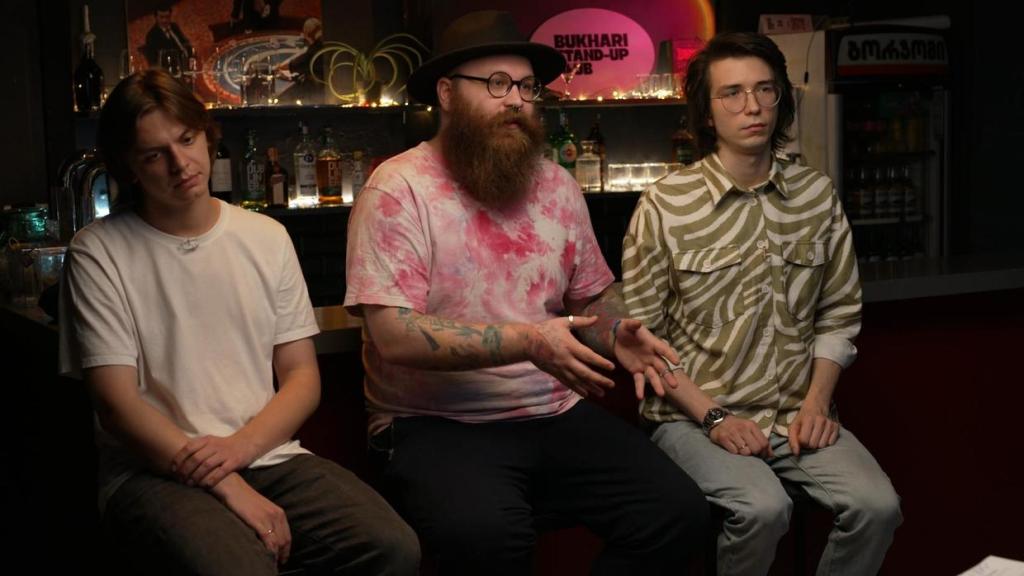
George Smorgulenko, Emmanuil Lisnif and Pavel Bakhadov are all Russians living in Georgia. Photo: 60 MINUTES

They now live in Georgia and work at this Russian-owned comedy club in Tbilisi.

Emmanuil Lisnif: I try and said ‘I’m against the war in Russia. I was beaten. and after that going to prison three times.’

Sharyn Alfonsi: So three times you went to jail?

Emmanuil Lisnif: Yes, yes three times.

Pavel Bakhadov: I believe and I know that Russians actually against the war

Sharyn Alfonsi: You think that most Russians are against the war?

Emmanuil Lisnif: Yeah, just scared, really scared.

Sharyn Alfonsi: Have any of you had any aggression towards you because you’re Russian?

Pavel Bakhadov: Actually I have a big writing on the wall. It’s the biggest thing I see from my window, just big ‘Russians go home.’ 

There is no subtlety in spray paint… anti-Russian graffiti blankets the city along with support for Ukraine.

[…]

Source: Sharyn Alfonsi, “Denial of Georgia’s EU membership bid would be ‘a big victory for Russia,’ President Zourabichvili says,” 60 Minutes, updated 9 June 2024. The emphasis, above, is mine. ||| TRR


This text is based on interviews I did as part of the Hidden Opinions public opinion polling project, which I launched in 2022 and continued in 2023 and 2024. I spoke with dissenting Russians — with those who oppose the current regime and its military actions against Ukraine, both those who have stayed in Russia and those who have left the country. My youngest respondent at the time of the [first] survey was sixteen years old, while the oldest was seventy-two years old. These people hail from a wide range of professions and walks of life, but what they have in common is their categorical opposition to the actions of the Russian authorities. In just two years, I have interviewed 154 people for this project, some of whom I have spoken with two or three times.

In 2022, all of my respondents — both those who had left the country and those who stayed — espoused anti-war views and expressed a negative attitude toward the Kremlin’s policies. However, in 2023, about a year and a half after the war’s outbreak, a group amongst my sources in Russia emerged. Small at first, but constantly growing, it consisted of people who had changed their negative attitudes toward the war and/or the government.

This does not mean that such changes are impossible among those Russians who have left the country. Amidst a full-scale war, research based on representative samples is hampered by the fact that the most accessible respondents are those who have agreed to be interviewed as a result of self-selection. This is a significant limitation to the project.

My research is qualitative, not quantitative, meaning that it would be wrong to speak of a particular percentage of anti-war Russians who have become pro-war. I think it is important to study and understand how views are transformed and what triggers them to change. It is the subject of this text.

***

The sociologist and philosopher Zygmunt Bauman, experimenting with means of gauging the conservatism–to–radicalism spectrum, asked his students to do the following exercise. They were shown twenty drawings, the first one depicting a dog, the last one depicting a cat; in between, the dog gradually shed its canine features and turned into the cat. It was vital that the researcher record the moment when the test subjects had doubts about what exactly was depicted in the picture, when they realized that the dog had mutated irreversibly. In a sense, I have been doing something similar, trying to record the moment at which anti-war or anti-Putin views have been transformed into pro-war or pro-government views.

I have observed that such a change in views depends on a number of extrinsic factors, and the more such factors that are combined, the more likely it is that the person’s stance will change. In addition, a great deal is determined by an individual’s (psychological, social, etc.) resources. Finally, inconsistent views play an important role in transformation and adaptation. In recent years, sociologists have increasingly noted that people often pursue mutually exclusive goals simultaneously without noticing the contradictions in their own behavior.

New rationalizations, disillusionment and loneliness

The gradual realization that the war is a long-term affair, combined with Alexei Navalny’s sudden death in a penal colony, has had a considerable impact on those resisting the regime within Russia. One can swim against the current, but it requires a considerable amount of strength, something not everyone possesses. It is difficult to be amongst the minority for years on end, to conceal one’s views and live in fear of being reported to the authorities. Respondents have thus begun reformatting [sic] their attitude to reality, explaining events in a new light and providing new rationalizations.

Failing to receive the expected support from the outside world or the possibility of a dignified workaround, some of my respondents eventually chose non-resistance to the regime, which in some cases has transmogrified into full-fledged loyalty.

I don’t want to go to prison, I don’t want to play the rebel. I just want to live. If they send me to listen to ‘Exorcist TV,’ I’ll go without question. If they tell me to go to a [pro-war] concert, I’ll go. I’m not trying to convince anyone of anything anymore. I’m tired. I can only accept it and live the life I have.”

This stance is not directly bound up with support for the war or the regime. Rather, it indicates fatigue and the lack of strength to resist. If the circumstances shift in a direction more in keeping with their own values, these people will gladly slough off the “burden of adaptation.”

It is worth noting that, over the last year, many of my respondents have stopped following the news and focused on their daily lives. There are respondents who, despite the troubling times, have decided to have children. This is also a way of disconnecting from current events.

Another important factor influencing the change of respondents’ views is the narrowing of their circles of trust. Fearing denunciation, dissenters avoid making new contacts. Afraid of being alone and unwilling to live in fear, uncertainty and/or exile, they then join the majority.

The distance between Russians who have left Russia and those who have stayed in Russia has grown greater with every passing year. In 2022–2023, when I asked my respondents about opposition members who had left Russia, they most often would say nothing or would limit themselves to brief remarks along the lines of “We still watch them on YouTube, but they have less and less sense of what’s happening at home.”

Expressions of resentment and frustration have become more frequent in my interviews in 2024. My sources have said that the opposition often engages in wishful thinking and plays fast and loose with the facts, and that the west does not always act logically and decently.

Consequently, previously opposition-minded people have chosen to abandon painful and exhausting self-reflection in favor of loyalty to the regime. This helps them to get on with their lives, normalizing both the war and the political crackdowns. As one respondent put it, “Since the opposition and the west cannot be trusted, we will make friends with Putin. He is an ogre, but he is our own ogre.”

“Western countries seem to be doing everything to help Putin’s propaganda machine. I was quite surprised when I heard Angela Merkel say that all our negotiations were just a smokescreen: we wanted to let Ukraine catch its breath, and the negotiations were just a deception. That is, the leader of one of the largest countries in Europe openly says: a) we can’t be trusted in any negotiations, and b) we have conspired to deceive you. […] Putin’s propaganda machine skillfully makes use of this. But the point is not that the propaganda machine is using it, it’s that it is reality. As a normal person, a question occurs to me: if they treat us this way, [then] we are their enemies. After such statements, the ‘west’ is regarded as the enemy of Russians, and, accordingly, their enemy — Putin — is our friend.”

Those respondents who have changed their views on the war emphasize that when the west blocked their bank cards and accounts, when they heard what Ukrainians (including their relatives and friends) were saying about Russians and how they called for killing them, they decided that the current regime, whatever it was like, was less hostile to them on balance.

Tired of guilt, shame, disappointment and indignation, they have essentially chosen peace by joining the majority and accepting the existing rules: don’t discuss politics, don’t speak out publicly, swear to the values that the government declares. This choice seems reasonable to them in a situation in which no political activism is possible anyway, and the political crackdown machine is only picking up steam.

This strategy ensured material well-being and career success for some of my respondents. For example, some mid-level specialists in the IT sector received good positions and salaries, while for other people the involvement of their relatives in the war has been a means of social mobility and a source of access to material goods. Still others have benefited from the war by arranging parallel imports, etc.

Another factor contributing to the shift in sentiment from anti-Putin to pro-government has been the radicalization and polarization of society.

“A sharp delineation between ‘black and white’ leads to the opposite outcome. Any attempts to express doubts about the actions of the Ukrainian or western side are automatically regarded both inside and outside [Russia] as pro-Putin behavior, the outcome of brainwashing, etc. The other side appears infallible and beyond criticism.

“If you criticize the west’s actions in any way, you are automatically pigeonholed as a ‘Putinist.’ It makes me feel like saying: if that’s how you treat me, well, to hell with you, chalk me up as a Putin supporter.”

The state of rejection and isolation provokes protests amongst some people: since the west condemns them for staying in Russia, they “will go the full mile and become real orcs.”

The mechanisms by which feelings of rejection are transformed into collective pride have been described by researchers and are not unique to Russia. These feelings reinforce nationalist sentiments and contribute to the strengthening of authoritarian regimes.

Emotional dilemma

Speaking about the change in their views from anti-war to pro-war, my respondents noted that in one way or another they were surrounded by people who had suffered in the war: classmates or school friends who had been drafted to the front or had volunteered for combat, their children, colleagues, and mere acquaintances. Telling them straight to their face that their sacrifices were in vain had become both emotionally more difficult and more dangerous. To maintain relationships and friendships, my sources generally had to listen in silence to their acquaintances’ stories about what they had experienced and seen at the front. And if they were people who mattered to them, it was impossible not to sympathize with them.

We should understand that Russians who initially opposed the war and the regime but remained in Russia feel definitely closer to those who went to the front or delivered humanitarian aid there than to those who have left the country. They are “in the same boat” as their relatives, friends, and colleagues. They feel compassion for them.

“When we were teenagers, all sorts of things happened. If the guys were caught [by the authorities], I would perjure myself and lie in all sorts of ways. Later I could tell them what I actually thought of them, but I wouldn’t abandon them. That’s not the way that blokes do things. Now I realize with my head that they are wrong a hundred times over, but they are my boys, I am on their side. And even if I am against the war, I cannot be against them.”

Propaganda equates anti-war sentiment with betrayal, and it paints people who espouse such views as accomplices of Russia’s enemies, who want to kill as many Russians as possible. This causes a very heavy feeling, my respondents note.

Meanwhile, the state softens such emotional blows by offering loyal citizens new benefits and additional material and social goods, free concerts, and beautiful and comfortable urban environments, demonstrating concern for people in general and for those returning from war in particular. “People-centeredness” has become the buzzword in the PR strategies of many employers and officials throughout Russia.

Russians who are concerned about their neighbors also respond to calls for help front-line soldiers, because amidst war and external isolation it is these people with whom, they say, they “share a common plight.” One of my respondents, overwhelmed by such sentimental feelings, volunteered for the army.

As a religious man, he hoped he would not face the need to kill others, but would be able to help “his boys” without bearing arms, because he “could not stand on the sidelines any longer.” If the need to kill arose, he would desert, my source had decided, explaining that he was emotionally prepared to be beaten up and go to prison.

Another type of people whom I have encountered more and more often are those whom researchers Maria Lipman and Michael Kimmage have characterized as anti-anti-war: these people do not necessarily support the war, but they strongly condemn or resent “unpatriotic” fellow citizens who do not support the Russian army or who even take the side of Ukraine.

Seeing soldiers returning from the front and watching the growing number of Russians killed in combat, my sources now often place the blame not on Putin or the Russian military, but on their compatriots who oppose continuing the war until Russia achieves total victory.

Ressentiment and the “demons” of propaganda

Propaganda has awakened ressentiment in some of my respondents. They have come to believe that this war is really about maintaining Russia’s status as a great power, which its enemies are trying to flout and rob. Such people believe it vital that Russia maintain its status as a victor, and they accept the state-imposed version of Russian history that asserts Russia’s greatness in all periods.

War, as happens under autocracies and dictatorships, is seen as the ultimate manifestation of the nation’s strength and vitality and a guarantee that its culture and traditions will be maintained. In conversations with me, my sources have repeatedly used the phrase “releasing demons,” referring to the fact that the current situation helps their acquaintances and themselves experience a sense of unity and superiority over the rest of the world, a sense of their own righteousness and chosenness.

Some respondents noted that the official rhetoric, concrete and catchy, seemed more acceptable to them than the verbose arguments and meaningless self-reflections of the opposition.

Meanwhile, according to my respondents, the number of anti-war-minded Russians today is decreasing. Since Navalny’s death, I have often heard in interviews that every second or third person in the orbit of my sources has changed their views.

It is difficult to say how strong this trend really is. I would estimate that a third of those who unequivocally opposed the war and the regime when I spoke to them [initially] have changed their views, but of course these numbers are in need of supplemental verification, which is not easy to accomplish today. There are probably also people who have switched their pro-war patriotic views to oppositional ones, but I assume that we hear the voices of these people even less frequently.

Respondents who are in a state of uncertainty and/or in the course of switching their views feel the need for support, at least informational support. They need arguments explaining that anti-war sentiments are not a betrayal and that the current war is destroying Russia, not restoring its greatness. But they also acknowledge that such an argument would hardly convince them under the current circumstances. For now, the only thing they think they can do is to maintain their sanity and adapt to reality in order to live to see better days.

***

The Russian regime has proven to be “smarter” and more adaptive than Russian opposition activists and western democracies thought, but this does not mean there is no point or possibility of supporting by any means possible those who have remained in Russia and are still resisting the regime or straddling the fence. One way or another, positive change in Russia is impossible without their involvement.

Source: Anna Kuleshova, “‘I’m a person with anti-war views, but I suddenly found myself signing up for the front’: how and why Russians have changed their attitude to the war,” Republic, 4 June 2024. The emphasis, above, is the author’s. Translated by the Russian Reader


“Their Logic Suggests It’s Immoral to Have an Opinion”

A snapshot of the “voluntary” resignation letter Vitaly Blazhevich was forced to submit on February 17, 2023.
Thanks for his kind permission to publish it here.

The Far Eastern Institute of Management, a branch of the Russian Academy of National Economy and Public Administration (RANEPA), has asked Vitaly Blazhevich, a lecturer at the institute, to resign. He spoke about the incident with Sibir.Realii.

The firing was occasioned by a comment that Blazhevich had made to Radio Svoboda. He had said that the residents of Khabarovsk Territory who had supported its former governor, Sergei Furgal, had thus given a vote of no confidence to President Vladimir Putin. Blazhevich was forced to “voluntarily” resign from the institute.

Blazhevich’s comment concerned the plight of Furgal, in which connection he touched on the attitude of residents of Khabarovsk Territory toward Putin.

“Khabarovsk residents said quite clearly — also, by the way, in the midst of a crackdown by the authorities — that they had lost confidence in Putin specifically. When Putin withdrew his support from Furgal, Khabarovsk residents said loudly and clearly at one of the largest rallies that from now on, we have no confidence in Putin. That is the genuine law that people passed,” Blazhevich said at the time.

The lecturer was summoned to the office of Oleg Kulikov, the institute’s deputy director for organizational matters and digitization. It was Blazhevich’s remarks about Putin that had caused Kulikov’s concern. One of his arguments was that RANEPA had been established by the President of Russia. (The decree establishing the university was signed in 2010 by then President Dmitry Medvedev.)

Blazhevich was informed that the complaint about his comments to Radio Svoboda had come from the so-called Regional Management Center, which is engaged in “collecting, analyzing and processing complaints and reports from the populace.”

According to Blazhevich, he was threatened that if the complaint made it to the police, an administrative case against him could be opened. In addition to the police, Blazhevich was threatened with dismissal under labor law for “immoral behavior.”

“We are university lecturers: we have no right to speak badly about the president,” the institute’s deputy director told him.

“Their logic suggests it’s immoral to have an opinion,” remarked Blazhevich. He added that he had not discussed politics with colleagues or students during working hours, and that there had been no complaints about his academic performance. He thus does not believe that the denunciation originated within the university.

[…]

After Sergei Furgal, the former governor of Khabarovsk Territory, was arrested in the summer of 2020, numerous protest rallies took place in Khabarovsk in support of the politician over the course of the next several months. On February 10 of this year, the Moscow Regional Court sentenced Furgal to twenty-two years in a maximum security penal colony, finding him guilty of organizing assassination attempts on three business competitors.

Source: “University lecturer in Khabarovsk fired for remarks about Putin,” Radio Svoboda, 13 February 2023. Translated by the Russian Reader


If you didn’t get enough brains when they were handing them out, you can only learn to tell good from evil the hard way. The process is quite long and painful. It is very, very scary to stop being the consenting majority. It is very, very scary to discover you’re having the “wrong” thoughts without nipping them in the bud. It takes a lot of courage to go through withdrawal when your whole body wants another dose of what it’s used to: it’s like quitting smoking or drinking. When you get free of it you’re left one on one with the whole world until you get washed up on some other shore. I’m not making excuses for anyone. I’m just trying on someone else’s shoes.

Source: Marina Varchenko (Facebook), 15 March 2023. Translated by the Russian Reader


A former governor from Russia’s Far East has been sentenced to 22 years in jail for murder and attempted murder in a controversial court case in Moscow.

Sergei Furgal insists he is innocent and says the trial against him was motivated by politics.

He was elected governor of Khabarovsk region in 2018, unexpectedly beating the Kremlin’s preferred candidate.

His detention in July 2020 caused widespread anger among locals.

The judge in Luberetsky Court near the capital ruled that Furgal, 52, must serve his sentence in a high-security prison after a jury found him guilty on two charges of murder and one of attempted murder.

The killings, said the prosecution, were linked to rivalry between Furgal and other businessmen in 2004 and 2005.

The ex-governor — who won office as a candidate for the ultranationalist Liberal Democratic Party of Russia (LDPR) — struggled to contain his emotions in the courtroom after the sentence was read out, shouting “Do you have no shame?” at the judge. His lawyers say they will appeal.

When he was first arrested, residents in the city of Khabarovsk took to the streets in huge numbers — some estimates put the figure as high as 50,000. Such demonstrations are rare in Russia and took the Kremlin by surprise.

Furgal’s supporters claimed that the criminal case against him was politically motivated — punishment for daring to beat the Kremlin’s candidate in elections.

Experts say his landslide victory was the result of a massive anti-Moscow vote. As governor, he was tough-talking, and some say more popular even than President Vladimir Putin.

Contract killings of business rivals were common in Russia, especially in the 1990s and the early 2000s, when Furgal was a successful businessman.

However, the case is more likely to be linked to his unique position — as a popular local politician who didn’t show absolute loyalty to the Kremlin.

“Furgal may well have been involved in shadowy business in the past, but so too were many of the other regional leaders whom Putin has been happy to support,” Russia expert Mark Galeotti told the BBC. “It seems clear that this was essentially a political move: once the Kremlin decided Furgal had to go, they looked for whatever excuse they could use.”

The Khabarovsk protest movement in 2020 was unusual for two reasons. Firstly, it was grassroots-based: meaning the authorities could not simply arrest the ringleaders.

Secondly, it was focused on a single local issue — the arrest of the governor — making it very difficult for the Kremlin to pin the blame on the West or on “foreign forces” — as is the usual tactic.

But in the weeks that followed, arrests were made, and the demonstrators were eventually silenced or pushed off the streets.

President Putin appointed a new governor, Mikhail Degtyaryov, who also represents the LDPR. Mr. Degtyarov, though, is a Kremlin loyalist and recently became a vocal supporter of Russia’s war in Ukraine.

Source: Will Vernon, “Sergei Furgal: Former Russian regional governor jailed in murder cases,” BBC News, 10 February 2023

Der Bier-Flip-Streik

bier-flip ingredients.jpg

Since I have been told, in no uncertain terms, by dozens of people smarter and better than me, and in hundreds of ways and shapes, that my views and opinions are wrong, unwelcome and a threat to solidarity among progressives worldwide, from now until further notice* I will limit myself to translating and posting cocktail recipes from a cookbook entitled Kochen, published in 1988 by Verlag für die Frau in Leipzig.

I have always argued that solidarity is a two-way street. I was wrong. There are people and groups in this world whose views and opinions are better than the views and opinions of other people. If you want to be liked and accepted, you need to understand this and support the correct views and opinions, not have views and opinions of our own. What you should never ever do, under any circumstances, is to criticize or otherwise comment on the views and opinions of our spiritual, moral and political betters.

My first recipe is a doozy known as the Beer Flip.

To make it you will need the following ingredients:

  • 100 grams of sugar
  • 1 cinnamon stick
  • Zest of 1 lemon peel
  • 2 bottles of beer
  • 2 eggs
  • 1 packet of vanilla sugar
  • Salt
  • 2 shots of cut brandy

Boil two cups of water, half of the sugar, the cinnamon stick, and the lemon zest for a few minutes. Pour in the beer and simmer. Beat the eggs, vanilla sugar, the rest of the sugar, and a pinch of salt until foamy. Gradually pour the beer through a sieve and stir in the cut brandy. This drink is served hot or cold.

Source: Kochen (Leipzig: Verlag für die Frau, 1988), p. 310. Photo courtesy of kochbar.de

* The Beer Flip Strike will end when someone makes a donation of any amount (see the left-hand side of this page for details) to this website or when three people show me proof, in the comments to this post, that they have shared a post (any post) from this website either on their own websites or their social media pages in the past week. 

UPDATE (October 1, 2019). It would have been nice, perhaps, to take a break from being the bad cop who brings tidings of Russia that neither the so-called right or the so-called left can bear (the strike was prompted by fresh attacks on me from both sides), but as he has done on two other occasions, a friend of the blog, RB, promptly made a donation of $100 yesterday. It is hard to say how much this means to me.

Donating money, however, is not the only way to support this website. It also means a lot to me when you share what I post here with your friends. That way I know that people are reading the Russian Reader. This has been my only mission since I started the blog twelve years ago: sharing news and views of the other Russias and other Russians with people in other parts of the world who would otherwise not be able to hear these voices. // TRR

Beglov, Big Love

Rotunda
August 31, 2019

It is eight days before the Petersburg gubernatorial election.

On Palace Square, there is a free concert by local rock group Splean, with the city footing the bill.

The winners of the creative contest Bolshaya Lyubov are also to be announced at the event.

If you reflect a bit on the elusive play of words and meanings in the contest’s name, you should easily be able to translate it into English as “Big Love.”

The contest winners are congratulated in person onstage by (drum roll, please) Alexander Beglov.

Several times, he says that all of us really love our city.

The gubernatorial candidate ushers a war veteran and singer Alexander Rosenbaum on stage.

Rosenbaum and Beglov sing “The City on the Wild and Free Neva.”

Palace Square is packed to capacity.

“The City on the Wild and Free Neva,” as performed and recorded by Valery Belyanin

Video footage courtesy of Rotunda. Translated by the Russian Reader. This is the 1,500th entry on this website. To learn how you can support my work, read this.

It Was a Joke

rostovpapaRussians do not swallow the regime’s propaganda hook, line and sinker, argues Ivan Mikirtumov, but use it to guide their public behavior. Photo by the Russian Reader
Why the Russian President Made Fun of Russian Propaganda
Ivan Mikirtumov
Vedomosti
October 22, 2018

Speaking at the Valdai Discussion Club on October 18, Vladimir Putin told his audience the punchline of what would later emerge as a “funny” joke about nuclear war.

“As martyrs, we will go to heaven, and they will simply croak, because they won’t even have time to repent,” said Putin.

Judging by the overall reaction, the joke has been a success.

The genre of the humorous anecdote, including the political anecdote, was typical of the Soviet period, that is, of a communist dictatorship in the midst of the Cold War. Unlike texts and drawings, anecdotes were an oral genre and, therefore, were relatively harmless to disseminate. The technical difficulties of proving someone had told a joke made it a less than reliable tool for snitching on other people. This sometimes had to do with the content. If you wanted to inform on someone who had told you a joke about Stalin, Khrushchev, Brezhnev, the KGB, the Politburo, etc., then likely as not you would have had to quote in writing what you had heard or, at any rate, admit you knew the joke. Under certain circumstances, however, this knowledge could be used against you.

In post-Stalinist times, people were rarely punished for telling jokes. Jokes were widespread in Soviet culture, achieving exceptional heights of wit and observation. Jokes could be used to track public opinion, since they reflected society’s critical self-consciousness. Jokes were a form of feedback, but by virtue of its unique incompetence the Soviet regime ignored them, too.

Everything dangerous, hostile, evil, harmful, stupid, and meaningless is made into a figure of fun when it fails and falls through. People do not laugh at things that are huge and horrible until they are rendered pitiful, proven weak, and shown to be a sham. Stalin gave people little occasion to laugh, because he rarely failed, but the leaders of the late-Soviet period and the entire Soviet system were perfect targets for jokes and other species of ridicule. It is said Brezhnev was smart enough to laugh at jokes about himself, but it was not something he did publicly.

Putin told his audience the punchline of a joke whose opening line we can imagine as an oral exam question at the General Staff Academy, a question asked by the examiner in a room adorned with framed photographs of the commander-in-chief and the Russian Orthodox patriarch.

“Tell me, how will the outcome of a nuclear war differ for Russians and people in western countries?

Why is it that Putin’s answer to this imaginary question might seem funny? What was he ridiculing?

Mentioning heaven, martyrdom, and repentance in a military context in Russia, a country in which cynicism has reigned supreme, is tantamount to a direct attack on official religiosity, as instilled by the regime, a religiosity that has become dreadfully tiresome to everyone. The notion Russians will go to heaven wholesale, whether they believe in God or not, whether they are religious believers of any denomination at all, and whether they are vicious or virtuous, is tantamount to a scathing parody of religious beliefs.

Nuclear war is the business of the military. It thus transpires souls are saved and people canonized as martyrs at the behest of the Russian army’s top brass. With Putin in charge of it, heaven promises to be something like an army barracks, so the entire satire on martyrdom and salvation was performed as a “humorous shtick” of the sort favored by Russia’s siloviki.

What do generals have to say about the soul’s salvation? They say what they are supposed to say, as they gaze at the patriarch’s framed photograph on the wall.

Recently, General Zolotov and the two heroic Russian tourists who took a trip to Salisbury this past March found themselves in the limelight nearly at the same time. We can easily imagine these men holding forth on heaven, martyrdom, and repentance. Putin’s joke was clearly a sendup of the symbiosis between state-imposed religiosity and militarism, a crucial concept in current Russian agitprop.

It is short step from a joke like this to jokes about Orthodox secret policemen, monarchist communists, sovereign democracy, the Kiev “junta,” the US State Department’s vials and cookies, and ritual murders, performed by Jews, of course, on Orthodox babies (and the tsar’s entire family in the bargain), and so on. During the years of Putin’s rule, a whole Mont Blanc of drivel has sprung up, and whole hosts of freaks have come out of the woodwork. It is simply amazing there are still so few jokes about Putin and Putinism in circulation, but now, I imagine, things will kick off, since the main character in these jokes has taken the bull by the horns.

This does not mean, of course, that, by artfully telling his joke, Putin meant to take the piss out of himself and his regime. We are dealing here with the long-familiar militarist bravado summed up by the saying “Broads will give birth to new soldiers,” with the teenage frivolity typical of the siloviki, a frivolity they enjoy acting out.

“We’ll wipe the floor with them,” as they would say.

If, however, Putin was publicly ridiculing the concept behind current state propaganda, we are confronted with a bad joke, a bad joke told to the selfsame ordinary Russians who are targets of the propaganda so ridiculed, while the guy who made the cute joke is the same guy who presides over production of this propaganda and benefits from it.

The rules of the genre have been violated, for now it is the audience, the public that has been ridiculed. Clearly, Russia’s ruling elite despises the people it attempts to manipulate, and the propagandists sometimes laugh themselves silly backstage after they have concocted a particularly nimble con.

I don’t think Russians are gulled by the Kremlin’s propaganda. Rather, they register the messages transmitted to them by the regime as signals telling them what to say and do in certain circumstances. This lovely consensus is destroyed when the concept underpinning the propaganda has been publicly turned into a laughingstock, because people who have been pretending in recent years that they take it seriously find themselves in an awkward situation. They have lost face, having themselves been made ludicrous.

How, then, do they answer the question as to why they played along with the regime in its efforts to gull them? The only plausible explanation for this behavior is shameful thoughtlessness, fear, and impotence, things to which no one wants to admit.

Ivan Mikirtumov is a visiting lecturer at the European University in St. Petersburg. Translated by the Russian Reader

Zeitgeist Checklist

taste real mexicoA Williamsburg-inspired eatery in snowy central Petersburg, 5 February 2018. Photo by the Russian Reader
It’s remarkable how the MH17 final report and Ukrainian political prisoner and filmmaker Oleg Sentsov’s hunger strike have exacerbated two sad trends among Russia’s left/liberal/creative/academic intelligentsia.

The first trend involves intelligenty out-Putining Putin and his regime’s put-on anti-Americanism by ramping up the number of social media posts and hasbarical hate-a-grams about the US, its sinister machinations, and its signal failings.

This is part of the same operetta in which the nefarious NATO is a greater threat to world peace than a country that reserves the right to invade its closest neighbor and join in crushing a democratic, grassroots rebellion in a faraway country whose people have never harmed Russia in any shape or form.

But it’s no fun talking, much less doing anything, about that at all, because it would require real collective effort. So, depending on your political tastes, it’s much easier, as a Russophone, to hate on NATO or Hamas.

Some Russians go for the trifecta, hating on both “terrorist” organizations, while also indulging in the most satisfying infantile pleasure on our planet today: Islamophobia. You know, Europe has been overrun by Islamic terrorists and that whole tired spiel, which gives such a sense of purpose to otherwise wildly ignorant people who have betrayed their own country and countrymen so many ways over the last 25 or 30 years it should make all our heads spin.

The other trend, which has also kicked into high gear again, is going hipster as hard as you can. There are any number of “projects,” “creative clusters,” eating and drinking establishments, festivals, semi-secret dance parties, and god knows what else in “the capitals” to make the younger crowd and even some of the middle-aged set forget they live in a country ruled by a ultra-reactionary kleptocratic clique that can have any of them abducted for any reason whatsoever at a moment’s notice and charged with “involvement in a terrorist community” or some such nonsense and ruin their lives forever.

That’s no fun to think about it, either, and it’s altogether scary to do something about it, so why not pretend you live in Williamsburg while you can?

The day before yesterday, I translated and posted an essay, by Maria Kuvshinova, about Oleg Sentsov’s hunger strike and the non/reaction to this brave call to action on the part of Russia’s creative so-called intelligentsia. At some point, I thought the essay might be a bit off the mark, but on second thought, despite its obvious quirks, I decided Ms. Kuvshinova had sized up the Russian zeitgeist perfectly.

Post-Soviet infantilism is total. It affects the so-called intelligentsia no less than the so-called ordinary folk. Infantilism means being unable to empathize, being unable to put yourself in another person’s shoes, even if that person is President Putin, a man with a quite distinct sense of ethics, a man who has been studied backwards and forwards for twenty years. Apparently, the message sent to the creative communities through the arrest of Kirill Serebrennikov was not registered. If you want to be a dissident, start down the hard road of doing jail time for misdemeanor charges, facing insuperable difficulties in renting performance and exhibition spaces, becoming an outsider, and experiencing despair. If you want a big theater in downtown Moscow, play by the rules. Like your average late-Soviet philistine, Putin regarded the creative intelligentsia with respect at the outset of his presidential career. (See, for example, footage from his visit to Mosfilm Studios in 2003.) However, a few years later, he was convinced the creative intelligentsia was a rampantly conformist social group who would never move even a millimeter out of its comfort zone and would make one concession after another. A lack of self-respect always generates disrespect in counterparts. // TRR

Maria Kuvshinova: What Sentsov Could Die For

What Sentsov Could Die For
Maria Kuvshinova
Colta.Ru
May 25, 2018

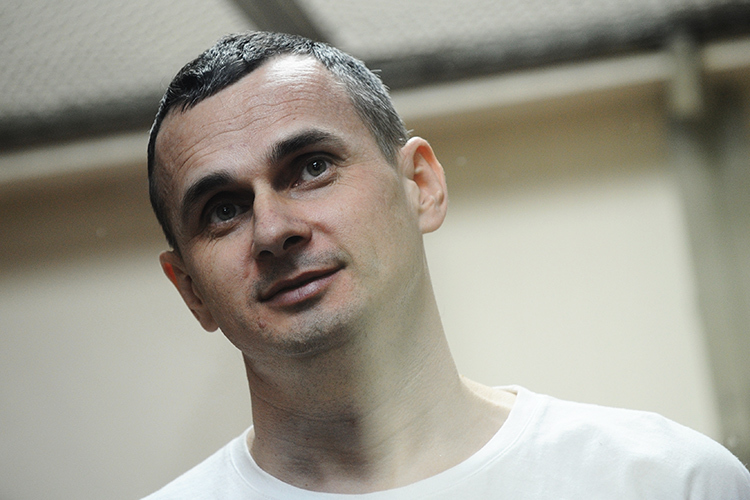
Detailed_pictureOleg Sentsov. Photo by Sergei Pivovarov. Courtesy of RIA Novosti and Colta.Ru 

On May 14, 2018, Oleg Sentsov went on an indefinite hunger strike in a penal colony located north of the Arctic Circle. His only demand is the release of all Ukrainian political prisoners in Russia. According to Memorial’s list, there are twenty-four such prisoners.

In August 2015, Sentsov was sentenced to twenty years for organizing a terrorist community and planning terrorist attacks. The second defendant in the case, Alexander Kolchenko, was sentenced to ten years in prison. Mediazona has published transcripts of the hearings in their trial. Around three hundred people have read them over the last three years. The transcripts make it plain the only evidence of the alleged terrorist organization’s existence was the testimony of Alexei Chirniy, who was not personally acquainted with Sentsov. It is police footage of Chirniy’s arrest while he was carrying a rucksack containing a fake explosive device that propagandists often pass off as police footage of Sentsov’s arrest.

Before his arrest, Sentsov was an Automaidan activist. In the spring of 2014, he organized peaceful protests against Crimea’s annexation by Russia.

“Yesterday’s ‘suicide bomber auto rally’ took place in Simferopol yesterday, but in quite abridged form,” Sentsov wrote on Facebook on March 12, 2014. “Only eight cars, six reporters with cameras, and twenty-five activists/passengers assembled at the starting point. I would have liked to have seen more. Unfortunately, most of the armchair revolutionaries who were invited were afraid to go. The traffic cops and regular police also showed up at the starting line, insisting we not leave for our own safety. We told them our protest was peaceful. We had no plans of breaking the rules, so we suggested they escort us to keep the peace for everyone’s sake.”

The second defendant, Kolchenko, admitted involvement in the arson of an office that was listed in the case file as belonging to the United Russia Party, but which in April 2014 was an office of Ukraine’s Party of Regions. The arson took place at night. It was meant to cause physical damage while avoiding injuring anyone.

The Russian authorities tried to prove both Sentsov and Kolchenko were linked with Right Sector, a charge that was unsubstantiated in Sentsov’s case and absurd in the latter case due to Kolchenko’s well-known leftist and anarchist convictions. Gennady Afanasyev, the second witness on whose testimony the charges against the two men were based, claimed he had been tortured and coerced into testifying against them.

Sentsov and Kolchenko’s show trial, like the show trials in the Bolotnaya Square Case, were supposed to show that only a handful of terrorists opposed the referendum on Crimea’s annexation and thus intimidate people who planned to resist assimilation. The Russian authorities wanted to stage a quick, one-off event to intimidate and crack down on anti-Russian forces. But two circumstances prevented the repressive apparatus from working smoothly. The first was that the defendants did not make a deal with prosecutors and refused to acknowledge the trial’s legitimacy. The second was that Automaidan activist Oleg Sentsov unexpectedly turned out to be a filmmaker, provoking a series of public reactions ranging from protests by the European Film Academy to questions about whether cultural producers would be capable of blowing up cultural landmarks. Segments of the Russian film community reacted to the situation with cold irritation. According to them, Sentsov was a Ukrainian filmmaker, not a Russian filmmaker, and he was not a major filmmaker. The owner of a computer club in Simferopol, his semi-amateur debut film, Gamer, had been screened at the festivals in Rotterdam and Khanty-Mansiysk, while release of his second picture, Rhino, had been postponed due to Euromaidan.

The Ukrainian intelligentsia have equated Sentsov with other political prisoners of the empire, such as the poet Vasyl Stus, who spent most of his life in Soviet prisons and died in Perm-36 in the autumn of 1985, a week after he had gone on yet another hunger strike. The Ukrainian authorities see Sentsov, a Crimean who was made a Russian national against his will and is thus not eligible for prisoner exchanges, as inconvenient, since he smashes the stereotype of the treacherous peninsula, a part of Ukraine bereft of righteous patriots. Sentsov’s death on the eve of the 2018 FIFA World Cup would be a vexing, extremely annoying nuisance to the Russian authorities.

Sentsov is an annoyance to nearly everyone, but he is a particular annoyance to those people who, while part of the Russian establishment, have openly defended him, although they have tried with all their might to avoid noticing what an inconvenient figure he has been. Although he was not a terrorist when he was arrested, he has become a terrorist of sorts in prison, because his trial and his hunger strike have been a slowly ticking time bomb planted under the entire four-year-long post-Crimean consensus, during which some have been on cloud nine, others have put down stakes, and still others have kept their mouths shut. Yet everyone reports on the success of their new endeavors on Facebook while ignoring wars abroad and torture on the home front. Sentsov represents a rebellion against hybrid reality and utter compromise, a world in which Google Maps tells you Crimea is Russian and Ukrainian depending on your preferences. To what count does “bloodlessly” annexed Crimea belong, if, four years later, a man is willing to die to say he does not recognize the annexation?

The success of Gamer on the film festival circuit, which made Sentsov part of the international film world, and his current address in a prison north of the Arctic Circle beg three questions. What is culture? Who produces culture? What stances do cultural producers take when they produce culture? There are several possible answers. Culture is a tool for reflection, a means for individuals and societies to achieve self-awareness and define themselves. It is not necessarily a matter of high culture. In this case, we could also be talking about pop music, fashion, and rap. (See, for example, the recent documentary film Fonko, which shows how spontaneous music making has gradually been transformed into a political force in post-colonial Africa.) On the contrary, culture can be a means of spending leisure time for people with sufficient income, short work days, and long weekends.

Obviously, the culture produced in Russia today under the patronage of Vladimir Medinsky’s Culture Ministry is not the first type of culture, with the exception of documentary theater and documentary cinema, but the founders of Theater.Doc have both recently died, while Artdocfest has finally been forced to relocate to Riga. The compromised, censored “cultural production” in which all the arts have been engaged has no way of addressing any of the questions currently facing Russia and the world, from shifts in how we view gender and the family (for which you can be charged with the misdemeanor of “promoting homosexualism”) to the relationship between the capitals and regions (for which you can charged with the felony of “calling for separatism”). Crimea is an enormous blank spot in Russian culture. Donbass and the rest of Ukraine, with which Russia still enjoyed vast and all-pervasive ties only five years ago, are blank spots. But cultural producers have to keep on making culture, and it is easier to say no one is interested in painful subjects and shoot a film about the complicated family life of a doctor with a drinking problem and a teetotalling nurse.

When we speak of the second type of culture—culture as leisure—we primarily have in mind Moscow, which is brimming over with premieres, lectures, and exhibitions, and, to a much lesser extent, Russia’s other major cities. So, in a country whose population is approaching 150 million people, there is a single international film festival staged by a local team for its hometown, Pacific Meridian in Vladivostok. All the rest are produced by Moscow’s itinerant three-ring circus on the paternalist model to the delight of enlightened regional governors. It matters not a whit that one of them ordered a brutal assault on a journalist, nor that another was in cahoots with the companies responsible for safety at the Sayano-Shushenskaya Dam, where 75 people perished in 2009. What matters is that the festival movement should go on. There is no room in this model for local cultural progress. There can be no free discussion generated by works of art when everyone is engaged in total self-censorship. After I went to Festival 86 in Slavutych, whose curators have been conceptually reassessing the post-Soviet individual and the post-Soviet space, I found it painful to think about Russian film festivals. This sort of focused conceptualization is impossible in Russia. It is of no interest to anyone.

There are two more possible answers to the question of what culture is. Culture is propaganda. Or, finally, culture is only the marquee on a commercial enterprise profiting at the taxpayer’s expense. It is not a big choice, and the kicker is that by agreeing today to be involved in churning out propaganda, milking taxpayers, supplying optional leisure time activities, producing censored works, and colonizing one’s own countrymen for the sake of money, status, and membership in a professional community, the people involved in these processes automatically stop making sense. It is naïve to think the audience has not noticed this forfeiture. It is no wonder the public has an increasingly hostile reaction to cultural producers and their work.

No one has the guts to exit this vicious circle even in protest at the slow suicide of a colleague convicted on trumped-up charges, because it would not be “practical.” The events of recent months and years, however, should have transported us beyond dread, since everyone without exception is now threatened with being sent down, the innocent and the guilty alike.

Post-Soviet infantilism is total. It affects the so-called intelligentsia no less than the so-called ordinary folk. Infantilism means being unable to empathize, being unable to put yourself in another person’s shoes, even if that person is President Putin, a man with a quite distinct sense of ethics, a man who has been studied backwards and forwards for twenty years. Apparently, the message sent to the creative communities through the arrest of Kirill Serebrennikov was not registered. If you want to be a dissident, start down the hard road of doing jail time for misdemeanor charges, facing insuperable difficulties in renting performance and exhibition spaces, becoming an outsider, and experiencing despair. If you want a big theater in downtown Moscow, play by the rules. Like your average late-Soviet philistine, Putin regarded the creative intelligentsia with respect at the outset of his presidential career. (See, for example, footage from his visit to Mosfilm Studios in 2003.) However, a few years later, he was convinced the creative intelligentsia was a rampantly conformist social group who would never move even a millimeter out of its comfort zone and would make one concession after another. A lack of self-respect always generates disrespect in counterparts.

By signing open letters while remaining inside the system and not backing their words with any actions whatsoever, the cultural figures currently protesting the arrests of colleagues are viewed by the authorities as part of the prison’s gen pop, while people who live outside Moscow see them as accomplices in looting and genocide. No one takes seriously the words of people who lack agency. Agency is acquired only by taking action, including voluntarily turning down benefits for the sake of loftier goals. The acquisition of agency is practical, because it is the only thing that compels other people to pay heed to someone’s words. I will say it again: the acquisition of agency is always practical. At very least, it generates different stances from which to negotiate.

Sentsov has made the choice between sixteen years of slow decay in a penal colony and defiant suicide in order to draw attention not to his own plight, but to the plight of other political prisoners. Regardless of his hunger strike’s outcome, he has generated a new scale for measuring human and professional dignity. It is an personal matter whether we apply the scale or not, but now it is impossible to ignore.

Thanks to Valery Dymshits for the heads-up. Translated by the Russian Reader

Valery Dymshits: After the Fight

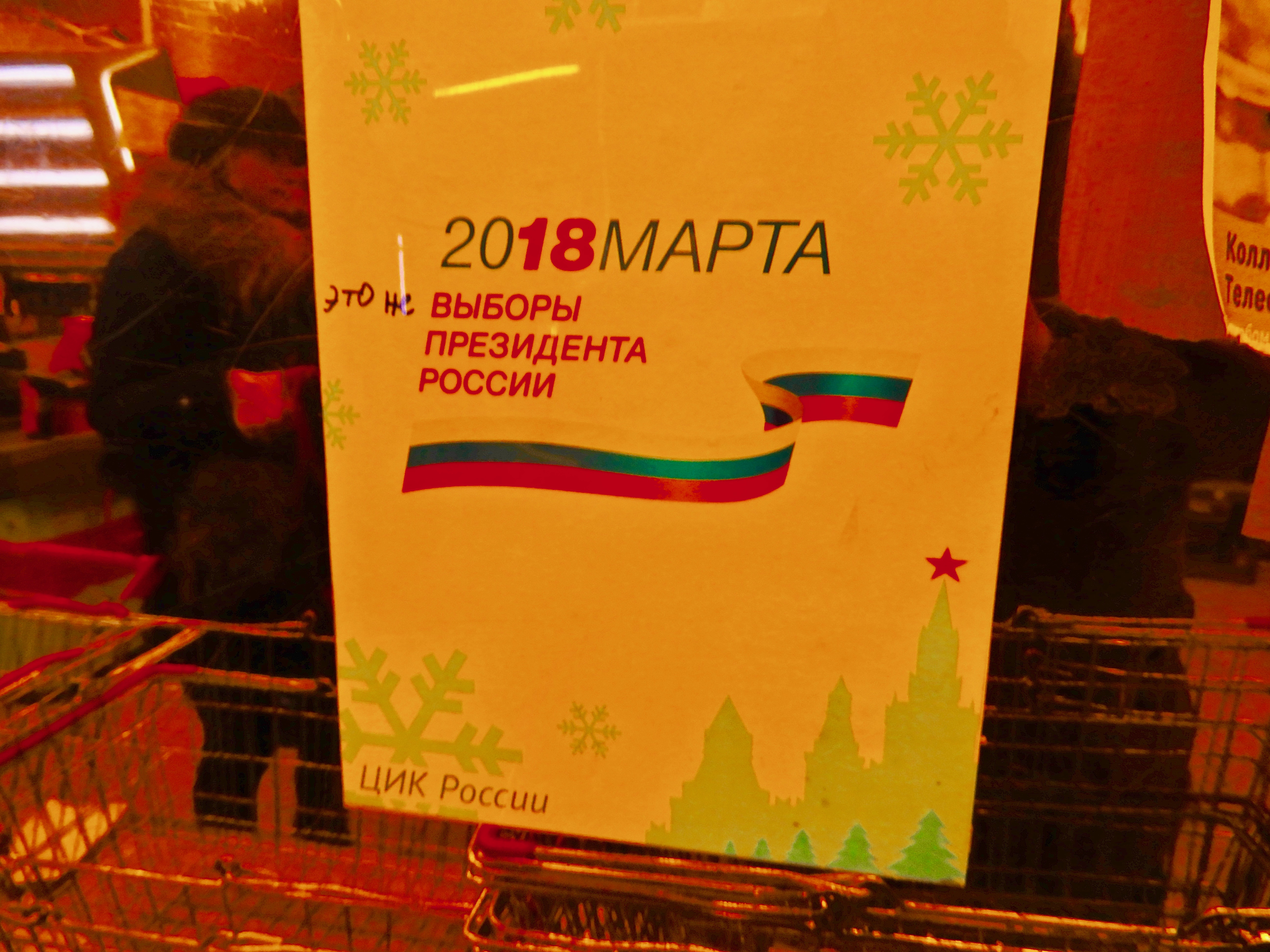
DSCN4942Poster: “March 18, 2018. Russian Presidential Election. Russian Central Election Commission.” || Graffiti: “This is not an election.” Dixie grocery store, Central District, Petersburg. Photo by the Russian Reader

Valery Dymshits
Facebook
March 20, 2018

After the Fight

I wrote so often about the election or, rather, the non-election, that it is time to sum up.

I admit I had hoped for a qualitative decrease in turnout, but it is true we did not manage to achieve this.

Of course, the feverish ideas (I heard them voiced more than once, alas) that if it were not for the boycott, the “forces of good” either would have returned a mystical 10% of the vote tally (whatever for?) or made it into the second round (yes, yes, I read such claims with my own eyes) have nothing to do with reality. The fact the turnout was a few percentage points less, and Putin got a few percentage points more, makes no difference at all to anyone.

Nevertheless, I continue to regard the boycott as the right choice. Here is the reason for my stubbornness.

It is self-evident the election—not the day of March 18, but the process—was god knows what, only it was not an election.

Accordingly, the feeling of disgust kept many people from voting. Disgust is a worthy emotion. But that is not my point here.

In so-called normal countries, candidates and parties fight over half a percentage point, and a threepercent difference is deemed a crushing victory or crushing defeat. In our archaic autocracy, the regime and the populace communicate with each other in a language of symbols. As soon as it transpired the Kremlin was planning to fight for a 70% turnout and 70% of the total vote tally, I immediately realized the Kremlin wanted fifty percent of all possible voters, plus or minus one percent, to come out and vote for Putin and—voilà!—a 65% turnout and a 75% share of votes cast is exactly 50% of all potential voters. Meaning the Kremlin’s statement was purely symbolic and qualitative. Qualitative, symbolic collective action was, likewise, the only possible counterargument. It largely did not come off, but there were no other gestures of resistance except the boycott. The attempt to talk back to the regime quantitatively—for example, Yabloko’s responding to the argument “we have half of all voters” with the rejoinder “but we have 10% of everyone who voted” (i.e., “you have 50%, but we have a whole 5%”)—was ridiculous. Now, if it had been possible to counter the claim “we are robustly supported by half of the populace” with the countargument “ha-ha, you have the support of no more than a third of the populace,” but, alas, it proved impossible.

It is clear the numerous violations, committed here and there by zealots who were not thinking straight, generated a certain stench on election day, but I don’t imagine they had a serious impact on the outcome. It was the outcome that sincerely floored me.

The issue of voter turnout, so hysterically raised by the regime, had nothing to do with a fear of Navalny and the boycott, but with the fact that in the absence of real suspense and real rivals, Russians would be reluctant to go out and vote for Putin, who would be elected anyway. After Navalny was not allowed to run, it was impossible to generate any suspense, so the regime combined the carrot and the stick. Russians were driven and dragged to polling stations by the gazillions.

I would like to make a slight digression. First of all, you can make people who are subordinate and dependent—state employees and employees of state corporations—vote by forcing them or threatening them. The state’s share in the economy has been growing continuously: in 2005, the state controlled 35% of the Russian economy, while it now controls around 70%. That means the numbers of dependent Russians have also been growing.

The Kremlin felt it was vital to drag lazy Russians to the polls whatever the cost. As for voting as they should, they would do that all on their lonesome. The Kremlin knew they would do it, but I didn’t. I thought more or less that people would feel their weekend had been ruined. They had been forced to go somewhere and then forced to report back to their superiors. How swinish! So these people would do something spiteful: vote for Grudinin, vote for Sobchak, vote for Yavlinsky, vote for a four-letter word.

No, since they were dragged all the way to the polling stations anyway, enticed with carrots and prodded with sticks, they voted for Putin.

This is an important albeit gloomy outcome. It means the regime relies on a not terribly active but quite considerable majority. It means the regime can do whatever it likes with whomever it likes, and will be able to do so for a long time to come.  Previously, it could do a lot of things, but not everything. Now, however, it can do anything. Strictly speaking, things have been this way for several years, but now it has been proven in a large-scale, expensive experiment. It is like in the Arabian tales: destroy a city, build a palace, jail a director, close a university, etc., just for the heck of it, just for the fun of it. This does not mean the regime will immediately start throwing its bulks around in all directions, but it can. A clear awareness of this circumstance should make us feel bleak.

Translated by the Russian Reader

Russian Socialist Movement: What Does the Presidential Election Show Us?

“March 2018. Russian Presidential Election: We Elect a President, We Choose a Future!” || “March 2018. Russian Presidential Election: Nice Scenery, Bad Play!” Photo courtesy of the Russian Socialist Movement (RSD)

Russian Socialist Movement (RSD)
Facebook
March 19, 2018

What Has the “Election” Shown Us?

It has shown us that the system for mobilizing dependent Russians (employees, servicemen, etc.) by management at all levels still functions, and that the managers in question (governors, factory directors, and heads of state-sector institutions) are still loyal to the regime. Putin’s personal power rests on the vulnerability of workers, who in Russia have been deprived of the right to strike. It also rests on the loyalty of the bureaucratic caste and corrupted business world, apathy and conformism, and control of the media.

In managed democracy’s topsy-turvy world, voter turnout and Putin’s total share of the vote are indices of political indifference, while boycotting the spectacle is a manifestation of civic activism. Elections in Russia have finally transmogrified into something like an oath of allegiance to the so-called national leader, which has nothing to do with a democratic expression of the popular will.

Undoubtedly, along with the administrative resource, the conservatism of a generation traumatized by the chaotic 1990s, the post-Crimea syndrome, and the careful casting of Putin’s opponents played their role. The Kremlin did its all to divide the forces of protest. Strawberry king Pavel Grudinin served as a scarecrow for voters who did not want a return to the Soviet Union, while Ksenia Sobchak exacerbated the fears of pro-Soviet conservatives vis-à-vis Yeltsinite liberals.

Supporters of the boycott were targeted for assaults and crackdowns. Despite the fact the Voters Strike did not produce a drop in the turnout (too many powerful forces were put into play for that to happen), non-participation in ersatz democracy was the only viable stance, the best option among a host of bad choices. Serving as polling station monitors on election day, we saw what props up both “voluntary” and forced voting. We are glad we did not support this well-rehearsed stunt with our own votes. Russia faces another six years of disempowerment, poverty, lies, and wars—but not in our name.

Only those people who were hoping for a miracle could be disappointed today. Grudinin, whose fans predicted he would make it into the second round, returned worse results than Gennady Zyuganov did in 2012. Some analysts expected that the candidate of the patriotic leftist camp would steal votes from Putin’s conservative electorate, but that did not happen. Nor did Grudinin convince chronic non-voters to go to the polls, since he did not offer them anything new.

Presidential elections, obviously, are not a focal point of politics and an opportunity for change. They are a mode of manipulating public opinion meant to leave everything the way it was.

We need a new politics that undermines the power structures making it possible to manipulate the populace in the interests of the elite. We need a politics that takes on the power of management over employees, the power of the patriarchy over women and young people, and the power of the bureaucracy over local self-government. Since electoral politics has essentially been banned, the democratic leftist movement must rely on nonconformist communities opposed to Putinism in the workplace, education and culture, city and district councils, the media, and the streets.

Only in this way, not as the result of yet more heavy-handed maneuvering by the regime or the opposition to fill the ever more obvious void of popular democratic (i.e., leftist) politics, can a force emerge that is a real alternative to the system. We are going to keep working on shaping that force.

Translated by the Russian Reader

“We Have a Surrogate Democracy”: An Interview with Ekaterina Schulman

Ekaterina Schulman. Photo courtesy of Andrei Stekachov and The Village

Political Scientist Ekaterina Schulman on Why You Should Vote
Anya Chesova and Natasha Fedorenko
The Village
September 16, 2016

This Sunday, September 18, the country will vote for a new State Duma, the seventh since the fall of the Soviet Union. The peculiarity of this vote is that it will take place under a mixed electoral system for the first time since 2003. 225 MPs will be elected to five-year tears from party lists, while the other 225 MPs will be elected from single-mandate districts. Several days before the elections, The Village met with Ekaterina Schulman, a political scientist and senior lecturer at the Russian Presidential Academy of National Economy and Public Administration (RANEPA). We talked with her about why you should vote if United Russia is going to win in any case, as well as about the changes in store for the Russian political system in the coming years.


The Upcoming Elections

The Village: On Sunday, the country will hold the first elections to the State Duma since 2011. The social climate in the city and the country as a whole has changed completely since that time. Protests erupted in 2011, and the people who protested on Bolotnaya Square and Sakharov Avenue believed they could impact the political situation. Nowadays, few people have held on to such hopes. What should we expect from the upcoming elections? And why should we bother with them?

Ekaterina Schulman: Everything happening now with the State Duma election is a consequence of the 2011–2012 protests, including changes in the laws, the introduction of the mixed system, the return of single-mandate MPs, the lowering of the threshold for parties to be seated in the Duma from seven to five percent, and the increased number of parties on the ballot. These are the political reforms outlined by then-president Dmitry Medvedev as a response to the events of December 2011. Later, we got a new head of state, but it was already impossible to take back these promises. The entire political reality we observe now has grown to one degree or another out of the 2011–2012 protest campaign, whether as rejection, reaction or consequence. It is the most important thing to happen in the Russian political arena in recent years.

The statements made by Vyacheslav Volodin, the president’s deputy chief of staff, on the need to hold honest elections, Vladimir Churov’s replacement by Ella Pamfilova as head of the Central Electoral Commission, the departure of someone more important than Churov from the CEC, deputy chair Leonid Ivlev, and the vigorous sacking of chairs of regional electoral commissions are all consequences of the protests. If they had not taken place, nothing would have changed. We would still have the same proportional voting system, the same seven-percent threshold, the same old Churov or Churov 2.0. Continue reading ““We Have a Surrogate Democracy”: An Interview with Ekaterina Schulman”