El lector ruso: El espíritu del año nuevo


“Devuelve el espíritu del año nuevo”: Igor Stomajin, Moscú, 2024

Fiel a su naturaleza vanguardista, el Noise Cabaret estrena, el 25 de diciembre, la serie inmersiva Diálogos, basada en la obra filosófica de Platón. Aleksander Judiakov transforma la antigua filosofía griega en una animada, ingeniosa y provocativa charla con la audiencia. 

Junto a su compañero, Ivan Wahlberg, Judiakov, quien no sólo actúa sino que también dirige el proyecto, guiará a la audiencia a través del laberíntico  pensamiento de Platón: ¿qué es la justicia?, ¿dónde está la línea entre lo existente y lo no existente?, ¿cuál es la naturaleza del amor? Estas y muchas otras fundamentales preguntas filosóficas servirán de punto de partida para reflexionar y debatir. 

Diálogos es una serie de performances interactivas en la que cada espectador toma parte en discusiones filosóficas que consisten en textos de Platón adaptados e improvisados de forma histriónica, lo que significa que el desarrollo de la sesión depende de la participación de la audiencia. Cada nueva performance es un capítulo aparte que trata un problema filosófico específico, de forma que el espectador puede unirse a la serie en cualquier momento. El primer episodio está dedicado al concepto de la justicia.   

El Noise Cabaret planea invitar a celebridades de San Petersburgo para enriquecer la conversación con la audiencia con sus propias opiniones y perspectivas. 

Judiakov ha compartido la idea básica del proyecto:

“Quisimos crear una historia acerca de gente que conversa en un bar. Pero, gente que habla sólo entre ellos no es interesante, tiene que haber algo primordial. Cuando estudié a Platón, me interesé en muchos aspectos de su filosofía, sería un error limitarnos a un solo tópico. Así nació la idea de crear una serie: tomar a Platón, leerle y discutir los temas que él refiere en los diálogos socráticos. 

Planeamos producir una nueva sesión cada dos o tres meses. No pretendemos ser estudiosos serios de la filosofía platónica, sino que esta es más bien una excusa para hablar con el público acerca de temas difíciles, exponer los Diálogos y reflexionar acerca de estos. Y un bar es un lugar donde podemos hablar de todo tipo de cosas, incluso de filosofía”.

Fuente: Fontanka.ru, 23 de diciembre del 2024. Traducción original The Russian Reader. Traducción al español por Hugo Palomino.


Los rusos han gastado casi 6 000 millones de rublos en Ozempic genéricos el 2024

Los medicamentos basados en semaglutida se usan habitualmente para perder peso. 

En los primeros diez meses del 2024, los rusos gastaron 5,9 000 millones de rublos (aproximadamente 52 000 millones de euros) en más de un millón de envases de versiones genéricas del medicamento Ozempic (semaglutido), de acuerdo al DSM Group, según un reporte de Vedomosti.

Entre los genéricos más populares se encuentran el Semavic de Geropharm y el Quincenta de Promomed. El Ozempic original dejó de exportarse a Rusia en diciembre del 2023, abriendo el mercado a otros equivalentes locales. 

2024 ha sido un año récord para medicamentos en esta categoría. En comparación, el 2023 los rusos gastaron sólo 297 millones de rublos en Ozempic al adquirir 20 mil dosis. El 2022 gastaron 1,9 mil millones de rublos (en 256 mil dosis); el 2021, 758 millones de rublos; y el 2020, 76 millones de rublos.

Los medicamentos basados en la semaglutida son usados en el tratamiento de diabetes, pero recientemente han ganado popularidad como fármacos  adelgazantes, lo que ha contribuido a su crecimiento de ventas en Rusia.  

Fuente: ASTV.ru, 21 de diciembre del 2024. Traducción original The Russian Reader. Traducción al español por Hugo Palomino.
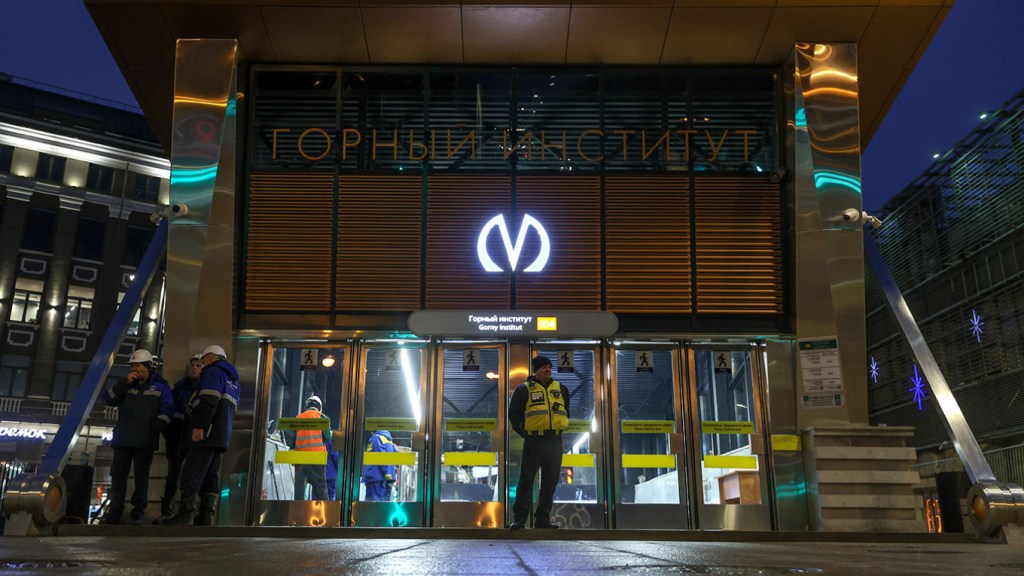

La ciudad de San Petersburgo inaugurará una nueva estación de metro esta semana. Así lo anunció, el jueves, el gobernador Alexander Beglov, en la que será la primera estación de metro en abrir en cinco años.

La estación Gorny Institute de la isla Vasílievski, extenderá la cuarta línea (naranja) hacia el oeste. Esta comenzará a operar el viernes (27 de diciembre) a las 9 de la mañana, cuando su vestíbulo se abra tanto al ingreso como a la salida, dijo Beglov.

“La apertura de la estación Gorny Institute es un hito”, escribió el gobernador en Telegram, haciendo notar que la ciudad ha superado “retos importantes” durante la construcción de la misma.

Beglov agradeció al presidente Vladimir Putin, a los constructores del metro, a ingenieros y residentes de San Petersburgo por su paciencia y apoyo, calificando la finalización de la estación el “primer resultado” de los constantes esfuerzos para mejorar el sistema de metro urbano.

La inauguración de la estación se produce tras años de retrasos. Inicialmente programada para el 2015, su apertura se pospuso primero al 2018 y luego al 2022. El trabajo de construcción fue empañado por la fatal caída de un andamio en junio del 2020, incidente en el que falleció un trabajador y otro resultó herido.   

Gorny Institute es la primera estación en abrir desde el 2019, cuando otras tres estaciones, Prospect Slavy, Dunayskaya y Shushary fueron inauguradas.

El metro de San Petersburgo está compuesto en la actualidad por cinco líneas y 72 estaciones. Sin embargo, su expansión se ha ralentizado con el tiempo, en claro contraste con el pujante sistema de metro de Moscú, que este último año inauguró ocho nuevas estaciones.  

Fuente: Moscow Times, 26 de diciembre del 2024. Traducción al español por Hugo Palomino para The Russian Reader.


Al tratar de comprender la tonalidad del film (Anora), se me viene a la memoria una frase de Francis Bacon: “Uno puede ser optimista y no tener esperanza alguna”. La situación en la que los protagonistas se ven envueltos, a merced de los ricos, es totalmente desesperanzadora. La versión optimista del guión mostraría a un Vanya que encararía a sus padres para huir con Ani, aún cuando así perdiera su fortuna –lo que constituye la trampa de la película. O quizás, la madre despiadada y capitalista podría sentir respeto a regañadientes por su tenaz nuera, como ocurrió en la última temporada de Fargo. Aún con su siniestro  desenlace, la impresión que deja la película  se aleja de lo penoso o pesimista. El optimismo desesperanzado del cine de Baker se sostiene en lo extraordinario de la vida que parece escapar de la pantalla y, especialmente, su cuidado por los personajes, incluso Vanya.  

Fuente: Aaron Schuster, “The Ethical Dignity of Anora,” e-flux Notes, 20 de noviembre del 2024. Traducción al español por Hugo Palomino para The Russian Reader.


Durante el otoño del 2023, con el objeto de entender qué ocurre con la sociedad rusa en tiempos de guerra, el equipo del Laboratorio Sociológico Público (Public Sociology Laboratory en inglés) realizó una serie de viajes de investigación etnográfica a tres regiones rusas: Sverdlovsk, Krasnodar y Buriatia. En el transcurso de un mes los investigadores del Laboratorio observaron cómo la gente aborda el tema de la guerra y sus efectos en la vida diaria de pueblos y ciudades. Grabaron también  entrevistas sociológicas con residentes locales. El Laboratorio ha compilado tres detallados diarios de observación (de más de 100 mil palabras cada uno) y ha conducido 75 entrevistas exhaustivas. Más importante aún, ha recolectado datos realmente invaluables que proporcionan una idea de lo que dice y piensa la gente acerca de la guerra en su vida cotidiana, más allá de sus respuestas a las interrogantes de los investigadores.  

El texto completo del reporte es de la envergadura de un libro, escrito también como uno: en siete capítulos se introducen  muchos personajes, permitiendo así a los lectores sumergirse por completo en los tiempos de la guerra contemporánea en Rusia. El siguiente sumario destaca las principales conclusiones del análisis.

●      La sociedad rusa permanece políticamente desmovilizada y sin ideología. Aún cuando predomina la opinión de que es una sociedad estrictamente militarizada, vemos que la guerra se ha convertido en una rutina y por ende en una parte ignorada de la realidad. Por ejemplo, comparado con el primer año del conflicto, la cantidad de simbología a favor de la guerra en espacios públicos ha disminuido en las tres regiones. La guerra no se ha convertido ni en fuente de nuevas ideas en la vida cultural de pueblos y ciudades ni se ha integrado en el ámbito familiar o en el ámbito cultural establecido. La guerra no se discute en espacios públicos, incluso, salvo raras excepciones, en comunidades locales en línea.    

●      En conversaciones espontáneas, los rusos raramente discuten los objetivos generales, causas, criminalidad o justificaciones de la guerra. Están más preocupados por el impacto del conflicto en sus vidas cotidianas. Cuando hablan acerca de la guerra, usualmente vuelven sobre tópicos que ya discutían antes de la conflagración, por ejemplo, problemas cotidianos, dinero o ética. Los hombres discuten más a menudo temas que son considerados “masculinos” en la sociedad, como aspectos técnicos de la guerra; mientras las mujeres se dedican a temas más “femeninos” como el efecto destructor del conflicto en las familias.

●      La participación de diversos tipos de voluntariado a favor de la guerra y asistencia organizada a la milicia, que generalmente es tomada como referencia y ejemplo de la movilización y militarización de la sociedad rusa, raramente está  motivada por un firme aval del público a la “operación especial”. Está, más bien, asociada con la presión de la administración, las normas morales de la comunidad (sobre el apoyo mutuo) y/o por el deseo de ayudar a sus seres queridos, en lugar del deseo de propiciar una victoria rusa. La observación de actividades de voluntarios muestra que estos no discuten de guerra o política en el trabajo, sino que prefieren temas  con los que pueden relacionarse personalmente: precios, pensiones, familias y/o historias vinculadas a centros voluntarios. 

●      A pesar de todas las similitudes, la guerra es percibida de forma diferente en diferentes regiones. Las peculiaridades de la perspectiva  de cada región se debe a factores como el número de unidades militares y colonias penitenciarias desde donde se reclutan presos, la proximidad a la zona de combate, la prosperidad de la región y el acceso a puestos de trabajo decentes, la compenetración de los lazos sociales, la circulación de noticias que llegan de amistades en el frente de batalla, etc. En otras palabras, las diferencias en las percepciones de la guerra pueden atribuirse principalmente a las peculiaridades de la vida en las regiones previas a la invasión rusa de Ucrania.

●      El conflicto entre opositores y simpatizantes de la guerra está perdiendo fuerza gradualmente, mientras el cisma entre aquellos que permanecen en Rusia y quienes se marcharon crece. Ambos casos se dan porque la experiencia compartida de vivir a través de una situación difícil dentro del país se está convirtiendo en algo más importante que cualquier diferencia de puntos de vista para muchos rusos y también porque la gente discute cada vez menos acerca de la guerra.

●      Al mismo tiempo, el menguante conflicto entre opositores y simpatizantes de la guerra no siempre implica una mayor cohesión social. Ya que la sociedad está intentando vivir como si la guerra no estuviera ocurriendo y el gobierno no menciona ninguna pérdida o problema relacionado con la guerra, todas las consecuencias negativas del conflicto se han normalizado o han sido apartados al ámbito de los “problemas personales” que no son discutidos con otros y que todos deben lidiar por sí mismos.

●      En general, muchos no se sienten capaces de influir en las decisiones políticas. Por consiguiente, se distancian cada vez más de la guerra. Ellos entienden que no pueden cambiar la política del gobierno pero retienen, al menos, algún control sobre sus vidas privadas, por lo que se refugian en estas. Con el tiempo, no solo los rusos apolíticos sino incluso opositores declarados de la invasión  sienten esta impotencia y, como resultado, algunos de ellos aceptan la nueva realidad, mientras siguen condenando la guerra para sus adentros.  

●      Consecuentemente, muchos rusos desconfían cada vez más de noticias políticas provenientes de un rango diverso de fuentes. En cambio ponen su confianza en medios locales. Los problemas locales en las noticias les parecen más importantes y relevantes. Más aún, sienten que, a diferencia de la guerra, al menos tienen la capacidad de influenciar en asuntos locales. 

●      Al mismo tiempo, la guerra está influyendo en el estado emocional de la gente. Muchos de nuestros interlocutores admiten haber experimentado ansiedad, tensión, incertidumbre, miedo incluso cuando no hablan de estas emociones  abiertamente. La partida de hijos y maridos a la guerra hace que las mujeres “griten a todo pulmón”. Sin embargo, raramente comparten estos sentimientos con otros y si lo hacen es en círculos de amistades cercanas. 

●      Muchos rusos sin interés en la política pueden justificar o condenar la guerra dependiendo del contexto comunicativo.

  1. Tienden a justificar la guerra de forma no emocional a través de la normalización (“siempre ha habido guerras”) o la racionalización (“era necesario”) cuando se les pregunta directamente en contextos formales como en las entrevistas de investigación.
  2. Tienden más a criticar la guerra cuando se les sugiere pensar en los efectos negativos de esta sobre la gente ordinaria. Este criticismo difiere del de los opositores al conflicto. Para los opositores, la guerra es un crimen moral contra Ucrania, mientras que para los rusos apolíticos, la guerra es vista como algo que destruye la sociedad rusa y daña a la gente común. Sin embargo, este criticismo no lleva a los rusos apolíticos a cuestionarse la necesidad o inevitabilidad de la guerra ni a extender sus críticas hacia el gobierno.
  3. Tienden a justificar la guerra emocionalmente cuando son confrontados con narrativas tradicionales contrarias al conflicto. Cuando Rusia es acusada de cometer crímenes morales contra la gente de Ucrania, suelen tomar tales acusaciones de manera  personal e intentan defender su propia dignidad.

Algunos experimentan un fortalecimiento del sentimiento de identidad nacional y, a veces, esto incrementa la demanda de una mayor solidaridad. Es importante dejar constancia que este incremento de la identidad nacional no guía a los rusos a adoptar el signo imperial del nacionalismo. A diferencia del Kremlin, la gente común y corriente vive en un mundo de estados-nación, no en un mundo de fantasías imperiales (según estas fantasías, Ucrania no es un estado real y los ucranianos son gente inferior). 

Una sensación de duda es lo que realmente une a los rusos hoy en día. A pesar de que la gente usa diferentes estrategias para hacer frente a esa sensación, esta complica significativamente la habilidad de planificar sus vidas y hunde a los rusos en el pesimismo.

Así, por una parte, lo que antes era la  naturaleza singular de la guerra, está dando paso a la normalización: gradualmente la guerra se está convirtiendo en algo ordinario, un elemento más del mundo que les rodea. De alguna manera, muchos rusos se resisten a los intentos del Kremlin de convertir ciudadanos ordinarios en partidarios ideológicos y a los intentos de la oposición liberal, que se manifiesta contra la guerra, de forzar a la sociedad a experimentar un sentimiento de culpa y participación activa. Por otra parte, la guerra constantemente nos recuerda su presencia al crear nuevas amenazas, nuevas ansiedades y nuevas razones para tener a los rusos descontentos.

Fuente: Public Sociology Laboratory (Programa ruso), diciembre del 2024. Traducción al español por Hugo Palomino para The Russian Reader.


¡Queridos lectores!

Estos tiempos son difíciles, la clave en este caso es persistir en todo sentido.

Nadie dijo que fuese sencillo.

Pero no es tan duro tampoco.

El otro día le pregunté a Vladimir Putin si él esperaba algo más de sí mismo en el año que acababa.

Pero quiero preguntarte, lector, ¿esperas algo más de ti mismo el año que viene?

Necesitamos esperar algo. Necesitamos querer algo. Es una forma de aferrarnos a nosotros mismos. De cuidar de nosotros mismos. Incluso de encontrarnos a nosotros mismos.

¡Un signo duro (“Ъ”) nunca será un signo blando (“Ь”)!

¡Feliz nuevo año por llegar!

¡No nos quedemos a la defensiva!  

Andrei Kolesnikov, Corresponsal especial,  Editorial Kommersant.

Fuente: correo electrónico de Kommersant, 31 de diciembre del 2024. Traducción original The Russian Reader. Traducción al español por Hugo Palomino. El llamado signo duro, que los bolcheviques eliminaron del alfabeto cirílico ruso en 1918, ha sido el logotipo de Kommersant desde que el periódico fue relanzado en enero de 1990. Andrei Kolesnikov ha sido el corresponsal especial del medio en el Kremlin, es decir el jefe Putinversteher* del diario, por muchos años. Por supuesto, él lo negará cuando las cosas se pongan difíciles y Putin se marche, y dirá que ha sido siempre la forma cínica y jocosa, aunque siempre leal, en la que ha escrito acerca del dictador ruso y criminal de guerra durante todos estos años.   

* Término derivado del alemán versteher, persona con conocimiento de un tema en particular, usado aquí de forma peyorativa, algo así como un “Putinologo” en el peor sentido de la palabra.

Thе New Year Spirit


Faithful to its avant-garde nature, Noise Cabaret premieres the immersive series Dialogues, based on the philosophical works of Plato, on December 25. Alexander Khudyakov turns ancient Greek philosophy into a lively, witty and provocative dialogue with the audience.

Along with his partner Ivan Wahlberg, Khudyakov, who not only acts in the project but directs it, will guide the audience through the labyrinths of Plato’s thought. What is justice? Where is the line between existence and non-existence? What is the true nature of love? These and many other fundamental philosophical questions will serve as starting points for reflection and debate.

Dialogues is a series of interactive performances in which each viewer is involved in a philosophical discussion consisting of adapted texts by Plato and actorly improvisation, meaning that the way the performance goes depends on the audience’s involvement. Each new performance is a separate chapter dealing with a specific philosophical problem, so you can join the series at any stage. The first episode deals with the concept of justice.

Noise Cabaret plans to invite Petersburg celebrities to enrich the conversation with the audience with their own opinions and views.

Khudyakov shared the idea behind the project.

“We wanted to do a story related to people talking in a bar. But just people talking to each other is not interesting. There has to be a big focus. When I studied Plato, I was interested in several aspects of his philosophy. It would have been wrong to limit ourselves to a single topic. So the idea to make a series arose: take Plato, read him, and discuss the themes he raises in the Socratic dialogues.

“We plan to produce a new episode every two or three months. There’s no pretense here that we’re serious scholars of Plato’s philosophy: it’s more of an excuse to talk to people about difficult topics, to air the Dialogues and reflect on them. And a bar is a place where you can talk about all sorts of things, including philosophy.”

Source: Fontanka.ru, 23 December 2024. Translated by the Russian Reader


Russians spent almost 6 billion rubles on Ozempic generics in 2024

Semaglutide-based drugs are commonly used for weight loss

In the first ten months of 2024, Russians spent 5.9 billion rubles [approx. 52 billion euros] on over one million packs of generic versions of the drug Ozempic (semaglutide), according to DSM Group, as reported by Vedomosti.

Among the most popular generics are Geropharm’s Semavic and Promomed’s Quincenta. The original drug Ozempic stopped [sic] official supplies to Russia in December 2023, opening the market to domestic analogues.

2024 was a record year for drugs in this category. By comparison, in 2023, Russians spent only 297 million rubles on Ozempic, buying 20 thousand packs. In 2022, they spent 1.9 billion rubles (256 thousand packs); in 2021, 758 million rubles; and in 2020, 76 million rubles.

Semaglutide-based drugs are used to treat diabetes but have recently been gaining popularity as weight loss drugs, which has also contributed to their sales growth in Russia.

Source: ASTV.ru, 21 December 2024. Translated by the Russian Reader


St. Petersburg will open a new metro station this week, Governor Alexander Beglov announced Thursday, marking the former Tsarist capital’s first new metro station in five years.

The Gorny Institute metro station, located on Vasilievsky Island, will extend the fourth (or “orange”) line westward. It will begin operations at 9:00 a.m. on Friday, with its vestibule open for both entry and exit, Beglov said.

“The opening of Gorny Institute is a milestone,” the governor wrote on Telegram, noting that the city had overcome “significant challenges” during the station’s construction.

Beglov thanked President Vladimir Putin, metro builders, engineers and residents of St. Petersburg for their patience and support, calling the station’s completion the “first results” of sustained efforts to advance the city’s metro system.

The station’s opening comes after years of delays. Initially scheduled for completion in 2015, its opening was postponed to 2018 and later to 2022. Construction efforts were further overshadowed by a fatal scaffolding collapse in June 2020 that killed one worker and injured another.

Gorny Institute is the first station to open since 2019, when three others — Prospect Slavy, Dunayskaya, and Shushary — were inaugurated.

St. Petersburg’s metro is currently made up of five lines and 72 stations. However, it has expanded slowly over the years, in stark contrast to Moscow’s burgeoning metro system, which this year opened eight new stations.

Source: Moscow Times, 26 December 2024


[…]

In trying to grasp the tonality of the film [Anora], I am reminded of a line from Francis Bacon: “You can be optimistic and totally without hope.” The situation the characters find themselves in, being at the mercy of the rich, is totally without hope. The “hopeful” version of the script would be one in which Vanya does stand up to his parents and runs off with Ani, even at the price of losing his wealth—this is the film’s narrative lure. Or maybe another where the ruthless capitalist mother gains a grudging respect for her tough daughter-in-law, like in the last season of Fargo. But despite its grim closure, the impression the film gives is far from dreary or pessimistic. The hopeless optimism of Baker’s cinema lies in the sheer life that seems to almost burst out of the filmic frame, and, especially, his deep care for his characters, even Vanya.

Source: Aaron Schuster, “The Ethical Dignity of Anora,” e-flux Notes, 20 November 2024


In the fall of 2023, with the goal of understanding what is really happening with Russian society during wartime, the Public Sociology Laboratory team went on ethnographic research trips to three Russian regions—Sverdlovsk, Krasnodar and Buryatia. Over the course of a month, PS Lab researchers observed how people talk about the war and how it affects daily life in cities and villages. In addition, they recorded sociological interviews with local residents. PS Lab has compiled three detailed ethnographic observation diaries (more than 100,000 words apiece) and conducted 75 in-depth interviews. Overall, it has managed to collect truly unique data that provides an idea of what people say and think about the war in everyday situations, and not only when answering researchers’ questions.

The full text of the report is book-length and written in a book-style format: it consists of seven chapters, introduces many characters, and allows readers to be fully immersed in contemporary wartime Russia. The following summary, meanwhile, highlights the main analytical conclusions.

  • Russian society remains politically demobilized and deideologized. Despite the prevailing opinion that it is strictly militarized, we see that the war has become routine and therefore a disregarded part of reality. For example, compared to the first years of the war, the amount of prowar symbolism in public spaces has decreased in all three regions. The war has neither become a source of new ideas in the cultural life of cities or villages nor been integrated into familiar and already-established cultural formats. The war is not discussed in public places, including, with rare exceptions, local online communities.
  • In spontaneous conversations, Russians rarely discuss the overall goals and causes, criminality, or justifications of the war. They are concerned with the impact of the war on their everyday lives. When they talk about the war, they mostly talk about the same things they discussed before the war, for example, everyday difficulties, money, or ethics. Men more often discuss topics that are considered “masculine” in society, such as the technical side of the war, and women usually talk about “feminine” topics, such as how war destroys families.
  • Participation in various types of prowar volunteering and organized assistance for the military, which are often cited as an example of the mobilization and militarization of Russian society, is rarely motivated by people’s firm support for the “special operation.” It is usually associated with pressure from the administration, community moral norms (concerning mutual assistance), and/ora desire to help loved ones, rather than a wish to make victory for Russia more likely. Observation of volunteers’ activities show that while working, they do not discuss the war or politics, rather choosing topics that are personable and relatable to them: prices, pensions, families, and/or stories related to the volunteer centers.
  • Despite all these similarities, the war is perceived slightly differently in different regions. The peculiarities of each region’s view owe to factors like the number of military units and penal colonies from which prisoners are recruited, proximity to the combat zone, the prosperity of the region and the availability of decent jobs, the density of social ties, the circulation of news transmitted by friends on the front lines, etc. In other words, the differences in perceptions of the war are attributable mainly to the peculiarities of life in the regions before the invasion of Ukraine.
  • The conflict between opponents and supporters of the war is gradually subsiding, while the rift between those who stayed in Russia and those who left is growing. This is happening both because the shared experience of living through a difficult situation within the country is becoming more important for many Russians than any differences in viewpoint, and also because people are discussing the war less.
  • At the same time, the waning conflict between opponents and supporters of the war does not always mean more social cohesion. Since people are trying to live as if the war is nonexistent and the government does not talk about any losses or problems associated with the war, all negative consequences of the war are either normalized or pushed into the realm of “personal problems” that are not discussed with anyone and that everyone must deal with on their own.
  • Overall, many people do not feel able to influence political decisions. Therefore, they are increasingly distancing themselves from the war. They understand that they cannot change government policy, but they retain at least some control over their private lives—and therefore they are immersed in them. Over time, not only apolitical Russians but even sure opponents of the invasion experience this powerlessness and, as a result, some of them accept the new reality while continuing to condemn the war internally.
  • Consequently, many Russians are increasingly distrustful of political news from a broad range of sources. Instead, they put their trust in local media. Local problems and news seem much more important and relevant to them. Moreover, they feel that, unlike the war, local issues are at least sometimes within their ability to influence.
  • At the same time, the war is weighing people’s emotional state. Many of our interlocutors admit that they experience anxiety, tension, uncertainty, fear, even if these things are not usually spoken about openly. The departure of sons and husbands to war makes women “scream at the top of their lungs.” However, people rarely share such emotions with others, and if they do, they do so in groups with close friends.
  • Many Russians who are not interested in politics may justify or condemn the war depending on the communicative context.
  1. They tend to non-emotionally justify the war through normalization (“there are always wars”) or rationalization (“it was necessary”) when asked about it directly in more formalized settings, such as research interviews.
  2. They are more likely to criticize the war when prompted to think about how it negatively affects them as ordinary Russians. This criticism differs from that of war opponents. For opponents, the war is a moral crime against Ukraine, whereas for apolitical Russians, the war is seen as something that destroys Russian society and harms ordinary people. However, this criticism does not lead apolitical Russians to question the war’s necessity or inevitability, nor does it extend to criticizing the Russian government.
  3. They tend to emotionally justify the war when confronted with traditional anti-war narratives. When Russia is accused of committing moral crimes against the Ukrainian people, they often take such accusations personally and attempt to defend their own dignity.
  • Some people have experienced a strengthened sense of national identity, and sometimes a demand for greater solidarity arises. It’s important to note that this increased sense of national identity does not lead Russians to adopt the official imperial brand of nationalism. Unlike the Kremlin, ordinary people live in a world of nation states, not in a world of imperial fantasies (according to which Ukraine is not a real state and Ukrainians are an inferior people).
  • A feeling of uncertainty is what truly unites Russians today. Despite the fact that people choose various strategies to cope with this feeling, it still significantly complicates the ability to plan one’s life and plunges Russians into pessimism.

Thus, on the one hand, the formerly extraordinary nature of the war is giving way to normalization: the war is gradually becoming something ordinary, another unremarkable part of the surrounding world. In a sense, many Russians resist both the Kremlin’s attempts to turn ordinary citizens into ideological supporters and the attempts of the anti-war liberal opposition to force society to actively experience guilt and fight. On the other hand, the war constantly reminds us of its existence, creating new threats, new anxieties, and new reasons for discontent in Russians.

Source: Public Sociology Laboratory (The Russia Program), December 2024


Dear readers!
Times are tough, and the key in this case is holding on in every sense.
No one says it’s easy.
But it’s not so hard either.
The other day I asked Vladimir Putin whether he expected anything more from himself in the outgoing year.
But I want to ask you: do you expect anything more from yourself in the coming year?
We need to expect things. We need to want things. It’s a way of holding on to ourselves. Of looking after ourselves. Of not losing ourselves. And even of finding ourselves.
A hard sign (“Ъ”) will never be a soft sign (“Ь”)!
Happy incoming New Year!
Let’s not be on the defensive!

Andrei Kolesnikov, Special Correspondent, Kommersant Publishing House

Source: Email from Kommersant, 31 December 2024. Translated by the Russian Reader. The so-called hard sign, which the Bolsheviks dropped from the Russian Cyrillic alphabet in 1918, has been the logo of Kommersant since the newspaper’s relaunch in January 1990. Andrei Kolesnikov has been the newspaper’s special Kremlin correspondent — that is, its chief Putinversteher — for many years. Of course he’ll deny it all when push comes to shove and Putin goes, and he’ll point of course to the cynical, jocular (but ultimately loyal) way he’s written about the Russian dictator and war criminal all these years.

All the Tabs Open in Chrome


Yekaterina Duntsova, who wants to run for president, said the Kremlin should end the conflict in Ukraine, free political prisoners and undertake major reform to halt the slide towards a new era of “barbed wire” division between Russia and the West.

Nearly 32 years since the 1991 fall of the Soviet Union stoked hopes that Russia would blossom into an open democracy, Duntsova, 40, said she was afraid as she spoke to Reuters in Moscow.

Source


In opinion polls, Russians voice support for the Putin regime’s action in Ukraine. And yet, many Russia would like the war to end, and the dynamics of recruiting “contract” soldiers does not demonstrate that a large number of people are ready to rise up “to fight the West in Ukraine.” What are the real sentiments of Russians? What do they think about the war and how do they justify it?

  • Lev Gudkov, deputy director, research director, Levada Center, “The war and collective identity,” (online)
  • Andrei Kolesnikov, senior researcher at the Carnegie Russia Eurasia Center in Berlin, “A semi-mobilized society in a hybrid totalitarian regime” (online)
  • Svetlana Erpyleva, Humboldt Fellow, Research Center for Eastern European Studies at the University of Bremen; researcher, Public Sociology Lab and the Centre for Independent Sociological Research, “Accepting the inevitable: how Russians justify the war in Ukraine”

Source. Annotation translated by the Russian Reader


Viktor Filinkov, convicted in the Petersburg portion of the high-profile Network Case, turned twenty-nine in early November. It was his third birthday in the penal colony, and for the first time he was not given any special “gift” there. Previously, surprises had been waiting for him that were even hard to imagine—for example, a new uniform with a piece of razor inside it. Filinkov has been imprisoned for six years total. During this time, he has seen a lot, including being threatened with dispatch to a war zone, but he quickly put a stop to such “jokes.” Now he is housed in the high-security wing along with other “repeat offenders.” And he constantly files suits against the penal colony. We talked to his girlfriend and public defender Yevgenia Kulakova, who loves him with all her heart and helps defend his rights behind bars.

Source. Excerpt translated by the Russian Reader, who looks forward to the day when he can see his friend and heroine Jenya Kulakova again and meet his hero Viktor Filinkov in person.


Putin noted that visitors from Tajikistan can stay in Russia for an extended period—fifteen days—without registering with the immigration authorities. They can also apply for a work permit that is valid for up to three years.

In addition, Putin announced the expansion of the quota for university students and postgraduates from Tajikistan—from 900 to 1,000 individuals.

The head of the Russian Federation added that the state would allocate 200 million rubles annually from this year for purchasing textbooks for Russian-speaking schools in Tajikistan.

Various regions of Russia have recently imposed restrictions on migrant labor. There have also been proposals to introduce such bans everywhere for visitors from countries where the Russian language is not recognized at the state level. In Tajikistan, Russian is enshrined in the constitution as the language of interethnic communication.

Due to the unstable financial situation, migrant workers have been leaving Russia. Up to a third of Tajik and Uzbek nationals may leave the country.

Source. Translated by the Russian Reader


As of February 24, 2022, Russian President Vladimir Putin declared the beginning of what he dubbed the “special military operation” and the Russian Armed Forces invaded Ukrainian territory. What the Russian authorities assumed would be a swift operation soon became a drawn-out, full-fledged war. Many events occurred over the course of the first year of war, keeping Russians in suspense, forcing them to detach themselves from the situation, giving them hope, and then driving them to despair. When we conducted our first interviews in spring 2022, many thought the war would not last long.

Since then, it has become clear that the war will be with us for a while. The daily life of Russian citizens has been invaded time and again by dramatic events. The Russian retreat from the occupied territories, the annexation of new regions, the bombing of Kiev, the first Crimean Bridge explosion, and the “partial mobilization”— to name just a few. Have these events changed the average Russian’s view of the war, and if so, how? How did residents of the Russian Federation perceive the “special military operation” more than half a year later? These questions are the focus of the report you see before you.

There are several research teams monitoring changes in Russian perceptions of the war through opinion polls (for example, Russian Field and Chronicles). The work they are doing is very important. However, like any research method, surveys have their drawbacks—there are some things they simply will not show. For example, surveys do not always allow us to understand a respondent’s attitude towards sensitive or hot-button topics, as sometimes people have a tendency to hide their true views. But more importantly, for Russians largely removed from the political process, perceptions of such politically-charged issues as the “special military operation,” war, and military conflict do not fit neatly into the standardized set of coherent positions that a survey is capable of capturing. These perceptions may be complex and contradictory, and in this case, in-depth interviews and long conversations with people allow us to better understand the idiosyncrasies of each viewpoint. To our knowledge, we are the only team that systematically monitors Russian perceptions of the war using qualitative (interview) rather than quantitative (survey) methods.

We released our first analytical report in September 2022. You can read it here (in Russian) and here (in English). In it, we presented the results of our qualitative study through interviews conducted over several months after the start of the war, in March, April, and May 2022. Our interviewees held a variety of opinions on the military conflict—there were those who supported the hostilities in one way or another (war supporters), those who condemned military aggression (war opposers), and those who tried to avoid giving any explicit assessment of the situation (undecided). We compared these three groups of respondents with each other: how they perceive the armed conflict, what emotions they associate with it, and how they consume information, assess the victims of the conflict, discuss the situation with loved ones, reflect on the consequences of the war, and so on. We have also published the results of this research in analytical media outlets, a few examples of which can be found herehere, and here, as well as in scientific journals, such as those found here (in Russian) and here.

The paper you are currently reading is the second analytical report we have published and a continuation of this research. It is based on qualitative sociological interviews with Russian citizens conducted in fall 2022, from 7 to 9 months after the outbreak of the war. We wanted to determine how Russian perceptions of the war had changed during this period. This time, we excluded subjects who consistently opposed the war from the sample and decided to focus our study on the specifics of perceptions held by Russian citizens who did not have an unambiguous anti-war stance.

Source


In audio intercepts from the front lines in Ukraine, Russian soldiers speak in shorthand of 200s to mean dead, 300s to mean wounded. The urge to flee has become common enough that they also talk of 500s — people who refuse to fight.

As the war grinds into its second winter, a growing number of Russian soldiers want out, as suggested in secret recordings obtained by The Associated Press of Russian soldiers calling home from the battlefields of the Kharkiv, Luhansk and Donetsk regions in Ukraine.

The calls offer a rare glimpse of the war as it looked through Russian eyes — a point of view that seldom makes its way into Western media, largely because Russia has made it a crime to speak honestly about the conflict in Ukraine. They also show clearly how the war has progressed, from the professional soldiers who initially powered Vladimir Putin’s full-scale invasion to men from all walks of life compelled to serve in grueling conditions.

“There’s no f—— ‘dying the death of the brave’ here,” one soldier told his brother from the front in Ukraine’s Kharkiv region. “You just die like a f—— earthworm.”

The prospect of another wave of mobilization lingers, even as Moscow has been trying to lure people into signing contracts with the military. Russia’s annual autumn conscription draft kicked off in October, pulling in some 130,000 fresh young men. Though Moscow says conscripts won’t be sent to Ukraine, after a year of service they automatically become reservists — prime candidates for mobilization.

Source


Twenty months ago, after Vladimir Putin had launched his full-scale invasion of Ukraine, many high-ranking Russians believed that the end was near. The economy faced disaster, as they saw it, and the Putin regime was on the brink of collapse.

Today, the mood has changed dramatically. Business leaders, officials and ordinary people tell me that the economy has stabilized, defying the Western sanctions that were once expected to have a devastating effect. Putin’s regime, they say, looks more stable than at any other time in the past two years.

Restaurants in Moscow are packed. “The restaurant market is growing, not only in Moscow, but throughout Russia, facilitated by the development of domestic tourism,” said a top Russian restaurateur. “And the quality of food is also changing for the better. Sure, panic struck the industry in early 2022, but it quickly passed.”

Source


Due to Helsinki’s decision to temporarily close the border with Russia, Finnish resident Yevgeny doesn’t know when he will be able to see his father again. He and other Russian-speaking residents of Finland are trying to get through to the authorities to convince them to open at least one border crossing.

Source. Annotation translated by the Russian Reader


Unprecedented dragnets for conscripts have been taking place in Moscow. The capital’s military enlistment offices have launched a large-scale “single-day” conscription campaign, dispatching people with serious illnesses and visitors from other regions to the army. The Russian conscripts have not yet been sent to Ukraine for full-scaled combat. But the number of lawsuits against draft commissions has tripled compared to 2022 and is approaching a thousand cases. The BBC tells how conscription is taking place in the Russian capital, which lawyers describe as lawlessness.

Source. Excerpt translated by the Russian Reader


Maria Andreeva, whose husband has been fighting in Ukraine for more than a year, is also waging a battle in Moscow: to get him home.

She is not alone.

A growing movement of Russian women is demanding the return from the front of their husbands, sons and brothers who were mobilised after a decree by President Vladimir Putin in September last year.

Initially, the movement pledged loyalty to what the Kremlin calls its “special military operation” (SVO) but what they regard as the perfunctory response they have received is hardening some of their opinions.

Source


The Udege language is so phonetically rich that linguists have devised several Cyrillic-based alphabets for it in an attempt to capture this wealth. Udege has both an inclusive and exclusive first-person plural pronoun (“we”), and the terms describing spatial relationships have parallel meanings in the home and beyond its confines. The language of the Udege people reflects their idea of the equality of time and space, and the starting point for the speaker is either a river or a hearth. Linguist Elena Perekhvalskaya acquaints us with the Udege language.

Source. Excerpt translated by the Russian Reader, who was told the other day by a prominent Udege civil rights activist that the number of native speakers of Udege is now eleven.


In reality, as the testimony of numerous witnesses shows, the armed conflicts between the Russian state and the subjugated peoples of Siberia demonstrate that Russian colonization differs little from European colonialism in Africa, Asia, and the Americas. The only apparent difference was how the colonizers treated the people they conquered. While the Spanish Conquistadors committed large-scale massacres in their pursuit of gold, the Siberian Cossacks were more interested in extracting lucrative tributes from locals. These tributes, paid in the form of furs collected by the legendary hunters of the conquered peoples, became a major source of wealth for the tsars. The legend that indigenous peoples were such expert hunters they could “shoot a squirrel in the eye” persists to this day.

Source


Irina Gurskaya, a human rights activist and volunteer, arrived in Cologne from Penza a year ago. More precisely, she did not come willingly but fled to Germany on a humanitarian visa. At the age of sixty, the pensioner had to leave her home, fearing for her life. The reason for Irina’s intimidation and harassment by the security forces in Penza was that she had helped Mariupol residents taken to Penza to return to their homeland or leave for safe countries.

Source. Excerpt translated by the Russian Reader


We don’t know whether there will be a stalemate on the battlefield moving into 2024, or more dramatic changes in the frontline like we saw in May and November 2022. It remains to be seen whether a more ambitious mobilization campaign will be attempted after the presidential elections in March 2024. It would face the same problems as those I have described here. Utter lack of capacity and resources among the commissariat, informal institutionalized ways of avoiding or undoing the will of the centre to recruit. Massive labour shortages which make industry hostile. A counter-productive administrative system of coercive command. Active and passive agency of the vast majority to avoid the draft. There are various indirect signs that the authorities collectively fear the results of having to implement further mobilization.

The botched first mobilization created an atmosphere of bitterness, fear and hostility to the state’s conduct regarding the war. It would be a mistake to say that mobilization in 2022 broke the social contract between state and people, because there was none to begin with. If the war continues, Russian society will become ‘insurgent’. Not literally, but figuratively, people will become more actively resistant to recruitment to the meatgrinder. No monetary offers, nor spreadsheet autocracy will be effective.

Source


Despite decades under Putin’s rule, it is too simplistic to assert that authoritarianism in Russia has eliminated activism, especially in relation to everyday life. Instead, we must build an awareness of diverse efforts to mobilize citizens to better understand how activism is shaped by and, in turn, shapes the regime.
 
Varieties of Russian Activism focuses on a broad range of collective actions addressing issues from labor organizing to housing renovation, religion, electoral politics, minority language rights, and urban planning. Contributors draw attention to significant forms of grassroots politics that have not received sufficient attention in scholarship or that deserve fresh examination. The volume shows that Russians find novel ways to redress everyday problems and demand new services. Together, these essays interrogate what kinds of practices can be defined as activism in a fast-changing, politically volatile society.
 
An engaging collection, Varieties of Russian Activism unites leading scholars in the common aim of approaching the embeddedness of civic activism in the conditions of everyday life, connectedness, and rising society-state expectations.

Source


The Bolshoy Kinel River flows among the forests of the Orenburg Region. Its name derives from the Bulgar word kin, meaning “wide.” When the ancient Bulgars first encountered it, they saw a wide, full-flowing river and decided to settle there. But nowadays the river is gradually disappearing: the banks have shoaled, the bottom is silted up, and the springs that feed it are clogged. And yet, the Bolshoy Kinel is only source of water for several towns. Its tributaries are also drying up. In 2021, the Turkhanovka River, which flows through the entire length of the city of Buguruslan, completely disappeared. It was a tragedy for the townspeople. The local residents joined together and together cleared the river of debris—and the water returned. It transpired that there are many people living in the town who feel a great love for their land. I spoke with them. And, as I gathered their stories, I saw how everyone’s small deeds, like rivulets, combine into one big, important cause—just as the Turkhanovka River flows into the Bolshoy Kinel, the Bolshoy Kinel into the Samara, the Samara into the Volga, and the Volga into the Caspian Sea.

Source. Excerpt translated by the Russian Reader. Photo by Darya Aslanyan for Takie Dela


There’s an idea about how children learn to read that’s held sway in schools for more than a generation — even though it was proven wrong by cognitive scientists decades ago. Teaching methods based on this idea can make it harder for children to learn how to read. In this podcast, host Emily Hanford investigates the influential authors who promote this idea and the company that sells their work. It’s an exposé of how educators came to believe in something that isn’t true and are now reckoning with the consequences — children harmed, money wasted, an education system upended.

Source


Both sides of the author’s family were remarkable. His maternal grandfather, Alfred Wiener, was a prominent German Jew who created the most extensive archives documenting the Holocaust; Alfred’s wife and daughters were deported to a concentration camp. The author’s paternal grandmother was transported to a gulag in Siberia. A tale of survival, eloquently told.

Source


A lyrical excavation of trauma and healing in the midst of early motherhood – the debut work of an endlessly inventive poet whose work ‘fizzes with energy, physicality, and the levitating openness of song’.

Source


It was snowing heavily when Yulia walked across the only open border between Ukraine and Russia last month, carrying her two cats and dragging a large suitcase behind her.

She had left her village on the edge of Russian-occupied Melitopol, a city in Ukraine’s Zaporizhzhia region, more than 24 hours earlier, paying a Russian ‘carrier’ with a minivan around $250 (nearly £200) to take her to the border-crossing in Ukraine’s northern Sumy region.

Walking across the two-kilometre no-man’s land was the final step in a long journey that is not without risk. Just two weeks earlier, a Russian volunteer who was transporting Ukrainians to the Sumy checkpoint was detained and tortured by Russian security personnel.

It was Yulia’s second attempt at the crossing. The first time, in early autumn, she was turned back at the border because she did not have a Russian passport and her name was flagged in a Russian state database as she had been questioned by the security services twice: once for tearing down Russian propaganda posters and then for arguing with a neighbour about life during the Soviet Union.

Source


If you’d like to see any of the Russian-language articles excerpted here translated in full and published on this website, make a donation in any amount to me via PayPal, indicating which article you’d like me to translate, and I’ll make it happen. ||| TRR

Say My Name

Putin’s critics have long noted his obstinate refusal to publicly utter the name of imprisoned opposition politician Alexei Navalny. But on Sunday, when asked by loyalist journalist Andrei Kolesnikov about Moscow theater director Zhenya Berkovich and Moscow leftist Boris Kagarlitsky, both of whom have been arrested on flagrantly trumped-up charges of “condoning terrorism,” Putin claimed never to have heard of them.

Maybe he hadn’t heard of them. But a good deal of progressive humanity has heard of them, not only because of the outrageous charges against them, but also because both of them are minor celebrities. This means that their cases matter enough to the Moscow-centered Russian “liberal” intelligentsia (broadly defined) and to leftist and liberal circles in the west that you will have already heard about them, too, and you will undoubtedly hear much more about them in the weeks and months to come.

What about the other, uncelebrated Russians persecuted for their dissenting views and direct protest actions during wartime? According to OVD Info, 665 criminal cases have been opened against “anti-war dissidents” since February 24, 2022. It would be understandable if the international press had trouble reporting in depth on each of these cases, despite the best efforts of international human rights organizations and projects like this website. But it turns out that the Russian opposition also finds it too troublesome to remember all their names, let alone name them publicly.

“Every day there are more and more [political] prisoners in Russia. Moreover, we do not have time to remember their names, because they are activists from Khabarovsk and Vologda, Murmansk and Perm. We don’t have time to remember these names,” Olga Romanova, the founder and head of Russia Behind Bars told Radio Svoboda at a rally in Berlin yesterday “in support of Vladimir Kara-Murza, Alexei Navalny and other political prisoners in Russia.”

I shouldn’t have been surprised, then, as I prepared a post yesterday about the trial of Petersburg anti-war activist Olga Smirnova, that a Google search for the keywords “Olga Smirnova trial Petersburg” generated the following dismal picture, in which it transpires that this remarkable, incredibly brave grassroots battler has been roundly ignored by the Anglophone world except for the dependable folks at RFE/RL and silly old me.

Several years ago, a Petersburg “artivist” with whom I worked closely for a time became fascinated with the so-called attention economy. I soon realized that the lesson they had learned from their “research” of the topic was that they had to compete even harder for attention to their own projects and causes. Later, I became convinced that nearly the entire Moscow-centric Russian opposition and their target audiences at home and abroad were also practicing “attention economics” to the extent that the political persecution of non-celebrities, regional activists, and social outsiders (Jehovah’s Witnesses, for example) almost never merited their focused and sustained attention.

They thus missed what I thought was the bigger picture, which was that the Putin regime and its repressive apparatus were themselves rehearsing for something “grander,” something that came to fruition on February 24, 2022.

And yet the right-thinking “attention economists” who dominate the Russian opposition and, consequently, the non-Russian Russia watchers whose narratives they help to shape, continue to engage in celebrity worship amid a fascist assault on Ukrainian independence, Ukrainian lives, and Russian grassroots dissent, thus betraying their own deep-seated anti-democratic biases. When people who should know better and should do better feel impelled not to say the names and share the stories of “lesser” political prisoners like Olga Smirnova, they are doing the Russian police state’s work for it. ||| TRR

__________

During a press conference after the Russia-Africa summit on Saturday evening, Kommersant reporter Andrei Kolesnikov asked the President of Russia a question about a number of the arrests that have occurred recently in the country.

Kolesnikov cited to Putin the names of the arrested sociologist Boris Kagarlitsky, against whom “condoning terrorism” charges have been filed for a post about the explosion on the Kerch Bridge, and theater director Yevgenia Berkovich. She has been charged with “condoning terrorism” over a theater production about Russian women recruited by the terrorist group Islamic State. The play is based on real events.

Human rights activists call the cases against Kagarlitsky and Berkovich politically motivated.

“People are arrested for written or spoken words. Is this normal? Well, thank God, it’s not 1937 here! But some people, you know, think that maybe it is 1937,” Kolesnikov asked.

“It’s 2023 here, and the Russian Federation is in a state of armed conflict with its neighbor. I think that there should be a certain attitude towards those people inside the country who harm us,” Putin replied, adding that “in order to achieve success, including in the combat zone, we must all follow certain rules.”

The President stated several times that he did not know about the cases against those whom Kolesnikov cited as an example. “I don’t know who you are talking about. I am hearing these names for the first time and don’t really understand what they did and what was done to them,” Putin said, but immediately added, “In Ukraine, people are shot for this.” As an example of an “execution,” he referred (without naming him by name) to Denis Kireyev, a member of the Ukrainian delegation to peace negotiations with Russia, who was killed in early March last year. “I don’t know what they [Berkovich and Kagarlitsky] did, you will tell me later. Maybe they don’t deserve what has been done to them. I don’t even know how,” Putin concluded his answer.

Putin did not explain how the case of Kireyev, who was [a Russian] agent, according to the Security Service of Ukraine (SBU), and whose death had nothing to do with any of his public statements, was connected with the Berkovich and Kagarlitsky cases. In addition, the case against Berkovich, although she did speak publicly against the war, is not connected with her anti-war statements, according to investigators.

[…]

Source: “Putin responds to question about prosecution of Kagarlitsky and Berkovich,” Radio Svoboda, 30 July 2023. Translated by the Russian Reader

__________

Today, a rally in support of Vladimir Kara-Murza, Alexei Navalny, and other political prisoners in Russia took place in downtown Berlin in front of the Brandenburg Gate. It was held by the organization Russia Behind Bars with the support of other Russophone NGOs in Berlin.

More than two hundred people turned to the rally on a cold July evening. Among them were human rights activists, journalists, and members of the creative intelligentsia, both those who have lived in Berlin for a long time and those who have recently arrived here.

“Every day there are more and more [political] prisoners in Russia. Moreover, we do not have time to remember their names, because they are activists from Khabarovsk and Vologda, Murmansk and Perm. We don’t have time to remember these names,” Olga Romanova, the founder and head of Russia Behind Bars told Radio Svoboda, “but Putin reminded us of something when he said that it was not 1937 in Russia now. He doesn’t know the names of either Boris Kagarlitsky or Zhenya Berkovich, but he firmly knows that they are guilty, and he firmly knows that people like them are ‘shot in Ukraine.’ It is very scary that Russia is ruled by a person with such ‘facts’ in his head and such a set of beliefs. It seems to me that we are here not only to let political prisoners know that we remember them, but also to try to show the rest of the world that not all of Russia is Putin and that perhaps Russia still has a future. There are people in Russia who oppose Putin. They are people who think the same way we do.”

A statement by Vladimir Kara-Murza was read out at the rally. In particular, he argues that Russian citizens who have publicly opposed the brutal, aggressive and unjust war that the Putin regime unleashed against Ukraine occupy a place on this list [sic].

“We are very different people, people of different professions, generations, and outlooks. Among us there are politicians and journalists, priests and soldiers, artists and lawyers, students and pensioners, leftists and rightists. We are united by our rejection of Putin’s criminal war, which the Kremlin is waging on Russia’s behalf . There are millions of people in our country who think like us. Thank you for listening to us and for not believing the Kremlin propaganda tall tales about the alleged universal support for these crimes. I know that the day will come when this darkness will dissipate and another Russia will return to the family of civilized nations, and we will finally be able to create a real united peaceful Europe.”

The words of the Russian politician sentenced to twenty-five years in prison in Russia were heard at the end of the evening rally in Berlin. On the same day, an appeals court in Moscow upheld the sentence against Kara-Murza, whom human rights activists consider a political prisoner.

One of the people attending the rally told Radio Svoboda that he considers it his duty to voice his disagreement with Russia’s criminal full-scale war in Ukraine in any format anywhere in the world. “Individual conscience is what matters. It doesn’t allow us to regard calmly the crimes that Russia is committing on behalf of its citizens,” the rally participant said.

Source: Anna Rose, “Rally in support of Russian political prisoners takes place in Berlin,” Radio Svoboda, 31 July 2023. Translated by the Russian Reader

__________

Say my name
Play my game

I tried to tell you
That you’re up to no good
So I lied to fell you
Just like you knew I would

I made you love me
I was a part of your life
You’d stand above me
Behind the blade of a knife

Return to sender
That’s what it says in the mail
I’ll never end up
Inside the county jail

The look of crystal
Still makes me blue
I’ll load my pistol
And keep my eye on you

Not much for living
But I’m pledging my time
This gift of giving
It perpetrated my crime

Don’t have to like it
So just stay out of my way
Don’t try to fight it
You know the words to say

From Country Hymn, released September 17, 2016
Words by Sumanth Gopinath, music by The Gated Community
Copyright 2016

Sumanth Gopinath: lead vocals, acoustic guitar
Rosie Harris: lead vocals, banjo
Beth Hartman: backing vocals, egg shaker
Teresa Gowan: fiddles
Johnny Becker: mandolin
Cody Johnson: electric bass
Paul Hatlelid: drums

Question 5

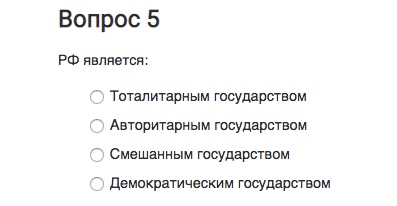
Four and half years ago, I had to renew my Russian permanent residence permit. The procedure had changed considerably since the last time I’d applied for the permit. Among the changes were two written exams that applicants were now required to pass — a Russian language exam and a Russian civics exam. I decided to study for them by doing practice exams which I found online. One of the civics question was “Question 5,” screenshotted above. It’s a multiple choice question. The examinee must decide whether the “RF” (the Russian Federation) is a) a totalitarian state, b) an authoritarian state, c) a hybrid state, or d) a democratic state. To be honest, I no longer remember whether this particular question came up in the actual exam, which I passed with flying colors. But I thought that you, my readers, might find it productive to ponder this question while reading the following three items, ripped straight from this week’s headlines in the Russian media. At the end of this post, you’ll see what the “right” answer was (in 2018, at least) and the answer I tried to give when taking the online practice quiz. ||| TRR


The Ministry of Culture of the Russian Federation has identified 17 priority topics for state financial support of film production in 2023.

The procedure and conditions for selection competitions in 2023 will be announced at the end of December 2022.

“We publish a list of topics before the start of competitions for financing production, hoping that filmmakers will take into account the priorities of state support for film production when developing projects. The Ministry of Culture continues to support such important topics for society as the protection of family values, patriotic education, preservation of the traditions of Russia’s regions, the success of domestic science, and popularization of the professions of engineer and teacher. Given modern realities, we consider it necessary to focus as well on countering attempts to falsify history and modern manifestations of the ideology of Nazism, to talk about the heroism and dedication of Russian soldiers during the special operation and the work of front-line brigades and volunteers,” said Olga Lyubimova, Minister of Culture of the Russian Federation.

Some priority topics have been established pursuant to the Decrees of the President of the Russian Federation: “On the Approval of the Foundations of State Policy for the Preservation and Strengthening of Traditional Russian Spiritual and Moral Values,” dated 09.11.2022, No. 809; “On the Announcement of the Decade of Childhood in the Russian Federation,” dated 29.05.2017, No. 240; “On the Announcement of the Decade of Science and Technology in the Russian Federation,” dated 25.04.2022, No. 231; and “On Holding the Year of the Teacher and Mentor in the Russian Federation,” dated 27.06.2022, No. 401.

The list of priority topics includes:

1. Russia’s culture. The preservation, creation and dissemination of traditional values.

2. The decade of childhood. Families and children, their protection and support.

3. Russian science: innovations, technologies, priorities.

4. Historical cinema. History lessons, memory lessons. Countering attempts to falsify history. Russia’s peacekeeping mission of Russia. Russia’s historical victories. The eightieth anniversary of the Victory in the Great Patriotic War. The Soviet soldier’s mission of liberation Generational conflict, generational continuity.

5. Russia as a modern, stable and secure state that provides opportunities for growth and self-realization.

6. The heroes among us. Stories of modern Russia’s outstanding individuals. Popularizing the teaching profession. School and college as important stages in social adaptation and personal orientation. The role of teachers and mentors in shaping the individual.

7. Motivating young people to master manual trades and engineering jobs. Improving the social status of the manual worker and the engineer, of research and innovation.

8. Film chronicle. The current state, culture and traditions of Russia’s regions. Development of the Far East and the Arctic. The life of small towns and villages, life in the provinces. Little Russia as a historical region of Russia.

9. Adaptations of works of Russian classical literature, including with the use of animation.

10. Films about outstanding figures in history, culture, science and sports. Popularizing the medical profession. Films about sporting achievements and victories.

11. Countering modern manifestations of the ideology of Nazism and fascism. Popularizing heroism and the dedication of Russian soldiers during the special military operation.

12. Popularizing service in the Russian Armed Forces of Russia. Society’s unanimous support of the army (front-line brigades and volunteers). Strengthening the status of the military profession as based on historical events and recent history.

13. The spiritual, moral and patriotic education of Russian citizens. Countering extremism. Images and models of behavior and creative motivation for modern youth. Spiritual leaders. The volunteer movement in Russia and the CIS countries as an international popularization of volunteerism.

14. The neocolonial policy of the Anglo-Saxon world. The degradation of Europe. The formation of a multipolar world.

15. Society without borders: the self-realization of people with disabilities. Volunteering in Russia. Active longevity.

16. Films about teenagers. Formation of values in life and guidelines while growing up. Disorientation in public space, information overload, forming one’s own way of thinking.

17. Modern society. Moral and ethical choice. Civic engagement. Social unity.

Source: “The Ministry of Culture of Russia has identified priority topics for state support of film production in 2023,” Ministry of Culture of the Russian Federation, 30 November 2022. Thanks to Radio Svoboda for the link. Translated by the Russian Reader


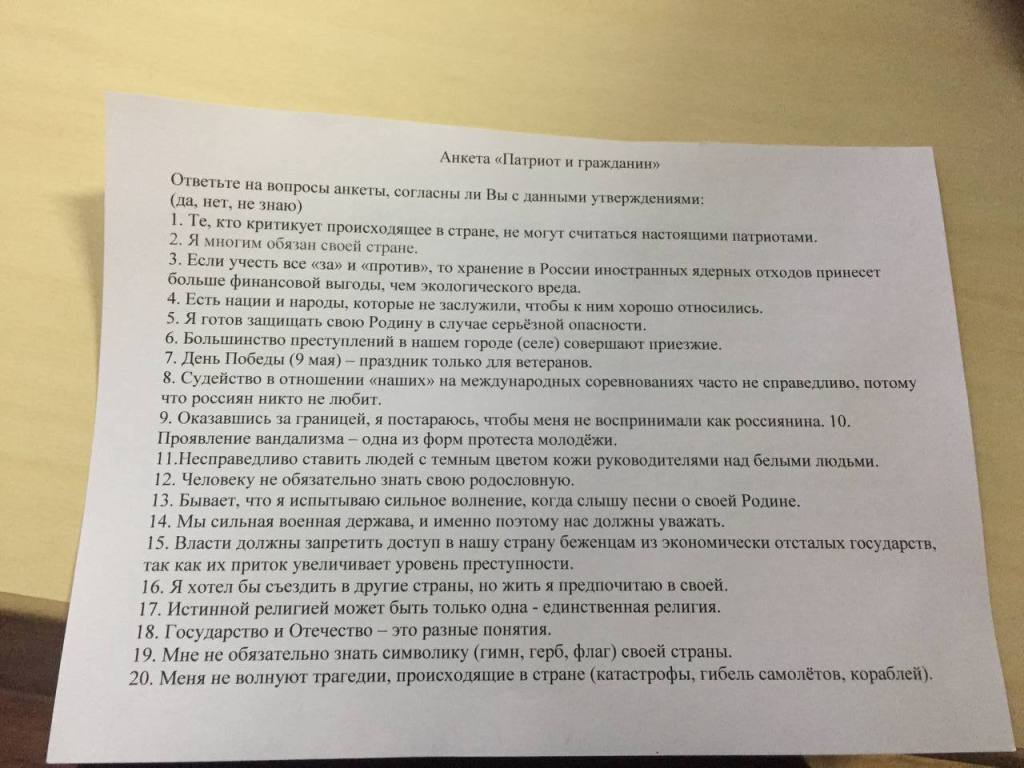
At a secondary school in the Leningrad Region, the Agalatovo Education Center, students were quizzed about racism, Russophobia and the emotions provoked by songs about the Motherland. A photo of the questionnaire, entitled “Patriot and Citizen,” was sent to Rotunda by the parents of one of the schoolchildren. Here are some of statements the children had to evaluate by answering “yes,” “no,” or “I don’t know.”

🇷🇺 Those who criticize what is happening in the country cannot be considered real patriots.
🇷🇺 I owe a lot to my country.
🇷🇺 Sometimes I get very excited when I hear songs about my Motherland.
🇷🇺 We are a strong military power, and that is why we should be respected.
🇷🇺 If I go abroad, I will try not to be seen as Russian.
🇷🇺 I am ready to defend my Motherland in case of serious danger.
🇷🇺 Most of the crimes in our city (village) are committed by outsiders and immigrants.

🇷🇺 Our athletes are often judged unfairly at international competitions, because no one likes Russians.
🇷🇺 If we take into account all the pros and cons, the storage of foreign nuclear waste in Russia brings more financial benefits than it does environmental harm.
🇷🇺 There are nations and peoples who do not deserve to be treated well.
🇷🇺 Vandalism is one of the forms of youth protest.
🇷🇺 It is unfair to put people with dark skin in charge of white people.
🇷🇺 There can be only one true religion.

🤦 The school confirmed to Rotunda that they had conducted such a survey. They agreed to communicate with us only by mail. In a written response signed by the vice principal, they claimed that the questionnaire was needed “as background for a faculty meeting.” The school did not answer questions about how correctly or adequately the questionnaire was worded. Rotunda was unable to contact the school’s principal, Svetlana Sergiyenko. She is a supporter of the United Russia party and has run for election several times on the party’s ticket.

📌 The questionnaire itself seems to have been found by the educators on the internet. In 2014, Belarusian media reported that a similar survey (only with Belarus instead of Russia) was conducted in schools in Minsk.

Source: “Schoolchildren in Leningrad region surveyed on whether they’re ashamed to be Russian,” Rotunda (Telegram), 28 November 2022. Thanks to Leda Garina for the heads-up. Translated by the Russian Reader


There is a belief that the Russian elite under President Vladimir Putin has only ever been interested in money. Yet Putin’s militant, anti-liberal, anti-Western, isolationist, paternalistic, and harshly authoritarian regime has always had an ideology.

This ideology is not systematized, but it does exist, and snippets of it can be found throughout Putin’s speeches, articles, and interviews. Now the war in Ukraine has necessitated a more articulated ideology, however.

The initiative to systematize and codify Putinism has led to a presidential decree listing Russia’s “traditional spiritual and moral values,” as well as the development of a new ideological curriculum for colleges.

It is no longer enough to indoctrinate children in kindergartens and schools. It is now time to unify the worldviews of college students, and, by extension, those of their professors, whose ranks will inevitably be purged. A similar course taught during the Soviet era was known as “Scientific Communism.”

The name for this new curriculum is “Fundamentals of Russian Statehood,” though it might as well be called “Scientific Putinism.” It is composed of four units: “History” – historical policy as the imposition of a mythologized official version of history, which is one of the instruments for manipulating the mass consciousness of Russians; “Cultural Codes” or the “traditional spiritual and moral values,” around which Putin has ordered federal and regional governments to unify; “Russia and the World” — a justification of isolationism, anti-Westernism, and jingoism; and “Vision for the Future,” which sets out what the state hopes to achieve beyond victory in Ukraine and the destruction of the “fifth column.”

The curriculum justifies the cult of the eternal leader and doubles down on the idea that Russia is fighting the forces of evil in Ukraine in an effort to “de-satanize” the country. However, at the same time, Scientific Putinism lacks key components such as development goals or a vision for Russia’s future, focusing as it does almost exclusively on the past.

During Dmitry Medvedev’s presidency, there were teams working on a future-oriented ideology and making road maps based on the idea that Russia would fast-track the modernization of the state and society. Putin’s ideology, however, is one that fundamentally opposes modernization.

Putin has successfully convinced a significant portion of the population that Russia must regain its status as a great power, and that Russia is under attack by both the liberal West and traitors at home. As the regime has grown more authoritarian, its ideology has also become more archaic, its propaganda more obtrusive, and any hopes of modernization have dwindled. 

An ideology that consists of historical, cultural, and religious myths, bogus traditions, and resentment seeks to legitimize an authoritarian regime and delegitimize those who oppose it.

Such an ideology makes it possible to label nonconformists as enemies, and to divide people into “us” and “them.” The division into “us” and “them” doesn’t just provide a marker for self-identification, it also serves to convince the public that there is a certain majority from which they should not stray.

In the past, the only requirement for being part of the “us” was passive, silent, conformist support. Today, however, this is not enough: Russians must surrender their very bodies to be cannon fodder in the supreme leader’s holy war against the “satanic” forces of the West. This is no longer authoritarianism; it is totalitarianism.

Imperialism and colonialism are key components of Putinism and key factors in the war. There is nothing new about this ideology; it comes almost verbatim from Stalinism and from earlier Eurasian and Slavophile narratives.

The war is being passed off as striving to restore historical fairness, as defensive and preventive, and as liberation. According to Putin, the land of the empire must be “returned and reinforced.”

In just a few years, the regime has evolved from a cult of the victory of 1945 to a cult of war itself, and Putin has managed to persuade a large segment of Russian society that the “special military operation” of 2022 is a natural continuation of World War II. In essence, it is an existential war between Russian and Western civilizations.

Putin has started to refer to Russia as an entire civilization. The state is not just sacred and worthy of the ultimate sacrifice; it is also a separate and superior civilization with a “thousand-year history” and its own special path.

Within this history, cultural codes are being passed down from generation to generation as part of the country’s political DNA. This state-civilization has its own pantheon of heroes unchanged from the Soviet era: Alexander Nevsky, Ivan the Terrible, Peter the Great, Joseph Stalin, and Yuri Gagarin.

This state-civilization has always been under attack by enviers and foes, making its state of permanent conflict critical, and not simply limited to the battlefield. The state must win in all aspects — in culture and in sports, in the construction of Olympic facilities, and in the war against Ukraine and the West.  

To defend the sovereignty of this state-civilization, the Kremlin is counting on the security services, or siloviki, who have been given additional funding and are reinforced by spin doctors and so-called “journalists” in the Kremlin’s service.

The Culture Ministry, the communications watchdog Roskomnadzor, and the Russian Orthodox Church are becoming de facto siloviki themselves, enjoying as they do the right to block or ban media, restrict the sales of books by authors who oppose the war, and decide who can perform on theater stages.

The ideology has become corporeal, bolstered by political and military acts, such as the annexation of Crimea and the “special military operation.” In short, the special ideological operation is ongoing, and it seems to be faring rather better than the military one. 

This article was originally published by the Carnegie Endowment For International Peace.

Source: Andrei Kolesnikov, “Scientific Putinism: Shaping Official Ideology in Russia,” Moscow Times, 27 November 2022. Thanks to Mark Teeter for the heads-up.


Back in the summer of 2018 I tried to answer Question 5 truthfully, replying that the Russian Federation was an “authoritarian state.” But the right answer, then, was “democratic state,” as it turned out. Again, I don’t remember now whether this question was on the actual civics exam that I took, but there were several other “ideological” questions like it, which I would have answered “incorrectly,” thus jeopardizing my chances to get a residence permit, if I hadn’t been schooled in advance by the practice quizzes I’d found online. ||| TRR

Andrei Kolesnikov: Hooked on Militarism?

new hope“New Hope. All drug addicts quit using. Some manage to do it while alive.” Photo by the Russian Reader

Where Militaristic Infantilism Leads
Society’s Losing Its Fear of War Is More Dangerous Than What Happens in the Absence of an Anti-War Movement
Andrei Kolesnikov
Vedomosti
November 28, 2018

The “polite people” in the Russian military have taken to ramming ships, shedding their politesse. A military coming out has happened. Either so-called hybrid war has become more hybridized in terms of the variety of its methods or it has become more like good old-fashioned war, involving actual armed clashes. Politically, Russia has become not merely toxic but hypertoxic. A premonition of war prevails among more timid folks, although the footage of the ramming at sea, as painless and triumphal as a military parade on Red Square or a football match (“Crush him!”), still make military operations appear unscary and toylike. We will carry the day in any case, sans victims and blood (ours, that is), as in a cartoon by Putin.

This militaristic infantilism—the loss of the fear of war, the loss of the idea that war is terrible—is the worst outcome of our country’s daily intoxication with the thought of its own greatness for several years running. The army is greatly respected nowadays. People need to trust someone, and the armed forces have bypassed another institution, the presidency, in trustworthiness ratings.

Does this mean Russians are ready for a real war? To put it more plainly, are Russian parents willing to let their eighteen-year-old boys be called up to fight Ukrainian boys just like them? Does anyone understand what they would be fighting for? Is it really all about cementing the nation, “Crimea is ours!” and the personal ambitions of several high-ranking figures in the Russian establishment?

Since 2012, Russia’s collective identity has been built on negative foundations, on awakened resentment, which had been dozing, but had no thought of waking up. The plan has worked quite well. This resentment, however, is verbal and fictitous. Public opinion supported “coal miners” and “tractor drivers” verbally. In Syria, the official army and private military companies fought, or so Russians imagined, at their own risk. The proxy war with the US has gone very far at times, but in the summer of 2018 it did not stop the majority of Russians from abruptly improving their attitude [sic] to the States and the west in general.

But suddenly there is the threat of a real war. On the other side of the border, in the country [i.e., Ukraine] that the Russian imperialist mind never really considered sovereign, a mobilization is underway and martial law has been declared. Is this reality capable of changing popular opinion and rousing Russian civil society, which has a lot going for it except an anti-war movement? No, because so far the war has not been regarded as real.

Identification with the military is the last bullet in the Russian regime’s gun, but it is a blank or, rather, a prop. Exploiting what Russians regard as sacred—i.e., privatization of the memory of the Great Patriotic War [WWII] by a particular group—is a tool that is still in play, but militarism as such has lost its power to mobilize and consolidate Russians. If “German POWs” are marched around Novgorod on January 20, 2019, in an absurd attempt to reenact the NKVD’s Operation Grand Waltz, and on January 29, a military parade is held in St. Petersburg to mark the latest anniversary of the lifting of the Siege of Leningrad, it will not raise Putin’s approval rating from 66% to 80%. Those days are gone. So, the props have been dropped in favor of direct action in the Kerch Strait, but its power to mobilize people is not at all obvious.

You can cynically throw the ashes of those who perished in the Siege of Leningrad to stoke the furnace of fading ratings as much as you want. You can march people dressed up as German POWs round Novgorod as much as you like. When, however, pollsters ask Russians between the ages of eighteen and twenty-four what countries they regard as role models, they list Germany, China, and the US. This is not because young Russians are unpatriotic, but because not everything comes to down to the top brass feeding on the poisonous corpse of the Stalinist past. The present day, progress, and visions for the future matter, too.

Can we do it again? We cannot. Nor is there any reason to do it. Infantilized by the regime, Russian society’s maturation will be measured by the numbers of people who are convinced that we cannot and should not do it again.

Andrei Kolesnikov is program director at the Moscow Carnegie Center. Translated by the Russian Reader

Cossacked

18A so-called Cossack lashes protesters with a plaited whip (nagaika) at the He’s No Tsar to Us opposition protest rally at Pushkin Square in Moscow on May 5, 2018. Photo by Ilya Varlamov
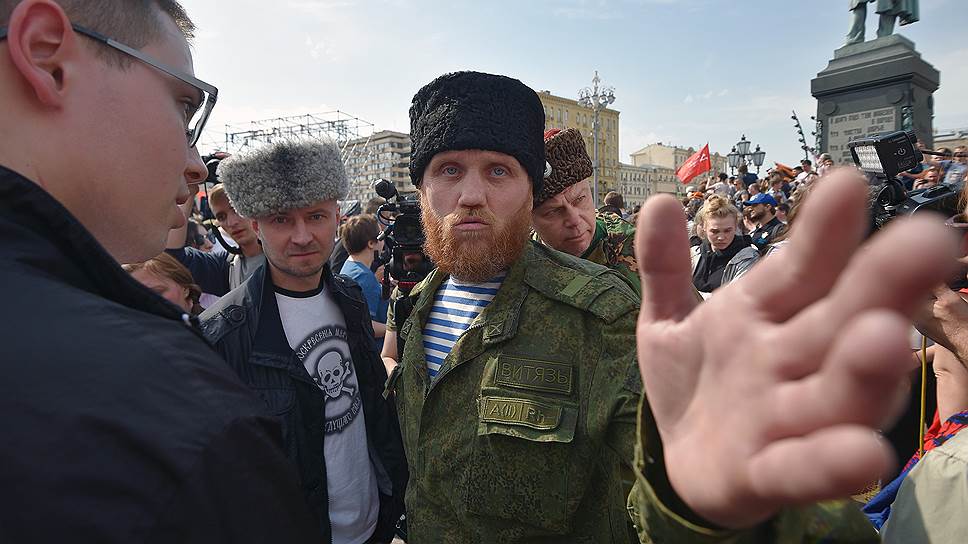
Сossacks Were Not Part of the Plan: Men with Whips Take Offense at the Opposition
Alexander Chernykh
Kommersant
May 8, 2017

The Presidential Human Rights Council (PHRC) plans to find out who the Cossacks were who scuffled with supporters of Alexei Navalny during the unauthorized protest rally on May 5 in Moscow. Meanwhile, the Moscow mayor’s office and the Central Cossack Host claimed they had nothing to do with the Cossacks who attempted to disperse opposition protesters. Kommersant was able to talk with Cossack Vasily Yashchikov, who admitted he was involved in the tussle, but claimed it was provoked by Mr. Navalny’s followers. Human rights defenders reported more than a dozen victims of the Cossacks have filed complaints.

The PHRC plans to ask law enforcement agencies to find out how the massive brawl erupted during the unauthorized protest rally on May 5 in Moscow. PHRC chair Mikhail Fedotov said “circumstances were exacerbated” when Cossacks and activists of the National Liberation Front (NOD) appeared at the opposition rally.

“It led to scenes of violence. We must understand why they were they and who these people were,” said Mr. Fedotov.

“Our main conclusion has not changed: the best means of counteracting unauthorized protest rallies is authorizing them,” he added.

On May 5, unauthorized protest rallies, entitled He’s No Tsar to Us, called for by Alexei Navalny, took place in a number of Russian cities. In Moscow, organizers had applied for a permit to march down Tverskaya Street, but the mayor’s officers suggested moving the march to Sakharov Avenue. Mr. Navalny still called on his supporters to gather at Pushkin Square, where they first engaged in a brawl with NOD activists and persons unknown dressed in Cossack uniforms. Numerous protesters were subsequently detained by regular police. Approximately 700 people were detained in total.

The appearance on Pushkin Square of Cossacks armed with whips has provoked a broad response in Russia and abroad. The Guardian wrote at length about the incident, reminding its readers that Cossacks would be employed as security guards during the upcoming 2018 FIFA World Cup in Russia. The Bell discovered a Central Cossack Host patch on the uniform of one of the Cossacks photographed during the brawl. According to the Bell, which cites documents from the Moscow mayor’s office, the Central Cossack Host was paid a total of ₽15.9 million for “providing security during large-scale events.”

However, Vladimir Chernikov, head of the Moscow Department of Regional Security, stressed, during an interview with Kommersant FM, that on May 5 “no Cossacks or any other organization were part of the plan and the means of providing security.”

Chernikov said police and the Russian National Guard acted impeccably. Spokesmen for the Central Cossack Host also said they had not dispatched any Cossacks to guard Pushkin Square, and that the Cossacks who, wearing their patches, did go to the square, had “voiced their civic stance.”

Bloggers have published information about the Cossacks they have been able to identify from photos and video footage of the rally. One video depicts a bearded man who grabs a placard, bearing the slogan “Open your eyes, you’re the tsar’s slave!”, from a young oppositionist before arguing with Open Russia coordinator Andrei Pivovarov. The Telegram channel BewareOfThem reported the man was Vasily Yashchikov, member of the Union of Donbass Volunteers. Mr. Yashchikov has confirmed to Kommersant he was, in fact, at the rally and was involved in the brawl with opposition protesters. Yet, he claimed, most of the Cossacks at Pushkin Square had nothing to do with the Central Cossack Host, as claimed by the Bell. According to Mr. Yashchikov, the brawlers mainly consisted of nonregistered (i.e., unaffiliated with the Russian government) Cossacks from two grassroots organizations, the First Hundred and the Crimean Regiment. Moreover, they allegedly showed up at the rally independently of one another.

“The rally was discussed in Cossack groups, and someone suggested we go and talk to people,” Mr. Yashchikov told Kommersant. “We have nearly a hundred people in the  Hundred, but only fifteen decided to go. At the square, we met Cossacks from the Crimean Regiment, which is actually not Crimean, but from the Moscow Region. But our organizations are not friendly, so we were there separately.”

He admitted there were several people from the Central Cossack Host at Pushkin Square, but his group did not interact with them, either.

KMO_165050_00034_1_t218_200833So-called Cossacks at the He’s No Tsar to Us opposition rally at Pushkin Square, Moscow, May 5, 2018. Photo by Alexander Miridonov. Courtesy of Kommersant
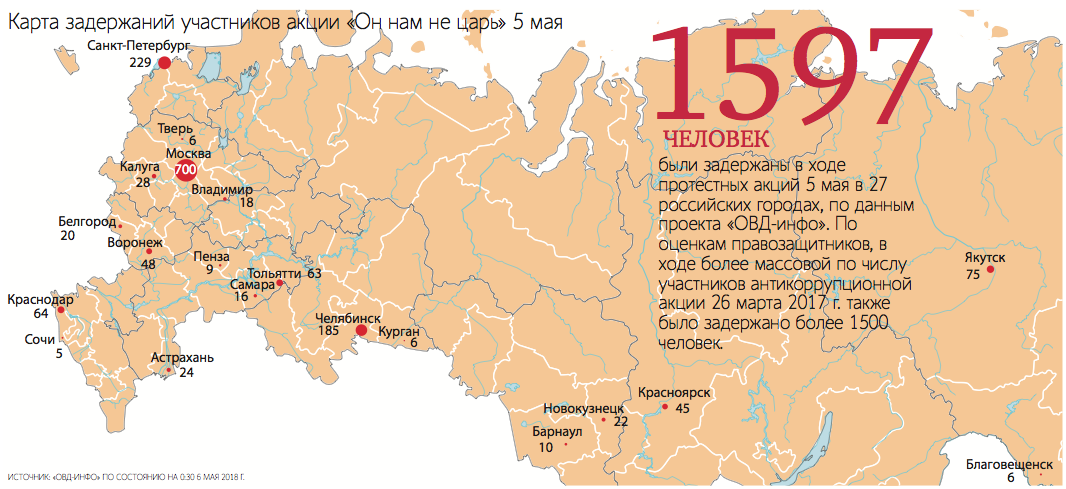
According to Mr. Yashchikov, the Cossacks came to Pushkin Square to talk with Mr. Navalny’s supporters, but had no intention of being involved in dispersing the rally.

“There were one and half thousand people there [the Moscow police counted the same number of protesters—Kommersant]. There were thirty-five of us at most, and we had only two whips. You could not have paid us to wade into that crowd,” claimed Mr. Yashchikov.

Mr. Yashchikov claimed he managed to have a friendly chat with Mr. Navalny, but opposition protesters were aggressive, he alleged.

“Someone picked on us, asking why we had come there, that it was their city. Another person tried to knock my cap off, while they swore at other Cossacks and blasphemed the Orthodox faith,” Mr. Yashchikov complained. “Well, we couldn’t take it anymore.”

People who attended the rally have denied his claims.

“The Cossacks acted cohesively, like a single team,” said Darya, who was at the rally [Kommersant has not published her surname, as she is a minor]. “They formed a chain and started pushing us towards the riot police, apparently, to make their job easier. The Cossacks kicked me, while they encircled my boyfriend and beat him. They retreated only when they realized they were being film and photographed.”

Darya planned to file a complaint with the police charging the Cossacks with causing her bodily harm. Currently, human rights defenders from Agora, Zona Prava, and Public Verdict have documented more than fifteen assault complaints filed against the Cossacks.

Oppositionists have claimed the police mainly detained protesters, allegedly paying almost no attention to the Cossacks and NOD activists. Kirill Grigoriev, an Open Russia activist detained at the rally, recounted that, at the police station where he was taken after he was detained, he pretended to be a NOD member, and he was released by police without their filing an incident report.

“When we arrived at the Alexeyevsky Police Precinct, a policeman immediately asked who of us was from NOD. I jokingly pointed at myself. He took me into a hallway and asked me to write down the surnames of other members of the organization,” said Mr. Grigoriev.

He wrote down the surnames of ten people, after which everyone on the list was given back their internal Russian passports and released.

*********

Cossacks Confront Navalny Supporters for First Time
Regime Prepares for Fresh Protests, Including Non-Political Ones, Analysts Argue 
Yelena Mukhametshina and Alexei Nikolsky
Vedomosti
May 6, 2018

He’s No Tsar to Us, the unauthorized protest rally in Moscow held by Alexei Navalny’s supporters, differed from previous such rallies. On Tverskaya Street, provocateurs demanded journalists surrender their cameras. By 2:00 p.m., the monument to Pushkin was surrounded by activists of the National Liberation Front (NOD). When protesters chanted, “Down with the tsar!” they yelled “Maidan shall not pass!” in reply. Behind the monument were groups of Cossacks, who had never attended such rallies. In addition, for the first time, the police warned people they intended to use riot control weapons and physical force, and indeed the actions of the security forces were unprecedentedly rough. The riot police (OMON) detained protesters by the hundreds, and Cossacks lashed them with plaited whips.

The Moscow police counted 1,500 protesters at the rally, while organizers failed to provide their own count of the number of attendees. Navalny said the nationwide rallies were a success. His close associate Leonid Volkov argued that “in terms of numbers, content, and fighting spirit, records were broken,” also noting the police’s unprecedented brutality. According to OVD Info, around 700 people were detained in Moscow, and nearly 1,600 people in 27 cities nationwide. Citing the PHRC, TASS reported that 658 people were detained in Moscow.

fullscreen-1sdb.png

“He’s No Tsar to Us, May 5: A Map of Arrests. 1,597 people were detained during protest rallies on May 5, 2018, in 27 Russian cities, according to OVD Info. According to human right activists, during nationwide anti-corruption protests on March 26, 2017, more than 1,500 people were detained. Source: OVD Info.” Courtesy of Vedomosti

PHRC member Maxim Shevchenko demanded the council be urgently convoked due to “the regime’s use of Black Hundreds and fascist militants.” According to a police spokesman, the appearance at the rally of “members of different social groups” was not engineered by the police, while the warning that police would use special riot control weapons was, apparently, dictated by the choice of tactics and the desire to avoid the adverse consequences of the use of tear gas.

According to NOD’s leader, MP Yevgeny Fyodorov, 1,000 members of the movement were involved in Saturday’s rally.

“We wanted to meet and discuss the fact the president must be able to implement his reforms. Because we have been talking about de-offshorization and withdrawing from a unipolar world for five years running, but things have not budged an inch,” said Fyodorov.

NOD did not vet their actions with the Kremlin, the leadership of the State Duma or the Moscow mayor’s office, Fyodorov assured reporters.

On Sunday, the Telegram channel Miracles of OSINT reported that, in 2016–2018, the Central Cossack Host, whose members were at the rally, received three contracts worth nearly ₽16 million from the Moscow Department for Ethnic Policy for training in the enforcement of order at public events. As Vedomosti has learned, according to the government procurement website, the Central Cossack Host received eleven contracts, worth nearly ₽38 million, from the Moscow mayor’s office over the same period.

Gleb Kuznetsov, head of the Social Research Expert Institute (EISI), which has ties to the Kremlin, argued there was no brutality at the rally.

“In Paris, the scale of protests is currently an order of magnitude higher, but no one speaks about their particular brutality. In Russia, so far the confrontation has been cute, moderate, and provincial. The only strange thing is that, in Russia, people who are involved in such protests, which are aimed at maximum mutual violence, are regarded as children. But this is not so. Everything conformed to the rules of the game, common to the whole world. If you jump a policeman, don’t be surprised if he responds with his truncheon,” said Kuznetsov.*

The Russian government has allied itself with the Cossacks and NOD, which are essentially illegal armed formations, argued Andrei Kolesnikov, a senior fellow at the Moscow Carnegie Center.

“This does not bode well. Apparently, in the future, such formations will be used to crack down on protests,” said Kolesnikov.

The authorities are preparing for the eventuality there will be more protests. Even now the occasions for them have become more diverse, and they are spreading geographically, noted Kolesnikov.

Grassroots activism has been growing, and the authorities have realized this, political scientist Mikhail Vinogradov concurred. They are always nervous before inaugurations. In 2012, there was fear of a virtual Maidan, while now the example of Armenia is fresh in everyone’s minds, he said.

“The security services had to flex their muscles before the new cabinet was appointed. Although, in view of the upcoming FIFA World Cup, law enforcement hung the regime out to dry contentwise,” said Vinogradov.

* In September 2017, the Bell reported that state corporations Rosatom and RusHydro were financing EISI to the tune of ₽400 million each, and it could not be ruled out that the so-called social research institute was receiving subsidies from other state companies.

Translated by the Russian Reader

The Immortal Regiment: The Regime’s Human Shield

Crimea Prosecutor General Natalia Poklonskaya leading the Immortal Regiment in Simferopol, Crimea, May 9, 2016. According to TASS, she carried a "wonder-working" icon of Holy Martyr Tsar Nicholas II.
Crimean Prosecutor General Natalia Poklonskaya leading the Immortal Regiment memorial procession in Simferopol, Crimea, May 9, 2016. According to TASS, she carried a “wonder-working” icon of Holy Martyr Tsar Nicholas II that had been sent to Crimea from Moscow for the event.

The Regime’s Moral Defense: The Immortal Regiment as a Shield 
Andrei Kolesnikov
Forbes.ru
May 9, 2016

On December 5, 1966, sitting as his dacha in Pakhra, Alexander Tvardovsky, an agonizingly conscientious and grimly self-reflective poet, recorded in his diary thoughts that nowadays would cause the higher-ups to stop inviting him to receptions at the Kremlin, and hired “patriots” to douse him, as is the custom nowadays, with brilliant green disinfectant.

First, Tvardovsky writes about the essence of Victory Day and its semi-official recension, including the myth of the Panfilov Division’s Twenty-Eight Guardsmen, whose debunking now costs people their jobs.

“Those who perished in the war for the Motherland have a indubitable, sacred right to be remembered and honored. […] However, there is a considerable admixture of ‘educational policy’ in all this as well, considerations on how to manipulate the moods of the ‘masses’ […] such as the tomb of the unknown soldier organized recently (God forbid he should prove to be a known soldier), a lot of needless bother, like the five or six of the twenty-eight [Panfilov Division Guardsmen] who utterly embarrassingly turned up alive.”

Tvardovsky then goes on to write about what is totally and even furiously excluded from the national memory and reflections on the topic nowadays.

“No doubt those who perished on the eve of the war and during the war, not at the front, but in the mad regime’s prisons, camps, and torture chambers, also deserve to be remembered in this way.”

Half a century has passed since Tvardovsky penned this diary entry, but nothing has changed at all or has been reborn in circumstances reminiscent of the Brezhnev period in terms of ideology and political strategy. The regime’s legitimacy was then directly linked to memory of the war, moreover, the official memory of the war, with many of the unpleasant particulars concealed. Today, too, the regime feeds on the juices of the past, powerful evidence of the effects of path dependence in the vast nation’s collective consciousness. Back then, however, there were still a couple of things that brought people together like conquering outer space and romanticizing the 1920s. (Fidel Castro and Cuba reproduced the spirit of that era.)  Our day and age parodies the things that consolidated the Soviet Union. But then again, Nikita Khrushchev would never have deigned to be personally involved in launching rockets from a cosmodrome, as did Vladimir Putin, a man who endeavors to inherit the Soviet Union’s achievements.

The current Russian regime’s final privatization of the Soviet victory in the Second World War and the amazing propagandistic transformation of each new war, including the Syrian campaign, into a direct sequel of the Great Patriotic War has divided the nation instead of consolidating it.

And the minority, who are not at all against remembering the great war, but are opposed to hysteria, official narratives, vulgarization, schematic renderings of the war, marking “friends” with Saint George’s Ribbons, and rejecting critical takes on historical events, have been virtually excluded from the ranks of citizens.

If you did not take a Saint George’s Ribbon foisted on you at a football match, and your kid was not involved in an Immortal Regiment event at school, you are a renegade, not a citizen. Everything the state gets its hands on immediately acquires an imperative and moralistic aftertaste and helps to identify an individual as friend or foe. Strangers have no place in this political system. People who think about the Gulag, for example, have no place. They are attacked, even if they are children, as happened during a Memorial school essay contest, and declared “national traitors.”

In our hybrid political framework, these prescriptions and nearly obligatory moral codes, sometimes reinforced by the Criminal Code, have been rented not even from authoritarian systems but from totalitarian ones.  In this model, morality is immoral, Russia’s heroes are anti-heroes, and vice versa. The nation has repented of the repentance it felt thirty years ago. It turns out that iPhones can peacefully coexist with the most primitive variety of Stalinism, and supermarkets, with archaization of the mind.

The Great Patriotic War is used, including to sell nonexistent threats to the general public. These threats strengthen the authority of the man commanding the besieged fortress and expand the food supply of the military and security services elites.

Today’s Russian society is a society of people who have been insulted a priori and attacked before the fact. We were attacked in 1941, and we are attacked now. We are attacked, so we defend ourselves and conduct just wars. These wars are triumphal and victimless, and ennobled and sterilized by TV. They resemble computer games where the players have a big supply of extra lives.

You cannot die a hero’s death in such wars, although you can go as a tourist. (According to Christopher Coker of the LSE, modern war is often a continuation of tourism by other means.)

In the name of the Soviet victory in the Second World War, you can do anything whatsoever. You can even crack down on the opposition, conduct a wild goose chase for “national traitors,” annex Crimea, invade Syria, and do battle with “Banderites.” Ceremony, rather than real success, has become a ritual means of “consolidating” the nation. Anyone who has avoided being consolidated during collective rituals is an internal enemy.

The victorious official narrative is a set of rote answers in the absence of questions. It is the triumph of simplification, the refusal to understand that history is complicated. It is the refusal to imagine the war as a tragedy. The topic of the unnecessary sacrifices and wastefulness of the Stalin regime, which did not count soldiers and devalued their lives, has disappeared from the discourse. Simplifying complicated things has also ben a means of simultaneously justifying the current regime and Stalin’s regime at a single blow, of dividing the nation into right and wrong, moral and immoral, by tying the “right” folks together with a single Saint George’s Ribbon, by marketizing the war and making it fashionable.

Everything in Russia is hybrid: the wars in Donbass and Syria, the political system itself, and now the celebration of Victory Day. Sacred memory has been placed at the service of solving a single albeit blistering problem: preserving the power of the current leaders and current elites as long as possible. To do this, the regime takes cover behind the Immortal Regiment’s morally impeccable shield, which, however, makes it look even more immoral.

Translated by the Russian Reader. Thanks to Leokadia Frenkel for the heads-up. Photo courtesy of Roman Dobrokhotov and TASS. For more on this topic, see Peter Hobson, “How Russian Authorities Hijacked a WWII Remembrance Movement,” Moscow Times, May 6, 2016.