Why bother to find the right word in Russian when the wrong word in English will do?
Текст «К каким последствиям для общества приводят войны» автор Лиза Шапатина писала долго, потому что нужно было найти хороших спикеров[spikerov], нужно было составить хорошую рыбу и нужно было структурировать текст так, чтобы было понятно, просто и интересно. И ей это удалось!
Author Liza Shapatina took a long time to write the text “What consequences wars have for society,” because she had to find good speakers, she had to make a good outline, and she had to structure the text so that it was clear, simple and interesting. And she succeeded!
The right Russian word in this case would have been собеседник [sobesednik] — meaning, “source,” “informant,” “interlocutor” — instead of the now absurdly overused Anglicism спикер [spiker], which not so long ago, in the 1990s, referred only to the chairs of the UK House of Commons and the US House of Representatives, and occasionally, by analogy, the chair of the Russian State Duma. Now it used not only to denote parliamentary chairs the world over, but also, absurdly, “speakers” at conferences and other public events, and now, apparently, anyone who speaks or with whom one speaks, although the implied corresponding verbal form спикить (instead of, depending on the context, говорить, выступать, беседовать, докладывать, etc.) has not yet come into use, thank God. ||| TRR
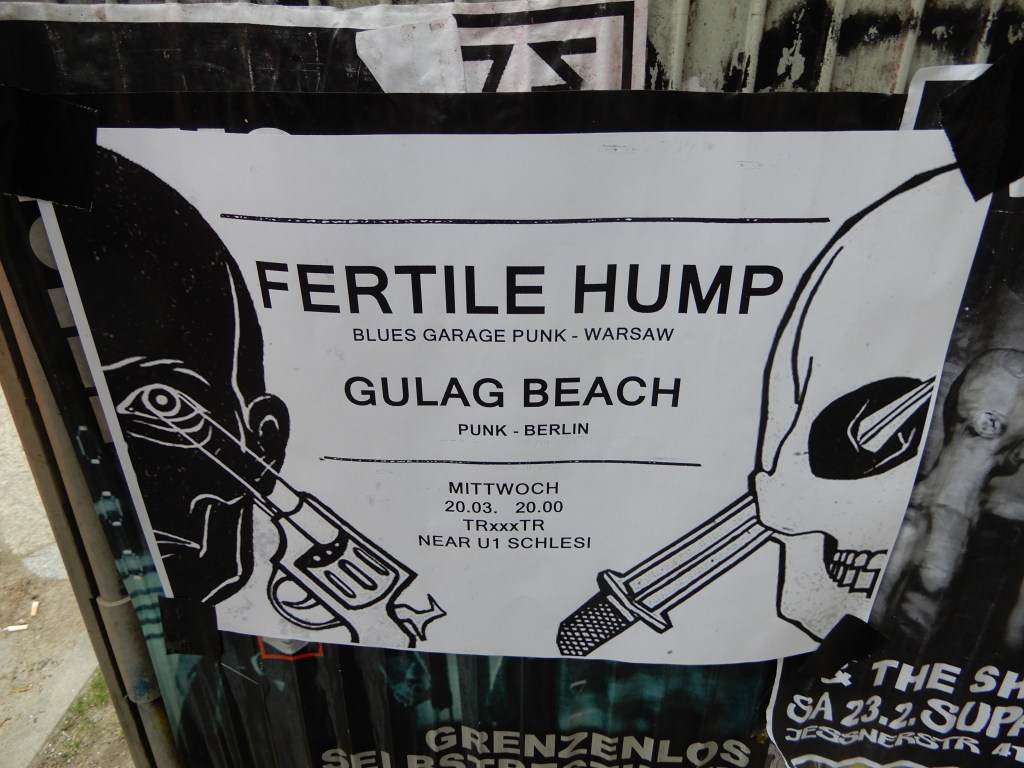
Berlin-Friedrichshain, 1 March 2019. Photo by the Russian Reader
Russian President Vladimir Putin has signed legislation that bans government officials from using foreign words in official documents and correspondence as well as while carrying out their duties.
“When using Russian as the state language of the Russian Federation, it is not allowed to use words and expressions that do not correspond to the norms of modern literary Russian language,” the law published Tuesday said.
The exception, according to the law, is the use of “foreign words which do not have widely used corresponding equivalents in Russian.”
A list of foreign words that can be used will be compiled by a government commission and will be published separately, the Kommersant business daily reported.
A number of Russian political figures vowed to protect the Russian language from Western influence due to what they called “Russophobia” and “attacks on everything connected with Russia.”
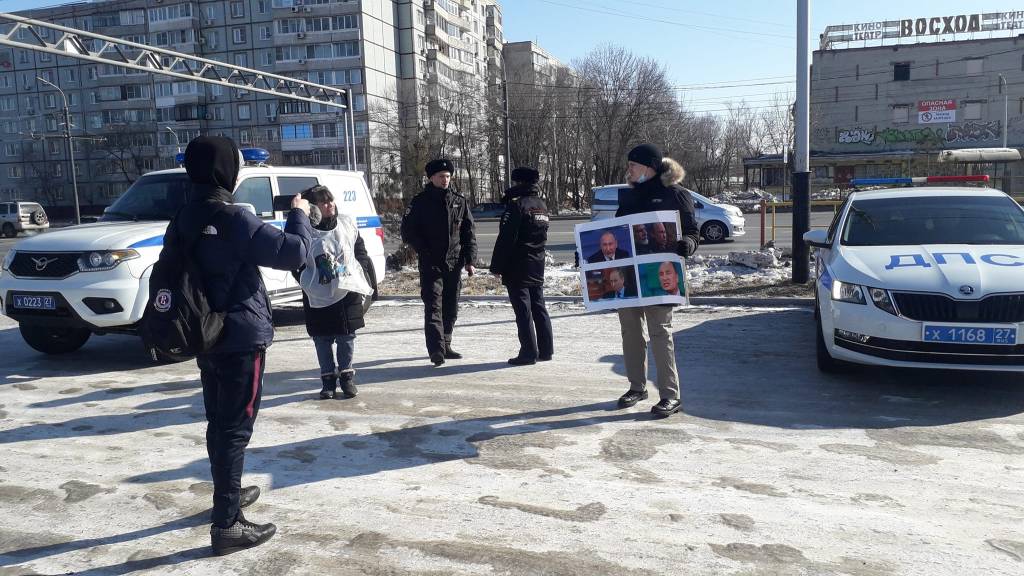
On February 23, Nikolai Zodchii was detained by police in Khabarovsk for appearing in public with these images of Vladimir Putin, which had originally appeared in broadcasts on state-run Channel One. Thanks to the indomitable VB for the snapshot and the heads-up, and for his personal fortitude in dismal circumstances. ||| TRR
When contacted by the media, the Kommunalnik health resort, located in the Omsk Region, refused to comment on reports of the death of a female Russian national during a speed pancake-eating contest.
Earlier, it was reported that a female contestant at a speed pancake-eating competition in the Omsk Region had choked to death. Currently, the exact cause of death is unknown, but the contestant’s death has been confirmed by law enforcement agencies. The 38-year-old female Russian national [rossiyanka] died before the ambulance arrived.
The celebration at which the pancake-eating competition took place was held at the Kommunalnik health resort in the Omsk Region on Saturday, February 25.
A spokesperson for the health resort refused to comment on reports of the death of the female Russian national and the absence of an ambulance team at the competition site.
In December 2022, it was reported that a 61-year-old resident of the Moscow Region had died after choking on a pancake.
Russians had been warned against overeating pancakes during Shrovetide. According to specialist Boris Mendelevich, overeating pancakes cooked with large amounts of oil is harmful to the body. In addition, heavy food can cause complications in the gastrointestinal tract.
Russia must ensure its security and maintain strategic stability.
President Vladimir Putin said this in an interview for the program “Moscow. Kremlin. Putin” on the TV channel Rossiya 1.
Source: Oleg Zubritsky, “Putin talks about the need to preserve the country and its security,” Kartoteka, 26 February 2023. Translated by TRR. Believe it or not, that was the entire article, which earned its author a well-deserved byline. See the last patch in this crazy quilt, below, for more detail about what Putin said.
Riot police officers in St. Petersburg detained 131 teenagers over a mass brawl that occurred in the Galereya shopping center, the media reports.
The publication [sic], citing police sources, indicated that the PMC Redan teenage subculture was involved in the incident.
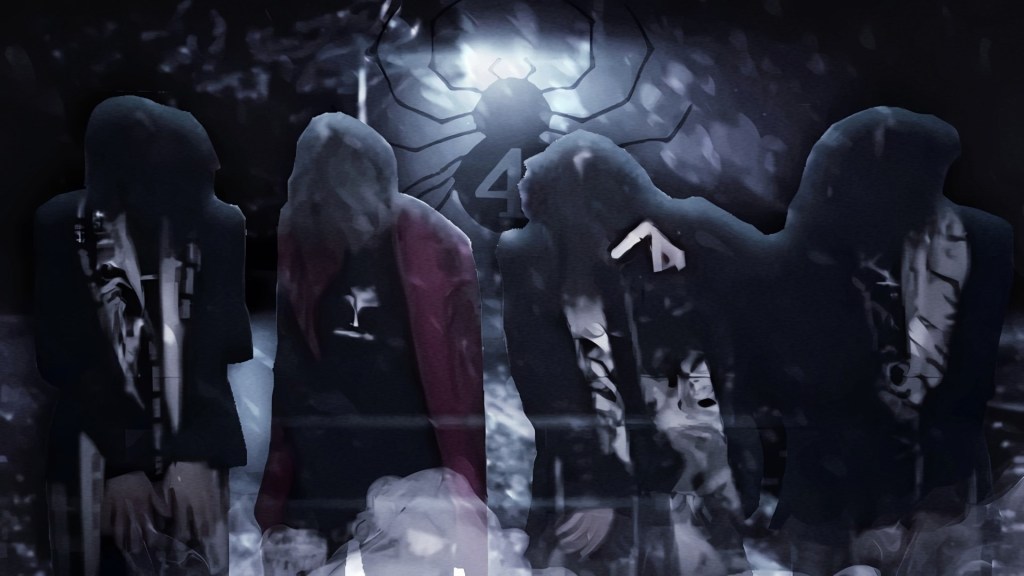
It is reported that other minors attacked a teenager in clothes embossed with a spider, which is the symbol of PMC Redan. One teenager was injured during the brawl.
Riot police arrived at the scene and detained 131 individuals. The Galereya shopping center was closed for entry, and shoppers were released only after police checked them.
Earlier, it was reported that Novosibirsk law enforcement officers had staged a dragnet to detain teenagers devotees of the PMC Redan subculture. The raid took place in the eponymous [sic] Galereya shopping center.
According to the head of the Safe Internet League, PMC Redan (as well as anime in general) is a “depressive-aggressive subculture,” and animeshniks themselves espouse violence and are willing to use it.
Such subcultures emerge, [Ekaterina] Mizulina argues, because teenagers have too much free time, as well as due to the manipulations of irresponsible bloggers and provocateurs who are encouraged by foreign states to engage in them.
In this regard, Mizulina suggests that “it is interesting to package the right meanings for children,” ideologically attack “all these spiders”, and also introduce control over social networks and the media — namely, to prohibit the coverage of “such topics.”
“No one has done more to popularize this local phenomenon than the media and social networks. […] Redan cells are growing like mushrooms after rain from Vladivostok to Kaliningrad,” Mizulina writes.
At the same time, it has been the state-run media that has written most about the activities of the so-called PMC Redan. Before them, information about teenage animeshniks strolling through shopping malls in telltale clothes appeared mainly on local community social media pages.
Source: Alexei Paramonov, “Ekaterina Mizulina urges media ban on PMC Redan,” Kartoteka, 26 February 2023. Translated by TRR. Fontanka.ru published this long, strange tirade-cum-report about the clash between riot police and teenagers at the Galereya shopping center in Petersburg (which is a stone’s throw from our house), on the one hand, and between “redans” and “ofniks,” on the other. If you donate one hundred dollars to this website, I’ll translate and publish that article here, although it left me hardly less befuddled about what happened in my old neighborhood this past weekend than before I’d read it.
The Cheryomushkinsky Court of Moscow placed house arrest on the leader of the Redan youth group
The Cheryomushkinsky Court of Moscow sent one of the leaders of the youth informal group “PMC Redan” under house arrest, reports TASS.
He is accused of attacking a teenager in the metropolitan metro – under part 2 of article 213 of the Russian Criminal Code (Hooliganism with the use of weapons or objects used as weapons), the court noted. The maximum penalty is imprisonment for up to seven years.
According to the agency, initially the investigators demanded that the accused be sent to a pre-trial detention center, but the court did not agree with this. Earlier, the Cheryomushkinsky court sent three more accomplices to the crime under house arrest.
On February 23, a teenager who was a member of the PMC Redan was beaten at the Lubyanka metro station. Teenagers wear long dark hair and spider badges on their clothes. They were inspired by the Genea Redan gang from the Hunter x Hunter manga. The symbol of this group is a spider with the number four. It is specified that young people oppose football fans, natives from the Caucasus and migrants.
Russian President Vladimir Putin has acknowledged the possibility of Russia facing a breakup in the future, with its population to be divided into separate nations, the country’s news agency TASS reported on Feb. 26.
Putin’s interview with Rossiya 1 TV channel marks the first time that the Russian dictator has publicly commented on the potential disintegration of Russia.
According to him, “if the West manages to make the Russian Federation collapse and to assume control of its fragments,” the Russian people may not survive as a nation.
“If we go down this path (of Russia’s collapse — ed.), I think that the fate of many peoples of Russia, and first of all, of course, the Russian people, may change drastically,” Putin said.
“I even doubt that such an ethnic group as the Russian people will survive as it is today, with some Muscovites, Uralian and others remaining instead.”
In addition, the Russian president claimed that “these plans are set out on paper.”
“But it’s all there, it’s all written, it’s all on a piece of paper,” Putin said.
“Well, now that their attempts to reshape the world exclusively for themselves after the collapse of the USSR have led to this situation, well, of course, we’ll have to respond to this.”
“They have one goal of liquidating the former Soviet Union and its main part, the Russian Federation. And later, [after liquidating Russia] they will probably admit us to the so-called family of civilized peoples, but only by parts, each part separately,” he said.
Ukraine’s National Security and Defense Council Secretary Oleksiy Danilov earlier said that the West has not yet made a final decision on what to do with Russia and does not understand how the full-scale war unleashed by Russia against Ukraine should end. However, the world should prepare for the collapse of Russia.
Previously, Ukrainian Defense Minister Oleksii Reznikov said that after the war is over, Russia will disintegrate into separate statelets, while Ukraine will retain its sovereignty and independence.
“Retarget Washington. RS-28 Sarmat. Sarmatmobile. For a sovereign Russia.” The Sarmatmobile is, apparently, the work of NOD, the National Liberation Movement, who were profiled in this recent VICE News video.
An abundance of news — especially bad news — sometimes robs a person of empathy. They have no compassion for anyone and do not want to help. They pay no mind to important events such as the military operations in Ukraine or disasters around the world. If this happens to loved ones, they seem callous to us, as if they are hiding their heads in the sand and refusing to look at reality. But when it concerns someone personally, they may wonder whether everything is okay with them.
Contemplative practices teacher Viktor Shiryaev explained to 7×7 why feelings disappear, how to bring them back, and why.
Viktor Shiryaev is a teacher of modern contemplative and somatic practices, a mindfulness instructor [instruktor maindfulnes], and an expert in adult maturation. He runs the Telegram channel Act of Presence, where he discusses mindfulness and meditation techniques, and does consultations.
— Is it normal to read the news and not to feel anything? How can people not have an emotional response to photos from Mariupol, to stories about injustice or emergencies?
— I think it’s fine. Everything that happens to people is governed by certain mechanisms. There are several of them involved here.
First, things regarded as “close to home” are felt more acutely. Photos of an earthquake in Turkey or a tsunami in Haiti that causes thousands of deaths are very poorly registered by our minds. People who have no relatives or direct contacts in Mariupol may not feel anything — and not because they lack empathy, but because it is happening to someone else and is therefore abstract.
The second mechanism is numbness, withdrawal. This is also a normal stress reaction, a defense mechanism. If you worry all the time, it is impossible to live and work normally. During our lifetimes, there has not been a single day that there were no wars on the planet. If you feel all this and constantly suffer from it — after all, empathy is generally premised on the idea that “when you hurt, I hurt too” — life will be uncomfortable.
The third mechanism is rationalization — that is, persuading yourself that what is happening is normal. This reduces empathy and sensitivity. For example, you think, “They’re all Nazis, it’s okay.” The fact that they are human beings is obscured by this “rational” argument.
The fourth mechanism is hardening. We are going through a collective trauma. Russians [rossiyane, i.e., Russian citizens] throughout the post-Soviet space [sic] are the result of the negative selection that has occurred over the last one hundred years: dekulakization, the Stalinist purges, the Holodomor, the forcible transfer of populations, World War II, the Stalinist crackdowns, the anti-cosmopolitan campaign, the Doctors’ Plot, the Afghan and Chechen wars, and so on. All this leaves scars on the psyche and on people’s behavior. Scar tissue is qualitatively different from normal skin. And while the idea of self-care and letting go of the past is more clearly expressed in the west, people in Russia become callous because they just put up with things: “I can take it,” “I’m no weakling,” “Hit me harder.”
— Do people come to you and say, “I don’t feel anything and I want to fix it”?
— Sensitive people who are trying to live in the midst of all the horror and stress, without turning away from it and disengaging, come to me more often. The complaint “I don’t feel anything” is a more advanced case. A person should not only take note of this, but also understand that it causes them harm. There is this meme:
“Feeling nothing. Pluses: you don’t feel anything. Minuses: you don’t feel anything.”
Decreased sensitivity ultimately complicates life, because it affects both your emotions and your body. It makes your life poorer.
— What should I do if earlier I took a keen interest in the news but now I don’t feel anything — if numbness, as you call it, has set in? Is it worth deliberately reading even more news to make myself feel something?
— You should not specifically trigger [triggerit’] yourself by reading the news, looking at war photos or something like that. This is pointless, because if the “chill” arose due to our unwillingness and inability to see things, then by forcibly increasing the intensity of the stimulus we will only make ourselves feel worse.
What makes sense is gently restoring your sensitivity per se.
How to regain sensitivity Viktor Shiryaev’s advice
Observe the sensations in your body — name them: touching, warm, smooth.
Observe your state of mind — try to name it: tense, calm, flustered, pleased.
Ask yourself how you are doing now more often. Give a specific answer.
Deploy scenarios to wind down the stress cycle: bath/massage, shaking [sheiking], physiological sigh, time with no phone and TV in the company of loved ones and/or in nature, high-quality physical activity.
— So, freezing up is a normal reaction on the part of the psyche? Or is it an occasion to consult with a psychologist?
— Ideally, of course, it should not come to this. So-called preventive medicine is much better than treating a disorder that has already taken hold.
Regular psycho-emotional fitness training — all kinds of methods of skillful self-support, meditation, mindfulness practice, physical training, and therapy — help to ready us for higher psycho-emotional loads. It works the same way as physical exercise: a trained body copes with challenges more easily.
You definitely need to go to specialists when you can’t “ride it out.” They have ways to help you.
— There are situations when one person in a couple, a group of friends or a family avidly watches the news, reacts to it and wants to discuss it, while the others don’t want to delve into anything and go about their business, saying that it doesn’t concern them and they don’t want to get bogged down in other people’s troubles. What should one do when there are different levels of sensitivity and different needs, when it is important for one person to experience and feel, while the other person wants to remain neutral?
— Respect the other’s feelings and needs. Talk about your feelings without trying to convince the other person and prove that your way of doing things is “right.” It is possible that it is only right for you. It is possible that you’re right on principle. But when we feel that we are being attacked, we want to defend ourselves, not to open up to the other person.
Dialogue — the opportunity to be seen, heard and accepted — involves opening up towards each other, thawing out.
— If a person is worried whether everything is okay with them, how can they can validate [validirovat’] their “feeling of insensitivity”?
— Everything that happens to us is normal. Not in the sense of being “good,” but in the sense of that’s how things are. It is normal to “freeze up” in moments of acute stress or amidst prolonged stress, because this is how the self-preservation instinct works.
The self-preservation instinct is much bigger and older than us. Even relatively feeble emotions diminish access to the rational and adult parts of the psyche — we are “captured” by emotions, let alone by truly tragic events.
It is important to understand and accept this, to carefully and gently regain access to your emotions. Not through force, violence and “overriding,” but through a kind attitude, gentleness and love.
The little green van sped down the road, the Russian forces just across the river. Inside, Halyna Luhova, the mayor of Kherson, cradled a helmet in her lap and gazed out the bulletproof window.
When the first shell ripped open, directly in the path of the van, maybe 200 yards ahead, her driver locked his elbows and tightened his grip on the wheel and drove straight through the cloud of fresh black smoke.
“Oh my god,” Ms. Luhova said, as we raced with her through the city. “They’re hunting me.”
The second shell landed even closer.
She’s been almost killed six times. She sleeps on a cot in a hallway. She makes $375 a month, and her city in southern Ukraine has become one of the war’s most pummeled places, fired on by Russian artillery nearly every hour.
But Ms. Luhova, the only female mayor of a major city in Ukraine, remains determined to project a sense of normality even though Kherson is anything but normal. She holds regular meetings — in underground bunkers. She excoriates department heads — for taking too long to set up bomb shelters. She circulates in neighborhoods and chit-chats with residents — whose lives have been torn apart by explosions.
She chalks up any complaints about corruption or mismanagement — and there are plenty — to rumor-mongering by Russian-backed collaborators who are paid to frustrate her administration.
Kherson, a port city on the Dnipro River, was captured by Russian forces in March; liberated by Ukrainian forces in November; and now, three months later, lies nearly deserted. Packs of out-of-school children roam the empty boulevards lined with leafless trees and centuries-old buildings cracked in half.
The Order is a group narrative therapy service. Uncertainty, wars, stress, trauma, isolation — you don’t have to cope with these difficulties in life alone. We’ll help you keep from losing yourself and regain control over your life’s story.
What does group therapy offer?
1.
You reflect on and accept what you have experienced in a safe environment
2.
You sort out the mess of your attitudes and fears
3.
You get the support of professional psychologists and mentors [mentorov]
4.
You see yourself from a new angle — through the eyes and experience of others
5.
You find your own network of supportive people
6.
You improve your communication skills and escape social isolation
7.
You realize the value of your own life and relationships
8.
You gain the inner strength to go on living
Feedback from group members
Andrei Sotnikov
POET-MUSICIAN-PRODUCER-PEACEMAKER
These art therapy sessions are literally an experiment in collective self-healing using creative improvised means that release everyone’s creative impulses. It’s an incredible experience of uniting people, one so necessary in our strange time. Despite the extreme difficulty of attending online sessions due to the blackouts in Kyiv, I look forward to each one and get ready knowing that I’m going to touch a miracle. The amazing original technique and wonderful company keep my soul warm and light for a long time after. Thank you for being there!
Maria Vershinina
JOURNALIST, WRITER, TEACHER
It’s a very strange feeling doing group therapy on Zoom: it’s like watching a TV series. Kit Loring has so much sincerity and empathy — I couldn’t believe what was happening was real, because I hadn’t met such people before. And the careful way he uses words and his tone were alarming at first. I got used to it over time. I like watching how people open up inside [sic] the session. And if a connection is established with the members of the group, it becomes very easy to trust them and speak openly. You understand that everyone has their own pain, but it’s also familiar to you now or it was familiar in the past.
Hanna Shtyka
3D-ARTIST
After the initial sessions, I feel that I’ve started to undergo psychological metamorphoses. Thanks to correctly posed questions and images, I am able to get in touch with experiences and sensitive moments, to “unpack” my emotions. Everything is done as carefully as possible: Kit Loring and the curators create a safe space in which it’s not scary to open up and be heard. I recommend it to everyone who wants to look inside themselves through the prism of creativity and start working with deep experiences using the tools of words, colors and images.
Yefim Balakin
GRAPHIC DESIGNER
The group sessions with Kit Loring are incredibly fulfilling and healing. It’s like a healing touch. The warmth of understanding spreads throughout the body. It really is like magic. Pulling out your painful experiences, opening up to other people in the group, all of them so different, and helping them too, you become stronger and begin to understand what else you can do with all of it. Complicated events and memories are no longer so complicated and forbidden. And, it seems, I no longer want to cover my eyes with my hands, I want to look into someone else’s eyes.
Nastya Rogozhkina
ECOFEMINIST
Due to traumas, it had become difficult for me to create (and often function), but in The Order, unexpectedly, I was pleased to find an accepting online space and validation [validatsiia] of my opinions and experiences. The meetings create a trusting atmosphere and mutual understanding. After the sessions, I have a pleasant feeling of unity with people, albeit strangers. Every time this magic happens in my mind —”Oh, I’m not the only one who feels and thinks like this” — and it’s worth a lot. I recommend these groups if you’re lonely and you find it difficult to talk about your traumas and thoughts with others.
How does it work?
“Hi! Your involvement in The Order begins here. [The Order] is a platform for developing your talents in storytelling [storitellinge]. Our job is to help you became aware of your creative potential and realize it.”
PSYCHOMETRIC SCREENING
You go through testing that helps you formulate your goals and helps us place you in a mini-group
MINI-GROUPS
We break the cohort into small groups. You have your own separate chat and meetings once a week
CONTRACT WITH YOURSELF
Signing a contract with yourself and supporting each other’s efforts is a vital part of the healing
ONLINE SESSIONS EVERY WEEK
The cohort first meets with an expert on Zoom, and then the groups move on to intimate interaction — all this lasts two and a half to three hours
MATERIALS FOR HEALING
Regular exercises designed by our specialists enable you to rethink significant events and attitudes
REWRITING YOUR STORY
Practices and tools, songs, drawing, communication and poems help you process fears and anxieties
SUPPORT AND CARE
You are guided by psychologists and curators to whom you always turn for advice
TRANSFORMING EXPERIENCE
You rethink difficulties with the healing power of creativity and find your own bearings
“Sergey Gulyaev, relationship architect. I See-I Feel-I Hear Exercise. When dealing with alarming situations, news, and complications at work, we often stop perceiving the environment that surrounds us [literally: ‘the surrounding reality that surrounds us’]. There are a multitude of sounds, objects, scents, tastes, and touches around us, but we lose contact with them and the only thing going round and round in our head is a past event…”
Each cohort is led by experienced psychotherapists and psychologists, experts, lecturers and mentors who help you transform your experiences.
Kit Loring
PSYCHOLOGIST, PSYCHOTHERAPIST
Certified British clinical art therapist, clinical supervisor and trainer, member of the British Association of Drama Therapists, co-founder and co-director of the humanitarian art therapy organization Ragamuffin International (South Wales, UK).
Senior expert at Meta, a service for selecting proven psychotherapists. Over 12 years of experience in the field of psychotherapy. Over 8 years of experience as a therapist working with psychological trauma. Over 5 years of experience consulting and evaluating midlevel and senior managers.
Anastasia Semko
CLINICAL PSYCHOLOGIST FOR CREATIVE PEOPLE
Organizer and leader of art therapy groups and support groups. I use an integrative approach in my work, relying on both research and cultural aspects. Lecturer for several youth organizations, designer of psychological games. Over five years of experience working with trauma.
Alex Kotlowitz
JOURNALIST, REPORTER AND FILMMAKER
A star of American journalism who has worked for the world’s best publications — The New Yorker, The Wall Street Journal, and The New York Times Magazine. He has twice received the Peabody Award, one of the oldest and most prestigious awards in journalism, and his bestseller There Are No Children Here was included in a list of the 150 most influential books of the twentieth century.
Philip Gourevitch
JOURNALIST, REPORTER, WRITER
He became famous for his debut book about the aftermath of the genocide in Rwanda, one of the bloodiest in the history of mankind. For more than 30 years, he has been telling poignant stories from all over the world, has received dozens of professional awards and has written four books. He has been published in The New Yorker and edited the magazine The Paris Review.
Zhanna Bobrakova
ART MENTOR, CONTEMPORARY ARTIST, CURATOR
Lecturer at the Moscow School of Contemporary Art (MSCA) and the British Higher School of Art & Design (BHSAD). Did her master’s at Saint Martins. Collaborated with the Tate Museum in London. Zhanna’s projects have been exhibited at Saatchi, Tate Modern, Kochi Biennale, Moscow Biennale, Cube and many other venues. Her works are in the collection of the Russian Museum and private collections around the world.
We were discussing the connection between narrative and trauma, and a female colleague of mine asked why we reassemble our identity after traumatic events. Why do we give up our previous identity? I found the comments of the other participants very interesting.
Many of the responses focused on the fact that the reassembling one’s identity is necessary, because otherwise the unprocessed trauma would begin to burst out in unexpected places, and you would feel it pulling you down. Along with this, the question arose: Can an identity be false? Here, the answers focused on the fact that self-deception won’t help, because you know the truth. Many of the participants concluded that false identity = problems that (do not) express themselves in reality and that poison life.
I thought about this discussion for a long time (I don’t always manage to get involved in the moment), and the responses made me ask even more questions:
Do I know the truth about what has happened and is happening to me?
If for some reason I decide to create a “false” identity for myself, then maybe it functions after all? And if it does function, then how?
First: Do I know the truth about what has happened and is happening to me?
I can say with confidence that I am aware of what has happened to me in my life, when it happened, and how it happened like no one else. It is on this understanding that I string together my narrative about myself. But to be honest, some of the stories that I know about myself in detail I either relate to others and sometimes to myself in abridged form, or I change the conclusions that I had once come to.
Sometimes my conclusions change in the process of growing up, which means that the truth can also be flexible. And it doesn’t happen because I cannot or do no want to be honest with myself or with others. Everything I tell is my truth, what I know myself. But some of the events in my life are imprinted in my memory, as if I saw them from the outside, and some through the eyes of my parents, while still other stories I remember vaguely.
Is it possible in this case to talk about a division between true and false narratives, even if I am not sure myself where the boundaries of truth lie?
Second: If for some reason I create a “false” identity for myself, then maybe it functions after all?
I will give the stupidest example on the planet. It’s from the TV series Hunters, which I decided to watch to take my mind off things.
Attention: there will be a spoiler next, which will be highlighted in color in the newsletter.
TW: The Holocaust
The Hunters live in the US in the 1970s and catch Nazis who somehow escaped punishment and live new lives under assumed names. One of the central characters of the series is Meyer Offerman, a former concentration camp inmate and the leader of the Hunters. At the end of the first season, it transpires that Offerman has been impersonated by Wilhelm Zuchs, a Nazi doctor from Auschwitz. After Soviet troops liberated the camp, Zuchs was imprisoned, but was able to escape. He killed the real Offerman, had plastic surgery and started a “new life.” According to Zuchs-Offerman, he “lived like a Jew and became a Jew”: he went to synagogue, learned the language, and read the Torah. As he himself claims, he understands that he cannot atone for his crimes, but neither is he any longer the Nazi he once was.
End of spoiler
Can at least one of the identities we have be false? We might have been different one, two, three years ago, and this doesn’t limit our potential for change. How do we recognize when we’re lying to ourselves? Or not to ourselves, but to others, if this lie doesn’t reinforce the narrative we have already constructed? And why can’t a story that might seem untrue to someone be your story? Who has the last say in determining the veracity of someone’s identity?
I don’t have clear answers to this question. What’s more, I am sure that these questions should be regularly addressed and we should check whether the answers we’ve already given still work. I myself have delved into this discussion to set in motion the already nearly ossified answers in my head. I think checking whether our beliefs correspond to reality is a good exercise for each of us. And here as well an attempt to catch oneself out in a lie might become an artificial restriction on change.
Perhaps the trauma needs to be lived through, perhaps the identity may be false. And yet, I don’t believe that while traumatic events are still ongoing any of us can make definite judgments about our own or someone else’s identity and its truth.
Whether you do a “good job” of living throughh your personal and social traumatic events is up to you to decide, just as it’s up to you evaluate your narratives about yourself. But this doesn’t dissolve us of responsibility for the ethical choices (and their consequences) that I/we make every day.
Source: Dasha Manzhura, Anti-War Newsletter #347 (DOXA), 13 February 2023. Ms. Manzhura is an editor at DOXA. Translated by the Russian Reader
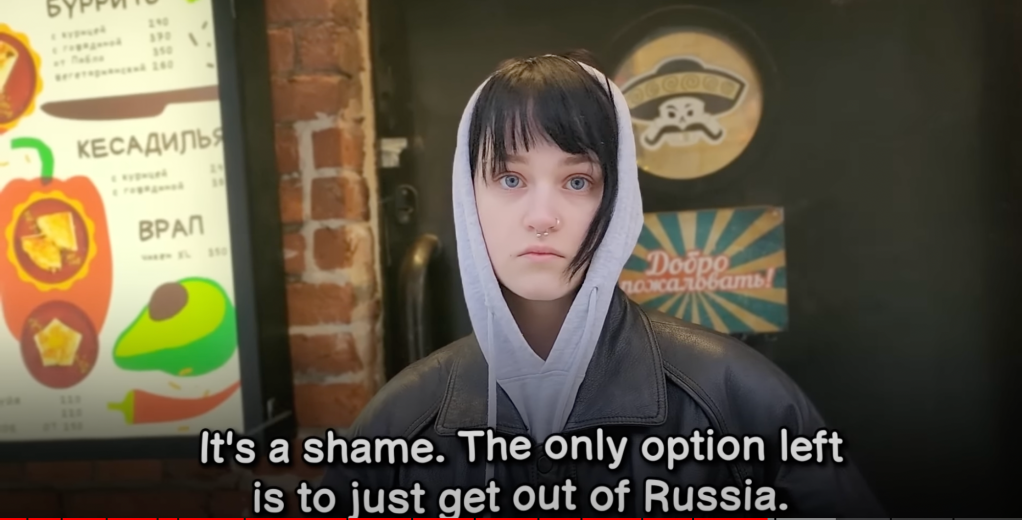
Source: 1420 by Daniil Orain (YouTube), “Do you support Putin? 100 Russians,” 28 January 2023. A huge thanks to Tiina Pasanen and Outi Salovaara for the heads-up.
My name is Daniil Orain. I’m a YouTuber from Russia, and I run the channel 1420. In my videos, I try to create a montage of everyday Russians and a transparent representation of what they believe.
Since the start of the conflict in Ukraine, people from all over the world have come to my channel to try and understand how Russians think.
Before I started the channel about 2 years ago, I had some skewed thoughts about the world.
At the time, I was working as a software engineer with a three-hour commute, and my perspectives changed when I began to watch on-the-street interviews with people in faraway cities during those rides. Those videos showed me how people from different places and cultures thought, and they played a big part in my self-education.
I started to wonder: Why isn’t there something like this on YouTube but with people from Russia, like me? That’s when my friend and I created 1420.
People often ask me for the story behind the channel’s name, but there’s no secret meaning. It’s just the name of the school we went to together. Our whole goal with the channel was to go out on the streets of Moscow and ask people questions that interested us — things like, “Do you believe in God?” or, “What do you think about Americans?”
When the conflict in Ukraine began, we suddenly saw a huge increase in viewers.
Our increase came from around the world — not just Europe and America, which had been our main audience. With the increase in viewership, I decided to double down and try to publish videos daily.
To get enough material for a full video, we have to ask a large number of people. Given the nature of our topics at the moment, a lot of people decline to participate.
When shooting the Zelenskyy video, for example, we had 124 people decline to answer. Only 28 people agreed. Even when they do agree, they often hold back from giving their full thoughts.
Making these videos is risky, but we haven’t had any problems so far.
Unlike with TikTok and Instagram, access to YouTube is still normal in Russia. In the videos, I’ve always muted certain words (but kept the subtitles) to avoid censorship.
For example, you’re not allowed to say “war” when referring to the situation in Ukraine. We have to say “secret operation” instead. So if someone does say “war,” we mute that word.
Some people in the comments have accused me of being a Russian propaganda channel, so I’ve had to find new ways to show that I’m not. For example, in one recent video, we blurred the faces and changed the voices of the people in it so that they could be honest without fear of repercussions. Also, we started showing longer continuous clips of the interviews so that the viewers didn’t think we purposely cut them to tell a certain narrative.
I have seen a change in how people view not only our channel since the war started — but also our participants.
Just recently, the comments on my YouTube videos said things like, “Russians are just like us.” But as the situation in Ukraine has progressed, they now tend to be more like: “Russians are brainwashed.”
I’m glad people are watching the videos because I know from my experience how helpful YouTube can be. We’re lucky to be able to learn online.
You’ll notice that in my videos, there’s a pretty clear divide between the answers coming from people who grew up in Soviet times and the younger people. When the older generations were growing up, they got their education only from books or teachers — they didn’t have access to the world like people my age do. The position that I’m in, running this channel, wouldn’t have even existed back then.
Today, you can learn things from websites, videos, and even comments.
Just last week, on one of my own videos, one viewer wrote: “You are not scared, not because you are fearless, but because you just haven’t been scared yet.”
That blew my mind. I know what I’m doing is risky, but maybe I don’t feel worried about it because I’ve never actually been that worried. But at the same time, I’m just the storyteller. A lot of people direct-message me asking for my opinion on various topics, but I don’t answer them.
I see my role as being the person who helps tell people’s stories, and I’ll continue to do so to show how and what Russians feel.
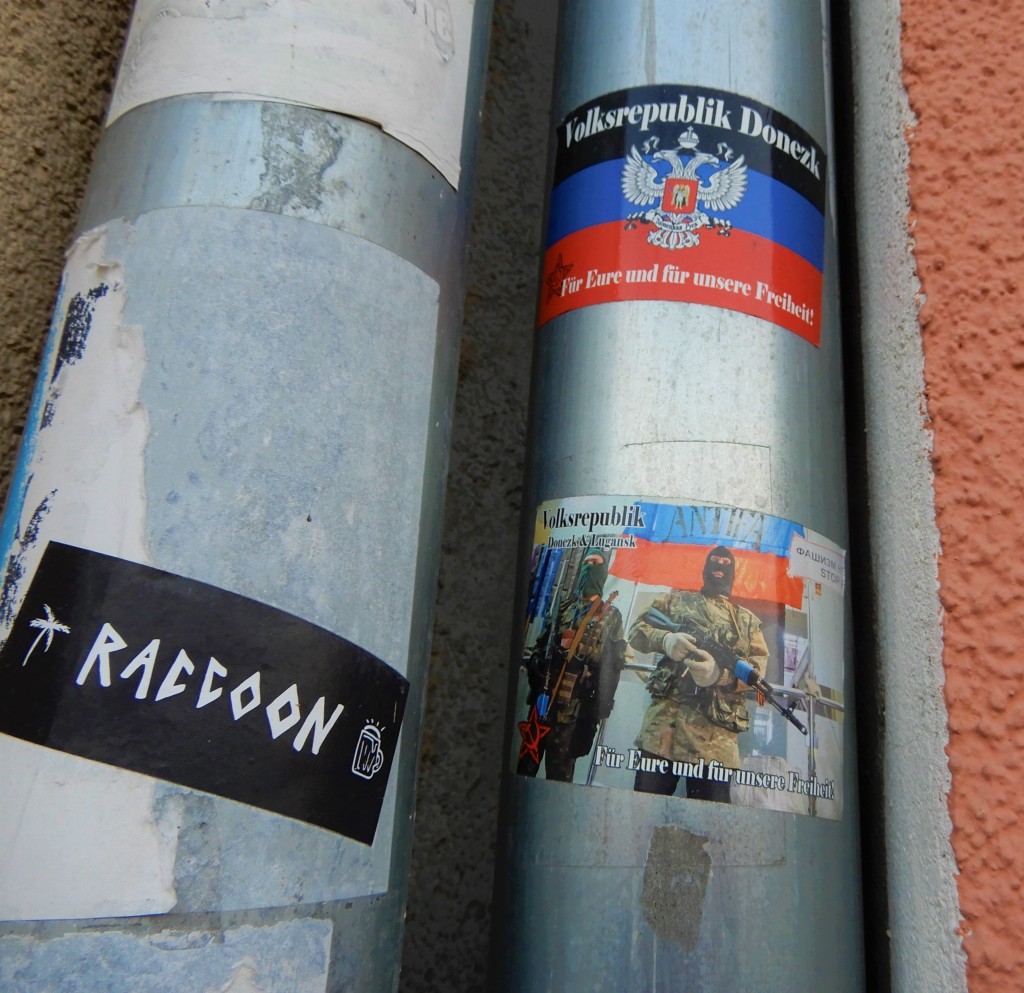
“Donetsk People’s Republic. For your and our freedom!” Berlin-Friedrichshain, 6 February 2023. Photo by the Russian Reader
State Duma deputy Andrei Kolesnik proposes reinstating the death penalty for treason
A proposal has been made in the Russian State Duma to revive the death penalty for those who have left the country and commenced criticizing the Russian authorities. The initiative was launched by deputy Andrei Kolesnik.
In an interview with Moscow Region Today [see translation below], the parliamentarian noted that an exception could be made for those who have simply left the country. According to him, traitors are those who have left and at the same time are waging an information war against Russia.
Security Council deputy chair Dmitry Medvedev said that Russians who fled the country and wish its destruction should be treated in accordance with the law, but the rules of wartime should also be remembered.
Following Nevzorov, Belotserkovskaya has been sentenced in absentia to nine years in prison for spreading fake news. State Duma deputy Andrei Kolesnik commented on this practice of “absentee sentences.”
“Okay, some people merely fled Russia. There are a lot of yellow bellies. They can stay there and work. But when a person works against Russia, it is called an information war. It’s more serious than a weapon, sometimes. Evil tongues are scarier than a gun,” the deputy said in an interview with Moscow Region Today.
However, Kolesnik stressed that the “traitors to the Motherland” had been punished according to the law: there is evidence, i.e., publications. But the deputy noted that he himself would have dealt with them more harshly.
“This is my personal opinion, although maybe I will voice it in parliament. If a person has committed serious crimes against Russia, then the sentence might be different. And this sentence could be enforced in the place where he (“traitor to the Motherland” — ed.) is located. Combat is currently underway. So, they should behave more carefully,” the deputy said.
When our correspondent asked whether he was talking about the death penalty, Kolesnik replied as follows.
“The [death penalty] can be employed for treason. We currently have a moratorium on the death penalty, although it exists in our laws. The decision to lift the moratorium is made not by the State Duma, but by the court. Although many people in the State Duma are leaning in this direction,” the deputy said.
Earlier, State Duma deputy [Maxim Ivanov] said that the unemployed could be sent to the SMO zone.
Known as Minnesota’s favorite Americana band of the 99%, The Gated Community celebrates the release of their highly anticipated new album The Honor and Glory of The Gated Community. Showcasing beautiful harmonies, multiple lead singers and virtuosic soloists, this 5th album from the folk/country cult favorites shows the band stepping out of their Marxist bluegrass band box to create poignant songs of personal and collective loss — many of which were written just a few blocks from where Minneapolis Police Department’s 3rd Precinct station was burned and abandoned following the murder of George Floyd.
Living just a few blocks from the 3rd Precinct, frontman Sumanth Gopinath (vocals, guitar) and his partner Beth Hartman (vocals, percussion) were filled with a particular anxiety and dread. “We went through a lot during the uprising itself, but we also feared repeat occurrences of violence at various points – like the November 2020 election, January 6, the inauguration and the Chauvin trial,” Gopinath says. “Moreover, family and friends died or nearly died from COVID-19. My retired colleague David Bernstein passed in March 2020, my aunt died in June 2020, and my uncle was in the hospital for months.”
Although The Gated Community started tracking some of the album in 2019 and early 2020, an electrical failure (caused by the 2020 unrest) fried the studio’s primary and backup hard drives. Left with only a few tracks and a whole new whirlwind of emotions stirred up by the pandemic, George Floyd’s murder, subsequent protests and the rise of fascism in America, the band reworked old songs and arranged new ones written by Gopinath during the pandemic. “Not being able to make music with the other five band members during 2020, I began composing classical music again for the first time in 25 years,” Gopinath says. “I also continued to write songs for the band until we were finally able to do some very distanced outdoor rehearsals in fall of that year.”
With various health concerns among band members, they worked safely and slowly, rehearsing and recording the new tracks with John Miller at Future Condo Studio in Minneapolis. Mastered by Bruce Templeton at Microphonic Mastering, the album was finally done in 2022. Their most ambitious yet, it includes 13 originals with powerful lyrics and thoughtful arrangements. Although still marked by the playfulness that have won them such a loyal following, these songs have less punk urgency and more of the laid-back folk and country vibes of some of their songwriting heroes – from the Ralph Stanley-inspired a capella song “To the Sea Once More” (written for Kobe Dimock-Heisler, a young man of color on the autism spectrum who had just been murdered by police in Brooklyn Center, MN, on Aug. 31, 2019) to the Terry Allen-esque “Mariia” (about the alleged Russian spy and current politician Maria Butina) to the Townes Van Zandt-sounding “Another Fire” (written following the nightly fires that erupted in South Minneapolis after George Floyd’s murder) to the beautiful simplicity of Gillian Welch exhibited in “The Life From My Eyes” (about domestic violence towards women). The album also features the heartfelt playing of recently retired fiddler Teresa Gowan.
Once thought of as a niche novelty outfit, The Gated Community show their evolution into a sophisticated band that mixes social commentary with emotionally rich songwriting. They are incredibly proud to bring this album into the world after the collective traumas of the past three years and are finding solace in playing together once more.
——————
credits
released February 3, 2023
The Gated Community is Sumanth Gopinath, Cody Johnson, Teresa Gowan, Paul Hatlelid, Rosie Harris, Beth Hartman, and Nate Knutson
with special guest Adrienne Miller
words by Sumanth Gopinath, music by The Gated Community
produced by The Gated Community and John Miller
recorded at Future Condo Studio by John Miller
mixed by John Miller
mastered by Bruce Templeton, Microphonic Mastering
thanks and much love to our families, friends, and fans
special thanks to Tom Campbell and Adam Zahller
in memory of the family members and friends we lost over the past few years, including Liz Adams, Stan Adler, Shekhar Bal, David Bernstein, Josette Bethany, Max Bromley, Jason Christenson, Karen Dresser, Marian Gopinath, Gwen Hartman, Dave Hoenack, Qadri Ismail, Chad Marsolek, Jim McDonald, Ryan Muncy, Rita Elizabeth Nye, Peter Schimke, and Jerold Marvin Schultz
One day, I hope, someone will explain to me why “progressive” Russians find the English words speak, speaker, speech, etc., so sexy and exciting that they have to incorporate them needlessly into Russian every chance they get.
Do they know that, in English, these words are less evocative than three-day-old bread, duller than dishwater?
In this case, hilariously (and awkwardly, too: “speak” appears after chas, generating an awkward phrase that translates as “hour of speak” or “speak hour,” although it’s supposed to be a play on the idiomatic phrase chas pik, meaning “rush hour”), the word “speak” adorns Sergei Medvedev’s reflections on the “imperialist mindset.”
Indeed.
Thanks to TP for this gem of Rusglish.
Below, you can watch the actual interview (in Russian, not Rusglish — well, almost), which, if for no other reason, is interesting because it was posted almost three months before Russia invaded Ukraine. ||| TRR
Historian and writer Sergei Medvedev is the program’s guest.
In an interview with Nikita Rudakov, he explained:
Why the idea of Russia’s “civilizational superiority” is so popular
Why propaganda encourages the ideological complexes of Russians
How the elite of the 2000s is trying to turn back history.
00:00 Chas Speak: Sergei Medvedev 01:40 The imperialist mindset and the idea of Russia’s greatness 06:10 Is there no place for nationalism in the imperialist mindset? 08:05 “Russia colonized itself” 14:03 The superiority of big ideas: why didn’t the USA become an empire? 21:02 The ideological complexes of Russians 25:41 “We rise from our knees via military achievements and parades on Red Square” 26:50 “Lukashenko does with us what he will”: Russia and Belarus 30:56 “Russia wants to live in the myth of 1945” 34:40 “We were unable to create a nation state”
In the new episode of the project "The Last Line" Chulpan Khamatova again recites the verse of Alya Khaitlina. In today's poem, she reflects on responsibility, guilt and humility. Already in the first stanza she asks a rhetorical question that many of us have asked and continue to ask ourselves: "Whose fault is it all?"
Read us here - https://spektr.press
You can also find us on:
Telegram - https://t.me/SpektrURGENT
Twitter - https://twitter.com/spektronline
Facebook - https://www.facebook.com/spektr.press
VK - https://vk.com/spektr.press
Chulpan Khamatova's social media pages:
https://instagram.com/chulpanofficialhttps://www.facebook.com/aboutchulpan
Alya Khaitlina's social pages:
https://www.facebook.com/alya.khaitlina/https://t.me/alja_hajtlina
The text:
Until nightfall, until nausea, you think, what should be done?
Bags under your eyes, a mouse in a noose in your fridge.
Whose fault is it all? It’s probably yours.
Someone has to take the rap [responsibility] already, right?
You loved the wrong folk. You sought the wrong ways.
At a party you wrinkled your nose and didn’t finish dessert.
Something like this was bound to happen,
Throwing us back a thousand years.
Let them take me away, let them say it's her,
Let them send me to prison, spit on me and sling mud.
But just let this terrible war stop,
Let it live on only in books — in Cyrillic, in Braille, in frilly fonts.
Let them send me to the back of beyond.
To where hell freezes over, to where nothing ever gets off the ground.
Just let the belligerents stop shooting right now,
Let them all drop off the radar, fizzle out, dissolve.
I’ll be doing time in prison, I’ll be sweeping floors,
And at night, to get to sleep, I’ll look at the flock
Of living, lively children who were saved.
Let them hate me if they will.
But let them grow up.
Source: "'Responsibility.' Chulpan Khamatova, Alya Khaitlina. Last Line Project," Spektr Press (YouTube), 27 January 2023. Translated by the Russian Reader. Ms. Khamatova lives in Riga. Ms. Khaitlina, according to her Facebook page, lives in Munich.
This photo of a Petersburg police officer and patrol van is probably from Zaks.ru’s archives, but it’s what they pinned to this article.
Petersburg law enforcement officers interrupted a solo picket of activist Alevtina Vasilyeva, who took up position facing Gostiny Dvor holding a placard featuring a popular pacifist slogan. This was reported by the human rights project OVD Info, which cited her spouse.
The police took Vasilyeva to the 28th police precinct [a few blocks from my house, which I haven’t seen for four years now].
Apparently, the picketer faces a fine for “discrediting the army” (per Article 20.3.3 of the Administrative Offenses Code). The maximum possible [fine for this offense] is 50 thousand rubles.
UPDATE, 3:35 p.m. Vasilyeva was released from the precinct after being cited for “discrediting the army.”