Contemporary listeners of Kino’s hit album Blood Type (1988) would have had no trouble identifying the war alluded to in the title track: the Soviet-Afghan War was still ongoing. The war was one of the causes of the Soviet Union’s sudden collapse in 1991. Unless it is stopped in short order, the Trump regime’s just-as-needless war against U.S. cities will lead to the collapse of the United States. ||||| TRR
The Soviet–Afghan War took place in Afghanistan from December 1979 to February 1989. Marking the beginning of the 47-year-long Afghan conflict, it saw the Soviet Union and the Afghan military fight against the rebelling Afghan mujahideen, aided by Pakistan. While they were backed by various countries and organizations, the majority of the mujahideen’s support came from Pakistan, the United States (as part of Operation Cyclone), the United Kingdom, China, Iran, and the Arab states of the Persian Gulf, in addition to a large influx of foreign fighters known as the Afghan Arabs. American and British involvement on the side of the mujahideen escalated the Cold War, ending a short period of relaxed Soviet Union–United States relations.
Combat took place throughout the 1980s, mostly in the Afghan countryside, as most of the country’s cities remained under Soviet control. The conflict resulted in the deaths of one to three million Afghans, while millions more fled from the country as refugees; most externally displaced Afghans sought refuge in Pakistan and in Iran. Between 6.5 and 11.5% of Afghanistan’s population of 13.5 million people (per the 1979 census) is estimated to have been killed over the course of the Soviet–Afghan War. The decade-long confrontation between the mujahideen and the Soviet and Afghan militaries inflicted grave destruction throughout Afghanistan, and has been cited by scholars as a significant factor contributing to the dissolution of the Soviet Union in 1991; it is for this reason that the conflict is sometimes referred to as “the Soviet Union’s Vietnam”.
Source: Wikipedia. The emphasis, in the last paragraph, is mine. ||||| TRR
[…]
The pretext for this war, of course, has always been a bogus premise. Yet federal agents treat it with the dogma of settled fact. But I keep wondering: How does the average CBP or ICE agent convince themselves of this? Even now, I can’t help shake the absurdity of anyone—Trump, Gregory Bovino, whomever—hoping to convince a thinking person, even themselves, to believe that places like Minneapolis have ever required an armed occupation. It’s against this genuine perplexity that I keep coming back to how these officers look and what mirrors might reflect back to them when they dress up for war.
“Anybody who’s had a fun evening on Halloween can understand what happens when somebody fully dresses up in paramilitary gear with flash-bang grenades hanging off of them,” said Peter Kraska, a justice studies professor at Eastern Kentucky University. “They’re going to walk out in public and say to themselves, ‘I am different from all these people.’ They become the enforcer. And when they look out and see the other, they see an enemy. The [paramilitary gear] gets them to react differently and think differently than they normally would.”
The role of military-style uniforms in helping the Trump administration create a theater of war where none exists cannot be overstated. It marks a stark evolution from the early days of Trump’s mass deportation plans, when plainclothed agents looked a lot like your best friend’s worst boyfriend—the guy who moved to rural Pennsylvania and discovered the basement levels of gun culture. Now, agents march into town in the costume of a foreign invasion.
Consider the camouflage now ubiquitous across the cities ICE occupies. At first, the pattern’s technical science might seem like a natural extension of the Trump administration’s increasingly illegal efforts to shield the identities of the men carrying out its vision of cruelty. But the theory breaks down when you look at the urban landscapes where ICE hunts down immigrants. Simply put, wearing camo in places like Lake Street or Hyde Park defies its central aim. If camo’s built-in purpose is to avoid detection, ICE’s embrace of it is the opposite: They want maximum visibility. They want to show they are soldiers. And they want to do so to make it seem reasonable, if only to themselves, to act like an invading army.
When I reached out to the Department of Homeland Security about the use of military gear among ICE agents, spokesperson Tricia McLaughlin responded with her own question: “Why do ICE agents wear tactical gear when they are facing rampant assaults and vehicular attacks? Is that the question you’re asking?” No, not really. But the snark with which McLaughlin replied was enough to grasp that questioning why DHS employs camo when lush woodlands do not exist in the cities its agents invade was irrelevant. They are dressing for the war they want.
What other way was there to interpret the coat of the former envoy of terror, Bovino? The commentariat spent much time deliberating its lineage, whether or not Bovino’s hulking olive garb was in fact true Nazi wear. (It turns out it was not.) But in roaming around Minneapolis in the fashions of Hugo Boss circa 1933, Bovino, who reportedly travels with his own film crew, succeeded in pushing the optics of war where it does not exist.
“What you’re seeing is the functionality of gear for legitimate, militarized purposes versus a type of postmodern, performative imagery,” Kraska said. “It makes them feel a particular way, to tap into those warrior fantasies and masculine drive of, ‘I’m a real man, I’m a real badass.’”
Federal agents stand outside the Whipple Federal Building in Saint Paul, Minnesota, on 8 January 2026. Photo: Octavio Jones/AFP/Getty/Mother Jones
The same holds for the men under Bovino. These are federal agents who wear hats intended for jungle warfare—again, in Minneapolis, where no such jungle exists—as well as blood-type patches, despite little evidence that they would ever be needed. After all, they are in Minneapolis, an American city with American hospitals, where doctors provide blood transfusions without the help of uniform instructions, the way a soldier on a remote battlefield might actually need. Furthermore, ICE’s own data strongly undercuts the notion that the job of an ICE officer is even uniquely dangerous work. In the absence of peril, federal agents turn to costume to legitimize their presence.
Despite its equestrian-themed title, misfit-spies motif and occasional reference to “Moscow rules,” Peacock’s new espionage thriller “Ponies” has little in common with Apple TV+‘s “Slow Horses.” Set in Cold War Moscow, “Ponies” falls, intriguingly and occasionally uneasily, somewhere between FX’s “The Americans” and underappreciated female-empowerment comedy film “The Spy Who Dumped Me.”
Which is not surprising since it was created by Susanna Fogel and David Iserson, co-writers of “The Spy Who Dumped Me,” which the former directed and the latter executive produced.
Opening with an attempt to extract a CIA asset from the clutches of the KGB, the series centers on Moscow’s American Embassy circa 1977 (with a soundtrack and brief glimpses of a young George H.W. Bush and, later, Elton John, to prove it).
As the American operatives engage in the obligatory shoot-‘em-up car chase, two women meet in a market. Though they are each less than thrilled with their almost nonexistent lives as wives of envoys to the associate of the U.S. ambassador (i.e. the spies from the opening sequence), their contrasting attitudes and sparky, odd-couple chemistry is immediately, and a bit ham-handedly, established.
Polite, rule-following and Russian-fluent Bea (Emilia Clarke) believes her husband, Chris (Louis Boyer), when he lovingly assures her that this posting will be over in a few years and soon she will be putting her unidentified Wellesley degree to better use. (Note to whoever wrote the Peacock press notes: A Wellesley degree does not make a woman “overeducated.”)
Tough-talking, streetwise Twila (Haley Lu Richardson) is not so deferential or deluded; she pushes Bea to face down an unscrupulous Russian egg merchant with profanity-laden elan. Unsurprisingly, her marriage to Tom (John Macmillan) is more than a little rocky.
Still, when their husbands die, ostensibly in a plane crash, Bea and Twila are grief-stricken — they have lost not only their husbands but their careers as foreign service wives.
Back in the U.S., Bea is bucked up by her Russian, Holocaust-surviving grandmother (the always welcome Harriet Walter), while Twila realizes she fled her hardscrabble Indiana background for good reason.
Determined to find out what really happened to their husbands, the two return to Moscow and confront station head Dane Walter (Adrian Lester), convincing him that their status as wives — the ultimate Persons of No Interest, or “PONI” in spy parlance — offers the perfect cover.
Ignoring the historical fact that both countries have long had female undercover operatives, Dane decides (and convinces then-outgoing CIA head Bush, played by Patrick Fabian) that Russia would never consider two women (including, you know, one fluent in Russian) a threat and, by the middle of the first episode, we’re off.
Reinstalled as secretaries, Bea’s mission is to get close to new asset Ray (Nicholas Podany), Twila’s to … be a secretary. She, of course, decides to become more involved, enlisting the aid of Ivanna (Lili Walters), an equally tough market merchant.
Everything gets immediately more complicated, and dangerous, when Bea catches the eye of Andrei (Artjom Gilz), a murderous KGB leader who may be able to lead the CIA to the surveillance facility that Chris and Tom were trying to find when they died.
Clarke, returning to TV for her biggest role since her career-making turn as Daenerys Targaryen in “Game of Thrones,” is the obvious headliner. And in early episodes she does, in fact, carry the series, evoking, with as much realism as the relatively light tone of the writing will allow, a woman whose self-knowledge and self-confidence have eroded after she was sidelined into the role of wife.
Richardson, who many will remember as Portia, long-suffering assistant to Tanya (Jennifer Coolidge) in Season 2 of “The White Lotus,” is given the opposite task. Twila is, in Hollywood parlance, a “firecracker” — you know, the tough-talking dame who inevitably nurses a wounded heart. While drafting Bea as a spy makes a certain amount of sense, Twila’s skill set, as she is told, is being “fearless.” Her real talent, however, turns out to be standing up for “ordinary women,” including a string of prostitutes, murdered and forgotten.
Since neither woman receives the kind of training even most fictionally drafted civilian spies get in these kinds of stories, Bea and Twila are forced to rely on their wits, and the yin-yang balance of their good girl/tough girl relationship.
This makes for some great banter and fish-out-of-water moments, but it muddies the tone — are they being taken seriously as spies or not? — and requires significant suspension of belief (as does the Moscow setting created by Budapest; everyone keeps talking about how cold it is, but it never seems that cold). Fortunately, compared with their professional counterparts in most espionage dramas, the career agents on both sides appear, at least initially, to be quite limited in their spy craft as well.
An emerging plotline involving sex tapes and blackmail adds all sorts of tensions, as well as historical accuracy, and, as things get rolling, the spies become sharper and the notion of surveillance grows increasingly complicated and tantalizing.
Still, “Ponies” is obviously less interested in the granular ins and outs of gadgets, codes and dead drops than it is in the personal motivations of those involved and the moral morass that is the Cold War. “You came to Moscow to find truth?” an asset scoffs.
The cast is uniformly strong, the performances solid and engaging (Walter’s Russian grandma reappears midway through to show everyone how it’s done). If “Ponies” takes almost half of its eight-episode season to equal the sum of its parts, Fogel, who also co-wrote “Booksmart,” is a master spinner of female friendship, and Clarke and Richardson make it impossible not to instantly recognize, and connect with, Bea and Twila.
Their chemistry, and the absurdity of their situation, propels the story over any early “wait, what?” bumps and confusing tonal shifts into an increasingly propulsive and cohesive spy drama, with plenty of “trust no one” twists and turns, and the kind of period detail that would make “Mad Men” proud. (OK, yes, I am old enough to have tried the shampoo “Gee Your Hair Smells Terrific.”)
Fortunately, even as it moves with increasing assurance into “Tinker, Tailor” territory, “Ponies” remains a story of love. Which, as spies know only too well, can exist only when you accept, and share, the real truth about yourself. With a cliff-hanging ending, “Ponies” is betting that Bea and Twila will get another season to find their truths, even in Moscow.
“The Shot Glass Beer Bar.” And what’s wrong with this picture? Another still from S1E1 of “Ponies”
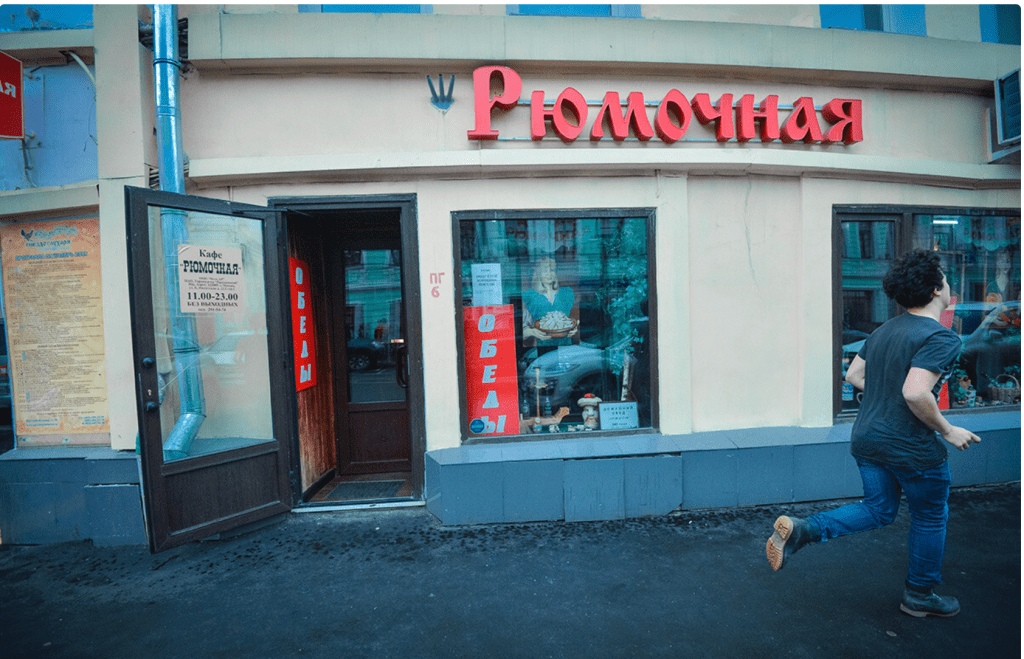
The ryumochnaya is a purely Soviet phenomenon. It is a special snack bar in a Spartan format. It specialized in strong alcoholic drinks, with sandwiches served as appetizers or snacks. At some point, these “snack bars” turned out to be a form of “cultural recreation” available to most Soviet people.
“Men who usually drank port by their building entrances, like revolutionaries who gathered for a meeting in the basement or under a painted wooden mushroom figure on a children’s playground, could now go to a proper establishment, knock back a shot and intelligently [sic] have a bite of sandwich as a snack. Such a thing was not even dreamt of at that time,” journalist Leonid Repin wrote in ‘Stories about Moscow & Muscovites throughout time’.
The first USSR shot bars opened in Moscow in 1954. According to Moscow historian Alexander Vaskin, this was a political move by the new head of state, first secretary of the CPSU Central Committee Nikita Khrushchev. He had to quickly win the people’s love and authority.
“The idea to open shot bars in Moscow was not just good — it was fantastic! By creating a network of shot stores, the Party and the government showed great care for the health of the people and their cultural leisure,” Leonid Repin wrote.
They were designed to make lovers of liquor and vodka products more “cultured”, so that they did not drink in public places. But, some places became a refuge for citizens who could not find a place for themselves in the post-war USSR.
“At the corner of Mayakovskaya and Nekrasova streets [in Leningrad – ed.], there was a terrible drinking parlor full of legless invalids. It smelled of damp sheepskin, misery, shouting, fighting… it was a terrible post-war shot bar. There was a feeling that the people were deliberately made drunk there – all those ‘stumps’, ‘crutches’, former officers, soldiers, sergeants. They couldn’t find a way to keep these people warm and busy and this was one of the ways out,” writer Valery Popov speculated.
Cheap and cheerful
They poured vodka, port wine, liqueurs, wine and cognac in shot bars. Each shot was served with a modest snack – a sandwich with sausage, cheese, eggs, herring or sprat. There were four sprats on a sandwich, which was supposed to go with a 100 ml shot.
“There was only one inconvenience: after one drink, I wanted to drink some more and I had already had more than enough sandwiches. In general, it all happened like this: men stood there, knocking over shot after shot while making the ‘Leaning Tower of Pisa’ out of piles of sandwiches,” recalled Repin.
There were no tables or waiters in shot bars. Visitors lined up, received simple orders from the barmaid and then went to the bar tables.
Soviet writer and publicist Daniil Granin described a shot bar: “This is a glorious place – the smell of vodka, cigarettes, only men and without the forced drunkenness of bars, without molestation, sticky lingering conversations. Drank a shot, ate a sandwich, quickly and delicately.”
Simplicity implied low prices, so almost any citizen could afford to go to a shot bar. Prices and sandwich varieties were the same throughout the Soviet Union, recalls Alexander Vaskin.
“Prices were just kopecks. Everything happened in silence, with a sense of dignity. You drink up and then move on home or to see somebody or to the Philharmonic,” St. Petersburg historian Lev Lurie describes the advantages of a shot bar.
Overheard over a shot of vodka
In general, the visitors of such places were mostly decent.
“A factory worker and a journalist, an engineer and a plumber could all get together in a shot bar. It was not only a men’s club of interest, but also a place that attracted different people. It was possible to conduct sociological surveys and study the structure of society in them,” says Alexander Vaskin.
And the state did study it. As Lev Lurie notes, in the 1950s, almost half of political cases were initiated because of freethinking at shot bars.
“The ryumochnaya remained a haven for skilled, intelligent workers, who determined the social appearance of the city: serious, hardworking men who go fishing, watch soccer, take vacations in their factory’s preventorium or at the dacha. These establishments for visitors who had finished their work shift played the same role as pubs did in England,” he writes.
Shot bars today
In 1985, Mikhail Gorbachev, general secretary of the CPSU Central Committee, initiated an anti-alcohol campaign. Its active phase lasted for two years, with the country reducing the production and sale of strong alcohol.
The measures also affected the shot bars.
The next blow to them was the collapse of the Soviet Union. The formation of the restaurant market in the country and the emergence of new formats of catering reduced the shot bars to the role of “nostalgic” establishments, frequented by an aging, but loyal audience.
“Rumochnayas were never rebuilt nor did they disappear anywhere. They remained, like the Rostral Columns, Zenith and ‘White Nights’, without changing their function. <…> The average age of visitors now is close to the retirement age: almost all of these people were brought up, knowing the simple and raw nature of a shot shop from childhood. All those who drank a lot, died, having failed to survive the 1990s. Only tough veterans now remain, who know their limit and are used to ‘cultured’ drinking,” Lev Lurie characterizes the situation in St. Petersburg.
A newfangled, post-Soviet ryumochnaya. Photo: Alexey Kudenko/Sputnik via Gateway to Russia
He emphasizes that it is in the Northern Capital that the shot bars have retained their popularity: according to Lurie, there are more of them than in Moscow, yet it is difficult for old places to attract a new audience.
“Shot shops don’t lend themselves to stylization. There have been several attempts to create something in this genre for a younger and better-off audience. They’ve all failed. Young people drink much less than their fathers and grandfathers and they are not hooked on vodka. Local hipsters prefer to have a ‘shot’ in a trendy bar somewhere on Dumskaya or Fontanka. But, real connoisseurs of the genre have not rushed to the new establishments – it is expensive. The shot bars are still alive, but they are slowly dying out along with their customers, like thick table magazines or a game of dominoes in the yard,” concludes Lurie, a St. Petersburg resident.
In Moscow, St. Petersburg or any other city in Russia, it is not a problem to find a shot bar: establishments in this format continue to open. Nevertheless, not all owners adhere to the principles of “old-school” shot bars; namely, simple, cheap and democratic. And any Soviet-styled “neryumochnaya” (non-shot bars) will still correspond to modern restaurant realities in terms of its interior and menu.
In the meantime, the genuine Soviet “ryumochnaya heritage” is hidden under inconspicuous signboards, in basements, visited by “their own” kind. It is cheap and cheerful, not fashionable at all, but authentic. The only difference is they have normal tables and chairs now.
A longstanding San Francisco wine competition accidentally accepted Russian wines, which are illegal to import to the U.S., leading to an outcry from the Bay Area’s pro-Ukrainian community.
The San Francisco International Wine Competition apologized for the mistake and removed the Russian wines before judging took place in early December, president Amanda Blue said, adding that the competition “takes full responsibility for the oversight.”
Since March 2022, the U.S. has banned Russian alcohol along with other products such as caviar, seafood and diamonds as part of its sanctions against the country for its invasion of Ukraine. But 15 Russian wineries went to apparently great lengths to smuggle their wines in for the San Francisco International Wine Competition.
The San Francisco International Wine Competition is run by a group called the Tasting Alliance, which was founded in 1980 and organizes a range of alcohol contests, including the San Francisco World Spirits Competition and the Asia World Spirits Competition. Alcohol makers submit their products to the competition, which convenes a group of expert judges to evaluate them blind and issue awards. (It has no affiliation with the San Francisco Chronicle Wine Competition, sponsored by this newspaper.)
Although awards from competitions like these tend not to be as influential as scores from wine critics, many wineries heavily feature their accolades — especially if they’ve won double gold, the San Francisco International Wine Competition’s highest honor — in their marketing materials.
“They were openly bragging about doing this,” said Dmytro Kushneruk, Ukraine’s consul general in San Francisco. His team learned about the smuggling operation from private Telegram channels that the consulate monitors. An article in the Russian publication Kommersant further explained the elaborate scheme that Pavel Mayorov, an executive with the Association of Winegrowers and Winemakers of Russia, deployed to sneak the wines into the U.S. He said that entering Russian wineries in international competitions was a priority for his organization in 2026, and that Russian customers like seeing international recognition for their country’s wines.
Pavel told Kommersant that he considered bringing the wine across the Mexican border using a “coyote,” and also weighed using a camper van to cross the Canadian border. Ultimately he used a passport that he possesses from another country (he did not say which one) to transport the wine as personal luggage, flying with the wine-stuffed suitcases through Tblisi and Doha before reaching San Francisco.
He told customs officers that the wines were “a collection assembled at the request of Californian winemakers,” according to Kommersant.
In total, 95 bottles of Russian wine from 15 wineries were submitted to the competition, Blue confirmed. The competition received roughly 2,000 entries.
Although the error was corrected, “we think it’s important for the public to know,” Kushneruk said. He noted the strong support that the Bay Area has shown for Ukraine throughout the war. Ukraine’s own wine industry has suffered significantly during the Russian invasion, he said: Some vineyards have been contaminated with the remnants of explosive materials, and bottles have burned, including at a large wine storage facility near Kiev that he said Russian soldiers destroyed.
Some Bay Area residents were outraged when they learned of the Russian submissions. Russia “has destroyed so much of Ukraine, displaced so many Ukrainians and also destroyed Ukrainian vineyards and wineries,” said Andy Starr, who, with his wife Deb Alter-Starr, runs Napa Valley to Ukraine, a nonprofit that raises funds for aid to Ukraine and its refugees.
“For them to potentially get awards at the same time as they’re destroying other wine regions, that doesn’t sit with me,” Starr continued. “That shouldn’t sit with anyone.”
Kushneruk’s office got in touch with the competition’s organizers once it learned about the submissions. He also contacted Rep. Mike Thompson, D-Napa, whose staff reached out directly to the competition to ensure that the Russian wines would not be included in the judging.
“Sanctions are a critical tool in holding Russia accountable for its brutal war against Ukraine,” Thompson wrote in an email to the Chronicle. “I was proud to join the California wine community to raise these concerns and I commend this decision ensuring that our industry does not provide a stage for Russian businesses while Ukrainians are under attack.”
After “consulting with legal counsel and executive leadership,” Blue said in a statement, the competition “concluded that these wineries are not eligible to participate due to U.S. sanctions imposed following Russia’s invasion of Ukraine.” The entries were not judged, and the wineries’ entry fees would be refunded, she said.
To Kushneruk’s knowledge, no Ukrainian wineries submitted bottles to the San Francisco International Wine Competition. “But next year we’ll definitely make sure our wine will be sent here,” he said. “Our idea is not only to make sure that the sanctions work, but that Ukrainian wine also has a chance to be evaluated by such a great competition as the San Francisco International Wine Competition.”
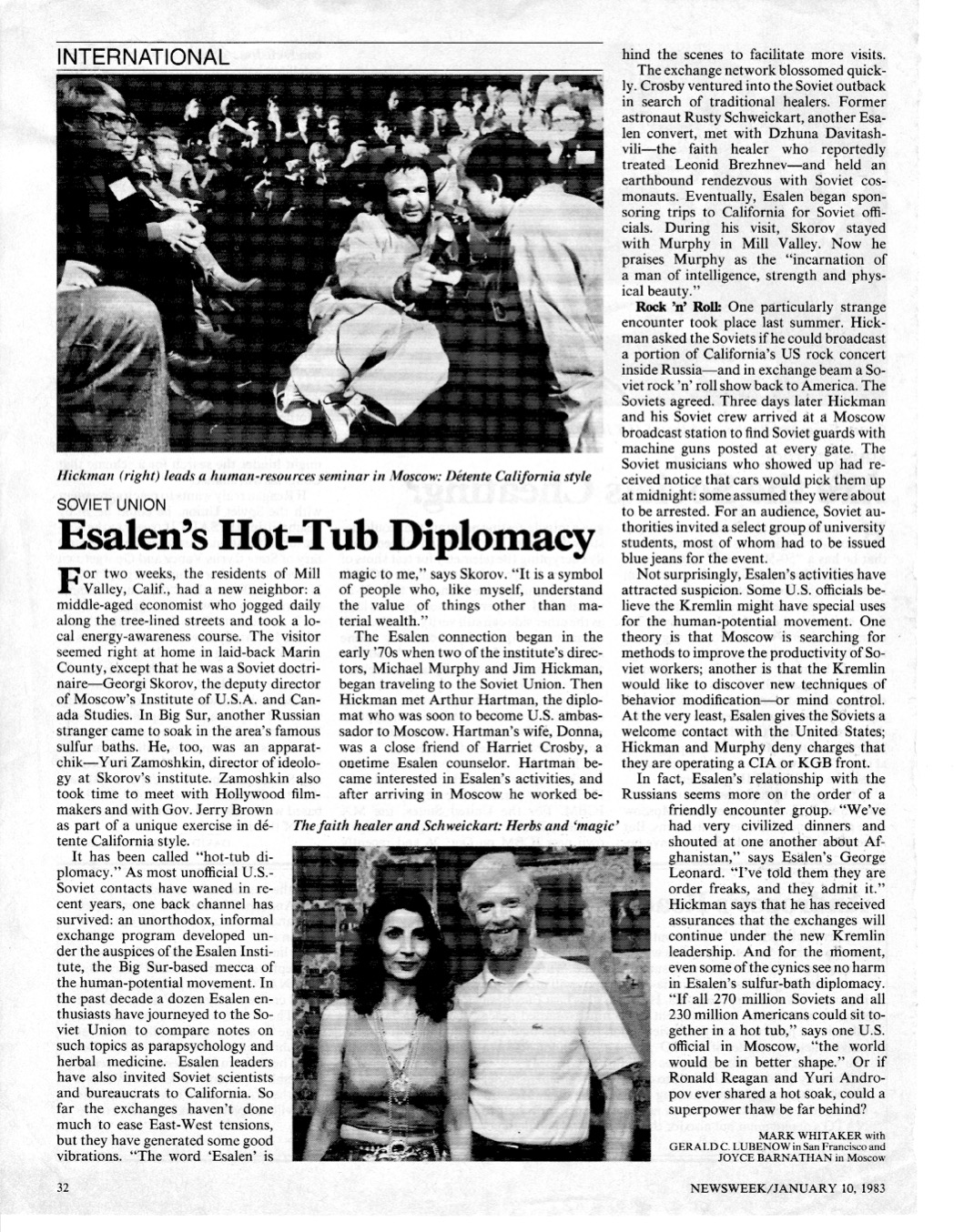
Source: Internet Archive. Thanks to Comrade Koganzon for the heads-up.
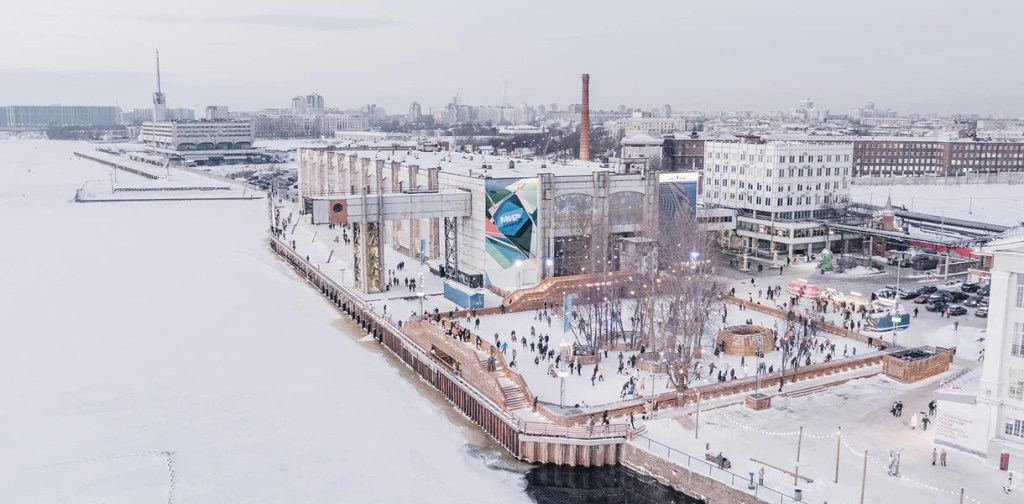
As a social activity, ice skating became the thing in the mid-19th century, popularized by Empress Eugene of France. For young women of her era, it became a way to present their slim ankles and effortless grace of their body in movement, not to mention an opportunity to fall into their partners’ arms without causing much scandal. In other words, ice skating provided freedom and romance, as documented in Tolstoy’s Anna Karenina – in which Levin sees Kitty Scherbatsky, whirling like a fairy and promptly falls in love. But Saint Petersburg has nothing on Monterey. Skating by the Bay’s seasonal ice skating rink is open daily until Jan. 4 for you to practice your body balance or maybe even start a little romance-on-ice.
On Friday, May ninth, Treptow Park was perhaps the most heavily guarded place in Berlin. Hundreds of police officers kept the peace at Germany’s most famous memorial to Soviet soldiers on the day Russia marked the eightieth anniversary of the end of the Second World War in Europe, known as the Great Patriotic War in the Soviet tradition. Because Russia has employed symbols of that earlier war in its current war against Ukraine, visitors were banned from displaying or wearing Soviet and Russian flags, military uniforms, and St George’s ribbons at the Berlin memorial this year. An exception was made for veterans and diplomats.
Soviet May ninth traditions and German pacifists
At about half past ten in the morning, a wreath was laid at the monument to the Soviet soldier by Russia’s ambassador to Germany, Sergei Nechayev. The day before, when Germany remembered the Wehrmacht’s surrender and the end of the war, Nechayev and the Belarusian ambassador were not invited to the memorial event at the Bundestag. In his speech, German President Frank-Walter Steinmeier thanked the Allies for liberating his country and recalled the Red Army’s sacrifices, but harshly criticized Russian attempts to justify the war in Ukraine in terms of the fight against the Nazis in the Second World War.
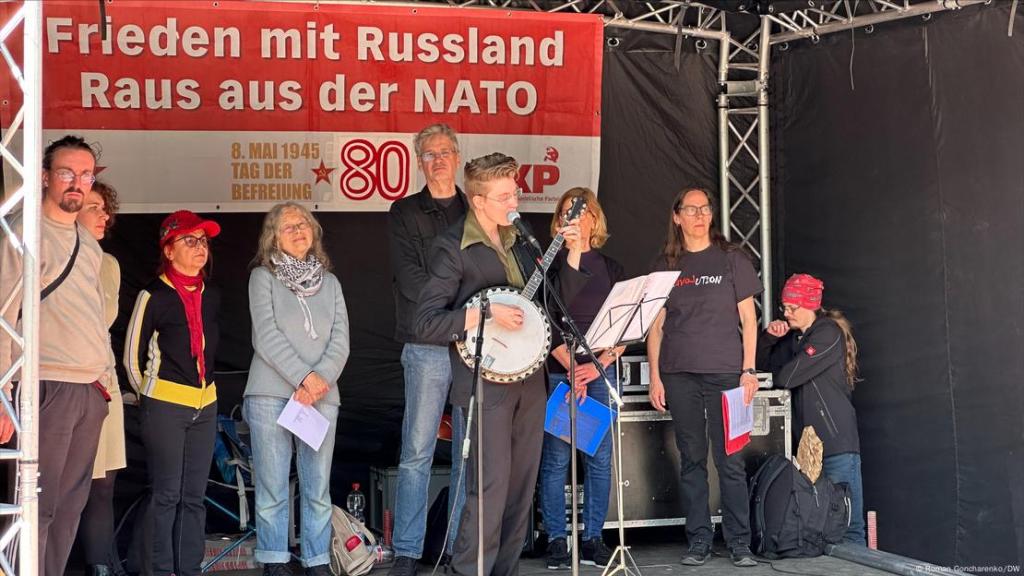
The flood of people in Treptow Park seemed endless: hundreds were there at any one time, and thousands came and went over the course of the day. Many brought scarlet carnations, while some bore wreaths. Russian and German were heard. Most of the visitors were elderly—immigrants from the former USSR living in Germany and Germans. There were also many leftist and ultra-leftist German political activists brandishing placards opposing NATO and calling for “peace with Russia.”
German ultra-leftists rally for “peace with Russia” and Germany’s exit from NATO, 9 May 2025. Photo: Roman Goncharenko/Deutsche Welle
Against this backdrop, the scene resembled a mixture of a traditional Russian May ninth celebration and a political protest by German pacifists, many of whom had clearly lived most of their lives in the GDR.
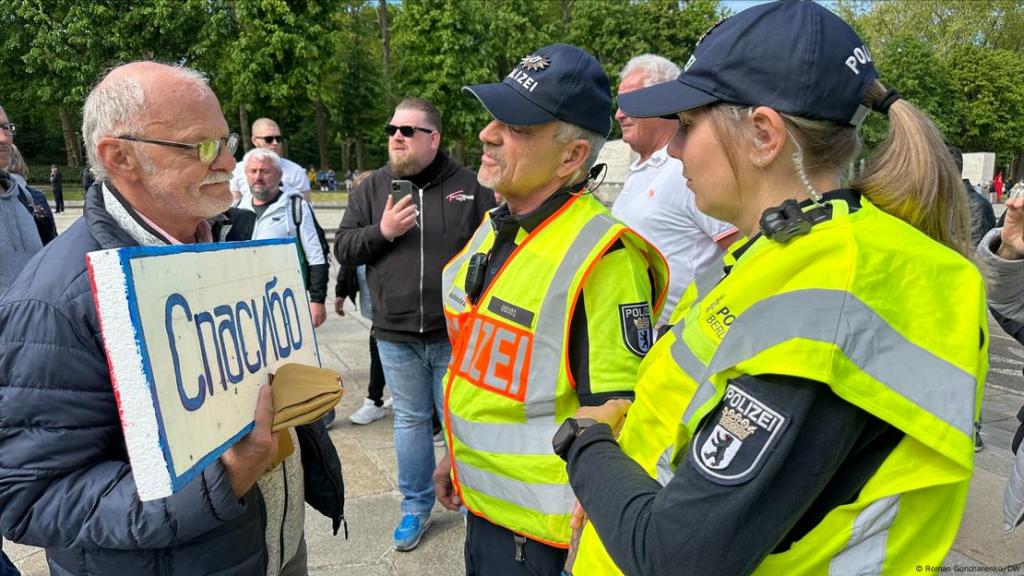
“I was a policeman in the GDR,” said a man in his sixties who held a placard that read “Thank you” in Russian. The policemen asked him to doff his Soviet cap, which sported a red star and a St. George’s ribbon.
“All people want peace, so the politicians should don their own military uniforms and crawl into the trenches,’ the man said.
Soviet wartime songs sounded from loudspeakers and were played live. One man, aged forty-five, climbed atop a mound to get a better view, but a policeman asked him to get off the lawn, explaining, “This is a grave.” The man cursed in Russian but climbed off the mound.
Another man played played “Arise, Great Country” on his clarinet. When he began quietly playing the melody of the Soviet and Russian national anthem, the police literally took him aside, after which he returned to the group of people who had gathered. They were outraged at the restrictions that had been adopted. From time to time, someone chanted “Russia, Russia!” and many other people would join in.
An ex-East German police office (holding a sign that says “Thanks!” in Russian): “All people want peace.” Photo: Roman Goncharenko/Deutsche Welle
Bikers in Treptow Park
Your correspondent saw men and a woman in leather jackets who looked like bikers from the Russian motorcycle gang Night Wolves. They were in small groups and were escorted by a large number of police officers. They posed for pictures in front of the wreaths and left. They could have been someone from a local “support group.” The Berlin press had written that only a small group of bikers made the trip to Berlin to visit the Soviet memorials this year. No incidents had been reported as this article went to press.
Treptow Park, 9 May 2025. The crimson and gold banners at the back of the crowd are inscribed with the names of the various “fronts” in the Red Army’s campaign against the Wehrmacht. Photo: Roman Goncharenko/Deutsche Welle
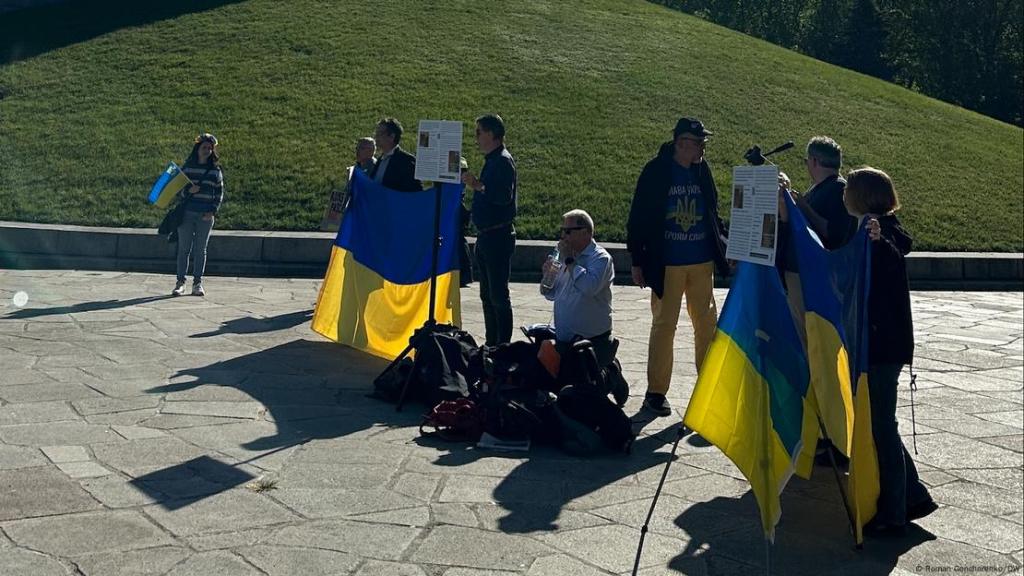
For the first half of the day, at least, things seemed relatively calm. Your correspondent had the impression that most people had come to Treptow Park not for political reasons, but to commemorate the war. And yet the atmosphere was tense. To the right and left of the monument to the Soviet warrior stood a dozen and a half activists holding placards and the flags of Ukraine and NATO.
Activists with placards and Ukrainian flags at the monument to Soviet soldiers in Treptow Park, 9 May 2025. Photo: Roman Goncharenko/Deutsche Welle
They said they wanted to draw attention to the Ukrainian Red Army soldiers who had perished in the Second World War, as well as to Russia’s war against Ukraine.
“I am here to prevent this event from being turned into a Russian propaganda stunt,” said a woman, aged thirty-five. According to her, insults had been hurled at her and the pro-Ukrainian activists.
“Some people regard our presence here as a provocation,” said the woman. “We are not here to change anyone’s mind, but to make Ukraine visible.”
One of their posters read: “Russia has usurped the memory of May eighth and ninth. But it was not Russia who liberated us from the yoke of National Socialism eighty years ago in Berlin. It was the Red Army, in whose ranks many Ukrainians served.”
The poster tells the story of Ukrainian soldier Fyodor Karpenko, who left his name on the walls of the destroyed Reichstag building in May 1945.
Since the Maidan uprising and Russia’s illegal annexation of Crimea in 2014, Kremlin propaganda has consistently portrayed Ukrainian leaders as Nazis or fascists. Russia also accused the Ukrainian authorities of “genocide” of the population of Donbass. On 24 February 2022, while announcing the full-scale invasion, the “denazification” of Ukraine was presented as the primary goal of the war, which is itself portrayed merely as a continuation of the Great Patriotic War: a conflict embedded in a cyclical conception of time in which Russia, eternally under threat from a Western enemy, fights for its very survival — on Ukrainian soil.
On the ground, there is no evidence to support Moscow’s accusations: nobody has ever documented a “genocide” against ethnic Russians or Russian speakers, whether in Ukraine or elsewhere. As for the Ukrainian far-right, its political influence remains minimal: in the 2019 parliamentary elections, the main ultra-nationalist parties, running together on a joint list, received just over 2% of the vote, well below the threshold required to enter Parliament. In short, the image of a “Nazi regime” in Kyiv is based on a glaring mismatch between rhetoric and reality.
So why do the Russian authorities repeatedly invoke references to the Second World War — or, in Russian parlance, the “Great Patriotic War” — when speaking about Ukraine? Understanding this memory dynamic is essential to grasp the power of a rhetoric that, despite lacking any factual basis, continues to shape the official Russian worldview.
The Soviet and Russian insistence on using the term “Great Patriotic War” to refer exclusively to the period from 1941 to 1945 erases the twenty-one months that preceded Nazi Germany’s invasion of the USSR. Between the Molotov–Ribbentrop Pact of August 23, 1939, and Operation Barbarossa on June 22, 1941, Moscow and Berlin were de facto allies: they engaged in extensive economic cooperation, diplomatic coordination, jointly invaded and partitioned Poland in September 1939, and the Soviet Union proceeded to annex the Baltic countries and wage war against Finland. By reducing the war to the period 1941–1945, the USSR and Russia could deny any responsibility in the outbreak of the Second World War and present itself solely as the victim of Nazi aggression and the primary liberator of Europe.
The Great Patriotic War — and especially the victory in 1945 — became the founding event of Soviet history and the cornerstone of collective memory. Yet this memory, often portrayed as monolithic and universally shared, is anything but uniform. A Ukrainian from the west, who endured two successive occupations between 1939 and 1944, remembers a war very different from that of an eastern Ukrainian, whose experience was shaped primarily by Nazi destruction. The memory of a Russian bears little resemblance to that of a Crimean Tatar, who was deported along with his entire community and denied the right of return for decades. As for Soviet Jews, whose families and communities were annihilated in the Holocaust, they were long forced to remain silent — official narratives left no room for the specificity of their suffering.
The collective experience of the war and the official discourse surrounding it deeply reshaped the Soviet population’s understanding of “fascism” and “antifascism.” Rather than referring to a specific political doctrine of the inter-war period, the term “fascism” had become a catch-all label for the ultimate enemy. Trotsky or the British Conservatives could just as easily be branded as “fascists,” as well as domestic and international opponents after 1945 — including even the Chinese Communists. The word “Nazi” itself was rarely used. In everyday life, calling someone a “fascist” served more as the gravest possible insult rather than as a statement of ideological substance.
Under Vladimir Putin, the cult of the Great Patriotic War has been revived. Following the pro-democracy protests of 2011 and Putin’s bid for a third presidential term in 2012, the regime instituted a deliberate policy of historical narrative construction, aimed at grounding its legitimacy in a vision of the nation as under siege. The glorification of the 1945 victory also allowed the regime to purge collective memory of its specifically socialist elements: by retaining only the narrative of national triumph, the Soviet period could be seamlessly integrated into a continuous national history without any revolutionary rupture. At the same time, the rehabilitation of Joseph Stalin as a legitimate victor served to validate autocracy. The mass repressions and genocidal policies that claimed millions of lives were reframed as a tragic but necessary step: they had made the USSR a global superpower, capable of defending civilization against the “brown plague.”
The Kremlin has multiplied its legal instruments to enforce this narrative. Since 2020, the Russian Constitution mandates “respect for the memory of the defenders of the Fatherland” and prohibits “diminishing the importance of the heroism” of the Soviet people. In April 2021, Putin signed a law increasing penalties for “insults” or “false claims” about the Second World War and its veterans. In December 2019, Putin himself gathered some leaders of post-Soviet states around a pile of archival documents that he said proved historical truths long ignored in the West — selectively quoting them to justify, in retrospect, the USSR’s annexation of Poland and the Baltic states. In this way, Putin has weaponized history, which has become inseparable from national interest. To challenge his interpretation is tantamount to treason.
Every year on May 9, Russians march in the Immortal Regiment carrying portraits of relatives who fought between 1941 and 1945. Increasingly, the faces of those who fought — or died — in the war against Ukraine are added to these ranks, as though both wars were part of a single, endless struggle. Past and present warfare are merged, and the victory of 1945 becomes the lens through which all events — past, present, and future — are interpreted in a continuous historical timeline. This symbolic fusion also explains the surreal images of Russian occupation forces who, in recent weeks, have placed propaganda banners in destroyed Ukrainian cities. An uninhabitable Bakhmut was transformed into a stage for celebrating the 80th anniversary of Russia’s victory in the “Great Patriotic War.”
The cult of victory is not only a central element of the Putinist imaginary — it functions as an operating system for both domestic governance and external aggression, with all of Russia’s actions on the international stage framed as part of an eternal war against fascism. A telling example of this is the installation of a giant screen on the Estonian border, broadcasting Victory Day celebrations in a loop — an attempt to remind Estonians, as well as Latvians and Lithuanians, that the Soviet victory represents an unassailable moral superiority. In the Russian collective imagination, the word “fascism” has lost all connection with a specific political ideology and now refers only to an abstract, absolute threat: the desire to destroy Russia. It has become synonymous with “enemy” or “Russophobe,” always denoting the Other, never a historically defined movement. This separation between word and meaning allows the regime to simultaneously glorify the antifascist victory and openly promote xenophobic, homophobic, or ultraconservative rhetoric, without any perceived contradiction.
The word “denazification,” used by Vladimir Putin on February 24, 2022, to justify the invasion, initially puzzled many Russians, most of whom were unfamiliar with the term in this context. Shortly afterwards, the state news agency RIA Novosti published an article by Timofey Sergeytsev — “What Russia Should Do with Ukraine”— aimed at clarifying its meaning: “denazification” was described as a “total cleansing,” targeting not only alleged Nazi leaders but also “the popular masses who are passive Nazis,” deemed guilty of having supported the “Nazi government.” According to Sergeytsev, modern Ukraine is able to hide its Nazism behind aspirations for “independence” and “European development.” To destroy this Nazism, he argues, is to “de-Europeanise” Ukraine. In this logic, denazification becomes synonymous with eliminating all Western influence from Ukraine and dismantling the country’s existence as a nation-state and a distinct society. Incubated on official state platforms, this narrative reveals the true scope of “denazification”: a large-scale project aimed at erasing any trace of Ukrainian singularity, a blueprint for the genocide.
The article recently published on the official website of the Russian Foreign Intelligence Service (SVR), entitled “Eurofascism, Today as 80 Years Ago, Is a Common Enemy of Moscow and Washington,” strikingly illustrates the expansion of the “denazification” discourse far beyond Ukraine. The accompanying image depicts a grotesque hybrid monster: its body is shaped like a black swastika with the EU’s circle of stars in the centre, while its head is a caricature of Ursula von der Leyen. The creature, with its blood-stained claws outstretched, is caught between two bayonets — one American, the other Russian/Soviet. This grotesque image is not merely a provocation: it reflects a narrative deeply entrenched in Russian state propaganda, where “Eurofascism” becomes an operational concept encompassing all European societies.
“Eurofascism, Today as 80 Years Ago, Is a Common Enemy of Moscow and Washington.” Screenshot courtesy of Meduza
The 2022 tipping point revealed these discourses for what they truly are: the ideological foundation of a large-scale invasion, long prepared within the informational sphere. Today, part of European society — particularly elements of the pacifist left — is falling into the same trap: underestimating or ignoring the ongoing propaganda dynamic. But the machine is already in motion. The language of fascism is being broadened daily to include new designated enemies, and the ideological war is shifting: it is no longer stopping at Ukraine — it is now targeting all of Europe. In the face of this brutal reconfiguration of the official Russian narrative, complacency or passivity have themselves become forms of strategic blindness.
Russia’s consolidated military registration registry website, Reestrpovestok.rf, is fully operational. On Friday, 9 May 2025, the human rights project Get Lost, which helps Russians avoid conscription into the army, reported that the notifications that it was operating in test mode had disappeared from the website, and the online resource appeared to have been fully launched.
Upon arrival on the website, users can log in to their personal accounts, check summonses, and obtain copies of records. Earlier, the website indicated that it was functioning in beta mode only in three regions—Sakhalin, Ryazan, and the Republic of Mari El. This notification has now disappeared.
“So far no one who has received a summons through this site or faced automatic restrictions has contacted us,” the human rights activists added. The registry’s launch has not been officially announced.
Recipients of summonses to face restrictions if they fail to report to military recruitment center
The law establishing a consolidated registry of persons subject to conscription and introducing electronic summonses was signed by Russian President Vladimir Putin in April 2023. The text of the document, in particular, states that conscripts who do not report to a military enlistment office within twenty days of receiving a summons may be prohibited from registering as an individual entrepreneur, registering vehicles and real estate, driving a vehicle, and getting a bank loan. In addition, they will not be able to leave Russia until they report to a military enlistment office.
A screenshot of the military enlistment summons website, outlining the penalties imposed on Russians who fail to respond.
The full-fledged launch of the electronic summonses registry was planned for last autumn, but was subsequently postponed.
The registry contains data on all Russian nationals who are already registered and are subject to military registration, as well as those who are not yet registered but are obliged to do so. Lawyers stress that the law and the decree apply to the delivery of any summonses, both for compulsory service and to clarify military registration status, and as part of the wartime mobilization, which Putin has not yet signed a decree to end.
This data will be collected from military enlistment offices. The decree digitizing their databases was signed by Putin back in November 2022. As Defense Ministry officials told the Federation Council, various databases are used for this purpose, including those of the Interior Ministry, the Federal Tax Service, civil registries, and pension funds.
“Yevgeny Zhumabekov, 96 kilograms” is how he introduces himself. Yevgeny is the person who came up with the idea of replacing Last Address plaques that had been torn down with homemade copies and who did this work incognito for almost a year. Now he can identify himself.
Bumaga has detailed the struggle that erupted over the plaques in December 2023. They began to disappear en masse, but copies subsequently appeared in place of the ones that had been torn down. These copies were also removed, after which a plaque appeared on the 14th Line on Vasilyevsky Island bearing the following message: “Plaques [memorializing] people who had been politically repressed in this place were repressed eight times.”
Here you can read Yevgeny’s own account of how the [Stalinist] crackdowns touched his family, what shaped his views, how his wife and children got involved in the fight for historical justice, why the Zhumabekovs had to leave the country, and who continues to install the plaques in their wake.
How the repressions touched Yevgeny’s family
I was born in the Sverdlovsk Region, in the town of Kushva, which has gradually been turning into a village. It’s a depressing place. Two of the industrial enterprises that supported the town have shut down. People have been leaving, while the old people are dying off.
It so happened that my history teacher at school was a good friend of my grandfather’s. He would come to my grandfather’s house, and they would drink hard alcohol together, play chess, and talk a lot. I often visited my grandmother and grandfather and heard these conversations. That’s how I learned that my grandfather came from a family of a person who had been politically repressed.
His parents had come from the Perm Region. My great-grandmother and great-grandfather were completely ordinary peasants. It was forbidden in their house to drink alcohol, [and because they were teetotalers] they harvested large crops. In 1931 or 1932, they were dekulakized and exiled far beyond the Arctic Circle, while their children were sent to orphanages. After a while great-grandmother and great-grandfather managed to escape, but great-grandmother had fallen ill in exile and died soon after returning home, while great-grandfather had to hide out in remote villages all the rest of his life.
I know that my grandfather also had a hard time as a member of a politically repressed family, but he never told me about it, although I tried to find out. It was such a profound trauma for him that he could discuss it only when he got drunk with his sole friend.
How the FSB visited Yevgeny’s workplace
In 2006, I moved to St. Petersburg, where I worked for a time in the car business. I held various positions: sales manager, head of the customer engagement department, manager of a car showroom. Then, before the war, I transferred to a construction company, where I sold real estate.
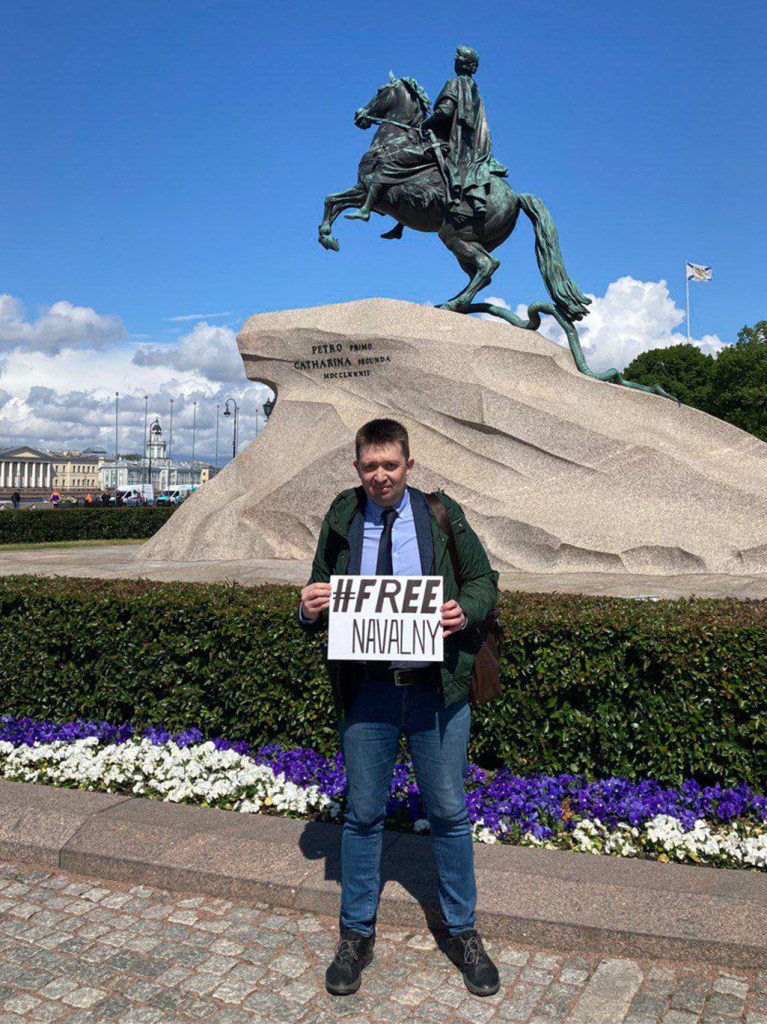
In 2021, I went to a rally in support of Alexei Navalny after he had returned from Germany. Then there was the protest action with flashlights and others. Not only did I attend these events but I also talked about them with my colleagues at work. I was just sharing my pain, not encouraging them to do anything.
Alexander Ivanov, “Gennady Shpalikov: Being Restless” (in Russian, with no subtitles)
Gennady Shpalikov and Guy Debord were nearly the same age, and their popularity peaked at the same time. But is this the only thing that unites the French philosopher and the Russian writer? Alexander Ivanov, founder of the publishing house Ad Marginem, will show that these two figures were connected not only by the time in which they worked but also by the very spirit of the time, which they saw, felt and were able to convey to others.
Debord’s adage “Love is possible only on the eve of a revolution” could well have been endorsed by Shpalikov.
Debord was the founder of Situationism.
An amazing poet, screenwriter, and director, Shpalikov was the Soviet Guy Debord. Like Debord, Shpalikov had an explicitly spatial mind: he understood space not as a receptacle for bodies but as a way of assembling the soul in the gaps, intervals, and flashes of aimless, unprogrammed, slippery movements around the urban environment. Debord called this mode of movement détournement — a deviation, an illegitimate, reverse appropriation in which the spaces and cultural signs captured by other people’s meanings are reappropriated by turning them inside out semantically or simple shifting their meaning. This was exactly how Shpalikov dealt with the anonymous, official space of the Soviet city: by romanticizing its most banal corners and nooks. Both of these artists conjured the mood of an entire epoch in the late 50s and early 60s.
November 1 is the fiftieth anniversary of the death of Gennady Shpalikov, the screenwriter, filmmaker, and poet, one of the symbols of the Thaw era, an extremely popular writer and yet one whose work has been poorly read. Igor Gulin explains how Shpalikov looked for an answer to the question of where good people end up, and how the drama of his characters reprised his own.
Gennady Shpalikov on the set of the film I Am Twenty. Photo: Gorky Film Studio
Screenwriting was an honorable profession in the Soviet Union. Screenwriters were not considered to be craftsmen consigned to the sidelines, but serious writers, and so the screenwriter’s name was listed first in the credits, before the director’s. Nevertheless, not even the best of them were stars. Gennady Shpalikov was an exception. From his very first efforts in cinema, his name was a symbol of the new art of the Thaw — first among his fellow filmmakers, then for a relatively wide swath of the intelligentsia. His death in 1974 was a token of the sixties generation’s demise.
The cinematic Thaw was already in full swing by the time Shpalikov joined the profession. Marlen Khutsiev and Felix Mironer’s Spring on Zarechnaya Street(1956), Mikhail Schweitzer’s The Tight Knot (1957), Mikhail Kalatozov’s The Cranes Are Flying (1957), and Grigory Chukhrai’s The Ballad of a Soldier(1959) had been released, but these beautiful pictures still lacked something that would instill a sense of decisive reform and renewal. Shpalikov carried out a tiny revolution in Soviet cinema — not alone, of course, but he was its leader. He contributed an open sense of form, showing that a movie could be something other than an itinerary from point A to point B. It could be a stroll, a stroll with no clear goals, from one impression to another, from one funny and touching incident to another.
Almost all of Shpalikov’s scripts from the 1960s are just such cinematic walkabouts: A Streetcar to Other Cities (1962), directed by his friend Yuli Fait (1962); The Star on the Buckle (1962) and I’m from Childhood (1966), written for Viktor Turov; I Walk Around Moscow (1963) directed by Georgiy Daneliya; The Wharf and Summer Holiday, which were never made into films; A Long Happy Life (1966), of course; and Ilyich’s Gate (1962–1964) to a great extent. This film was more complicated, however. Khutsiev’s lofty idealism counterbalanced Shpalikov’s nimble gifts, and it was their confrontation and, at times, conflict that gave birth to a masterpiece. This later worked with Larisa Shepitko, when she and Shpalikov agonizingly co-wrote You and I (1971). To produce something truly significant, Shpalikov needed a co-writer-slash-director — a collaborator and an opponent, not a faithful executor of his ideas.
The stroll was the genre not only of Shpalikov’s creative work but also of his life. He existed in the same way, charming everyone he met, traipsing from one crowd to another, from one idea to another. He wrote the same way: on telegram blanks and napkins, not bothering with punctuation and spelling, and often not worrying whether the text was coherent, paying mind to its intonation and pacing, rather than to the idea and the logic of form. His scripts and songs, poems and prose experiments often seem sloppy to a sober eye. But their sloppiness never irritates: it comes across as organic, as a hallmark of authenticity.
Dozens of memoirs have been written about Shpalikov. Their authors constantly wonder aloud how it happened that this carefree, lively man took to drinking heavily and eventually committed suicide. They often blame the era. There is some truth to this, but it is a little different than is commonly thought. The Stagnation was not only a time of disillusionment after the upswing of the Thaw. It was also a time of complication. The members of the Sixties generation who continued to create and grow learned to resist better. It required them to mobilize their inner strength, making them more reflective and deeper. Shpalikov was a genius of splendid superficiality, of drifting and gliding. He understood this perfectly well. The drama of his art kicked off long before the frosts of the Brezhnev era set in.
The same disturbing intuition — sometimes well concealed, sometimes voiced as directly as possible — was evident in everything Shpalikov wrote. Surprisingly, this anxiety was hardly detected by his contemporaries, who remained under the hypnosis of the myth they had created themselves. It concerns the central figure of Shpalikov’s entire oeuvre. What to do with the fact that the “good man,” about whom he always wrote, so easily goes to the bad? What to do with the fact that charming frivolity quickly turns into grim irresponsibility, moral freedom into immorality, the freewheeling life of the tumbleweed into pathetic escapism, and nonstop wittiness into nauseating clownishness? Committed to the utmost sincerity, Shpalikov had an absolute ear for falsity and from the very beginning heard the rudiments of falsity in himself. Perhaps that is why he seemed doomed (and suicidal notes appear in his texts very early on). Drunkenness, however, made it easier for him to accept his fate.
This intuition is almost nonexistent in Ilyich’s Gate, in which the romantics and the bastards are delineated from each other. But it is already present (for the time being, as a quite vague hint) in I Walk Around Moscow (the young Nikita Mikhalkov’s ambiguous charisma works perfectly in this regard). It is also palpable in TheWharf, Shpalikov’s first major feature. (Its director, Vladimir Kitaysky, committed suicide while working on the picture, and the movie was never completed.) The script of The Wharf is an enchanting, airy text centered on a rather savage deed. Coming to Moscow for a single evening, the main character, a barge captain, decides to kidnap his son from his mother, wanders around nighttime Moscow with the boy for a long while, and when he falls asleep on a bench, simply runs away to his barge. A good guy’s transformation into a scoundrel is amped up to wholly Dostoevskyean cruelty in Summer Holiday and A Charming Man’s Day (another script that was never produced). This trajectory devolves into total despair in You and I, in which a Thawnik’s romantic flight to the Far North is played out as an egoistic escape from his own worthless life, frittered-away talent, ruined romance, and lost friendship.
Shpalikov never judges his characters: their meannesses and downfalls just happen. There is no reflection at all in his art. There is only movement, and this movement has its own laws. At the beginning of the trajectory there is a good, harmonious man, but once chosen, the freewheeling life gradually whittles him down to the ugly figure of a cynic, a vulgarian, a scoundrel. Shpalikov has a very frank poem about this:
Аh the streets, the only refuge Not for the homeless, but for those who live in the city. The streets pester and haunt me, They are my comrades and my adversaries.
I don’t feel as if I am walking them, I obey them, I move my feet, And the streets guide me, they lead me Through a sequence set once upon a time,
A sequence of cherished back alleys, A sequence of jaunty notions and good intentions.
The same thing happens in Shpalikov’s only directorial work. A Long Happy Life is usually remembered as a light, lyrical picture, but actually it is chockablock with contempt for oneself and one’s kind. It is a movie about how a typical man of the 1960s, a charming unshaven geologist, runs off into nowhere and away from a beautiful woman, and at the same time from any future, from that selfsame long happy life, simply because he cannot help but run. A lighter note is generated by the finale: the famous five-minute scene of a barge on a river is Shpalikov’s homage to Jean Vigo’s L’Atalante, his favorite film.
This is Shpalikov’s main gimmick. As intoxication relieves a hangover, so the shame of escape is relieved by yet another escape. And if the body can no longer escape, there remain flights of fantasy. Distracted from the protagonist’s mediocre fate, the gaze follows the barge and loses itself in this marvelous tracking shot. All of Shpalikov’s best poems are about the same thing: not about the joy of life, but about the desire to escape from it to a place that is obviously impossible, somewhere “where mother is young and father is alive.” To leave, but not by sinking into drunkenness, illness, and rows, but to disappear gently, to be weathered away from the world. “My head is vacant, / Like a deserted place. / I’m flying off somewhere, / Like a tree from a leaf.”
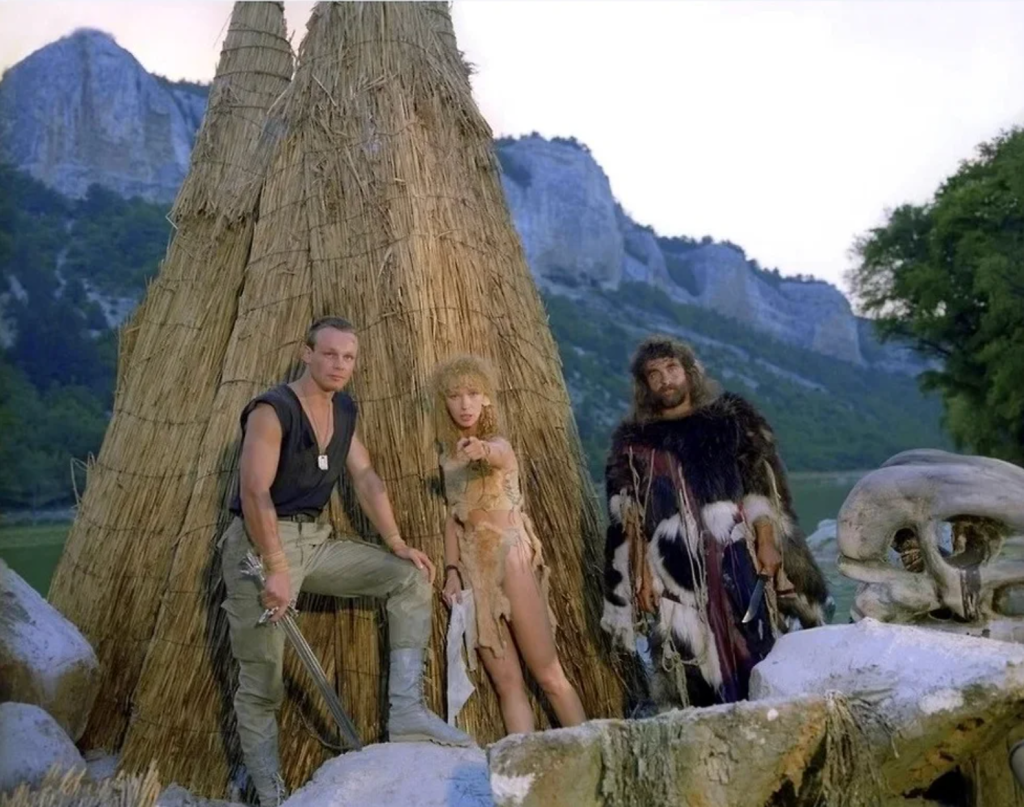
Richard Viktorov, Per Aspera Ad Astra (1981). In Russian, with English subtitles.
Per Aspera Ad Astra/Through the Thorns to the Stars (1981), a new version, in Russian with English subtitles.
Soviet film directed by Richard Viktorov, based on a novel [sic] by Kir Bulychev. Music by Alexey Rybnikov (original score); Sergei Skripka (conductor).
Yelena Metyolkina as Neeya • Uldis Lieldidz as Cadet Stepan Lebedev • Vadim Ledogorov as Sergei Lebedev • Yelena Fadeyeva as Maria Pavlovna • Vatslav Dvorzhetsky as Petr Petrovich • Nadezhda Semyontsova as Professor Nadezhda Ivanova • Aleksandr Lazarev as Professor Klimov • Aleksandr Mikhajlov as Captain Dreier • Boris Shcherbakov as Navigator Kolotun • Igor Ledogorov as Ambassador Rakan • Igor Yasulovich as Torki • Gleb Strizhenov as Glan • Vladimir Fyodorov as Turanchoks • Yevgeni Karelskikh
The lone survivor of a derelict spaceship is brought to Earth to recuperate and regain her lost memories. Given the name Neeya, a series of events triggers her telekinetic powers and a number of flashbacks reveal her origins on the planet Dessa. A human spaceship returns her to Dessa. The planet is found to be in ecological ruin and run by a businessman who intends to keep it that way. The crew of the ship, aided by their robot and Neeya’s powers, defeat a monster unleashed against them. They repair the planet’s ecosystem and Neeya remains to help rebuild Dessa while the crew returns to Earth.
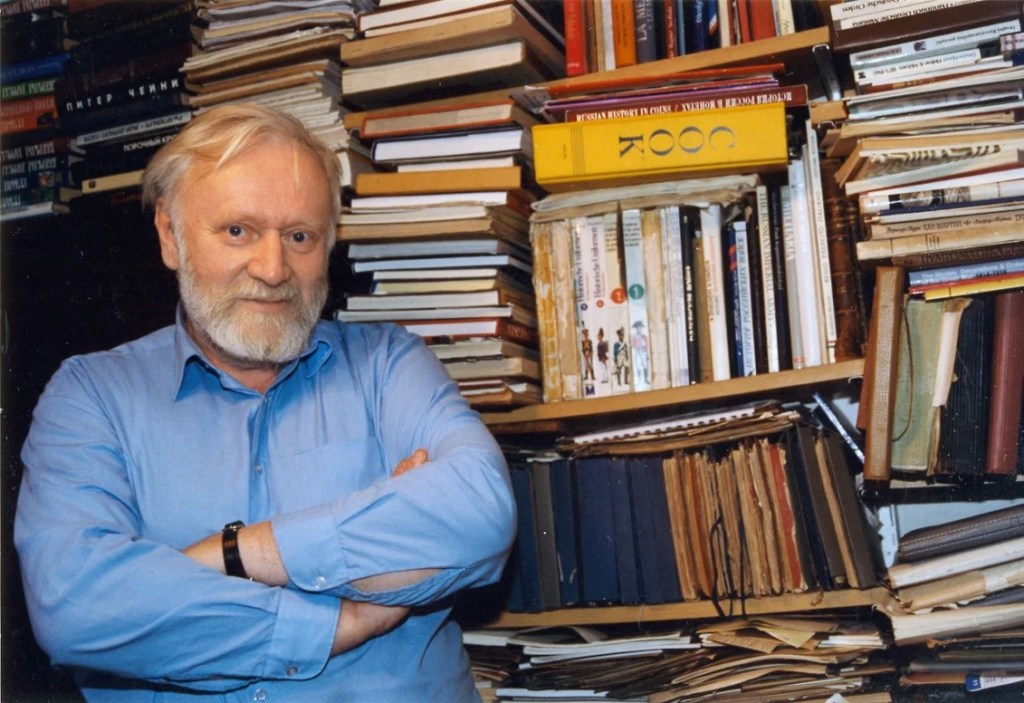
Igor Mozheiko was born ninety years ago in Moscow. Mozheiko was a failed spy, a narrowly focused academic and extraordinarily wide-ranging popularizer and encyclopedist, a passionate collector, a skillful translator, and a great writer. As an author, Mozheiko was renowned under the pseudonym Kir Bulychev, but far from all his accomplishments are well known.
Soviet science fiction writer Kir Bulychev (aka Igor Mozheiko) Photo: Ogonyok magazine photo archive/Kommersant
The Darling
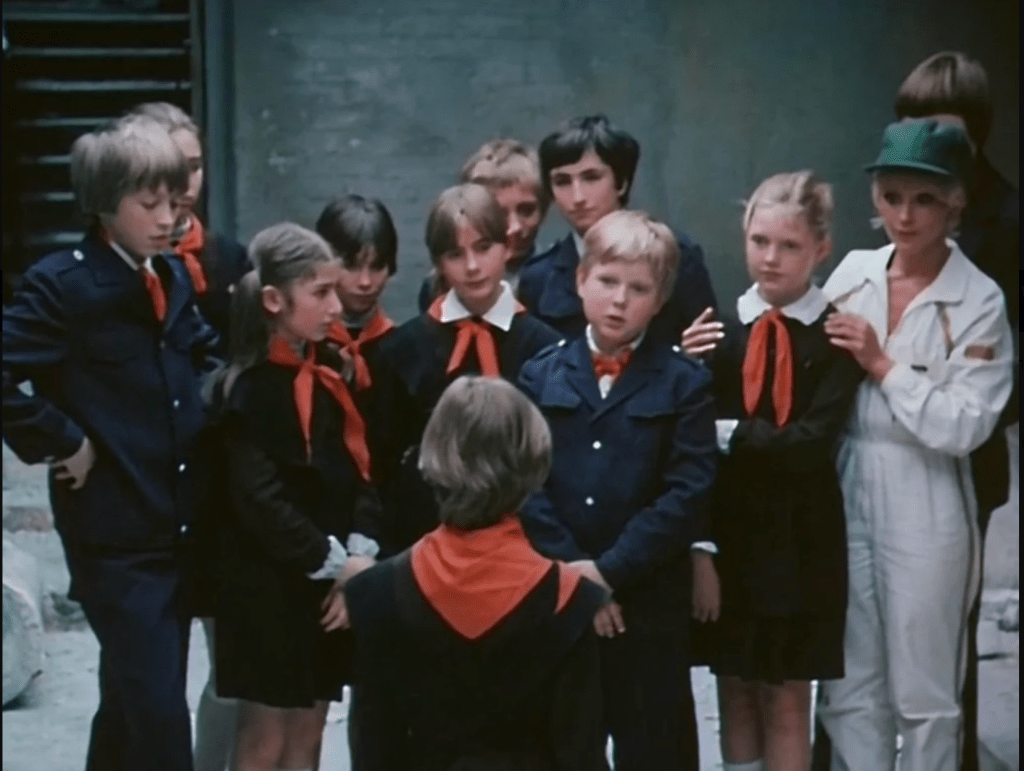
The popular take on the happy Soviet era is founded, as we know, on the realities of the final Five-Year Plans. The cultural component of these notions consists almost entirely of cinematic images and lines from movies. The enormous eyes of Natalya Guseva and Yelena Metyolkina, the ominous Turanchoks, the catchphrases “I have the mielophone” and “He will turn speckled purple,” jokes about the android Werther and, of course, the song “The Beautiful Afar” stole the hearts of thousands of Young Pioneers.
Thanks to clever mental gymnastics, for many of these erstwhile Young Pioneers the beautiful afar speaks not from the future, which they would have had to make happen, but from the past, when Young Pioneer ties were redder, ice cream tasted better, and friendship was stronger.
The key creator of this beautiful afar was Kir Bulychev, the screenwriter and author of the literary works on which these movies, TV series and cartoons were based.
It is impossible to argue with this, as well as with the fact that this reputation would amuse, if not offend, Bulychev. He explained the popular love for science fiction by the fact that “any alternative reality was hostile to communist reality,” and in the Theater of Shadows series he turned the concept of yesterday into a dusty boring hell in which scoundrels perpetrate madness.
The cinema noticed Bulychev late, and at first not as a writer, but as an imposing extra. His beard and his friendship with novice actors got the young Orientalist a role in the film Hockey Players (1964) as a silent sculptor who beautifully shares the screen with a portrait of Ernest Hemingway. The first screen adaptation of his work — based on the story “The Ability to Throw a Ball” — happened twelve years later in Alma-Ata, and after that his cinematic career was up and running.
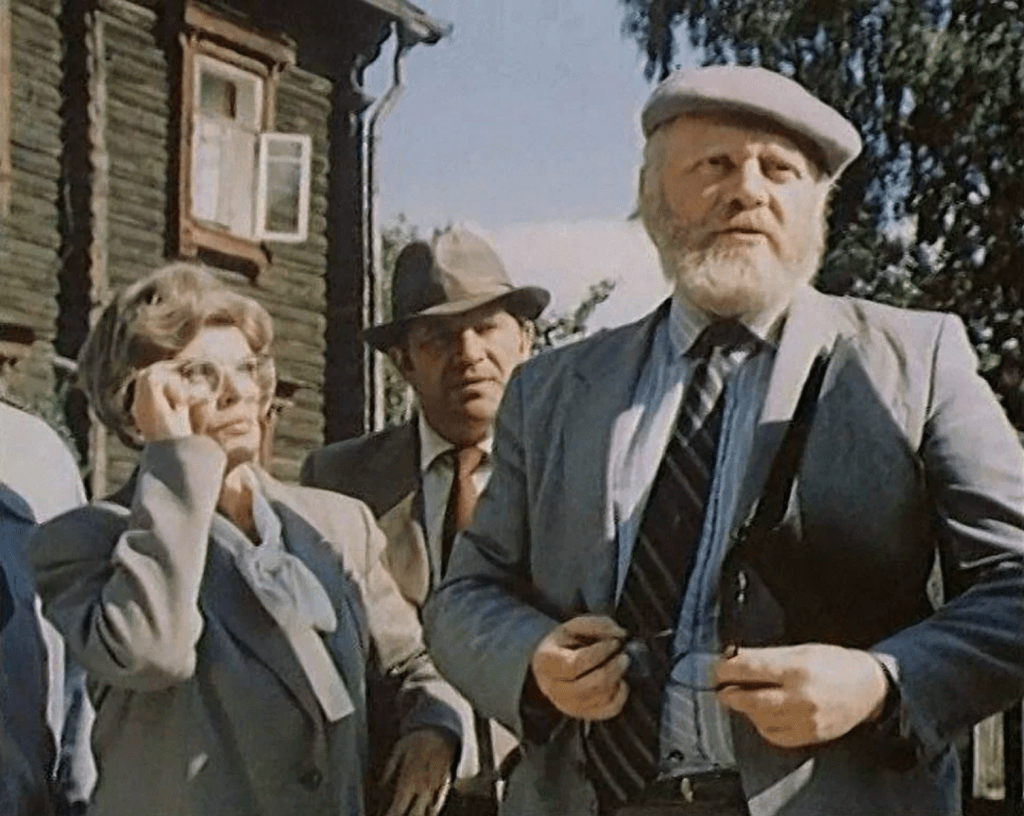
Writer Kir Bulychev, aka scholar Igor Mozheiko, in the film Birthmark, based on a story from his collection Aliens in Guslyar: Photo: Mosfilm
Bulychev’s stories were adapted by both novice filmmakers and the country’s leading directors. A vivid example in all senses is Georgiy Daneliya’s Tears Were Falling (1982). Bulychev’s plots were the basis for comedies (Chance, 1984), action films (The Witches Cave, 1989) and slapstick tragedy (The Comet, 1983). Some of the stories have been adapted more than once. For example, “The Ability to Throw a Ball” was reshot for Central Television twelve years after the first adaptation, and another twelve years later in Poland. The story “Abduction of the Wizard” was made into a two-part television play in Leningrad in 1981, and into a feature film in Sverdlovsk in 1989. It is superfluous to remind readers of the fresh remake of Guest from the Future into the science fiction film One Hundred Years Ahead(which diverges almost entirely from its source), but it does make sense to note that this year the television series Obviously Incredible, based on the Veliky Guslyar series, was released.
There are a lot of questions raised by the 1989 film adaptation of The Witches Cave, but they definitely don’t involve the plot and the cast. Photo: Gorky Film Studio
In his memoirs, which Bulychev wrote in 1999, four years before his death, he said, “I did not make a noticeable mark on the cinema.” Since then, the number of films, cartoons, and TV series based on his texts has increased by a dozen. Now approaching fifty, this number will clearly continue to grow.
Sanctuary
The adventures of Alisa Seleznyova, as played by Natalya Guseva, deprived Soviet schoolchildren of sleep, but they were seemingly the least worried about the mielophone. Photo: Gorky Film Studio
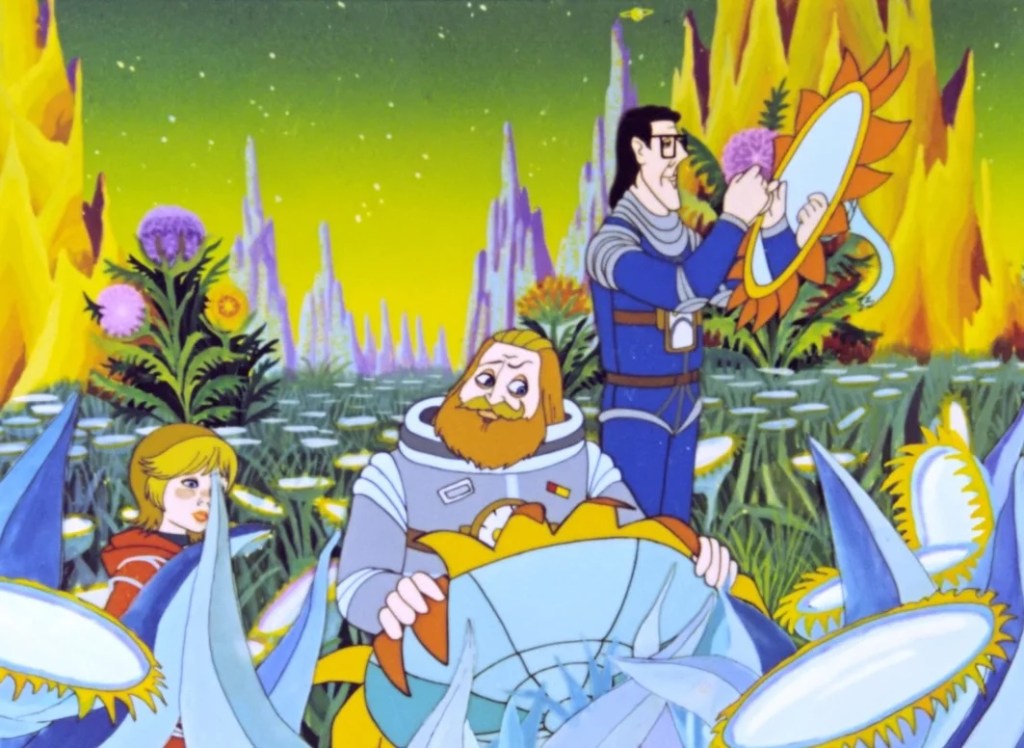
Kir Bulychev became the number one Soviet science fiction writer in the early 1980s. He was awarded two State Prizes at once — for his screenplays for The Mystery of the Third Planet and Per Aspera Ad Astra, thus revealing at last the real man behind the pseudonym. Previously, few people had known that the mega-popular books were written by an Orientalist specializing in Burmese history.
He proved to be one of the few science fiction writers whom editors were not ashamed to publish and who were safe to publish. This was a massive virtue in an era in which the people in charge were guided by the slogan “Fiction is either anti-Soviet or crap” (said to Boris Strugatsky by a Leningrad filmmaker) or “I divide socially engaged science fiction into two kinds: the first I send to the trash bin, the second to the KGB” (related to Mozheiko by an editor at Molodaya Gvardiya, the only dedicated publishers of new Russian science fiction at the time.)
The film A Guest from the Future was window into another world for many Soviet children. Photo: Gorky Film Studio
In the early 1980s, the Soviet Union was going through the so-called gun carriage races (a series of funerals for the country’s rapidly expiring leaders) and the unnamed Afghan war, and butter and meat rationing cards were introduced in some regions at the request of workers. Meanwhile, schoolchildren were being readied for nuclear war by taking them out of classes for practice runs to bomb shelters, which in most cases were nonexistent. And the cries of punks (who, according to Soviet propaganda, were exemplars of decadent petty-bourgeois ideology, and sometimes even neo-Nazis), “No future for me,” resounding from the other side of the Iron Curtain, resonated painfully in immature hearts, and they did not presage confidence in the future.
The Olympics proved a poor substitute for the communism promised by 1980. The Food Programme, scheduled to run until 1990, was little inspiration, and the world’s most advanced ideology could not offer any more attractive image of the future. But Kir Bulychev could and did.
The animator partly modeled the characters in Mystery of the Third Planet on her own relatives. Image: Soyuzmultfilm
He brought Alisa Seleznyova into every home and the dreams of man. Even more importantly, he became a major source of intellectual entertainment, a kind conversationalist and a sensitive shepherd for a vast army of Soviet teenagers. Bulychev’s stories and novels were printed in most children’s newspapers and magazines, which were widely available, unlike the books (especially those with illustrations by Yevgeny Migunov), and anyone could try his or her hand as a co-author. Mozheiko agreed to publish two of his novels in Pionerskaya Pravda in an interactive mode: the author took into account the suggestions and wishes sent by Young Pioneers by mail in each new installment.
Neither children, their parents, nor any normal person could resist the world described vividly and painstakingly in his books: a prosperous, bright and fascinating world with no ideology at all, a world in which a girl can fly not only to the Medusa system, but also abroad, dress beautifully and easily break century-old Olympic records, descend to the seabed in the arms of dolphins, fight with pirates, make friends with Baba Yaga, sit down for a chat with her teacher, know all languages and basically everything in the world, while being friends with whomever she wants. She is A Girl Nothing Can Happen To.
It was a world of private interests and emphatically personal growth rather than a collective existence based on the principle that the majority were always right. It was a world of tenderhearted people, where only pirates were evil and only robots were stupid.
It was a world in which one would like to live, like the Noon Universe of the Strugatskys, only tailored to younger and middle-aged children. “Let’s give the globe to children,” sang Sofia Rotaru, and nobody believed it, but what if we could do it? Everything was free, everything was cool, you didn’t have to die at all, and there were vending machines on the streets dispensing free ice cream and soda of all sorts. And there was no communism, capitalism and other historical materialisms, no Young Pioneers, Komsomol members, Communards and Soviet power, no giant monuments to Lenin looming over Sverdlovsk, as in the early Strugatsky novels. On the contrary, the Stalinist monument to Gogol on the eponymous boulevard was replaced by a pre-revolutionary one, and the boulevard itself was turned into a jungle complete with cypresses, bananas and monkeys.
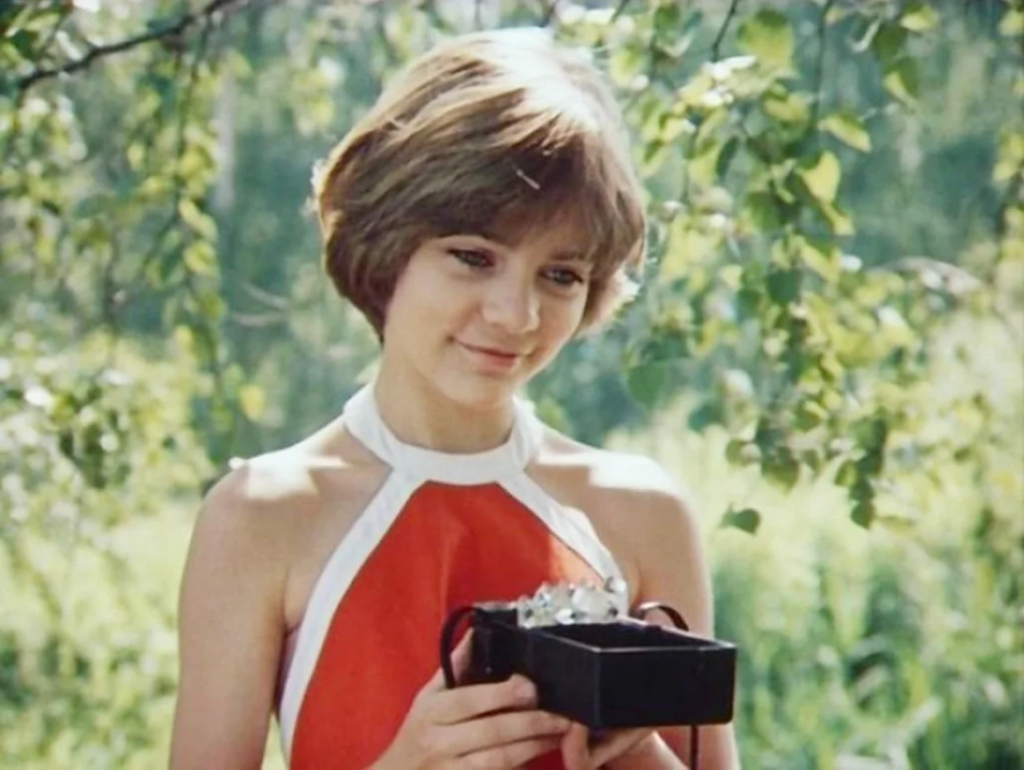
Actress Elena Metyolkina (seated) starred in the film Per Aspera Ad Astra, based on a script by Kir Bulychev, and then appeared as Polina in Guest from the Future. Photo: RIA Novosti
Such an approach was tantamount to an “Attack!” command for conservative editors and their curators in the security services. But it was Molodaya Gvardiya whose internal reviewers noted that “We know what the author is hinting at when he writes that dark clouds were creeping over Red Square” and also pointed out that the author’s secret goal in “Cinderella’s White Dress” was to discredit Soviet cosmonauts. This review, according to Mozheiko, had been written by Alexander Kazantsev, a veteran Soviet science fiction writer and the prototype of Professor Vybegallo in the Strugatskys’ novel Monday Begins on Saturday. The requirements of the publishing house Detskaya Literatura (Children’s Literature) were milder, and the censorship’s scrutiny of it, more lax.
As a matter of fact, a well-fed future in which carefree children bounce between planets had long been a commonplace in Soviet science fiction, but the world was quite sterilely fantastic, the characters were cartoonish, and the action was forced in the works of Vitaly Gubarev, Vitaly Melentyev and Anatoly Moshkovsky.
As painted by Bulychev-Mozheiko, Alisa’s world is natural and authentic.
The girl with with the Carrollesque name made Wonderland beautiful and desirable.
Few people paid attention to the fact that in the original version of the song about the beautiful afar, as heard in Guest from the Future, the voice summons viewers not to “marvelous lands” (as in all subsequent reprints and collections of lyrics), but “to non-paradisal lands.”
In any case, the voice asks strictly.
An Aerial View of the Battle
Science fiction writer Kir Bulychev published serious historical books under his real name. Image: Molodaya Gvardiya
According to a popular legend, Kir Bulychev was born by accident. In 1967, the censors removed a translated story from the upcoming issue of the almanac Iskatel (Seeker), which already had a cover featuring a dinosaur in a glass jar. Replacing the cover would cost a hell of a lot of money and threatened the editors with the loss of their bonuses, so the young feature writer Mozheiko overnight came up with a sci-fi story on the given theme, which he signed with a pseudonym inspired by his wife’s name and his mother’s surname, in keeping with the habit of academics of not blowing their cover in in non-academic outings. The editors kept their bonuses, and world literature gained a new author.
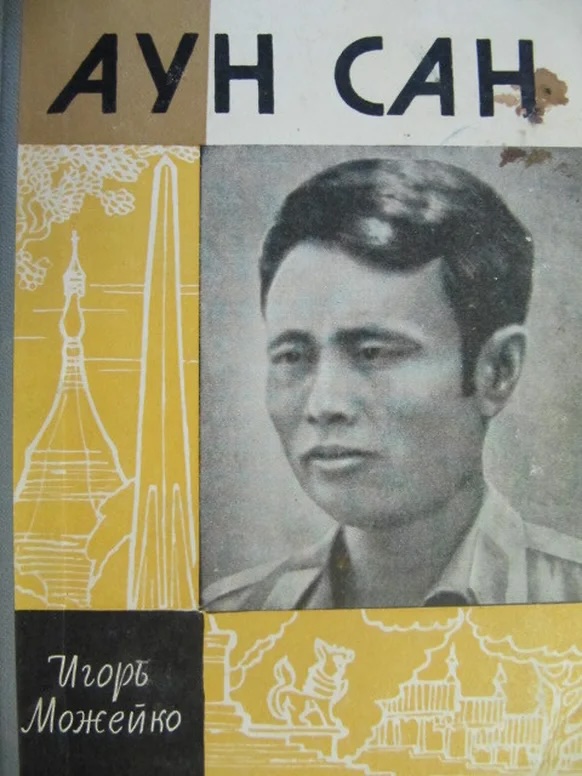
The legend, of course, is false. By 1967, Mozheiko had already published four books, including a very popular one about the Burmese revolutionary Aung San, in The Lives of Remarkable People series. He has also published a couple of science fiction stories under the pseudonym Maung Sein Ji, passing them off as translations from the Burmese. Most importantly, he had published several stories about Alisa under the pseudonym Kirill Bulychev.
As a translator he had debuted a decade earlier, when he published a story by Arthur C. Clarke, which he translated with his childhood friend and future academic colleague Leonid Sedov. Initially, the pals had offered the publisher their translation of an unknown book about a girl who fell down a rabbit hole into a magical land. The young men had no clue about the book’s cult status beyond their one-sixth of the world nor about the existence of at least four previously published Russian translations. But at least one of the failed translators obviously remembered the heroine’s name.
In any case, Bulychev — initially, Kirill or “Kir.”, then just Kir — was born an experienced author with a steady hand, a broad outlook, a constructive mindset and a quite recognizable style. It was a style capacious and not simple even, but simplified at times, almost, to the point of outright silliness. But only almost.
The life of Soviet individuals was subject to a set of unwritten rules that changed markedly from department to department and from decade to decade. Mozheiko learnt them early —because there was no other way.
He was born into the family of a prosecutor from the Middle Volga region and the commandant of the Shlisselburg Fortress. However, by that time the fortress had been turned into a chemical warehouse. His mother had gone into the reserves before her maternity leave, and came to work as a rank-and-file staffer at a chemistry institute. His father soon took the post of Chief Arbitrator of the USSR (a position similar to the chair of the Supreme Arbitration Court), but by that time he had already left the family. Igor’s stepfather, who had fought through the entire conflict, was killed on the last day of the Second World War. Igor and his sister and mother survived bombings, evacuation, a return to Moscow and starvation.
He learnt to read late, fell in love with science fiction early and started writing it, went to a “special faculty for future intelligence officers,” which “was modestly called the translation department of the Institute for Foreign Languages,” and twice dodged KGB drafts (after graduation and as a correspondent for the APN news agency in Burma) and escaped into academia, which he combined with popular science journalism from the very beginning.
As a translator he worked on Zarubezhstroy construction projects in Burma, Ghana and Iraq. As a correspondent for the magazine Vokrug Sveta (Around the World) he journeyed to the most exotic fringes of the Soviet Union, and as a simultaneous interpreter he traveled in Europe and the USA. “Asimov greeted me with a handshake, Harlan Ellison chatted with me, I heard [Clifford] Simak speak, I argued (I was so brazen) with Frederik Pohl, I appeared on the radio with Lester del Rey, and I palled around with James Gunn, but most importantly I spent a whole day drinking with Gordon Dickson and Ben Bova, not to mention his gloriously beautiful wife, Barbara Benson,” recalled Mozheiko. This, of course, was not only unimaginable for most venerable Soviet writers, but also for the so-called Gertrudes — the Heroes of Socialist Labor [Geroi truda] who led the Writers’ Unions for decades.
Mozheiko himself never joined either the Writers’ Union or the Communist Party, flatly refusing the most persistent invitations. The explanation “I consider myself unworthy” did the trick, but just barely. When it didn’t work, Mozheiko changed jobs.
This, by the way, enabled him to keep his beard, since the recruiters from state security, or high-ranking guests like cosmonaut Valentina Tereshkova insistently advised him to shave it off. (“As a correspondent for APN, I photographed cosmonauts for our newspaper. Valentina Tereshkova sent back one of the photos I had given to her with the following autograph: ‘Your wife should make you shave off your beard. After all, a person’s dignity is determined by their character, not by their personality.’ Our guest believed that personality was the nose and the ears.”)
Mozheiko was no longer allowed to travel abroad after 1970, but at least he did not go to jail with several of his acquaintances, passionate collectors like him who were handed lengthy prison sentences in the so-called Case of the Numismatists. (Dozens of lines in the indictment amounted to nothing more than “Defendant No. X criminally exchanged one coin for another.”)
And he continued to write.
The Academicians’ Reserve
The talking tiger in Two Tickets to India, a cartoon based on Kir Bulychev’s screenplay, has an unearthly charm. Image: Vitaly Karpov/RIA Novosti
Mozheiko’s reputation as a supremely tenderhearted storyteller was reinforced by his appearance and his work for Detskaya Literatura, but he was actually quite a tough-minded author. Bulychev’s first novel, The Last War, deals with the aftermath of a nuclear armageddon: even if it was set on another planet, such topics were not encouraged in Soviet literature. A couple of years earlier, a scene depicting a tactical nuclear strike was thrown out of the magazine version ofInhabited Island, by the Strugatskys, and the book edition was put on hold for two years. The release of The Last War in the same series (The Library of Adventure and Science Fiction) seemed to pop the cork, so Inhabited Island was also published, but both books waited twenty years to be reprinted in the capital.
A considerable portion of “Abduction of the Wizard” is given over to a quasi-documentary account of brilliant children killed in childhood by Nazis, pogromists and torpid relatives. In the prologue to the story “A Pet,” the touching rendezvous of a young couple ends with the words, “They were incinerated.” And the protagonist of the later story “A Plague on Your Field!”, whose son has died of an overdose, dooms a outsized segment of humanity to starvation in order to take revenge on the drugs mafia.
Bulychev was also quite decisive in interviews and in correspondence with dissatisfied readers: “I beg you: stop reading me. Spare your nerves.” He spared himself even less, however, and he repeatedly explained this in his final years. “I had no willpower, no courage, no determination to oppose the authorities. Yes, I was duplicitous. I wrote certain things for myself, for my friends. I’m not a battler by nature. Since I lived in our country, I went to my job at the institute and was certain that I would die under unfinished socialism.”
The phrase about his job is significant: censorship troubles occasionally threatened him not only on the literary front, but also on the academic one. A good illustration is the 1966 popular history book about the colonizers of Southeast Asia, With Cross and Musket, whose depth and unconventionality overwhelmed readers and amazed experts. Mozheiko wrote it in collaboration with Leonid Sedov and Vladimir Tyurin. Sedov, his old friend and now a prominent Khmerologist, resigned from the Institute of the Peoples of Asia after Warsaw Pact troops invaded Czechoslovakia. Tyurin, a specialist on Malaysia, was declared a defector and dismissed fifteen years later. (Subsequently, however, he returned safely and was reinstated to his post.) The book has never been reprinted.
But Mozheiko published many other scholarly and popular scholarly books, including those dealing not only with his main subject of study, the history of Myanmar.
It is time to mention the encyclopedia Nagrady (Honors; 1998) and the fact that Mozheiko spent the last ten years of his life as a member of the Presidential Commission on State Honors developing the country’s current system of state honors, based on the traditions of the Russian Empire.
Mozheiko’s fundamental study of piracy, In the Indian Ocean (later published as Pirates, Corsairs, Raiders) also deserves special mention, as well as the absolutely revolutionary monograph 1185, a cross-section of one year in world history, focused on events which the author considered crucial in many senses.
Reviewers noted with some bewilderment that individual people’s motives and feelings are far more interesting to the historian Mozheiko than historical processes and the movements of the masses, and even more so than quotations from the classic Marxist-Leninist authors (defiantly ignored even in a book published on the fiftieth anniversary of the October Revolution).
The River Chronos
The animated film Alisa’s Birthday was produced in 2008, marking Alisa’s rebirth in the twenty-first century. Image: Cinema Panorama
The writer Bulychev declared his humanism with his trademark rigor. “There is nothing in literature but man,” he explained in an ancient interview (in 1980). Bulychev’s texts, which are chockablock with miracles, journeys through time and space, incursions of fairy tale into reality and vice versa, are populated by nothing but people, or rather, by what he identified as the typical triad of “man, society and time.” That is why his work is still massively reprinted and, more significantly, still massively read, along with the Strugatsky brothers and Vladislav Krapivin. Other stars of Soviet science fiction have not passed the test of time much less well.
Bulychev pointedly assigned himself on a lower shelf. “If God has not given me the talent of Tolstoy or the Strugatskys,” he said, “I am to some extent willing to compensate for this deficiency through hard work,” while also stipulating, “I can usually spare two months a year for science fiction.” After the collapse of the Soviet Union, the reason for the stipulation, apparently, became less pressing. In any case, the author’s productivity increased manifold, if not by an order of magnitude.
According to his own estimates, Bulychev wrote a total of fifty volumes: a dozen were popular science books, another dozen were children’s science fiction, while the rest were science fiction for adults. Understandably, the most visible and talked about were the works in the Alisa Seleznyova series, almost fifty novellas, most of them pounded out in the post-perestroika years in frankly machine-gun mode. Only the first five or six of them are actively reissued nowadays, which is not surprising.
Puppet animations based on Kir Bulychev’s series about the town of Veliky Guslyar are less renowned than the drawn stories about Alisa. Photo: Kuibyshevtelefilm
Almost as popular is the series about Veliky Guslyar: a hundred stories and seven novellas, alternately ironic and mocking, about the inhabitants of a provincial town teeming with aliens, and rife with paranormal phenomena and outright devilry.
Fans of old-school science fiction love the Doctor Pavlish series, about a space doctor facing generally insoluble ethical dilemmas.
Bulychev himself appreciated the River Chronos series, which plays with the twists and turns of Russian history. The author always gravitated to such games: back in 1968, he wrote (with no hopes of publishing it) the story “Misfire ’67,” about reconstructors who accidentally cancel the October Revolution.
And yet Kir Bulychev remains in world literature and in the hearts of readers as a genius of the short story — psychological stories for adults about the impossibility of understanding someone else’s mind and feeling someone else’s love and the fierce necessity of it. These stories are told in the same stingy style, which does not distract from their initially unpretentious plots, which conclude quite unsophisticatedly. But they make you catch your breath for a moment, because you recognize them as familiar — as painful and akin and tenderhearted.
Few people call these texts their favorites and keep them at their fingertips for quick infusions of wisdom, but every few weeks, the story “Can I Ask Nina?” suddenly pops up in social networks, messengers, and private conversations, and like an avalanche, everyone starts asking each other, “Have you read ‘The Snow Maiden’? And ‘Professor Kozarin’s Crown’? And ‘Red Deer, White Deer?’”
The list goes on and on and on.
At the end of the Soviet era, Bulychev explained, “I write only what I find interesting. This is unforgivable from the point of view of a reader who loves science fiction of a certain style and school. But it isn’t a shortcoming to me.”
Researchers at INION RAN analyzed depictions of Russia in the history textbooks of CIS and Middle Eastern countries. They found that these textbooks in post-Soviet countries mostly portray Russia as a colonial power.
Most of these textbooks portray Russia as a colonial state which has oppressed the peoples in the annexed territories and damaged their culture, Razil Guzayerov, one of the co-authors of the study and a junior researcher in INION’s Middle and Post-Soviet East Department, told RBC. He noted, however, that often much less attention is paid to Russia’s contribution to the growth of these countries.
According to the authors of the study, “the promotion of false and distorted events in history textbooks shapes a negative attitude towards Russia, and in the future may become the basis for the growth of xenophobia and Russophobia.”
What RAN researchers read about Russia in CIS textbooks
“Colonial politics” in Kazakhstan
According to INION’s analysis, the authors of Kazakh textbooks for eighth graders view the Russian Empire as a country which sought to use Kazakhstan as a platform for its military and economic interests. They note that the Russian Empire’s policy of “military and colonial expansion” was the key element of its relations with the hinterlands. It aimed at establishing control over the new territories, exploiting their resources, and managing their populations.
In a textbook for colleges and universities, the authors criticize the policies of the Soviet regime. They pay special attention to the famine of 1921 in Kazakhstan, brought on by crop failure and drought. The authors note that the prodrazverstka, which by late 1920 had extended to all agricultural products, was regarded by the local population as robbery, leading to growing discontent. The famine, the textbook authors point out, seriously impacted the population of Kazakhstan, triggering mass hunger riots and deaths. According to their data, the population of the region decreased by more than two million people compared to 1914.
In a history textbook for tenth graders, the Russian Empire’s policy towards Kazakhstan is described by the author [sic] with terms like “territorial expansion,” “protectorate,” and “colonial politics.” The textbook characterizes the policy of the Russian Empire in Kazakhstan as “aggressive and ineffective,” citing as an example Prime Minister Pyotr Stolypin’s resettlement policy, which, according to the authors [sic], led to social conflicts and popular uprisings.
“Invasion” of Azerbaijan with the aid of ”traitorous forces”
The establishment of Soviet power in Azerbaijan is referenced in that country’s textbooks as a “military invasion,” which was carried out with the support of “traitorous forces.” Uprisings against the Soviet regime and its “exploitative policy” are described in detail. The authors emphasize that the Azerbaijan SSR was established not by the Azerbaijani people but by Soviet Russia, and that the entire Soviet system was “aimed at satisfying Russia’s interests and ensuring its hegemony.”
“History textbooks for general education institutions in Azerbaijan imagine Russia as a colonial empire. The entire history of Russia is covered as the seizure and occupation of lands with subsequent exploitation of the local population. It is important to note that such anti-colonial discourse is especially exacerbated in new textbooks,” the authors of the collection [sic] write. “The current period of relations between Russia and Azerbaijan is presented in more neutral tones, although Moscow is occasionally accused of supporting Armenia and creating the Karabakh issue.”
Russia is identified in textbooks as the cause of the Karabakh conflict and other negative events in the nineteenth and twentieth centuries. Thus, the ninth-grade textbook The Hstory of Victory describes the coming to power of the “pro-Armenian” General Secretary Mikhail Gorbachev, under whom “the separatists ratcheted up their activities.” The authors of the textbook explain the success of “Armenian separatists” in terms of Moscow’s active support.
The INION researchers also note that the authors of some textbooks seek to introduce a divide between the central and local authorities in the Soviet Union. Thus, in these textbooks, life in the Azerbaijan SSR runs its normal course: while the local government carries out industrialization and raises the standard of living, the central government creates misfortunes for the republic.
The authors of the study detect a tendency towards a strengthening anti-colonial discourse around the Russian Empire and the Soviet Union, a negativization [sic] of the entire historical period which “will eventually cause Azerbaijani youth to reject our countries’ common past.”
“Identity damage” and despotism in Uzbekistan
In a basic history textbook for students at the Academy of the Uzbekistan Interior Ministry, the authors describe the annexation of Central Asia as a violent conquest. They also “refute the opinion of historians that the policies of Tsarist Russia in colonized Turkestan had progressive consequences.” The authors challenge arguments about the construction of railroads, telegraphs, and industrial enterprises in Central Asia.
The textbook argues that any imperialist state “attempts to justify its wars of conquest by various propaganda myths, such as that it brings progress and civilization to the conquered peoples and liberates them from despotism, and they voluntarily join the metropole.” The Russian Empire in this context appears to be just such an “imperialist” state.
The textbook offers a harshly negative characterization of the period when Central Asia was part of the Russian Empire and the Soviet Union. With a few exceptions, such as education, the textbook’s main thrust is that Russia damaged both Uzbekistan’s national identity and its economic prospects.
Eradicating the Basmachi and transiting to a settled way of life in textbooks in Kyrgyzstan and Tajikistan
According to INION’s analysis, textbooks in Kyrgyzstan and Tajikistan describe Russia’s influence more positively. Textbooks in Kyrgyzstan thus indicate that relations between Russia and Kyrgyz tribes evolved in different ways at different times — from moderately hostile attitudes to petitions by the Kyrgyz to join the Russian Empire. The authors positively assess Kyrgyzstan’s accession to the USSR, which enabled the Kyrgyz to grow their economy, education system, and industry, and marked the final transition to a settled way of life.
The Soviet period is generally not regarded and, most importantly, not depicted in a negative way by [the country’s] scholars, the researchers point out.
Tajik history textbooks positively assess the actions of Soviet Russia during the civil war in the country [sic]. They point out that Soviet troops were the main force protecting the local populace. The textbooks also note Russia’s contribution to the growth of science in Tajikistan.
In general, Tajik historians assess positively the rise of the Communists to power in Russia, which subsequently led to the attainment of independent statehood by the Tajik nation. And yet, Russia during the Tsarist period is assessed negatively as an imperialist power. Soviet policy is evaluated positively for “eradicating the Basmachi,” and for contributing to Tajikistan’s agriculture, industrialization, culture, and education. Although “individual problematic points” are also noted, they are described as inevitable parts of a complex historical process.
What RAN researchers read about Russia in Israeli and Iranian textbooks
Israeli textbooks describe the Russian Empire and the Soviet Union as anti-Semitic states, while many positive aspects of bilateral relations between Israel and the USSR, especially during the Jewish state’s emergence, are ignored, according to INION.
Russian policy in Iran is often associated with interference in the country’s internal affairs and support for regimes favorable to the empire. Iranian historians present Russia as an aggressor implementing a policy of “expansion” into territories formerly belonging to Persia. The authors also draw attention to the consequences of the Russo-Persian Wars for the mindset of the Iranian people. They see these wars as emblematic of colonial domination and loss of sovereignty.
A textbook for eleventh graders ambiguously assesses the founding of the Tudeh Party of Iran, whose purpose, according to the authors, was anti-government agitation and the forcible secession of Southern Azerbaijan and the country’s northern regions. The textbook notes that the party, which was supported by the Soviet Union, was a factor of destabilization in Iranian society, causing tension and threatening civil war.
Moscow’s provision of arms, military specialists and technical support to the Iraqi army, including Soviet military equipment and missiles, is seen as a factor that complicated the Iran-Iraq conflict and caused great harm to Iran.
According to Murad Sadygzade, president of the Center for Middle East Studies and guest lecturer at the Higher School of Economics, such descriptions of events in history textbooks are not distortions of events, but their interpretation from the position of the losing countries.
“In fact, there were three bordering empires — the Russian, Persian and Ottoman empires — which divided territories between them. Textbooks in these countries describe the events from their own point of view. Of course, they may present Russia as a conqueror. But we can say that this is their position as the losing party. This does not mean that these countries have a drastically negative attitude toward Russia and its people,” Sadygzade says.
Sadygzade argues that Russophobia in the countries of the post-Soviet space and the Middle East is not promoted through [the writing and teaching of] history. Rather, “there are only some figures who try to present it in such a way so as to drive a wedge between countries.”
Diplomatic disputes over textbooks
In August, the Russian Foreign Ministry criticized an Armenian history textbook for the eighth grade, saying that it “depicted events in the South Caucasus during the late eighteenth and early nineteenth centuries in a distorted manner.”
The Foreign Ministry detected an attempt to revise the outcome of the Russo-Persian War of 1826-1828. “The Treaty of Turkmenchay is labeled as nothing other than the ‘annexation’ of Eastern Armenia. Such a framing is capable of causing consternation for any historian,” the ministry said. It noted that the treaty, which ended the Russo-Persian War of 1826–1828, has so far been regarded as having “colossal significance for the future restoration of Armenian statehood.” Moscow viewed this interpretation as “another shameless attempt” to rewrite the common history “in the best traditions of Western propaganda and political engineering.”
As a result, the authors promised to make changes to this chapter of their textbook.
On September 26, Konstantin Zatulin, first deputy head of the State Duma Committee on CIS Affairs, Eurasian Integration and Relations with Compatriots Abroad, voiced concern about the way Russian history was portrayed in foreign textbooks. “I am certainly concerned, as we all are, about the interpretations that are permitted everywhere and anywhere outside of Russia, when it is depicted in a different way than we would like in the national versions of the history of the newly independent states,” he said during a discussion of a draft law on an agreement that would establish an international educational center for gifted children in Tajikistan. According to Zatulin, the Education Ministry and the Foreign Ministry were obliged to respond to all “unfriendly phenomena” in neighboring countries.
RBC sent a request to the Foreign Ministry and Rossotrudnichestvo to provide their own assessments of INION’s finding.
Crimea’s Tatars: “They drive us from our homes, just as they did to our grandparents 80 years ago”
By Katya Aleksander, who interviewed activists supporting more than 100 Crimean Tatar political prisoners. First published in Russian by Important Stories (Vazhnye Istorii)on 18 May, the 80th anniversary of the deportation of the Crimean Tatars.
On 18 May 1944, eighty years ago, the Soviet government accused an entire people of “collaboration with the Nazis” and “betraying the fatherland” – and deported the Tatars from the Crimean peninsula. It took the Crimean Tatars more than forty years of constant struggle to return to Crimea. But in 2014 the peninsula was annexed by Russia. The war began, and, with it, repression by the new authorities on a massive scale.
Political prisoners Tofik Abdulgaziev, Vladlen Abdelkadyrov, Izzet Abdullaev, Medzhit Abdurakhmanov and Bilial Adilov, among those falsely accused of “terrorism” and “preparation to seize state power” in 2019, and sentenced to 12-14 years’ imprisonment. Abdullaev’s T-shirt says, “the truth can not be imprisoned, killed or hidden”. Photo by Crimea Solidarity
On the anniversary of that tragedy, which Ukraine demands be categorised as genocide, Important Stories spoke with Crimean Tatars who continue the struggle to live freely in their historic homeland.
Every Crimean Tatar family has its stories of deportation. They all start in the same way. On 18 May 1944, at five o’clock in the morning, soldiers burst in to the house and gave people 5-10 minutes to collect their belongings and go to the nearest train station. No explanations. At dawn, everyone was forced into cattle wagons and taken away.
It was all over by 4:00 pm on 20 May: one of the fastest deportations in world history. All the deportees’ property passed to the Soviet state.
“Many people thought they were being taken away to be shot. The Soviet Union was an atheist regime, and many Crimean Tatars were of Islamic faith”, said Azime (her name has been changed), the wife of a present-day Crimean Tatar political prisoner. Her family were deported to Uzbekistan.
“They put everyone in cattle wagons, with no windows and locked doors. There was no sanitation. No water, no food. People died from hunger, thirst and dysentery. The soldiers just threw their bodies out at the train stations. Some people were able to hide their relatives’ bodies: those families hoped that they would soon arrive somewhere and be able to bury their loved ones like human beings.”
The transport took 2-3 weeks. About 80 per cent were taken to Uzbekistan, and the rest were sent to special places of exile in other parts of the Soviet Union.
“Part of my family was deported to Uzbekistan, part perished in those cattle wagons, and my grandfather was taken to the Urals”, said Ismail (his name has been changed), who today acts as a defence lawyer for Crimean Tatars. “Grandad said that, while he and his mother tried to find accommodation, they could not go to work for two days. And so [for breaking the labour laws] his mother was sent to prison for five years.”
Soviet propaganda prepared local people to receive the deportees. Uzbeks were advised to keep well away from the newcomers, who were “cyclops” and “cannibals”. In exile, Crimean Tatars faced hunger, dangerously unsanitary conditions and an absence of health services. Between 18 May 1944 and January 1946, about 200,000 Crimean Tatars lost their lives, according to estimates by the National movement.
The struggle to return home
People could not return to Crimea. Until 1956 the Crimean Tatars had the status of “special settlers” with limited civil rights. They had to report regularly to police commandant’s offices. They were permitted to move to a different region only by invitation from close relatives. Attempts to leave without permission were punished by up to ten years’ imprisonment.
Although their language was banned, the Crimean Tatars preserved their culture and traditions. Parents told children what their home looked like, and how to get there, so that they could find their way to it when they returned.
“Everyone lived with thoughts of going back”, Ismail said, telling his family’s story. “My uncle somehow found a way to travel to Crimea. My grandmother asked him to bring a bottle of water from home: she wanted to drink Crimean water. When my uncle got back from his trip, he realised that he had forgotten about the water. He took a bottle, filled it from the tap, and took it to Grandma [telling her it was from Crimea]. She cried. For her, that bottle was almost sacred. She kept it, and never drank a drop.”
In the 1960s, the Crimean Tatars began independently to collect information about the victims of the deportation. They demanded that the Soviet authorities revoke the slander that they were traitors, and allow them to return home. That is how the Crimean Tatar national movement was born.
On 5 September 1967, after many attempts to secure justice, came a decree of the Presidium of the Supreme Soviet of the Union of Soviet Socialist Republics (USSR), which revoked all accusations against the Crimean Tatars and allowed them to live in any part of the country. But to return to Crimea, they had to secure a residence permit, and find work. [Residence permits, linked to employment, were used to discipline labour in the Soviet Union.]
By the end of September 1967, about 2000 Crimean Tatars had already returned to the peninsula. But the majority of them could neither get a residence permit, nor any chance of work, from Crimea’s new inhabitants. Many were deported again, and brought to court for breaches of the internal passport regulations.
Azime’s family was one of the first that returned to Crimea and found a way to stay there. “My grandfather, an activist of the national movement, left behind all that he had worked for in Uzbekistan, took his four children, and went home. We are not even talking about returning to his own village, where his grandparents were buried – only returning to somewhere on the peninsula where the family would be allowed to stay. They found a place in Dzhankoi district, where several other [Crimean Tatar] families also moved in. The street was named International Street, because we, the non-Russians, lived there.”
Azime was born at the end of the 1980s, already back in Crimea. Among people of her age, that is very unusual, she said. “I know literally two other people [of her age] who were born back there [on the peninsula].”
[In the 1970s and 80s] the Crimean Tatars had to build their homes all over again. The homes from which their families had been deported now belonged to other people. The work they could find was always the hardest. The attitude of the new local population was hostile: they continued to accuse them of treachery.
“Our grandparents were often dismissed from work”, Azime remembers. “They were constantly searching for new jobs, in order not to be deported again. My mum went to school in Crimea: when the family returned, she was eleven years old. She was admitted to university only on the fourth or fifth attempt. The dean of Simferopol medical school told her father outright that he would not accept Crimean Tatar students, not for any amount of money.
“My mum was the only Crimean Tatar woman in her university. [When her fellow students and teachers learned that she was a Crimean Tatar], she was told to her face that she had no business being there. Many teachers simply marked her work down. Our people felt everywhere that Crimean Tatars were strangers in their own land.”
The Crimean Tatar national movement had already taken shape, and its activists fought for the right to live in Crimea and for the freedom of those imprisoned for breaches of the internal passport regulations. They monitored attacks on human rights, and took part in hunger strikes and other forms of protest. In 1978 the activist Musa Mamut burned himself to death as an act of protest: this became one of the symbols of Crimean Tatar resistance.
But even twenty years after the decree of 5 September 1967, the situation had hardly changed. “The mechanisms to obstruct the Crimean Tatars’ return had been so finely tuned by the Crimean authorities, that I never heard of a single instance of a new Crimean Tatar family buying a house”, the Crimean Tatar activist Bekir Umerov wrote in his memoirs. His family was also prevented from returning to Crimea: in the 1980s they moved to the Krasnodar region [of southern Russia], to be nearer to home.
After the beginning of perestroika [the reform of the Soviet system started under Mikhail Gorbachev, from 1986] in the spring of 1987, the Crimean Tatars gathered in Tashkent [in Uzbekistan] for their first All-Union Assembly. They agreed on a document that called on Mikhail Gorbachev, then the general secretary [of the Communist Party of the Soviet Union] to meet a delegation. This call went unanswered, and so on 18 May, the anniversary of the Crimean Tatars’ deportation, the activist Bekir Umerov announced a hunger strike in protest.
This met with a powerful response, and not only among Crimean Tatars. The scientist and human rights defender Andrei Sakharov mentioned the action in his call to Gorbachev to resolve the problem of Crimean Tatars being able to return home. Umerov ended his protest a month later, when the Second All-Union Assembly of Crimean Tatars elected him to a delegation that travelled to Moscow. But the Kremlin refused to meet the Crimean Tatars, as it had done before.
The activists then began protests at the Lenin mausoleum [on Red Square], at the building of the CPSU Central Committee, at the Kremlin. Each day the number of participants grew. One of the biggest rallies was held on Red Square in the middle of July 1987. The Crimean Tatars staged a peaceful sit-down protest, and the police held back from using force. A week later, on 26 July, more than 1000 Crimean Tatars took part. This time the police blocked the way to Red Square and so the demonstrators went along Vasilevsky Spusk, sat on the ground, raised their placards and shouted: “Crimea! Our homeland!” The action went on for 26 hours.
Many of the participants were arrested and deported from Moscow to the places where they lived. No official documents sanctioning a return to Crimea were issued by the authorities – but there were fewer obstructions.
The Crimean Tatar protests continued through the whole perestroika period.
Occupation of the peninsula
Many families could return to their homeland only after the collapse of the USSR. The move was difficult, even without the authorities interfering. “For more than 20 years, the Crimean Tatars had been finding their feet in the places to which they were deported. They had settled down. And now they had to leave everything again, return home empty-handed, and again start to get on their feet”, Azime explained.
“After all that had happened to our people [as a result of deportation], we stuck closer together and helped each other. My parents told me about how someone had got land in Crimea, gathered 30-40 families and built a house on it together. And then they built another. We are not just a people, we are one big family”, Ismail, the human rights defender, said.
“In general the Crimean Tatars are Muslims. This means a sense of collectivism, which means brotherhood, giving moral support to each other, good neighbourliness. These are traditions going back to the [Crimean] khanate [of the 15th-18th centuries]. The Prophet says, ‘if you laid down to sleep well-fed, and your neighbour was hungry, you will not sense the scent of paradise’. And it makes no difference whether your neighbour is Muslim or not.”
The Crimean Tatars were only able to live a relatively quiet life in their historical homeland for a little more than twenty years.
“It turned out that my generation was the only one, in the past century, who could spend their early years at home, living in peace”, Azime said. “I just recently said to my children that I could not now myself imagine how carefree those years were. We just lived, and did not think that things could be different.”
That life changed at the beginning of 2014. “I was then pregnant with my third child”, Azime recalled. “I was already preparing for the birth when I heard on the news that the Russian [armed forces] were coming. I knew that for decades Russia had imprisoned Muslims simply for professing their faith. I can not tell you how terrified I was, for my child, for my husband, for all of us. Then tanks appeared on the streets, and men in uniform, and the occupation began.”
Some Crimean Tatars decided to move to Ukrainian-controlled territory. Azime and her husband also discussed that, but decided to stay. “We both agreed that here is our home, our land, for which our parents had fought. Why should we leave? It was they who came to us, no-one asked the Russians to come here. We decided that we would not allow Russia to drive us from our homes a second time.”
Most of the Crimean Tatars were against the occupation, and boycotted the “referendum” [of March 2014, on joining the Russian Federation]. Consequently, after the annexation, the Russian authorities took repressive measures: Crimean Tatars were arrested, kidnapped, and accusations under the laws on terrorism were fabricated en masse. People were accused of membership of [the transnational Muslim organisation] Hizb ut-Tahrir, which is banned in Russia. As proof, “secret witnesses” were produced, together with the fact that the accused professed the Islamic faith.
“We did not know what to do”, Ismail remembers. “We did not know the new legal code, or what to do when three brothers by faith were falsely accused of terrorism. From the start, the new ‘authorities’ were determined to show that they would liquidate anyone who opposed Russia. They only wanted people loyal to them in Crimea.”
Ismail himself suffered intimidation and harassment. In 2015 an officer of the Federal Security Service (FSB) planted drugs on him [and he was arrested]. When being questioned, he was asked about Crimean Tatar affairs. They tried to convince him to work for the security services. Thanks to the prominent Crimean Tatar lawyer Emil Kuberdinov, the case did not go any further than the prosecutor’s office.
“At that time the Russians were still trying to work out the extent to which their hands were tied in Crimea”, Ismail said. “But I already understood what was on its way. Crimean Tatar lawyers came on the scene, not only helping people who were arrested, but also support political prisoners’ families, explaining how to send parcels to prison, what to do on prison visits and so on.”
In 2016, Crimean Tatar activists, together with lawyers, formed the Crimea Solidarity organisation.
In 2017, about one hundred Crimean Tatars across peninsula simultaneously staged one-person pickets against Russian repression. About 60 people were served with administrative summonses, for breaching the regulations on picketing (Article 20.2 Part 5 of the code on administrative offences [similar to civil law]). The hearings were all arranged on the same day, in different districts. As well as Crimea Solidarity’s lawyers, the interests of the accused were represented by civil society activists. One of these was Ismail. “People began to offer support to Crimea Solidarity. I did so myself. We had no legal education, but the lawyers helped us to prepare. So the Crimean Tatars continue to help each other.”
Repression under occupation
Criminal cases under terrorism laws have become the main instrument of repression against Crimean Tatars. Military courts deal with these cases in closed hearings that even close relatives can not attend. The sentences under these laws are 10-20 years’ imprisonment.
The Russian security forces have conducted searches at mosques, arrested clerics, cases have been put together alleging failure to inform on “terrorist groups”. Family members of political prisoners have also been subject to surveillance and harassment.
Every arrest and raid becomes a matter for the whole community. People gather at any time of day or night, often bringing children along, to support families who have been singled out for searches. Azime, along with her elder sons, has often gone to support her neighbours. She tells her children not to fear people in uniform, that those people’s fear is even greater.
Azime also prepared the family for the fact that they might be raided at home. Her husband Rinat (his name has been changed) is an activist in the national movement, has written a great deal about the repression of the Crimean Tatars, and has spoken out openly against repression and against the occupation. He had been arrested on administrative charges several times, and the family understood that sooner or later he could face criminal charges. Some time ago Azime started to sleep wearing her clothes and a hijab [expecting a raid].
The security forces came for Rinat at 6:00 in the morning, but he was not at home.
“Before sunrise every day we read prayers. My mother asked me in Tatar (in the family we use our native language) how she would be able to perform ablutions. I told her not to be afraid and to stay calm. The armed men told us that we could not speak in Tatar. That was offensive to me, as a woman and as a mother. They insulted our faith: they said that instead of ‘beating the floor’ five times a day, which should behave like normal people.”
Protesters and Russian armed forces in Crimea, 2014. Photo by Krym.Realii/RFE-RL
During the raid, Azime’s three children were much calmer than she had expected them to be. “I tried to stay confident and not to fear these men and their automatic weapons, hoping that that would also help the children to stay calm. Only my daughter was crying, at the start when she first saw the guns, she is the youngest.
“When I woke up, the room was dark, but I could see floodlights being shone from the street directly into our windows. The shadows were dancing around the courtyard. I understood that it had started. Then wild knocking at the door”, Azime recalled. “I asked my mum to dress and open the door. A big crowd of armed men in masks ran in, shouting. They turned the shelves upside down, everything from outer clothes to underwear. They paid closest attention to the books.
“My sons are still in primary school, I don’t think they understood exactly what was going on. For them it was like something out of a fairy tale, where we needed to defy evil. They did not sit in the corner like mice, but walked between these people with the automatic rifles, as though everything was OK. The men did not touch them. Just once, they tried to find out [from the children] the password for my phone, which I refused to unblock. I did not want them to see photographs of me unveiled.”
It only became clear later how stressful the children had found the raid. “For years afterward, my elder son started to fear the whole world that surrounds him. He thought that the FSB was everywhere, he saw all people as a threat. When we went into town, he would stick close by me and say, ‘I am afraid that they are going to take me away’. For a year or two, my daughter developed a nervous tic. She works with a psychotherapist, but still fears me falling asleep before her, fears being alone.
“At least the children didn’t see how their father was set upon and thrown to the ground with an automatic pointed at his temple. That’s a rare thing for a Crimean Tatar family nowadays. I have talked with the children many times, I saw to them that the Almighty is with us, and that his wisdom also oversees what is happening with their dad”, Azime said.
Wives of Crimean Tatar political prisoners
Azime’s husband was beaten, and arrested, when he travelled to Rostov to deliver parcels to other Crimean Tatar political prisoners being held there. While Rinat’s case was in court, Azime could at least see him at the hearings. But when the sentence was announced, neither Rinat’s wife nor other Crimean Tatars were admitted to court. Rinat was sentenced to nearly 20 years in a maximum security facility, under two Articles of the criminal code: “organisation of the activity of a terrorist group” and “preparation for a violent seizure of power”.
Azime said: “My husband is big, kindly man, like a bear in a cartoon. He went out to work, went to court hearings [of other arrestees], publicised the repression of our people, and always found time for our family. I lived like a princess. And now all that has finished. A new life has begun: I have to survive, and to try to understand what comes next.
“At night I cry into the pillow, so that the children can not hear. I have to learn to do things in the household that were previously done by my husband: what documents have to go where, how to pay for the electricity, how to read the meters. I have had to give up studying and my teaching work. Before all this, I had more time for the children: now I often have to leave them to look after each other.”
Azime’s health has suffered as a result of all that has happened, and she has had two operations. She is supported not only by her family but by the community. “There was a knock at the door, and a woman I don’t know was standing there, offering me eggs and cheese. She said: ‘That’s for you, my dear. You don’t know me, but your husband gave court support to my son.’ Around here there are already many women with the same, bitter experience. I turn to them for advice, about where to buy things for prison parcels, where to send documents for this and that. I am walking along a well-trodden road.”
It is now five years since Rinat’s conviction. In that time, Azime has not been able to meet her husband once. Her only contact with him is through letters, that are passed on by his lawyer. In prison, Rinat has continued to write about the repression against the Crimean Tatars. Azime receives his articles, retypes them electronically, publishes them and sends them out. “My husband constantly writes to me, thanking the Almighty for the fact that his wife is here. He says, ‘when my book comes out, that will be your doing – you are my censor, editor, proof-reader and publisher!’
“Like the wives of other Crimean Tatars, I have chosen to continue the fight taken up by my husband. Up until 2022, we used to travel, to explain what is happening to our people. We were in Kyiv, Kherson and Mariupol. We continue to campaign now, but we can not travel anywhere. Our husbands have been deprived of free speech. Who, if not us, will speak about their cases and convey their arguments? They, also, became activists not by choice. And now we stand in their place.
“In our letters to our husbands, we sound very strong, like stone, their bastion. I always write to my husband, ‘this is your challenge from the Almighty. If you meet it, you will earn yourself a place in paradise’. It’s at night-time that I cry in my pillow. I feel sorry for my husband, and it is hard for me too. I have to be both mother and father to my children; I have to support my husband; and be an activist. But you cry, and you keep going – and that’s how I earn a place in paradise too.”
The all-out war
With the Russian army’s all-out invasion of Ukraine in Feburary 2022], many Crimean Tatars were again forced to leave their homes. The biggest exodus took place when military mobilisation was announced. According to the Mejlis of the Crimean Tatar people [the national representative council, now based outside Crimea], since September 2022 between six and eight thousand Crimean Tatars have left the peninsula. Azime said that Crimean Tatar families that have sons of conscription age try to leave Crimea. “Everyone fears that their sons will be taken by force to the war.”
Ismail said: “Many people have left because they do not want to fight on Russia’s side – although the mobilisation turned out to be more a moral pressure than a physical one. Of those who have been sent to the front from Crimea, only about 5 per cent are Tatars. I reckon that, of those who did go to the front in autumn of 2022, 60-70 per cent have already returned.”
Those who have moved to territory controlled by Ukraine can not return to Crimea, due to the risk of repressive action. In 2023 the Crimean Tatar Leniye Umerova tried to get to Crimea to see her father, who was very ill. She travelled from Ukraine via Georgia. She was arrested at the border on suspicion of spying. Umerova has already spent a year behind bars in Russia. The case will be heard in secret and she is threatened with 20 years’ imprisonment.
Since 2022, repression against Crimean Tatars has been stepped up. The Russian authorities have conducted at least 71 searches, and there have been at least 110 convictions – more than in the preceding eight years. In the autumn of 2022 a second pre-trial detention centre (SIZO) was opened in Crimea: Crimean Tatars, and Ukrainians kidnapped in the occupied territories, are sent there. Since the all-out war began, there have been a much greater number of cases, compared to the previous eight years, related to the “voluntary Noman Chelebidzhikhan battalion of Crimean Tatars”, that has been fighting on the Ukrainian side since 2014.
There was also a wave of repressive measures against Crimean Tatars when parts of Kherson and Zaporizhzhya regions were occupied: about 100 people have been arrested there. Some cases have been initiated by informers who write on the Krymsky SMERSH telegram channel that was set up in 2022.
“Informing has become a big thing in Crimea”, Ismail says. “Someone says something at the market, and that’s it, you get a knock on the door. The regional authorities have acquired an extra repressive tool against the peninsula’s citizens: the Article [in the code on administrative offences] on discrediting the army. There have been many administrative cases as a result, some for people writing comments on social media.”
Azime said: “Today, deportation of Crimean Tatar people takes a hybrid form. Now it’s not in cattle wagons: people are taken away in prison transport vans. From many families they have taken all the menfolk: for example they will take the husband, son and father. I have a neighbour who is 75, they have taken both her sons. Every time I see her she says, ‘my dream is just to be able to hug them once more in this life’.”
Azime has decided to stay on the peninsula, as long as possible. “In our lives we have seen hundreds, perhaps thousands, of families that have been broken up, which fought for so long to be able to return home. I have decided for myself that I will never leave our homeland. We understand that the repression will intensify, that whatever has to happen, will happen.
“What’s the point of cowering like a mouse, of living in fear? If they succeed in shutting our mouths, that would be a betrayal of our people who have suffered so much. We must not stay silent. As long as our husbands are imprisoned, and as long as they continue to try to destroy the Crimean Tatar people, we won’t stop fighting.”
Ismail, too, has no intention of leaving the peninsula. He continues to support Crimean Tatars in court. “I have decided for myself to take this position. I see how the families of my close friends are punished and repressed, how people are imprisoned. As a Crimean Tatar and a Muslim, how should I react? Do I sit here and say, ‘it’s nothing to do with me’ – or give some help. For me, this is a test from God.
“The best example to me in this situation is the Prophet Muhammad. Yasir’s family was taken to the desert and tortured by infidels for their religion. What did the Prophet do? He did not sit at home saying a prayer; he did not stand to one side. He went there, where Yasir’s family was under attack, and gave his support. That shows how we, today, faced with this repressive machine, need to react.
“It does not depend on us, whether they imprison a person or not. But it depends on us what we do, what support we give. Can we help the defence in court? Then we’ll go to court. Can we help the family? Then we will visit their home, bring things that they need, and money, and help with the children.
“For the Crimean Tatars it is very important to preserve our spirit of unity. We have faced many trials. When a person is left to face a problem on their own, that is very hard to bear. If someone just sits down for coffee with that person, and says, ‘you are not alone, we will help you, we are right alongside you’, this helps to deal with tragedy.
“I was recently in touch with the mother, and aunt, of a Crimean Tatar who was sentenced to ten years, in a case related to the ‘voluntary Noman Chelebidzhikhan battalion of Crimean Tatars’. They kept telling me how people had come to visit them, to help and support them, how they felt the support of our people. Without this, they said, they would have been broken.
“Russia is trying to give the appearance that everything is fine in Crimea, and now they don’t lay a finger on anybody. That is a lie. We can show the world that we have already had ten years of this. We understand, of course, that the repressive machine pays little heed to laws, let alone to moral and humanitarian values. If an instruction comes down to lock someone up, they do it, no matter what defence is presented in court.
“But we continue to go to court, to record videos showing how Crimean Tatars face harassment and intimidation. We continue to fight. We don’t keep quiet or swallow all this silently. We will take a stand and say, ‘we are not guilty’. I think that if we had not done this, if we had sat quiet, then Crimea would already have been turned into another Chechnya.”
The links in the article are from the original Russian version, to sources in Ukrainian and Russian. Web sites in English include the Mejlis of the Crimean Tatar people; Crimea Platform, recently launched by the Ukrainian government; the Crimea Human Rights Group; and Crimea SOS. Reports on human rights abuses have been published this year and last by the UN and the Council of Europe. A history of the Crimean Tatars, ‘A Seditious and Sinister Tribe’: the Crimean Tatars and their Khanate, by Donald Rayfield, has just been published, and reviewed. There are more than 100 political prisoners listed (Russian only) on the Crimea Solidarity web site currently detained.
Source: People and Nature, 16 August 2024. Thanks to Simon Pirani for translating this important overview of the Crimean Tatars’ struggle and for permitting me to reprint his translation here.
Alexander Skobov. Photo courtesy of V. Izotov/Deutsche Welle
A new criminal case, on charges of “involvement in a terrorist community,” has been opened against former Soviet dissident and Russian political journalist Alexander Skobov, who has been detained for over a month on charges of “condoning terrorism.” This news was reported on Saturday, 18 May, on Skobov’s official Facebook account by his wife, Olga Shcheglova.
Shcheglova said that she visited her husband on 14 May in the pretrial detention center in Syktyvkar, where he had been transferred from St. Petersburg. During a conversation with him, his lawyer and local police investigators, she learned that Skobov has also been charged with “condoning terrorism” and “involvement in a terrorist community.” The dissident’s wife is convinced that these two charges stem from her husband’s affiliation with the Free Russia Forum.
According to Shcheglova, on 21 May, Skobov will be sent to the regional psychiatric hospital in Komi for a forensic psychiatric examination. Skobov himself has stated that he would not participate in the investigation and forensic expertise, and he would appear in court only if his mother were present at the hearings. Skobov’s defense has filed an appeal, which will be heard by the court on 22 May.
Skobov’s Persecution in the USSR and Russia
On 22 March 2024, Russian authorities designated Skobov a “foreign agent.” According to the Justice Ministry, he had “disseminated unreliable information” about the decisions of public officials, opposed the war, “identified the Russian Federation with a terrorist organization,” been involved in the work of an “undesirable organization,” and produced and distributed “foreign agent materials” [sic], the human rights project OVD Info reports.
In 1978, Skobov was arrested over his active involvement in the Left Opposition group and the samizdat publication of an anti-government magazine. He was later sentenced by the court to undergo treatment at a psychiatric hospital, from which he was released in the summer of 1987.
This time around, the political journalist was arrested on charges of “condoning terrorism.” Skobov was detained in St. Petersburg on 2 April 2024. In protest, the dissident refused to take with him to jail his diabetes medication and his glasses, despite his poor eyesight. According to the Telegram channel Memorial Support for Political Prisoners, the real reason for his arrest was “a [social media] post condoning the bombing of the Crimean Bridge.”
In early April, 66-year-old dissident Alexander Skobov was arrested for allegedly “justifying terrorism” in his posts online. For his friends and family members, the arrest came as no surprise.
Skobov, a long-time dissident who was made to spend seven years in a psychiatric ward after taking part in protests against the Soviet authorities in the 1970s, had published multiple posts condemning Russia’s actions in Ukraine since 2014. In March he was named a “foreign agent”, and since then people close to him said his arrest had seemed inevitable.
“He and I talked a hundred times about the fact that he would be arrested — if not today then tomorrow,” said Skobov’s friend Yuly Rybakov, a human rights activist and former deputy in the State Duma, Russia’s lower house of parliament. “People have been imprisoned for much less.”
Skobov’s 90-year-old mother, whom he lives with and cares for, said she had been having nightmares about his arrest for months before it happened, and Rybakov recalled that Skobov himself said he “didn’t understand” why the authorities hadn’t come for him yet.
Skobov’s children, who moved abroad long before Russia’s invasion of Ukraine, urged their father to flee the country when they saw him in Istanbul in early March. Other friends have also tried to convince him to leave and avoid arrest, citing his many health issues, including severe diabetes, hepatitis C, chronic obstructive pulmonary disease and near blindness.
But, Rybakov said, Skobov was resolute, telling him that he “wanted to be part of his own judicial process” when he was inevitably arrested.
Rybakov said that Skobov had been “driven to despair” by what had been happening in Russia in recent years and “felt that someone had to be radical”.
Another friend, Mikhail Sedunov, said that trying to convince Skobov to change his course of action was like “grabbing the wing of a plane that was already accelerating down the runway”.
On 2 April, masked policemen arrived at Rybakov’s flat, where Skobov had been staying. When Rybakov left to take the dog for a walk, the police reportedly entered the property, threw Skobov to the ground, twisted his arms and handcuffed him. According to Rybakov, Skobov “defiantly” refused to take either warm clothing, his diabetes medication, or his glasses with him, intending these gestures as an “act of protest”.
Skobov’s wife, Olga Shcheglova, managed to buy him replacement medication and glasses, which she brought to him ahead of his interrogation by Russia’s Investigative Committee. But Skobov refused to accept them — a reaction Shcheglova said she had “expected” from her husband.
Resistance to the authorities and a fight for justice had defined Skobov’s life for more than four decades. His first foray into political activism was in 1976, when he and other university students in St. Petersburg scattered leaflets calling for the “establishment of true humane socialism” and the “overthrow of the tyranny of officials” ahead of a meeting of the Communist Party of the Soviet Union. The students were expelled from university and brought before a court, and some, like Skobov, were then sentenced to compulsory treatment in psychiatric hospitals because, according to Rybakov, it was believed that “only crazy people could dislike the Soviet regime”.
Skobov’s radical spirit remained unquelled when he was finally released from hospital in 1981, however, and he immediately joined the Free Inter-Professional Association of Workers, a dissident group that led the first attempt to create an independent trade union in the USSR. In 1982 he was arrested for his involvement with the group and sent back to hospital, where he spent another three years.
In the early 1990s Skobov taught history at a secondary school for gifted students, writing and publishing his own award-winning textbooks. But later in the decade political activism again became the focal point of his life as he took part in protests against the Chechen wars.
When Russia annexed Ukraine in 2014, Skobov took to social media to rail against the regime, openly supporting Ukraine and condemning Russia’s military action. The same year, two unidentified men armed with knives attacked him outside his home in what his friends and family members say they are sure was retribution for his criticism of the regime.
Even this did not deter him, however, and his friends said his statements opposing Putin’s rule became “even sharper, more unrestrained, and more radical”. Speaking last year at the Free Russia Forum, an opposition conference held biannually in the Lithuanian capital Vilnius, Skobov condemned the regime more harshly than any of the other attendees, despite being one of the only participants still living in Russia.
Another friend of Skobov, Nikita Yeliseyev, said he doubted Skobov would survive the 7.5-year sentence that he is almost certain to receive.
“He is an old man,” Yeliseyev said. “And he has a number of very serious illnesses.”
Sedunov said all of Skobov’s actions stemmed from a desire to “struggle, as vigorously as possible, against the obvious evil represented by the current Russian government”.
“This is the way he was brought up: he wanted to fight evil any way he could. And this was the only way left,” Sedunov said.
Aleksandr Skobov has been a thorn in the side of authoritarian governments for more than four decades, from the Soviet era to President Vladimir Putin’s long rule. And now, in pretrial detention in St. Petersburg and facing prison, he is in no mood for compromise.
“On principle I refuse to comply with fascist laws,” he told RFE/RL late last month, shortly after the Russian government designated him a “foreign agent” on March 22. “I don’t intend to get into debates with the government. I will not try to prove my innocence. I will not label my writings, and I will not write any financial reports for them.”
“A criminal case could be launched at any moment,” he concluded.
He was right: On April 3, the 66-year-old was arrested and charged with “justifying terrorism” for a social-media post about the Ukrainian attacks that damaged the Crimea Bridge that links Russia with the Ukrainian region of Crimea, which Moscow occupied in 2014. The following day, a St. Petersburg court ordered Skobov held in pretrial detention for at least two months.
“If you take any of my articles or YouTube videos, you can find a whole bouquet of possible charges,” Skobov said in the March 31 interview. “Discrediting the army. Inciting hatred and enmity. Justifying terrorism. The rehabilitation of Nazism. I directly equate the actions of the Stalin regime with those of Hitler’s during World War II.”
Another reason for Skobov’s prosecution, his supporters believe, is his leadership role in the Free Russia Forum, a group of mostly exiled opposition figures founded by former world chess champion Garry Kasparov and activist Ivan Tyutrin in 2016 that has been declared “undesirable” in Russia. If he is charged with participation in an “undesirable” organization, he could face up to six years in prison.
“I am a member of the forum’s council, and I regularly participate in its broadcasts,” Skobov told RFE/RL. “I help write its statements and official pronouncements. Several of them I have written myself. I am actively involved, and I do not intend to stop.”
Skobov said he was drawn to the group because “it was the only opposition organization that categorically rejected the idea of the peaceful transformation of Putin’s dictatorship toward democracy using the procedure established by that dictatorship.”
“It was the only organization that, beginning with the annexation of Crimea, unambiguously stood by Ukraine as a victim of aggression,” he added. “We try to help the Ukrainian Army and the Russian volunteer formations that are fighting with them.”
Writing on Facebook after Skobov’s arrest, writer and critic Mikhail Berg said Skobov suffered from “an unbearable fear of being afraid.”
“And that is why he chooses the most painful forms of criticizing the authorities,” he wrote. “He shouts even though the authorities have long been destroying people for whispering or even for just opening their mouths.”
Parallel Lives
Born in Leningrad, as St. Petersburg was called then, in 1957, Skobov participated in his first anti-government protest when he was 19. He and other members of an underground organization threw about 100 flyers calling for “humanistic socialism” from the roof of a downtown building on the eve of the 25th congress of the Soviet Communist Party. Several of the protesters were kicked out of their universities, but Skobov — a first-year history student at Leningrad State University — got off with a disciplinary meeting of the Komsomol youth group.
In October 1978, he was arrested for publishing an underground, anti-government magazine called Perspectives. He spent half a year in a KGB prison before being sentenced to forced psychiatric treatment.
“In the late 1970s and early 1980s, political prisoners in Soviet psychiatric hospitals were rarely forcibly medicated, although there were such cases, of course,” Skobov said. “But I was treated more or less OK. Most of the doctors that I encountered tried to avoid playing the role of executioners or stranglers.”
He spent three years in confinement.
In 1982, he was again sentenced to psychiatric treatment, this time for a samizdat article he wrote defending Chile’s former socialist president, Salvador Allende, who died in unclear circumstances in 1973, and criticizing the rightist dictator General Augusto Pinochet. That article was deemed “anti-Soviet propaganda.”
This time, Skobov spent five years in the hospital before being released in the summer of 1987 during the initial phase of Soviet leader Mikhail Gorbachev’s liberalization campaign.
In many ways, Skobov and Putin led parallel lives during this period. Putin was born in Leningrad almost exactly five years before Skobov and studied at Leningrad State University just before him. But as Skobov became drawn into a life of opposition to authoritarianism, Putin joined the KGB secret police.
The president’s official biography insists that Putin always worked for the KGB’s First Directorate, which carried out counterintelligence operations. However, rumors have persisted for years that he worked for some time in the Fifth Directorate, which was responsible for suppressing internal dissent and prosecuting political dissidents. At the time, a senior figure in that department was Viktor Cherkesov, a longtime member of Putin’s inner circle who served as his deputy when he headed the Federal Security Service — the KGB successor organization — in the 1990s and who died in 2022.
In 2022, journalist and researcher Konstantin Sholmov published a photograph of a KGB archival document from 1976 that he said was on display at the Political History Museum in St. Petersburg. The document, a protocol of a search of the residence of Leningrad artist and dissident Oleg Volkov, named “Lieutenant Putin” as one of the officers carrying out the search.
In 2013, a series of photographs emerged showing a 1989 Leningrad protest during which KGB operatives roughly detained dissident Valery Terekhov. One of the men in the photograph resembles Putin. The Kremlin later denied that the man was Putin, saying the future president had already been sent to East Germany by 1989.
Prominent human rights activist Aleksandr Cherkasov of the banned rights group Memorial told the news outlet Agentstvo earlier this month that he believes Putin was involved in the investigation of Skobov. He said Skobov had told him Putin staked out his Leningrad apartment in November 1982 when prominent dissidents gathered to celebrate Skobov’s birthday.
Despite the danger growing around him after he was designated a “foreign agent,” Skobov refused to consider emigration.
“I’m not going to quit,” he said.
“Today anyone in Russia who disagrees with Putin’s Nazi regime is taking a risk,” he added, “even if he doesn’t really stick out or act publicly. Since the regime has already made the transformation from ‘hybrid totalitarian’ to totalitarian, it demands not just silence from its loyal subjects, but active participation. And even avoidance can be dangerous.”
Opposition leader Aleksei Navalny’s suspicious death in prison on February 16 was “to be expected,” Skobov said.
“Navalny constantly laughed in [Putin’s] face, and a dictator cannot stand that,” he added. “Unfortunately, I don’t think it will be the last death of a political prisoner in Putin’s Russia.”