Researchers at INION RAN analyzed depictions of Russia in the history textbooks of CIS and Middle Eastern countries. They found that these textbooks in post-Soviet countries mostly portray Russia as a colonial power.
Most of these textbooks portray Russia as a colonial state which has oppressed the peoples in the annexed territories and damaged their culture, Razil Guzayerov, one of the co-authors of the study and a junior researcher in INION’s Middle and Post-Soviet East Department, told RBC. He noted, however, that often much less attention is paid to Russia’s contribution to the growth of these countries.
According to the authors of the study, “the promotion of false and distorted events in history textbooks shapes a negative attitude towards Russia, and in the future may become the basis for the growth of xenophobia and Russophobia.”
What RAN researchers read about Russia in CIS textbooks
“Colonial politics” in Kazakhstan
According to INION’s analysis, the authors of Kazakh textbooks for eighth graders view the Russian Empire as a country which sought to use Kazakhstan as a platform for its military and economic interests. They note that the Russian Empire’s policy of “military and colonial expansion” was the key element of its relations with the hinterlands. It aimed at establishing control over the new territories, exploiting their resources, and managing their populations.
In a textbook for colleges and universities, the authors criticize the policies of the Soviet regime. They pay special attention to the famine of 1921 in Kazakhstan, brought on by crop failure and drought. The authors note that the prodrazverstka, which by late 1920 had extended to all agricultural products, was regarded by the local population as robbery, leading to growing discontent. The famine, the textbook authors point out, seriously impacted the population of Kazakhstan, triggering mass hunger riots and deaths. According to their data, the population of the region decreased by more than two million people compared to 1914.
In a history textbook for tenth graders, the Russian Empire’s policy towards Kazakhstan is described by the author [sic] with terms like “territorial expansion,” “protectorate,” and “colonial politics.” The textbook characterizes the policy of the Russian Empire in Kazakhstan as “aggressive and ineffective,” citing as an example Prime Minister Pyotr Stolypin’s resettlement policy, which, according to the authors [sic], led to social conflicts and popular uprisings.
“Invasion” of Azerbaijan with the aid of ”traitorous forces”
The establishment of Soviet power in Azerbaijan is referenced in that country’s textbooks as a “military invasion,” which was carried out with the support of “traitorous forces.” Uprisings against the Soviet regime and its “exploitative policy” are described in detail. The authors emphasize that the Azerbaijan SSR was established not by the Azerbaijani people but by Soviet Russia, and that the entire Soviet system was “aimed at satisfying Russia’s interests and ensuring its hegemony.”
“History textbooks for general education institutions in Azerbaijan imagine Russia as a colonial empire. The entire history of Russia is covered as the seizure and occupation of lands with subsequent exploitation of the local population. It is important to note that such anti-colonial discourse is especially exacerbated in new textbooks,” the authors of the collection [sic] write. “The current period of relations between Russia and Azerbaijan is presented in more neutral tones, although Moscow is occasionally accused of supporting Armenia and creating the Karabakh issue.”
Russia is identified in textbooks as the cause of the Karabakh conflict and other negative events in the nineteenth and twentieth centuries. Thus, the ninth-grade textbook The Hstory of Victory describes the coming to power of the “pro-Armenian” General Secretary Mikhail Gorbachev, under whom “the separatists ratcheted up their activities.” The authors of the textbook explain the success of “Armenian separatists” in terms of Moscow’s active support.
The INION researchers also note that the authors of some textbooks seek to introduce a divide between the central and local authorities in the Soviet Union. Thus, in these textbooks, life in the Azerbaijan SSR runs its normal course: while the local government carries out industrialization and raises the standard of living, the central government creates misfortunes for the republic.
The authors of the study detect a tendency towards a strengthening anti-colonial discourse around the Russian Empire and the Soviet Union, a negativization [sic] of the entire historical period which “will eventually cause Azerbaijani youth to reject our countries’ common past.”
“Identity damage” and despotism in Uzbekistan
In a basic history textbook for students at the Academy of the Uzbekistan Interior Ministry, the authors describe the annexation of Central Asia as a violent conquest. They also “refute the opinion of historians that the policies of Tsarist Russia in colonized Turkestan had progressive consequences.” The authors challenge arguments about the construction of railroads, telegraphs, and industrial enterprises in Central Asia.
The textbook argues that any imperialist state “attempts to justify its wars of conquest by various propaganda myths, such as that it brings progress and civilization to the conquered peoples and liberates them from despotism, and they voluntarily join the metropole.” The Russian Empire in this context appears to be just such an “imperialist” state.
The textbook offers a harshly negative characterization of the period when Central Asia was part of the Russian Empire and the Soviet Union. With a few exceptions, such as education, the textbook’s main thrust is that Russia damaged both Uzbekistan’s national identity and its economic prospects.
Eradicating the Basmachi and transiting to a settled way of life in textbooks in Kyrgyzstan and Tajikistan
According to INION’s analysis, textbooks in Kyrgyzstan and Tajikistan describe Russia’s influence more positively. Textbooks in Kyrgyzstan thus indicate that relations between Russia and Kyrgyz tribes evolved in different ways at different times — from moderately hostile attitudes to petitions by the Kyrgyz to join the Russian Empire. The authors positively assess Kyrgyzstan’s accession to the USSR, which enabled the Kyrgyz to grow their economy, education system, and industry, and marked the final transition to a settled way of life.
The Soviet period is generally not regarded and, most importantly, not depicted in a negative way by [the country’s] scholars, the researchers point out.
Tajik history textbooks positively assess the actions of Soviet Russia during the civil war in the country [sic]. They point out that Soviet troops were the main force protecting the local populace. The textbooks also note Russia’s contribution to the growth of science in Tajikistan.
In general, Tajik historians assess positively the rise of the Communists to power in Russia, which subsequently led to the attainment of independent statehood by the Tajik nation. And yet, Russia during the Tsarist period is assessed negatively as an imperialist power. Soviet policy is evaluated positively for “eradicating the Basmachi,” and for contributing to Tajikistan’s agriculture, industrialization, culture, and education. Although “individual problematic points” are also noted, they are described as inevitable parts of a complex historical process.
What RAN researchers read about Russia in Israeli and Iranian textbooks
Israeli textbooks describe the Russian Empire and the Soviet Union as anti-Semitic states, while many positive aspects of bilateral relations between Israel and the USSR, especially during the Jewish state’s emergence, are ignored, according to INION.
Russian policy in Iran is often associated with interference in the country’s internal affairs and support for regimes favorable to the empire. Iranian historians present Russia as an aggressor implementing a policy of “expansion” into territories formerly belonging to Persia. The authors also draw attention to the consequences of the Russo-Persian Wars for the mindset of the Iranian people. They see these wars as emblematic of colonial domination and loss of sovereignty.
A textbook for eleventh graders ambiguously assesses the founding of the Tudeh Party of Iran, whose purpose, according to the authors, was anti-government agitation and the forcible secession of Southern Azerbaijan and the country’s northern regions. The textbook notes that the party, which was supported by the Soviet Union, was a factor of destabilization in Iranian society, causing tension and threatening civil war.
Moscow’s provision of arms, military specialists and technical support to the Iraqi army, including Soviet military equipment and missiles, is seen as a factor that complicated the Iran-Iraq conflict and caused great harm to Iran.
According to Murad Sadygzade, president of the Center for Middle East Studies and guest lecturer at the Higher School of Economics, such descriptions of events in history textbooks are not distortions of events, but their interpretation from the position of the losing countries.
“In fact, there were three bordering empires — the Russian, Persian and Ottoman empires — which divided territories between them. Textbooks in these countries describe the events from their own point of view. Of course, they may present Russia as a conqueror. But we can say that this is their position as the losing party. This does not mean that these countries have a drastically negative attitude toward Russia and its people,” Sadygzade says.
Sadygzade argues that Russophobia in the countries of the post-Soviet space and the Middle East is not promoted through [the writing and teaching of] history. Rather, “there are only some figures who try to present it in such a way so as to drive a wedge between countries.”
Diplomatic disputes over textbooks
In August, the Russian Foreign Ministry criticized an Armenian history textbook for the eighth grade, saying that it “depicted events in the South Caucasus during the late eighteenth and early nineteenth centuries in a distorted manner.”
The Foreign Ministry detected an attempt to revise the outcome of the Russo-Persian War of 1826-1828. “The Treaty of Turkmenchay is labeled as nothing other than the ‘annexation’ of Eastern Armenia. Such a framing is capable of causing consternation for any historian,” the ministry said. It noted that the treaty, which ended the Russo-Persian War of 1826–1828, has so far been regarded as having “colossal significance for the future restoration of Armenian statehood.” Moscow viewed this interpretation as “another shameless attempt” to rewrite the common history “in the best traditions of Western propaganda and political engineering.”
As a result, the authors promised to make changes to this chapter of their textbook.
On September 26, Konstantin Zatulin, first deputy head of the State Duma Committee on CIS Affairs, Eurasian Integration and Relations with Compatriots Abroad, voiced concern about the way Russian history was portrayed in foreign textbooks. “I am certainly concerned, as we all are, about the interpretations that are permitted everywhere and anywhere outside of Russia, when it is depicted in a different way than we would like in the national versions of the history of the newly independent states,” he said during a discussion of a draft law on an agreement that would establish an international educational center for gifted children in Tajikistan. According to Zatulin, the Education Ministry and the Foreign Ministry were obliged to respond to all “unfriendly phenomena” in neighboring countries.
RBC sent a request to the Foreign Ministry and Rossotrudnichestvo to provide their own assessments of INION’s finding.
Crimea’s Tatars: “They drive us from our homes, just as they did to our grandparents 80 years ago”
By Katya Aleksander, who interviewed activists supporting more than 100 Crimean Tatar political prisoners. First published in Russian by Important Stories (Vazhnye Istorii)on 18 May, the 80th anniversary of the deportation of the Crimean Tatars.
On 18 May 1944, eighty years ago, the Soviet government accused an entire people of “collaboration with the Nazis” and “betraying the fatherland” – and deported the Tatars from the Crimean peninsula. It took the Crimean Tatars more than forty years of constant struggle to return to Crimea. But in 2014 the peninsula was annexed by Russia. The war began, and, with it, repression by the new authorities on a massive scale.
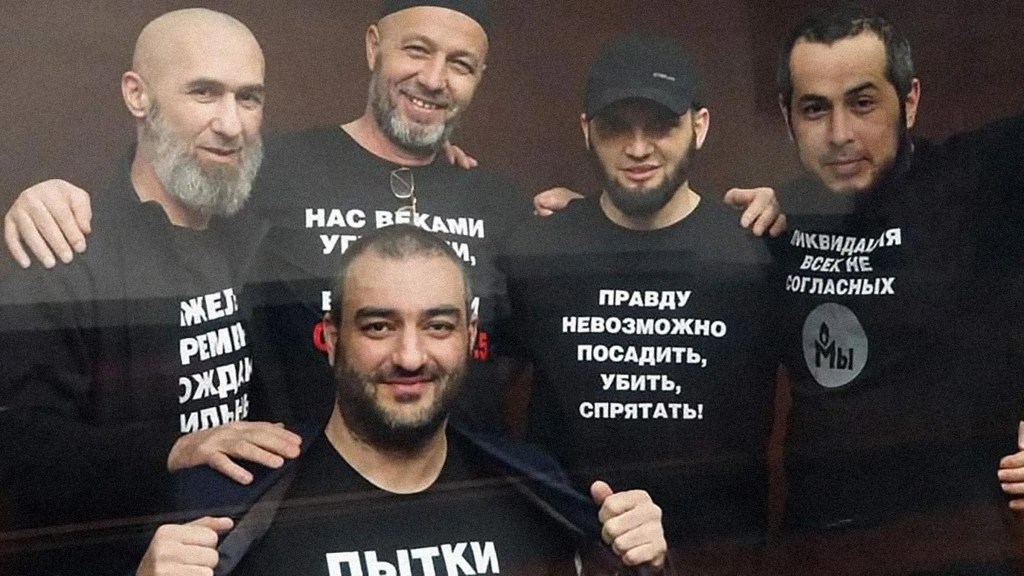
Political prisoners Tofik Abdulgaziev, Vladlen Abdelkadyrov, Izzet Abdullaev, Medzhit Abdurakhmanov and Bilial Adilov, among those falsely accused of “terrorism” and “preparation to seize state power” in 2019, and sentenced to 12-14 years’ imprisonment. Abdullaev’s T-shirt says, “the truth can not be imprisoned, killed or hidden”. Photo by Crimea Solidarity
On the anniversary of that tragedy, which Ukraine demands be categorised as genocide, Important Stories spoke with Crimean Tatars who continue the struggle to live freely in their historic homeland.
Every Crimean Tatar family has its stories of deportation. They all start in the same way. On 18 May 1944, at five o’clock in the morning, soldiers burst in to the house and gave people 5-10 minutes to collect their belongings and go to the nearest train station. No explanations. At dawn, everyone was forced into cattle wagons and taken away.
It was all over by 4:00 pm on 20 May: one of the fastest deportations in world history. All the deportees’ property passed to the Soviet state.
“Many people thought they were being taken away to be shot. The Soviet Union was an atheist regime, and many Crimean Tatars were of Islamic faith”, said Azime (her name has been changed), the wife of a present-day Crimean Tatar political prisoner. Her family were deported to Uzbekistan.
“They put everyone in cattle wagons, with no windows and locked doors. There was no sanitation. No water, no food. People died from hunger, thirst and dysentery. The soldiers just threw their bodies out at the train stations. Some people were able to hide their relatives’ bodies: those families hoped that they would soon arrive somewhere and be able to bury their loved ones like human beings.”
The transport took 2-3 weeks. About 80 per cent were taken to Uzbekistan, and the rest were sent to special places of exile in other parts of the Soviet Union.
“Part of my family was deported to Uzbekistan, part perished in those cattle wagons, and my grandfather was taken to the Urals”, said Ismail (his name has been changed), who today acts as a defence lawyer for Crimean Tatars. “Grandad said that, while he and his mother tried to find accommodation, they could not go to work for two days. And so [for breaking the labour laws] his mother was sent to prison for five years.”
Soviet propaganda prepared local people to receive the deportees. Uzbeks were advised to keep well away from the newcomers, who were “cyclops” and “cannibals”. In exile, Crimean Tatars faced hunger, dangerously unsanitary conditions and an absence of health services. Between 18 May 1944 and January 1946, about 200,000 Crimean Tatars lost their lives, according to estimates by the National movement.
The struggle to return home
People could not return to Crimea. Until 1956 the Crimean Tatars had the status of “special settlers” with limited civil rights. They had to report regularly to police commandant’s offices. They were permitted to move to a different region only by invitation from close relatives. Attempts to leave without permission were punished by up to ten years’ imprisonment.
Although their language was banned, the Crimean Tatars preserved their culture and traditions. Parents told children what their home looked like, and how to get there, so that they could find their way to it when they returned.
“Everyone lived with thoughts of going back”, Ismail said, telling his family’s story. “My uncle somehow found a way to travel to Crimea. My grandmother asked him to bring a bottle of water from home: she wanted to drink Crimean water. When my uncle got back from his trip, he realised that he had forgotten about the water. He took a bottle, filled it from the tap, and took it to Grandma [telling her it was from Crimea]. She cried. For her, that bottle was almost sacred. She kept it, and never drank a drop.”
In the 1960s, the Crimean Tatars began independently to collect information about the victims of the deportation. They demanded that the Soviet authorities revoke the slander that they were traitors, and allow them to return home. That is how the Crimean Tatar national movement was born.
On 5 September 1967, after many attempts to secure justice, came a decree of the Presidium of the Supreme Soviet of the Union of Soviet Socialist Republics (USSR), which revoked all accusations against the Crimean Tatars and allowed them to live in any part of the country. But to return to Crimea, they had to secure a residence permit, and find work. [Residence permits, linked to employment, were used to discipline labour in the Soviet Union.]
By the end of September 1967, about 2000 Crimean Tatars had already returned to the peninsula. But the majority of them could neither get a residence permit, nor any chance of work, from Crimea’s new inhabitants. Many were deported again, and brought to court for breaches of the internal passport regulations.
Azime’s family was one of the first that returned to Crimea and found a way to stay there. “My grandfather, an activist of the national movement, left behind all that he had worked for in Uzbekistan, took his four children, and went home. We are not even talking about returning to his own village, where his grandparents were buried – only returning to somewhere on the peninsula where the family would be allowed to stay. They found a place in Dzhankoi district, where several other [Crimean Tatar] families also moved in. The street was named International Street, because we, the non-Russians, lived there.”
Azime was born at the end of the 1980s, already back in Crimea. Among people of her age, that is very unusual, she said. “I know literally two other people [of her age] who were born back there [on the peninsula].”
[In the 1970s and 80s] the Crimean Tatars had to build their homes all over again. The homes from which their families had been deported now belonged to other people. The work they could find was always the hardest. The attitude of the new local population was hostile: they continued to accuse them of treachery.
“Our grandparents were often dismissed from work”, Azime remembers. “They were constantly searching for new jobs, in order not to be deported again. My mum went to school in Crimea: when the family returned, she was eleven years old. She was admitted to university only on the fourth or fifth attempt. The dean of Simferopol medical school told her father outright that he would not accept Crimean Tatar students, not for any amount of money.
“My mum was the only Crimean Tatar woman in her university. [When her fellow students and teachers learned that she was a Crimean Tatar], she was told to her face that she had no business being there. Many teachers simply marked her work down. Our people felt everywhere that Crimean Tatars were strangers in their own land.”
The Crimean Tatar national movement had already taken shape, and its activists fought for the right to live in Crimea and for the freedom of those imprisoned for breaches of the internal passport regulations. They monitored attacks on human rights, and took part in hunger strikes and other forms of protest. In 1978 the activist Musa Mamut burned himself to death as an act of protest: this became one of the symbols of Crimean Tatar resistance.
But even twenty years after the decree of 5 September 1967, the situation had hardly changed. “The mechanisms to obstruct the Crimean Tatars’ return had been so finely tuned by the Crimean authorities, that I never heard of a single instance of a new Crimean Tatar family buying a house”, the Crimean Tatar activist Bekir Umerov wrote in his memoirs. His family was also prevented from returning to Crimea: in the 1980s they moved to the Krasnodar region [of southern Russia], to be nearer to home.
After the beginning of perestroika [the reform of the Soviet system started under Mikhail Gorbachev, from 1986] in the spring of 1987, the Crimean Tatars gathered in Tashkent [in Uzbekistan] for their first All-Union Assembly. They agreed on a document that called on Mikhail Gorbachev, then the general secretary [of the Communist Party of the Soviet Union] to meet a delegation. This call went unanswered, and so on 18 May, the anniversary of the Crimean Tatars’ deportation, the activist Bekir Umerov announced a hunger strike in protest.
This met with a powerful response, and not only among Crimean Tatars. The scientist and human rights defender Andrei Sakharov mentioned the action in his call to Gorbachev to resolve the problem of Crimean Tatars being able to return home. Umerov ended his protest a month later, when the Second All-Union Assembly of Crimean Tatars elected him to a delegation that travelled to Moscow. But the Kremlin refused to meet the Crimean Tatars, as it had done before.
The activists then began protests at the Lenin mausoleum [on Red Square], at the building of the CPSU Central Committee, at the Kremlin. Each day the number of participants grew. One of the biggest rallies was held on Red Square in the middle of July 1987. The Crimean Tatars staged a peaceful sit-down protest, and the police held back from using force. A week later, on 26 July, more than 1000 Crimean Tatars took part. This time the police blocked the way to Red Square and so the demonstrators went along Vasilevsky Spusk, sat on the ground, raised their placards and shouted: “Crimea! Our homeland!” The action went on for 26 hours.
Many of the participants were arrested and deported from Moscow to the places where they lived. No official documents sanctioning a return to Crimea were issued by the authorities – but there were fewer obstructions.
The Crimean Tatar protests continued through the whole perestroika period.
Occupation of the peninsula
Many families could return to their homeland only after the collapse of the USSR. The move was difficult, even without the authorities interfering. “For more than 20 years, the Crimean Tatars had been finding their feet in the places to which they were deported. They had settled down. And now they had to leave everything again, return home empty-handed, and again start to get on their feet”, Azime explained.
“After all that had happened to our people [as a result of deportation], we stuck closer together and helped each other. My parents told me about how someone had got land in Crimea, gathered 30-40 families and built a house on it together. And then they built another. We are not just a people, we are one big family”, Ismail, the human rights defender, said.
“In general the Crimean Tatars are Muslims. This means a sense of collectivism, which means brotherhood, giving moral support to each other, good neighbourliness. These are traditions going back to the [Crimean] khanate [of the 15th-18th centuries]. The Prophet says, ‘if you laid down to sleep well-fed, and your neighbour was hungry, you will not sense the scent of paradise’. And it makes no difference whether your neighbour is Muslim or not.”
The Crimean Tatars were only able to live a relatively quiet life in their historical homeland for a little more than twenty years.
“It turned out that my generation was the only one, in the past century, who could spend their early years at home, living in peace”, Azime said. “I just recently said to my children that I could not now myself imagine how carefree those years were. We just lived, and did not think that things could be different.”
That life changed at the beginning of 2014. “I was then pregnant with my third child”, Azime recalled. “I was already preparing for the birth when I heard on the news that the Russian [armed forces] were coming. I knew that for decades Russia had imprisoned Muslims simply for professing their faith. I can not tell you how terrified I was, for my child, for my husband, for all of us. Then tanks appeared on the streets, and men in uniform, and the occupation began.”
Some Crimean Tatars decided to move to Ukrainian-controlled territory. Azime and her husband also discussed that, but decided to stay. “We both agreed that here is our home, our land, for which our parents had fought. Why should we leave? It was they who came to us, no-one asked the Russians to come here. We decided that we would not allow Russia to drive us from our homes a second time.”
Most of the Crimean Tatars were against the occupation, and boycotted the “referendum” [of March 2014, on joining the Russian Federation]. Consequently, after the annexation, the Russian authorities took repressive measures: Crimean Tatars were arrested, kidnapped, and accusations under the laws on terrorism were fabricated en masse. People were accused of membership of [the transnational Muslim organisation] Hizb ut-Tahrir, which is banned in Russia. As proof, “secret witnesses” were produced, together with the fact that the accused professed the Islamic faith.
“We did not know what to do”, Ismail remembers. “We did not know the new legal code, or what to do when three brothers by faith were falsely accused of terrorism. From the start, the new ‘authorities’ were determined to show that they would liquidate anyone who opposed Russia. They only wanted people loyal to them in Crimea.”
Ismail himself suffered intimidation and harassment. In 2015 an officer of the Federal Security Service (FSB) planted drugs on him [and he was arrested]. When being questioned, he was asked about Crimean Tatar affairs. They tried to convince him to work for the security services. Thanks to the prominent Crimean Tatar lawyer Emil Kuberdinov, the case did not go any further than the prosecutor’s office.
“At that time the Russians were still trying to work out the extent to which their hands were tied in Crimea”, Ismail said. “But I already understood what was on its way. Crimean Tatar lawyers came on the scene, not only helping people who were arrested, but also support political prisoners’ families, explaining how to send parcels to prison, what to do on prison visits and so on.”
In 2016, Crimean Tatar activists, together with lawyers, formed the Crimea Solidarity organisation.
In 2017, about one hundred Crimean Tatars across peninsula simultaneously staged one-person pickets against Russian repression. About 60 people were served with administrative summonses, for breaching the regulations on picketing (Article 20.2 Part 5 of the code on administrative offences [similar to civil law]). The hearings were all arranged on the same day, in different districts. As well as Crimea Solidarity’s lawyers, the interests of the accused were represented by civil society activists. One of these was Ismail. “People began to offer support to Crimea Solidarity. I did so myself. We had no legal education, but the lawyers helped us to prepare. So the Crimean Tatars continue to help each other.”
Repression under occupation
Criminal cases under terrorism laws have become the main instrument of repression against Crimean Tatars. Military courts deal with these cases in closed hearings that even close relatives can not attend. The sentences under these laws are 10-20 years’ imprisonment.
The Russian security forces have conducted searches at mosques, arrested clerics, cases have been put together alleging failure to inform on “terrorist groups”. Family members of political prisoners have also been subject to surveillance and harassment.
Every arrest and raid becomes a matter for the whole community. People gather at any time of day or night, often bringing children along, to support families who have been singled out for searches. Azime, along with her elder sons, has often gone to support her neighbours. She tells her children not to fear people in uniform, that those people’s fear is even greater.
Azime also prepared the family for the fact that they might be raided at home. Her husband Rinat (his name has been changed) is an activist in the national movement, has written a great deal about the repression of the Crimean Tatars, and has spoken out openly against repression and against the occupation. He had been arrested on administrative charges several times, and the family understood that sooner or later he could face criminal charges. Some time ago Azime started to sleep wearing her clothes and a hijab [expecting a raid].
The security forces came for Rinat at 6:00 in the morning, but he was not at home.
“Before sunrise every day we read prayers. My mother asked me in Tatar (in the family we use our native language) how she would be able to perform ablutions. I told her not to be afraid and to stay calm. The armed men told us that we could not speak in Tatar. That was offensive to me, as a woman and as a mother. They insulted our faith: they said that instead of ‘beating the floor’ five times a day, which should behave like normal people.”
Protesters and Russian armed forces in Crimea, 2014. Photo by Krym.Realii/RFE-RL
During the raid, Azime’s three children were much calmer than she had expected them to be. “I tried to stay confident and not to fear these men and their automatic weapons, hoping that that would also help the children to stay calm. Only my daughter was crying, at the start when she first saw the guns, she is the youngest.
“When I woke up, the room was dark, but I could see floodlights being shone from the street directly into our windows. The shadows were dancing around the courtyard. I understood that it had started. Then wild knocking at the door”, Azime recalled. “I asked my mum to dress and open the door. A big crowd of armed men in masks ran in, shouting. They turned the shelves upside down, everything from outer clothes to underwear. They paid closest attention to the books.
“My sons are still in primary school, I don’t think they understood exactly what was going on. For them it was like something out of a fairy tale, where we needed to defy evil. They did not sit in the corner like mice, but walked between these people with the automatic rifles, as though everything was OK. The men did not touch them. Just once, they tried to find out [from the children] the password for my phone, which I refused to unblock. I did not want them to see photographs of me unveiled.”
It only became clear later how stressful the children had found the raid. “For years afterward, my elder son started to fear the whole world that surrounds him. He thought that the FSB was everywhere, he saw all people as a threat. When we went into town, he would stick close by me and say, ‘I am afraid that they are going to take me away’. For a year or two, my daughter developed a nervous tic. She works with a psychotherapist, but still fears me falling asleep before her, fears being alone.
“At least the children didn’t see how their father was set upon and thrown to the ground with an automatic pointed at his temple. That’s a rare thing for a Crimean Tatar family nowadays. I have talked with the children many times, I saw to them that the Almighty is with us, and that his wisdom also oversees what is happening with their dad”, Azime said.
Wives of Crimean Tatar political prisoners
Azime’s husband was beaten, and arrested, when he travelled to Rostov to deliver parcels to other Crimean Tatar political prisoners being held there. While Rinat’s case was in court, Azime could at least see him at the hearings. But when the sentence was announced, neither Rinat’s wife nor other Crimean Tatars were admitted to court. Rinat was sentenced to nearly 20 years in a maximum security facility, under two Articles of the criminal code: “organisation of the activity of a terrorist group” and “preparation for a violent seizure of power”.
Azime said: “My husband is big, kindly man, like a bear in a cartoon. He went out to work, went to court hearings [of other arrestees], publicised the repression of our people, and always found time for our family. I lived like a princess. And now all that has finished. A new life has begun: I have to survive, and to try to understand what comes next.
“At night I cry into the pillow, so that the children can not hear. I have to learn to do things in the household that were previously done by my husband: what documents have to go where, how to pay for the electricity, how to read the meters. I have had to give up studying and my teaching work. Before all this, I had more time for the children: now I often have to leave them to look after each other.”
Azime’s health has suffered as a result of all that has happened, and she has had two operations. She is supported not only by her family but by the community. “There was a knock at the door, and a woman I don’t know was standing there, offering me eggs and cheese. She said: ‘That’s for you, my dear. You don’t know me, but your husband gave court support to my son.’ Around here there are already many women with the same, bitter experience. I turn to them for advice, about where to buy things for prison parcels, where to send documents for this and that. I am walking along a well-trodden road.”
It is now five years since Rinat’s conviction. In that time, Azime has not been able to meet her husband once. Her only contact with him is through letters, that are passed on by his lawyer. In prison, Rinat has continued to write about the repression against the Crimean Tatars. Azime receives his articles, retypes them electronically, publishes them and sends them out. “My husband constantly writes to me, thanking the Almighty for the fact that his wife is here. He says, ‘when my book comes out, that will be your doing – you are my censor, editor, proof-reader and publisher!’
“Like the wives of other Crimean Tatars, I have chosen to continue the fight taken up by my husband. Up until 2022, we used to travel, to explain what is happening to our people. We were in Kyiv, Kherson and Mariupol. We continue to campaign now, but we can not travel anywhere. Our husbands have been deprived of free speech. Who, if not us, will speak about their cases and convey their arguments? They, also, became activists not by choice. And now we stand in their place.
“In our letters to our husbands, we sound very strong, like stone, their bastion. I always write to my husband, ‘this is your challenge from the Almighty. If you meet it, you will earn yourself a place in paradise’. It’s at night-time that I cry in my pillow. I feel sorry for my husband, and it is hard for me too. I have to be both mother and father to my children; I have to support my husband; and be an activist. But you cry, and you keep going – and that’s how I earn a place in paradise too.”
The all-out war
With the Russian army’s all-out invasion of Ukraine in Feburary 2022], many Crimean Tatars were again forced to leave their homes. The biggest exodus took place when military mobilisation was announced. According to the Mejlis of the Crimean Tatar people [the national representative council, now based outside Crimea], since September 2022 between six and eight thousand Crimean Tatars have left the peninsula. Azime said that Crimean Tatar families that have sons of conscription age try to leave Crimea. “Everyone fears that their sons will be taken by force to the war.”
Ismail said: “Many people have left because they do not want to fight on Russia’s side – although the mobilisation turned out to be more a moral pressure than a physical one. Of those who have been sent to the front from Crimea, only about 5 per cent are Tatars. I reckon that, of those who did go to the front in autumn of 2022, 60-70 per cent have already returned.”
Those who have moved to territory controlled by Ukraine can not return to Crimea, due to the risk of repressive action. In 2023 the Crimean Tatar Leniye Umerova tried to get to Crimea to see her father, who was very ill. She travelled from Ukraine via Georgia. She was arrested at the border on suspicion of spying. Umerova has already spent a year behind bars in Russia. The case will be heard in secret and she is threatened with 20 years’ imprisonment.
Since 2022, repression against Crimean Tatars has been stepped up. The Russian authorities have conducted at least 71 searches, and there have been at least 110 convictions – more than in the preceding eight years. In the autumn of 2022 a second pre-trial detention centre (SIZO) was opened in Crimea: Crimean Tatars, and Ukrainians kidnapped in the occupied territories, are sent there. Since the all-out war began, there have been a much greater number of cases, compared to the previous eight years, related to the “voluntary Noman Chelebidzhikhan battalion of Crimean Tatars”, that has been fighting on the Ukrainian side since 2014.
There was also a wave of repressive measures against Crimean Tatars when parts of Kherson and Zaporizhzhya regions were occupied: about 100 people have been arrested there. Some cases have been initiated by informers who write on the Krymsky SMERSH telegram channel that was set up in 2022.
“Informing has become a big thing in Crimea”, Ismail says. “Someone says something at the market, and that’s it, you get a knock on the door. The regional authorities have acquired an extra repressive tool against the peninsula’s citizens: the Article [in the code on administrative offences] on discrediting the army. There have been many administrative cases as a result, some for people writing comments on social media.”
Azime said: “Today, deportation of Crimean Tatar people takes a hybrid form. Now it’s not in cattle wagons: people are taken away in prison transport vans. From many families they have taken all the menfolk: for example they will take the husband, son and father. I have a neighbour who is 75, they have taken both her sons. Every time I see her she says, ‘my dream is just to be able to hug them once more in this life’.”
Azime has decided to stay on the peninsula, as long as possible. “In our lives we have seen hundreds, perhaps thousands, of families that have been broken up, which fought for so long to be able to return home. I have decided for myself that I will never leave our homeland. We understand that the repression will intensify, that whatever has to happen, will happen.
“What’s the point of cowering like a mouse, of living in fear? If they succeed in shutting our mouths, that would be a betrayal of our people who have suffered so much. We must not stay silent. As long as our husbands are imprisoned, and as long as they continue to try to destroy the Crimean Tatar people, we won’t stop fighting.”
Ismail, too, has no intention of leaving the peninsula. He continues to support Crimean Tatars in court. “I have decided for myself to take this position. I see how the families of my close friends are punished and repressed, how people are imprisoned. As a Crimean Tatar and a Muslim, how should I react? Do I sit here and say, ‘it’s nothing to do with me’ – or give some help. For me, this is a test from God.
“The best example to me in this situation is the Prophet Muhammad. Yasir’s family was taken to the desert and tortured by infidels for their religion. What did the Prophet do? He did not sit at home saying a prayer; he did not stand to one side. He went there, where Yasir’s family was under attack, and gave his support. That shows how we, today, faced with this repressive machine, need to react.
“It does not depend on us, whether they imprison a person or not. But it depends on us what we do, what support we give. Can we help the defence in court? Then we’ll go to court. Can we help the family? Then we will visit their home, bring things that they need, and money, and help with the children.
“For the Crimean Tatars it is very important to preserve our spirit of unity. We have faced many trials. When a person is left to face a problem on their own, that is very hard to bear. If someone just sits down for coffee with that person, and says, ‘you are not alone, we will help you, we are right alongside you’, this helps to deal with tragedy.
“I was recently in touch with the mother, and aunt, of a Crimean Tatar who was sentenced to ten years, in a case related to the ‘voluntary Noman Chelebidzhikhan battalion of Crimean Tatars’. They kept telling me how people had come to visit them, to help and support them, how they felt the support of our people. Without this, they said, they would have been broken.
“Russia is trying to give the appearance that everything is fine in Crimea, and now they don’t lay a finger on anybody. That is a lie. We can show the world that we have already had ten years of this. We understand, of course, that the repressive machine pays little heed to laws, let alone to moral and humanitarian values. If an instruction comes down to lock someone up, they do it, no matter what defence is presented in court.
“But we continue to go to court, to record videos showing how Crimean Tatars face harassment and intimidation. We continue to fight. We don’t keep quiet or swallow all this silently. We will take a stand and say, ‘we are not guilty’. I think that if we had not done this, if we had sat quiet, then Crimea would already have been turned into another Chechnya.”
The links in the article are from the original Russian version, to sources in Ukrainian and Russian. Web sites in English include the Mejlis of the Crimean Tatar people; Crimea Platform, recently launched by the Ukrainian government; the Crimea Human Rights Group; and Crimea SOS. Reports on human rights abuses have been published this year and last by the UN and the Council of Europe. A history of the Crimean Tatars, ‘A Seditious and Sinister Tribe’: the Crimean Tatars and their Khanate, by Donald Rayfield, has just been published, and reviewed. There are more than 100 political prisoners listed (Russian only) on the Crimea Solidarity web site currently detained.
Source: People and Nature, 16 August 2024. Thanks to Simon Pirani for translating this important overview of the Crimean Tatars’ struggle and for permitting me to reprint his translation here.
Alexander Skobov. Photo courtesy of V. Izotov/Deutsche Welle
A new criminal case, on charges of “involvement in a terrorist community,” has been opened against former Soviet dissident and Russian political journalist Alexander Skobov, who has been detained for over a month on charges of “condoning terrorism.” This news was reported on Saturday, 18 May, on Skobov’s official Facebook account by his wife, Olga Shcheglova.
Shcheglova said that she visited her husband on 14 May in the pretrial detention center in Syktyvkar, where he had been transferred from St. Petersburg. During a conversation with him, his lawyer and local police investigators, she learned that Skobov has also been charged with “condoning terrorism” and “involvement in a terrorist community.” The dissident’s wife is convinced that these two charges stem from her husband’s affiliation with the Free Russia Forum.
According to Shcheglova, on 21 May, Skobov will be sent to the regional psychiatric hospital in Komi for a forensic psychiatric examination. Skobov himself has stated that he would not participate in the investigation and forensic expertise, and he would appear in court only if his mother were present at the hearings. Skobov’s defense has filed an appeal, which will be heard by the court on 22 May.
Skobov’s Persecution in the USSR and Russia
On 22 March 2024, Russian authorities designated Skobov a “foreign agent.” According to the Justice Ministry, he had “disseminated unreliable information” about the decisions of public officials, opposed the war, “identified the Russian Federation with a terrorist organization,” been involved in the work of an “undesirable organization,” and produced and distributed “foreign agent materials” [sic], the human rights project OVD Info reports.
In 1978, Skobov was arrested over his active involvement in the Left Opposition group and the samizdat publication of an anti-government magazine. He was later sentenced by the court to undergo treatment at a psychiatric hospital, from which he was released in the summer of 1987.
This time around, the political journalist was arrested on charges of “condoning terrorism.” Skobov was detained in St. Petersburg on 2 April 2024. In protest, the dissident refused to take with him to jail his diabetes medication and his glasses, despite his poor eyesight. According to the Telegram channel Memorial Support for Political Prisoners, the real reason for his arrest was “a [social media] post condoning the bombing of the Crimean Bridge.”
In early April, 66-year-old dissident Alexander Skobov was arrested for allegedly “justifying terrorism” in his posts online. For his friends and family members, the arrest came as no surprise.
Skobov, a long-time dissident who was made to spend seven years in a psychiatric ward after taking part in protests against the Soviet authorities in the 1970s, had published multiple posts condemning Russia’s actions in Ukraine since 2014. In March he was named a “foreign agent”, and since then people close to him said his arrest had seemed inevitable.
“He and I talked a hundred times about the fact that he would be arrested — if not today then tomorrow,” said Skobov’s friend Yuly Rybakov, a human rights activist and former deputy in the State Duma, Russia’s lower house of parliament. “People have been imprisoned for much less.”
Skobov’s 90-year-old mother, whom he lives with and cares for, said she had been having nightmares about his arrest for months before it happened, and Rybakov recalled that Skobov himself said he “didn’t understand” why the authorities hadn’t come for him yet.
Skobov’s children, who moved abroad long before Russia’s invasion of Ukraine, urged their father to flee the country when they saw him in Istanbul in early March. Other friends have also tried to convince him to leave and avoid arrest, citing his many health issues, including severe diabetes, hepatitis C, chronic obstructive pulmonary disease and near blindness.
But, Rybakov said, Skobov was resolute, telling him that he “wanted to be part of his own judicial process” when he was inevitably arrested.
Rybakov said that Skobov had been “driven to despair” by what had been happening in Russia in recent years and “felt that someone had to be radical”.
Another friend, Mikhail Sedunov, said that trying to convince Skobov to change his course of action was like “grabbing the wing of a plane that was already accelerating down the runway”.
On 2 April, masked policemen arrived at Rybakov’s flat, where Skobov had been staying. When Rybakov left to take the dog for a walk, the police reportedly entered the property, threw Skobov to the ground, twisted his arms and handcuffed him. According to Rybakov, Skobov “defiantly” refused to take either warm clothing, his diabetes medication, or his glasses with him, intending these gestures as an “act of protest”.
Skobov’s wife, Olga Shcheglova, managed to buy him replacement medication and glasses, which she brought to him ahead of his interrogation by Russia’s Investigative Committee. But Skobov refused to accept them — a reaction Shcheglova said she had “expected” from her husband.
Resistance to the authorities and a fight for justice had defined Skobov’s life for more than four decades. His first foray into political activism was in 1976, when he and other university students in St. Petersburg scattered leaflets calling for the “establishment of true humane socialism” and the “overthrow of the tyranny of officials” ahead of a meeting of the Communist Party of the Soviet Union. The students were expelled from university and brought before a court, and some, like Skobov, were then sentenced to compulsory treatment in psychiatric hospitals because, according to Rybakov, it was believed that “only crazy people could dislike the Soviet regime”.
Skobov’s radical spirit remained unquelled when he was finally released from hospital in 1981, however, and he immediately joined the Free Inter-Professional Association of Workers, a dissident group that led the first attempt to create an independent trade union in the USSR. In 1982 he was arrested for his involvement with the group and sent back to hospital, where he spent another three years.
In the early 1990s Skobov taught history at a secondary school for gifted students, writing and publishing his own award-winning textbooks. But later in the decade political activism again became the focal point of his life as he took part in protests against the Chechen wars.
When Russia annexed Ukraine in 2014, Skobov took to social media to rail against the regime, openly supporting Ukraine and condemning Russia’s military action. The same year, two unidentified men armed with knives attacked him outside his home in what his friends and family members say they are sure was retribution for his criticism of the regime.
Even this did not deter him, however, and his friends said his statements opposing Putin’s rule became “even sharper, more unrestrained, and more radical”. Speaking last year at the Free Russia Forum, an opposition conference held biannually in the Lithuanian capital Vilnius, Skobov condemned the regime more harshly than any of the other attendees, despite being one of the only participants still living in Russia.
Another friend of Skobov, Nikita Yeliseyev, said he doubted Skobov would survive the 7.5-year sentence that he is almost certain to receive.
“He is an old man,” Yeliseyev said. “And he has a number of very serious illnesses.”
Sedunov said all of Skobov’s actions stemmed from a desire to “struggle, as vigorously as possible, against the obvious evil represented by the current Russian government”.
“This is the way he was brought up: he wanted to fight evil any way he could. And this was the only way left,” Sedunov said.
Aleksandr Skobov has been a thorn in the side of authoritarian governments for more than four decades, from the Soviet era to President Vladimir Putin’s long rule. And now, in pretrial detention in St. Petersburg and facing prison, he is in no mood for compromise.
“On principle I refuse to comply with fascist laws,” he told RFE/RL late last month, shortly after the Russian government designated him a “foreign agent” on March 22. “I don’t intend to get into debates with the government. I will not try to prove my innocence. I will not label my writings, and I will not write any financial reports for them.”
“A criminal case could be launched at any moment,” he concluded.
He was right: On April 3, the 66-year-old was arrested and charged with “justifying terrorism” for a social-media post about the Ukrainian attacks that damaged the Crimea Bridge that links Russia with the Ukrainian region of Crimea, which Moscow occupied in 2014. The following day, a St. Petersburg court ordered Skobov held in pretrial detention for at least two months.
“If you take any of my articles or YouTube videos, you can find a whole bouquet of possible charges,” Skobov said in the March 31 interview. “Discrediting the army. Inciting hatred and enmity. Justifying terrorism. The rehabilitation of Nazism. I directly equate the actions of the Stalin regime with those of Hitler’s during World War II.”
Another reason for Skobov’s prosecution, his supporters believe, is his leadership role in the Free Russia Forum, a group of mostly exiled opposition figures founded by former world chess champion Garry Kasparov and activist Ivan Tyutrin in 2016 that has been declared “undesirable” in Russia. If he is charged with participation in an “undesirable” organization, he could face up to six years in prison.
“I am a member of the forum’s council, and I regularly participate in its broadcasts,” Skobov told RFE/RL. “I help write its statements and official pronouncements. Several of them I have written myself. I am actively involved, and I do not intend to stop.”
Skobov said he was drawn to the group because “it was the only opposition organization that categorically rejected the idea of the peaceful transformation of Putin’s dictatorship toward democracy using the procedure established by that dictatorship.”
“It was the only organization that, beginning with the annexation of Crimea, unambiguously stood by Ukraine as a victim of aggression,” he added. “We try to help the Ukrainian Army and the Russian volunteer formations that are fighting with them.”
Writing on Facebook after Skobov’s arrest, writer and critic Mikhail Berg said Skobov suffered from “an unbearable fear of being afraid.”
“And that is why he chooses the most painful forms of criticizing the authorities,” he wrote. “He shouts even though the authorities have long been destroying people for whispering or even for just opening their mouths.”
Parallel Lives
Born in Leningrad, as St. Petersburg was called then, in 1957, Skobov participated in his first anti-government protest when he was 19. He and other members of an underground organization threw about 100 flyers calling for “humanistic socialism” from the roof of a downtown building on the eve of the 25th congress of the Soviet Communist Party. Several of the protesters were kicked out of their universities, but Skobov — a first-year history student at Leningrad State University — got off with a disciplinary meeting of the Komsomol youth group.
In October 1978, he was arrested for publishing an underground, anti-government magazine called Perspectives. He spent half a year in a KGB prison before being sentenced to forced psychiatric treatment.
“In the late 1970s and early 1980s, political prisoners in Soviet psychiatric hospitals were rarely forcibly medicated, although there were such cases, of course,” Skobov said. “But I was treated more or less OK. Most of the doctors that I encountered tried to avoid playing the role of executioners or stranglers.”
He spent three years in confinement.
In 1982, he was again sentenced to psychiatric treatment, this time for a samizdat article he wrote defending Chile’s former socialist president, Salvador Allende, who died in unclear circumstances in 1973, and criticizing the rightist dictator General Augusto Pinochet. That article was deemed “anti-Soviet propaganda.”
This time, Skobov spent five years in the hospital before being released in the summer of 1987 during the initial phase of Soviet leader Mikhail Gorbachev’s liberalization campaign.
In many ways, Skobov and Putin led parallel lives during this period. Putin was born in Leningrad almost exactly five years before Skobov and studied at Leningrad State University just before him. But as Skobov became drawn into a life of opposition to authoritarianism, Putin joined the KGB secret police.
The president’s official biography insists that Putin always worked for the KGB’s First Directorate, which carried out counterintelligence operations. However, rumors have persisted for years that he worked for some time in the Fifth Directorate, which was responsible for suppressing internal dissent and prosecuting political dissidents. At the time, a senior figure in that department was Viktor Cherkesov, a longtime member of Putin’s inner circle who served as his deputy when he headed the Federal Security Service — the KGB successor organization — in the 1990s and who died in 2022.
In 2022, journalist and researcher Konstantin Sholmov published a photograph of a KGB archival document from 1976 that he said was on display at the Political History Museum in St. Petersburg. The document, a protocol of a search of the residence of Leningrad artist and dissident Oleg Volkov, named “Lieutenant Putin” as one of the officers carrying out the search.
In 2013, a series of photographs emerged showing a 1989 Leningrad protest during which KGB operatives roughly detained dissident Valery Terekhov. One of the men in the photograph resembles Putin. The Kremlin later denied that the man was Putin, saying the future president had already been sent to East Germany by 1989.
Prominent human rights activist Aleksandr Cherkasov of the banned rights group Memorial told the news outlet Agentstvo earlier this month that he believes Putin was involved in the investigation of Skobov. He said Skobov had told him Putin staked out his Leningrad apartment in November 1982 when prominent dissidents gathered to celebrate Skobov’s birthday.
Despite the danger growing around him after he was designated a “foreign agent,” Skobov refused to consider emigration.
“I’m not going to quit,” he said.
“Today anyone in Russia who disagrees with Putin’s Nazi regime is taking a risk,” he added, “even if he doesn’t really stick out or act publicly. Since the regime has already made the transformation from ‘hybrid totalitarian’ to totalitarian, it demands not just silence from its loyal subjects, but active participation. And even avoidance can be dangerous.”
Opposition leader Aleksei Navalny’s suspicious death in prison on February 16 was “to be expected,” Skobov said.
“Navalny constantly laughed in [Putin’s] face, and a dictator cannot stand that,” he added. “Unfortunately, I don’t think it will be the last death of a political prisoner in Putin’s Russia.”
Dark Matter contained a re-recorded version of his Emmy award-winning song ‘It’s a Jungle Out There’, which was used as the theme song for the television series Monk. The album tells countless humorous tales. However, one of its most memorable cuts is the track ‘Putin’, which sees Newman sarcastically attack the Russian president.
The song pokes fun at Putin’s efforts to appear macho, with Newman singing, “And when he takes his shirt off/ He drives the ladies crazy/ When he takes his shirt off/ Makes me wanna be a lady.” A chorus of ‘Putin Girls’ chime in to sing, “Putin if you put it/ Will you put it next to me?”
To accompany the scathing lyrics, Newman uses chaotic instrumentation that sounds like the perfect theme for a cartoon villain. The musician explained that he wrote the song when “all those pictures were appearing of him with his shirt off, and I couldn’t understand why. What did he want?”
He continued: “I think it was just personal vanity of some kind, like he wanted to be Tom Cruise. It wasn’t enough to be the richest and most powerful. He wanted to be the most handsome and a superhero, throwing young people around and wrestling.”
Newman claims that he originally wrote a much harsher version but had to tone down the insults. In 2018, the song won the singer his seventh Grammy, this time for the relatively obscure category of Best Arrangement, Instrumentals and Vocals.
Source: Aimee Ferrier, “Remembering Randy Newman’s satirical warning about Vladimir Putin,” Far Out, 14 October 2022
“RUSSIAN PROPAGANDA HAS MADE ITS WAY into the United States, unfortunately, and it’s infected a good chunk of my party’s base.” That acknowledgement from Michael McCaul, Republican chairman of the House Foreign Affairs Committee, was echoed a few days later by Michael Turner, the chairman of the Intelligence Committee. “It is absolutely true, we see, directly coming from Russia, attempts to mask communications that are anti-Ukraine and pro-Russia messages, some of which we even hear being uttered on the House floor.” Among the falsehoods that GOP members of Congress are repeating is the notion that the Ukraine war is actually a battle between NATO and Russia. “Of course it is not,” Turner told CNN. “To the extent that this propaganda takes hold, it makes it more difficult for us to really see this as an authoritarian versus democracy battle.”
What makes it even more difficult to see reality plainly is the presence in the GOP of dunderheads like Sen. Tommy Tuberville, who gushed to an Alabama radio show that “Putin is on top of his game,” while scorning U.S. media accounts of Russian behavior. “The propaganda media machine over here, they sell anything they possibly can to go after Russia.” Tuberville may be the dimmest Putin booster on the Hill, but he is hardly lonely.
It has been two months since the Senate passed, in a 70–29 vote (including 22 Republican yes votes), a $95 billion foreign aid bill that included $60 billion for Ukraine. The Republican-controlled House, by contrast, has been paralyzed. Stories leak out that Speaker Mike Johnson, apparently influenced by high-level briefings he’s received since capturing the gavel, has changed his posture and wants to approve the aid. But Johnson leads, or is at least is the titular congressional chief, of a party that contains a passionate “Putinwing,” and so he dithers. This week, Volodomyr Zelensky has warned that Ukraine will lose the war if the aid is not approved. Yet Johnson is heading not to Kyiv but to Mar-a-Lago.
Pause on that for a moment. The Republican party is now poised to let a brave, democratic ally be defeated by the power that the last GOP presidential nominee save one called “without question, our number one greatest geopolitical foe.” One member of Congress has sworn to introduce a resolution to vacate the speaker’s chair if Johnson puts aid for Ukraine on the floor. And the entertainment wing of conservatism—most egregiously Tucker Carlson—has gone into full truckling mode toward the ex-KGB colonel in the Kremlin.
It’s worth exploring how the Republican party, the party of “Mr. Gorbachev, tear down this wall,” became the party that now credulously traffics in blatant Russian disinformation while it flirts with betraying an important ally—along with all of its principles.
To some degree, people’s foreign policy inclinations are reflections of their domestic views. During the later years of the Cold War, large numbers of liberals and Democrats were more sympathetic to leftist regimes like Cuba (see Bernie Sanders) and Nicaragua (see Michael Harrington) than were conservatives and Republicans. I wrote a book about liberal softness toward left-wing authoritarianism and, though I haven’t yet read it, I gather that Jacob Heilbrunn’s new book does some similar spelunking about conservatives’ tolerance for right-wing dictators. Certainly some conservatives were more inclined than any liberal to go easy on South Africa because it was perceived to be a Cold War ally. On the other hand, Republican administrations did push allies to clean up their act on corruption, democratic elections, and other matters where they could (as for example in El Salvador).
Trump’s particular preferences and ego needs play a starring role in the GOP’s devolution. Cast your minds back to 2016 and the revelation that the Russians had hacked the Democratic National Committee. To rebut this damaging development, Fox News conjurers got busy inventing a tale about CrowdStrike, the company that documented the hack, alleging that the servers had been mysteriously moved to Ukraine so that the FBI could not examine them. In his infamous phone call with Zelensky, Trump fished out this debunked nugget and asked Ukraine’s president, who was then already fighting Russia in the Donbas, to do him a favor before he released the weapons Congress had approved:
I would like you to find out what happened with this whole situation with Ukraine, they say CrowdStrike. . . . I guess you have one of your wealthy people. . . . The server, they say, Ukraine has it. I would like to have the attorney general call you or your people and I would like you to get to the bottom of it.
This was bonkers. As the Mueller report made clear, the FBI did get all the data regarding the DNC hack. There was never a shred of evidence that the servers were moved to Ukraine, and in any case physical control of the servers was unnecessary. But what was Zelensky supposed to say? He promised to look into it just as a courtier to a mad king will say, “Yes, your majesty, we will look into why your slippers are turning into marshmallows when the sun goes down.”
As Fiona Hill told me, Tom Bossert, Trump’s first homeland security advisor, tried “a million times” to disabuse Trump of this Ukraine myth, as did CIA Director Gina Haspel, Cybersecurity and Infrastructure Security Agency Director Chris Krebs, and many others, to no avail. It was, Hill notes, “a too-convenient fiction.”
Because Trump regarded any implication that he had received assistance from Russia as impugning his victory, he latched onto the idea (perhaps whispered by Putin himself in one of their many private conversations) that, yes, there had indeed been foreign interference in the election, but it was Ukraine boosting Hillary Clinton, not Russia aiding Trump. Now, it’s true that Ukraine’s friends reached out to Clinton, but why wouldn’t they? Trump’s campaign manager was Paul Manafort, a paid agent of Viktor Yanukovych, the ousted pro-Putin Ukrainian leader.
Trump nurtured his misplaced grudge for years. Recall that when Putin launched the full-scale invasion of Ukraine in 2022, Trump’s initial response was that it was a “genius” move.
I went in yesterday and there was a television screen, and I said, “This is genius.” Putin declares a big portion of the Ukraine—of Ukraine—Putin declares it as independent. Oh, that’s wonderful. He used the word “independent” and “we’re gonna go out and we’re gonna go in and we’re gonna help keep peace.” You gotta say that’s pretty savvy.
A non-sociopath would say it was raw aggression of the worst kind. A normal Republican of the pre-Trump mold would have been outraged at the attempted rape of a peaceful, democratic neighbor.
Most Republican officeholders are not sociopaths, but they take their marching orders from one and have adjusted their consciences accordingly. The talking point J.D. Vance and his ilk favor is that they cannot be concerned about Ukraine’s border when our southern border is also being invaded. Of course it’s absurd to compare immigrants looking for work or safety to tanks, bombs, and missiles, but that’s what passes for Republican reasoning these days. In any case, it was revealed to be hollow when Biden and the Democrats offered an extremely strict border bill to sweeten aid for Ukraine, and the GOP turned it down flat.
Russia’s fingerprints are all over the Republicans’ failed attempt to impeach (in all senses of the word) Joe Biden. Their star witness, Alexander Smirnov—who alleged that Hunter and Joe Biden had been paid $5 million in bribes by Burisma—was indicted in February for making false statements. High-ranking Russians appear to be his sources.
Whether the subject is Ukraine, Biden’s so-called corruption, or NATO, Putin seems to have pulled off the most successful foreign influence operation in American history. If Trump were being blackmailed by Putin it’s hard to imagine how he would behave any differently. And though it started with Trump, it has not ended there. Putin now wields more power over the GOP than anyone other than Trump. GOP propagandists indulge fictions that even many Russians can see through: Ukraine is governed by Nazis; Russia is a religious, Christian nation; Russia is fighting “wokeness.”
Republicans are not so much isolationist as pro-authoritarian. They’ve made Hungary’s Viktor Orbán a pinup and they mouth Russian disinformation without shame. Putin must be pinching himself.
Putin recommends reviving ‘Come On, Girls!’ contest, following Uralvagonzavod’s example
Following his visit to the Sverdlovsk and Chelyabinsk regions, President Vladimir Putin instructed regional heads to explore the initiative.
This isn’t the winner of the Come On, Girls! contest in Nizhny Tagil, but a stock image that Rabota.ru figured was good enough.
The list of the head of state’s mandates includes holding corporate Come On, Girls! contests, as is already being done at Uralvagonzavod in Nizhny Tagil, where Putin met with the event’s winner.
Top officials have until November to submit a report detailing how they have implemented the mandate.
Come On, Girls! was a televised Soviet competition that aired from 1970 to 1987. Members of particular professions competed both for the title of best specialist and in creative contests.
During the same visit to Uralvagonzavod, it was suggested to Putin that excursions by schoolchildren to industrial enterprises be made mandatory. For the time being, authorities are drafting labor education lessons for pupils modeled on the Soviet system.
First broadcast in 1981, this Hidden Treasure play by Dennis Potter stars Denholm Elliott as Harris and Ian Ogilvy as James. It has not been heard for over 40 years.
In a dingy flat in Moscow, he sits alone — a traitor to his family, his friends, his colleagues. Then the international press descend upon him and he gives his first interview — an interview which brings forth terrible, haunting memories.
Adapted for radio and directed by Derek Hoddinott A BBC World Service Drama production
With thanks to Keith Wickham, Dr Steve Arnold, Ruby Churchill, Louisa Britton, Alison Hindell, Matthew Dodd, Claire Coss, Carl Davies, Helen Toland, Richard Culver, Andrew Jupp, James Peak, BBC Archives and the Radio Circle.
On Sunday, Representative Michael R. Turner (R-OH), chair of the House Intelligence Committee, said it is “absolutely true” that Republican members of Congress are parroting Russian propaganda. “We see directly coming from Russia attempts to mask communications that are anti-Ukraine and pro-Russia messages, some of which we even hear being uttered on the House floor,” he said on CNN’s State of the Union.
Turner was being questioned about an interview in which Representative Michael McCaul (R-TX), chair of the House Foreign Affairs Committee, told Russia specialist Julia Ioffe that “Russian propaganda has made its way into the United States, unfortunately, and it’s infected a good chunk of my party’s base.” McCaul blamed right-wing media. When asked which Republicans he was talking about, McCaul answered that it is “obvious.”
Catherine Belton and Joseph Menn reviewed more than 100 internal Kremlin documents from 2022 and 2023 obtained by a European intelligence service and reported in the Washington Post today that the Russian government is running “an ongoing campaign that seeks to influence congressional and other political debates to stoke anti-Ukraine sentiment.” Kremlin-backed trolls write fake “news articles, social media posts and comments that promote American isolationism, stir fear over the United States’ border security and attempt to amplify U.S. economic and racial tensions” while claiming that “Biden’s policies are leading the U.S. toward collapse.”
Aaron Blake pointed out in the Washington Post that Republicans are increasingly warning that Russian propaganda has fouled their party. Blake notes that Russia specialist Fiona Hill publicly told Republicans during the 2019 impeachment inquiry into Trump that they were repeating “politically driven falsehoods that so clearly advance Russian interests,” but Republicans angrily objected.
Now Senators Mitt Romney (R-UT), Thom Tillis (R-NC), and John Cornyn (R-TX) and a top aide to Senator Todd Young (R-IN), as well as former South Carolina governor Nikki Haley and even Trump’s vice president Mike Pence, have warned about the party’s ties to Russia. Former Representative Liz Cheney (R-WY) has said the Republican Party now has “a Putin wing.”
Trump has hinted that he has a plan to end Russia’s war in Ukraine in 24 hours. Yesterday, Isaac Arnsdorf, Josh Dawsey, and Michael Birnbaum reported in the Washington Post on the details of that plan: he would accept Russian annexation of Ukraine’s Crimea and the Donbas region. He refuses to say how he would negotiate with Ukraine president Volodymyr Zelensky, who has been adamant that Ukraine will not give up its territory to an invader, or Russia president Vladmir Putin, who has claimed all of Ukraine, but after meeting with Trump last month, Hungarian prime minister Viktor Orbán said Trump told him he would accomplish “peace” by cutting off funds to Ukraine.
Trump’s team said Orbán’s comment was false, but it is worth noting that this plan echoes the one acknowledged by Trump’s 2016 campaign director Paul Manafort as the goal of Russian aid to Trump’s campaign.
Fiona Hill told the Washington Post reporters that Trump’s team “is thinking…that this is just a Ukraine-Russia thing…rather than one about the whole future of European security and the world order.”
Trump’s MAGA loyalists in the House of Representatives have held up funding for Ukraine for six months. Although a national security supplemental bill that would fund Ukraine has passed the Senate and would pass the House if it were brought to the floor, House speaker Mike Johnson (R-LA) refuses to bring it to the floor. The House returns to work tomorrow after a two-week recess but is so backed up on work that Johnson is not expected to bring up the Ukraine measure this week.
Clint Watts, the head of Microsoft’s Threat Analysis Center, told the Washington Post’s Belton and Menn: “The impact of the Russian program over the last decade…is seen in the U.S. congressional debate over Ukraine aid…. They have had an impact in a strategic aggregate way.”
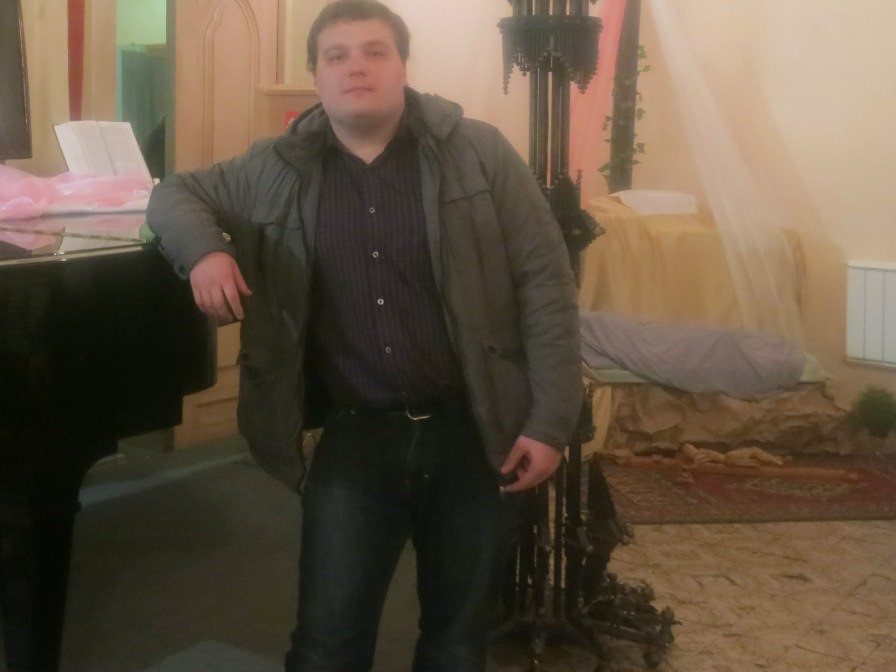
Vyacheslav Luthor, as seen in his online CV at Careerist.ru
The Second Western District Military Court in Moscow sentenced Vyacheslav Luthor, a bank clerk from St. Petersburg, to ten years in prison after finding him guilty of charges of high treason, secret collaboration with the representative of a foreign power, and involvement in a terrorist organisation, over his alleged attempt to join the [pro-Ukrainian] Free Russia Legion. Despite the fact that the courts usually hear such cases in closed chambers, our correspondent was able to attend one of the hearings. Thus, it transpired that last summer Luthor had been contacted by a recruiter who promised him a new job, a high salary, and assistance moving abroad.
Born and raised in Krasnoyarsk, Vyacheslav Luthor is thirty-three years old. According to his CV, he graduated from the local affiliate of the Moscow State University of Economics, Statistics and Informatics (MESI) in 2014, before working as an accountant in the local state statistics bureau and as a manager in real estate and trading companies. After moving to Petersburg, he took a job at Bank Saint Petersburg, which is also listed as Luthor’s place of work on his hidden VKontakte page.
The case against the bank clerk came to light last summer. On 29 July 2023, Mediazona found a record of his arrest on the website of Moscow’s Lefortovo District Court. At that time the charges of high treason and involvement in a terrorist organisation were listed there. Apparently, the charges were updated during the investigation, and so the Second Western District Military Court was asked to try Luthor on three charges: attempted high treason, confidential cooperation with the representative of a foreign power, and involvement in a terrorist organisation.
Previously, “high treason,” as defined by Article 275 of the Russian Criminal Code, was rarely charged, but after the outbreak of the full-scale war, involvement in combat on the Ukrainian side (or an attempts to go there to fight) and donations to the Armed Forces of Ukraine were equated with “high treason.” Also, a new article on “confidential collaboration” with foreigners—Article 275.1—was inserted into the Criminal Code.
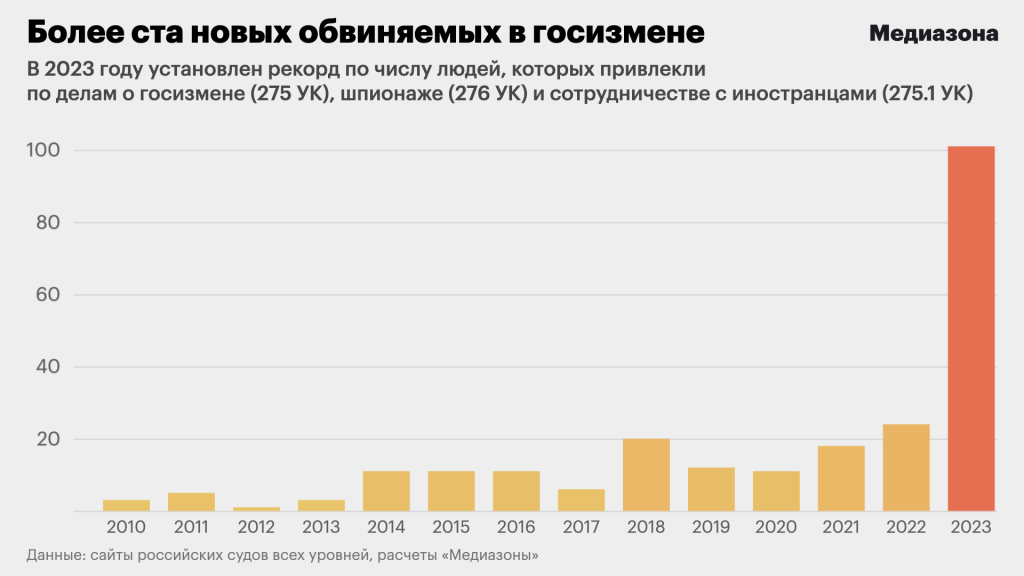
2023 was a banner year in Russia for charges of “high treason,” according to Mediazona.
Last year, as Mediazona has discovered, at least 107 people were accused of high treason (Article 275), espionage (Article 276), or collaboration with foreign powers or organisations (Article 275.1). Many such cases are classified, so the actual number of people charged with these crimes may be higher.
The human rights project Department One wrote that sixty-three high treason cases and seven cases of collaborating with foreigneers were submitted to lower trial courts. Verdicts have already been handed down in thirty-seven cases. All of them were guilty verdicts.
Unlike the high treason cases of previous years, which were mainly transferred to Moscow, courts in the regions began hearing these cases in 2023, human rights activists note. According to our calculations, more than seventy percent of such cases are now being heard outside Moscow, in the places where the crimes were allegedly committed, but the arrests and indictments are usually made in the capital.
This is what happened to Vyacheslav Luthor. Before he was placed in a pretrial detention centre, he had been jailed twice on administrative charges: on 11 July 2023, for minor disorderly conduct (Luthor was accused of “using foul language, shouting loudly, and waving his hands” at the airport) and on 14 July 2023, for disobeying police officers (Lutor was jailed for fifteen days for allegedly refusing to show his passport to law enforcers). He was to be released from the special detention centre on the day he was sent to the pretrial detention centre on the criminal charges.
“He asked me to keep my fingers crossed for him”: the testimony of coworkers
The Second Western District Military Court began hearing the case against Vyacheslav Luthor on 5 February. The state’s case was made by prosecutors Igor Potapov and Dmitry Nadysyev.
Trials on charges of treason are held in closed chambers and members of the public are not allowed to attend them, but our correspondent was able to get inside the courtroom at the only open hearing. That day, the court questioned the prosecution witnesses’s from Petersburg via video conference, and it was from these interrogations of Luthor’s former colleagues that it transpired that the bank clerk was accused of having ties with the Free Russia Legion and attempting to leave the country to fight on the Ukrainian side. Luthor himself has denied his guilt.
Luthor’s boss described her attitude to her former employee as “neutral.” She said that last summer Luthor had asked for time off from 10 July to 19 July in order to fly to his hometown of Krasnoyarsk to deal with “family problems.” According to the investigation, Luthor had probably planned to leave Russia on these dates.
Responding to a question from Prosecutor Nadysyev, the defendant’s former supervisor said that she had never spoken to Luthor about politics or the war in Ukraine.
“Tell me, did Luthor ever come to work dressed in military-style clothing?” the prosecutor asked.
The supervisor replied that he came to the bank in regular clothes — a shirt and trousers. When asked by defence lawyer Yulia Kuznetsova whether Luthor had talked about the Free Russia Legion and his desire to leave to fight in Ukraine, she also answered in the negative.
“I didn’t know what this organisation was doing and didn’t pay much attention to it,” the witness said.
“Did Vyacheslav Alexandrovich inform you that he was going to be involved in combat?” the defence counsel clarified.
“No,” the witness replied, and then she added that the word “legion” made her suspicious, as it could be associated with military action.
A female colleague of the defendant said that Luthor had asked her to come with him, but she had turned him down. The woman noted that she had advised him to refrain from the trip, although she did not completely believe that he would dare to go, as she regarded Luthor as a “wallflower.” The prosecutors then petitioned the court to have the testimony given by the same witness during the investigation read aloud due to “significant discrepancies.” The defence counsel objected. Luthor himself, a large man with short hair and dressed in a warm jacket, supported all of his defence lawyer’s motions and answered the court’s questions briefly.
The court granted the prosecutors’ testimony. In her [original] testimony to investigators, the witness had described her correspondence with Luthor in more detail. In it, he said that he had been contacted by a representative of the Free Russia Legion, who had offered him a high salary, and explained his offer to her to go with him by the fact that the recruiter needed two people. In addition, Luthor had specified to her that he would be working in the “frontline zone.” Then he asked if she had acquaintances at the Almaz-Antey military plant [he probably had in mind the company’s Obukhov Plant in St. Petersburg], and afterwards advised her to stay away from it. Luthor himself confirmed in court that he had written this to the witness.
Another colleague of Luthor’s who was questioned in court could not remember what exactly he wrote to her, apart from the fact that he had been invited to work for the Free Russia Legion. Consequently, her [original] testimony during the investigation was also read out in court. When questioned, she had said that in late June 2023, Luthor wrote to her that while he was on sick leave, he had been contacted by “a certain organisation” that offered him a job in Poland. He later clarified that his contact in the “legion” told him that he needed to leave Russia, where a “civil war was about to kick off.” He explained that he was being “actively recruited” and had been asked to “go work in reconnaissance.”
On 5 July, he asked her to “keep [her] fingers crossed for him so that he comes back safe and sound.” The witness said that she “disliked” Luthor. She did not take what he said seriously, thinking he was making things up. Luthor once again confirmed that he had sent the messages.
Human rights activists from Department One have written that people accused of high treason are often “provoked” by Russian law enforcers themselves.
“FSB officers and field agents find those who are subscribed to the Legion’s social media channels (not only the real ones, but also fake ones), and [ask them to] send them messages via bot or fill out a questionnaire to join.”
The provocateurs then introduce themselves as members of the Free Russia Legion, the Russian Volunteer Corps, or the SBU [Security Service of Ukraine], and ask the victim to do something: to take pictures of a military recruitment centre or an FSB building, to paste up [anti-war] leaflets, to set fire to a military recruitment centre or buy equipment, and then to fly to Turkey via a particular airport.
“The FSB denies they are involved in these provocations,” wrote Department One. “The[ir] official position in the courts is that it was allegedly done by the Ukrainian special services.”
The human rights activists also noted that the provocateurs sometimes write even to random people who have not voiced their opinions about the war on social networks. They “initiate friendly chats, introduce themselves as people who work on behalf of Ukraine, and ask [their correspondents] to do something.”
“He was constantly being provoked”: the mother’s testimony
“I’m alarmed — I haven’t seen my son for eight months,” was the first thing the defendant’s mother said when the judge asked how she was feeling.
Luthor’s mother, an energetic red-haired woman, had flown to Moscow from Krasnoyarsk to testify in the first hearing. In court, despite the fact that she had a hard time hearing the questions posed to her, she described Luthor’s childhood and their home life in detail. Even the prosecutor’s provocative question about her attitude to the “special operation” did not trip her up. Clearly understanding where Prosecutor Potapov was going, she said that she and her son considered what had occurred inevitable, but both of them were in favour of a peaceful end to the conflict between the two countries.
“What is your relationship with your son like?” the judge asked.
“It’s very good,” the woman assured him.
According to Luthor’s mother, her son has “a total aversion to violence, so there were problems with that at school.”
“He was constantly being provoked, and he asked his father to help him with it, but [he] has a father who believed that he had to defend himself,” the witness said.
According to his mother, Luthor did not serve in the army due to illnesses, and was not interested in military affairs or martial arts.
“We tried to send him to wrestling as a child, but after two classes he was kicked out for skipping. He just can’t hit [another] human being,” she said.
“My son never wanted to fight, he was afraid of it. He dreamed of travelling around the country and the world, even buying a trailer and driving it,” the witness said.
She said her son has hypertension, “a high degree of vascular and cardiac complications,” a stomach ulcer, and occasional panic attacks. Both she and Luthor’s father had medical conditions “galore”: [the father] had his knee joint replaced with an implant and was scheduled to have the other one replaced soon, but due to his small pension he still had to work despite his aching knees.
“He’s very nice,” the witness continued her account of her son. “He and I are close, and in terms of our views as well. He and I are not of this century: we are very trusting. He couldn’t pass a single beggar by.”
She added that Luthor had been afraid of [the military] mobilisation, although “there were no grounds [for this fear],” and he was not against leaving [Russia] if he had the opportunity.
She said that around the beginning of July he had stopped answering her calls, although they usually contacted each other every day. The mother went to the police and was told that Luthor had been detained for using foul language at the airport, although, according to her, Luthor did not swear as a matter of principle.
The witness said that her son liked his job at the bank and was very fond of Petersburg, where he had gone on her advice. She said that she did not know about his plans to travel abroad and that she was even going to visit him in August.
The prosecutor’s questions made it clear that at some point Luthor had asked his parents to help him pay off a debt.
“Tell me, what was the story when fraudsters allegedly stole money from your son’s [bank] card and you had to sell your property to cover the debts?” asked the prosecutor.
“‘Property’ is too strong a word, but we had to [sell] part of it. It was at MTS Bank,” Luthor’s mother replied. “We sold the garage and just part of that sum—”
“Well, what was the amount? Was it large?” asked the judge, interrupting her.
“Approximately two hundred [thousand rubles],” she replied.
“And did you discourage your son from filing a law suit or going to law enforcement [to tell them] a fraud had been committed?” the judge asked.
“Well, yes, I said it was useless,” she replied.
After the judge sighed heavily, the witness repeated that they were very gullible and she herself had fallen victim to fraudsters.
“Did you contact law enforcement?”
“Yes. They managed to recover part [of the money].”
“You see,” added the prosecutor.
“The rest is being earned back by my husband,” the witness said in conclusion. She was dismissed from the stand, and the journalists were asked to leave the courtroom.
Luthor’s trial took only five hearings, four of which were held in closed chambers. On 28 February, the prosecution asked the court to sentence Luthor to fifteen years in a high-security penal colony. The very same day, the court handed down the sentence: ten years of imprisonment, of which Luthor will spend the first two years in a closed prison, serving out the remaining eight years in a high-security penal colony.
Communist Dissidents in Early Soviet Russia. Five documents translated and introduced by Simon Pirani
This book gives voice to Russian communists who participated in the 1917 revolution, but found themselves at odds with the Communist Party as it consolidated its rule in the early 1920s. One Red army veteran demands action against corrupt officials; another mourns the dashed hopes of 1917 and the loss of friendship and solidarity; a “collectivist” group aspires to new cultural and technological revolutions; other oppositionists denounce material inequalities, the return of workplace exploitation and creeping state authoritarianism. The five documents in the book are published in English for the first time, with an introduction and notes.
“These voices of rank-and-file worker communists, from the early 1920s, convey not only accurate diagnoses of the situation then, but also prophetic warnings of the consequences of the Bolshevik Party’s bureaucratic degeneration and of workers’ alienation from control over power. This book is an important contribution to the study of early Soviet history, and necessary for understanding the overall legacy of those Soviet dissidents who criticised the ruling regime from the left, from socialist and democratic positions.”
– Ilya Budraitskis, author of Dissidents Among Dissidents: ideology and the left in post-Soviet Russia (Verso, 2022)
“This slim volume offers a valuable addition to our insights and understandings of worker resistance and opposition in the early Soviet period. The documents themselves are captivating. They are expertly translated and annotated, and the introduction provides crisp and scholarly contextualisation. It will be particularly useful in the classroom for undergraduate and graduate students.”
– Professor Sarah Badcock, author of Politics and the People in Revolutionary Russia: A Provincial History (Cambridge, 2007)
“Given how the Soviet Union developed and the persistent anticommunism around the world today, it is easy to forget that early Soviet Russia was a time and place rich in possibility and in diversity of experience and vision, even among Marxists themselves. The dissident communist voices in Simon Pirani’s compact collection of well introduced, contextualized, annotated, and translated documents from 1920-22 brings this vital era alive intellectually, ideologically, and even emotionally. We hear in this small but diverse selection of largely forgotten communist voices great uncertainty and determination, disillusionment and hope, desire and despair. These voices offer critical viewpoints on ideology and politics, but also richly textured feelings about the condition of the revolution in these key years. Frustration, anger, shame, disgust, and melancholy are among the interpretive emotions weaving through these texts. And we hear important critical perspectives on the failings of the new society—inequality, corruption, bureaucratism, authoritarianism, dishonesty, poverty of thought—and important principles for a new society, including democracy, collectivism, and worker power. This collection is ideal for stimulating student discussion in courses and will be of interest to anyone who wants to understand the experience of revolutionary Russia beyond dismissive stereotypes and simplifications.”
– Mark Steinberg, author of The Russian Revolution, 1905-1921 (Oxford, 2017) and Russian Utopia: A Century of Revolutionary Possibilities (Bloomsbury, 2021)
Contents
Introduction. 1. Anton Vlasov’s letter to the Central Committee (September 1920). 2. Declaration of the Workers and Peasants Socialist Party (Moscow, May 1921). 3. ‘We are Collectivists’ (1921). 4. Appeal of the Workers Truth group (1922). 5. From Iosif Litvinov’s diary (1922). (120 pages)
About the author
Simon Pirani is Honorary Professor at the University of Durham. He is author of The Russian Revolution in Retreat, 1920-1924: Soviet workers and the new communist elite (Routledge, 2008) and other books and articles about Russia and Ukraine.
The second explanation that also immediately arises is the persistent sense of victimhood, which is embedded in the language: “we are victims of the West”; “we are victims of the Horde“; “we are victims of the authorities and the regime”; “we are victims of immigrants”; “we are victims of the capitalists”; “we are victims of circumstance”; “we are victims of revolution and war”; “we are victims of the Soviet era”, “we are victims of the 1990s”; and so on and so on. Again, this wide range of culprits who have victimized us enables us to integrate the image of victim into any ideological matrix. But all of these versions of victimhood are united by a sense of resentment, a sense of mediocrity, a sense of lacking something, and these feelings are constantly reproduced and cultivated. This language has no room, of course, for a critique of our own history and culture’s imperialism. We are not to blame: we are victims ourselves, our history is a victim, our culture is a victim. How can our sense of victimhood be squared with the fact that we ourselves have victimized others? The perception of ourselves as victims is one of our privileges, one of our special rights; it is our manifest destiny. However, the criticism of imperialism, the emergence of voices who declare themselves our victims, who want to discern our history and culture’s violence, subjugation, and injustice towards them, undermines this language’s entire foundation and our image of ourselves as victims. It undermines the foundation on which we stand, our privilege of being unique. And this triggers pushback and resistance, of course.
The generation of scholars who started studying the Soviet Union in the late 1980s and early 1990s were also shaped by their firsthand experience of the country. When they travelled as foreign students to Moscow, they found impoverished people. Empty shelves and pervasive poverty made Russians look like victims of the Soviet regime, and financially, Soviet Moscow seemed more like a European periphery than an imperial metropole, which they associated with material affluence.
The wave of decolonisation in Africa, the Middle East, South and Southeast Asia, which started after World War II, was accompanied by rigorous academic discussions and scholarship of colonial legacies and tools of violence.
By contrast, the 1991 dissolution of the Soviet Union did not result in similar scrutiny of the Russian imperial legacy.
For metropolitan Western Europe and the United States, Europe stood for metropolitanism – a place from which the world was colonised, not a place of colonisation. Accepting colonial history within Europe made little sense, so the colonial nature of Russia remained unchallenged.
In Russia itself, the dominant narrative was one of victimhood. Russians learned to see themselves as a special nation that sacrificed its own wellbeing for the sake of non-Russians in the Soviet Union. “Let us stop feeding them” was the slogan Russians used to explain Moscow’s decision to let the colonies go in 1991.
A recent article from the American Political Science Association (APSA) examined how the words used to describe Central Asia sometimes reinforce the region’s image as being part of Russia or the Soviet Union. Amid growing awareness of Central Asia’s colonial history, some argue it is time to move beyond terms such as “post-Soviet,” “near abroad,” or “Russia’s backyard” when referring to Central Asia today. Join host Bruce Pannier for a thought-provoking conversation on decolonizing Central Asian discourse with the co-authors of the APSA article: Botakoz Kassymbekova, a lecturer and assistant professor of modern history at the University of Basel; and Erica Marat, a professor at the National Defense University’s College of International Security Affairs.
Putin’s propaganda builds on seeing Russia as both victimized by the West and entitled to regional dominance over Ukraine, Belarus, Central Asia, and the South Caucasus. Russia’s sense of its lost greatness in 1991 after the demise of the Soviet Union fuels a sense that it is the innocent victim of outside powers. Its shrunken geography and collapsing economy made post-Soviet Russia economically poor compared to the wealth accumulated by Western colonial metropoles. Soviet socialism as a global anti-capitalist force had failed to bring the same level of prosperity. Russian intellectuals became preoccupied with their own imagined marginal position vis-à-vis the West fueling the denial of the true colonial nature of the Soviet regime.
At the same time, Russian political elites expect loyalty from former Russian colonies that includes knowledge of the Russian language and political loyalty, and unity in opposition to Western influence. According to such an imperial view, Russian rule over non-Russian populations is not colonialism but a gift of modernity. It is a deeply altruistic act for the sake of backward people. Rejection of Russian cultural dominance, including building independent foreign policy and contesting the Russian view of Soviet history, is an act of political disloyalty. In Central Asia, for instance, Russian ambassadors routinely condemn states’ prioritization of indigenous languages as attempts to limit the rights of the ethnic Russian population. Such search for independence triggers a sense of victimhood in Russia, as if disagreement with the Russian imperial self-image is an attack on Russian cultural greatness.
Putin coupled Russia’s innocent victim narrative with a historical self-image of a civilizing power against former Soviet republics that sought closer ties with the West. The Russian imperial myth allows identity mobilization around militant patriotism while also helping the state keep the public passive and uncritical. Putin recently spoke about Russia’s imperial identity when announcing the military attack on Ukraine: “It was necessary to immediately stop this nightmare—the genocide against the millions of people living there, who rely only on Russia, hope only on us.” Western leaders’ naming atrocities in Bucha a genocide further deepened the Russian regime’s sense of victimhood. The Russian Defense Ministry stated that the West is collectively attacking Russia. Feeling humiliated by the West, the Russian public was simultaneously supporting Russian aggression in former Soviet territories. Economic hardships can be reframed as a burden unjustly borne by a victim-savior or as an imperial duty of those who humanely seek to liberate the world from evil.
Someone wrote in the comments: “I get the impression that Dmitry is sitting near the same five-storey apartment block [pyatietazhka] and photographing life in the vicinity.” Existentially, that’s how it is, and so when I geotag a post I feel I’m doing something that is somewhat meaningless, as if a Khrushchev-era apartment block [khrushchevka] in Ladoga were fundamentally different in some way from a Khrushchev-era apartment block in Petrozavodsk.
Nevertheless, the Soviet neighborhoods with their endless labyrinths of prefab blocks of flats and bricks are the most interesting and beautiful things in a city. [On the contrary,] I enjoy going to museums and fortresses about as much as I enjoy going to a municipal outpatient clinic.
I would like to paraphrase a quote by an artist,* although he is probably the last artist whose quotes I would like to paraphrase—Warhol: “Five-storey apartment blocks are the most beautiful things in Russia. Five-storey apartment blocks are the most beautiful things in Belarus. Five-storey apartment blocks are the most beautiful things in Kazakhstan. There is nothing beautiful in Beijing and New York.”
* [“The most beautiful thing in Tokyo is McDonald’s. The most beautiful thing in Stockholm is McDonald’s. The most beautiful thing in Florence is McDonald’s. Peking and Moscow don’t have anything beautiful yet.”]
Friends, I don’t answer questions about shooting and processing, not because I keep this knowledge secret, but because the very wording of the question don’t entail a substantive answer. How do I get people’s consent? In different ways. How do I process shots? Manually.
Many people think there is some kind of universal life hack—a script for talking to people, a filter for processing photos, etc.—that will solve the problem. It is excusable for youngsters who grew up on TikTok and other shit to think this way, but we adults should realize that things are more complicated. And supposing that quality is determined by equipment is like believing that a properly selected frying pan is the key to being awarded Michelin stars.
I used to think that this desire for quick results was a peculiarity of young people, but my psychotherapist friends, for example, face the same situation, although their clients are no longer teenagers. Apparently, it is human nature to cut corners and look for a panacea.
You can get experience in communicating with people only by doing it. And in this case it is also difficult to give advice because everyone has their own patterns of behavior—at first. Some [photographers] get the consent [of the people they’re shooting], some shoot brazenly, some shoot secretly, etc. Situations are different too: in some places it’s enough to shoot once, on the fly, while in others you have to get to know your subjects. Being able to predict which strategy will be most effective in which case and will give the best result is a tour de force, I think. And this comes with experience.
P.S. By the way, shooting secretly is no solution at all—any street photographer will tell you that when shooting covertly, the photographer has such an anxious and telltale kisser that it would be better if he shot openly.
“To be honest, we don’t need to educate anyone. Everyone knows everything. If they don’t know, they have a hunch. We are a country of very experienced people, and this experience has taught most of us to live by choosing ignorance — in order to survive. I’m not talking about physical survival, but about the minimum amount of mental comfort without which life ceases to be life, even if one is alive.” ||| Yelena Bonner, Postscript: A Book about the Exile in Gorky (Moscow: Interbruk, 1990), p. 247
Very soon — this Sunday — our current exhibition will wrap up, and the Sakharov Center will close its doors.
THIS MATERIAL (INFORMATION) WAS PRODUCED AND/OR DISTRIBUTED BY A FOREIGN AGENT, THE SAKHAROV CENTER, OR CONCERNS THE ACTIVITIES OF A FOREIGN AGENT, THE SAKHAROV CENTER. 18+
Coincidentally, our final exhibition is dedicated to Yelena Georgiyevna Bonner, who founded the center. Eviction, of course, does not mean at all that we are ceasing operations. This year we expect to launch a website in honor of Yelena Georgiyevna, produce a podcast, and do a lot more. And yet, it is clear that an important period in the center’s history is coming to an end.
The headquarters of Russian human rights group the Sakharov Center, a rare island of free debate in the Russian capital, will close its doors to the public this weekend in response to an eviction order from local authorities as Russia’s wartime drive to suppress dissent shows no sign of ending.
Opened in 1996 to honor the memory of Soviet dissident and Nobel Peace Prize winner Andrei Sakharov, the center has been an iconic location for talks, exhibitions, funerals and discussions about human rights.
“Without these two buildings, we are no longer a public center,” said Vyacheslav Bakhmin, a veteran human rights activist and the chairman of the board of the Sakharov Center.
“It makes any activity extremely difficult.”
The eviction comes as the few human rights groups still operating inside Russia face intensifying state pressure in the wake of the Kremlin’s decision to invade Ukraine.
The country’s oldest human rights organization, the Moscow Helsinki Group, was closed down by a court order in January, while eight top members of shuttered rights group Memorial, which was jointly awarded the 2022 Nobel Prize last year, were targeted in police raids last month.
The Sakharov’s Center’s final exhibition at its headquarters on the banks of the Yauza River in downtown Moscow was devoted to Yelena Bonner, the wife of Andrei Sakharov and a major Soviet dissident in her own right.
“We did not plan this symbolism, it just happened this way — they started closing us down on the eve of Bonner’s centenary,” curator Natalia Samover told The Moscow Times.
“This center is filled with her name,” she said, standing amid the exhibition that included some of Bonner’s photos and video interviews as well as her desk, notebooks and letters opposing Russia’s 1990s war in the North Caucasus republic of Chechnya.
Bonner was involved in founding the Moscow Helsinki Group in the 1970s and worked tirelessly to raise Sakharov’s profile when he was exiled to Gorky (now Nizhny Novgorod) by the Soviet authorities.
The Sakharov Center. Photo by The Moscow Times
Following Sakharov’s death in 1989, Bonner established the Sakharov Center — gifted rent-free by the Moscow authorities — and opened the Sakharov archives to the public.
On a recent visit by a Moscow Times reporter to the Bonner exhibition, there were a handful of visitors.
“The center is definitely a significant place — it’s important to have different points of view as well as places where these different points of view can be discussed,” said Artemy, an IT specialist, who decided to visit because he knew that the center was due to close.
“I think that everyone can be represented in the public field,” said another visitor, Stanislav, who admitted that he wasn’t aware of “the history of the center.”
The closure of the Bonner exhibition — titled “Life Was Typical, Tragic and Wonderful” — marks the end of the Sakharov Center’s long tradition of public engagement.
Employees earlier this month dismantled the center’s permanent exhibition on the legacy of Sakharov and victims of Soviet-era repression and its final public event — dedicated to Bonner — will take place Sunday evening.
According to the eviction notice, the center must be fully vacated by April 28.
Formally, the authorities’ decision to deprive the Sakharov Center of its Moscow home was a result of the organization’s designation as a “foreign agent” in 2014 — Russian law forbids “foreign agent” organizations from receiving any state support.
But the Sakharov Center has said it believes the order was really motivated by the Kremlin’s desire to destroy “independent organizations that defend the public interest.”
For the moment, the Sakharov Center does not have any new premises lined up and is planning to continue its activities online.
In addition, it is undergoing an unscheduled inspection by the Justice Ministry this month, board chairman Bakhmin told The Moscow Times.
“The results will make it clear whether and how we can continue,” Bakhmin said.
The eviction is just the latest example of official pressure on the Sakharov Center.
Russia’s Prosecutor General’s Office declared the Andrei Sakharov Foundation — a group opened by Bonner in the U.S. — as an “undesirable” organization in January, a designation that means any association with the group could result in criminal charges in Russia.
That means the Russia-based Sakharov Center now avoids any cooperation with its U.S. counterpart.
The current state of human rights in Russia is “unprecedented,” according to Tatiana Lokshina, a Europe and Central Asia expert at Human Rights Watch, which was forced to close its own Moscow office last year.
“While Russia is fighting against Ukraine, it is also fighting against any critical actors within the country. This is a real war with dissenting opinions,” she told The Moscow Times.
Over the years, the Sakharov Center, which describes itself as “a place uniting thousands of Russian citizens who are not indifferent to the fate of the country,” has hosted a number of landmark events — including the unofficial lying-in-state for Soviet dissident Valeria Novodvorskaya and murdered Kremlin critic Boris Nemtsov.
Despite the loss of a physical presence in central Moscow, Bakhmin remains optimistic that the Sakharov Center will survive and the current crackdown will be reversed.
“The situation [in Russia] will change again — the reality we live in right now has no future,” Bakhmin told The Moscow Times.