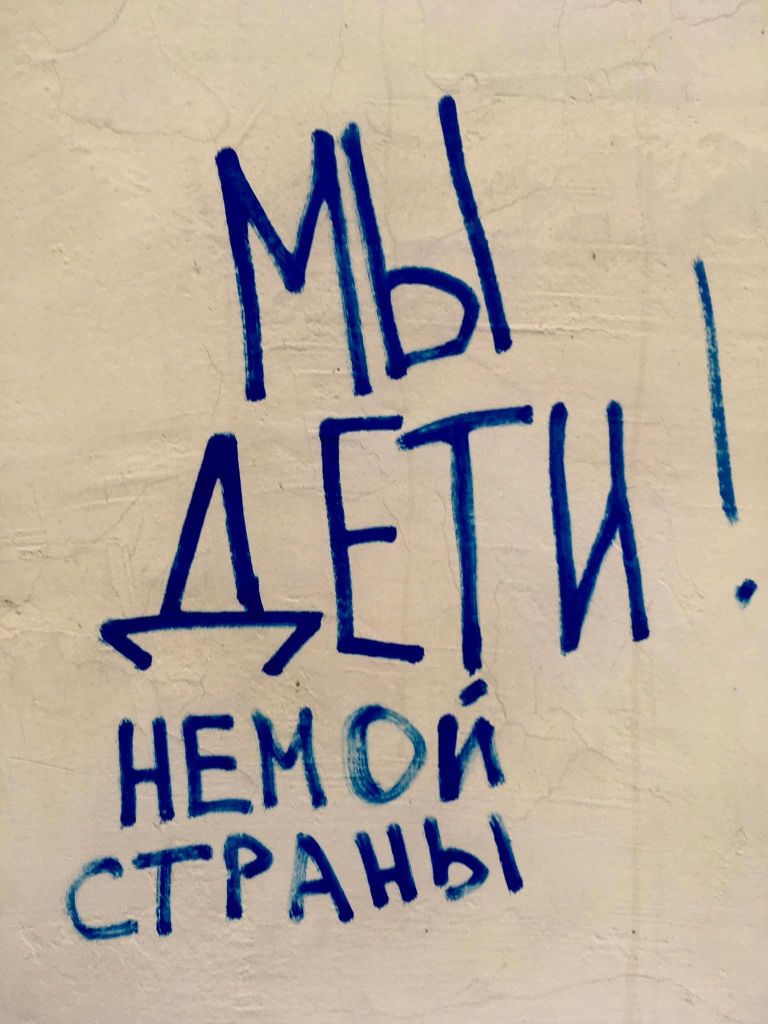
“We are children of a mute country.” Graffiti on a wall in Petersburg, 11 February 2024. Identity of photographer suppressed for their own safety.
Last night I dreamt I was taking a long exam to see whether I “met the standards of the biological species.” The examining committee was chockablock with priests, Cossacks, and members of the ruling party.
A bust of Stalin stood on the table. The flag was hung upside down, meaning, that is, that it was the Serbian flag. The anthem played, with the Soviet lyrics, but everyone was staring at their smartphones.
I wrote my answers along with other candidates for the title of human being. Then a female robot arrived, introducing herself as Marusya. She collected the answer sheets and shook hands with everyone. The sheets were fed into something that looked like a coconut with eyes. It was an artificial intelligence, and it was the chief examiner.
The scores popped out almost instantly. To qualify as a human being, you had to get 75% of the answers right. I didn’t do so well: 28%. Everyone was divided into two groups—those who had passed the exam and those who hadn’t. Both groups walked one by one to different doors. Those who passed were congratulated and immediately accepted into the party, while those who failed had their passports confiscated and were issued a green (?) certificate identifying them as “second-class sentient beings.”
We walked out the door. The new party members went to a banquet hall, while the “beings,” me included, took off their clothes and donned identical uniforms, which were also green. The words “second class” were embossed on the breast pocket.
[Ksenia] Sobchak: You want your children to live in a stable country without revolution?
[Chulpan] Khamatova: Without revolution. It could be some kind of changes in mindset. Without revolutions. I don’t want revolution. I’m categorical on this point, because the heads of completely innocent people fly in revolution and all these wars. I don’t think it’s right. Both sides have to do their utmost to avoid this.
Sobchak: But would you accept any compromise for the sake of avoiding revolution? Figuratively speaking, I don’t know whether you have any notion of geopolitics or not, whether you understand what’s happening in North Korea. People eat grass, and there’s a city within a city where officials live, while [ordinary] people live a completely different life without electricity. It’s just that I’ve been there, and so I know what I’m talking about. To put it starkly, which would you choose—living in a country like North Korea, for example, or revolution?
Khamatova: I would choose North Korea. I don’t want victims. It means that the people who oppose this regime lack certain tactics, know-how, and wisdom, that’s all.
Russian holiday-goers are set to be the first known tourists allowed into North Korea since it closed its borders as a pandemic response in early 2020. A five-day jaunt was arranged by an agency in Primorsky Krai after the eastern region’s governor visited the hermit kingdom’s capital for talks. The countries pledged closer ties after a series of meetings in September.
Friends, we apologize for replacing the video. The Zygar channel team reposted it due to a factual textual error, but the time codes remain the same.
Since I am a writer, I think that in the near future I will have to write a book which could be called The Empire Must Die, but only about another empire—Putin’s Russia.
And, of course, in this book one of the most important characters will be Chulpan Khamatova, the actress and co-founder of the Gift of Life charitable foundation.
She was one of the first to protest against the war with Ukraine and leave Russia.
Chulpan will talk about her life, starting the foundation, her encounters with Putin, and fighting for the lives of children, friends, and her own honor.
[…]
You can help children with cancer and donate an affordable amount to the Gift of Life Foundation: https://podari-zhizn.ru/ru.
00:00 – First meeting with Putin 09:57 – The germ of charity 13:30 – Anton Chekhov in the Kremlin 17:47 – Meeting Yuri Shevchuk 21:40 – The foundation’s first concert 24:31 – On medicine, doctors, and building a new hospital 26:41 – Putin and the PR move 30:22 – The Friendship Medal and the search for the missing money 33:20 – The relationship between Putin, the doctors and the clinic 36:53 – Canceling Matvienko and Gref’s speech 40:10 – Putin’s meeting with the creative intelligentsia 42:07 – Putin on democracy and freedom 45:24 – Chulpan, Putin, and the breast pump 48:48 – President Dmitry Medvedev in the lives of charitable organizations
49:44 – Medvedev’s meeting with foundations, the story about the hamsters and beads 1:01:51 – Putin’s election campaign 1:07:05 – “This clinic should be turned over to the doctors.” 1:09:57 – Decentralization of hospitals, opening the center in Yekaterinburg 1:14:50 – Bullying and depression 1:18:58 – “Chulpan chooses North Korea”: the problematic headline 1:25:50 – “If I chose North Korea, why didn’t I stay there?” 1:28:53 – Reorganizing the foundation”from a church into a McDonald’s” 1:31:32 – Unholy Chulpan and Dima Yakovlev’s Law 1:35:53 – One-on-one with Putin 1:44:23 – Petition for the annexation of Crimea 1:45:53 – Offer to become children right’s ombudsperson 1:54:44 – Kirill Serebrennikov and detention 2:01:22 – Last meeting with Putin 2:05:56 – “Should I be afraid?” 2:09:56 – War in Ukraine: 24 February 2023 2:16:23 – The difficulty of emigration
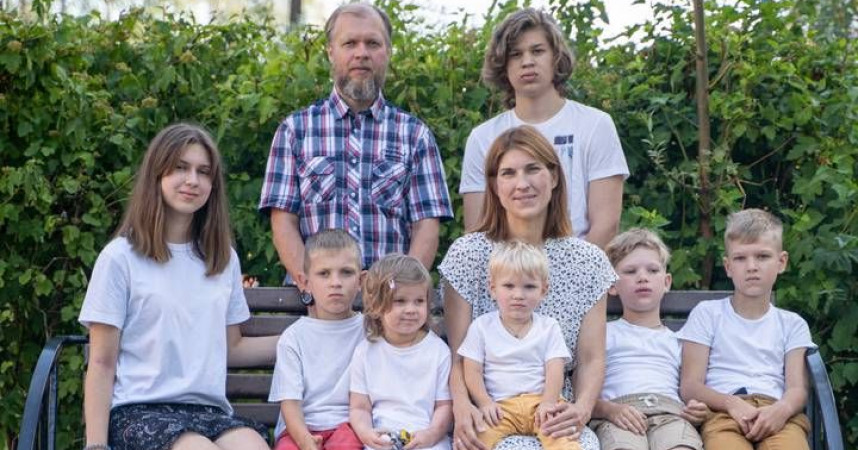
A portrait of the perfect Russian family, per Global Orthodox
State Duma drafting law that would prohibit the promotion of childlessness
The State Duma is drafting a law that would prohibit the “promotion of childlessness,” according to an RIA Novosti interview with Irina Filatova, a member of the Duma’s cross-party working group on the defense of traditional values. The MP emphasized that the draft law does not touch on the personal beliefs of individuals, explaining that it specifically targets destructive propaganda in the information space. In the autumn of 2022, lawmakers in Bashkortostan introduced a similar draft law. The bill’s author described the consciously childless lifestyle as a “foreign ideology” and accused its supporters of causing population decline. They argued that it degraded public institutions and eroded traditional values. At the time, the authorities had decided to investigate why, despite financial subsidies and campaigns to prohibit the “propagation of the childfree ideology,” Russians were unwilling to have children.
[…]
Russians will be taught to resist western influence beginning in kindergarten
The Federation Council’s committee on the defense of state sovereignty held a hearing on countering interference in Russia’s internal affairs “through youth policy.” The senators [sic] came to a unanimous decision about the need to give the younger generation a “vaccination” against foreign influence from an early age. Alexei Chesnakov, the head of the research council at the Center for the Political Climate, proposed creating a “registry of negative phenomena” and incorporating sovereignty protection into “children’s political education programs.”
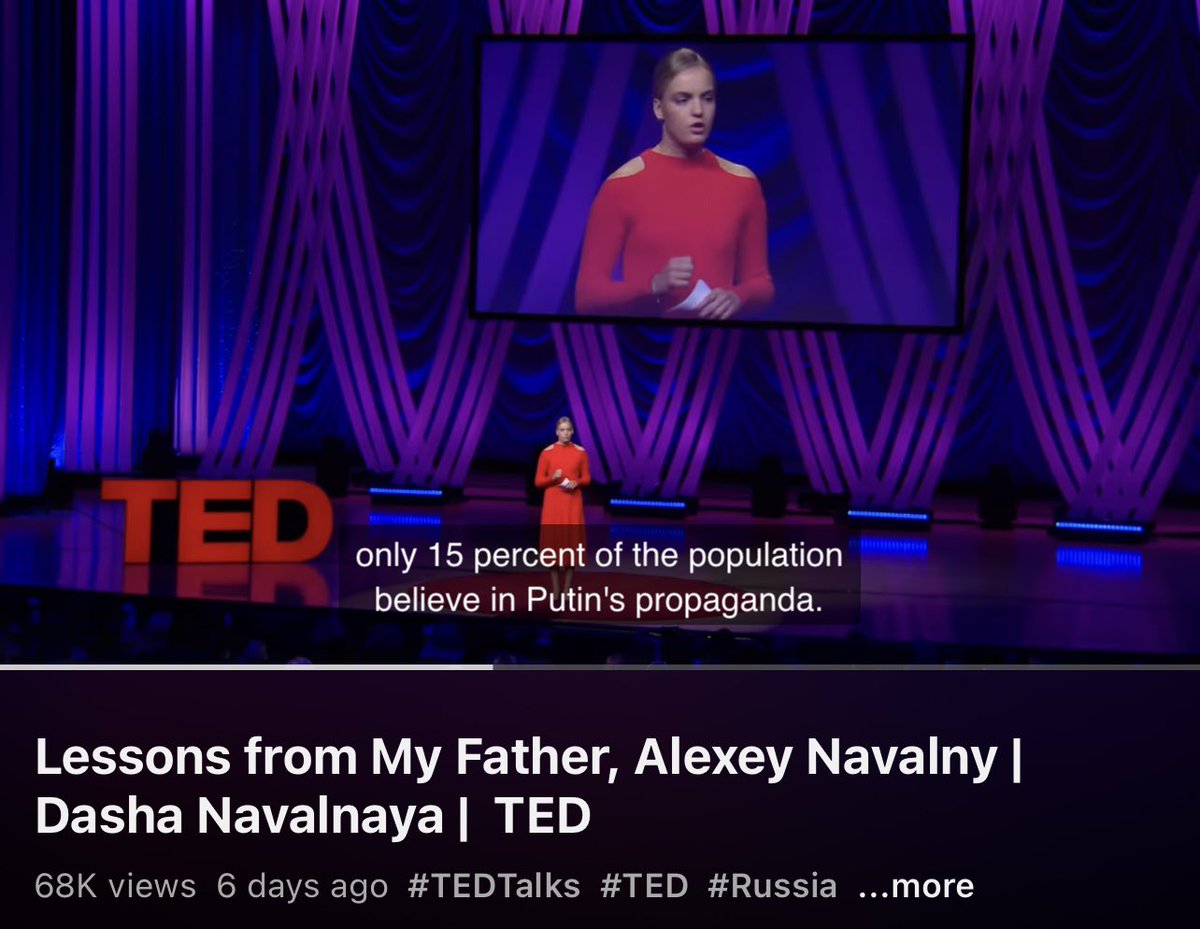
Dasha Navalnaya is the daughter of Alexey Navalny, the politician and leader of the Russian opposition to Vladimir Putin. Sharing the story of her father’s poisoning, persecution and current imprisonment, she details what it was like growing up under the watchful eye of government surveillance as her father led a decade-long investigation into the corruption of Putin’s regime — and shows why paying attention to what happens in Russia matters to everyone, everywhere.
There’s been some discussion lately on what proportion of russians actually believe russian propaganda. The presumption is that a low number gives hope for the end of the regime. There’s a lot of problems with that logic. Firstly, domestic russian propaganda is very often very open about the crimes russia is committing as an imperial aggressor. So it’s nonsensical to talk only about whether russians recognise lies. What matters is the extent to which they share this imperialist mindset and chauvinistic attitudes. It doesn’t matter whether you can recognise lies if you still think of Ukrainians as your little brother speaking a funny dialect of russian who needs to be pulled back into line. The key question is what proportion understand Ukraine is an independent nation – all the way to Crimea – and has a right to exist and do sovereign things like choose its own security alliances. It’s definitely not 85%. Not even close. When it comes to russia’s lies – like the lie it’s fighting nazis – I’d estimate the proportion of russians who understand this to be a lie at roughly 100%. On some level, to some extent, literally everyone knows this is a lie. Consider this. Have you ever heard anyone ever express any confusion as to why wagner, founded by a neo-nazi, had a leading role in ‘denazification’. It was never hidden. And it does not make any sense if you believe the lie. But no one really believes russia is fighting nazis. This would be a very, very long thread if I went through all the examples of where no one ever expresses confusion when russia openly does and says things that are completely contradictory to much of its own propaganda. No one is confused because everyone knows russia lies. But that does not translate to not supporting the regime. Lying is an endemic feature of russian society. People accept lying as easily as they lie themselves because, in this case, they know the lies are necessary to advance the imperial agenda. When Navalny’s people speak to Western audiences, they play on the assumption that western values are universal in russia and that russians are yearning for a liberal democracy yet only being held back by lies told to them. This is nonsense. Think of russia like a sports team. When diehard fans see their players fake an injury to get a free kick, the fans will shout outrage to the referee in favour of their team’s free kick with no care whether that is fair or not. Would you wade into that crowd of diehard fans to tell them “actually your side cheated” and think this would end their support for their favourite team? On some level, those fans know their side cheated, but what matters is that they just don’t care about the truth despite their feigned indignation. Similarly, convincing russians their country is an imperial aggressor committing genocide does not mean they’ll suddenly want to become a rules-based democracy that stays within its borders. They already know what they are. They support it. Note that russia’s key lies, like the denazification narrative, are used far more prominently towards international audiences in just the same way as fans shouting at a referee. In both cases, the lies are part of the game to them. But this is why international attitudes to Navalny are more positive the further away from russia you get. From afar, it’s easy to convince yourself that exposing russia’s lies will lead to the end of the regime and the start of some happy liberal era led by whoever rules next, even though so much of the russian opposition reflects these same imperial attitudes. What really matters is the end of the russian imperial mindset and its ability to conduct aggression with impunity. For that, the world must support a victory to Ukraine and a Special Tribunal for russia. Give us a TED Talk about that. More importantly, do it.
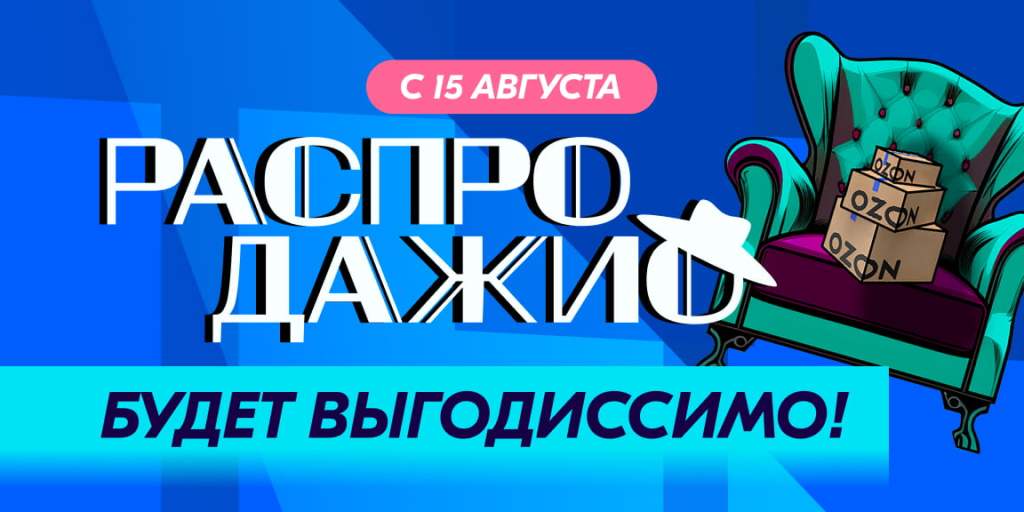
“From August 15. There’ll be bargains galore at the clearance sale!” Source: Email flyer from Russian e-commerce giant Ozon. In the original, the nouns meaning, roughly, “bargains galore” and “clearance sale” are written, unaccountably, with the Italian endings -ggio and -issimo.
Let’s think about who the beneficiaries are and what their profit is: this should explain why the regime is stable. The beneficiaries include not only the supreme leader, who of course wants to be “mistress of the seas” and has been trying consolidate the regime for himself and his entourage. The beneficiaries also include different groups among the elites, the security forces, officialdom, businessmen, and “intellectuals” at all levels. Material and symbolic resources are now funneled to these groups, and they are granted new powers to cause mayhem in their own bailiwicks. Many of them have taken advantage of this opportunity to quash rivals and take up new positions in their respective economic, political, and cultural markets. The beneficiaries also include different sectors of the populace—for example, people employed in the defense industry, people employed by law enforcement agencies, people who volunteer for the army as contract soldiers, and people engaged in producing different kinds of propaganda. They amount to millions of people, and the streams of financing that nourish them flow far and wide. In addition to power and material gain, there is a psychological benefit: one can now openly be proud of one’s country and hate its “enemies.” How many of the insulted and injured now feel joy and have made their own complexes the norm. This satisfaction also costs money, and it means millions more in new profits.
“These amendments are written for a big war and general mobilisation. And the smell of this big war can already be scented,” Andrei Kartapolov, the head of the Duma’s defence committee, said this week as the Russian parliament rushed to adopt a new law. The legislation enabling the Kremlin to send hundreds of thousands more men into combat reveals a sad truth: that far from seeking an off-ramp from his disastrous war in Ukraine, Vladimir Putin is preparing for an even bigger war.
It is understandable that many in Ukraine and the west want to believe that Russia’s president is cornered. The Ukrainian army is gradually reconquering lands occupied by the Russians and has shown itself capable of striking deep into enemy territory — even into the Kremlin itself. The sanctions pressure on Russia is mounting.
For now, the west remains united in support of Kyiv, and streams of modern weaponry and money sustain the Ukrainian war effort. Finally, the mutiny staged by the Wagner mercenary boss Yevgeny Prigozhin and visible conflicts among senior Russian military commanders add to hopes that the Kremlin’s war machine will break down.
Things likely look very different to the Kremlin, which believes that it can afford a long war. The Russian economy is forecast to record modest growth this year, mostly thanks to military factories working around the clock. Critical components such as microchips needed for the defence industry are arriving from China and other sources.
Despite sanctions, the Kremlin’s war chest is still overflowing with cash, thanks to windfall energy profits last year and also to the adaptability of Russian commodities exporters, who have found new customers and who settle payments mostly in yuan. If budgetary pressures were to become more acute, Russia’s central bank could further devalue the rouble, making it easier to pay soldiers, defence industry workers and the internal security forces who keep the Russian elite and public repressed and largely in line with Putin’s disastrous course.
When it comes to the war itself, the Kremlin still seems unperturbed by the Ukrainian counteroffensive. Even if Kyiv makes more advances, the Kremlin may brush them off as temporary. Putin is banking on the fact that the Russian manpower that can potentially be mobilised is three to four times bigger than Ukraine’s, and the only pressing task is to be able to tap into that resource at will: to mobilise many more men, arm them, train them and send them to fight. This is precisely the purpose of the new law, which should help the Kremlin to avoid another official mobilisation.
From now on, the government can quietly send draft notices to as many men as it deems necessary. The upper age limit for performing mandatory service will be increased from 27 to 30, and could be raised again in future. Once an electronic draft notice is issued, Russia’s borders will be immediately closed to its recipient in order to prevent a massive exodus of military-age men like the one Russia witnessed last autumn. The punishments for refusing to serve have also been ramped up. These moves, combined with massive state investment in expanding arms production, should help Putin to build a bigger and better equipped army.
A parallel tactic is the strangulation of Ukraine’s economy. Knowing that the Ukrainian budget is on life support provided by its western allies, the Kremlin wants to deny Kyiv all sources of revenue. Moscow has therefore not only pulled out of the grain deal that had enabled Ukrainian agricultural exports via the Black Sea, it has also launched massive air strikes against Ukrainian ports to destroy any possibility of reviving the agreement. The same logic underpins Russia’s air strikes against civilian infrastructure: they are aimed at making Ukrainian cities uninhabitable and preventing reconstruction efforts.
The Kremlin hopes that the rapid rebuilding of the Russian army and gradual decimation of the Ukrainian economy and armed forces will result in growing western frustration and a decline in material support for Kyiv. To speed up this process and break the west’s will, Moscow is using threats of escalation, including expansion of the conflict towards Nato territory via Belarus with the help of Wagner mercenaries based there.
Putin has made plenty of fatal mistakes. But as long as he is in charge, Moscow will dedicate its still vast resources to achieving his obsession with destroying and subordinating Ukraine. As western leaders think about policies to support Ukraine into the third year of this ugly war, any long-term strategy must take this reality into account.
Things like this also get written: “Is it just Putin’s war or a war on the part of all Russians? Perhaps neither one nor the other. Another sociological hypothesis is that the cynical elite has provided the real support for the military aggression, rather than a grassroots gone bad.” (This is a headline: you can google it.). Further, the authors define “the cynical elite” as “the mid-level and low-level officials who ensure the functioning of the Kremlin’s military-political machine; the para-state businesses engaged in import substitution and circumventing sanctions; the upper middle class and the leadership of so-called public sector entities, compelled in one way or another to demonstrate loyalty to the war”—that is, only a few million people. In other words, the Russian ruling class supports the foreign policy that the Russian state pursues in the interests of the Russian ruling class. This argument is tautological in the Marxist manner (although, as the authors of the article rightly point out, it occurs to very few people) and is not entirely true, because there are groups within the ruling class who do not benefit at all from this policy. But it certainly sounds more convincing than the theory of a “grassroots gone bad.”
I reread our interview with Dima Spirin [leader of the recently dissolved veteran Russian punk rock band Tarakany!], and one phrase cut me to the quick: “Our attempt to be free in an unfree country has failed.” An ordinary argument, seemingly, and it’s been made a hundred times. There were oases of freedom in Russia, but then they were destroyed and everything collapsed.
Such things are usually spoken of with regret, as of disappointed hopes. But oases of freedom in a poor dying country are not terribly moral, by and large. Do you know who was free in ancient Greece? That’s right, slaveholders. All the others were slaves.
Does this mean it isn’t worth fighting for freedom in an unfree country? It doesn’t mean that at all. But what’s worth fighting for is everyone’s freedom, not just one’s own. There is no separate freedom for fifteen percent of the population. That is called colonialism.
Some have it good, while others have it bad. Some are free, while others are slaves. Some are rich, while others are poor. There is no other way. Or rather, there is another way, but it ends exactly as it has now—in enormous bloodshed.
It’s either everyone or no one: freedom is not achieved piecemeal.
This is our collective fault. Our guilt is terrible and bloody. I don’t excuse myself either.
And the inner freedom that is the talk of the town nowadays is a lame excuse, like inner emigration. The madman and the drunkard are truly free. But neither meditation, nor reading Borges, nor listening to psychedelic rock will save you from hunger, cold, or getting smacked with a billy club. And they won’t cancel the fact that your neighbor has it bad.
A woman falls on the street, breaks her leg, and lies on the ground screaming. But you’re listening to Pink Floyd on your headphones: you’re free.
I’ve always liked a certain phrase from our fellow countryman, the philologist Professor Lotman. In one of his university lectures he said: “A person is always in an unforeseen situation. And here they have two legs: conscience and intellect.”
This is a very wise thought, I think. And a person must rely on both of those legs.
Relying on your conscience alone seems intuitively right. But abstract morals that fail to take into account human nature and the real world will devolve into either stupidity or evil-doing, as we’ve seen more than once in the past.
Then you have reliance on the intellect without conscience—which is exactly what lies at the foundations of the Russian state today. At first this idea seemed logical to the elites. Using petroleum, gas and other resources, we’ll build a conscience-free, but very clever, modern, rational and merciless state. We’ll become richer than the tsars of the past. And we have so much gas that even the populace will get a little something. Making use of the contradictions and vulnerability of democracy, we will become leaders and be respected. And if not, then feared.
But what happens is what happens everywhere. The intellect, unfettered by conscience, whispers: seize, steal. If you’re stronger, then your interests are always more important than the rights of others.
Not wishing to rely on the leg of conscience, my Russia made several big leaps, pushing everyone else around, but then slipped and came crashing down, destroying everything all around it. And now it is floundering in a pool of either mud or blood, its bones broken, its population destitute and robbed blind, while all around lie tens of thousands of people killed in the stupidest and most senseless war of the 21st century.
But sooner or later, of course, Russia will rise again. And it’s up to us what [leg] it will rely on in the future.
Russian prosecutors have requested a 20-year prison sentence for jailed Kremlin critic Alexei Navalny on a new string of “extremism” charges, his team reported Thursday.
Navalny, 47, has been charged with creating an extremist community and an organization that infringes on the rights of citizens; financing extremism; making calls to extremism; and involving minors in dangerous acts and the rehabilitation of Nazism.
He and his allies have denied the charges as “absurd” and politically motivated.
If convicted, the trained lawyer and Putin opponent will spend a total of 29 years in prison.
In his final word in a prison court before his sentencing, Navalny slammed the invasion of Ukraine and expressed his hope for Russia’s future.
“My Russia made several big jumps, pushing everyone around, but then slipped and with a roar, destroying everything around, collapsed,” Navalny said, according to a statement published by his team.
“And now it is floundering in a pool of either mud or blood, with broken bones, with a poor and robbed population, and around it lie tens of thousands of people killed in the most stupid and senseless war of the 21st century.
“But sooner or later, of course, it [Russia] will rise again. And it’s up to us what it will rely on in the future,” he added.
His verdict is expected to take place on August 4.
The European Union added the chief of the Russian prison camp holding Navalny to its sanctions list as prosecutors requested the 20-year sentence.
Navalny was jailed upon his January 2021 return to Russia after recovering from a near-fatal poisoning with what Western scientists determined was Novichok, a banned military-grade nerve agent developed by the Soviets.
Russian officials outlawed Navalny’s political and activist organizations as “extremist” organizations later that year, prompting nearly all of his close associates to leave the country.
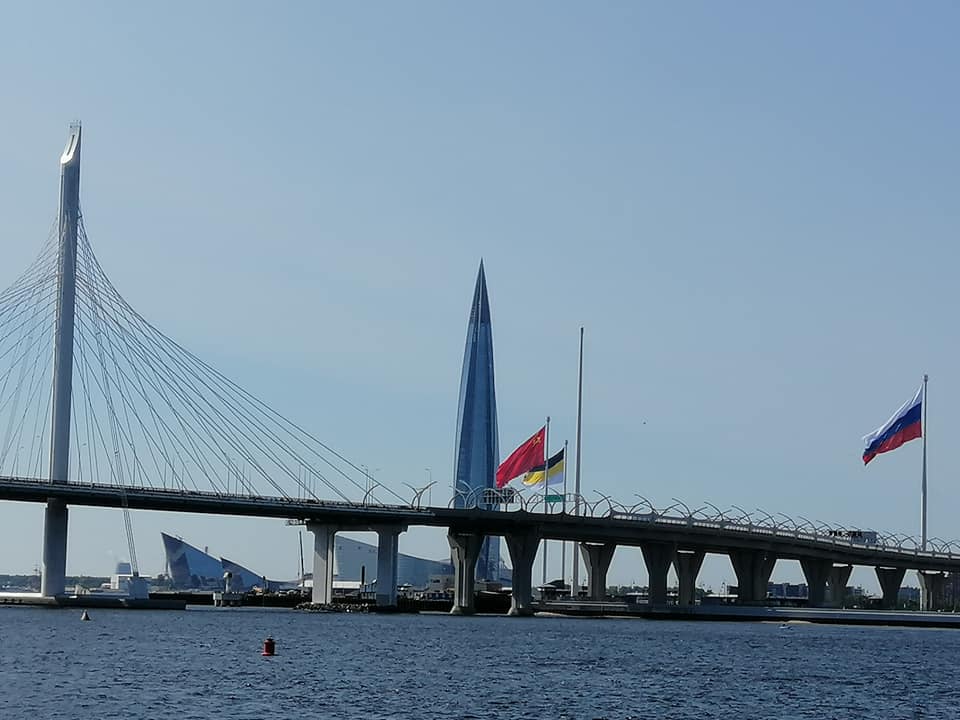
Russian President Vladimir Putin took part in a ceremony to raise the flags of the Russian Federation, the USSR, and the Russian Empire in St. Petersburg Tricentennial Park.
The head of state arrived in the area of the Gulf of Finland near Lakhta Center on the yacht Okhta. He watched the ceremony from the water.
On board the yacht, the head of state was welcomed by Elena Ilyukhina, deputy general director of Gazprom Neft and general director of Gazprom Lakhta LLC.
“St. Petersburg’s aquatic area and maritime facade,” she said, waving her hand at the view. “It’s beautiful. I understand that you have finished this complex,” Putin said, pointing at the 462-meter tower of Lakhta Center. Ilyukhina briefly told the president about the project, and also announced plans to build a 555-meter skyscraper next door.
[…]
“I understand that today’s event is connected with the fact that one stage [of the project] is ending and another beginning,” Putin said. Ilyukhina explained that the flag-raising ceremony, whose guest of honor of was the head of state, commemorated historical dates: the 165th anniversary of the Russian imperial flag, the 100th anniversary of the Soviet flag, and the 330th anniversary of Peter the Great’s tricolor.
Ilyukhina underscored that the choice of banners was not accidental: each flag represented a certain historical stage, marked by feats of heroism, victories and achievements. “The raised banners are a tribute to our history,” she pointed out, saying that Gazprom had erected the three 179.5-meter-high flagpoles to form the world’s first ensemble of flagpoles of such a height built on water. “The trinity symbolizes the continuity of our history,” Ilyukhina emphasized.
“It’s beautiful,” Putin said appreciatively. His interlocutor also noted that as part of the comprehensive improvement of St. Petersburg Tricentennial Park’s shoreline, hydraulic works had been designed to protect the coastline from erosion. A pedestrian bridge would stretch from each of them to the shore. The project’s development and implementation required complex engineering and design solutions and innovative construction techniques.
When the Russian national anthem rang out during the ceremony, Ilyukhina continued her story. The president stopped his interlocutor’s narration with a gesture of his hand, however. He put his finger to his lips, thus asking for silence as the national anthem was played.
After [the anthem was performed], the flag of the Russian Federation, the flag of the Soviet Union, and the flag of the Russian Empire soared into the air. The raised banners are remarkable for their immense size: each width of cloth is slightly larger than half of a football field: sixty by forty meters. Each flag weighs almost half a ton.
St. Petersburg Tricentennial Park is the youngest in the city. It was founded in 1995 to commemorate the three hundredth anniversary of the city’s founding [which did not occur until 2003]. [The then-Petersburg mayor] Anatoly Sobchak and future president Vladimir Putin each planted a tree.
According to Ilyukhina, as part of the project for improving the city’s coastal area, they are now planning to work on the park’s shoreline, including building a water sports base and equipping the beach, sports grounds, and walking paths.
I had visions, I was in them I was looking into the mirror To see a little bit clearer The rottenness and evil in me
Fingertips have memories Mine can’t forget the curves of your body And when I feel a bit naughty I run it up the flagpole and see who salutes (But no one ever does)
I’m not sick but I’m not well And I’m so hot ’cause I’m in Hell
Been around the world and found That only stupid people are breeding The cretins cloning and feeding And I don’t even own a TV
Put me in the hospital for nerves And then they had to commit me You told them all I was crazy They cut off my legs, now I’m an amputee, God damn you
I’m not sick but I’m not well And I’m so hot ’cause I’m in Hell I’m not sick but I’m not well And it’s a sin to live so well
I wanna publish ‘zines And rage against machines I wanna pierce my tongue It doesn’t hurt, it feels fine The trivial sublime I’d like to turn off time And kill my mind You kill my mind, mind
Paranoia, paranoia Everybody’s coming to get me Just say you never met me I’m running underground with the moles, digging holes Hear the voices in my head I swear to God it sounds like they’re snoring But if you’re bored, then you’re boring The agony and the irony, they’re killing me (whoa)
I’m not sick but I’m not well And I’m so hot ’cause I’m in Hell I’m not sick but I’m not well And it’s a sin to live this well (One, two, three, four)
Sasha Skochilenko (center) at her criminal trial in Petersburg, 25 May 2023. Photo: Nadezhda Skochilenko
At today’s hearing [in Sasha Skochilenko’s criminal trial on charges of disseminating knowingly false information about the Russian army], Sasha’s defense lawyers and Svetlana Drugoveyko-Dolzhanskaya, a linguist who conducted an independent forensic examination and found no knowingly false information in Sasha’s messages, were able to question one of the authors of the linguistic forensic examination [commissioned by the prosecution].
Olga Safonova, a specialist in political science (!), was enlisted to contribute to the linguistic forensic examination. But, as she was instructed to do by a staff member at the forensics expertise center, she evaluated whether what was written [on the anti-war “price tags” that Ms. Skochilenko is alleged to have posted in a Petersburg supermarket] was in line with the Russian Defense Ministry’s position, not whether it was truthful.
[Safonova] admitted that her analysis of one of the messages was “slightly misleading.” She was “at a loss” when asked to respond to the assertion that Sasha faces up to ten years in prison on the basis of such misleading conclusions, among other things.
After a recess (due to her heart problems, Sasha found it difficult to endure the stuffiness and lack of water), the examination of the witness was continued by Drugoveyko-Dolzhanskaya. Safonova was forced to admit that among the sources against which she checked Sasha’s messages, only the Defense Ministry’s website corresponded to her own definition of an official source — unlike the website Life.ru and anonymous Telegram channels. She also could not answer a school curriculum-level question about impersonal sentences, although their erroneous definition in the forensic examination is one of the “proofs” of Sasha’s guilt.
In addition to pointing out the errors in the forensic examination and its noncompliance with government standards, Drugoveyko-Dolzhanskaya recalled that, according to the Justice Ministry’s methodological recommendations, when an expert strays beyond their area of professional competence, it is a procedural error and is inadmissible [as evidence in court]. Safonova was forced to agree. Drugoveyko-Dolzhanskaya followed this up by asking a direct question: “Can you, as an expert, prove conclusively that Skochilenko knowingly falsified information?”
Safonova replied that she could not.
The new prosecutor abruptly interrupted her and requested that the hearing be postponed.
You can come out and support Sasha at 11:30 a.m on June 13. Many thanks to everyone who continues to attend the trial, shares information about the case, and donates money to pay the lawyers and buy food and medicine care packages! You can help Sasha financially here:
+79627117055
(Sofia S., Sberbank)
5469550065976075
(Sberbank)
Source: Nadezhda Skochilenko (Facebook), 25 May 2023. Translated by the Russian Reader. The details for donating money to Ms. Skochilenko’s defense fund are only for people based in Russia.
[…]
Olga Safonova. Photo courtesy of The Village
In the late 1990s, St. Petersburg State University, for reasons unknown, gave away one of its dormitories on Vasilievsky Island — 10 Bering Street — with a two-story attic built on. Later, one of the university’s vice-rectors regretfully claimed that if the building had not been given away, the university would have had room to house over 500 students. Today, the building houses apartments (a three-bedroom flat there will run you 20 million rubles) and offices. It is owned by the Bering-10 Condominium Association, whose chair is Olga Diomidovna Safonova. She has the exact same name as an associate professor in the Faculty of Political Science at St. Petersburg State University.
Safonova has been involved as an expert witness in the criminal cases against [Petersburg anti-war protesters]Victoria Petrova, Sasha Skochilenko, and Vsevolod Korolev. They face up to ten years in prison if convicted. These are quotations from the expert analysis in the case against Victoria Petrova:
“Objective facts indicate that the war crimes against the civilian population of Ukraine have not been committed by the Armed Forces of the Russian Federation, but by the Kiev regime and the armed formations controlled by it.”
“The practical intent and purpose of the statements under examination [i.e., Victoria Petrova’s posts] consists in generating false ideas among readers (listeners) that the actions of the Russian federal leadership are condemned by society, as manifested by the threat of the use of nuclear weapons against Ukraine and against European countries.[…]In the materials submitted for examination, the negative assessment of the policy of Russian federal state bodies vis-a-vis their deployment of Russian federal armed forces to protect the interests of the Russian Federation and its citizens and maintain international peace and security, is not supported by arguments and evidence.”
Safonova graduated first from St. Petersburg State University’s law faculty, then from its philology faculty. In 2005, she defended her dissertation in political science. Here is a quote from the abstract: “Social deprivation has become a characteristic feature of the lifestyle of a significant portion of the Russian populace. A drop in the level of real monetary income has entailed increased competition for survival, thereby generating an increase in the stratum of people whose intentions have become criminal, i.e., unlawful.”
At least until the mid-2010s, Safonova led an active social life. The Village found the academic’s picture in a dozen photo reportages from different parties, as published by Sobaka.ru and Geometria. Here she is at a presentation by the jewelry house Freywille; here, at the (now-closed) restaurant Gusto’s birthday party; and here, at the opening of XXXX Baltika Brew.
The Village spoke about Safonova with graduates of various faculties at St. Petersburg State University: their assessments of her were contradictory. Journalist Anastasia Romanova, who took Safonova’s lecture course on political science, remembered her as “the toughest teacher, whose pass-fail exam was very hard to pass.” “She honestly read the whole class the riot act,” said Romanova. “It was very scary to go to her.” Emile, a graduate of the political science faculty, where Safonova taught a course on law, recalls, on the contrary, that “the course was a formality,” and “at some point that woman just disappeared.” It was one of the easiest subjects to pass,” he said.
In 2012, commenting to Delovoi Peterburg on the newly adopted law on foreign agents, Safonova said, “There are many organizations that, under plausible pretexts, are engaged in near-subversive activities. We as a state should be concerned about this, and it’s good that this issue has been addressed.”
“I remember that Safonova gave what I thought were absurd descriptions of the political regimes in other countries. She said there was no democracy anywhere. It seems to me that most students found her unpleasant both as a teacher and as an apologist for the regime. A couple of days ago, a classmate sent me an article in Rotunda about her involvement in the expert analysis [in the case of Victoria Petrova]. I wasn’t surprised,” says Emile. Romanova adds, “She didn’t give the impression of being a stupid person. Arrogant, yes. I think she understands perfectly well what is happening now.”
A man sporting a “Made in the USSR” tattoo, Liteiny Prospect, Petersburg, May 1, 2023. Photo by Vadim F. Lurie, reproduced here with his kind permission
Victory Day is a memorable holiday for every citizen of St. Petersburg! During the celebration of the Great Victory, each of us remembers the heroic deeds of our grandfathers. In keeping with a long-established tradition, many musicians dedicate their concerts to this important date.
On May 15, the Lensovet Palace of Culture will host “Echo of Victory,” a soulful solo musical performance by Dmitry Pevtsov and the Pevtsov Orchestra.
Dmitry Pevtsov, “Echo of Victory,” 15 May, Lensovet Palace of Culture
“Echo of Victory” is a new themed concert in which poems and songs of the war years and the best songs of Soviet and modern composers will be performed. The program will feature such songs as “Airplanes First of All,” “From Dawn to Dawn,” and, of course, everyone’s favorite song, which has become a symbol of the celebration of May 9—”Victory Day”!
We invite everyone to the “Echo of Victory” concert on May 15 at the Lensovet Palace of Culture. Let’s remember the great songs of that heroic time and once again feel proud of our great nation!
Directed by Denis Isakov
Duration 1 hour 40 minutes (without intermission)
Source: Bileter.ru. Translated by the Russian Reader
The Russian authorities and Russian propagandists have been competing with each other to recreate something outwardly similar to the Soviet system in our country. The message to Russian society is simple: we are different, we have a different path, don’t look anywhere else, this is our destiny — to be unlike everyone in the world. And yet there are more and more traits of our country’s yesterday in its tomorrow.
For some reason, the speakers at the Knowledge educational forum, starting with Prime Minister Mikhail Mishustin, called directly for Russia’s self-isolation. Mishustin demanded that we achieve independence from foreign designs in the information sphere. The word “independence” has been increasingly used to mean isolation and breaking ties.
Deputies in the State Duma have proposed re-establishing the mandatory three-year “repayment through job placement” for university graduates, and prohibiting those who have not served in the army from working in the civil service.
With Ella Pamfilova, head of the Russian Central Elections Commission, on hand as a friendly observer, Uzbekistan held a referendum on April 30 to decide whether to adopt a new constitution that would grant the current president, Shavkat Mirziyoyev, the right to de facto lifelong rule by lengthening presidential terms from five to seven years and nullifying Mirziyoyev’s previous terms. The ballot, which involved digital technologies, produced a turnout of 84.54%, and according to preliminary data, 90.21% of voters said yes to the amendments, which would change two-thirds of the Constitution, while 9.35% of voters voted no, and 0.49% of the ballots were disqualified. Although democratic procedures were seemingly followed, Uzbekistan is moving away from democracy.
Something makes us see Pamfilova’s visit to Uzbekistan not only as a trip “to strengthen friendship and cooperation,” but also as a completely practical exchange of know-how in organizing such referendums. Only by adopting a new constitution can the first and second chapters of the current Russian Constitution be amended, and it is the second chapter that enshrines civil rights and freedoms, we should recall.
Alexander Bastrykin, the prominent human rights activist and chair of the Russian Investigative Committee, has proposed adopting a new Russian constitution that would enshrine a state ideology, completely eliminate international law’s precendence over domestic law, and re-envision human rights as an institution alien and hostile to Russia, as something encroaching on its sovereignty. Uzbekistan’s know-how in voting on a new constitution will come in handy for the Russian Central Election Commission.
At seven o’clock this evening live on Citizen TV, we will talk about why, exactly, the Russian authorities are so enthusiastic about Soviet political practice and the Soviet style, and where such intentions can lead our country.
Russian President Vladimir Putin agreed with the need [for Russia] to develop its own communication protocols instead of foreign TCP/IP to ensure the country’s technological sovereignty and independence.
On Thursday, the head of state held an event at the Rudnevo Industrial Park during which the specifics of the development of domestic unmanned aerial systems were discussed. In this context, Alexander Selyutin, board chair of the Technojet group, spoke about the “Internet from Russia” project.
After listening to the proposals, Putin turned to his aide Maxim Oreshkin.
“Maxim Stanislavovich, talk to your colleagues, then report back to me separately, we need to help. This is obligatory, because if you have advanced proposals, your own, of course, we need to do everything to support them. It means technological sovereignty, and better competitiveness, and independence. […] We will definitely help,” the president said.
Those wishing to take part in a virtual LDPR rally at the monument to Vladimir Zhirinovsky created in Minecraft have overloaded the server. The number of applications exceeded twelve thousand, LDPR’s press service informed us.
As Andrei Svintsov, a member of the LDPR faction [in the State Duma], noted, this is only the first such event. The Liberal Democrats plan to continue using [Minecraft] and other gaming platforms to communicate with voters and attract new supporters, becoming in fact “Russia’s first digital party.”
The MP also recalled that experts continue to work on the “Cyber Zhirinovsky” political algorithm, which was previously announced by the party’s current leader Leonid Slutsky.
In late April, Judge Yevgenia Nikolayeva closed a court hearing at which it was decided how much time to give Alexei Navalny to examine the 196 volumes of the latest criminal case against him. According to the police investigator, this was necessary in order to protect investigatory privilege.
Over the past five years, judges in Russia have increasingly closed court hearings to observers, journalists, and even relatives of defendants. Because of this, defense lawyers cannot inform the public about what happens in these proceedings. Mediazona reviewed the judicial statistics and discovered that, in 2022, judges ruled 25,587 times to hear cases in closed chambers. This was almost twice as often as in 2018, when judges decided 13,172 times to hear cases without outsiders present.
The Constitution actually guarantees that your case should be heard in open court, but there are exceptions. The principal exceptions are cases involving state secrets (which is why all treason and espionage trials are closed), cases against defendants under sixteen years of age, and cases involving sexual offenses. The statistics for all such cases have not changed much in recent years.
But there is one more exception — a trial can be closed to “ensure the safety” of the people involved in the proceedings and their loved ones. This extremely vague wording allows judges to close any court hearing. Judges make vigorous use of it, especially when hearing high-profile cases.
Here’s another example. In September, the Moscow City Court closed the hearing of an appeal against the verdict in the “fake news” trial of municipal district council deputy Alexei Gorinov, who had been sentenced to seven years in prison for an argument over a children’s drawing contest in which he had said that children were dying in the war in Ukraine The judge alleged that the court had received threats, and said that the hearing would have to be closed for the safety of the parties to the proceedings.
Russian judges may be following the lead of their Belarusian colleagues, who have learned how to conduct political trials without outside scrutiny. They cite covid regulations, or fill the gallery with persons unknown, or don’t let anyone except the relatives of the defendants in the courtroom. Russian courts have begun to use many of these methods. And the Belarusian courts can declare a hearing closed without explaining the reasons at all.
The authorities do not want people to know about political trials, to monitor these trials, or to support the accused. That is why, on the contrary, it is important for society today to talk about political prisoners and help them.
A Russian version of the song by the French left-wing chansonnier Georges Moustaki. Translation: Kirill Medvedev. Guitar: Oleg Zhuravlev. Video: Nikolay Oleynikov
Don’t ask what her name is, she’s Beloved and tender, but fickle Very spunky, she’ll wake up and go forward To a new life that shines and sings
Bullied and branded Tortured and executed Well, how much can she suffer! And she rises up and strikes, And spends many, many years in prison, Yes, we betrayed her But we only love her more and more And so we want to follow her Right to the end
What her name is, don’t ask, my friend, She’s just a mayflower and a wild fruit She sprouts anywhere, like grass Her path will take her wherever she wishes
Don’t ask what her name is, she’s Sometimes beloved, sometimes persecuted, but faithful This girl that everyone is waiting for Permanent revolution is her name
After two decades spent in Russian politics, after all that I have seen and experienced, I was sure that nothing can surprise me any more. I must admit that I was wrong.
I’ve been surprised by how far my trial, in its secrecy and contempt for legal norms, has surpassed even the “trials” of Soviet dissidents in the 1960s and 1970s. And that’s not even to mention the harsh sentence requested by the prosecution or the talk of “enemies of the state”. In this respect, we’ve gone beyond the 1970s – all the way back to the 1930s.
As a historian, for me this is an occasion for reflection.
At one point during my testimony, the presiding judge reminded me that one of the extenuating circumstances [in my case] was “remorse for what [the accused] has done”. And although there is little that’s funny about my current situation, I couldn’t help but smile: A criminal, of course, must repent of his deeds. I’m in jail for my political views. For speaking out against the war in Ukraine. For many years of struggle against Vladimir Putin’s dictatorship. For facilitating the adoption of personal international sanctions under the Magnitsky Act against human rights violators.
Not only do I not repent of any of this, I am proud of it. I am proud that [assassinated opposition politician] Boris Nemtsov brought me into politics. And I hope that he is not ashamed of me. I support every word that I have spoken and every word of which I have been accused by this court. I blame myself for only one thing: that over the years of my political activity I have not managed to convince enough of my compatriots and enough politicians in the democratic countries of the danger that the current regime in the Kremlin poses for Russia and for the world. Today this is obvious to everyone, but at a terrible price – the price of war.
In their last statements to the court, defendants usually ask for an acquittal. For a person who has not committed any crimes, acquittal would be the only fair verdict. But I do not ask this court for anything. I know the verdict. I knew it a year ago when I saw people in black uniforms and black masks running after my car in the rear view mirror. Such is the price for speaking up in Russia today.
But I also know that the day will come when the darkness over our country will evaporate. When black will be called black and white will be called white; when it will be officially recognised that two times two is still four; when a war will be called a war, and a usurper a usurper; and when those who fostered and unleashed this war will be recognised as criminals, rather than those who tried to stop it.
This day will come as spring comes after even the coldest winter. And then our society will open its eyes and be horrified by what terrible crimes were committed on its behalf. Through this realisation, through this reflection, the long, difficult but vital path toward Russia’s recovery and restoration begins, its return to the community of civilised countries.
Even today, even in the darkness surrounding us, even sitting in this cage, I love my country and believe in our people. I believe that we can walk this path.
A Russian court sentenced opposition politician Vladimir Kara-Murza to 25 years in prison on charges of treason and “fake news” Monday, capping a high-profile trial of one of the country’s most defiant anti-war voices.
Moscow City Court found Kara-Murza, 41, guilty of treason, “false information about the Russian army,” and affiliation with an “undesirable organization,” Interfax reported.
“Russia will be free, tell everyone,” Kara-Murza said after the verdict, according to the independent news site Avtozak.info.
Russia has witnessed a widespread wartime crackdown on dissent, but the severity of Kara-Murza’s sentence marks a new record as the Kremlin seeks to muzzle any criticism of its ongoing invasion of Ukraine.
The Western-educated politician was detained in April 2022 on charges of “spreading false information about the Russian army” in an address to U.S. state legislators a month earlier.
Kara-Murza was later accused of being affiliated with an “undesirable organization” for participating in a conference in support of political prisoners. His treason charges came in October over anti-war comments made at three public events abroad.
Prosecutors had requested a prison sentence of 25 years — the maximum possible jail term — for Kara-Murza.
“My self-esteem even went up [on the prosecutors’ request]. I realized I was doing everything right,” Kara-Murza’s lawyer Maria Eismont recounted her client as saying.
“Twenty-five years is the highest score I could get for what I did, what I believe in as a citizen, as a patriot, as a politician,” Eismont quoted him as saying, adding that he greeted the verdict “with a smile.”
His trial was held behind closed doors.
Monday’s hearing was attended by several Kara-Murza supporters and foreign diplomats including a U.S. embassy official named David Bernstein, according to the Mediazona news site.
The Kremlin declined to comment on Kara-Murza’s prison sentence, which his supporters and Western governments slammed as politically motivated.
U.S. Ambassador Lynne Tracy called Russia’s criminal prosecution of Kremlin critics “a symbol of weakness, not strength,” while Canadian Ambassador Alison LeClaire said Kara-Murza’s sentence marked a “dark turn” in Russia’s post-Soviet history.
The British Ambassador in Moscow Deborah Bronnert denounced the court ruling and called for the “immediate” release of Kara-Murza, a dual British-Russian citizen.
“The British government expresses solidarity with Vladimir Kara-Murza and his family,” Bronnert told journalists from the steps of the courthouse.
A Russian citizen by birth, Kara-Murza received British citizenship after moving to the United Kingdom with his mother when he was 15.
Russia’s Ambassador in London Andrei Kelin was summoned by the U.K. Foreign Office, which condemned Kara-Murza’s sentence as a violation of his right to a fair trial under international law.
The European Union denounced Kara-Murza’s sentence as “outrageously harsh” and called on Russia to provide access to health care for the ailing Kremlin critic.
The opposition activist suffers from a nerve condition called polyneuropathy which his lawyers say was due to poisoning attempts in 2015 and 2017.
The condition has worsened in prison, and he was too unwell to attend some of his hearings, his lawyers said.
Kara-Murza says he was poisoned twice because of his political activities, but he continued to spend long periods of time in Russia.
Kara-Murza has said he stands by all of his political statements, including those opposing the Ukraine offensive.
“I subscribe to every word that I have said, that I am incriminated for today,” Kara-Murza said in his final address to court last week, highlighting his fight against the Ukraine offensive and President Vladimir Putin.
“Not only do I not repent for any of it — I am proud of it,” he said.
Germany condemned the “shocking level repression” in Russia on Monday, and Latvia announced it had banned 10 Russian nationals from traveling to the Baltic country in retaliation to the court ruling.