I was brought up in the Soviet Union to believe that when a malicious, cruel aggressor attacks civilians, you have to take up arms and go do battle with him, and that if you cannot bear arms, you help the people who are doing battle and call on others to do the same.
All my work as a political commentator has been about calling on people to go do battle with the aggressor which has attacked Ukraine, to assist Ukraine with weapons and ammunition.
No one had attacked or threatened Russia.
It was Putin’s Nazi regime which attacked Ukraine, only because of the megalomania of the regime’s ringleaders, because of their inhuman thirst for power over all they survey.
Murdering hundreds of thousands of people is their way of bolstering their self-esteem. They are degenerates, scum, and Nazi riffraff.
The guilt of Putin’s Nazi dictatorship in plotting, unleashing, and waging a war of aggression is obvious and does not need to be proven. We also do not need to prove our right to offer armed resistance to this aggression on the battlefield and in the aggressor’s rear. It would be laughable to expect this right to be acknowledged by a regime which tosses people in prison for morally condemning its aggression out loud. All legal means of protesting Putinist Russia’s aggression have been eliminated.
My calls to resist the aggressor’s regime with armed force have caused me to be charged with terrorism.* I won’t deign to argue with the aggressor’s officials even if they claim my actions constitute pedophilia. Russia’s courts have long ago shown themselves to be appendages of the Nazi tyranny and seeking justice from them is pointless. I will never stand up before these people, who are the lackeys of murderers and scoundrels.
I see no point in arguing with puppets of the dictatorship about how conscientiously they execute their own laws. In any case, these laws are the laws of a totalitarian state and their aim is to stifle dissent. I do not recognize these laws and I will not obey them.
I also have no intention of appealing any rulings made by or actions taken by representatives of the Nazi regime.
The Putinist dictatorship may murder me, but it cannot force me to stop fighting against it. Wherever I find myself, I will keep calling on honest Russians to join the Ukrainian Armed Forces. I will keep calling for airstrikes on military facilities deep in Russian territory. I will keep calling on the civilized world to inflict a strategic defeat on Nazi Russia. I will keep trying to prove that the new Hitler’s regime must be routed militarily.
Putin is the new Hitler, a vampire driven insane by impunity and drunk on blood. I shall never grow tired of saying, “Crush the viper!”
Death to the murder, tyrant and scoundrel Putin!
Death to the Russian fascist invaders!
Glory to Ukraine!
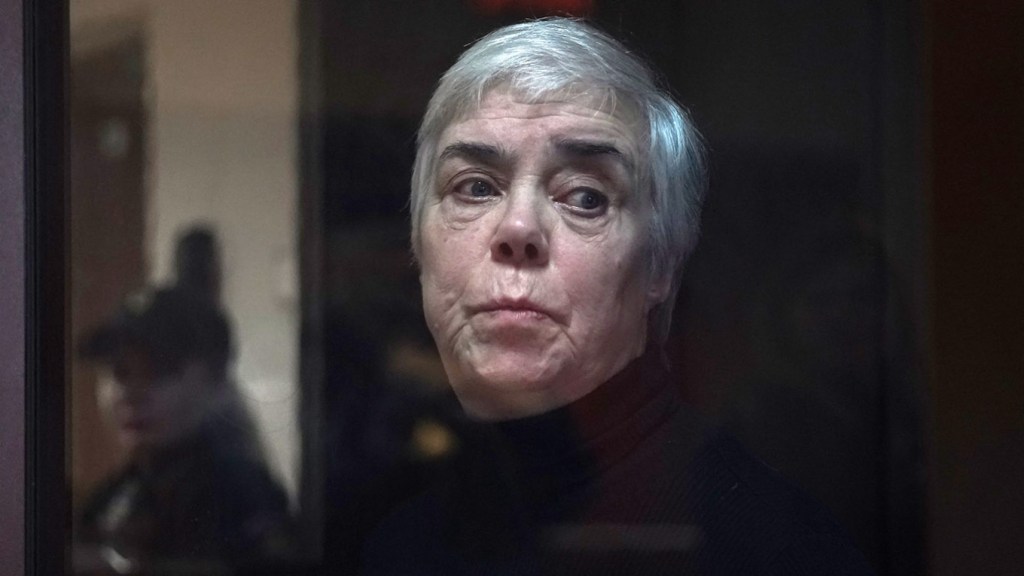
[Grani.Ru:] Thanks to Alexander Valeryevich’s dedicated wife Olga Shcheglova (pictured above). Thanks to SotaVision for filming at the Petersburg military court (Skobov is participating in the trial via video link from Syktyvkar). Thanks to those who didn’t unsubscribe from Grani.Ru after it closed. It’s as if Skobov timed his brave deed to coincide with the final moral collapse of numerous media brands. And yet he will be heard by a handful of his contemporaries. But he has already gone down in history.
* Skobov has been charged with “publicly calling for terrorism,” “publicly condoning terrorism or promoting terrorism using the mass media, including the internet” and “organizing a terrorist community and participating in it.” If Skobov is convicted on these charges, he faces a maximum penalty of ten to fifteen years in prison and fines of up to one million rubles (approx. 9,500 euros)— TRR.
Faithful to its avant-garde nature, Noise Cabaret premieres the immersive series Dialogues, based on the philosophical works of Plato, on December 25. Alexander Khudyakov turns ancient Greek philosophy into a lively, witty and provocative dialogue with the audience.
Along with his partner Ivan Wahlberg, Khudyakov, who not only acts in the project but directs it, will guide the audience through the labyrinths of Plato’s thought. What is justice? Where is the line between existence and non-existence? What is the true nature of love? These and many other fundamental philosophical questions will serve as starting points for reflection and debate.
Dialogues is a series of interactive performances in which each viewer is involved in a philosophical discussion consisting of adapted texts by Plato and actorly improvisation, meaning that the way the performance goes depends on the audience’s involvement. Each new performance is a separate chapter dealing with a specific philosophical problem, so you can join the series at any stage. The first episode deals with the concept of justice.
Noise Cabaret plans to invite Petersburg celebrities to enrich the conversation with the audience with their own opinions and views.
Khudyakov shared the idea behind the project.
“We wanted to do a story related to people talking in a bar. But just people talking to each other is not interesting. There has to be a big focus. When I studied Plato, I was interested in several aspects of his philosophy. It would have been wrong to limit ourselves to a single topic. So the idea to make a series arose: take Plato, read him, and discuss the themes he raises in the Socratic dialogues.
“We plan to produce a new episode every two or three months. There’s no pretense here that we’re serious scholars of Plato’s philosophy: it’s more of an excuse to talk to people about difficult topics, to air the Dialogues and reflect on them. And a bar is a place where you can talk about all sorts of things, including philosophy.”
Russians spent almost 6 billion rubles on Ozempic generics in 2024
Semaglutide-based drugs are commonly used for weight loss
In the first ten months of 2024, Russians spent 5.9 billion rubles [approx. 52 billion euros] on over one million packs of generic versions of the drug Ozempic (semaglutide), according to DSM Group, as reported by Vedomosti.
Among the most popular generics are Geropharm’s Semavic and Promomed’s Quincenta. The original drug Ozempic stopped [sic] official supplies to Russia in December 2023, opening the market to domestic analogues.
2024 was a record year for drugs in this category. By comparison, in 2023, Russians spent only 297 million rubles on Ozempic, buying 20 thousand packs. In 2022, they spent 1.9 billion rubles (256 thousand packs); in 2021, 758 million rubles; and in 2020, 76 million rubles.
Semaglutide-based drugs are used to treat diabetes but have recently been gaining popularity as weight loss drugs, which has also contributed to their sales growth in Russia.
St. Petersburg will open a new metro station this week, Governor Alexander Beglov announced Thursday, marking the former Tsarist capital’s first new metro station in five years.
The Gorny Institute metro station, located on Vasilievsky Island, will extend the fourth (or “orange”) line westward. It will begin operations at 9:00 a.m. on Friday, with its vestibule open for both entry and exit, Beglov said.
“The opening of Gorny Institute is a milestone,” the governor wrote on Telegram, noting that the city had overcome “significant challenges” during the station’s construction.
Beglov thanked President Vladimir Putin, metro builders, engineers and residents of St. Petersburg for their patience and support, calling the station’s completion the “first results” of sustained efforts to advance the city’s metro system.
The station’s opening comes after years of delays. Initially scheduled for completion in 2015, its opening was postponed to 2018 and later to 2022. Construction efforts were further overshadowed by a fatal scaffolding collapse in June 2020 that killed one worker and injured another.
Gorny Institute is the first station to open since 2019, when three others — Prospect Slavy, Dunayskaya, and Shushary — were inaugurated.
St. Petersburg’s metro is currently made up of five lines and 72 stations. However, it has expanded slowly over the years, in stark contrast to Moscow’s burgeoning metro system, which this year opened eight new stations.
In trying to grasp the tonality of the film [Anora], I am reminded of a line from Francis Bacon: “You can be optimistic and totally without hope.” The situation the characters find themselves in, being at the mercy of the rich, is totally without hope. The “hopeful” version of the script would be one in which Vanya does stand up to his parents and runs off with Ani, even at the price of losing his wealth—this is the film’s narrative lure. Or maybe another where the ruthless capitalist mother gains a grudging respect for her tough daughter-in-law, like in the last season of Fargo. But despite its grim closure, the impression the film gives is far from dreary or pessimistic. The hopeless optimism of Baker’s cinema lies in the sheer life that seems to almost burst out of the filmic frame, and, especially, his deep care for his characters, even Vanya.
In the fall of 2023, with the goal of understanding what is really happening with Russian society during wartime, the Public Sociology Laboratory team went on ethnographic research trips to three Russian regions—Sverdlovsk, Krasnodar and Buryatia. Over the course of a month, PS Lab researchers observed how people talk about the war and how it affects daily life in cities and villages. In addition, they recorded sociological interviews with local residents. PS Lab has compiled three detailed ethnographic observation diaries (more than 100,000 words apiece) and conducted 75 in-depth interviews. Overall, it has managed to collect truly unique data that provides an idea of what people say and think about the war in everyday situations, and not only when answering researchers’ questions.
The full text of the report is book-length and written in a book-style format: it consists of seven chapters, introduces many characters, and allows readers to be fully immersed in contemporary wartime Russia. The following summary, meanwhile, highlights the main analytical conclusions.
Russian society remains politically demobilized and deideologized. Despite the prevailing opinion that it is strictly militarized, we see that the war has become routine and therefore a disregarded part of reality. For example, compared to the first years of the war, the amount of prowar symbolism in public spaces has decreased in all three regions. The war has neither become a source of new ideas in the cultural life of cities or villages nor been integrated into familiar and already-established cultural formats. The war is not discussed in public places, including, with rare exceptions, local online communities.
In spontaneous conversations, Russians rarely discuss the overall goals and causes, criminality, or justifications of the war. They are concerned with the impact of the war on their everyday lives. When they talk about the war, they mostly talk about the same things they discussed before the war, for example, everyday difficulties, money, or ethics. Men more often discuss topics that are considered “masculine” in society, such as the technical side of the war, and women usually talk about “feminine” topics, such as how war destroys families.
Participation in various types of prowar volunteering and organized assistance for the military, which are often cited as an example of the mobilization and militarization of Russian society, is rarely motivated by people’s firm support for the “special operation.” It is usually associated with pressure from the administration, community moral norms (concerning mutual assistance), and/ora desire to help loved ones, rather than a wish to make victory for Russia more likely. Observation of volunteers’ activities show that while working, they do not discuss the war or politics, rather choosing topics that are personable and relatable to them: prices, pensions, families, and/or stories related to the volunteer centers.
Despite all these similarities, the war is perceived slightly differently in different regions. The peculiarities of each region’s view owe to factors like the number of military units and penal colonies from which prisoners are recruited, proximity to the combat zone, the prosperity of the region and the availability of decent jobs, the density of social ties, the circulation of news transmitted by friends on the front lines, etc. In other words, the differences in perceptions of the war are attributable mainly to the peculiarities of life in the regions before the invasion of Ukraine.
The conflict between opponents and supporters of the war is gradually subsiding, while the rift between those who stayed in Russia and those who left is growing. This is happening both because the shared experience of living through a difficult situation within the country is becoming more important for many Russians than any differences in viewpoint, and also because people are discussing the war less.
At the same time, the waning conflict between opponents and supporters of the war does not always mean more social cohesion. Since people are trying to live as if the war is nonexistent and the government does not talk about any losses or problems associated with the war, all negative consequences of the war are either normalized or pushed into the realm of “personal problems” that are not discussed with anyone and that everyone must deal with on their own.
Overall, many people do not feel able to influence political decisions. Therefore, they are increasingly distancing themselves from the war. They understand that they cannot change government policy, but they retain at least some control over their private lives—and therefore they are immersed in them. Over time, not only apolitical Russians but even sure opponents of the invasion experience this powerlessness and, as a result, some of them accept the new reality while continuing to condemn the war internally.
Consequently, many Russians are increasingly distrustful of political news from a broad range of sources. Instead, they put their trust in local media. Local problems and news seem much more important and relevant to them. Moreover, they feel that, unlike the war, local issues are at least sometimes within their ability to influence.
At the same time, the war is weighing people’s emotional state. Many of our interlocutors admit that they experience anxiety, tension, uncertainty, fear, even if these things are not usually spoken about openly. The departure of sons and husbands to war makes women “scream at the top of their lungs.” However, people rarely share such emotions with others, and if they do, they do so in groups with close friends.
Many Russians who are not interested in politics may justify or condemn the war depending on the communicative context.
They tend to non-emotionally justify the war through normalization (“there are always wars”) or rationalization (“it was necessary”) when asked about it directly in more formalized settings, such as research interviews.
They are more likely to criticize the war when prompted to think about how it negatively affects them as ordinary Russians. This criticism differs from that of war opponents. For opponents, the war is a moral crime against Ukraine, whereas for apolitical Russians, the war is seen as something that destroys Russian society and harms ordinary people. However, this criticism does not lead apolitical Russians to question the war’s necessity or inevitability, nor does it extend to criticizing the Russian government.
They tend to emotionally justify the war when confronted with traditional anti-war narratives. When Russia is accused of committing moral crimes against the Ukrainian people, they often take such accusations personally and attempt to defend their own dignity.
Some people have experienced a strengthened sense of national identity, and sometimes a demand for greater solidarity arises. It’s important to note that this increased sense of national identity does not lead Russians to adopt the official imperial brand of nationalism. Unlike the Kremlin, ordinary people live in a world of nation states, not in a world of imperial fantasies (according to which Ukraine is not a real state and Ukrainians are an inferior people).
A feeling of uncertainty is what truly unites Russians today. Despite the fact that people choose various strategies to cope with this feeling, it still significantly complicates the ability to plan one’s life and plunges Russians into pessimism.
Thus, on the one hand, the formerly extraordinary nature of the war is giving way to normalization: the war is gradually becoming something ordinary, another unremarkable part of the surrounding world. In a sense, many Russians resist both the Kremlin’s attempts to turn ordinary citizens into ideological supporters and the attempts of the anti-war liberal opposition to force society to actively experience guilt and fight. On the other hand, the war constantly reminds us of its existence, creating new threats, new anxieties, and new reasons for discontent in Russians.
Dear readers! Times are tough, and the key in this case is holding on in every sense. No one says it’s easy. But it’s not so hard either. The other day I asked Vladimir Putin whether he expected anything more from himself in the outgoing year. But I want to ask you: do you expect anything more from yourself in the coming year? We need to expect things. We need to want things. It’s a way of holding on to ourselves. Of looking after ourselves. Of not losing ourselves. And even of finding ourselves. A hard sign (“Ъ”) will never be a soft sign (“Ь”)! Happy incoming New Year! Let’s not be on the defensive!
Andrei Kolesnikov, Special Correspondent, Kommersant Publishing House
Source: Email from Kommersant, 31 December 2024. Translated by the Russian Reader. The so-called hard sign, which the Bolsheviks dropped from the Russian Cyrillic alphabet in 1918, has been the logo of Kommersant since the newspaper’s relaunch in January 1990. Andrei Kolesnikov has been the newspaper’s special Kremlin correspondent — that is, its chief Putinversteher — for many years. Of course he’ll deny it all when push comes to shove and Putin goes, and he’ll point of course to the cynical, jocular (but ultimately loyal) way he’s written about the Russian dictator and war criminal all these years.
Pro-Kremlin Telegram channels on Friday circulated a New Year’s video depicting Russian air defense systems shooting down Santa Claus’ reindeer sleigh.
The video, first shared by the Pul N3 Telegram channel, begins with Santa flying over central Moscow to the tune of “We Wish You a Merry Christmas.”
“Hi, Russians! Here are your presents,” says Santa Claus, sipping a Coca-Cola as the camera zooms in on his sleigh, which is loaded with rockets bearing NATO logos.
“Happy New Year,” Santa says before a missile shoots into his sleigh, causing it to explode mid-air.
Ded Moroz and Russian airpower. Image courtesy of Moscow Times
The scene then shifts to a military control room where a Russian serviceman and Ded Moroz — Russia’s version of Santa Claus — monitor the action on a screen as a traditional Russian folk tune plays.
“Is it done?” Ded Moroz asks the headset-wearing serviceman.
“Yes, it’s done. The target was destroyed,” the serviceman replies.
“Good. We don’t need any kind of foreign stuff [in our skies],” Ded Moroz says, embracing the serviceman. “Happy New Year!”
The video’s release comes just days after an Azerbaijani passenger plane crashed in western Kazakhstan, with reports suggesting it was shot down by a Russian surface-to-air missile.
Social anthropologist Alexandra Arkhipova conducted an investigation and concluded that Anna Korobkova, renowned for her numerous denunciations of people advocating anti-war stances, is probably a pseudonym of Ivan Abaturov, a journalist from Yekaterinburg. The BBC Russian Service has published the results of Arkhipova’s research.
Arkhipova assembled more than seventy letters, addressed to various institutions and agencies, in which Korobkova accused doctors, teachers, human rights activists, and journalists of “discrediting” the Russian army and called for them to be brought to justice. Among the denouncer’s victims are a doctor at a clinic who made a comment to [banned opposition channel] TV Rain, the mother of an enlisted soldier killed in the war, and Arkhipova herself. In one case, a student was expelled from a university after it received a denunciation alleging that he had been involved in “unauthorized protest rallies.”
In early December 2024, Arkhipova found a page about Korobkova on Wikipedia. With the assistance of linguists, she did a comparative analysis and found that the author of the Wikipedia article was probably the same person who had written the denunciations signed by Korobkova.
Arkhipova and the investigative journalists were able to identify the author of the Wikipedia article. It turned out to be a journalist from Yekaterinburg, Ivan Abaturov.
Abaturov, as the article points out, had already been at the center of a whistleblowing scandal. In the summer of 2022, Sergei Erlich, director of the publishing house Nestor History, said that Abaturov had allegedly detected “false information about the USSR’s actions during the Second World War” in one of his company’s books. Consequently, law enforcement officials visited Nestor History’s offices.
Abaturov himself has never concealed his attitude to denunciations. In 2019, he wrote on social media that “a journalist under Stalin was a walking prosecutor’s office” and that he wanted to be one too.
When asked by a BBC correspondent whether he had been writing denunciations under the name “Korobkova,” Abaturov replied on VKontakte: “Hello. You are mistaken.” Consequently, he stopped replying to messages, and the BBC was unable to reach him by phone.
Since the beginning of their country’s full-scale war with Ukraine, Russians have filed 2,623 complaints with law enforcement agencies about anti-war statements made by their fellow citizens, the investigative journalism website Important Stories (iStories) calculated in June on the basis of open source data. So-called LGBT propaganda (487 complaints) and Russophobia (250 complaints) ranked second and third, respectively, as grounds for denunciations.
According to Important Stories, seventy percent of the complaints were written by subscribers of the anonymous Telegram channel Mrakoborets, which specializes in tracking down anti-war activists. The channel’s daily norm is a minimum of three complaints on its pages on the social networks VKontakte and Odnoklassniki (“Classmates”). Yekaterina Mizulina, head of the Safe Internet League, had personally written 148 denunciations, while sixty were penned by pro-Kremlin activist Vitaly Borodin.
In the autumn of 2022, executives at the Russian Academy of National Economy and Public Administration (RANEPA) received a letter signed “Anna Vasilievna Korobkova.” It began as follows: “I fully support the special operation of the Armed Forces of the Russian Federation on Ukrainian territory. I am against all violations of the law.”
The letter concerned an interview that Alexandra Arkhipova, who had worked for many years as a senior research fellow at RANEPA, had given to the channel TV Rain, which had been designated a “foreign agent” by Russian authorities. (At the time of the interview, the TV channel had not yet been designated an “undesirable organization.”)
In her denunciation, “Korobkova” asked the university to dismiss Arkhipova for “immoral misconduct,” which, in her opinion, consisted in the fact that in the interview with TV Rain she had “disseminated false information discrediting the Special Military Operation [sic] on Ukrainian territory.” Korobkova also suggested that the university send the evidence against Arkhipova to the prosecutor’s office.
“Korobkova” was outraged that Arkhipova did not interrupt TV Rain presenter Anna Nemzer when the latter had called the “special military operation” a “war” (“thus showing she agreed with Nemzer’s false opinion”), mentioned Facebook without mentioning that it had been designated an “extremist organization” in Russia, and uttered the phrase “before the war I would ask.”
“This is a lie, as there is no war,” the letter said.
Upon seeing the text of the denunciation, Arkhipova was surprised by how long and detailed it was. Korobkova’s letter took up two pages, and even the time codes for the points in the interview at which Arkhipova had said certain things that angered Korobkova were noted. As a folklorist and social anthropologist who works extensively with different texts, Arkhipova was struck by the structure of the denunciation and the specific language in which it was written.
“I was reading this denunciation to friends, discussing it as a phenomenon of contemporary political culture, when one of my colleagues looked at me sadly and took a crumpled piece of paper out of his pocket. He unfolded it and read aloud a denunciation. It had the same wording, and was also signed ‘Anna Vasilievna Korobkova,'” Arkhipova tells the BBC.
REMEMBER RUSSIAN ‘GUN-RIGHTS ADVOCATE’ [ ] AND CONVICTED FELON MARIA BUTINA? Who doesn’t? Welp, here she is w/ your Daily Irony Supplement — and it’s a massive dose! See, as of Jan. 20 she’ll likely get a pardon and move back Stateside to improve on her spying career (hey, how could she do worse?); but in the meantime, she’s trying to get *Americans* (et al.) to go the *other* way, i.e. move to Moscow — y’know, like Our Guy Ed Snowden & his new roommate, Bashar al-Assad, who just *love* it there, right?
[WARNING: Do not watch this video immediately after a meal.]
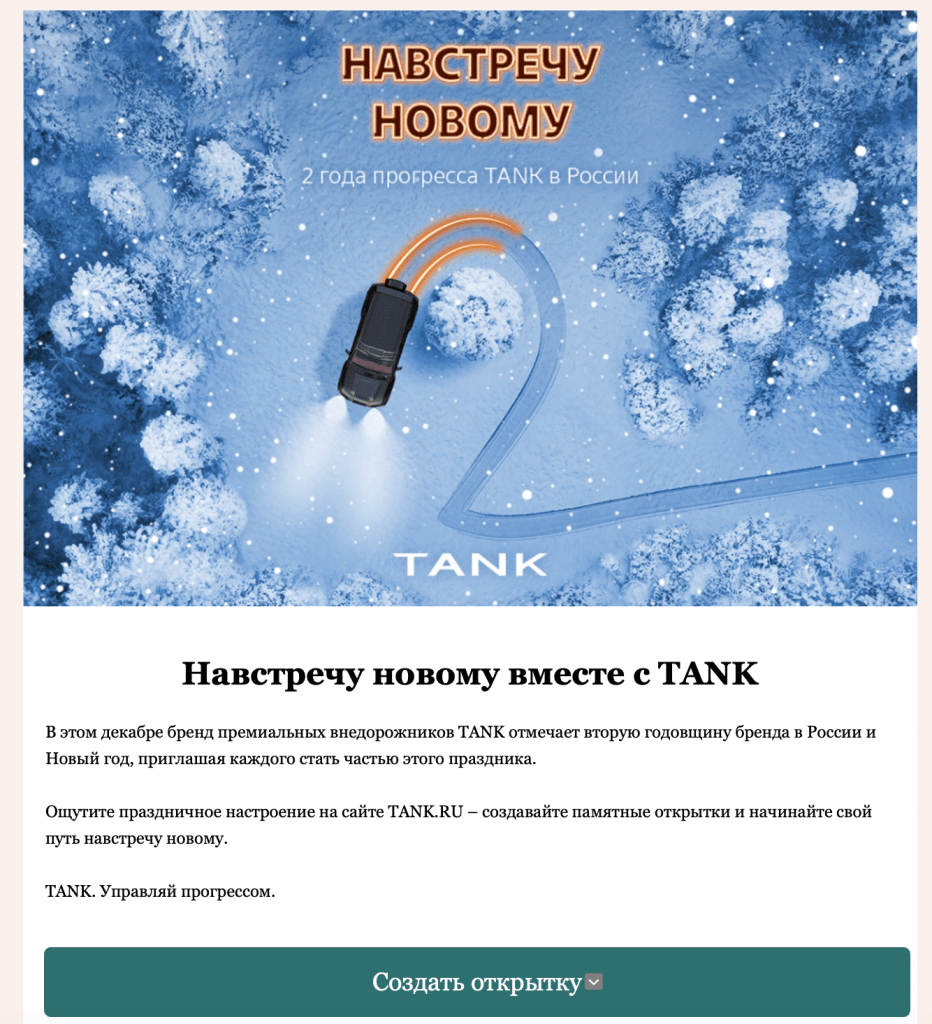
This December, premium SUV brand TANK celebrates its second anniversary in Russia and the New Year, inviting everyone to be a part of the celebration.
Get into the festive mood on the TANK.RU website by creating commemorative cards and beginning your own journey towards the new.
TANK. Drive your own progress.
Source: Unsolicited email from Vedomosti, 10 December 2024
The fall of the Baath state in Syria is a serious defeat for Russia (and a disaster for Iran). It would however be a grave mistake to assume that this by necessity makes it a success for the United States.
Moscow and Washington may indeed now face similar challenges in Syria.
Three issues led Russia to intervene in the Syrian civil war to save the Assad regime. First was a general desire to preserve a partner state — one of the very few remaining to Russia after the U.S. overthrow of the regimes in Iraq and Libya, which helped to prop up Moscow’s international influence. Second was a desire to retain Russia’s only naval and air bases in the Mediterranean.
Third was a deep Russian fear that an Islamist victory would lead to Syria becoming a base for terrorism against Russia and its partners in Central Asia. That anxiety was increased by the presence of numerous fighters from Chechnya and other Muslim regions of Russia in the ranks of the Islamist forces in Syria and Iraq.
[…]
Thanks to our readers and supporters, Responsible Statecraft has had a tremendous year. A complete website overhaul made possible in part by generous contributions to RS, along with amazing writing by staff and outside contributors, has helped to increase our monthly page views by 133%! In continuing to provide independent and sharp analysis on the major conflicts in Ukraine and the Middle East, as well as the tumult of Washington politics, RS has become a go-to for readers looking for alternatives and change in the foreign policy conversation.
We hope you will consider a tax-exempt donation to RS for your end-of-the-year giving, as we plan for new ways to expand our coverage and reach in 2025. Please enjoy your holidays, and here is to a dynamic year ahead!
On Sunday, something extraordinary happened: the Syrian people overthrew the Assad regime. For years we have been waiting to share this news with you. We wanted to make sure you didn’t miss our message below.
Dear Thomas,
This is the message we have been waiting so long to write. Assad is gone. The Syrian people have toppled the Assad regime. Our hearts burst with hope today. A war criminal of the worst kind no longer has the power to torture, starve, bomb and detain people in Syria.
The regime that has caused indescribable suffering and trauma for decades no longer has the power to commit war crimes. Syrians in Syria and all over the world are singing, “Syria is for the people, it does not belong to the Assad family”. We are chanting along with them. Ragheed al-Tatari, Syria’s longest-held political prisoner, has been freed alongside many others.
We write these words thinking of so many of our friends and loved ones who we lost in the past years. Our hearts break that they’re not witnessing these moments with us.
There is much that is unknown. We have lost so much. Our dream for freedom and democracy declared almost 14 years ago was for a peaceful transition of power out of authoritarian hands into those of the Syrian people – all of us diverse and different but together in our vision for a new Syria.
At the Syria Campaign we commit to continuing to work with all those who stand with human rights, with you all, to ensure our vision for a free and democratic Syria is made real.
The hope we feel today feels something like those first weeks when we took to the streets and dared to call for freedom and dignity. We believed the world would join us to protect humanity and champion the values they claimed to hold dear.
As our committed and courageous supporters you all know the journey we have been on since then. You have been with us as we rallied loudly against the bombings of hospitals, whole communities massacred by chemical weapons, the systematic use of detention and disappearance, meant to crush our spirits. You, and hundreds of thousands of people around the world, have stood with us and made our demands for protection of civilians and justice for war crimes more powerful.
Our movement, alongside the heroes on the ground in Syria – the White Helmets, medics, women’s rights activists, journalists – and the vibrant Syrian civil society in refuge around the world – the lawyers, investigators, artists, campaigners, survivor groups and family associations, has kept the demands of the revolution loud and clear.
Today, those demands are all the more urgent. It is time for Syrians to lead a peaceful Syria. Free and democratic, vibrant and diverse.
Now is the moment for Syria and the international community to restart Syria’s stalled UN-led political process, with a clear timeline for political transition that leads to free elections, as outlined in UN Resolution 2254.
There is so much to be done. We are impatient for accountability and justice. So many people remain detained or disappeared and families across the world are now hoping to go back to their homes and cities and be reunited with their loved ones. Almost every Syrian carries pain and trauma into this new moment. It is a moment that holds such promise. It is the chance to create a new beautiful Syria.
P.S. The weeks ahead will be critical. Please consider donating to support our work towards our vision for a free, just and democratic Syria.
The Syria Campaign is a human rights organisation that supports Syria’s heroes in their struggle for freedom, justice and democracy. Read more about our work here.
Online donations by credit card are processed by Voices Project USA and are tax deductible in the United States to the full extent allowable under the law. Online donations by PayPal are processed by The Voices Project (UK) and are not currently tax deductible in the US or available for gift aid in the UK. Voices Project USA Federal Identification Number is 82-3505967.
Source: A very welcome email from the Syria Campaign, 10 December 2024
“GREETING THE NEW”: the “commemorative postcard” generated for me by TANK.RU, based on my answers to six leading questions and a photo of myself I uploaded to the website.
Since the beginning of 2023, Russians have bought more than 600 Chinese Tank SUVs. According to Autostat, from January to April, Tank dealers sold 632 cars, and the more affordable model with the 300 index is more popular than the Tank 500 — during the reporting period, the first sold 479 copies, and the second — 153 copies. Thus, the Tank 300 accounts for 76 percent of total sales, and the “five hundredth” — 24 percent. Tanks are in the greatest demand in Moscow — every fourth car of this brand (166 units) is registered in the capital. In second place in terms of sales is St. Petersburg with an indicator of 125 Chinese SUVs sold (every fifth), followed by the Moscow region – every 10th SUV is registered there. The top 5 regions also include Nizhny Novgorod and Kemerovo regions (45 and 37 copies, respectively).
Tanks are in the greatest demand in Moscow — every fourth car of this brand (166 units) is registered in the capital. In second place in terms of sales is St. Petersburg with an indicator of 125 Chinese SUVs sold (every fifth), followed by the Moscow region – every 10th SUV is registered there. The top 5 regions also include Nizhny Novgorod and Kemerovo regions (45 and 37 copies, respectively).
Official sales of the Tank 300 began only in the early spring of this year. The “younger” Tank is supposed to have a two-liter “turbocharger” with a capacity of 220 horsepower in conjunction with an eight-band automatic, the drive is only full. The larger Tank 500 model appeared a month after the “three hundredth” — it is offered with a 3.0-liter V6 engine that develops 299 horsepower and works with a nine-band automatic. The drive is also full.
“Not until I went into the churches of America and heard her pulpits flame with righteousness did I understand the secret of her genius and power. America is great because she is good, and if America ever ceases to be good, she will cease to be great.” – Alexis de Tocqueville
In the Soviet Union, where I grew up, any expression of faith was met with ridicule and harassment under anti-religion propaganda. This experience deepened my appreciation for the freedom to worship and inspired DEO FAVENTE wine—a tribute to God’s grace and providence.
As we approach Thanksgiving, let us reflect on the foundation of America’s greatness: her faith in God. It is through that faith and the values rooted in His word that our nation remains a true Land of Promise, guided by His hand.
Source: Land of Promise emailing, 14 November 2024
“We chose the name Terra de Promissio, latin for the Land of Promise. because as farmers, the land is about the “promise”. The promise that every new season brings the possibility AND the hope of a bountiful harvest.”
“and as we were both born, have lived and worked overseas, It is the promise of AMERICA, one nation under god AND the American Dream. We very much appreciate what this country represents. America is truly the land of promise and we are grateful for the freedom, liberty and opportunities that these united states offers to all of us.”
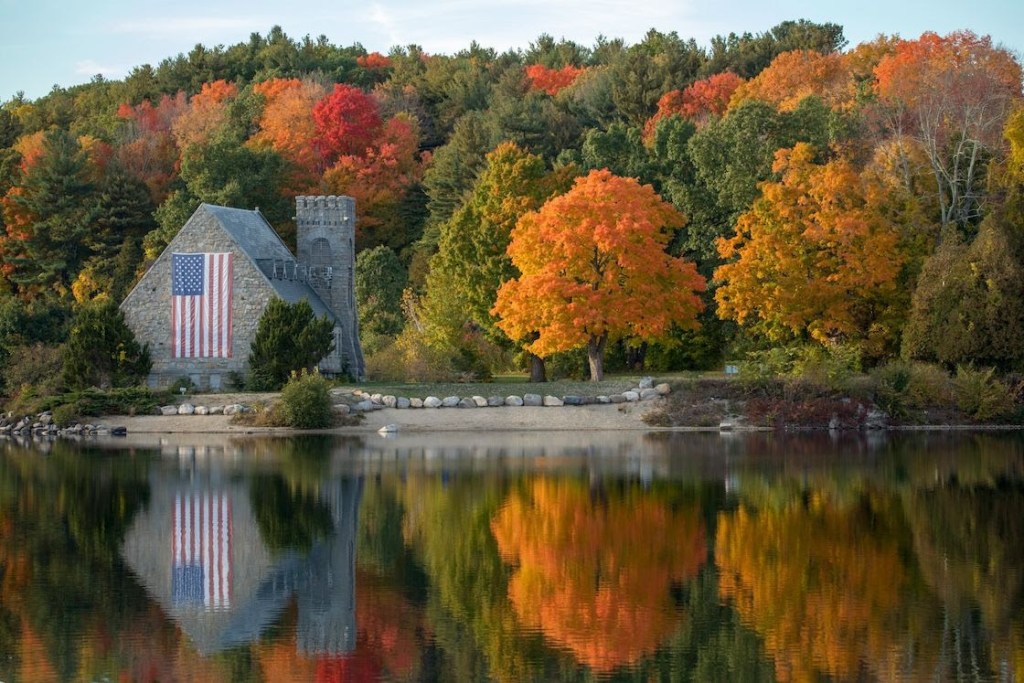
Charles and Diana bought a former dairy ranch in 1999 and then over the next 3 years, oversaw the planting of 33,000 vines. During the summer of 2002, they bought a used trailer to live in and then brought Diana’s Dad and sister Alina from Russia to help manage the vineyard. We welcomed Diana’s Family to the USA with an American Flag. And from that day on, the American Flag has proudly flown every day here at the vineyard. Terra de Promissio had its first harvest in 2005 and sold to 3 wineries. In 2007, after renting a house in Petaluma, they converted a barn into a home and moved to the vineyard full time. In 2012 and 2013, they planted an additional 18,000 vines to bring the total planted acreage of Terra de Promissio to 50 acres.
[…]
Diana KARREN
Diana was born in the Soviet Union. She was a Young Pioneer in the Communist System. But in the 1980s as the Soviet Union began to collapse, she put herself thru college and at the same time, worked for western companies that were investing in the now Former Soviet Union. Her hard work and great grades paid off and she was accepted to the University of Pennsylvania’s Wharton School of Business, where she graduated with a Masters of Business Administration in 2003.
During a two year period (2001-2003) Diana single-handily designed, gained government approvals and oversaw the planting of Terra de Promissio, while being pregnant and giving birth to Christian and doing it as a full time MBA Ivy-League student. In 2005, Diana oversaw the first harvest to Siduri, Flowers and Lynmar. In the ensuring years, as the grape production ramped up, Diana added multiple wineries including Kistler, Kosta-Browne and Willams Selyem. In 2011, Kosta Browne received the Wine Spectator’s Wine of the Year for the 2009 Sonoma Coast, which was primarily using grapes from Terra de Promissio.
Since day one, every row and block is custom farmed per each of the winemakers specific instructions. Because of this attention to detail by Diana, Terra de Promissio is now the most vineyard designated pinot noir in Sonoma County with over 10 wineries using the TdP name on their label. Beginning with the 2013 harvest, Diana began overseeing the winemaking process for Land of Promise. She now makes 4 Land of Promise Pinots and one Rosé. For more info, please click here or the link below.
In addition to managing the vineyard and the winery, Diana spends her Sunday mornings at Calvary Chapel Petaluma where she volunteers watching the babies and toddlers during the busy first service, so their parents can enjoy and listen to the sermons.
Just one week has passed since Donald Trump’s electoral triumph, and already Russian President Vladimir Putin—one of the strongman leaders Trump admires most—is messing with his head.
First, Putin waited two days before congratulating Trump on his victory. One can imagine Trump receiving phone calls from kowtowing leaders the world over—Ukraine’s Volodymyr Zelensky, Israel’s Benjamin Netanyahu, the Palestinian Authority’s Mahmoud Abbas, the chief of NATO, the European heads of state—all the while wondering about the man whom he’s admired publicly and privately for the past eight years: When is Vladimir going to call?
Then, in response to Trump’s claim that during their phone call, he asked—in some accounts, warned—Putin not to escalate the war in Ukraine, a Kremlin spokesman denied that the two had spoken on the phone at all. (Putin issued his belated congratulations at a news conference.)
I don’t know who’s telling the truth, a practice for which neither man has a sterling reputation. But either way, in the next few weeks, when Putin orders 50,000 fresh recruits (including 10,000 imported North Korean soldiers) to go on the next rampage—ousting Ukrainian soldiers from the thin slice of Russian territory they hold, then retaking soil across the border in Donbas province—he can tell a complaining Trump that he doesn’t recall any such conversation. If Trump thinks Putin actually will refrain from stepping up attacks on Ukraine as a friendly favor … well, maybe our once-and-future president will learn a lesson about the limits of personal relations in the face of perceived national interests early in his second term.
The final twist of this saga came on Monday, when Nikolai Patrushev, an aide to Putin who was previously director of Russia’s Federal Security Service, made the following comment in an interview with the Moscow newspaper Kommersant:
The election campaign is over. To achieve success in the election, Donald Trump relied on certain forces to which he has corresponding obligations. As a responsible person, he will be obliged to fulfill them.
This is a mind-blowing bit of psychological warfare! The Russians are basically telling Trump: We put you in office. Now it’s time for you to pay us back.
When you woke up yesterday the idea that Pete Hegseth—a philandering morning TV host who has never run anything bigger than a frozen banana stand—could serve as the secretary of defense was the most preposterous idea in the history of the federal government.
By the dinner time Trump issued two nominations that made Hegseth look like Bobby Gates.
The Matt Gaetz appointment is getting most of the attention because of the irony. The DoJ being controlled by a man who was recently investigated by the same department for having an alleged sexual relationship with a 17-year-old girl, whom he (allegedly) paid to travel with him? It’s too good.
Also, in the near term, the attorney general can a lot of damage to America. The AG has the power both to turn the state against its citizens and to shield wrongdoers from accountability.
But it’s the appointment of Tulsi Gabbard as director of national intelligence that worries me more. Because for a decade Gabbard has looked and behaved like a Russian asset.
In four terms as a congresswoman her most notable actions were ongoing defenses of two war criminals: Bashar al-Assad and Vladimir Putin.
Nadezhda Buyanova. Photo: Tatyana Makeyeva/AFP, via Moscow Times
A pediatrician has been imprisoned on the strength of a denunciation by her patient’s mother. The pediatrician allegedly insulted the boy’s father, who had been killed in the war. There were no witnesses to the conversation, and it seems that the decisive factor in the verdict was the pediatrician’s birthplace — Lviv. Only recently I published the file of the criminal case against my great-uncle, who had allegedly spread rumors about the fall of Soviet regime among children at an orphanage. There, too, the accused’s background was an important point of the accusation: the arrested man’s father had once been a prosperous peasant. It was obvious to the investigators (and this was explicitly stated in the verdict) that the status of “kulak’s son” was in itself proof that the charges were true.
Lo and behold we’re back where we started: a person born in Lviv is guilty of course and must have said what they have been accused of saying.
I don’t know why we should measure things off in terms of milestones on the road to a familiar hell, but this is certainly a milestone.
A Moscow court on Tuesday sentenced a pediatrician to five and a half years in prison for criticizing the war in Ukraine during a patient visit earlier this year.
Nadezhda Buyanova, 68, was found guilty of spreading “fake” information on the Russian army under wartime laws used to silence dissent.
“I believe this is absurd,” she said in court Tuesday, moments before Judge Olga Fedina announced her sentence.
Buyanova was arrested in February after the ex-wife of a soldier who was killed in Ukraine, Anastasia Akinshina, said she had criticized Russia’s role in the conflict during an appointment.
Several of Buyanova’s supporters, mostly medical professionals, shouted “Shame on you!” in the court as the sentence was announced.
“We must empathize with one another and love others,” Buyanova said in court. “But there is no paradise on earth, there is no peace on earth.”
She protested her innocence throughout the trial.
“I am a pediatrician. I do not regret a single day,” Buyanova said.
Buyanova was prosecuted despite there being no public evidence that she criticized the war. Akinshina’s seven-year-old son testified against Buyanova in court.
Monday, 18 November, 6 p.m. “Political prisoners in Russia and the Occupied Territories of Ukraine”.
Panel discussion with Sergei Davidis (Memorial), Evgeny Zakharov (Kharkhiv Human Rights Protection Group), Bill Bowring (Birkbeck, University of London) and Judith Pallot (Gulag Echoes research project / University of Oxford).
At: Montague Lecture Centre, Graduate Centre, Queen Mary University of London, 327 Mile End Road, London E1 4NS. Also on line, via Zoom.
All welcome. Event organised by the Queen Mary University, London, Centre for Eurasian, Russian and East European Studies. Register on Eventbrite here.
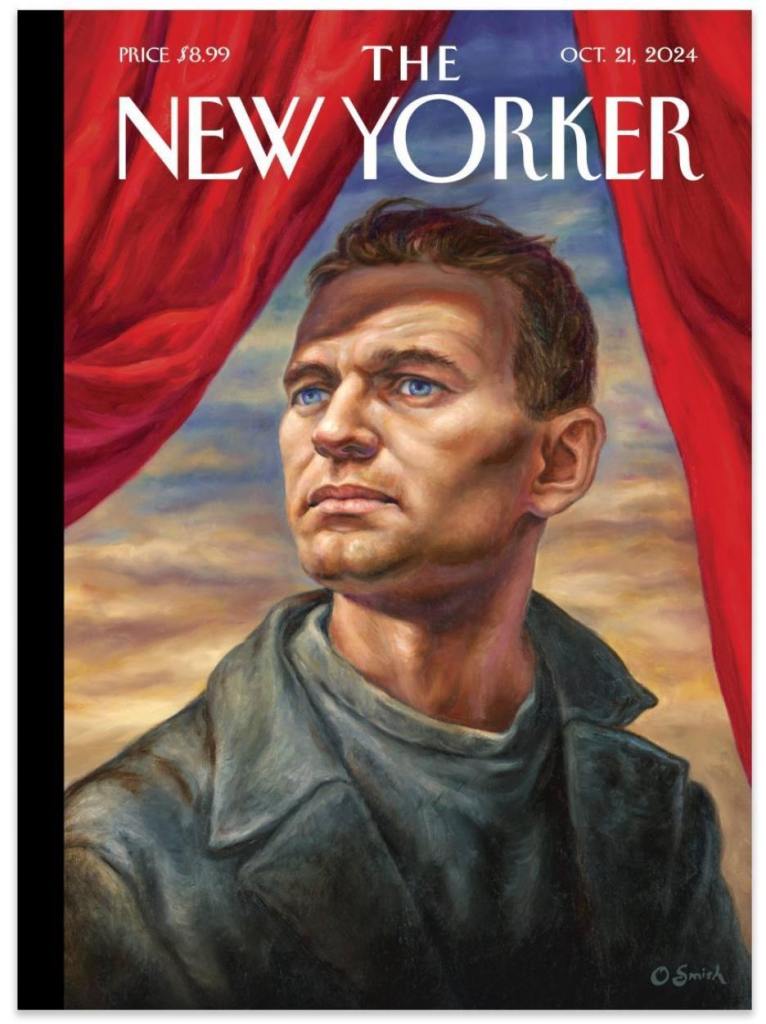
I wouldn’t want Navalny to be remembered the way he has been remembered this past year.
I haven’t read the book Patriot yet, but I was quite upset by Mikhail Zygar’s review of it. Zygar compares Navalny to Jesus and concludes that by dying, Navalny bequeathed us an idea that would rid future generations of cynicism and teach them to believe.
This is feeble sentimentalization, in my opinion. Navalny didn’t not dream up any particular ideas. He called for action, not faith. The meaning of his sacrifice, in my mind, is practical and political, not abstract and ideological. It can and should benefit the current generation, not some future generation.
Navalny didn’t dream up a new ideal. The “beautiful Russia of the future” is a feeble image, but Navalny understood better than anyone how tyranny operates on the mechanical level. I often complain that the FSB understands better how Russian society functions than do opposition politicians, sociologists and psychologists. Navalny couldn’t be accused of this shortcoming.
He was the only person in Russian politics who talked about power relations as a two-way street. He didn’t talk about the enormous resources Putin has, but about the fact that we give Putin power. It is not the security services, the army and the tanks that give Putin power. We give Putin power.
This view evolved over the course of Navalny’s career, becoming more and more central. As time went by, it separated Alexei more and more from his colleagues in the opposition. Toward the end of his life, Navalny’s writings centered on the idea that power consists in consenting to obedience, in “obeying in advance.” We say to ourselves: I cannot disobey, because if I don’t obey, they will (notice me/file administrative charges against me/fire me/banish me from my profession/send me to jail/kill me).
Only by obeying in advance can governing by unfulfilled threat be scaled up indefinitely, to a country of 140 million people, because this means of governing doesn’t require any resources. We obey without taking resources from the state. Putin’s estimates for the war in Ukraine include every dollar, euro, and pound spent on Ukraine’s defense. They are what counts against Russian budgets, not “faith in democracy” or “anti-war sentiment.” I understand Alexei’s decision to return to Russia in this sense; I see it as logical and unusually tenderhearted on the personal level. By returning to Russia, Alexei was able to provide Russians with one more example of tyranny’s limits: Putin never had power over Alexei. Had he stayed in Germany, Putin’s power would have extended to Navalny.
Navalny was concerned not with the thoughts in our heads, but with whether our deeds matched our thoughts. I appreciate Christian philosophy, but I could never accept the postulate that a second of faith can save a person, no matter their actions — “Now thou shalt be with me in paradise,” and so forth. The Russian opposition, for as long as I’ve been watching it, wants to get to democracy approximately the same way the thief gets to paradise — by believing in it. The notion that we are democrats and decent because we believe in democracy while all remaining Russians are slaves and awful because they don’t believe in it is the main obstacle to democracy in Russia, in my mind, and the Koshchei’s egg of tyranny. A “democracy” in which only “democrats” have a stake and which only they want is an oxymoron that makes democracy impossible and tyranny in Russia perennial. Democracy cannot be for Muscovites alone. It cannot be built via media outlets in which only Petersburg and Moscow have a voice. It cannot be built without equal representation of activists, issues, and interests from other regions and ethnicities.
Late in life, Navalny hated talk about the “freewheeling ’90s” and the good Chekists/bad democrats dichotomy, which doesn’t prevent his supporters from remaining stuck in this selfsame paradigm.
Alexei started his career in Russia’s faux democracy project, which was unfair from the get-go. He entered politics as a “democratic nationalist,” desiring greatness and a better elite for Russia. It was within this same paradigm that he pursued the most successful project of his life: “fighting the regime by legal means.” By the end of his life, however, he came to realize that Russian power is held by a hypocritical elite which justifies its obedience by talking about white coats, and is not willing to share power. It is not even willing to think about being the equals of other Russians, let alone the equals of Ukrainians, for example.
This, in my opinion, is what Navalny left behind. It pains me to see how the legacy he left at such a high cost is being frittered away by films about traitors, stupid speeches, and sentimental religious comparisons.





 ] AND CONVICTED FELON MARIA BUTINA? Who doesn’t? Welp, here she is w/ your Daily Irony Supplement — and it’s a massive dose! See, as of Jan. 20 she’ll likely get a pardon and move back Stateside to improve on her spying career (hey, how could she do worse?); but in the meantime, she’s trying to get *Americans* (et al.) to go the *other* way, i.e. move to Moscow — y’know, like Our Guy Ed Snowden & his new roommate, Bashar al-Assad, who just *love* it there, right?