Mal Hombre

Lydia Mendoza, “Mal Hombre” (1934)

Era yo una chiquilla todavÌa
Cuando tú, casualmente me encontraste
Y a merced de tus artes de mundano
De mi honra el perfume te llevaste
Lo hiciste con migo lo que todos
Los que son como tu con las mujeres
Por lo tanto no extrañes que yo ahora
En tu cara te diga lo que eres

Mal hombre.
Tan ruin es tu alma que no tiene nombre
Eres un canalla, eres un malvado
Eres un, mal hombre

A mi triste destino abandonada
Entablé fiera lucha con la vida
Ella recia y cruel me torturaba
Yo, mas débil, al fin caí vencida

Tu supiste a tiempo mi derrota
Mi espantoso calvario conociste
Te dijeron algunos que a salvarle
Y probando quien eres, te reiste

Mal hombre
Tan ruin es tu alma que no tiene nombre
Eres un canalla eres un malvado
Eres un, mal hombre

Poco tiempo después en el arroyo
Entre sombras mi vida dependÌa
Una noche con otra tú pasaste
Y al mirarme oí que te decía:
“¿Quien esa mujer, tú la conoces?”
Y a la vez, respondiste: “¡una cualquiera!”
Al oír de tus labios tal ultraje
Demostrabas también lo que tú eras

Mal hombre
Tan ruin es tu alma que no tiene nombre
Eres un canlla, eres un malvado
Eres un, mal hombre

Source: Musixmatch


Yesterday we learned from a forthcoming book by veteran journalist Bob Woodward that in 2020, while he was president, Trump secretly shipped Covid-19 testing equipment to Russian president Vladimir Putin for his own personal use at a time when Americans could not get it. To be clear, this equipment was not the swabs we now use at home, but appears to be what at the time was a new point-of-care machine from Abbott Laboratories that claimed to be the fastest way to test for Covid-19. 

Journalist Karly Kingsley points out that at the time, central lab testing to diagnose Covid-19 infections took a long time, causing infections to spread. Machines like Abbott’s were hard to get. Trump chose to send them to Putin—not to charge him for them, or to negotiate for the release of Paul Whelan and Trevor Reed, two Americans being held by Russia at the time and later released under the Biden administration, but to give them to him—rather than keeping them for Americans.

It’s hard to overstate just what an astonishing story this is. In 2016, Republicans stood firm against Putin and backed the arming of Ukraine to stand against Russia’s 2014 invasion of Crimea. But that summer, at Trump’s urging, the party changed its platform to weaken its support of Ukraine. In 2020, it appears, Trump chose to give lifesaving equipment to Putin rather than use it for Americans. And in 2024, Trump’s willingness to undermine the United States to cozy up to an adversary his own party stood against less than a decade ago does not appear to be a deal breaker for Republicans.

As Senator Chris Murphy (D-CT) put it: “What has this country come to if the revelation that Trump secretly sent COVID testing machines to Putin while thousands of Americans were dying, in part because of a shortage of testing machines here, doesn’t disqualify him to be President?” He continued: “Donald Trump helped keep Putin alive during the pandemic and let Americans die. This revelation is damning. It’s disqualifying. He cannot be President of the United States.” 

Increasingly, Trump’s behavior seems to parrot the dictators he appears to admire. 

After 60 Minutes called him out for breaking a fifty-year tradition of both candidates talking to 60 Minutes and backing out of an interview to which he had agreed, Trump today accused the producers of 60 Minutes of cutting Vice President Kamala Harris’s answers to make her look good. He suggested that such cuts were “illegal” and possibly “a major Campaign Finance violation” that “must be investigated, starting today!” “The public is owed a MAJOR AND IMMEDIATE APOLOGY!” he wrote. Trump is trying to cover for his own failure by attacking CBS in an echo of dictators determined to control the media.

In a post on his social media site tonight, Trump appears to have declined to appear at another presidential debate with Vice President Harris. After declaring he had won the previous debate with Harris and rehashing many of his grievances, he wrote: “THERE WILL BE NO REMATCH!”

As Beth Reinhard of the Washington Post recounted yesterday, a report from Senator Sheldon Whitehouse (D-RI), who sits on the Senate Judiciary Committee, revealed that the Trump White House prevented a real investigation into sexual misconduct allegations against Trump’s second Supreme Court nominee, Brett Kavanaugh. More than 4,500 calls and electronic messages about Kavanaugh sent to the FBI tip line went directly to the White House, where they were never investigated, and the FBI was told not to pursue corroborating evidence of the accusations by Christine Blasey Ford and Deborah Ramirez although lawyers for the women presented the names of dozens of people who could testify to the truth of their allegations.  

A number of senators said the lack of corroborating evidence convinced them to vote in favor of Kavanaugh’s confirmation. As Steve Benen of MSNBC recalled, Senator Susan Collins (R-ME) said at the time that it appeared to be “a very thorough investigation,” while the late Senator Dianne Feinstein (D-CA) said that the 2018 FBI report “looks to be a product of an incomplete investigation that was limited perhaps by the White House.”

After he left office, Trump told author Michael Wolff that he had gone to bat for Kavanaugh, saying: “I…fought like hell for Kavanaugh—and I saved his life, and I saved his career.” Kavanaugh was the crucial vote for Trump’s right-wing agenda, including ending the federal recognition of abortion rights by overturning the 1973 Roe v. Wade decision.

Ken Bensinger reported in the New York Times today that Trump’s team has refused to participate in preparations for a transition to a potential Trump presidency. Normally, the nonpartisan transition process, dictated by the Presidential Transition Act, has candidates setting up teams as much as six months before the election to begin vetting and hiring political appointees and working with the administration in office to make sure the agencies continue to run smoothly. 

With the election less than a month away, Trump has neither signed the required agreements nor signed the transition’s ethics plan that would require him to disclose private donors to the transition and limit them to contributions of no more than $5,000. Without that agreement, there are no limits to the money the Trump transition can take. Trump has also refused to sign an agreement with the White House requiring that anyone receiving classified information have a security clearance. Currently, his aides cannot review federal records.

Trump ignored the traditional transition period in 2016, cutting off communications with President Barack Obama’s team. He refused to allow incoming president Joe Biden access to federal agencies in 2020, hampering Biden’s ability to get his administration in place in a timely fashion. Now it’s possible that Trump sees no need for a normal transition because Project 2025, on which he appears to be relying, has been working on one for many months. 

It calls for him to fire most federal employees, reinstating the policy he started at the end of his term. To fill their positions, the Heritage Foundation has been vetting loyalists now for months, preparing a list of job candidates to put in place a new, right-wing agenda.  

Yesterday, on California’s KFI radio station, Trump told host John Kobylt that Tom Homan of Project 2025, who as director of U.S. Immigration and Customs Enforcement oversaw the family separation policy at the southern border, will be “coming on board” a new Trump administration. 

This afternoon, Trump told an audience in Scranton, Pennsylvania, that he expects to put former rival Vivek Ramaswamy into an important position in his administration. On October 7, 2024, Ramaswamy suggested on social media that he wants to get rid of Social Security and Medicare. He wrote: “Shut down the entitlement state & you solve most of the immigration problem right there. We need to man up & fix the root cause that draws migrants here in the first place: the welfare state. But no one seems to want to say that part out loud, because too many native-born Americans are addicted to it themselves.”

Trump has expressed frustration with the independence of the Federal Reserve, expressing a desire to make it answer to the president. In an interview with Barron’s, one of his advisors, Scott Bessent, has floated the idea of creating a shadow Fed chair until the term of the current chair, Jerome Powell, ends, thus undercutting him without facing a fight over firing the Fed chair. 

This agenda is not a popular one in the U.S., but Trump is getting a boost as Russian operatives work to swing downballot races toward the Republicans. In a briefing on Monday, October 7, experts from the Office of the Director of National Intelligence (ODNI) told reporters that China and Iran are trying to influence the upcoming election and that “Moscow is leveraging a wide range of influence actors in an effort to influence congressional races, particularly to encourage the U.S. public to oppose pro-Ukraine policies and politicians. Russian influence actors have planned, and likely created and disseminated, content, particularly over social media, intended to encourage the election of congressional candidates that Moscow assesses will oppose aid to Ukraine.”  

Russia, an ODNI spokesperson said, uses “influence-for-hire firms, or commercial firms with expertise in these type[s] of activities.” It also coopts “witting and unwitting Americans to work on Russia’s behalf,” to “launder their influence narratives through what are perceived as more authentic U.S. voices.” 

Not all of Trump’s supporters appear eager to stick around to see if Trump will win another term. Today news broke that Patrick M. Byrne, the former chief executive officer of OverStock, who became a fervent advocate of the idea that Trump was the true winner of the 2020 presidential election, has left the country, apparently permanently, to live in Dubai. Dominion Voting Systems is suing Byrne, as is President Biden’s son Hunter. The younger Biden sued Byrne for defamation last November after Byrne claimed Hunter Biden sought a bribe from Iran. 

In September, Biden’s lawyers were trying to schedule a date for Byrne’s deposition when his lawyer abruptly “claimed for the first time that Defendant has moved his residence to Dubai and if Plaintiff wanted to take his in-person deposition counsel would have to fly to Dubai to do so, to which Plaintiff responded with various related inquiries to try to resolve this matter and defense counsel stated Defendant would not be returning to the United States for the foreseeable future.” 

Byrne claimed to have fled the U.S. because the Venezuelan government has put a bounty on him, but as Biden’s lawyers note, “the Defendant’s truthfulness is directly at issue.” 

[…]

Source: Heather Cox Richardson, Letters from an American, 9 October 2024


Lydia Mendoza, interviewed by Professor Gene Bluestein and Professor Manuel Pena at CSU, Fresno, before performing “Mal hombre.” Courtesy of the UNC Chapel Hill Folk Archives.

I was but a young girl
when, by chance, you found me
and with your worldly charm
you crushed the flower of my innocence.
Then you treated me like all men
of your kind treat women,
so don’t be surprised now that when I tell you
to your face what you really are.

Bad man
your soul is so vile it has no name
you are despicable, you are evil,
you are a bad man.

Abandoned to a sad fate,
my life became a fierce struggle
suffering the harshness and cruelty of the world
I was weak and was defeated.
In time you learned of my downfall
how my life had become a road to hell.
Some people advised you, “You can help her,”
but being who you are, you just laughed.

Bad man
your soul is so vile it has no name
you are despicable, you are evil,
you are a bad man.

Shortly after in a gully
among shadows I defended my life.
One night you passed by with another woman
and on seeing me I heard her ask you:
Who is that woman? Do you know her?
And looking at me you answered: She’s a nobody
and when I heard adultery from your lips
you demonstrated again what you are.

Bad man
your soul is so vile it has no name
you are despicable, you are evil,
you are a bad man.

Source: “Tango in Mexico: Mal hombre (Bad man),” Tango Stories: Musical Secrets, 8 April 2020
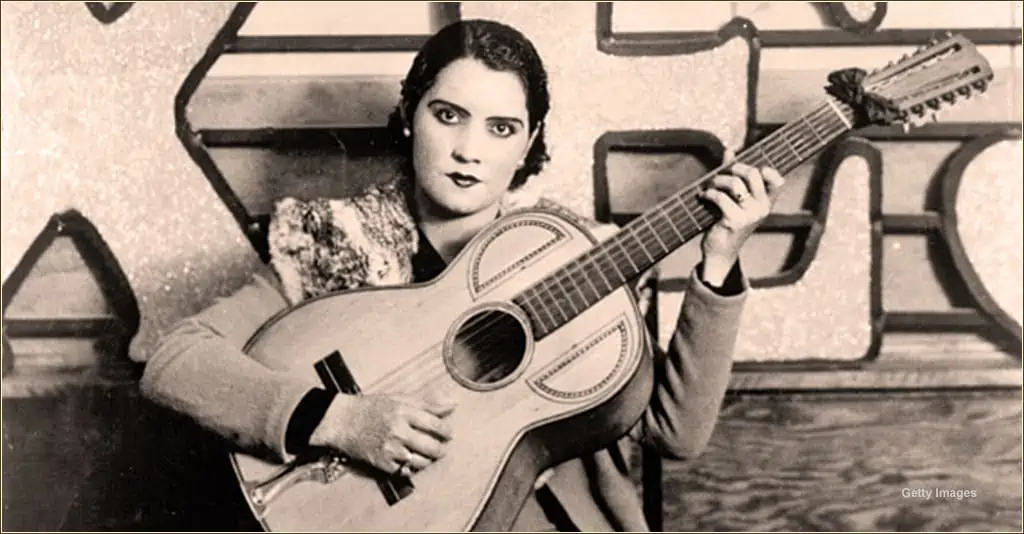

Lydia Mendoza (May 31, 1916–December 20, 2007) was born in Houston, Texas, to musically inspired Mexican parents. During Mendoza’s first ten years the family migrated back and forth between Texas and the Mexican city of Monterrey in the state of Nuevo León, as part of her father’s work with the railroad. In the 1920s, when Lydia Mendoza’s father left the railroad, the Mendoza family eked out a living doing musical performance, first in the lower Rio Grande Valley, and then singing for pennies and nickels on the streets of downtown San Antonio, Texas. The ten year-old Lydia Mendoza began her recording career—singing and playing mandolin—in the 1920s and 1930s with the Mendoza family who recorded for the OKeh, Odeon, and Bluebird labels. As a teenager in 1934, Lydia Mendoza did her first solo recording. The recording she made that day was of the song “Mal hombre” (“Evil Man”), which she popularized, and which became closely identified with her throughout her long singing career. In her later years, she recorded with DLB Records (San Antonio) and, in 2001, issued her last concert recording as part of her published life story, Lydia Mendoza’s Life in Music.

Mendoza’s performance career stands as one of the longest in American music history, spanning from the 1920s to the 1980s when a stroke ended her performing life. Following upon her early success with “Mal hombre,” Mendoza continued to tour with her family as an itinerant performance unit that offered a variety of acts. They followed the agricultural labor routes where most of the Mexican American population worked: north to Michigan, back south to the Rio Grande Valley, later to California. Her closeness to her audiences earned her two epithets—“La cancionera de los pobres” (“The Singer of the Poor”) and “La alondra de la frontera” (“Lark of the Border”). As a grassroots idol, she was loved for her ability to articulate a working-class sentimiento (sentiment and sentience) through song and through the breathtaking visual spectacle of her flashy hand-sequined, hand-beaded performance attire whose symbolic designs announced her ancient cultural roots in the Americas. She publicly marked the enduring presence of indigenous Mexican culture even throughout historical periods (from the 1930s to the 1960s) in which public displays of Mexicanness targeted you for governmental harassment and/or deportation by Euro-American officials. Along the migrant agricultural worker routes, she affirmed and celebrated Mexicanness during those decades when eating establishments regularly featured signs that read “NO DOGS, NO MEXICANS.” Lydia Mendoza manifests the social powers of music: her natural speech-like voice, her striking physical presence, and her songs, so beloved among the communities she sang for, symbolically reclaimed and remapped a Mexican America. Mendoza always enacted a space of popular collective expression, an audible Mexican American homeland.

Throughout her performance career Lydia Mendoza adhered to the oral traditional practice of singing by popular demand: she sang what her audiences requested. That traditional practice meant that audience members called out each song and they tended to call out traditional songs associated both with that singer and with the broader norteño cultural matrix. The repertoire of songs was not unchanging, and “Mal hombre” is testament to that. Once Lydia Mendoza recorded the song—a song not originating in the US-Mexico borderlands, nor of a borderlands rhythmical style—audiences welcomed it into the changing body of “traditional songs.” Thus “Mal hombre,” whose rhythm and cadences mark its origins in distant Argentinian tango or milonga repertoires, became one of Lydia Mendoza’s signature songs; audiences requested it from her throughout her performance life. It should, however, be noted that in the course of the several decades of repeated performance, Mendoza indigenized the “foreign” rhythmed “Mal hombre” into the borderlands rhythms of the canción Mexicana. Still, after Mendoza’s performance life ended, “Mal hombre” also vanished from the borderlands circle of songs and has not been recorded by any borderlands singer since then.

“Mal hombre” was, from the onset, something of an anomaly within the Mexican borderlands musical landscape. The early sound media—recordings, radio, and later television—as well as the Euro-colonization process of the last 200 years, introduced music from far-flung places to the borderlands. There were various waves that swept through the Texas-Mexican landscape: tango, foxtrot, big band, polka, bolero, country, canción, cumbia, and more. The Mendoza family repertoire of recorded songs manifests that rich variety of song genres: ranging from the deeply rooted norteño song forms to the more fad-oriented recent arrivals. Along those same lines, Lydia Mendoza performed and recorded a rich variety of genres from the oral tradition accompanied by the full gamut of Mexican borderlands instrumentations—including the button-accordion conjunto, mariachi, guitar trio, and more. Yet Mendoza’s mainstay ultimately became her performance as a solo singer self-accompanied with her 12-string guitar.

Mendoza notably self-designated as a “norteña” (a Northerner) and as a “Mexicana,” marking her musical cultural geo-regional roots as spanning not only the northern Mexican states of Nuevo León, Tamaulipas, Coahuila, Sonora, and Chihuahua, but also what was, until 1848, the northern half of Mexico, today’s southwest United States. As a mature artist, the mainstays of her song repertoire were the hugely popular canción ranchera (ranch song) and corridos (narrative ballads). The canción ranchera genre represents an evolution of the older Mexican canción. In the ranchera evolution, the love song often tends to be infused with imagery, customs, and symbols from the deep cultural matrix of Mesoamerica. During her last concert tour in 1986-87, Mendoza sang almost exclusively rancheras and corridos. She offered for sale her most recent cassette recording “Corridos,” which included, for example, “The Ballad of Joaquín Murrieta” (1829–1853). That corrido (narrative ballad) recounts the heroic acts of an iconic California freedom fighter that organized an army to protect Indians and Mexicans against the Gold Rush invasion. There is some common ground between such historic narrative ballads and the appeal of “Mal hombre”: they are songs from underdogs who face powerful odds against them. Singers such as Lydia Mendoza carried the voices of underdogs and thus impart the life lessons they embody.

“Mal hombre” (“Evil Man”) offers a life narrative in the voice of a woman underdog who at a very young age is seduced by an evil man’s “worldly arts.” The narrative voice in the song describes various stages of sexual exploitation: her seduction as a young girl, her abandonment by the lover, her life-and-death struggle, and her eventual downfall. The song’s popularity can only be understood in the context of the rampant sexual violence inherent of our patriarchal society institutionalized since colonialism. One of “Mal hombre’s” most notable features, however, is its beautiful poetics. No sexual act is described per se. Nor does the narrator offer any realism-based specifics of her demise. In the song, a great deal is left to the listener’s imagination, such as when she references “mi espantoso calvario” (“my horrific cavalry”). The female narrative voice of “Mal hombre” embodies a protracted life struggle, a feature shared by many classical corrido underdog heroes. The redemptive quality of this song, however, has to do with the victim rising to sing, with her strong indictment of the Evil Man, and with the fact that she has the last word in the matter, hurling loaded terms at the Evil Man with this refrain:

Tan ruin es tu alma

que no tiene nombre

Eres un canalla

Eres un malvado

Eres un mal hombre

Your soul is so vile

It is deplorable.

You are a scoundrel

You are a malicious man

You are an evil man

Through songs such as “Mal hombre,” Lydia Mendoza defies the subordination of women of color. She takes a womanist self-affirming stance in a number of her signature songs, such as “Mujer paseada” (“Experienced Woman”) or “Celosa” (“Jealous Woman”). Mendoza’s traditional corridos similarly praise the deeds of collectively cherished and remembered anti-colonial historical figures omitted from mainstream history books. At all times, Lydia Mendoza expressed in song her existential ties to her people.

In 1982, Mendoza became the first Texan named a NEA National Heritage Fellow. She performed for President Jimmy Carter at the Kennedy Center in Washington in 1975. She was inducted into the Tejano Music Hall of Fame in 1984 and into the Conjunto Music Hall of Fame in 1991. In 1999, she received the National Medal of the Arts from President Clinton. Lydia Mendoza passed away on December 20, 2007, at the age of 91.

Yolanda Broyles-González is appointed University Distinguished Scholar at Kansas State University where she serves as head of the American Ethnic Studies Department. She is a Yaqui elder of the Tucson, Arizona Barrio Libre tribal community. Her book publications include El Teatro Campesino: Theater in the Chicano Movement (UT Press); Lydia Mendoza’s Life in Music/La Historia de Lydia Mendoza (Oxford); and Earth Wisdom: California Chumash Woman (Univ. of Arizona Press).

Source: Library of Congress. Image courtesy of Wednesday’s Women

Policing the Polls

Elections observer who left message on ballot jailed for 5 days

Marina Popova served as an observer during the elections in St. Petersburg. On Sunday, she decided to vote herself. Prior to this, she specially had herself reassigned to Polling Station No. 2213 on Lomonosov Street [where she was working as an elections observer].

Popova told Rotunda that two other people voted after her. A police officer then noticed a ballot in the ballot box on which a pacifist message [“No war!”] had been written. According to Popova, a polling board member wrote out a statement saying that it was Popova who had dropped the ballot with the message into the ballot box.

Consequently, Popova was detained and taken to the police station. There, she was charged with “petty hooliganism” and, later, “discrediting the army.” The first charge sheet says that Popova disturbed the peace because she wrote a pacifist message in large letters in bright blue ink that was seen by people at the polling station.

Popova was taken to the police station on Sunday morning and never returned to the polling station. She was taken to court on Tuesday. When her detention period expired, she went home. She was taken back to court in handcuffs—the police collected her from her home.

At the court hearing, Popova’s lawyer Alyona Skachko told Rotunda, polling board members claimed that the ballot was state property, which the observer had spoiled. As a result, Popova was fined 30,000 rubles [approx. 300 euros] and jailed for five days.

📌 Marina’s husband Dmitry Popov and two people from the United Russia party were the only observers left at the polling station on Lomonosov Street after it closed on the last day of voting. During the vote tally, Popov was forcibly restrained by persons unknown who, as he claimed, tried to strangle him. Eventually, however, the police arrived and detained Popov. At the police station, he was charged with “petty hooliganism.” It is alleged that he used foul language.

Source: Rotunda (Telegram), 10 September 2024. Photo courtesy of Fontanka.ru. Translated by the Russian Reader


Residents of 81 federal subjects of Russia will vote in regional and municipal elections starting Friday. 

The elections mark the second time this year that Russians are heading to the polls following the March presidential election. That vote, which saw Vladimir Putin win a fifth term virtually unchallenged, was marred by widespread reports of vote tampering, restrictions on monitors and pressure on voters. 

But unlike the presidential campaign, Russian media coverage of this year’s regional elections has been scarce — likely the result of a deliberate government strategy of decreasing voter turnout to a bare minimum of loyal voters, an analysis published by independent election watchdog Golos suggests. 

Golos analysts believe that the Kremlin is betting on mobilizing a relatively small number of voters working in the government sector and demotivating all the rest to ensure a smooth victory for its candidates.

To help you understand what else is expected in the upcoming September elections, the Moscow Times has gathered everything known about the vote so far[.]

What will the voting look like? 

Multi-day voting, which was first introduced across Russia during the Covid-19 pandemic, will be implemented in most regions for the September 2024 elections. The majority of voters will have two or three days to cast their ballots depending on the region. 

Some regional electoral commissions, including in the republics of Chechnya, Tatarstan and Sakha (Yakutia), have chosen to hold voting on one day on Sunday. 

Twenty-five regions will allow residents to vote online via the state portal Gosuslugi, while election officials in Moscow have scrapped paper ballots altogether in favor of online voting.  

Independent observers have long argued that extended voting periods and online voting make voter fraud more likely, as it becomes harder for independent monitors and poll workers to do their jobs.

Meanwhile, the CEC advised authorities in six southern Russian regions near Ukraine and in occupied Crimea to limit access to online broadcasts from polling stations, citing public safety concerns. 

G[ubernatorial] elections 

Residents of 21 regions, including the city of St. Petersburg, will vote for their governors. 

Among these, the Far East Zabaikalsky region, the Siberian republic of Altai and the southern republic of Kalmykia stand out as some of the most “troublesome” regions for the Kremlin. 

The ruling United Russia party has struggled to secure strong wins for its candidates in these regions in the past and incumbents hoping for reelection remain largely unpopular among local populations and elites, according to Golos.

The Urals republic of Bashkortostan will also be under the Kremlin’s close watch as Moscow-backed incumbent Radiy Khabirov stands for reelection in the wake of the January protests in support of jailed activist Fayil Alsynov. 

Coupled with high numbers of war casualties in Ukraine and a slew of recent corruption scandals involving Khabirov’s inner circle, those protests forced the incumbent’s approval ratings to plummet. 

But as in most other regions, the Kremlin mitigated the possibility of a potential blow in Bashkortostan by not allowing a single independent candidate on the ballot. 

Regional parliament elections 

Members of regional parliaments will be chosen across 11 regions, including the capital Moscow, the republics of Tatarstan and Tyva and the Khabarovsk region. 

This year’s election will see the participation of a record-low number of political parties with an average of 6.2 parties represented on the ballot, according to Golos. 

Golos said this worrying statistic is a direct result of an unprecedented scale of repression faced by independent politicians regardless of their political views.

“[A politician] can be declared a foreign agent or convicted of extremism to be removed from the elections,” Golos wrote in an analytical report published last month. 

“And if they still [manage to] register and win, there is…the possibility of being declared a foreign agent and deprived of his mandate a couple of weeks after the elections,” the watchdog said. 

Municipal elections

Elections for city mayors and city parliaments will take place across 22 regions. 

Abakan, the capital of the Siberian republic of Khakassia, and Anadyr, the capital of the Chukotka autonomous district, are two of only four Russian cities where mayors are still chosen through direct election. 

Mayoral elections had also been set for Ulan-Ude, the capital of the Siberian republic of Buryatia, but the region’s parliament scrapped the procedure in favor of the council electors system in March. 

In St. Petersburg, where 1,560 seats in the city’s [municipal district councils] are up for grabs, candidates running from so-called “systemic opposition” parties — namely the Communist Party (CPRF) and the social-liberal Yabloko party — were barred from registering en masse.

And while CPRF managed to get 25% of its original pool of candidates onto the ballot, Yabloko will not have any representation in this year’s [m]unicipal [c]ouncil[s] race.   

Occupied Ukrainian and Russian territories 

In annexed Crimea, Kremlin-installed head Sergei Aksyonov will stand for reelection and members of the regional parliament and the legislative assembly of the Crimean port city of Sevastopol — its own federal subject — will be voted in. 

The Kremlin refused to cancel voting in the Kursk border region, where Ukrainian forces have been carrying out a bold incursion for more than a month, and where Putin appointee Alexei Smirnov is seeking to secure his mandate as governor.

The CEC instead extended the voting period to 10 days and is supplying local election officials with bulletproof vests and helmets. 

Kursk regional authorities announced Thursday that nearly 27% of eligible voters [had] already cast their ballots in the [gubernatorial] election.

Source: “The Roadmap to Russia’s 2024 Regional Elections,” Moscow Times, 6 September 2024.


[…]

GROSS: So Trump recently spoke to the Fraternal Order of Police, and he urged them to watch out for voter fraud. Let’s hear what he said.

(SOUNDBITE OF ARCHIVED RECORDING)

DONALD TRUMP: You’re in serious trouble if you get caught trying to find out what are the real results of an election. It’s an amazing thing. Do you ever see that? They go after the people that are looking at the crime, and they do terrible things to them. But the people that committed the voter fraud and everything, they can do whatever they want to do. It’s so crazy. And I hope you, as the greatest people – just as great as there is anybody in our country – I hope you watch for voter fraud.

So it starts early. You know, it starts in a week, but I hope you can watch, and you’re all over the place. Watch for the voter fraud because we win. Without voter fraud, we win so easily. Hopefully, we’re going to win anyway, but we want to keep it down. You can keep it down just by watching because, believe it or not, they’re afraid of that badge. They’re afraid of you people. They’re afraid of that.

GROSS: Nick, is that voter intimidation? He’s telling the police that these fraudulent voters are afraid of police, implying that the police should use that fear to find voter fraud so that Trump can win.

CORASANITI: I think it – certainly, were it to be carried out – would be challenged by voting rights groups, Democrats and probably even some Republicans – that that would amount to voter intimidation. It’s also pretty important to note that a couple states have very specific laws that, you know, outlaw uniformed police officers having a kind of patrolling presence in – at polling places during elections.

And, you know, there’s a very dark history in the Jim Crow South about uniformed police officers and voter suppression within the Black community. So a combination of history and state laws and then the kind of instruction that the former president was giving to these police officers could certainly amount to voter intimidation or possibly even more unlawful behavior.

[…]

Source: Terry Gross, “How Democrats and Republicans are gearing up for a post-election legal fight,” Fresh Air (NPR), 12 September 2024

The Score

1,289 political prisoners in Russia remain in prison (according to OVD Info).

Source: TV Rain (Instagram), 2 August 2024


Meshell Ndegeocello: Tiny Desk Concert

Experiencing all of the Tiny Desks this Black Music Month has made many of my dreams come true, and Meshell Ndegeocello’s performance was no exception. For 30 years the Grammy-winning artist’s music has cast an unflinching gaze on love, race, sexuality and religion. Her new album out in August, No More Water: The Gospel of James Baldwin, zooms out to focus on the love of humanity as inspired by the writer and civil rights activist.

Her performance includes three songs from that album, starting with “Travel,” which features Kenita Miller’s swirling whispers alongside Jake Sherman’s organ and Ndegeocello’s bass, which ushers us into her church service. “Thus Sayeth The Lorde” references the writings of Audre Lorde: “If I did not define myself for myself, I’d be crunched into other people’s fantasies for me and eaten alive.” This conviction has been the binding agent of Ndegeocello’s career. Releasing her debut album at a time when many of the women who dominated Black music were singers who adopted an ultra-feminine aesthetic, as a bassist and vocalist she gallantly eschewed that standard for androgyny, fully embracing her queer, two-spirit identity.

“Love” continues this theme, urging you to allow love to take over and accept yourself in the face of existential crisis. The final songs of Ndegeocello’s Tiny Desk Concert are fan favorites. First, we’re sent off into space with the playful “Virgo,” from Ndegeocello’s album The Omnichord Real Book. Then she brings us back to Earth with the yearning “Outside Your Door.”

SET LIST: “Travel,” “Thus Sayeth The Lorde,” “Love,” “Virgo,” “Outside Your Door”

MUSICIANS: Meshell Ndegeocello, vocals, bass; Jake Sherman, organ; Justin Hicks, vocals; Abe Rounds, drums, vocals; Chris Bruce, guitar; Kenita Miller, vocals; Kyle Miles, bass

Source: NPR Music (YouTube), 18 June 2024


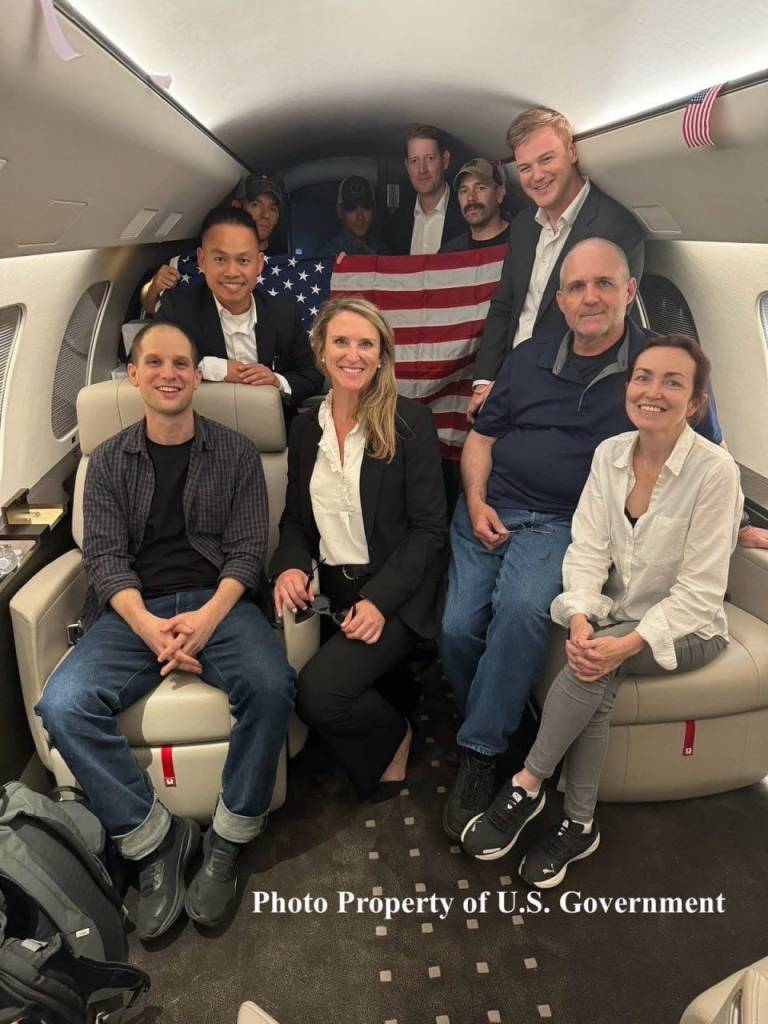
15 political prisoners were exchanged.

Source: TV Rain (Instagram), 2 August 2024


The Kremlin has sent recommendations to state-run and pro-government media outlets on how to cover the prisoner exchange between Russia and the West, Meduza has reported, citing sources close to the Russian presidential administration and a source in a major Russian online media outlet. The presidential administration has not prepared detailed instructions this time, the publication notes.

The mass media have been advised that when mentioning the names of Russian political prisoners, they should cite the crimes of which they were convicted, such as “discrediting” the army, “espionage,” or “treason,” as well as the terms of imprisonment to which the court sentenced them.

The presidential administration thus wants to emphasize that “saboteurs and traitors, their own agents, were handed over to the West,” one of the sources explained to Meduza. “Quote: nothing terrible has happened—we got rid of some unwanted people,” they said. Another of the publication’s sources, a political scientist who gives official comments on state-run and pro-Kremlin media, holds a similar view.

On the contrary, when reporting on those who have been returned to Russia after the prisoner exchange the media have been told to say they are people who “worked for their motherland.” In particular, when discussing Vadim Krasikov—an agent of the Russian security services who murdered former Chechen commander Zelimkhan Khangoshvili in central Berlin in 2019—the mass media are urged to say that he “eliminated the enemy.” One of the publication’s sources suggests that Vladimir Putin will want to make Krasikov a public figure, as he did with Maria Butina and Victor Bout, but so far the presidential administration has not received any such instructions from the president.

In addition to the murder of Khangoshvili, Krasikov and two accomplices (other FSB officers) shot businessman and Kostomuksha city councillor Yuri Kozlov in 2007. Krasikov was also the main suspect in the murder of businessman Albert Nazarov in Moscow in 2013.

[…]

Source: Moscow Times Russian Service, 2 August 2024. Translated by the Russian Reader


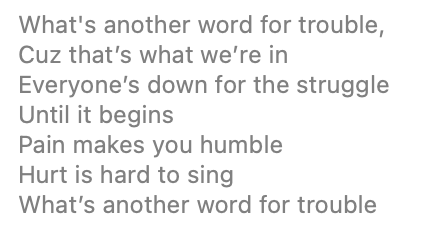
Source: Meshell Ndegeocello, “Trouble,” No More Water: The Gospel of James Baldwin (2024)

Hideout

It took me a while to understand why the news about the prisoner swap has been making me feel bitter rather than happy, although I wish all these people freedom, of course.

No, it wasn’t because, thanks to an American journalist’s arrogance and a German tourist’s stupidity, a professional FSB killer has been set free, meaning that his crime will go unpunished and nullifying the enormous efforts a large number of people made in apprehending him. And not because they mainly swapped for prisoners celebrated by the media, leaving in the gulag the unknown loners who wanted to fight on behalf of Ukraine. And not even because the leaders of the Anti-Corruption Foundation themselves took credit for the release of Navalny’s supporters while failing to thank the US authorities for their unbelievable efforts in haggling for their people’s freedom.

My bitterness arises from the very fact that the haggling took place. It shows that Putin is treated as a force to be reckoned with, that he is given what he wants. And that means that Putin’s Russia will be around for a long time to come. The regime is recognized and there is still no strategic decision on what to do about it.

Source: Julia Khazagaeva (Facebook), 1 August 2024. Translated by the Russian Reader


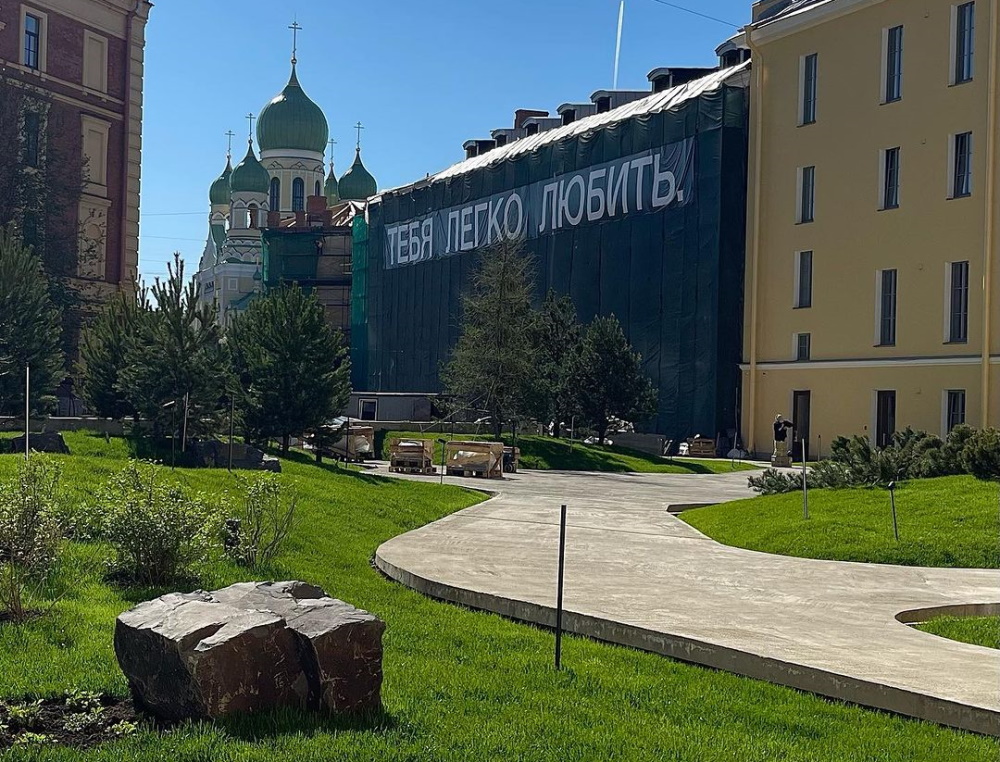
In 2024, the creators of the Wynwood Hotel opened Hideout, a new public space [sic] at 22 Rimsky-Korsakov Avenue [in Petersburg]. Bumaga shows its readers what the neighborhood looks like and explains how it is laid out.

“You’re easy to love.” Photo: @3axapkina (Instagram)

People started talking about the space in the spring of 2024, when a banner emblazoned with the words “You’re easy to love” was hung on the facade of a historic building. This Is a Sign, a team that installs similar messages in the urban environment, was commissioned by Hideout to do the piece.

The Hideout Residence apartments began operating in the summer, and a Scandinavian garden in the courtyard was also opened, Hideout told Bumaga.

The garden in the courtyard was designed by landscape architecture studio L.Buro. The main works have been completed, but the garden will be developed and improved in the future, Hideout said.


L.Buro’s new Scandinavian garden project is now open to the public! Hideout is an urban space featuring an aparthotel, restaurants, and a fitness studio. Spoiler: a hotel and a contemporary art gallery will open there soon🤫 When designing this project, the studio’s architects managed to take a fresh look at Petersburg’s historic centre . In the video, L.Buro founders Valery Fedotov and Pyotr Lari talk in detail about the Hideout project.

The space’s press service of the space also noted that trees and plants were already growing at the site in the late eighteenth century. State Councillor Charles Gascoine, who owned the plot, laid out a fruit orchard near his mansion.

L.Buro’s rendering of Hideout’s garden

Suite Beauty Salon, Power Peach Yoga and Functional Training Studio, and other tenants operate in the space. The space’s first gastronomic tenant was Jam Café, by the creators of Atelier Tapas & Bar, which opened at the beginning of the year.

In the summer, Hideout added another gastro project, Aster Bakery‘s 23-table patio terrace in the courtyard.

Aster Bakery’s patio terrace. Photo: Hideout

An aparthotel featuring 60- to 100-square-metre residences has been welcoming guests. They have been decorated in neutral colors and sport designer furniture.

In August, the residences can be booked starting at 43,000 rubles [approx. 500 USD] a night.

A residence at Hideout

Source: “Hideout is a space in Kolomna with a Scandinavian garden, an Aster Bakery patio, and a sign that says, ‘You’re easy to love.’ Here’s what it looks like,” Bumaga, 31 July 2024. Translated by the Russian Reader

Adios, America!

“Adios, America! Now it’s only this way (tacos). End of story.”

This ultra-patriotic gem was just beamed to me by my fellow Petersburg psychogeographer V., who found it forlornly pasted up in the former “party zone” on Dumskaya and Lomonosov streets in downtown Petersburg, a quarter which was thoroughly purged last year by the local powers that be for no good reason.

A quick scan of the QR code leads to the now-equally shuttered website El-Chapo.rf. According to the restaurant review site Restoclub, El Chapo is “closed indefinitely.” But what it must have been back in its heyday, during the first year of Russia’s glorious war against fascist Ukraine and its Western puppet masters!

Dance bar with Mexican cuisine on Lomonosov Street. El Chapo serves Mexican cuisine: quesadillas with oyster mushrooms, burritos with shredded beef and shrimp in coconut. To try the spicy chimichanga tortillas with meat, you have to sign a special contract. Here they mix cocktails based on tequila, rum and house-made tinctures. At the bar you can have your photo taken with local star Frida the Pig. El Chapo hosts DJ sets and parties, and plays Mexican rap, funk, and sometimes disco.

The once lively (and, in the early 2000s, avowedly ethnically and internationally tolerant) Dumskaya bar district is indeed now a ghost town, as witnessed by another snapshot which V. sent to me. ||| TRR


After breathing a sigh of relief, this was the first question that popped in my head:

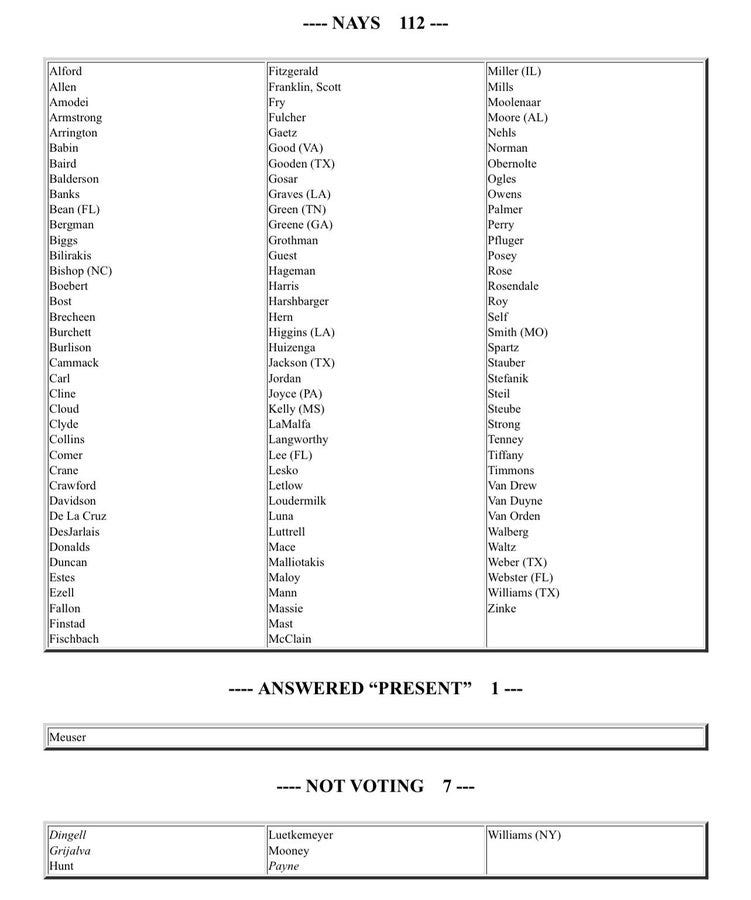
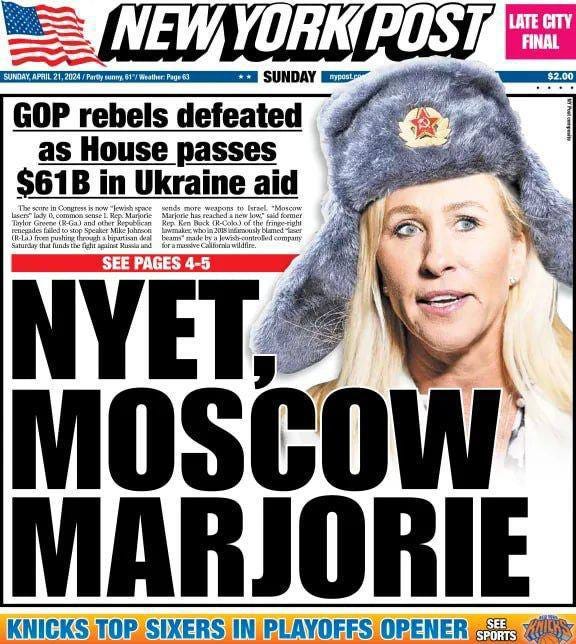
Who are the 112 U.S. representatives who thought it was a great idea to unilaterally disarm Ukraine, an ally that is fighting for its survival against a U.S. adversary?

The list was published almost immediately.

Image

My reflection is not about these particular people in particular, but the fact that in Washington, and in capitals across Europe, a hefty number of our democratically elected representatives are brazenly siding with Russia, a totalitarian state which has the aim of not only weakening our democracies but bringing defeat to our entire system and the international rules based system. They are siding with the destruction of a sovereign state, Ukraine, and the occupation of its territory and citizens.

Marjorie Taylor Greene is in the company of Matteo Salvini (head of the League), Giuseppe Conte (former Italian PM), and so many other European politicians who may be motivated to side with Russia for a variety of reasons. It speaks to the penetration of Russian capture in some cases, or industrial and commercial interests influencing our political base. Since Russia has no ideology at the present time, I’m assuming they agree with the neo-realist worldview which would see large states eat up smaller ones by force simply because they can, throwing out the entire concept of state sovereignty.

If they have been captured and are working for a foreign adversary, there is no indication that any of them (at least in Italy) are under investigation. The only way we can rid our system of elected representatives working openly in the interests of an adversary to the detriment of our national interests is to vote them out. In Italy, that isn’t possible because even if a head of a party loses an election, he/she can still remain in their place and continue working in the interests of Russia: see Salvini and Conte.

This is why I am overjoyed that the House has belatedly passed the aid to Ukraine bill, but unspeakably frustrated with our inability to rid ourselves of people who are ready to throw our security, and Ukraine, under the bus.

Dmitri Medvedev meltdown: He’s hoping for a civil war in the U.S.

No one doubted that American lawmakers would approve “aid” to a gang of neo-Nazis. It was a vote by the joyous bastards of the state:

a) in favour of continuing the civil war of the divided people of our formerly united country;

b) for maximising the number of victims of this war.

We will win, of course, despite the 61 billion bloody dollars that will mostly go down the throats of their insatiable military-industrial complex. Strength and Truth are behind us.

But in view of this Russophobic decision, I cannot but wish with all sincerity that the United States would plunge into a new civil war as soon as possible. Which, I hope, will be cardinally different from war of the North and the South in XIX century and will be conducted with application of planes, tanks, artillery, MLRS, all kinds of missiles and other weapons. And which will finally lead to the ignominious collapse of the vile evil empire of the XXI century – the United States of America

Source: Monique Camarra, Eurofile, 21 April 2024


Russian President Dmitry Medvedev became the first Russian to get the brand new iPhone 4, which are to go on sale on Thursday.

The Russian leader received the smarthphone [sic] as a present from Apple CEO Steve Jobs during his visit to the company’s headquarters in Cupertino, California.

At 9.3 mm the iPhone 4 is 25 percent thinner than its predecessors and the thinnest smartphone on the market. The gizmo also boasts a state of the art battery, with seven hours of talk time and 300 hours of standby.

According to the Russian mobile operator Beeline, the brand new device may appear on the Russian market no earlier than September.

During his visit to the Silicon Valley the Russian leader also visited the U.S. office of the Russian search engine Yandex.

The Yandex Labs center, based in Paolo Alto, California, is involved in scientific projects concerning mainly the optimization of online search technologies and other advanced research activities.

The president was accompanied by Yandex CEO Arkady Volozh and the chief technology officer of the Silicon Valley-based Yandex Labs, Arkady Borkovsky.

Source: “Medvedev becomes first iPhone 4 owner in Russia,” Sputnik, 23 June 2010

The Putin Party

Randy Newman, “Putin” (2016)

[…]

Dark Matter contained a re-recorded version of his Emmy award-winning song ‘It’s a Jungle Out There’, which was used as the theme song for the television series Monk. The album tells countless humorous tales. However, one of its most memorable cuts is the track ‘Putin’, which sees Newman sarcastically attack the Russian president. 

The song pokes fun at Putin’s efforts to appear macho, with Newman singing, “And when he takes his shirt off/ He drives the ladies crazy/ When he takes his shirt off/ Makes me wanna be a lady.” A chorus of ‘Putin Girls’ chime in to sing, “Putin if you put it/ Will you put it next to me?”

To accompany the scathing lyrics, Newman uses chaotic instrumentation that sounds like the perfect theme for a cartoon villain. The musician explained that he wrote the song when “all those pictures were appearing of him with his shirt off, and I couldn’t understand why. What did he want?”

He continued: “I think it was just personal vanity of some kind, like he wanted to be Tom Cruise. It wasn’t enough to be the richest and most powerful. He wanted to be the most handsome and a superhero, throwing young people around and wrestling.” 

Newman claims that he originally wrote a much harsher version but had to tone down the insults. In 2018, the song won the singer his seventh Grammy, this time for the relatively obscure category of Best Arrangement, Instrumentals and Vocals.

Source: Aimee Ferrier, “Remembering Randy Newman’s satirical warning about Vladimir Putin,” Far Out, 14 October 2022


“RUSSIAN PROPAGANDA HAS MADE ITS WAY into the United States, unfortunately, and it’s infected a good chunk of my party’s base.” That acknowledgement from Michael McCaul, Republican chairman of the House Foreign Affairs Committee, was echoed a few days later by Michael Turner, the chairman of the Intelligence Committee. “It is absolutely true, we see, directly coming from Russia, attempts to mask communications that are anti-Ukraine and pro-Russia messages, some of which we even hear being uttered on the House floor.” Among the falsehoods that GOP members of Congress are repeating is the notion that the Ukraine war is actually a battle between NATO and Russia. “Of course it is not,” Turner told CNN. “To the extent that this propaganda takes hold, it makes it more difficult for us to really see this as an authoritarian versus democracy battle.”

What makes it even more difficult to see reality plainly is the presence in the GOP of dunderheads like Sen. Tommy Tuberville, who gushed to an Alabama radio show that “Putin is on top of his game,” while scorning U.S. media accounts of Russian behavior. “The propaganda media machine over here, they sell anything they possibly can to go after Russia.” Tuberville may be the dimmest Putin booster on the Hill, but he is hardly lonely.

It has been two months since the Senate passed, in a 70–29 vote (including 22 Republican yes votes), a $95 billion foreign aid bill that included $60 billion for Ukraine. The Republican-controlled House, by contrast, has been paralyzed. Stories leak out that Speaker Mike Johnson, apparently influenced by high-level briefings he’s received since capturing the gavel, has changed his posture and wants to approve the aid. But Johnson leads, or is at least is the titular congressional chief, of a party that contains a passionate “Putin wing,” and so he dithers. This week, Volodomyr Zelensky has warned that Ukraine will lose the war if the aid is not approved. Yet Johnson is heading not to Kyiv but to Mar-a-Lago.

Pause on that for a moment. The Republican party is now poised to let a brave, democratic ally be defeated by the power that the last GOP presidential nominee save one called “without question, our number one greatest geopolitical foe.” One member of Congress has sworn to introduce a resolution to vacate the speaker’s chair if Johnson puts aid for Ukraine on the floor. And the entertainment wing of conservatism—most egregiously Tucker Carlson—has gone into full truckling mode toward the ex-KGB colonel in the Kremlin.

It’s worth exploring how the Republican party, the party of “Mr. Gorbachev, tear down this wall,” became the party that now credulously traffics in blatant Russian disinformation while it flirts with betraying an important ally—along with all of its principles.

To some degree, people’s foreign policy inclinations are reflections of their domestic views. During the later years of the Cold War, large numbers of liberals and Democrats were more sympathetic to leftist regimes like Cuba (see Bernie Sanders) and Nicaragua (see Michael Harrington) than were conservatives and Republicans. I wrote a book about liberal softness toward left-wing authoritarianism and, though I haven’t yet read it, I gather that Jacob Heilbrunn’s new book does some similar spelunking about conservatives’ tolerance for right-wing dictators. Certainly some conservatives were more inclined than any liberal to go easy on South Africa because it was perceived to be a Cold War ally. On the other hand, Republican administrations did push allies to clean up their act on corruption, democratic elections, and other matters where they could (as for example in El Salvador).

Trump’s particular preferences and ego needs play a starring role in the GOP’s devolution. Cast your minds back to 2016 and the revelation that the Russians had hacked the Democratic National Committee. To rebut this damaging development, Fox News conjurers got busy inventing a tale about CrowdStrike, the company that documented the hack, alleging that the servers had been mysteriously moved to Ukraine so that the FBI could not examine them. In his infamous phone call with Zelensky, Trump fished out this debunked nugget and asked Ukraine’s president, who was then already fighting Russia in the Donbas, to do him a favor before he released the weapons Congress had approved:

I would like you to find out what happened with this whole situation with Ukraine, they say CrowdStrike. . . . I guess you have one of your wealthy people. . . . The server, they say, Ukraine has it. I would like to have the attorney general call you or your people and I would like you to get to the bottom of it.

This was bonkers. As the Mueller report made clear, the FBI did get all the data regarding the DNC hack. There was never a shred of evidence that the servers were moved to Ukraine, and in any case physical control of the servers was unnecessary. But what was Zelensky supposed to say? He promised to look into it just as a courtier to a mad king will say, “Yes, your majesty, we will look into why your slippers are turning into marshmallows when the sun goes down.”

As Fiona Hill told me, Tom Bossert, Trump’s first homeland security advisor, tried “a million times” to disabuse Trump of this Ukraine myth, as did CIA Director Gina Haspel, Cybersecurity and Infrastructure Security Agency Director Chris Krebs, and many others, to no avail. It was, Hill notes, “a too-convenient fiction.”

Because Trump regarded any implication that he had received assistance from Russia as impugning his victory, he latched onto the idea (perhaps whispered by Putin himself in one of their many private conversations) that, yes, there had indeed been foreign interference in the election, but it was Ukraine boosting Hillary Clinton, not Russia aiding Trump. Now, it’s true that Ukraine’s friends reached out to Clinton, but why wouldn’t they? Trump’s campaign manager was Paul Manafort, a paid agent of Viktor Yanukovych, the ousted pro-Putin Ukrainian leader.

Trump nurtured his misplaced grudge for years. Recall that when Putin launched the full-scale invasion of Ukraine in 2022, Trump’s initial response was that it was a “genius” move.

I went in yesterday and there was a television screen, and I said, “This is genius.” Putin declares a big portion of the Ukraine—of Ukraine—Putin declares it as independent. Oh, that’s wonderful. He used the word “independent” and “we’re gonna go out and we’re gonna go in and we’re gonna help keep peace.” You gotta say that’s pretty savvy.

A non-sociopath would say it was raw aggression of the worst kind. A normal Republican of the pre-Trump mold would have been outraged at the attempted rape of a peaceful, democratic neighbor.

Most Republican officeholders are not sociopaths, but they take their marching orders from one and have adjusted their consciences accordingly. The talking point J.D. Vance and his ilk favor is that they cannot be concerned about Ukraine’s border when our southern border is also being invaded. Of course it’s absurd to compare immigrants looking for work or safety to tanks, bombs, and missiles, but that’s what passes for Republican reasoning these days. In any case, it was revealed to be hollow when Biden and the Democrats offered an extremely strict border bill to sweeten aid for Ukraine, and the GOP turned it down flat.

Russia’s fingerprints are all over the Republicans’ failed attempt to impeach (in all senses of the word) Joe Biden. Their star witness, Alexander Smirnov—who alleged that Hunter and Joe Biden had been paid $5 million in bribes by Burisma—was indicted in February for making false statements. High-ranking Russians appear to be his sources.

Whether the subject is Ukraine, Biden’s so-called corruption, or NATO, Putin seems to have pulled off the most successful foreign influence operation in American history. If Trump were being blackmailed by Putin it’s hard to imagine how he would behave any differently. And though it started with Trump, it has not ended there. Putin now wields more power over the GOP than anyone other than Trump. GOP propagandists indulge fictions that even many Russians can see through: Ukraine is governed by Nazis; Russia is a religious, Christian nation; Russia is fighting “wokeness.”

Republicans are not so much isolationist as pro-authoritarian. They’ve made Hungary’s Viktor Orbán a pinup and they mouth Russian disinformation without shame. Putin must be pinching himself.

Source: Mona Charen, “The GOP is the Party of Putin,” The Bulwark, 11 April 2024. Thanks to Mark Teeter for the heads-up.


Putin recommends reviving ‘Come On, Girls!’ contest, following Uralvagonzavod’s example

Following his visit to the Sverdlovsk and Chelyabinsk regions, President Vladimir Putin instructed regional heads to explore the initiative.

This isn’t the winner of the Come On, Girls! contest in Nizhny Tagil, but a stock image that Rabota.ru figured was good enough.

The list of the head of state’s mandates includes holding corporate Come On, Girls! contests, as is already being done at Uralvagonzavod in Nizhny Tagil, where Putin met with the event’s winner.

Top officials have until November to submit a report detailing how they have implemented the mandate.

Come On, Girls! was a televised Soviet competition that aired from 1970 to 1987. Members of particular professions competed both for the title of best specialist and in creative contests.

During the same visit to Uralvagonzavod, it was suggested to Putin that excursions by schoolchildren to industrial enterprises be made mandatory. For the time being, authorities are drafting labor education lessons for pupils modeled on the Soviet system.

Source: Andrei Gorelikov, “Putin recommends reviving ‘Come On, Girls!’ contest,” Rabota.ru, 9 April 2024. Translated by the Russian Reader

The War on Terror

This is not the first time the editors of our local newspaper have “platformed” the lies of the mendacious and violent fascist butcher Vladimir Putin.

1. US warns that Russia will invade Ukraine. General disbelief, daily Russian mockery. (December 3 2021-February 24 2022)

2.  Russia invades Ukraine, kills tens of thousands of people, kidnaps tens of thousands of children, commits other ongoing war crimes (February 24 2022-present)

3.  Russia blames US for Russia’s invasion of Ukraine (March 2022-present)

4. US warns of terror attack in Moscow. Putin denies any risk and mocks the United States. (March 7 and March 19 2024).

5.  Terror attack near Moscow, ISIS takes responsibility, Russia meanwhile kills Ukrainian citizens with drones and missiles as it has for more than two years. (today, March 22 2024)

6.  Russia’s security apparatus, focused on bringing carnage to Ukraine, has failed in Moscow.  Russia’s leaders, focused on demonizing the US, did not protect Russians. What next? Where to direct the blame?

7.  It would not be very surprising if the Kremlin blames Ukraine and the United States for terror in Moscow and uses the Moscow attack to justify continuing and future atrocities in Ukraine.

Source: Timothy Snyder, “Moscow Terror: A Chronology That Might Predict,” Thinking about…, 22 March 2024


This past Friday, 22 March, a horrifying terrorist attack took place in Crocus City Hall in the outskirts of Moscow.  Islamic State plausibly claimed responsibility.

Earlier that day, Russian authorities had designated international LGBT organizations as “terrorist.” Also earlier that day, Russia had carried out massive terror attacks on Ukrainian cities. Those actions reveal the enemies Putin has chosen. As the attack on Crocus City Hall demonstrated, his choices have nothing to do with actual threats facing Russians.

Russia and the Islamic State have long been engaged in conflict.  Russia has been bombing Syria since 2015.  Russia and the Islamic State compete for territory and resources in Africa.  Islamic State attacked the Russian embassy in Kabul.  This is the relevant context for the attack outside Moscow. The horror at Crocus City Hall obviously has nothing to do with gays or Ukrainians or any other of Putin’s enemies of choice.

Putin had publicly dismissed the real threat. The United States had warned Russia of a coming attack by Islamic State.  The United States operates under a “duty to warn,” which means that summaries of intelligence about coming terrorist attacks are passed on, even to states considered hostile, including (to take recent examples) Iran and Russia.  Putin chose to mock the United States in public three days before the attack. 

People reasonably ask how a terror attack could succeed in Russia, which is a police state.  Regimes like Russia’s devote their energy to defining and combating fake threats.  When a real threat emerges, the fake threats must be emphasized.  Predictably (and as predicted), Putin sought to blame Ukraine for Crocus City Hall.

What if Russians realize that Putin’s designations of threats are self-serving and dangerous?  What if they understand that there are real threats to Russians ignored by Putin?  He has devoted the security apparatus to the project [of] destroying the Ukrainian nation and state.  What if Putin’s obsession with Ukraine has only made life worse for Russians, including by opening [t]he way to actors who are in fact threats to Russian life, such as Islamic State? 

These are the questions Putin must head off. It is not easy, however, to blame Ukraine for Islamic State terrorism.  Putin’s first media appearance, nearly a day after the attack, was far from convincing.  The specifics he offered were nonsensical.  He claimed that the suspects in the terrorist act were heading for an open “window” on the Russian-Ukrainian border.

The term “window” is KGB jargon for a spot where the border has been cleared for a covert crossing.  That the leader of the Russian Federation uses this term in a public address is a reminder of his own career inside the KGB.  Yet Putin had obviously not thought this claim through, since a “window” must involve a clear space on both sides of the border.  For escaping terrorists, it would be the Russian side that opened the window.  By speaking of a “window” Putin indicated that the terrorists had Russian confederates preparing their exit, which he presumably did not mean.  It seems that Putin was hastily making things up.

Setting aside the “window” business, though, the whole idea that escaping terrorists would head for Ukraine is daft.  Russia has 20,000 miles of border.  The Russian-Ukrainian part of it is covered with Russian soldiers and security forces. On the Ukrainian side it is heavily mined.  It is a site of active combat.  It is the last place an escaping terrorist would choose. 

And there is no evidence that this is what happened.  Russia claims that it has apprehended suspects in Bryansk, and claimed that this means that they were headed for Ukraine.  (Western media have unfortunately repeated this part of the claim.)  Regardless of whether anything about these claims is true, Bryansk would suggest flight in the direction of Belarus.  Indeed, the first version of the story involved Belarus, before someone had a “better” idea.

In moments of stress, Russian propaganda tries out various ways to spin the story in the direction preferred by the Kremlin.  The reputed suspects are being tortured, presumably with the goal of “finding” some connection to Ukraine.  The Kremlin has instructed Russian media to emphasize any possible Ukrainian elements in the story.  Russian television propaganda published a fake video implicating a Ukrainian official.  The idea is to release a junk into the media, including the international media, and to see if anything works. 

Amidst the flotsam and jetsam are those who spread Russian propaganda abroad, who try out versions more extreme than Putin’s.  Putin does not directly deny that Islamic State was the perpetrator — he simply wants to direct attention towards Ukraine.  But actors outside Russia can simply claim that Ukraine was at fault.  Such actors push the discussion further than the Kremlin, and thereby allow Russia to test what might work abroad.

As a result, we have a bizarre discussion that leads to a harmful place.  Islamic State claims responsibility for Crocus City Hall.  The Islamic State publishes dreadful video footage.  Russia cannot directly deny this but seeks help anyway in somehow pushing Ukraine into the picture.  Those providing that help open a “debate” by denying that Islamic State was involved and making far more direct claims about Ukraine than the Kremlin does.  (This brazen lying leads others to share [a] Islamic State perpetration video (don’t share it; don’t watch it).  So the senseless “debate” helps Islamic State, since the reason it publishes perpetration videos is to recruit future killers.)

Meanwhile, Russia’s senseless war of aggression against Ukraine continues.  In its occupied zones, Russia continues to kidnap Ukrainian children for assimilation and continues to torture Ukrainians and place them in concentration camps.  It continues to send glider bombs, drones, cruise missiles and rockets at Ukrainian towns and cities. 

On the same day as the attack at Crocus City Hall, Russia carried out its single largest attack to date on the Ukrainian energy grid, leaving more than a million people without power.  Among other things it fired eight cruise missiles at the largest Ukrainian dam. Russia attacked the city of Zaporizhzhia (the consequences are in the four photos) and other cities throughout Ukraine.

On Friday Russia fired, in all, eighty-eight missiles and sixty-three explosive drones into Ukraine. And that represents just a single day (if an unusually bad one) of a Russian war of terror in Ukraine that has gone on for more than two years.

Putin is responsible for his mistakes inside Russia. And he is at fault for the war in Ukraine.  He is trying to turn two wrongs into a right: into his own right to define reality however he likes, which means his right to kill whomever he chooses. 

Source: Timothy Snyder, “Moscow Terror (2): The Claim and the Blame,” Thinking about…, 24 March 2024


It is obvious that the terrorist attack at Crocus City Hall on the evening of 22 March 2024, during which 133 people were killed, according to the official count, has clear goals and objectives. A week before Putin’s “election” I wrote that, after receiving a “mandate from the people,” Putin would unleash a mass terror campaign. But for this, of course, he needs a decent and obvious excuse. The exemplary terrorist attack in broad daylight in politically unreliable Moscow is intended to convince society that “decisive action” is what it needs now.

Why would Putin do that? It’s simple logic. Come hell or high water he has to win the war he has unleashed. This is obvious, for it is a matter of self-preservation. If Putin does not win, he is a weakling, a lowlife, and at the same time the person to blame for hundreds of thousands of deaths not only of Ukrainians, but also of Russians. It is clear that he will not last long in this state. Not to mention such a trifle as his sick, wounded ego, repeatedly insulted by Ukraine. But victory would wipe everything out, because victors are not judged, Putin is convinced, taking his cue from his idol Catherine the Great.

So, Putin has to have victory at any cost. But two things have long prevented him from achieving it: 1) his numerous domestic enemies, and 2) a lack of “manpower” in the ranks of the army.

Putin intends to solve problem number one by means of a mass terror campaign against malcontents, especially since he has long been urged to do so by a well-rehearsed chorus of heralds, from Dmitry Medvedev and General Gurulyov to a host of other, lower-ranking epigones of contemporary Russian fascism. Guessing the mood of their Führer, they demand that, at very least, he restore the death penalty; at most, that he carry out “total executions of the terrorists and crackdowns against their families” (per the latest quotable quote from Medvedev).

We can only guess at this point whether Putin’s forthcoming terror will exceed Stalin’s body count or whether the current ruler in the Kremlin will limit himself to “merely” increasing the number of prison sentences meted out to dissidents by a factor of two and carrying out demonstrative executions of dozens or hundreds of his fellow citizens. But there is no doubt that a serious expansion of such tactics is on his agenda.

Putin will solve problem number two through a mass mobilization. This is nothing new either. Piling hundreds of thousands of soldiers into the enemy’s trenches is a time-honored tactic practiced by both the Russian and Soviet military, and, as Putin has seen, it has worked well in the “meat assaults” on Avdiivka, Bakhmut, Severodonetsk, and many other small Ukrainian towns. But these towns are nothing compared to the million-strong cities of Kharkiv, Dnipro, Zaporizhzhia, and Odesa, not to mention the three-million-strong Kyiv. So there must be massively more cannon fodder. The second problem is directly related to the first.

Combined with large-scale crackdowns, the mobilization is sure to proceed more vigorously this time round.

As a bonus for the Kremlin, this terrorist attack diverts public attention (at least for a while) from such things as Russia’s largest-ever strike on Ukraine, involving a hundred and fifty missiles and drones, which happened just a day before the events at Crocus City Hall.

I’d now like to talk about other explanations of this terrorist attack. Looking through the news related to it, I honestly could not help but marvel at the comments of certain respected colleagues, opposition Russian analysts, who easily took the bait about IS, Islamist terrorists, and the other nonsense that the FSB obligingly leaked to the public in the first hours after the attack through the Russian media and Telegram channels.

To clarify, certain people of “non-Slavic ethnicity” were chosen to directly perpetrate this heinous crime. There are hundreds of thousands of Tajik, Uzbek, and Kyrgyz migrant workers in Russia, EVERY ONE of whom is literally turned inside out by the Russian Interior Ministry upon arriving in Russia, including with regard to their attitudes to radical Islam and similar things. The Russian secret services thus have the broadest selection of perpetrators available for such a terrorist attack.

Let us ask ourselves an elementary question: how could Islamist radicals purchase not only assault rifles and pistols but also the flamethrower with which the terrorists torched the unfortunate audience members at Crocus City Hall without the knowledge and support of Russian “law enforcement”? Is such a thing possible in today’s Russia, and in Moscow to boot? If someone thinks that it is possible, I would simply remind them that when members of Eduard Limonov’s National Bolshevik Party tried to buy weapons somewhere in the Altai Territory back in the 2000s, their plan was instantly exposed. The idea of Tajiks buying assault rifles and flamethrowers in today’s militarized Russia, which is chockablock with surveillance cameras and special services, is a bad joke.

Let me also remind you that the initial semi-official Russian explanation was that the terrorist attack at Crocus City Hall was revenge on Russia for its actions in Syria and Chechnya. Seriously? So, it matters not a whit that the Russian army and its air force have not conducted any active operations in Syria for two years now? If you have not been paying attention during this time, let me just remind you that the Kremlin is certainly not concerned with Syria right now. For the last two years all Russian armed forces, including those operating from military bases in Syria and in Armenia, have been deployed in destroying Ukraine. There have been no large-scale military operations in Chechnya for almost twenty years.

However, as it turned out, all this argumentation was completely superfluous, because my gullible colleagues were made to eat their lunch by Putin himself and his favorite propagandist, Margarita Simonyan. As a shadow of her “boss” (as she herself dubs Putin), Simonyan naturally cannot afford to indulge in improvisations not vetted by him, and especially at such a crucial moment. On her Telegram channel, she bluntly pointed out who, in her (and therefore her boss’s) opinion, had organized and perpetrated the terrorist attack: “It wasn’t IS. It was the Khokhols.”

The “boss” himself, who was supposed to address the nation in the early hours after the terrorist attack, unexpectedly postponed his address by twenty-four hours. The delay appears to have been caused by technical blunders. Obviously, organizing the details of a terrorist attack is not Putin’s pay grade. It is clear that in such cases the relevant special services are simply given the go-ahead from the top brass. They are told to do their job. The operation was entrusted, of course, to professional hatchet men. As usual, they made a miserable mess of it. You need a large-scale terrorist attack? The Russian security services always have two or three dozen Tajiks on hand for this purpose, who can be hastily given their marching orders, paid, and… And that’s basically it. The Tajik passport found in a car allegedly belonging to the terrorists is, of course, a masterpiece. It is clear that no terrorist, as he sets off to carry out an attack, ever forgets to take his passport with him. It was meant as a helpful hint to law enforcers, and also so decent folk would know whom to hate. It is strange that the business card of the already half-forgotten Dmytro Yarosh was not found in the car as well.

But the point is that this special operation were certainly not meant to spoil relations with the Islamic world. Russia’s allies—Iran, Hezbollah, Hamas—might take offense.

In addition to the domestic agenda we mentioned above, the terrorist attack was meant to firmly link the globally condemned villains of IS with Ukraine in world public opinion.

This was why Putin’s speech on the terrorist attack was postponed for almost twenty-four hours. The dictator’s dodgy mind was deciding how to clean up the mess made by his numbskulls and tie up the loose ends. That is, to tie IS (or any other Islamists) to Ukraine. And he probably thinks he has figured out how to do it. As he put it, [the terrorists were trying to escape through] “a window prepared for them on the Ukrainian side of the border.”

All these tricks of Putin’s are painfully obvious to people capable of thinking, but he doesn’t care about that. Moreover, having sensed a change in the mood of his American “partners” (remember the reports that the U.S. has been pressuring Ukraine to stop hitting Russian oil refineries, and the fact that for almost two months no American aid has arrived in Ukraine and it is not known whether it will arrive in the future), Putin makes a high-pitched appeal to all countries to unite against this inhuman evil—that is, against Ukraine + Daesh.

Another very important point from Putin’s speech, indicating that he is paving the way for a mass terror campaign at home, is that he called the shooting of civilians at Crocus City Hall nothing more or less than “a blow to Russia, to our people.” He, his propagandists, and the Russian media have already established the link between Islamist terrorists and Ukraine. The next logical step is to claim that those Russians who support Ukraine are direct and immediate supporters of the terrorists who struck “a blow to Russia, to our people”—that is, that they are enemies of the people.

To be honest, all of this is as monstrous as it is predictable. I will repeat what I have said many times before: as long as Putin is alive and in power, things will get even worse and even scarier.

Source: Alexander Zhelenin, “The terrorist attack at Crocus City: who benefits from it and what will happen next,” Republic, 23 March 2024. Translated by the Russian Reader

On Her Knees

This security footage of apparent ballot stuffing at a polling station in Petersburg was released by the Petersburg [Elections] Observers movement on their Telegram channel on 20 March. The polling station was later identified as No. 5, housed in School No. 260 in the city’s Admiralty District. The women shown doing their patriotic duty to prolong Russia’s current fascist regime were identified by another source as school teachers.

Vladimir Putin was re-elected as Russian president. Officially it’s his fifth term in the Kremlin — although in practice it’s six if we include his stint pulling the strings as prime minister. The official results have Putin polling even higher than predicted, taking 87% of the vote. That figure looks utterly implausible and places Putin among the likes of Asian, Middle Eastern and Central Asian autocrats. The election itself went ahead against a tense background, with Ukrainian shelling and attempted incursions into Russia’s border regions along with on-going drone attacks on Russian oil refineries.

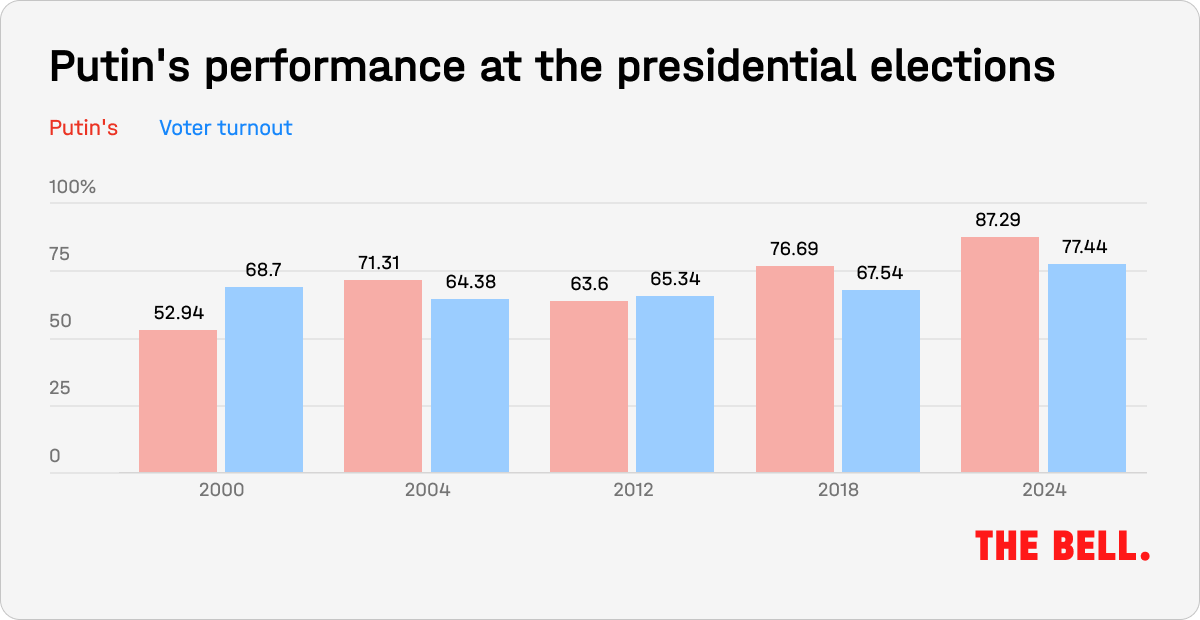
The official election result is already out — Vladimir Putin secured 87.28% on a turnout of 77.44%. Both those numbers are record highs since the collapse of the Soviet Union. And both are about 10 percentage points up on 2018 (when Putin polled 76.8% on a 67% turnout). This suggests that the Kremlin’s political managers were tasked with delivering a significant increase in Putin’s popularity. That in itself is not surprising: in the current circumstances an autocrat needs to demonstrate how his people have rallied around the flag.

Initial research by journalists and independent experts suggests the vote could have been the most heavily falsified in the history of post-Soviet Russia. Analysis by IStories and Ivan Shukshin, a researcher and activist with the Golos vote monitoring NGO, estimated that around 22 million of the 76.3 million votes cast for Putin were “anomalous.” In other words, almost a third of Putin’s official tally could have been false. 

Their methodology is based on analyzing the turnout and vote shares at individual polling stations, using the central election commission’s official data. Districts with higher turnouts also have larger vote shares for Putin — a fact which suggests ballot-stuffing since the two shouldn’t be strongly correlated. IStories and Shukshin didn’t include results in Moscow, where online voting makes the analysis trickier. A third report by Novaya Gazeta Europe said as many as 31.6 million votes — almost half of Putin’s total — could have been fake.

Many experienced observers of Russian politics (1,2) believe that election organizers in provincial Russia “overdid it” this time round. Most pre-election leaks of the Kremlin’s vote strategy featured more modest targets. In spring 2023, for instance, RBC wrote that the Kremlin wanted to secure 75% of the vote on a 70% turnout. A few months later, Meduza wrote that regional authorities were advised that they should secure at least 80% of the vote for Putin. The final pre-election opinion polls conducted by state pollster VTsIOM (which also represent indirect instructions to regional election officials for polling day) showed Putin’s result was at the initial target level of 75%.

The record result places Putin firmly among his fellow autocrats. In free democratic elections, it’s a rare anomaly for a candidate to poll even at 60-70%. Only once, in extreme circumstances, have we seen more than 80% in a democratic country — a huge protest vote that gave France’s Jacques Chirac 82% in a presidential run-off against Jean-Marie le Pen in 2002, the BBC reported. In Russian history, Putin still has something to aim for if we look back to Soviet times. The turnout in 2024 was slightly higher than when Boris Yeltsin was voted president of the Russian Soviet Federative Socialist Republic in 1991, but there is still some way to go to match the Stalin era of 100% turnout in votes to appoint new deputies.

Since Putin was re-elected in 2018, voting in Russia has become even less transparent, and offered greater opportunities for fraud. Remote electronic voting was conducted in 29 Russian regions. Some 70% of the 4.7 million voters registered to vote online apparently cast their votes on the first of the three-day poll. Monitoring violations at physical polling stations is an almost impossible task. The Central Electoral Commission stopped broadcasting live footage from monitoring cameras in polling stations after the pictures from 2018 had depicted numerous violations and led observers to conclude that the scale of ballot stuffing was so great that the real result could not be determined in at least 11 regions. 

The 2024 poll also differed from Putin’s two most recent victories in the selection of candidates who ran against the Kremlin leader. In 2012, political strategists allowed businessman Mikhail Prokhorov to stand, proposing that Russia’s marginal liberal opposition would consolidate around him. And in 2018, that same role went to TV presenter Ksenia Sobchak. But this time round there was no acceptable liberal candidate. Even the little-known politician Boris Nadezhdin, who timidly spoke out against the war in Ukraine, was denied registration. On the ballot were only Putin’s “rivals” from the systemic opposition parties. All of them have been equally supportive of Russia’s repressive turn, backing various crackdown measures that have come before the State Duma in recent years.

The extras in the 2024 race — Communist Nikolai Kharitonov, Vladislav Davankov of New People, and Leonid Slutsky of the LDPR — polled less than 12% combined. That’s slightly less than communist candidate Pavel Grudinin managed on his own in 2018. The 75-year-old Kharitonov’s 4.3% was better than the youthful Davankov’s 3.8%, while Slutsky, the unsuccessful heir to charismatic populist Vladimir Zhirinovsky, trailed in last with 3.2%.

Source: “‘Record’ victory cements Putin’s autocrat status,” The Bell, 19 March 2024


Despite intimidation by the authorities, many Russians went to polling stations across the country and abroad at noon on 17 March as part of the Noon Against Putin protest, which was conceived as one of the few safe ways for Russians to voice their dissent. After all, it is hard to punish people for going to a polling station on election day and queueing.

The protest was the brainchild of Maxim Reznik, a former member of St. Petersburg’s legislative assembly, and it was endorsed by Alexei Navalny. After the opposition politician was murdered in a Russian penal colony, his supporters and other Kremlin opponents urged Russians to take part in Midday Against Putin.

This time round the last day of the election fell on the end of Shrovetide, and the powers that be tried to take advantage of it. For example, in Tomsk, they organized Shrovetide festivities at one of the polling stations to generate “hustle and bustle.” In Arkhangelsk, local restaurants were forced to cook pancakes for free distribution at the polling stations. Festivities were also organized, for example, in Moscow Region, Perm, Chuvashia, Murmansk Region, and Kamchatka.

Investigative journalist Andrei Zakharov quoted an anonymous agitator who, along with his colleagues, was tasked with “inviting people to a Shrovetide party in a park while also suggesting they take their [internal] passports with them in order to vote. It’s not far to the polling station.”

Those who decided to take part in the noonday protest were intimidated by fake mailings. As early as 13 March, some users in Russia received messages purporting to be from Navalny supporters postponing the Noon Against Putin protest to late Sunday. On Saturday, some Muscovites got messages accusing them of supporting “extremist ideas” and demands to vote “without waiting in line.”

There was also intimidation from actual law enforcers. The Moscow Prosecutor’s Office issued three warnings about the danger of the protest and possible criminal chargers against the protesters.

In spite of this, people in Russia and around the world came to the polling stations at noon on 17 March.

The huge queues abroad attracted a lot of media attention. Just look at the number of people at [Russia’s] diplomatic missions in Almaty and Bishkek. In European countries, people stood in line for many hours.

The long waits at polling stations abroad were sometimes caused by the deliberately slow work of the election commissions. For example, in Riga, voters were let in two at a time, although there were six voting booths and four polling station officials available. Voting was also delayed because many embassies and consulates banned cell phones, searched voters as they entered, and made them temporarily surrender their belongings.

In Russia, people were also searched in many polling places after dozens of incidents of attempted arson and spoiling ballot boxes with paint (the handiwork of phone scammers) took place. “First, two policemen search the bags [of voters] very thoroughly outside. I even had to show them my deodorant stick,” a reader of Dmitry Kolezev’s Telegram channel from Moscow wrote.

Due to the [long] queues in Riga, Vienna and Yerevan, for example, the polls were kept open for at least another hour [after they were to have been closed]. But in Berlin, the embassy was immediately closed, prompting the people gathered there to stage an impromptu protest. One of the staffers at the diplomatic mission danced a little jig as they shouted “Shame!”

But the principal queues were in Russia.

The first lines formed at precincts in Siberia and the Urals — for example, in Perm and Yekaterinburg, Novosibirsk and Akademgorodok. In the last place, by the way, Putin lost to [Vladislav] Davankov, a rare case for electoral precincts in Russia itself.

The queues were de facto protest rallies. People lined up outside polling stations in Moscow, St. Petersburg, Arkhangelsk, and Sochi. Officials tried to persuade them to cast their votes on electronic terminals — it is easier to rig the vote that way — but people took paper ballots and either voted for someone other than Putin or defaced them by writing on them such things as “Love is stronger than hate,” or “You have the blood of Ukrainians on your hands, scumbag” (the latter remark was addressed to Vladimir Putin).

As it turned out, nobody interfered with the queues; the police were not violent and did not detain anyone. Most of the detentions that did occur were of independent observers and members of elections commissions who had tried to prevent violations. According to OVD Info, 17 March was “relatively calm.”

The election’s outcome surprised no one in a country where wartime censorship has virtually been introduced. Vladimir Putin took more than 87% of the vote according to the official count — a result almost like that of Central Asian dictators, and greater than that of [Belarusian dictator Alexander] Lukashenko.

The main outcome was that many Russians took advantage of the procedure as one of the few remaining opportunities to safely speak out against Putin and his policies. And they saw that they were not alone.

Source: “What the Noon Against Putin queues showed,” WTF? newsletter (Mediazona), 18 March 2024. Translated by the Russian Reader


In a third video, another man detained by law enforcement agents identified himself as Rajab Alizadeh.

A man off camera asked him: “When you fled from Moscow, you had weapons. Where did you throw them? There or here?”

Alizadeh, whose face and shirt were covered in blood and whose head was wrapped in medical gauze, said “somewhere along the road,” but could not recall exactly where he and his accomplices left their weapons.

An unverified graphic video shared online showed what was said to be Alizadeh lying face down on the ground as Russian law enforcement agents cut off his ear, which, if confirmed, could explain why the man’s head was wrapped in bandages in the interrogation video. 

Source: “Russian State Media Release Interrogation Videos of Concert Attack Suspects,” Moscow Times, 23 March 2024

Time of Heroes

In his state of the nation speech, President Vladimir Putin announced the launch of the national project “Time of Heroes” for veterans and current participants of the special operation by Russian troops in Ukraine.

Статья на медиа «Просто работа»
Photo: Pixabay courtesy of Rabota.ru

Servicemen with university degrees, managerial experience, and no criminal records can apply to the personnel program. The head of state called such people the country’s “true elite” and argued that they should “lead regions, enterprises, and the largest public projects.”

The program will kick off on March 1. Veterans will be trained per the standards of the School of Governors and the Leaders of Russia competition, and ministers and heads of enterprises will act as their mentors.

Currently, all participants of the special military operation also enjoy priority hiring, and their employers also receive benefits.

Source: Andrei Gorelikov, “SMO veterans will participate in the Time of Heroes’ personnel programme: According to the President, they should take up ‘elite’ positions,” Just Work (Rabota.ru), 29 February 2024. Translated by the Russian Reader


News from the territories occupied by Russia:  

Ukrainian journalist and former editor abducted from Russian-occupied Henichesk  (Kharkiv Human Rights Protection GroupMarch 8th)

Russia sentences Ukrainian marine to 20 years for defending Mariupol  (Kharkiv Human Rights Protection GroupMarch 8th)

‘It wasn’t like this before Russia came’ The state of healthcare in Ukraine’s occupied territories after two years of war (Meduza, March 7th)

‘When I was evacuated, I only had a pair of trousers, shoes, a jacket and my documents’ (Kharkiv Human Rights Protection GroupMarch 6th)

Another wave of searches and detentions of Crimean Tatars (Crimea SOS and others, 6 March)

Crimean Solidarity journalist and activists arrested, their families terrorized, in new Russian offensive against Crimean Tatars  (Kharkiv Human Rights Protection GroupMarch 6th)

Ominous denials a month after Crimean Tatar father abducted by Russian FSB  (Kharkiv Human Rights Protection GroupMarch 6th)

Russia’s abuses against civilians in the occupied territories of Ukraine: event during the UN Human Rights Council  (ZminaMarch 6th)

Absence of law and international control (Kharkiv Human Rights Protection GroupMarch 6th)

UN records 104 cases of pro-Ukrainian Crimeans abducted in past 10 years  (Ukrainska Pravda, March 5th)

Reshat Ametov and 10 years of Russia’s systematic torture, abductions and killings of civilians for supporting Ukraine  (Kharkiv Human Rights Protection GroupMarch 4th)

Russia passes huge conveyor belt sentences against Ukrainians tortured for propaganda videos (Kharkiv Human Rights Protection GroupMarch 4th)

All’s fair in art and war: Russia’s plunder of Ukrainian museums (The Insider, February 29th)

Source: News from Ukraine Bulletin no. 88, 11 March 2024

Mark Teeter: A Day of Sadness Past Any Telling of It

I never met Alexei Navalny, although we have (or had) a number of mutual friends, as you’d expect. And while his death was not a surprise — this regime had tried to kill him before, but he survived, literally miraculously — it was still a shock when news of it came yesterday morning.

You may have heard AN referred to as “Russia’s Nelson Mandela.” Commentators here have also been invoking Martin Luther King and several other Americans (on a list to which I would add RFK) in an effort to give U.S. listeners/readers a sense of how this loss may affect several generations of Russians.

What those comparisons cannot convey is how much the shock and loss register on a personal level. I am sure that millions of Russians today feel as though they’ve lost a family member — for some immediate, for others more distant — but in any case a relative, someone who was “one of ours” …and who they can’t quite believe is really gone, never to show up again at their homes, at a peace rally or in some live link on their laptops/phones/etc. And doubtless many Russianists abroad, like me, are experiencing a version of that same feeling: an almost palpable sense of personal loss.

Over recent years I have described AN more than once as the only person who, if the nation proved very lucky, might just be able to bring the place to its senses following the prolonged and self-inflicted disaster that has defined Russia in the first quarter-century of the new millennium. But here we are: the nation has not been very lucky (it seldom is), and all of us — Russians, Russianists and the rest of the world — can only mourn the passing of a genuine Russian праведник (PRA-ved-neek; a righteous man) and regret that the country has missed the slim yet credible “Navalny chance” that he represented. 

I am discouraged about the near-term future — meaning the country’s prospects overall as well as my own chances of returning to Moscow and our little family there (both wife and grandson continue OK, thanks) as long as the current President for Life remains either above ground or unincarcerated. But I am also trying to stay focused on AN’s injunction, which figures near the end of last year’s Oscar-winning Navalny documentary and is now being cited widely in various media. It goes, in paraphrase, “If they do kill me, it will be a sign of weakness, not strength. So don’t despair — that’s not allowed! — and keep up the good fight.”

AN’s daughter Dasha is, as you may know, an undergrad at Stanford. Somehow this picture cheers me up a little today.

Source: Mark Teeter, email newsletter to family and friends, 17 February 2024. Thanks to Mark for his kind permission to reproduce it here. Mark is not only a proud alumnus of Stanford University, but he also played a role in welcoming me to Russia for the first time, in 1994. He describes my own feelings about Navalny’s death to a tee. ||| TRR


ALEXEI NAVALNY (1976-2024): Покойся с миром / R.I.P.

“Alexei Navalny, Russian opposition leader, dies in prison”

For Russians, Russianists and friends of the nation everywhere, a day of sadness past any telling of it.

Source: Mark H. Teeter (Facebook), 16 February 2024