

America’s Greatness
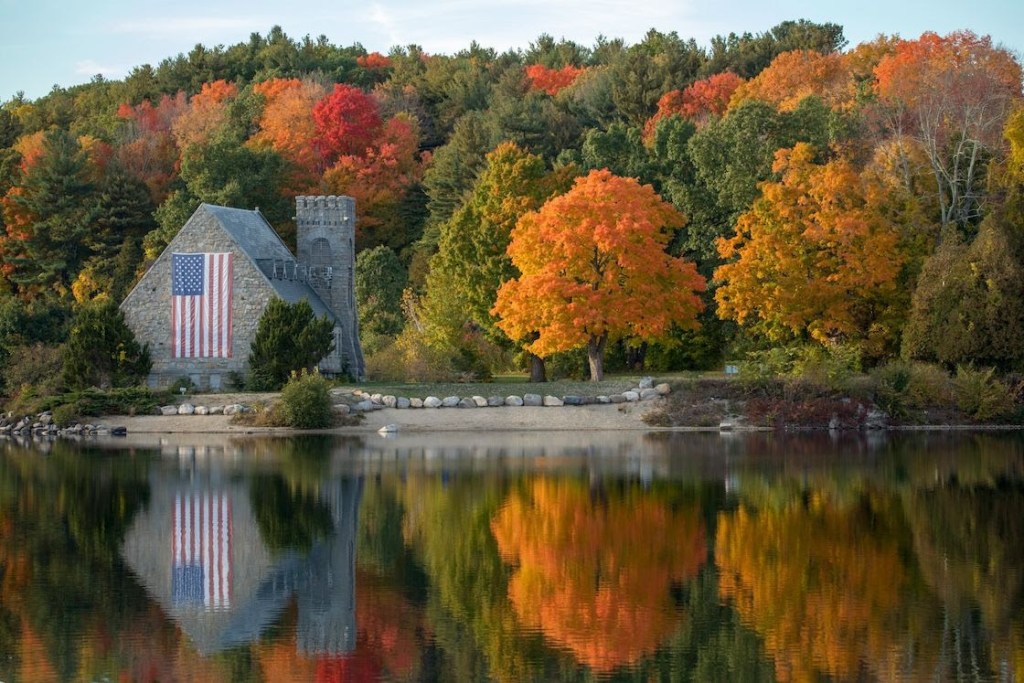
“Not until I went into the churches of America and heard her pulpits flame with righteousness did I understand the secret of her genius and power. America is great because she is good, and if America ever ceases to be good, she will cease to be great.” – Alexis de Tocqueville
In the Soviet Union, where I grew up, any expression of faith was met with ridicule and harassment under anti-religion propaganda. This experience deepened my appreciation for the freedom to worship and inspired DEO FAVENTE wine—a tribute to God’s grace and providence.
As we approach Thanksgiving, let us reflect on the foundation of America’s greatness: her faith in God. It is through that faith and the values rooted in His word that our nation remains a true Land of Promise, guided by His hand.
With blessings to you and your families,
Diana Karren
Grapegrower, Winemaker, American
LAND OF PROMISE
(707) 971-9995
Unsubscribe © LAND OF PROMISE 2024
Source: Land of Promise emailing, 14 November 2024
“We chose the name Terra de Promissio, latin for the Land of Promise. because as farmers, the land is about the “promise”. The promise that every new season brings the possibility AND the hope of a bountiful harvest.”
“and as we were both born, have lived and worked overseas, It is the promise of AMERICA, one nation under god AND the American Dream. We very much appreciate what this country represents. America is truly the land of promise and we are grateful for the freedom, liberty and opportunities that these united states offers to all of us.”
Charles and Diana bought a former dairy ranch in 1999 and then over the next 3 years, oversaw the planting of 33,000 vines. During the summer of 2002, they bought a used trailer to live in and then brought Diana’s Dad and sister Alina from Russia to help manage the vineyard. We welcomed Diana’s Family to the USA with an American Flag. And from that day on, the American Flag has proudly flown every day here at the vineyard. Terra de Promissio had its first harvest in 2005 and sold to 3 wineries. In 2007, after renting a house in Petaluma, they converted a barn into a home and moved to the vineyard full time. In 2012 and 2013, they planted an additional 18,000 vines to bring the total planted acreage of Terra de Promissio to 50 acres.
[…]
Diana KARREN

Diana was born in the Soviet Union. She was a Young Pioneer in the Communist System. But in the 1980s as the Soviet Union began to collapse, she put herself thru college and at the same time, worked for western companies that were investing in the now Former Soviet Union. Her hard work and great grades paid off and she was accepted to the University of Pennsylvania’s Wharton School of Business, where she graduated with a Masters of Business Administration in 2003.
During a two year period (2001-2003) Diana single-handily designed, gained government approvals and oversaw the planting of Terra de Promissio, while being pregnant and giving birth to Christian and doing it as a full time MBA Ivy-League student. In 2005, Diana oversaw the first harvest to Siduri, Flowers and Lynmar. In the ensuring years, as the grape production ramped up, Diana added multiple wineries including Kistler, Kosta-Browne and Willams Selyem. In 2011, Kosta Browne received the Wine Spectator’s Wine of the Year for the 2009 Sonoma Coast, which was primarily using grapes from Terra de Promissio.
Since day one, every row and block is custom farmed per each of the winemakers specific instructions. Because of this attention to detail by Diana, Terra de Promissio is now the most vineyard designated pinot noir in Sonoma County with over 10 wineries using the TdP name on their label. Beginning with the 2013 harvest, Diana began overseeing the winemaking process for Land of Promise. She now makes 4 Land of Promise Pinots and one Rosé. For more info, please click here or the link below.
In addition to managing the vineyard and the winery, Diana spends her Sunday mornings at Calvary Chapel Petaluma where she volunteers watching the babies and toddlers during the busy first service, so their parents can enjoy and listen to the sermons.
Source: “Family,” Terra de Promissio
Just one week has passed since Donald Trump’s electoral triumph, and already Russian President Vladimir Putin—one of the strongman leaders Trump admires most—is messing with his head.
First, Putin waited two days before congratulating Trump on his victory. One can imagine Trump receiving phone calls from kowtowing leaders the world over—Ukraine’s Volodymyr Zelensky, Israel’s Benjamin Netanyahu, the Palestinian Authority’s Mahmoud Abbas, the chief of NATO, the European heads of state—all the while wondering about the man whom he’s admired publicly and privately for the past eight years: When is Vladimir going to call?
Then, in response to Trump’s claim that during their phone call, he asked—in some accounts, warned—Putin not to escalate the war in Ukraine, a Kremlin spokesman denied that the two had spoken on the phone at all. (Putin issued his belated congratulations at a news conference.)
I don’t know who’s telling the truth, a practice for which neither man has a sterling reputation. But either way, in the next few weeks, when Putin orders 50,000 fresh recruits (including 10,000 imported North Korean soldiers) to go on the next rampage—ousting Ukrainian soldiers from the thin slice of Russian territory they hold, then retaking soil across the border in Donbas province—he can tell a complaining Trump that he doesn’t recall any such conversation. If Trump thinks Putin actually will refrain from stepping up attacks on Ukraine as a friendly favor … well, maybe our once-and-future president will learn a lesson about the limits of personal relations in the face of perceived national interests early in his second term.
The final twist of this saga came on Monday, when Nikolai Patrushev, an aide to Putin who was previously director of Russia’s Federal Security Service, made the following comment in an interview with the Moscow newspaper Kommersant:
The election campaign is over. To achieve success in the election, Donald Trump relied on certain forces to which he has corresponding obligations. As a responsible person, he will be obliged to fulfill them.
This is a mind-blowing bit of psychological warfare! The Russians are basically telling Trump: We put you in office. Now it’s time for you to pay us back.
Did this make Trump wonder: WTF?
It is well established that toward the end of this year’s presidential election campaign, Russians created and disseminated phony videos designed to swing voters away from Vice President Kamala Harris. One such video purported to show illegal Haitian immigrants voting. (The FBI, the director of national intelligence, and the top cybersecurity agency issued a rare joint statement about that claim, warning that these videos were false and Russian in origin.) Russians also phoned in bomb scares to polling stations in Black neighborhoods that tend to favor Democratic candidates.
However, there is no evidence—nor has anyone claimed—that Trump or his campaign staffers colluded in, or knew anything about, these videos or the bomb threats. If Trump did have some involvement, or if Russia possesses some other form of kompromat (compromising material) on Trump, Patrushev’s message constitutes an extraordinarily bodacious threat of blackmail, delivered in public, against an American president-elect.
If Trump did not have any involvement in this escapade, Patrushev’s gambit shows—some would say, confirms—that Russia’s main goal, in all these misinformation ventures, is to sow chaos, breed mistrust, and weaken the sinews of democracy in Western countries, especially in the U.S., regardless of who is the president.
What Trump does about this campaign—whether he is fully aware of its extent and depth—is as yet unknown. His foreign policy, which he has clearly expressed many times, is angled toward a realignment with Putin’s Russia. At a first-term news conference in Helsinki, he said he believed Putin rather than his own intelligence agencies on the question of whether Russia interfered in the 2016 election. More broadly, Trump abhors multinational alliances, especially NATO. He considers U.S. military aid to Ukraine to be a waste of money; he doesn’t much like Ukrainian President Volodymyr Zelensky, decrying him as a “salesman,” and he no doubt remains bitter over the role that their “beautiful phone call” played in his first impeachment trial. (This was the call where Trump tried to hold up delivery of U.S. anti-tank missiles until Zelensky agreed to dig up dirt on Hunter Biden.)
The entire MAGA wing of the Republican Party—which is to say, the Republican Party—endorses Trump’s desire to renew good relations with Russia, all the better to go after America’s real adversary, Xi Jinping’s China. The first few of Trump’s Cabinet nominees—Rep. Mike Waltz as national security adviser, Sen. Marco Rubio as secretary of state, and Rep. Elise Stefanik—all share this perspective. Soon after his victory, Trump made a point of tweeting that former Secretary of State Mike Pompeo and former U.N. Ambassador Nikki Haley, both of whom had lobbied for a senior position, would have no place in his administration. Haley had committed the unforgivable sin of running against Trump in the primaries, but beyond that, both she and Pompeo supported—and still do support—boosting military aid to Ukraine. So, they were out.
One can only wonder what Trump will do—whether he’ll change his position, whether he’s capable of changing his stance—when he realizes, if he realizes, that Putin is not his friend. Trump certainly should not act as if he is.
On Nov. 12, the Russian parliament voted to ban “childfree propaganda” in the latest wave of government-sponsored restrictions.
The sole exception, at the request of the Russian Orthodox Church, was made for monks, who are allowed to promote celibacy. Everyone else in Russia now must want to have children or pay a fine if they don’t.
Hi, my name is Oleksiy Sorokin, I’m the deputy chief editor of the Kyiv Independent, and this is the latest issue of our Russia-themed newsletter.
Today we will talk about why the Russian government continues to impose additional restrictions on a population that for the most part agrees with its policies and has little to no desire to oppose the regime.
According to the new legislation, still formally requiring the signature of Russian President Vladimir Putin, speaking in support of not having children is a misdemeanor that will result in a hefty fine.
It’s now illegal in Russia to say that you don’t want kids, and it’s illegal to advertise it online in any way and form, which also effectively bans any promotion and advertising of contraceptives. The right to abortion is now also put into question.
For an individual, the fine will be up to $4,000; for an official, the sum rises to $8,000, while the fine for businesses can hit up to $50,000 and get the company’s license revoked for 90 days.
You must want to have kids if you are in Russia. Or become a monk.
In Russia, 8.5% of the population is living below the poverty line, while the minimum wage is $220. The lack of financial means isn’t an excuse to have kids. Medical conditions are also irrelevant in this case — if you risk giving birth to an unhealthy child or your life is at risk, this can’t be an excuse for not wanting to try.
In our recent story on this issue, Dr. Valerie Sperling, professor of political science at Clark University in Massachusetts, asked the same question I was asking when I first heard of this initiative — “The law is striking in the sense that it seems so completely unnecessary; it seems like a response to something that doesn’t really exist,” Sperling said.
The ban on expression and the state-sponsored attacks on certain groups of people had been ongoing in Russia for over a decade, accelerating since the start of the country’s full-scale war against Ukraine.
In November 2023, the Russian Supreme Court imposed a ban on what it described as “the international LGBT movement,” labeling it as an “extremist organization.” The ruling effectively outlawed the LGBTQ+ community and any visual representation of such, including the pride flag, public showing of affection between people of the same sex, and so on.
Since then, being homosexual has been de facto illegal in Russia, with people persecuted for holding hands, kissing, and even living together.
In the Chechen Republic, led by warlord Ramzan Kadyrov, the LGBTQ+ community is hunted down, tortured, and, in some instances, killed. We had an entire newsletter on the inhumane brutality that is taking place in contemporary Chechnya.
Russians themselves are helping the state to persecute those who the state sees as undesirable. According to a June report from the IStories media outlet, Russians wrote at least 3,500 denunciations since the start of the all-out war. The media outlet says it’s a conservative estimate based on data available online.
So why does this happen? Why does the state continue to impose new restrictions on the passive population? And why do people take it a step further and help the restrictive state do more damage?
In the Oct. 3 edition of this newsletter, we spoke about the accelerating spiral of repression. If you take away the rights and freedoms and impose tight control over the population, any decrease in restrictions may be seen as a sign of weakness, thus, a need to impose new restrictions on a regular basis seems like the most logical step for the regime.
Minorities, unprotected, and secluded groups are usually the primary targets. Such attacks are meant to create a common enemy that will tie the disenfranchised population closer to the ruling class.
Have you noticed that autocrats and strongmen often use hate as the main appeal?
It’s usually “us against them,” and it’s “them that are guilty of our own misfortunes.”
Contemporary Russia is fighting “Americans and the collective West” and their “imposed values” represented, according to the Kremlin, by LGBTQ+, multiculturalism, and people who don’t want children. By blaming everyone else for the country’s own faults, the government shifts the dissatisfaction onto those who don’t have a say.
Absurd? Yes. Does it work? Yes.
If you are barely making ends meet, if your life is hard (for any given reason) — it’s someone else’s fault.
Russian propaganda was successful in shifting the blame for the country’s problems onto the “evil West,” while people in Russia are themselves successfully shifting the blame for their problems onto “foreign agents,” “homosexuals,” and everyone else.
A popular meme in the 2010s was that then-U.S. President Barack Obama was responsible for the bad smell in Soviet apartment buildings that no one dared to clean. The meme was meant to ridicule the overall notion that the West is somehow responsible for the streets being dirty, public transportation being old and having a bad smell, and local officials taking bribes.
Yet, many in Russia do believe “it’s Obama’s fault.”
This also creates a window of opportunity. If there’s a common enemy, attacking this ene migimprove your social standing and earn you benefits otherwise out of reach.
In 1963, historian Hannah Arendt wrote the book — Eichmann in Jerusalem — which followed the trial of Adolf Eichmann, a Nazi war criminal who oversaw the execution of the Holocaust.
Eichmann was abducted from Argentina, where he was hiding, brought to Israel, and tried for crimes against humanity, war crimes, and membership in a criminal organization. He was found guilty on all 15 counts and hanged in June 1962.
Arendt, who was present at the trial, coined the term “the banality of evil.” The term referred to the fact that, according to Holocaust survivor Arendt, Eichmann wasn’t evil, he was spineless. He saw joining the Nazi Party (NSDAP) as a career development, and he took on more work as his career progressed. Murdering innocent people en masse in gas chambers was a mundane job for Eichmann.
“Eichmann obeyed orders,” “Eichmann obeyed the law.”
Millions of Russians work 9 to 5 jobs, watch movies or sports on TV, kiss their loved ones goodnight, then write or call the police to tell them that their neighbor or colleague at work has a pride flag or told them in a private conversation that he or she doesn’t want children.
They effectively make the lives of some people miserable, but “they are simply following the law.”
Source: Oleksiy Sorokin, WTF Is Wrong with Russia? newsletter (Kyiv Independent), 14 November 2024. I am nearly certain that “millions of Russians” are not involved in denouncing their neighbors and coworkers to the police, but after nearly three years of brutal, senseless war you can’t blame a Ukrainian for jumping to such conclusions. ||| TRR
