
Era yo una chiquilla todavÌa
Cuando tú, casualmente me encontraste
Y a merced de tus artes de mundano
De mi honra el perfume te llevaste
Lo hiciste con migo lo que todos
Los que son como tu con las mujeres
Por lo tanto no extrañes que yo ahora
En tu cara te diga lo que eres
Mal hombre.
Tan ruin es tu alma que no tiene nombre
Eres un canalla, eres un malvado
Eres un, mal hombre
A mi triste destino abandonada
Entablé fiera lucha con la vida
Ella recia y cruel me torturaba
Yo, mas débil, al fin caí vencida
Tu supiste a tiempo mi derrota
Mi espantoso calvario conociste
Te dijeron algunos que a salvarle
Y probando quien eres, te reiste
Mal hombre
Tan ruin es tu alma que no tiene nombre
Eres un canalla eres un malvado
Eres un, mal hombre
Poco tiempo después en el arroyo
Entre sombras mi vida dependÌa
Una noche con otra tú pasaste
Y al mirarme oí que te decía:
“¿Quien esa mujer, tú la conoces?”
Y a la vez, respondiste: “¡una cualquiera!”
Al oír de tus labios tal ultraje
Demostrabas también lo que tú eras
Mal hombre
Tan ruin es tu alma que no tiene nombre
Eres un canlla, eres un malvado
Eres un, mal hombre
Source: Musixmatch
Yesterday we learned from a forthcoming book by veteran journalist Bob Woodward that in 2020, while he was president, Trump secretly shipped Covid-19 testing equipment to Russian president Vladimir Putin for his own personal use at a time when Americans could not get it. To be clear, this equipment was not the swabs we now use at home, but appears to be what at the time was a new point-of-care machine from Abbott Laboratories that claimed to be the fastest way to test for Covid-19.
Journalist Karly Kingsley points out that at the time, central lab testing to diagnose Covid-19 infections took a long time, causing infections to spread. Machines like Abbott’s were hard to get. Trump chose to send them to Putin—not to charge him for them, or to negotiate for the release of Paul Whelan and Trevor Reed, two Americans being held by Russia at the time and later released under the Biden administration, but to give them to him—rather than keeping them for Americans.
It’s hard to overstate just what an astonishing story this is. In 2016, Republicans stood firm against Putin and backed the arming of Ukraine to stand against Russia’s 2014 invasion of Crimea. But that summer, at Trump’s urging, the party changed its platform to weaken its support of Ukraine. In 2020, it appears, Trump chose to give lifesaving equipment to Putin rather than use it for Americans. And in 2024, Trump’s willingness to undermine the United States to cozy up to an adversary his own party stood against less than a decade ago does not appear to be a deal breaker for Republicans.
As Senator Chris Murphy (D-CT) put it: “What has this country come to if the revelation that Trump secretly sent COVID testing machines to Putin while thousands of Americans were dying, in part because of a shortage of testing machines here, doesn’t disqualify him to be President?” He continued: “Donald Trump helped keep Putin alive during the pandemic and let Americans die. This revelation is damning. It’s disqualifying. He cannot be President of the United States.”
Increasingly, Trump’s behavior seems to parrot the dictators he appears to admire.
After 60 Minutes called him out for breaking a fifty-year tradition of both candidates talking to 60 Minutes and backing out of an interview to which he had agreed, Trump today accused the producers of 60 Minutes of cutting Vice President Kamala Harris’s answers to make her look good. He suggested that such cuts were “illegal” and possibly “a major Campaign Finance violation” that “must be investigated, starting today!” “The public is owed a MAJOR AND IMMEDIATE APOLOGY!” he wrote. Trump is trying to cover for his own failure by attacking CBS in an echo of dictators determined to control the media.
In a post on his social media site tonight, Trump appears to have declined to appear at another presidential debate with Vice President Harris. After declaring he had won the previous debate with Harris and rehashing many of his grievances, he wrote: “THERE WILL BE NO REMATCH!”
As Beth Reinhard of the Washington Post recounted yesterday, a report from Senator Sheldon Whitehouse (D-RI), who sits on the Senate Judiciary Committee, revealed that the Trump White House prevented a real investigation into sexual misconduct allegations against Trump’s second Supreme Court nominee, Brett Kavanaugh. More than 4,500 calls and electronic messages about Kavanaugh sent to the FBI tip line went directly to the White House, where they were never investigated, and the FBI was told not to pursue corroborating evidence of the accusations by Christine Blasey Ford and Deborah Ramirez although lawyers for the women presented the names of dozens of people who could testify to the truth of their allegations.
A number of senators said the lack of corroborating evidence convinced them to vote in favor of Kavanaugh’s confirmation. As Steve Benen of MSNBC recalled, Senator Susan Collins (R-ME) said at the time that it appeared to be “a very thorough investigation,” while the late Senator Dianne Feinstein (D-CA) said that the 2018 FBI report “looks to be a product of an incomplete investigation that was limited perhaps by the White House.”
After he left office, Trump told author Michael Wolff that he had gone to bat for Kavanaugh, saying: “I…fought like hell for Kavanaugh—and I saved his life, and I saved his career.” Kavanaugh was the crucial vote for Trump’s right-wing agenda, including ending the federal recognition of abortion rights by overturning the 1973 Roe v. Wade decision.
Ken Bensinger reported in the New York Times today that Trump’s team has refused to participate in preparations for a transition to a potential Trump presidency. Normally, the nonpartisan transition process, dictated by the Presidential Transition Act, has candidates setting up teams as much as six months before the election to begin vetting and hiring political appointees and working with the administration in office to make sure the agencies continue to run smoothly.
With the election less than a month away, Trump has neither signed the required agreements nor signed the transition’s ethics plan that would require him to disclose private donors to the transition and limit them to contributions of no more than $5,000. Without that agreement, there are no limits to the money the Trump transition can take. Trump has also refused to sign an agreement with the White House requiring that anyone receiving classified information have a security clearance. Currently, his aides cannot review federal records.
Trump ignored the traditional transition period in 2016, cutting off communications with President Barack Obama’s team. He refused to allow incoming president Joe Biden access to federal agencies in 2020, hampering Biden’s ability to get his administration in place in a timely fashion. Now it’s possible that Trump sees no need for a normal transition because Project 2025, on which he appears to be relying, has been working on one for many months.
It calls for him to fire most federal employees, reinstating the policy he started at the end of his term. To fill their positions, the Heritage Foundation has been vetting loyalists now for months, preparing a list of job candidates to put in place a new, right-wing agenda.
Yesterday, on California’s KFI radio station, Trump told host John Kobylt that Tom Homan of Project 2025, who as director of U.S. Immigration and Customs Enforcement oversaw the family separation policy at the southern border, will be “coming on board” a new Trump administration.
This afternoon, Trump told an audience in Scranton, Pennsylvania, that he expects to put former rival Vivek Ramaswamy into an important position in his administration. On October 7, 2024, Ramaswamy suggested on social media that he wants to get rid of Social Security and Medicare. He wrote: “Shut down the entitlement state & you solve most of the immigration problem right there. We need to man up & fix the root cause that draws migrants here in the first place: the welfare state. But no one seems to want to say that part out loud, because too many native-born Americans are addicted to it themselves.”
Trump has expressed frustration with the independence of the Federal Reserve, expressing a desire to make it answer to the president. In an interview with Barron’s, one of his advisors, Scott Bessent, has floated the idea of creating a shadow Fed chair until the term of the current chair, Jerome Powell, ends, thus undercutting him without facing a fight over firing the Fed chair.
This agenda is not a popular one in the U.S., but Trump is getting a boost as Russian operatives work to swing downballot races toward the Republicans. In a briefing on Monday, October 7, experts from the Office of the Director of National Intelligence (ODNI) told reporters that China and Iran are trying to influence the upcoming election and that “Moscow is leveraging a wide range of influence actors in an effort to influence congressional races, particularly to encourage the U.S. public to oppose pro-Ukraine policies and politicians. Russian influence actors have planned, and likely created and disseminated, content, particularly over social media, intended to encourage the election of congressional candidates that Moscow assesses will oppose aid to Ukraine.”
Russia, an ODNI spokesperson said, uses “influence-for-hire firms, or commercial firms with expertise in these type[s] of activities.” It also coopts “witting and unwitting Americans to work on Russia’s behalf,” to “launder their influence narratives through what are perceived as more authentic U.S. voices.”
Not all of Trump’s supporters appear eager to stick around to see if Trump will win another term. Today news broke that Patrick M. Byrne, the former chief executive officer of OverStock, who became a fervent advocate of the idea that Trump was the true winner of the 2020 presidential election, has left the country, apparently permanently, to live in Dubai. Dominion Voting Systems is suing Byrne, as is President Biden’s son Hunter. The younger Biden sued Byrne for defamation last November after Byrne claimed Hunter Biden sought a bribe from Iran.
In September, Biden’s lawyers were trying to schedule a date for Byrne’s deposition when his lawyer abruptly “claimed for the first time that Defendant has moved his residence to Dubai and if Plaintiff wanted to take his in-person deposition counsel would have to fly to Dubai to do so, to which Plaintiff responded with various related inquiries to try to resolve this matter and defense counsel stated Defendant would not be returning to the United States for the foreseeable future.”
Byrne claimed to have fled the U.S. because the Venezuelan government has put a bounty on him, but as Biden’s lawyers note, “the Defendant’s truthfulness is directly at issue.”
[…]
Source: Heather Cox Richardson, Letters from an American, 9 October 2024
Lydia Mendoza, interviewed by Professor Gene Bluestein and Professor Manuel Pena at CSU, Fresno, before performing “Mal hombre.” Courtesy of the UNC Chapel Hill Folk Archives.
I was but a young girl
when, by chance, you found me
and with your worldly charm
you crushed the flower of my innocence.
Then you treated me like all men
of your kind treat women,
so don’t be surprised now that when I tell you
to your face what you really are.
Bad man
your soul is so vile it has no name
you are despicable, you are evil,
you are a bad man.
Abandoned to a sad fate,
my life became a fierce struggle
suffering the harshness and cruelty of the world
I was weak and was defeated.
In time you learned of my downfall
how my life had become a road to hell.
Some people advised you, “You can help her,”
but being who you are, you just laughed.
Bad man
your soul is so vile it has no name
you are despicable, you are evil,
you are a bad man.
Shortly after in a gully
among shadows I defended my life.
One night you passed by with another woman
and on seeing me I heard her ask you:
Who is that woman? Do you know her?
And looking at me you answered: She’s a nobody
and when I heard adultery from your lips
you demonstrated again what you are.
Bad man
your soul is so vile it has no name
you are despicable, you are evil,
you are a bad man.
Source: “Tango in Mexico: Mal hombre (Bad man),” Tango Stories: Musical Secrets, 8 April 2020
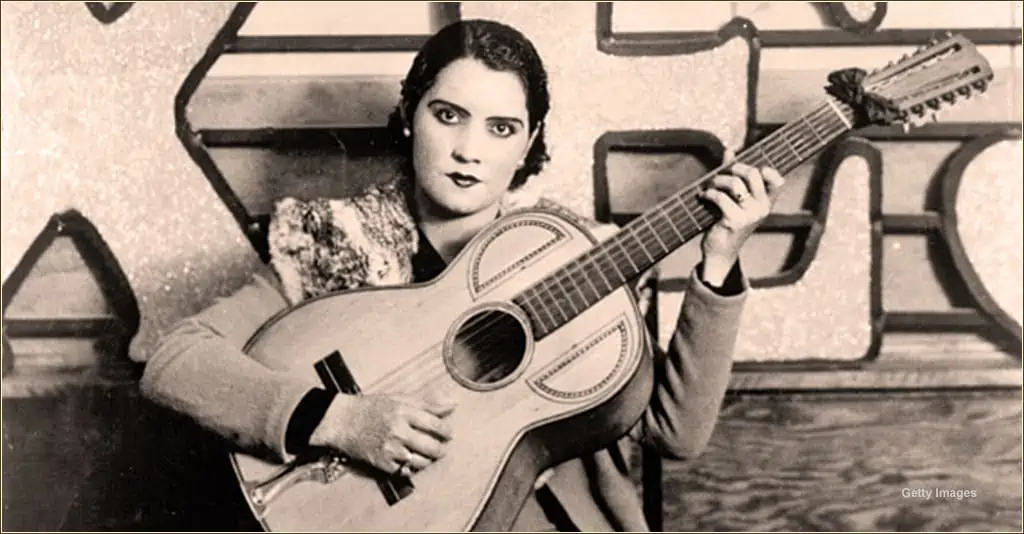
Lydia Mendoza (May 31, 1916–December 20, 2007) was born in Houston, Texas, to musically inspired Mexican parents. During Mendoza’s first ten years the family migrated back and forth between Texas and the Mexican city of Monterrey in the state of Nuevo León, as part of her father’s work with the railroad. In the 1920s, when Lydia Mendoza’s father left the railroad, the Mendoza family eked out a living doing musical performance, first in the lower Rio Grande Valley, and then singing for pennies and nickels on the streets of downtown San Antonio, Texas. The ten year-old Lydia Mendoza began her recording career—singing and playing mandolin—in the 1920s and 1930s with the Mendoza family who recorded for the OKeh, Odeon, and Bluebird labels. As a teenager in 1934, Lydia Mendoza did her first solo recording. The recording she made that day was of the song “Mal hombre” (“Evil Man”), which she popularized, and which became closely identified with her throughout her long singing career. In her later years, she recorded with DLB Records (San Antonio) and, in 2001, issued her last concert recording as part of her published life story, Lydia Mendoza’s Life in Music.
Mendoza’s performance career stands as one of the longest in American music history, spanning from the 1920s to the 1980s when a stroke ended her performing life. Following upon her early success with “Mal hombre,” Mendoza continued to tour with her family as an itinerant performance unit that offered a variety of acts. They followed the agricultural labor routes where most of the Mexican American population worked: north to Michigan, back south to the Rio Grande Valley, later to California. Her closeness to her audiences earned her two epithets—“La cancionera de los pobres” (“The Singer of the Poor”) and “La alondra de la frontera” (“Lark of the Border”). As a grassroots idol, she was loved for her ability to articulate a working-class sentimiento (sentiment and sentience) through song and through the breathtaking visual spectacle of her flashy hand-sequined, hand-beaded performance attire whose symbolic designs announced her ancient cultural roots in the Americas. She publicly marked the enduring presence of indigenous Mexican culture even throughout historical periods (from the 1930s to the 1960s) in which public displays of Mexicanness targeted you for governmental harassment and/or deportation by Euro-American officials. Along the migrant agricultural worker routes, she affirmed and celebrated Mexicanness during those decades when eating establishments regularly featured signs that read “NO DOGS, NO MEXICANS.” Lydia Mendoza manifests the social powers of music: her natural speech-like voice, her striking physical presence, and her songs, so beloved among the communities she sang for, symbolically reclaimed and remapped a Mexican America. Mendoza always enacted a space of popular collective expression, an audible Mexican American homeland.
Throughout her performance career Lydia Mendoza adhered to the oral traditional practice of singing by popular demand: she sang what her audiences requested. That traditional practice meant that audience members called out each song and they tended to call out traditional songs associated both with that singer and with the broader norteño cultural matrix. The repertoire of songs was not unchanging, and “Mal hombre” is testament to that. Once Lydia Mendoza recorded the song—a song not originating in the US-Mexico borderlands, nor of a borderlands rhythmical style—audiences welcomed it into the changing body of “traditional songs.” Thus “Mal hombre,” whose rhythm and cadences mark its origins in distant Argentinian tango or milonga repertoires, became one of Lydia Mendoza’s signature songs; audiences requested it from her throughout her performance life. It should, however, be noted that in the course of the several decades of repeated performance, Mendoza indigenized the “foreign” rhythmed “Mal hombre” into the borderlands rhythms of the canción Mexicana. Still, after Mendoza’s performance life ended, “Mal hombre” also vanished from the borderlands circle of songs and has not been recorded by any borderlands singer since then.
“Mal hombre” was, from the onset, something of an anomaly within the Mexican borderlands musical landscape. The early sound media—recordings, radio, and later television—as well as the Euro-colonization process of the last 200 years, introduced music from far-flung places to the borderlands. There were various waves that swept through the Texas-Mexican landscape: tango, foxtrot, big band, polka, bolero, country, canción, cumbia, and more. The Mendoza family repertoire of recorded songs manifests that rich variety of song genres: ranging from the deeply rooted norteño song forms to the more fad-oriented recent arrivals. Along those same lines, Lydia Mendoza performed and recorded a rich variety of genres from the oral tradition accompanied by the full gamut of Mexican borderlands instrumentations—including the button-accordion conjunto, mariachi, guitar trio, and more. Yet Mendoza’s mainstay ultimately became her performance as a solo singer self-accompanied with her 12-string guitar.
Mendoza notably self-designated as a “norteña” (a Northerner) and as a “Mexicana,” marking her musical cultural geo-regional roots as spanning not only the northern Mexican states of Nuevo León, Tamaulipas, Coahuila, Sonora, and Chihuahua, but also what was, until 1848, the northern half of Mexico, today’s southwest United States. As a mature artist, the mainstays of her song repertoire were the hugely popular canción ranchera (ranch song) and corridos (narrative ballads). The canción ranchera genre represents an evolution of the older Mexican canción. In the ranchera evolution, the love song often tends to be infused with imagery, customs, and symbols from the deep cultural matrix of Mesoamerica. During her last concert tour in 1986-87, Mendoza sang almost exclusively rancheras and corridos. She offered for sale her most recent cassette recording “Corridos,” which included, for example, “The Ballad of Joaquín Murrieta” (1829–1853). That corrido (narrative ballad) recounts the heroic acts of an iconic California freedom fighter that organized an army to protect Indians and Mexicans against the Gold Rush invasion. There is some common ground between such historic narrative ballads and the appeal of “Mal hombre”: they are songs from underdogs who face powerful odds against them. Singers such as Lydia Mendoza carried the voices of underdogs and thus impart the life lessons they embody.
“Mal hombre” (“Evil Man”) offers a life narrative in the voice of a woman underdog who at a very young age is seduced by an evil man’s “worldly arts.” The narrative voice in the song describes various stages of sexual exploitation: her seduction as a young girl, her abandonment by the lover, her life-and-death struggle, and her eventual downfall. The song’s popularity can only be understood in the context of the rampant sexual violence inherent of our patriarchal society institutionalized since colonialism. One of “Mal hombre’s” most notable features, however, is its beautiful poetics. No sexual act is described per se. Nor does the narrator offer any realism-based specifics of her demise. In the song, a great deal is left to the listener’s imagination, such as when she references “mi espantoso calvario” (“my horrific cavalry”). The female narrative voice of “Mal hombre” embodies a protracted life struggle, a feature shared by many classical corrido underdog heroes. The redemptive quality of this song, however, has to do with the victim rising to sing, with her strong indictment of the Evil Man, and with the fact that she has the last word in the matter, hurling loaded terms at the Evil Man with this refrain:
Tan ruin es tu alma
que no tiene nombre
Eres un canalla
Eres un malvado
Eres un mal hombre
Your soul is so vile
It is deplorable.
You are a scoundrel
You are a malicious man
You are an evil man
Through songs such as “Mal hombre,” Lydia Mendoza defies the subordination of women of color. She takes a womanist self-affirming stance in a number of her signature songs, such as “Mujer paseada” (“Experienced Woman”) or “Celosa” (“Jealous Woman”). Mendoza’s traditional corridos similarly praise the deeds of collectively cherished and remembered anti-colonial historical figures omitted from mainstream history books. At all times, Lydia Mendoza expressed in song her existential ties to her people.
In 1982, Mendoza became the first Texan named a NEA National Heritage Fellow. She performed for President Jimmy Carter at the Kennedy Center in Washington in 1975. She was inducted into the Tejano Music Hall of Fame in 1984 and into the Conjunto Music Hall of Fame in 1991. In 1999, she received the National Medal of the Arts from President Clinton. Lydia Mendoza passed away on December 20, 2007, at the age of 91.
Yolanda Broyles-González is appointed University Distinguished Scholar at Kansas State University where she serves as head of the American Ethnic Studies Department. She is a Yaqui elder of the Tucson, Arizona Barrio Libre tribal community. Her book publications include El Teatro Campesino: Theater in the Chicano Movement (UT Press); Lydia Mendoza’s Life in Music/La Historia de Lydia Mendoza (Oxford); and Earth Wisdom: California Chumash Woman (Univ. of Arizona Press).
Source: Library of Congress. Image courtesy of Wednesday’s Women
