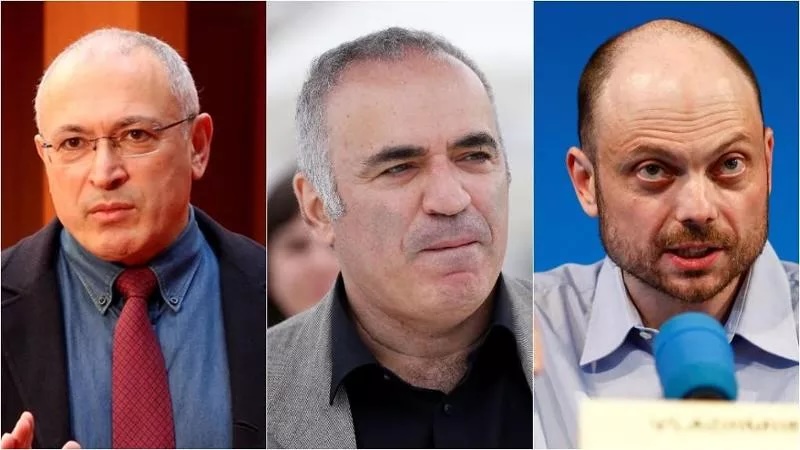
The Russian Opposition in Exile

This isn’t a show of unity but a photo montage from La Stampa: (left to right) Mikhail Khodorkovsky, Garry Kasparov, and Vladimir Kara-Murza all lay claim to leadership of the Russian opposition in exile and the Russian antiwar movement.

Vladimir Kara-Murza has resigned from the [Russian] Antiwar Committee after Garry Kasparov’s offensive outburst in Paris.

I was there when it happened.

What happened, exactly?

At a dinner before a morning meeting with the leadership of the Parliamentary Assembly of the Council of Europe (PACE), Kasparov adopted a mobsterish tone with Kara-Murza, demanding to know why he would not sign the Berlin Declaration. Kara-Murza tried to respond constructively, explaining that he had been in prison when the Berlin Declaration was drafted.

“Aren’t you ashamed to say that you only served two years in prison, when there is a man here who served ten years?” Kasparov said, (referring to [Mikhail] Khodorkovsky. — A.G.).

To which the retort was: “Are you speaking as someone who fled Russia in 2013? As far as we know, you have served five days in jail in your entire life.”

At that point, Garry Kimovich lost it and started yelling that all true militants against Putin’s regime had left [Russia] and were fighting for Ukraine, rather than serving time in prisons.

“Why aren’t you fighting for Ukraine yourself, instead of serving time in a restaurant in Paris?” I asked.

“Why aren’t you fighting?” the chess player blurted out.

“But you’re a man, aren’t you?”

“I’m sixty-two years old!”

***

“You scoundrel!” Kasparov shouted at Kara-Murza. “Who got you out of prison?! I got you out! You’re not signing the Berlin Declaration because you can’t say that Crimea belongs to Ukraine!”

FYI: In 2014, after Kasparov had already emigrated, Kara-Murza declared that Crimea was part of Ukraine during an [anti-war] march in Moscow.

***

But here is the most “brilliant” thing the future member of PACE’s Russian platform said:

“Kara-Murza has a British passport, he swore allegiance to the Queen! But I haven’t sworn allegiance to anyone. I have a Croatian passport… just for traveling.”

He’s a traveler all right.😌

Croatian, my ass.

This was how PACE’s Russian platform was assembled.

Source: Alexandra Garmazhapova (Facebook), 12 December 2025. Translated by the Russian Reader


PACE has decided to create a Platform for Dialogue between the Assembly and Russian democratic forces in exile.

Participants in the platform – whose composition has yet to be decided, based on a set of criteria – would be able to hold two-way exchanges with the Assembly on issues of common concern. They would also be able to attend meetings of selected committees during part-sessions.

Unanimously approving a resolution based on a report by Eerik-Niiles Kross (Estonia, ALDE), the Assembly said participants in the platform would be “persons of the highest moral standing” who, among other conditions, all share Council of Europe values, unconditionally recognise Ukraine’s sovereignty, independence and territorial integrity, and are working towards “regime change” in Russia.

The parliamentarians said the new platform – among other things – would help to strengthen the capacity of Russian democratic forces to “bring about sustainable democratic change in Russia and help achieve a lasting and just peace in Ukraine, alongside ensuring the responsibility of Russian actors for the international crimes committed”.

The Assembly said it honours the commitment of “those Russian human rights defenders, democratic forces, free media, and independent civil society who oppose the totalitarian and neo-imperialistic Russian regime, fight for democracy, human rights and the rule of law, and support Ukraine, sometimes at the risk of their lives and freedom”.

However, unlike Belarusian democratic forces, “Russian democratic forces do not have a single, unified political structure”, the Assembly pointed out. It encouraged Russian groups and initiatives in exile to join forces to advocate for democratic change in Russia, expose the crimes of the Russian regime and support Ukrainians.

Source: “PACE creates a ‘platform for dialogue’ with exiled Russian democratic forces,” Parliamentary Assembly of the Council of Europe, 2 October 2025


On 1 October 2025, the Parliamentary Assembly of the Council of Europe (PACE) adopted a resolution to establish a Platform for Dialogue with Russian Democratic Forces (RDF). The initiative is intended to provide a framework for exchanges on issues of shared interest. The decision has sparked some controversy, which appears likely to grow.  

A “Legitimate Alternative” Without Legitimacy 

According to the report presented by the PACE General Rapporteur on RDF, Eerik-Niiles Kross, the Platform is designed to facilitate the participation of Russian opposition representatives in the Assembly’s activities. Approved candidates will form a delegation, gain access to committee meetings, and be able to address them. Yet the nomination procedure remains vague: Russian opposition groups are expected to reach a “common decision” on who will attend PACE sessions and then submit a candidate list to the President of the Assembly. This process is supposed to be completed by early next year. 

The report describes Russian democratic forces as “a legitimate alternative to Putin’s regime.” However, the basis for such legitimacy remains unclear. Unlike the Belarusian opposition, which can point to Sviatlana Tsikhanouskaya’s electoral mandate from the 2020 presidential race, Russian opposition figures lack any comparable representative legitimacy. Strictly speaking, they represent no one but themselves. 

PACE further specifies which actors it considers part of these “democratic forces”: structures associated with Mikhail Khodorkovsky, Garry Kasparov’s Free Russia Forum, Vladimir Kara-Murza’s Free Russia Foundation, as well as unspecified “representatives of the peoples of Russia.” The Anti-Corruption Foundation (FBK), founded by Alexei Navalny, is also mentioned, but the report explicitly excludes it from the category of democratic forces. The reason given is that the FBK refused to sign the Berlin Declaration, defined by the rapporteur as a conditio sine qua non for cooperation with PACE. In response, FBK representatives reiterated their lack of interest in working with what they called a “talk shop for expressing concerns” and branded the report “rude and vile.” 

Defining Democratic Credentials 

However, it is not only about the FBK. Some influencers and activists who denounce Russia’s crimes in Ukraine refuse to sign the Berlin Declaration, viewing it not as a universal document, but rather as an act of swearing personal allegiance to Mikhail Khodorkovsky and his Anti-War Committee, which drafted it. Even human rights defenders who did sign the Declaration question why it, in particular, has come to serve as the benchmark of democratic credentials. They regard its inclusion among the criteria for assessing the democratic legitimacy of a potential member as “odd,” since the Berlin Declaration represents “a private statement by one particular segment of the Russian opposition.”  

Indeed, it is worth recalling that eight months before the Berlin Declaration, Alexei Navalny’s “15 Points”—a set of principles to which a significant number of Russian political activists still profess commitment—were published. These points outline similar foundations: ending hostilities and withdrawing Russian troops from the occupied territories, compensating Ukraine for the damage caused by the war, condemning imperial policies, committing to a European path of development, as well as dismantling the Putin regime and transforming Russia into a political system that would make the usurpation of power impossible. At the same time, both documents contain elements that appear puzzling. Notably, neither the Berlin Declaration nor Navalny’s 15 Points frames the war in Ukraine as Russia’s war, and both remain silent on the future of captive nations in Russia. 

But even if one sets aside the questions raised by Navalnists as to why the “15 Points” are not adopted as the criterion of democratic legitimacy, how will PACE respond if other Russian opposition groups come up with similar declarations of their own? 

Ukraine: Scepticism and Restrained Acceptance 

Unsurprisingly, initiatives to create platforms involving Russian opposition figures within international organisations are viewed with deep scepticism in Ukraine. Most prominent Russian émigré politicians do not take part in armed resistance against the Putin regime, prefer to shift all responsibility for the invasion onto Putin personally, reject the idea of dismantling the Russian empire, and instead lobby for easing sanctions against “regular Russians.” Increasingly, they blame the west—rather than themselves—for the failure of democratisation in Russia. Nearly four years into the war, the exiled Russian opposition has proven largely irrelevant to Ukraine’s struggle against the invasion. 

These arguments were strongly echoed by members of the Ukrainian delegation during the debate. Seven deputies took the floor. None opposed the resolution outright, but all signalled their distrust of the Russian political figures present in the chamber, stressing that they do not view them as a genuine opposition to Putin. Dialogue, they insisted, should be held only with Russians fighting in the Ukrainian armed forces and with representatives of captive nations. 

Another concern raised was the lack of clarity in the procedure for determining Russian participants. The Ukrainian delegation succeeded in nearly doubling the criteria for candidate selection, but the Assembly rejected amendments that would have formalised Ukraine’s role in approving the list. This gave the impression that there is no genuine consensus within PACE on the establishment of the Platform for Dialogue with the RDF. As a result, some Assembly members began to doubt the wisdom of the initiative, suggesting that consultations with Russian opposition figures remain at the informal level. 

Still, indirect signs suggest that communication between the PACE’s leadership and the Ukrainian delegation had taken place before the resolution was put to a vote. Notably, Ukrainian deputies refrained from openly torpedoing the resolution and instead largely abstained from the vote. Such restraint likely reflected a compromise, which may include the following items. First, the right of Ukraine to nominate representatives of Russian volunteer battalions serving in the Ukrainian armed forces, such as the Russian Volunteer Corps, which has already expressed willingness to join the Platform. Second, a commitment by PACE to establish a separate forum for indigenous peoples and national minorities of Russia, with one-third of seats on the current Platform reserved for them until that forum is created. Third, indirect Ukrainian involvement in controlling the Platform’s activities, possibly through performance indicators such as “feedback from Ukrainian civil society.” 

Risks of Division Within the Platform 

The creation of the Platform seems to carry potential risks for PACE while offering few tangible benefits. One of the key objectives declared by the resolution’s initiators is to foster greater unity among the highly fragmented Russian anti-Putin forces. In practice, however, it may have the opposite effect—further deepening and cementing the existing divisions among Russian diaspora political groups.  

Besides, the inclusion of a diverse array of groups engaged in mutually irreconcilable conflicts raises the question of whether PACE can manage the level of potential tensions within the Platform itself. Frictions are likely to emerge between Russians fighting in the Ukrainian armed forces and well-known dissidents espousing pacifist convictions. Similarly, some Russian émigré politicians—despite condemning imperial policies—still advocate the armed suppression of any hypothetical secession by the North Caucasus. Such a position is unlikely to resonate with representatives of oppressed peoples, who view supporters of continued Russian control over their territories as foes. 

It is also unclear whether PACE has a contingency plan should Ukrainian criticism intensify amid internal conflicts within the Platform. Such a scenario could place the Assembly in a difficult position, straining relations with Ukraine, a country whose citizens are dying daily for their independence and the values that the Council of Europe stands for. Were that to happen, the Platform would be remembered alongside PACE’s scandalous decision to restore the credentials of the Russian delegation in 2019 and the leadership’s attempts to shield its disgraced president, Pedro Agramunt—further damaging the Assembly’s image in Ukraine. 

Defending his resolution proposal during the debate, Eerik-Niiles Kross drew a parallel with the Soviet occupation, noting that the Estonian diaspora played a vital role by representing the idea of an independent Estonia. By analogy, he argued, Russian democratic forces could play a similar role today, potentially producing their own Willy Brandt or Konrad Adenauer. The comparison, however, is not entirely accurate. Estonian émigrés did not enjoy a formal platform within PACE, but they still managed to convey their message effectively and ultimately saw it realised. Besides, the case of Germany clearly shows that it is not the establishment of a dialogue platform in Strasbourg that increases the chances of Russian Brandts and Adenauers emerging, but Ukraine’s victory on the battlefield. So far, there is scant evidence that prominent Russian emigrants have contributed anything of tangible significance to this cause.

Source: Igor Gretskiy, “Why PACE’s New Russian Platform May Backfire,” International Centre for Defence and Security (ICDS), 9 October 2025


Declaration of Russian Democratic Forces

In this darkest hour, we declare our strategic goals – to stop the aggression against Ukraine and create a free, rule of law based, federal Russia. To do this, we consider it necessary to strengthen the coordination of our actions.

We declare our commitment to the following fundamental positions:

  1. The war against Ukraine is criminal. Russian troops must be withdrawn from all occupied territories. The internationally recognized borders of Russia must be restored; war criminals must be brought to justice and the victims of aggression must be compensated.
  2. Putin’s regime is illegitimate and criminal. Therefore, it must be liquidated. We see Russia as a country in which the individual freedoms and rights are guaranteed, in which the usurpation of state power is eliminated.
  3. The implementation of imperial policy within Russia and abroad is unacceptable.
  4. Political prisoners in Russia and prisoners of war must be released, forcibly displaced persons must be allowed to return home, and abducted Ukrainian children must be returned to Ukraine.
  5. We express our solidarity with those Russians who, despite the brutal repressions, have the courage to speak up from anti-Putin and anti-war positions, and with those tens of millions who refuse to participate in the crimes of the Putin’s regime.

The signatories of the Declaration share the values of a democratic society, respectful communication, recognize human rights and freedoms, the principles of diversity and equal rights, rejection of discrimination.

The signatories refrain from public conflicts in the democratic and anti-war movements.

We call on the citizens of Russia to join this Declaration.

We commit to uphold this Declaration until our common strategic goals are achieved.

Berlin, April 30, 2023

Source: “Declaration of Russian Democratic Forces,” Russian Antiwar Committee, 30 April 2023


According to eyewitnesses who spoke to SOTA, the reason for Vladimir Kara-Murza’s departure from the “Anti-War Committee” today was an argument that took place in a restaurant where potential PACE delegation members were seated. The quarrel began with Garry Kasparov accusing Vladimir Kara-Murza of a lack of teamwork.

According to Kasparov, Kara-Murza deliberately brought Yulia Navalnaya and Ilya Yashin to meet the PACE President, bypassing the general meeting—despite neither of them having signed the Berlin Declaration, which implies support for Ukraine. It should be noted that the opposition will receive only 12 seats in PACE, 4 of which are allocated to “decolonizers.”

Alexandra Garmazhapova, who is close to “Free Russia” and heads the “Free Buryatia” foundation created under its protection, omitted the beginning of the conflict with “Free Russia” Vice-President Kara-Murza in her Facebook post.

According to the former journalist, “Kasparov started questioning Kara-Murza in a thuggish tone about why he had not signed the Berlin Declaration. Kara-Murza tried to respond constructively that he was in prison when work on the Berlin Declaration was underway.”

Meanwhile, Kara-Murza himself stated on X (formerly Twitter) today that he and his colleagues from “Free Russia” were allegedly ready to sign the declaration but did not explain why they have not done so yet.

Back in October, Kara-Murza had virtually refused to sign the declaration: “When the criterion for participation in the Russian democratic platform at PACE is signing a document that a significant number of people associate only with one specific political group—that, in my opinion, is a completely clear element of political manipulation, and it is strange, to say the least. Many colleagues feel the same way, including those who were here in Strasbourg last week at the PACE plenary session.”

The “political group” he referred to is the “Anti-War Committee,” which Kara-Murza only left today under the pretense of a conflict with Kasparov, who is only one of its participants.

Garmazhapova further reported that Kasparov accused Kara-Murza of having “only served two years” in prison, unlike Mikhail Khodorkovsky. Garmazhapova then intervened in the conflict on the side of her “Free Russia” colleague, asking why 62-year-old Kasparov is not on the front line but demands it of others.

It should be noted that Natalia Arno—head of “Free Russia”—and Ilya Yashin, who conducts his world tours with funds from this foundation, also joined the public conflict.

Arno stated that “G. Kasparov allowed monstrous insults directed at my colleague Vladimir Kara-Murza,” called it “dirty methods,” called Kara-Murza a hero, and Kasparov someone who fled Russia in 2013. Arno herself emigrated in 2012.

Ilya Yashin, on X, urged Kara-Murza to believe that “he is there for him.”

Thus, the conflict for leadership in PACE between Khodorkovsky and Kara-Murza, as Arno’s protégé, which SOTA previously wrote about, became public today: Kara-Murza’s self-removal from the “Anti-War Committee,” despite the formal conflict with Kasparov—who is only one of its members—only highlighted the brewing contradictions and “intrigues” that Kasparov had mentioned.
Source: “‘Free Russia’ vs. ‘Anti-War Committee’: What Happened Between Kasparov and Kara-Murza,” Sota News (X), 12 December 2025

Social Parasites

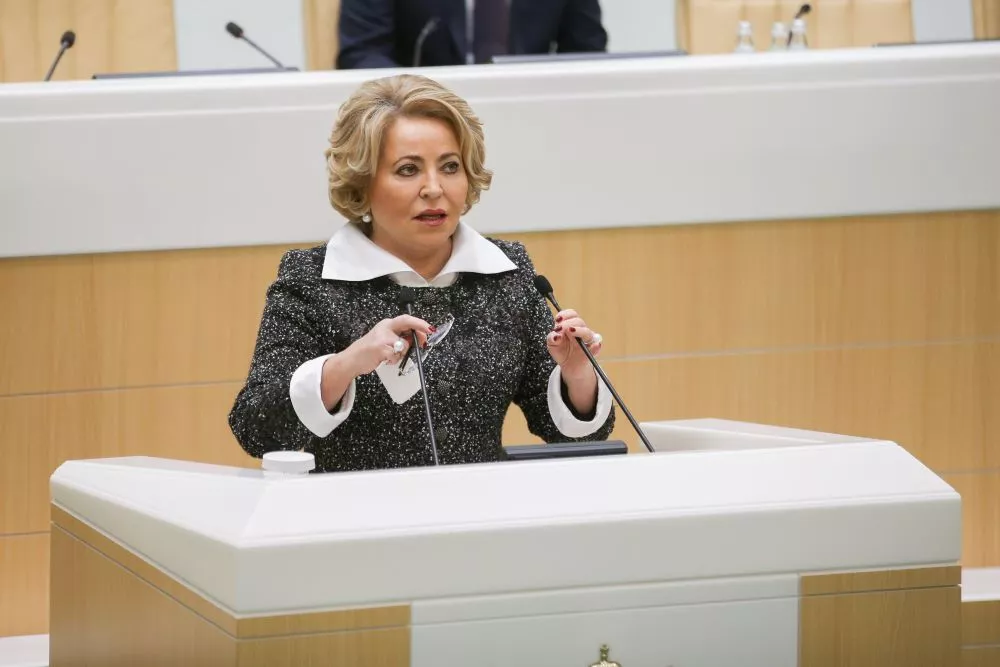
Federation Council Speaker Valentina Matviyenko has promised that the Soviet-era law criminalizing “social parasitism” would not be revived.

And yet, the politician argues that certain categories of unemployed people should at least make contributions to the compulsory medical insurance system. The Federation Council speaker spoke about this in an interview with Moskovsky Komsomolets:

I am talking about those unemployed people who drive Mercedes, have considerable hidden incomes, and yet do not pay taxes or make contributions to the compulsory medical insurance system. Or those, for example, who let their flats in downtown Moscow for 200,000 rubles a month [approx. 2,200 euros], but “on paper” claim that they rent it out for 10,000 rubles a month [approx. 110 euros]…. The tax service should identify such unscrupulous citizens and flush them out of the shadow economy and shadow incomes…. Workers, teachers, and doctors should not have to pay for young, healthy people who are under no obligation to society.

According to Matviyenko, forcing such citizens to be involved in the compulsory medical insurance system is fair because it is impossible to live in society and be free from it. She noted that teachers, doctors, workers, and others should not have to pay for healthy citizens without fixed employment.

This is not the first time Matviyenko has voiced the idea of collecting health insurance contributions from the unemployed: she has said that paying 45,000 rubles a year [approx. 500 euros] is quite affordable.

Surveys show that most Russians oppose a tax on social parasitism.

“Social parasitism” was a criminal offense in the USSR from 1961 to 1991. People who were unemployed without a valid reason could be sentenced to corrective labor, exile, or imprisonment. Citizens engaged in shadow private business were often prosecuted on this charge. The poet Joseph Brodsky was also convicted of “social parasitism.”

Source: Andrei Gorelikov, “Matviyenko: A law on social parasites will not be passed, but social parasites must pay,” Prosto Rabota, 25 November 2025. Translated by the Russian Reader


In 1964, when Joseph Brodsky was 24, he was brought to trial for “social parasitism.” In the view of the state, the young poet was a freeloader. His employment history was spotty at best: he was out of work for six months after losing his first factory job, and then for another four months after returning from a geological expedition. (Being a writer didn’t count as a job, and certainly not if you’d hardly published anything.) In response to the charge, Brodsky leveled a straightforward defense: he’d been thinking about stuff, and writing. But there was a new order to build, and if you weren’t actively contributing to society you were screwing it up.

Over the course of the trial he stated his case repeatedly, insistently, with a guilelessness that annoyed the officials:

BRODSKY: I did work during the intervals. I did just what I am doing now. I wrote poems.
JUDGE: That is, you wrote your so-called poems? What was the purpose of your changing your place of work so often?
BRODSKY: I began working when I was fifteen. I found it all interesting. I changed work because I wanted to learn as much as possible about life and about people.
JUDGE: How were you useful to the motherland?
BRODSKY: I wrote poems. That’s my work. I’m convinced … I believe that what I’ve written will be of use to people not only now, but also to future generations.
A VOICE FROM THE PUBLIC: Listen to that! What an imagination!
ANOTHER VOICE: He’s a poet. He has to think like that.
JUDGE: That is, you think that your so-called poems are of use to people?
BRODSKY: Why do you say my poems are “so-called” poems?
JUDGE: We refer to your poems as “so-called” because we have no other impression of them.

Brodsky and the judge were (to put it mildly) talking past one another: Brodsky felt his calling had a value beyond political expediency, while the judge was tasked with reminding him that the state needn’t subsidize his hobby if he wasn’t going to say anything useful. But the incommensurability of these points of view runs much deeper than this one case.

[…]

Source: Rachel Wiseman, “Switching Off: Joseph Brodsky and the moral responsibility to be useless,” The Point, 23 April 2018

Andrei Khrzhanovsky: Even Tel Aviv Hipsters Can Commit Genocide

Andrei Khrzhanovsky. Source: social media

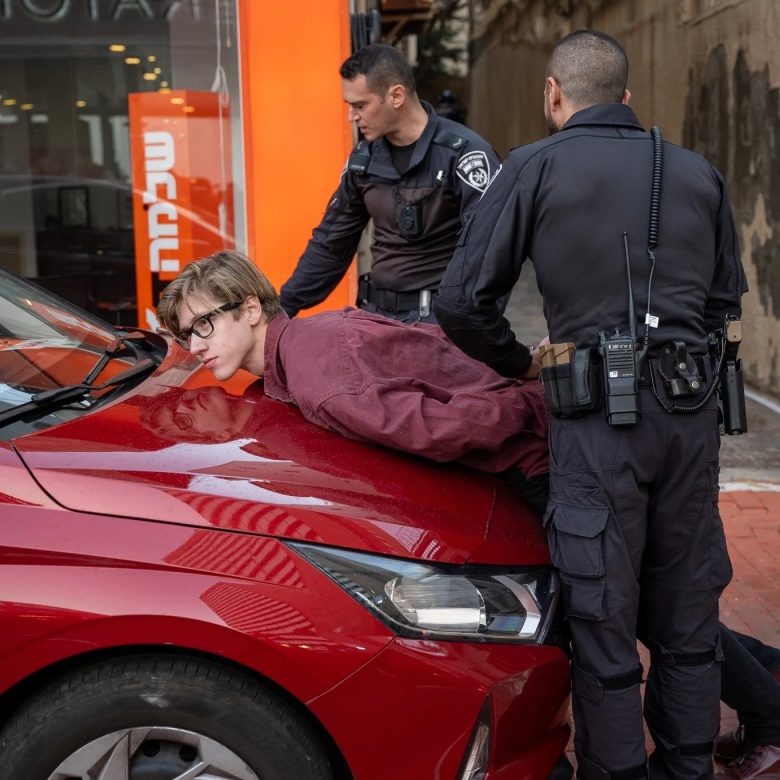
Son of the renowned filmmaker Ilya Khrzhanovsky, anthropology graduate and activist Andrei Khrzhanovsky moved to Israel in 2022. He almost immediately adopted a pro-Palestinian stance in the Middle East conflict, dubbing Israel’s actions genocide, and Zionism an ethnically supremacist idea. He says he is fighting for the rights of Palestinians in the West Bank due to his sense of guilt over the war in Ukraine. He spoke with Marina Berdichevskaya about his radical stance and his conflicts with his family.


Andrei Khrzhanovsky, 26, has been living in Israel since 2022. When Russia launched its full-scale invasion of Ukraine, he found himself in Tel Aviv with his entire family, including his famous father, grandfather, and grandmother. When the time came to fly home, there was nowhere to go. On February 24, Ilya Khrzhanovsky had begun circulating a petition, condemning the invasion of Ukraine, among cultural figures. Andrei flew to Georgia and applied there for Israeli citizenship.

Since March 2022, Andrei X, as he likes to be called, has enthusiastically plunged into the weeds of Israeli life and quite quickly chosen a side: he has taken up activism and, so he claims, journalism, on behalf of “the most vulnerable group on Earth at the moment,” the inhabitants of the West Bank. At the same time, Andrei has been doing battle with “the genocide in Gaza” and on this score has found himself at odds with his father, who has repeatedly said that, in the wake of 7 October 2023, he has felt himself to be Israeli first and foremost.

We talked at length and quite emotionally about how the profoundly erudite Khrzhanovsky, who has a degree in anthropology from the University of London, has decided to atone for the collective guilt of generations for world colonialism. Andrei happily juggles concepts and historical facts and is sure that this is the only way to do things: to always stand up for the downtrodden and to never succumb to propaganda. Whether he himself is suspectible to propaganda is an open question. Ah, yes. The opinions expressed here do not necessarily reflect the views of Republic or its editors—nor should they.

“The closer you are to the empire’s center, the greater the blame”

— Let’s begin with where you live. Your Facebook page says you live in Jericho. Is this true?

— Nowadays, I don’t stay anywhere longer than a few days in a row. I rent a flat, but I won’t divulge its location, because I get several death threats a day. I come home once every month and a half for a couple of days and then I hit the road again. Yesterday, I came from Bethlehem.

—  How do people on the West Bank relate to you? Do they understand that you have an Israel passport?

— I’ve never had any problems with this because this is a political conflict, not an ethnic one. I speak with Palestinians deep in Area A (the West Bank is divided into three areas; Area A, which makes up seventeen percent of the West Bank, is wholly controlled by the Palestinian Authority — Republic) whose relatives have been killed, who have done time in prison. Israel fosters the illusion that all Palestinians want to kill all Jews. But this isn’t an ethnic conflict, and not even a religious one at the end of the day.

— In February of last year you said in an interview, “When the war in Ukraine began, I had an enormous sense of guilt that I hadn’t done more [to stop it]. That’s why I’ve thrown myself into all political activism here.” You explained your activism in terms of not wanting to “squander another country.” Where does such a young man come by a sense of personal guilt for what is happening in and with a country? After all, many Russian nationals, especially the remainers, reject the very principle of collective guilt.


Karèn Shainyan, interview with Andrei Khrzhanovsky and Artyom Nikitin (in Russian, with no subtitles)

Today’s episode of Who Am I After This? is very sensitive for me personally. The conversations with its two subjects, leftists and human rights activists, were the hardest and most emotional in the whole project because they both touch on a very painful personal conflict of loyalties for me. This is the only episode where there are two protagonists at once: journalist Andrei Khrzhanovsky and architect Artyom Nikitin. Quite handsome and young, both moved to Israel after the war in Ukraine began, and both travel to the West Bank to support the local Arab [sic] population, even and especially now, when there is a war in [sic] Israel.

Source: Karen Shainyan (YouTube), 2 February 2024


— Before February 2022 we all lived in a magical reality of sorts: there was a dictatorship in Russia, seemingly, but no one was getting killed, as it were; everything was sluggish, we had to tackle corruption and so on. But there was no sense of the disaster that any dictatorship represents. This illusion personally crumbled for me on 24 February 2022. The disaster started then, and then intensified after the genocide in Gaza began. Over the past few years, the feeling has only grown in me that we are all to blame for what is happening; some more, some less. The closer you are to the empire’s center, the greater the blame.

— And when did you personally start counting down that blame?

— If we speak of the entire timeline, there were three moments. The first was 24 February 2022. The second was an article by Yuval Abraham (an Israeli journalist and co-director of the Oscar-winning film No Other LandRepublic), based on conversations with soldiers fighting in Gaza who admitted that they had been tasked with firing on civilian targets. And the third was the morning when I woke up, opened Instagram, and saw the video of a man in Gaza burning alive after an IDF strike on a hospital.

Andrei Khrzhanovsky. Source: social media

— How did you get involved in political activism in Israel?

— I had an approximate, general notion of what was happening here when I turned up here. I grew up in the Russophone media space after all. But when I arrived I realized that I had to figure out what was happening. I started reading books and talking to people. The more I researched, the more horrified I was. Suddenly, I found out about the status of Palestinians in East Jerusalem: their land was annexed, but they weren’t granted [Israeli] citizenship. To get into the Shuafat refugee camp, which the Israelis annexed and surrounded with a wall, Palestinians have to go through a security checkpoint. The sheer number of different methods for constructing a state based on ethnic supremacy is insane.

Continue reading “Andrei Khrzhanovsky: Even Tel Aviv Hipsters Can Commit Genocide”

Sunday Reader No. 5: American Pie

Jade Bird, “American Pie” (Don McLean cover). Thanks to the amazing Dick Gregory for the heads-up.

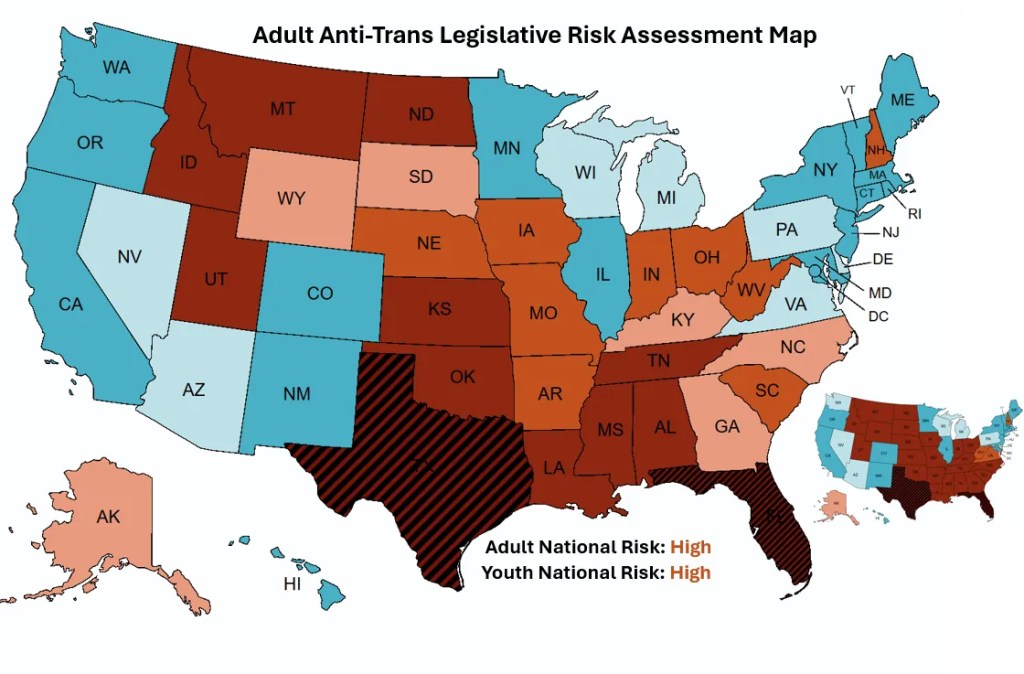
Nearly 3 million Americans identify as transgender, including one in 30 of those aged 13 to 17, according to a new report. But data on the country’s trans community may soon be hard to come by, its authors warned, as the Trump Administration and a number of GOP-led states seek to limit the recognition, and rights, of transgender people.

The UCLA Williams Institute has been publishing reports about transgender Americans since 2011, tracking information such as the race, ethnicity, age, regional location, and mental health of transgender individuals. 

Trans adults and youth make up 1% of Americans aged 13 and older and 3.3% of 13-to 17-year-olds, according to the institute’s Wednesday report. Researchers found that younger adults, those aged 18 to 34, were more likely to identify as transgender than their older counterparts, making up more than 50% of the country’s transgender population.

For its initial 2011 report, the institute relied on just two state-level population surveys. Researchers noted that they have since been able to access broader and higher-quality data through the Centers of Disease Control and Prevention (CDC): To generate the most recent findings, they used data from the CDC 2021-2023 Behavior Risk Factor Surveillance System and 2021 and 2023 Youth Risk Behavior Survey. The report authors noted that the Youth Risk Behavior Survey in particular “currently provides the best available data for our estimates of the size and characteristics of youth who identify as transgender in the U.S.”

But the agency will no longer collect information on transgender people in compliance with President Donald Trump’s Executive Order calling for federal recognition of only two biological sexes. 

Since Trump returned to office in January, information regarding trans people and health resources for LGBTQ+ people has been quietly removed or modified on federal websites. And the Department of Health and Human Services (HHS) has stepped away from its previous practice of supporting gender-affirming-care, in spite of numerous statements from all major medical associations in the U.S., including the American Medical Association and the American Academy of Pediatrics, declaring the care as best practice. In May, HHS called for “exploratory therapy” or psychotherapy to treat individuals with gender dysphoria instead of the medically recommended care.

Multiple states have also sought to restrict access to gender-affirming care, particularly for minors, amid broader global efforts to target such care for trans youth. A June Supreme Court decision upholding a Tennessee state-level ban on gender-affirming-care for youth delivered a heavy blow to the U.S. LGBTQ+ community, permitting similar bans that have been enacted across the country and presenting a significant obstacle to future efforts to challenge restrictions in the courts.

Amid the current political climate, the authors of Wednesday’s Williams Institute report say they are unsure whether survey respondents will accurately respond to questions regarding their gender identity moving forward. In addition to the uncertain future of data on the U.S. transgender population, they wrote, “It is also unclear whether individuals’ willingness to disclose on surveys that they identify as transgender will remain unchanged in the years to come.”  

Despite those looming challenges in gathering information, however, the authors noted it is already clear that younger people are more likely to identify as transgender and they anticipate that to continue being true.

“This has implications for institutions in our society, including educational institutions, the U.S. Armed Forces, civilian workplaces, health care settings, and other areas, regarding how to meet the needs of and provide opportunities for current youth and future generations,” they said.

Source: Solcyré Burga, “1 in 30 U.S. Teens Identifies as Transgender—But That Data May Soon Disappear,” Time, 20 August 2025


Jade Bird, “I’ve Been Everywhere” (Johnny Cash cover)

In the Central Coast, where my father farmed strawberries, the land is mostly flat for miles in every direction so it was easy to spot the green vans and trucks of the Immigration and Naturalization Service heading our way in the distance, kicking up a cloud of dust in their wake. It was the late ‘70s and raids were an occasional part of working in the ag industry.

When the trucks were spotted — most often by a worker — a loud call would go out: “La Migra, la migra.” That’s when immigrant workers without legal status would drop what they were doing and sprint away, either for a nearby riverbed or over a set of raised railroad tracks adjacent to the fields. The immigration raids on my father’s strawberry fields fascinated me when I was a boy. It wasn’t until I was older that I understood the impact on the workers who were rounded up and deported, as well as the effects on the families left behind. I now recall them in a more somber light.

My father worked as a sharecropper in the Central Coast. He oversaw several acres of strawberries and managed up to a dozen workers for Driscoll Inc., the berry company headquartered in my hometown of Watsonville.

From the time I was about 6 or 7 years old until I was 16, I spent my summers and most weekends in the fall in my dad’s strawberry fields. It was backbreaking work. I have the chiropractor invoices to prove it.

Immigration raid methods have changed. The toll they take has not

The ICE raids of the past few months across Southern California reignited my boyhood memories of the strawberry field raids.

What has not changed is the impact on the immigrant families, especially the children. Children of immigrants sustain deep emotional scars from immigration raids.

A study published last month on Psychiatry News said immigrant children or children of mixed-status parents endure serious trauma when their parents are deported.

“Forced family separations, particularly those resulting from immigration enforcement (e.g., detention, deportation), introduce acute psychological risks,” according to the study, which list the results as an “elevated risk of suicidal ideation, externalizing behavior and alcohol use.”

Even living under the threat of having a parent deported is traumatizing to children.

“These fears have been shown to lead to school absenteeism, academic disengagement, and heightened emotional distress,” the study says.

Even as a boy, the fear and desperation were palpable

When I worked in the fields, the raids came about once or twice a summer. I didn’t witness this myself, but the family lore includes the story of a worker who was so desperate to escape the INS that he jumped into a nearby port-a-potty — hiding among the feces and urine in the holding tanks — until the INS agents departed.

Each summer, two or three of my father’s workers would be deported, only to return the following season. That was more common back in the ‘70s than it is today. My dad tried to help his workers without green cards by connecting them with legal aid groups or lawyers so they could straighten out their legal status. Not all of them did and some who had green cards ran at the sight of INS trucks anyway.

In a recent conversation with my younger brother, Peter, he recalled panicking during the first raids he witnessed. He said he asked my older siblings if he should run from the agents, too.

“No, you’re an American. Just shut up,” they told him.

“How do they know that?” my brother asked.

Source: Hugo Martín, “Essential California” newsletter (Los Angeles Times), 22 August 2025


Jade Bird, “Grinnin’ in Your Face” (Son House cover)

[…]

A lost white race of Bible giants—literally bigger, stronger, and whiter than everyone else—fashioned as a symbol of everything conservatives wanted to remake America into, is an all-too-convenient bit of lore for the conspiracy-besotted right. (Never mind that the Nephilim were technically the villains in Genesis!) And the Smithsonian was, if anything, a useful foil for a fringe movement looking for an enemy to accuse of suppressing the truth.

Soon enough, claims that the Smithsonian intentionally hid the bones of Bible giants went mainstream, presaging the country’s own rightward shift. By the 2010s, the Smithsonian’s secret giants appeared in popular paranormal books, on late-night radio shows, in multiple cable TV documentaries (including at least two separate History Channel shows), and across a network of evangelical and far-right media outlets.

Among the most popular of these were the Christian DVDs and later podcasts produced by Steve Quayle and his Nephilim-hunting partner, Timothy Alberino. Quayle, an archconservative, blamed Bible giants for “teaching” men to be gay. He and Alberino were regulars on the right-wing podcast circuit in the 2010s, often appearing with figures like Alex Jones and Jim Bakker so Quayle could hawk their merch, attack Democratic politicians as demonic, and advocate for a targeted genocide of Nephilim-controlled liberals.

Burlinson told Blaze TV that he had been radicalized against the Smithsonian through Alberino’s podcasts and videos. In his podcasts, Alberino has described Bible giants as a “superior race society.”

In recent years, Alberino has made moves to go more mainstream. He has appeared on Ancient Aliens, the History Channel show advocating historical conspiracies, where David Childress is a featured star. That same show also hosted Tucker Carlson, Tennessee Republican Representative Tim Burchett, and others to peddle conspiracies about government cover-ups of space aliens, interdimensional beings, demons, and more.

For the far right, the E.T.s of Ancient Aliens—the same ones Congress is currently hunting in various UFO hearings—are actually angels and demons, and those demons are the souls of the giants who died in the Flood, according to a nonbiblical text Alberino endorses. Burlinson said in 2023 that he thinks UFOs could be angels, and more recently he promised that a congressional UFO hearing to be held on September 9 would feature witnesses who “handled the bodies” of these beings.

Conspiracies about Bible giants are basically the Christian version of UFOs and aliens, and it’s no wonder there is significant cross-pollination between believers in the two camps, even in Congress, where several representatives like Burlinson and Burchett have publicly discussed their belief in both. In fact, both conspiracies give pride of place to the Nephilim narrative from Genesis 6:4 as proof of either fallen angels or alien intervention.

It would be laughable if the Smithsonian conspiracy theory and tales of Bible giants now being spread on Blaze TV, on Joe Rogan’s podcast, and across right-wing media, were not a kind of Trojan horse to soften up the public to accept political propaganda in place of history and complete the assault on America’s museums that failed in the 1990s. But the conspiracists continue to spread their lore, and mainstream conservative politicians continue to escalate their attacks on the Smithsonian—a far-right pincer movement directed at an institution that is both the nation’s premier repository of historical fact and a potent bolsterer of America’s civic fabric. And that is no laughing matter.

Source: Jason Colavito, “The Super-Weird Origins of the Right’s Hatred of the Smithsonian,” New Republic, 21 August 2025


Jade Bird, “Love Has All Been Done Before”

THE BIZARRE TWISTS AND TURNS of Donald Trump’s Ukraine peacemaking project continue: Just three days after the president announced in a triumphant Truth Social post that Vladimir Putin was willing to meet with Volodymyr Zelensky—either one on one or in a trilateral summit with Trump—and to accept an arrangement in which NATO countries would provide postwar security guarantees for Ukraine, the Putin regime has unequivocally shot down both proposals. Russian foreign minister Sergei Lavrov (last seen sporting a “USSR” sweatshirt on his trip to Alaska) has made it clear that there won’t be a meeting with Zelensky until “all the issues” have been resolved—including the question of Zelensky’s legitimacy as president, given that Ukrainian elections have been put on hold on account of the war—and that Russia will not accept the presence of foreign troops, presumably other than its own, on Ukrainian soil.

Trump’s stormy bromance with Putin seems to be off again, too: in social media posts on Thursday, he criticized “crooked and grossly incompetent” Joe Biden for not allowing Ukraine to strike back at Russia and (speciously) compared his chummy-seeming interaction with Putin in Alaska with Richard Nixon’s confrontation with Nikita Khrushchev in Moscow in 1959.

It’s impossible to tell whether Trump’s social-media posturing will translate into action. There is still no word, for instance, on whether the administration is greenlighting Ukraine’s proposal, unveiled after the Monday White House meeting, for $100 billion in U.S. arms shipments to Ukraine (with the Europeans footing the bill) and an additional $50 billion project for joint U.S.-Ukrainian drone production. Nor is there any word on whether or when new sanctions will kick in.

WHILE THE CIRCUS PLAYS ON in Washington and Moscow, the war on the ground—and in the air—continues in Ukraine, and sometimes in Russia. Ukraine is in an undeniably tough position, though nowhere near the desperate predicament imagined both by haters and by worriers who keep predicting an imminent “collapse” of its defenses. On August 12, just before the Alaska summit, many thought they saw a sign of such collapse in a Russian “breakthrough” not far from the long-contested city of Pokrovsk (Donetsk region), near the former coal-mining town of Dobropillia, where Russian forces managed to make rapid advances past severely undermanned Ukrainian lines, move about nine miles forward, seize three villages (now mostly deserted, though some residents who have not been able to get out still remain there), and cut off a vital supply route for Ukrainian troops. These gains appeared to augur the fall of Pokrovsk itself, a prospect that has been discussed since late last year.

But a few days later, the supposed catastrophic defeat turned into an impressive Ukrainian victory thanks to the quick deployment of new units from the Armed Forces of Ukraine and the National Guard, which retook two of the captured villages as well as four previously occupied settlements and cleared the area of Russian troops, reportedly inflicting significant losses. As for Pokrovsk itself, there have been some clashes inside the city, with incursions by small Russian units; but observers such as expatriate Russian military expert Yuri Fedorov think it’s extremely unlikely that the city will fall before inclement weather forces the Russian offensive to wind down.

It is true that momentum is on Russia’s side, in the sense that only Russia is currently conducting offensive operations. But Russian forces’ progress is snail-paced and intermittent, with the Ukrainians often successful in pushing them back (and using drones to make up for manpower and ammunition shortages). The result, more often than not, is a ghastly tug-of-war over small patches of devastated land—contests in which a “win” may consist of planting a flag in a ghost settlement.

Overall, analysts agree that Russia has no chance of capturing the entirety of the Donetsk region—as it has tried to do since the start of Putin’s covert war in Eastern Ukraine in 2014—anytime in the foreseeable future; doing so would require taking heavily fortified urban areas, and even the most cavalier willingness to sacrifice men may not accomplish that goal without several more years of costly fighting. Hence Russian demands for Ukraine to surrender the remainder of the region without a fight.

Ukraine also continues to score successes in its aerial war on strategic Russian targets such as oil refineries, arms and ammunition depots and factories, and trains carrying weapons and fuel to the frontlines. (Russian troops aren’t the only ones feeling the effects: there are reported miles-long lineups for gasoline in parts of Russia.) And, Western arms deliveries aside, Ukraine is making strides in developing its own weaponry, like the new Flamingo long-range cruise missile capable of hitting targets more than 1,800 miles away; Zelensky has said that it could be mass-produced by February.

In other words: Ukraine is still not losing. But there is no question that it is exhausted—and that the enemy’s continuing terrorism against its civilian population is taking its toll. On Wednesday night, Russia launched one of its heaviest assault waves yet: 574 drones and 40 missiles, with targets located as far away from the frontlines as Lviv and Transcarpathia. Most were intercepted by Ukrainian defenses, but one person was killed and over a dozen wounded.

Was this a deliberate middle finger to Trump over his supposed peace effort? It sure looks like it, especially considering the bombing of an American factory in the Transcarpathian city of Mukachevo—the premises of Flex Ltd., a manufacturer of civilian electronic goods. At the very least, it shows that Russia is not de-escalating. Likewise, it’s unclear whether the incursion of a Russian drone that crashed and burned in a rural area in eastern Poland during the overnight attack on Ukraine was a deliberate provocation, as the Polish government charged. But it certainly doesn’t tell us that Putin wants peace.

He can still be forced into it, however. A scenario in which Ukraine drives Russian troops and occupation forces out of its territory is as impossible as one in which Russia makes major territorial gains in Ukraine; but there may come a point, perhaps soon, when the war’s economic and political burdens for the Putin regime become too heavy. Even with rigged elections and a thoroughly owned population, Putin still cannot afford too much discontent among the Russian middle class—or among the elites. There is a reason he has not undertaken another round of mobilization since 2022. But right now, recruitment is dropping, soldiers recovering from wounds or suffering from serious physical and mental health problems are being forced into combat, and mobilization may be the only way to keep the war going. The war will end when Putin starts to see its costs as too high and the chances of achieving his aims, stated and unstated, as too low.

U.S. policy could be instrumental in making that happen. But for that, the Trump administration would have to commit to a firm and consistent pro-Ukraine policy. For starters, the president’s promises of “very severe consequences” if Putin stands in the way of peace should mean something more than memes and empty talk. (And the vice president shouldn’t keep fawning about the “soft-spoken” Kremlin dictator who “looks out for the interests, as he sees it, of Russia.” Sorry, JD, but you sound like a jackass.)

Yet here we are, with Putin doing everything to sabotage any meaningful peace talks but put up an “I ♥ WAR” neon sign on the Kremlin walls—and what is Trump’s response? Another deadline: this time, he says, we’ll know whether a deal can be made “within two weeks”—famously, Trump’s “placeholder” unit of time. No doubt they’re quaking in their boots in the Kremlin.

Source: Cathy Young, “Putin Tanks Trump’s Supposed Peace Effort,” The Bulwark, 22 August 2025

Photo by the Russian Reader

The Trump administration has quietly rescinded long-standing guidance that directed schools to accommodate students who are learning English, alarming advocates who fear that schools will stop offering assistance if the federal government quits enforcing the laws that require it.

The rescission, confirmed by the Education Department on Tuesday, is one of several moves by the administration to scale back support for approximately 5 million schoolchildren not fluent in English, many of them born in the United States. It is also among the first steps in a broader push by the Trump administration to remove multilingual services from federal agencies across the board, an effort the Justice Department has ramped up in recent weeks.

The moves are an acceleration of President Donald Trump’s March 1 order declaring English the country’s “official language,” and they come as the administration is broadly targeting immigrants through its deportation campaign and other policy changes. The Justice Department sent a memorandum to all federal agencies last month directing them to follow Trump’s executive order, including by rescinding guidance related to rules about English-language learners.

Since March, the Education Department has also laid off nearly all workers in its Office of English Language Acquisition and has asked Congress to terminate funding for the federal program that helps pay for educating English-language learners. Last week, education advocates noticed that the guidance document related to English learning had a new label indicating it was rescinded and remains online “for historical purposes only.”

On Tuesday, Education Department spokeswoman Madi Biedermann said that the guidance for teaching English learners, which was originally set forth in 2015, was rescinded because it “is not in line with Administration policy.” A Justice Department spokesman responded to questions by sending a link to the July memorandum and said he had no comment when asked whether the guidance would be replaced.

For decades, the federal government has held that failing to provide resources for people not proficient in English constitutes discrimination based on national original under Title VI of the Civil Rights Act.

In rescinding the guidance, the Trump administration is signaling that it may stop enforcing the law under that long-standing interpretation. The Education and Justice departments have been responsible for enforcing the law.

In the July memorandum, Attorney General Pam Bondi cited case law that says treating people, including students, who aren’t proficient in English differently does not on its face amount to discrimination based on national origin.

Other guidance related to language access for people using services across the federal government is also being suspended, according to the memo, and the Justice Department will create new guidance by mid-January to “help agencies prioritize English while explaining precisely when and how multilingual assistance remains necessary.” The aim of the effort, Bondi said in a statement published alongside the memo, is to “promote assimilation over division.”

The consequences for school districts were not immediately clear, but advocates worry that rescinding the 2015 guidance could open the door for weaker instruction for English learners and upend decades of direction from the federal government to provide English-language services to students who need them.

“The Department of Education and the Department of Justice are walking away from 55 years of legal understanding and enforcement. I don’t think we can understate how important that is,” said Michael Pillera, an attorney who worked at the Office for Civil Rights for 10 years and now directs the Educational Opportunities Project at the Lawyers Committee for Civil Rights.

Without pressure from the federal government to comply with the law, it is possible that some school districts will drop services, Pillera said, particularly as many districts struggle with financial pressures.

“It’s going to ripple quickly,” he predicted. “Schools were doing this because the Office for Civil Rights told them they had to.”

Many districts will probably not change their services, but rescinding the guidance opens the door, said Leslie Villegas, an education policy analyst at New America, a think tank. Advocates may watch for changes in districts that previously had compliance problems or those that had open cases with the Office for Civil Rights related to English-language instruction, she noted.

“The rescission of this guidance may create the mentality that no one’s watching,” Villegas said.

In recent months, the Justice Department notified at least three school districts — in Boston; Newark; and Worcester, Massachusetts — that the government was releasing them from government monitoring that had been in place to ensure they offered services to English-language learners.

Officials in Worcester said they expected the action even before Trump took office. But in Boston, some parent advocates questioned why the monitoring had ended, the Boston Globe reported.

Supporters of immigration restrictions argued that relieving pressure on schools to provide these services might be helpful, especially given the costs to districts.

“If you devote all these resources to these kids coming in [to school] completely unprepared, inevitably it will diminish the quality of education others are getting,” said Ira Mehlman, spokesman for the Federation for American Immigration Reform.

Todd DuBois, communications director for U.S. English, a group that advocates for English as the official and common language, said some education is needed to help “bridge the gap” for students who do not speak English, but the group is concerned that multilingualism “gets in the way of teaching English literacy earlier in life.”

The requirement to serve English-language learners in school is based on two federal statutes. The first is Title VI of the Civil Rights Act, which bars discrimination based on national origin, among other traits. Alandmark 1974 Supreme Court case, Lau v. Nichols, interpreted this law to include a mandate for English-language services in schools.

The second federal law at issue is the 1974 Equal Educational Opportunities Act, which requires public schools to provide for students who do not speak English. A 1981 case decided in federal appeals court, Castañeda v. Pickard, laid out a test to determine whether schools were properly providing services to English learners in school.

In 2015, the Justice and Education departments published their 40-page guidance document, explaining how schools can properly comply with these laws and avoid potential federal investigations and penalties.

“For a teacher, it was kind of like the Bible,” said Montserrat Garibay, who headed the Office of English Language Acquisition under the Biden administration. “If, in fact, we want our students to learn English, this needs to be in place.”

In her memorandum, Bondi said that in addition to cutting back on multilingual services the administration deems “nonessential,” federal agencies would be tasked with boosting English education and assimilation.

“Instead of providing this office with more capacity and more resources to do exactly what the executive order says — to make sure that everybody speaks English — they are doing the total opposite,” Garibay said.

Mark Krikorian, executive director of the Center for Immigration Studies, which supports immigration enforcement measures, suggested the federal government should not direct how school districts offer services. But he also said that teaching children English is consistent with efforts to make sure people living in the United States speak English.

“I’m all for English-language education. We probably need to do even more of that,” he said. “If you’re going to let people in who don’t speak English, then you want them to be acquiring English as soon as possible.”

Source: Laura Meckler and Justine McDaniel, “Education Department quietly removes rules for teaching English learners,” Washington Post, 20 August 2025

Kirill Medvedev & Oleg Zhuravlev: Russia’s (Post)War Future

“A Russia without profanity. The word mom is sacred! Speak without swearing.” Photo: Igor Stomakhin, Moscow, 2025

What can serve as the basis for new Russian post-war identity? What sort of patriotism can there be in a country which has lived through an aggressive war? Of what should the people of this country be proud? What should they associate themselves with? Republic Weekly presents a programmatic text by the sociologist Oleg Zhuravlev and the poet and activist Kirill Medvedev on how the so-called Russian nation came to 2022 and what its prospects are in 2025.

How can Russia get beyond being either an embryonic nation-state or a vestigial empire? People have been talking about this for three decades now. Does it require years and years of peaceful development? A national idea painstakingly formulated by spin doctors in political science labs? A bourgeois revolution? Or maybe just a small victorious war? The so-called special military operation in Ukraine, which has grown into a global military and political conflict, poses these questions in a new light.

In our view, large-scale social changes are happening inside Russia today, changes which could help shape a new national project.

These changes are not always so easy to spot.

According to the social critique prevalent in the independent media, wartime Russian society is organized roughly as follows. Its freedom-loving segment has been crushed and disoriented, while its loyalist segment is atomized and under the thumb of government propaganda, which preaches xenophobia, imperialism and cynicism. Society is fragmented and polarized, suspended somewhere between apathy and fascism. But these tendencies, which are certainly important — and therefore visible to the naked eye, as well as exaggerated by the liberal discourse — are nevertheless not absolute and probably are not even the most important. Society lives its own life, meaning that different groups within it live their own lives and move in their own directions. When you analyze the trajectories of that movement you get a better sense of the major pathways along which these groups might in the future coalesce into a new nation. 

Despite the official rhetoric about unity during the war years, the regime has not managed to consolidate a nation, but it has laid the groundwork for its formation in the future. This has been significantly aided by the west’s anti-Putin policies and the information war waged by the new Russian emigration’s radical wing, which speaks of the collective guilt of all Russians, of their culture and language. Consequently, the only alternative to Putinism and war has seemed to be the disenfranchisement of all Russianness, and the only alternative to official government patriotism has been the “fall of the empire.” Meanwhile, there have been and continue to exist images of the country and modes of attachment to it which cannot be reduced to either of these two options. 

THE NEW RUSSIAN PATRIOTISM

The idea of a new Russian identity was expressed succinctly by Boris Yeltsin on 22 August 1991, when he said that the attempted coup had targeted “Russia, her multi-ethnic people” and her “stance on democracy and reform.” The new modern Russian identity was supposed to be the result of choosing Europe, overcoming the archetypes of slavery and subjugation, and transcending the legacies of the October Revolution, interpreted as a criminal conspiracy and lumpenproletarian revolt, and of the Soviet nation as a grim community of “executioners and victims.”

Ultimately, though, it was the reforms themselves, along with the trauma of losing a powerful state, that generated Soviet nostalgia and a new version of Stalinism. [Yeltsin’s] shelling of the [Russian Supreme Soviet] in 1993 and the dubious 1996 presidential election, which many initially regarded as a triumph for the liberal project, proved to be its doom.

Despite the fact that advocates of the radical anti-liberal revanche were momentarily defeated and exited the scene, widespread disappointment and depoliticization was a barrier for further democratization through people’s involvement in politics. The story of 1991 spoke clearly about what the new Russians could take pride in: victory over the revanchists, for which they had taken to the streets and sacrificed the lives of three young men. Subsequently, amid the chaos and bloodshed of 1993, two ideological projects of Russian identity took shape which were mostly in competition with each other, splitting civil society in the period that followed.

LIBERALS VS. THE RED-BROWN COALITION

Vladimir Putin was nominated to strengthen the new capitalism and prevent a “Soviet revanche.” But his most successful project, as was quickly revealed, actually lay in the Soviet legacy’s partial rehabilitation. Putin managed to bridge the gap of 1993: he drew in part of the pro-Soviet audience (by using patriotic rhetoric, bringing back the Soviet national anthem, and taking control of the Communist Party) and drove the most intransigent liberals and democrats into the marginal opposition. The grassroots yearning for a revival of statism, which had taken shape in the early 1990s, was gradually incorporated into the mainstream. Many years later, this enabled things that would have been impossible to imagine even during the Brezhnev era, let alone during perestroika: the erecting of monuments to Stalin, the creeping de-rehabilitation of Stalinism’s victims, the normalization of political crackdowns as the state’s defense mechanism, and, consequently, a greater number of political prisoners than during the late-Soviet period.

Today’s ideal Russians, in Putin’s eyes, are those who identify themselves with all of Russian history from Rurik to the present, see that history as one of continuous statehood, and regard the periods of turmoil (the early sixteenth century, post-revolutionary Russia, the 1990s) as instances of outside meddling which should never be repeated.

The ideological struggle over Russia’s image during the Yeltsin and Putin years was thus rooted in the opposition between the liberal narrative (based on Yeltsin’s reforms) and the Stalinist great power narrative. Putinism, which is institutionally rooted in the Yeltsin legacy, acted as a kind of arbiter in the argument between the Shenderovich and Prokhanov factions, but gradually dissolved 1993’s great power Stalinist and White Russian imperial legacy into semi-official rhetoric.

But was this semi-official rhetoric part of the national identities of ordinary Russians? Or were their national identities not so thoroughly ideologized?

Did most of the country’s citizens even have national identities during early Putinism, which deliberately atomized and depoliticized society?  

THE ESCALATION OF NORMALITY

Amid the relative prosperity, socio-economic progress, and apoliticality of the 2000s we see the emergence of a new, rather de-ideologized, “normal” everyday patriotism, involving a decent life, good wages, and an image of the country which made one proud rather than ashamed. Research by the sociologist Carine Clement has shown that this brand of patriotism could be socially critical and emerge from the lower classes (who criticized the authorities for the fact that far from everyone enjoyed good wages), but could also be more loyal to officialdom and come from the middle classes (who believed that the country had on the whole achieved a good standard of living, or had created conditions for those who actually wanted to achieve it).

In any case, early Putinism depoliticized and individualized society, neutralizing the civic conflict between the liberals and the “red-brown coalition,” but one outcome of this ideological neutralization was that it brought into focus something given to citizens by default: their connection to the motherland. This connection is not conceptualized through belonging to one ideological camp or another. It is grasped through one’s sense of the value possessed by a normal, decent life, a life which all the country’s citizens deserve individually and collectively.

This value was politicized after 2011. The Bolotnaya Square protests launched a peculiar mechanism: the escalation of normality. One author of this article recently decided to go back and re-analyze the interviews PS Lab did with people who protested in support of Navalny in 2021. The analysis showed something interesting: the most “radical” protesters, the people most willing to be detained and arrested, who wanted to go all the way and topple Putin, turned out to be the most “normal.” They were middle-class people whose demands were measured and respectable.

They did not dream of building utopias or radically restructuring society, but of a parliamentary republic and combating corruption. Both the Bolotnaya Square and post-Bolotnaya Square democratic movements, including the Navalny supporters, transformed the reasonable demand for a normal, bourgeois, prosperous country into the battle standard of a heroic revolutionary struggle against the Putin regime. Navalnyism, meanwhile, also integrated a measured social critique of inequality into its agenda.

The “normal patriotism” of the lower and middle classes thus became a stake in a fierce political struggle.

The new patriotic pride might have said something like this: “We can expose and vote out corrupt officials, push back against toxic waste dumps and insane development projects, vote in solidarity, and hit the streets to protest for the candidates we support whom Moscow doesn’t like. We have people who look to the west, people who miss the USSR, and people who defended the White House in 1991 and in 1993. We face Putin’s truncheons and paddy wagons together, and together we demand democratic freedoms and social justice.” This was how a civil society made up of Navalny fans, radical communists, and regional movements might have fought together for a “normal” country, how they might have shaped the political project of a vigorous nation pursuing solidarity. They might have done it, but they didn’t have time. They did manage to piss off the Kremlin, though.

In response, the regime launched its own escalation of normality. On the one hand, it responded to the protests with radically conservative counterrevolutionary propaganda and crackdowns. On the other hand, behind the façade of radical conservativism, Putinism erected its own edifice of “normality,” which would prove to be truly durable. Beginning in 2011, the Kremlin appropriated part of the Bolotnaya Square agenda not only in its slogans but also in practice by improving the quality of the bureaucracy, raising living standards, technocratically upgrading public amenities, and advancing technological progress. Sobyanin’s Moscow was the testing ground and façade of a new normalization which involved no democracy at all.

But the real escalation of normality on the Putin regime’s part occurred when the special military operation kicked off in 2022.

WAR, (AB)NORMALITY, AND PATRIOTISM

The war has been something profoundly abnormal for many people. It has meant a break with normal life and with any hopes for a normal country. This is what the war has meant for many people, but not for all of them.

PS Lab’s research has shown that a segment of the Russian populace, the middle-class economic beneficiaries of the new wartime economic policy, argue that Russia is now approaching the image of a normal country, even if they do not support the war. According to them, it is not the war per se but the concomitant economic progress (visible, for example, in the growth of wages and the creation of jobs) and the strengthening of national identity which have finally put paid to the period of crisis and launched a stage of growth.

Their argument goes like this. They do not know the reasons behind the tragic special military operation, which has taken tens of thousands, maybe hundreds of thousands of lives, but in trying to cope with this tragedy, they have strengthened the Russian economy and become more patriotic.

What matters is that the idea of growth is firmly separated, in the minds of such people, from the official “goals and objectives” of the special military operation and its ideological framework. It transpires that heavyweight official patriotism is digested by a significant part of society in a milder form. PS Lab’s respondents claim that they do not support violent methods of resolving foreign policy conflicts and are indifferent to the annexation of new territories, but that it has been a good thing that they have begun to think more about the motherland.

Wartime Putinism has two faces, in other words. On the one hand, we see war, increasing crackdowns, and spasms of neo-imperialist ideology. On the other, Russians are not overly fond of those things. They value other things more, such as economic growth and the strengthening of national identity, which unites the segment of society who feel alienated by the state’s ideological and foreign policy projects. When thinking about their own patriotism, many Russians underscore the fact that it is not defined by imperialist ideology. The country is going through a difficult moment, so would it not be better for Russia to take care of itself, rather than worry about acquiring new lands? This has been a leitmotif in many interviews done by PS Lab.

Economic nationalism in the guise of military Keynesianism and the sense of community experienced by citizens going through trials (in their everyday lives, not in terms of ideology) have thus laid the foundations less for an imperial project, and more for the formation of a “normal” nation-state.

Nor is the issue of democracy off the table: it has been missed not only by the opponents but also by the supporters of the special military operation. We welcome the growth of a sovereign economy, but if Putin strangles civil society and lowers the Iron Curtain, we will be opposed to it, say the quasi-pro-war volunteers. For them, however, Putin remains the only possible guarantor of a “normal” future. Many Russians who want an end to the war and a future life without upheaval have pinned their hopes on the president for years.

This focus on gradually developing and civilizing the country is nothing new. Since the 1990s, part of the intelligentsia and, later, the new middle class, pinned their hopes first on the reforms of the pro-market technocrats, then on the successes of a then-still-liberal Putinism, then on Kudrin’s systemic liberals, then on Sobyanin’s policies, and so on.

Something went wrong, and many of these people are now in exile, but it is quite natural that images of a normal life and a normal country, albeit in radically altered circumstances, continue to excite Russians. Normality can be politicized, however, as it was between 2011 and 2022.

The social movements and the independent opposition which emerged after the Bolotnaya Square uprising have been virtually destroyed by the regime: the last bright flashes of this tradition faded before our eyes at the 2022 anti-war rallies. Nevertheless, the tradition of democratic protest continues. As before the war, the latter can grow from the demand for normalcy.

Moreover, the demand for normalcy can sound particularly radical in wartime.

The hardships of war have given rise to movements such as The Way Home, whose activists, wives of mobilized military personnel, have evolved from human rights loyalism to collective protest as they have demanded a return to normal life. Starting with individual demands for the protection and return of their loved ones from the front, they then arrived at a national agenda of fighting for a “normal” and even “traditional” country in which every family should have the right to a dignified, happy and peaceful life.

After a period of struggle between the two versions of patriotism born in the 1990s, liberal and neo-Soviet, the time for everyday “normal” patriotism has thus dawned. Initially, it existed as a public mood which was not fully articulated, but subsequently we witnessed a mutual escalation of normality on the part of warring protesters and the Kremlin.

The “post-Bolotnaya” opposition, led by Navalny, launched a revolutionary struggle with the regime over the project for a “normal” bourgeois country, attempting to create a broad movement that would reach far beyond the former liberal crowd. In response, the Kremlin unveiled its neo-imperialist militarist project with one hand, while with the other hand it satisfied the public demand for normality on its own after the opposition had been defeated.

TWO SCENARIOS FOR A NORMAL RUSSIA

The above-mentioned contradictions of the Putinist discourse and the complex realities of wartime (and the postwar period?) allow us to imagine two scenarios for society’s growth, the realization of two images of Russian patriotism. In other words, we see two scenarios for a socio-political dynamic which could culminate in the creation of a new nation.

Military Putinism, contrary to its radically imperialist image, has in terms of realpolitik and public sentiment put down certain foundations for the formation of a nation-state in Russia.

If economic growth, redistributive policies, and the strengthening of everyday patriotism continue after the end of the war and captivate the majority or at least a significant segment of society, the project of turning Russia into a nation-state from above will have a chance.

Whether it materializes depends on many unknowns. Will the government be able to maintain economic dynamism after dismantling the wartime economy? Will everyday patriotism turn into a solid ideological edifice? Will the end of the war be followed by a liberalization of political life? (Is this possible at all?) Will the current pro-war and anti-war volunteerism serve as the basis for an industrious, widespread civil society? Will there be a change of elites?

Russia’s transformation into a nation-state under these circumstances would constitute a serious paradox. It would thus emerge not after a lost imperialist war or a war of national liberation, but in the wake of a partly successful war, which evolved from an imperialist war into a nationalist war. What would hold such a society together?

It is easiest to envision an identity based on Russia’s opposition to the west on the basis of geopolitical confrontation or economic and technological competition, especially if a fierce struggle between newly emerging geopolitical blocs lies ahead. This confrontation with the west, which we allegedly have pulled off with dignity (even if we are willing to recognize the special military operation itself as a dubious event), will be accompanied by various practices and emblems of cultural uniqueness.

But will this new nation be capable of producing a powerful culture, as in the nineteenth and twentieth centuries? Or will this future Russia be doomed to cultural and intellectual degradation as presaged by Dugin’s philosophy and pro-war poetry?

There are serious doubts that the grounds listed above would be sufficient for a multi-ethnic and multicultural entity like the Russian Federation to turn into a national community united by an understanding of a common destiny and values. The USSR as a community was based on the complex mix of the new Soviet individual and Russocentrism that took shape in the Stalinist period. The roles of this dynamic duo are currently played by the adjective rossiyskiy, which is a designation of civic membership in a multi-ethnic community, and the similar-sounding adjective russkiy, which is a grab bag of several easily manipulated meanings.

Putin is responsible for regular messages about multi-ethnicism, while numerous actors in the government and the loyalist media are charged with sending signals about Russian ethnicism. In this bizarre system, ethnic Russians, on the one hand, constitute a “single nation” with Belarusians and Ukrainians; on the other hand, they vouchsafe the coexistence of hundreds of other ethnic communities, supposedly united by “traditional values” (and, no matter how you look at it, the most important of these values is the rejection of homosexuality); while, on the third hand, they have a special message for the world either about their own humility, or about the fact that they will soon “fuck everyone over” again.

This complex edifice has been looking less and less persuasive. The zigzags and wobbles of the political top brass — Russia has swerved from alliances with North Korea and China to newfound friendship with the United States; from casting itself as a global hegemon to posing as an aggrieved victim — do nothing to help Russians understand who we are. They have, however, stimulated the growth of local, regional, ethnic narratives and identities which are much more reliable and comfortable. Ethnic brands, music and art projects involving folkloric reconstructions, the vogue for studying the languages of the peoples of the Russian Federation, and the plethora of Telegram channels about ethnic cultures and literatures are all outward signs of the new ethnic revival. Although they do not seem as provocative as the forums of radical decolonizers, they correspond less and less with a vision in which ethnic Russianness is accorded a formative role, while “multi-ethnicity” is relegated to a formal and ceremonial role.

When we draw parallels with the Soviet identity, we should remember that it was based not simply on a set of ideological apparatuses (as the current fans of censored patriotic cinema and literature imagine), but on a universal idea of the future, on the radical Enlightenment project of involving the masses and nations in history (including through “nativization” and the establishment of new territorial entities). The project had many weaknesses from the outset, and it was radically undermined by the deportation of whole ethnic groups and the anti-Semitic campaign (for which the current regime has less and less desire to apologize), but as the British historian Geoffrey Hosking has argued, the fundamental reason for the Soviet Union’s collapse was the lack of civil institutions in which the emerging inter-ethnic solidarity could find expression.

If an ethnic cultural and regional revival really awaits us amid war trauma, confusion, possible economic problems, and the deficit of a common identity, how would Moscow handle it? Would it try to control or guide the process? Or maybe it would focus on loyal nationalists and fundamentalists in a replay of the Chechen scenario? This may turn out to be a prologue to disintegration, or it may serve as the field for establishing new community. The radical democratic opposition, once it has a chance, would simply have to combine local, regional, and ethnic cultural demands with general social and democratic ones.

It is for the sake of this that we must rethink the imperial legacy, the Soviet project with its complex mix of colonialism, federalism and modernization, the way communities have lived together for centuries on this land, sometimes fighting and competing, sometimes suffering from each other and from Moscow, sometimes evolving, and sometimes coming together to fight the central government (as during the Pugachev Rebellion).

This combination of civil struggle and intellectual reflection can not only generate a fresh political counter-agenda but also reanimate the worn-out leitmotifs and narratives of Russian culture.

It can reintroduce the productive tension and contradiction, the universality inherent in a great culture, which the regime, while oppressing and exiling critical voices, has been trying to replace with an emasculated, captive patriotism.

***

We want a quiet private life without upheaval, the life which generations of Russians have dreamed of; we want to be independent, stick to our roots and remain who we are, says one group of our compatriots.

We want to overcome dictatorship, political oppression, inequality, corruption and war; we want to live in a society based on freedom and solidarity, says another group of our compatriots.

Interestingly, both of these scenarios are revolutionary. The first scenario, despite its adoration of technocracy and the petit bourgeois lifestyle, is the result of an anti-democratic revolution from above, during which the authoritarian regime has been transformed from a predominantly technocratic to a counter-revolutionary one and has challenged both the world order and the domestic political order. The abrupt transition to a redistributive military Keynesian macroeconomic policy, which was unthinkable ten years ago, and which fuels the current workaday patriotism, has emerged as part of the war. The war itself has been the decisive event of Putin’s counterrevolution, which, like any counterrevolution, always bears certain revolutionary traits.

But while the first scenario (albeit with a new, rather sinister twist) epitomizes the long-standing dream of a bourgeois life based on comfort and tradition, the second draws on a more grassroots and rebellious vision of social progress and related practices. It hearkens back to the defenders of the Russian White House in 1991 and 1993, the protesters against the monetization of benefits and the Marches of the Dissenters, the radical segment of the Bolotnaya Square movement, and the street movements in support of Navalny and Sergei Furgal. History, including Russian history, knows many such examples of new national communities emerging in radical joint struggles for democracy and justice.

Both scenarios could be generated by the current catastrophic reality, and both are fraught with fresh dangers: the first with the threat of a new descent into fascism, the second with violent civil conflicts. In our opinion, though, it is these two scenarios which shape the field for analyzing, discussing and imagining the country’s future.

Source: Kirill Medvedev and Oleg Zhuravlev, “The Russian nation’s (post)war future,” Republic, 9 March 2025. Translated by the Fabulous AM and the Russian Reader

Playing the Victim: The Schlosberg Controversy

Lev Schlosberg’s lengthy interview with Ksenia Sobchak, released last week, predictably kicks off with a discussion of his condemnation of his former allies. In August of this year, Lev Schlosberg lashed out on Facebook at the emigrant liberals who had welcomed the Ukrainian army’s offensive in the Kursk Region, calling writer Dmitry Bykov, journalist Sergei Parkhomenko, and politician Garry Kasparov comrades in the “someone else’s blood” party. His post sparked a freewheeling discussion, demonstrating once again to both onlookers and participants how far apart they were, even though they are still citizens of the same country. While the outcome of the Russian-Ukrainian military conflict will supposedly be determined by the newly re-elected Donald Trump, the Kremlin has long since won the war on the invisible front.

Caution: Sobchak, “Lev Schlosberg: Why is it important for a politician to stay in Russia?” (in Russian; no subtitles)

It was beyond the strength of the majority to resist the Kremlin’s propaganda. How fortunate for the minority, who had honestly declared before the war that they had no soul, only a paycheck.

Three months later, Schlosberg felt the need to continue the conversation, choosing as his interlocutor Ksenia Sobchak, about whose views on war and peace there can be no two opinions: what Vladimir Putin finds ambiguous also seems ambiguous to the breeding bulls in his herd. But the question is why the veteran democrat Schlosberg decided to hang a huge bell around his neck next to the “foreign agent” disclaimer. Was it vanity or fear? As becomes clear in the first half hour of the high-minded conversation, however, the cause, as always, is run-of-the-mill stupidity. Schlosberg really thinks what he says. It is even sadder to watch his rantings than it is to watch the criminal proceedings against him.

Explaining his stance as a compassionate fellow traveler (which, as we remember, can be summarized in Akhmatova’s famous line about one’s own people, on whose side one should be both in happy times and during the Special Military Operation), Schlosberg recalls Leo Tolstoy’s famous essay “Bethink Yourselves!,” published in 1904 after the outbreak of the Russo-Japanese War. According to Shlosberg, love for a fragile peace distinguishes the authentic Russian writer from the fake one. For this reason, Shlosberg has no hesitation in ejecting Dmitry Bykov from the company of engineers of Russian souls, and, it seems, from the human race altogether. A similar fate befalls the other participants of the Free Russia Forum. Typically, Sobchak, an experienced investigator-slash-provocateur, cajoles Lev Markovich into making public his entire list of traitors to the Motherland (probably to check it against the firing squad list, lest there be an extrajudicial error).

It is worth nothing that all the ideological opponents mentioned by Schlosberg* did not differ much from the great elder from Yasnaya Polyana in their appeals to the silent audience. Since then, however, much water (demagoguery) has flowed under the bridge, along with the lives of millions of people. No wonder that the cardboard humanism of the captive Yabloko Party now looks, if not ridiculous, then simply ugly. Schlosberg and Yavlinsky suggest that we still eat from the fruit of the tree of knowledge, which was chosen as the symbol of their so-called political association. And it seems to have been known for a long time that this fruit is a pure stage prop, a fruit plate from a Moscow Art Theater performance, but its contents continue to rot and to reek, frankly.

“Myth: that Ukraine remains a victim doesn’t fit the historical facts”:
Lev Schlosberg, as featured on Ksenia Sobchak’s YouTube program (via Republic)

We are all victims of this war, Schlosberg claims. Vladimir Putin and Volodymyr Zelensky, the United States and Europe had the same opportunities to prevent the war. “But the mincemeat of history cannot be cranked backwards,” he continues, indulging in inventive parallels, “the cutlet will not turn back into the cow.” Yes, of course, the “Russian World” will never be the same again, but only because thinkers like Schlosberg, as Circe did to Odysseus’s companions, have been turning Russians into ungulates with their pseudo-Christian speeches. It is other people, of course, who have been leading them to the slaughter, but the Yabloko Party, alas, bears a considerable share of the blame.

Dubbing himself “the people,” Schlosberg wants to escort the popular masses on a journey to the end of the night, i.e., he suggests that they wander together until they are blue in the face in the pitch darkness and sprinkle the ashes of their ideals on each other’s heads, even though they should sprinkle “mother earth” on their heads. Schlosberg imagines collective euthanasia as a therapy in which there is no room for hatred. What’s the difference between dying with calls to love one another on your lips and dying while calling for violence? There is a difference, Schlosberg contends. In the first case, our church cemetery will finally become a true “brotherly” [i.e., mass] grave.

Source: Zinaida Pronchenko, “Caution, Schlosberg: how to properly take last communion,” Republic, 11 November 2024. Translated by the Russian Reader


There used to be a Three Hierarchs Street in Kyiv. It was renamed after the October Revolution, of course. In 1919, it was called Victims of the Revolution Street in memory of the Bolsheviks who had been led down it to their executions. The street bore this tragic name until 1955, when someone competent finally showed up at city hall and explained to them how the name was ambiguous. City hall agreed and renamed it Heroes of the Revolution Street. But you can’t fool the people, and so the name “Victims of the Heroes of the Revolution” stuck to the street like glue. Old-timers still referred to it as they had in the old Soviet days. “Can you tell me how to get to the outpatient clinic?” “Go straight down Victims of the Revolution….” In the early 1990s, when the powers that be were getting rid of abominable “Red” place names, the street was given back its old name, Three Hierarchs Street.

I was reminded of this by the recent incident involving Lev Schlosberg, who explained in an interview with Ksenia Sobchak that Ukraine cannot be considered a “victim” [zhertva]. This has happened in the context of the Yabloko Party’s now-familiar cry “Both of you stop immediately!” Here is what Schlosberg said, verbatim:

Ukraine is resisting. State and individuals are victims [zhertva] until the minute, until the second they start resisting. Ukraine started resisting on the morning of February 24 [2022]. It is a resistance supported by dozens of foreign countries with their money, their equipment, their specialists, with everything they have. This had led to the fact that Ukraine has equalized the situation. Today, the military forces — the combined military forces of Ukraine (taking into account the allies, their weapons and their money) and the combined military forces of Russia — are roughly equal. Whoever resists is not a victim [zhertva]. A victim [zhertva] does not resist. A victim [zhertva] allows itself to be killed. The myth that Ukraine is a victim does not fit the historical facts. If Ukraine were a victim, Ukraine would not exist now. It would simply not exist.

Of course, we could go on at length about Shlosberg and the Yabloko applesauce* in his head, but he has gotten enough pushback. He has talked a load of nonsense and still goes on, so God be his judge. “Why do we listen to him? Let’s eat him.” I’m in favor of not listening to anyone at all, since there came a point when everyone started talking in commonplaces. Schlosberg is no exception: his leitmotif is well rehearsed and has long been familiar. But this paragraph about victims and non-victims is peculiar. Not politically peculiar (not at all), but it is quite peculiar as a mirror reflection of illiteracy.

Lev Markovich managed to cram a lot of nonsense into one paragraph, both about equalizing the situation and about western assistance. But that’s not what I have in mind. What I have in mind is the fact that even the well-spoken Schlosberg has no linguistic sense at all, as it turns out. And he’s not alone in having this handicap, although it is not remotely acceptable for him as a politician to have it.

The whole passage about the victim, I think, meant the opposite of what its author was been lambasted. He was rightly lambasted, generally, but he didn’t mean to strip Ukraine of its status as a victim of aggression. “Victim of aggression” and “sacrificial victim” are different things. The concept of the sacrificial victim is as old as sacrifice itself and is widely employed in the Old Testament as an inalienable part of the love for God. The Old Testament is chockablock with sacrifice, beginning with Abraham’s sacrifice of his son Isaac.

It would be odd, of course, to assume that Schlosberg was talking about biblical connotations in his conversation with Sobchak (and it is doubtful the interviewer has ever thoughtfully read the Bible), but it is almost certain that this was the notion of zhertva which he had in mind. A sheep to the slaughter is apparently Lev Markovich’s idea of a textbook victim. The sheep does not resist: that’s a fact. Ukraine has been resisting, and that’s also a fact. From Schlosberg’s point of view, it all makes sense. If he had said that Ukraine was not a victim of aggression, then he would have become a deserving punching bag forever. But he wanted to make a graceful compliment to Ukraine while not deviating from Yabloko Party’s twee “peace and good will to all — just stop shooting!” In the Old Testament sense of the word, Ukraine is truly not a victim: it is a heroic scrapper, a country as hard as nails. But what Schlosberg said was understood as it should have been understood.

A politician should know the value of words and the cost of his linguistic blunders. The Schlosberg incident is such an obvious example of linguistic deafness that it should be included in political rhetoric textbooks — someday, of course, not now. A politician should realize that words addressed to the public are always heard as they are commonly understood, and that few people will use zhertva [“victim”] in the Old Testament sense [of “sacrifice”].

Once upon a time, a rookie journalist was brought on at the newspaper where I worked. His first article was about a theater event that had turned out to be a chummy gathering at which only the in-crowd got the jokes. The article ended with the following sentence: “The result was an event only for those who could get to it through the box office window.” I immediately pictured a man trying to Winnie-the-Pooh his way through a tiny window. When the journalist noticed that I was editing the sentence, he was indignant.“Why?! It’s clear as it is,” he said, “it’s about the people who managed to get their hands on complimentary tickets.” “Yes,” I replied, “it is clear. But not immediately clear, like it should be.” The guy held a grudge against me for a long time, not understanding the point of my objection.

The feeling for language is an innate thing, like a sense of pitch. But if it is weak, it must be trained, just like the sense of pitch. Andrei Mironov, who sang countless songs on screen and on stage, had no ear for music, but he worked until the point of exhaustion, singing the same lines a hundred thousand times until he could hit the notes. Only the people close to him and the directors who worked with him knew that he lacked a sense of pitch.

When I hear an advertisement for “tonal cream” [foundation cream], I am amazed at how one could fail to anticipate that every other person would hear “anal cream.” We can attribute this to a common lack of linguistic pitch, of which there are countless examples. It is essentially a habitual neglect of language, of its purity. “Anal cream” is a harmless example. “Phyto tea for women with hog uterus” [i.e., Orthilia secunda, or wintergreen, whose common name is matka borovaya] is basically harmless, too, just like most of the complete misunderstandings of “how our words will be heard” which we encounter at every turn.

The Schlosberg incident is a quintessential example of the damage which carelessness can do to a public figure. Lev Markovich already has a catastrophically dwindling number of allies, given his inappropriate Leopold the Cat-like appeals and dubious patriotic outbursts. After his latest musings, this number has precipitously plunged. “Alas, they didn’t understand me,” the annoyed Schlosberg must say, playing the victim.

* Although the Yabloko Party‘s name was derived from the surnames of its three founders (Grigory Yavlensky, Yuri Boldyrev, and Vladimir Lukin), the word thus formed, yabloko, means “apple” in Russian. |||TRR

Source: Ekaterina Barabash, “Playing the victim: the Schlosberg incident as a textbook example of linguistic deafness,” Republic, 12 November 2024. Translated by the Russian Reader

Forty Million Daggers

Jimmy Kimmel Live, “Jimmy Kimmel Reacts to Donald Trump Winning the Presidential Election”

Last night we had the choice between a prosecutor and a criminal and we chose the criminal, more than half of the country voted for Donald Trump, it turns out the election wasn’t rigged even though he said it was while people were in line voting, Jimmy’s kids were very upset at the news, Jimmy received a lot of texts from anxious friends and family members, President Biden watched all of the action from the White House and he called Trump today to congratulate him, Kamala Harris also called Donald Trump to concede and she gave a speech at her alma mater Howard University, the voting itself went relatively smoothly despite a number of bomb threats that were sent into heavily democratic precincts, it was a terrible night for so many in America, Jimmy offers some thoughts about how we move forward, Cousin Micki shares something positive, and we head out to Hollywood Blvd to ask people if they voted in the election today (even though it was yesterday).

Source: Jimmy Kimmel Live (YouTube), 6 November 2024


Source: Executive Department, State of California. Thanks to Rebecca Solnit for the heads-up.


Pavement, “Two States” (1992)


Two states
We want two states
North and south
Two, two states

Forty million daggers

Two states
We want two states
There’s no culture
There’s no spies

Forty million daggers

Source: Genius


Natalia Corazza and Raven Cook, “Young Readers’ Reverie,” 2023. Acrylic paint on cement.
Monterey (CA) Public Library. “If you can read this, thank a teacher, a parent, and your local library.”

Source: The Russian Reader

National Unity Day

Monterey, California, 4 November 2024. Photo: The Russian Reader

I’m worried about the left’s demonization of America’s origins and the future of Western civilization, as many conservatives feel that the basic tenets of society as we’ve known it are under attack.

Source: Scott Jennings, “Opinion: Why I’m voting for Donald Trump,” Los Angeles Times, 1 November 2024


Carolina Performing Arts, “Omar the Opera: Behind the Scenes”

Rhiannon Giddens’ opera Omar was presented at Carolina Performing Arts in February 2023. In this video, take a deep dive into the opera’s creation and hear from cast members about their experiences. To learn more, visit: https://southernfuturescpa.org/projects/omar/ Omar was co-commissioned and co-produced by Spoleto Festival USA and Carolina Performing Arts at the University of North Carolina at Chapel Hill. Additional co-commissioners include LA Opera, Boston Lyric Opera, San Francisco Opera, and Lyric Opera of Chicago.

Source: Carolina Performing Arts (YouTube), 2 October 2023


“Video has come out from Bucks County, Pennsylvania showing a ballot counter destroying ballots for Donald Trump and keeping Kamala Harris’s ballots for counting,” an account called “Dan from Ohio” wrote in the comment section of the far-right website Gateway Pundit. “Why hasn’t this man been arrested?”

But Dan is not from Ohio, and the video he mentioned is fake. He is in fact one of hundreds of inauthentic accounts posting in the unmoderated spaces of right-wing news site comment sections as part of a Russian disinformation campaign. These accounts were discovered by researchers at media watchdog NewsGuard, who shared their findings with WIRED.

“NewsGuard identified 194 users that all target the same articles, push the same pro-Russian talking points and disinformation narratives, while masquerading as disgruntled Western citizens,” the report states. The researchers found these fake accounts posting comments in four pro-Trump US publications: the Gateway Pundit, the New York Post, Breitbart, and Fox News. They were also posting similar comments in the Daily Mail, a UK tabloid, and French website Le Figaro.

“FOX News Digital’s comment sections are monitored continuously in real time by the outside company OpenWeb which services multiple media organizations,” a spokesperson for the company tells WIRED. “Comments made by fake personas and professional trolls are removed as soon as issues are brought to our attention by both OpenWeb and the additional internal oversight mechanisms we have in place.”

Breitbart replied to WIRED’s request for comment in Russian: “Пожалуйста, скажите Newsguard, чтобы они пошли на хуй.” In English, this means “please tell Newsguard to go fuck themselves.”

The Gateway Pundit and the New York Post did not respond to a request for comment from WIRED.

“The actors behind this campaign appear to be exploiting a particularly vulnerable part of the media landscape,” McKenzie Sadeghi, the AI and foreign influence editor at NewsGuard, tells WIRED. “Comment sections designed to foster reader engagement lack robust security measures, allowing bad actors to post freely, change identities, and create the illusion of genuine grassroots campaigns rather than orchestrated propaganda.”

The disinformation narratives being pushed by these accounts are linked to Storm-1516, according to Newsguard. Storm-1516 is a Russian disinformation campaign with a history of posting fake videos to push Kremlin talking points to the West that was also connected to the release of deepfake video falsely claiming to show a whistlelbower making allegations of sexual assault against vice presidential candidate and Minnesota governor Tim Walz. (WIRED first reported that the Walz video was part of a campaign by Storm-1516. A day later, the US government confirmed WIRED’s reporting.)

Links to the video were posted by multiple accounts with names like “Disobedient Truth” and “Private Patriot” in the comment section of outlets like Breitbart and the Gateway Pundit.

“More bad news for the Dems: Breaking: Tim Walz’s former student, Matthew Metro, drops a shocking allegation- claims Walz s*xually assaulted him in 1997 while Walz was his teacher at Mankato West High School,” the comments read.

The links posted in the comments came hours before the video was shared on social media platforms like X, where it racked up millions of views.

After the Bucks County video went viral, researchers quickly traced it back to Storm 1516US intelligence agencies then confirmed Russia was behind the fake video.

Russian influence operations have, in the past, made use of comment sections to boost their narratives, including during their campaign to disrupt the 2016 elections. This is the first time this tactic has been reported as part of Russia’s efforts to disrupt the 2024 presidential election.

“Replying in threads is a tactic that can have an impact with very little investment,” Darren Linvill, codirector at Clemson University’s Media Forensics Hub, tells WIRED. “By inserting disinformation into an unrelated conversation it might be seen, even if the account being used has no followers and was just created yesterday. It also doesn’t matter if the account you are using is caught and shut down because you haven’t lost an investment, you can just create another account five minutes later.”

The fake comments, Newsguard found, are also then used in reports from Russian state-backed media outlets to bolster claims about how Western audiences are responding to a particular incident.

After the Trump assassination attempt in July, Tsargrad TV published an article titled “Biden’s Trace in Trump’s Assassination Attempt. Americans Agree with the Kremlin’s Version: ‘Russians Are Right.’” The article outlined how Americans believe that the Biden administration played a part in the shooting, citing “comments to articles in Western media” as evidence.

NewsGuard’s researchers identified 104 articles in Russian state media that cited comments from Western news outlets as evidence to back up their claims between January and August of this year.

“This tactic allows bad actors to reduce the risk of detection and embed propaganda in a subtle, seemingly organic way, blending it into the casual commentary of supposed everyday Western readers,” Sadeghi said. “The repetition of the same claim across multiple formats and contexts can create a sense of familiarity that may lend the narratives an appearance of credibility.”

The network of accounts has also been used to seed other narratives, including one earlier this month where dozens of comments in the New York Post and Breitbart claimed, without evidence, that Ukrainian president Volodmyr Zelensky had used Western military aid to purchase a car that once belonged to Adolf Hitler.

That claim has been spread by the network of inauthentic websites controlled by former Florida cop John Dougan, who now lives in Moscow and runs a network of pro-Kremlin websites. Dougan’s network of websites have previously shared disinformation narratives from Storm-1516.

Source: David Gilbert, “A Russian Disinfo Campaign Is Using Comment Sections to Seed Pro-Trump Conspiracy Theories,” Wired, 1 November 2024. The emphasis is mine. ||| TRR


Carolina Performing Arts, “Omar the Opera: A Scholar’s Perspective”

Learn about Rhiannon Giddens’s opera Omar from the perspective of North Carolina scholars.

Source: Carolina Performing Arts (YouTube), 8 April 2024


This very disturbing story about Russian grassroots lucre in wartime was published on the front page of yesterday’s print edition of the New York Times. I’m quoting it in full here for the benefit of non-subscribers.

On the other hand, as perhaps only I am in a position to know, there is something disturbing about how certain of the sources for this story boldly claim eyewitness-like knowledge of events in the Russians provinces which they couldn’t possibly have witnessed, while also cashing in on the chaos unleashed by Russia’s vicious war against Ukraine, only from the opposite side of the world.

I’m also troubled that PS Lab, which was founded long before the war, is portrayed here as an outgrowth and brainchild of those selfsame academic entrepreneurs at George Washington University. ||| TRR


Expensive new cars and motorcycles crowd the streets. Apartment prices have more than doubled. And once-strapped residents are suddenly seen wearing fur coats and carrying ostentatiously overflowing grocery bags.

That is how one resident of a small, long-impoverished industrial city in Siberia describes her hometown these days. The explanation for the burst in prosperity lies in the isolated cemetery, with rows of Russian flags marking the new graves of soldiers killed in Ukraine, and also downtown, where a billboard lists the scores of local men who went to fight.

“I was stunned by how many,” said the resident, the wife of a middle-aged firefighter who enlisted last summer without telling her beforehand. “Money from the war has clearly affected our city.”

The Kremlin has been showering cash on men who enlist. It wants to avoid an unpopular draft, while also addressing the lack of men with sufficient patriotic zeal to join up. There are large signing bonuses, fat monthly salaries and what Russians call “coffin money,” a substantial payment to the families of the tens of thousands of soldiers killed in battle.

The money is changing the face of countless Russian backwaters like the Siberian city. “The allure of extremely high salaries and other benefits has been a major factor in attracting voluntary recruits, especially from relatively poor regions,” said a report issued this year by the Bank of Finland’s Institute for Emerging Economies.

By improving the standard of living among Russia’s poor, the payments have spurred support for President Vladimir V. Putin and the war, researchers noted, while also changing the perception of fighters from patriots to “soldiers of fortune.”

The names and hometowns of the people living inside Russia who agreed to discuss these war payments are not being published to avoid possible legal problems for speaking publicly about the conflict.

Russia has stopped publishing various economic statistics, leaving only a patchwork of indicators about the effects of the war payments. Some studies have documented the influx, however.

For example, the Bank of Finland researchers found that the number of bank accounts in Russia’s poorer areas surged over the past year. Nationwide data was too uneven to establish a concrete correlation with signing bonuses and enlistment data, the study said, but general estimates of casualties by region coincided with the areas experiencing high growth in bank depositors.

Also, in recent months, recruitment posters across Russia changed noticeably, replacing patriotic themes with financial offers. State TV and advertisements on social media carried the same messages.

“Pride of Russia,” some ads used to say, naming the soldier pictured, or “Homeland Begins with Family,” showing a soldier silhouetted with a mother and child. There were comparisons to heroic feats during The Great Patriotic War, as World War II is known in Russia.

Now, a ruble sign dominates the posters, which display the large sums on offer for signing a military contract. Payments vary by region.

“The people who wanted to join out of patriotic sentiment have mostly already been recruited and died or were wounded,” said Oleg Jouravlev, one of the founders of PS Lab, a group of mainly sociologists organized under the Russia Program at George Washington University to study attitudes toward the war. “There are not many like that left in Russia.”

On July 31, Mr. Putin issued a decree more than doubling the contract signing bonus from the federal government to 400,000 rubles, or more than $4,000, from 195,000 rubles. At least 47 regional governments followed suit after he encouraged them to match the reward, according to a survey by the independent media outlet iStories, with the average signing bonus nationwide quadrupling in the past eight months.

U.S. officials estimate that Russia is recruiting 25,000 to 30,000 new soldiers a month, roughly equal to the number of dead and wounded. As soon as local governments see interest lagging, they jack up the financial incentives, experts say.

This past month, the frontline Belgorod region broke all records with a signing bonus amounting to more than $30,000, well above the previous leader, Moscow, at about $20,000. The lowest bonuses are around $500.

The larger sums constitute a small fortune in many of the less developed towns and villages of Russia — where the average salary is a few hundred dollars per month — especially when combined with a frontline fighter’s monthly salary starting at 210,000 rubles, or about $2,100.

A study of the payments for Re: Russia, an online platform for political and economic analysis, found that the signing bonus equals roughly the average annual per capita income in Russia, and the monthly salary is three times the average wage. Rural wages are significantly lower than those in big cities.

“The money is a social elevator for those who went to war,” said Ayan, a resident of Buryatia, a Siberian region with a considerable proportion of people living below the poverty line and high levels of personal debt.

Coffin money payments amount to almost $150,000 per family, enough to buy an apartment in all but the most expensive Russian cities. While an apartment is often the main goal, recipients say they buy all kinds of things, including new teeth, breast implants and vacations.

The war payments are especially attractive to impoverished, middle-aged men who see them as their last chance to escape a lifetime of debt, said Ivan Grek, the director of the Russian Program at George Washington University. Beyond that, people getting the money are eating in restaurants, and buying cars, electronics, clothes and property.

Government statistics from early 2024 show a 74 percent growth in ordinary Russians across the country purchasing cars compared with the same time period last year, Mr. Grek noted, while those paying off consumer debts jumped to 21 percent, up from about 9 percent before the war.

“There is the spirit of a party out there,” he said, even if the source of the money limits the euphoria. His program recently sent three researchers to live for a month in small Russian communities to gauge perceptions of the war. “Now they have a car, they can drink and eat, it is a whole new life for them,” he said.

Artem, a soldier who fled Russia, estimated that 60 percent of the men in his unit signed up because they had unpaid loans. “Almost all of them had problems with alcohol and debt,” he said.

Some experts question whether the spiraling payouts are sustainable and expect that the draw, like patriotism, will eventually fade. Overall, war payments to Russian soldiers — whether for signing, injury or death — will amount to at least 7.5 percent of federal spending for the year, according to Re: Russia.

The sister of a dead officer from Makhachkala said that while he was alive he kept telling her that the death payment would take care of her, their mother and his daughter: “‘Buy an apartment,’ he said, and I told him, ‘You are a moron! Don’t even say such things.’”

Despite the shattering grief after his death, the sister said, the money makes it feel as if her brother is watching over them posthumously. “He did everything he wanted for us,” she said.

The money often has a trickledown effect. A resident of North Ossetia said that a couple of years ago his local plumber had applied to emigrate due to the lack of work. But recently, he said, the plumber told him, “I’ve never had so much work in my life,” with war widows buying new apartments or refurbishing old ones.

The firefighter from Siberia, aged 46, had gone heavily into debt over failed foreign exchange trades, according to his son. After losing several fingers in an industrial accident, he had burned through a $25,000 settlement and a considerable chunk of his disability pension. The father sold the family car to raise money, but ultimately the man filed for bankruptcy before enlisting.

A few days after the first interview for this article, the firefighter’s wife, who had not heard from him in a month, received a military report saying that he had been shot in the chest and killed on July 30, just four days after he deployed in Ukraine. Two younger soldiers trying to rescue him also died, but no bodies have been recovered.

“You are signing your death warrant,” his son said of his father’s decision to enlist. “It was a foolish decision to abandon my mother and my sister and cause everyone so much pain. Money is irrelevant in this situation.”

Source: Neil MacFarquhar and Milena Mazaeva, “Russia Showers Cash on Men Enlisting in Ukraine War, Bringing Prosperity to Some Towns,” New York Times, 2 November 2024. The emphasis is mine. ||| TRR


News from Ukraine Bulletin no. 120 (4 November 2024)

DOWNLOAD THE BULLETIN AS A PDF HERE

In this week’s bulletin: An Arab-Ukrainian perspective/ A Lithuanian view on Russian aggression/Evidence of Russian war crimes/ persecution of Crimean Tatars/ forced abductionsmiscarriages of justiceCultural genocide in Kharkiv/ UN report on torture as a war crime.

News from the territories occupied by Russia:  

Reporters without Borders demand Russia ends torment of Crimean Tatar journalist sentenced to 14 years for defending human rights (Kharkiv Human Rights Protection Group, 1 November)

Russian FSB abduct Ukrainian from her mother’s funeral in occupied Crimea (Kharkiv Human Rights Protection Group, 31 October)

Ukrainian POW sentenced to 18 years as Russia mass produces legally nonsensical ‘terrorism trials’ (Kharkiv Human Rights Protection Group, 30 October)

Horrific sentences where any Ukrainian will do in Russian-occupied Crimea (Kharkiv Human Rights Protection Group, 29 October)

Russia secretly buries the bodies of the Ukrainian teenagers it murdered in occupied Berdiansk (Kharkiv Human Rights Protection Group, 28 October)

The situation at the front:

Russia deploys 7,000 North Korean soldiers to areas bordering Ukraine (Ukrainska Pravda, 2 November)

Russia’s cultural genocide in Kharkiv (Ukraine Solidarity Campaign, 29 October)

News from Ukraine – general: 

Over 1,700 children missing due to war in Ukraine – Interior Ministry (Ukrainska Pravda, 29 October)

ZMINA took part in the presentation of the Shadow Report to the European Commission’s report on Ukraine (Zmina, October 29th)

Humanitarian deminers’ union join independent union confederation (Confederation of Free Trade Unions, 28 October)

Absence of extrajudicial procedure hinders access to Ukrainian documents for TOT residents – Alena Lunova (Zmina, 26 October)

Ukraine: Love+War, a Review (Turning Point, 16 October)

War-related news from Russia:

Verkhneuralsk political prison (Solidarity Zone, 2 November)

“For 72 days I was electrocuted, beaten, not allowed to eat or sleep”: how Russian convicts are driven to “meat-grinder assaults” (The Insider, 31 October)

The story of Roman Nasryev and Alexei Nuriev (Solidarity Zone, 31 October)

Special Demographic Operation: how Russian authorities are restricting women’s reproductive rights (Posle.Media, 30 October)

“Human safaris” and havoc on the “home front”: How Russian soldiers kill Ukrainian civilians, fellow Russians — and even each other (The Insider, 30 October)

Analysis and comment:

Serhii Guz: civil society and labour in Ukraine in the third winter of all-out war (Ukraine Information Group, 3 November)

Hanna Perekhoda: ‘Russian political elites are openly promoting a global project’ (Links, 1 November)

In the Shadow of Empires: From a ‘Hezbollah Stronghold’ to ‘Denazified’ Ukraine, the Experience of an Arab-Ukrainian (Turning Point, 30 October)

New Law Raises Religious Freedom Concerns (Human Rights Watch, 30 October)

Lithuania: ‘for us, the fear of being occupied is more real’ (People & Nature, 29 October)

Research of human rights abuses:

Finland to try Russian neo-Nazi Rusich mercenary for war crimes in Ukraine (Kharkiv Human Rights Protection Group, 1 November)

Torture by Russian authorities amounts to crimes against humanity, says UN Commission of Inquiry (UNHCR, 29 October)

Ukrainian POWs tortured for ‘confessions’ to Russia’s war crimes and for show trials (Kharkiv Human Rights Protection Group, October 28th)

International solidarity:

We have completed fundraisers for €7680 (Solidarity Zone, 2 November)

Fundraiser for scary drones (Solidarity Collectives, 30 October)

Upcoming events:

Thursday, 7 November, 19.00. On Zoom. Emergency Forum on the US presidential election with Tanya Vyhovsky (Vermont State Senator), Bohdan Ferens (SD Platform Ukraine) and Alex Sobel MP. Ukraine Solidarity Campaign.Information and registration here.

Monday, 18 November, 18.00. “Political prisoners in Russia and the Occupied Territories of Ukraine”.  Panel discussion with speakers from Memorial, Kharkhiv Human Rights Protection Group and others. Queen Mary University, London, Centre for Eurasian, Russian and East European Studies. This is a hybrid event with in-person and on-line attendance. Register on eventbrite here


This bulletin is put together by labour movement activists in solidarity with Ukrainian resistance. To receive it by email each Monday, email us at 2022ukrainesolidarity@gmail.com. To stop the bulletin, reply with the word “STOP” in the subject field. More information at https://ukraine-solidarity.org/. We are also on XFacebook and Substack, and the bulletin is stored online here.

Source: Ukraine Information Group


John Oliver’s compelling but soberly made case for voting for Kamala Harris was pointed out to me by my fellow exile from fascist Russia, Mark Teeter. ||| TRR


Expo of war materiel captured in SMO opens in Petersburg on National Unity Day; visitors handed volunteer army service recruiting brochures

Visitors to the Russia Is My History Park were shown equipment from the Kharkiv and Sumy fronts, including an American Abrams tank and a Bradley IFV. The city hall media outlet Petersburg Diary reports that the exhibition was organized at the behest of Governor Alexander Beglov.

Beglov himself attended the opening. In his speech, Beglov said that, in the SMO [special military operation], the enemy’s vehicles “burn just like they burned during the Great Patriotic War.”

“Only three of the twenty-two ‘death machines’ [on display] are Ukrainian-made. All the rest were made in America, Canada, Europe and even by our neighbors in Finland, who basically have always lived at our expense,” Fontanka quotes the head of the city as saying.

Fontanka reports that there were so many visitors in the park that it was difficult to get close to the [captured] equipment. Those who came to the expo were handed propaganda booklets about volunteering for the army. Volunteers who are sent to the SMO zone are now promised 2.1 million rubles [approx. 19,500 euros] in a lump sum and 210 thousand rubles [approx. 1,950 euros] monthly.

Source: Rotunda (Telegram), 4 November 2024. Translated by the Russian Reader. The emphasis, above, is Rotunda’s.

The Russian Reader Reads: Erin in the Morning

This is the second in a series of posts in which I showcase some of the newsletters, blogs, Substacks, and websites — all of them produced by hardworking, passionate lone wolves or tiny, perpetually underfunded grassroots collectives — which inspire me to continue making the Russian Reader and inform me about parts of the world and communities about which otherwise I would be utterly clueless.

Erin Reed describes Erin in the Morning as a place to “stay up to date on all of the most important pieces of trans and queer news and legislation for the week. I summarize it all complete with links to source documents. I hope to distill the information that you get from me in other places like @erininthemorn on TikTok and Twitter into a digest so that you can be sure you didn’t miss anything!”

Ms. Reed’s latest post on Erin in the Morning, endorsing Kamala Harris for U.S. president, could not be timelier, of course. More importantly, as a blogger who has chronicled the Putin’s regime ferocious war on Russia’s LGBT community and their rights, I cannot help but be inspired by Ms. Reed’s fierce, fact-driven defense of the transgender community and their rights in the U.S. I hope you’ll consider subscribing to Erin in the Morning and supporting it financially, as I have done. \\\ TRR


As one of America’s leading transgender journalists, I have reported on the wave of anti-transgender legislation sweeping across the United States over the past four years. These laws impact nearly every aspect of our lives: from using restrooms in peace to accessing essential medical care, from seeing our histories taught in schools to expressing our identities through art at Pride parades. I’ve listened to thousands of hours of testimony on these bills. Facing the 2024 election, I can’t stay silent on the dangers a second Trump term would pose to my community. For the long-term safety and dignity of transgender Americans, I believe there is only one viable path forward: electing Kamala Harris this November.

In some of my earliest reporting on anti-trans laws, many Republican elected officials were less fanatical than they are today. For instance, the first bill banning transgender healthcare in Arkansas was vetoed by Republican Governor Asa Hutchinson. In his veto statement, Gov. Hutchinson described the bill as “overbroad and extreme,” noting that it would “create new standards of legislative interference with physicians and parents.” In early 2022, Republican Gov. Spencer Cox vetoed a sports ban, making an impassioned plea: “I want them to live.” Many anti-trans bills failed early on, failing to gather enough Republican votes. Even Republican-nominated justices crossed party lines to side with Democratic-nominated justices, affirming that transgender individuals deserve protection under the constitution.

But soon after, the party began waging a fear campaign, leaving countless people in my community harmed in the process. I watched as one Republican-controlled statehouse after another, spurred on by far-right Freedom Caucus members, voted to enact some of the most draconian laws targeting transgender individuals ever seen. I listened as members of my community were labeled “dangerous,” “an infection,” and even “demons.” Gov. Cox no longer “wanted us to live,” and instead quietly signed the first bathroom ban to cross his desk.

I have seen transgender people forced to flee anti-trans states, seeking new lives in places where they are protected. Some of my earliest work involved families in Texas with transgender children who were targeted by Attorney General Ken Paxton, accused of child abuse simply for supporting their kids. Soon, other states followed with healthcare bans, bathroom bans, and more. I reported on these bills as families begged their state legislators for dignity, only to be ignored. I then helped these families raise funds, and I’m glad to report that many now lead fulfilling lives as valued members of their new communities.

I am keenly aware of which states transgender people are fleeing—and which ones they are fleeing to. Every state enacting extreme anti-trans laws has either a Republican trifecta or a Republican supermajority. Meanwhile, transgender people are finding refuge in states where Democrats have established safe havens. One of those havens is Minnesota, thanks to Governor Tim Walz. I know people whose lives were saved by his actions—people who can now live authentically and freely, without fear of government persecution.

Erin Reed posted the latest edition of this periodically updated map yesterday. It was not included in her endorsement of Ms. Harris, but I’ve inserted it to show what is at stake in the upcoming election.

I have followed this election cycle intently and was among the first to report that transgender people would be a primary target of Trump’s 2024 campaign. In early 2023, Trump released a video outlining a dozen anti-transgender policies he would enact upon taking office, including national bans on trans care for youth, investigations into hormone therapy manufacturers, probes into affirming teachers, and eliminating funding for schools that treat transgender students with dignity and respect. These policies would take the harmful measures I’ve seen in Republican statehouses and nationalize them.

In 2024, it’s clear that the Trump campaign intends to follow through. If you’ve watched any sporting event or turned on the TV in a battleground state, you’ve seen the culmination of this fear campaign against transgender people, now led by Trump himself. Nearly $100 million in anti-trans ads have blanketed the nation, with Trump spending more on these ads than on immigration, housing, and the economy combined. I have seen what other Republican leaders do when they center their focus on my community, and I know the end results are not pretty.

When Kamala Harris was chosen as the Democratic nominee, I watched her closely. While the Biden administration was not flawless on transgender rights—and I often criticized it for these shortcomings—no federal anti-trans laws passed during his presidency. I reported on the defeat of 50 anti-trans and anti-LGBTQ+ policy riders as Republicans threatened to shut down the entire government over transgender issues, and Biden did not back down. His nominees have overturned anti-trans laws and policies. Thanks to Biden, I was able to change my passport, even though my home state of Louisiana doesn’t allow birth certificate changes. I wanted to see if Harris would continue that commitment.

I’m convinced she will. One of Harris’s first moves that reassured me was selecting Gov. Tim Walz as her choice for vice president, fully aware of the Republican attacks against him for making Minnesota a safe haven for those fleeing anti-trans laws in other states. Walz, who campaigned on his record of starting his high school’s first Gay-Straight Alliance decades ago, has consistently been at the forefront of supporting LGBTQIA+ people. He brought that commitment with him to the Governor’s office, where he governed with a focus on making the state welcoming and inclusive for all.

Then in the final weeks of the campaign, she and Tim Walz were asked no less than three times about transgender people in interviews with Fox News, NBC, and Glennon Doyle’s podcast. I was encouraged to see Harris stand on her record of supporting transgender people when questioned. She had ample opportunity to throw us under the bus—as some other Democrats have done this campaign cycle—but she did not.

On Fox News, she criticized Trump for spending $20 million on ads targeting our community. On NBC, echoing her stance on abortion, she emphasized that transgender care is a decision to be made between doctors and patients. Her framework mirrored the approach used by many Democrats—and even some Republicans—to successfully push back against anti-trans bills in dozens of states. Meanwhile, that same week, Walz passionately defended transgender youth, stating that Donald Trump was attempting to “demonize a group of people for being who they are” and pledging that the administration would appoint justices committed to protecting our rights.

With over 1,000 bills introduced in the past three years targeting trans and queer people, undoing the harm they’ve caused will require sustained and strategic effort. The path forward depends on nominating justices who can help reverse these laws, while also protecting our rights in cities and states that offer refuge. For those living in oppressive states where their care, bodily autonomy, and right to exist freely have been threatened, we will continue organizing, supporting each other through mutual aid, and building the foundation to dismantle these discriminatory laws for good. The future rights of transgender people depend on electing Harris, uplifting Walz’s leadership, and securing the justices their administration will appoint.

If Trump wins a second term, we could be bound by his justices for an entire generation. Many transgender adults may never see the day when his court no longer controls our right to exist peacefully in public. Project 2025 could become a national reality, turning the same hateful bills and rhetoric shaping statehouses across the country into federal law. Schools could be defunded for allowing transgender youth to use restrooms in peace, and our very existence could be labeled obscene. There may be no return from the harm he intends to inflict on our community.

Transgender people are in a fight for our lives, and we are a powerful voting force, with millions of us across the United States. In an election that could come down to a few thousand votes in key swing states, we have the numbers to make a difference. In states like Georgia and Arizona, the transgender population is four times the size of the previous vote margins. We cannot afford complacency this election cycle. There is a path forward from the harm inflicted by Republican policies championed by Trump—a path that depends on us showing up and casting our votes for Kamala Harris.

Source: Erin Reed, “As A Leading Transgender Journalist, Here’s Why I’m Endorsing Kamala Harris,” Erin in the Morning, 29 October 2024

Where the Day Takes You

Video: The Russian Reader


Donald Trump’s rally at Madison Square Garden, billed as a triumphant homecoming, instead turned into a political fiasco on Sunday night as a pro-Trump comedian’s racist diatribe drew furious condemnation, including from prominent Republicans.

The rally, held just more than a week before Election Day, was intended to serve as a platform for Trump to make his closing argument but sparked backlash for racial slurs and vulgarity.

The first speaker of the evening, Tony Hinchcliffe, the host of “Kill Tony” podcast, began the rally with slurs about Latinos and African Americans.

Latinos “love making babies. There’s no pulling out. They come inside, just like they do to our country,” Hinchcliffe said to laughter inside the arena. He added: “There’s literally a floating island of garbage in the middle of the ocean right now. I think it’s called Puerto Rico.”

Hinchcliffe’s racist remarks drew swift rebuke from a pair of congressional Republicans from Florida. GOP Rep. María Salazar wrote on X that she was “disgusted” by his “racist” rhetoric that “does not reflect GOP values.” Sen. Rick Scott denounced the “joke” as “not funny” and “not true.”

[…]

But his derogatory comments and the slew of offensive remarks offered up by the pillars of Trump’s political movement throughout the hours-long program quickly overshadowed the spectacle of the event that drew thousands of MAGA faithful to the heart of Manhattan and was designed to serve as a capstone to the former president’s two-year attempt at a political comeback.

Trump supporter David Rem called Harris the “anti-Christ.” Businessman Grant Cardone claimed Harris has “pimp handlers.” Radio host Sid Rosenberg called Hillary Clinton, Trump’s 2016 rival and a former secretary of state, a “sick son of a bitch” and cast Democrats more broadly as “Jew-haters and lowlives.”

A Trump adviser said the speakers’ remarks weren’t vetted by the campaign.

In his own speech, Trump reprised some of his harshest remarks about immigration, with his calls to weed out “the enemy from within.”

Trump, who has demonized migrants, called for the death penalty for “any migrant who kills an American citizen or a law enforcement officer,” and at one point stopped to show a video about Venezuelan migrants and gang activity in New York.

The crowd responded by chanting: “Send them back.”

[…]

Source: Meridith McGraw and Lisa Kashinsky, “Trump’s New York homecoming sparks backlash over racist and vulgar remarks,” Politico, 27 October 2024


Source: SpanishDictionary.com


Editor’s note: This report has been updated to correct the number of physicians who have called for former President Trump to release his medical records.

Former President Trump joined “Fox & Friends” on Friday for an in-person interview where he told a 6-year-old child the U.S. “won’t have any cows” if Vice President Harris is elected.

In a recorded video, the child asked the Republican candidate about his favorite farm animal.

“I’ll tell you what I love, I love cows, but if we go with Kamala, you won’t have any cows anymore,” the former president responded to the child’s question. “I don’t want to ruin this kid’s day.”

He then called Harris a “radical left lunatic.”

This is not the first time the Republican nominee made this claim about cows. Trump made similar remarks at a North Carolina campaign event in July and during a Nevada rally with Hispanic voters this past Saturday. While speaking to voters, Trump said Democrats wanted to remove windows from buildings and get rid of cows.

“They just come up, they want to do things like no more cows and no windows in buildings. They have some wonderful plans for this country, honestly they’re crazy,” he stated.

In North Carolina, he added that Harris would “outlaw red meat.”

The Harris-Walz team hit back by calling the claims a “delusional rant,” questioning the former president’s mental capacity. After the vice president released a medical report from her doctor, she and 230 physicians asked Trump to do the same. 

The Trump campaign released two letters from doctors who have evaluated the former president’s health and cited his busy schedule as a reason for not releasing his medical history or formal medical report. 

During his “Fox & Friends” appearance, Trump also fielded questions about whether he will include former Republican candidate Nikki Haley in his administration and about his support for school choice.

Source: Ashleigh Fields, “Trump Tells Child There Will Be No Cows Under Harris,” The Hill, 18 October 2024


NASA Administrator Bill Nelson on Friday called for an investigation into a Wall Street Journal report that SpaceX founder and Donald Trump ally Elon Musk and Russian President Vladimir Putin have been in “regular contact” since late 2022.

The report, which said the SpaceX founder has discussed “personal topics, business and geopolitical tensions” with the Russian leader, raises national security concerns as SpaceX’s relationships with NASA and the US military may have granted Musk access to sensitive government information and US intelligence.

“I don’t know that that story is true. I think it should be investigated,” Nelson told Semafor’s Burgess Everett. “If the story is true that there have been multiple conversations between Elon Musk and the president of Russia, then I think that would be concerning, particularly for NASA, for the Department of Defense, for some of the intelligence agencies.”

Some US officials have raised counterintelligence concerns in the last year about Musk’s interactions with US adversaries like Russia, but the US intelligence community is wary of looking into those interactions because Musk is an American citizen, an official familiar with the matter told CNN.

Several White House officials told the Journal they weren’t aware of the contact between Musk and Putin, and the paper said knowledge of the discussions “appears to be a closely held secret in government.” The discussions were confirmed to the Journal by several current and former US, European and Russian officials.

In one instance, the newspaper cited a request from Putin to Musk not to activate his Starlink satellite internet service over Taiwan “as a favor to Chinese leader Xi Jinping.”

Musk did not respond to the Journal’s requests for comment.

National Security Council spokesperson John Kirby said Friday that he had seen the reporting but the White House is “not in a position to corroborate” it and deferred questions to Musk. A Pentagon spokesman told the Journal that the Defense Department does not comment on “any individual’s security clearance, review or status, or about personnel security policy matters in the context of reports about any individual’s actions.”

Kremlin spokesman Dmitry Peskov told the newspaper that Musk and Putin have only had one telephone call in which they discussed “space as well as current and future technologies.”

Since Russia’s invasion of Ukraine in early 2022, Musk’s support for Ukraine — exemplified by SpaceX’s provision of Starlink services — has diminished as his public statements about the conflict have become further aligned with those of Trump, who has said he would negotiate an end to the war quickly. The satellite internet terminals provided by Musk’s company have been a vital source of communication for Ukraine’s military, allowing it to fight and stay connected even as cellular and internet networks have been destroyed.

Dmitri Alperovitch, a Russia and cybersecurity expert, told CNN’s Alex Marquardt Friday on “CNN News Central” that Musk’s Starlink is “essential to Ukraine in particular because they really could not prosecute this war without” its services.

After Musk trumpeted his early support for Ukraine, SpaceX then abruptly asked the Pentagon to pay tens of millions of dollars per month to fund Starlink in Ukraine and take the burden off SpaceX. In response to that reporting, Musk then abruptly announced on Twitter that he had withdrawn the funding request. Around the same time, Musk used a poll on X to suggest a “Ukraine-Russia Peace” plan that included re-doing elections “under UN supervision” in the regions of the country recently annexed illegally by Russia. After Ukrainian President Volodymyr Zelensky questioned Musk’s preference in the war, the tech entrepreneur responded that he “still very much support(s) Ukraine” but feared “massive escalation.”

SpaceX had previously limited its Starlink signal to areas controlled by Ukrainian forces, hampering potential advances that would have relied on Starlink communications. SpaceX then enlarged it to the rest of the country, and earlier this year, Ukraine’s Defence Intelligence claimed it has confirmed the use of Starlink satellite communications by Russian forces in occupied areas. Russia appeared to be buying the terminals from third parties; SpaceX said it did not do business of any kind with the Russian government or its military and that its service would not work in Russia. The statement didn’t address whether it would work in occupied Ukraine.

Ukraine’s claim followed revelations in a biography of Musk, written by Walter Isaacson, about the satellite system’s use in the war. According to an excerpt from the book, Musk did not grant a Ukrainian request to turn on his company’s Starlink satellite communications network near the Crimean coast last year to disrupt a Ukrainian sneak attack on the Russian naval fleet.

Musk’s decision, which left Ukrainian officials begging him to turn the satellites back on, was driven by an acute fear that Russia would respond to a Ukrainian attack on Crimea with nuclear weapons, a fear driven home by Musk’s conversations with senior Russian officials, according to Isaacson.

In October 2022, Musk denied a claim by American political scientist Ian Bremmer that he had spoken with Putin about the war and a proposed “peace plan” to end the conflict.

Musk, who is also the CEO of Tesla and owner of X, has emerged as a major financial figure in this year’s presidential election. He plowed nearly $44 million in October into a super PAC working to restore Trump to the White House — pushing the billionaire’s total donations to the group to nearly $119 million — and he appeared with Trump on the campaign trail earlier this month in Butler, Pennsylvania.

Musk also held his own town halls last week in Pennsylvania, where he urged voters to support Trump and promoted several debunked conspiracy theories about the 2020 election. The two have publicly discussed a potential government role for Musk.

In recent days, Musk also offered splashy, $1 million daily sweepstakes for swing-state voters that has drawn scrutiny from the US Justice Department. Despite a warning from the Justice Department that the payments might be illegal, Musk’s super PAC awarded two $1 million prizes to registered voters in Michigan and Wisconsin on Thursday.

Source: Shania Shelton, “NASA chief calls for investigation into report that Musk and Putin have spoken regularly,” CNN, 25 October 2024


Photo: The Russian Reader