National Unity Day

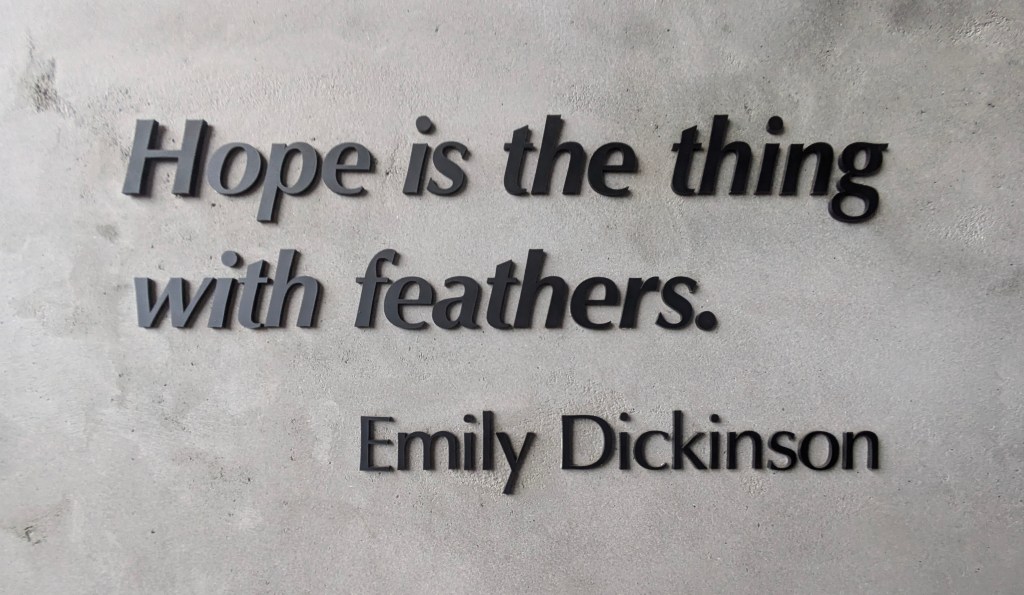
Monterey, California, 4 November 2024. Photo: The Russian Reader

I’m worried about the left’s demonization of America’s origins and the future of Western civilization, as many conservatives feel that the basic tenets of society as we’ve known it are under attack.

Source: Scott Jennings, “Opinion: Why I’m voting for Donald Trump,” Los Angeles Times, 1 November 2024


Carolina Performing Arts, “Omar the Opera: Behind the Scenes”

Rhiannon Giddens’ opera Omar was presented at Carolina Performing Arts in February 2023. In this video, take a deep dive into the opera’s creation and hear from cast members about their experiences. To learn more, visit: https://southernfuturescpa.org/projects/omar/ Omar was co-commissioned and co-produced by Spoleto Festival USA and Carolina Performing Arts at the University of North Carolina at Chapel Hill. Additional co-commissioners include LA Opera, Boston Lyric Opera, San Francisco Opera, and Lyric Opera of Chicago.

Source: Carolina Performing Arts (YouTube), 2 October 2023


“Video has come out from Bucks County, Pennsylvania showing a ballot counter destroying ballots for Donald Trump and keeping Kamala Harris’s ballots for counting,” an account called “Dan from Ohio” wrote in the comment section of the far-right website Gateway Pundit. “Why hasn’t this man been arrested?”

But Dan is not from Ohio, and the video he mentioned is fake. He is in fact one of hundreds of inauthentic accounts posting in the unmoderated spaces of right-wing news site comment sections as part of a Russian disinformation campaign. These accounts were discovered by researchers at media watchdog NewsGuard, who shared their findings with WIRED.

“NewsGuard identified 194 users that all target the same articles, push the same pro-Russian talking points and disinformation narratives, while masquerading as disgruntled Western citizens,” the report states. The researchers found these fake accounts posting comments in four pro-Trump US publications: the Gateway Pundit, the New York Post, Breitbart, and Fox News. They were also posting similar comments in the Daily Mail, a UK tabloid, and French website Le Figaro.

“FOX News Digital’s comment sections are monitored continuously in real time by the outside company OpenWeb which services multiple media organizations,” a spokesperson for the company tells WIRED. “Comments made by fake personas and professional trolls are removed as soon as issues are brought to our attention by both OpenWeb and the additional internal oversight mechanisms we have in place.”

Breitbart replied to WIRED’s request for comment in Russian: “Пожалуйста, скажите Newsguard, чтобы они пошли на хуй.” In English, this means “please tell Newsguard to go fuck themselves.”

The Gateway Pundit and the New York Post did not respond to a request for comment from WIRED.

“The actors behind this campaign appear to be exploiting a particularly vulnerable part of the media landscape,” McKenzie Sadeghi, the AI and foreign influence editor at NewsGuard, tells WIRED. “Comment sections designed to foster reader engagement lack robust security measures, allowing bad actors to post freely, change identities, and create the illusion of genuine grassroots campaigns rather than orchestrated propaganda.”

The disinformation narratives being pushed by these accounts are linked to Storm-1516, according to Newsguard. Storm-1516 is a Russian disinformation campaign with a history of posting fake videos to push Kremlin talking points to the West that was also connected to the release of deepfake video falsely claiming to show a whistlelbower making allegations of sexual assault against vice presidential candidate and Minnesota governor Tim Walz. (WIRED first reported that the Walz video was part of a campaign by Storm-1516. A day later, the US government confirmed WIRED’s reporting.)

Links to the video were posted by multiple accounts with names like “Disobedient Truth” and “Private Patriot” in the comment section of outlets like Breitbart and the Gateway Pundit.

“More bad news for the Dems: Breaking: Tim Walz’s former student, Matthew Metro, drops a shocking allegation- claims Walz s*xually assaulted him in 1997 while Walz was his teacher at Mankato West High School,” the comments read.

The links posted in the comments came hours before the video was shared on social media platforms like X, where it racked up millions of views.

After the Bucks County video went viral, researchers quickly traced it back to Storm 1516US intelligence agencies then confirmed Russia was behind the fake video.

Russian influence operations have, in the past, made use of comment sections to boost their narratives, including during their campaign to disrupt the 2016 elections. This is the first time this tactic has been reported as part of Russia’s efforts to disrupt the 2024 presidential election.

“Replying in threads is a tactic that can have an impact with very little investment,” Darren Linvill, codirector at Clemson University’s Media Forensics Hub, tells WIRED. “By inserting disinformation into an unrelated conversation it might be seen, even if the account being used has no followers and was just created yesterday. It also doesn’t matter if the account you are using is caught and shut down because you haven’t lost an investment, you can just create another account five minutes later.”

The fake comments, Newsguard found, are also then used in reports from Russian state-backed media outlets to bolster claims about how Western audiences are responding to a particular incident.

After the Trump assassination attempt in July, Tsargrad TV published an article titled “Biden’s Trace in Trump’s Assassination Attempt. Americans Agree with the Kremlin’s Version: ‘Russians Are Right.’” The article outlined how Americans believe that the Biden administration played a part in the shooting, citing “comments to articles in Western media” as evidence.

NewsGuard’s researchers identified 104 articles in Russian state media that cited comments from Western news outlets as evidence to back up their claims between January and August of this year.

“This tactic allows bad actors to reduce the risk of detection and embed propaganda in a subtle, seemingly organic way, blending it into the casual commentary of supposed everyday Western readers,” Sadeghi said. “The repetition of the same claim across multiple formats and contexts can create a sense of familiarity that may lend the narratives an appearance of credibility.”

The network of accounts has also been used to seed other narratives, including one earlier this month where dozens of comments in the New York Post and Breitbart claimed, without evidence, that Ukrainian president Volodmyr Zelensky had used Western military aid to purchase a car that once belonged to Adolf Hitler.

That claim has been spread by the network of inauthentic websites controlled by former Florida cop John Dougan, who now lives in Moscow and runs a network of pro-Kremlin websites. Dougan’s network of websites have previously shared disinformation narratives from Storm-1516.

Source: David Gilbert, “A Russian Disinfo Campaign Is Using Comment Sections to Seed Pro-Trump Conspiracy Theories,” Wired, 1 November 2024. The emphasis is mine. ||| TRR


Carolina Performing Arts, “Omar the Opera: A Scholar’s Perspective”

Learn about Rhiannon Giddens’s opera Omar from the perspective of North Carolina scholars.

Source: Carolina Performing Arts (YouTube), 8 April 2024


This very disturbing story about Russian grassroots lucre in wartime was published on the front page of yesterday’s print edition of the New York Times. I’m quoting it in full here for the benefit of non-subscribers.

On the other hand, as perhaps only I am in a position to know, there is something disturbing about how certain of the sources for this story boldly claim eyewitness-like knowledge of events in the Russians provinces which they couldn’t possibly have witnessed, while also cashing in on the chaos unleashed by Russia’s vicious war against Ukraine, only from the opposite side of the world.

I’m also troubled that PS Lab, which was founded long before the war, is portrayed here as an outgrowth and brainchild of those selfsame academic entrepreneurs at George Washington University. ||| TRR


Expensive new cars and motorcycles crowd the streets. Apartment prices have more than doubled. And once-strapped residents are suddenly seen wearing fur coats and carrying ostentatiously overflowing grocery bags.

That is how one resident of a small, long-impoverished industrial city in Siberia describes her hometown these days. The explanation for the burst in prosperity lies in the isolated cemetery, with rows of Russian flags marking the new graves of soldiers killed in Ukraine, and also downtown, where a billboard lists the scores of local men who went to fight.

“I was stunned by how many,” said the resident, the wife of a middle-aged firefighter who enlisted last summer without telling her beforehand. “Money from the war has clearly affected our city.”

The Kremlin has been showering cash on men who enlist. It wants to avoid an unpopular draft, while also addressing the lack of men with sufficient patriotic zeal to join up. There are large signing bonuses, fat monthly salaries and what Russians call “coffin money,” a substantial payment to the families of the tens of thousands of soldiers killed in battle.

The money is changing the face of countless Russian backwaters like the Siberian city. “The allure of extremely high salaries and other benefits has been a major factor in attracting voluntary recruits, especially from relatively poor regions,” said a report issued this year by the Bank of Finland’s Institute for Emerging Economies.

By improving the standard of living among Russia’s poor, the payments have spurred support for President Vladimir V. Putin and the war, researchers noted, while also changing the perception of fighters from patriots to “soldiers of fortune.”

The names and hometowns of the people living inside Russia who agreed to discuss these war payments are not being published to avoid possible legal problems for speaking publicly about the conflict.

Russia has stopped publishing various economic statistics, leaving only a patchwork of indicators about the effects of the war payments. Some studies have documented the influx, however.

For example, the Bank of Finland researchers found that the number of bank accounts in Russia’s poorer areas surged over the past year. Nationwide data was too uneven to establish a concrete correlation with signing bonuses and enlistment data, the study said, but general estimates of casualties by region coincided with the areas experiencing high growth in bank depositors.

Also, in recent months, recruitment posters across Russia changed noticeably, replacing patriotic themes with financial offers. State TV and advertisements on social media carried the same messages.

“Pride of Russia,” some ads used to say, naming the soldier pictured, or “Homeland Begins with Family,” showing a soldier silhouetted with a mother and child. There were comparisons to heroic feats during The Great Patriotic War, as World War II is known in Russia.

Now, a ruble sign dominates the posters, which display the large sums on offer for signing a military contract. Payments vary by region.

“The people who wanted to join out of patriotic sentiment have mostly already been recruited and died or were wounded,” said Oleg Jouravlev, one of the founders of PS Lab, a group of mainly sociologists organized under the Russia Program at George Washington University to study attitudes toward the war. “There are not many like that left in Russia.”

On July 31, Mr. Putin issued a decree more than doubling the contract signing bonus from the federal government to 400,000 rubles, or more than $4,000, from 195,000 rubles. At least 47 regional governments followed suit after he encouraged them to match the reward, according to a survey by the independent media outlet iStories, with the average signing bonus nationwide quadrupling in the past eight months.

U.S. officials estimate that Russia is recruiting 25,000 to 30,000 new soldiers a month, roughly equal to the number of dead and wounded. As soon as local governments see interest lagging, they jack up the financial incentives, experts say.

This past month, the frontline Belgorod region broke all records with a signing bonus amounting to more than $30,000, well above the previous leader, Moscow, at about $20,000. The lowest bonuses are around $500.

The larger sums constitute a small fortune in many of the less developed towns and villages of Russia — where the average salary is a few hundred dollars per month — especially when combined with a frontline fighter’s monthly salary starting at 210,000 rubles, or about $2,100.

A study of the payments for Re: Russia, an online platform for political and economic analysis, found that the signing bonus equals roughly the average annual per capita income in Russia, and the monthly salary is three times the average wage. Rural wages are significantly lower than those in big cities.

“The money is a social elevator for those who went to war,” said Ayan, a resident of Buryatia, a Siberian region with a considerable proportion of people living below the poverty line and high levels of personal debt.

Coffin money payments amount to almost $150,000 per family, enough to buy an apartment in all but the most expensive Russian cities. While an apartment is often the main goal, recipients say they buy all kinds of things, including new teeth, breast implants and vacations.

The war payments are especially attractive to impoverished, middle-aged men who see them as their last chance to escape a lifetime of debt, said Ivan Grek, the director of the Russian Program at George Washington University. Beyond that, people getting the money are eating in restaurants, and buying cars, electronics, clothes and property.

Government statistics from early 2024 show a 74 percent growth in ordinary Russians across the country purchasing cars compared with the same time period last year, Mr. Grek noted, while those paying off consumer debts jumped to 21 percent, up from about 9 percent before the war.

“There is the spirit of a party out there,” he said, even if the source of the money limits the euphoria. His program recently sent three researchers to live for a month in small Russian communities to gauge perceptions of the war. “Now they have a car, they can drink and eat, it is a whole new life for them,” he said.

Artem, a soldier who fled Russia, estimated that 60 percent of the men in his unit signed up because they had unpaid loans. “Almost all of them had problems with alcohol and debt,” he said.

Some experts question whether the spiraling payouts are sustainable and expect that the draw, like patriotism, will eventually fade. Overall, war payments to Russian soldiers — whether for signing, injury or death — will amount to at least 7.5 percent of federal spending for the year, according to Re: Russia.

The sister of a dead officer from Makhachkala said that while he was alive he kept telling her that the death payment would take care of her, their mother and his daughter: “‘Buy an apartment,’ he said, and I told him, ‘You are a moron! Don’t even say such things.’”

Despite the shattering grief after his death, the sister said, the money makes it feel as if her brother is watching over them posthumously. “He did everything he wanted for us,” she said.

The money often has a trickledown effect. A resident of North Ossetia said that a couple of years ago his local plumber had applied to emigrate due to the lack of work. But recently, he said, the plumber told him, “I’ve never had so much work in my life,” with war widows buying new apartments or refurbishing old ones.

The firefighter from Siberia, aged 46, had gone heavily into debt over failed foreign exchange trades, according to his son. After losing several fingers in an industrial accident, he had burned through a $25,000 settlement and a considerable chunk of his disability pension. The father sold the family car to raise money, but ultimately the man filed for bankruptcy before enlisting.

A few days after the first interview for this article, the firefighter’s wife, who had not heard from him in a month, received a military report saying that he had been shot in the chest and killed on July 30, just four days after he deployed in Ukraine. Two younger soldiers trying to rescue him also died, but no bodies have been recovered.

“You are signing your death warrant,” his son said of his father’s decision to enlist. “It was a foolish decision to abandon my mother and my sister and cause everyone so much pain. Money is irrelevant in this situation.”

Source: Neil MacFarquhar and Milena Mazaeva, “Russia Showers Cash on Men Enlisting in Ukraine War, Bringing Prosperity to Some Towns,” New York Times, 2 November 2024. The emphasis is mine. ||| TRR


News from Ukraine Bulletin no. 120 (4 November 2024)

DOWNLOAD THE BULLETIN AS A PDF HERE

In this week’s bulletin: An Arab-Ukrainian perspective/ A Lithuanian view on Russian aggression/Evidence of Russian war crimes/ persecution of Crimean Tatars/ forced abductionsmiscarriages of justiceCultural genocide in Kharkiv/ UN report on torture as a war crime.

News from the territories occupied by Russia:  

Reporters without Borders demand Russia ends torment of Crimean Tatar journalist sentenced to 14 years for defending human rights (Kharkiv Human Rights Protection Group, 1 November)

Russian FSB abduct Ukrainian from her mother’s funeral in occupied Crimea (Kharkiv Human Rights Protection Group, 31 October)

Ukrainian POW sentenced to 18 years as Russia mass produces legally nonsensical ‘terrorism trials’ (Kharkiv Human Rights Protection Group, 30 October)

Horrific sentences where any Ukrainian will do in Russian-occupied Crimea (Kharkiv Human Rights Protection Group, 29 October)

Russia secretly buries the bodies of the Ukrainian teenagers it murdered in occupied Berdiansk (Kharkiv Human Rights Protection Group, 28 October)

The situation at the front:

Russia deploys 7,000 North Korean soldiers to areas bordering Ukraine (Ukrainska Pravda, 2 November)

Russia’s cultural genocide in Kharkiv (Ukraine Solidarity Campaign, 29 October)

News from Ukraine – general: 

Over 1,700 children missing due to war in Ukraine – Interior Ministry (Ukrainska Pravda, 29 October)

ZMINA took part in the presentation of the Shadow Report to the European Commission’s report on Ukraine (Zmina, October 29th)

Humanitarian deminers’ union join independent union confederation (Confederation of Free Trade Unions, 28 October)

Absence of extrajudicial procedure hinders access to Ukrainian documents for TOT residents – Alena Lunova (Zmina, 26 October)

Ukraine: Love+War, a Review (Turning Point, 16 October)

War-related news from Russia:

Verkhneuralsk political prison (Solidarity Zone, 2 November)

“For 72 days I was electrocuted, beaten, not allowed to eat or sleep”: how Russian convicts are driven to “meat-grinder assaults” (The Insider, 31 October)

The story of Roman Nasryev and Alexei Nuriev (Solidarity Zone, 31 October)

Special Demographic Operation: how Russian authorities are restricting women’s reproductive rights (Posle.Media, 30 October)

“Human safaris” and havoc on the “home front”: How Russian soldiers kill Ukrainian civilians, fellow Russians — and even each other (The Insider, 30 October)

Analysis and comment:

Serhii Guz: civil society and labour in Ukraine in the third winter of all-out war (Ukraine Information Group, 3 November)

Hanna Perekhoda: ‘Russian political elites are openly promoting a global project’ (Links, 1 November)

In the Shadow of Empires: From a ‘Hezbollah Stronghold’ to ‘Denazified’ Ukraine, the Experience of an Arab-Ukrainian (Turning Point, 30 October)

New Law Raises Religious Freedom Concerns (Human Rights Watch, 30 October)

Lithuania: ‘for us, the fear of being occupied is more real’ (People & Nature, 29 October)

Research of human rights abuses:

Finland to try Russian neo-Nazi Rusich mercenary for war crimes in Ukraine (Kharkiv Human Rights Protection Group, 1 November)

Torture by Russian authorities amounts to crimes against humanity, says UN Commission of Inquiry (UNHCR, 29 October)

Ukrainian POWs tortured for ‘confessions’ to Russia’s war crimes and for show trials (Kharkiv Human Rights Protection Group, October 28th)

International solidarity:

We have completed fundraisers for €7680 (Solidarity Zone, 2 November)

Fundraiser for scary drones (Solidarity Collectives, 30 October)

Upcoming events:

Thursday, 7 November, 19.00. On Zoom. Emergency Forum on the US presidential election with Tanya Vyhovsky (Vermont State Senator), Bohdan Ferens (SD Platform Ukraine) and Alex Sobel MP. Ukraine Solidarity Campaign.Information and registration here.

Monday, 18 November, 18.00. “Political prisoners in Russia and the Occupied Territories of Ukraine”.  Panel discussion with speakers from Memorial, Kharkhiv Human Rights Protection Group and others. Queen Mary University, London, Centre for Eurasian, Russian and East European Studies. This is a hybrid event with in-person and on-line attendance. Register on eventbrite here


This bulletin is put together by labour movement activists in solidarity with Ukrainian resistance. To receive it by email each Monday, email us at 2022ukrainesolidarity@gmail.com. To stop the bulletin, reply with the word “STOP” in the subject field. More information at https://ukraine-solidarity.org/. We are also on XFacebook and Substack, and the bulletin is stored online here.

Source: Ukraine Information Group


John Oliver’s compelling but soberly made case for voting for Kamala Harris was pointed out to me by my fellow exile from fascist Russia, Mark Teeter. ||| TRR


Expo of war materiel captured in SMO opens in Petersburg on National Unity Day; visitors handed volunteer army service recruiting brochures

Visitors to the Russia Is My History Park were shown equipment from the Kharkiv and Sumy fronts, including an American Abrams tank and a Bradley IFV. The city hall media outlet Petersburg Diary reports that the exhibition was organized at the behest of Governor Alexander Beglov.

Beglov himself attended the opening. In his speech, Beglov said that, in the SMO [special military operation], the enemy’s vehicles “burn just like they burned during the Great Patriotic War.”

“Only three of the twenty-two ‘death machines’ [on display] are Ukrainian-made. All the rest were made in America, Canada, Europe and even by our neighbors in Finland, who basically have always lived at our expense,” Fontanka quotes the head of the city as saying.

Fontanka reports that there were so many visitors in the park that it was difficult to get close to the [captured] equipment. Those who came to the expo were handed propaganda booklets about volunteering for the army. Volunteers who are sent to the SMO zone are now promised 2.1 million rubles [approx. 19,500 euros] in a lump sum and 210 thousand rubles [approx. 1,950 euros] monthly.

Source: Rotunda (Telegram), 4 November 2024. Translated by the Russian Reader. The emphasis, above, is Rotunda’s.
The Russian Reader Reads: Erin in the Morning

This is the second in a series of posts in which I showcase some of the newsletters, blogs, Substacks, and websites — all of them produced by hardworking, passionate lone wolves or tiny, perpetually underfunded grassroots collectives — which inspire me to continue making the Russian Reader and inform me about parts of the world and communities about which otherwise I would be utterly clueless.

Erin Reed describes Erin in the Morning as a place to “stay up to date on all of the most important pieces of trans and queer news and legislation for the week. I summarize it all complete with links to source documents. I hope to distill the information that you get from me in other places like @erininthemorn on TikTok and Twitter into a digest so that you can be sure you didn’t miss anything!”

Ms. Reed’s latest post on Erin in the Morning, endorsing Kamala Harris for U.S. president, could not be timelier, of course. More importantly, as a blogger who has chronicled the Putin’s regime ferocious war on Russia’s LGBT community and their rights, I cannot help but be inspired by Ms. Reed’s fierce, fact-driven defense of the transgender community and their rights in the U.S. I hope you’ll consider subscribing to Erin in the Morning and supporting it financially, as I have done. \\\ TRR


As one of America’s leading transgender journalists, I have reported on the wave of anti-transgender legislation sweeping across the United States over the past four years. These laws impact nearly every aspect of our lives: from using restrooms in peace to accessing essential medical care, from seeing our histories taught in schools to expressing our identities through art at Pride parades. I’ve listened to thousands of hours of testimony on these bills. Facing the 2024 election, I can’t stay silent on the dangers a second Trump term would pose to my community. For the long-term safety and dignity of transgender Americans, I believe there is only one viable path forward: electing Kamala Harris this November.

In some of my earliest reporting on anti-trans laws, many Republican elected officials were less fanatical than they are today. For instance, the first bill banning transgender healthcare in Arkansas was vetoed by Republican Governor Asa Hutchinson. In his veto statement, Gov. Hutchinson described the bill as “overbroad and extreme,” noting that it would “create new standards of legislative interference with physicians and parents.” In early 2022, Republican Gov. Spencer Cox vetoed a sports ban, making an impassioned plea: “I want them to live.” Many anti-trans bills failed early on, failing to gather enough Republican votes. Even Republican-nominated justices crossed party lines to side with Democratic-nominated justices, affirming that transgender individuals deserve protection under the constitution.

But soon after, the party began waging a fear campaign, leaving countless people in my community harmed in the process. I watched as one Republican-controlled statehouse after another, spurred on by far-right Freedom Caucus members, voted to enact some of the most draconian laws targeting transgender individuals ever seen. I listened as members of my community were labeled “dangerous,” “an infection,” and even “demons.” Gov. Cox no longer “wanted us to live,” and instead quietly signed the first bathroom ban to cross his desk.

I have seen transgender people forced to flee anti-trans states, seeking new lives in places where they are protected. Some of my earliest work involved families in Texas with transgender children who were targeted by Attorney General Ken Paxton, accused of child abuse simply for supporting their kids. Soon, other states followed with healthcare bans, bathroom bans, and more. I reported on these bills as families begged their state legislators for dignity, only to be ignored. I then helped these families raise funds, and I’m glad to report that many now lead fulfilling lives as valued members of their new communities.

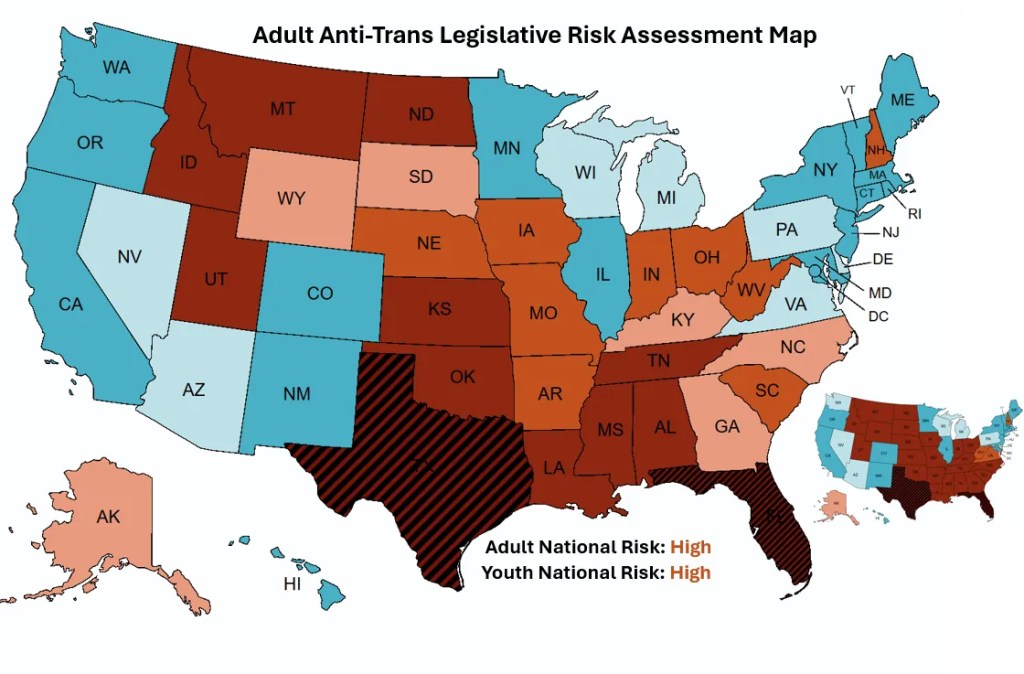
I am keenly aware of which states transgender people are fleeing—and which ones they are fleeing to. Every state enacting extreme anti-trans laws has either a Republican trifecta or a Republican supermajority. Meanwhile, transgender people are finding refuge in states where Democrats have established safe havens. One of those havens is Minnesota, thanks to Governor Tim Walz. I know people whose lives were saved by his actions—people who can now live authentically and freely, without fear of government persecution.

Erin Reed posted the latest edition of this periodically updated map yesterday. It was not included in her endorsement of Ms. Harris, but I’ve inserted it to show what is at stake in the upcoming election.

I have followed this election cycle intently and was among the first to report that transgender people would be a primary target of Trump’s 2024 campaign. In early 2023, Trump released a video outlining a dozen anti-transgender policies he would enact upon taking office, including national bans on trans care for youth, investigations into hormone therapy manufacturers, probes into affirming teachers, and eliminating funding for schools that treat transgender students with dignity and respect. These policies would take the harmful measures I’ve seen in Republican statehouses and nationalize them.

In 2024, it’s clear that the Trump campaign intends to follow through. If you’ve watched any sporting event or turned on the TV in a battleground state, you’ve seen the culmination of this fear campaign against transgender people, now led by Trump himself. Nearly $100 million in anti-trans ads have blanketed the nation, with Trump spending more on these ads than on immigration, housing, and the economy combined. I have seen what other Republican leaders do when they center their focus on my community, and I know the end results are not pretty.

When Kamala Harris was chosen as the Democratic nominee, I watched her closely. While the Biden administration was not flawless on transgender rights—and I often criticized it for these shortcomings—no federal anti-trans laws passed during his presidency. I reported on the defeat of 50 anti-trans and anti-LGBTQ+ policy riders as Republicans threatened to shut down the entire government over transgender issues, and Biden did not back down. His nominees have overturned anti-trans laws and policies. Thanks to Biden, I was able to change my passport, even though my home state of Louisiana doesn’t allow birth certificate changes. I wanted to see if Harris would continue that commitment.

I’m convinced she will. One of Harris’s first moves that reassured me was selecting Gov. Tim Walz as her choice for vice president, fully aware of the Republican attacks against him for making Minnesota a safe haven for those fleeing anti-trans laws in other states. Walz, who campaigned on his record of starting his high school’s first Gay-Straight Alliance decades ago, has consistently been at the forefront of supporting LGBTQIA+ people. He brought that commitment with him to the Governor’s office, where he governed with a focus on making the state welcoming and inclusive for all.

Then in the final weeks of the campaign, she and Tim Walz were asked no less than three times about transgender people in interviews with Fox News, NBC, and Glennon Doyle’s podcast. I was encouraged to see Harris stand on her record of supporting transgender people when questioned. She had ample opportunity to throw us under the bus—as some other Democrats have done this campaign cycle—but she did not.

On Fox News, she criticized Trump for spending $20 million on ads targeting our community. On NBC, echoing her stance on abortion, she emphasized that transgender care is a decision to be made between doctors and patients. Her framework mirrored the approach used by many Democrats—and even some Republicans—to successfully push back against anti-trans bills in dozens of states. Meanwhile, that same week, Walz passionately defended transgender youth, stating that Donald Trump was attempting to “demonize a group of people for being who they are” and pledging that the administration would appoint justices committed to protecting our rights.

With over 1,000 bills introduced in the past three years targeting trans and queer people, undoing the harm they’ve caused will require sustained and strategic effort. The path forward depends on nominating justices who can help reverse these laws, while also protecting our rights in cities and states that offer refuge. For those living in oppressive states where their care, bodily autonomy, and right to exist freely have been threatened, we will continue organizing, supporting each other through mutual aid, and building the foundation to dismantle these discriminatory laws for good. The future rights of transgender people depend on electing Harris, uplifting Walz’s leadership, and securing the justices their administration will appoint.

If Trump wins a second term, we could be bound by his justices for an entire generation. Many transgender adults may never see the day when his court no longer controls our right to exist peacefully in public. Project 2025 could become a national reality, turning the same hateful bills and rhetoric shaping statehouses across the country into federal law. Schools could be defunded for allowing transgender youth to use restrooms in peace, and our very existence could be labeled obscene. There may be no return from the harm he intends to inflict on our community.

Transgender people are in a fight for our lives, and we are a powerful voting force, with millions of us across the United States. In an election that could come down to a few thousand votes in key swing states, we have the numbers to make a difference. In states like Georgia and Arizona, the transgender population is four times the size of the previous vote margins. We cannot afford complacency this election cycle. There is a path forward from the harm inflicted by Republican policies championed by Trump—a path that depends on us showing up and casting our votes for Kamala Harris.

Source: Erin Reed, “As A Leading Transgender Journalist, Here’s Why I’m Endorsing Kamala Harris,” Erin in the Morning, 29 October 2024

Where the Day Takes You

Video: The Russian Reader


Donald Trump’s rally at Madison Square Garden, billed as a triumphant homecoming, instead turned into a political fiasco on Sunday night as a pro-Trump comedian’s racist diatribe drew furious condemnation, including from prominent Republicans.

The rally, held just more than a week before Election Day, was intended to serve as a platform for Trump to make his closing argument but sparked backlash for racial slurs and vulgarity.

The first speaker of the evening, Tony Hinchcliffe, the host of “Kill Tony” podcast, began the rally with slurs about Latinos and African Americans.

Latinos “love making babies. There’s no pulling out. They come inside, just like they do to our country,” Hinchcliffe said to laughter inside the arena. He added: “There’s literally a floating island of garbage in the middle of the ocean right now. I think it’s called Puerto Rico.”

Hinchcliffe’s racist remarks drew swift rebuke from a pair of congressional Republicans from Florida. GOP Rep. María Salazar wrote on X that she was “disgusted” by his “racist” rhetoric that “does not reflect GOP values.” Sen. Rick Scott denounced the “joke” as “not funny” and “not true.”

[…]

But his derogatory comments and the slew of offensive remarks offered up by the pillars of Trump’s political movement throughout the hours-long program quickly overshadowed the spectacle of the event that drew thousands of MAGA faithful to the heart of Manhattan and was designed to serve as a capstone to the former president’s two-year attempt at a political comeback.

Trump supporter David Rem called Harris the “anti-Christ.” Businessman Grant Cardone claimed Harris has “pimp handlers.” Radio host Sid Rosenberg called Hillary Clinton, Trump’s 2016 rival and a former secretary of state, a “sick son of a bitch” and cast Democrats more broadly as “Jew-haters and lowlives.”

A Trump adviser said the speakers’ remarks weren’t vetted by the campaign.

In his own speech, Trump reprised some of his harshest remarks about immigration, with his calls to weed out “the enemy from within.”

Trump, who has demonized migrants, called for the death penalty for “any migrant who kills an American citizen or a law enforcement officer,” and at one point stopped to show a video about Venezuelan migrants and gang activity in New York.

The crowd responded by chanting: “Send them back.”

[…]

Source: Meridith McGraw and Lisa Kashinsky, “Trump’s New York homecoming sparks backlash over racist and vulgar remarks,” Politico, 27 October 2024


Source: SpanishDictionary.com


Editor’s note: This report has been updated to correct the number of physicians who have called for former President Trump to release his medical records.

Former President Trump joined “Fox & Friends” on Friday for an in-person interview where he told a 6-year-old child the U.S. “won’t have any cows” if Vice President Harris is elected.

In a recorded video, the child asked the Republican candidate about his favorite farm animal.

“I’ll tell you what I love, I love cows, but if we go with Kamala, you won’t have any cows anymore,” the former president responded to the child’s question. “I don’t want to ruin this kid’s day.”

He then called Harris a “radical left lunatic.”

This is not the first time the Republican nominee made this claim about cows. Trump made similar remarks at a North Carolina campaign event in July and during a Nevada rally with Hispanic voters this past Saturday. While speaking to voters, Trump said Democrats wanted to remove windows from buildings and get rid of cows.

“They just come up, they want to do things like no more cows and no windows in buildings. They have some wonderful plans for this country, honestly they’re crazy,” he stated.

In North Carolina, he added that Harris would “outlaw red meat.”

The Harris-Walz team hit back by calling the claims a “delusional rant,” questioning the former president’s mental capacity. After the vice president released a medical report from her doctor, she and 230 physicians asked Trump to do the same. 

The Trump campaign released two letters from doctors who have evaluated the former president’s health and cited his busy schedule as a reason for not releasing his medical history or formal medical report. 

During his “Fox & Friends” appearance, Trump also fielded questions about whether he will include former Republican candidate Nikki Haley in his administration and about his support for school choice.

Source: Ashleigh Fields, “Trump Tells Child There Will Be No Cows Under Harris,” The Hill, 18 October 2024


NASA Administrator Bill Nelson on Friday called for an investigation into a Wall Street Journal report that SpaceX founder and Donald Trump ally Elon Musk and Russian President Vladimir Putin have been in “regular contact” since late 2022.

The report, which said the SpaceX founder has discussed “personal topics, business and geopolitical tensions” with the Russian leader, raises national security concerns as SpaceX’s relationships with NASA and the US military may have granted Musk access to sensitive government information and US intelligence.

“I don’t know that that story is true. I think it should be investigated,” Nelson told Semafor’s Burgess Everett. “If the story is true that there have been multiple conversations between Elon Musk and the president of Russia, then I think that would be concerning, particularly for NASA, for the Department of Defense, for some of the intelligence agencies.”

Some US officials have raised counterintelligence concerns in the last year about Musk’s interactions with US adversaries like Russia, but the US intelligence community is wary of looking into those interactions because Musk is an American citizen, an official familiar with the matter told CNN.

Several White House officials told the Journal they weren’t aware of the contact between Musk and Putin, and the paper said knowledge of the discussions “appears to be a closely held secret in government.” The discussions were confirmed to the Journal by several current and former US, European and Russian officials.

In one instance, the newspaper cited a request from Putin to Musk not to activate his Starlink satellite internet service over Taiwan “as a favor to Chinese leader Xi Jinping.”

Musk did not respond to the Journal’s requests for comment.

National Security Council spokesperson John Kirby said Friday that he had seen the reporting but the White House is “not in a position to corroborate” it and deferred questions to Musk. A Pentagon spokesman told the Journal that the Defense Department does not comment on “any individual’s security clearance, review or status, or about personnel security policy matters in the context of reports about any individual’s actions.”

Kremlin spokesman Dmitry Peskov told the newspaper that Musk and Putin have only had one telephone call in which they discussed “space as well as current and future technologies.”

Since Russia’s invasion of Ukraine in early 2022, Musk’s support for Ukraine — exemplified by SpaceX’s provision of Starlink services — has diminished as his public statements about the conflict have become further aligned with those of Trump, who has said he would negotiate an end to the war quickly. The satellite internet terminals provided by Musk’s company have been a vital source of communication for Ukraine’s military, allowing it to fight and stay connected even as cellular and internet networks have been destroyed.

Dmitri Alperovitch, a Russia and cybersecurity expert, told CNN’s Alex Marquardt Friday on “CNN News Central” that Musk’s Starlink is “essential to Ukraine in particular because they really could not prosecute this war without” its services.

After Musk trumpeted his early support for Ukraine, SpaceX then abruptly asked the Pentagon to pay tens of millions of dollars per month to fund Starlink in Ukraine and take the burden off SpaceX. In response to that reporting, Musk then abruptly announced on Twitter that he had withdrawn the funding request. Around the same time, Musk used a poll on X to suggest a “Ukraine-Russia Peace” plan that included re-doing elections “under UN supervision” in the regions of the country recently annexed illegally by Russia. After Ukrainian President Volodymyr Zelensky questioned Musk’s preference in the war, the tech entrepreneur responded that he “still very much support(s) Ukraine” but feared “massive escalation.”

SpaceX had previously limited its Starlink signal to areas controlled by Ukrainian forces, hampering potential advances that would have relied on Starlink communications. SpaceX then enlarged it to the rest of the country, and earlier this year, Ukraine’s Defence Intelligence claimed it has confirmed the use of Starlink satellite communications by Russian forces in occupied areas. Russia appeared to be buying the terminals from third parties; SpaceX said it did not do business of any kind with the Russian government or its military and that its service would not work in Russia. The statement didn’t address whether it would work in occupied Ukraine.

Ukraine’s claim followed revelations in a biography of Musk, written by Walter Isaacson, about the satellite system’s use in the war. According to an excerpt from the book, Musk did not grant a Ukrainian request to turn on his company’s Starlink satellite communications network near the Crimean coast last year to disrupt a Ukrainian sneak attack on the Russian naval fleet.

Musk’s decision, which left Ukrainian officials begging him to turn the satellites back on, was driven by an acute fear that Russia would respond to a Ukrainian attack on Crimea with nuclear weapons, a fear driven home by Musk’s conversations with senior Russian officials, according to Isaacson.

In October 2022, Musk denied a claim by American political scientist Ian Bremmer that he had spoken with Putin about the war and a proposed “peace plan” to end the conflict.

Musk, who is also the CEO of Tesla and owner of X, has emerged as a major financial figure in this year’s presidential election. He plowed nearly $44 million in October into a super PAC working to restore Trump to the White House — pushing the billionaire’s total donations to the group to nearly $119 million — and he appeared with Trump on the campaign trail earlier this month in Butler, Pennsylvania.

Musk also held his own town halls last week in Pennsylvania, where he urged voters to support Trump and promoted several debunked conspiracy theories about the 2020 election. The two have publicly discussed a potential government role for Musk.

In recent days, Musk also offered splashy, $1 million daily sweepstakes for swing-state voters that has drawn scrutiny from the US Justice Department. Despite a warning from the Justice Department that the payments might be illegal, Musk’s super PAC awarded two $1 million prizes to registered voters in Michigan and Wisconsin on Thursday.

Source: Shania Shelton, “NASA chief calls for investigation into report that Musk and Putin have spoken regularly,” CNN, 25 October 2024


Photo: The Russian Reader

Remembering Navalny

There’s shoddy work everywhere. Even great publications suffer ridiculous failures.

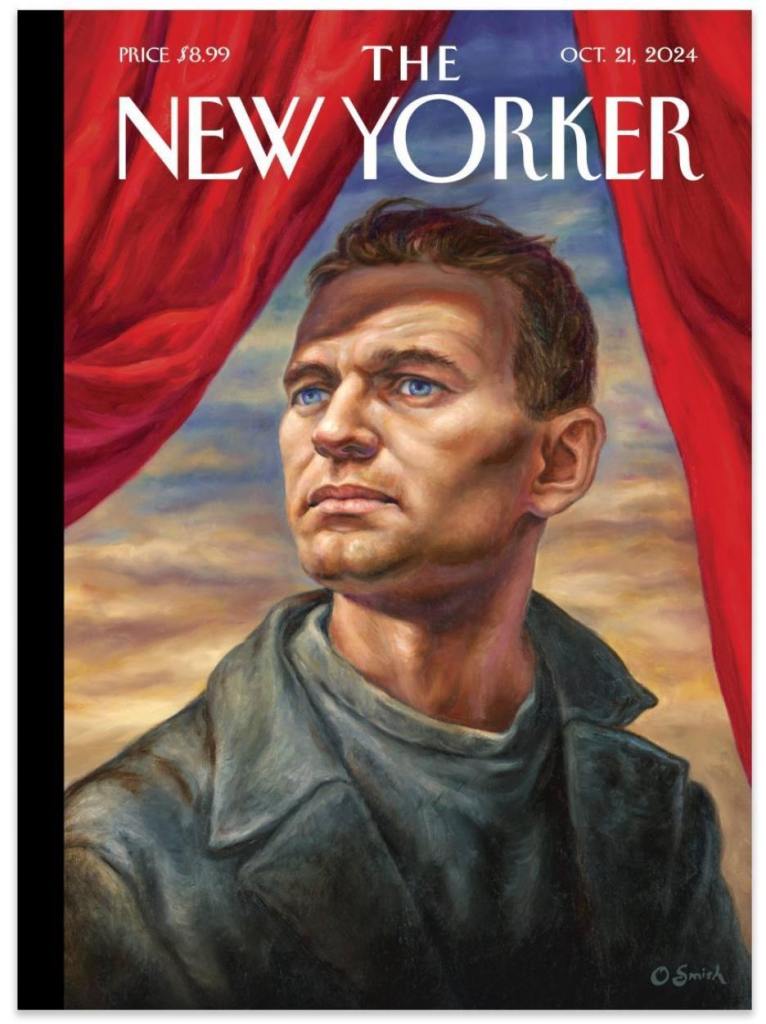
This is the cover of the new issue of the New Yorker.

What ridiculous crap.

(You can probably guess who that is supposed to be.)

Source: Sergei Parkhomenko (Facebook), 12 October 2024. Translated by the Russian Reader


I wouldn’t want Navalny to be remembered the way he has been remembered this past year.

I haven’t read the book Patriot yet, but I was quite upset by Mikhail Zygar’s review of it. Zygar compares Navalny to Jesus and concludes that by dying, Navalny bequeathed us an idea that would rid future generations of cynicism and teach them to believe.

This is feeble sentimentalization, in my opinion. Navalny didn’t not dream up any particular ideas. He called for action, not faith. The meaning of his sacrifice, in my mind, is practical and political, not abstract and ideological. It can and should benefit the current generation, not some future generation.

Navalny didn’t dream up a new ideal. The “beautiful Russia of the future” is a feeble image, but Navalny understood better than anyone how tyranny operates on the mechanical level. I often complain that the FSB understands better how Russian society functions than do opposition politicians, sociologists and psychologists. Navalny couldn’t be accused of this shortcoming.

He was the only person in Russian politics who talked about power relations as a two-way street. He didn’t talk about the enormous resources Putin has, but about the fact that we give Putin power. It is not the security services, the army and the tanks that give Putin power. We give Putin power.

This view evolved over the course of Navalny’s career, becoming more and more central. As time went by, it separated Alexei more and more from his colleagues in the opposition. Toward the end of his life, Navalny’s writings centered on the idea that power consists in consenting to obedience, in “obeying in advance.” We say to ourselves: I cannot disobey, because if I don’t obey, they will (notice me/file administrative charges against me/fire me/banish me from my profession/send me to jail/kill me).

“The only fear there should be is that we leave our homeland to be plundered by a pack of liars, thieves and hypocrites, that we surrender without a fight, voluntarily, both our own future and the future of our children.”

Only by obeying in advance can governing by unfulfilled threat be scaled up indefinitely, to a country of 140 million people, because this means of governing doesn’t require any resources. We obey without taking resources from the state. Putin’s estimates for the war in Ukraine include every dollar, euro, and pound spent on Ukraine’s defense. They are what counts against Russian budgets, not “faith in democracy” or “anti-war sentiment.” I understand Alexei’s decision to return to Russia in this sense; I see it as logical and unusually tenderhearted on the personal level. By returning to Russia, Alexei was able to provide Russians with one more example of tyranny’s limits: Putin never had power over Alexei. Had he stayed in Germany, Putin’s power would have extended to Navalny.

At the end of his life, Navalny did not call for faith, he called for deeds: “If your convictions are worth something, you must be willing to stand up for them. And if necessary, make some sacrifices. And if you are not willing, then you don’t have any convictions. You just think you do. But they are not convictions and principles. They are just thoughts in your head.”

Navalny was concerned not with the thoughts in our heads, but with whether our deeds matched our thoughts. I appreciate Christian philosophy, but I could never accept the postulate that a second of faith can save a person, no matter their actions — “Now thou shalt be with me in paradise,” and so forth. The Russian opposition, for as long as I’ve been watching it, wants to get to democracy approximately the same way the thief gets to paradise — by believing in it. The notion that we are democrats and decent because we believe in democracy while all remaining Russians are slaves and awful because they don’t believe in it is the main obstacle to democracy in Russia, in my mind, and the Koshchei’s egg of tyranny. A “democracy” in which only “democrats” have a stake and which only they want is an oxymoron that makes democracy impossible and tyranny in Russia perennial. Democracy cannot be for Muscovites alone. It cannot be built via media outlets in which only Petersburg and Moscow have a voice. It cannot be built without equal representation of activists, issues, and interests from other regions and ethnicities.

Late in life, Navalny hated talk about the “freewheeling ’90s” and the good Chekists/bad democrats dichotomy, which doesn’t prevent his supporters from remaining stuck in this selfsame paradigm.

“I hate the authors of the authoritarian [Russian] constitution, which was sold to us idiots as democratic, even then granting the president the powers of a full-fledged monarch. […] I hate the ‘independent media’ and the ‘democratic community,” which fully supported one of the most dramatic turning points in our new history — the fake presidential election of ’96.”

Navalny was able to cringe at his former self: “I repeat that back then I vigorously supported all that stuff. Not election fraud, of course — I didn’t like that even then — but I did everything I could to ignore it, and the general unfairness of the elections didn’t fluster me one bit. Now we are paying for the fact that in ’96 we thought that election fraud was not always a bad thing.”

Alexei started his career in Russia’s faux democracy project, which was unfair from the get-go. He entered politics as a “democratic nationalist,” desiring greatness and a better elite for Russia. It was within this same paradigm that he pursued the most successful project of his life: “fighting the regime by legal means.” By the end of his life, however, he came to realize that Russian power is held by a hypocritical elite which justifies its obedience by talking about white coats, and is not willing to share power. It is not even willing to think about being the equals of other Russians, let alone the equals of Ukrainians, for example.

This, in my opinion, is what Navalny left behind. It pains me to see how the legacy he left at such a high cost is being frittered away by films about traitors, stupid speeches, and sentimental religious comparisons.

Source: Vladimir Ponizovskiy (Facebook), 23 October 2024. Translated by the Russian Reader

Mal Hombre

Lydia Mendoza, “Mal Hombre” (1934)

Era yo una chiquilla todavÌa
Cuando tú, casualmente me encontraste
Y a merced de tus artes de mundano
De mi honra el perfume te llevaste
Lo hiciste con migo lo que todos
Los que son como tu con las mujeres
Por lo tanto no extrañes que yo ahora
En tu cara te diga lo que eres

Mal hombre.
Tan ruin es tu alma que no tiene nombre
Eres un canalla, eres un malvado
Eres un, mal hombre

A mi triste destino abandonada
Entablé fiera lucha con la vida
Ella recia y cruel me torturaba
Yo, mas débil, al fin caí vencida

Tu supiste a tiempo mi derrota
Mi espantoso calvario conociste
Te dijeron algunos que a salvarle
Y probando quien eres, te reiste

Mal hombre
Tan ruin es tu alma que no tiene nombre
Eres un canalla eres un malvado
Eres un, mal hombre

Poco tiempo después en el arroyo
Entre sombras mi vida dependÌa
Una noche con otra tú pasaste
Y al mirarme oí que te decía:
“¿Quien esa mujer, tú la conoces?”
Y a la vez, respondiste: “¡una cualquiera!”
Al oír de tus labios tal ultraje
Demostrabas también lo que tú eras

Mal hombre
Tan ruin es tu alma que no tiene nombre
Eres un canlla, eres un malvado
Eres un, mal hombre

Source: Musixmatch


Yesterday we learned from a forthcoming book by veteran journalist Bob Woodward that in 2020, while he was president, Trump secretly shipped Covid-19 testing equipment to Russian president Vladimir Putin for his own personal use at a time when Americans could not get it. To be clear, this equipment was not the swabs we now use at home, but appears to be what at the time was a new point-of-care machine from Abbott Laboratories that claimed to be the fastest way to test for Covid-19. 

Journalist Karly Kingsley points out that at the time, central lab testing to diagnose Covid-19 infections took a long time, causing infections to spread. Machines like Abbott’s were hard to get. Trump chose to send them to Putin—not to charge him for them, or to negotiate for the release of Paul Whelan and Trevor Reed, two Americans being held by Russia at the time and later released under the Biden administration, but to give them to him—rather than keeping them for Americans.

It’s hard to overstate just what an astonishing story this is. In 2016, Republicans stood firm against Putin and backed the arming of Ukraine to stand against Russia’s 2014 invasion of Crimea. But that summer, at Trump’s urging, the party changed its platform to weaken its support of Ukraine. In 2020, it appears, Trump chose to give lifesaving equipment to Putin rather than use it for Americans. And in 2024, Trump’s willingness to undermine the United States to cozy up to an adversary his own party stood against less than a decade ago does not appear to be a deal breaker for Republicans.

As Senator Chris Murphy (D-CT) put it: “What has this country come to if the revelation that Trump secretly sent COVID testing machines to Putin while thousands of Americans were dying, in part because of a shortage of testing machines here, doesn’t disqualify him to be President?” He continued: “Donald Trump helped keep Putin alive during the pandemic and let Americans die. This revelation is damning. It’s disqualifying. He cannot be President of the United States.” 

Increasingly, Trump’s behavior seems to parrot the dictators he appears to admire. 

After 60 Minutes called him out for breaking a fifty-year tradition of both candidates talking to 60 Minutes and backing out of an interview to which he had agreed, Trump today accused the producers of 60 Minutes of cutting Vice President Kamala Harris’s answers to make her look good. He suggested that such cuts were “illegal” and possibly “a major Campaign Finance violation” that “must be investigated, starting today!” “The public is owed a MAJOR AND IMMEDIATE APOLOGY!” he wrote. Trump is trying to cover for his own failure by attacking CBS in an echo of dictators determined to control the media.

In a post on his social media site tonight, Trump appears to have declined to appear at another presidential debate with Vice President Harris. After declaring he had won the previous debate with Harris and rehashing many of his grievances, he wrote: “THERE WILL BE NO REMATCH!”

As Beth Reinhard of the Washington Post recounted yesterday, a report from Senator Sheldon Whitehouse (D-RI), who sits on the Senate Judiciary Committee, revealed that the Trump White House prevented a real investigation into sexual misconduct allegations against Trump’s second Supreme Court nominee, Brett Kavanaugh. More than 4,500 calls and electronic messages about Kavanaugh sent to the FBI tip line went directly to the White House, where they were never investigated, and the FBI was told not to pursue corroborating evidence of the accusations by Christine Blasey Ford and Deborah Ramirez although lawyers for the women presented the names of dozens of people who could testify to the truth of their allegations.  

A number of senators said the lack of corroborating evidence convinced them to vote in favor of Kavanaugh’s confirmation. As Steve Benen of MSNBC recalled, Senator Susan Collins (R-ME) said at the time that it appeared to be “a very thorough investigation,” while the late Senator Dianne Feinstein (D-CA) said that the 2018 FBI report “looks to be a product of an incomplete investigation that was limited perhaps by the White House.”

After he left office, Trump told author Michael Wolff that he had gone to bat for Kavanaugh, saying: “I…fought like hell for Kavanaugh—and I saved his life, and I saved his career.” Kavanaugh was the crucial vote for Trump’s right-wing agenda, including ending the federal recognition of abortion rights by overturning the 1973 Roe v. Wade decision.

Ken Bensinger reported in the New York Times today that Trump’s team has refused to participate in preparations for a transition to a potential Trump presidency. Normally, the nonpartisan transition process, dictated by the Presidential Transition Act, has candidates setting up teams as much as six months before the election to begin vetting and hiring political appointees and working with the administration in office to make sure the agencies continue to run smoothly. 

With the election less than a month away, Trump has neither signed the required agreements nor signed the transition’s ethics plan that would require him to disclose private donors to the transition and limit them to contributions of no more than $5,000. Without that agreement, there are no limits to the money the Trump transition can take. Trump has also refused to sign an agreement with the White House requiring that anyone receiving classified information have a security clearance. Currently, his aides cannot review federal records.

Trump ignored the traditional transition period in 2016, cutting off communications with President Barack Obama’s team. He refused to allow incoming president Joe Biden access to federal agencies in 2020, hampering Biden’s ability to get his administration in place in a timely fashion. Now it’s possible that Trump sees no need for a normal transition because Project 2025, on which he appears to be relying, has been working on one for many months. 

It calls for him to fire most federal employees, reinstating the policy he started at the end of his term. To fill their positions, the Heritage Foundation has been vetting loyalists now for months, preparing a list of job candidates to put in place a new, right-wing agenda.  

Yesterday, on California’s KFI radio station, Trump told host John Kobylt that Tom Homan of Project 2025, who as director of U.S. Immigration and Customs Enforcement oversaw the family separation policy at the southern border, will be “coming on board” a new Trump administration. 

This afternoon, Trump told an audience in Scranton, Pennsylvania, that he expects to put former rival Vivek Ramaswamy into an important position in his administration. On October 7, 2024, Ramaswamy suggested on social media that he wants to get rid of Social Security and Medicare. He wrote: “Shut down the entitlement state & you solve most of the immigration problem right there. We need to man up & fix the root cause that draws migrants here in the first place: the welfare state. But no one seems to want to say that part out loud, because too many native-born Americans are addicted to it themselves.”

Trump has expressed frustration with the independence of the Federal Reserve, expressing a desire to make it answer to the president. In an interview with Barron’s, one of his advisors, Scott Bessent, has floated the idea of creating a shadow Fed chair until the term of the current chair, Jerome Powell, ends, thus undercutting him without facing a fight over firing the Fed chair. 

This agenda is not a popular one in the U.S., but Trump is getting a boost as Russian operatives work to swing downballot races toward the Republicans. In a briefing on Monday, October 7, experts from the Office of the Director of National Intelligence (ODNI) told reporters that China and Iran are trying to influence the upcoming election and that “Moscow is leveraging a wide range of influence actors in an effort to influence congressional races, particularly to encourage the U.S. public to oppose pro-Ukraine policies and politicians. Russian influence actors have planned, and likely created and disseminated, content, particularly over social media, intended to encourage the election of congressional candidates that Moscow assesses will oppose aid to Ukraine.”  

Russia, an ODNI spokesperson said, uses “influence-for-hire firms, or commercial firms with expertise in these type[s] of activities.” It also coopts “witting and unwitting Americans to work on Russia’s behalf,” to “launder their influence narratives through what are perceived as more authentic U.S. voices.” 

Not all of Trump’s supporters appear eager to stick around to see if Trump will win another term. Today news broke that Patrick M. Byrne, the former chief executive officer of OverStock, who became a fervent advocate of the idea that Trump was the true winner of the 2020 presidential election, has left the country, apparently permanently, to live in Dubai. Dominion Voting Systems is suing Byrne, as is President Biden’s son Hunter. The younger Biden sued Byrne for defamation last November after Byrne claimed Hunter Biden sought a bribe from Iran. 

In September, Biden’s lawyers were trying to schedule a date for Byrne’s deposition when his lawyer abruptly “claimed for the first time that Defendant has moved his residence to Dubai and if Plaintiff wanted to take his in-person deposition counsel would have to fly to Dubai to do so, to which Plaintiff responded with various related inquiries to try to resolve this matter and defense counsel stated Defendant would not be returning to the United States for the foreseeable future.” 

Byrne claimed to have fled the U.S. because the Venezuelan government has put a bounty on him, but as Biden’s lawyers note, “the Defendant’s truthfulness is directly at issue.” 

[…]

Source: Heather Cox Richardson, Letters from an American, 9 October 2024


Lydia Mendoza, interviewed by Professor Gene Bluestein and Professor Manuel Pena at CSU, Fresno, before performing “Mal hombre.” Courtesy of the UNC Chapel Hill Folk Archives.

I was but a young girl
when, by chance, you found me
and with your worldly charm
you crushed the flower of my innocence.
Then you treated me like all men
of your kind treat women,
so don’t be surprised now that when I tell you
to your face what you really are.

Bad man
your soul is so vile it has no name
you are despicable, you are evil,
you are a bad man.

Abandoned to a sad fate,
my life became a fierce struggle
suffering the harshness and cruelty of the world
I was weak and was defeated.
In time you learned of my downfall
how my life had become a road to hell.
Some people advised you, “You can help her,”
but being who you are, you just laughed.

Bad man
your soul is so vile it has no name
you are despicable, you are evil,
you are a bad man.

Shortly after in a gully
among shadows I defended my life.
One night you passed by with another woman
and on seeing me I heard her ask you:
Who is that woman? Do you know her?
And looking at me you answered: She’s a nobody
and when I heard adultery from your lips
you demonstrated again what you are.

Bad man
your soul is so vile it has no name
you are despicable, you are evil,
you are a bad man.

Source: “Tango in Mexico: Mal hombre (Bad man),” Tango Stories: Musical Secrets, 8 April 2020


Lydia Mendoza (May 31, 1916–December 20, 2007) was born in Houston, Texas, to musically inspired Mexican parents. During Mendoza’s first ten years the family migrated back and forth between Texas and the Mexican city of Monterrey in the state of Nuevo León, as part of her father’s work with the railroad. In the 1920s, when Lydia Mendoza’s father left the railroad, the Mendoza family eked out a living doing musical performance, first in the lower Rio Grande Valley, and then singing for pennies and nickels on the streets of downtown San Antonio, Texas. The ten year-old Lydia Mendoza began her recording career—singing and playing mandolin—in the 1920s and 1930s with the Mendoza family who recorded for the OKeh, Odeon, and Bluebird labels. As a teenager in 1934, Lydia Mendoza did her first solo recording. The recording she made that day was of the song “Mal hombre” (“Evil Man”), which she popularized, and which became closely identified with her throughout her long singing career. In her later years, she recorded with DLB Records (San Antonio) and, in 2001, issued her last concert recording as part of her published life story, Lydia Mendoza’s Life in Music.

Mendoza’s performance career stands as one of the longest in American music history, spanning from the 1920s to the 1980s when a stroke ended her performing life. Following upon her early success with “Mal hombre,” Mendoza continued to tour with her family as an itinerant performance unit that offered a variety of acts. They followed the agricultural labor routes where most of the Mexican American population worked: north to Michigan, back south to the Rio Grande Valley, later to California. Her closeness to her audiences earned her two epithets—“La cancionera de los pobres” (“The Singer of the Poor”) and “La alondra de la frontera” (“Lark of the Border”). As a grassroots idol, she was loved for her ability to articulate a working-class sentimiento (sentiment and sentience) through song and through the breathtaking visual spectacle of her flashy hand-sequined, hand-beaded performance attire whose symbolic designs announced her ancient cultural roots in the Americas. She publicly marked the enduring presence of indigenous Mexican culture even throughout historical periods (from the 1930s to the 1960s) in which public displays of Mexicanness targeted you for governmental harassment and/or deportation by Euro-American officials. Along the migrant agricultural worker routes, she affirmed and celebrated Mexicanness during those decades when eating establishments regularly featured signs that read “NO DOGS, NO MEXICANS.” Lydia Mendoza manifests the social powers of music: her natural speech-like voice, her striking physical presence, and her songs, so beloved among the communities she sang for, symbolically reclaimed and remapped a Mexican America. Mendoza always enacted a space of popular collective expression, an audible Mexican American homeland.

Throughout her performance career Lydia Mendoza adhered to the oral traditional practice of singing by popular demand: she sang what her audiences requested. That traditional practice meant that audience members called out each song and they tended to call out traditional songs associated both with that singer and with the broader norteño cultural matrix. The repertoire of songs was not unchanging, and “Mal hombre” is testament to that. Once Lydia Mendoza recorded the song—a song not originating in the US-Mexico borderlands, nor of a borderlands rhythmical style—audiences welcomed it into the changing body of “traditional songs.” Thus “Mal hombre,” whose rhythm and cadences mark its origins in distant Argentinian tango or milonga repertoires, became one of Lydia Mendoza’s signature songs; audiences requested it from her throughout her performance life. It should, however, be noted that in the course of the several decades of repeated performance, Mendoza indigenized the “foreign” rhythmed “Mal hombre” into the borderlands rhythms of the canción Mexicana. Still, after Mendoza’s performance life ended, “Mal hombre” also vanished from the borderlands circle of songs and has not been recorded by any borderlands singer since then.

“Mal hombre” was, from the onset, something of an anomaly within the Mexican borderlands musical landscape. The early sound media—recordings, radio, and later television—as well as the Euro-colonization process of the last 200 years, introduced music from far-flung places to the borderlands. There were various waves that swept through the Texas-Mexican landscape: tango, foxtrot, big band, polka, bolero, country, canción, cumbia, and more. The Mendoza family repertoire of recorded songs manifests that rich variety of song genres: ranging from the deeply rooted norteño song forms to the more fad-oriented recent arrivals. Along those same lines, Lydia Mendoza performed and recorded a rich variety of genres from the oral tradition accompanied by the full gamut of Mexican borderlands instrumentations—including the button-accordion conjunto, mariachi, guitar trio, and more. Yet Mendoza’s mainstay ultimately became her performance as a solo singer self-accompanied with her 12-string guitar.

Mendoza notably self-designated as a “norteña” (a Northerner) and as a “Mexicana,” marking her musical cultural geo-regional roots as spanning not only the northern Mexican states of Nuevo León, Tamaulipas, Coahuila, Sonora, and Chihuahua, but also what was, until 1848, the northern half of Mexico, today’s southwest United States. As a mature artist, the mainstays of her song repertoire were the hugely popular canción ranchera (ranch song) and corridos (narrative ballads). The canción ranchera genre represents an evolution of the older Mexican canción. In the ranchera evolution, the love song often tends to be infused with imagery, customs, and symbols from the deep cultural matrix of Mesoamerica. During her last concert tour in 1986-87, Mendoza sang almost exclusively rancheras and corridos. She offered for sale her most recent cassette recording “Corridos,” which included, for example, “The Ballad of Joaquín Murrieta” (1829–1853). That corrido (narrative ballad) recounts the heroic acts of an iconic California freedom fighter that organized an army to protect Indians and Mexicans against the Gold Rush invasion. There is some common ground between such historic narrative ballads and the appeal of “Mal hombre”: they are songs from underdogs who face powerful odds against them. Singers such as Lydia Mendoza carried the voices of underdogs and thus impart the life lessons they embody.

“Mal hombre” (“Evil Man”) offers a life narrative in the voice of a woman underdog who at a very young age is seduced by an evil man’s “worldly arts.” The narrative voice in the song describes various stages of sexual exploitation: her seduction as a young girl, her abandonment by the lover, her life-and-death struggle, and her eventual downfall. The song’s popularity can only be understood in the context of the rampant sexual violence inherent of our patriarchal society institutionalized since colonialism. One of “Mal hombre’s” most notable features, however, is its beautiful poetics. No sexual act is described per se. Nor does the narrator offer any realism-based specifics of her demise. In the song, a great deal is left to the listener’s imagination, such as when she references “mi espantoso calvario” (“my horrific cavalry”). The female narrative voice of “Mal hombre” embodies a protracted life struggle, a feature shared by many classical corrido underdog heroes. The redemptive quality of this song, however, has to do with the victim rising to sing, with her strong indictment of the Evil Man, and with the fact that she has the last word in the matter, hurling loaded terms at the Evil Man with this refrain:

Tan ruin es tu alma

que no tiene nombre

Eres un canalla

Eres un malvado

Eres un mal hombre

Your soul is so vile

It is deplorable.

You are a scoundrel

You are a malicious man

You are an evil man

Through songs such as “Mal hombre,” Lydia Mendoza defies the subordination of women of color. She takes a womanist self-affirming stance in a number of her signature songs, such as “Mujer paseada” (“Experienced Woman”) or “Celosa” (“Jealous Woman”). Mendoza’s traditional corridos similarly praise the deeds of collectively cherished and remembered anti-colonial historical figures omitted from mainstream history books. At all times, Lydia Mendoza expressed in song her existential ties to her people.

In 1982, Mendoza became the first Texan named a NEA National Heritage Fellow. She performed for President Jimmy Carter at the Kennedy Center in Washington in 1975. She was inducted into the Tejano Music Hall of Fame in 1984 and into the Conjunto Music Hall of Fame in 1991. In 1999, she received the National Medal of the Arts from President Clinton. Lydia Mendoza passed away on December 20, 2007, at the age of 91.

Yolanda Broyles-González is appointed University Distinguished Scholar at Kansas State University where she serves as head of the American Ethnic Studies Department. She is a Yaqui elder of the Tucson, Arizona Barrio Libre tribal community. Her book publications include El Teatro Campesino: Theater in the Chicano Movement (UT Press); Lydia Mendoza’s Life in Music/La Historia de Lydia Mendoza (Oxford); and Earth Wisdom: California Chumash Woman (Univ. of Arizona Press).

Source: Library of Congress. Image courtesy of Wednesday’s Women

Policing the Polls

Elections observer who left message on ballot jailed for 5 days

Marina Popova served as an observer during the elections in St. Petersburg. On Sunday, she decided to vote herself. Prior to this, she specially had herself reassigned to Polling Station No. 2213 on Lomonosov Street [where she was working as an elections observer].

Popova told Rotunda that two other people voted after her. A police officer then noticed a ballot in the ballot box on which a pacifist message [“No war!”] had been written. According to Popova, a polling board member wrote out a statement saying that it was Popova who had dropped the ballot with the message into the ballot box.

Consequently, Popova was detained and taken to the police station. There, she was charged with “petty hooliganism” and, later, “discrediting the army.” The first charge sheet says that Popova disturbed the peace because she wrote a pacifist message in large letters in bright blue ink that was seen by people at the polling station.

Popova was taken to the police station on Sunday morning and never returned to the polling station. She was taken to court on Tuesday. When her detention period expired, she went home. She was taken back to court in handcuffs—the police collected her from her home.

At the court hearing, Popova’s lawyer Alyona Skachko told Rotunda, polling board members claimed that the ballot was state property, which the observer had spoiled. As a result, Popova was fined 30,000 rubles [approx. 300 euros] and jailed for five days.

📌 Marina’s husband Dmitry Popov and two people from the United Russia party were the only observers left at the polling station on Lomonosov Street after it closed on the last day of voting. During the vote tally, Popov was forcibly restrained by persons unknown who, as he claimed, tried to strangle him. Eventually, however, the police arrived and detained Popov. At the police station, he was charged with “petty hooliganism.” It is alleged that he used foul language.

Source: Rotunda (Telegram), 10 September 2024. Photo courtesy of Fontanka.ru. Translated by the Russian Reader


Residents of 81 federal subjects of Russia will vote in regional and municipal elections starting Friday. 

The elections mark the second time this year that Russians are heading to the polls following the March presidential election. That vote, which saw Vladimir Putin win a fifth term virtually unchallenged, was marred by widespread reports of vote tampering, restrictions on monitors and pressure on voters. 

But unlike the presidential campaign, Russian media coverage of this year’s regional elections has been scarce — likely the result of a deliberate government strategy of decreasing voter turnout to a bare minimum of loyal voters, an analysis published by independent election watchdog Golos suggests. 

Golos analysts believe that the Kremlin is betting on mobilizing a relatively small number of voters working in the government sector and demotivating all the rest to ensure a smooth victory for its candidates.

To help you understand what else is expected in the upcoming September elections, the Moscow Times has gathered everything known about the vote so far[.]

What will the voting look like? 

Multi-day voting, which was first introduced across Russia during the Covid-19 pandemic, will be implemented in most regions for the September 2024 elections. The majority of voters will have two or three days to cast their ballots depending on the region. 

Some regional electoral commissions, including in the republics of Chechnya, Tatarstan and Sakha (Yakutia), have chosen to hold voting on one day on Sunday. 

Twenty-five regions will allow residents to vote online via the state portal Gosuslugi, while election officials in Moscow have scrapped paper ballots altogether in favor of online voting.  

Independent observers have long argued that extended voting periods and online voting make voter fraud more likely, as it becomes harder for independent monitors and poll workers to do their jobs.

Meanwhile, the CEC advised authorities in six southern Russian regions near Ukraine and in occupied Crimea to limit access to online broadcasts from polling stations, citing public safety concerns. 

G[ubernatorial] elections 

Residents of 21 regions, including the city of St. Petersburg, will vote for their governors. 

Among these, the Far East Zabaikalsky region, the Siberian republic of Altai and the southern republic of Kalmykia stand out as some of the most “troublesome” regions for the Kremlin. 

The ruling United Russia party has struggled to secure strong wins for its candidates in these regions in the past and incumbents hoping for reelection remain largely unpopular among local populations and elites, according to Golos.

The Urals republic of Bashkortostan will also be under the Kremlin’s close watch as Moscow-backed incumbent Radiy Khabirov stands for reelection in the wake of the January protests in support of jailed activist Fayil Alsynov. 

Coupled with high numbers of war casualties in Ukraine and a slew of recent corruption scandals involving Khabirov’s inner circle, those protests forced the incumbent’s approval ratings to plummet. 

But as in most other regions, the Kremlin mitigated the possibility of a potential blow in Bashkortostan by not allowing a single independent candidate on the ballot. 

Regional parliament elections 

Members of regional parliaments will be chosen across 11 regions, including the capital Moscow, the republics of Tatarstan and Tyva and the Khabarovsk region. 

This year’s election will see the participation of a record-low number of political parties with an average of 6.2 parties represented on the ballot, according to Golos. 

Golos said this worrying statistic is a direct result of an unprecedented scale of repression faced by independent politicians regardless of their political views.

“[A politician] can be declared a foreign agent or convicted of extremism to be removed from the elections,” Golos wrote in an analytical report published last month. 

“And if they still [manage to] register and win, there is…the possibility of being declared a foreign agent and deprived of his mandate a couple of weeks after the elections,” the watchdog said. 

Municipal elections

Elections for city mayors and city parliaments will take place across 22 regions. 

Abakan, the capital of the Siberian republic of Khakassia, and Anadyr, the capital of the Chukotka autonomous district, are two of only four Russian cities where mayors are still chosen through direct election. 

Mayoral elections had also been set for Ulan-Ude, the capital of the Siberian republic of Buryatia, but the region’s parliament scrapped the procedure in favor of the council electors system in March. 

In St. Petersburg, where 1,560 seats in the city’s [municipal district councils] are up for grabs, candidates running from so-called “systemic opposition” parties — namely the Communist Party (CPRF) and the social-liberal Yabloko party — were barred from registering en masse.

And while CPRF managed to get 25% of its original pool of candidates onto the ballot, Yabloko will not have any representation in this year’s [m]unicipal [c]ouncil[s] race.   

Occupied Ukrainian and Russian territories 

In annexed Crimea, Kremlin-installed head Sergei Aksyonov will stand for reelection and members of the regional parliament and the legislative assembly of the Crimean port city of Sevastopol — its own federal subject — will be voted in. 

The Kremlin refused to cancel voting in the Kursk border region, where Ukrainian forces have been carrying out a bold incursion for more than a month, and where Putin appointee Alexei Smirnov is seeking to secure his mandate as governor.

The CEC instead extended the voting period to 10 days and is supplying local election officials with bulletproof vests and helmets. 

Kursk regional authorities announced Thursday that nearly 27% of eligible voters [had] already cast their ballots in the [gubernatorial] election.

Source: “The Roadmap to Russia’s 2024 Regional Elections,” Moscow Times, 6 September 2024.


[…]

GROSS: So Trump recently spoke to the Fraternal Order of Police, and he urged them to watch out for voter fraud. Let’s hear what he said.

(SOUNDBITE OF ARCHIVED RECORDING)

DONALD TRUMP: You’re in serious trouble if you get caught trying to find out what are the real results of an election. It’s an amazing thing. Do you ever see that? They go after the people that are looking at the crime, and they do terrible things to them. But the people that committed the voter fraud and everything, they can do whatever they want to do. It’s so crazy. And I hope you, as the greatest people – just as great as there is anybody in our country – I hope you watch for voter fraud.

So it starts early. You know, it starts in a week, but I hope you can watch, and you’re all over the place. Watch for the voter fraud because we win. Without voter fraud, we win so easily. Hopefully, we’re going to win anyway, but we want to keep it down. You can keep it down just by watching because, believe it or not, they’re afraid of that badge. They’re afraid of you people. They’re afraid of that.

GROSS: Nick, is that voter intimidation? He’s telling the police that these fraudulent voters are afraid of police, implying that the police should use that fear to find voter fraud so that Trump can win.

CORASANITI: I think it – certainly, were it to be carried out – would be challenged by voting rights groups, Democrats and probably even some Republicans – that that would amount to voter intimidation. It’s also pretty important to note that a couple states have very specific laws that, you know, outlaw uniformed police officers having a kind of patrolling presence in – at polling places during elections.

And, you know, there’s a very dark history in the Jim Crow South about uniformed police officers and voter suppression within the Black community. So a combination of history and state laws and then the kind of instruction that the former president was giving to these police officers could certainly amount to voter intimidation or possibly even more unlawful behavior.

[…]

Source: Terry Gross, “How Democrats and Republicans are gearing up for a post-election legal fight,” Fresh Air (NPR), 12 September 2024

Tim

Source: The Current


On Tuesday, Democratic presidential nominee Kamala Harris announced that her pick for Vice President is Tim Walz, the governor of Minnesota. In recent years, as trans and queer people have come under attack from over a thousand proposed bills, Walz is expected to serve as a source of optimism for LGBTQ+ people. The governor’s long track record on LGBTQ+ rights positions him as a strong oppositional force against what has become a national attack on LGBTQ+ people, particularly transgender individuals.

“I am proud to announce that I’ve asked Tim Walz to be my running mate. As a governor, a coach, a teacher, and a veteran, he’s delivered for working families like his. It’s great to have him on the team. Now let’s get to work. Join us,” read Harris’ statement on Twitter.

Walz has taken decisive action against attacks on transgender people in surrounding states, making Minnesota a refuge for those seeking care. In 2023, he signed an executive order protecting transgender people from out-of-state prosecution if they seek care within Minnesota’s borders. The executive order also issued a bulletin to health insurance companies, mandating coverage and initiating investigations into health insurance denials in the state.

In 2024, Walz signed a bill banning the gay and transgender panic defense. This defense is often used to help individuals avoid murder charges or receive lighter sentences by asserting that they were “deceived” by a romantic partner who was gay or transgender. According to one study, the transgender panic defense has been used at least 351 times.

Walz’s pro-LGBTQ+ record goes back much further than his time as governor. In 1999, he sponsored the first gay-straight alliance at his high school while working as a teacher. In Congress, he co-sponsored the repeal of the Defense of Marriage Act and voted to repeal Don’t Ask, Don’t Tell.

Having a Vice President with a track record of protecting trans and queer people will be important for LGBTQ+ members of the Democratic Party. Currently, 24 states have passed bans on transgender care for youth and some adults. Nationally, Republicans are attempting to negotiate over 50 anti-LGBTQ+ provisions into the national budget, including bans on federal funding for any entity offering gender-affirming care for trans youth, as well as trans military bans for dependent care, threatening to shut down the government over such provisions. Walz’s history of fighting against anti-trans and anti-LGBTQ+ provisions could aid the White House in opposing such policies should Harris be elected President.

As for LGBTQ+ allies and organizations, they appear happy with the pick. Kelly Robinson of HRC stated, “Her pick of Governor Walz sends a message that a Harris-Walz Administration will be committed to advancing equality and justice for all. That is the choice we are faced with in America. A Trump-Vance Administration that would demonize LGBTQ+ people, terrorize our families, send our rights and freedoms back to The Land Before Time and install Project 2025. Or a Harris-Walz Administration that will fight for our freedoms, defend our families, and make America a place where people don’t just get by — but can get ahead.”

Source: Erin Reed, “Tim Walz Took Historic Action To Protect Trans People, Now He’s The Dem VP Choice,” Erin in the Morning, 6 August 2024


The Replacements, “Bastards of Young” (1985)

Ah

God, what a mess, on the ladder of success
Where you take one step and miss the whole first rung
Dreams unfulfilled, graduate unskilled
It beats pickin’ cotton and waitin’ to be forgotten

Wait on the sons of no one, bastards of young
The daughters and the sons

Clean your baby womb, trash that baby boom
Elvis in the ground, no way he’ll be here tonight
Income tax deduction, one hell of a function
It beats pickin’ cotton or waitin’ to be forgotten

Wait on the sons of no one, bastards of young
Now the daughters and the sons

Unwillingness to claim us, ya got no war to name us

The ones love us best are the ones we’ll lay to rest
And visit their graves on holidays at best
The ones love us least are the ones we’ll die to please
If it’s any consolation, I don’t begin to understand them

Wait on the sons of no one, bastards of young
Daughters and the sons

Young, of young, young, young, young

Take it, it’s yours, take it, it’s yours
Take it, it’s yours

Source: LyricFind


Today Vice President Kamala Harris named her choice for her vice presidential running mate: Governor Tim Walz of Minnesota. Walz grew up in rural Nebraska. He enlisted in the Army National Guard when he was 17 and served for 24 years, retiring in 2005 as a command sergeant major, making him the highest-ranking enlisted soldier ever to serve in Congress, according to the House Committee on Veterans’ Affairs.  

He went to college with the educational benefits afforded him by the Army, and graduated from Chadron (Nebraska) State College. From 1989 to 1990, he taught at a high school in China, then became a social studies teacher in Alliance, Nebraska, where he met fellow teacher Gwen Whipple, who became his wife. They moved to Minnesota, where they both continued teaching and had two children, Hope and Gus, through IVF. 

Walz became the faculty advisor for the school’s gay-straight alliance organization at the same time that he coached the high-school football team from a 0–27 record to a state championship. The advisor “really needed to be the football coach, who was the soldier and was straight and was married,” Walz said in 2018. 

Walz ran for Congress in 2005 after some of his students were asked to leave a rally for George W. Bush because one of them had a sticker for Democratic presidential nominee John Kerry. Walz won and served in Congress for twelve years, sitting on the House Agriculture Committee, the Transportation and Infrastructure Committee, and the Committee on Veterans’ Affairs.

Voters elected Walz to the Minnesota state house in 2018, and in his second term they gave him a slim majority in the state legislature. With that support, Walz signed into law protections for abortion rights, supported gender-affirming care, and legalized the recreational use of marijuana. He signed into law gun safety legislation and protections for voting rights, and pushed for action to combat climate change and to promote renewable energy. 

Strong tax revenues and spending cuts gave the state a $17.6 billion surplus, and the Democrats under Walz used the money not to cut taxes, as Republicans wanted, but to invest in education, fund free breakfast and lunch for schoolchildren, make tuition free at the state’s public colleges for students whose families earned less than $80,000 a year, and invest in paid family and medical leave and health insurance coverage regardless of immigration status. 

While MAGA Republicans are already trying to define Walz as “far left,” his votes in Congress put him pretty squarely in the middle.  His work with Lieutenant Governor Peggy Flanagan to expand technology production and infrastructure funding in the state was rewarded in 2023, when Minnesota knocked Texas out of the top five states for business. The CNBC rating looked at 86 indicators in 10 categories, including the workforce, infrastructure, health, and business friendliness. 

Walz checks a number of boxes for the 2024 election, most notably that he hails from near the battleground states of Wisconsin, Michigan, and Pennsylvania and comes across as a normal, nice guy. He favors unions, workers’ rights, and a $15 minimum wage. He is also the person who coined the phrase that took away the dangerous overtones of today’s MAGA Republicans by dubbing them “weird.” As a student of his said: “In politics he’s good at calling out B.S. without getting nasty or too down in the dirt…. It’s the kind of common sense he showed as a coach: practical and kinda goofy.”

Walz is also a symbol of an important resetting of the Democratic Party. He has been unapologetic about his popular programs. On Sunday, July 28, when CNN’s Jake Tapper listed some of Walz’s policies and asked if they made Walz vulnerable to Trump calling him a “big government liberal.” Walz joked that he was, indeed, a “monster.” 

“Kids are eating and having full bellies so they can go learn, and women are making their own health care decisions, and we’re a top five business state, and we also rank in the top three of happiness…. The fact of the matter is,” where Democratic policies are implemented, “quality of life is higher, the economies are better…educational attainment is better. So yeah, my kids are going to eat here, and you’re going to have a chance to go to college, and you’re going to have an opportunity to live where we’re working on reducing carbon emissions. Oh, and by the way, you’re going to have personal incomes that are higher, and you’re going to have health insurance. So if that’s where they want to label me, I’m more than happy to take the label.” 

Right-wing reactionary politicians have claimed to represent ordinary Americans since the time of the passage of the Voting Rights Act—on August 6, 1965, exactly 59 years ago today—by insisting that a government that works for communities is a “socialist” plan to elevate undeserving women and racial, ethnic, and gender minorities at the expense of hardworking white men. 

Historically, though, rural America has quite often been the heart of the country’s progressive politics, and the Midwest has had a central place in that progressivism. Walz reintegrates that history with today’s Democratic Party. 

That reintegration has left the Republicans flatfooted. Trump and J.D. Vance expected to continue their posturing as champions of the common man, but on that front the credentials of a New York real estate developer who inherited millions of dollars and of a Yale-educated venture capitalist pale next to a Nebraska-born schoolteacher. Bryan Metzger, politics reporter at Business Insider, pointed out that J.D. Vance tried to hit Walz as a “San Francisco-style liberal,” but while Vance lived in San Francisco as a venture capitalist between 2013 and 2017, Walz went to San Francisco for the first time just last month. 

Head writer and producer of A Closer Look at Late Night with Seth Meyers Sal Gentile summed up Walz’s progressive politics and community vibe when he wrote on social media: “Tim Walz will expand free school lunches, raise the minimum wage, make it easier to unionize, fix your [carburetor], replace the old wiring in your basement, spray that wasp’s nest under the deck, install a new spring for your garage door and put a new chain on your lawnmower.” 

Vice President Harris had a very deep bench from which to choose a running mate, but her choice of Walz seems to have been widely popular. Representatives [sic] Alexandria Ocasio-Cortez of New York and Joe Manchin of West Virginia, who are usually on opposite sides of the party, both praised the choice, prompting Ocasio-Cortez to post: “Dems in disconcerting levels of array.” 

Harris and Walz held their first rally together tonight in Philadelphia, where Pennsylvania governor Josh Shapiro, who had been a top contender for the vice presidential slot, fired up the crowd. “Each of us has a responsibility to get off the sidelines, to get in the game, and to do our part,” he said. “Are you ready to do your part? Are you ready to form a more perfect union? Are you ready to build an America where no matter what you look like, where you come from, who you love, or who you pray to, that this will be a place for you? And are you ready to look the next president of the United States in the eye and say, ‘Hello, Madam President?’ I am too, so let’s get to work!”

Pennsylvania is a crucial state, and Shapiro issued a statement offering his “enthusiastic support” to the ticket. He pledged to work to unite Pennsylvanians behind my friends Kamala Harris and Tim Walz and defeat Donald Trump.”

Notes:

https://www.businessinsider.com/kamala-harris-vice-president-tim-walz-career-facts-2024-8#tim-walz-was-born-in-rural-west-point-nebraska-in-1964-1

https://www.thenation.com/article/politics/tim-walz-harris-vp

https://www.washingtonpost.com/style/power/2024/08/02/tim-walz-kamala-harris/

https://apnews.com/article/business-minnesota-legislature-state-budgets-government-and-politics-99f78b46d4bd90ccb9f1ce7525f759f9

https://apnews.com/article/election-2024-harris-vice-president-walz-minnesota-006bca6e18be7ce39ef4bfd97547c3b5

https://www.cbsnews.com/minnesota/news/minnesota-ranked-as-a-top-state-for-businesses/

https://www.democracydocket.com/news-alerts/tim-walz-is-kamala-harris-vp-pick-heres-his-record-on-voting-rights

https://abcnews.go.com/Technology/climate-advocacy-groups-call-harris-walz-pairing-winning/story?id=112607332

https://www.inquirer.com/politics/election/how-gov-josh-shapiro-lost-vp-kamala-harris-tim-walz-20240806.html#loaded

X:

Fritschner/status/1820874987315613913

atrupar/status/1820944764843274286

atrupar/status/1820940281572724920

Acyn/status/1820943608595493026

JoshShapiroPA/status/1820827281658446166

metzgov/status/1820872498235253035

AOC/status/1820846151920230812

salgentile/status/1820815724178285013

Source: Heather Cox Richardson, “August 6, 2024,” Letters from an American, 7 August 2024


WHY WALTZ
Josh Shapiro would seemingly have been a much more interesting choice as a vice presidential candidate for Kamala Harris, but her choice was different. Tim Walz, governor of Minnesota, won’t help with his state—Minnesota will vote Democrat anyway—but seems to pose less risk. (Although, it would seem, how much less risk could he pose?) He’s an army veteran, although he wasn’t in combat. He’s white, elderly, rural, and traditional, and he’s from a super reliable political coalition.

What I like about Waltz’s biography is that, before being elected to Congress fifteen years ago and then to the governorship, he was a teacher at a local school for over twenty years. He coached a local American football team that competed almost at the state level, and he was the head of the homosexual/non-homosexual friendship club at his school. I mean, he was just a regular, cool, interesting dude before he went into professional politics in his forties.

Source: Konstantin Sonin (Facebook), 6 August 2024

Alexander Podrabinek: Opposition Politicians Must Live in Russia to Do Their Jobs

Alexander Podrabinek in 1980

The recent prisoner swap has suddenly and quite vividly clarified the emotions and motives of the militant segment of the Russian emigration. Those who did photography in the old days will remember how you would dip a blank sheet of photographic paper into developer and gradually an image would appear on it. At first, the image would be vague, just outlines, but then it would become clearer and clearer, until finally you would pull it out from under the red lamp and hold it up to the white light: wow, you could see everything clearly!

I will avoid beeing politically correct and say everything I think. Emigrants from the so-called liberal crowd went abroad because they were afraid of going to prison in Russia. It’s an understandable fear—a valid reason, one might even say. The issue of personal security, their personal well-being and that of their families, was more important to them than Russian freedom and democracy, about which they spoke with such pathos and fervor at protest rallies, in the independent press, and on the internet. They did not have the guts, and such things happen. There is nothing laudable about it, but nothing catastrophic either. No one obliges them to sacrifice themselves, and they themselves were willing to be heroes on the podiums, but not in a real showdown with the repressive regime. All right, so they left: it’s no great loss. In any case, it is better to leave in time than to spill your guts later during an investigation.

I think most of those who have left Russia feel fine, but a certain segment of the emigration, the most militant and vocal, experiences emotional discomfort. They sense their own political inferiority, especially amidst what has happened in Russia to those who stayed, to those who have been resisting and are now in prison. To prove to themselves and others their insightfulness and to confirm the correctness of their choice to emigrate, they portray those who have remained in Russia as naive fools who don’t understand life. The very existence of political prisoners irritates them. They believe that people have been imprisoned by mistake or because they overestimated themselves. But they themselves didn’t overestimate!

Alexei Navalny’s decision to stay in Russia cut them to the quick. A month before his death, Navalny wrote in a letter from prison camp: “I have my country and my beliefs. I don’t want to give up either my country or my beliefs. I can betray neither the first nor the second. If your beliefs are worth something, you must be ready to stand up for them. And if necessary, to make sacrifices.”

The bombastic Ekaterina Schulmann just doesn’t get it. “The context of events is such that the first thought that comes to mind upon hearing the news is how he could have failed to leave [Russia] after the first [guilty] verdict, and almost the only emotion is amazement at this fact.” She is amazed: isn’t personal well-being the most important thing?

Dmitry Gudkov, a politician who is quite nimble in all respects, was even more definite at the time. “Almost all public figures, including well-known opposition figures, have been allowed to leave. But in case they didn’t get the signal, they go to jail. So if you don’t want to go to jail, you don’t have to wait for mercy from the Investigative Committee—there are flights to Tbilisi and other beautiful cities. At the slightest hint of danger, save yourself. The decision to take care of your life is always the right one.”

Gudkov and Schulmann are simple people, and they write about the benefits of cowardice in a straightforward, uncomplicated manner. But some others feel uncomfortable in such situations. They don’t like to feel as if they are fugitives saving they own skin—they need decent arguments. They want to remain on top, preferably at the heights they commanded in Russia, where everyone listened to them.

And what arguments are these? The most murderous one is that Russia is a lost country and the whole nation supports the fascist regime. As if there were not hundreds of political prisoners in camps and prisons who have chosen resistance rather than escape. As if there had not been rallies and marches throughout Russia, attended by many thousands of people, when such events could still be organized. As if the authorities didn’t have to falsify election results to avoid revealing Putin’s paltry electoral support.

Anna Rose writes about her Russian acquaintances, but it reads as if she is writing about Russians in general: “My Russian acquaintances didn’t show any sympathy for the real victims of aggression. The fact that in Ukraine, due to Russia’s fault and with their own tacit consent, people were being killed every day, that not only only cities were destroyed but also the basis for civic life in a sovereign country, seemed to them a backdrop, not the essence of what was going on.” What to do with such a worthless people? Clearly, run away from them and denounce them in the crudest possible language. And God forbid anyone should think that you are one of them yourself.

Journalist Victoria Ivleva took it a step further by attacking Vladimir Kara-Murza, Ilya Yashin, and Andrei Pivovarov on her Facebook page for talking too little and saying the wrong things about Ukraine at their press conference. “I would very much like to hear a single word of repentance from you, not stories about how Putin is to blame while the nation is wonderful and fresh. Who elected Putin time after time, was it not the nation? The war started by our Motherland has left us all with only one right—to get down on our knees.”

A well-off emigrant, Ivleva expects words of repentance from recent political prisoners who were imprisoned for their anti-war stance! Ivleva herself has nothing to do with it, she has nothing to repent for. It is they, the Russians, who should all fall on their knees as one, while those who left in time are not to blame for anything. But if we are talking about sincere repentance, shouldn’t Ivleva repent for the Soviet Union’s war against Afghanistan? That war was no less bloody than the current one, and Ivleva was then a civic-minded Soviet student and a successful journalist who was published in the Communist Youth Union’s newspaper. She didn’t protest. She didn’t get down on her knees. If we call everyone to repent for the sins of the regime, shouldn’t we turn to ourselves?

No, of course, only the people are to blame, the people who, according to Ivleva, have elected Putin time and time again. That is, the presidential elections, in her opinion, have been fair and transparent time and again: the president was elected by the people, the president is legitimate, and, therefore, the evidence of the people’s worthlessness is clear. And let’s forget about how the ballot rigging has been exposed and pretend that it didn’t happen.

The great thing about collective responsibility is that personal responsibility dissolves into universal responsibility. If everyone is to blame, then no one is to blame. It is a very convenient position. In a debate on Facebook, Konstantin Borovoy denounces the freed political prisoners: “Asking the West to lift sanctions when the regime has gone berserk and the citizens are supporting it is stupid and mean.” To say nothing of playing fast and loose with the facts (they were not talking about lifting sanctions, but about targeting them correctly), claiming that the citizenry supports the brutal regime is a sin against the truth. Some people support it and some don’t. No one knows the exact percentage, but it is certain that millions of people in Russia do not support this regime. Why should we talk about the unity of the party and the people and thus echo Putin’s propaganda? And if we are to blame everyone, shouldn’t we start with ourselves? Borovoy was a member of parliament during the crucial years and had much more sway in politics than the average man on the street. If something has gone wrong in our country, maybe we should think about our place in these processes? Or is everyone else to blame?

The premise of national guilt is not enough for successful self-affirmation. The liberated political prisoners are hysterically pointed to the plight of Ukraine and its prisoners of war in Russia, as if anyone would argue with this. But this generates the illusion that only the political emigrants are concerned about it, while no one in Russia understands any of it and no one in Russia sympathizes with Ukraine. The opinion that there are also Russian problems that require a political solution is jealously disputed: no, today there is only one problem—the war in Ukraine.

Yes, it is true that the war is the most important issue for Ukraine. But for Russia it is not the most important issue. It may be the most painful, but it is not the main one. For Russia, the primary problem is the authoritarian regime, a dictatorship which at a single person’s whim can start a war, murder dissidents, take away all freedoms, and threaten the entire world. The war in Ukraine is a consequence of Russia’s primary problem and this is what the liberated political prisoners were talking about. The fundamental solution to the issues of war and peace depends on the nature of the regime, not on military successes or defeats. Russia’s policy towards other states depends on the kind of regime it has. This is obvious.

Kara-Murza’s and Yashin’s desire to engage primarily in Russian politics and address the interests of Russia’s democratic future is understandable and rational. A democratic Russia will have no need of enemies on its borders or anywhere in Africa. It will return all annexed territories, pay reparations, and atone for and eventually redeem its guilt before Ukraine and the other countries it has attacked.

Opposition politicians must be in Russia to make this all happen. It won’t work otherwise. It’s understandable that this elicits a rabid reaction from political emigrants who label cowardice prudence and prefer glamorously clamoring in emigration to risking resistance in Russia. In my opinion, Kara-Murza explained it all quite clearly to them in an interview which he gave in March of this year while still in prison.

“A politician cannot work remotely. It is not a matter of practical efficacy; for a public figure, it is a question of ethics and responsibility to their fellow citizens. If you are calling on people to oppose an authoritarian regime, you cannot do this from a safe distance—you must share the risks with your community.”

Source: Alexander Podrabinek (Facebook), 6 August 2024. Translated by the Russian Reader. Mr. Podrabinek is a well-known dissident, journalist, human rights activist, and former political prisoner.

The Score

1,289 political prisoners in Russia remain in prison (according to OVD Info).

Source: TV Rain (Instagram), 2 August 2024


Meshell Ndegeocello: Tiny Desk Concert

Experiencing all of the Tiny Desks this Black Music Month has made many of my dreams come true, and Meshell Ndegeocello’s performance was no exception. For 30 years the Grammy-winning artist’s music has cast an unflinching gaze on love, race, sexuality and religion. Her new album out in August, No More Water: The Gospel of James Baldwin, zooms out to focus on the love of humanity as inspired by the writer and civil rights activist.

Her performance includes three songs from that album, starting with “Travel,” which features Kenita Miller’s swirling whispers alongside Jake Sherman’s organ and Ndegeocello’s bass, which ushers us into her church service. “Thus Sayeth The Lorde” references the writings of Audre Lorde: “If I did not define myself for myself, I’d be crunched into other people’s fantasies for me and eaten alive.” This conviction has been the binding agent of Ndegeocello’s career. Releasing her debut album at a time when many of the women who dominated Black music were singers who adopted an ultra-feminine aesthetic, as a bassist and vocalist she gallantly eschewed that standard for androgyny, fully embracing her queer, two-spirit identity.

“Love” continues this theme, urging you to allow love to take over and accept yourself in the face of existential crisis. The final songs of Ndegeocello’s Tiny Desk Concert are fan favorites. First, we’re sent off into space with the playful “Virgo,” from Ndegeocello’s album The Omnichord Real Book. Then she brings us back to Earth with the yearning “Outside Your Door.”

SET LIST: “Travel,” “Thus Sayeth The Lorde,” “Love,” “Virgo,” “Outside Your Door”

MUSICIANS: Meshell Ndegeocello, vocals, bass; Jake Sherman, organ; Justin Hicks, vocals; Abe Rounds, drums, vocals; Chris Bruce, guitar; Kenita Miller, vocals; Kyle Miles, bass

Source: NPR Music (YouTube), 18 June 2024


15 political prisoners were exchanged.

Source: TV Rain (Instagram), 2 August 2024


The Kremlin has sent recommendations to state-run and pro-government media outlets on how to cover the prisoner exchange between Russia and the West, Meduza has reported, citing sources close to the Russian presidential administration and a source in a major Russian online media outlet. The presidential administration has not prepared detailed instructions this time, the publication notes.

The mass media have been advised that when mentioning the names of Russian political prisoners, they should cite the crimes of which they were convicted, such as “discrediting” the army, “espionage,” or “treason,” as well as the terms of imprisonment to which the court sentenced them.

The presidential administration thus wants to emphasize that “saboteurs and traitors, their own agents, were handed over to the West,” one of the sources explained to Meduza. “Quote: nothing terrible has happened—we got rid of some unwanted people,” they said. Another of the publication’s sources, a political scientist who gives official comments on state-run and pro-Kremlin media, holds a similar view.

On the contrary, when reporting on those who have been returned to Russia after the prisoner exchange the media have been told to say they are people who “worked for their motherland.” In particular, when discussing Vadim Krasikov—an agent of the Russian security services who murdered former Chechen commander Zelimkhan Khangoshvili in central Berlin in 2019—the mass media are urged to say that he “eliminated the enemy.” One of the publication’s sources suggests that Vladimir Putin will want to make Krasikov a public figure, as he did with Maria Butina and Victor Bout, but so far the presidential administration has not received any such instructions from the president.

In addition to the murder of Khangoshvili, Krasikov and two accomplices (other FSB officers) shot businessman and Kostomuksha city councillor Yuri Kozlov in 2007. Krasikov was also the main suspect in the murder of businessman Albert Nazarov in Moscow in 2013.

[…]

Source: Moscow Times Russian Service, 2 August 2024. Translated by the Russian Reader


Source: Meshell Ndegeocello, “Trouble,” No More Water: The Gospel of James Baldwin (2024)

Article of the Week

Article of the week

Each Wednesday we tell you what material has been the most interesting for one of the residents [sic] of the Delovoi Peterburg Experts Club, a reader, or one of our employees.

Today, Zurab Pliyev, first deputy director general of Northern Capital LLC, shared an article with us.

“Putin’s final result in the presidential election was 87.28%”

During the recent Russian presidential election, we were honored to be part of the team that ensured the smooth operation of 248 polling stations in St. Petersburg. Our company was responsible for their catering for all three days.

We catered hot meals for all polling station employees, election commission members, observers, and representatives of law enforcement agencies free of charge.

And we read this article in Delovoi Peterburg with a sense of pride that we had also made a contribution to the way those three days came off.

Article of the week:

Putin’s final result in the presidential election was 87.28%

Read the article

Source: Delovoi Peterburg “Article of the Week” email newsletter, 27 March 2024. Translated by the Russian Reader


Vladimir Putin won the Russian presidential election with 87.28% of the vote. The final vote count was announced by the head of the Central Election Commission, Ella Pamfilova.

76,277,708 people voted for Putin.

After all the votes were tabulated, the candidate from the Communist Party Nikolai Kharitonov garnered 4.31%, the leader of the LDPR Leonid Slutsky received 3.2%, and the candidate from New People, Vladislav Davankov, got 3.85%, Pamfilova said.

Earlier, the CEC had announced a record-high turnout in the history of presidential elections in [post-Soviet] Russia.

The 2024 presidential election also was the first multi-day campaign in the history of [post-Soviet] Russia. It was possible to vote for the new [sic] head of state on March 15, 16 and 17.

The regions of the Northwestern Federal District were among the worst in terms of turnout in the Russian Federation. The lowest turnout for the presidential election was in the Komi Republic, at 58.52%. Karelia, where 60.08% voted in the election, was also among the five regions with the lowest turnout.

Source: “Putin’s final result in the presidential election was 87.28%,” Delovoi Peterburg, 21 March 2024. Translated by the Russian Reader


Northern Capital LLC’s cabbage pasties are only 75 rubles a pop. Photo courtesy of Delovoi Peterburg

The presidential election was held, a decisive event not only for the future of the country, but also for every Russian citizen. Over the course of three days, Russian citizens chose a worthy candidate for the post of the head of state, and, according to experts, the turnout at polling stations was the highest in the history of [post-Soviet] Russia.

The catering service Northern Capital LLC also compiled its own statistics for the three days of elections. The snack bars at the 248 polling stations were supplied with the most relevant and necessary items. Current and future voters enjoyed pancakes, pastries, pies, and drinks. For the Central District alone, Northern Capital produced 23,679 baked goods. Polling station workers, election commissioners, law enforcers, and election observers did not go hungry either. At the behest of Zurab Pliyev, first deputy director general of Northern Capital LLC, they were provided with free hot lunches and beverages.

“We consider it our duty to continue and support the tradition of snack bars at polling stations, which has passed from generation to generation. We want to maintain that special election atmosphere that makes the celebration a family affair. The snack bar is the second largest component of the process. That is why we made sure that there was a wide variety of high-quality and tasty food not only for voters, but also for those who directly implement the electoral process,” said Zurab Izrailovich Pliyev, first deputy director general of Northern Capital LLC.

Source: “Northern Capital catering service carefully preserves the tradition of buffets at the elections,” Delovoi Peterburg, 22 March 2024. Translated by the Russian Reader