On Tuesday, Democratic presidential nominee Kamala Harris announced that her pick for Vice President is Tim Walz, the governor of Minnesota. In recent years, as trans and queer people have come under attack from over a thousand proposed bills, Walz is expected to serve as a source of optimism for LGBTQ+ people. The governor’s long track record on LGBTQ+ rights positions him as a strong oppositional force against what has become a national attack on LGBTQ+ people, particularly transgender individuals.
“I am proud to announce that I’ve asked Tim Walz to be my running mate. As a governor, a coach, a teacher, and a veteran, he’s delivered for working families like his. It’s great to have him on the team. Now let’s get to work. Join us,” read Harris’ statement on Twitter.
Walz has taken decisive action against attacks on transgender people in surrounding states, making Minnesota a refuge for those seeking care. In 2023, he signed an executive order protecting transgender people from out-of-state prosecution if they seek care within Minnesota’s borders. The executive order also issued a bulletin to health insurance companies, mandating coverage and initiating investigations into health insurance denials in the state.
In 2024, Walz signed a bill banning the gay and transgender panic defense. This defense is often used to help individuals avoid murder charges or receive lighter sentences by asserting that they were “deceived” by a romantic partner who was gay or transgender. According to one study, the transgender panic defense has been used at least 351 times.
Walz’s pro-LGBTQ+ record goes back much further than his time as governor. In 1999, he sponsored the first gay-straight alliance at his high school while working as a teacher. In Congress, he co-sponsored the repeal of the Defense of Marriage Act and voted to repeal Don’t Ask, Don’t Tell.
Having a Vice President with a track record of protecting trans and queer people will be important for LGBTQ+ members of the Democratic Party. Currently, 24 states have passed bans on transgender care for youth and some adults. Nationally, Republicans are attempting to negotiate over 50 anti-LGBTQ+ provisions into the national budget, including bans on federal funding for any entity offering gender-affirming care for trans youth, as well as trans military bans for dependent care, threatening to shut down the government over such provisions. Walz’s history of fighting against anti-trans and anti-LGBTQ+ provisions could aid the White House in opposing such policies should Harris be elected President.
As for LGBTQ+ allies and organizations, they appear happy with the pick. Kelly Robinson of HRC stated, “Her pick of Governor Walz sends a message that a Harris-Walz Administration will be committed to advancing equality and justice for all. That is the choice we are faced with in America. A Trump-Vance Administration that would demonize LGBTQ+ people, terrorize our families, send our rights and freedoms back to The Land Before Time and install Project 2025. Or a Harris-Walz Administration that will fight for our freedoms, defend our families, and make America a place where people don’t just get by — but can get ahead.”
God, what a mess, on the ladder of success Where you take one step and miss the whole first rung Dreams unfulfilled, graduate unskilled It beats pickin’ cotton and waitin’ to be forgotten
Wait on the sons of no one, bastards of young Wait on the sons of no one, bastards of young The daughters and the sons
Clean your baby womb, trash that baby boom Elvis in the ground, no way he’ll be here tonight Income tax deduction, one hell of a function It beats pickin’ cotton or waitin’ to be forgotten
Wait on the sons of no one, bastards of young Wait on the sons of no one, bastards of young Now the daughters and the sons
Unwillingness to claim us, ya got no war to name us
The ones love us best are the ones we’ll lay to rest And visit their graves on holidays at best The ones love us least are the ones we’ll die to please If it’s any consolation, I don’t begin to understand them
Wait on the sons of no one, bastards of young Wait on the sons of no one, bastards of young Daughters and the sons
Young, of young, young, young, young
Take it, it’s yours, take it, it’s yours Take it, it’s yours, take it, it’s yours Take it, it’s yours, take it, it’s yours Take it, it’s yours, take it, it’s yours Take it, it’s yours
Today Vice President Kamala Harris named her choice for her vice presidential running mate: Governor Tim Walz of Minnesota. Walz grew up in rural Nebraska. He enlisted in the Army National Guard when he was 17 and served for 24 years, retiring in 2005 as a command sergeant major, making him the highest-ranking enlisted soldier ever to serve in Congress, according to the House Committee on Veterans’ Affairs.
He went to college with the educational benefits afforded him by the Army, and graduated from Chadron (Nebraska) State College. From 1989 to 1990, he taught at a high school in China, then became a social studies teacher in Alliance, Nebraska, where he met fellow teacher Gwen Whipple, who became his wife. They moved to Minnesota, where they both continued teaching and had two children, Hope and Gus, through IVF.
Walz became the faculty advisor for the school’s gay-straight alliance organization at the same time that he coached the high-school football team from a 0–27 record to a state championship. The advisor “really needed to be the football coach, who was the soldier and was straight and was married,” Walz said in 2018.
Walz ran for Congress in 2005 after some of his students were asked to leave a rally for George W. Bush because one of them had a sticker for Democratic presidential nominee John Kerry. Walz won and served in Congress for twelve years, sitting on the House Agriculture Committee, the Transportation and Infrastructure Committee, and the Committee on Veterans’ Affairs.
Voters elected Walz to the Minnesota state house in 2018, and in his second term they gave him a slim majority in the state legislature. With that support, Walz signed into law protections for abortion rights, supported gender-affirming care, and legalized the recreational use of marijuana. He signed into law gun safety legislation and protections for voting rights, and pushed for action to combat climate change and to promote renewable energy.
Strong tax revenues and spending cuts gave the state a $17.6 billion surplus, and the Democrats under Walz used the money not to cut taxes, as Republicans wanted, but to invest in education, fund free breakfast and lunch for schoolchildren, make tuition free at the state’s public colleges for students whose families earned less than $80,000 a year, and invest in paid family and medical leave and health insurance coverage regardless of immigration status.
While MAGA Republicans are already trying to define Walz as “far left,” his votes in Congress put him pretty squarely in the middle. His work with Lieutenant Governor Peggy Flanagan to expand technology production and infrastructure funding in the state was rewarded in 2023, when Minnesota knocked Texas out of the top five states for business. The CNBC rating looked at 86 indicators in 10 categories, including the workforce, infrastructure, health, and business friendliness.
Walz checks a number of boxes for the 2024 election, most notably that he hails from near the battleground states of Wisconsin, Michigan, and Pennsylvania and comes across as a normal, nice guy. He favors unions, workers’ rights, and a $15 minimum wage. He is also the person who coined the phrase that took away the dangerous overtones of today’s MAGA Republicans by dubbing them “weird.” As a student of his said: “In politics he’s good at calling out B.S. without getting nasty or too down in the dirt…. It’s the kind of common sense he showed as a coach: practical and kinda goofy.”
Walz is also a symbol of an important resetting of the Democratic Party. He has been unapologetic about his popular programs. On Sunday, July 28, when CNN’s Jake Tapper listed some of Walz’s policies and asked if they made Walz vulnerable to Trump calling him a “big government liberal.” Walz joked that he was, indeed, a “monster.”
“Kids are eating and having full bellies so they can go learn, and women are making their own health care decisions, and we’re a top five business state, and we also rank in the top three of happiness…. The fact of the matter is,” where Democratic policies are implemented, “quality of life is higher, the economies are better…educational attainment is better. So yeah, my kids are going to eat here, and you’re going to have a chance to go to college, and you’re going to have an opportunity to live where we’re working on reducing carbon emissions. Oh, and by the way, you’re going to have personal incomes that are higher, and you’re going to have health insurance. So if that’s where they want to label me, I’m more than happy to take the label.”
Right-wing reactionary politicians have claimed to represent ordinary Americans since the time of the passage of the Voting Rights Act—on August 6, 1965, exactly 59 years ago today—by insisting that a government that works for communities is a “socialist” plan to elevate undeserving women and racial, ethnic, and gender minorities at the expense of hardworking white men.
Historically, though, rural America has quite often been the heart of the country’s progressive politics, and the Midwest has had a central place in that progressivism. Walz reintegrates that history with today’s Democratic Party.
That reintegration has left the Republicans flatfooted. Trump and J.D. Vance expected to continue their posturing as champions of the common man, but on that front the credentials of a New York real estate developer who inherited millions of dollars and of a Yale-educated venture capitalist pale next to a Nebraska-born schoolteacher. Bryan Metzger, politics reporter at Business Insider, pointed out that J.D. Vance tried to hit Walz as a “San Francisco-style liberal,” but while Vance lived in San Francisco as a venture capitalist between 2013 and 2017, Walz went to San Francisco for the first time just last month.
Head writer and producer of A Closer Look at Late Night with Seth Meyers Sal Gentile summed up Walz’s progressive politics and community vibe when he wrote on social media: “Tim Walz will expand free school lunches, raise the minimum wage, make it easier to unionize, fix your [carburetor], replace the old wiring in your basement, spray that wasp’s nest under the deck, install a new spring for your garage door and put a new chain on your lawnmower.”
Vice President Harris had a very deep bench from which to choose a running mate, but her choice of Walz seems to have been widely popular. Representatives [sic] Alexandria Ocasio-Cortez of New York and Joe Manchin of West Virginia, who are usually on opposite sides of the party, both praised the choice, prompting Ocasio-Cortez to post: “Dems in disconcerting levels of array.”
Harris and Walz held their first rally together tonight in Philadelphia, where Pennsylvania governor Josh Shapiro, who had been a top contender for the vice presidential slot, fired up the crowd. “Each of us has a responsibility to get off the sidelines, to get in the game, and to do our part,” he said. “Are you ready to do your part? Are you ready to form a more perfect union? Are you ready to build an America where no matter what you look like, where you come from, who you love, or who you pray to, that this will be a place for you? And are you ready to look the next president of the United States in the eye and say, ‘Hello, Madam President?’ I am too, so let’s get to work!”
Pennsylvania is a crucial state, and Shapiro issued a statement offering his “enthusiastic support” to the ticket. He pledged to work to unite Pennsylvanians behind my friends Kamala Harris and Tim Walz and defeat Donald Trump.”
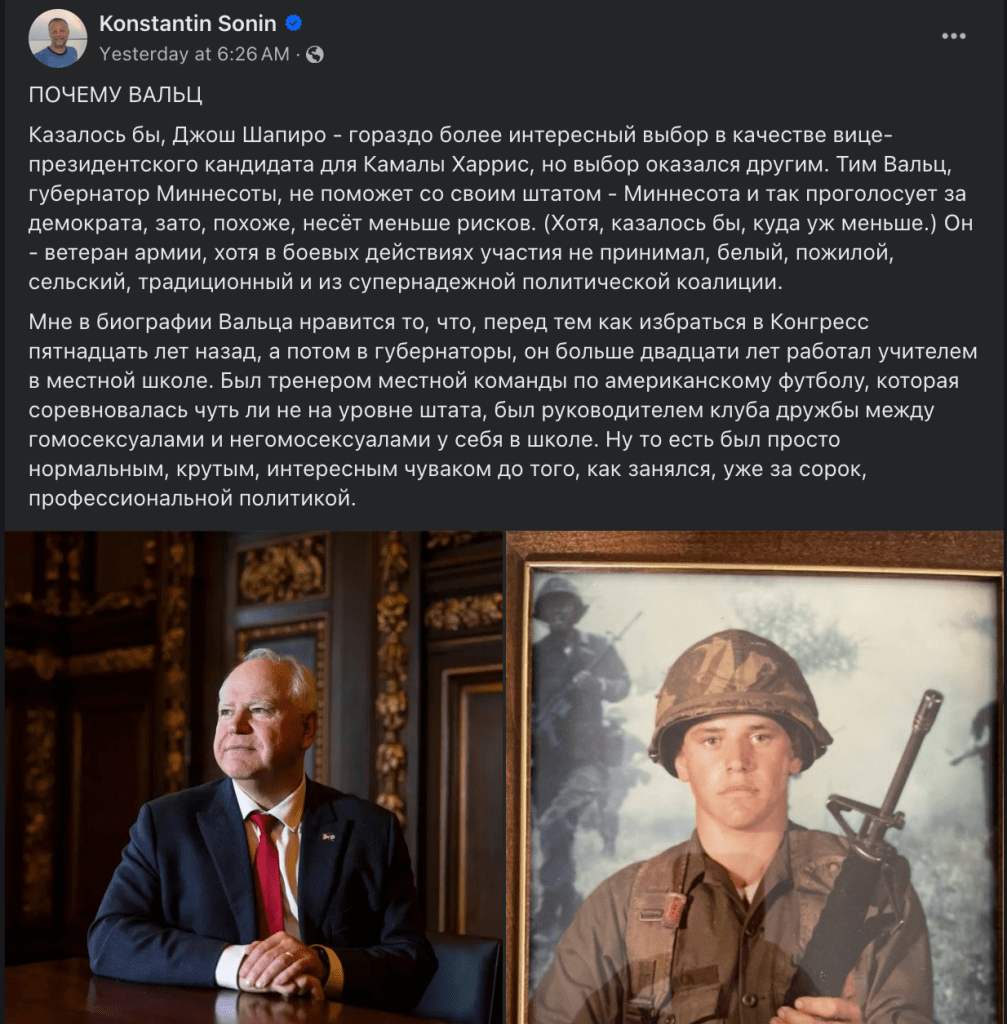
WHY WALTZ Josh Shapiro would seemingly have been a much more interesting choice as a vice presidential candidate for Kamala Harris, but her choice was different. Tim Walz, governor of Minnesota, won’t help with his state—Minnesota will vote Democrat anyway—but seems to pose less risk. (Although, it would seem, how much less risk could he pose?) He’s an army veteran, although he wasn’t in combat. He’s white, elderly, rural, and traditional, and he’s from a super reliable political coalition.
What I like about Waltz’s biography is that, before being elected to Congress fifteen years ago and then to the governorship, he was a teacher at a local school for over twenty years. He coached a local American football team that competed almost at the state level, and he was the head of the homosexual/non-homosexual friendship club at his school. I mean, he was just a regular, cool, interesting dude before he went into professional politics in his forties.
In late July 2024, 39-year-old pianist Pavel Kushnir died in a Birobidzhan pretrial detention center. His musician friends and musicologists have no doubt he was a genius. Many of them had been unaware of his arrest in May 2024 on charges of “publicly calling for terrorist activities.” The grounds for his arrest were his anti-war videos, although his YouTube channel had only five subscribers at the time.
According to close friends, Kushnir himself had wanted to go “far from the capitals,” so he chose Birobidzhan hoping that he would not be forced to perform WWII Victory Day concerts amidst the ongoing war against Ukraine. As soon as the war started, Kushnir wrote social media posts opposing it, posted antiwar leaflets, and staged hunger strikes in protest. Before he was taken to the detention center, he had gone on at least two protest hunger strikes, one of which lasted for over one hundred days.
“He was almost a professional faster, so I don’t think he could have died in the pretrial detention center solely due to that,” his close friend Olga Shkrygunova told Okno.
“We Live in a Fascist Society”
“I am a musician, a pianist, and I graduated from the Moscow Conservatory, where I studied under Victor Merzhanov. I worked as a soloist at the Kursk Regional Philharmonic for seven years, and as a soloist at the Kurgan Philharmonic for three years. I have also tried my hand as a writer, and published an anti-war novel called ‘Russian Mash-Up’” was how Kushnir introduced himself in one of the interviews his friend Olga quoted to Okno.
Kushnir was born in Tambov, where his closest relatives still live. He studied at the music school and the Rachmaninoff Music College in Tambov. After graduating from the Moscow Conservatory, he worked in the Kursk and, later, the Kurgan philharmonic orchestras. In 2023, Kushnir was appointed soloist to the Birobidzhan Regional Philharmonic, and he was arrested in Birobidzhan in May 2024.
The person closest to him, his father Mikhail Borisovich Kushnir, a music school teacher in Tambov and a promoter of musical cognition, died several years before the Russia-Ukraine war started. Many of his friends note that had Kushnir senior lived to see this day, he definitely would not have survived his son’s death.
“They had a very close relationship. Mikhail Borisovich had great faith in him and was proud of him. They laughed a lot together, and he was very supportive of him,” Olga recalls. “The loss of his father was hard for [Pavel].”
Kushnir’s friends invariably call him super-talented, and even more often they call him a brilliant pianist.
“Pasha was just an incredible person. Ever since he was a child, everyone has talked about his incredible ear for music. For me, he was always a genius, both as a person and as a musician. A genius is an idealist who brooks no compromise, who battles on behalf of love, creativity, and freedom. His inexhaustible imagination knew no bounds. He once studied the language of Avatar and wrote a poem in it. He loved the cinema and knew it well, and he read a lot. He loved Vonnegut’s Cat’s Cradle. He wrote an anti-war novel, Russian Mash-Up: it is an original dystopia with references to Russian literature, and the main idea is to denounce the state dictatorship. Pavel was able to send me the manuscript of the new novel by mail. I hope that we friends of his can pool our efforts and publish it soon,” says Olga, who left Russia for Germany in 2012.
It was then, twelve years ago, that Kushnir last visited Shkrygunova in Moscow. In May 2012, he went to Bolotnaya Square to take part in the large-scale protests that were sparked by the fraudulent elections to the State Duma.
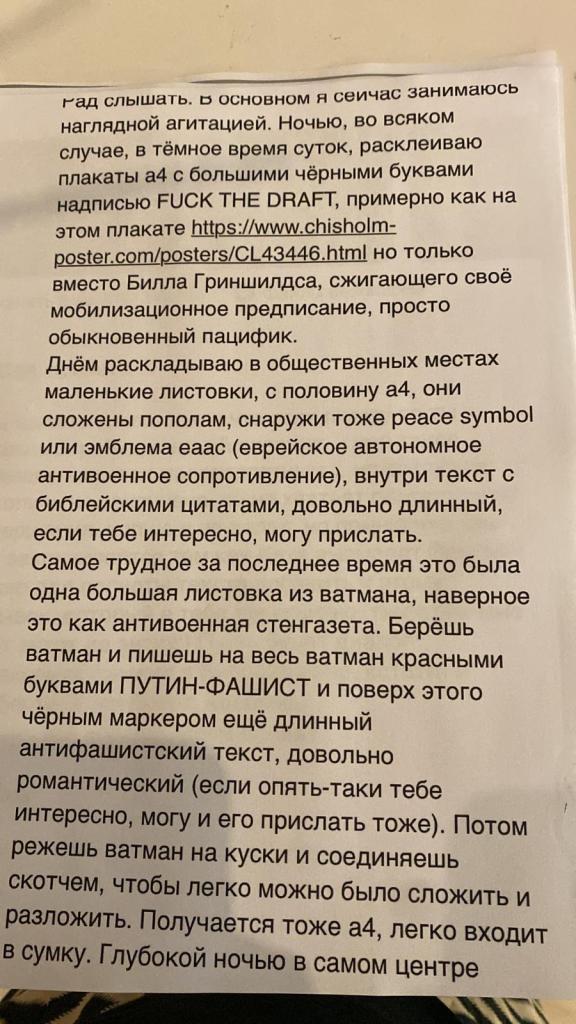
Kushnir’s description of his anti-war leafletting in Kurgan.
“He still believed back then that things could be fixed,” Olga says, sighing. “I know that Pavel protested the war in 2018 by going to pickets against the annexation of Crimea and the war in Donbas. When in May 2018 he went to Pushkin Square [in Moscow] holding a placard that said ‘Down with war, freedom for Russia,’ his homemade sign was torn apart [by police]. After the military invasion, he bitterly observed that nowadays [the police] would tear him apart at such a picket. So, he replaced pickets with leaflets, and leaflets with hunger strikes. They were his form of protest against fascism. He didn’t argue that we should give up picketing, but he understood that it required great courage, ‘because we live in a fascist society,'” Olga quotes her friend as saying.
As Kushnir admitted in his letters to friends, “the turning point and epiphany” for him had been Bucha.
“I think that the Bucha massacre is a disgrace to our motherland. Fascism is the death of our motherland. Putin is a fascist. Our motherland sacrificed millions of the best lives so that fascism would not exist, and we will not accept it. The criminal, despicable war which Putin’s fascism has been waging in our name is a challenge to my conscience, to all my personal hopes, to all the best things in me. I am sure I am not alone. For many people of my generation, accepting the war, ignoring the war, is unthinkable. Two nations are dying in this war. It must be stopped as soon as possible,” Olga quoted him as saying.
In 2022, Kushnir produced anti-war leaflets and posted them around Kurgan.
“At night, he put up large A4-sized leaflets, and during the day he put up small ones with peace symbols and biblical quotes in public places,” says Olga.
“Hunger Striking Is a Peaceful Form of Protest”
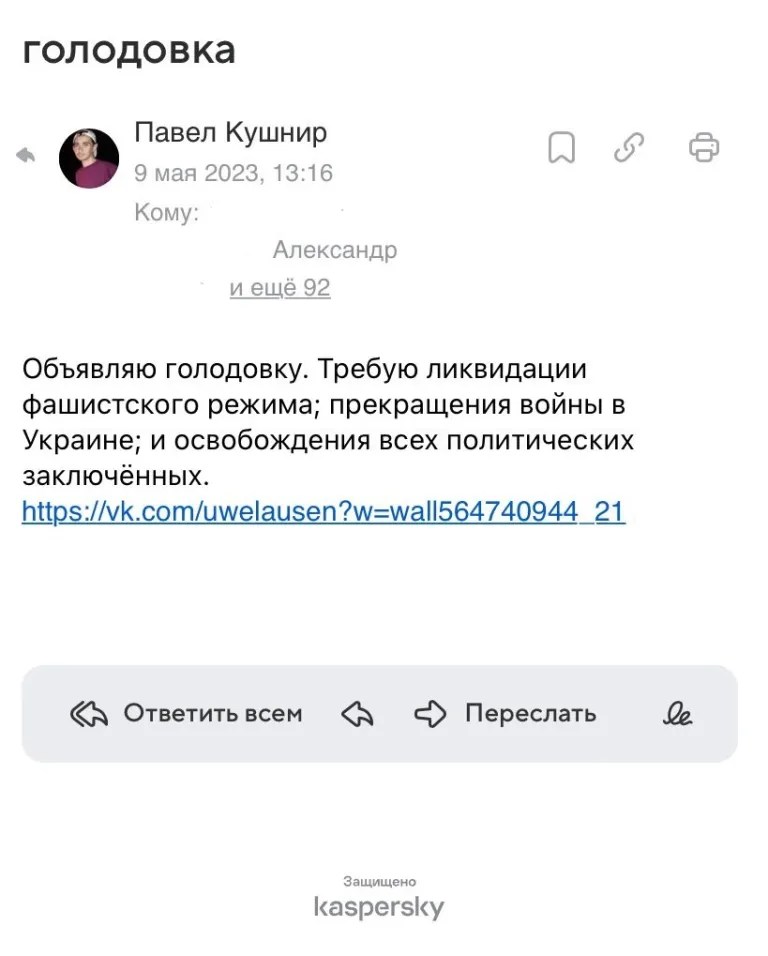
On 9 May 2023, Kushnir declared his first hunger strike, which was to last twenty days.
By his own admission, Kushnir did not expect a positive response from the authorities, but he hoped that other people would embrace his peaceful form of protest.
“I expect people to think hard about their attitude to the war, to end their silence. I expect a miracle,” he wrote.
According to his friends, Kushnir easily tolerated hunger and scheduled his next hunger strike, which was to last one hundred days, in the winter and spring of 2024.
“He went on and off [hunger strikes] absolutely systematically,” says Olga. “In March, when he had finished, he called us to say that everything was fine, that he felt good. He had been drinking water, apple juice, and coffee. As an illustration of his hunger strike, he suggested we imagine a glass of apple juice. So I don’t think he could have died from the hunger strike alone. I don’t believe it. I can’t rule out that they could have beaten him up in the detention center or in some other way they exacerbated his condition.”
In late May 2024, Kushnir was detained by the FSB. A criminal case was launched against him on charges of “publicly calling for terrorist activities” (per Article 205.2 of the Russian Criminal Code). The community Vkontakte page Atypical Birobidzhan was the first to report Kushnir’s arrest, claiming that four videos posted on Kushnir’s YouTube channel had served as grounds for the charges. It also reported that Kushnir was allegedly found in possession of a “homemade FBI agent’s ID.”
The short anti-war video which Pavel Kushnir posted on his “Foreign Agent Mulder” YouTube channel on 5 January 2024
“Pavel had been running the channel ‘Foreign Agent Mulder’ since 2011, and there are only four videos posted there. All of them criticized the war and the policies of the current Russian government. Before Pavel’s death, the channel had exactly five subscribers,” says one of Kushnir’s friends. “Now there are [507] subscribers.”
Many of his friends first learned of Kushnir’s death in late July and only then that he had been behind bars when he died.
“Unfortunately, Pavel’s arrest has come to light only now. I, for example, do a monitoring of court proceedings in the regions quite often, but I missed the news of Pavel’s hearing… I think this was a case when publicity could have saved the prisoner. I learned about Pavel’s death from Arshak Makichan, with whom I was involved in environmental activism; Arshak later left Russia, but he had known Pavel at the conservatory. I think that the intervention of such well-known activists in the case could have prevented Pavel from taking such a desperate step,” says Marina, an activist who corresponds with political prisoners. “Pavel’s cellmates testify that his death resulted from a dry hunger strike, and there is no reason not to trust them. As I understand it, the family is afraid of publicity, as the Moloch of the political crackdowns may strike them as well, so we don’t really know anything yet. But if you watch Pavel’s interviews and listen to his statements, I think it is clear that he was a man of genius, a talented, brilliant, and sensitive man. Unfortunately, such people do not have the ability to stand up to brute, base force, and the only protest that was available in the pretrial detention center was a hunger strike, apparently. Many anti-war activists—Ivan Kudryashov, Maria Ponomarenko, and dozens of others—have gone on hunger strike. When there is no communication with the outside world, no media contacts, alas, this is all that is left to a person. It’s scary to imagine what Pavel went through. The country has yet to realize who we have lost.”
Anna Karetnikova, a human rights activist who for many years aided prisoners as a member of the Moscow Public Monitoring Commission and, later, as a lead analyst in the Federal Penitentiary Service’s Moscow office, argues that the official cause of Kushnir’s death will not be listed as hunger strike, even if that was the cause. According to her, concealment of the real cause of death is a common practice in the Russian penitentiary system, so there are no statistics for hunger strikes in pretrial detention centers and penal colonies.
Pavel Kushnir’s messenger service announcement of a hunger strike, dated 9 May 2023 (celebrated in Russia as WWII Victory Day): “I’m going on a hunger strike. I demand the liquidation of the fascist regime, cessation of the war in Ukraine, and release of all political prisoners.”
“Pavel Kushnir’s death in the Birobidzhan pretrial detention center has been attributed to his hunger strike, a dry hunger strike in which the detainee refuses not only food, but also water. In my experience, cases of hunger strikes in places of detention are frequent and fall into two main categories: those triggered by criminal cases, and those protesting conditions of detention. They can be both for serious reasons, such as gross violations of human rights, and for trifling reasons, such as an investigating officer refusing to bring an inmates cigarettes. They can also be individual and collective. But dry hunger strikes are quite rare, because most detainees realize that it can eirquickly lead to th death,” says Karetnikova. “The law provides for a detainee’s refusal to eat, but it also stipulates what actions wardens should take in such cases. After receiving a written application for a hunger strike, the wardens at a pretrial detention center must notify the person in charge of the criminal case, as well as the supervising prosecutor. In addition, the hunger striker is entitled to a daily checkup by a doctor, during which their temperature, blood pressure, and weight are measured and recorded, and, if possible, to be placed in a separate cell from which all food has been removed. Every day, they will be brought food, which is left on a table, or on the feeder tray if it is open. Also a mentor will come and try to persuade them to give up this waste of time. Information about hunger strikers in each institution is entered daily into the penitentiary service’s overall statistical summary.”
“Forced feeding of detainees is provided for by law. Most often, in agreement with the hunger striker, they are given glucose drips, possibly with something else added to the mix to support them. If their lives are threatened, they can be force fed through a tube.”
“I don’t think hunger strike was listed as the cause of Kushnir’s death, however. I think that only his relatives and friends and cellmates knew that he was on a hunger strike. Even after the publicity, for example, a medic could be punished if he forgot to perform certain formalities— for example, doing a physical examination and taking the inmate’s temperature. He could be reprimanded and, at worst, dismissed. In a similar case, the head doctor of the hospital at the Matrosskaya Tishina prison in Moscow was fired. Of course, no one explained the reasons for his dismissal, and a different cause of death was listed . But the [inmate] had been quite emaciated, and it was feared that the truth could come out. If it had come out, [the doctor] could have been jailed for negligence, for example, or endangerment.
“Force feeding is not practiced as a matter of principle in Russia, because, for example, in order to force feed Alexander Shestun[the ex-head of the Moscow Region’s Serpukhov District (2003–2018) and chair of its Council of Deputies, Shestun was sentenced to fifteen years in a penal colony on charges of fraud and money laundering, but Memorial listed him as a political prisoner] they contacted headquarters a hundred times, since they could not understand what to do and how to do it. But they didn’t get any reasonable instructions from headquarters either, except ‘do something or we’ll punish you,'” Karetnikova says.
According to Karetnikov, the hunger striker loses weight, their vitals deteriorate, and sometimes they are unable to walk.
“There are stomach pains, different organs can fail, and in the long term, people can become confused and sometimes go crazy. Some people engage in self-harm. This is not the case with dry hunger strikers: I usually was able to convince them to give up, in exchange for my promises to do something to help, promises which I tried to keep,” says Karetnikova. “Some detainees starved for months. The longest well-known hunger strikers included Nadiya Savchenko, Alexander Shestun (who was subjected to force feeding), Sergei Krivov, and many other people who were released, but whom I don’t want to identify here. One of the hunger strikers was a stoma patient. One can live without food for about two months, on average. However, many hunger strikers took week-long breaks that enabled them to go without food for months at a time, and they were also put on IVs while on hunger strike. If you give up water too, you can die within a week.”
“He Played for God”
After Kushnir’s death, it was revealed that that he had long foreseen his own arrest, as evidenced in correspondence with his friends.
“He often wrote ‘I haven’t been jailed yet,’ and he sent me interviews where he openly spoke of the current system in Russia as fascist. I tried to persuade him, especially when he was looking for a new place to work a year ago, to come to Germany. I said we would take him in and he would find a job. He agreed but then immediately refused to write a bio, which is what you have to do if you want to play concerts. Those are laws of the music market, what can you do. But he was uncompromising: ‘I am a musician, my music speaks for me,'” Olga recalls. “Then there was the hope that he would be hired in a remote city, as he had decided to stay in Russia. Basically, he strove to be far from the capitals, so that the political pressure would be minimal. For example, he did not want to be forced to perform those selfsame Victory Day concerts.”
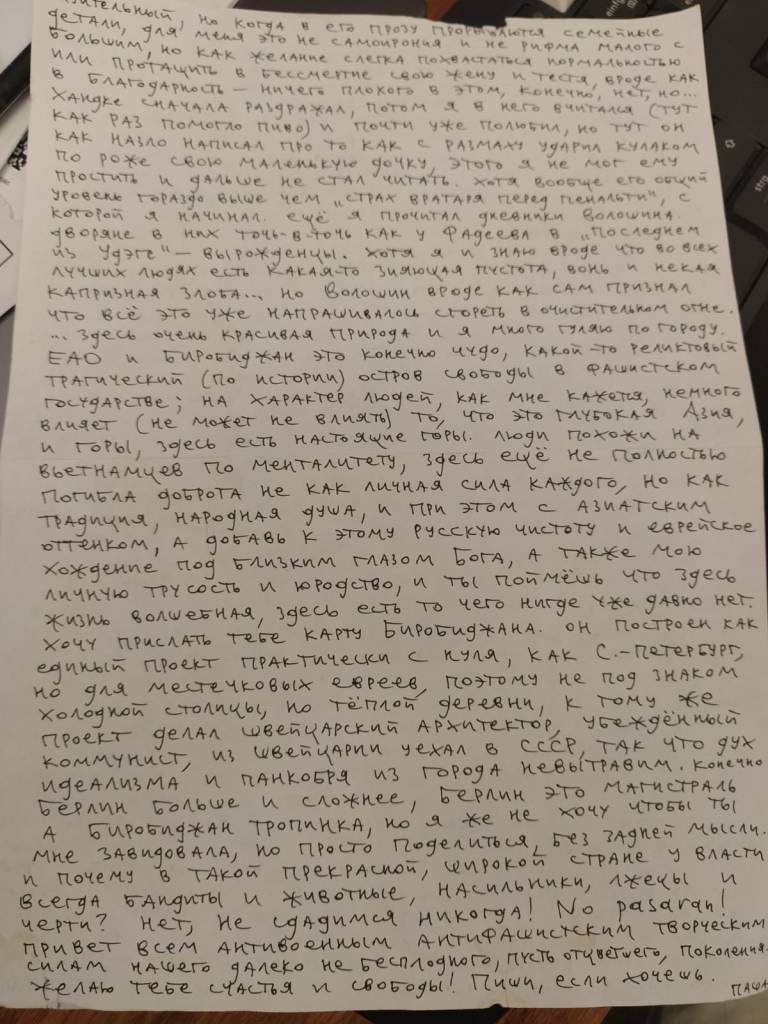
“Maybe I’ll be able to get a job in Russia. Anyway, I had an audition for the Philharmonic, and it seems to have gone well. Anyway, they treated me well, even though I have a ‘no war’ status on my Facebook page… or maybe they just didn’t notice it,” Pavel wrote to Olga at the start of his tenure with the Birobidzhan Philharmonic. “I traveled across the entire country on the Moscow-Vladivostok train, and I looked out the window at the nature, at the people in the parlor car. We have a tragic country, and miserable, predatory people, but so much beauty. We can’t give it to the fascists. Before the audition I ate, so my hunger strike demanding an end to the war was a waste of time. (I had held out for more than twenty days after all.) Probably, a person is free in everything except their own profession. It holds you and doesn’t let you sink, but it also doesn’t let you soar. It’s an anchor of normality.
A letter from Pavel Kushnir to a friend
Kushnir often gave interviews, and the All-Russia State Television and Radio Broadcasting Company even did a story about him. In one of his conversations with journalists, the pianist said that he planned to stay in Birobidzhan: “I had an audition [with another orchestra] but I canceled it. I decided to take a risk to stay and work here for twelve years. If I am not imprisoned, drafted into the army, or fired, I hope I will be with you for the next twelve years.”
“He just wanted to play. Without ingratiating himself to anyone, without making connections, without bending to anyone. Apparently, the ‘plain old’ cities of Russia, unlike Moscow, seemed to him better suited for this. He spoke fondly of Birobidzhan, sent me a map [of the city], and told me that he goes on walks there a lot,” Olga says. “I think he could have been happy there. He could have been happy in any place where you could just say what you think and do what you think. He had a lot of faith in God. He played for God. Maybe now he’s found that place.”
Pavel Kushnir’s concert recordings, even the most amateurish ones, garnered thousands of views, unlike his YouTube channel.
“Pasha Kushnir was in our class,” writes his Moscow Conservatory classmate Julia Wertman.
“We became friends somewhere in the middle of third year, I don’t remember exactly when,” she continues. “We lived in the dormitory, and there was a time when he would often visit my roommate and me for a glass of tea.
“Pasha would recite Brodsky from memory for hours, for days on end. Pasha had a shabby beige overcoat with a bulging pocket. Under the coat he was always dressed in black, and a half-liter bottle of vodka often stuck out of his pocket. (In most cases, it was just there for image. Pasha cultivated the image of a dissident, as if he were Venedikt Yerofeev.)
“Pasha could avoid sleeping, eating, or living, and yet still play absolutely stunningly. There’s an interview with him, linked to in the comments, in which he talks about some genius contemporaries who could prepare for a solo in half an hour under any conditions. As far as I remember, Pasha himself was like that.
“Once, at five in the morning, I went to the dorm kitchen to make breakfast. An incredible scene unfolded before my eyes. Kushnir, as clear-headed as piece of glass, stood at the open window and gazed at Malaya Gruzinskaya Street with a sad, detached look. Before him, a drunken German student with whom he had been living it up way past midnight was crawling on his knees. The German’s speech was so slurred that not even his accent was audible. He was literally sobbing a river of tears.
“‘Brother! Forgive me! Forgive me if you can, for….. Forgive me!’ [he said]. ‘Forgive my grandfather, forgive my great-grandfather, forgive me!!!’
“One Hanukkah, he brought my roommate and me a menorah and candles. I had very little idea at the time what to do with them. I only remember reading on the label: ‘The light of the Hanukkah candles reminds us of G-d’s constant presence in our lives.’
“That was when we nicknamed him ‘Hasid,’ a nickname that stuck.
“‘That’s good,’ Pasha said. ‘Yes, call me that. I think it suits me…’
“Then Hasid showed up at the prom. My favorite person and I were drinking champagne and eating leftover cake. While all the graduates were eating the cake, we danced a waltz somewhere that only we could hear. And G-d knows where Kushnir had been, but he too came have a last piece of cake.
“‘Guys! Be happy! Cheers, guys! [he said]. ‘The main thing now is not to fuck away your diploma!’
“We were only happy for a little while. Hasid went back home to his dad in Tambov, and we went to graduate school. That is, we didn’t fuck away our diplomas. On the contrary, we got PhDs. You basically know what happened after that.
“I tried several times to find the pianist Pavel Kushnir. I found show bills, all of them for concerts in provincial towns. Two years ago, I found out that he was in Birobidzhan. I thought, Well, he’s getting closer to his roots, so maybe he’ll come [to Israel] soon.
“But he didn’t come. Instead, he wound up on on an Israeli news feed, and from there, just now, he came to my attention.
“Was he a rebel? Was he openly calling for some kind of nightmare? I don’t think so.
“He always said what he wanted to say. He didn’t bite his tongue. He wasn’t swayed by stereotypes. He didn’t fit into any system. He lived his own life, thought his own thoughts, and searched his own search. He tried to get to the heart of the matter, like Pasternak. But in all other respects, he was probably more like Vysotsky.
“Hasid, I don’t know what your mother’s name was. Pavel, son of Mikhail, a great pianist, may your memory be blessed.
“And there will be Hanukkah, and there will be light.”
“We will defeat the ogres, and their descendants will ask our forgiveness again.”
Experiencing all of the Tiny Desks this Black Music Month has made many of my dreams come true, and Meshell Ndegeocello’s performance was no exception. For 30 years the Grammy-winning artist’s music has cast an unflinching gaze on love, race, sexuality and religion. Her new album out in August, No More Water: The Gospel of James Baldwin, zooms out to focus on the love of humanity as inspired by the writer and civil rights activist.
Her performance includes three songs from that album, starting with “Travel,” which features Kenita Miller’s swirling whispers alongside Jake Sherman’s organ and Ndegeocello’s bass, which ushers us into her church service. “Thus Sayeth The Lorde” references the writings of Audre Lorde: “If I did not define myself for myself, I’d be crunched into other people’s fantasies for me and eaten alive.” This conviction has been the binding agent of Ndegeocello’s career. Releasing her debut album at a time when many of the women who dominated Black music were singers who adopted an ultra-feminine aesthetic, as a bassist and vocalist she gallantly eschewed that standard for androgyny, fully embracing her queer, two-spirit identity.
“Love” continues this theme, urging you to allow love to take over and accept yourself in the face of existential crisis. The final songs of Ndegeocello’s Tiny Desk Concert are fan favorites. First, we’re sent off into space with the playful “Virgo,” from Ndegeocello’s album The Omnichord Real Book. Then she brings us back to Earth with the yearning “Outside Your Door.”
SET LIST: “Travel,” “Thus Sayeth The Lorde,” “Love,” “Virgo,” “Outside Your Door”
The Kremlin has sent recommendations to state-run and pro-government media outlets on how to cover the prisoner exchange between Russia and the West, Meduza has reported, citing sources close to the Russian presidential administration and a source in a major Russian online media outlet. The presidential administration has not prepared detailed instructions this time, the publication notes.
The mass media have been advised that when mentioning the names of Russian political prisoners, they should cite the crimes of which they were convicted, such as “discrediting” the army, “espionage,” or “treason,” as well as the terms of imprisonment to which the court sentenced them.
The presidential administration thus wants to emphasize that “saboteurs and traitors, their own agents, were handed over to the West,” one of the sources explained to Meduza. “Quote: nothing terrible has happened—we got rid of some unwanted people,” they said. Another of the publication’s sources, a political scientist who gives official comments on state-run and pro-Kremlin media, holds a similar view.
On the contrary, when reporting on those who have been returned to Russia after the prisoner exchange the media have been told to say they are people who “worked for their motherland.” In particular, when discussing Vadim Krasikov—an agent of the Russian security services who murdered former Chechen commander Zelimkhan Khangoshvili in central Berlin in 2019—the mass media are urged to say that he “eliminated the enemy.” One of the publication’s sources suggests that Vladimir Putin will want to make Krasikov a public figure, as he did with Maria Butina and Victor Bout, but so far the presidential administration has not received any such instructions from the president.
I see that I’m quoted on the web all the time in connection with Shaman and other bastards. Yes, I have had to write a lot about them in the line of duty. But it would be a shame if I were to die tomorrow and be remembered for only this. I want to share something more interesting with you, music I’ve been listening to lately. Oddly enough, there’s very little outward political protest in this music.
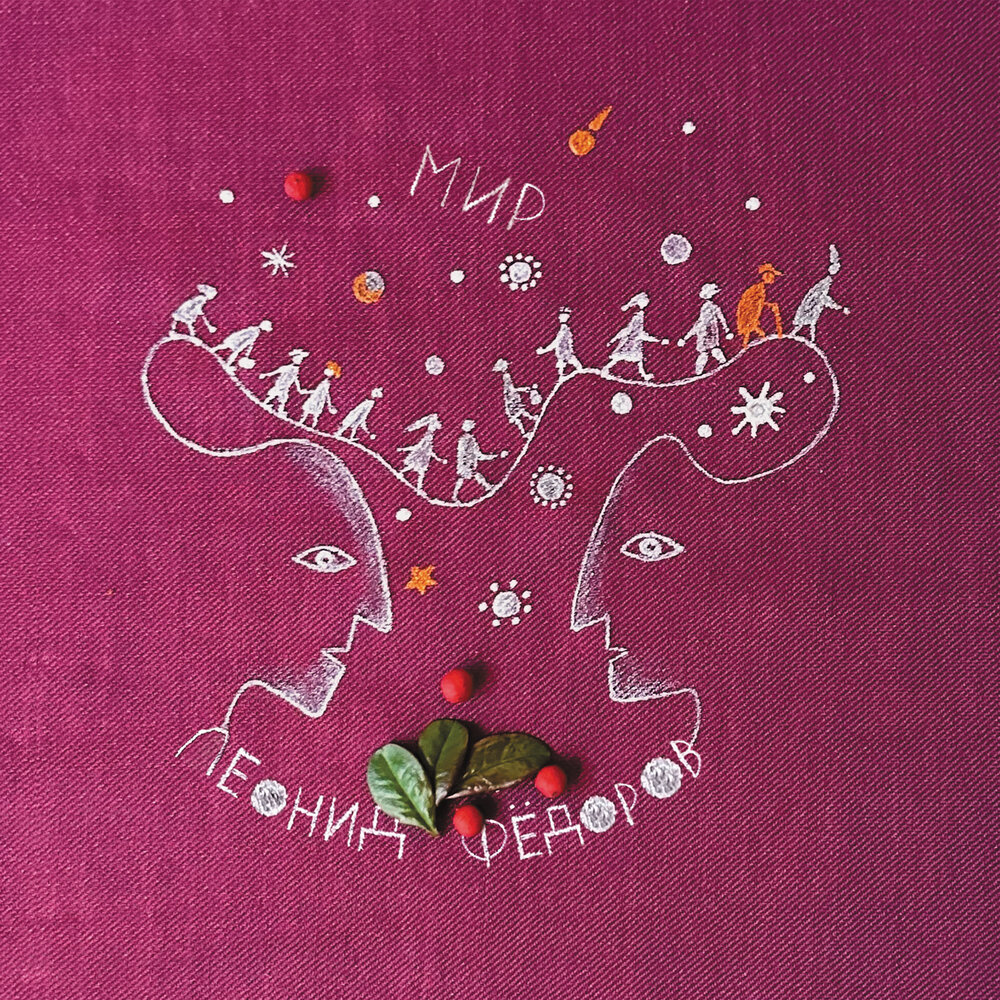
Leonid Fyodorov has released an album entitled Mir [which means both “peace” and “world” in Russian]. Yes, I do recall that it [peace? world?] is a forbidden word. We understand what Fyodorov’s stance [on the war?] is, although he doesn’t say anything outright, but then again he is not a person who can be measured in terms of his [political] stance — his music is much more interesting. His music is always strange, chockablock with dissonances, avant-garde twists, noises, and sudden pauses. He doesn’t write songs that are not odd.
And this is despite the fact that Fyodorov is an amazing melodist, one of the best in Russia. But he creates melodies of astonishing beauty, sings them in his magical voice, and in the middle of the melodies he inserts unbearable guitar scrapes or something of the sort, as if he wanted to show that he didn’t believe in the very possibility of harmony. I once asked him about it, and he said something like, “It’s the times, I guess. I feel it’s the right thing to do.”
I got so used to it that I was expecting the same thing from every new album. Yes, the album was going to be great, but it was clear in advance exactly how it would be great. Even weirdness can become familiar and predictable.
Suddenly, over the last few years, I see that something has changed. I listen attentively: almost ubiquitously in Fyodorov’s songs there’s a perfectly even, constant rhythm and repetitive bits in the arrangements. In our country, however, even when I was at school, this has been considered a sign of bubblegum pop. There is nothing to it, in point of fact: you turn on a simple drum machine track and out comes fucking “White Roses” or “Svetka Sokolova.” There’s no creativity involved.
But a craftsman of Fyodorov’s stature doesn’t do anything for no reason. If he had wanted to make the rhythm more complicated, he would have made it more complicated. So he has to do it: he’s trying to say something.
I close my eyes and suddenly I see a river flowing. It flows swiftly, swiftly, and birds of prey circle above it. They are shrieking, trying to scare it, but it cannot be stopped. But they are really trying to scare it with all their might, and at times the music is quite scary.
And the lyrics have become different. Fyodorov used to employ lyrics (most often penned by Dmitry Ozersky) like a musical instrument. He had little interest in their meaning: he was mainly interested in how they sounded, how they fit the music. There was a lot of cosmic absurdity, a lot of onomatopoeia and, again, a lot of weirdness. They were lyrics, not poems.
What do we hear now? Almost the entire album consists of perfectly regular couplets with proper rhymes. The lyrics are eminently intelligible and designed to be listened to carefully.
На вопросы есть ответы. Бедный мальчик, где ты, где ты? Сам как будто маленький, Но как будто старенький. Было грустно, стало пусто. У меня такое чувство, Что зачем-то, почему-то Мы не нравимся кому-то.
[Questions have answers. Poor little boy, where are you, where are you? You look like you’re little yourself, But you look kind of old. I was sad and now I’m empty. I have this feeling: For some reason, for some reason Somebody doesn’t like us.]
The strange thing is that the music is quite sad, restrained, and expressionless. [Fyodorov] sings as if the jig is up and there’s no point in trying. But the music goes on anyway, and you can’t stop it. Fyodorov’s strange fluidity gives hope for life and peace. You can defeat man, beast, and the state, but you cannot defeat water.
The video for “Mir” (“Peace” or “World”), the title track of Auktyon frontman Leonid Fyodorov’s 2024 solo LP
Следите за нами, смотрите за нами, Идём в путешествие между мирами, На лестнице странной находится вход, Чтоб прыгать обманно, ногами вперёд. Дверь спрятана в мире 134, Здесь люди похожи на крем на зефире, Мы здесь никого ни о чём не попросим, А спрячемся в мире 178. И тут же ныряем в созвездие Звон, Здесь звон геликоновый с разных сторон, И мы принимаемся сразу за дело, Чтоб громко гремело и звонко звенело. Приятно орудовать палкой железной — И звук интересный и опыт полезный. А в мире 14 дяди и тёти. Они сразу спросят: «А где вы живёте? А как вас зовут? А конфетку хотите? Уходите? Ладно, тогда уходите… У нас здесь не любят врунов и смутьянов! Здесь мир тараканов и мир хулиганов!» Планета 15, и смотрим мы на… Здесь нет ничего, здесь одна тишина. На это приятно смотреть и занятно, Что нет ничего, лишь какие-то пятна. Есть мир номер 8 и мир номер 3, Здесь 5 человек заблудились внутри, У них не осталось ни воли, ни мнений, И скорбно блуждают в тени отражений. И плачут во сне, и глаза прикрывают, Кричат: «Нам противно, таких не бывает», Кричат: «Уходите!», и машут руками, А это они отражаются сами. Планета 14-76! Здесь что не придумаешь — всё уже есть. Приятно девчонкам, приятно мальчишкам, Здесь весело — очень! Но, тоже, не слишком. Есть Розовый Штрудель и Мир Голубой. Где люди бессмысленно спорят с собой. Они отрицают, что есть и что будет, И спорят с судьбой. Интересные люди. На лестнице странной, в созвездии странном, В краю безымянном, в щели под диваном, Есть радостный мир, под названием «Где-то», Здесь море и солнце, и вечное лето, А рядом, конечно, находтится «Что-то», Здесь только дремота, тоска и зевота, И петь неохота, и лень веселиться — Я чувствую: что-то должно приключиться… Бежим — нас преследует Мир Сорок-дыр! Он ловит детей — это призрачный мир! Здесь только часы, и нельзя оставаться, Здесь можно в себе навсегда потеряться Здесь всё забываешь, и сны и мечты И сам не узнаешь, что ты — это ты! И будешь ходить и дрожать еле-еле… Успели, наверное… Если успели. Есть мир Вычислитель и Чёрная Кошка. Приятно, что каждый из них понарошку. Есть мир Колесо и созвездие Спящий. Ужасно, что каждый из них настоящий… Есть мир Крокодил и вселенная Горе. Пожалуй, заделаем дырку в заборе.
Follow us, watch us, We’re going on a journey between worlds. On a strange staircase the entrance is such That you leap deceitfully, feet first. The door is hidden in World 134, Where the people are like the fluff in a marshmallow. We won’t ask anyone here for anything, But we’ll hide in World 178. And then we dive into the Ringing Constellation: There’s heliconic ringing from every corner, And we get right down to business Loudly rattling, jingling and jangling. It’s nice to wield a rod of iron — It’s an interesting sound and a rewarding experience. There are uncles and aunties in World 14. They’ll ask you right off the bat, “Where do you live? And what’s your name? Would you like some candy? Are you leaving? Okay, then go away… We don’t like liars and troublemakers here! It’s a world of cockroaches and a world of bullies!” Planet 15, and we’re looking at — There’s nothing here, there’s only silence. It’s nice to look at and entertaining That there’s nothing, just spots and specks. There’s World No. 8 and World No. 3, There are five people lost inside, They have no will, no opinions, And wander mournfully in the shadows of reflections. They cry in their sleep and cover their eyes, They shout, “We’re disgusted, such people don’t exist.” They shout, “Go away!” and wave their hands, And that’s them reflecting themselves. Planet 14-76! Whatever you can think of, they’ve got it all. It’s nice for the girls, it’s nice for the boys. It’s a lot of fun! But it’s not too much fun either. There’s Pink Strudel and Blue World, Where people argue senselessly with themselves. They deny what is and what will be, And argue with fate. Interesting people. On a strange staircase, in a strange constellation, In a nameless corner, in a crevice beneath a sofa, There’s a joyful world called Somewhere, There’s sea and sunshine and eternal summer. And next door, of course, there’s Something. Here, there’s only slumber, languor and yawning: You don’t feel like singing, you don’t feel like having fun. I feel something’s going to happen. Come on, we’re being chased by World Forty-hole! He catches children, it’s a ghostly world! There’s only hours and you can’t stay here. Here you can lose yourself forever. Here you forget everything, your dreams and your hopes, And you’ll never know you’re you! And you’ll walk around shivering. They must have made it. If they did make it. There’s the world of the Calculator and the Black Cat. It’s nice that each of them is made-up. There’s the world of the Wheel and the Sleeper Constellation. The terrible thing is that each one is real…. There’s the world of the Crocodile and the universe of Woe. Let’s patch up the hole in the fence.
Source: Leonid Fyodorov (YouTube), 14 April 2024. Music: Leonid Fyodorov; lyrics: Dmitry Ozersky; video: Lydia and Leonid Fyodorov. Translated by the Russian Reader
Memorial for actor Joachim Gottschalk. When his Jewish wife Meta and son Michael were to be deported, the whole family decided to commit suicide on November 6, 1941. The bronze figure, which was created by Theo Balden in 1967, resembles the actor. It was initially located in a park but had to be moved due to the building of the local Sparkasse in the 1990s. Its new place is a memorial wall in the Joachim-Gottschalk-Straße 35.
The Impact of the Gold Rush on Native Americans of California
This inquiry lesson provides primary sources, maps, images, and background history to offer teachers and students insight into a little-known but vitally important aspect of one of the most iconic events in American history—the California gold rush. Students will analyze sources to answer the question: Do American actions against California Native Americans during the gold rush meet the United Nations definition of genocide?
The attitude of César Chávez and the UFW towards the undocumented changed over time and can be divided into three periods: 1962 to 1975; 1975 to 1993; and 1993 to the present. A look at these changes reveals much about Chávez, the union, and the times. Frank Bardacke is the author of Trampling Out the Vintage: César Chávez and the Two Souls of the UFW.
Whenever an infant heads to nursery, it can feel like an enormous step. Things are changing for everyone. There are all sorts of feelings flying around – relief, sadness, doubt, fear. But what’s going on behind the doors of nurseries and childcare settings in England? India speaks to Joeli Brearley from Pregnant Then Screwed about the current childcare crisis, child development psychotherapist Graham Music about how childcare impacts children, as well as economist Emily Oster on our choices around childcare. India then meets artists Conway and Young who have found a way to make the invisible labour of childcare pay.
Presented by: India Rakusen. Producer: Georgia Arundell. Series producer: Ellie Sans. Executive producer: Suzy Grant. Commissioning Editor: Rhian Roberts. Original music composed and performed by The Big Moon. Mix and Mastering by Charlie Brandon-King.
Childbirth is deadlier in the United States than in any other high-income nation, according to a study released Tuesday by the Commonwealth Fund that underscores the persistence of maternal mortality.
More than 80 percent of pregnancy-related deaths in the United States are preventable, but factors including a shortage of maternity care providers, limited access to after-birth home visits and lack of guaranteed paid parental leave have increased the risk of maternal mortality, especially for Black people, researchers have found.
In 2022, about 22 maternal deaths happened for every 100,000 live births in the United States. For Black people, that number rose sharply to 49.5 deaths per 100,000, according to the report from the Commonwealth Fund, which conducts independent research on health-care issues. Two out of three maternal deaths occur up to 42 days after birth, highlighting the importance of postpartum care, which only some state Medicaid programs and private health insurers cover.
The study compared 14 high-income countries. It used data from the Organization for Economic Co-operation and Development — known as the OECD — which tracks health system metrics across 38 high-income countries, and from the Centers for Disease Control and Prevention Maternal Mortality Review Committees in 36 states.
Although OECD data is widely regarded as the gold standard for international comparisons, the authors note that discrepancies in how countries gather health data may affect the findings.
“We can’t just think of reproductive health at the time of pregnancy because a lot happens after the baby is born. If we’re not supporting women during this crucial time period, we’re never going to solve this problem,” said Munira Z. Gunja, the study’s lead author and a senior researcher at the Commonwealth Fund.
Ten of the countries listed in the report had a death rate of fewer than 10 per 100,000 live births; in 2022, Norway’s maternal death rate was zero.
Laurie C. Zephyrin, senior vice president for advancing health equity at the Commonwealth Fund, said these numbers paint a stark picture of health care in the United States. She called for more focus on community-led investments, including birth centers and health-care teams working with patients in the weeks before and after delivery. She also said health systems should have incentives and accountability involving equitable quality of care, particularly for communities of color.
With 65 percent of maternal deaths occurring after birth, many health experts emphasize the need for not only more prenatal care but an increase in comprehensive postpartum care.
“We want this to be the cultural norm. We want this to be federal policy. We want there to be a big change because we know that we can completely minimize the rate of maternal deaths in this country,” Gunja said.
Health disparities are not unique to the United States. In Australia, Aboriginal people are twice as likely to die of maternal complications compared with other people giving birth, according to the report. Still, experts are hopeful that policy changes and awareness will help bridge the divide and decrease the overall maternal mortality rate in the United States.
The report highlighted the importance of access to midwives, whose work has been described as an important factor in countries with the lowest maternal mortality rates, the report found. Teams involving midwivescould deliver 80 percent of essential maternal care and potentially prevent 41 percent of maternal deaths, 39 percent of neonatal deaths and 26 percent of stillbirths, the report said.
Some studies have found that teams led by midwives offer care comparable, or superior, to care provided by obstetrician-gynecologists. In the United States, Canada and South Korea, OB-GYNs outnumber midwives, but in most other high-income nations, midwives are more prevalent.
The United States and Canada face a shortage of midwives and OB/GYNs. Almost 7 million people in the United States live in areas without hospitals or birth centers offering obstetric care or any obstetric providers. The shortage is expected to worsen.
“We are setting ourselves up for an absolute reproductive health provider shortage, and contributing to that is this interference into the patient-provider relationship and the restrictions that are being placed on us,” said Tamika C. Auguste, a D.C. OB/GYN and chair of the American College of Obstetricians and Gynecologists Foundation Board who was not involved with the study.
The United States is the only high-income nation without a federally mandated paid parental leave policy and universal health care. Only 13 states and D.C. have paid family and medical leave laws; these policies have been shown to improve health outcomes for pregnant people.
“We are in a dire time in our country, where we’re seeing firsthand the impact of these policy changes at the state level and how they are impacting people’s lives,” Zephyrin said.
In recent years, abortion restrictions have sparked debates and legal battles. State legislatures have been enacting increasingly stringent laws aimed at limiting access to abortion services, such as mandatory waiting periods, ultrasound requirements and bans on certain procedures.
The current wave of abortion restrictions has significantly affected broader health-care services, particularly obstetric care. States that have imposed abortion restrictions often face closure of clinics offering a variety of health-care services, such as cancer screenings, contraceptive services and general reproductive health care. As a result, people in these states encounter greater challenges that exacerbate existing health disparities.
“Women’s health-care providers are being driven out of areas due to the restrictions on practicing full-scope reproductive health care,” Auguste said. “This creates areas where there are no health women’s providers for women.”
The factors that led into the creation of their newest album aligns perfectly with the discussions this podcast is about. Just blocks away from the 3rd Police Precinct that burned down during the protests, Twin Cities country-folk band The Gated Community saw many of their recordings lost due a power outage. But being in the center of burning buildings, gunshots, and neighborly concern, Sumanth Gopinath was compelled to write about it. The result: songs about that tumultuous era that culminated in a new album filled with important issues and topics, which fit perfectly with their existing songs and socially conscious perspective as a band. Sitting around one table, I got to hear about the evolution of a band without egos, which is part of what makes The Gated Community so special.
In his new book, Barons: Money, Power, and the Corruption of America’s Food Industry (Island Press, 2024), Austin Frerick identifies contemporary “barons” in seven different corporations—such as Cargill, Inc., the Driscoll’s and the conglomerate JAB Holding Company—who have taken over food systems and re-shaped communities. Frerick writes in the introduction, “I refer to these people as ‘barons’ to hearken back to Gilded Age robber barons such as John D. Rockefeller and J. P. Morgan because I believe that we are living in a parallel moment when a few titans have the power to shape industries.”
A fellow at theThurman Arnold Project at Yale University and former Treasury Department official, Frerick has been among the leading experts and researchers in competition policy and antitrust examining food industry consolidation. As co-chair of the Biden campaign’s Agriculture Antitrust Policy Committee, he helped advise several of the leading Democratic presidential candidates on agricultural policy leading up to the 2020 election.
Frerick’s interest in the barons of today’s food-industry is also personal. As a seventh-generation Iowan, Frerick’s interest in antitrust policy began as an undergraduate at Grinnell College where he researched corporate power in Iowa’s slaughterhouse communities.
Barn Raiser spoke with Frerick about how agricultural consolidation has changed the landscape of rural America, and how to bring rural people out from their local Walmart and back onto “Main Street.”
What is it like writing about your home?
It started off as angry and it changed into profound sadness. I think that’s because the origin of the book is in Iowa. “The Hog Barons” chapter is what started this whole thing. This book came about because I published that article in Vox on the hog barons at Iowa Select Farms in Iowa, and I got a book deal from that. I noticed that I changed the tone from when I wrote it as a magazine article and made it into a book chapter. It now reads to me as profoundly sad, like it all kind of fell apart in Iowa. It’s grappling with the Iowa I grew up in and what it’s become, from the anger that’s everywhere to just how industrial the landscape has become.
You wrote that “as farms consolidate, more and more of the wealth leaves rural communities and flows to the Cargills of the world.” You also describe how your hog barons live in a gated community in Des Moines — far from the pollution and working conditions they are creating. A few weeks after your book came out, Jeff and Deb Hansen of Iowa Select Farms, the hog barons you highlight in chapter one, published an op-ed in the Des Moines Register, where they called themselves “stewards of [their] land and communities.” What was your reaction to that op-ed?
They employ their own spokesperson, like someone’s job is to do this for a living, and I just thought it was so poorly written. It reinforced in my head that no one’s ever the villain in their own story. And they’re just delusional. They’re living in a delusional world. They’re just not living in the same world we’re living, and I think the op-ed reflected that. To call themselves stewards of the land with a straight face, it’s just like, no one in Iowa thinks that. That’s an accepted reality at this point.
You hosted a book event in Iowa Falls, where the hog barons are from. What was the reception to your book like there?
Honestly that one shocked me the most. I was actually nervous for that event. I really haven’t been nervous at all during this whole book process. That was the one time I was a little worried for my safety. I turned that tracking thing on my phone so my husband could follow me. It’s a little scary, it’s like you’re going into the heart of the beast. At every book event someone asked me am I worried about my safety, which was, you know, an unnerving question to get all the time. But I had a completely different reaction when I got there. I was shocked. Not only at the turnout—I mean, like 45-50 people—but that there was not one dissenting voice. It was among the most incredible after-talk experiences I’ve had because it felt like a third or half of the room came up and talked to me afterwards, because they all know Jeff and Deb, the hog barons.
They all told me a different story of how Iowa Select Farms bamboozled the community from promises they made and didn’t keep for Des Moines and the intimidation tactics they used to build their empire. Iowa Falls is a beautiful town. It was the epitome of the American Dream for a lot of people and then Jeff and Deb just come in and kind of destroy things to their own personal benefit, and then they hightail it out of there. That’s one thing I kept hearing from people, how they did all this stuff, and then they just left.
In the conclusion of your book, you discuss how “a sense of a distinct regional and local identity” disappears when local businesses disappear. “Unlike the barons, the owners of local businesses live in the communities they serve and are stakeholders in their success. Losing them means losing the glue that binds communities together.” What would need to change for the “Main Street” in rural communities to be revitalized?
This culture of efficiency we live in has stripped us of our community. It views everything as an Excel sheet. There are no coffee beans native to Iowa, you can get coffee anywhere. So much of what you’re buying into is interaction with another human, a sense of being. People bought coffee from my mom because of the human connection and Excel can’t capture that. I was really determined to make that point. Because I saw my mom, who used to work for her own coffee store, and later worked at a corporate Starbucks in Target.
These communities thrive when middle class family farms are around. The biggest way to do that is by putting animals back on the land. These confinements have just destroyed rural communities in every way possible. We also need old fashioned trust busting and antitrust enforcement.
Could you explain how CAFOs are connected to Main Street? How are confinements impacting Main Street?
Denise O’Brien in southwest Iowa really drove home this point to me. She’s a longtime activist, and she talked about how much her street has changed in her lifetime. First of all, one human being can only watch so many cows on pasture—you can’t do robotics for that. Family farms pay local taxes, send their kids to local schools and spend their money locally in town. When that consolidates to one person who owns a big metal shed stuffed full of animals, and the owner of the asset lives in an urban rich community, and then has a low wage worker pop by and take care of things, that’s a very different occupation. It’s the difference between watching a cow on pasture to hauling out dead pig bodies, which is what a lot of that work entails. There’s a whole undercurrent of trauma a lot of these low wage workers experience from basically being surrounded by this incredibly cruel production model that is full of death and destruction.
You write that to change the current system and to “build a more balanced food system” we need to “challenge power directly.” How are you hoping your book will mobilize others to build a more just food system?
That’s my nice Iowa way of rejecting the whole change the food system with your fork mentality that’s been the theory of change the last few decades. To me, it just bifurcated the food system between those that go to the New Pioneer Co-op in Iowa City and those go to Walmart. No one’s ever going to get you a seat at the table. So you have to fight for it.
Mariameno Kapa-Kingi, Te Pāti Māori Member of Parliament for Te Tai Tokerau, raised eyebrows recently when she claimed in parliament that the government of had a “mission to exterminate Māori.”
Kapa-Kingi was speaking on a proposed change to the processes under which children forcibly removed from their parents by the child welfare agency Oranga Tamariki are placed in foster care.
“The theory of the Minister is that Oranga Tamariki’s governing principles should be colour-blind, which is just another word for white supremacy, because to say we are all one people is really to say we should all be white people,” she explained.
Mariameno Kapa-Kingi, Te Pāti Māori Member of Parliament for Te Tai Tokerau. Photo: Tania Whyte
Prime Minister Christopher Luxon described the speech as ‘completely out of line’ and ‘unhelpful.’ Opposition leader Chris Hipkins agreed that it was unhelpful, adding “It’s certainly not language that I agree with.”
Te Pāti Māori co-leaders backed up their MP, however. Rawiri Waititi called it a brilliant speech. “This is how we feel and we will not be told how to feel,” Waititi said. “Many of the policy changes that this Government absolutely makes us feel like there [are] huge extermination processes and policies [aimed at] the very existence of tangata whenua in this country, so it was absolutely the right wording.”
When the facts don’t stack up, you can always appeal to feelings.
Co-leader Debbie Ngarewa-Packer concurred. She could hardly do otherwise, since she herself had used similar language in respect of another of the government’s reforms. Her own response last November to the incoming government’s move to roll back some recent restrictions on sales of cigarettes was equally immoderate: “There is absolute deliberate intention of this government, as I said, to create systemic genocide,” she said on that occasion.
Te Pāti Māori Co-leaders Rawiri Waititi and Debbie Ngarewa-Packer
The question, however, is not how Rawiri Waititi or anyone else feels about anything, but whether the claim is true. And as everyone who has not completely lost their head knows, such claims are preposterous. Genocide is not just cultural assimilation, but the physical extermination of a people. It is inconceivable without mass violence and ethnic killings.
The closest thing to ethnic violence against Māori on such a scale in New Zealand history was during the land wars of the 19th century. And even that was not a war of genocide, but a war of dispossession. As soon as the colonial authorities had their hands securely on the land, the fate of the dispossessed Māori became a matter of relative indifference to them.
A repeal of anti-smoking legislation, or of child welfare legislation – irrespective of one’s attitude to that repeal – does not constitute mass violence. To use such terms to describe what is happening in New Zealand today only debases the language and renders the terms themselves meaningless. And in doing so, it disorients anyone who takes the term for good coin, concealing the true nature of the problem, and disarming anyone who seeks to address it.
What drives Te Pāti Māori to resort to such histrionics and attention-seeking language?
The answer to that question lies in what Te Pāti Māori is. It is an electoral formation and nothing more. It has no existence outside of Parliament and its associated vote-gathering machinery. It is a parliamentary voice without a movement, like a head without a body, and is therefore powerless, despite its presence in parliament, to affect the course of politics in any significant way.
This powerlessness was exposed in the immediate aftermath of last year’s election, when, buoyed by its electoral gains and alarmed by the new government’s right-leaning course, it called for a National Day of Action to coincide with the opening of the new Parliament in early December. The declared kaupapa was to demonstrate the “beginning of a unified Aotearoa approach to the government’s assault on Tangata Whenua and Te Tiriti o Waitangi”. Their hype included the prediction that “The movement that we’re seeing from Māori will make the foreshore and seabed hīkoi look like something extremely small.” This was a reference to the protest of twenty years ago, in which 15,000 Māori and others converged on Parliament, and which triggered the Labour Party’s Māori MPs to quit to form Te Pāti Māori.
Nothing remotely comparable to this occurred in the December 2023 Day of Action, despite generous support of the action by the liberal news media, which publicised the assembly points in advance. A few hundred marched in Wellington, and groups of a few dozen rallied in various other towns and cities. In the largest working class concentration, Auckland, a handful of car drivers attempted to disrupt traffic on the motorways, with little effect. It was a rather stark revelation of the narrowness of support for Te Pāti Māori, especially among workers.
When its fighting talk in parliament produces zero effect, the party therefore has few options except to open their mouth wider, shout louder, and use more extreme language in order to win the ear of the ruling class. Not just ‘racism’, but ‘white supremacy’ becomes the order of the day. Not just ‘discrimination’ but ‘extermination’. Not just ‘extermination’, but ‘systemic genocide.’
Don’t be fooled by the truculent posturing and coarseness of tone: these appeals are directed to the rulers, asking “please, listen to us!” They hope to frighten the ruling layers into adjusting their course.
(On his side, Winston Peters of New Zealand First, the counterpart of Te Pāti Māori on the right wing of capitalist politics, uses equally hyperbolic language in his denunciations of Te Pāti Māori, accusing them of “cultural Marxism” and of wanting “anarchy – headed by their Māori elitist cronies turning this country into something akin to apartheid.” Believe me, Winston, nothing could be more alien to Marxism than the politics of feelings!)
But neither the government nor the broader ruling class will listen to Te Pāti Māori. They defend above all else the dictatorship of profit, and the rate of profit has now fallen to the point where it is incompatible with some of the most basic social rights and needs, such as affordable housing, equitable access to health care, basic infrastructure like water and roads, and more. Their ability to grant even small concessions is strictly limited: on the contrary, their present focus is to restore their profits by making even deeper inroads against our wages and social rights.
And among the things capitalist society today is incapable of delivering is the protection of children from violence. The child welfare ministry Oranga Tamariki has been in a permanent state of turmoil for many years, over the question of uplifting children from their parents. It is no closer to resolving this than it was five years ago, when a shockingNewsroom documentary by reporter Melanie Reid exposed the brutality of child ‘uplifts’.
On the one hand, Oranga Tamariki is rightly excoriated for the tearing apart of Māori families in circumstances where it is not justified, such as the case documented in the 2019 documentary, causing long-term trauma. On the other hand, it gets criticised – again with full justification, at least in some cases – for failing to protect the lives of children, who suffer violent deaths at the hands of their family members at a high rate in New Zealand.
Coming under fire from both these opposite directions, the institution lurches from one policy to the opposite, according to the nature of the most recent scandal. At the time of the 2019 documentary, Oranga Tamariki was uplifting hundreds of babies each year, in response to criticism for failing to prevent the violent deaths of babies at the hands of family members. About 70% of these uplifted infants were Māori. (Māori make up about 20% of the population). Oranga Tamariki was under pressure to act pre-emptively in many of these cases, before there was any clear evidence of danger to the child – and therefore these decisions were inevitably based on rumour, prejudice, and racial profiling of Māori as ‘bad parents’. In many cases, the decision to uplift was taken in secret, without any prior discussion with the family concerned.
An intense public outcry followed the documentary. Protests outside Parliament demanded an end to the unjustified snatching of babies, especially Māori babies, from their parents’ arms. The protests denounced the lasting trauma inflicted on the affected Māori families, and the damage to the social fabric caused by the high rate of children being taken into state care. A petition called Hands off Our Tamariki (children) gained 17,377 signatures.
Protest at Parliament demands “Hands off Tamariki forever” Photo: Lynn Grieveson
These protests prompted a switch to the opposite policy. Following multiple inquiries into the functioning of Oranga Tamariki, an amendment to the governing principles of Oranga Tamariki was introduced in 2019, called Section 7AA, which bound the institution to uphold the principles of the Treaty of Waitangi in matters concerning Māori children. In practice this meant placing uplifted babies with members of their own whānau, or with their wider iwi, wherever possible. Labour Party Minister for Children Kelvin Davis proclaimed “This report will end uplifts as we have known them. While there will always be a need for some children to be taken into care, this should only happen after all avenues with community and whanau have been exhausted.” The rate of uplifts fell steadily, from 963 uplifts in 2018 to 251 in 2022.
This was a small but significant gain for the whole working class. It pushed back state interference in Māori families and strengthened the bonds of solidarity within our class.
The death of another young child at the hands of his family has halted that momentum, and now the pendulum is poised to swing all the way back again. Wellington toddler Ruthless-Empire Wall was beaten to death by family members unknown, just shy of his second birthday, in October 2023 – after the boy’s uncle had alerted Oranga Tamariki to the dangerous environment he was living in, and requested them to place the boy in his care.
Now the government, at the behest of its Act Party component, seeks to restore the policy of wholesale uplifts. Act campaigned on the issue in last year’s election, and repeal of Section 7AA was part of the coalition agreement between the three parties that formed the new government in November 2023. The campaign is headed by Act’s Karen Chhour, the incoming Minister for Children and for the Prevention of Family and Sexual Violence. Chhour, who is Māori herself and was raised in state care, presented her own petition to repeal Section 7AA, which received more than 13,400 signatures.
Chhour claims that Section 7AA has led to Māori children being removed from safe and loving homes because their caregivers weren’t of Māori descent. “I consider that section 7AA allows the treatment of children and young people as an identity group first, and a person second, it creates a divisive system that has had a negative impact on caregivers. This repeal will make sure that Oranga Tamariki is entirely child-centric and is making decisions that ensure a child’s wellbeing and best interest. Over successive years, Oranga Tamariki has failed our most vulnerable children, and in part that has been because of Section7AA,” she said.
Karen Chhour Photo: Doug Mountain
Chhour presents no evidence to back these assertions, a point noted by the Waitangi Tribunal which entered the debate. If children are actually being torn from existing foster homes where they have already bonded with their caregivers, simply because their caregivers were not of Māori descent, that could be a matter of legitimate concern. But it is incumbent on Chhour to prove that this is in fact happening. Since she does not do so – beyond claiming to have seen it herself – this appears to be a spurious claim.
Nor does she make any attempt to explain why or how adherence to the Treaty of Waitangi should lead to Oranga Tamariki making decisions that are not in the child’s best interest. Her unsupported assertion hints at an unspoken racist explanation: that Māori parents and foster parents are less than competent caregivers. This is a debate with high stakes.
Thus, the issue Mariameno Kapa-Kingi was attempting to address is a real one, and the repeal of Section 7AA should be opposed. It is the ability to recognise a real problem, combined with the inability to do anything about it, that generates the flailing of arms in Parliament, and the politics of middle class hysteria in general.
Even if the repeal of 7AA is defeated, the social scourge of violence against children can only be expected to worsen in the short term. It is a consequence of, among other things, the divided, weakened state of the working class, which is increasingly being torn apart by the ordinary workings of the capitalist economy, exacerbated by the actions of its government and state.
Such violence against children is connected with massively increased economic and other pressures on families: the inflation eroding our wages, the growing insecurity of employment, the cuts to social services like health care, including mental health care, the breakdown of attendance at school, and above all, the housing shortage, which hurls ever-wider layers of workers down into the horrors of drug-riddled and gang-infested ‘emergency housing.’
Violence against children is closely connected with the scourge of violence against women, in which New Zealand ranks so shamefully high in the world. It is worth noting that Te Pāti Māori, along with the Labour, National and Green parties, supported legislation that undermined women’s single-sex spaces, including women’s refuges from domestic violence, by requiring them to open their doors to males. They took an active part in the attack which shut down a women’s rally in Auckland in March 2023 by force and violence. This fact alone should nullify their claim to speak in defence of children.
As long as these social conditions continue, there will continue to be situations in which children have to be removed from their parents’ care in the interests of their own safety. But such removals can also provide an opening for hostile class interests to drive in a wedge that tears apart working class families. This has been done disproportionately, though not exclusively, against Māori, who make up a substantial component of the working class. It is the built-in tendency of intervention by the capitalist state and its agencies like Oranga Tamariki.
It falls to a revived movement of the whole working class to oversee such situations and to ensure that the ties between children and their whānau are maintained as far as possible during their removal, and that they are returned to their parents’ custody as quickly as possible. Strengthening solidarity within the working class, along with raising the social status of women, is the road to ending the violence against children in a more permanent way.
This is not a new problem for the working class worldwide. Farrell Dobbs, a leader of the historic Teamsters Union strikes which organised truck drivers in the US Midwest in the 1930s, once described how these strikes took on the character of the mass social movement. The Teamsters Union Local 574 ‘flying squads’, which had been organised to shut down strike-breaking trucking operations across the city, expanded their operations to intervene when the union got news of unemployed workers being evicted from their homes for non-payment of rent. The arrival of the union flying squad quickly ended the attempts by landlords and their deputy sheriffs to evict the worker.
Farrell Dobbs, (with images from the 1934 strikes behind him)
“In a few instances, the union even adopted children,” Dobbs said.
He explained that at the time it was common for bourgeois charities to identify working-class families that in their view were unable to adequately provide for their children, and the charities would then arrange to have the children adopted out, against the wishes of their parents. The union organisation stepped in to prevent this happening, finding foster parents from among the union ranks to care for the children temporarily, so that they could be returned to their parents at the earliest opportunity. (The talks where Dobbs tells the story of the Minneapolis strikes are available on YouTube, and are very inspiring to listen to in full. Dobbs describes the adoption of children in the third talk, beginning about the 24th minute.)
Children demonstrate in support of their unionist parents
At this point there is little outward sign of such a revived fighting labour movement in New Zealand, so this political course is far from obvious to see.
What is abundantly clear, however, is that Te Pāti Māori, and all those like them who pursue the opposite course – of appealing to the capitalist rulers and relying on their parliamentary apparatus and state institutions – quickly find themselves in a blind alley.
Errollyn Wallen’s memoir Becoming a Composer is a look into the mind of the composer as well as the life of one. Born in Belize but now based in the far-flung north of Scotland, where she sometimes inhabits a lighthouse, she works at a brisk pace, composing prolifically for orchestra, chamber ensemble, choir, and over twenty operas. Her major public commissions have included music for The Last Night of the Proms, the Paralympic Opening Ceremony, and the Queen’s Diamond Jubilee, and she joins us from her home in the Orkney Islands to talk about Becoming a Composer, and becoming a composer.
Music heard in the show:
Title: Horseplay i. Dark and mysterious Artist: The Continuum Ensemble/Philip Headlam Composer: Errollyn Wallen Album: The Girl In My Alphabet Label: Avie AV0006
Title: Dervish Artist: Matthew Sharp (cello), Dominic Harlan (piano) Composer: Errollyn Wallen Album: The Girl In My Alphabet Label: Avie AV0006
After talking to relatives in Kharkiv, once again shelled by Russia, and hearing news of the missile strike on one of Ukraine’s largest printing plants, I touch the bindings of the books on my shelves. I think about how many of them were printed in that same city, now very much on the frontlines again. This time it was not only transport and urban infrastructure that were targeted but books as well.
Factor Druk is one of the largest full-cycle printing plants in Europe. It is part of the large Factor holding, which includes, among other companies, Vivat, one of the top Ukrainian publishing houses, which has its own network of bookstores. Factor’s customers include not only Ukrainian publishers but also such global publishers as Penguin Random House, Simon & Schuster, Hachette, and Macmillan.
I look at the kaleidoscope of photos—the burnt-out shop floors, the waves of pages, the scattered covers (one—oh, the bitter irony!—bears the title “The Club of the Rescued”)—and wonder how much a Russian missile costs. The internet, for example, reports that an Iskander runs for around three million dollars. Instead of “liberating” us from twenty thousand books a week before Book Arsenal, Ukraine’s most important book fair, the aggressors could, say, print themselves a few more copies of books by their own classic authors. This is not the first such strike, by the way. On 20 March of this year, Russian forces hit another printing plant in Kharkiv where many Ukrainian publishers also had their books printed.
The Factor Druk printing plant, damaged by a Russian missile strike on Kharkiv. Photo: Nicolas Cleuet/Le Pictorium/MAXPPP/dpa/picture alliance
Solidarity in response to terror
But the further away they are from Ukraine, the less people in the rest of the world understand the symbolism of these events. As the well-known Ukrainian journalist Kristina Berdynskykhwrote on her Facebook page, “Three days ago, I bought the diary of Volodymyr Vakulenko, as published by Vivat. [Vakulenko’s] shot corpse was found in a grave in a forest outside Izium in autumn 2022. The diary was found by Ukrainian writer Victoria Amelina, who unearthed it in a courtyard near the house where he lived during the occupation. Amelina died [from the wounds she suffered during] the missile strike on Kramatorsk in 2023. The plant where this book was printed was destroyed by a Russian missile strike today, in 2024. ‘Volodymyr Vakulenko kept a diary during the occupation, hoping that you, the world, might be able to hear him. If you are holding this book in your hands, the writer Vakulenko has won,’ Victoria writes in the foreword. Hold books printed in Ukraine in your hands. The world will never understand all the way anyway.”
Ukrainian social networks have been overflowing with solidarity and sympathy. Thousands of people have simply gone and ordered books by their favorite publisher, Vivat, and so for a while, due to the number of orders, the publisher’s website was down, and long queues formed in some bookstores. This is probably the least that can be done now. It is the constructive fact that gathers us every day, in the midst of worries and threats, when just being is a victory in itself.
Bookshops opening in Ukraine during the war against all odds
Against all the odds, new bookshops have been opening in Ukraine amidst the war. Literary events, festivals and book fairs have been taking place. In Kyiv, one major book fair ended a month ago, another is due to start in a week, and two more are planned for the next few months. There are many reports about the growing demand for books. The other day, a bookshop manager I know commented, “People are just jumping on books. This not only furthers the culture but also helps to maintain some level of normality.”
I take one of my favorite Vivat books from the shelf—Lazarus, a novel by Svitlana Taratorina, a Ukrainian author originally from Crimea. It’s a contemporary fantasy set in an alternative magical Kyiv in the early twentieth century. The city is inhabited by both ordinary people and various “impure” creatures such as water sprites, ghouls, and werewolves. Although the book presents an interesting, intriguing and self-contained world of magical adventure, it is not hard to see its political aspect. The human beings in Lazarus come to Kyiv from the Empire. They try to impose their centralized way of life on the city, seeking to neutralizing its peculiarities and nuances, to level anything outside the imperial framework, anything “impure,” that is. This clampdown eventually and inevitably leads to an explosion. Sounds familiar, doesn’t it?
Everything can be restored but people cannot be brought back to life
It is a day of mourning in Kharkiv. Ukrainian President Volodymyr Zelensky has visited the site of the attack.
“The production facility was destroyed, and tens of thousands of books were burned by this strike. A lot of children’s literature, manuals, and textbooks…. Russian terror should never go unpunished,” he said.
Seven workers were killed at the printing plant: five women and two men who were printing children’s books that day. Twenty-one people were injured. As Elena Rybka, editor-in-chief of the publishing house, wrote, “Everything can be restored. It is impossible to bring people back to life. We sympathize with the families of the victims. We pray for the wounded. We support Ukrainian culture, because it will never be beyond politics.”
Julia Stakhivska is a Ukrainian writer who has published books of poetry and fantasy stories for children and co-edited anthologies of Ukrainian poetry.
Russia’s strike on the Factor Druk printing house killed seven workers and left 16 wounded, according to Suspilne. The company estimates that 20,000 books were destroyed, of which 40 percent were schoolbooks.
Factor Druk printed around half of Ukraine’s schoolbooks, CEO Serhii Polituchniy said in an interview with Radio Liberty.
“I don’t know how we will print tomorrow,” he added. The strike on the company’s printing facilities stands to reduce the volume of Ukraine’s publishing industry by 40 percent, according to Polituchniy’s estimates.
Three out of 10 leading publishing companies in Ukraine are located in Kharkiv which is constantly under Russian missile assault. Factor Druk did not evacuate its facilities from its location, around 40 kilometers from Russia’s border, due to the complexities and costs involved.
Polituchniy stated that most publishing professionals have chosen to stay in Kharkiv rather than move westward, where the right skills and knowledge are believed to be harder to find. “One should teach a professional for 4-5 years minimum,” Polituchniy said.
Industry leader
Factor Druk became a founder of Vivat Publishing House, one of the most prominent and popular book brands in the country, printing non-fiction and fiction books in the Ukrainian language. In 2023, Vivat became the seventh largest in Ukraine’s book publishing industry, with Hr. 191 million in revenue (almost $5 million), according to Pro-Consulting estimates provided to Kyiv Post.
Ukraine’s honey exports amounted to almost a third of the commodity’s imports to the EU in the last year, with China taking the leading position.
Vivat’s two bestsellers include Winston Churchill’s biography written by ex-UK prime minister Boris Johnson (50,000 books sold) and “Stus’s Case” – a novel about how the KGB arrested and tried Vasyl Stus, Ukraine’s poet, translator, literary critic, journalist, and an active member of the Ukrainian dissident movement. Around 120,000 copies of the book have been sold.
In addition to books, Factor Druk prints newspapers and magazines, booklets, catalogs, as well as stationery products such as calendars, notebooks and school diaries according to the company’s website.
The company also prints for other publishers, including:
Industry leaders KSD and Folio (both also Kharkiv-based)
Schoolbooks publishing company Ranok
Faith books publishing house Svichado
Children’s publishing house Zelenyy Pes
Vivat forms the majority of Factor Druk’s revenues. Overall, between 2017 and 2023, Factor Druk generated Hr. 230 million ($5.7 million) as an annual average, according to the company’s financial statements on Vkursi big data platform. The enterprise did not generate losses even during the first year of Russia’s full-scale invasion of Ukraine.
Ukraine’s publishing industry includes 385 publishing enterprises of different sizes, 200 of them each generating more than Hr. 1 million (£25,000) in revenues in 2023, according to Pro-Consulting’s data provided to Kyiv Post.
Well I turned around in time to see the clouds fade Running back could only make them stay Forward now I run down a winding road Try to pay back everything that I have ever owed
And when your money runs, will you buy a friend? And when your guns don’t fire, will that be the end? With no land left to burn, and nowhere left to run Where then can we stand when it’s all said and done?
Well I hear the thunder roll, I feel the cold winds blowing But you won’t find me there, ’cause I won’t go back again While you’re on smoky roads, I’ll be out in the sun Where the trees still grow, where they count by one?
Well you take from our schools to build a bigger bomb You tell us fiery lies about the course we’re on And you’ll kill all the world, and you’ll reverse the sun And which would you sell first, your soul or your gun?
But I hear the thunder roll, I feel the cold wind blowing But you won’t find me there, ’cause I won’t go back again While you’re on smoky roads I’ll be out in the sun Where the trees still grow, where they count by one?
For several years now, almost every May 21st, we release a statement that speaks more clearly about memory, colonialism, defiance against repressive mechanisms, and resistance to assimilation.
For the Circassians, this day is a day of mourning, marking the end of the Russo-Caucasian War in 1864, the loss of independence, and the mass expulsion from their historical homeland.
Alongside the Adyghe, the Abkhazians also mourn on this day, having faced similar displacement. The Ubykhs, who lived in what is now Krasnodar Krai, are believed to have disappeared entirely, save for their descendants, who scarcely remember their language and cultural heritage. Most of them now identify as Circassians.
Open sources provide general information on these events, and the descriptions of past May releases cover our stance on the Circassian genocide.
The situation regarding how federal authorities in Russia and regional authorities in Kabardino-Balkaria, Karachay-Cherkessia, Adygea, and Krasnodar Krai address the history of the Circassians and the Caucasus, as well as their reactions to contemporary issues, remains unchanged. It is consistently disheartening, and one could reread our texts from previous years to find that everything stays on the same trajectory. We’ve even expressed this very thought a few years ago.
However, there is a positive stability — Circassian society continues to calmly and confidently speak about their problems and historical traumas while striving to build their future. Those engaged in linguistic activism, genetic and archaeological research, history, music, or contemporary Circassian art in recent years are unlikely to seriously hope for systemic changes, official acknowledgment of past mistakes, or a shift in the offensive or bland rhetoric of officials, such as “we brought you culture.” Yet, the realization that self-education and self-driven work are essential has dawned on many, if not all.
Xexes — The Diaspora
One visible result of the Russo-Caucasian War was the creation of a massive Circassian diaspora in Syria, Jordan, the United States, Europe, and especially Türkiye. Today, there are more Adyghe in these countries than in the Caucasus (various sources estimate between 3 and 5-6 million). These are the descendants of the muhajirs, forced migrants of the 19th century.
They have their own context, their own struggles, and even their own intonations in music and culture. In Türkiye, all North Caucasians — Balkars, Karachays, Ossetians, Dagestanis, Chechens, Ingush, Abazins, and Abkhazians — are collectively referred to as Circassians.
For a long time, the Turkish government prohibited muhajirs and their descendants from speaking their native languages, using native names and surnames, or naming villages in their native languages. Consequently, Caucasians in Türkiye carry two surnames: an official Turkish one and their “real” native one.
There was no systematic direct communication between the diaspora and the homeland for a long time. Since the early 20th century, muhajirs have returned home with exciting projects (e.g., Adyghe educator Nuri Tsagov/Tsağe Nuri). Or the North Caucasian political figures or abrek warriors who became heroes at home left for Türkiye and Europe (e.g., Kabardian abrek Murat Ozov/Wazi Murat or the founders of the Mountain Republic), but these were exceptions rather than the rule.
In the context of fragmentation and separation from each other, the Adyghe and Abkhazians have preserved and developed their music differently depending on the region. In the diaspora, songs and melodies that are no longer remembered in the Caucasus have been preserved, but those still remembered at home have been lost.
For example, neither Türkiye, Syria, nor Jordan have preserved the violins (shichepshins), but the accordion has developed unique features. Each diaspora has created its own style, which did not exist in the homeland. In this sense, diaspora life has gifted diversity to our people. However, the Circassians and Abkhazians in the diaspora retain a romantic and even sacred perception of the homeland (Hequ for the Circassians) as a pure, untouched, and genuine place.
This presents a danger — any information from the Caucasus is perceived as an unquestionable truth, and any style coming from Hequ is considered the most authentic. Consequently, young musicians sometimes ignore their local characteristics and strive to sound like Kabardian pop music. As a label, this disheartens us.
Nevertheless, the desire for unity and strong ties between the diasporas and the Caucasus is generally positive. Perhaps we should view fragmentation not as a problem but as a feature that makes us more global and mobile.
Düzce and Sakarya
This album includes recordings from a major expedition across Türkiye in 2017. Some of these materials have been released in previous years. This release features songs and tunes we collected in two neighboring provinces: Sakarya and Düzce.
In Sakarya, we visited the Abkhazian family ensemble Azar, which folklorist Madina Pashtova and our friend Erhan Turkav recommended to us before the expedition. Erhan, a Circassian from Türkiye, knew almost all the elderly and young musicians in Sakarya and Düzce.
The rare recordings we found on Facebook from compilations promised a meeting with an old style, free from academic or pop influences. Expeditions in Abkhazia showed that such music is almost gone there. The Soviet influence was very strong — choirs in Sukhumi, Pitsunda, and even villages often sounded like ensembles from radio committees or cultural centers. This, of course, is also interesting, but we wanted to find performers who had either not been influenced by this or had somehow overcome it.
Thus, we were looking forward to our trip to the villages of Sakarya, perhaps even more so than other meetings in Türkiye. It seemed our informants were just as eager to meet us. From the doorstep, we were greeted by elderly Abkhazians keen to show us their hospitality — the table was full of homemade food, and people were ready for well-wishes and toasts (though we only drank tea there).
During the long feast, we learned that the ensemble had faced difficult times — one of the main vocalists and experts in traditional Abkhazian songs, Nezhmettin Anashba, had recently passed away, making it harder for the group to maintain the style of Abkhazian polyphony. It was also sad that there seemed to be no replacements among the younger generation. Azar was regarded as the last bastion of Abkhazian table singing. As is often the case, people were more focused on preserving the image of the last and most valuable bearers of tradition than on acquiring their knowledge and skills.
Fortunately, Tolat Sadzba was still alive — an elder who still remembered the song lyrics and was willing to sing them. That day, after several dishes and traditional blessings, we managed to record only two songs. A heroic ballad from the Russo-Caucasian War about Ajgerei-ipa Kuchuk (about whom there are both Circassian and Ossetian songs) and a song-melody for choral dances — “Aurasha.”
Perhaps we could have recorded more, but the informants were more interested in talking and asking about the homeland (both Abkhazia and the Circassian republics) than in singing songs. The first expedition is often introductory, where we establish contact, and the main part of the material is recorded during the second visit when people are no longer trying to impress us with their hospitality. We left Sakarya firmly believing we would return later and record the rest. But just a few months after our recording, Tolat Sadzba passed away. Thus, these two incredible songs became our only recording of the legendary Azar.
Recording in Düzce
Erhan also organized the recording in Düzce. There, elders (mostly Shapsugs and a few Abkhazians) formed a home ensemble with the ironic name “70-Year-Old Youth” (70’lik Delikanlılar). This joke not only accurately described the participants’ age and enthusiasm but also the music played by the unofficial group — wedding music for games — dzhegu.
The lively elders passed the accordion, played the melodies from hand to hand, sang dance refrains in chorus, and used large wooden benches as percussion instruments, hitting them with wooden sticks (called pkhachag here).
The musicians energized each other, getting into a groove and creating a festive atmosphere for themselves. However, this was not a real wedding but a recording session, so the “70-Year-Old Youth” quickly grew tired and switched to having tea with guests from Nalchik. We managed to record a few very bright but too short tunes. If it had been a real wedding, the release would have consisted of many hours of melodies. Even so, the release conveys an atmosphere of joy and musical festivity.
Hope Instead of Despair
We cannot find reasons for joy or even for optimistic forecasts regarding the attitude of official institutions towards Circassian and Abkhazian history. The situation is either stagnating or worsening, with less space for free discussion of colonialism. Circassians march in mourning despite unjustified bans, and Abkhazians fight against the distribution of their lands and the pressure on civil activists. Instead of developing and striving for the future, our people are forced to defend basic things.
Nevertheless, it is fundamentally important for us to release something every May 21st that speaks not only of mourning but more about hope. Yes, Tolat Sadzba is no longer with us, but his voice and the voices of his friends are preserved in digital formats. These people sang songs and found reasons for joy in the harshest conditions. What they preserved, new generations can take and infuse this music with new meanings and moods.
The joy lies in the fact that there are people for whom these recordings are made. There are those for whom these songs can be sung.
Дызэкъуэтымэ – дылэщщ.
Sound: Timur Kodzoko
Sound editing: Timur Kodzoko
Cover image: Timur Kodzoko
Cover art: Milana Khalilova
Notes: Bulat Khalilov, Sergey Zotov and Bella Mirzoeva
Special thanks to Erhan Turkaw for organization and Fatih Ersem for contacts. Also we want to thank Aslanbek Nacho for his financial support.
Recorded in Sakarya and Düzce, Turkey, November 2017
Source: Ored Recordings (Bandcamp). I would strongly encourage all my readers to buy and download this digital album (paying as much as you wish) and thus support the unique, vital mission of Ored Recordings. |||TRR
Dark Matter contained a re-recorded version of his Emmy award-winning song ‘It’s a Jungle Out There’, which was used as the theme song for the television series Monk. The album tells countless humorous tales. However, one of its most memorable cuts is the track ‘Putin’, which sees Newman sarcastically attack the Russian president.
The song pokes fun at Putin’s efforts to appear macho, with Newman singing, “And when he takes his shirt off/ He drives the ladies crazy/ When he takes his shirt off/ Makes me wanna be a lady.” A chorus of ‘Putin Girls’ chime in to sing, “Putin if you put it/ Will you put it next to me?”
To accompany the scathing lyrics, Newman uses chaotic instrumentation that sounds like the perfect theme for a cartoon villain. The musician explained that he wrote the song when “all those pictures were appearing of him with his shirt off, and I couldn’t understand why. What did he want?”
He continued: “I think it was just personal vanity of some kind, like he wanted to be Tom Cruise. It wasn’t enough to be the richest and most powerful. He wanted to be the most handsome and a superhero, throwing young people around and wrestling.”
Newman claims that he originally wrote a much harsher version but had to tone down the insults. In 2018, the song won the singer his seventh Grammy, this time for the relatively obscure category of Best Arrangement, Instrumentals and Vocals.
Source: Aimee Ferrier, “Remembering Randy Newman’s satirical warning about Vladimir Putin,” Far Out, 14 October 2022
“RUSSIAN PROPAGANDA HAS MADE ITS WAY into the United States, unfortunately, and it’s infected a good chunk of my party’s base.” That acknowledgement from Michael McCaul, Republican chairman of the House Foreign Affairs Committee, was echoed a few days later by Michael Turner, the chairman of the Intelligence Committee. “It is absolutely true, we see, directly coming from Russia, attempts to mask communications that are anti-Ukraine and pro-Russia messages, some of which we even hear being uttered on the House floor.” Among the falsehoods that GOP members of Congress are repeating is the notion that the Ukraine war is actually a battle between NATO and Russia. “Of course it is not,” Turner told CNN. “To the extent that this propaganda takes hold, it makes it more difficult for us to really see this as an authoritarian versus democracy battle.”
What makes it even more difficult to see reality plainly is the presence in the GOP of dunderheads like Sen. Tommy Tuberville, who gushed to an Alabama radio show that “Putin is on top of his game,” while scorning U.S. media accounts of Russian behavior. “The propaganda media machine over here, they sell anything they possibly can to go after Russia.” Tuberville may be the dimmest Putin booster on the Hill, but he is hardly lonely.
It has been two months since the Senate passed, in a 70–29 vote (including 22 Republican yes votes), a $95 billion foreign aid bill that included $60 billion for Ukraine. The Republican-controlled House, by contrast, has been paralyzed. Stories leak out that Speaker Mike Johnson, apparently influenced by high-level briefings he’s received since capturing the gavel, has changed his posture and wants to approve the aid. But Johnson leads, or is at least is the titular congressional chief, of a party that contains a passionate “Putinwing,” and so he dithers. This week, Volodomyr Zelensky has warned that Ukraine will lose the war if the aid is not approved. Yet Johnson is heading not to Kyiv but to Mar-a-Lago.
Pause on that for a moment. The Republican party is now poised to let a brave, democratic ally be defeated by the power that the last GOP presidential nominee save one called “without question, our number one greatest geopolitical foe.” One member of Congress has sworn to introduce a resolution to vacate the speaker’s chair if Johnson puts aid for Ukraine on the floor. And the entertainment wing of conservatism—most egregiously Tucker Carlson—has gone into full truckling mode toward the ex-KGB colonel in the Kremlin.
It’s worth exploring how the Republican party, the party of “Mr. Gorbachev, tear down this wall,” became the party that now credulously traffics in blatant Russian disinformation while it flirts with betraying an important ally—along with all of its principles.
To some degree, people’s foreign policy inclinations are reflections of their domestic views. During the later years of the Cold War, large numbers of liberals and Democrats were more sympathetic to leftist regimes like Cuba (see Bernie Sanders) and Nicaragua (see Michael Harrington) than were conservatives and Republicans. I wrote a book about liberal softness toward left-wing authoritarianism and, though I haven’t yet read it, I gather that Jacob Heilbrunn’s new book does some similar spelunking about conservatives’ tolerance for right-wing dictators. Certainly some conservatives were more inclined than any liberal to go easy on South Africa because it was perceived to be a Cold War ally. On the other hand, Republican administrations did push allies to clean up their act on corruption, democratic elections, and other matters where they could (as for example in El Salvador).
Trump’s particular preferences and ego needs play a starring role in the GOP’s devolution. Cast your minds back to 2016 and the revelation that the Russians had hacked the Democratic National Committee. To rebut this damaging development, Fox News conjurers got busy inventing a tale about CrowdStrike, the company that documented the hack, alleging that the servers had been mysteriously moved to Ukraine so that the FBI could not examine them. In his infamous phone call with Zelensky, Trump fished out this debunked nugget and asked Ukraine’s president, who was then already fighting Russia in the Donbas, to do him a favor before he released the weapons Congress had approved:
I would like you to find out what happened with this whole situation with Ukraine, they say CrowdStrike. . . . I guess you have one of your wealthy people. . . . The server, they say, Ukraine has it. I would like to have the attorney general call you or your people and I would like you to get to the bottom of it.
This was bonkers. As the Mueller report made clear, the FBI did get all the data regarding the DNC hack. There was never a shred of evidence that the servers were moved to Ukraine, and in any case physical control of the servers was unnecessary. But what was Zelensky supposed to say? He promised to look into it just as a courtier to a mad king will say, “Yes, your majesty, we will look into why your slippers are turning into marshmallows when the sun goes down.”
As Fiona Hill told me, Tom Bossert, Trump’s first homeland security advisor, tried “a million times” to disabuse Trump of this Ukraine myth, as did CIA Director Gina Haspel, Cybersecurity and Infrastructure Security Agency Director Chris Krebs, and many others, to no avail. It was, Hill notes, “a too-convenient fiction.”
Because Trump regarded any implication that he had received assistance from Russia as impugning his victory, he latched onto the idea (perhaps whispered by Putin himself in one of their many private conversations) that, yes, there had indeed been foreign interference in the election, but it was Ukraine boosting Hillary Clinton, not Russia aiding Trump. Now, it’s true that Ukraine’s friends reached out to Clinton, but why wouldn’t they? Trump’s campaign manager was Paul Manafort, a paid agent of Viktor Yanukovych, the ousted pro-Putin Ukrainian leader.
Trump nurtured his misplaced grudge for years. Recall that when Putin launched the full-scale invasion of Ukraine in 2022, Trump’s initial response was that it was a “genius” move.
I went in yesterday and there was a television screen, and I said, “This is genius.” Putin declares a big portion of the Ukraine—of Ukraine—Putin declares it as independent. Oh, that’s wonderful. He used the word “independent” and “we’re gonna go out and we’re gonna go in and we’re gonna help keep peace.” You gotta say that’s pretty savvy.
A non-sociopath would say it was raw aggression of the worst kind. A normal Republican of the pre-Trump mold would have been outraged at the attempted rape of a peaceful, democratic neighbor.
Most Republican officeholders are not sociopaths, but they take their marching orders from one and have adjusted their consciences accordingly. The talking point J.D. Vance and his ilk favor is that they cannot be concerned about Ukraine’s border when our southern border is also being invaded. Of course it’s absurd to compare immigrants looking for work or safety to tanks, bombs, and missiles, but that’s what passes for Republican reasoning these days. In any case, it was revealed to be hollow when Biden and the Democrats offered an extremely strict border bill to sweeten aid for Ukraine, and the GOP turned it down flat.
Russia’s fingerprints are all over the Republicans’ failed attempt to impeach (in all senses of the word) Joe Biden. Their star witness, Alexander Smirnov—who alleged that Hunter and Joe Biden had been paid $5 million in bribes by Burisma—was indicted in February for making false statements. High-ranking Russians appear to be his sources.
Whether the subject is Ukraine, Biden’s so-called corruption, or NATO, Putin seems to have pulled off the most successful foreign influence operation in American history. If Trump were being blackmailed by Putin it’s hard to imagine how he would behave any differently. And though it started with Trump, it has not ended there. Putin now wields more power over the GOP than anyone other than Trump. GOP propagandists indulge fictions that even many Russians can see through: Ukraine is governed by Nazis; Russia is a religious, Christian nation; Russia is fighting “wokeness.”
Republicans are not so much isolationist as pro-authoritarian. They’ve made Hungary’s Viktor Orbán a pinup and they mouth Russian disinformation without shame. Putin must be pinching himself.
Putin recommends reviving ‘Come On, Girls!’ contest, following Uralvagonzavod’s example
Following his visit to the Sverdlovsk and Chelyabinsk regions, President Vladimir Putin instructed regional heads to explore the initiative.
This isn’t the winner of the Come On, Girls! contest in Nizhny Tagil, but a stock image that Rabota.ru figured was good enough.
The list of the head of state’s mandates includes holding corporate Come On, Girls! contests, as is already being done at Uralvagonzavod in Nizhny Tagil, where Putin met with the event’s winner.
Top officials have until November to submit a report detailing how they have implemented the mandate.
Come On, Girls! was a televised Soviet competition that aired from 1970 to 1987. Members of particular professions competed both for the title of best specialist and in creative contests.
During the same visit to Uralvagonzavod, it was suggested to Putin that excursions by schoolchildren to industrial enterprises be made mandatory. For the time being, authorities are drafting labor education lessons for pupils modeled on the Soviet system.
Here’s a tale of Tom
Who worked the railroads long
His wife would cook his meal
As he would change the wheel
Poor Tom, seventh son
Always knew what was going on
Ain’t nothing that you can hide from Tom
Ain’t nothing that you can hide from Tom
Worked for thirty years
Sharing hopes and fears
Dreaming of the day
He could turn and say
Poor Tom, work is done
Been lazing out in the noonday sun
Ain’t nothing that you can hide from Tom
Ain’t nothing that you can hide from Tom
His wife was Annie Mae
With any man a game she would play
When Tom was out of town
She couldn’t keep her dresses down
Poor Tom, seventh son
Always knew what was going on
Ain’t nothing that you can hide from Tom
Ain’t nothing that you can hide from Tom
And so it was one day
People got to Annie Mae
Tom stood, a gun in his hand
And stopped her running around
Poor Tom, seventh son
Gotta die for what you have done
All those years of work are thrown away
To ease your mind is that all you can say?
But what about that grandson on your knee?
Them railroad songs, Tom would sing to me
Ain’t nothing that you can hide from Tom
Ain’t nothing that you can hide from Tom
Ain’t nothing that you can hide from Tom
Ain’t nothing that you can hide from Tom
Hey
Keep-a truckin’
Keep-a truckin’
Hey
Once upon a time, apologizing on camera was a Chechen and Belarusian practice. Since the outbreak of full-scale war, the Russian authorities have also adopted this method of putting pressure on dissenters, especially in music and pop culture. Here are some examples from the last year.
Quote: “We have to be role models, but ones with the right values. I urge all performers to be responsible. The moment has come to change everything for the better, and I want to have an impact on this.”
Did it help: Yes, Mizulina gave the rapper another chance: he had his a picture taken with her and deleted some of his songs from streaming services. The security forces stopped disrupting his concerts.
Quote: “I spent time in prison. More precisely, I spent five days under arrest in a pretrial detention center. On this occasion, I have to shore up my opinion about the complaints about the pots.* I was wrong: I should not wish harm to my army, because the army is inseparable from the people. And I am an inseparable part of this people.”
Did it help: yes, apparently. Roman Khudyakov (which is the rapper’s real name) has stopped making public appearances, however.
*[In a video recorded on 23 March 2022, Loqiemean is shown baking meat in clay pots and saying that he would like those who bombed an apartment building in Odessa to be cooked in clay pots. On 1 May , Yekaterina Mizulina posted this video on her Telegram channel, captioning it as follows: “But we definitely do not need such concerts in Russia. Let him perform at home in his kitchen.”]
Quote: “I was mistakenly obsessed with false information [voice-over: “Why were you brought here?”] I had a misfire in understanding what was happening.”
Did it help: no. Charlotte has been charged on four criminal counts, including “disseminating fake news about the Russian army” and “discrediting the Russian army.” He’s now under arrest in a pretrial detention center.
Charlotte, “Posh or Not” (2019): “When I see a person, I look into their eyes It doesn’t matter what you look like It’s important what you’re talking about When I don’t see a person, I look up at the sky It doesn’t matter what I look like It’s important what I’m talking about”
For what: for an “almost naked” party, at which the guests were dressed scantily; Vacìo even came wearing only a sock over his penis.
Quotes:
Vacìo: “I want to say that I don’t support LGBT people in any way and didn’t want to make any propaganda about it. I condemn LGBT supporters. I apologize for offending the feelings of other people and for being involved in such a terrible video at such a difficult time for our country.”
Philipp Kirkorov: “I went through the wrong door. Yes, I knew about the event, had received an invitation, promised to come and came, but I didn’t know about the nature of the events that would take place behind that door. And so I left.”
Ksenia Sobchak: “I can tell you for sure for myself, my friends, I definitely did not want to offend anyone. If someone is offended by my appearance, I apologize for it.”
Did it help: We don’t know yet. It seems that the backlash against Ivleeva and her guests is still underway.
MOSCOW, Dec 28 (Reuters) – A rapper who attended a celebrity party with only a sock to hide his modesty has been jailed for 15 days, sponsors of some of Russia’s best known entertainers have torn up their contracts, and President Vladimir Putin is reported to be unamused.
An “almost naked” party at a Moscow nightclub held at a time when Russia is engaged in a war with Ukraine and the authorities are pushing an increasingly conservative social agenda, has provoked an unusually swift and powerful backlash.
A video clip of Putin’s spokesperson listening to an explanation from one of the stars who attended has been circulating online. Baza, a news outlet known for its security services contacts, has reported that troops fighting in Ukraine were among the first to complain after seeing the footage and that photographs of the event reached an unimpressed Putin.
Dmitry Peskov, Putin’s spokesperson, on Wednesday asked reporters to forgive him for not publicly commenting on the burgeoning scandal, saying: “Let you and I be the only ones in the country who aren’t discussing this topic.”
Maria Zakharova, a spokesperson for the Russian Foreign Ministry, said that the event had “stained” those who took part, but that they now had a chance to work on themselves, according to the Ura.ru news outlet.
The fierce backlash from the authorities, pro-Kremlin lawmakers and bloggers, state media, and Orthodox Church groups has been dominating the headlines for days, displacing stories about rising egg prices and allowing people to let off steam by railing against the show-business elite instead.
The party, in Moscow’s Mutabor nightclub, was organised by blogger Anastasia (Nastya) Ivleeva and attended by well-known singers in their underwear or wearing skimpy costumes who have been staples on state TV entertainment programmes for years.
DOUBLE APOLOGY
Ivleeva, who has since become one of Russia’s most recognised names, is seen in one clip showing off an emerald-studded chain around her backside worth 23 million roubles ($251,000) at a time when some Russians are struggling to get by.
She has since issued two public apology videos for the event which spanned Dec. 20–21.
In the second tearful apology, released on Wednesday, Ivleeva said she regretted her actions and deserved everything she got but hoped she could be given “a second chance.”
Nastya Ivleeva’s second social media apology for the “almost naked” party, posted on Wednesday
Her name has since disappeared as one of the public faces of major Russian mobile phone operator MTS, the tax authorities have opened an investigation that carries a potential five-year jail term, and a Moscow court has accepted a lawsuit from a group of individuals demanding she pay out 1 billion roubles ($10.9 million) for “moral suffering.”
If successful, they want the money to go to a state fund that supports Ukraine war veterans.
“To hold such events at a time when our guys are dying in the (Ukrainian) special military operation and many children are losing their fathers is cynical,” said Yekaterina Mizulina, director of Russia’s League for a Safe Internet, a body founded with the authorities’ support.
“Our soldiers on the front line are definitely not fighting for this.”
Many of the party’s famous participants have recorded apologies, including journalist Ksenia Sobchak whose late father Anatoly was once Putin’s friend and boss.
SOCIAL CONSERVATISM
The scandal comes at a time when Putin, who is expected to comfortably win another six-year term at a March election, has doubled down on social conservatism, urging families to have eight or more children, and after Russia’s Supreme Court ruled that LGBT activists should be designated as “extremists.”
Nikolai Vasilyev, a rapper known as Vacio who attended wearing only a sock to cover his penis, was jailed by a Moscow court for 15 days and fined 200,000 roubles ($2,182) for propaganda of “non-traditional sexual relations.”
Other more famous names have had concerts and lucrative state TV airtime cancelled, contracts with sponsors revoked, and, in at least one case, are reportedly being cut out of a new film.
The scandal has angered those who support Russia’s war in Ukraine.
Standing outside the Bolshoi Theatre on Thursday, Nadezhda, one Moscow resident, told Reuters she was outraged and thought those who took part should be punished and not shown on TV anymore.
“If you’re partying at least don’t film it,” she said. “At such a difficult time (for Russia), they should at least be ashamed. Aren’t they ashamed before those who are fighting for us?”
Alexander, another Muscovite, said those who attended had not broken any law and were free to do as they pleased at what was a private event.
But one woman who said her nephew had lost both legs in combat wrote in a post to the League for a Safe Internet that the stars should pay for prosthetic legs for her relative and others to make amends.
“That would be a better apology,” the unidentified woman wrote.
The situation around the “naked party in Moscow,” in the course of which the Russian patriotic crowd has canceled many quite pro-regime figures, quite tellingly illustrates the degradation of Russian society. Previously, there were two realities: the reality of official propaganda, and a parallel reality in which there was “contemporary art,” “kinky parties,” and “Knife magazine.” In exchange for symbolic loyalty to the regime, one could gain comparative individual freedom.
Now that time has come to an end. There will be no individual freedom even for the chosen ones. The only freedom that remains for Russians is the freedom to vote for Putin and the freedom to apologize to Kadyrov.
There is something incredibly funny about the fact that Russian culture, after all its sobbing about imaginary [culture] “cancellation” [on the part of the west], has finally joyfully taken the plunge and canceled itself.