Russia confirms revenge sentences against savagely tortured Crimean Tatar cousins, seized with Nariman Dzhelyal (Kharkiv Human Rights Protection Group, December 20th)
Abducted Kherson activist sentenced for ‘spying for Ukraine’ while in Russian captivity denied vital medical treatment (Kharkiv Human Rights Protection Group, December 19th)
Russia churns out surreal ‘terrorism’ sentences against Ukrainian POWs for defending Ukraine (Kharkiv Human Rights Protection Group, December 17th)
20-year-old from Mariupol sentenced to 11 years for argument opposing Russia’s war against Ukraine (Kharkiv Human Rights Protection Group, December 16th)
Human rights defenders: Ukrainian citizens under occupation need support (Zmina, December 13th)
Joint appeal of representatives of the coalition “Ukraine. Five in the Morning” and the Initiative “Tribunal for Putin” (Tribunal for Putin, December 21st)
Can a huge bail replace justice? (Kharkiv Human Rights Protection Group, December 18th)
Impact of War on Education and Neoliberal Reforms (Ukraine Solidarity Campaign, December 17th)
“We cannot allow this to happen to our children.” Discussion on “No Child of Ukraine Should Be Left Alone with the Experience of War” (Center for Civil Liberties, December 16th)
Over 16,000 Ukrainian civilians held captive in Russia – Ukraine’s ombudsman (Ukrainska Pravda, December 16th)
Upcoming events:
Saturday 18 January 2025, 12:00 midday. National March for Palestine. Assemble BBC, Portland Place, London. Unite the Struggles, Ukraine Information Group and others will march with our banner, “From Ukraine to Palestine, Occupation is a Crime”. Details of assembly point in the new year on our web site or by email.
Saturday 15 February 2025 11AM — 4PM, Conference: End the Russian invasion and occupation. National Education Union, Mabledon Place, London, WC1H 9BD. Register here.
This is the last News from Ukraine bulletin for 2022. The next one will appear on Monday 6 January. With best wishes for 2025 to our readers
This bulletin is put together by labour movement activists in solidarity with Ukrainian resistance. To receive it by email each Monday, email us at 2022ukrainesolidarity@gmail.com. To stop the bulletin, reply with the word “STOP” in the subject field. More information at https://ukraine-solidarity.org/. We are also on Twitter, Bluesky, Facebook and Substack, and the bulletin is stored online here.
Petersburg police have arrested a 24-year-old freight handler who threw a Molotov cocktail at a military recruitment office (voenkomat). He had been hoodwinked by scammers whom he had contacted himself.
The Petrograd District Court remanded Daniil Pavlov in custody to a pretrial detention center, Rotunda’s correspondent reports. Pavlov faces ten to twenty years’ imprisonment on charges of “terrorism” (per Article 205 of the Russian Federal Criminal Code). The pretrial restrictions hearing took place in closed chambers.
Baza writes that in early December Pavlov had been unable to log onto the Gosuslugi (municipal and state services) app, and instead of the number for customer support he found the scammers’ number on the internet. They asked him to move the conversation to Telegram and told him that they had hacked the young man’s account. According to RIA Novosti, Pavlov then wired 800,000 rubles [approx. 7,400 euros] to these persons unknown.
“Customer service” told Pavlov that he had to throw a Molotov cocktail at the military recruitment office on Tchaikovsky Street* [in Petersburg’s Liteiny District]. He thus intended to assist in the apprehension of certain “bad guys,” journalists explain.
RIA Novosti writes that he was promised a payment of two million rubles [approx. 18,500 euros] for the job. As soon as the young man threw the flammable mixture, he was detained by police.
📌 Daniil Pavlov lived in [the Petersburg suburb of] Sestroretsk and was employed as a freight handler. Judging by his subscriptions on VKontakte, the young man enjoyed anime and computer games. His girlfriend told Rotunda that they had been planning to get married.
* Tchaikovsky Street in Petersburg is named after the Russian revolutionary Nikolai Tchaikovsky, not the Russian composer Pyotr Tchaikovsky.
🍍🍍🍍🍍 WOW News: the number of pineapples needed to enter prize drawings has dropped! Hurry up and hunt for pineapples and get closer to winning! You still have time to take part in drawings for a flat in Moscow, cars and tours abroad.
√ Search for pineapples on the product pages in the Ozon app.* The products marked with pineapples change daily. You can also get pineapples for purchases of 500 rubles or more. Pineapples are awarded for redeemed items.
√ Double your pineapples when paying for purchases outside Ozon with the Ozon Bank card (more details in the terms and conditions of the promotion).
*The promotion is available only in app versions 17.40 and up.
Source: Email flyer from news@news.ozon.ru, 18 December 2024. Translated by the Russian Reader
Alleged video footage of the arson attack in Bolshoi Kamen, Maritime Territory, Russia
A resident of Bolshoy Kamen (Maritime Territory) attempted to torch a building after he fell prey to scammers, writes the Telegram channel Mash.
After the 23-year-old male was detained, he told police that telephone scammers from Ukraine had persuaded him to take out a bank loan. He later realized he had been conned.
Sometime later the con men again telephoned the local resident. Identifying themselves as members of the secret services, they asked the young man to torch town hall and a bank branch, saying these actions would allegedly repay the detained man’s [sic] debt.
“They sent him instructions on how to assemble a Molotov cocktail and gave him subsequent orders over the telephone,” Mash writes.
Heeding these recommendations [sic], the young man broke a window in the bank branch and set fire to it. According to Telegram channels, he also attempted to torch town hall. The flames also engulfed fire department vehicles.
The fire in the first building was extinguished quickly, but what happened at the other two locations [lokatsii] is not reported.
Earlier in Blagoveshchensk, four people attempted to torch a military recruitment office and were handed prison sentences of up to seventeen years.
REMEMBER RUSSIAN ‘GUN-RIGHTS ADVOCATE’ [ ] AND CONVICTED FELON MARIA BUTINA? Who doesn’t? Welp, here she is w/ your Daily Irony Supplement — and it’s a massive dose! See, as of Jan. 20 she’ll likely get a pardon and move back Stateside to improve on her spying career (hey, how could she do worse?); but in the meantime, she’s trying to get *Americans* (et al.) to go the *other* way, i.e. move to Moscow — y’know, like Our Guy Ed Snowden & his new roommate, Bashar al-Assad, who just *love* it there, right?
[WARNING: Do not watch this video immediately after a meal.]
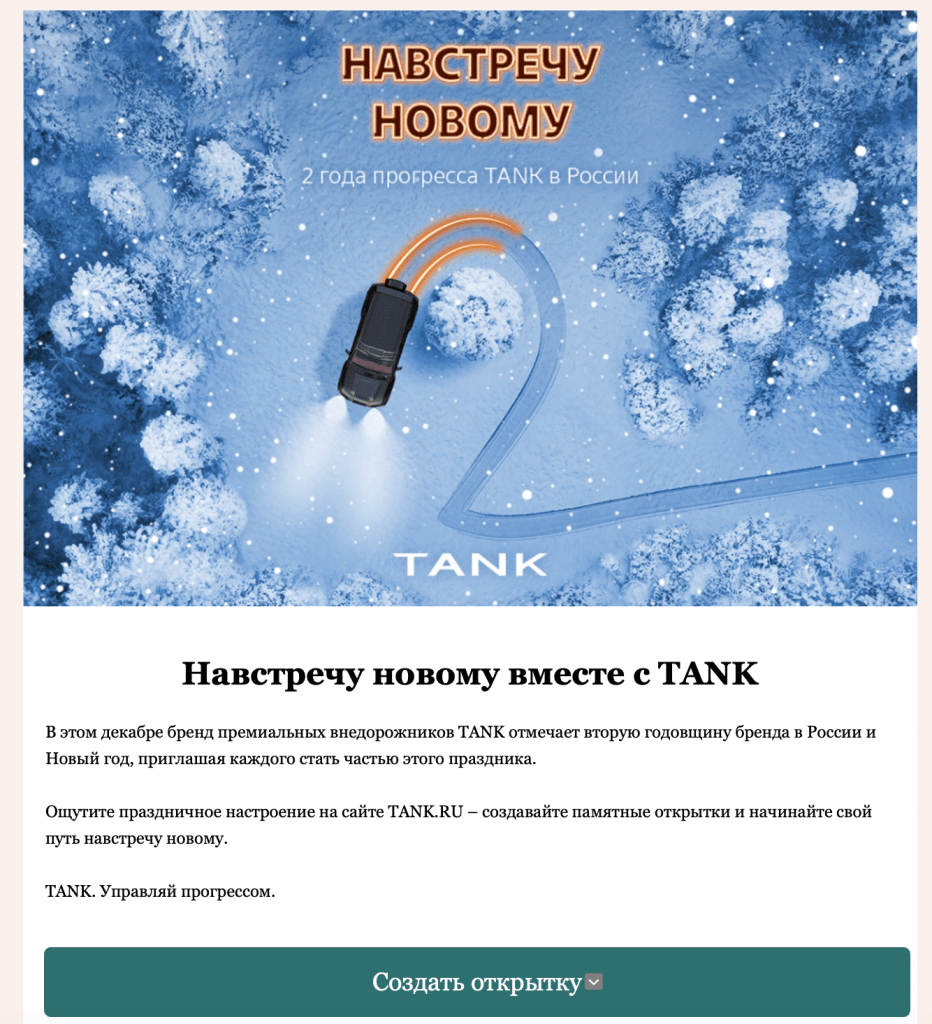
This December, premium SUV brand TANK celebrates its second anniversary in Russia and the New Year, inviting everyone to be a part of the celebration.
Get into the festive mood on the TANK.RU website by creating commemorative cards and beginning your own journey towards the new.
TANK. Drive your own progress.
Source: Unsolicited email from Vedomosti, 10 December 2024
The fall of the Baath state in Syria is a serious defeat for Russia (and a disaster for Iran). It would however be a grave mistake to assume that this by necessity makes it a success for the United States.
Moscow and Washington may indeed now face similar challenges in Syria.
Three issues led Russia to intervene in the Syrian civil war to save the Assad regime. First was a general desire to preserve a partner state — one of the very few remaining to Russia after the U.S. overthrow of the regimes in Iraq and Libya, which helped to prop up Moscow’s international influence. Second was a desire to retain Russia’s only naval and air bases in the Mediterranean.
Third was a deep Russian fear that an Islamist victory would lead to Syria becoming a base for terrorism against Russia and its partners in Central Asia. That anxiety was increased by the presence of numerous fighters from Chechnya and other Muslim regions of Russia in the ranks of the Islamist forces in Syria and Iraq.
[…]
Thanks to our readers and supporters, Responsible Statecraft has had a tremendous year. A complete website overhaul made possible in part by generous contributions to RS, along with amazing writing by staff and outside contributors, has helped to increase our monthly page views by 133%! In continuing to provide independent and sharp analysis on the major conflicts in Ukraine and the Middle East, as well as the tumult of Washington politics, RS has become a go-to for readers looking for alternatives and change in the foreign policy conversation.
We hope you will consider a tax-exempt donation to RS for your end-of-the-year giving, as we plan for new ways to expand our coverage and reach in 2025. Please enjoy your holidays, and here is to a dynamic year ahead!
On Sunday, something extraordinary happened: the Syrian people overthrew the Assad regime. For years we have been waiting to share this news with you. We wanted to make sure you didn’t miss our message below.
Dear Thomas,
This is the message we have been waiting so long to write. Assad is gone. The Syrian people have toppled the Assad regime. Our hearts burst with hope today. A war criminal of the worst kind no longer has the power to torture, starve, bomb and detain people in Syria.
The regime that has caused indescribable suffering and trauma for decades no longer has the power to commit war crimes. Syrians in Syria and all over the world are singing, “Syria is for the people, it does not belong to the Assad family”. We are chanting along with them. Ragheed al-Tatari, Syria’s longest-held political prisoner, has been freed alongside many others.
We write these words thinking of so many of our friends and loved ones who we lost in the past years. Our hearts break that they’re not witnessing these moments with us.
There is much that is unknown. We have lost so much. Our dream for freedom and democracy declared almost 14 years ago was for a peaceful transition of power out of authoritarian hands into those of the Syrian people – all of us diverse and different but together in our vision for a new Syria.
At the Syria Campaign we commit to continuing to work with all those who stand with human rights, with you all, to ensure our vision for a free and democratic Syria is made real.
The hope we feel today feels something like those first weeks when we took to the streets and dared to call for freedom and dignity. We believed the world would join us to protect humanity and champion the values they claimed to hold dear.
As our committed and courageous supporters you all know the journey we have been on since then. You have been with us as we rallied loudly against the bombings of hospitals, whole communities massacred by chemical weapons, the systematic use of detention and disappearance, meant to crush our spirits. You, and hundreds of thousands of people around the world, have stood with us and made our demands for protection of civilians and justice for war crimes more powerful.
Our movement, alongside the heroes on the ground in Syria – the White Helmets, medics, women’s rights activists, journalists – and the vibrant Syrian civil society in refuge around the world – the lawyers, investigators, artists, campaigners, survivor groups and family associations, has kept the demands of the revolution loud and clear.
Today, those demands are all the more urgent. It is time for Syrians to lead a peaceful Syria. Free and democratic, vibrant and diverse.
Now is the moment for Syria and the international community to restart Syria’s stalled UN-led political process, with a clear timeline for political transition that leads to free elections, as outlined in UN Resolution 2254.
There is so much to be done. We are impatient for accountability and justice. So many people remain detained or disappeared and families across the world are now hoping to go back to their homes and cities and be reunited with their loved ones. Almost every Syrian carries pain and trauma into this new moment. It is a moment that holds such promise. It is the chance to create a new beautiful Syria.
P.S. The weeks ahead will be critical. Please consider donating to support our work towards our vision for a free, just and democratic Syria.
The Syria Campaign is a human rights organisation that supports Syria’s heroes in their struggle for freedom, justice and democracy. Read more about our work here.
Online donations by credit card are processed by Voices Project USA and are tax deductible in the United States to the full extent allowable under the law. Online donations by PayPal are processed by The Voices Project (UK) and are not currently tax deductible in the US or available for gift aid in the UK. Voices Project USA Federal Identification Number is 82-3505967.
Source: A very welcome email from the Syria Campaign, 10 December 2024
“GREETING THE NEW”: the “commemorative postcard” generated for me by TANK.RU, based on my answers to six leading questions and a photo of myself I uploaded to the website.
Since the beginning of 2023, Russians have bought more than 600 Chinese Tank SUVs. According to Autostat, from January to April, Tank dealers sold 632 cars, and the more affordable model with the 300 index is more popular than the Tank 500 — during the reporting period, the first sold 479 copies, and the second — 153 copies. Thus, the Tank 300 accounts for 76 percent of total sales, and the “five hundredth” — 24 percent. Tanks are in the greatest demand in Moscow — every fourth car of this brand (166 units) is registered in the capital. In second place in terms of sales is St. Petersburg with an indicator of 125 Chinese SUVs sold (every fifth), followed by the Moscow region – every 10th SUV is registered there. The top 5 regions also include Nizhny Novgorod and Kemerovo regions (45 and 37 copies, respectively).
Tanks are in the greatest demand in Moscow — every fourth car of this brand (166 units) is registered in the capital. In second place in terms of sales is St. Petersburg with an indicator of 125 Chinese SUVs sold (every fifth), followed by the Moscow region – every 10th SUV is registered there. The top 5 regions also include Nizhny Novgorod and Kemerovo regions (45 and 37 copies, respectively).
Official sales of the Tank 300 began only in the early spring of this year. The “younger” Tank is supposed to have a two-liter “turbocharger” with a capacity of 220 horsepower in conjunction with an eight-band automatic, the drive is only full. The larger Tank 500 model appeared a month after the “three hundredth” — it is offered with a 3.0-liter V6 engine that develops 299 horsepower and works with a nine-band automatic. The drive is also full.
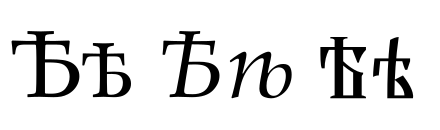
I’d like to say I was first drawn to Russia by a fascination with late Soviet politics under Gorbachev, or the great works of Russian literature. But for me the initial interest was the language itself, as taught by an eccentric but effective teacher called Mr Criddle. Short and bearded, even a little gnome-like, he usually dressed in sandals and socks and ran his classes at Worcester Sixth Form College with old-fashioned discipline. Before we started the course, he had handed out copies of the thirty-three character Cyrillic script at our college open day with instructions to learn it or not bother turning up for class.
Mr Criddle had learned his own Russian in the mid-sixties at the Liverpool College of Commerce, taught by a graduate of a Cold War creation known as the Joint Services School for Linguists (JSSL). The JSSL had taken around 5,000 conscripted men from military boot camps in the 1950s and produced a whole generation of Russianists. The kadety, as the students called themselves, were trained to be high-level interpreters, ready to interrogate Soviet prisoners, decipher classified documents and run counter-propaganda operations should the USSR ever invade. As it never did, many ended up teaching the language in UK universities and schools.
The JSSL method was fast, deep and tough, with heavy emphasis on repetition and rote-learning. Its students had a skukometer, a made-up word from the Russian for boredom, to measure how brain-numbing a class was, and I would come to know how they felt. Mr Criddle had picked up the JSSL military style from his own teacher. Ignoring any official syllabus, he had a giant library of homemade flash cards which he used to drill us relentlessly. He’d cut all the images out of magazines and glued them to one side of the cards, writing the correct adjective endings or verb declensions on the back. He kept them in recycled envelopes at the back of the room. It was the exact opposite of how I’d learned French and German, where we chose a ‘foreign’ name and then role-played trips to the bakery or camp-site shop. For Russian, Mr Criddle had us create our own carefully indexed grammar books and then he dictated every page. It was a whole year before we learned anything practical like how to introduce ourselves perhaps partly because no one was planning a summer holiday in the Soviet Union, but we could soon form the genitive plural in our sleep.
Source: Sarah Rainsford, Goodbye to Russia (2024)
The Booker Prize: “Nonso Anozie reads from ‘James’”
Watch Nonso Anozie read from Booker Prize 2024-shortlisted James, written by Percival Everett.
The story so far: It’s 1861 and Jim, a slave and soon-to-be companion of Huckleberry Finn on a dangerous journey along the Mississippi River, is a man driven by a fierce instinct to survive and to protect his family. This includes teaching his own and other children the behavioural and language skills needed to avoid antagonising the white people who have made their lives hell.
All traces of Ukraine are being expunged. Schools have switched to the Russian curriculum, and Russian youth and paramilitary organisations work in the territories. Repression combined with Russification aims to transform the social and political fabric of the territories, says Nikolay Petrov, the author of a new report for the German Institute for International and Security Affairs.
“I dreamed that I was talking in my dream and to be safe was speaking Russian. (I don’t speak any Russian, and also I never talk in my sleep.) I was speaking Russian so that I wouldn’t understand myself and no one else would understand me either.”
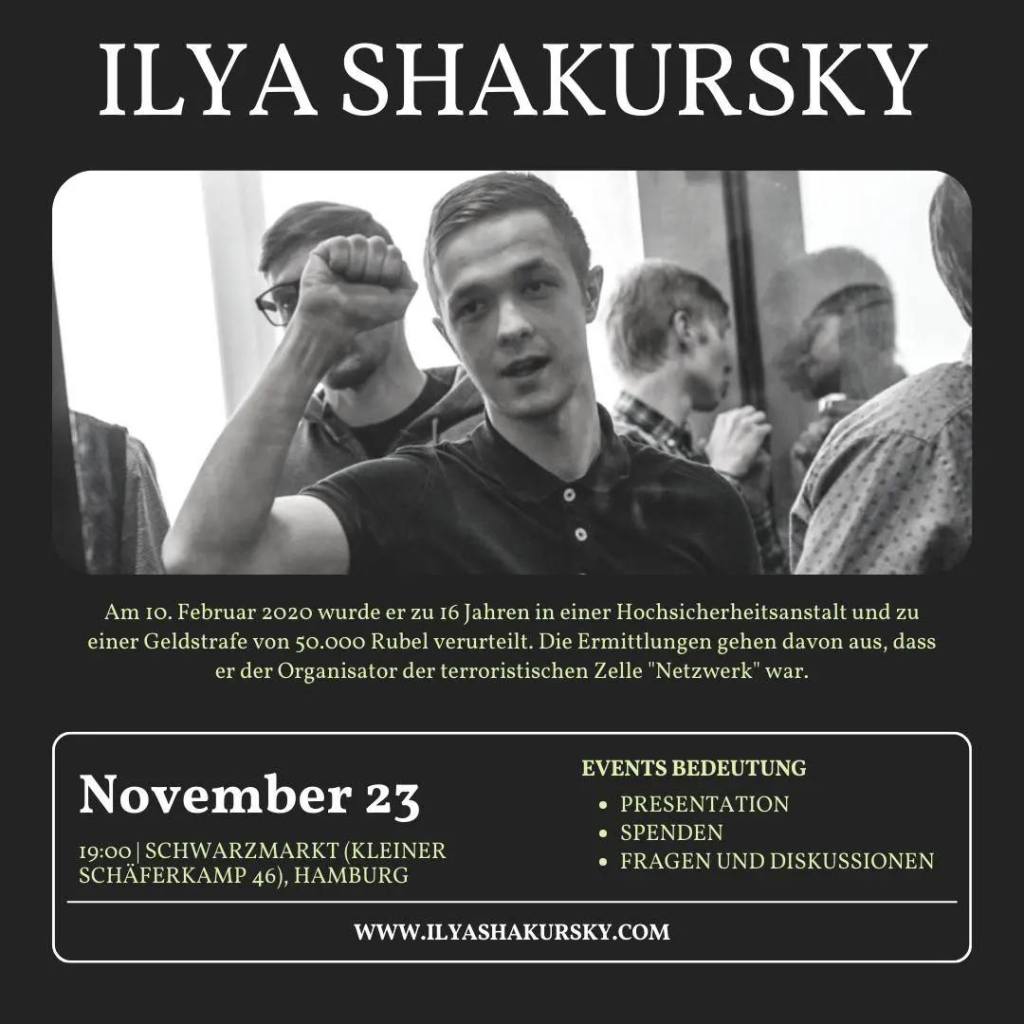
This Saturday, 23 November, at 7 p.m., the last presentation about and fundraiser for Ilya Shakursky will take place at Schwarzmarkt in Hamburg (Kleiner Schäferkamp 46). After the new year, a big update is in store for the project, but in the meantime we look forward to seeing the local public and thank everyone who has supported us this year!
Este sábado 23 de noviembre será la última presentación sobre Ilya Shakursky con posibilidad de donaciones en Hamburg im Schwarzmarkt (Kleiner Schäferkamp 46), después del año nuevo el proyecto espera una gran actualización, pero mientras tanto esperamos al público local y ¡gracias a todos los que nos han apoyado este año!
A charity concert has been held in Paris in tribute to the pianist Pavel Kushnir, who died in detention in Russia. The funds raised were donated to the Paris-based Atelier des artistes en exil (Agency of Artists in Exile), which aids artists who have fled their countries due to war, persecution, and discrimination.
The concert was held at Salle Cortot in Paris. World-renowned pianists Grigory Sokolov and Sergei Babayan performed a program of pieces by Frederic Chopin, Robert Schumann, Franz Schubert, Franz Liszt, and Sergei Rachmaninoff. Tickets for the concert were sold out almost instantly.
“As musicians, we want to voice our support for artists around the world who are persecuted and sometimes forced to leave their native country. Pavel Kushnir chose internal emigration and bravely and unreservedly spoke out against the war. He paid for this with his life. We wholeheartedly support Grigory Sokolov and Sergei Babayan’s November 18 concert in Paris and join them in paying tribute to Pavel, as well as in voicing our solidarity with all artists who are suffering from repression today,” reads a letter in support of the concert, which was signed by Martha Argerich, Daniel Barenboim, Gidon Kremer, Anne-Sophie Mutter, Semyon Bychkov, Paavo Järvi, and many other famous musicians of our time.
“Music can be used for good as well as for ill. Pavel Kushnir always used it for good. Let us honor his memory and follow his example,” says pianist Evgeny Kissin, who also signed the letter.
“I am honored to pay tribute to the memory of a young artist who gave his life for the truth. Pavel Kushnir clearly understood that there can be no happiness and, in fact, no real art when one country causes another country untold suffering, and the truth about this crime is not heard. The deeply inhuman nature of the regime responsible for his death is underscored by the fact that he, a young artist living far from the capital, posed no danger to the continuation of its criminal rule. He made a beautiful recording of Rachmaninoff’s Preludes, and for that reason I wanted to play Rachmaninoff for him. I would have loved to have met Pavel, who was undoubtedly a beautiful, exceptionally sincere young soul. My thoughts are with Pavel Kushnir, his family, and all the victims of the enemies of freedom and truth,” said Sergei Babayan, explaining his involvement in the concert and the works selected for it.
The proceeds from the concert, as well as the donations raised, will be given to the Paris-based Atelier des artistes en exil, which has aided many hundreds of artists during the seven years of its existence.
“When we left Russia, we had heard nothing about Atelier, and it was not clear where we would put down roots,” says composer Dmitry Kurlyandsky, who turned down Russia’s Golden Mask national theater prize, which he was awarded for the music he wrote for Perm-based Theater-Theater’s production of the play Katerina Izmailova. He called the award “antics on the part of a system which is destroying the theater.”
“But on the second day,” Kurlyandsky says, “I had already found out about Atelier. We called them and they invited us to a meeting. It was the very beginning of the wave of emigration from Russia, and Atelier had more capacity to accommodate refugees. We lucked out. Thanks to Atelier we stayed for eight months for free in a hotel in downtown Paris, and during this time we were able to get our papers sorted and find a place to live.”
Judith Depaule
Judith Depaule, founder and head of Atelier des artistes en exil, sat down for an interview with Radio Svoboda.
— How did you find out about Pavel Kushnir’s tragic story?
— From Russian acquaintances. I also read about it in the French press. There wasn’t that much coverage of Kushnir’s plight, but there were some articles nevertheless. Many artists at Atelier talked about it.
It’s all quite frightening, of course. I have been studying the history of theater in the Gulag for a long time. I see Kushnir’s tragedy as a repetition of what already happened, of things with which we are all very familiar. I’m always amazed at how much history can repeat itself. I wonder why it repeats itself, despite everything we know about our past. How is it that people are dying again just for freely expressing themselves! I find it scary, because the right to freedom of expression is what matters most.
— You said that you said that you studied theater in the Gulag. Tell us a little more about that.
— It so happened that as part of my studies I researched the work of the Futurist theater director Igor Terentiev, who was arrested and sent to work on the White Sea Canal. We know a lot about his life on the White Sea Canal because he was photographed by the legendary Alexander Rodchenko. It was a shock to me that the theater could exist in the Gulag. I researched the topic. I went to the Memorial Society, and I was able to interview many former prisoners. I even traveled to Magadan and Vorkuta. So I am an expert on the history of the theater in the Gulag.
— Whose idea was Pavel Kushnir memorial concert? Why were Grigory Sokolov and Sergei Babayan involved in it?
— It was the artists at Atelier who took the initiative. To make the event respectable, they decided to invite famous musicians. We approached Sokolov and Babayan, and they immediately agreed.
— Yes, Sokolov and Babayan are certainly musicians of the highest order. Babayan is also a renowned teacher. Was the concert program solely Sokolov’s and Babayan’s choice? Or did they discuss it with you as well?
— No, they decided themselves what to play in memory of Kushnir. It was their own choice; we didn’t discuss it with them. It was important to us that the program included pieces which they loved and were willing to perform.
— I think any classical music lover would dream of going to such a concert. It’s just a pity that the occasion is so tragic. There was also a letter in support of the concert, signed by a plethora of classical music stars. The letter claimed that Pavel Kushnir had chosen internal emigration, internal exile. Do you agree with this? If so, how do you understand this term?
— I would imagine that Pavel did not want to be the center of attention, but simply wanted to feel freer. This did not work out for him, alas. I think that, while living under a dictatorship, Pavel was trying to find a place where he could at least breathe freely and do what he loved doing. Because Russia is so vast, you could say that it really was internal exile. This again takes us back to the past. When people tried to disappear from the Kremlin’s sight, they left the major cities to feel at least a little bit freer.
— Atelier des Artistes en Exile deals with a wide range of creative genres, not just music or theater, for example. How did you decide to take on such a serious challenge?
— I founded Atelier in 2017 as a response to the migration crisis in Europe, which peaked in September 2015. There were so many Syrian migrants in Paris. I was working in a small cultural center at the time. We just decided to shelter migrants; it wasn’t about artists at the time. Gradually we began helping immigrants and put together a festival that was dedicated to Syria. I often talked to exiled artists, and they always said the same thing: “We were professional artists before we left. We had a profession. What are we supposed to do now? We don’t understand how French society works, we don’t understand its cultural traditions.” And so on. I decided that something had to be done to help performers and artists in exile. Gradually, this idea began to develop, and I set up this agency in early 2017. At the time there was no talk at all about Russian artists and performers, back then it was mostly Sudan and Syria. Atelier has grown because it helps everyone who leaves their country, whatever the reason, whether dictatorship or discrimination. The world is now in a state in which there are wars, dictatorships, and illegal imprisonment everywhere. So performers and artists have started arriving in France much more often.
— What kind of assistance do you provide? Do you help with accommodation, visas, and jobs, or do you support cultural projects?
— For those who are still in their home countries but want to come to France, we help them get visas and explain how to get here. When people are already in France, we help them with long-term visas and residence permits, so that they are staying in France legally. We help them with social services — medical insurance and so on. We provide a place to work, because that is super important. If you don’t have a place to work, you are no longer an artist or a performer. We offer French language courses, and we have put together a program for artists to learn French through art. We help them understand how French society is organized and learn the peculiarities of French culture. We explain to them what rights they have, what benefits they can claim, how they should fill out their income tax declarations, and so on. We also organize cultural events.
— Who supports Atelier des artistes en exil itself?
— It is supported by the French Ministry of Culture, which sponsors various programs. Private foundations also help out. We are constantly looking for resources. The Pavel Kushnir memorial concert also includes a fundraising campaign to support the Atelier. This involves the money from ticket sales and donations, which we need very much, as we have a large team helping hundreds of people — 350-400 people a year.
— How can people who decide to come to you for help prove that they are artists?
— You have to show us what you have done up to this point: a portfolio, internet links, an account of your past work. It is not difficult to check whether a person is actually an actor, musician, or artist. It is immediately clear what kind of experience they have, where they studied, with whom they worked. Then we decide whether or not to work with them.
— Given that there is a full-scale war on in Ukraine, do you prioritize Ukrainian artists who have fled the hostilities when you’re choosing whom to help?
— Because there are many ongoing wars in the world, we don’t prioritize anyone. We just assist people who find themselves in a dangerous situation. If we talk about relevance, we are most often contacted by people from Gaza and Lebanon, who can be killed at any moment and who ask us how they can leave and what they need to do to leave. We are always watching what is happening in the world. It was not that everything was fine in the world when we started, but there were not so many conflicts. After the pandemic, there were immediate problems in Myanmar and Afghanistan, there was the war in Ukraine, there was the brutal crackdown against the women’s rights movement in Iran. And so on and so forth. More and more performers and visual artists have been turning to us because they don’t know how to go on living.
— Has the number of Russians who seek your assistance increased recently?
— It has been a constant flow which doesn’t stop. The current wave of émigrés from Russia is even greater than the very first one, whom we call White Russian émigrés.
— Let us return to the fate of Pavel Kushnir. I have read that famous musicians who learned about this tragedy and then listened to Pavel’s recordings and read what he wrote, voiced regret that they had not known about him or his talent earlier. Do you think there are many such unknown talents in the world? If so, how can we help the world learn about them not only after their tragic deaths, as happened with Kushnir?
— Pavel’s fate mirrors the history of art in many ways. Many great talents have been discovered after their death. There are so many musicians, actors, and artists for whom creating and making art is what matters most, not being famous. It doesn’t matter to them that they are not in the public eye. We can’t know about everyone, of course. I can’t suggest any way of remedying ths; it’s just the way the world works. There are people who will always be in the limelight, and there are people who will go on modestly pursuing what they love. Sometimes they are more talented than the artists we know well. When we discover a great talent after their death, sometimes a hundred years later, we ask ourselves how come we hadn’t heard anything about them until now, how we had missed them. But there’s hardly anything we can do about it.
“Not until I went into the churches of America and heard her pulpits flame with righteousness did I understand the secret of her genius and power. America is great because she is good, and if America ever ceases to be good, she will cease to be great.” – Alexis de Tocqueville
In the Soviet Union, where I grew up, any expression of faith was met with ridicule and harassment under anti-religion propaganda. This experience deepened my appreciation for the freedom to worship and inspired DEO FAVENTE wine—a tribute to God’s grace and providence.
As we approach Thanksgiving, let us reflect on the foundation of America’s greatness: her faith in God. It is through that faith and the values rooted in His word that our nation remains a true Land of Promise, guided by His hand.
Source: Land of Promise emailing, 14 November 2024
“We chose the name Terra de Promissio, latin for the Land of Promise. because as farmers, the land is about the “promise”. The promise that every new season brings the possibility AND the hope of a bountiful harvest.”
“and as we were both born, have lived and worked overseas, It is the promise of AMERICA, one nation under god AND the American Dream. We very much appreciate what this country represents. America is truly the land of promise and we are grateful for the freedom, liberty and opportunities that these united states offers to all of us.”
Charles and Diana bought a former dairy ranch in 1999 and then over the next 3 years, oversaw the planting of 33,000 vines. During the summer of 2002, they bought a used trailer to live in and then brought Diana’s Dad and sister Alina from Russia to help manage the vineyard. We welcomed Diana’s Family to the USA with an American Flag. And from that day on, the American Flag has proudly flown every day here at the vineyard. Terra de Promissio had its first harvest in 2005 and sold to 3 wineries. In 2007, after renting a house in Petaluma, they converted a barn into a home and moved to the vineyard full time. In 2012 and 2013, they planted an additional 18,000 vines to bring the total planted acreage of Terra de Promissio to 50 acres.
[…]
Diana KARREN
Diana was born in the Soviet Union. She was a Young Pioneer in the Communist System. But in the 1980s as the Soviet Union began to collapse, she put herself thru college and at the same time, worked for western companies that were investing in the now Former Soviet Union. Her hard work and great grades paid off and she was accepted to the University of Pennsylvania’s Wharton School of Business, where she graduated with a Masters of Business Administration in 2003.
During a two year period (2001-2003) Diana single-handily designed, gained government approvals and oversaw the planting of Terra de Promissio, while being pregnant and giving birth to Christian and doing it as a full time MBA Ivy-League student. In 2005, Diana oversaw the first harvest to Siduri, Flowers and Lynmar. In the ensuring years, as the grape production ramped up, Diana added multiple wineries including Kistler, Kosta-Browne and Willams Selyem. In 2011, Kosta Browne received the Wine Spectator’s Wine of the Year for the 2009 Sonoma Coast, which was primarily using grapes from Terra de Promissio.
Since day one, every row and block is custom farmed per each of the winemakers specific instructions. Because of this attention to detail by Diana, Terra de Promissio is now the most vineyard designated pinot noir in Sonoma County with over 10 wineries using the TdP name on their label. Beginning with the 2013 harvest, Diana began overseeing the winemaking process for Land of Promise. She now makes 4 Land of Promise Pinots and one Rosé. For more info, please click here or the link below.
In addition to managing the vineyard and the winery, Diana spends her Sunday mornings at Calvary Chapel Petaluma where she volunteers watching the babies and toddlers during the busy first service, so their parents can enjoy and listen to the sermons.
Just one week has passed since Donald Trump’s electoral triumph, and already Russian President Vladimir Putin—one of the strongman leaders Trump admires most—is messing with his head.
First, Putin waited two days before congratulating Trump on his victory. One can imagine Trump receiving phone calls from kowtowing leaders the world over—Ukraine’s Volodymyr Zelensky, Israel’s Benjamin Netanyahu, the Palestinian Authority’s Mahmoud Abbas, the chief of NATO, the European heads of state—all the while wondering about the man whom he’s admired publicly and privately for the past eight years: When is Vladimir going to call?
Then, in response to Trump’s claim that during their phone call, he asked—in some accounts, warned—Putin not to escalate the war in Ukraine, a Kremlin spokesman denied that the two had spoken on the phone at all. (Putin issued his belated congratulations at a news conference.)
I don’t know who’s telling the truth, a practice for which neither man has a sterling reputation. But either way, in the next few weeks, when Putin orders 50,000 fresh recruits (including 10,000 imported North Korean soldiers) to go on the next rampage—ousting Ukrainian soldiers from the thin slice of Russian territory they hold, then retaking soil across the border in Donbas province—he can tell a complaining Trump that he doesn’t recall any such conversation. If Trump thinks Putin actually will refrain from stepping up attacks on Ukraine as a friendly favor … well, maybe our once-and-future president will learn a lesson about the limits of personal relations in the face of perceived national interests early in his second term.
The final twist of this saga came on Monday, when Nikolai Patrushev, an aide to Putin who was previously director of Russia’s Federal Security Service, made the following comment in an interview with the Moscow newspaper Kommersant:
The election campaign is over. To achieve success in the election, Donald Trump relied on certain forces to which he has corresponding obligations. As a responsible person, he will be obliged to fulfill them.
This is a mind-blowing bit of psychological warfare! The Russians are basically telling Trump: We put you in office. Now it’s time for you to pay us back.
When you woke up yesterday the idea that Pete Hegseth—a philandering morning TV host who has never run anything bigger than a frozen banana stand—could serve as the secretary of defense was the most preposterous idea in the history of the federal government.
By the dinner time Trump issued two nominations that made Hegseth look like Bobby Gates.
The Matt Gaetz appointment is getting most of the attention because of the irony. The DoJ being controlled by a man who was recently investigated by the same department for having an alleged sexual relationship with a 17-year-old girl, whom he (allegedly) paid to travel with him? It’s too good.
Also, in the near term, the attorney general can a lot of damage to America. The AG has the power both to turn the state against its citizens and to shield wrongdoers from accountability.
But it’s the appointment of Tulsi Gabbard as director of national intelligence that worries me more. Because for a decade Gabbard has looked and behaved like a Russian asset.
In four terms as a congresswoman her most notable actions were ongoing defenses of two war criminals: Bashar al-Assad and Vladimir Putin.
Donald Trump’s stunning political comeback has created an opening for Russia to shatter Western unity on Ukraine and redraw the global power map, according to several influential members of the Russian elite.
In the corridors of power in Moscow, the win for Trump’s populist argument that America should focus on domestic woes over aiding countries like Ukraine was being hailed as a potential victory for Russia’s efforts to carve out its own sphere of influence in the world.
In even broader terms, it was seen as a victory for conservative, isolationist forces supported by Russia against a liberal, Western-dominated global order that the Kremlin (and its allies) have been seeking to undermine.
In his first remarks since the election, President Vladimir Putin said Thursday that the West’s post-Cold War monopoly on global power was “irrevocably disappearing,” before going on to praise Trump for behaving “courageously” during an attempt on his life this summer.
“His words about his desire to restore relations with the Russian Federation and to help resolve the Ukrainian crisis, in my opinion, deserve attention,” he said during his annual speech at the Valdai Forum in Sochi.
Members of Russia’s elite were more blunt in their response to Trump’s victory.
“We have won,” said Alexander Dugin, the Russian ideologue who has long pushed an imperialist agenda for Moscow and supported disinformation efforts against Kamala Harris’s campaign. “The world will be never ever like before. Globalists have lost their final combat,” he wrote on X.


 ] AND CONVICTED FELON MARIA BUTINA? Who doesn’t? Welp, here she is w/ your Daily Irony Supplement — and it’s a massive dose! See, as of Jan. 20 she’ll likely get a pardon and move back Stateside to improve on her spying career (hey, how could she do worse?); but in the meantime, she’s trying to get *Americans* (et al.) to go the *other* way, i.e. move to Moscow — y’know, like Our Guy Ed Snowden & his new roommate, Bashar al-Assad, who just *love* it there, right?