Yulia Tsvetkova: Blues and Pinks

“He Threatened to Kill Us for Perverting Children”
A Feminist Staged a Children’s Play. She Has Been Accused of Extremism and Interrogated by Police
Larisa Zhukova
Lenta.ru
March 15, 2019

The police department in Komsomolsk-on-Amur has been investigating the work of feminist Yulia Tsvetkova, producer of the activist comedy theater Merak. The ostensible cause of the investigation is her production of a children’s play about gender stereotypes, Blues and Pinks, which the people who denounced Tsvetkova to the police regarded as promotion of homosexual relations among minors. The suspicions of the authorities have also been piqued by the anti-militarist dance productions Praise the Lord and Pass the Ammunition and Prague Spring, and the VK community page Komsomolka. Lenta.ru recorded Tsvetkova’s account of why regional activists have grown accustomed to threats of real violence and how the local extremism prevention center (Center “E”) inspects children’s dances and drawings.

“Are You Against the Soviet Union?”
Everyone who has known us for a long time agrees that something completely insane has been happening. We have pupils who have been working with us for almost sixteen years, starting with my mom’s early development workshop.

Our theater is me, the actors, and my mom, our manager. We are a tiny theater company in a really small city and the only young people’s theater of its kind. We are not a classic theater company, but a horizontal (egalitarian) and activist theater. We highlight societal problems and look for ways of solving them. We established the theater a year ago. We decided to call it Merak, with the stress on the first syllable. In Serbian, mérak means a buzz, a high, life’s little pleasures.

The actors are twenty-one children aged six and up. They write poems, contribute to the scripts, build scenery, and choreograph the dance numbers. As director, I supply the overall outline, but then I leave the creativity to them. How do you feel in this scene? I ask them. What should it be like? How should the dialogue sound? What words would  you use to say that? How would you dance it? Some find it odd I deal with children as equals, but I believe it has to be this way. We use improvisation, forum theater, gags, and free dance.

Everything was fine until February, until we decided to stage four danced-based plays, which we had been rehearsing for six months. Two plays are staged one day, while the other two plays are staged the next day. We came up with the idea of calling them a festival by way of combining them. It would have been the first activist art festival in the region. A week before the first performance we got a phone call from city hall. The next day, the Youth Center, a venue we had already confirmed, told us they were booked up on the dates we needed, and there were no openings for the next six months.

The telephone conversation with city hall lasted over an our. City officials went over our poster point by point. Why was our play called Blues and Pinks? We wrote, “We can do it again”: were we against the Soviet Union or something? We were asked what we meant by the word “individual.” Obviously, there was something about what we were doing they didn’t like. We also suddenly got the cold shoulder at other venues.

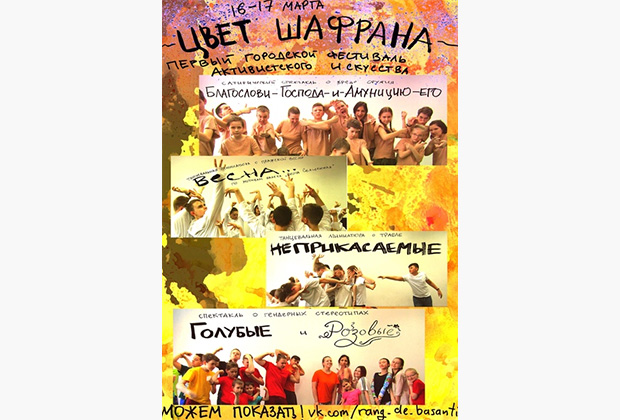
pic_08ab34d1a9a5f76eb7ff4c96411bec73Detail of a poster for The Color of Saffron Festival of Activist Art. The inscription reads “We can do it again. We can ban it!” 

After the news that the festival had been shut down was published, city hall called us and said we had misunderstood them. Actually, they supported our undertaking. They invited us to a meeting at which they made it understood that if we denied the news reports, they would help us find a venue. Since I don’t like having my arm twisted, and I didn’t think I had done anything wrong by talking about the connection between their first phone call and the sudden refusals to give us a venue, I was not about to refute any of the reports. That was when they interrogated the kids.

“The Kids Are Feared like Terrible Dissidents”
To be honest, I thought we would be called on the carpet for our anti-militarist production Praise the Lord and Pass the Ammunition. It is a translation of a song by Serj Tankian, lead singer of System of a Down. He often voices his opposition to war and the arms industry. The big dance number in the play is set to his song. It’s an urgent problem for us, because all the boys who attend our workshop, which has been functioning for over twenty years, try to smuggle in toy pistols at first. But we have a ban on weapons, even toy weapons. Why? We are trying to make sense of things. During the big dance number, one dancer acquires a “pistol.” Then another gets one, too, as a means of defense. A third dance gets hold of a machine gun, and the atmosphere heats up. It is satirical and exaggerated, of course, but it is a quite dramatic play as well.
pic_dc844038f81c1c5c70e0d764a49c0a98

Merak Theater’s poster for its four-play, two-day festival, The Color of Saffron. Originally scheduled for March 16 and 17, it was to have featured (in descending order) Praise the Lord and Pass the Ammunition, Spring [sic], Untouchables, and Blues and Pinks. 

But when we came up with the play, the shooting at the college in Kerch occurred. The kids were scared: the shooting affected them greatly. We talked a lot about what they thought about the incident and how it could have been avoided. No one at school discussed the incident with the children at all, although it should be said adults generally avoid discussing really important things with teenagers. The kids came up with the play’s finale on their own: it showed how the situation could have been avoided.

Prague Spring is a production based on Igor Stravinsky’s Rite of Spring. We pay homage to Vaslav Nijinsky’s original choreography and Maurice Béjart’s 1955 choreography, using music by John Cage. Coincidentally, I got the idea during the fiftieth anniversary of the invasion of Czechoslovakia by Soviet troops: the two “springs” came together in my mind around the subject of human rights and resisting oppression. It’s a simple, obvious subject, but when you grow up in a small city like Komsomolsk, it can seem quite remote and forbidden. But this is just what I read into it, inner thoughts not meant for viewers. The kids simply dance spring. That’s it. Six-year-olds hop up and down and run around in circles, making up half of it as they go along.

Our fifteen-minute play Untouchables focuses on bullying at school and kindergarten. A lot of what the kids told us themselves about their own experiences went into the play. The more we talk things through, the easier it is for them to deal with them.

pic_eda40eabbbb3ba6a6ff95708693a0148Photo from the Merak Activist Comedy Theater’s page on VK 

Blues and Pinks is a play that illustrates stereotypes about girls and boys. According to the script, we run through the list of clichés: girls like pink, boys like blue; boys are messy, girls clean up after them; boy are defenders and warriors and shouldn’t cry, while girls are future mothers who dream only of getting married; girls and boys can never understand each other. This is presented on stage as a lighthearted dance. We try and show the notion that if a boy pulls your pigtail, it means he likes you is a step away from the idea that if a man beats a woman he must love her.

We continue by suggesting a solution. One of the boys dances, releasing his pent-up feelings as it were. The other boys follow his example, realizing that, whether they dance or not, it does not make any more or less guys. The girls share their dreams. One of them wants to be a businesswoman, while another wants to be a director. They recite the names of great women: the first woman to climb Everest, the first woman to win an Oscar, and so on.

Sophisticated audiences in the western half of Russia would probably find it quite naive, but in our city it is timely and relevant. For example, the other day, a local radio presenter, Tatyana Zhemerenetskaya, announced she planned to run for mayor. She was fired: her bosses were outraged by her excessively “unfeminine ambitions.” Women are supposed to stay home and make soup. In the final scene of our play, the kids say they are individuals. They have dreams and passions.

The funny thing is I didn’t even think about the connotation of the play’s title, which the police caught. One of our pupils came up with it. I have hung out with female LGBT activists, and none of them ever call themselves “blues” or “pinks.” They are just colors to me. Honestly, if I had had doubts, I would not have bothered using the words in the title.

Our actors are between six and seventeen, but the authorities fear us as if we were terrible dissidents. Miraculously, we found a woman interested in contemporary young people’s theater who was not afraid to provide us with a venue. We intend to hold the festival there as planned, on March 16 and 17. But we have nowhere to seat viewers: we cannot find people who will give us chairs. One person said yes, but later he was scared off, apparently.

“She Drew the Rainbow of Her Own Free Will”
The policewoman who came to my office could not say out loud the reason for the investigation. The complaint read that we were promoting homosexuality among minors. She showed me the complaint and blushed.

During my interrogation, I was told I was at the local department for extremism and terrorism prevention (Center “E”). Three complaints had been filed against me: for promoting homosexual relations among minors, for inciting hatred towards men, and for “extremism,” I think.

The interrogation lasted nearly four hours.

First, the officers gave me screenshots of various posts and photos from my personal social media page and the community page Dandelion Field, where I write about really simple things like contraception, HIV, and condoms, things that, unfortunately, not all teenagers know about. There was also stuff from Komsomolka, which deals with feminism. By the way, there I don’t write at all about men: it’s a community page about women.

One of the screenshots showed a workshop from last year at which a girl had drawn a picture, and there was a rainbow in her picture. I was forced to write two paragraphs explains that my underage female pupil had drawn the rainbow of her own free will. No one had pressured and coerced her to draw it.

Next, we got hung up on the phrase “gender stereotypes.” The police officer thought gender had something to do with transgenders. I explained to him what gender stereotypes were, what I meant by the term, and gave examples of stereotypes, as if I were sitting for an exam at school.

Then I was shown a screenshot of a post in which I had negatively assessed the “gay propaganda law,” and I had described the persecution of the lesbians in Chechnya and the “corrective” rapes to which they had been subjected.

The detective asked whether I engaged in propaganda. He asked was sex education was, and who needed it and why. He asked what feminism was. He asked what intersectional feminism was. Ultimately, I had to describe to him how I imagined traditional family values, what I thought about families. I wrote that I wasn’t against traditional family values like love, acceptance, and warmth. This ridiculous testimony took up four pages.

This was followed by the persecution of our children and personal attacks on them. There is no other way of putting it.

“The Police Have Come for You. Let’s Go”
The police officers running the investigation are clueless about the questions they have been asking, and this incompetence has only exacerbated the circumstances.

On March 10, they came for one of boys and one of our girls. It is not clear why they were chosen. There are seventeen teenagers in our theater, and they attend different schools. The police did not pick on our oldest and youngest pupils.

The 15-year-old girl was summoned after school from her house and grilled for two hours by five adults: two police officers and three female school employees. They put the screws on her and descended into semi-insults. They quizzed her about LGBT. Did she know what it meant? they asked. How had she found out? Was I promoting homosexuality? Did I encourage girls to sleep with girls, and boys with boys? The subjects they discussed were such that they would have earned an 18+ rating, but the interrogation took place without the girl’s parents present.
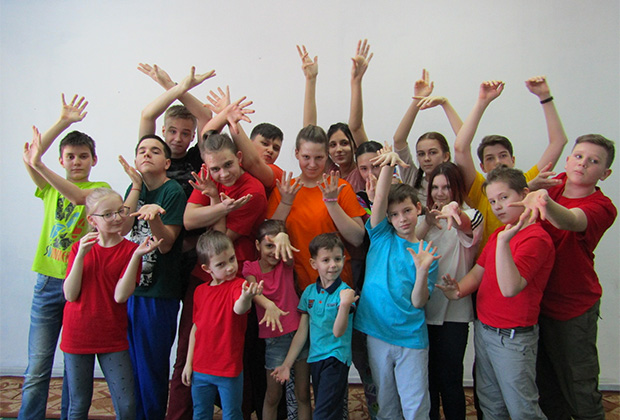
pic_7bc908930662b55a0cdbabb1976b5037Photo from the Merak Activist Comedy Theater’s page on VK 

The 13-year-old boy was kept after school. He was summoned to the headmaster’s office. “The police have come for you. Let’s go,” he was told. No one had the presence of mind to call his parents. The police officers showed him the likes I had awarded a post I no longer remembered, but they were showing this to a child! The absurdity was off the charts. They asked the boy and the girl about each other. Maybe they had picked the through the list of  numbers in their telephones.

When, the next day, they came for another of our boys, we warned him to call his parents immediately. He called his dad, who works as a beat cop, so he was not grilled for two hours, but twenty minutes, and the conversation was more polite and less biased.

Everyone is scared. Naturally, it is frightening when you’re interrogated for two hours. For now, no one wants to quit the theater, because everyone is aware of my work. They know I am opposed to violence, and I treat boys and girls equally. But, first of all, the subject itself scares the kids, because they are still kids and not tuned into all these issues. Second, they feel the pressure: they are afraid to say something wrong and inadvertently throw me under the bus.

Their parents and I have now been trying to understand the legal grounds of why we have been persecuted. We have been poring over the laws.

“Rewind to Fifty Years Ago”
Until recently, everyone really loved our theater and told us how cool we were. We did two productions wholly in English about the history of the English language, which were unprecedented in our city. At the Drama Theater, we did a dance performance about the problems of teenagers entitled Evolution. It was about how society puts pressure on carefree kids, but ultimately their friends help them and their problems are solved. This was all performed to poems written by one of the girls involved in the production. The show was a benefit for disabled children and the local organization Lighthouse of Hope. Not a bad track record for a single year!

Children grow up, and the problems they face get more complicated. First of all, they deal with domestic violence. I have had whole black months when it was one story after another, and I cried because I felt so helpless. It’s really scary: dad’s beating mom, dad’s beating me, dad’s beating my brother. Gender stereotypes are also something our kids deal with up close and personal. My fifteen-year-old female pupils are already pestered now with questions of when they are getting married and having kids, and why they should bother with careers. Homophobia is also a force. I know there are LGBT teenagers out there, and I cannot imagine how hard it is for them to cope alone. The streets in Komsomolsk are a really dangerous place, just as in most typical provincial towns, I would guess.

Komsomolsk is one half a factory town, and one half a gangster town. When you hear about us, rewind to fifty years ago. It is not the twenty-first century here, but the twentieth century. I think what really spooked the police was that I had been talking about activism and feminism. These words scare people.

Our local feminist community consists of two volunteers and me. I have an audience of a thousand some subscribers on our community page, but between two and twenty people in Komsomolsk itself. That is the number of people who come to our events. Unfortunately, that is our audience for the time being. It is a infantile scale.

But there have always been plenty of haters. When I decided to do a lecture on abuse, there were threats: we will come and show you what real violence is like, I was warned. Instead, a group of women showed up who sabotaged the lecture by insisting victims had only themselves to blame or something of the sort.

Even our women’s tea party was disrupted. We wanted to make it women-only, without men, so we could talk about our problems. Men wrote to us that they would come and show us what feminism was. There were so many threats that even the young women themselves got scared, along with the venue where we had scheduled the tea party. They asked us not to come.

I have stopped responding to death threats. Now, as we have been chatting, I have received three messages from a young man. The only word in the messages you can print is the word “you.” Yesterday, a man wrote on the community page of our theater workshop threatening to kill us for “perverting children.” This the general background.

After I was interrogated for four hours by the police about feminism and sex education, I felt I had a claim to the hashtag #FeminismIsNotExtremism. Six months ago, I would insert in posts in connection with the case of Lyubov Kalugina, when I was not even remotely in harm’s way. It is one thing to read about persecuted activists, but it is another thing to become one of them. People keep asking why I do it. What is the point?  My run-in with the police makes me think hard about the kind of country we live in. But I can name at least twenty-one people for whom what I do is not pointless. I can name even more people, actually.

pic_55145f4a6ff0238f1689b54bfaa9dccbPhoto from the Merak Activist Comedy Theater’s page on VK 

What scares me most is the kids think they did something wrong. I ask them, You believe in what we do? Yes, they reply. Do you see anything bad about it? No, they answer. But the whole situation puts them under psychological pressure. It is a really terrible precedent, because the kids have been rapped on the knuckles as it were. They really work their butts off staging our plays. They invest a tremendous amount of energy in them. They are sincerely looking for ways to change the world for the better. These kids are really delicate and sensitive, and they are close to each other as group. They volunteer their time, they visit orphanages, they support other social projects. They are totally maxed out: they try and get straight A’s at school, and they are involved in academic competitions. In the midst of all their activities, they manage to come to four-hour-long, physically draining rehearsals.

But then adults tell them activism is bad, activism is evil, without even fully understand what activism is. And when these adults show up a week before our festival and tell us to get lost, both the kids and I are stressed out. They are really worried.

I have not slept or eaten for three days. I am on the verge of a nervous breakdown. I have been summoned again to the extremism prevention department. The phone is tapped, and calls with my lawyer are cut off. But I dream of opening a women’s crisis center in our city and an alternative independent school where the children would be not be bullied and hounded, and continuing to move the theater forward. In late spring, we are doing a production based on Svetlana Alexievich’s book Last Witnesses, about children during the Second World War, and in the summer we are staging a new English-language production.

Thanks to Darya Apahonchich for the heads-up. Translated by the Russian Reader.

UPDATE. DVHab.ru reports that, despite the fact the local authorities ostensibly canceled Merak Theater’s Color of Saffron Festival, the festival went ahead way anyway at “closed” venues. DVHab.ru included a full video of Merak’s performance of Blues and Pinks in its article. I have reproduced it below.
How Petersburg Celebrated International Women’s Day 2019

Feminists Explain
YouTube
March 9, 2019

March 8, 2019, was probably the most well-attended feminist rally of the twenty-first century in St. Petersburg.

The rally was attended by a variety of feminists, including socialists, Marxists, liberals, lesbian separatists, and queer feminists.

We made a montage of the speeches, chants, and songs for everyone who lives in other cities or could not attend the rally, as well as those who were with us on Lenin Square and want to remember the day’s highlights.

Shot and edited by Varya Mikhaylova. Thanks to her for the heads-up. Annotation translated by the Russian Reader

Schoolchildren in Kemerovo Region Fainting from Hunger

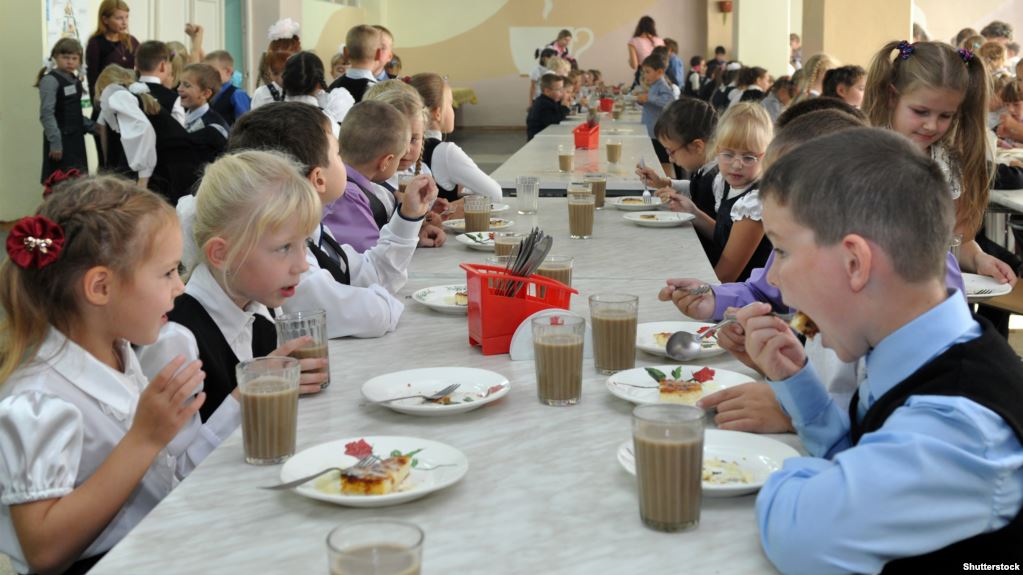
school lunchA stock photo of schoolchildren enjoying lunch in some place happier and more prosperous than Kemerovo Region and other parts of Russia that have been left to die by the country’s rapacious, neo-imperialist ruling class. Courtesy of Siber.Realii

Inspection Confirms Schoolchildren Fainting from Hunger in Kemerovo Region
Radio Svoboda
February 5, 2019

An inspection has confirmed that schoolchildren in Kemerovo Region have been fainting from hunger. Dmitry Kislitsyn, the region’s children’s rights ombudsman, said schoolmasters and regional officials had attempted to hush up the incidents. He has written about the problem in a report to Kemerovo Governor Sergei Tsivilyov. REN TV has published a copy of the report.

In particular, the health worker at the school in the village of Pashkovo, in the region’s Yashkino District, reported three incidents of children fainting that officials had not bothered to register. They were caused by hunger. In the school itself, the water was unfit for drinking, and the cafeteria was in disrepair. At other schools, pupils were divided into those who paid for meals and those from impoverished families. In certain cases, the number of children receiving hot meals during the school day did not exceed a third of the total number of pupils, while the portions of food served were smaller than stated in the regulations.

Kislistyn said the majority of members of the inspection commission had tried to “paper over the incidents.” Nevertheless, the ombudsman had reported the outcome of the inspection to the Russian Investigative Committee, the prosecutor’s office, and the official national consumer watchdog Rospotrebnadzor.

On January 23, 2019, Kislitsyn told a session of the regional council that incidents of hunger-induced fainting had increased among children in the region’s schools. He claimed he had been contacted by homeroom teachers who had noticed the social stratification of their pupils in connection with school meals. Some children were not eating at school because their parents did not pay for meals. According to Kislitsyn, the parents also could not afford to feed their children in the mornings. The ombudsman said this was the case in village schools, as well as among children bused to school from the countryside. Regional officials, however, had denied Kislitsyn’s claims.

Thanks to Comrade Koganzon for the heads-up. Translated by the Russian Reader

Detsl, Roseanne, and Me

Detsl,  “Party at Detl’s House” (1999)

Victoria Andreyeva
Facebook
February 3, 2019

Detsl’s death made me recall a story.

In the school I attended, No. 157, we had this great thing, Model United Nations. All the dynamic pupils with a good command of English could be involved, first as staff members, then as delegates, and finally as committee chairs and even secretaries general, if they were smart and ambitious enough.

Delegates from all over the world came to the Petersburg Model UN, and even the youngest pupils at our school were given the chance to invite a delegate home for a an an evening “party.”

My friend Lyuba and I were assigned Roseanne Ooi, a girl from faraway, exotic Malaysia. At my house, we entertained each other by chatting. Roseanne was the most curious about Russian music, and she wanted to listen to Russian rap. As non-connoisseurs, all we could remember and let Roseanne listen to were Detsl’s songs, which blew Roseanne away.

Later, we gave her a Detsl CD. We would imagine her listening to Detsl in Malaysia, which we could not picture at all in our wildest dreams. We imagined how her compatriots were amazed and jealous of her.

Surprisingly, the second thing that made a huge impression on our Malaysian visitor were the bananas that were part of our modest repast. She was so staggered by their huge size she took one home to Malaysia to show to her mom.

On the contrary, Lyuba and I thought that if a person from such southern latitudes were amazed by our bananas, there must be something wrong with them.

Thanks to Victoria Andreyeva for her permission to translate and publish her story. Translated by the Russian Reader. Photo of Detsl, below, courtesy of Alchetron

detsl

Last Address in Petersburg: January 13, 2019

нев 111полтав 3-3.jpgA Last Address memorial plaque near the corner of Poltava Street and Nevsky Prospect in Petersburg, October 11, 2018. Photo by the Russian Reader

This coming Sunday, January 13, 2019, Last Address in Petersburg and relatives of three men executed during the Great Terror will install memorial plaques on the Petrograd Side and Vasilyevsky Island.

At 12 p.m., a plaque will be hung at Kronverskaya Street 29/37 in memory of Andrei Aro. Aro taught at the Communist University of Ethnic Minorities of the West until 1937. When he was arrested in April 1938, he was working as a welder in the workshop of the district housing management company. He was sentenced to death by a so-called Dvoika [a commission of the NKVD and Soviet Prosecutor’s Office] and shot on August 3, 1938. He was 48 years old.

At 12:45 p.m., a third plaque will be installed on Building 7, Kamennoostrovsky Prospect 64. Until his arrest on July 22, 1937, it was the home of Shahno Krasilshchik, a dispatcher at Furniture Factory No. 162, located nearby. Krasilshchik was shot on November 24, 1937. 719 people were executed in Leningrad that day.

At 1:30 p..m., a plaque will be erected at Bolshoi Prospect 72 in memory of Boleslav Misnik, a design engineer who worked for fourteen years at the Baltic Plant. He was shot on October 6, 1937. His wife was exiled from Leningrad, while his son and daughter were left in the care of their grandfather.

A Finn, a Belarusian Jew, and Pole: all three men were shot after they had been sentenced by an extrajudicial authority, a joint commission of the NKVD and Soviet Prosecutor’s Office.  Victims of the Great Terror’s ethnic purges [“national operations”], they were subsequently rehabilitated.

UPDATE (January 8, 2019). In order to accommodate the number of relatives wishing to attend, the installation of the plaque commemorating Boleslav Misnik has been postponed to a later date TBA.

Translated by the Russian Reader

Leonid Volkov: The Export Pozner

pozner-yale-1.jpgVladimir Pozner at Yale University on September 27, 2018. Photo by Peter Cunningham. Courtesy of YaleNews
Leonid Volkov
Facebook
September 28, 2018

Yale has an incredibly rich extracurricular life. Every evening is chockablock with special events, public lectures, round tables, debates, and so on. Many politicians and public figures consider it an honor to speak at Yale. Today, for example, the president of Ghana is going to be lecturing, and there is nothing exotic about it.

All these events fight for an audience. They are advertised in a variety of mailings, and the bulletin boards on campus are densely crammed with flyers.

I imagine the president of Ghana will be sad today. He was beaten this evening [September 27]. The prettiest flyers, which have been on the bulletin boards since mid-August, announced a lecture provocatively entitled “How the United States Created Vladimir Putin.”

I had never seen such a popular event here. It was standing room only. Audience members (students, professors, researchers, etc.) sat on the steps of the lecture hall and stood in the aisles. There were around three hundred people. And no, I could not resist my curiosity, either. I was really interested in how Channel One operated when it was exported.

On stage was the ageless Vladimir Pozner. Would that everyone looked like that at eighty-four! His speech and manners were flawless. His manner of interacting with the audience was impeccable. He joked when it was appropriate and answered questions quickly. He was a professional of the highest class.

[These were Pozner’s talking points.]

  • Putin extended a helping hand after 9/11, but it was rejected.
  • The first proposal Putin made when he was elected to the presidency in 2000 was that Russia should join NATO. He was mortally offended by NATO’s rejection of his offer.
  • He fully voiced this resentment in his 2007 Munich speech, and the resentment was justified.
  • The western media have portrayed Putin in a negative light, all but comparing him with Hitler. This treatment has been wholly undeserved.
  • By offending and attacking Putin, they naturally angered him and made him what he is. The media are to blame for this (sic).

Did Russia meddle in the 2016 US presidential election?

[Pozner’s response was that] the Russian regime cheered for Trump, naturally, because Hillary Clinton had said so many bad things about Putin, but Pozner had seen no proof of meddling. Besides, had America not meddled in elections the world over?

And so it went.

Moreover, [the tone of the Pozner’s speech was captured] in the very first words [out of Pozner’s mouth].

“First of all, believe me when I say I am not representing anyone here. I speak here as an independent journalist, a breed that has nearly died off in Russia.”

Oh, while I was writing all this down, there was a question about Crimea. [Pozner’s response can be paraphrased as follows.]

Was international law violated? Yes, it was, but Sevastopol is a city populated by Russian naval officers and sailors. How could Russia have allowed the possibility of losing its naval base there and having it replaced by a NATO base, by the US Sixth Fleet? Should international law not be disregarded in such circumstances? Besides, Crimea has always been part of Russia.

Finally, [Pozner told his listeners, they] would understand better what had happened in Crimea if [they] imagined what would happen if a revolution occurred in Mexico (sic). In this case, would the US not want to deploy several army divisions on its southern border?

Yes, a new referendum should probably be held in Crimea, but [Pozner] was absolutely certain of the referendum’s outcome.

Argh!

Pozner equated Putin and Russia, of course, in all his remarks.

“It was clear the Russians had to respond in a certain way,” he would say in reference to actions taken by Putin.

In short, my friends, I was impressed. The export Pozner is nothing at all like the Pozner served up for domestic consumption in Russia. (I hope he is very well paid.)

But despite his best efforts, Pozner portrayed Putin as a rather pitiful man: insecure, petty, and vindictive. In this sense, of course, Pozner did not lie.

Leonid Volkov has been attacked on his own Facebook page by readers and Mr. Pozner himself on the latter’s website for his allegedly inaccurate portrait of Mr. Pozner’s appearance at Yale. Stories about the evening published on Yale University’s in-house organ YaleNews and the university’s student-run newpaper the Yale Daily News, however, substantially corroborate Mr. Volkov’s sketch of the event. His description of Pozner and his talk also jibe with my own sense of Mr. Pozner as a chameleon who skillfully tailors his messages to his audiences and the times. Or was it not Mr. Pozner who routinely appeared on my favorite news program, ABC’s Nightline, when I was a teenager in the early 1980s, to defend the moribund Soviet regime with a completely straight face? Read “In the Breast of Mother Russia Speaks a Kind and Loving Heart” for an account of a similiarly virtuoso agitprop performance by Mr. Pozner in the US nearly four years ago. {TRR}

Translated by the Russian Reader

Tatyana Schukina: Why Russian Schoolchildren Protest

reutersx

Tatyana Schukina
VK
September 10, 2018

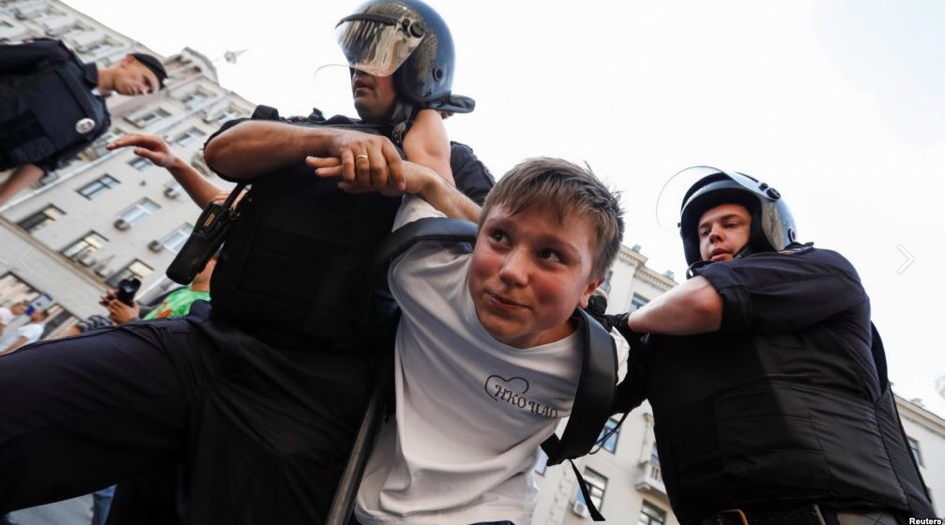
“Gendarmes Savagely Nab Teenagers”

Who are the teenagers who go to protest rallies? Blind rebels who would oppose any system or children who have realized this country has no future?

Yes, I believe my views are oppositional, sometimes to extremes. But I want to at least try and examine this topic objectively.

I think there are both kinds of children at protest rallies. The scary thing is that if absolutely all children came to protest rallies merely to have a laugh, feel they were part of something meaningful, and yell at the government, basing their arguments on someone else’s words, it wouldn’t be so terrible.

At the [anti-inauguration] rally on May 5, my friends and I saw a boy who was six or seven. He wore a blazer and had a school bag on his back. He marched with the crowd. He was not yelling, but he was part of the rally.

One of my friends wanted to take the piss out of him.

“Our little rebel. You against the system, too?” he said.

“Systems are inevitable,” the boy replied. “I’m against this one.”

We freaked out. We delicately asked him whether he was frightened.

(The atmosphere was frightening. There were tons of paddy wagons and helmeted polizei wielding truncheons. The crowd was screaming. Protesters were getting nicked and marched off to the paddy wagons. Some people were crying.)

The boy laughed.

“It’s frightening when they explain to me at school why I could be punished if I’m strolling out here,” he said.

“You’re frightened you’ll be punished?”

“I’m frightened I don’t know why I would be punished,” he said.

I’m scared that children talk like that. I’m scared that children speak beyond their years and in their own words. I’m scared they could be sent to jail or expelled from school in their own city, yet no one can properly explain to them why. For pictures posted on the internet? For attending peaceful protest rallies? Even though the authorities herd children to a rally if it’s a pro-Putin rally. That’s the difference. Children are simply bused to pro-United Russia rallies and hold placards made ahead of time for them.

They go to opposition rallies on their own.

I know the schools are flooded with propaganda. I know because I was a schoolgirl until recently. I also know that political campaigning and propaganda is legally forbidden in schools.

I remember one September first, the first day of the school year. We sat in our classroom, and the teacher told us about the plans for the years. Another teacher walked around the room, taking snapshots of diligent pupils at their desks. A slide with an image of Putin flashed on the screen. It was captioned, “Russian Federation President V.V. Putin.”

It was no big deal. The next slide flashed on the screen.

“Wait, bring Putin back. I’ll take a snapshot of the class with him in the background,” the teacher with the camera yelled to the pupil running the projector.

It was a trifle. Totalitarianism is made up of trifles such as children seated in front of the supreme leader’s picture. But wait, it’s the twenty-first century. Everything’s cool. The picture is digital.

That teacher takes a class snapshot with Putin in the background. Another teacher stuffs ballot boxes on election day. Yet another teacher tells pupils why they are forbidden to attend protest rallies. Finally, a fourth teacher takes children to a pro-United Russia rally. But children don’t understand what’s happening. Children ask questions. Children are interested in politics. Children understand this is where they will have to live. Children watch investigative reports, children see the poverty, and children go to protest rallies.

Thanks to Leokadia Frenkel for the heads-up. Translated by the Russian Reader. Photograph courtesy of Reuters and Ms. Shchukina’s VK page

Neocolonialism

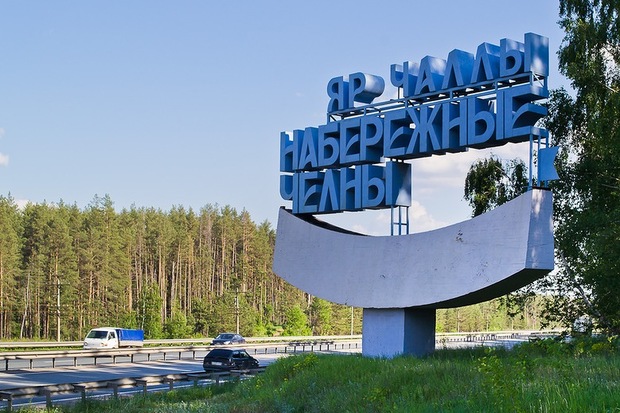
7d34dc1c84d3ef36Tatarstan’s second largest city, Naberezhnye Chelny, is known as Yar Chally in Tatar. Photo courtesy of Realnoe Vremya
Minority Languages Ready for Third Reading
State Duma Updates Standards for Teaching Official Languages
Viktor Khamrayev and Kirill Antonov
Kommersant
July 25, 2018

On Wednesday, July 25, the State Duma should pass in its third and final reading a law bill that would make study of the Russian Federation’s official language, Russian, and the official languages of the country’s ethnic republics an obligatory part of the school curriculum. However, parents would freely choose the language their children study as their native tongue. MPs are confident they have defused the anxiety felt in the ethnic republics over the plight of minority native languages. Experts in a number of the republics, however, are still concerned minority native tongues will gradually outlive their usefulness.

On Tuesday, July 24, the Duma approved in their second reading amendments to the law “On Education.” During their first reading, the draft amendments had drawn criticism from the ethnic republics due to the fact they introduced the principle of choice when studying native languages.

Vyacheslav Nikonov, chair of the Duma’s education committee, told Kommersant two important provisions had been inserted into the law bill for the second reading. The Federal Education Standards “should guarantee the opportunity to be instructed in the native languages of the peoples of the Russian Federation” and, to this end, they should provide for the study of “the official languages of the Russian Federation’s republics, the native languages of the peoples of the Russian Federation, including the Russian language.”

According to Mr. Nikonov, this rule should diffuse “concerns in the republics that the study of minority languages would become optional.”

“The federal standard means mandatory inclusion in the curriculum,” Mr. Nikonov said.

At the same time, the law establishes the free choice of the language of classroom instruction, as well as the choice of what language children would study as their native tongue, as determined by their parents.

During its second reading, 371 MPs voted for the law bill. It should pass during its third reading on Wednesday.

Mr. Nikonov reported the education committee had already negotiated with the relevant parties to establish a fund to support native languages.

“We suggest establishing the fund through a presidential decree, making it a presidential fund with appropriate federal financing,” he said.

In addition, Mr. Nikonov said MPs had been asked to develop the basic concept on which the new Federal Education Standards would be based. The government has established a working group in accordance with the resolution adopted by the Duma after the first reading of the bill.

As approved by MPs, the draft law does not provide for a transitional period while the government elaborates the new concept and educational standards. The law would come into force as soon as it was signed by the president and published. In this regard, the republics are afraid of the consequences set in motion once the law has been adopted. The free choice of a native language would come into play in the absence of new federal standards.

Under current guidelines, pupils attend five hours of Russian classes a week, while minority language classes are offered only three hours a week, Svetlana Semyonova, director of the Ethnic Schools Research Institute, explained to Kommersant.

This means, Ms. Semyonova said, that “pupils who choose Russian as their native language will have eight hours of Russian class a week, while those pupils whose native language is Yakut will study Russian for only five hours a week.”

Given that the Leaving Certificate Examination (EGE) is administered only in Russian, Ms. Semyonova argues Yakut children would be more poorly prepared for it.

Due to the EGE, very few pupils would risk choosing a minority language as their native language, Marat Lotfullin, a researcher in ethnic education at the History Institute of the Tatarstan Academy of Sciences, told Kommersant. Even non-Russian children in Tatarstan would choose Russia as their native language. He fears the Tatar language will gradually outlive its usefulness.

Mr. Lotfullin draws attention to the fact that the new law stipulates the teaching of minority native languages and classroom instruction in these languages only for primary and secondary schools, meaning ethnic schools would function only until the ninth grade.

This is “a serious restriction of the rights of the peoples of the Russian Federation,” he argues.

“If we take Tatarstan, Tatars have always enjoyed instruction in Tatar all through secondary school, including the upper grades,” Mr. Lotfullin said.

Translated by the Russian Reader. See whether you can square this story with my previous post, about a young Khakas woman in Abakan who has been charged with “extremism” by the FSB for promoting Khakas language and culture, and publishing a blog post about the discrimination Khakas experience at the hands of ethnic Russians, who constitute the majority in the nominally “ethnic” Republic of Khakassia.

Twenty Percent of Russian Schoolteachers Contemplate Quitting

Twenty Percent of Russian Schoolteachers Contemplate Quitting
Salaries Lower than Official Rates, While Workload Is Extremely Heavy
Yelena Mukhametshina
Vedomosti
June 27, 2018

russian teacher salariies

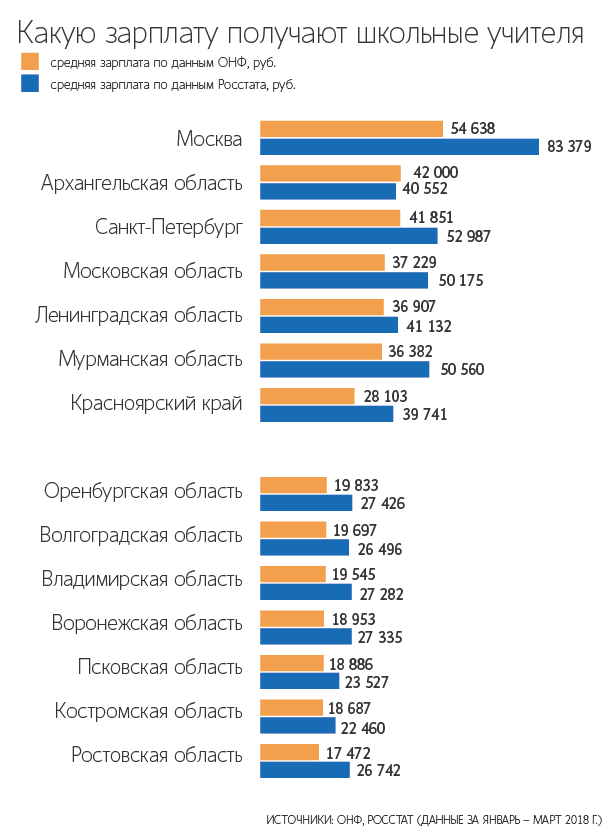
“How Much Schoolteachers Are Paid.” Orange = average monthly salary according to ONF survey, in rubles; blue = average monthly salary according to Rosstat (Russian State Statistics Service), in rubles. From top to bottom, the two sets of figures are provided for Moscow, Arkhangelsk Region, St. Petersburg, Moscow Region, Leningrad Region, Murmansk Region, Krasnoyarsk Territory, Orenburg Region, Volgograd Region, Vladimir Region, Voronezh Region, Pskov Region, Kostroma Region, and Rostov Region. The figures given are for the period January–March 2018. Courtesy of Vedomosti

A third of Russian schoolteachers do not know how their salaries are calculated or whether incentive payments and reimbursements are added to their paychecks. This was one finding of a survey carried out by the Russian People’s Front (ONF) in May 2018, during which researchers interviewed more than 3,000 teachers in 82 regions.

“Wage growth remains insignificant, making it impossible to attain the wage levels claimed by Rosstat,” the ONF concluded.

In Murmansk Region, for example, the survey showed teachers earned an average of ₽36,382 a month [approx. €495 a month], while official statistics showed they earned ₽50,560 a month [approx. €688 a month].

But even the salary the teachers earn comes at the price of an extremely heavy workload, the researchers stressed. The workload was heaviest in Kemerovo, Kostroma, and Samara Regions, where teachers averaged over thirty classes a week.

A quarter of schoolteachers have second jobs or hold additional positions at the same school, while twenty percent think of quitting the profession due to the heavy workload. Seven percent of the teachers surveyed spoke of not having been paid at all or paid in full at times. Twenty-three percent said their paychecks had been miscalculated, while fifty-seven percent had not been paid for overtime or additional duties.

Lyubov Dukhanina, deputy chair of the State Duma’s education committee and a member of the ONF’s central staff, argues the current nontransparent system of calculating salaries, which divides salaries into basic pay and incentive pay, should be abandoned. Instead, teachers should receive a guaranteed salary for their work. She also notes that, according to many teachers, incentive payments are unfair and opaque, and the amount of these payments can vary wildly from month to month.

Igor Remorenko, rector of Moscow State Pedagogical University and former deputy education minister, said all systems of compensation include guaranteed basic pay.

“In organizations undergoing reform, the lower the guaranteed basic pay, the better, because it enables you to rotate employees. In stable organizations, the constant part of the paycheck is more important, because it motivates employees. We need to move in the direction of having teachers sign annual contracts and feel confident in the future, while accepting the possibility of being paid different amounts depending on differing workloads from month to month,” said Remorenko.

The ONF’s survey actually embellished the real picture, noted Vsevolod Lukhovitsky, co-chair of the Teacher Trade Union.

“There are legal means of turning tiny salaries into big salaries on paper. For example, in Moscow, until 2018, the statistics included only full-time employees who had open-ended contracts, while the part-timers, who earned less money, were not included in the stats,” said Lukhovitsky.

According to Lukhovitsky, a law bill would be tabled in the State Duma this autumn that would establish a guaranteed minimum salary, equal to at least two minimum wages, for eighteen academic hours.

“It’s nice a large organization like the ONF has supported our conclusions four years after we started talking about going back to a fixed salary,” said Lukhovitsky.

Naturally, teachers are dissatisfied with their salaries. They are thus fertile ground for the ONF, argues political scientist Konstantin Kalachev. Teachers play a key role in elections and the entire political system.

[The ONF is a pro-Putin, astroturfed “populist” front organization. Teachers are critical to the Putin regime because many of them serve as polling station workers during elections, due to the fact that polling stations are commonly set up in schools. Teachers are thus often involved in the systematic vote rigging and electoral fraud that have helped keep Putin and his allies in power for twenty years—TRR.]

“The current system of governance sometimes needs to let off steam. There is nothing frightening about the fact the stats are fudged, and the president’s May decrees are not fully implemented. The president sets tasks, and if they are not solved that is the problem of the people trying to solve them,” said Kalachev.

It is pensioners, teachers, and physicians who have the most impact on approval ratings, “so it makes sense the powers that be are focused on worrying about teachers,” he concluded.

Translated by the Russian Reader

The Kids Are (Not) Alright, Part 3: Are You Ready to Defend the Motherland?

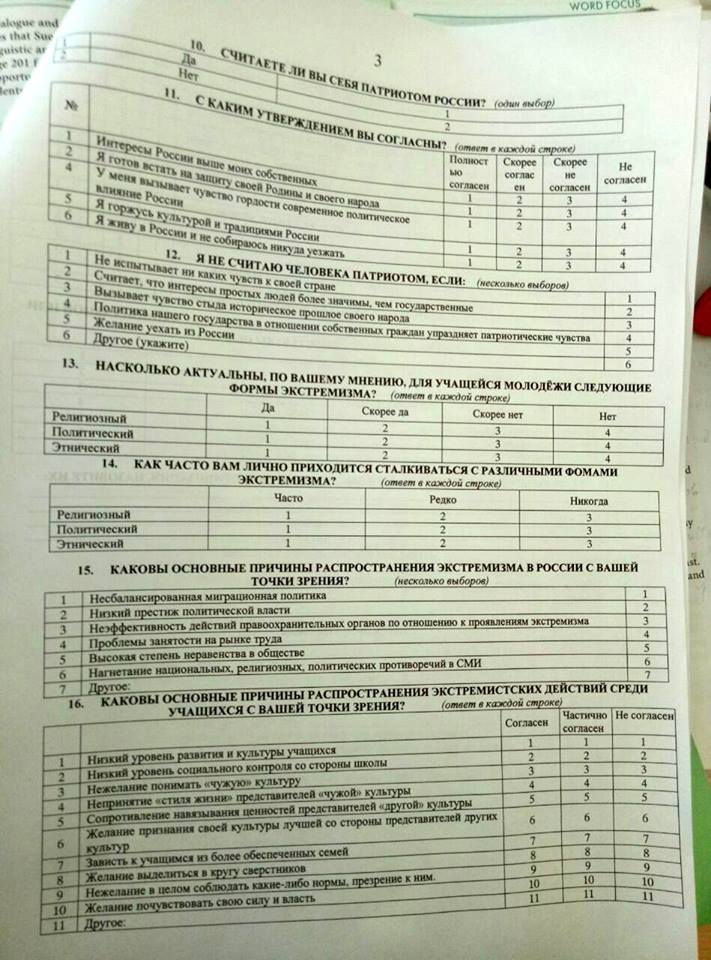
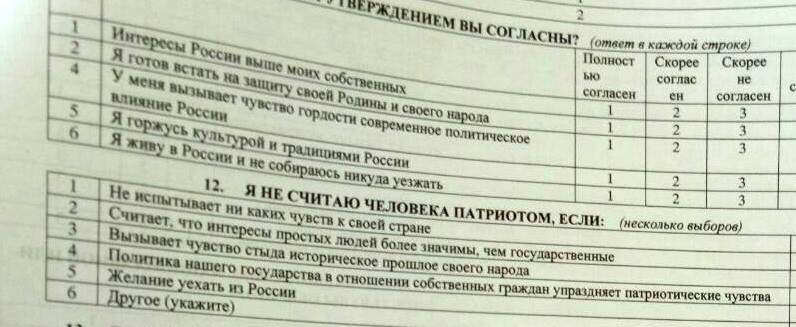
30707960_10156005294207203_9089823561300341523_nThe third page of a questionnaire focusing on “patriotism” and “extremism,” allegedly administered to schoolchildren in Petersburg’s Moscow District. Photo courtesy of Daniel Alexandrov, Jr.
Daniel Alexandrov, Jr.
Facebook
April 20, 2018

The most monstrous thing currently in the works is the forthcoming ban on imported drugs. Much has been written about it, emotions have flared, and I have nothing to add. I would imagine we have seen nothing like it in recent Russian history. People are cynicallly willing to sacrifice tens of thousands and hundreds of thousands of lives, by sending medical care forty or fifty years back in time, in order to increase the profits of several Russian companies.

But what kicked off the other day in Petersburg’s schools is no less vicious, although it is not such an obvious case of cannibalism. As Marina Tkachova, on whose page I saw the link, wrote correctly, a witch hunt has been launched.

In violation of Article 29 of the Russian Consitution,* which directly prohibits forcing people to voice their political views, the Moscow District Administration, assisted by the Center for Psychological, Pedagogical, Medical, and Social Aid, made schoolchildren fill out a questionnaire.

The questionnaire asked the schoolchildren, for example, to voice the extent to which they agreed with the following statements.

  • Russia’s interests are greater than my own.
  • I am ready to defend the Motherland and the people [narod = das Volk].
  • I feel proud of Russia’s current political influence.
  • I am proud of Russia’s culture and traditions.
  • I live in Russia and I do not plan to emigrate to another country.

31068869_10156005294157203_338838680958886823_nPart 12 of the questionnaire reads, “I don’t consider a person a patriot if . . . ” 1) He experiences no feelings for his country; 2) Believes the interests of ordinary people are more significant than the state’s interests; 3) The historic past of his people makes him ashamed; 4) The policies of our state towards its own citizens abolish patriot sentiments; 5) he want to leave Russia; 6) Other (specify).” Students could chose more than one answer. Photo courtesy of Daniel Alexandrov, Jr.

In addition, the pupils were asked to determine what social phenomena and psychological traits (!) generate nationalist or extremists moods among young people. The people who compiled the questionnaire openly provoked teenagers into violating Article 282 of the Russian Federal Criminal Code [which forbids “inciting the hatred and enmity” against other people based on ethnicity, religion, etc.] by asking them, “Are their religions or ethnic groups you dislike?” and “When faced with people different from you in appearance, ethniicity or religion, you usually . . .” One of the possible answers was, “I act aggressively.”

30742559_10156005294177203_1430095687740250696_nThe fourth and final page of the questionnaire focuses on the attitude of students toward different ethnic, religious, and social groups, thus encouraging them to violate Article 282 of the Russian Criminal Code, as Mr. Alexandrov points out. Photo courtesy of Daniel Alexandrov, Jr.

The Education Committee at Petersburg City Hall explained to Fontanka.ru that the questionnaire was part of a “comprehensive plan for preventing juvenile delinquency among minors during the 2017–2018 academic year.” It is a program for monitoring and identifying potential “extremists” among schoolchildren.

I have the sense these people either do not realize what they are saying or they do realize it, which is even worse.

Even the Soviet Union was bereft of such idiocy and meanness, as when minors were asked to fill out questionnaires with questions like, “How much do you love the Motherland on a scale from one to five?” or “Whom do you love more, the Motherland or Mom?”

I have learned the schools on Vasilyevsky Island have not administered the questionnaire—yet—but since the Education Committee has adopted the plan, it means the questionnaire will be administered, if not now, then in September.

This cannot be ignored. We cannot stay silent about this. Interrogating schoolchildren about their love of the Motherland and their willingness to sacrifice themselves, and suggesting they should rat on themselves are real manifestations of fascism, and there are no ifs, ands, or buts about it. Friends, city council members, human rights activists, public figures, and local journalists: do something about it.

* Article 29 of the Russian Constitution:

1. Everyone shall be guaranteed freedom of ideas and speech.

2. Propaganda or agitation instigating social, racial, national or religious hatred and strife shall not be allowed. Propaganda of social, racial, national, religious or linguistic supremacy shall be banned.

3. No one may be forced to express his views and convictions or eject them.

4. Everyone shall have the right to freely look for, receive, transmit, produce and distribute information by any legal means. The list of data comprising state secrets shall be determined by federal law.

5. The freedom of mass communication shall be guaranteed. Censorship shall be banned.

Thanks to Valery Dymshits for the heads-up. Translated by the Russian Reader. I slightly edited the excerpted quotation from the Russian Constitution to make it more readable.