This week’s edition of BBC Radio 4’s obituaries program featured appreciations of the KGB defector Oleg Gordievsky and the composer Sofia Gubaidulina. ||| TRR
Oleg Gordievsky, Renee Goddard, Professor Richard Fortey, Sofia Gubaidulina
Matthew Bannister on Oleg Gordievsky, the KGB agent who defected to Britain and became a valued source of secret intelligence during the 1970s and 80s.
Renee Goddard, the actress and TV commissioner who fled Nazi persecution only to be interned in Britain.
Professor Richard Fortey, the palaeontologist who used his expertise in trilobites to tell stories about the origins of life on earth. Bill Bryson pays tribute.
Sofia Gubaidulina, the composer whose large scale religious works attracted criticism from the Soviet authorities.
Nacimiento-Fergusson Road is a stunning drive located on the Pacific coast of the U.S. state of California, regarded as one of the best motorcycling roads in central California.
Where is the Nacimiento-Fergusson Road?
The road is located in Monterey County, in the US state of California, running across the eastern slope of the Santa Lucia range within Los Padres National Forest.
25 years ago, on March 26, 2000, Vladimir Putin won the Russian presidential election, making him the official successor of Boris Yeltsin, who had resigned three months earlier. Putin, who was prime minister at the time and had served as acting president after Yeltsin’s resignation, won 53.4 percent of the vote in what is widely considered the last truly competitive presidential election in Russia to date. Over the next 25 years, Putin would only tighten his grip on power. To comply with the constitutional limit of two consecutive terms, he switched to the role of prime minister in 2008 while his ally Dmitry Medvedev occupied the presidency. After amending the constitution to extend presidential terms from four to six years starting in 2012, Medvedev made way for Putin to run in the 2012 presidential election. Putin won 63.6 percent of the vote, securing a third term in Russia’s highest office.
After winning re-election again in March 2018, Putin once again faced hitting the constitutional term limit in 2024. To address what became widely known as “the 2024 problem”, Putin proposed wide-ranging amendmen[t]s to the constitution in January 2020, which included a change to presidential term limits. While making the rules stricter on paper by limiting Russian citizens to two presidential terms in their lifetime — disallowing the shuffling between positions that Putin had employed in 2008 and 2012 — the amendmen[t] was designed to disregard past or current terms, effectively erasing Putin’s first four terms. The new rule paved the way for Putin to run again in 2024 and to seek re-election in 2028 if he so chooses, which could keep him in power until 2036.
If Putin remains in power beyond 2030, he would become Russia’s longest-serving leader, surpassing Joseph Stalin, who led the Soviet Union for 29 years between 1922 and his death in 1953.
Tequilajazzz frontman Evgeny Fedorov explains to Konstantin Eggert, the presenter of DW’s #Trendy, why Putin is a genuinely grassroots president, what Fedorov’s wealthy fans asked him to play at company parties, and how Russian chanson masqueraded as Russian rock.
Konstantin Eggert: You and I are speaking in Vilnius, where your manager had to look for quite a long while for a venue for your gig because many people turned him down. Does this bother you?
Evgeny Fedorov: Of course it makes me sad. We realize that, in our case, it is unfair. There are artists playing both sides of the fence who are traveling around the world to make money. We are vocal opponents of the war and everything that has been happening in Russia. So it’s a little bit offensive to us, but we realize that this is the price the times make us pay and nothing can be done about it.
— It’s gotten harder. I can’t say that we were a big box-office band. Our music is specific: we’ve always had a fairly modest audience, and we’re used to it. Business wise, we are now cut off from the Russian market and can’t tour Siberia and the Far East. It’s not a big deal, because on 25 February 2022 I personally announced on social media that we would stop doing concerts in the Russian Federation. It was a deliberate (not hysterical) step on our part. We have been coping with these difficulties. We have a small but very loyal, attentive, smart fan base. As it turned out, a significant number of them left the country with us, and so I see in the audience the same people who used to come out for our concerts in St. Petersburg and Moscow.
— In one interview, you spoke about the muteness that overcame you when the full-scale invasion began. Is that muteness completely gone now?
— No, it’s not gone. It has become obvious that I have to reinvent myself, to devise a new language, both creatively and literally. It’s just inappropriate even to remember now some of the things I wrote songs about. I have to change a lot, and this applies to all areas of my life.
Konstantin Eggert interviews musician Evgeny Fedorov, Deutsche Welle Russian Service, 26 March 2025 (in Russian)
— What do you mean that you have to change? You once said that writing protest songs wasn’t your thing.
— I’m not good at it. I tried to voice my rage and grief, all the emotions that were overwhelming me, but it sounded stupid and unnatural. Despite the fact that they were my emotions, I couldn’t express them adequately in songs. We wrote only one [protest] song, “A Machine Full of Evil.” These were the first lines I wrote down in a notebook after the war started. I was watching a war newsreel from Ukraine, and this line came to my mind: “A machine full of evil was crawling.” It’s the only song on the subject where it’s quite obvious to everyone what it’s about. We don’t use any Aesopian language in it.
— Do you think that most people in Russia are just running this “evil machine”?
— No, of course not. I see a huge number of people who were not able to leave [Russia] for various reasons. Some of them deliberately stayed behind to try and destroy the system and to help each other survive. But I’m still horrified to see what a humungous number of people wholeheartedly support this crap.
Tequilajazzz, “A Machine Full of Evil” (2023)
— Among them are people with whom you have collaborated — [Vyacheslav] Butusov, [Konstantin] Kinchev, and a considerable portion of today’s Z-patriots from the cultural realm. Did you already feel at that time that this could happen? Or are those people just interested in the money?
— Almost none of them was a surprise to me. They had obviously been drifting in that direction. You could see that they were going over to that side, they had got their own personal confessors. […] The guys were fusing with the regime, it was out in the open for everyone to see, and nobody surprised me. You know, I had a dream a couple of times that Putin and I were in an office. He says, “Zhenka, sit down, I’m going to take care of business and then we’ll go fishing.” Something like that. I remember the nasty delight I felt in the dream. How cool, I’m hanging out with Putin himself! That courtier’s joy of being near power. I woke up, horrified to discover that I had it in me too, that no one was immune.
The more popular an artist is, the more often they are in the regime’s domain. I have friends who played at ex-President Medvedev’s dacha. I realize that if my music had suddenly appealed to Putin and I had been invited, I cannot rule out that a metamorphosis would have happened to me, and that I would suddenly have been possessed by this despicable joy of being around powerful people. I thank God and our firmness, which we have maintained all these years, and our aesthetic commitments and our ethical commitments, too, that we escaped the danger.
We played company parties three times in our lives. Each time it was a former fan of ours who, as a university student, used to pogo at our gigs, but then had struck it very rich, and so for his birthday or for his company’s birthday he had engaged our band and asked us to play our most hardcore alternative songs. It was always quite funny, because it was obviously the wrong music for a company party. It was just that the guy had bought himself the kind of hardcore show which he couldn’t permit himself to attend now, because he was a “big man,” surrounded by security guards, and so on. But God spared us from all those parties organized by the presidential administration and all those people who were trying to craft the new imperialist mindset.
— Is Putin a people’s president?
— I wish I could joke about it, but I look at people, how they relate to him, and everything that is happening now, and it seems that he is in fact a people’s president, because this type of president did not “go viral” for nothing and enjoys such popularity. It means that he resonates with the people, so that means he is a people’s president.
— What resonates?
— The jokes, the quips, the anecdotes. The man thinks in memes from Soviet movies. He knows how to speak this language and this appeals to people. I remember that my normal, sane friends, when Putin started making all those jokes, squealed with delight: “What a great joke he made!” I said, Guys, what’s wrong with you, it’s a purely cop joke, filled with contempt for people and the belief that no one is without sin, that “everyone shits somewhere,” that everyone is dirty, and if they aren’t, they should be made dirty. I think his practice is based on that.
— And even the war, all the Cargo 200s coming home, doesn’t change that?
— Those people are certain they are fighting for a just cause, they have been convinced of it. We all grew up completely convinced we were the kindest and most generous [people in the world], that we couldn’t be wrong. It’s a very cozy room from which it’s hard to escape and realize that we [do not do] the most magnanimous things. And when we save nations, we are just saving a lane for business.
— In January 2000, when Radio Liberty journalist Andrei Babitsky was abducted in Chechnya, I realized the new regime were the enemies of the media, and therefore the enemies of everything else that was decent. Did you have a moment when you realized that this was a catastrophe?
— September 1999, the apartment building bombings. It was quite obvious this was regime change, that [the bombings] had been necessary to bring that person to power. I lived with that horror for twenty years, trying to resist, not allowing myself to flirt with Russian chanson, with underworld things, with what Russian rock later turned into — this fusion of the guitars, the image, and the courtyard songs of Russian chanson with all the paraphernalia of chthonic values — with vodka, herring, the banya, and so on.
— You once said that the need for protest songs ended in the 90s and the bourgeois era of just being creative dawned. Was it a good time for you?
— It’s generally normal for people to do creative work and sing love songs. The need to write protest songs is not normal. We liked the fact that rock and roll was no longer a genre persecuted by the KGB and that it was safe to play. We sang about ugly things, often without delving into lofty matters. Our music is about different aspects of human life, both lofty and absolutely ordinary, even shameful. That’s normal. What is happening now is not normal.
— If you look at the last thirty years, what Russian music, literature or cinema has stuck with you?
— A few Boris Grebenshchikov albums for sure. Now I’m just cut off. I can’t listen to anything that I liked three years ago. I turn on my favorite album and realize I can’t listen to it because it takes me back to a life which no longer exists. I’ve become an “anti-old fart.” Because old farts listen to the music of their youth and choose to stay in their time bubble. My bubble has burst. I’m listening to the stuff teenagers and young adults listen to, to weird experimental stuff that doesn’t sound like what I used to enjoy.
I’m reading a lot of hundred-year-old émigré prose right now, which has suddenly become timely. It’s interesting to compare [my experiences with] the experiences of people who left [Russia] between 1918 and 1920. There is this sense of horror at the darkness that surfaced and deluged everything, the mundane details, the executions, the horror at this outbreak of self-righteous darkness, spewing saliva, blood, and shit… The horror is quite comparable.
— Let’s imagine that tomorrow Putin falls, we make peace with Ukraine and give them back the occupied territories, and the political prisoners are released. Would you be willing to go home?
— I don’t want to see those mugs. Where will all these cops, FSO officers, and the people who are in league with them go? A huge number of my friends in Russia are in a terrible situation. What is it like for those people who are on our side, but who are [in Russia]? How do they survive? How do they each struggle in their own way, often just on an aesthetic level? I have a quite pessimistic view of the future. I don’t believe that any of this will change quickly, if it didn’t change in the few years of freedom that Russia had, which people didn’t savor, but decided to go back to the Brezhnev-era twilight.
Tequilajazz, One Hundred Fifty Billion Steps (LP, 1999)
Evgeny Fedorov is a Russian musician, composer, and producer. Having played and composed music from a young age, he is a well-known and highly regarded figure in the Russian alternative rock scene. Since late August 2024, he has been in ICORN residence in Stockholm after openly criticising Russia’s war in Ukraine.
Evgeny Fedorov joined his first band Объект Насмешек (‘Object of Ridicule’) in 1986 and became very popular in the final years of communism, touring and performing across the USSR until the band broke up in 1991.
In 1993, Fedorov formed another band Tequilajazzz for which he continues to be the lead singer and bass player. The band has recorded and released numerous critically acclaimed albums and has toured all over the world.
In addition to Tequilajazzz, Fedorov has been involved in several other music projects, including Optimystica Orchestra and Zorge, and has composed music for Russian films and TV series.
After openly criticising Russia’s full-scale invasion of Ukraine in February 2022, Fedorov was harassed and threatened with legal action by the Russian government. He was publicly condemned on state-controlled Russian television.
At the end of August 2024, Evgeny Fedorov began an ICORN residency in Stockholm. He continues his work from Kulturhuset Stadsteatern.
Stockholm ICORN City of Refuge
Stockholm has hosted writers and artists at risk since 1998 and has been an ICORN City of Refuge since the network was established in 2006. Since 2012, Kulturhuset Stadsteatern has been managing Stockholm’s ICORN programme, so far hosting 12 ICORN residents, including Faraj Bayrakdar, Arya Aramnejad, and Zahra Hussaini.
Currently, Stockholm offers three ICORN residences simultaneously. Alongside Evgeny Fedorov, music artist Mun Mun from Myanmar and poet and short story writer Raafat Hekmat from Syria are also continuing their work from Stockholm and Kulturhuset Stadsteatern.
Russia ranks poorly in transparency, corruption, and democracy in many international indexes. Researchers at The Economist ranked it 150th out of 167 countries in its Democracy Index last year, highlighting the country’s lack of political diversity and frequent election manipulation. Russia also received a worrying score for corruption in NGO Transparency International’s most recent annual report, where it ranked 154th out of 180.
The Kremlin regime’s repression and journalistic censorship are also reflected in a ranking on global press freedom, with Reporters Without Borders placing the country 183rd out of 208 last year—a score that is hardly surprising, considering that Russia still regularly imprisons journalists, including on the grounds of “espionage.” The government also restricts access to the internet and critical content online.
Russia jails dissident once targeted by Putin at KGB for 16 years
A court in St. Petersburg has sentenced Alexander Skobov, a 66-year-old Soviet dissident and activist, to 16 years in jail on charges of justifying terrorism and joining a terrorist group. Skovov was first arrested more than four decades ago and Vladimir Putin was among the KGB officers who worked on his case. Prosecutors said Skobov justified terrorist attacks on Russian territory and supported the Freedom of Russia legion, which Russia has deemed a terrorist organisation for fighting alongside Ukrainian forces.
Skobov will spend the first three years of his sentence in prison (typically reserved for highly dangerous criminals such as kidnappers and terrorists and repeat offenders), with the rest in a high-security penal colony. He will be 80 by the time he can be released, although it is questionable whether he will survive that long in Russia’s harsh prison system. The activist has many health problems, including diabetes, hepatitis C, asthma and glaucoma.
At the court hearing, Skobov made clear that he did not believe he was facing a fair trial. He refused to answer questions and did not stand when the judge addressed him. “Today they will ask me again – do I plead guilty? Well, now I’m the one asking,” he said in his closing statement. “It’s me asking the servants of Putin’s regime who are present here, who are small cogs in his repressive regime: do you plead guilty to complicity in Putin’s crimes? Do you repent of your complicity?”
In the USSR, Skobov was repeatedly charged with “anti-Soviet” offenses. He was first arrested in 1978 on charges of distributing anti-Soviet leaflets and was sentenced to two years in a psychiatric hospital (punitive psychiatry was widespread in the Soviet Union and used as one of the main tools of repression in the 1960s, 70s and 80s). Skobov was forcibly hospitalized again in 1982 for daubing anti-Soviet graffiti on the walls of a building and then released in 1985.
Vladimir Putin, who worked in the Fifth Department of the KGB that was tasked with combating “ideological sabotage,” was among the KGB officers that handled his original cases, independent media and rights groups reported.
Why the world should care
This is far from the first instance when somebody in Russia has been imprisoned for a post on social media. Since 2010, prosecutors have opened more than 1,000 such criminal cases. But a 16-year sentence for an elderly activist in frail health stands out as particularly punitive. It’s safe to say that treatment of dissidents in modern Russia is growing far tougher than it was in the post-Stalin Soviet Union.
“Illinois Governor JB Pritzker (D-IL) Speaks at the 2025 HRC Los Angeles Dinner,” Human Rights Campaign (YouTube)
The Trump administration and his Republican lackeys in Congress are looking to reverse every single victory this community has won over the last 50 years. And right now, it’s drag queens reading books and transgender people serving in the military. Tomorrow, it’s your marriage license and your job they want to take. Bending to the whims of a bully will not end his cruelty. It will only embolden him. The response to authoritarianism isn’t acquiescence. Bullies respond to one thing, and one thing only, a punch in the face.
But you see, that starts with fully acknowledging what is happening. The meme lords and the minions in the White House are intentionally breaking the American system of government so they can rebuild it in their own image. They’ve shut down cancer research and HIV prevention. They’ve eliminated drinking water and clean air regulations and upended the lives of veterans. They’ve said that a recession that Trump is likely to cause will be worth it, which is an assessment worthy of Trump University.
At its core, what Elon Musk and Donald Trump are doing isn’t about efficiencies or cost savings. It’s about giving their wealthy friends a tax break and making the middle class and veterans and public school kids pay for it. It’s a few idiots trying to figure out how to pull off the scam of their lives.
Meanwhile, the scariest part is that they’re using the power of the presidency to try to delight their base by targeting vulnerable people, people they think can’t fight back, calling them domestic enemies or claiming they’ll ruin American culture. Remember their slogan, “Make America Great Again.” Authoritarians target vulnerable minority communities first because they think that if they can conquer those that they deem weak, and they can show everyone else who’s boss, which is why we can’t sit back right now and wait to see what happens. If we wait, I guarantee you the battle will have already been lost.
Donald Trump cannot take anything from us that we don’t choose to give him. He and his henchmen don’t want people to realize that. But now is the time for us to wake up. The good news is every day I’m seeing more and more people across this country realize that they don’t want to give him much at all.
The question I get asked most right now is, “So what can I do? What can I do?” And I’m going to be blunt about this. Never before in my life have I called for mass activism, but this is the moment. Take to the streets, protest, show up at town halls. Jam the phone lines in Congress, 202-224-3121, and afford not a moment of peace to any elected representatives who are aiding and abetting Musk and Trump’s illegal power grab. This is not a drill, folks. This is the real thing.
Seize every megaphone you have. Go online and make a donation to the legal funds fighting Trump, to HRC, and to the candidates for Congress that vow to take this country backward. And don’t limit your voice to the traditional political channels. Be like Lucy Welch. When JD Vance went to vacation at the Sugarbush Resort in Warren, Vermont, Lucy, who writes the Sugarbush Daily Snow Report, used her report to defend her diverse and wonderful community, ending by saying, “I am using my relative platform as a snow reporter to be disruptive. What we do or don’t do matters.”
What we do and don’t do matters. It matters right now more than it ever has before. When my future grandkids look back on this moment, I want them to know that my voice was one of the loudest in the room, screaming for justice and fighting against tyranny.
And in the midst of this existential fight, this battle that seems to consume everything, well, let’s not take the soul-sucking path of sacrificing the most persecuted for that which we deem to be most popular. I know that there are transgender children right now looking out at this world and wondering if anyone is going to stand up for them and for their simple right to exist. Well, I am. We are. We will.
I know that amidst the ongoing assault on our institutions, it is easy for people to fall into despair about our democratic system. But I love this country too much not to fight for it. You’re here tonight because you do too. And when I think about that love, I think back to all the times in our history when our ancestors had to fight back against tyrants and racists and those who couldn’t understand that freedom and justice are our foundational promises in this country.
That group of people, that small group of people that got together in Chicago to found this country’s first known gay rights organization. Well, it was called the Society for Human Rights. It was 1924 and the flicker of light was brief. It only lasted a matter of months before social persecution and criminal prosecution bankrupted the promise of the group’s charter. But oh, that flicker ignited something. By whisper and by word of mouth, folks around the country started to catch wind of the idea. And eventually, it ended up in the ears of a man here in California who later said the idea of gay people getting together at all was an eye-opener for him.
Well, that man’s name was Harry Hay. And a couple of decades later, he went on to found the Mattachine Society right here in Los Angeles. It was the first sustained gay rights organization in the United States. Harry said that he was first told about the Chicago group as a warning that the idea was too dangerous and nobody should try to pull anything off like that ever again. How lucky the world is that Harry didn’t listen.
When we say history repeats itself, it’s not because the villains and battles don’t evolve with the ages. They do. But the fight itself remains elemental. It’s always men who would be king, blaming the suffering of the masses on those who look different or sound different or live differently. And since the dawn of time, the triumph of good over evil has relied on those who believe in empathy and kindness, summoning the steel spine needed to defend those values that by their nature leave us vulnerable to attack. This community knows that. You have lived and breathed this fight for generations. Our hope, our hope lies in this room.
The fact that we are still here today means that we have the faith and courage that we will win the battles that really matter. Now, when I first ran for governor in 2018, I started every single stump speech by saying, and this will tell you why Donald Trump doesn’t like me very much. I said at the beginning of every stump speech, everything we care about is under siege by a racist, misogynist, homophobic, xenophobic Donald Trump.
Riot police disperse protesters in Baymak, Bashkortostan, on 17 January 2024. Photo: Anya Marchenkova/AFP via Getty Images via Foreign Policy
On Wednesday, a local court in the Orenburg region handed out prison sentences to four participants of peaceful rallies in support of Indigenous activist Fayil Alsynov.
Up to 5,000 people gathered in Bashkortostan’s southeastern Baymak district in January last year to protest the imprisonment of Alsynov, a prominent Indigenous rights and environmental campaigner. The protests were followed by sweeping arrests.
Aydar Yusupov, Ilnaz Makhmutov, Zaki Ilyasov and Vallyam Mutallapov, who will spend from three to four years in a penal colony, are among more than 80 men and women facing criminal prosecution in the “Baymak case,” the largest political trial in Russia’s history.
To mark the first anniversary of the Baymak events, Kremlin-installed authorities in Bashkortostan released a propaganda film “The Anatomy of Bashkir Nationalism. The Baymak Tragedy” produced by state-aligned journalist Timur Valitov.
In her piece for From the Republics, Bashkort social researcher Iliuza Mukhamedianova considers why regional authorities invested in the film and aired it during prime time, as well as how carefully crafted smear campaign against the protesters could impact Bashkortostan’s civil society.
Kremlin-Funded Propaganda Fuels Destabilization in Bashkortostan
By Iliuza Mukhamedianova
25 minutes. That’s how much time the creators of “The Anatomy of Bashkir Nationalism” dedicate to speaking about the local national organization “Bashqort.” This is almost a third of the entire movie.
But why pay such close attention to an organization dismantled back in 2020, long before the protests in Baymak?
Perhaps, that’s the easiest way to construct an image of an almighty enemy.
In the film, “Bashqort” — an organization that aimed to reinstate Bashkortostan’s sovereignty and preserve the Bashkort language and culture — is portrayed as the ultimate evil. The filmmakers place sole responsibility for the Baymak protests on “Bashqort” members, accusing them of “extremism” and collaboration with “foreign enemy states.”
Demonizing an organization that no longer exists helps to absolve Bashkortostan’s authorities of responsibility, legitimizes their actions, and justifies their brutal response to the protests.
The film also glances over the fact that protests in Baymak were not organized by a single group like “Bashqort” or one individual but were instead a grassroots action, an organic reaction to the sentencing of activist Fayil Alsynov.
Neither does the film mention who killed protester Rifat Dautov or who tortured the many Baymak detainees. And that’s truly a shame because these are the questions we, the people of Baymak, would like to have answered.
The Baymak protests would not have gained momentum without extensive media coverage — the authorities understand this well.
As for sources—sure, we could lace every article with footnotes and hyperlinks, but let’s be real: a name and a citation don’t mean much in a world where half of Washington is reading scripts written by billionaires and lobbyists. Sources can be biased, corrupt, cherry-picked, or outright fabricated, and if you need proof of that, just look at the gibbering circus act that is the modern Republican Party. These are people who think “alternative facts” are a valid concept and that the guy who bankrupted a casino somehow knows how to fix the economy. You think they care about good sourcing?
Besides, bogging our writing down with a mess of citations and academic formalities would wreck the flow faster than a Senate hearing on TikTok. Our job isn’t to hand-hold people through a bibliography—we’re here to tell the story as it is, from the trenches, with all the blood, chaos, and absurdity intact. If you want a research paper, head to JSTOR. If you want the truth with its teeth bared, you’re in the right place.
It’s telling that Closer to the Edge is clueless about the egregious circumstances of Skobov’s actual trial. They paint a vivid picture of Skobov confronting the judges and other shameless Putinist law enforcement officials directly in the courtroom: “On March 21, 2025, the 67-year-old Soviet-era dissident walked into a Russian courtroom, stared down the agents of Vladimir Putin’s dictatorship, and set himself ablaze in words.”
Today, the 1st Western District Military Court sentenced 67-year-old dissident Alexander Skobov to 16 years in prison and fined him 300,000 rubles (just over $3,500). Skobov, who first faced criminal prosecution in the USSR, was convicted under charges of “participation in the activities of a terrorist community” (for his involvement with the Free Russia Forum, a Russian opposition conference abroad) and “justification of terrorism” (for his social media posts and articles). Mediazona publishes Skobov’s closing statement from today’s trial—a passionate speech in which he continues to openly support Ukraine, defies persecution and denounces judges as accomplices of Putin’s war crimes.
I will not dwell on the fact that the investigation has branded the organisation I have the honour of belonging to, the Free Russia Forum, as a terrorist community. There has been no official ruling from any government body recognising the Free Russia Forum as such. For now, it is merely an “undesirable organization.”
But I have little interest in all this petty mumbling. I prefer to speak about what truly matters. What matters here is the platform of the Free Russia Forum, a platform I was directly involved in shaping, and one that distinguishes the Free Russia Forum from most other opposition organisations.
Let me remind you that this platform is built on three principles. First: we stand for the unconditional return to Ukraine of all its internationally recognised territories occupied by Russia, including Crimea. Yes, Крим це Україна. [Crimea is (part of) Ukraine — TRR.]
Second. We support all those who are fighting to achieve these goals—including citizens of the Russian Federation who have voluntarily joined the Armed Forces of Ukraine.
And third. We recognise any form of war against Putin’s tyranny inside Russia, including armed resistance. Of course, we are deeply disgusted by the methods of ISIS, when innocent people are targeted, as was the case in Crocus City.
But are the Kremlin’s war propagandists a legitimate target? The Free Russia Forum has not formally debated this issue or adopted any resolutions on it, so what I say next reflects my personal position alone.
I believe that propagandists such as TV host Vladimir Solovyov deserve the same fate as Hitler’s chief propagandist Julius Streicher, who was hanged by the Nuremberg Tribunal. Until these outcasts of the human race are brought before a new Nuremberg Tribunal—and as long as this war continues—they remain legitimate military targets.
For me, the comparison between Putin’s and Hitler’s propagandists is not mere rhetoric. Much of my public writings has been devoted to proving the inherently Nazi nature of Putin’s regime—a regime with which peaceful coexistence is fundamentally impossible.
I appeal now, as I have before, first and foremost to Europe, which should remember the origins of the current European system. Since 1945, Europe has been building a world in which predators no longer prevailed, a world based on the principles of law, justice, freedom, and humanity. Europe had achieved much on this path and seemed to have rid itself of massacres and territorial redistributions forever.
Europe once believed that this safe and prosperous world was securely protected by a great powerful ally across the ocean. Today, this world is being torn to splinters by two scoundrels on both sides: the Kremlin and Washington. People with pro-fascist values have come to power in the United States.
We are witnessing a disgusting attempt at a purely imperialist collusion between two predators. An even more despicable collusion than the Munich Betrayal of 1938. If Putin’s annexations are legalised, it will spell disaster for civilization. Europe, you have been betrayed. Wake up and go fight for your world!
Death to the Russian fascist invaders! Death to Putin, the new Hitler, murderer and scoundrel! Glory to Ukraine! Glory to the heroes!
I usually end my speeches with these words. But today I will be further asked whether I plead guilty.
Well, I am the accuser here.
I accuse Putin’s corpse-stinking clique of planning, unleashing, and waging an aggressive war. Of committing war crimes in Ukraine. Of orchestrating political terror in Russia. Of corrupting my people.
And now, I ask the servants of Putin’s regime present here, mere cogs in the repressive machine: do you find yourselves guilty of complicity in Putin’s crimes? Do you repent?
A Russian military court sentenced Soviet-era dissident Alexander Skobov to 16 years in prison on charges of justifying terrorism and being a member of a terrorist organization, the exiled news outlet Mediazona reported Friday.
Skobov, 67, was arrested in April on allegations that he justified an attack on the Russian-built Crimea Bridge in an online post and was a member of the Lithuania-based liberal opposition platform Free Russia Forum, which Russian authorities have outlawed as “undesirable.”
A military court in St. Petersburg convicted Skobov on both charges and sentenced him to serve his time in a maximum-security prison.
Prosecutors had requested an 18-year sentence for Skobov, whose health had deteriorated significantly during pre-trial detention.news
In a defiant last statement in court, Skobov condemned both Russian and U.S. leaders as “predators” engaged in an “imperialist conspiracy” in Ukraine.
“Death to the Russian fascist invaders! Death to Putin, the new Hitler, the murderer and scoundrel! Glory to Ukraine!” Mediazona quoted Skobov as saying.
“I’m the one blaming you here. I accuse Putin’s ruling clique, which stinks of corpses, of preparing, unleashing and waging an aggressive war,” Skobov added.
Russia’s Justice Ministry designated Skobov as a “foreign agent” in March 2024. He is among the few outspoken critics of Russia’s full-scale invasion of Ukraine to remain inside the country despite the risk of facing criminal charges under wartime censorship laws.
A dissident since the late 1970s, Skobov was convicted twice and subjected to punitive psychiatric treatment for “anti-Soviet propaganda.”
The complete text of Alexander Skobov’s speech during closing arguments at his trial today (18 March 2025). Video: SOTAvision
Those who have been following my trial will certainly have noticed that the position of my lawyers and my position are not quite the same. We have emphasized different things, and we have slightly different objectives. My lawyers have sought to draw attention to a problem that is identified in the reports of international organizations as the abuse of anti-terrorist legislation to restrict the freedom of expression, the freedom of speech.
This problem does exist, and in some quite decent countries, particularly the European countries. The European approach to this problem has differed from the American one. The United States of America has the First Amendment of the Constitution, which expressly prohibits any limitations on freedom of speech. In the wake of the severe trauma wrought by the Second World War, the European countries took a somewhat different path. They introduced measures to restrict the dissemination of ethnic hatred, ethnic superiority, and ethnic inferiority — all the ideas associated with Nazism. A whole system of restricting freedom of speech has arisen out of this. Europe has sought a reasonable balance between freedom of speech and its restriction.
I do not regard this experiment as successful. Freedom of speech either exists or it doesn’t exist. Any restrictions on it will always lead to abuse, no matter how well intentioned. The very idea of prohibiting people from condoning anything or anyone is flawed in principle. It means forbidding people from thinking and feeling. Lawyers have the inalienable right to seek to condone their client any way they can, but so does any human being.
Only this whole story has nothing to do with us. There is no abuse of anti-terrorist legislation in Putin’s Nazi Russia. There is legislation explicitly aimed at quashing all expression of disagreement with the authorities. Under this legislation, a theatrical production about the horrible fate of women who were tricked by ISIS fighters into joining their war as their wives is deemed “condoning terrorism.” Those complicit in the guilty verdict against Yevgenia Berkovich and Svetlana Petriichuk have no souls, they are undead, but the law itself is worded in such a way that it can be interpreted this way. Can we speak the language of law with a state which has adopted a law like this and deploys it in this way? Of course we cannot.
My case is fundamentally different from the case against Berkovich and Petriichuk, as well as from the numerous cases against people who limited themselves to voicing moral condemnation of Russia’s aggression against Ukraine. My case is not about freedom of speech, its limitations, and the abuses of these limitations. My case is about the right of a citizen in a country waging an unjust war of aggression to utterly and completely take the side of the victims of the aggression. It is about the right and duty of a citizen in a country waging such a war.
This right is covered by the category of natural law because it cannot, in principle, be regulated by legal norms. All warring states regard going over to the side of their armed enemy as treason. And the aggressor never recognizes himself as the aggressor and calls the robbery and plunder in which they engage “self-defense.” Can we prove legally to the aggressor that they are the aggressor? Of course not.
But Putin’s Nazi dictatorship is an aggressor of a special kind. Having legislatively declared a war a “non-war,” it regards all armed opposition to its aggression as “terrorism.” It does not recognize the existence of a legitimate armed opponent at all. The obligatory reports of the Russian high command persistently refer to the Ukrainian army as “militants.” Does this have anything to do with law? Of course not. But war, in principle, is not compatible with law. By its very nature, the law is a constraint on violence, while war is violence without restraint. When the guns talk, the law is silent.
My case has to do with my involvement in the armed resistance to Russian aggression, even if only as a propagandist. The goal of all my public statements has been to achieve a radical expansion of military assistance to Ukraine, up to and including the direct involvement of the armed forces of NATO countries in combat operations against the Russian army. For the sake of this goal I refused to emigrate and deliberately went to prison. What I say carries more weight and resounds more loudly when I say it here.
Borrowing the wording of the so-called Criminal Code of the so-called Russian Federation, all these actions constitute assistance to a unfriendly foreign power in generating threats to the national security of the Russian Federation, as described in the current Criminal Code’s article on high treason. Why was I not charged with violating this article, nor with violating the many other political articles in the current Criminal Code, charges which should have been brought against me for my publications? The most important of my publications were never included in the indictment, although I had the opportunity to make sure that the investigation was acquainted with them. In addition, the investigation was aware that I had made personal donations to purchase lethal weapons for the Ukrainian army and publicly encouraged others to follow my example. This is the kind of thing for which the authorities now automatically charge people with high treason.
Why didn’t they do it? I think that they didn’t do it not only due to the overloaded repressive apparatus, human laziness, and the typical aversion of Russian authorities to legal norms in general, including their own legal norms. They are our legal norms, they would say. We do what we want with them, we enforce them when and if we want to enforce them. We call the shots.
But there is another reason. Even among the people who have morally condemned the Russian aggression and risked going to prison for it, there are not many who have dared to take the side of the victims of the aggression. The dictatorship is afraid that there will be more such people, and it is afraid of “bad” examples. So it has had a stake in not amplifying my voice too much and not mentioning the specifics of my case, which I have just mentioned. I have tried to focus the public’s attention on these selfsame peculiarities.
Unlike my lawyers, I really have not tried to prove to the aggressor that they are an aggressor who has violated all internationally recognized legal norms. It makes as much sense as discussing human rights with Hitler’s regime or with Stalin’s similar regime. By the way, maybe the judge can recall which article of the Criminal Code criminalizes equating Stalin’s regime with Hitler’s.
But my lawyers and I are unanimous that my case cannot be considered outside the context of the ongoing war. It is a part of this war. And my lawyers’ attempts to speak the language of law with the aggressor’s authorities only illustrate once more that when the guns do the talking, the law is silent.
Free speech is not the issue in my case. In this war, speech is also a weapon that also kills. The Ukrainians write my name on the shells annihilating Putin’s lowlife who have invaded their land. Death to the Russian fascist invaders, death to Putin, the new Hitler, a murderer and scoundrel! Glory to Ukraine, glory to the heroes! I rest my case.
Prosecutors have requested an 18-year prison sentence for Russian dissident Alexander Skobov, whose trial on charges of justifying terrorism over a social media post he wrote about the Ukrainian bombing of the Crimean Bridge is coming to an end in St. Petersburg, independent news outlet Bumaga reported on Tuesday.
Requesting Skobov be given a six-year sentence for justifying terrorism, as well as a 12-year sentence for “involvement with a terrorist community”, prosecutors also asked the court to ban Skobov from administering websites or Telegram channels for four years and to fine him 400,000 rubles (€4,500). Having openly criticised the regime of Vladimir Putin and opposed both Russia’s 2014 annexation of Crimea and its 2022 full-scale invasion of Ukraine, Skobov was arrested in April over a social media post he wrote about the Ukrainian bombing of the Crimean Bridge, which connects Russia to the annexed peninsula.
Skobov had previously said that the destruction of the bridge was “extremely important from a military-political standpoint” and called a failed Ukrainian attempt to destroy it a “shame”. He had also been fined for his links to the pro-democracy Free Russia Forum, an organisation deemed “undesirable” and thus effectively outlawed in Russia. The Free Russia Forum condemned his detention, calling it “arbitrary”, and demanding his immediate release.
Now 68, Skobov is a well known Soviet-era dissident who was part of the New Leftists opposition movement in the late 1970s. He was forced to spend two three-year stints in a psychiatric hospital, a common fate for political dissidents at the time, for publishing the anti-government magazine Perspectives and for participating in protest actions.
Having been deemed a “foreign agent” by the authorities, Skobov nevertheless refused to leave Russia, despite pleas from his family to leave. While in pretrial detention, Skobov’s health in general, and eyesight in particular, have deteriorated rapidly.
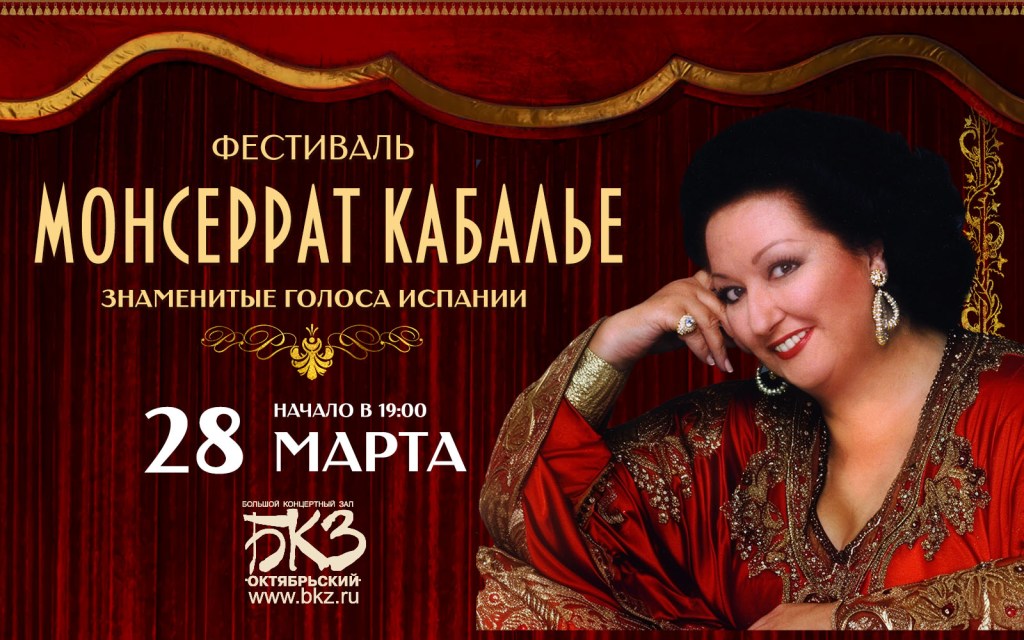
Performers: MONTSERRAT MARTÍ CABALLE (soprano), OSCAR ENCINAS (tenor), LUCÍA GARCÍA (soprano), CARLOS COSÍAS (tenor), OLGA PUDOVA
A Russian premiere!
THE MONSERRAT CABALLÉ FESTIVAL
On 28 March 2025, the Oktyabrsky Concert Hall will host a magnificent musical celebration, the first Monserrat Caballé Festival, dedicated to the great Spanish opera singer.
Specially for this event, renowned artists from Spain — relatives, friends, and students of the legendary opera diva — will come to Russia for one evening only! For their one and only performance they have chosen the beautiful St. Petersburg, our country’s musical capital, and the Oktyabrsky Concert Hall, where a distinct atmosphere always reigns.
Monserrat Caballé, whose name has come to symbolize impeccable vocals and subtle artistry, has left an indelible mark on world culture. Having performed over 100 opera roles and almost 1,000 different musical works, she has forever remained in the hearts of not only connoisseurs of exquisite classical music but also fans of musicals and fans of pop rock for performances like the title song from the album Barcelona, the international mega hit she recorded with Queen lead signer Freddie Mercury. Monserrat adored Russia and often visited our country to give concerts. The Caballé family thus decided to hold the first music festival named after her in our country.
The Monserrat Caballé Festival is meant to preserve the superstar’s historical legacy and introduce the public to today’s talents, the most popular performers continuing the Spanish school of opera’s rich traditions.
Among the performers are the great singer’s daughter, MONTSERRAT MARTÍ CABALLÉ (soprano), and the famous Spanish voices OSCAR ENCINAS (tenor), LUCÍA GARCÍA (soprano), and CARLOS COSÍAS (tenor). OLGA PUDOVA, a guest soloist at the Bolshoi and Mariinsky theaters, a phenomenal coloratura soprano who has already conquered Europe’s principal opera stages, is a special guest from Russia.
The artists will be accompanied by OLGA PUDOVA, well known to Russian and international audiences, and the famous conductor MIKHAIL GOLIKOV, People’s Artist of Kabardino-Balkaria. Creative teams from St. Petersburg and Moscow will also be involved in the concert.
The Monserrat Caballe Festival is not only a tribute to the legendary singer but also a grand exuberant celebration, aimed at a wide range of spectators and embracing all generations and the most varied musical tastes.
Don’t miss the opportunity to gift yourself an unforgettable evening full of vivid emotions, beautiful melodies and Spanish passion!
Source: Bileter.ru. Translated by the Russian Reader
On 20 October 2012, during her tour in Russia, Caballé suffered a stroke in Yekaterinburg and was quickly transferred to the Hospital de Sant Pau in Barcelona.
In his Literary Life, [Joseph] Brodsky’s friend Lev Loseff explained the background of “A Halt in the Desert,” a poem about the destruction of a beautiful old building: “One night Brodsky watched the first stages in the razing of the Greek Orthodox church from the apartment of his friends, two sisters from a Tatar family,” and called the poem “a meditation on the symbolic significance of what has just happened: Russia has broken with its Christian and Hellenistic cultural heritage.” Brodsky writes:
So few Greeks live in Leningrad today that we have razed a Greek church, to make space for a new concert hall, built in today’s grim and unhappy style. . . . it is sad that from this distance now we see, not the familiar onion domes, but a grotesquely flattened silhouette.
The deliberately created “fresh ruins” and “open altar wounds” recall the recent wartime devastations. The biblical allusion in “Thou who doest sow” suggests the threat of retribution in Hosea 8:7, “they have sown the wind and they shall reap the whirlwind.” Brodsky concludes by hopelessly asking:
What lies ahead? Does a new epoch wait for us? And if it does, what duty do we owe?– What sacrifices must we make for it?
Loseff claimed that Brodsky condemns “the collective guilt of a nation that produced this regime, that refused to accept the historical alternative, the heritage of Greece and Greek democracy.” But the Russians did not refuse to accept the heritage of Greece. They were not consulted and had no choice. An atheistic Communist system had been imposed on them by deadly force after the Revolution of 1917 and brutally maintained by all successive regimes. It was now the poet’s responsibility to preserve this culture.
Kirill Medvedev*, poeta, editor e integrante de la banda Arkady Kots, dejó Rusia en 2023 y retornó hacia el final del 2024. A pedido de la “Republic Weekly”, él nos explica su sinuoso andar, como luce Moscú después de una ausencia prolongada y que tienen que decir los que se quedaron acerca de los que se van.
Tras un año y medio viviendo en el extranjero por motivos personales (políticos, por supuesto), llevo ya varios meses en Moscú. A pesar de los evidentes riesgos, realmente no deseo marcharme y me aterroriza pensar en todo lo que hay que hacer cuando se vive en el exilio. Estoy dispuesto a hablar en alegorías o incluso a permanecer completamente en silencio, si es necesario, para poder vivir en mi ciudad natal. Aunque, claro, ¿qué podría ser más importante que despertarse por la mañana y puñetear al régimen de Putin en la cara sin andarse con rodeos?
Todo en Moscú es familiar y acogedor. Me son indiferentes los trabajos de renovación de Sobyanin. Las cosas han mejorado en algunas partes, en otras, todo lo contrario. Lugares medio abandonados han emergido súbitamente, incluso en barrios caros, como si repentinamente el dinero se hubiera evaporado. Estoy seguro de que eso es lo que ha ocurrido, literalmente.
No veo ningún festín privado en medio de la plaga, pero creo que aún no doy con los lugares indicados. Toda Moscú se ha vuelto desolada y salvaje. Cuando la capital finalmente se mude a Siberia, la Moscú que conozco y amo se verá aún mejor. Pero, por ahora, es lo que es: un disparatado patchwork al caótico estilo euroasiático que absorbe millones de tonos ostentosos y pobres del país entero y de alrededor, mientras nos tienta con nuevas revoluciones en alguna de sus plazas y patios traseros.
Toda Rusia puede encontrarse en Moscú, y aún así, como todos saben, Moscú no es toda Rusia. Debido a esta rareza, los moscovitas pueden amar a todo el país más fácilmente que cualquier otro, aunque este país sea imaginario e insondable, hecho a partir de retazos. “Estoy de pie como frente a un acertijo eterno, / ante una gran y fabulosa tierra”, cantaba un famoso moscovita. Repito una línea de otro poeta acerca de otra ciudad y pienso que amar la ciudad capital y el país es un privilegio enorme, complicado. “Que no sea mi suerte / morir tan lejos de ti”.
Los hábitos de comunicación pública en línea han cambiado mucho por los riesgos que implican. Ahora ya no parece que tu evento no hubiese existido si no tiene publicaciones en internet, ni si dejaste de publicar fotos tuyas con un alegre grupo de asistentes.
Ahora hay (más) canales de comunicación personales con comunidades y más boca a boca. La gente reacciona de forma más reservada en público y más emocional entre amigos. Discúlpenme por ser sentimental pero nada se compara a los abrazos reales de amigos y familia en una ciudad llena de recuerdos, tuyos y de otros.
Por supuesto, hay muchos nuevos problemas y prefiero lidiar con algún tipo de adicción al internet que con la pesadilla a la que todos nos enfrentamos ahora. Aún así, existe la idea de que la guerra se ha hecho camino en la degradación de todas las formas de vivir en Rusia. Esto no es cierto. Los seres humanos son criaturas muy creativas e ingeniosas. Los golpes violentos no acaban con la vida, sino que la impulsan a nuevas formas. Un detalle: ninguna forma de vivir y crear puede justificar el asesinato en masa de gente que no volverá a despertar. Comunidades culturales, activistas, educaciones y otras que persisten y cambian, a pesar de la semi clandestinidad, a pesar del costo del riesgo o compromiso, incrementan nuestras posibilidades de transicionar a una forma diferente de vivir en nuestro país en el futuro. Mientras más aliados tengamos en casa ahora, más posibilidades de que estén en el lugar correcto, a la hora correcta, esto si los primeros vuelos en los que nuestros amigos han sido expulsados del país se demoran un poco.
Es evidente la ironía o irritación contra quienes han salido (de Rusia) por una u otra razón entre quienes se han quedado, a excepción de los que planean partir. Una de las quejas usuales es “ellos se fueron para vivir tranquilos e hicieron bien, pero no deberían hacerlo pasar por un acto político”.
Es cierto, aunque con muchos peros. Por supuesto, bravo por los activistas que han ayudado a muchos a emigrar y adaptarse a vivir en el extranjero. Bravo por los periodistas que se han mudado a lugares relativamente seguros desde donde pueden continuar con sus obligaciones profesionales para con sus conciudadanos. Noticias regulares, aunque serias, mostradas con respeto a la audiencia y a ellos mismos, sin brutalidad innecesaria (“para poder compartirlas con la abuela”) son desesperadamente indispensables, casi todos coinciden en esto. Pero el pesimismo y animosidad contra la vida en el país por parte de los ciudadanos emigrados está completamente fuera de lugar. Claramente, los exilios autoterapéuticos, a la vieja usanza, deben tratarse de forma privada.
Mientras la demanda por información alternativa es grande (también muchos en la URSS escuchaban La voz de América, sin ser necesariamente antisoviéticos), se puede notar el escepticismo o falta de interés en los emigrados políticos. ¿Por qué? Al parecer son muchos los ejemplos en los que, a su regreso, son los emigrados políticos quienes se involucran en grandes transformaciones e incluso las lideran. Escapar de una prisión rusa, huir al extranjero, brindar por el éxito de la aventura con camaradas en Génova mientras se discuten futuras estrategias en atmósferas relajadas y retornar para trabajar clandestinamente, era la trayectoria típica de los demócratas radicales rusos de principios del siglo veinte.
Los tiempos han cambiado desde entonces, aún cuando muchos viajan de ida y vuelta. Podemos dialogar largamente acerca de las dificultades de la emigración con quienes se quedaron en Rusia, ellos estarán de acuerdo y simpatizarán con nosotros, especialmente si estuvimos en riesgo aquí, en casa. Pero la mayoría aún ve en alguien que se muda al exterior una mejora de su vida privada.
Renunciar a tu vida pasada es, automáticamente, como renunciar a tu comunidad del pasado. La propaganda, por supuesto, hace su mejor esfuerzo para inflamar el resentimiento, pero no es sólo la propaganda. La emigración es una experiencia de constante autonegación. Especialmente ahora, cuando a los emigrados rusos se les recuerda (gentilmente y no tan gentilmente) que deben cancelarse a ellos mismos en términos de su ciudadanía, pasado, lenguaje, identidad e incluso su bandera. Es más, el reanimado discurso ético religioso de la guerra fría, con su confrontación entre el bien y el mal a escala global, ha jugado un rol considerable en todo esto.
El campo en el que debería tomar lugar el diálogo entre los que se van y los que se quedan, así como entre los opositores moderados y los leales dubitativos, ha sido arrasado por moralizadores de proverbiales abrigos blancos y patriotas rabiosos. Ellos son quienes dividen y conquistan.
Quienes se van generalmente argumentan en términos de libertad negativa –libertad de la censura, de la represión política, de la movilización militar, de financiar indirectamente la guerra y a quienes la defienden. Quienes se quedan lo hacen porque no encuentran cómo superarse en el extranjero, al menos no sin un esfuerzo sobrehumano y el convencimiento de que les atemoriza más la amenaza del arresto o la autocensura. Estos generalmente hablan de deberes, hacia sus parientes mayores, estudiantes, pacientes, votantes, prisioneros políticos, las tumbas de sus familiares, hacia la patria, etc. Y muchas veces obtienen como réplica que es inmoral ser parte de la vida normalizada de la Rusia actual. El conflicto ético es evidente.
Me imagino a los Pokrovas y a los Ordynkas pensando de dónde sacarán dinero para pagar las cuentas y las deudas. Hay afiches en los que se llama a los hombres a enlistarse en el ejército. De alguna forma, no me siento más respetable que quienes matan por dinero. Definitivamente no lo haría, pero esto no es motivo para elevar mi autoestima. Pienso en algún viejo camarada, perecido en la “operación militar especial”. Sus deudas, su bajo nivel social y su resentimiento izquierdista antioccidental convertidos en enajenación imperialista. Me siento en un café, pienso en mis planes. La gente a mi alrededor habla de diversas cosas mientras los habitantes de un país vecino son bombardeados en nuestro nombre.
Soy bueno alejando lo desagradable. Todos lo somos.
Al estar aquí y disolverme en esta vida, es difícil sentirse como un miembro de un comité de ética. Es sencillo darse cuenta que todos somos básicamente iguales, que no hay diferencias insuperables entre nosotros. Todas nuestras acciones (ya sean ordinarias, vergonzosas o magnificentes), toda la pasividad de las masas, todas las revueltas de las naciones, son manifestaciones del mismo principio humano en diferentes circunstancias históricas. La forma en que mi propia humanidad se manifiesta en ellas es de lo más interesante de observar. Vale, eso ya ha quedado claro.
No, por supuesto, hay una gran diferencia entre la oposición a la crueldad, la no participación pasiva, y la complicidad. Los propagandistas putinistas han estado desvaneciendo la distinción entre estas para despolitizar y degradar moralmente a la sociedad. Sabemos eso y no nos pueden engañar. Tanto en entornos seculares y cristianos, una persona siempre tiene una elección y una responsabilidad que deviene de esta. No debemos ver al individuo como una reticente víctima de la carencia y la propaganda. También es verdad que, aún si creemos haber tomado la elección moralmente supercorrecta definitiva y juzgamos incesantemente a nuestro vecino o creemos que está hecho de algo diferente, o caemos en la tentación de culparle de complicidad colectiva sin un juicio, sería hacer lo mismo que hacen varios líderes espirituales y políticos en nuestro país.
La maldad política no se combate con la virtud personal, ni mucho menos con el postureo moralista, sino con la ética política o cívica. En ese sentido, nuestro país tiene un gran problema.
Todos los debates entre los que se van y los que se quedan, entre los lema “paz ya” y “guerra hasta que caiga la dictadura”, sobre si Navalni debió o no retornar a Rusia, giran alrededor de una pregunta sin respuesta: ¿qué es aquello por lo que estamos dispuestos a arriesgar nuestras vidas privadas, nuestros ideales colectivos?
Ciertamente, no tengo una respuesta clara. Rusia ha dejado atrás los heroicos tiempos del liberalismo y el socialismo, cuando la gente creía que el heroísmo cívico no era una debilidad mental o una temeridad, sino un deliberado y maduro paso hacia un futuro mejor. El deseo del pueblo de tomar las calles contra la guerra y la dictadura es imposible sin la convicción de que se está en el lado correcto de la historia, de que estamos en un movimiento que coincide y trasciende nuestro interés privado.
Los bolcheviques creyeron en el arribo inevitable del comunismo a escala global y fueron capaces de convencer a muchos de que esto pasaría, lo que les significó la victoria. En 1991, los rusos creían que al defender la Casa blanca (rusa) y enfrentarse a los tanques de los conspiradores golpistas, encaminaban a Rusia por el camino del progreso, por el que todas las naciones democráticas estaban transitando. Querrámoslo o no, Rusia no está lista para seguir ningún camino conocido. Es más, ya no hay camino alguno: el camino ha de ser empedrado desde cero (estoy contando con esto).
Hoy, vemos una tenue luz de esperanza en el republicanismo y su concepción de que el espíritu comunitario no es un premio consuelo para gente sin realizamiento profesional ni felicidad personal. Este no se puede reducir a una virtud profesional o personal y no es una profesión en sí misma.
Cualquiera que se atreva a unirse a otros para oponerse a la tiranía y trabaje cada día para prevenir que esta se repita, es capaz de demostrar valor cívico. Y mientras más brillante, resuelto y constructivo sea alguien en su compromiso con su trabajo, mientras más use su potencial profesional, creativo o de otro tipo, mayor será su autoridad en su comunidad y mayor será la posibilidad de que quede en la memoria comunitaria. Esto suena bien como motivación pero si la ética republicana es posible, entonces es realizable en campañas en pequeños y medianos espacios alrededor de edificios residenciales, patios, vecindarios y (la mayoría de) ciudades, donde es posible encontrar analogías con las antiguas plazas griegas en las que la gente sostenía reuniones.
Una comunidad nacional es imaginaria, sin importar cómo la pensemos, se basa en una vaga situación histórica y en la memoria colectiva. Si no queremos que esta sea la memoria de como “todos nos temían”, debería entonces ser la memoria de como sobrevivimos y resistimos juntos –secreta y explícitamente, pasiva y activamente– la exterminación de otros y nuestra propia exterminación, de como construimos lazos, nos comprometimos con la “cultura”, educamos a los niños, apoyamos a los prisioneros políticos y ayudamos a las víctimas de los bombardeos y a quienes se quedaron sin hogar.
Esta es la base de la comunidad, una base alimentada no por la superioridad moral, ni por la negación de uno mismo y sus raíces, ni por marcar diferencias. Se nutre, en cambio, de la responsabilidad de la gente que está o ha estado con nosotros en las mismas plazas y en las mismas filas, de la gente que camina las mismas calles, de quienes fueron a las mismas escuelas, de quienes comparten las mismas esperanzas por el futuro.
Si estamos de acuerdo en esto, entonces tiene sentido tomar el riesgo y poner nuestro corazón en algo, juntos.
* Medvedev ha sido incluido en el registro de “agentes extranjeros” del ministerio de justicia ruso.
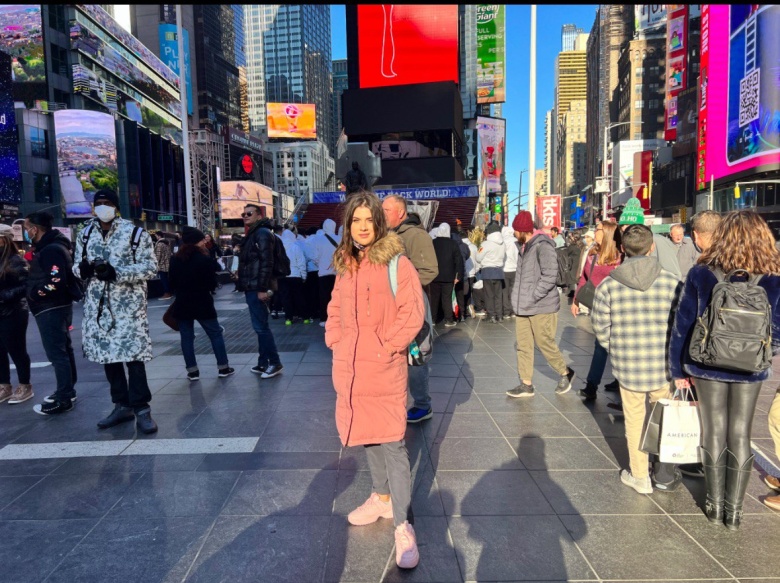
Alexandra in Times Square. Personal photo courtesy of Republic
Alexandra left Russia four years ago, fleeing oppression, propaganda, and ever harsher anti-LGBT laws. She applied for political asylum in the U.S., made a home in New York, and felt safe for the first time. But with Donald Trump’s return to power, her fears have returned. The new rules and laws, the rhetoric, and the swaying of public sentiment against trans people have been much too reminiscent of what she had escaped. Alexandra spoke to Republic about how America has been changing and what now lies in store for thousands of people like her.
I arrived in the U.S. exactly four years ago yesterday. A lot has changed in that time. I arrived right when the covid restrictions were still in force. Just a couple of days before I arrived in New York, an order to wear two masks each had been issued. The city was completely empty. I went straight to Times Square, and there were maybe one or two people walking down the street. Gradually, the restrictions were lifted, and more and more people were out in public. And then the border with Mexico was opened, and everything changed dramatically in terms of jobs, the economy, and real estate — rent went up about forty percent. Now there are new problems: Trump and Musk. But first things first.
“I always had a hard time in Russia”
I am thirty-four years old. I lived in Perm until I was twenty-five, then I moved to St. Petersburg and lived there until I moved to the U.S. I did a lot of jobs in Russia, mainly sales. In my final years in Perm, I worked at a real estate agency.
I had traveled a lot and at first I decided to just move to a big city in Russia, which didn’t make me safe in the end. I decided to leave Russia after the lockdown started. My ex-husband had gone to the U.S. in 2011 on the Work and Travel Program and he had really liked the country. Besides, when it was possible to fly anywhere again, the only valid visas we had were for the U.S.
When I was twenty-five years old, I officially changed my gender and got a woman’s passport. This was in 2016, back in Perm. It was quite difficult to do this. The problem was that at the real estate agency where I worked, no one knew about me, but I had to sign legal documents there. So I had to change my surname, first name, and patronymic to something feminine, but without specifying my gender. The civil registry office did not immediately know how to do this legally: they discussed it among themselves for several months. In the end, they changed my name and surname to the feminine versions of the original ones. I had been Alexander, and so I became Alexandra. They got rid of my patronymic because they didn’t know how to come up with a feminitive for it.
Later, after the updated information had been entered into my birth certificate, I went to the passport office. They remembered me there because a couple of years earlier they had refuse to issue me a passport on the grounds that the photo I had given them was of a young woman, but my papers indicated my gender as “M.” I had filed a complaint with the prosecutor’s office, but it hadn’t led to anything at the time. Ultimately, though, the [passport office] staff decided to meet my needs and help me. I was issued a passport with an “F” in it. I have had several cosmetic surgeries, but have not had intimate plastic surgery, meaning I haven’t undergone a complete transition, but a social one. I don’t want to have surgery yet.
It was always hard for me in Russia. If you are lesbian or gay, you can hide it from society somehow. This is impossible for us transgender people.
You go to apply for a job and you are simply rejected, at best. At worst, you are threatened and humiliated.
I was also harassed at school. For example, I was subjected to a full body search with no clothes on at the checkpoint when I took my Unified State Exam. When it comes to medical institutions, even if you go to a private clinic for a paid operation, you still face discrimination. When I tried to get permission for a sex change, they suggested I go to the male ward because in the female ward they thought I would “rape all the female patients.”
I was an activist in Rainbow World, the Perm branch of the Russian LGBT Network: I constantly attended events and was actively involved in organizing them. When I needed supporting evidence [for my asylum claim] from the head of Rainbow World, she was afraid to communicate with my lawyers, since she seriously feared reprisals from the authorities. Now she doesn’t contact me at all.
We once took part in the May Day rally. We had got all the permissions beforehand, but the placards had not been discussed, and so we ended up having our own mini-gay pride parade. Things were still relatively calm at the time: we marched down the street and people heard us; we were written about and discussed. But then the pressure started. Public opinion shifted dramatically in the direction of aggression towards LGBT people. A few months later, the police came to the offices of our organization and searched them. They confiscated our laptops, and there, of course, they found all our info — addresses, contacts, and passwords. No one thought at the time that things would take such a turn for the worse.
At one point, when I was working at the real state agency in Perm, a local activist came into my life. I don’t know who he was, but he had sent me clip from an episode of the Malakhov show in which he had taken part. He was always stalking me outside the real estate office where I worked. When I would walk past him with my colleagues, right in front of them he would say, “You have to give me an interview.” I would say, “I don’t know you. What’s this about anyway?’ And he would say, “If you don’t, I’ll tell everyone who you are.” This would happen in public, right on the street.
After the first law banning so-called LGBT propaganda for minors was adopted in 2013, police officers started showing up at my house because I right then I was helping out transgender teenagers. The police would knock on our door and ring the doorbell. They would try to get into my flat under various pretexts. One time they stood outside the door for three hours. We just pretended nobody was home. Then, when it got quiet, we looked out the window. The police officers looked up too, realized we were looking at them, and came upstairs again. They stood outside our door again for a while.
Then some people assaulted me and my ex-husband. It turned into a brawl, and a police patrol turned up “by chance.” We were all taken to the police station and advised to “keep quiet and stay inconspicuous.” After that, in 2019, we decided to move to Peter. Everything was relatively calm in Petersburg. But then they found us there too. I do not know what kind of databases they have, but they found us, although I didn’t show my face anywhere at all in Petersburg, and I wasn’t involved in any organizations. The only thing I did was go to the Side by Side LGBT film festival.
I was in no hurry to leave Russia because I have an elderly father, who is seventy-one. I didn’t want to leave him. And I never thought that I should leave the country where I was born, grew up, worked, and paid taxes. Plus, I had a flat and a car in Russia. I didn’t want to start all over again in another place. When covid started, my husband’s and my Schengen visas had expired. We only had our U.S. visas left, and they were still valid for about six months. We decided to give it a try, because we were afraid that, later, the authorities wouldn’t let us go anywhere at all, that the country was heading towards the Iron Curtain.
“Since Moving to the U.S., I Haven’t Been Hiding Anything from Anyone at All”
We arrived in New York on a visa, on a direct flight from Moscow. We started looking for human rights organizations who could provide free lawyers. We called various places: our English was nonexistent, so we used online translators and sometime just read the text into an answering machine. Several organizations reached out to us. Eventually, an organization which deals with domestic violence helped us out. We lived in a hotel at first. We were quarantined there for a fortnight, then we rented a place through Airbnb and looked for a permanent place. I started working three weeks later.
I am currently working as a cleaner and as a webcam model. Webcam modeling is not an easy gig. I started doing it back in Petersburg, because I was afraid of getting a on-the-books job. Initially, you think that it’s easy money and that it won’t affect you in any way, but then you realize you’re just a piece of meat. It’s quite tough psychologically. All this overlapped with my old traumas, and eventually led to big psychological problems. Before the New Year, I stopped taking the antidepressants I’d been taking since 2018.
You can make $100, $300, and $500 a day in the webcam industry. Here in the U.S., it’s a legitimate job, you pay taxes, it’s all above board. Since moving to the U.S., I haven’t been hiding anything from anyone at all. It’s my new principle in life.
I am horrified to read the news from Russia about LGBT people being labeled “extremists” and being murdered in prisons, about gay bars and clubs being raided. It’s wacky, it’s incomprehensible. After moving to the U.S., especially after Russia’s war with Ukraine began, I realized how effective propaganda was in Russia. All my friends and acquaintances in Russia suddenly changed their opinions about politics dramatically, even about LGBT people. Even my friends who are LGBT people themselves either try to avoid the topic or say, “Well, that’s right, but what can we do? It’s the way it has to be.” Some of them I’ve stopped talking to, some I haven’t. Maybe they are simply afraid to say too much.
The authorities inserted pedophilia into the law on “LGBT propaganda” and thus made a strong link in people’s heads between LGBT people and pedophiles. This propaganda has been effective even in my own family.
My dad’s new wife has a niece. The niece’s son was three years old at the time. Kids are drawn to me and I always play with them. But at one point I saw how afraid she was to leave her child alone with me. The propaganda has affected even those closest to me.
In the U.S., I saw a completely different world and attitude towards people like me. When I told someone at work for the first time that I was a transgender woman, I got a neutral reaction, as if I was talking about something quite ordinary. The first time I went to the New York Pride March, it was more like a carnival: it was beautiful, friendly, and flamboyant. There were a lot of children there, and there were separate events for them. For the first time in my life I felt I was no different from anyone else, that I had rights, that I could speak openly, that I could receive proper medical care. When I lived in Perm, I was even unable to find an endocrinologist who did hormone replacement therapy. [Living in New York] has changed my sensibility a lot.
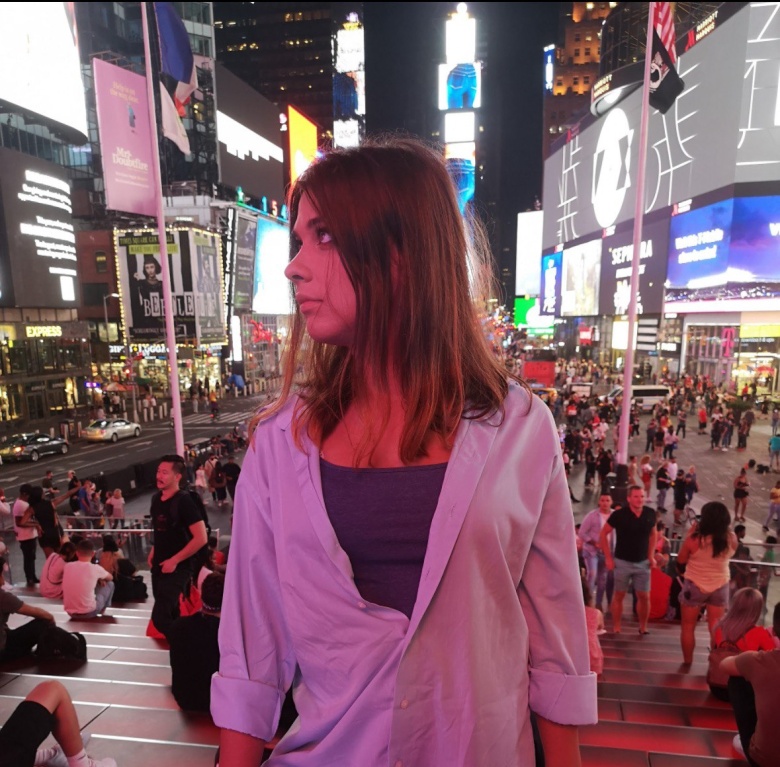
Alexandra in Times Square. Personal photo courtesy of Republic
Donald Trump’s policies have not affected me specifically yet. But knowing how it all kicked off in Russia, I am scared. In 2013, there was the ban on “gay propaganda,” and consequently, teenagers were left without the support that, for example, they had received from Lena Klimova and her project Children 404. I also helped kids out then, shared my know-how with them, and tried to support them. All transgender people have been dismissed from the [U.S.] army. It’s a nightmare. When the state starts cracking down on a single albeit tiny segment of the populace, and it succeeds, it keeps on going.
“Judging by the First Month of Trump’s Presidency, We Are in for Tough Times”
I believe that common sense should prevail in all things. Previously, the bias had gone in the other direction in the U.S.: people used to be afraid to say something against LGBT, and this was also wrong. Everyone should have freedom of speech. For example, my acquaintances from [the country of] Georgia had this thing happen to them. They were working on a commission for a moving company: a gay couple was moving. One of the workers looked askance, or they said something among themselves. They then got a call from the front office and a dressing-down. They were warned that they would be fired if it happened again. Or there was the case of the flower shop: the owners refused to sell flowers for a same-sex wedding, and the shop had to close because of the scandal that erupted. That’s over the top. I think that if you’re refused service somewhere, you can go to some other place. Let them lose their profits. It’s the same with clubs: if the bouncers don’t let you in, well, those are their views. Everybody has different views. But now it’s going too far in the other direction and it’s scary. I hope that one day we will reach a sensible balance.
Now I live with my fiancé, who is from Ukraine. We discuss politics, and we both want the war to end soon, for people to stop dying. I would like to make a trip to Russia.
I don’t think Russia belongs to Putin and his lackeys. It’s my country, just like it is yours, just like it is everyone else’s. I would like to believe that things will change and we can go back someday.
I am in the U.S. legally, but I am waiting for political asylum. There are numerous such cases, and they take a very long time to process. The approximate wait time for a green card in the past was ten years . I was involved in a class action lawsuit against the U.S. Immigration Service, and I was told that as long as I had a short wait time, the case would not be considered. I appealed that decision and have been scheduled for an interview for late 2026. I would like to go to Turkey, for example, to meet my relatives. I would really like to see my dad. But even if everything goes well at the interview, I will probably not get a green card until 2028.
My father loves me, but over the last three years, since the war started, we have come to disagree about Russian politics, and over time we stopped discussing it. He watches [Russian] television and relays to me what is said there. He constantly accuses me of being under the influence of “American propaganda” and “brainwashed.” But I just reply, “Fine.”
They usually say that the first one hundred days of a presidency set the course for the next four years. Judging by the first month of Trump’s presidency, we are in for tough times, although maybe these measures are like Margaret Thatcher’s — first shock therapy, then stabilization. I hope to get citizenship in the future. I would finally feel safe: there is still a risk of deportation for now. I try not to give up, to hope for the best. Let’s see if positive thinking does the trick.