Belarus

— Паслухай, стары,
нам учора абвешчана воля,
і сёння ад рання
народам запоўнены пляцы,
наперадзе – радасць,
якая нас век не пакіне,
і я назаўсёды з табой
развітацца хачу…
— Паслухай, мой хлопча,
учора зіма пачалася,
і белыя вопраткі
чорныя дрэвы надзелі,
і шэранем ранішнім
ледзь прыцярушаны прорвы,
і холад хавае
ўсялякі ці прыпах, ці пах –
і так будзе доўжыцца
аж да вясновае ўлады –
тады на дарогах
адкрыюцца раны старыя,
як сонца сарве перавязкі…
Крывёю і брудам
вам станецца радасць
і доўга чаканая воля.
А тут, пад зямлёй,
пад заброснелай нізкаю столлю,
на змрочнай сцяне,
будуць мілыя блікі блукаць
маленькай, як жменька,
і вечнай – і вечнай! – надзеі…
… У кніжцы без вокладкі
і без апошніх старонак,
дзе вы, адмыслоўцы шалёнага часу,
жылі,
я сёння заместа закладкі
лісток пакладу
ад пекнай герані,
падобнай на кроў і агонь.

Тацяна Сапач (1962-2010)

vadim f lurie-minsk 2019Vadim F. Lurie, Minsk, 2019. Courtesy of the photographer

— Послушай, старик,
нам свободу вчера обещали,
и нынче с утра
уже площади полны народа,
их радость ведет,
и она нас вовек не покинет,
и с этого дня я с тобою
расстаться хочу…
— Послушай, сыночек,
вчера к нам зима подступила,
и белые платья
решили примерить деревья,
и инеем ранним
чуть проруби сверху покрыты,
и холод скрывает
повсюду и запах, и вонь —
и будет держаться
все это до вешнего ветра —
тогда на дорогах
откроются старые раны,
лишь солнце сорвет с них повязки…
И кровью и грязью
окажется радость
и званая вами свобода.
А тут, под землей,
тут, где низкие своды и плесень,
на темной стене
будут милые блики играть
от зеркала крошечной
светлой и вечной надежды…
Но в книгу, где нет ни последних страниц,
ни обложки,
где вы, мастера сумасшедшего времени,
жили,
я вместо закладки сегодня
листок положу
прекрасной герани,
похожей на кровь и огонь.

Translated from the Belarusian by Gennady Kanevsky


—Listen, granddad,
yesterday they promised us freedom,
and now, since morning,
the squares are filled with people,
led on by joy,
and it will never abandon us,
and from this day, I want
to part with you . . .
—Listen, sonny,
yesterday winter arrived,
and the trees decided
to try on white dresses,
and the ice holes are slightly covered
with early frost,
and everywhere the cold hides
both scents and stink—
and all this will hold firm
until a wind comes from outside—
then, on the roads,
old wounds will open,
if only the sun tears off the bandages . . .
And blood and dirt
will turn out to be the joy
and the freedom you called for.
And here, under the earth,
here, where there are low vaults and mold,
on the dark wall
dear flecks of light will play
from the tiny mirror
of bright and eternal hope.
But today, in this book, where there are no final pages,
no covers,
where you, masters of the crazy times,
lived,
I will place a leaf
instead of a bookmark
from a wonderful geranium
that resembles blood and fire.

Translated from Gennady Kanevsky’s Russian by Joan Brooks

* * * * *

Tatsyana Sapach (1962–2010) was a Belarusian poet, journalist, and translator, and the author of two collections of poetry. Gennady Kanevsky (b. 1965, Moscow) has published eight books of verse. Many of his poems have been translated into English, Italian, Hungarian, and Ukrainian. Video courtesy of Nexta and Andrey Rysev

Bayan Mirzakeyeva: Where Do You Begin?

Anti-University
Facebook
August 7, 2020

“My name is Bayan Mirzakeyeva. I am 21 years old, and I am an ethnic Kazakh from Almaty. I have been living and studying in St. Petersburg at the Architectural University for several years. It was here, in Russia, that I realized that I was “non-white” and learned about this condescending and contemptuous attitude towards myself. Since almost no one around me talks about racism and migration, I wanted to make my own statement. I posted these pictures on social networks and have faced different reactions, from support to aggression and rejection. This was expected, but it has been a kind of impetus for me to continue working with this problem.”

Bayan sent us her illustrations, and we are publishing them for you.

Come and talk about racism and migration at the open events that we are doing together with the Viadrinicum Summer School. Details here: https://www.facebook.com/AntiUniversityMSK/posts/626498341315382

churka 1

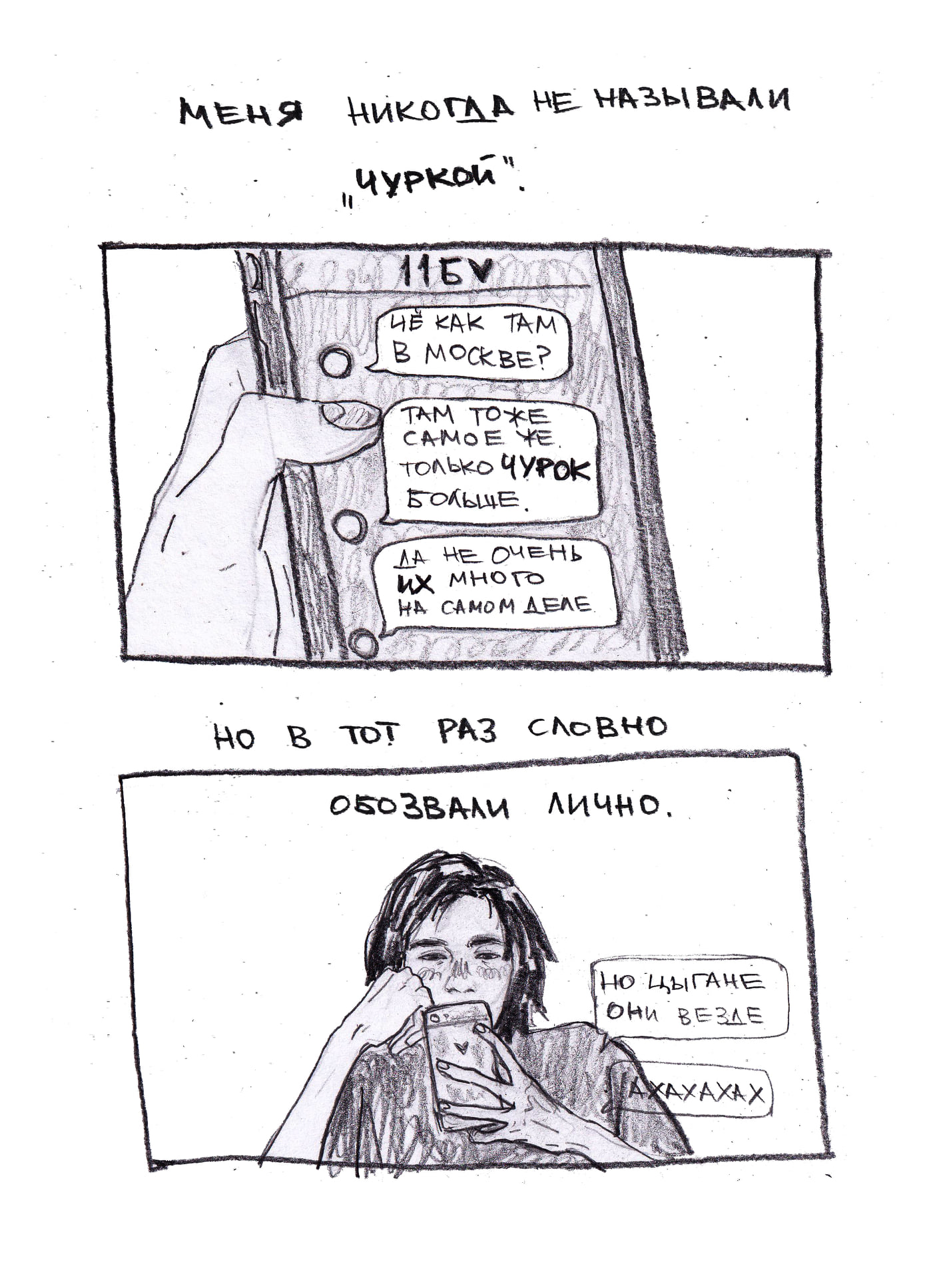
I had never been called a “wog” [churka].

“So what’s it like in Moscow”?

“It’s the same old same old. Only there are more wogs.”

“There aren’t that many of them, actually.”

But this time it was if I had been called that name personally.

“But the Gypsies are everywhere.”

“Ha-ha-ha.”

churka 2

But how do I differ from those who are called “wogs”?

Am I different because I finished high school with honors?

Because I got a scholarship to university?

Because I speak Russian without an accent?

churka 3

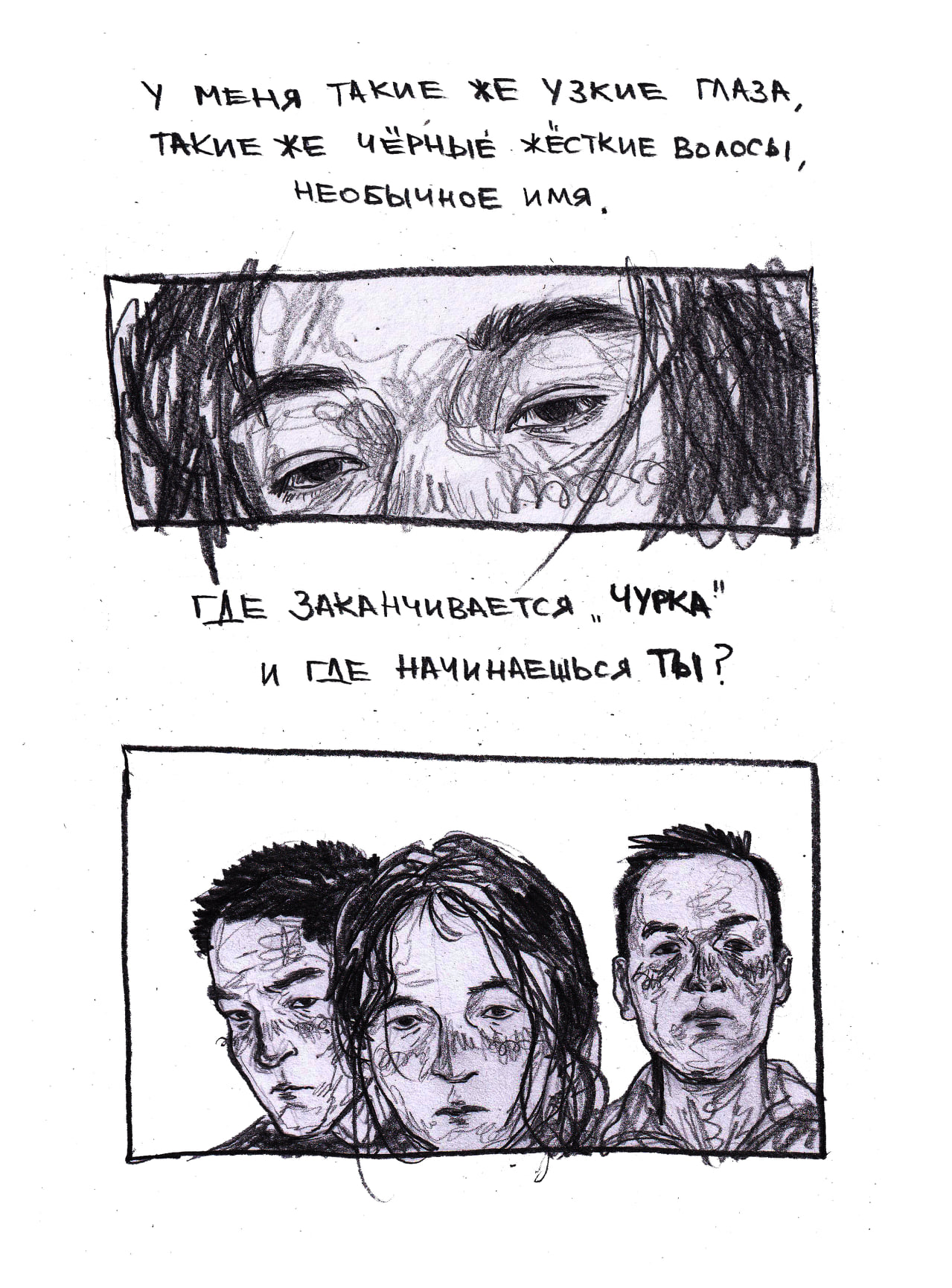
I have the same narrow eyes, the same coarse black hair. An unusual name.

Where does “wog” end and where do you begin?


Thanks to Sofiko Arifdzhanova for the heads-up. Translated by the Russian Reader

Last Address in Petersburg: August 9, 2020

черняховского-все таблички

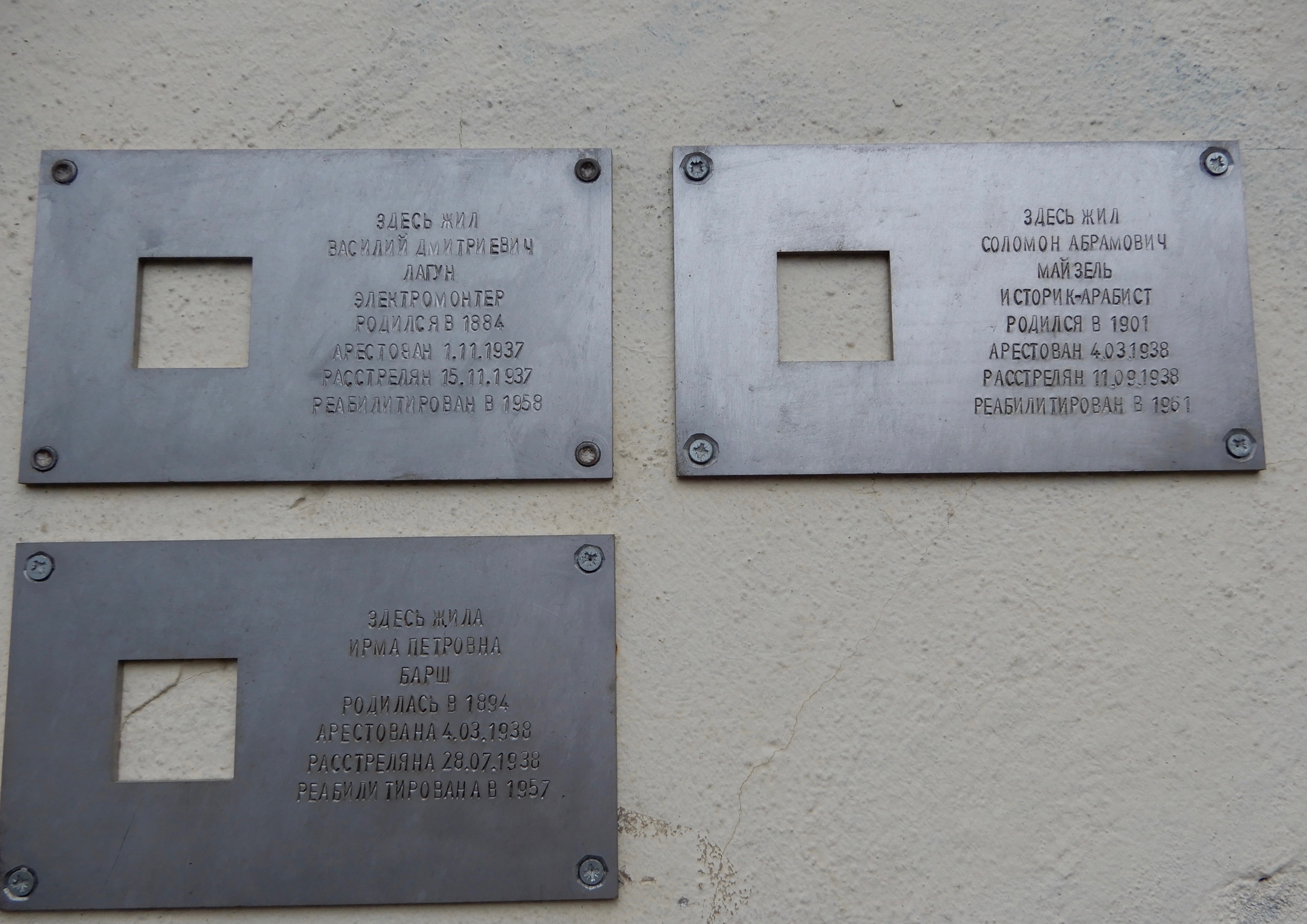
On August 9, three new Last Address plaques will be installed in Petersburg.

At 12:00 p.m., relatives will install a plaque in memory of Anatoly Viktorovich Abramson at 77 Chaykovsky Street. Educated as a lawyer, Abramson worked an economic planner. In 1935, as a “socially dangerous element,” he was exiled to Saratov along with his family. He was arrested there in December 1937 and shot on January 6, 1938, after being convicted by an NKVD troika.

At 1:00 p.m., a plaque in memory of Artemy Markovich Markov, a mechanic with the Kirov Railway, will be installed in the courtyard of the house at 44 Ligovsky Prospect. Markov was shot on December 10, 1937, as a member of an alleged “Polish counter-revolutionary sabotage group” of railway workers. The grandson of one of the men shot as part of the case has been installing memorial plaques for all of his grandfather’s co-defendants.

At 2:00 p.m., a plaque in memory of Iosif Kazimorovich Kazanovsky will be installed at 1 Dzhambul Lane. A 38-year-old technician at the Plastics Factory, he was arrested on September 16, 1937, and shot on September 28, 1937, along with classmates from the Polish High School. The plaque is being installed at the behest of the son of one of the executed men.

All three men were exonerated in the 1950s.

We invite you to join us for the installation ceremonies, while asking you to assess the risks and observe safety measures in connection with the ongoing coronavirus pandemic (such as wearing a mask and maintaining physical distance).

Courtesy of the Last Address Petersburg mailing list. Photo and translation by the Russian Reader

New Greatness Trial Ends in Guilty Verdict and Harsh Sentences

New Greatness Members Get from Six to Seven Years in Prison
RBC
August 6, 2020

ngNew Greatness defendants Vyacheslav Kryukov, Ruslan Kostylenkov, and Pyotr Karamzin in the cage at the Lyublino District Court in Moscow. Photo by Sergei Ilnitsky for EPA/TASS. 

The Lyublino District Court in Moscow has sentenced members of the organization [sic] New Greatness, Vyacheslav Kryukov, Pyotr Karamzin, and Ruslan Kostylenkov to six, six and a half, and seven years in prison, respectively, reports our correspondent. According to the verdict, they will serve their sentence in a medium-security penal colony.

The other defendants in the case—Dmitry Poletayev, Maxim Roshchin, Maria Dubovik, and Anna Pavlikova—received suspended [i.e., probationary] sentences of four to six and a half years. They should be released from custody in the courtroom.

The judge found all the defendants guilty of “creating an extremist community” (punishable Article 282.1 of the Russian Criminal Code). At the same time, the court acknowledged that there were mitigating circumstances: the fact that the defendants had no criminal records, the positive character statements made on their behalf, and the fact that some of them suffered from chronic illnesses.

“She is very upset. Even though it’s a suspended sentence, you can only be away from home from 10 a.m. to 6 p.m. She wanted to work the night shift at the Moscow Zoo, but she won’t be able to do that. They will have full-fledged live only when all of them are free: a suspended sentence is still a sentence,” Anastasia, Anna Pavlikova’s sister, told RBC.

According to her, Pavlikova plans to appeal the verdict.

Our correspondent reports that the people gathered outside the courthouse are chanting “Shame!”

“In terms of standards of proof, the incident of provocation [by FSB agents] was the hardest to prove. It’s very hard to prove anything under the auspices of the security services. We did a great deal, we asked lots of questions. [Our] most important argument has been that such crimes are committed with a specific motive, but no motive was specified in the indictment. Therefore, there is no evidence of a crime,” Maxim Pashkov, Maria Dubovik’s lawyer, told reporters.

Translated by the Russian Reader

Darya Apahonchich: Did The Police Have Nothing More Important to Do?

apaDarya Apahonchich is greeted by supporters outside the October District Court in Petersburg, August 4, 2020

Darya Apahonchich
Facebook
August 5, 2020

So, here is a more detailed account of my arrest and trial.

Yesterday, I was stopped by police officers on the street near work. They would not let me pass, grabbing my scooter and saying that I should go with them, because they had “material” on me. I said I wasn’t going anywhere, so they just forced me into a vehicle.

In the vehicle, they refused to tell me what the reason was for detaining me. We drove to the first police precinct for a very long time, and the car broke down along the way. All the way, I scolded them, appealing to their conscience and reason. There were four of them and a vehicle, they had spent the whole day on me (probably more than one): did they have nothing more important to do? Later, I found out that they had been waiting for me since 5:30 in the morning, but I had left the house only at 2:00 in the afternoon. (So many resources wasted on me! Whatever for?) By the way, it’s funny that they were waiting for me near my house, but they only arrested me near my work, because I when I left the house I immediately jumped on my scooter, so they probably didn’t have time to grab me there. I can imagine how annoyed they were.

Varya Mikhailova, a community public defender, came and found me at the precinct, where I was handed charge sheets, concocted on the spot, for two street performances: the vulva ballet in support of Yulia Tsvetkova, and the road to the ocean of blood in support of the Khachaturyan sisters. There were a lot of mistakes in the charge sheets, which Varya had better tell you about, and I just refused to testify against myself.

vardarVarya Mikhailova and Darya Apahonchich waiting for her hearing at the October District Court in Petersburg, August 4, 2020. Photo courtesy of Ms. Mikhailova’s Facebook page

Around six o’clock, I was taken to court and tried on the two charges at once. It was there that I had a gander at my case files. They were quite hilarious. There was a touching insert from Center “E” [the “anti-extremism” police] where you could see the photos from all my old [internal] passports, in which I was fifteen, twenty-one, and so on. Then there were screenshots of videos, and disks containing these same videos. In short, it was a cool folder, better than my pathetic portfolio. Another funny thing was that all the performances had been taken from a page on the MBKh Media Northwest website. They also wrote in my file how many likes and comments there were. There were very few likes.

The judge’s assistant showed the video and read aloud the text of the performance “this road leads to an ocean of blood.” She read very well, after which everyone fell silent. I really liked it, I would also add it to my portfolio.

I was found guilty (under Article 20.2, Part 5 of the Administrative Offenses Code of the Russian Federation [“violation by a participant of a public event of the established procedure for holding an assembly, rally, demonstration, march or picket”] and was sentenced to pay two fines of 10,000 rubles each [approx. 230 euros]. We will appeal the fines, of course, and I think we will also file a complaint against police officers for unlawful arrest.

***

I am upset, of course. (My “joking” program clicks on in such situations, but then when I get home, the “get scared” program turns on.) I don’t like living in a world where people in uniform grab you on the street and shove you into a paddy wagon. (I told them, “Don’t touch my scooter!” They said, “We’re not touching it!”—and then they grabbed the scooter.) I’m also sorry, of course, that I said I worked at the Red Cross. In the past, I usually didn’t tell them where I worked, but I didn’t get picked up on the street like this in the past. It’s an important lesson for everyone who has a “civilian” job: don’t tell the police about it.

I’m also upset that I have to constantly be ready for violence from all directions. Today, I have again been getting messages containing insults from strangers. Thank you for only sending messages. I categorically don’t like that, in this world, I constantly have to prove I have the right to voice my opinion. You see, the system thinks that if you are a teacher, a mother, then okay, that is a normal job, a normal life, you have the right to be (a little) dissatisfied, to engage in a little activism. (Moms cannot be held overnight at police stations on administrative charges.) But employers rarely like it when you are an activist. This system is very complicated and stifling.)

But I cannot help doing what I do. My support for Yulia Tsvetkova, for Angelina, Maria, and Krestina Khachaturyan is a very important part of my life. It is my freedom, my fight for the safety of all women, and my contribution to my children’s future. (I am really, really worried that my daughter is growing up in an unsafe world, that my son is growing up in an unsafe world, that society imposes places on them in the hierarchical meat grinder.) I am still going to be involved in activism: I cannot do it any other way.

(I had a year in my life when I worked at a college and was quite afraid that my name would be googled at work and I would be fired. Consequently, I tried not to do performances, and then I was fired anyway, because the college was shuttered, and my students were deported to boot.)

I want to say a huge thank you for your support. Yesterday, I got calls and emails, and my wonderful friends came to the courthouse. (No one was allowed inside, but we met outside when it was all over.) I am very glad for this a world of solidarity, thank you.

***

My  public defender suggested that I should immediately announce that I was soliciting donations to pay the fines. I decided this was probably reasonable. There is hope that we will be able to get the fines reversed. In this case, I will transfer all money donated to Yulia Tsvetkova and Mediazona.

So here’s my card number. 4276 5500 7321 7849.

(This photo was taken near the courthouse. I found it on the Telegram channel  https://t.me/armageddonna.)

Photo courtesy of Ms. Apahonchich’s Facebook page. Translated by the Russian Reader

We All Live in a Yellow Submarine

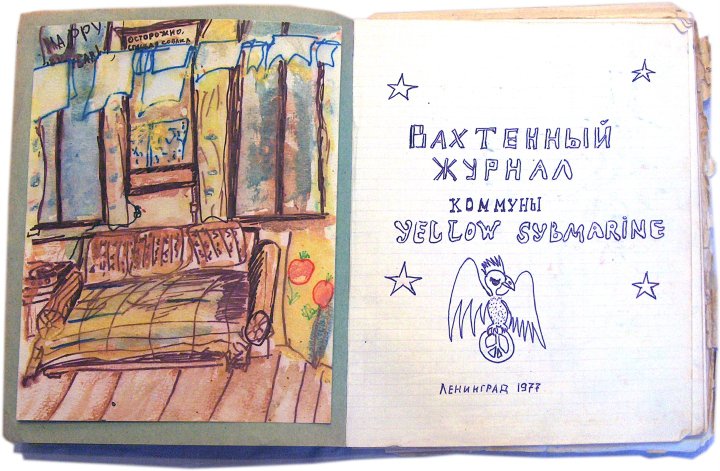
ys_02The Yellow Submarine’s log book. Image courtesy of Felix and Marina Vinogradov 

We All Live in a Yellow Submarine
Ekaterina Nezvankina
Islands of Freedom (Iofe Center)

Bearing the proud name Yellow Submarine, the commune at 28 Primorsky Prospect [in Leningrad] arose in August 1977 and lasted for just one year. Its organizers were university classmates Alexander Skobov and Felix Vinogradov, who had dreamed about a place where everyone could experience personal freedom, where everyone could distance themselves from the current regime and express themselves freely.

The history of the commune’s emergence as a nonconformist association and, simultaneously, a haven for free thinkers originates in western culture. However, as Skobov notes, there were no concrete prototypes, meaning that its inner workings were shaped by the intuition of the people involved in it.

And so, a commune. What the heck is that, and what has brought us here? For nearly a year, several of us had been building magnificent castles in the air, which unexpectedly acquired an extremely firm earthly foundation. First and foremost, who are We? Let’s identify ourselves in full: students Marina Nikitina (Vinogradova), Felix Vinogradov, Tatiana Komarova, Alexander Skobov, Igor Malsky, Andrei Antonenko, and Alexander Volkov (aka Lupus). [From the commune’s log book]

The commune was located in a private, two-story wooden house (something rare for Leningrad) on Primorsky Prospect that Felix and Marina Vinogradov had rented not long before their son was born. The first people to join them in the commune were Skobov’s university crowd and several acquaintances from their school days. Later, Andrei Reznikov, one of the founders of the so-called Leningrad School, and Alexei Khavin, who was involved in creating the dissident magazine Perspektiva, joined the commune. Then the commune gradually became a refuge for Leningrad hippies and various acquaintances who were looking for temporary housing or simply а “crash pad.”
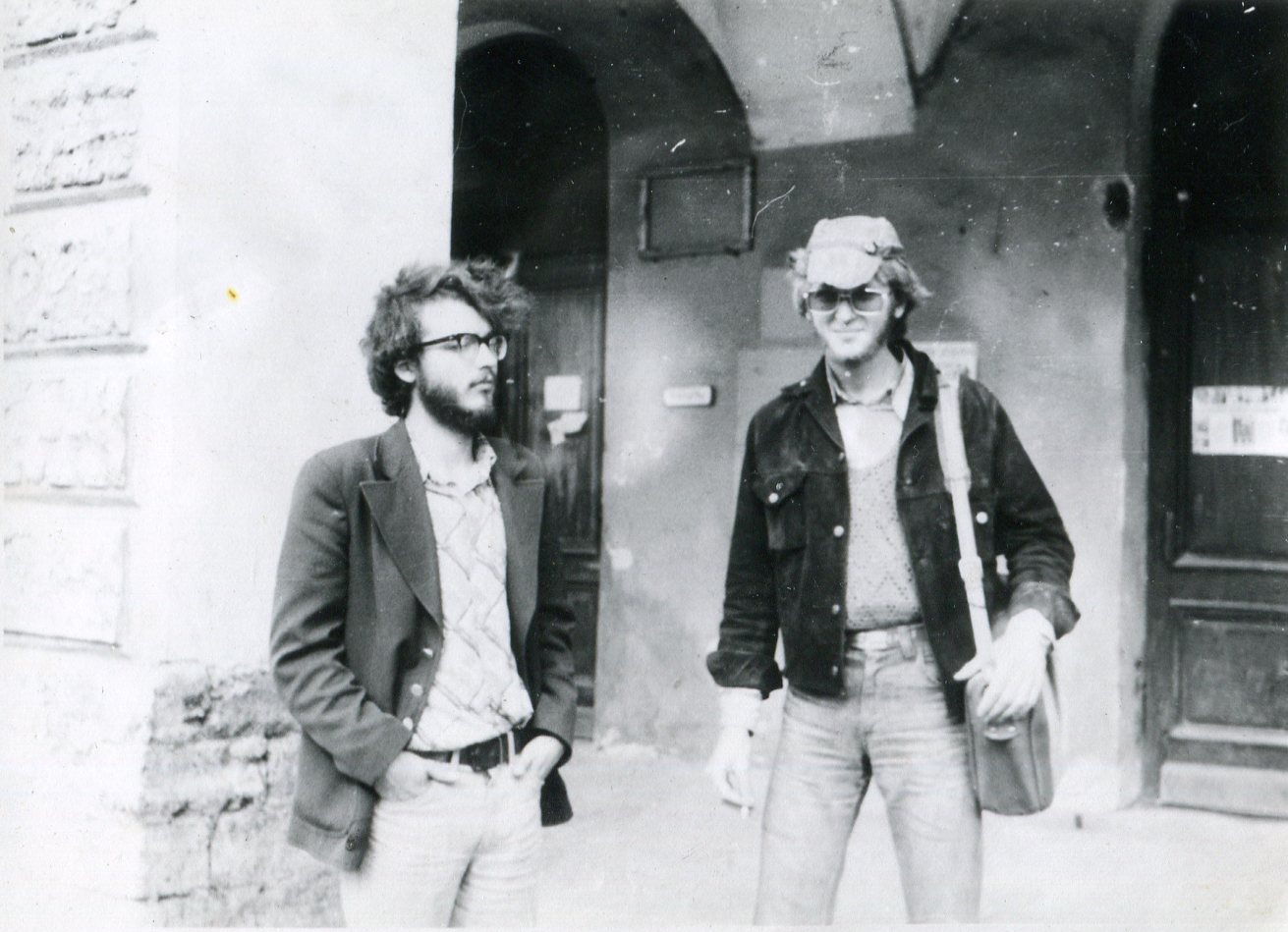
1009_crAlexander Skobov and Felix Vinogradov outside the Leningrad University history department, circa 1976–1977. Photo courtesy of the Iofe Foundation

One of the motives for founding an “island of liberty” like the commune on Primorsky was the desire to live an independent life and leave home.

“It was a way of dropping out of society,” Skobov said in a 1991 interview.

The commune was created not simply as vehicle for internal emigration and distancing from Soviet reality, but also as an alternative cultural and ideological space based on establishing certain shared values of freedom and mocking certain existing official norms. This was expressed even in the commune’s interior decor, including yellow walls with wild strawberries drawn on them and homemade ironic posters that played off Soviet and western symbols. The parodic decrees and decisions issued by the Yellow Submarine and its separate “holds,” as well as poems and songs that turned propagandistic clichés inside out, were an ironic response to the meaningless words of the official Soviet discourse. One inhabitant of the commune on Primorsky, Igor Malsky, even claimed that the communards collectively invented the folklore genre “sadistic verse.” The peak of the commune’s creative powers is considered the “rock poem” “Lazha” (“Crap”), among whose characters one can recognize the residents of the Yellow Submarine.
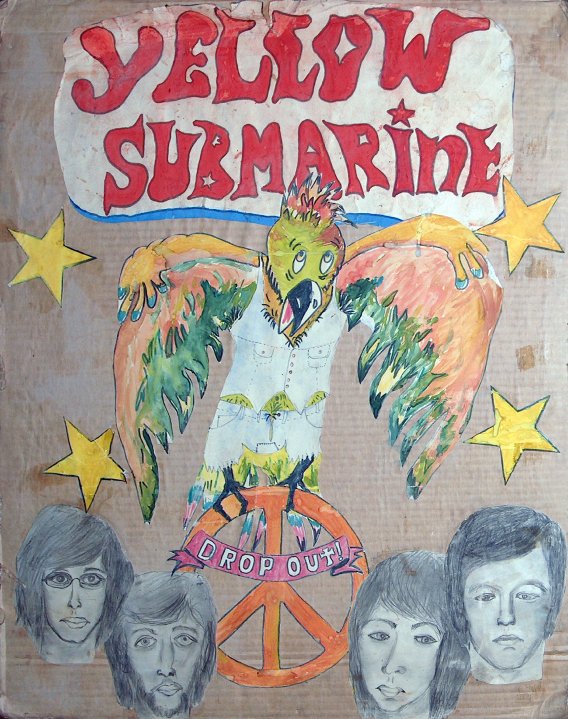
ys_10Felix Vinogradov, Seal of the Yellow Submarine commune, 1977. Image courtesy of Felix and Maria Vinogradov

In an interview with us, Skobov said that his idea, subsequently, of engaging in political activity, printing flyers, etc., came to him while living in the commune. Many participants named as their motive for moving into the commune the “total crap,” i.e., the lies that surrounded the celebrations of the October Revolution’s sixtieth anniversary and the adoption of the new Soviet constitution [in 1977]. As for revolutionary sentiments, Skobov said that those went no further than kitchen table conversations “berating the authorities.”

Daily life in the commune took shape as in a large family: arguments periodically arose among its inhabitants. The commune was supported by various means, but everyone tried to contribute in accordance with the main rule, “a little bit from everyone each day”: one person received a university stipend, another was working, while a third person “dragged it out of  their parents.” The refuge itself was a two-story wooden house whose first floor belonged to the “dissidents,” and the second to the “hippies.”

“Two rooms, two kitchens, a wooden staircase. All of it was quite exotic, except for the fact that the decor was even more exotic,” Skobov said when describing the interior. The commune residents took care of decorating and the “cozy touches” themselves.

We can divide the commune into two ideological centers: those who took part in publishing Perspektiva magazine (which was originally Skobov’s initiative), and those who were “Soviet hippies.” For example, Felix Vinogradov, one of the commune’s founders, was interested exclusively in the cultural aspect of the process—art, music, lifestyle, and language. All of it was inspired by western ideas of nonconformism, hence his choice of name for the commune.  His opposite number was Alexei Khavin, another striking member of the Primorsky scene. He was actively involved in the protest movement: he typed up leaflets on a typewriter in the commune and wrote articles criticizing the government for Perspektiva. Khavin was eager to go beyond kitchen conversations and do something more concrete.

The confrontation between the inhabitants of the first and second floors of the commune—the more bourgeois “upper level” and the anarchic “lower level”—at times began to resemble the intensity of a cold civil war, complete with mutual insults, reproaches, and accusations. [Andrei Antonenko and Felix Vinogradov, press release for the exhibition The Yellow Submarine Commune, 1977–2007]

This internal division could not but determine the community’s fate. Felix Vinogradov was the first to leave the house on Primorsky, followed by almost all the hippies.

The KGB took an interest in our magazine: its destruction was imminent, and our commune was threatened along with it. They didn’t nab us at the house itself. The thing was that its residents felt that something was brewing and departed to their own homes. My friend from the university, an idealistic hippie, rented apartments for the commune with me, and his father was a colonel in the Border Guards, and they were under the KGB. He worked in [the KGB’s famous local headquarters] on Liteiny Prospect. It was then a rather widespread phenomenon, not only here but also in Europe: the children of wealthy parents and security forces officers turned into hippies. And so this hippie’s dad pulled up to the house in a small truck filled with soldiers. They loaded up his things and drove him and his wife away. The others understood what was going on, and they left too. [Alexander Skobov, “Our Oppositional Communism Was an Oddity”]

ys_15Alexander Skobov, Tatiana Komarova, and Felix Vinogradov, 1977. Photo courtesy of Felix and Marina Vinogradov

The only residents remaining were those who were primarily interested in publishing Perspektiva and were organizing a meeting of opposition groups, which the New Left group planned to hold on the Karelian Isthmus. But because information about the upcoming meeting was leaked to the KGB, the group’s members were also forced to urgently remove everything from the commune having to do with their political activities. Alexander Skobov and Arkady Tsurkov were soon arrested, and the apartments of other members of the New Left group were searched, while the house on Primorsky Prospect was completely abandoned. After the dissidents left their Yellow Submarine, the house was razed, and no photos of it remain. But the phenomenon of the Yellow Submarine commune itself is one of the most striking examples of the “islands of freedom” adrift in the space of Soviet Leningrad.

Further Reading
Interview with Alexander Skobov, recorded at Memorial Research and Information Centre, 1991. Iofe Foundation Electronic Archive

Juliane Fürst, “We All Live in a Yellow Submarine: Life in a Leningrad Commune,” in Juliane Fürst and Josie McLellan, eds., Dropping Out of Socialism: Alternative Spheres in the Soviet Bloc (New York, 2016), 179–207

Alexei Sochnev, “Our Oppositional Communism Was an Oddity,” Russkaya Planeta, March 19, 2014 [Interview with Alexander Skobov]

A.F. Belousov, “Igor Malsky’s Memoir ‘The Crooked Mirror of Reality’: On the Origin of Sadistic Verse,” Lotman Anthology, vol. 1 (Moscow, 1995), pp. 681–690

Thanks to Jenya Kulakova for the heads-up. Translated by Mary Rees
 

Jenya Kulakova: A Sunny Downpour

sunny downpour

Jenya Kulakova
Facebook
July 28, 2020

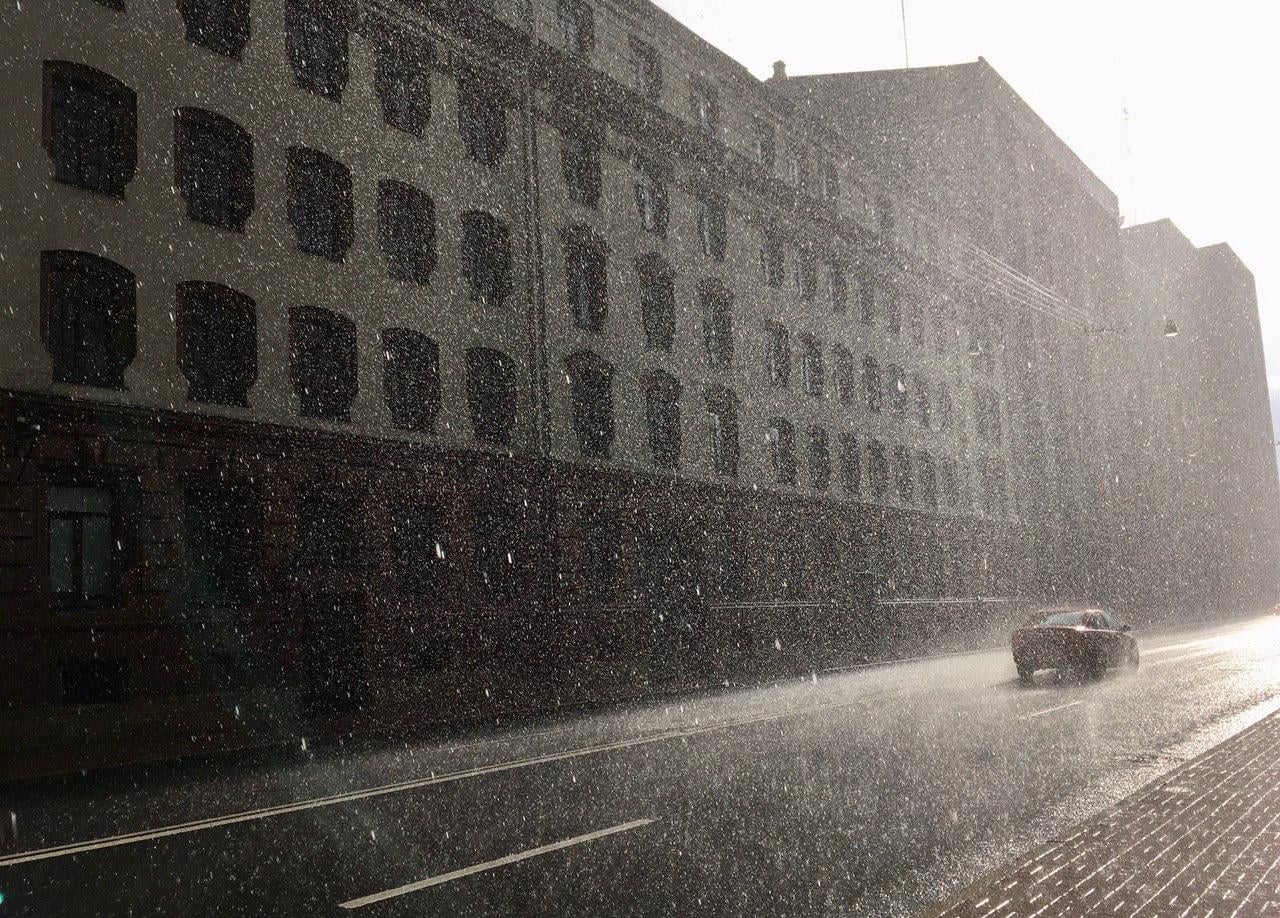
I exit the remand prison on Shpalernaya Street—and find myself in a sunny downpour. From inside, the storm seemed much darker. (Many things probably seem much darker inside the prison.). I stand under the awning of Center “E” and look across the road at the prison, dazzling in silver drops from the sky, in the spray made by the wheels of passing cars. I’m under the awning and safe, but my feet are getting a little wet. For a short time the street is quiet, there are no people or cars. A small rainbow falls directly on Shpalernaya from the sky, vanishing in a few minutes.

I will tell Vitya [Viktor Filinkov] about this when we meet, just I told him about the bat that flies at night in the courtyard near the prison. And he told me how a pigeon had flown into their prison cell and landed on his trousers, and how he and his cellmate had caught it by donning plastic bags. They had chased it out of the window and fed it prison bread.

About the verdict.* Vitya had received it on Thursday and immediately read it, but he hadn’t looked at it again. Tomorrow and the day after tomorrow, he plans to write and send an appeal. When I asked him to comment on the verdict, he could not say anything printable—he cursed loudly and waved his hands. When I asked him one more time to make a publishable statement on the matter, he slumped his head on the table. That was when I realized that it was his verdict and his seven years in prison, and he could comment or not comment on them as he wished.

He will write an appeal, of course, there is no doubt about it. Although he doesn’t feel like doing it at all: he says that he is always busy with something, and there is not enough time. He reads a lot about math (I only remember something about graph theory, but there are a lot of other topics), devises assignments for a training course on “pogromming,” and studies English. He’s apparently in good health, and his mood is also cheerful. However, the last couple of weeks he has had increased problems with sleep. He falls asleep in the morning, when it is already time to get up. (And this is despite the fact that since February, he has been taking drugs that should also level out his sleep.)

The censor is on vacation, and for three weeks, Vitya has received no letters from the outside world. (I don’t think he is able to send letters, either). But he gets Novaya Gazeta once a week, so Vitya is more or less aware of all the news. The library has been undergoing repairs of some kind, so a month ago, Vitya and his cellmate had to return all their library books, but they cannot take out new ones yet.

Update (added here from the comments). The coronavirus restrictions, imposed in early April, have almost all been lifted: the receipt of care packages and parcels has resumed, as well as visits with relatives. Meetings with lawyers no longer take place through glass, but all visitors must still wear masks and gloves. The mysterious “cleaning day” on Friday, when lawyers cannot visit clients, is also still in place.

*The verdict has been mailed to Vitaly [Cherkasov] and me by mail, and is still on its way, but Olga Krivonos has posted it here, so you can read it.

Photo by and courtesy of Jenya Kulakova. Translated by the Russian Reader. Please read my previous posts on Viktor Filinkov and the Network Case (see below), and go to Rupression.com to find out how you can show your solidarity with him and the other defendants in the case. All of them now face long terms in prison unless their guilty verdicts are reversed on appeal, which is not going to happen as long as the current regime remains in power, unfortunately.

#NetworkCase