Alexei Gaskarov and Anna Karpova. Photo courtesy of Anna Karpova and PRI
Anna Karpova The Unstable Prisoner, the Exclusion Zone, and Infinity Snob.ru
June 18, 2016
“Gaskarov has had reprimands both at the pretrial detention facility and the penal colony. There have been commendations, too. He works hard, studies well, and runs economics seminars for the inmates. But now he gets reprimands, then he gets commendations He is unstable somehow, unstable.”
Lieutenant Colonel Plaksin (I now always pay attention to such things) stared at the table. He was trying to explain to the judge why the wardens of the penal colony were opposed to paroling my husband.
I remember how I was invited to the studios of TV Rain the day the second wave of Bolotnaya Square defendants was sentenced to talk about we would do next. I put on a brave face and said the heck with the sentence. We would get everyone out on parole. But who knew Plaksin would be staring at the table?
There really is an outstanding reprimand in convict Gaskarov’s personal file: for not greeting an employee of the prison administration. When the judge was reading out the report on this terrible incident, I got goosebumps myself. Was this the man I had married?!
The handful of people to whom the Bolotnaya Square case still matters send us rays of supports and remind us that, in the worst circumstances, we have a little less than four and a half months to wait. They assure me the time can be done “standing on one leg.” It is nothing compared to the three years already served.
But that is not how it works.
Maybe I have been playing Fallout 3 (a video game about life on earth after a nuclear war) way too much, but I will say this. The trials and hearings, the pretrial detention facilities, and the penal colonies are like exclusion zones, places with elevated radiation levels that (I will tell you a secret) poison and destroy the individual. The more time you spend there, the worse the consequences are. Everyone involved in the process is irradiated. The prisoner and his family have it the worst of all, of course. Friends, acquaintances, and sympathizers are also affected, albeit on a lesser scale. The impact of the “radiation” does not end when the sentence ends.
The radiation sickness caused by the Russian penitentiary system can manifest itself in very different ways. For example, when it is quite hard to admit your absolute helplessness before court and prison functionaries, you might think there was “that one piece of paper” that could have fixed everything, but you fools did not bother about it. The thought eats into your brains and prevents you from working, sleeping, and communicating with each other. Worst of all, you look for someone to blame. Who messed up? The lawyer? The prisoner? His wife? His parents? The incident then comes up in every stressful situation, most likely, after release as well. The gulf between what prisoners have gone through and what their families went through fighting on the outside can be bridged only by the most patient and wisest. The former will never fully understand what it was like for the latter, and vice versa.
Each week spent there, behind the penal colony’s dilapidated fence, means the risk of sustaining all the major injuries and traumas that will make themselves felt in the most unexpected situations for a long time to come. Not to mention the fact that if you suddenly have the most ordinary appendicitis on the inside, you are probably a goner.
When I am asked whether everything is okay, whether there have been problems at the penal colony, it is enough for everyone to hear that my husband has not been transferred to maxim security, and that neither the wardens nor the inmates have been messing with him, but that amounts to only ten percent of possible problems. The other ninety percent have to do with how inmates and their families digest what has happened to their lives. And it not the done thing to talk about it, but an additional four and a half months feel like an infinity and keep on poisoning the lives of those who wait.
This means there is no “only” when we are talking about the remainder of a prison sentence. And it means we must fight for every month of freedom, even for a single month. By the way, that is how it is going to be with us.
Artem Kravchenko Facebook
January 22, 2015 • Razvilka, Moscow Region
Re: words and deeds
My elder brother has a wife and four children, aged almost zero to nine years old. Boy-girl-boy-girl.
In this situation, of course, overall carelessness means that all six of them are stepping on each other’s toes, running around, jumping, being late getting somewhere, losing socks, toys, passports, and so on and so forth.
I don’t know exactly in what terms the youngest part of the family reflects on these difficulties (and whether they do reflect on them), but the eldest part of the family, it goes without saying, periodically tends to resort to dramatic statements on the matter.
For example, the mother of the family took a shine to a remarking, “It’s time to lather the rope!”
You can utter this phrase exhaustedly and phlegmatically. Or, on the contrary, belt it out while wringing your hands. Or stress each word strictly and disapprovingly. Basically, there are plenty of fine options.
But, as we all know well, “We cannot predict / How our words will resound” (Tyutchev).
Eventually, after a while my three-year-old nephew showed up and said, “Mom, I lathered you a rope.”
He pulled out a fairly long piece of twine, solicitously adding, “With good antibacterial soap.”
_________
Current Time
June 17, 2016
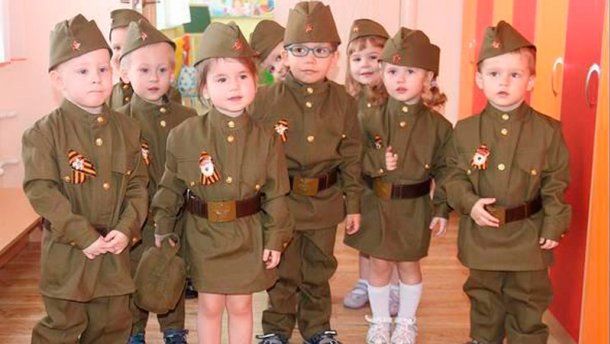
Community volunteers in Novosibirsk have spent a grant from the mayor’s office to organize a Zarnitsa[Soviet-era children’s war game] for children with disabilities. The goal was to adapt the children to life and integrate them into society. This is an interesting way of doing it.
[Subtitles]
The Novosibirsk authorities organized a Zarnitsa game for orphans and children with disabilities.
“And smile!”
“Put down the pistol.”
“There will be live fire. We are going to be firing, and we will be fired on.”
[Sign on left:] “Red Army warrior! The lair of the fascist beast lies ahead.”
“This is a war game, which the young generation needs nowadays.”
The game was meant to help the child adapt to life.
Translated by the Russian Reader. Photo courtesy offakty.ictv.ua
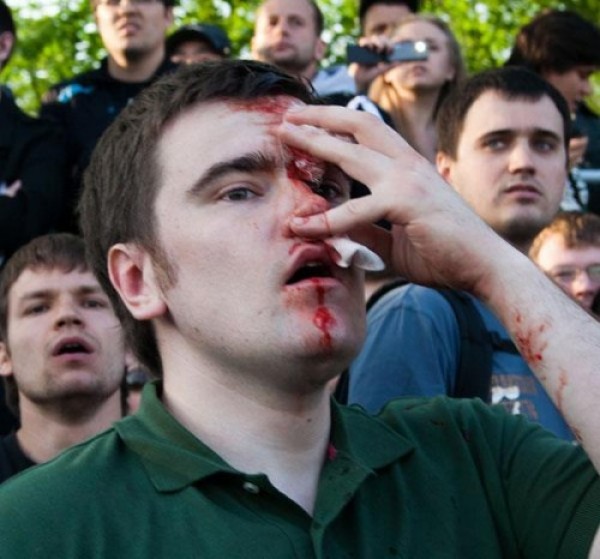
Alexei Gaskarov on Bolotnaya Square, Moscow, May 6, 2012
Alexei Gaskarov Denied Parole Grani.ru
June 17, 2016
Novomoskovsk City Court in Tula Region has denied Bolotnaya Square case convict Alexei Gaskarov’s request of parole, Gaskarov’s wife Anna Karpova [sic] reported on Snob.ru.
“Novomoskovsk City Court Judge Irina Sapronova turned down the request. The spokesman for the penal colony also testified against the request, because Gaskarov had been reprimanded for not greeting a penal colony employee in March,” wrote Karpova.
According to Karpova, the penal colony gave Gaskarov a negative character report. The report noted that the convict had been issued two disciplinary reprimands in solitary confinement and two in the colony for violating the daily routine and not greeting wardens.
And yet the report states that Gaskarov has not violated the internal code of conduct or the terms of his sentence, has been working at the colony and taking part in social activities, has qualified as an electrician, and has been studying to be a welder. Gaskarov has received two commendations for hard work and good behavior. He is polite with the wardens, neat, has a positive effect on new inmates, attends events, and has no outstanding writs of enforcement, the report states.
Gaskarov was arrested in late April 2013. On August 18, 2014, Judge Natalia Susina of the Zamoskvorechye District Court in Moscow sentenced the activist to three and a half years in a medium-security penitentiary facility under Criminal Code Articles 212 (involvement in rioting) and 318.1 (use of non-threatening violence against a state official).
Gaskarov was found guilty of tugging police officer Pavel Bulychev’s arm and police officer Igor Ibatulin’s leg. Gaskarov claimed he tugged Bulychev’s arm to break a police chain that was causing the crowd to stampede. He attempted to pull Ibatulina away from a detainee lying on the ground.
Gaskarov himself was severely beaten at Bolotnaya Square on May 6, 2012, sustaining lacerations to his head. And yet the Russian Investigative Committee refused to file criminal charges in response to his complaint.
On November 27, 2014, a panel of judges at the Moscow City Court (with Tatyana Dodonova acting as reporting judge) left the antifascist’s verdict unchanged.
On June 24, 2015, Novomoskovsk City Court Judge Elena Gorlatova denied Gaskarov parole, citing an outstanding reprimand he received while still in custody at Pretrial Detention Facility No. 5 in Moscow.
Alexei Gaskarov was born in 1985 in Zhukovsky, Moscow Region. A graduate of the Government Finance Academy, he worked at the Institute of Sociology of the Russian Academy of Sciences. In 2010, he was arrested and charged during an investigation of the campaign to defend the Khimki Forest but was acquitted the same year.
Translated by the Russian Reader. No thanks to anyone for letting one of Russia’s finest young men rot in prison for the crime of acting like a decent human being in a horrible situation deliberately provoked by the police. Photo courtesy of bolotnoedelo.info. Read my previous reports on Alexei Gaskarov’s case and the futile efforts to free him.
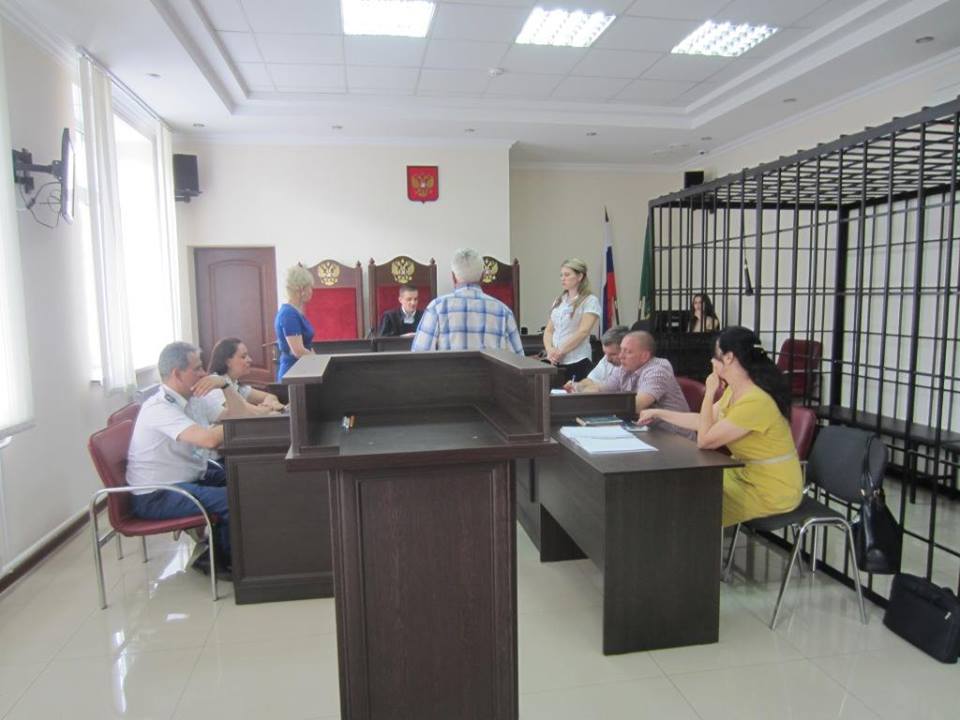
The latest hearing in my criminal case took place in Maykop from 11 a.m. to 4 p.m. on June 17 of this year. This time, the prosecution’s last two witnesses were finally questioned, albeit by a videoconference link with the Soviet District Court in Krasnodar. Vyacheslav Potapov and Vitaly Isayenko were supposed to answer questions about the operations of the website For Krasnodar, on which the article “The Silence of the Lambs” was posted.
It seemed to me that Sergei Shvetsov, senior deputy prosecutor of the Republic of Adygea, was not prepared to examine the witnesses today and the questions he asked them sounded like childish prattle. Even the judge noted this and advised the public prosecutor to concentrate. Ultimately, however, the second public prosecutor, Inessa Orlova from the Maykop City Prosecutor’s Office, took the microphone from Shvetsov and asked the witnesses specific questions.
I was personally interested in Isayenko’s responses to two sets of questions, first, about the circumstances of his interrogation on December 12, 2014. On that day, after the search [at his house], he was brought from Krasnodar to Maykop and interrogated until evening. It was night when they sent him back home to Krasnodar. As Isayenko, who suffers from Type 1 Diabetes, explained, he spent almost half a day at the Republic of Adygea Investigation Department with no food and, much more dangerously, with no insulin. They gave him only water. And yet they interrogated him intensively, trying to squeeze testimony against me and Vyacheslav Potapov, editor of the website For Krasnodar, from him. I was being interrogated in the next room, and I could hear Senior Investigator Kirill Kustov screaming at him. The stress he underwent and the long period he endured without food and insulin landed Vitaly Isayenko in the hospital the day after his return from Maykop. His diabetes flared up and he suffered from other ailments.
I was also interested in Isayenko’s comments, as a computer specialist, on certain statements in the inspection report on the computers seized at Isayenko’s house, an inspection carried out by Senior Investigator Kustov on the night of December 12, 2014. In particular, the report states that three processors were discovered in one of the computers. Isayenko explained there had been only one processor in the computer. He did not know nothing about any other processors.
In general, the witnesses said nothing new. They only confirmed what was already contained in the minutes of their interrogations.
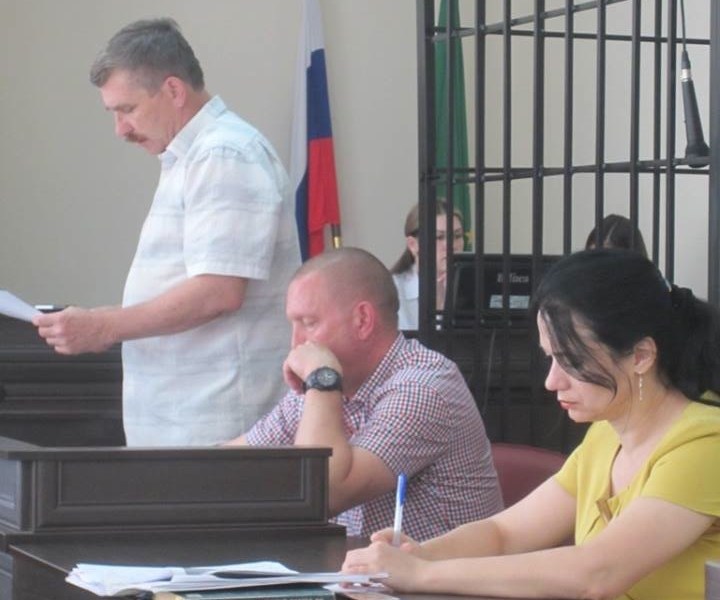
Valery Brinink (left) and his attorney, Andrei Sabinin. Maykop City Court, June 17, 2016
After the witnesses were examined, my attorney, Andrei Sabinin, attempted to request that Elizaveta Koltunova, a linguist from Nizhny Novgorod, be examined via videoconference, but the prosecutors objected, and Judge Vitaly Galagan did their bidding. Our request to examine the linguist by videoconferencing was rejected. According to the defense, this stance on the part of the prosecution and the court contradicts the adversarial nature of judicial proceedings and the principle of the equality of arms.
Much more unexpected and even amusing was the procedural action, which took place after lunch, of obtaining handwriting samples and a signature from prosecution witness Mugdin Mossovich Guchetl, a resident of the village of Gabukay. Everything would have been alright if the witness had simply produced his signature in silence, but instead he recalled another circumstance that I think gave the prosecutors a slight shock. Guchetl recalled that in February of last year, when Investigator A.S. Rudenko of the Investigative Department of the Republican Investigative Committee’s Teuchezsky District office took Guchetl’s written testimony, he asked him to sign blank sheets of paper, because, as Rudenko explained, allegedly, he would later type out Guchetl’s handwritten testimony on the computer, but he needed the signatures right away so he would not have to make a return trip to Adygeisk.
The investigator thus clearly violated the procedure for processing interrogation reports, a procedure strictly regulated by criminal procedural laws. At the same time, the investigator committed forgery by inserting things Guchetl did not say into the report. Today, after reading the interrogation report, which is part of the criminal case file, Guchetl categorically stated he did not say to the investigator what was written in the penultimate paragraph of his printed testimony, which reads as follows: “I want to clarify that I strongly disagree with the contents of the article entitled ‘The Silence of the Lambs,’ because I think the article has defamed my honor and dignity as an Adyghe, as well as insulting all Muslims. The article compares us to pigs and cowards, and claims we have no sense of self-esteem.”
Basically, it was for the sake of this passage that the investigator obtained Guchetl’s testimony. In fact, the investigator could have written something even rougher on Guchetl’s behalf, because he already his signatures on blank interrogation report forms.
Finally, I made a motion to rule the Teuchezhsky District Council an illegitimate injured party in my case, since it did not satisfy the grounds set out in Article 42 of the Russian Federal Criminal Procedure Code. When the prosecutors objected as usual, spouting platitudes about the proper recognition of the local authorities as an injured party, we demanded the prosecution present legal grounds for its stance. We were quite curious to find out how exactly the district council had been injured, if, as they themselves have said, the article had caused moral injury to the residents of the Teuchezhsky District.
The prosecutors drew a blank and requested a time-out until the next hearing, at which they promised to provide a written justification for their objection. That suited us just fine, as it did the judge, who postponed consideration of our motion until next time.
The next court hearing is scheduled for June 24.
Translated by the Russian Reader. Photos courtesy of Valery Brinikh. Please read my previous posts on his case.
This minute-long excerpt from a program on the Russia channel is an excellent illustration of what some people have been trying to turn patriotism into recently.
First, the smug presenter fudges the surname of his colleague, one of the country’s best sports commentators. Then, instead of apologizing, he says it is no big deal, because the commentator did not hear him in any case, and basically who cares what his name is. Next, he claims, seemingly is passing, it was the English who attacked the Russian sector in Marseille, although we know it was the other way around. Finally, the commentator, Vladimir Stognienko, is accused of not supporting Russia, just because he refuses to back up this lie on the air. The studio audience applauds.
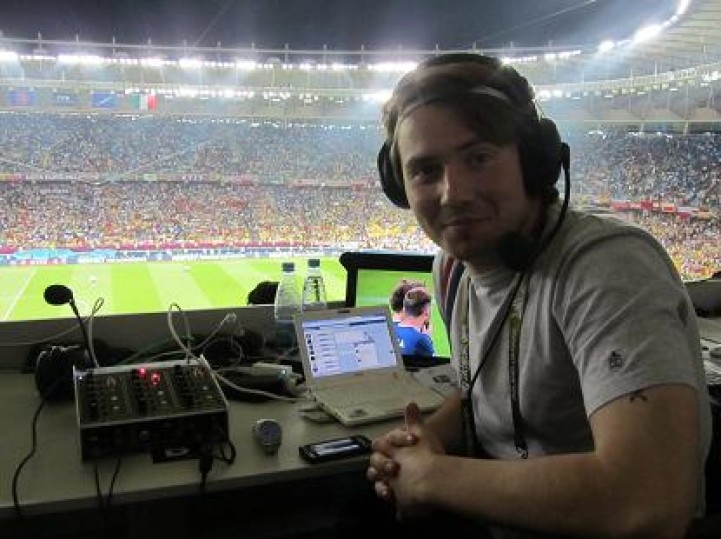
It so happened that today we rode back from the match in Lille in the same bus as Vladimir Stognienko. Later, we discussed the fact that he was, seemingly, the most upset about the defeat [against Slovakia]. Anyone who has heard his play-by-plays knows how emotional he gets about the Russian squad. For the presenter of the TV show, it boils down to the fact we lost, we chatted about it, and now we have moved on, but a commentator lives for football. Maybe Stognienko has dreamed his whole life of someday doing the play-by-play of a European Championship final involving the Russian team.
Two hours later, Stognienko goes on the air from downtown Lille and hears from the presenters that he does not support Russia and is basically a traitor. As they say this, the presenters flash sparkling white smiles. I am curious: what are they so happy about? Our team lost, and they did not play particularly strongly.
A strange kind of patriotism has emerged recently in Russia. For the new breed of “patriots,” supporting Russia and telling the truth are incompatible. Yet they somehow feel entitled to tell others who is a patriot and who is not.
It does not occur to these people that saying a honest man cannot be a patriot is tantamount to insulting one’s country. That the slogan “you are either for the truth or for our side” demeans Russia.
In my opinion, Stognienko summed up the basic principle of the real patriot.
“If there is a problem, you have to talk about the problem,” he said.
Honest professionals have always been and will always be the main patriots in Russia.
And yes, our day will definitely come.
Translated by the Russian Reader. Photo courtesy ofRusfootball
An elderly woman, quite rural in appearance, dressed in a headscarf and long skirt, was standing in the queue to the book return window at the Public Library on Moskovsky Prospect. She was returning books entitled “Fifth Form Mathematics,” “Help for the High School Pupil,” and something else in the same vein.
She caught my gaze.
“Yes,” she said, “my grandson is doing very badly at school. He got a D in maths. His parents could care less: both of them drink. His teacher said he had to pick up the slack or down the line it would only get worse. But who is going to help him? So I sit trying to figure things out. I will come again tomorrow. Basically, he is a kind, clever boy. He is good at drawing.”
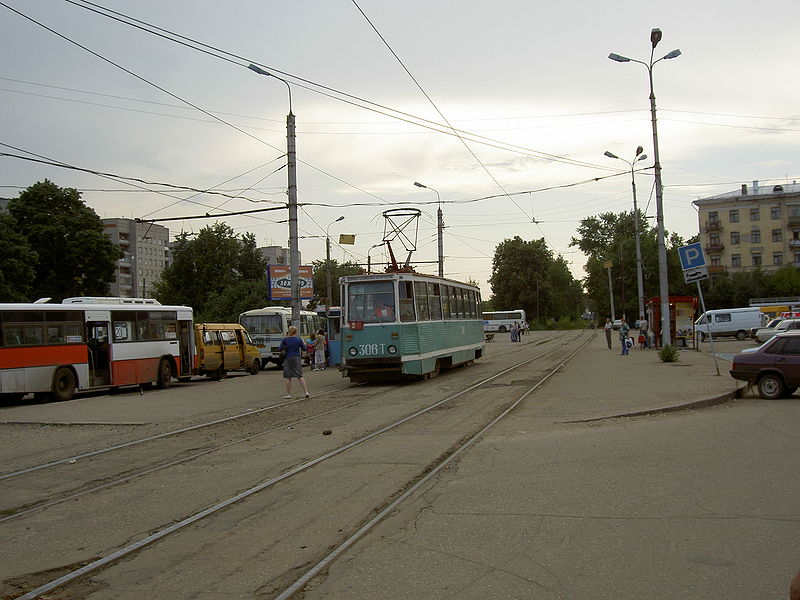
“Tram service in Ivanovo was cancelled in 2008.” Tram at Vokzalnaya Square in Ivanovo, July 28, 2007. Photo by Dinamik / Wikipedia
Public transport is represented by trolleybuses, buses and taxis. The trolleybus system was opened on November 5, 1962. The first line ran from the Bagayeva area (now Victory Square) to the GZIP plant. The tram was operated from November 6, 1934 until June 1, 2008. According to former Ivanovo Mayor Alexander Fomin, “Over the past 20 years, the number of vehicles in the city has increased by more than 10 times, while traffic is 5–7 times higher than that for which they were designed.”
The system of urban bus services in Ivanovo-Voznesensk began on November 8, 1926. The bus park was originally located on Paris Commune Street. In the early 1960s, a new bus depot was built on Prospekt Tekstilchshiki. In the Soviet period, buses and coaches were operated Ivanovo Passenger Motor Company (MTE-1) and the taxi service (Ivanovo MTE-2). Ivanovo MTE-1 closed in December 2007.
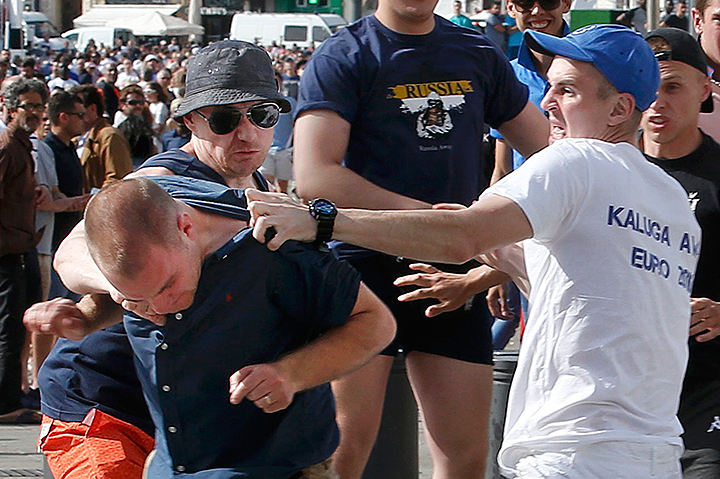
Russian football hooligans attacking an opponent in Marseille. Photo courtesy of tribuna.sports.ru
Come on I will show you how I will change
When you give me something to slaughter
Shepherd boy (Hey!)
Everybody sing (Hey!)
Better act quick (Hey!)
Be my toy Come on have a bet We live on blood We are Sparta F.C.
The Russian National Football Hooligans Squad: The Russia They Represent in Marseille
Sergei Medvedev Forbes.ru
June 14, 2016
Russia has fought yet another small victorious war. On the eve of the national squad’s first match in Euro 2015, a couple dozen Russian fans routed the numerically superior forces of the English fans in the Old Port of Marseille. A day later, right after the match, they went berserk in the English sector at the stadium, beating up everyone in their path, including spectators with families and elderly people. The results were distressing. At least thirty-five people were injured, and a fifty-year-old English fan who was crowbarred over the head is at death’s door. As punishment, UEFA has provisionally suspended the Russian team until the end of Euro 2016 (if the violations are repeated, we will be completely disqualified from the championship) and fined the Russian Football Union 150,000 euros, including for the racist behavior of the Russian sector during the match against England. On June 14, French police detained fifty people from the Russian Union of Supporters, led by the notorious Alexander Shprygin (aka Kamancha) and held them for twenty-four hours. Russian fans made the top world news headlines (isn’t it what they wanted?), and Russia’s chances of losing the right to host the 2018 World Cup have seriously increased.
This shameful episode perhaps should not deserve such attention. Football hooliganism has long ago turned into a sanctuary of violence and a near equivalent of world war. Fans of all countries fight and run rampant, and massacres happen too, like the tragedy at Heysel Stadium in Brussels, which left thirty-nine people dead and led to all English clubs being banned from UEFA competitions for five years. And Marseille well remembers the English fans during the 1998 World Cup, who staged a donnybrook with fans from Tunisia and smashed up half the town.
But the difference lies elsewhere. While in England, supporters are unanimously condemned by society and politicians in the wake of such scandals, over the last few days the football hooligans have figured almost as national heroes in Russia. Dmitry Yegorov, a reporter for Soviet Sport, live tweeted the carnage, commenting it like a football match and admiring the organization and physical training of the Russians. Social media have been buzzing with approval for the supporter, who smacked the spineless English upside the head and stood up for Russia like the three hundred Spartans at Thermopylae. A blog by sports journalist Andrei Malosolov entitled “Why the Victory of Russian Supporters in the Port of Marseille Is Cool!” has been especially popular.
What is even more curious, the Russian hooligans have enjoyed the backing of high-ranking officials. Russian Investigative Committee spokesman Vladimir Markin commented on the reaction of the Marseille authorities on Twitter, calling the Russian fans “well-trained fighters.”
“A normal man, as he should be, surprises them,” he wrote. “They’re used to seeing ‘men’ at gay parades.”
LDPR State Duma deputy Igor Lebedev (whose aides include Shprygin aka Kamancha), a member of the Russian Football Union’s executive committee, wrote, “I don’t see anything terrible about fans fighting. On the contrary, our guys were great. Keep it up!”
“If [Russian sports minister Vitaly] Mutko had been with the fans in the stands, he would have fought too,” Lebedev suggested later, in an interview.
Here we have to acknowledge one unpleasant thing. The fans in Marseille supply a honest picture of official policy and conventional wisdom in post-Crimea Russia.
They are waging the same hybrid so popular in our propaganda, infiltrating well-trained fighters, skilled in hand-to-hand combat and disguised as “holidaymakers,” into France, using force selectively and purposefully, attacking in unexpected places. The web is now full of rumors the hooligans were really Russian military intelligence (GRU) special ops units, who had infiltrated the championship to intimidate Europeans, so pumped-up, organized, and sober did the Russian hooligans appear in the numerous videos, but we shall leave this hypothesis to fans of conspiracy theories. As I imagine it, a joint detachment of so-called ultras from different “firms” of fans, fighters experienced in street brawling, converged in Marseille, attacking beer-bellied English “Kuzmiches,” i.e., simple fans who had come not fight, but to cheer and show off, some accompanied by their families.
One Russian fan admitted as much in an interview that our guys had come to fight.
“It doesn’t matter what cities our fans are from and what teams they support. What matters is that we are from Russia and are going to fight against the English. They have always said they are the main football hooligans. We are here to show that English fans are girls.”
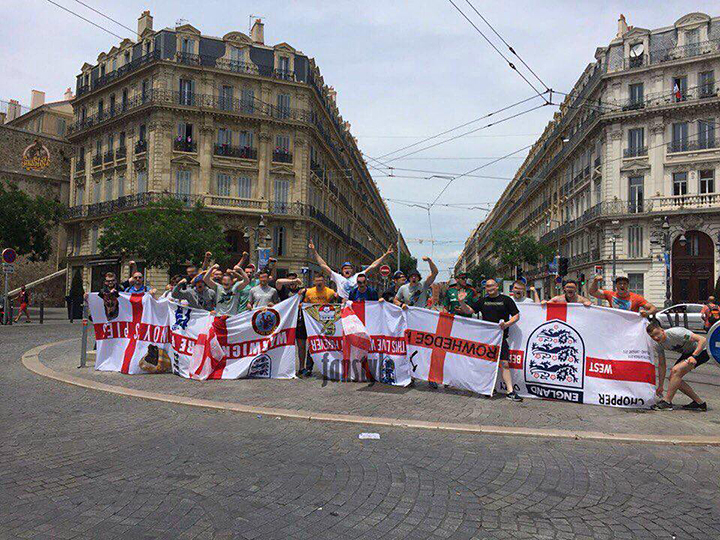
Russian football hooligans displaying captured English flags. Photo courtesy of tribuna.sports.ru
So even if the Russian assault was not really a planned military operation, such rumors do not come out of nowhere. First, Russia is not a novice at “hybrid” interventions in social movements in Europe. It has organized rallies and agitprop campaigns, worked skillfully through the media to fuel anti-immigrant sentiments, cooperated with right-wing radical and neofascist movements, and supported scandalous populists and European separatists. Just as in Soviet times the Comintern engaged in subversion in western countries, Russia has been worming its way into the cracks and fissures of European society. It has been trying to weaken the west from within, explaining it in terms of a total “information war.” Alarmed Europeans see the Russian ultras in this light.
Second, football supporters really are one of the combat units of the regime, which has an irresistible attraction to various groups of mummers who try and make a show of strength, such as Cossacks, bikers, and football supporters. Members of these stern fraternities are invited to drink tea with high officials. They are identified as exemplars of patriotism. They are awarded civil society development grants. And when push comes to shove, they are sent out on so-called Russian Marches and sicked on opposition rallies and individual dissidents. However, the football hooligans are as alien to the football tradition as the Surgeon’s latex bikers, with their Orthodox banners and Saint George’s ribbons, are to the rebellion and freedom of Easy Rider, and the paunchy “Cossacks,” with their glued-on topknots and cardboard medals, specialists in fighting gays and theater productions, are to the honor and glory of Russian Cossacks. They are all fakes in the era of Putin and Pelevin. When “the public” is a total simulation, protest countercultures turn into vehicles for dull officialdom and perfunctory patriotism, into tamed grant recipients.
Finally, the Russian fans (at least the ones who are photographed by reporters) are the readymade products of official propaganda, reproducing on their clothes and bodies all the typical corny kitsch of the era of Crimea and “getting up off our knees”: t-shirts emblazoned with slogans like “polite people” and “we don’t abandon our own,” budyonovkas and earflap caps twinkling with red stars, banners displaying toothy bears and Slavic Siegfrieds, kids in Armata tank t-shirts and, as the apotheosis of all this patriotic trash, a gigantic tricolor, covering half the Russian sector at the stadium, inscribed with the message “YOU’RE FUCKED.” Apparently, these people see this as the new Russia’s national idea.
This mayhem, however, kicked off long before Crimea. Russian fans have usually reserved the most boorish displays of great-power chauvinism and racism for trips abroad. In the Czech Republic, Russian hockey fans unfurled banners emblazoned with tanks and the promise to reprise 1968. In downtown Warsaw in 2012, football supporters staged a march in honor of Russia Day, nearly provoking a battle royal with Polish ultras. Fueled by beer and egged on by propaganda, Russian resentment shows itself to the hilt in the stands at football and hockey matches, taking symbolic revenge for the Soviet empire. Yeah, we forfeited a great power and never have learned how to play football, but we can smash chairs and smack Europeans in the kisser, “kick the shit” (otbutskat) out of them, as Vladimir Putin once put it, invoking a football supporter coinage. Ultimately, wasn’t it Putin who shared a bit of popular wisdom drawn from a tough childhood in Petersburg’s courtyards, i.e., you have to hit first?
The fans in Marseille did just that, and in this sense they are worthy ambassadors of Putin’s Russia.
As MP Lebedev would have it, they should be greeted at the airport as heroes, just as the bikers have been greeted when they return from their patriotic motorcycle rallies. They should be secretly awarded state honors, as the “polite people” were in their time for bringing Crimea back into the fold. And they should be elected to seats in the Public Chamber and State Duma. Football hooliganism is a matter of national importance in hybrid Russia.
The term “football hooliganism” (okolofutbol) quite precisely reflects the essence of events. Despite the adult budgets of its premier league teams and national squad, despite the purchase of international stars (a typical strategy of superficial modernization), Russia has remained an average performer in the world rankings, both in terms of its own national championship and the performances of its national team. Before the start of the Euro 2016, our country was ranked twenty-ninth in FIFA’s world ratings. But, at the same time, a fan movement based on the British model has very quickly and naturally put down roots in Russia. Books by Dougie Brimson, who has written authoritatively on England’s football fan culture, have achieved cult status among Russian supporters. Without becoming a world football power, Russia has succeeded brilliantly in hybrid football hooliganism, spewing its entrenched and publicly recognized culture of violence onto the international arena.
But Russia has been engaged in the same hybrid “football hooliganism” in Ukraine, where it has not been waging an open war, but delegating well-trained groups of fighters, and in Syria, where it arrived with its own agenda and has been bombing targets for reasons known only to it, and in Europe, where it has banked on populism, separatism, and breaking up the European Union.
Football hooliganism substitutes fair play, real work, and the painstaking cultivation of institutions with violent action and demonstrative bullying. This is not the first year the entire Russian state has been playing at football hooliganism. The hooligans in Marseille are merely its away side.
Sergei Medvedev is a journalist, historian, and faculty member at the Higher School of Economics (HSE) in Moscow. Translated by the Russian Reader
“Islamo-, homo-, xeno- phobia kill. #Orlando.” Spontaneous memorial to the victims of the Orlando shooting outside the US Consulate in St. Petersburg, Russia, June 13, 2016. Photo by Vadim F. Lurie
I have received lots of comments assessing my worth as a woman and a daughter, and a lot of the usual fare, such as “I wish you were dead” and “You’re not human beings.” But there is one more thing I would like to discuss.
When you write that “terrorists only need an excuse,” “the sexual orientation of the victims doesn’t matter,” and “I am mourning too, so how am I different from you?” you are closing your eyes to the cause of the murders.
Homophobia is the cause.
I don’t like the word. It is abstract, but it does a fair job of explaining how, in the last two years, nineteen of my acquaintances have been assaulted, two have been raped, and two have been murdered, and how over twenty people I know have been forced to leave the country. These have been people from my circle of friends, which is not so huge. Laws have been passed against us. We are unequal and officially deemed unequal according to Article 6.21 of the Russian Administrative Offenses Code. We do not have the right to marry and have joint custody of children. We do not have the right to visit each other in prison or hospitals. For the past three years, in the Russian hinterlands, there have been neo-Nazi groups operating who prey exclusively on LGBT. Television has vigorously inflamed the atmosphere of hatred and fear. There was a break, which lasted a year, for the Ukrainian war, but now we are the number one public enemies. Just watch the news.
I am glad you can live without noticing this, that it doesn’t concern you. I would also be glad not to know all the particulars, for example, how a bullet from a trauma pistol penetrates the eye, and the sound it makes, or what it is like to file a complaint against a guy your father brought over to “fix” you, or how to dial 911, because someone is trying to open your door, but the cops refuse to show up. And you sit there till morning with a little knife in your hand listening to someone trying to pick your lock. And then, in the morning, when the fuss has died down, you close the door, leave the house, and never go back there again. These are the things people close to me have gone through. Maybe your colleagues and friends have gone through some of these things. I am even certain they have.
I know how long a broken nose takes to heal (I can even compare, because noses get broken often), what it is like to get hit by a stone, a bottle, and a chunk of pavement, what it is like when your girlfriend is found strangled in a car, what it is like when the doctors say you can expect to go deaf, because the auditory nerves die off after a blow to the temple (I can tell you about that in detail: I went through it myself), what it is like when you are doused with urine and videotaped, what it is like when you are called into the director’s office and fired, forced to switch schools, universities, the place you work. I even know what it is like when your classmates rape you behind a garage. I know what it is like when a cop spits in your face while his buddies are suffocating your friend, and you cannot do a thing, because your arms are pinned behind your back, and all this is accompanied by jubilant cries of “faggots!” I know what it is like to dream of buying a plot of land, surrounding it with a fence three meters high, and raising your children in this cage, because it is the only way you can guarantee their safety.
Any conversation on the topic ends with the advice to “not stick your neck out.” When mass murders occur, the same attitude leads to comments that “it doesn’t matter what your orientation is.”
No, you really don’t know how my mom felt when she heard about the shooting at the gay club, or what I feel when I realize I have no way of reassuring her. “Everything will be okay.” Are you kidding?
The orientation of the people who were killed matters.
If it doesn’t matter to you, then you could give a fuck about the cause of the murders and why these murders happen again and again and again.
Elena Kostyuchenko is a journalist with Novaya Gazeta newspaper and a Russian LGBT rights activist. Translated by the Russian Reader. Thanks to Comrade AS for the heads-up
Center “E” Comes Looking For Performance Artist Who Changed Disabled Orphan’s Dressings Near Kremlin
Natalia Zotova Novaya Gazeta
June 13, 2016
Katrin Nenasheva and Dmitry Zhdanov. Photo: Viktor Novikov/Facebook
Center “E” (Center for Extremism Prevention) officers visited the dormitory room of performance artist Katrin Nenasheva at the Gorky Literary Institute in Moscow on Sunday. Nenasheva reported this on Facebook, referring to the accounts of her dormitory roommates. Nenasheva was not in the dormitory at the time.
A few hours earlier, the artist had staged a performance in Moscow’s Alexander Garden. As passersby looked on, she changed the daily dressings of a former orphanage ward now confined to a wheelchair.
The young man who took part in the performance was Dmitry Zhdanov. He was disabled after jumping from the fifth floor of a building in despair and breaking his back. His brother had been beaten up by other former orphanage wards, who had not been punished for the crime. The criminal case against them fell apart altogether. The performance was dedicated to wards of orphanages and the punishments they suffer.
“It was an exhibition of the body, the real symbol of those very punishments,” Nenasheva explained to Novaya Gazeta.
“Why should I hide the wounds I got from living in this system? Such things must be shown. My body is Russia just as it is today,” Nenasheva quoted Zhdanov as saying.
“Many people avoided us and would not let their kids approach Dmitry. Some people turned away. There was a man who just ran off, clutching his head,” wrote the artist about the performance.
Police did not attempt to detain them. According to Nenasheva, they were confused and did not know what to do.
The performance was timed to coincide with Russia Day (June 12), but was part of the multiday action Punishment (Na–kazanie), dedicated to wards of orphanages.
“One of the most common punishments is sending children to mental hospitals, where various methods are used to limit their mobility, for example, by tying them to the beds,” Nenasheva explained another performance in the action, in which she tied herself to a bed frame and carried it down the street. “Of course, the experience delineates their lives, and it remains with them in one shape or another, as a memory, symbol or just a metaphor.”
Nenasheva has done push-ups on the streets and stood on one leg during the action. These are all punishments meted out to orphans.
The action will last twenty-one days. It is the same number of days that children diagnosed with “mental retardation” at orphanages are sent to mental hospitals, explained Nenasheva, adding the diagnosis is often made for no objective reason.
“I think the topic was touched on too concretely, ” Nenasheva told Novaya Gazeta when asked to comment on law enforcement’s having shown up at her room. “When there are two people, an artist and a real, totally alive, and simultaneously scary character, the message is more assertive, and it really is not clear what to do with it.”
Last year, Nenasheva also staged a multiday performance. She walked around Moscow for a month dressed in a prison uniform, drawing attention to the stigmatization of ex-convicts, who find it hard to adjust to life on the outside. It was then that Nenasheva shaved herself bald on Red Square, for which she was sentenced to twenty-four hours in a special detention center.