Russia Has Over a Million Slaves

Russia Plans to Fight Slavery: The Country Has More than a Million Slaves
Ivan Ovsyannikov
PROVED.RF
June 26, 2018

The Russian government has tabled a law bill in the State Duma that would ratify the protocol to the convention of the International Labour Organisation (ILO) outlawing forced labor. Russian officials claim ratifying the protocol is a formality, because there is no slavery in Russia. However, the government itself employs forced labor. PROVED has written about how the Russian Federal Penitentiary Service (FSIN) sells the labor of inmates to commercial companies, although it is forbidden by the convention. The Walk Free Foundation (WFF), an international human rights advocacy group, estimates there are over one million slaves in Russia.

The Convention Concerning Forced or Compulsory Labour (No. 29) was adopted by the ILO in Geneva in 1930. The Soviet Union signed it only at the dawn of the Khrushchev Thaw in 1956. In 2014, the convention was supplemented with a protocol introducing  new restrictions on the use of forced labor. In particular, the original convention had stipulated people could be forced to work for public purposes. Such voluntary forced labor was widely practiced in the Soviet Union. Blue- and white-collar workers spent their weekends laboring at so-called subbotniks, while university students were sent to the fields of collective farms to harvest potatoes, carrots, and cabbages. The protocol to ILO Convention No. 29 deems this coerced labor a criminal offense.

Post-Soviet Russia has not ratified either the first or second versions of the convention. The Russian Labor Ministry has decided to correct the omission and tabled a law bill in the State Duma approving the statutes in the protocol to the convention.

The protocol requires signatories to take vigorous measures for eliminating slavery. They must pay compensation to victims of compulsory labor, educate law enforcement officers and employers about prohibited labor practices, and develop strategies for combating the slave trade.

The Labor Ministry’s draft bill says slavery has been banned in Russia as it is, and so it does not suggest any special measures for combating compulsory labor nor does it amend existing laws.

Seventh Place in Terms of Slavery
Experts claim, however, that Russian officials are disingenuous. In fact, in its 2016 survey, the WFF estimated there are least one million people in Russia subjected to some form of slavery, i.e., 0.73% of the country’s total population. Russia was thus ranked seventh in the WFF’s 2016 Global Slavery Index of 167 countries in terms of absolute number of people subjected to modern slavery. According to the index, only India (over 18 million), China (approx. 3.4 million), Pakistan (approx. 2.1 million), Bangladesh (approx. 1.5 million), Uzbekistan (approx. 1.2 million), and North Korea (1.1 million) had more slaves than Russia did.

slavery indexAn excerpt from the 2016 Global Slavery Index

Russian officials have not analyzed slave labor in Russia and do not acknowledge the problem. In their way of thinking, the president has not given them any instructions on the matter and nothing needs to be done, explains Yelena Gerasimova, director of the Center for Social and Labor Rights.

“I cannot say the government is a party to the scheme, but it closes its eyes on it. Russian Criminal Code Articles 127.1 (Human Trafficking) and 127.2 (Use of Slave Labor) are vaguely worded. While the ILO has a clear definition of slavery, the Russian police often do not understand what we are talking about. They ask us, ‘What slaves? Where are the shackles?’ But no one has ever kept slaves in shackles, for they have to work,” adds Oleg Melnikov, head of the grassroots organization Alternative.

The Government Protection Racket
Slavery includes forced marriages in which women are used as domestic servants, prostitutes forced to work in brothels, and migrant workers whose passports are confiscated by employers. As Gerasimova notes, however, Russian police, prosecutors, and labor inspectors refuse to acknowledge the problem and do nothing to identify people subjected to slavery.

She cites the example of the slaves of Golyanovo, twelve men and women freed from the basement of a grocery story on the outskirts of Moscow in 2012.

“The police were running protection for the store, which had kept people in bondage for years. They had their papers confiscated and were not paid for their work. Golyanovo is the tip of the iceberg,” argues Gerasimova.

The Russian government is willing to sell the manpower of inmates to commercial clients. For example, as PROVED discovered, Arkhangelsk Commercial Seaport LLC, a subsidiary of Evraz, purchased “workers from the inmate population” at the local penal colony for 860 rubles a day per person [approx. €12 a day]. The contract was posted on the government procurements website, although Arkhangelsk Regional Governor Igor Orlov hotly denied the deal. Now it is clear why. The ILO convention permits courts to impose work as a punishment, but it forbids leasing inmates to private companies.

Russian convicts usually work within the FSIN’s own system. Thus, the FSIN’s Main Industrial and Construction Department used inmates to build an entire residential complex for penitentiary service employees on the outskirts of Krasnoyarsk. Ironically, the complex is located on Work Safety Street.

However, the temptation to pursue public-private partnerships in the field of hard labor is too great. For example, FISN officials in Krasnodar Territory not only make no bones about their cooperation with business, but even brag about it. Inmates there sew uniforms for regular police and the Russian National Guard, cobble shoes, produce construction material, and are employed in woodworking and animal husbandry. Krasnodar Territory subsidizes businessmen who buy the goods produced by convicts. The entire enterprise is part of the territory’s official industrial development program for 2017–2020.

The Slave International
Forced labor is popular not only in the Russian penitentiary system but also in the outside world.

Melnikov describes a typical path to slavery.

“People from the hinterlands who go to Moscow and other major cities to improve their lot can end up as slaves. Someone approaches them on the streets, offering them a job in another region working on a rotational basis. He offers them a drink. Two days later, they wake up as they are arriving in Dagestan, Kalmykia or Stavropol Territory. Usually, the slaves work in cottage industries. The victims are told they have been bought. When they try and escape, they are captured and given a beating in front of everyone,” he says.

Moscow has recently been deluged with young women from Nigeria. Allegedly, they have come to study, but ultimately they are forced into prostitution. The farther workers are from home, the more vulnerable they are, adds Melnikov.

Fly-by-night firms, registered in Russia, recruit laborers in the rural regions of Uzbekistan and Kyrgyzstan. So-called foremen act as intermediaries between the firms and the local populace.

“They are often ethnic Russians from Central Asia or elders of the local communities, the mahallahs. They bring young men and women from the villages and hand them over to the managers of the companies that operate as agents. From the viewpoint of the UN and international law, this is human trafficking. But the migrant workers themselves do not see it that way. Many of them regard it as the natural order of things, an act of initiation. If you have not worked as a migrant laborer, you’re not a real man,” notes Andrei Yakimov, an expert on migrant workers.

People who are employed in this manner usually sign no work contracts with their employers. They do not know the names of the companies where they work or the names of their supervisors.

“A female cleaner from Uzbekistan knows only that she works for someone named Feruz. Feruz is her foreman or her foreman’s manager. At most, she will have heard that somewhere at the top of the food chain her work is supervised by someone named Andrei Nikolayevich, say. If I am an unskilled worker named Abdullo who has not been paid his wages, I am going to find it hard to figure where my money is. The foreman, the manager, his managers or contractor could be holding on to it. The chain of command can consist of dozens of links, especially in the construction business,” Yakimov explains.

There is no one to whom the migrant work can complain. If the migrant worker’s ID papers have also been confiscated, his or her enslavement is complete.

Slave labor is employed in different sectors of the economy. In Dagestan, slaves are sent to work at brick factories, while in Moscow they are employed as shop clerks, beggars, and prostitutes. In Novy Urengoy, they work in construction, while in Tver Region they are employed in sawmills.

Employment Off the Books
Yakimov argues that slavery in Russia is one of the shapes taken by undocumented employment. Russian nationals are fine with the fact that foreigners from Central Asia do the dirty, poorly paid jobs. These workers never turn to the authorities for help, fearing they will be punished for not having residency papers and work permits.

Russian nationals sometimes also avoid turning to the authorities, since many of them are employed on the black market and have not signed employment contracts, either. State Duma MP Oleg Shein has calculated that 34 million able-bodied Russians are employed in the illegal labor market, earning 10 trillion rubles [approx. €136 billion] annually. They constitute 40% of Russia’s entire workforce, says Shein. Such workers risk ending up as forced laborers, according to the wording of ILO Convention No. 29.

Translated by the Russian Reader

UPDATE (July 24, 2018). The 2018 Global Slavery Index has updated the figures for modern slavery in Russia. It has this to say in particular about slavery in Russia and efforts to combat it. Continue reading “Russia Has Over a Million Slaves”

You Gotta Fight for Your Right to Party

Involving Teenagers in Unauthorized Protest Rallies Could Cost as Much as One Million Rubles
Experts Say Authorities Won’t Find It Hard to Prove Charges
Olga Churakova
Vedomosti
July 11, 2018

Госдума готовится ввести многотысячные штрафы за вовлечение подростков в несанкционированные митингиThe State Duma plans to introduce hefty finds for involving teenagers in unauthorized protest rallies. Photo by Andrei Gordeyev. Courtesy of Vedomosti

On Tuesday, the State Duma’s Family Affairs Committee gave the go-ahead to a law bill that would introduce penalties for “encouraging” teenagers to attend unauthorized protest rallies. On Monday, the bill was approved by the government’s Legislative Affairs Commission. In its written appraisal of the bill, the Family Affairs Committee recommended clarifying the minimum age at which offenders would be held liable for violations, although the relevant committee reviewing the bill is the Committee on Constitutional Law.

Tabled by Alyona Arshinova, Anatoly Vyborny, and other United Russia MPs, the law would amend the Administrative Violations Code to include penalties of 15 days in jail, 100 hours of community service or a fine of 50,000 rubles for individuals who encourage minors to attend unauthorized protest rallies. Fines for officials would range from 50,000 to 100,000 rubles, while fines for legal entities would range from 250,000 to 500,000 rubles. A repeat violation could send individuals to jail for up to thirty days, while legal entities would be fined as much as one million rubles [approx. €13,800].

“In my experience, there is no such thing as a perfect law bill. As for the current bill, the relevant committee has not yet meet to discuss it,” says Vyborny.

However, Vyborny is certain the amendments are necessary.

“Children cannot resist the negative influence of adults. It matters to them to express themselves, and we hope this bill will deter them from ill-considered actions. Administrative liability will be a deterrent,” he says.

What matters is that young people are not drawn into a culture of legal nihilism, the MP argues. According to Vyborny, the bill does not aim to punish minors, but protest rally organizers. Hence, the age limit is defined in the bill.

OVD Info estimated that ninety-one teenagers were detained on May 5, 2018, in Moscow at an unauthorized protest rally to mark the inauguration of Vladimir Putin as president for the fourth time. According to OVD Info, at least 158 minors were detained nationwide on May 5 at similar protests. OVD Info estimated that a total of 1,600 people were detained that day.

Lawyer Oleg Sukhov says proving protest rally organizers are in violation of the new law would be a piece of cake. Rallies are organized in different ways, including personal contacts and public announcements.

“Our government is planning to deter all means of organizing protest rallies. It realizes this work on the part of the opposition will only intensify over time not only via the web but also through communication with young Russians,” notes Sukhov.

The main point is the government would not have to prove anything, argues Sukhov. Minors will go on attending protest rallies. Whenever they tell police they saw an announcement on the web, the organizers will be charged with violating the law according to a fast-track procedure.

“Clearly, the law will be enforced selectively. It’s a classic manifestation of the so-called mad printer. The terms used in the wording of the bill are not defined at all. For example, what does it mean to ‘encourage’ a teenager to attend a rally? Can teenagers attend rallies? They can. So, how do we figure out whether they attended on their own or were ‘encouraged’? We can’t,” says Navalny’s righthand man Leonid Volkov.

Volkov does not believe the law will be effective since protesters have been paying fines as it is.

“It is no accident this attempt to intimidate young people made the news today, the same day the Investigative Committee released a video about a teenager who goes to prison for reposting [‘extremist’ items] on social media. Of course, this will only produce new Primorsky Partisans,” Volkov concludes.

“Extremism Is a Crime,” a video posted on YouTube on June 25, 2018, by the MultiKit Video Studio. The annotation to the video reads, “A public service video on the dangers of extremism, produced by MultiKit Video Studio for the Russian Investigative Committee’s Altai Territory Office. The video will be shown in schools to prevent such crimes.”

__________________________

__________________________

KMO_156800_00022_1_t218_212746.jpgAlexei Avetisov. Photo by Emin Dzhafarov. Courtesy of Kommersant

Youth Policy Finds a Direction
Kremlins Finds a Specialist in Subcultures and Extremism
Sofia Samokhina, Maxim Ivanov and Lada Shamardina
Kommersant
July 11, 2018

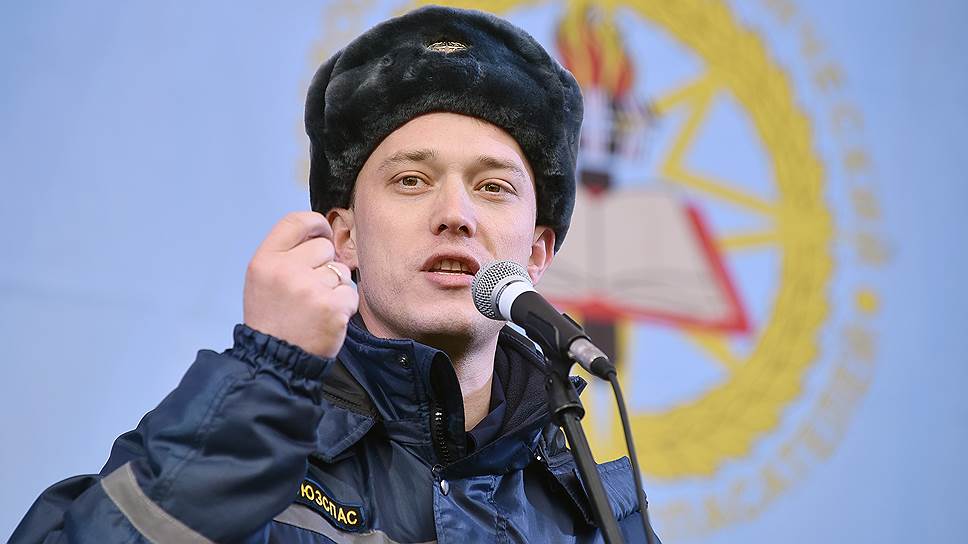
Kommersant has learned Alexei Avetisov, member of the Russian Public Chamber and president of the Russian Student Rescue Corps, could join the Office of Public Projects in the Kremlin. Avetisov has been tapped to head the Department for Combating Extremism among Youth. Ksenia Razuvayeva, head of Rospatriotcenter (Russian Center for the Civic and Patriotic Education of Children and Young People) has been named as a candidate for head of the Department of Youth Policy in the Office of Public Projects. Both candidates would still have to be vetted by the Kremlin.

Alexei Avetisov, member of the Russian Public Chamber and president of the Russian Student Rescue Corps, could head the Department for Combating Extremism among Youth in the Kremlin’s Office of Public Projects. Currently, the Office of Public Projects, which is run by Sergei Kiriyenko, the president’s first deputy chief of staff, has no such department. Our sources say Mr. Avetisov would be tasked with overseeing youth subcultures and decriminalizing the youth scene, in particular, by dealing with the popular AUE network of criminal gangs. The Presidential Human Rights Council discussed the issue with Vladimir Putin in December 2016.

Olga Amelchenkova, head of the Victory Volunteers Movement and member of the Russian Public Chamber, told us there were few organizations in Russia involved in volunteering in emergencies, and Mr. Avetisov was one of the few people who had constantly brought up the subject in the Public Chamber.

An acquaintance of Mr. Avetisov’s said his Russian Student Rescue Corps had brought many universities together. The organization took part in the first Taurida Camp held after the annexation of Crimea in 2014, an event attended by MPs and high-ranking officials. From 2015 to 2017, Mr. Avetisov was director of Territory of Meanings on the Klyazma, a youth education form, sponsored by Rosmolodezh (Russian Agency for Youth Affairs). His main job at the forum was providing technical support for the camp.

On June 6, Znak.com, citing its own sources, reported law enforcement agences were investigating Territory of Meanings on the Klyazma and, in this connection, “questions for the forum’s ex-director Alexei Avetisov could arise.” The website indicated companies allegedly affiliated with Mr. Avetisov had for several years been awarded “lucrative” contracts for constructing venues at the forum. The firms in question had no experience implementing government contracts. Currently, some of the companies have either gone out of business or are dormant, wrote the website.

Timur Prokopenko, deputy chief of staff in charge of the Office of Domestic Policy in the Kremlin, had been in charge of youth forums in recent years. He also handleded youth policy in his capacity as head of the Office of Domestic Policy. However, on June 14, a presidential decree turned youth policy over to the Office of Public Projects.

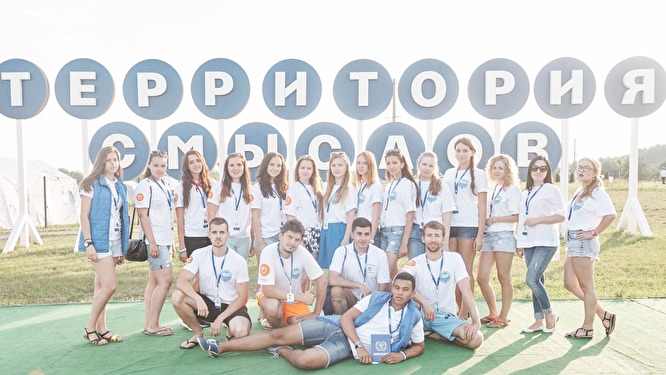
znakcom-2039402-666x375Territory of Meanings staffers. Photo from the camp’s VK page. Courtesy of Znak.com

Gazeta.Ru has reported that Rospatriotcenter head Ksenia Razuvayeva could take charge of the Office of Public Project’s Department of Youth Policy. Before taking over the running of Rospatriotcenter, Ms. Razuvayeva ran the Moscow branch of the Russian Volunteers Union and collaborated with the Young Guard of United Russia (MGER), which Mr. Prokopenko ran from 2010 to 2012. Ms. Razuvayeva would not confirm to us that she was moving to the Office of Public Projects Earlier, a source of ours in the Kremlin said she might not make it through the vetting process. Another of our sources noted a possible conflict of interests was at play. Ms. Razuvayeva also told us it was the first time she had heard about Mr. Avetisov’s moving to the Office of Public Projects.

“The vast majority of Young Guardsmen and other pro-regime activists brought up through the ranks in the past decades are supremely focused on their careers. The system simply spits out anyone else,” political scientist Abbas Gallyamov told us.

According to Gallyamov, “Changing colors for the new boss and refusing to have anything to do with people they worshipped only the day before are quite ordinary for this crowd.”

“Therefore, it does not matter whose people they were considered yesterday. They will be loyal to any boss, just because he or she is the boss,” Gallyamov added.

Translated by the Russian Reader

Patriots

pyotr tolstoy's daughter“While Pyotr Tolstoy, deputy speaker of the State Duma, battles the treacherous West and discusses labeling journalists ‘foreign agents,’ his daughter is on vacation in Crimea and Suzdal. (In fact, she is in Rome.)” Miracles of OSINT, July 5, 2018

__________________________________

Russian Duma Committee OKs Legislation to Label Individual Journalists “Foreign Agents”
Committee to Protect Journalists
July 3, 2018

The Committee to Protect Journalists today called on Russian authorities to refrain from labeling individual bloggers and journalists as foreign agents. The State Duma’s information and communication committee today approved legislation that would allow authorities to label private persons as foreign agents if they work for organizations the Justice Ministry labels as foreign agents or receive funding for producing content for these organizations, according to media reports.

The proposed legislation would require individuals to go through annual audit, submit a bi-annual report on their work activities, and put a “foreign agent” label on all produced content, according to the reports.

“Labeling journalists, including bloggers, as foreign agents is the latest step in the Russian authorities’ systematic policy towards obstructing the free flow of news,” said CPJ’s Europe and Central Asia research associate, Gulnoza Said. “We call on Russian authorities to reverse course and allow its citizens to receive information and opinion from a wide range of sources.”

The Duma, the lower house of parliament, initially passed a related bill in January. The parliament’s upper house, the Federation Council, is yet to vote on the legislation, which also requires presidential approval before becoming law.

The information and communication committee’s chair, Leonid Levin, who co-authored the latest proposals, told the state news agency Interfax that the Foreign Ministry and State Prosecutor’s office, two separate entities, would be responsible for labeling private persons as foreign agents “for additional protection of individuals from accidental decisions” from the Justice Ministry. Those bloggers who “simply repost information of foreign agents” will not “suffer,” Levin said. The Justice Ministry will still determine which groups fall into the category of foreign agent.

The latest legislation also includes provisions that would prevent websites or other media being blocked without a court ruling, according to news reports.

Today’s action came after the Kremlin-funded television station RT, formerly Russia Today, said in November that it had complied with a U.S. Justice Department order to register under the Foreign Agents Registration Act (FARA).

The Justice Ministry has already used the newly expanded laws to designate nine U.S.-funded news outlets, including the U.S. Congress-funded Voice of America (VOA) and Radio Free Europe/Radio Liberty (RFE/RL), as foreign agents, according to reports.

Yuri Shchekochikhin to Vladimir Putin, March 25, 2002

shchekochikhinYuri Shchekochikhin (June 9, 1950–July 3, 2003)

Oleg Pshenichny
Facebook
June 19, 2018

A letter from Yuri Shchekochikhin to Vladimir Putin. Thanks to Dmitry Nosachev for the heads-up.

I heard with my own ears how arrogantly young journalists then spoke of him. They claimed he was paranoid. They claimed he was obsessed with the mafia and the KGB’s machinations. They all but called him a clown. I won’t point fingers. There is no need.

_______________________________________________

March 25, 2002

To: Vladimir Vladimirovich Putin, President of the Russian Federation

Dear Vladimir Vladimirovich,

I was extremely surprised that, at a time when the whole world has been busy fighting terrorism, the Russian Federal Security Service (FSB) has been busy with little old me, thus violating Article [98] of the Russian Federal Constitution, which guarantees the immunity of State Duma members.

You will remember the Three Whales Scandal, I hope. It was a big surprise to me that, after the hearing of the State Duma’s Security Committee and my article in Novaya Gazeta on the subject, Pavel Zaytsev, the special investigator who had been handling this criminal case, was summoned for questioning by the FSB—not to find out the truth about how the mafia was organized, but only because of me, deputy chair of the State Duma’s Security Committee and a member of its Commission on Combating High-Level Corruption in Government.

I would not have attached much importance to the incident were it not for one circumstance.

Several years ago, Vyacheslav Zharko, a junior field agent in the St. Petersburg Tax Police, gave me documents showing that ships were entering the Russian Navy’s bases in Lebyazhy and Lomonosov[] without being inspected by customs and border control.

There were several signatures on the documents authorizing this financial escapade, including that of the then Deputy Prime Minister [Oleg] Soskovets and yours, Vladimir Vladimirovich.

[Mikhail] Katyshev, who at the time was the First Deputy Prosecutor General, gave orders to open a criminal case and set up an operational investigative group in the Prosecutor General’s Office after reading the documents submitted by Zharko.

It was this criminal case that led to the arrest of Dmitry Rozhdestvensky, head of Russian Video. Unfortunately, however, due to political motives, the investigative team, led by [Vladimir] Lyseiko, dealt only with the embezzlement of funds by Media Most, “forgetting” about the evidence relating to Russian Video’s Marine Department.

During the investigation of this criminal case, I had to fly to St. Petersburg on several occasions to arrange for Zharko’s protection and security, since his life was in real danger. [Georgy] Poltavchenko, then head of the St. Petersburg Tax Police, and [Viktor] Cherkesov, then head of the FSB’s Petersburg office, were simply afraid to help the young field agent in investigating the high-profile criminal case. I was quite surprised it was Zharko who was summoned from St. Petersburg to handle the arrest of [Vladimir] Gusinsky.

I don’t want to bother you with the details of the criminal case, although I imagine you are familiar with them. It is a different matter that concerns me. In December 2001, Zharko, who had transferred from the Tax Police to the Main Intelligence Directorate (GRU) of the Russian Defense Ministry, was detained at Sheremetyevo 1 Airport on trumped-up charges of using a counterfeit passport and illegally crossing the border, put under arrest at the behest of the Deputy Prosecutor General, and remanded in custody to Lefortovo Prison. The arrest, especially an arrest sanctioned by such a top-ranking official, on charges of committing a crime that carries a punishment of up to two years in prison, and the subsequent change in his pretrial status, as ordered by Prosecutor General Vladimir Ustinov, would seem incredible were it not for one circumstance. While Zharko was jailed in Lefortovo Remand Prison, FSB field agents tried to “crack” [kololi] him (I use the word “crack” deliberately) while figuring out whether he had in his possession documents bearing your signature and relating to the criminal case. What especially angered me was that the officers attempted to force Zharko to confess that he and I were mixed up with Boris Berezovsky. During their conversations, it was said that I received $50,000 a month from Berezovsky, part of which I gave to Zharko, who in turn gave some to Mikhail Katyshev.

Vladimir Vladimorovich, I have spoken with Berezovsky once and only once in my life. It was in the State Duma building. It just happened.

Most important, however, I don’t like it that I, deputy chair of a State Duma committee, have been targeted by the FSB. I don’t like it that my phones have been bugged and that someone has been trying hard to find means to discredit me.

Vladimir Vladimirovich, I don’t think this letter will end up in your hands. I once sent you a letter about Mr. [Nazir] Khapsirokov, one of the most notorious characters investigated by the Commission on Combating Corruption, during the last sitting of the State Duma. It was when he was appointed deputy head of your administration. In that letter, I wrote to you that you wanted to put together a team while a pack of dogs was circling you. After receiving a reply from a clerk in your administration, I realized the pack had encircled you once and for all, and that it was stronger than the team. Therefore, I am sending a copy this letter to the chair of the State Duma and the head of the Yabloko Party faction in the State Duma, of which I am a member.

Respectfully,

Yuri P. Shchekochikin
Deputy Chair, State Duma Security Committee
Member, State Duma Commission on Combating High-Level Corruption in Government
Member, State Duma (Yabloko Party Faction)

It is widely believed Mr. Shchekochikhin was poisoned to death. Thanks to Sergey Abashin for the heads-up. Translated by the Russian Reader. Photo courtesy of Pinterest

Twenty Percent of Russian Schoolteachers Contemplate Quitting

Twenty Percent of Russian Schoolteachers Contemplate Quitting
Salaries Lower than Official Rates, While Workload Is Extremely Heavy
Yelena Mukhametshina
Vedomosti
June 27, 2018

russian teacher salariies

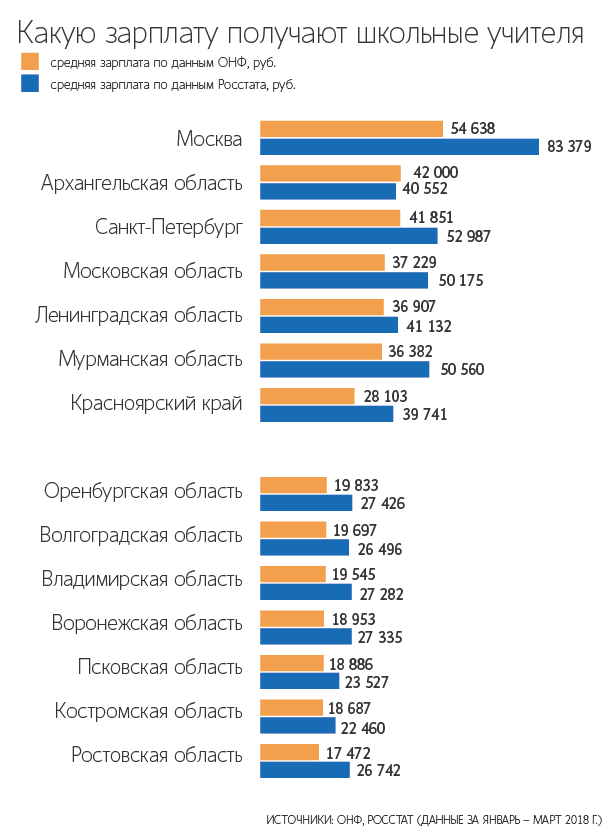
“How Much Schoolteachers Are Paid.” Orange = average monthly salary according to ONF survey, in rubles; blue = average monthly salary according to Rosstat (Russian State Statistics Service), in rubles. From top to bottom, the two sets of figures are provided for Moscow, Arkhangelsk Region, St. Petersburg, Moscow Region, Leningrad Region, Murmansk Region, Krasnoyarsk Territory, Orenburg Region, Volgograd Region, Vladimir Region, Voronezh Region, Pskov Region, Kostroma Region, and Rostov Region. The figures given are for the period January–March 2018. Courtesy of Vedomosti

A third of Russian schoolteachers do not know how their salaries are calculated or whether incentive payments and reimbursements are added to their paychecks. This was one finding of a survey carried out by the Russian People’s Front (ONF) in May 2018, during which researchers interviewed more than 3,000 teachers in 82 regions.

“Wage growth remains insignificant, making it impossible to attain the wage levels claimed by Rosstat,” the ONF concluded.

In Murmansk Region, for example, the survey showed teachers earned an average of ₽36,382 a month [approx. €495 a month], while official statistics showed they earned ₽50,560 a month [approx. €688 a month].

But even the salary the teachers earn comes at the price of an extremely heavy workload, the researchers stressed. The workload was heaviest in Kemerovo, Kostroma, and Samara Regions, where teachers averaged over thirty classes a week.

A quarter of schoolteachers have second jobs or hold additional positions at the same school, while twenty percent think of quitting the profession due to the heavy workload. Seven percent of the teachers surveyed spoke of not having been paid at all or paid in full at times. Twenty-three percent said their paychecks had been miscalculated, while fifty-seven percent had not been paid for overtime or additional duties.

Lyubov Dukhanina, deputy chair of the State Duma’s education committee and a member of the ONF’s central staff, argues the current nontransparent system of calculating salaries, which divides salaries into basic pay and incentive pay, should be abandoned. Instead, teachers should receive a guaranteed salary for their work. She also notes that, according to many teachers, incentive payments are unfair and opaque, and the amount of these payments can vary wildly from month to month.

Igor Remorenko, rector of Moscow State Pedagogical University and former deputy education minister, said all systems of compensation include guaranteed basic pay.

“In organizations undergoing reform, the lower the guaranteed basic pay, the better, because it enables you to rotate employees. In stable organizations, the constant part of the paycheck is more important, because it motivates employees. We need to move in the direction of having teachers sign annual contracts and feel confident in the future, while accepting the possibility of being paid different amounts depending on differing workloads from month to month,” said Remorenko.

The ONF’s survey actually embellished the real picture, noted Vsevolod Lukhovitsky, co-chair of the Teacher Trade Union.

“There are legal means of turning tiny salaries into big salaries on paper. For example, in Moscow, until 2018, the statistics included only full-time employees who had open-ended contracts, while the part-timers, who earned less money, were not included in the stats,” said Lukhovitsky.

According to Lukhovitsky, a law bill would be tabled in the State Duma this autumn that would establish a guaranteed minimum salary, equal to at least two minimum wages, for eighteen academic hours.

“It’s nice a large organization like the ONF has supported our conclusions four years after we started talking about going back to a fixed salary,” said Lukhovitsky.

Naturally, teachers are dissatisfied with their salaries. They are thus fertile ground for the ONF, argues political scientist Konstantin Kalachev. Teachers play a key role in elections and the entire political system.

[The ONF is a pro-Putin, astroturfed “populist” front organization. Teachers are critical to the Putin regime because many of them serve as polling station workers during elections, due to the fact that polling stations are commonly set up in schools. Teachers are thus often involved in the systematic vote rigging and electoral fraud that have helped keep Putin and his allies in power for twenty yearsTRR.]

“The current system of governance sometimes needs to let off steam. There is nothing frightening about the fact the stats are fudged, and the president’s May decrees are not fully implemented. The president sets tasks, and if they are not solved that is the problem of the people trying to solve them,” said Kalachev.

It is pensioners, teachers, and physicians who have the most impact on approval ratings, “so it makes sense the powers that be are focused on worrying about teachers,” he concluded.

Translated by the Russian Reader

MP: Russian Women Should Avoid Sex with Foreign Men during World Cup

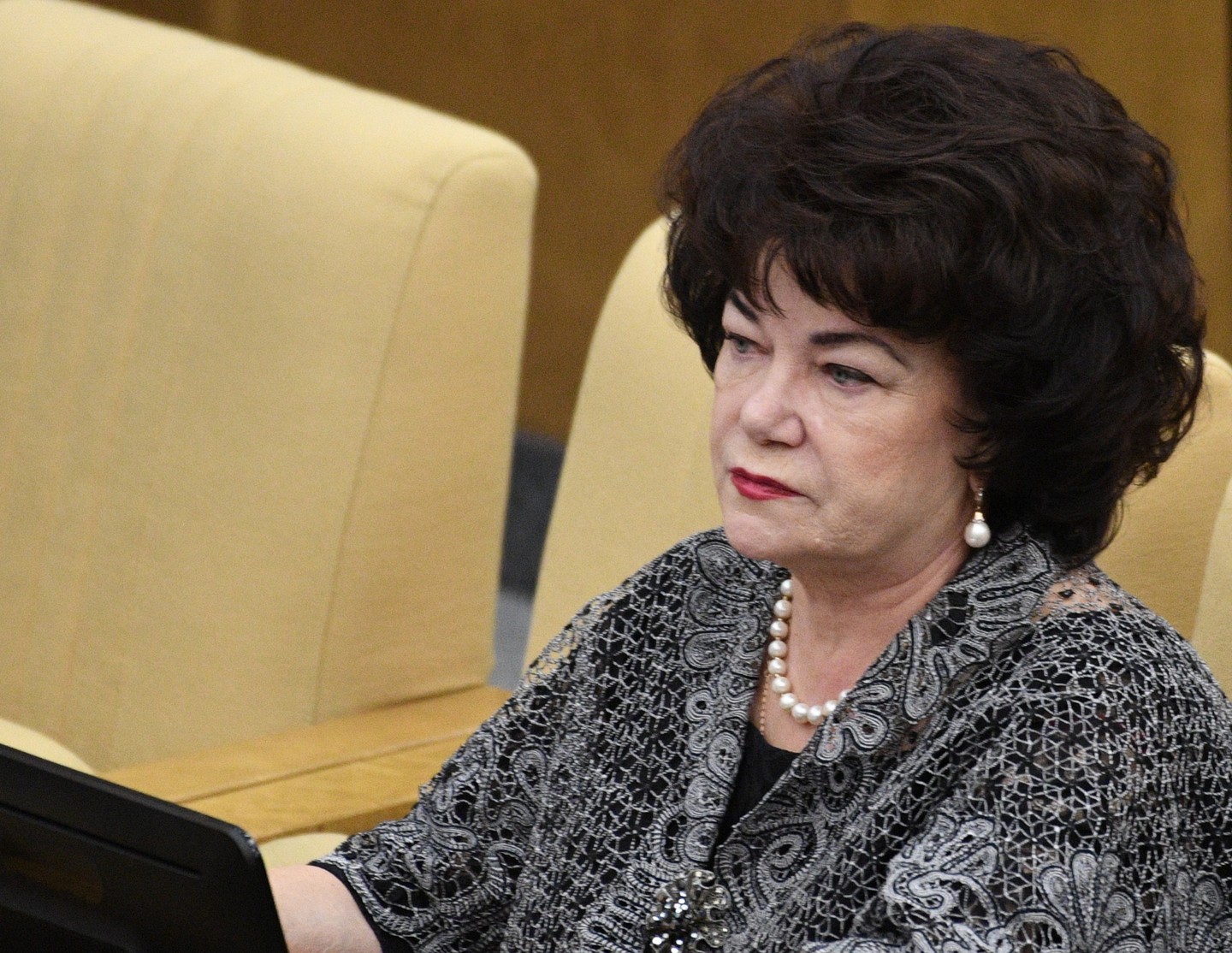
плетневаVeteran Russian MP Tamara Pletnyova (CPRF) has urged Russian women to avoid sex with foreign men during the 2018 World Cup, which kicks off tomorrow in Moscow. Photo courtesy of Life.ru

Russian Women Urged “Not to Engage in Sexual Relations” during 2018 World Cup
Fontanka.ru
June 13, 2018

Tamara Pletnyova, chair of the Russia State Duma’s Committee on Family, Women, and Children has urged Russian women not to engage in sexual relations with foreign men during the 2018 Football World Cup.

As the MP said this afternoon on radio station Moscow Speaking, inappropriate behavior on the part of Russian women would lead to the birth of children in single-parent families. Even if the foreign men married their sexual partners, it would not end well, the MP argued.

“Even if they marry the women and take them abroad, later on the women won’t know how to come back home. Women like that come to my committee for help. They cry, telling us how their husbands grabbed their children and left the country with them. I would like women in our country to marry men for love, no matter what their ethnicity, as long as they are Russian nationals who would build good families, live in harmony, have children, and raise them,” said Pletnyova.

The Duma committee chair argued many women became single mothers in the aftermath of the 1980 Moscow Olympics.

“These kids have suffered since Soviet times. If the parents were from the same race, it was better than nothing, but if they were from different races, the kids had it bad. I’m not a nationalist, but nonetheless. I know the children suffer. Then they are abandoned, and that is that: they are left with their mothers,” Pletnyova said in conclusion.

Thanks to Sergey Abashin for the heads-up. Translated by the Russian Reader

Russia Has No Senate or Senators

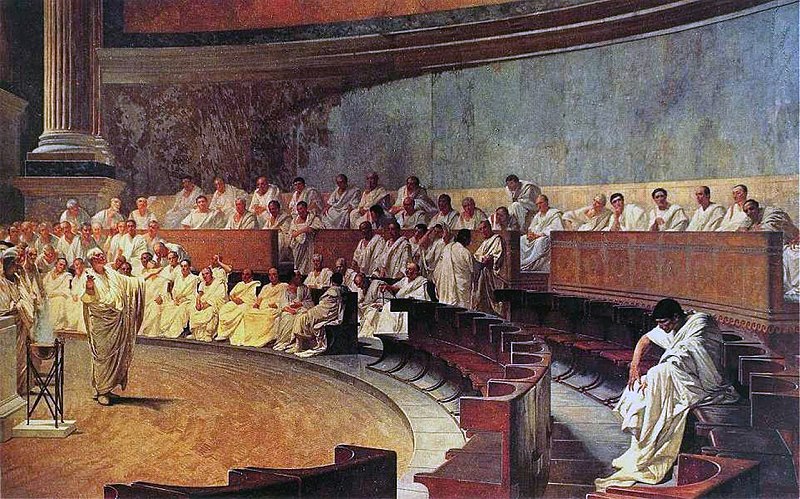
800px-Maccari-CiceroCesare Maccari, Cicero Denounces Catiline, 1889. Fresco. Palazzo Madama, Rome. Image courtesy of Wikimedia Commons

“Russia’s Senate wants a visit from Mark Zuckerberg.”
The Real Russia. Today email newsletter, May 30, 2018

I am not a huge fan of Mark Zuckerberg, but he can easily turn down this invitation, if only because Russia does not have a senate.

It does have something called the Federation Council, which is supposedly the upper house of the Russian parliament, a mostly fictitious organization itself, considering how its MPs are essentially appointed to their seats, not elected by popular vote.

The members of the Federation Council are a group of Putinist lackeys. They are handpicked by the Kremlin to represent Russia’s ninety-some regions. In most cases, however, they have nothing whatsoever to do with those regions, unlike during the rough-and-tumble Yeltsin administration, when each region’s two-person Federation Council consisted of its elected head and an elected representative of its own parliament. As I recall, this was the set-up not because Yeltsin decreed it, but because the regions themselves decided to run their own house of parliament this way, meaning the Federation Council was often a rowdy bunch, opposed to Yeltsin’s proposals and policies, just like the parliament’s lower house, the State Duma, which was so notoriously rowdy it often made the news in other countries. That does not happen anymore.

Nowadays, however, most Federation Council members are either natives or longtime residents of Moscow and Petersburg, both called “capitals” for similarly pompous reason. Like their fellows MPs in the State Duma, Federation Councillors engage in neither vigorous debate nor rebellion, but in rubber-stamping the increasingly odious law bills drafted for them by the Kremlin and various government ministries. They do their jobs as executioners of the remnants of Russian democracy and civil liberty so uncomplainingly and speedily that opposition-minded Russians have taken to calling the parliament the “mad printer.”

Naturally, given their real condition as contemptible yes-men, the Federation Councillors decided it would be more dignified if they fancied themselves “senators” and dubbed their rinky-dink collective sinecure a “senate.”

The funny thing is the non-senators have succeeded in hoodwinking nearly all reporters, even foreign reporters, into adopting this utterly groundless, self-aggrandizing, hokey moniker.

This is hardly surprising, since, in my experience, reporters are gullible creatures. I once persuaded a Russian reporter I was an unemployed Finnish shipbuilding engineer from Turku who had turned his life around by making fresh mango and salt lasses from a cart in downtown Helsinki. She duly reported this non-fact about my fictional alter-ego in her article about the latest edition of International Restaurant Day. The article was duly published in a well-known Petersburg daily, which has since gone defunct. I had just been joking to pass the time of day while making lasses outside in less than clement late-spring weather, but the reporter took me seriously. She even snapped my picture or, rather, the picture of the Finnish ex-shipbuilder from Turku, and it, too, was printed, properly captioned, in her overview of Restaurant Day in Petersburg.

The resident of New Haven, Conn., who edits the daily English newsletter for the online Russian-language news website-in-exile Meduza has bought into the “Russia Senate” con hook, line, and sinker, too. Seemingly indifferent to what really happens in our rapidly re-totalitarianizing country, he has endowed us with a senate on several occasions, in fact. You see, it is the done thing nowadays, whether it is actually true or not.

But I don’t have to buy it, nor does Mark Zuckerberg. And neither should you.

Russia has no senate and, hence, no senators. Anyone who says or writes otherwise is indulging in glibness for reasons that should make you question everything else they write or say. Good reporters write something because it it true or reported to be true. They don’t involve themselves in collective hoaxes, especially, as in this case, in an easily disproved imposture that has gone on for years. // TRR

The Annals of PreCrime: “An Absolute Nightmare”

precriminals.jpegUnder legislation currently tabled in the Russian parliament, these up-and-coming Russian businesswomen could do hard time in a penal colony for the wholly fanciful crime of “complying” with western sanctions against target businesses and individuals. Image courtesy of Credit Bank of Moscow

Sanctions Victims Refuse the Russian State’s Protection
Big Business Categorically Rejects Adopting Law on Anti-Sanctions
Yelizaveta Bazanova, Anna Kholyavko and Yekaterina Burlakova
Vedomosti
May 16, 2018

“An absolute nightmare”: that was the phrase used by the majority of lawyers and executives of Russian and foreign companies whom we asked to comment on plans to imprison people who “implemented” foreign sanctions. On Monday, a law bill to this effect, tabled by State Duma Speaker Vyacheslav Volodin, Federation Council Speaker Valentina Matviyenko, and leaders of all four parliamentary factions was passed in its first reading. The second reading has been scheduled for Thursday.

Under the law bill, if a company refuses to sign a public contract with an entity on the sanctions list, the company and its executives would be threatened with a maximum fine of ₽600,000 [approx. €8,200] and a maximum prison term of four years.

The board of the Russian Union of Industrialists and Entrepreneurs (RSPP) has decided passage of the law would be completely unacceptable. Companies would find themselves between the frying pan and the fire: violations of sanctions would threaten them with secondary sanctions, while complying with sanctions would make them criminally prosecutable in Russia.

The RSPP’s resolution was supported even by board members who had themselves been sanctioned.

“We believe it would cause further damage to the Russian economy, including business with foreign and Russian companies, and both Comrade Vekselberg [Renova Group Chair Viktor Vekselberg] and I voted for the resolution,” Interfax has quoted VTB Bank president Andrei Kostin as saying.

A spokesperson for Vekselberg did not respond to our questions. We were also unable to contact a spokesperson for Oleg Deripaska, another target of western sanctions, yesterday evening.

If passed, the law would be unlikely to have a considerable impact on how businesses operate, but it could be a means of threatening and pressuring them, the entrepreneurs we surveyed said unanimously. The wording of the law bill is harsh. Nearly anyone could be prosecuted on the flimsiest of pretexts, complained an executive at a transnational food producer.

The key risk is the absence of clear criteria for defining what would constitute a violation of the proposed law, our sources all agreed. Even the Russian Finance Ministry could be prosecuted. In its Eurobonds prospectus, it pledged not to use the funds raised to support entities targeted by western sanctions. In January, Alfa Bank warned Russian defense companies it would not handle their accounts due to sanctions. Spokespeople for the Finance Ministry and Alfa Bank did not respond to our inquiries.

The Kremlin has also been unhappy with the law bill, said a federal official close to the presidential administration.

The law bill, if passed, would also generate risks for those companies who refuse to do business in Crimea due to sanctions, said Alexei Panich, a partner at Herbert Smith Freehills. These include the state banks Sberbank and VTB, as well as mobile telecom operators. Andrei Isayev, deputy head of the State Duma’s United Russia faction, claimed  companies who do not open branches in Crimea would not be affected by the law. What was at stake, he said, were the ordinary deals and transactions companies perform almost automatically. However, refusal to do business with counterparts in Crimea could be considered a criminal offense under the terms of the law, said an attorney at a major international law firm. The law could complicate public offerings, the issuing of loans, and contracts and transactions, he specified.

An employee at a major international firm explained it would be hard to determine whether a company refused a deal with a counterpart due to their bad reputation or the threat of sanctions. An auto dealer agreed the threat of criminal prosecution would be powerful leverage. To encourage its partners to agree to a deal, a business could threaten to report them to law enforcement agencies, argued Panich.

The proposed measures were excessive, agreed a spokesperson for an agricultural commodities trader. Some companies have in-house rules restricting such deals. Our source said the law bill appeared to be means of coercing such companies. Theoretically, it could be used as leverage. A company or person on the Specially Designated Nationals And Blocked Persons List (SDN) could show up and demand another company do business with them, agreed the head of major private bank. It was difficult to imagine how banks would solve such dilemmas, he said.

“There are many ambiguities in how the law would be interpreted, and what specific actions or inactions would be punishable,” he concluded.

Foreign businesses could interpret the law bill as a signal it was time to wrap up their operations in Russia, said the vice-president of a major foreign company that produces popular consumer products. No one has any intention of sacrificing their top executives to the Russian law enforcement and judicial system.

All issuers of bonds include in their covenants the refusal to do business with entities targeted by sanctions. Perhaps expatriates who do not want to take risks would leave the country, argued an employee at a large foreign company.

Passing the bill into law would be a mistake, said political scientist Yevgeny Minchenko. The law would have to be seriously amended over time.

“Knowing how this could affect both Russian companies and foreign business operating in Russia, this is very risky decision in my opinion,” Minchenko told us.

Spokespeople for Sberbank and Credit Bank of Moscow declined to comment.

With additional reporting by Vladimir Shtanov, Darya Borisyak, Alexandra Astapenko, and Svetlana Bocharova

Translated by the Russian Reader

Harmacy

DSCN6345.jpg

Back to the World of Me-Too Drugs: How Anti-Sanctions Will Deal a Blow to the Mental Health of Russians
Takie Dela
May 2, 2018

The ban on the import of drugs from the United States and other “unfriendly” western countries, tabled by MPs in the Russian State Duma, will worsen the mental health of Russians. Two psychiatrists discussed the consequences facing people with mental illnesses if brand-name drugs are replaced by domestic lookalikes.

The Big Picture
In early April, State Duma Speaker Vyacheslav Volodin announced the imminent expansion of countersanctions by Russia towards the US and other western countries opposed to the Russian Federation’s foreign policies. In particular, there are plans to introduce a ban on the import of drugs from the countries on the sanctions lists, but only on those drugs for which there are domestic counterparts. However, many foreign-manufactured psychotropic drugs have domestic counterparts, and they will be banned, therefore.

Russia is not a happy country in terms of psychiatry. Every fourth Russian suffers from mental illness at some point in his or her life, and between three and six percent of the populace needs to take medications regularly.

Due to severe conditions such as epilepsy, schizophrenia, clinical depression, and bipolar disorder, hundreds of thousands of Russians lose the capacity to work and are unable to adapt to society. Many of them commit suicide. Modern drugs are effective enough to let most patients lead full lives. Their well-being depends on drugs, which they must take for many years and, sometimes, their whole lives.

The drugs in question are antidepressants, antipsychotics, tranquillizers (sedatives), and normotics (mood stabilizers). Nearly all the brand-name drugs in the field are produced in Western Europe and the US. If theban is adopted, they will vanish from Russian pharmacies, since nearly all these drugs have counterparts (i.e., generics), with the same active ingredients, that are produced in Russian and Eastern Europe.

When discussing the possbile stop list, experts named two popular antidepressants: Paxil (France) and Cymbalta (USA). Many other drugs popular in Russia, including the antipsychotics Zyprexa (Eli Lilly, UK) and Seroquel (AstraZeneca, UK/Sweden), and the antidepressant Zoloft (Pfizer, USA), could be included in the ban. What would be the consequences for millions of patients?

Increasingly Ineffective Treatment
Mental equilibrium is a delicate matter, and selecting drugs to treat psychiatric conditions can much more complicated than selecting drugs to treat somatic illnesses. The optimal outcome is for the individual not merely to stop experiencing severe symptoms like obsessive suicidal tendencies and hallucinations, but also to remain capable of working and leading a social life, rather than turning into a lifeless vegetable.

People with clinical depression, which can last for years, know well the laborious process of choosing the right drug and the right dosage that will finally let them live a normal life. The process can take weeks and months.

Matters are even more complicated with bipolar disorder. The disease’s two opposite phases require different medications, and an unsuitable drug can even worse the outcome of the illness. Schizophrenia presents such a variety of symptoms that a veritable cocktail of drugs is sometimes needed, and attending physicians have to make sure the side effects do not outweigh the benefits of treatment.

“Current guidelines for pharmacotherapy recommend prescribing the brand-name drug and not substituting a generic without good reason,” says Maria Gantman, a psychiatrist at the Mental Health Center.

Dr. Gantman prescribes her patient brand-name drugs, which have undergone high-quality trials on thousands of patients and have a proven effect. Generics also undergo trials when they are licensed, trials that prove their similarity to brand-name drugs, but the evidentiary base is filled with too many gaps, she notes.

“Generics are usually less expensive, and we start off with them if the patient cannot afford the brand-name drug. The abrupt replacement of one generic with another can produce a change in the effect. Due to the peculiarities of their ingredients, generics may be absorbed at a greater or lesser rate and generate a different concentration of the active ingredient in the blood. The people who suffer most are those forced to switch from a brand-name drug they have been taking for years and that was laboriously selected for them to a generic,” explains Dr. Gantman.

She fears the Russian authorities will approach the issue in a perfunctory manner.

“For example, there is a drug that is effective in treating schizophrenia, Rispolept. There are Russian lookalikes, sold under the generic name risperidone. But if the brand-name drug is banned, it hard to imagine what lies in store for people who survive by taking Rispolept Consta (Belgium), which does not exist in this form as a generic in Russia,” says Dr. Gantman.

“The problem is that theRussian pharmaceutical industry hopelessly lags behind the western pharmaceutical industry. There are certain types of drugs Russia just cannot produce, because it does not have the resources, the equipment or the research,” continues Anatoly Shepenyov, a psychiatrist and psychotherapist. “Say, the antidepressant Cipralex (Denmark) cannot be synthesized in Russia. Folic acid is an indispensable drug, too. In Russia, it cannot be produced in the form needed for the synthesis of serotonin, that is, in the form needed for maintaining normal brain function.”

Side Effects
The side effects of psychotropic drugs are numerous and varied. Mental impairment, convulsions, fainting, anemia, and fever are only some of them. Predicting them ahead of them is impossible: they are the individual body’s reactions. A drug that simultaneously provides relief while not producing agonizing side effects is a valuable find for many patients.

Dr. Shepenyov illustrates the circumstances by mentioning the antidepressant Paxil (France). It has generics, for example, Rexetin (Hungary). Rexetin works, but its therapeutic effectiveness is lower. To get the same effect she would get from 20 mg of Paxil, thae patient would need to take at least 30 mg of Rexetin. As dosages increase, so do the side effects.

“The main difficult is not synthesizing the right substance, but isolating it in pure form. I’ll give you an example. The antidepressant must fit the receptor in the brain the way a key fits a lock. When generics are synthesized, a whole slew of impurities emerge, extra ‘keys,’ if you like. If you use this ‘dirty’ molecule, you won’t open the lock, but there will be something jammed in it,” notes Dr. Shepenyov.

The use of generics thus introduces the risk there will be a lack of therapeutic effect coupled with a slew of side effects that would never be produced by brand-name drugs. The liver also suffers more from the constant intake of “dirty” drugs.

“Take the most popular Russian-made antidepressant, Fluoxetine (a generic version of the US-produced Prozac). It is terrible in terms of side effects. Although its benefits are weak, patients suffer from phenomenal absentmindedness,” explains Dr. Shepenyov.

Withdrawal Syndrome
If western-produced drugs one day vanish from Russian pharmacies, thousands of patients will undergo withdrawal syndrome, the body’s physiological reaction to the absence of a substance to which it is accustomed.

“I felt terribly sick within a few days. I had a terrible chill, severe dizziness, nausea, weakness, and insomnia,” a female patient described her withdrawal from Paxil.

It is necessary to gradually reduce the dosage to avoid this effect, which means having a good supply of the drug and then just as gradually increasing the dosage of the new drug. This means weeks of enduring shaky health.

The Anti-Placebo Effect
“The anti-placebo effect is no less frequent and severe than the placebo effect. The patient knows she has taken another drug. This exacerbates her anxiety and could ultimately destabilize her condition. So, if an individual has taken the same drug for years and feels fine, there is no need to give her another drug. It’s risky,” says Dr. Gantman.

Both doctors are agreed that patient health should not be a geopolitical bargaining chip. According to Dr. Gantman, medical issues should be left out of the political games countries play, and she calls the State Duma’s plans to ban the imports of foreign-made drugs “profoundly unethical.”

“If Russian MPs adopt such a law, we should oblige them to be treated solely with Russian-made drugs, drive Russian-made cars, and use Russian-made telephones and computers. Those would be excellent sanctions that would finally force them to use their brains before making radical decisions without having the foggiest notion about either medicine or how the body functions,” concludes Dr. Shepenyov.

Translated by the Russian Reader

*******************

Anastasia Plyuto
VK
May 12, 2018

A group picket was held on Saturday, May 12, 2018, in Petersburg’s Ovsyannikov Garden, to protest the Russian State Duma’s tabling of a bill that would ban the purchase of drugs abroad. Yes, we have heard that legislators have suggested removing the word “drugs” from the wording, but we know much freighted the phrase “and other goods” can be.

To increase the chances city authorities would authorize the picket, activists applied for several venues at once. The authorities waited until the last possible moment to render a decision, and so there was no time to inform the public about the planned protest. Around a dozen people were in attendance, including a diabetic who depends on imported insulin, and several people outraged by the politics and statements of our MPs.

One of the placards featured a toy pyramid for little children, which MP Iosif Kobzon gave to a teenaged cancer patient while visiting a hospital in Simferopol in 2015. In our view, the incident reflects the lack of understanding displayed by our bigwigs when it comes to the needs of patients.

There were few visitors in the garden, and nearly none of them had heard of the law bill, but no one, from schoolgirls to a seventy-year-old female pensioner, was left unmoved by the subject. They reacted with surprise, indignation, and complete support for the picketers.

meds-1“You want to ban imported drugs? Start with yourselves. Treat your ailments with oak bark!”
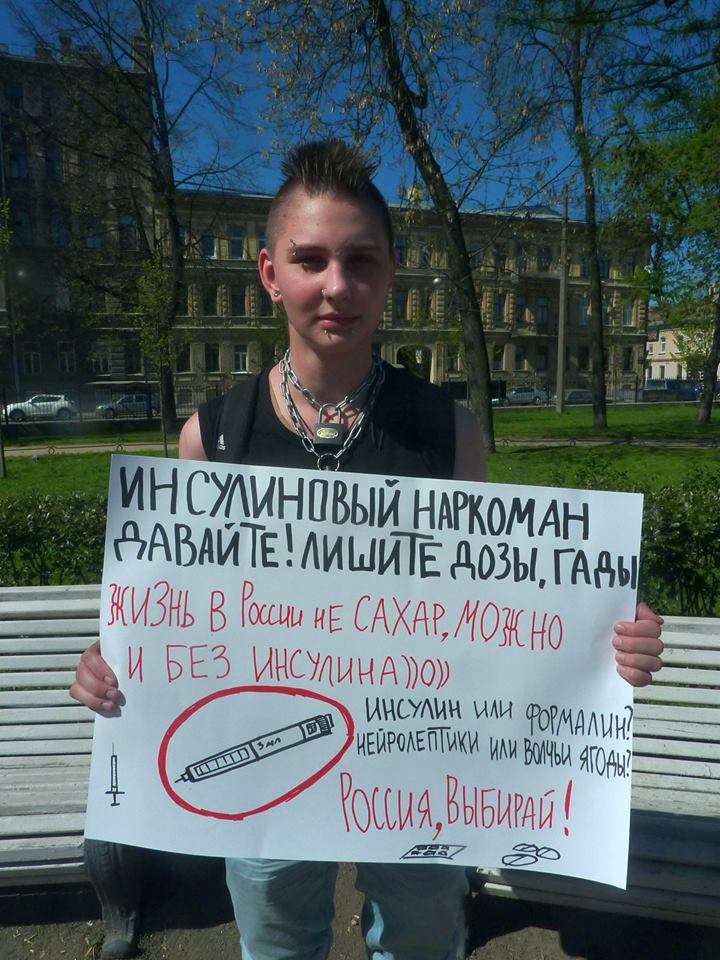
meds-2.jpg“Insulin addict. Bring it on! Deprive us of our doses, assholes. ‘Life in Russia is no picnic: you can survive without insulin.’ Insulin or formaldehyde? Neuroleptics or belladonna? You choose, Russia!”
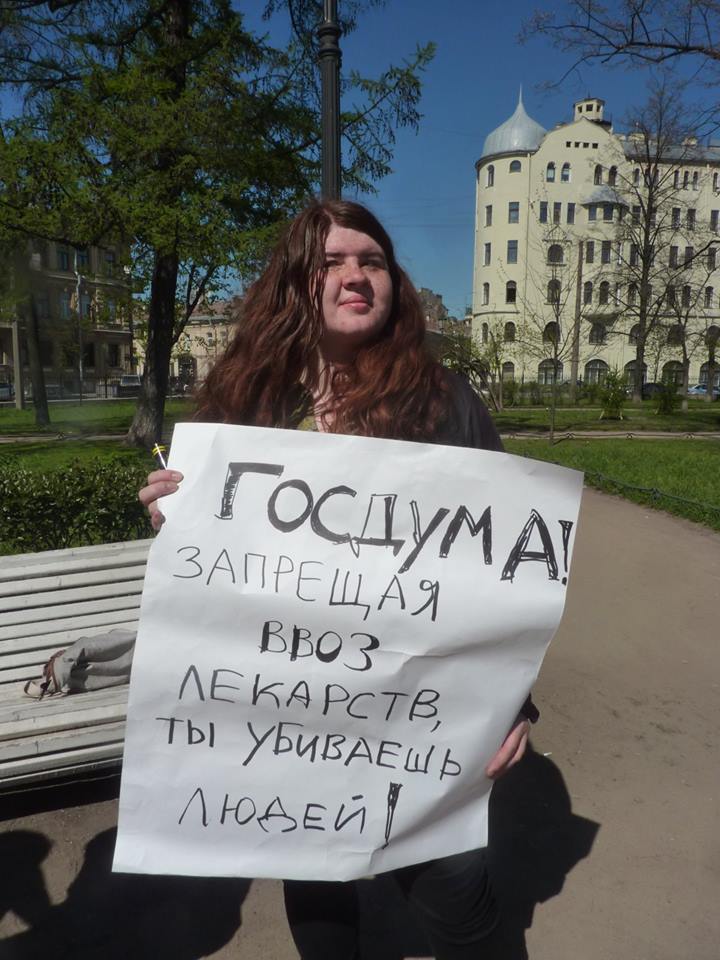
meds-3“State Duma! By banning the import of drugs, you are killing people!”

meds-4“Ban yourselves from driving Geländewagens! Hands off the drugs!”
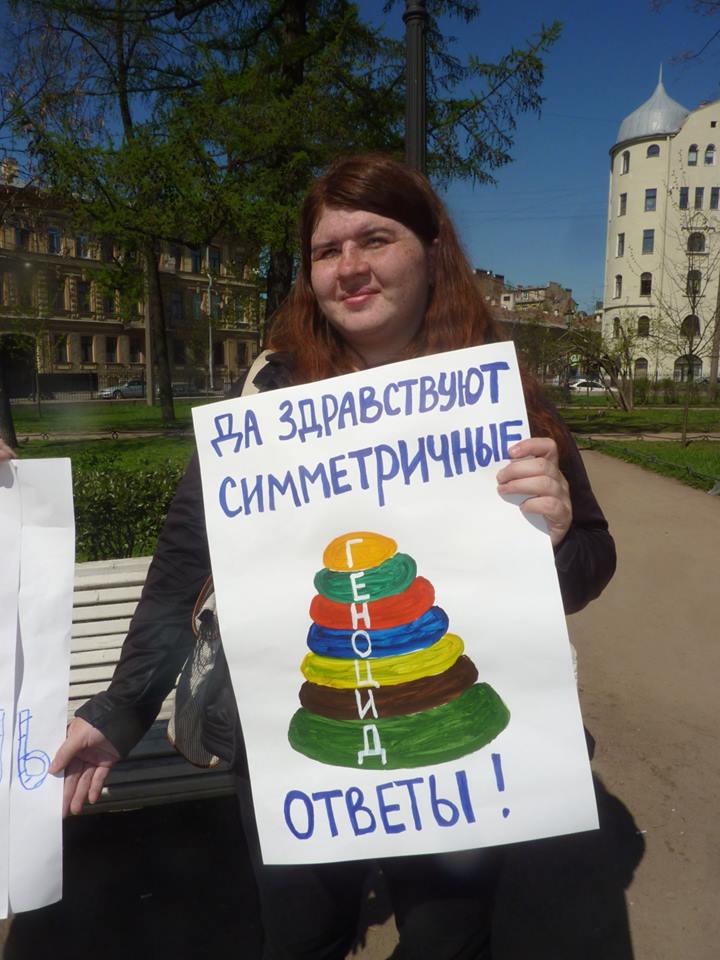
meds-5jpg“Viva asymmetrical responses! (Genocide)”

Photos by Mikhail Ryzhov and Anastasia Plyuto. Thanks to Victoria Andreyeva for the heads-up. Translated by the Russian Reader

Monetizing Russia’s Migration Maze?

DSCN5633.jpg“Help is like hell, only it’s help.”

Punishment Minus Expulsion
Interior Ministry Develops Individual Approach to Migrant Workers
Anna Pushkarskaya
Kommersant
April 27, 2018

The Russian Interior Ministry has published draft amendments to the Administrative Offenses Code that would permit judges not to expel people from Russia who violated immigration regulations by allow them to take into account mitigating circumstances and substitute monetary fines for expulsion. The individual approach has already been enshrined in several articles of the Administrative Offenses Code by decision of the Russian Constitutional Court, but the police are willing to make it the “general rule for the assignment of administrative penalties.” Meanwhile, the Russian Justice Ministry has reported to the Council of Europe on measures it has taken in response to the complaints of stateless persons, although the rulings of the European Court of Human Rights (EHCR) and the Russian Constitutional Court on these cases have not yet been implemented, experts have noted.

The draft amendments to the Administrative Offenses Code, which would give judges the ability to replace administrative punishment with less harsh penalties, depending on the specific circumstances of the case, have been posted by the Interior Ministry for public discussion until May 4. The police drafted them on the basis of a February 17, 2016, ruling by the Constitutional Court. The ruling was rendered in the case of Moldovan national Mihai Țurcan, who was expelled from Russia for failing to notify the Federal Migration Service he was registered in Moscow Region. (This requirement is stipulated by Article 18.8 Part 3 of the Administrative Offenses Code, and it also applies to stays in Moscow, St. Petersburg, and Leningrad Region.)

Expulsion entails a five-year ban on entering the Russian Federation and reapplying for a residence permit. Courts did not consider the complainant’s work experience and payment of taxes as grounds for mitigating his punishment. The Constitutional Court ruled that these immigration regulations were unconstitutional and obliged legislators to individualize penalties for single violations of the controversial regulation by taking into account the length of an alien’s stay in the country, whether or not s/he has family in Russia, payment of taxes, and law-abiding behavior. Since December 2016, Article 18.8 Part 3 has allowed authorities to avoid explusion except in cases in which the documents confirming the alien’s right to stay have been lost or are lacking. In April 2017, the Constitutional Court’s approach was enshrined in the “General Rules for the Assignment of Administrative Penalties” (Article 4.1 of the Administrative Offenses Code), which deals with violations at official sporting events, for which foreign fans can get off, under mitigating circumstances, with a fine of 40,000 to 50,000 rubles and a ban on visiting stadiums for a period of one to seven years.

In October 2017, First Deputy Prime Minister Igor Shuvalov instructed authorities to extend the approach to all cases of compulsory explusion. If the court concludes that expulsion is an excessive stricture on the right to a private life and is disproportionate to the objectives of administrative penalties, it can be substituted by a fine of 40,000 to 50,000 rubles [approx. 530 euros to 660 euros]. Courts may already opt not to order expulsion in accordance with the clarifications issued by the Russian Supreme Court and Russian Constitutional Court, but now the factors courts should take into account are supposed to be incorporated in the wording of the law, noted lawyer Sergei Golubok. Lawyer Olga Tseitlina told Kommersant the draft amendments are quite important, because courts have, in practice, ignored marital status and other vital circumstances.

At the same time, the Russian Justice Ministry has sent a letter to the Council of Europe’s Committee of Ministers, asking it to recognize that the EHCR’s rulings on complaints filed by stateless persons have been implemented. The virtually indefinite detention of complainants in special Russian Interior Ministry facilities on the basis of rulings by Russian courts and the conditions of their detention in custody were ruled violations of the European Convention on Human Rights. The Justice Ministry reported that compensation had been paid to the complainants. They are now no longer subject to expulsion and deportation, and can “fix their migration status.” Moreover, the State Duma has passed, in their first reading, the admendments to the Administrative Offenses Code drafted by the Interior Ministry to settle the problem, the Justice Ministry reported four years after the ECHR issued its ruling. The Justice Ministry referred to the Constitutional Court’s ruling in the Mskhiladze case. In May 2017, the court also ordered that the Administrative Offenses Code be amended.

The ruling has not been implemented, noted Golubok and Tseitlin, who represented Mr. Mskhiladze. The ECHR’s decision in the case of another of Tseitlina’s clients, Roman Kim, has not been implemented, either, she told Kommersant.

“He has no legal status and de facto cannot apply for [Russian] citizenship or a [Russian] residence permit, since he cannot expunge his conviction due to his unemployment, but he is unemployed because legally no one can hire him,” said Tseitlina.

She stressed the general measures required by the ECHR and the Constitutional Court have not been implemented, either, since no changes have been made to Russian federal laws.

Thanks to anatrrra for the heads-up. Translation and photo by the Russian Reader