As Protests Increase, National Guard Ready to Crack Down

dimon balet
“Dimon, what’s with the ballet?” Anti-corruption protesters on the Field of Mars in Petersburg. Photo courtesy of Sergei Nikolayev/DP

Experts Speak of Sharp Increase in Number of Protests in Russia
Delovoi Peterburg
November 7, 2017

According to a report by the Center for Economic and Political Reform (CEPF), the number of social and political protests in Russia has risen sharply compared to the beginning of the year.

The number of protests has been continuously growing in Russia throughout the year. In the first quarter, 284 protests were recorded; in the second quarter, 378; and in the third quarter, 445. Thus, as noted in the report, the overall number of protests has increased by almost 60% since the beginning of the year.

The analysts at the CEPF divide protests into political protests, socio-economic protests, and labor protests. They note that around 70% of protests had to do with socio-economic issues, including protests by Russian truckers against the Plato road tolls system, and protests by Russian farmers against the seizure of land by agroholdings, as well as protests by hoodwinked investors in unbuilt cooperative apartment buildings.

Political protests came in second place, including protests by supporters of opposition leader Alexei Navalny. A total of 106 political protests were recorded in the third quarter of 2017. There were 27 labor protests in the third quarter.

The number of conflicts related to labor relations has also steadily climbed throughout the year. The number of protests caused by cases of late payment and non-payment of wages, for example, has grown as follows: 142 in the first quarter, 196 in the second quarter, and 447 in the third quarter. Thus, by the third quarter, the number of such incidents had more than tripled.

The authors of the CEPR report cites figures provided by Rosstat, according to which the amount of unpaid back wages in Russia totaled 3.38 billion rubles [approx. 49 million euros] as of October 1, 2017. The number of incidents of late payment and non-payment of wages in the third quarter of 2017 (447 companies) was more than triple the number of such incidents in the first quarter (147 companies), and more than double the number in the second quarter (196 companies).

The analysts point out that Russia has not yet put in place a system for preventing and constructively solving social conflicts, and thus protests are still nearly the only effective means for employees to defend their rights.

“We should generally expect the high number of protests nationwide to continue, especially in the socio-economic realm. This is due to the fact the problems people (hoodwinked investors, truckers, farmers, opponents of construction projects, environmental activists et al.) have been currently protesting have not been solved. At the same time, evolution of the protest movement has been greatly hampered by the lack of capable political parties, grassroots organizations, and trade unions,” write CEPR’s analysts.

Translated by the Russian Reader

_________________

Ahead Of Election, Putin Seeks Wider Mandate For Russian National Guard
Radio Free Europe/Radio Liberty
November 6, 2017

0327929D-DFC1-4E65-BD89-EC9685C0B625_cx0_cy8_cw0_w1023_r1_sRussian President Vladimir Putin (second right) and National Guard chief Viktor Zolotov (third left) take part in a ceremony marking National Guard Day in Moscow on March 27. Photo courtesy of Mikhail Klimentyev/TASS

Russian President Vladimir Putin has proposed legislation to widen the responsibility of the National Guard, an entity created last year and headed by Putin’s former chief bodyguard, to include protecting regional governors.

The bill was published on the website of the State Duma, the lower house of parliament, on November 6.

The Duma is dominated by the Kremlin-controlled United Russia party and supports almost all Kremlin initiatives.

The proposed change could enhance Putin’s ability to crack down on dissent or seek to impose order if there is unrest in Russia’s far-flung regions.

The National Guard reports directly to the president. Its director, Viktor Zolotov, was chief of the presidential security service from 2000 to 2013.

The initiative comes months before a March 18 election in which Putin is expected to seek and secure a new six-year term.

Putin will be barred from seeking reelection in 2024 if he does win a fourth presidential term in the March vote, raising questions about how Russian politics will play out in the coming years and how he will maintain his grip.

Putin established the National Guard (Rosgvardia) in 2016 on the basis of the Interior Ministry troops and other security forces.

Its stated tasks initially included preserving “social order,” fighting against terrorism and extremism, and guarding state facilities.

The National Guard announced that it will be also responsible for a fingerprints database, issuing weapons-possession licenses, averting “threats to state order,” and protecting information security.

Locos In Loco Parentis (Perfecting the Russian Police State)

DSCN1069

Making as many ordinary people as possible de facto accomplices or targets of thoroughgoing injustice, an endless series of crimes great and small, daily repression, and ubiqitous surveillance smacks more of totalitarianism than it does of the run-of-the-mill authoritarianism that, if you believe the most progressive political scientists, currently rules the roost in Russia. TRR

Culture to Be Equated with Cigarettes and Alcohol
Fontanka.ru
October 17, 2017

The Culture Ministry has drafted a bill which, if adopted into law, will vest ticket sellers and ticket takers at theatrical and entertainment events with the authority to check people’s passports. In addition, the Culture Ministry wants to legally forbid persons under the age of eighteen from attending events with an 18+ rating. Currently, the rating is advisory in nature, and parents make the final decision.

The media were informed on October 17 that a document containing such provisions had been drafted by the Culture Ministry. They were referred to Natalya Romashova, head of the ministry’s legal and regulatory department. According to Romashova, the draft amendments to the law “On the Protection of Children from Information Harmful to Their Health and Development” will shortly be submitted to the State Duma.

“The organizer of an entertainment event containing information prohibited for children is obliged to take measures eliminating the possibility that persons under 18 years of age attend the event,” the draft bill reads. “Failure by the organizer of the entertainment event to take the measures indicated shall entail liability as established by Russian federal legislation.”

At the same time, the draft law bill specifies that the documents checks will also affect foreign nationals and stateless persons. The list of admissible documents should be established by an executive body authorized by the government.

Translation and photo by the Russian Reader. Thanks to Comrade Uvarova for the heads-up

“Senators” vs. “Undesirables”

A37K0741_0
The Russian Federation Council,* whose members have a penchant for calling themselves “senators,” even though they are not a popularly elected body nor a body known as a “senate.” This peculiar fashion has been picked up by the Russian media and, now, even some foreign media, thus reinforcing the fallacy that Russia is governed democratically. Photo courtesy of Izvestia and Zurab Dzhavakhadze

Media Learns about Idea to Expel People from Russia for “Undesirable Behavior”
RBC
September 4, 2017

The Federation Council’s Committee for Defending State Sovereignty and Preventing Interference in Russian Domestic Affairs [sic] has been drafting a law bill that would stipulate expulsion from Russia for “undesirable behavior.” Izvestia learned about the bill from sources in the parliament familiar with the drafting of the document.

Acccording to the newspaper, the penalty of expelling people from Russia for “undesirable behavior” would be stipulated by a law bill that could be tabled in the State Duma as early as next year. It would amend the current federal law “On Undesirable Organizations,” adopted two years earlier.

The newspaper’s sources said that expulsion for “undesirable behavior” would be applied to individuals, mostly foreigners. However, the sources noted the term could be applied to Russian citizens and legal entities.

The newspaper notes that “undesirability” would be determined by whether the actions of the persons caused real harm to Russia’s national security. It could be a matter of “inciting ethnic and religious hatred and political discord,” as well as potential interference in Russia’s electoral process. The newspaper likewise notes that “outside work” with Russian educational institutions and young people could be deemed “undesirable.”

According to the sources, several options for how the law would be applied were currently under consideration. One of them would involve empowering State Duma and Federation Council members with the capacity to send requests to the Prosecutor General’s Office to check whether a person’s activities were “undesirable.” If the audit turned up a violation, Russian citizens could be accountable. [sic] Foreigners, on the contrary, would be threatened with expulsion from the country.

Andrei Klimov, deputy chair of the Federation Council’s Committee on Foreign Affairs confirmed that the amendments to the law were being drafted.

Translated by the Russian Reader

*Сritics of the Federation Council stress that it is an inherently undemocratic body made for regional elites, with little say from the Russian people. Since the reforms advocated and passed by President Putin in 2000, critics have also charged that the Council resembles more of a rubber stamp body for the Kremlin than an independent legislative body. Many senators are viewed as close allies of Putin and the United Russia party, despite rules which explicitly spell out that political factions are not allowed. Since Mironov’s rise in the Council in 2002, the Kremlin’s position on impending legislation is closely communicated to and coordinated with the Chairman and the committee and commission chairs. This top-down approach has meant that the Council votes with extreme efficiency, backing Kremlin positions on legislation nearly all of the time.

Critics also point to how long the Council convenes, meeting only one day every two weeks, speeding through legislative analysis and providing lop-sided majorities for each vote. Many blame this speedy legislation on the enormous influence the Kremlin exerts, who they charge have already instructed Council committee and commission chairs on how to vote. Several left-leaning State Duma deputies have lamented that Putin has stripped away the Federation Council’s last hold on checks and balances.

Since Putin’s restructuring of provincial executives in 2004, placing them under direct appointment by the Kremlin upon approval of their legislatures, federalist supporters have also charged the president in reducing the provincial role of the Federation Council. Where Yeltsin had envisioned a chamber [addressing] regional concerns, they argue, critics view Putin’s restructuring as deeply centralizing the Council to reflect the president’s and United Russia’s political interests, taking away provincial voices. Putin supporters counter these criticisms by acknowledging that Yeltsin had also appointed governors to Russia’s federal subjects in the early days of the Federation.

Source: Wikipedia

Another News Item about Russia That Will Brighten Your Day and Make You Smile

russian-smile-features-1
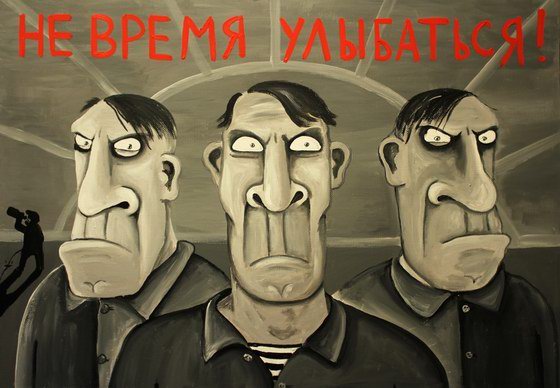
Vasya Lozhkin, “No Time for Smiling!” Pilfered by crypto-nationalist website russiatrek.org and not credited to the artist

I’ve had complaints in recent days that my Facebook news feed and Word Press-powered blog (the very blog you’re reading now) felt “tired” and lacked humor.

This news item, however, is sure to energize you positively while tickling your funny bone.

Russia’s Federation Council has approved a bill that would prohibit the use of Internet proxy services—including virtual private networks, or VPNs.

The bill approved on July 25 would also ban the anonymous use of mobile messaging services.

The bill was adopted in its final reading by the lower house of the parliament, the State Duma, on July 21.

It now goes to President Vladimir Putin to be signed into the law.

If signed by the president, the legislation would take effect on January 1, 2018. That is less than three months before a presidential election in which Putin is widely expected to seek and win a new six-year term.

Under the bill, Internet providers would be ordered to block websites that offer VPNs and other proxy services. Russians frequently use such websites to access blocked content by routing connections through servers abroad.

The legislation also would require messenger apps to verify users through their phone numbers and to send out compulsory text messages from government agencies on request.

Lawmakers who promoted the bill said it is needed to prevent the spread of extremist material and ideas.

Critics say Putin’s government often uses that justification to suppress political dissent.

Source: Radio Free Europe/Radio Liberty

It will also have the added effect, I’m sure, of making large numbers of professionals give up their lives in the perpetually decadent west and move to Russia.

Because in Russia it’s all about laughter and spiritual uplift.©

NB. This post is a paid advertisement for Re-Elect Putin 2018, a nonpartisan group of cash-hungry foreign turncoats working to keep the world’s largest country a dictatorship, because in an increasingly complex world only outright tyranny is capable of getting things done

Eliminating Local Government in Russia

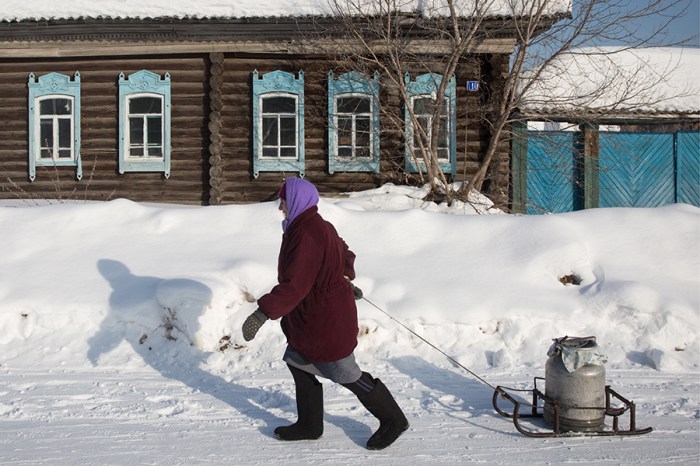
An elderly woman pulling a metal container with water past a snow-covered wooden house with carved window frames in the village of Kondratyevo, Omsk Region, February 17, 2017. Photo courtesy of Dmitry Feoktistov/TASS Россия. Омская область. 19 февраля 2017. Жительница села Кондратьево в Муромцевском районе Омской области. Дмитрий Феоктистов/ТАСС
An elderly woman pulling a container with water in the village of Kondratyevo, Omsk Region, February 19, 2017. Photo courtesy of Dmitry Feoktistov/TASS

Duma to Legalize Elimination of Settlements by the Regions
Maria Makutina
RBC
February 22, 2017

The Duma has tabled an amendment that would legalize converting municipal districts into urban districts. RBC’s sources have informed us the move to eliminate local government in settlements would be supported by the relevant committee. In Moscow Region, such mergers have sparked grassroots protests.

An “Elegant Way” of Eliminating Local Self-Government
Mikhail Terentiev, an United Russia MP from Moscow Region, has submitted amendments to the law on general principles of local self-government to the Duma Committee on Local Self-Government. (RBC has the document in its possession.) The MP has proposed amending the law to make it possible to merge all settlements, including rural settlements, that constitute a municipal district with an urban district. Under such a merger, the settlements and the municipal district would forfeit their status as municipal entities. Decisions about such mergers would be taken by regional authorities “with the consent” of local representative bodies.

Terentiev has also proposed changing the definition of an “urban district,” as stipulated by the law. Currently, it is defined as a urban settlement that is not part of a municipal district. The new draft law defines it as “one or more contiguous populated areas that are not municipal entities.”

Moscow Region authorities have found an “elegant and simple  way” to legalize the single-tier system of local government that, in recent years has, been established in a number of Russia’s regions, including Moscow Region, Andrei Maximov, an analyst with the Committee of Civic Initiatives, explained to RBC.

Moscow Region Governor Andrei Vorobyov. Photo courtesy of Sergei Fadeichev/TASS

Protests
In November of last year, Andrei Vorobyov, governor of Moscow Region, announced plans to convert around twenty municipal districts into urban districts in 2016–2017. According to Vorobyov, the reform would save money by reducing the number of officials.

The proposed move sparked popular protests. Moscow Region municipal district council members, unhappy with the dissolution of local executive and representative bodies, held protest rallies. Public hearings on reforming local systems devolved into clashes with the Russian National Guard.

A Local Self-Government Congress was held in Moscow in February. Local council members from Moscow Region requested that Prime Minister Dmitry Medvedev and law enforcement agencies investigate “numerous incidents in which local government bodies, including municipal districts, rural settlements, and urban settlements, have been forcibly dissolved.”

“The law does not provide for dissolving a municipal district or converting it into a urban district, so Moscow Region authorities conceived a way of getting round the law. First, they merge rural settlements with an urban settlement, and then they turn it into an urban district.  But the municipal districts are left in a limbo,” said Maximov.

The Presidential Human Right Council has argued that the reforms in Moscow Region violate the public’s right to local self-government. HRC deputy chair Yevgeny Bobrov said as much to Vladimir Putin at the council’s December 8, 2016, meeting. The president promised to “work” on the issue.

Nevertheless, in 2015, the Russian Supreme Court ruled that the merger of two rural settlements and the Ozyory urban settlement into an urban district was legal.

Simplifying Governance
MP Terentiev explained to RBC that his amendments were motivated by the need to optimize the budget in Moscow Region.

“The governor and I realized that money could be saved on officials,” he said.

Thanks to the reforms, “there will be an overall approach to wage policies and the opportunity to reduce administrative barriers to business,” Terentiev argued.

The current law stipulates that Russia is divided into settlements, which are organized into municipal districts, and particularly large settlements, which are organized into urban districts, Maximov explained. According to Terentiev’s draft amendments, any territorial entity in Russia can be turned into an urban district, meaning it can be moved from the two-tier system to the one-tier system.

The authorities have been attempting to confer the status of urban districts on municipal districts in order to dissolve settlements and simplify governance. Rural authorities can interfere with the plans of regional authorities to implement urban planning projects and create obstacles to resolving land use issues, which currently require the consent of the settlements affected, political scientist Alexander Kynyev explained to RBC.

The Total Deterioration of Settlements
Experience has shown that populated areas lacking elements of self-governance deteriorate and disappear, RBC’s source on the Local Self-Government Committee told us. According to the source, the draft amendments would lead to the total deterioration of the settlement-tier of governance throughout the entire country.

“It is nonsense to eliminate settlements in densely populated Moscow Region. It doesn’t fit into any paradigm. It is just the governor’s whim. It will be easier for him to manage his affairs this way, and so the law has been mangled for this sake. He has to demolish everything so it will be easier to build it up again,” RBC’s source said.

The reform has been opposed by people of different views and parties. Local self-government as such has been threatened. As the 2018 presidential election approaches, the federal authorities want to avoid such controversies, argues Kynyev.

Through the Back Gate
Terentiev tabled his draft amendments as part of the second reading of a draft law bill that would abolish direct popular votes on whether to change the status of urban and rural settlements. The government tabled the draft law back in the spring of 2015. It was passed in its first reading the same year, after which the Duma has not returned to it.

Radical change in the territorial basis of local self-government has been brought in “through the back gate,” noted our source in the Duma, although the 2014 local self-government reforms were “seriously discussed” in society, he recalled.

Alexei Didenko (LDPR), chair of the Duma’s Local Self-Government Committee, agreed the draft bill could “eliminate the machinery of popular self-government,” and ordinary people would find it harder to defend their interests. According to Didenko, the draft amendments were at odds with what the president said during his 2013 state of the nation address: “Local governance should be organized in such a way  anyone can reach out and touch it.”

Didenko told RBC  the decision whether to support Terentiev’s draft amendments or not would be made by his committee, most of whom are United Russia members, in March. Two sources in the Duma told RBC the committee would approve the draft amendments.

How Local Authorities Have Been Stripped of Their Powers
In his December 2013 address to the Federal Assembly, President Putin asked that the organizational principles of local self-government be clarified. According to Putin, the quantity of responsibilities and resources of municipal officials were out of balance, “hence the frequent confusion over powers.”

In May 2014, a law reforming local self-government was passed, endowing the regions with the right to assume a considerable number of the powers previously exercised by local authorities in taking economic decisions.

The original draft of the bill called for the abolition of direct elections of big-city mayors and city council members. The final draft stipulated the heads of municipal entities could be either elected directly or appointed from among council members.  In the first case, the head of the municipal entity could lead the administration himself. (If the municipal entity in question is a city, he would become city manager.) In the second case, the head of the municipal entity would chair its representative body.

Regional legislative assemblies were accorded the right to divide cities and towns into intra-urban municipal entities. Two new types of municipal entities were introduced for this purpose: urban districts with intra-city divisions, and intra-urban districts.

First-tier council members (that is, council members of urban and rural settlements) are elected directly by voters. Second-tier council members (of municipal districts and urban districts with intra-city divisions) are either elected or delegated from among the heads of settlements and first-tier council members, in the case of municipal districts, or only from among first-tier council members, in the case of urban districts with intra-city divisions. The method of electing council members was also to have been defined by regional law.

In February 2015, two other methods for electing heads of municipal entities were introduced. The first method allows the head of a municipality, chosen by the municipality’s council from among its members, to lead the local administration. However, he surrenders his mandate as a council member. The second method allows a bureaucrat, chosen by council members from a slate of candidates suggested by a hiring committee, to lead the local administration. This had made it possible for city managers to become autocratic mayors.

Translated by the Russian Reader. See my December 15, 2016, post on the same topic, “In Tomilino.”

MP Oleg Shein: Astrakhan Region Headed for Social Catastrophe

Russian MP Oleg Shein. Photo courtesy of Wikipedia
Russian MP Oleg Shein in 2009. Photo courtesy of Wikipedia

MP: Astrakhan Region Headed for Deep Social Catastrophe
Rosbalt
November 18, 2016

Astrakhan is among the regions undergoing a social catastrophe, argues MP Oleg Shein, who sits on the State Duma’s Committee for Labor, Social Policy, and Veterans Affairs. As the MP told our correspondent, both federal and regional authorities are to blame for the situation.

“Astrakhan Region is currently undergoing a fiscal disaster due to the fact the regional budget has collapsed. This year, it has been slashed by 15%, from 38 to 33 billion rubles. Next year, the regional authorities have proposed cutting the budget by another eight billion rubles. Accordingly, the budget will have shrunk by about 40% in two years. Already this year, financial aid to the poor has been completely eliminated, and subsidies for parents paying fees to kindergartens have been canceled, causing kindergarten fees to increase by one and half times. The upper grades have been eliminated in a number of schools. Schools have gone from eleven grades to nine grades, and this has caused overcrowded classes in the remaining schools. Payroll has been reduced by 7% for public sector employees: doctors, teachers, and cultural workers. Actually, 7% is the average figure; large numbers of people have had their salaries cut much more considerably. So the region really is headed downhill, and the regional government sees no ways of heading off the disaster,” said Shein.

 […]

“The regional authorities—and there is some truth to this—explain what is happening by referring to the loss of tax revenues from the oil industry. Several years ago, the State Duma—or rather, the United Russia party—freed Lukoil from paying taxes on its oil rigs in the Caspian Sea. This year as well, United Russia has voted to transfer the profits from oil production in the Caspian, the income tax revenue, from the regional budget to the federal budget. The regional authorities were really counting on the money, but they have ended up with nothing.  But there is a second reason: their completely devil-may-care approach to drafting the regional budget and the loss of the local tax base. Sometimes, the regional government has literally abetted hostile takeovers of local companies, as, for example, happened to the local company Bassol, which supplies 60% of the salt to the Russian market and now pays taxes outside of Astrakhan Region. Paradoxically, the regional government welcomed this,” said Shein.

The MP said that despite its socio-economic difficulties, Astrakhan Region was also marked by high levels of corruption and the waste of money on mega projects like a musical theater and so on.

According to a rating compiled by the sociology department at the Russian Federation Government Financial University, Astrakhan was among the Russian cities with populations of 500,000 or more where the lowest indices for quality of life had been recorded. According to Astrakhanstat, during the period from January 2016 to August 2016, the real disposable income of Astrakhan Region residents was 89.4% of what it had been during the same period last year.

Translated by the Russian Reader. Thanks to Valentin Urusov for the heads-up

Ivan Ovsyannikov: A Wake-Up Call for the Regime

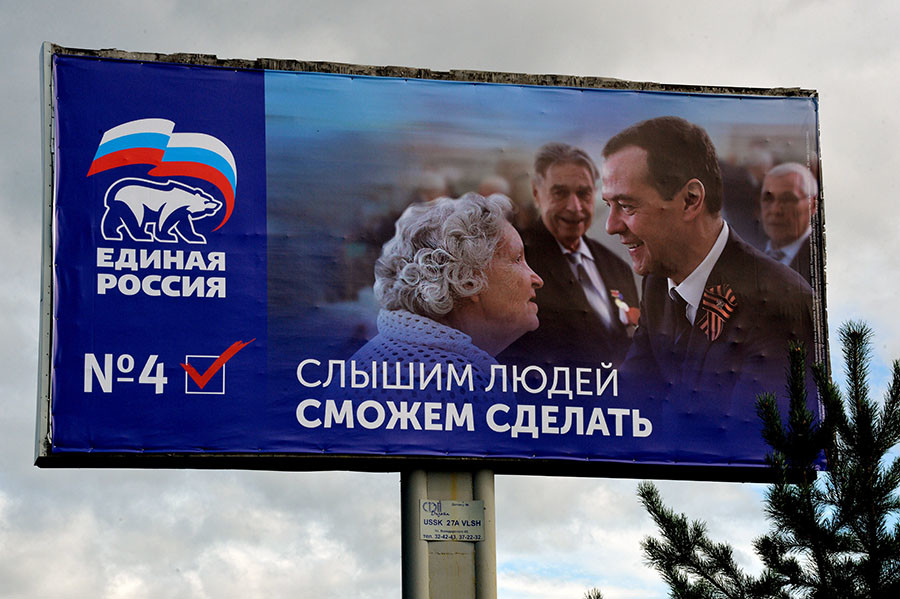
“United Russia. No. 4 [on the ballot]. We hear people. We can get it done.” Photo courtesy of Surkovian Propaganda

Ivan Ovsyannikov
A Wake-Up Call for the Regime
Anticapitalist.ru
September 19, 2016

The most inappropriate reaction to these so-called elections is disenchantment with their outcome. Was anyone really enchanted by them? I can understand the pessimism of moderate liberals, for whom the procedure of voting is democracy’s alpha and omega, but a “constitutional change of power” is the ultimate political daydream. Even smart liberals must realize the Duma is not a parliament, and Russia is not a republic. What, then, are we to make of elections to a body that does not form the cabinet, cannot impeach the president, and, most important, gave up any pretensions to power long ago? What is demonstrated by so-called elections to a body in whose necessity over forty percent of respondents have doubts, according to opinion polls? What does it mean when people vote for parties that in their vast majority are flimflam organizations imitating political pluralism?

Nothing sounded more out of tune in the opposition’s rhetoric of recent months than the campaign slogans of liberals, hoping to cross the five-percent threshold, about effecting a “change of power” by dropping a ballot into a ballot box. Perhaps the statement made by Ella Pamfilova, chair of the Russian Central Electoral Commission, that she was “really, really sorry” not a single non-parliamentary party made it into the Duma, reflects not only her own opinion but also that of her bosses. A few rebellious voices would not have harmed a body one of its former speakers infamously dubbed “not a place for discussion.” They would have made the bureaucracy’s imitation of democracy slightly more believable.

But let us get back to the question of what these so-called elections show us. Maybe, at least, they are a cross section of public opinion, a sincere manifestation of confidence in the regime or, as the opposition is fond of claiming, an index of the populace’s “zombification”? No, they are none of these things, and that, perhaps, is the most troubling news for the ruling elite.

If, after several years of severe economic crisis, and amidst a record-low turnout, a party headed by an unpopular prime minister garners even more votes than it did in 2011, it means that elections to the Duma have finally shed their remaining links with any known social reality. It would be more soothing for the Kremlin if the votes had been divvied up more evenly among the four pro-regime parties. That would have been a sign of confidence in the political system. If Russians had sought an alternative within the current system by voting for the Communists or any other pro-Kremlin party that would have told us that faith in the Putin regime is indeed strong.

But people who vote for United Russia in 2016 are not voting for the government’s policies, the annexation of Crimea or even Putin. They vote not because they expect the elections will change things for the better, and not because they are blinded by propaganda or are especially fond of government officials. They fear a change for the worse and take part in a pre-programmed ritual, thus hoping to prevent the collapse of their usual lives. In its own way, this choice is rational, although it smacks of pessimism and conservatism. People are clinging with all their might to a crumbling stability. But what will happen when there is nothing more to cling to?

Turnout to Duma Elections by Year
1993 – 54%
1995 – 64%
1999 – 61%
2003 – 55.7%
2007– 59%
2011– 60%
2016 – 48%


Some of the voters who did not go to the polls could have been guided by similar motives. It would be wrong to interpret high absenteeism unambiguously as passive protest. The majority realizes nothing actually depends on Duma elections. Superstitiously, involuntarily or habitually, some partake in this ritual exorcism of hardship and troubles. Others fail to partake in the ritual out of laziness, apathy or contempt. Only an indoctrinated minority literally believes in the campaign slogans.

So the only information the powers that be and we can extract from the election results is that the country is not in the midst of a revolution, and the supplies of public apathy on which the system depends have not run out yet. But as a tool of political leverage, a reflection of the confidence the masses have in the ruling class, and even as a means of studying public opinion, the Duma elections have shown their uselessness. Like routine vote rigging, their outcome is an indication of Putinism’s degradation as a political system rather than its stability.

socresist_knsnjnkbt84-jpg-ecfbe02aa410465c66e5c5c5f251a5e3Ivan Ovsyannikov is a writer, union activist, member of the Russian Socialist Movement (RSD), and editor of Trade Union Navigator (Profsoiuznyi navigator), the newspaper of the Interregional Trade Union Workers Association (MPRA). Translated by the Russian Reader. Previously published on LeftEast

Making the Same Mistake Thrice

p5150123

The 2016 Elections: Making the Same Mistake Is Fate
Nikolay Mironov
Moskovsky Komsomolets
September 19, 2016

It is apparent to almost everyone the country has fallen into a deep pit. (That is the most decent word for describing the situation.) Economic stability (and, along with it, the stability in our lives) is irreversibly over, and it is clear a new (moreover, radically new) economic policy is needed to bring it back. The current, extractive economic policy has run out of steam. Both the regime and society are aware that a crisis has ensued, but for the time being no one is doing anything about it. Meanwhile, the time for reform is running out.

Now, after the elections to the State Duma, as new and old MPs take their seats, 2018 moves into the foreground of the political agenda. In fact, the main issue is not whether Vladimir Putin will seek a fourth term. The main suspense revolves around whether in the near future we can expect a change in the country’s economic and political model. Which transition scenarios are the most likely? The future president’s name is interesting only from this viewpoint. Whether the president is young, mature or elderly, what matters is whether he or she will be able to implement reforms and how they will implement them.

The country’s reserves are running out, and the system acutely, critically needs a reboot. However, launching reforms becomes more complicated with every passing year. The situation has now almost been brought to an extreme. The government obviously is now no longer coping with its obligations to society: the population is rapidly plunging into poverty. The political structure is held together only by the president’s word of honor and good health.

At a critical time for the country’s future, however, the regime has preferred to act tactically rather than strategically.  When the oil price was high, it was possible not to think about costs, effective spending, and rampant corruption. When circumstances worsened, the regime also took the easy, well-trodden path of spending reserves, introducing new taxes for the general population, clamping down on small business, reducing social spending, and commercializing health care, education, and research.

Soon, however, it became clear these measures were insufficient for riding out the crisis. So, currently, the mechanism for confiscating “superfluous” money from major businessmen and top officials, previously untouchable, has been set into motion. This is borne out by the alleged anti-corruption campaigns that have been unleashed. In fact, their goal is to collect tribute from certain segments of the elite. But not from all segments, only from the “extended” circles, without affecting the circle of businessmen and administrators closest to the regime.

The system is going down the same road as the Soviet nomenklatura did in the 1980s. Initially, it firmly “brezhnevized” itself, stagnated, and rusted on the inside. Now, experiencing a lack of resources, it attempts to get by with superficial half-measures, in particular, by tempering corruption, which is sucking the country dry, by jailing a limited number of individuals. Ultimately, when the common folk learn of the colossal wealth possessed by middling colonels they are convinced of the regime’s utter corruption, but see no decisive measures being taken and are persuaded the elite has no desire to change anything. Eight billion rubles are seized in anti-corruption official Dmitry Zakharchenko’s flat, and people are paid eight-thousand-ruble pensions! [I honestly don’t know where Mironov got the second set of figures, although, of course, pensions in Russia are usually entirely to low to cope with the rising cost of living. — TRR.] A million times difference! But none of the higher-ups in the Interior Ministry has resigned. This fact alone is enough to shatter confidence in the entire political system.

The problem, however, and it is the main problem, is that the people with power and money—the nomenklatura-slash-oligarchy of our time—do not want to change their position even in the midst of a crisis. They cling to their extreme wealth and privileges. But the realization that change is necessary dawns on them with catastrophic tardiness. It was this way during tsarism’s final days, and under the late-Soviet regime. Instead of launching reforms in timely fashion, the regime has put them off, pushing the situation to the point of no return.

In the recent elections to the State Duma, United Russia, trudging to victory under the leadership of Prime Minister Medvedev, refrained altogether from proposing an anti-crisis plan to the nation, either a strategy of some sort or even a winning tactic. Quotations of Putin and tiresome references to Crimea and the country’s rising from its knees were the entire content of their campaign. The nation responded partly by skipping the elections, partly by voting as they were told, and partly by voting because there was no alternative. But the question of what to do next remains unanswered. Does the regime intend to answer the question, or will all this uncertainty crystallize in 2018?

Meanwhile, Russia finds itself at a crossroads. The first road is the inertial scenari0. Politically, it involves further crackdowns. The unwritten “social compact,” which emerged in the early noughties, has become impracticable since it cannot ensure a comfortable life. So without purging possible rivals and curtailing grassroots activism it will not be possible to painlessly solve the problem of extending the president’s term or transferring power to a chosen successor. So, for example, further censorship of the media will be required, as will the strict administration of what remains of elections, and increased persecution of undesirables, and more frequent trials and more show trials.

In economic terns, this simple plan involves the the “dekulakization” of less than totally loyal oligarchs and wayward officials, who will have to pay for the crisis. Undoubtedly, this will have a temporary effect and make it possible to plug certain holes in the budget. For a country like Russia, however, given the scale of the crisis, the effect will be quite short-lived. When this money runs out as well, reform will be the only option. But I am afraid that by then the last capital will be spent, and there will nothing left to invest in the economy. The chance to change things without radical demolition could be missed. The country will spend the last bits of the Soviet legacy, and exiting the crisis will once again require titanic efforts on the part of the people. Given increased global competition, however, Russia risks never catching up with anyone ever again.

The second scenario, vital for our survival, involves carrying out reforms right now. The government has to support the economy to give it a leg up and get development up and running. I would argue this is impossible without injections from the budget and, consequently, without strategic government planning, facilitating the rational use of the resources we have left. We not should support the economy per se, but those areas of growth that will encourage import substitution and the establishment of competitive production in the non-extractive sector and agriculture.

Where do we get the money? From reserves, tax reform (redirecting the tax burden toward the super wealthy), confiscation of funds acquired through corruption, and capital export controls. This will require quite stringent measures towards the business elite and high-ranking officials. Medium-sized businesses and rank-and-file servants should not be touched, however. Not scapegoats but the genuinely super wealthy should be involved in getting the county out of crisis.

To keep the money meant to bolster the economy from being stolen, we need a perestroika of the political system, because that is where the roots of corruption lies. It comes from secrecy, the regime’s accountability to no one but itself, and officialdom’s bloat and inefficiency. There are no miraculous prescriptions in this case. Throughout the world, free media and judicial, parliamentary, and public control help to temper the appetites of those in charge of the budget. The regular turnover of those in power is also necessary, and the only cure in this case are free and fair elections.

We also need to support the population, which has been rapidly growing poorer during the crisis, and not only from a sense of social justice. When people have no purchasing power, the economy is alway in crisis. Government financial assistance should be used to stimulate consumer demand, ensuring import substitution in those sectors where funds are received from public. Otherwise, the money will be converted to foreign currency and sent abroad. We must protect domestic producers from robbery and extortion. Otherwise, they will hide everything they get from the government and the public abroad. Plus, interest rates on loans to business must be drastically reduced. If all these things are done, tax revenues will start to grow in a few years, and government aid will be recouped.

Strategically, a reboot of the educational system is also needed now in keeping with the country’s development priorities for at least the next twenty years. Science and the national technological base must be supported.

The prescriptions for solving Russia’s problems are self-explanatory. Given the president’s high ratings and United Russia’s overwhelming majority in the Duma, it is high time to carry out large-scale reforms. There is a margin of safety and the required level of support. But everything in Russia is topsy-turvy. In Russia, it is more likely reforms will be launched if the regime’s ratings take a catastrophic nosedive. They will inevitably reach a critical level when the socio-economic situation worsens. You cannot fill your belly with endless tales of patriotism. People, after all, need to eat something, clothe their children, and get medical care.

We could also arrive at a different fork in the road: reforms from above or turmoil from below. Attempts to stop time have always led Russian regimes to ruin, destroying the country in the process. Must things come to this? The populace’s passivity in the face of a purge of the opposition is a temporary and illusory phenomenon. Many local social protests have erupted around the country. Their number is not diminishing, and general discontent has been growing. And things could seriously explode somewhere. Is it our fate to make the same mistake again and again?

I recall the joke about Ivan the Fool. A father had three sons. The eldest went into the yard, where a rake lay on the ground. He stepped on it and was killed. The middle son goes out, and it is the same story. Ivan, the youngest brother, realizes a rake is lying in the yard and he should not step on it, but there is no way around it. Such is life.

It would be funny if it weren’t so sad.

Nikolay Mironov is head of the Center for Economic and Political Reform, in Moscow, and a frequent columnist for Moskovsky Komsomolets newspaper. I have published translations of his columns “Whipping Bear: Why the President Needs a ‘Bad’ Prime Minister” (June 2016) and “Despair as a Sign of the Times” (September 2016). Translation and photo by the Russian Reader. Thanks to Sean Guillory for the heads-up.

A Guide for the Perplexed Russian Voter

A Voter’s Strategy
Grigorii Golosov
Polit.ru
September 6, 2016

Campaigning on the streets of Moscow, August 23, 2016. Photo courtesy of Kirill Zykov and Moscow City News Agency

Compared with previous elections to the Duma, the parliamentary elections scheduled in Russia for September 18, 2016, have a number of peculiarities. And it is not only because the elections will be held under a mixed system, proportional and majoritarian simultaneously. The 2016 election campaign is different from all previous campaigns.

Grigorii Golosov, a political scientist and professor at the European University in St. Petersburg, talked to Polit.ru about the unusual aspects of the current election campaign, its likely outcome, and alternative scenarios and strategies that the politically active segment of society should keep in mind.

It is obvious what is unusual about these elections: they are taking place in September rather than December. They were not scheduled for September accidentally, of course, but to things easier for United Russia.

The election campaign has gone completely unnoticed. In addition, it is quite short compared with the campaigns we have had earlier. It is completely obvious [the regime] is counting on the fact that it will fail to catch voters’ attention at all.

Campaigning on the streets of Moscow, August 23, 2016. Photo courtesy of Kirill Zykov/Moscow City News Agency

This means people are basically expected not to have political motivations to vote in these elections. What motivations could they have if they simply know nothing about the elections or who is running in them? This, in turn, means the people organizing the election campaign are counting on the fact that the bulk of voters will be people who are obliged to vote for one reason or other, or have a material stake in voting.

We essentially know what segments of the populace these are: employees of state-funded organizations; pensioners; and employees of certain major enterprises where management may be able to influence how they vote. Since their reasons for going to vote are so unpolitical, they will vote as they are told to vote, meaning for United Russia.

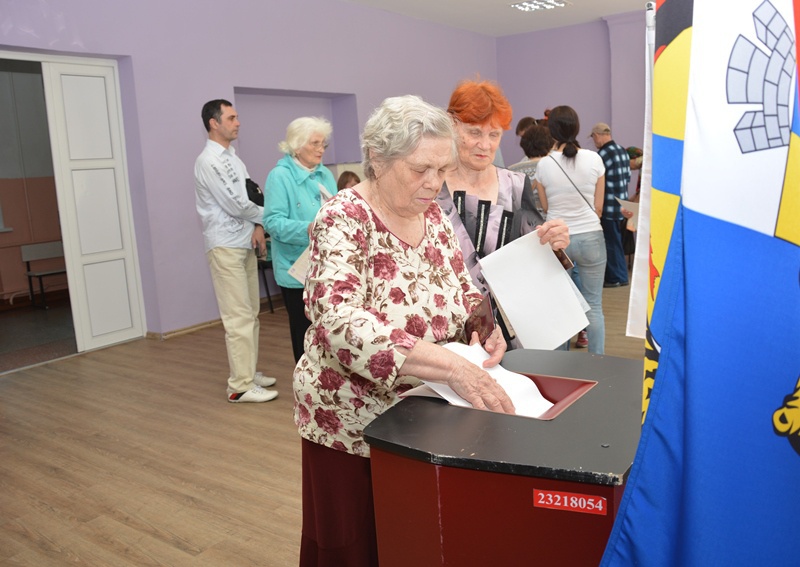
Voting during United Russia’s primaries in Khabarovsk, May 22, 2016. Photo courtesy of United Russia

Given such a scenario, it follows that United Russia will receive a substantial majority. I think this year they won’t go after the really big numbers that you can achieve only by falsifying the turnout. Probably, however, the optimal scenario for the authorities would involve United Russia’s getting fifty to fifty-five percent of the proportional vote according to party lists.

In addition, it is already clear, given the fact that the electoral districts are mainly controlled by the regional authorities, that United Russia will also get an overwhelming majority of the seats in the [single-mandate] districts. Thus, in tandem with their numbers in the proportional voting part of the ballot, United Russia will again be able to control the Duma completely and reliably support the legislation drafted by the presidential administration and the government.

The alternative scenario would consist in more people coming out to vote, and some of them coming out for political reasons.

Frankly speaking, even those people who support Vladimir Putin have no particular political motivation to vote for United Russia, because Dmitry Medvedev is heading the party in these elections. He bears no responsibility for foreign policy, whose successes have been trumpeted constantly. Both Medvedev and United Russia are linked in voters’ eyes with domestic policy and, thus, with the economic situation in Russia. A considerable part of Russian society now senses that it is getting worse.

Dmitry Medvedev meeting with pensioners in Lipetsk on August 30, 2016. Photo courtesy of United Russia

However, many parties involved in these elections exhibit no less loyalty to Putin and his foreign policies than United Russia does, and under these circumstances, politically motivated voters have no particular incentive to vote for the ruling party.

We should also not forget that support even for Putin’s foreign policy is not universal in Russia, and pollsters have always recorded a fairly considerable group of people who do not support this policy in any way and oppose Putin. Strategically, the current election campaign is meant to discourage this segment of Russian voters from going out to vote at all. They have been sent a variety of signals to the effect that voting is pointless, the elections are pointless, and they had better stay home.

Will it work? It is quite likely that it will, and so I find United Russia’s optimistic scenario more plausible. However, there will undoubtedly be a certain number of politically motivated voters turning out for the elections. How many votes the United Russia list will garner in proportional voting will depend on this number.

Regardless of the published opinion poll results, the spread could be quite wide. I would suggest somewhere between forty percent (in the event that the turnout of political motivated voters is quite high) and fifty-five percent. But this will have no significant impact on the makeup of the State Duma, because in any case it will be controlled through the single-mandate MPs.  Besides, many parties who might get votes from politically motivated voters are not likely to clear the five-percent barrier for entering the Duma.

However, precisely because the outcome of these elections are politically unimportant in terms of controlling the State Duma, they could be politically important as a demonstration of Russian society’s attitude toward the authorities in general, meaning the attitude of its politically engaged segment. In this sense, I would argue opposition-minded voters should understand they can reduce United Russia’s vote total, thus showing it does not enjoy unanimous support, or they can increase it by not coming out to vote.

What should they do if they do come out to vote?  If they do not dislike it intensely, they can vote for the party that has adopted a directly oppositional stance, i.e., for PARNAS. Or they can vote for a party that, while generally deferent to the authorities, exercises this deference in a particular way, i.e., for Yabloko.

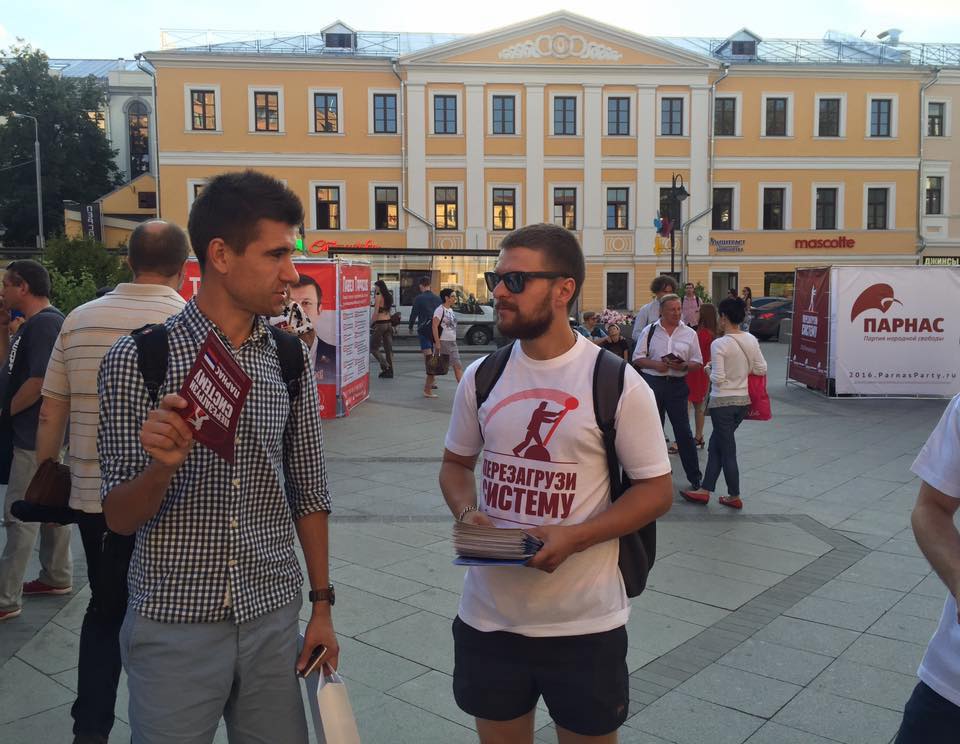
PARNAS on the campaign trail. Photo courtesy of Alla Naumcheva and PARNAS

Taking into account what I have said about small parties not clearing the five-percent barrier, voters can, nevertheless, vote for the small parties. If, for whatever reason, they definitely do not feel like voting for either PARNAS or Yabloko, they can vote for other small parties, even if they do not particularly like them.

It would probably be pointless to vote for parties who have no chance of garnering votes, but there is a limited number of minor parties that have some chances. I would identify the Communists of Russia, the Pensioners Party, the Party of Growth, and, possibly, Motherland. I have mentioned Motherland partly because there is nationalist feeling within society, and party because they ended up in the first slot on the voting ballot. During the free elections that took place in Russia in the 1990s, first place in the voting ballot always gave the party listed there a palpable bonus of about one percent of the vote.

Communists of Russia campaigner handing out the party’s pamphlets. Kirov Region, September 6, 2016. Photo courtesy of comros.info

It is not a matter of whether these parties are decent or not. During these elections, if they espouse genuinely oppositional views, the strategy of politically motivated voters should be based not on facilitating a particular candidate’s victory or impacting the breakdown of mandates. (From this point of view, it does not matter who gets into the Duma.) Their strategy should be based only on showing the policies now pursued by the Russian authorities do not enjoy unanimous support. And this can be achieved by doing what I have talked about.

Translated by the Russian Reader

Alexander Zamyatin: Three and a Half Theses on the Elections

Three and a Half Theses on the Elections
Alexander Zamyatin
Anticapitalist.ru
July 24, 2016

Thesis No. 0: The Obvious
The parliament in Russia has been reduced to such a condition there is no point in talking about a hypothetical leftist faction or a group of MPs from single-mandate electoral districts tabling or blocking law bills independently of the presidential administration. If there has been anything consistent about the political reforms of the past fifteen years, it is that legislative bodies, the Duma foremost among them, have been stripped of the power to influence the government’s social and economic policies, even despite their formally voting budgets up or down.

The elections to the Seventh State Duma are not a chance to transform the political regime or even have an impact on it.

The entire campaign is controlled to a lesser or greater extent by the presidential administration’s Office for Domestic Policy. The leaders of the current Duma factions have long ago left no doubt as to the complete absence of conflict within parliament. Even such a harmless identity as “systemic opposition” has taken a backseat to rallying round the president by way of combatting the “fifth column.”
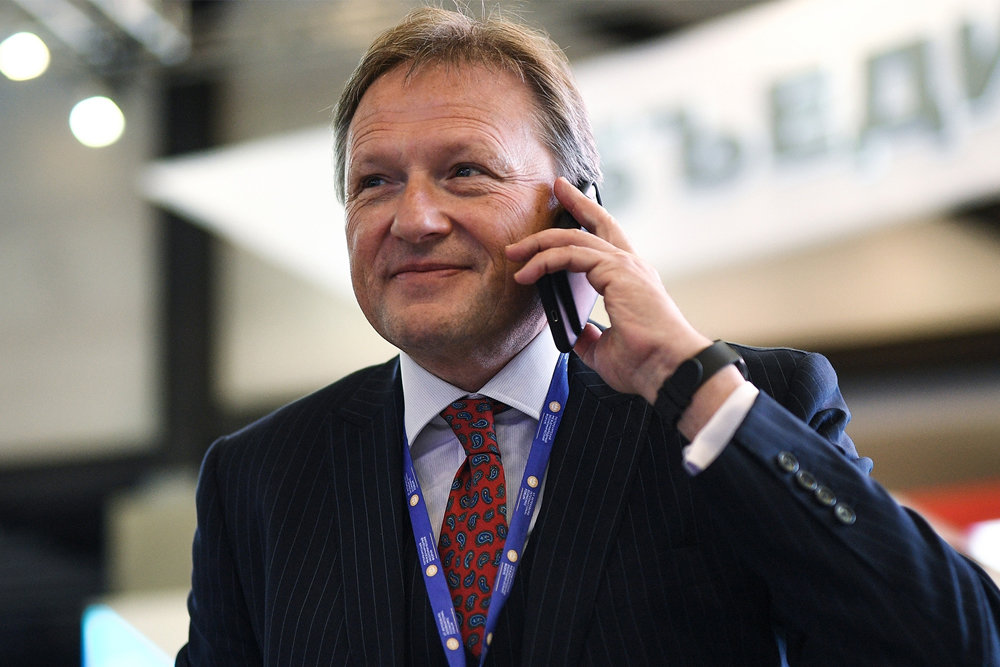
1000_d_850Boris Titov. Photo courtesy of Rossiyskaya gazeta

This stricture applies as well as to the Party of Growth (Partiya Rosta) and its leader Boris Titov, the federal commissioner for the rights of entrepreneurs. The handiwork of spin doctors, the party’s emergence has marked the utter degeneration of the idea of founding an independent right-wing party, a project that has dragged on since the late nineties in shape of parties such as Boris Nemtsov and Nikita Belykh’s Union of Right Forces (SPS) and Leonid Gozman and Mikhail Prokhorov’s Right Cause (Pravoe delo). The fortunes of the Party of Growth’s forerunners have been telling: they immediately fell apart, absorbed by the so-called Crimean consensus.

Despite the transparency of the schemes involved, any conversation about parties and elections has to begin with these textbook truths, not only because they are not obvious to many people but also because certain actors in this process, including people comfortable with leftist ideas, call them into question by the way they behave.

Thesis No. 1: The Possible
A considerable number of the Kremlin’s actions in domestic and foreign policy over the past five years has been aimed at preventing the recurrence of the events surrounding the 2011 parliamentary elections. Despite the fact that, in retrospect, the White Ribbon rallies and Marches of the Millions seem harmless, they were an unprecedented challenge to the Putin regime, a challenge that, moreover, meshes perfectly with the ruling elite’s view of the world.

The ouster of spin doctor extraordinaire Vladislav Surkov and his projects for building “sovereign” democracy and preventing the “orange threat” by establishing quasi-fascist youth movements, and his replacement by the hard and taciturn Vyacheslav Volodin as domestic policy chief were obvious reshuffles meant to be read literally. During Putin’s third term, not even the pretense of political liberalism must remain.

This would seemingly contradict the preservation of certain liberal gains in the realm of electoral law made during Dmitry Medvedev’s single term as president: reduction of the electoral threshold for parties hoping to enter the Duma from 7% to 5%; the return of the mixed voting system, with 225 seats (out of a total of 450) up for grabs in single-mandate districts; and a reduction of the number of members required to officially register a party (from 50,000 to 500). But attempts by the independent right-wing liberal opposition to run in “warm-up” regional elections in 2013-2015 have shown that everything remains under the Kremlin’s total control.

Moving the date of the Duma elections from November to September reveals one of the regime’s main wagers: the election campaign should be as inconspicuous and cushy as possible for all vetted candidates, and the turnout on voting day must be minimal. Previously, parliamentary elections immediately preceded the presidential election, but now, finally, the figure of the president has been detached from the bureaucratic and political body of the country with all its shortcomings.

Should we expect independent candidates in the single-mandate districts who are capable of taking advantage of the simplified electoral procedures, as described above? Hardly. To get his or her name on the ball0t, an independent candidate has to collect the signatures of at least 3% of voters in the district. (Until 2003, they were required to collect the signatures of 1% of all voters and put up a cash surety.) In reality, this amounts to collecting the signatures of 5-6% of all voters in the district [because local electoral commissions make a habit of invalidating large numbers of signatures—TRR], meaning tens of thousands of signatures.

The only legal loophole for independent candidates is to run in single-mandate districts as the nominees of parties, which are not required to collect signatures. This applies to parties that hold seats in the Duma or one of the regional legislatures. All other parties must collect around 200,000 signatures to be registered in the elections. There are only fourteen such parties among the seventy-seven parties registered in the country.

Thesis No. 2: The Unlikely
The right-wing liberal opposition’s march to the elections using the slain Boris Nemtsov’s mandate as an MP in the Yaroslavl Regional Parliament was frustrated after the Democratic Coalition’s primaries proved a failure, with only a tenth of the planned 100,000 participants registering to vote.  The infighting that ensued ended with the dubious, to put it mildly, ex-PM Mikhail Kasyanov being joined on the PARNAS list by the extreme right-wing populist blogger Vyacheslav Maltsev, who is totally at odds with the party’s moderate electorate, and Professor Andrei Zubov, famously sacked from MGIMO (Moscow State Institute for International Relations) for his anti-regime remarks about Crimea, but a man who is otherwise given to alternately spouting liberal truisms or utter monarchist nonsense. That is all you need to know about the Democratic Coalition at present.
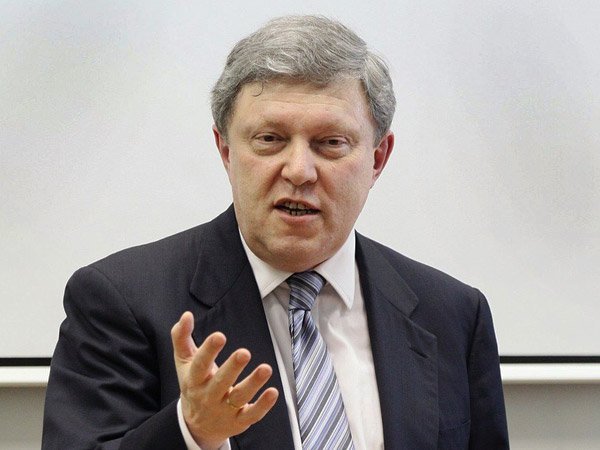
yavlin1_1428604380Grigory Yavlinsky. Photo courtesy of Polit.ru

The only source of intrigue in these elections has, perhaps, been the good old Yabloko Party. For the first time, the party has supported independent politicians from outside the party’s central apparatus, thus benefiting from the collapse of the Democratic Coalition. Yabloko’s willingness to blur its identity both on the right (there are members of Democratic Choice of Russia among Yabloko’s single-mandate candidates) and the left, has given hope to many opposition castaways. At the same time, Yabloko has proposed a strategic deal to everyone who has asked the party’s help in getting access to state campaign financing. Grigory Yavlinsky will need broad support in the 2018 presidential election.

Basically, the intrigue boils down to how honest Yavlinsky and Co. are in their intentions to give the regime a fight and compete with Putin in the presidential election. The first answer that comes to mind would question their independence. The party has been perfectly integrated into the system since 1999 (or even 1996). Party functionaries are kept on a short lease by state financing, and access to national media leaves no doubt as to the existence of an agreement between Yavlinsky and the presidential administration or the president himself.

Yet a more cunning answer is possible as well. Yablokov’s moderateness gives it a tactical advantage over opposition politicians who held the bar high for radicalism in 2012 and are now political outsiders driven to the verge of legality. We will be able to clarify which of these hypotheses is closer to the truth after the elections.

Be that as it may, these parties have been talking seriously about overcoming the five percent barrier and forming a faction in the Duma. Is this possible without a serious mobilization of the protest electorate?

Thesis No. 3: The Imperative
What does the radical left have to do with any of this? The paradox of the situation in which we find ourselves is that while our programs and main slogans answer to the interests of tens of millions of people in Russia (and, in a sense, of the entire society), our campaigning hardly goes beyond a few thousand people. We are excluded from the political process, which is now dominated by anti-popular and, sometimes, simply dangerous forces.

The fact that Russia lacks a full-fledged bourgeois parliamentary democracy sometimes leads people to draw the false conclusion that the country lacks a political process. Of course, it is imitated to a considerable degree by constructs, controlled by the presidential administration, that imitate pluralism in hysterical debates with Alexander Prokhanov and Vladimir Solovyov on national TV. But the very origins of these costly imitations, cultivated for years on end, indicates the presence of political antagonism, in which there are, at least, two sides: the current elite, playing to maintain the status quo, and the active segment of society, opposed to the elite and trying to organize alternatives.

Another common mistake appears at this point in the otherwise correct argument that the right-wing liberal opposition offers no real alternatives and stands programmatically for the very same neoliberal reforms as the regime. Trading the Putinist elite for someone from the opposition, such people argue, would not entail any consequences for the country except, perhaps, the flagrant acceleration of the selfsame unpopular economic reforms.

This claim completely ignores the real state of affairs, in which the loss of power by the Putinist elite (even under a smooth and sophisticated transfer of power to someone from outside that elite) would be tantamount to its death.

Whoever came to power afterwards, the chance to make public the details of how the president’s friends personally enriched themselves both at the expense of individuals knocked out of the game and at the expense of the Russian state and the entire Russian people, would give this person colossal power over the current members of the ruling class. This is clearer to the ruling class than to anyone else, so they have been doing everything to make sure that stripping them of power would be prohibitively costly to their opponents and, thus, the entire country. It is therefore quite likely that the departure of the Putinist elite would be accompanied by tectonic shifts in the societal and political landscapes, shifts that could have quite different consequences. This state of affairs has become a risk factor even for the well-off segments of society, not to mention its least socially protected members.

Coupled with the systemic depravity of the current economic model, the developing political crisis at some stage could bring the country to yet another historical fork in the road. Expectation of this moment, when the accumulated contradictions are revealed as keenly as possible, unites more or less everyone in the leftist opposition. But does our budding leftist movement currently have any sense of how to hasten this moment? No. Does it have a clear, confident answer as to how to prepare for it? No. Nor could it have such an answer, because we cannot know anything about the political struggle without being involved in it. Of course, economic struggle is supposed to shape an organized working class. But it is a classic mistake to believe that by disconnecting ourselves from the “bustle of bourgeois politicking” and redeploying all our forces to the economic struggle and organizing, we will accelerate the awakening of working class consciousness.

Involvement in the political struggle, which in any case does not abolish the economic struggle, encourages the movement to take on qualities necessary for the establishment of a real political force: the know-how of spirited political agitation among the depoliticized masses, the know-how of debating opponents, and, finally, a place in the media that report on politics and society. It is important that even in the embryonic state in which we find ourselves we can begin working in this direction.

When freedom of assembly is practically nonexistent, and freedom of speech and the freedom to agitate are subjected to well-known restrictions, elections remain a venue for developing the three qualities mentioned above. But there is another consideration at work here. It is only during election campaigning that we have a chance to speak to people with the hope of being heard. If you simply hold pickets and hand out leaflets, the only means of drawing considerable attention to yourself is by engaging in tawdry moralizing. As an election campaigner, however, you play a role to which people are accustomed, a role in which they either ask you what we should do or vigorously object to your arguments. And that means you have made contact. What you do with it depends on your skills as a campaigner.

vy_nas_b_1“You don’t represent us.” / “You can’t even imagine us.” Banner at Fair Elections rally in Petersburg, December 2011. Photo courtesy of Colta.ru

Is there currently a party we could support in these elections? No, but that means only that it will have to be created. There is nothing surprising about the fact we still have not founded a party in a country where, with some reservations, there are no independent, grassroots parties, parties not generated by the Kremlin. It is amazing to think it will always be this way and it is not necessary to prepare for change.

The lack of such a party poses the most difficult question: how can we be involved? First, it is possible to back candidates running in single-mandate districts, candidates whose campaigns we can join without forfeiting our own identity. Now, when the registration process has almost ended at the Central Electoral Commission, we can identify such candidates in our districts.

Second, oddly enough, there is the hypothetical possibility of running a campaign against involvement in the elections, since there is no political force advancing a leftist agenda. This campaign tactic could become part of the political struggle if it were run as a full-fledged campaign with a highly refined appeal every activist would be able to defend. There are two significant drawbacks to this option: a) unlike a campaign in support of a particular candidate, there is no source of funding; and b) campaigning “against all” candidates appears more dubious to the authorities than legally campaigning for a registered candidate and is likely to be prohibited altogether.

This paltry slate of options for active involvement in the upcoming elections to the Duma might get a big boost from the municipal council elections scheduled for next fall. Registering as an independent candidate for a municipal council is an accessible option for where we are at now, and all the advantages of running an election campaign can be realized in this case as well.

We have a whole year to answer the question of whether the leftist movement needs to be involved in elections and prepare ourselves should the answer be yes. From this point of view, this September’s elections are useful at least in the sense they confront us with the issue of political involvement, even if some imagine that it has been decided once and for all.

Translated by the Russian Reader