“Life Is Very Difficult for People”
Yelizaveta Mayetnaya Radio Svoboda
November 30, 2017
The announcement first appeared on the doors of a cafe in St. Petersburg, and then on the social media networks: “Olivier salad, kharcho, vegetable ragout with chicken, compote or ale, bread. 200 rubles. Free of charge to veterans and impoverished pensioners.” The whole town learned about the charity campaign literally within a few days, and old people flocked from all ends of the city to enjoy the free lunch special.
No one asks for any letters, verifying a person’s income. Pensioner ID cards are not required, either. You just have to sit down at a table and you will be fed.
Czech Yard, the cafe that will not let pensioners go hungry, is a family business. 25-year-old Alexandra Sinyak, the cafe’s co-owner, came up with the idea for the charity campaign.
“It all started with an old man who came into eat, but had little money on him. My husband was working in the cafe that day. He felt sorry for the man and said that lunch specials in our cafe would be free to pensioners,” recounts Sinyak. “The old man came for lunch every day for three weeks or so. We thought we should be feeding all the old people in our neighborhood, and not once, but on a permanent basis. We hoped our colleagues would support us, and one or two cafes that fed old people would pop up in each district. We did not imagine, of course, that they would come from all parts of the city to our cafe, but life is clearly very difficult for people. They spend forty minutes, an hour traveling one way to come here. We feed everyone. We do not turn anyone down.”
At first, Sinyak recalls, for some reason the old women brought their pension receipts along with them. The amounts listed on them were 6,200 rubles, 8,000 rubles, and 10,000 rubles. [That is, these women receive, at most, a pension of 143 euros a month.] They brought other receipts as well, such as the receipts for their apartment maintenance bills, which contained almost identical sums. [In fact, the amount of my latest apartment maintenance bill is 6,285 rubles and 20 kopecks. It tends to be lower by two or three thousand rubles in the summer months, when the centralized heating system is shut off—TRR.] Many of them have adult children who are employed, but they cannot help their own old folks, because they are barely making ends meet themselves.
According to Rosstat, around two million employed Russians are paid wages below the subsistence level. If we account for the fact that this money is also spent on other family members, the number of employed but impoverished Russians is over twelve million people or 16.8% of the population, according to calculations made by experts at the Russian Federal Government’s Analytical Center. Analysts at the World Bank have argued that the percentage of economically vulnerable people in Russia is over fifty percent. According to a World Bank report, the proportion of Russians with a daily income of less than $10 has risen to 53.7%, while 13.8% of Russians spend less than 5$ a day.
Sinyak has seen her share of employed poor people in hospitals and rehabilitation centers. Four years ago, she and her husband gave birthto a premature baby. Doctors told the couple the girl would not be able to walk, talk or see, and they could not even dream of sending her to school. The Sinyaks threw all their efforts into making their baby daughter well. Now she has a slight limp, but is otherwise a normal child.
“We organized charity concerts for the children, and my husband and I simply gave their parents money because we really wanted to help them,” says Sinyak. “Now we are thinking about organizing a New Year’s party for the old people.”
At first, they posted the announcement about the free lunch specials on the cafe’s front door, but only one person showed up. It was only after Sinyak posted the announcement on social media sites that the whole city discovered her and her husband’s lunches. Now they serve at least twenty-five free lunch customers daily.
The initial announcement outside the cafe: “Dear patrons! The restaurant invites needy people of pension age and veterans to enjoy free lunches daily from 10 a.m. to 1 p.m.” The post on the VK social network reads, “Czech Yard Cafe at 73 Sixteenth Line. All veterans and elderly people can eat lunch for free from noon to four p.m. […] We will support all cafes that can afford to do it. There are three of us for the time being. We are reposting this. Maybe a whole bunch of cafes in every district of the city will join us.”
One of their customers is 66-year-old Lyubov Volkova. She lives nearby, but she ordinarily does not walk on the side of the street where the cafe is located. She saw the announcement on VK. She spread the word to all her girlfriends in the neighborhood so they could lunch together.
“The lunch specials are a tremendous support to me. I worked my whole life. I have the title of veteran worker, but my monthly pension is 10,200 rubles, and the maintenance bill for my two-room flat is at least 7,000 rubles during the winter. I’m left to my own devices,” says Volkova, sighing heavily. “The electricity has been shut off for non-payment, and I have 15,000 rubles in unpaid fines, but I have not paid them, because I do not have the money to pay them. There are lots of people like me in our district. The people at the housing maintenance service and the electric company have become insolent. They constantly raise rates. They could not care less whether we can pay their bills or not. It is a good thing that Alexander appeared on the scene. Her cafe is charming and serves tasty food, and it is just nice to come here.”
Alexandra Sinyak, her husband Yevgeny, and pensior Lyubov Volkova
Volkova leads a rather active lifestyle. She is a member of the human rights public monitoring commission, inspecting pretrial detention centers and prisons, and she also volunteers at several public veterans organizatons. But all this work is unpaid.
“Most of the work in Russia is done by migrants. Our own people struggle to make ends meet, and they cannot get jobs. I have two sons, but they themselves have to squirm to feed their families. And I have lots of girlfriends: we left jobs at research institutes in the nineties to trade on the streets in order to raise our children. The situation was no better: everyone’s pensions were tiny. You know, I really love Russia, but everything that is happening makes me terribly sad. I want to go back to the Soviet Union. There was stability and calm then. Sure, we did not live high on the hog, but nor did we go begging. We had enough to pay for the essentials.”
Igor Bukharov, president of the Federation of Restaurateurs and Hoteliers of Russia, says the vast majority of restaurateurs have been feeding the needy for many years, but they do not talk about it.
“Societies for disabled people ask us for help, as do war veterans, as do veterans of military operations, as do the orphanages. Who doesn’t ask us for help?! Some ask to be fed breakfast, some ask to be fed lunch, some ask for help with charity suppers, and I have never heard of anyone being turned down,” claims Bukharov. “Generally, I think helping the needy is everyone’s personal affair, and we should not talk about it.”
For the time being, according to Alexandra Sinyak, they have been contacted by one only restaurant, in Sestroretsk, about arranging lunches on a permanent basis, rather than a one-off basis, and businessmen have turned up who are willing to supply their cafe with produce. Municipal councils in some large cities arrange free lunches for pensioners, but there are waiting lists, and the pensioners have to provide documented proof of their neediness. On the other hand, you can then eat free twenty-one times per quarter, says Lyubov Volkova.
Social organizations also provide assistance in the form of produce and groceries. For example, the Rus Food Fund has distributed 20,000 tons of produce and consumer goods to the needy during the five years it has operated. Right now, for example, the fund has been collecting “Food for the Backwoods” in time for the New Year’s holiday. The food will be delivered to the poor and lonely who live in villages in seven regions. Fifteen thousand people will receive assistance.
Anna Kirilovskaya has taken charge of so-called foodsharing in St. Petersburg. Volunteers collect food from various businesses, and distribute it for free to the needy. Originally, Kirilovskaya explains, the idea was to save edible produce from being discarded. The project now employs around 400 volunteers. The produce is collected almost daily, and thirty businesses give away their leftovers on a constant basis. According to the project’s website, over 113,000 kilos of produce have been saved in the different regions where foodsharing exists and there are teams of foodsavers.
“The volunteers decide themselves what to do with the food. They can take unsold soup from a cafe and pour it into sixty packets, freeze them, and eat them for the next two months. But I know that many of our volunteers take care of neighbors, families with lots of children, and old people. Some volunteers will take leftover meat that has been given to them, turn them into cutlets, and hand them out to the people they look after, but we get the most donations from vegetable warehouses. We mainly distribute fruits and vegetables,” says Kirilovskaya.
According to Kirilovskaya, the businesses most willing to help are owned by green-minded people who promise their customers fresh products and goods.
“Imagine how bakers at a private bakery feel when they have to throw their unsold goods into the trash in the evening?” Kirilovskaya wonders. “But everyone, employers and employees, likes giving away food to the needy. By the way, employees appreciate their employers more when they have this considerate attitude to their work.”
Alexandra Sinyak says she does not know what to do if hundreds of people come every day for their lunch specials, and whether she and her husband can continue to feed them at their own expense for very long.
“We decided we would do it as long as we were able,” she says.
In the coming days, she plans to make the rounds of the cafes in neighboring districts to personally persuade their owners to provide similar lunches to their own local pensioners. Sinyak is certain that someone will respond to her request.
Lyubov Volkova argues that Sinkyak should keep a count of the people who come for lunch, and if there are really too many of them, to refuse to serve everyone.
“I would not want these wonderful, kind folks to end up beggars themselves because of us poor pensioners,” she says.
Translated by the Russian Reader. Thanks to Comrade Preobrazhenskaya for the heads-up
Petersburgers Congratulated Putin on His Birthday by Blocking Liteiny Avenue
Timofei Tumashevich Activatica
October 7, 2017
An unauthorized [sic] rally of Alexei Navalny’s supporters in Petersburg turned out to be an unexpectedly serious, well-attended event. Most supporters of the unregistered candidate for the Russian presidency had expected the rally to be poorly attended. A few days before the rally, workers were replacing gravel on the Field of Mars, the announced venue for the rally. On Palace Square, a massive motorcycle rally, featuring the pro-regime motorcycle club Night Wolves, drew hundreds of bikers.
Motorcycle rally on Palace Square, October 7, 2017
In addition, on October 7, an “event whose purpose [was] to inform people about society’s complicated attitude towards the homeless, orphans, and HIV-infected people” had been authorized for the Field of Mars. A few days earlier, on October 3, police had confiscated stickers promoting the rally at Navalny’s campaign office in Petersburg and detained local campaign coordinator Polina Kostyleva.
Most of all, however, activists were amused to hear announcements, broadcast through a loudspeaker, inviting people to a free screening of the patriotic blockbuster Crimea at the nearby Rodina cinema. The oppositionists greeted the announcements with laughter.
Navalny supporter holding the Russian flag and sporting a humorous “Navalny 2018” t-shirt on the Field of Mars in Petersburg, October 7, 2017.
Navalny supporters and anti-Putin protesters milling about on the Field of Mars, Petersburg, October 7, 2017.
At 6:15 p.m., the people gathered on the Field of Mars chanted “Putin is a thief,” “Navalny,” “Freedom,” and even “Happy birthday!,” as the protest was timed to coincide wwith President Putin’s sixty-fifth birthday. On the Field of Mars itself, the protesters encountered no resistance from the numerous police officers on hand. They merely asked photographers to climb down from the walls of the memorial surrounding the eternal flame. Seemingly spontaneously, the crowd headed in the direction of Pestel Street. When the column of marchers spread out, it was obvious that no fewer than two or three thousand people were involved in the unauthorized [sic] march.
Otherwise, it would be hard to explain how the rally attendees easily managed to stop traffic on Pestel and, subsequently, on Liteiny Avenue, one of the main thoroughfares in downtown Petersburg. The marchers chanted, “Down with the tsar!,” “Free Navalny!,” “We are the power here!,” “This is our city!,” and even “St. Isaac’s Cathedral is a museum!” An Interior Ministry press release would later claim that 1,800 protesters made it to Liteiny Avenue.
Protesters abandoning the Field of Mars, where on June 12, 2017, around a thousand of their comrades were arrested for standing in place.
Anti-Putin protesters marching down Pestel Street, Petersburg, October 7, 2017
Police commenced to detain people roughly only at the intersection with Nekrasov Street. Police officers formed up in a line. Among the detaineed were well-known former political prisoner Ildar Dadin and photo journalist David Frenkel. Marina Bukina, an activist with the Detainees Support Group, was struck on the head by police. It has been reported that she suffered a concussion and had to have stitches. She was taken to St. Elizabeth’s Hospital. Polina Kostyleva, Navalny’s campaign manager in Petersburg, was once again detained by police. Georgy Alrubov, an employee of Navalny’s Anti-Corruption Foundation, reported his own arrest on Twitter. A number of bloggers have reported that Alrubov arrived on the Field of Mars only after most of the other protesters had left.
Police forming a line on Liteiny Avenue
Reporter David Frenkel during his arrest by police. He was later released from the paddy wagon.
Nevertheless, the police line on Liteiny was unable to shut down the protest march completely. Activists bypassed the roadblock by taking side streets and regrouped on Insurrection Square on the plaza near the entrance to the Galereya shopping center. Several hundred people made it there. At approximately 8:05 p.m., announcements were made inside the shopping center that it was closing immediately due to “technical difficulties.” A mob of shoppers flooded out of the shopping center and mixed with the protesters.
Protester outside Galereya shopping center: “No to Moscow Fascism. Putin, go away! We’re going in a different direction.”
Protesters, press, and police confront each other on Ligovsky Avenue, outside the Galereya shopping center and Moscow Station. Petersburg, October 7, 2017
Maxim Reznik, an MP in the city’s Legislative Assembly, was on hand for the rally.
“I gather that people headed spontaneously from the Field of Mars to Insurrection Square. This is the main problem, in fact. The regime itself has done everything it can to let the situation get out of control. Since they don’t allow people to assemble and arrest the organizers, people will take to the streets where they will,” the MP told Activatica.
Reznik personally witnessed the most serious incident outside Galereya. An unknown provocateur threw a beer bottle at a police officer. Subsequently, a fight broke out between people in civilian clothing. Protesters suggested the provocation was incited by plainclothes policemen. [That is certainly how it appeared on Radio Svoboda’s live stream coverage of the event—TRR.]
Fight outside Galereya shopping center between person unknown, some of whom were probably plainclothes policeman.
Around 10 p.m, a group of protesters decided to assemble again, this time on Palace Square, where the concert portion of the motorcycle rally had wrapped up. Around a hundred people came to the square. There was a discussion on certain Telegram channels whether they should spend the night there.
At least forty people were detained during the protests in Petersburg. Two workers in Navalny’s Petersburg campaign office who were detained at the protest have been fined 40,000 rubles each [approx. 585 euros].
Interfax reports that a woman who lived on Kolokolnaya Street, in downtown Petersburg, died waiting for an ambulance due to the fact that Navalny supporters partially blocked traffic on several central streets. [In a post published yesterday on Facebook, reporter David Frenkel explained why this report sounds implausible—TRR.]
Protester holds photo of President Putin aloft outside Galereya shopping center. In Russian tradition, the black ribbon indicates the person in the picture has just died.
Alexei Navalny’s supporters held rallies in eighty Russian cities on October 7. Navalny himself was arrested in early October and sentenced to twenty days in jail for urging people to attending an unauthorized [sic] rally and meeting in Nizhny Novgorod.
Protesters outside Galereya shopping center shouting slogans and waving flyers that read, “Navalny 2018.”
Translated by the Russian Reader. All photos courtesy of Timofei Tumashevich/Activatica
On the anniversary of the tragedy, Takie Dela remembers the principal witnesses to the events in School No. 1.
On September 1, 2004, terrorists seized School No. 1 in Beslan. The gunmen herded over a thousand hostages, including small children, into the school’s gym. For three days, the hostages were forcibly held in the building without food and water. The security services assaulted the school to free the hostages.
A total of 334 people were killed in the terrorist attack, including 186 children. 126 of the former hostages were crippled. During the assault, the FSB killed 28 terrorists. The only terrorist taken alive, Nurpashi Kalayev, was arrested. A court later sentenced him to life in prison.
Many articles, investigative reports, and special projects have been written about the Beslan tragedy, and several documentary films and books have been released. Takie Dela recalls the primary witnesses to the events in School No. 1.
Novaya Gazeta
Novaya Gazeta reporter Elena Milashina was in Beslan during the terrorist attack. The first article she filed about the tragedy, “Lies Provoked Terrorists’ Aggression,” was published in the newspaper’s September 6, 2004, issue.
“According to the police officers and special forces soldiers with whom we have spoken, the preparations for the assault were vigorous. That the authorities were learning toward this option is borne out by one other fact. They did not, in fact, negotiate with the gunmen. No one intended to meet even their formal demands. They explained to us, ‘It’s not clear what they want.'”
In 2014, on the tenth anniversary of the tragedy, Milashina recalled how events had unfolded before and after the terrorist attack .
“The Beslan terrorist attack will go down in Russian history as an instance when the populace was disinformed on an unprecendented level. Up until the assault of the school, officials concealed the scale of the tragedy (the number of hostages). They also concealed negotiations with Chechen separatist leader Aslan Maskhadov, who was ready to ask the gunmen to put down their weapons. Akhmed Zakayev, Maskhadov’s emissary, was ready to fly straight to Beslan and take part in negotiations with the terrorists.”
In 2006, Novaya Gazeta published a special issue on the outcome of its investigation, featuring forensic evidence, annotated maps, official reports, and eyewitness testimony. The newspaper came to several conclusions. Reliable information about the upcoming terrorist attack was known to the authorities at least three hours before the school was seized, and Alexander Dzasokhov, president of North Ossetia, offered to replace the children with 800 officials and local MPs, but Moscow forbade him under pain of arrest from entering into negotiations. The biggest public outcry was caused by the newspaper’s claims that the school was fired upon by grenade launchers, flamethrowers, tanks, and helicopters on several occasions when the hostages were still in the building. According to the newspaper, the official inquiry, while it was in full possession of these facts, found no wrongdgoing in the actions of those in charge of the operation to free the hostages.
Twelve years later, Novaya Gazeta special correspondent Elena Kostyuchenko wrote down the dreams of surviving hostages.
“Vladimir’s dream: “I want to pick a plum. “Now,” I say, “I want a ladder to the plum and to pick the plum.” A young girl below me says, “I’m not your little girl.” I say, “And where is my little girl?” She says, “She is not here. I am another girl here.” After all, she was lying with my wife in the grave. “I’m not your daughter,” she says, “Don’t pick me plums.” I say, “Where is my little girl?” She says, “I don’t know. Look for her.”‘”
Kommersant
Kommersant reporter Olga Allenova was returning from Grozny, when her editors called her and told her about the terrorist attack in Beslan. She went to North Ossetia to write a story.
“‘Don’t let the hostages’ relatives on the air. Don’t cite any number of hostages except the official figure. Don’t use the word “storm.” The terrorists should not be called gunmen, only criminals, because terrorists are people you negotiate with.’ This was what several national TV channel reporters, located in Beslan, heard immediately from the top brass. We were all side by side, and I saw how hard it was for those guys to carry out the orders of the top brass. And I saw one of them crying in the evening after the school had been stormed.”
On October 17, 2004, the newspaper published an article entitled “How Did We Help Them?” The story dealt with the fortieth day after the terrorist attack. [In Orthodox culture, the fortieth day after a person’s death is usually remembered and marked by a ritual.]
“In Moscow, we say that forty days have passed since the school in Beslan was seized. Here those days did not exist. In their place is a black hole, like the hole made by a grenade in the floor of the assembly hall. And every day is a day of mourning.
“The entire city of Beslan is dressed in black. There are houses here in which not a single child is left, and entryways through which three caskets a day are carried out.”
In 2011, an infographic was posted on the newspaper’s website: it features a map of the school on which the main locations where the events took place are illustrated by short excerpts from archival video footage.
Esquire
In 2006, the Russian edition of Esquire published an article [in Russian] by New York Times reporter C.J. Chivers, in which he retraced the events in Beslan School No. 1 hour by hour: from the beginning of the ceremonial, first-day-of-school lineup at nine in the morning of September 1 to the medical care administered to the victims in the Vladikavkaz Hospital on September 4. Chivers had written the article[in English] o understand who the hostages had felt the whole time.
“Like many people who have been to Beslan, I subsequently thought a lot about what had happened. Like the people of Beslan, I was infuriated by the endless contradictory statements, the lack of information about many important episodes in the hostage crisis and the actions of the Russian authorities.”
Radio Svoboda
Ten years after the tragedy, Tom Balmforth and Diana Markosian published a story on the Radio Svoboda website about the lives of the surviving schoolchildren. The former hostages talked about their memories, features, and thoughts of the future.
“The children behaved heroically. We all grew up immediately. We really supported each other. In fact, we came together like a family there. Even many of the adults did not behave with as much dignity as the children. Apparently, the adults understand everything in terms of their being grown-up and wise, while we children saw it all through rose-tinted glasses, maybe. I know for a fact that, after those three days, we became completely different people,” recalls Zarina Tsirikhova. She was fourteen when the terrorist attack occurred.
Takie Dela
Takie Dela published Diana Khachatrian’s story about how, in September 2016, the memorial events in Beslan ended in arrests. During the ceremonial school lineup at School No. 1, five women staged a protest. They removed their jackets, under which they were wearing t-shirts that bore accusations against the regime.
Voice of Beslan activists in the gym of School No. 1. Their t-shirts are emblazoned with the slogan, “Putin is the execution of Beslan.” Photo courtesy of Diana Khachartian and Takie Dela
“The female activists of Voice of Beslan stand apart in the gym. The five women are wearing handmade t-shirts on which the inscription “Putin is the executioner of Beslan” has been written in marker pen. This is not a hysterical slogan. Based on their own impressions and evidence from the investigations, the women argue that on September 3, 2004, Vladimir Putin or a member of his entourage gave the orders to storm the school in order to expedite events and prevent negotiations with Aslan Maskhadov. They argue the hostages could have been saved.”
Photography
Photographer Oksana Yushko has for many years produced unique photograph projects on the aftermath of the Beslan tragedy. Yushko takes pictures of the children who were taken hostage in September 2004 at different stages in their school careers, both in everyday life and during graduation from school.
Amina Kachmazova, left, and Fariza Mitdzieva hugging each other in the old school No. 1 in Beslan. Fariza, 18: ‘Here we are, such heroes, living after the attack. And somehow we are able to find happiness in life. Life just goes on and we cannot change what already happened to us. Just the opposite: now it is more pleasant to look at how we laugh, have fun and enjoy life.’ Beslan, North Ossetia, 2013. Photo courtesy of Oksana Yushko
Documentary Films
In 2005, some of the relatives of those who were killed during the terrorist attack established the grassroots organization Mothers of Beslan. That same year, due to friction within the group, a number of committee members left the group and founded another organization, Voice of Beslan.
Rodion Chepel’s The Committee, released on the tenth anniversary of the tragedy, focuses on Beslan’s female activists.
“We have never met such people. They are such uncompromisingly honest people, it was if they would be shot for lying. From a distance it seems that Beslan is god knows what, part of Moscow’s war with terrorism. But when you go there, you understand it is just human grief that has made them so tough and very honest. It’s not a matter of politics. They’re in touch with their humanity. You talk to them and you realize you simply have not met such people. This was what we wanted to show in the film: what these ten years have done with these people is incredible. They just want someone to explain to them what happened, for someone to say, “Forgive me. It was my fault.” Instead, they have been threatened and slandered. People have tried to sick them on each other, drive a wedge through them, and present them as insane.”
Filmmaker Vadim Tsalikov has shot four documentary films about the terrorist attack in Beslan. One of them is Beslan: Memory.
Foreign filmmakers have also shot films about the tragedy in North Ossetia. For example, Joe Halderman shot the film Beslan: Three Days in September for Showtime. The picture was screened at the Tribeca Film Festival in 2006.
Personal Diary
In 2012, one of the hostages, 14-year-old Agunda Vatayeva, decided to publish her memoir of the terrorist attack. The young woman launched a diary on LiveJournal and wrote three posts in which told from beginning to end the story of the three days she spent in captivity.
“If you deliberately searched for my diary, you probably want to read my memoir of the terrorist attack in Beslan: Day One, Day Two, and Day Three. It is unlikely that you will find my LiveJournal exciting or at least positive reading. It was started once upon a time for quite different purposes. It was a kind of psychotherapy for me.”
The Kremlin reacted to the ECtHR’s ruling by saying that “an emotional assessment is hardly appropriate.”
“Of course, we cannot agree with this formulation. In a country that has been repeatedly attacked by terrorists, and the list of such countries has been growing, unfortunately, these formulations and purely hypothetic arguments are hardly acceptable. An emotional assessment is hardly appropriate.
“All the necessary legal actions related to this decision will be taken,” said Dmitry Peskov, the president’s spokesman.
The sign outside the 33rd Police Precinct in Petersburg’s Moscow District. Courtesy of Google Maps and OVD Info
Petersburg Police Confirm Pepper Spray Used in Precinct Radio Svoboda
June 19, 2017
The Interior Ministry Directorate for St. Petersburg has confirmed that pepper spray was employed in the 33rd Police Precinct, where detainees from the June 12 anti-corruption protest rally were being held, reports Rosbalt.
As the police’s press service reported, a man was brought to the precinct for minor misconduct. After the man attempted to harm himself, police officers doused his cell with pepper spray. The Interior Ministry claims that after the spray was deployed, the people who had been detained at the protest on the Field of Mars were taken to a meeting room.
Earlier, OVD Info reported that the protest rally detainees complained the pepper spray had spread into neighboring cells. They asked that a doctor be summoned to the precinct, since one of them suffered from bronchial asthma, but police officers did not react. One of the detainees, who had his mobile phone with him in the cell, managed to summon doctors. Subsequently, seventeen people, who had been left to spend the night at the precinct, were transferred to a basement room, where they were held until the evening of the following day. They were not given food, only one bottle of water each.
Alexander Shishlov, Petersburg’s ombudsman for human rights, said he would formally investigate the incident.
More than six hundred people were detained during an unauthorized [sic] protest rally against corruption in Petersburg. The city courts registered 546 cases against the detainees. They were charged with involvement in an unauthorized rally and disobeying the police.
Translated by the Russian Reader. Thanks to Comrade NS for the heads-up
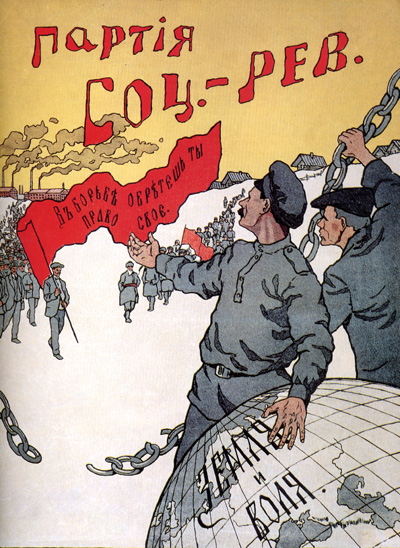
Socialist Revolutionary election poster, 1917. “Party of the Socialist Revolutionaries. Through struggle you will attain your rights. Land and freedom.” Courtesy of Wikimedia
The SR Alternative
Yaroslav Shimov Radio Svoboda
March 8, 2017
“On the morning of February 23, the workers who had reported to the factories and shops of the Vyborg District gradually downed tools and took to the streets in crowds, thus voicing their protest and discontent over bread shortages, which had been particularly acutely felt in the above-named factory district, where, according to local police, many had not had any bread whatsoever in recent days.”
Thus read a report by agents of the Okhrana on the first day of a revolution that forever changed Russia, February 23, 1917 (March 8, New Style).
Revolutionary events such as the unrest in Petrograd, which the bewildered tsarist regime failed to put down, Nicholas II’s abdication on March 2 (15) at Dno Station near Pskov, and the establishment of the Provisional Government were recalled by contemporaries as happening so swiftly that they were unable to understand where Russia was headed so wildly and who would ultimately benefit from the changes. In February 1917, no one would have predicted that less than year later the Bolsheviks, a radical faction of the Social Democrats who had been on the sidelines of Russian politics, would emerge victorious, and Bolshevik leaders themselves were no exception in this regard.
But an enormous thirst for social justice was apparent from the revolution’s outset. Russia had emerged a quite leftist country. In the stormy months following the monarchy’s fall, it transpired that a definite majority of the country’s citizens sympathized with socialist ideas in one form or another. This was reflected in the outcome of the first free elections in Russian history, which took place in the autumn, when the chaos and anarchy on the war front and the home front were obvious. The newly elected Constituent Assembly was meant to define the country’s future. The Socialist Revolutionaries (SRs), a party that had consistently, albeit violently and bloodily, waged war against the Romanov Dynasty, but in 1917 had favored peaceful but radical reforms, primarily land reforms, scored a convincing victory in the elections.
Soldiers who had gone over to the revolution and armed city dwellers on the streets of Petrograd, 1917
If the country had managed to slip past the threat of dictatorship, issuing from the left (the Bolsheviks) and from the right (radical counter-revolutonaries), the SRs would definitely have been post-revolutionary Russia’s ruling party for a time, argues Konstantin Morozov, a professor in the Institute of Social Sciences at RANEPA and convener of a permanent seminar, Leftists in Russia: History and Public Memory. In an interview with Radio Svoboda, he reflects on why this did not happen and what the SR alternative would have meant to Russia.
*****
What was the condition of the Socialist Revolutionary Party in February 1917?
I would say the the party was then in a state of organization disarray. A considerable part of its prominent leaders was abroad, while the other part was in prison, exile, and penal servitude. It had to be rebuilt from scratch, and it was the SRs who had withdrawn from revolutionary work in 1905–07 but who basically returned to the party in 1917 who mainly engaged in the rebuilding. It was they who organized all the party’s new cells. There were also serious problems among the SRs in terms of internal rifts, especially due to differing viewpoints on the war. In March, the SRs began to rebuild themselves as a single party, which was implemented subsequently at the party’s 3rd Congress in May and June. In my view, this was a mistake, because the disagreements within the party were such that it could not function, manage itself, and take decisions as a united party. A factional struggle immediately ensued. Accordingly, it ended in collapse and the inability to hew to a single internal party policy in 1917.
Due to the first phase of their history, the SRs are associated in the popular imagination with violence and terrorism, which they had long renounced by 1917. What were the views of the SRs and the leaders on violence as a principle of political struggle? The baggage of their terrorist pasts still haunted Viktor Chernov and other party leaders, after all. How did they view it in 1917?
The Socialist Revolutionary Party discussed the question of terrorism throughout its existence. At first, such figures as Mikhail Gots and Viktor Chernov, who advocated he inclusion of terror in the party’s tactics, had the upper hand. But even then the SRs included people who advocated a popular, mass-based party, who favored propaganda and agitation among the peasantry and proletariat rather than focusing on terror. Their ideal was a grassroots socialist party, something like the Second International’s exemplary party, the German Social Democracy. It went from bad to worse. During the 1905 Revolution, the party’s grassroots combat squads were keen on practicing expropriation and many other things that party leaders dubbed “revolutionary hooliganism.” But after 1909–11, in the aftermath of Evno Azef‘s exposure, the voices of those SRs who had argued for giving up terrorism grew ever stronger. By February 1917, there was no longer any talk of terror. The last terrorist act carried out by SRs had taken place in 1911, after which they basically ceased engaging in terrorism. Terrorist sentiments in the Socialist Revolutionary Party were resurrected only in the wake of October 1917, especially after the Bolsheviks forcibly disbanded the Constituent Assembly. Even then, however, the greater number of SR leaders were against engaging in terrorism against the Bolsheviks. These SR leaders argued that first they had to get the grassroots on their side using the methods of a popular political party.
In his memoirs, Boris Savinkov quotes his friend Ivan Kalyayev, a member of the SR Combat Organization who killed the Grand Duke Sergei Alexandrovich. Kalyayev said that an SR without a bomb was not an SR. In reality, however, the majority of SRs were not involved in terrorism, and they would have disagreed with Kalyayev’s statement. It can be argued that use of terrorist tactics dealt a huge blow to the Socialist Revolutionaries who wanted the party to be a grassroots socialist party, a party that could carry out the will of Russia’s “triune working class” (in which the SRs included the proletariat, the working peasantry, and the working intelligentsia), and a party that proposed an evolutionary and democratic path to progress. Essentially, the SRs were not terrorists, of course. They had more or less given up terrorism in 1911. What mattered politically was that they were able to propose a program, both agrarian and federalist, that excited the sympathies of millions of people. By the autumn of 1917, the Socialist Revolutionary Party had more than a million members, while the Bolsheviks had only 350,000 members. Most important, the SRs won the elections to the Constituent Assembly, taking 41% of the vote.
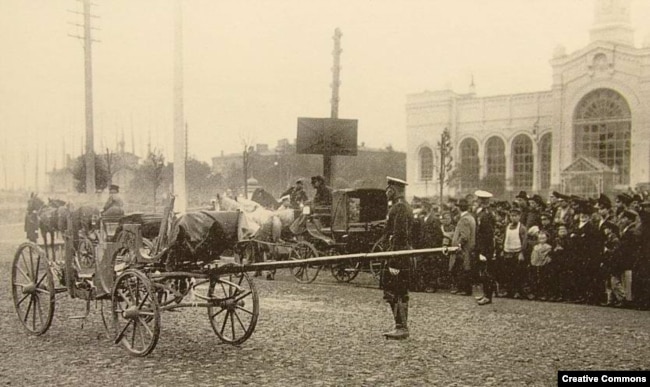
SR terrorism in the early 20th century: the carriage of Interior Minister Vyacheslav Pleve, killed on July 15 (28), 1904, in St. Petersburg
So 1917 was the heyday for the SRs: they had a million members, and they won the elections to the Constituent Assembly. Why, ultimately, were they unable to take advantage of this? How did it happen that the SRs, despite their popularity, ceded power to the Bolsheviks later as well, despite attempts to the contrary? What predetermined their failure?
There are two sets of causes, objective and subjective, meaning, the mistakes made by the SRs themselves. What I think is fundamentally important is that it is extremely difficult to campaign for democratic reforms while a world war is underway. The fact that the Revolution took place during the First World War considerably predetermined the entire subsequent course of events. What is a world war? On the one hand, it involves a collapse in living standards and a aggravation of all the contradictions that have been accumulating in society over decades. On the other hand, it involves millions of people getting used to killing other people. This causes quite serious psychological changes. Extreme cruelty is combined with societal expectations pushed to the limit. These expectations had amassed to such an extent that in 1917 very many people wanted everything right away. Say, workers were no longer satisfied they had trade unions that the selfsame socialists would meet halfway. The workers wanted more. They wanted control and management of the factories. Practically, the Mensheviks and SRs could not take this step, because it would have led to serious industrial management issues. And the peasants wanted the land right away.
Here we turn to the mistakes made by the Socialist Revolutionaries. It was wrong to delay the convocation of the Constituent Assembly. Rather, it was wrong to go along with the liberals in the Provisional Government, the Kadets, who tried to postpone the Constituent Assembly any way they could. The liberals realized the leftist parties were stronger. They would have an outright majority in the Constituent Assembly, and consequently the peasantry and proletariat would get much of what they had been demanding. So the Kadets postponed the Constituent Assembly. That was a big, serious mistake.
Did the subjective factor play a role in the fact that the SRs failed? Let’s take a closer look. On the one hand, they were a party who styled themselves as the party of “land and freedom.” They were supported by the peasants. On the other hand, most SR leaders were members of the urban intelligentsia, not the salt of the earth. Did this contradiction factor in the SR electoral victory, but one in which their supporters were unwilling to secure their political power?
It was a lot more interesting than that. The program for socializing land ownership, advocated by the SRs, did not fall out of the sky. It was the outcome of quite serious work on the part of Populist economists and sociologists. It was revenge, if you like, for the failure of the “going to the people” campaign of 1874. In the aftermath, Populist economists, sociologists, and statisticians undertook a serious study of how peasants really lived. Within twenty or thirty years, they had figured out how the Russian peasantry really lived and what it wanted. The SRs based their own land socialization program on this research. Moreover, the SRs tended not to act like typical Russian intelligentsia, who often preferred philosophizing and imposing their own values on others. The SRs always tried to maintain feedback from the peasantry. I came across a quite curious document, a survey of sorts, which the SR Central Committee sent out in 1906 or 1907 to their local organizations, who were supposed to conduct this sociological survey, which asked peasants about their attitudes towards the regime, the army, and the clergy, and what they thought about the land, and how it should be distributed and managed. So it was no wonder the Socialist Revolutionary Party and their program, crafted over many years and through the efforts of many people, were seen by the peasants as their party and their program. On the other hand, there was a fairly powerful peasant lobby in the Socialist Revolutionary Party. The grassroots level of party activists and functionaries consisted of the so-called popular intelligentsia: physician’s assistants, schoolteachers, agronomists, surveyors, and foresters.
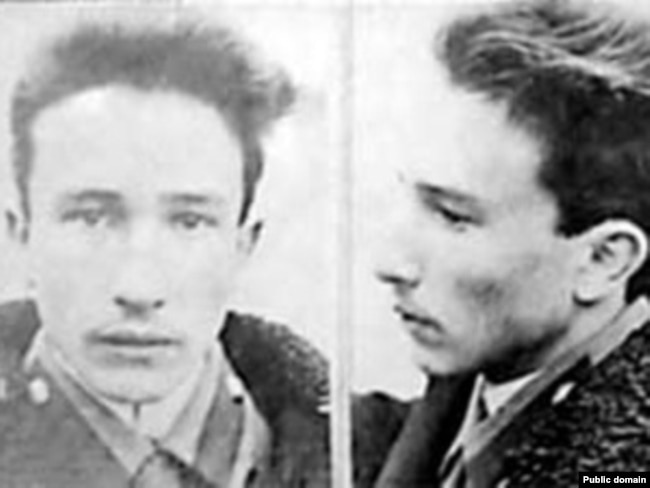
One of the most prominent SRs, Boris Savinkov, in his youth. Photos from his police file
The problem was that the SRs did not fully take the peasantry’s interests into account in 1917. The revolutionary authorities were afraid to cede land to the peasants, because, on the one hand, the army’s quartermasters argued that the supply of provisions to the army would immediately collapse. On the other hand, there were fears that the rank-and-file soldiers, who were actually peasants dressed in greatcoats, would immediately desert the front and run home. Later, at the party’s Fourth Congress, Yevgeniya Ratner, a member of the SR Central Committee, put it quite aptly. She said that for the war’s sake, for the front’s sake, they were forced into compromises with the bourgeois parties and thus were unable to defend the class interests of the peasantry and workers, and this was their huge guilt in the face of history. According to Ratner, they should have convoked the Constituent Assembly two or three month earlier, i.e., in August or September 1917, and set out to implement agrarian reforms. We should point out that some of the SRs had wanted to do this: Chernov, for example, insisted on it. There were ideas for forming a socialist government. In September 1917, the SR Central Committee was leaning towards this option.
By a socialist governmment, do you mean one that would have included all leftist parties, including the Bolsheviks?
There were two options. The first was the most leftist and quite adventuresome, or at least it seemed that way to the SRs themselves. It was proposed by Maria Spiridonova. She suggested the SRs should simply take power and form their own homogeneous SR government.
Meaning, they should have done what the Bolsheviks did finally?
It’s another matter that the Bolsheviks immediately set about tweaking their slogans and their actions. That is, they adopted the same slogans, but over time all of this was transformed into something else entirely. But getting back to the SRs, the majority of them wanted a coalition socialist government that would have included the Bolsheviks. At some point after October 1917, there were negotiations between the Bolsheviks and the socialist parties about forming such a government, but without Lenin and Trotsky. It was Lenin who in many ways destroyed this option. Was the formation of a socialist government a viable alternative if it had been agreed, say, in September? I think so. This would have been followed by elections to the Constituent Assembly, where the socialist parties obtained a majority. The SRs took the top spot, and the Bolsheviks won 25%, meaning they were the second largest faction. Clearly, they would have carried a lot of weight, but this course of events would, nevertheless, have made it possible to maintain a parliamentary democracy. Obviously, after a while, the SRs would have lost power in elections, as we see in Europe, where power swings back and forth between the right and the left. There was a chance then to set up a similar scheme for changing power through democratic procedures, via parliament. After all, the Constituent Assembly was highly regarded in society. It had been elected in the first genuinely free ballot in Russian history.
You have already touched a bit on the period after the Bolshevik coup. But let’s go back in time a bit. One of the key figures of 1917 was Alexander Kerensky. How did the other SRs regard him, and what role did he ultimately play in the party’s history?
It’s a very good question, but before answering it, I would like to voice a more general consideration. You just mentioned the “Bolshevik coup.” On the one hand, centrist and Right SRs used the term themselves. On the other hand, the Left SRs and anarchists would later come to favor the concept of a single Russian revolution that lasted from 1917 to 1921. That is, they saw it as a unified revolutionary process in which there was February and October, followed by the civil war. Currently, this is more or less how it is discussed. Those who rejected the concept argued that October 1917 was not a revolution on its own terms, because it did not involve a spontaneous popular movement. Until the early 1920s, the Bolsheviks themselves would also often speak of a coup, of their coup. But some of the SRs, Mark Vishnyak, for example, rightly noted, in my opinion, that the events of October 1917 could be interpreted as a sort of “staff revolution,” organized from above. It was a symbiosis of a revolutionary process with traits of a coup. When someone simply speaks of a coup, that is not entirely right, because there was definitely support from the workers and soldiers. Besides, the word “coup” itself suggests an analogy with Latin American-style military coups. Whatever the case, we must continue to make sense of those events conceptually.
What if we return to Kerensky?
The SR leadership definitely saw Kerensky as a fellow traveler, as the term was then. He had been in the SR movement during the Revolution of 1905–07. Elected as an MP to the State Duma, he tried to unite different Populist groups. On the other hand, some SRs might have simply envied him. Kerensky was one of the most popular people in Russia. Socialist Revolutionaries who had spent years fighting in the underground and building the party, wound up in the background, while he, who had declared himself an SR, was regarded by society in 1917 as the most important SR. Chernov had harsh things to say about Kerensky. According to Chernov, Kerensky played a quite negative role in the Socialist Revolutionary Party, because he had almost no contact with the SR leadership and did not follow the Central Committee’s instructions. The Right SRs and right-centrists supported Kerensky, while the Left SRs tried to break with him. At the party’s Third Congress, in May and June 1917, the Left SRs sabotaged Kerensky’s election to the party’s Central Committee. He was rejected outright. It was a real slap in the face.
Alexander Kerensky, chair of the Provisional Government, was a symbol of democratic Russia and its collapse in 1917.
What does that tell us? That, unlike the Bolsheviks, the SRs were not a leaderist party, remaining a more collectivist force?
Democrats are generally less inclined to leaderism, and this was fully borne out by the SRs. This does not mean there were no authoritarians among the SRs. It was another matter that the leaders had to adapt to the moods and ideas of the revolutionary milieu, to the subculture of the Russian revolutionary movement. The notions of decentralization, self-reliance, and independence fromthe leadership were quite strong in the Socialist Revolutionary Party. Initially, they had a sort of collective leadership. At various times, it consisted of different people, usually three or four people. Plus, we have to speak here of three or four generations of SRs. The first generation had been been members of the People’s Will, while the last generation joined the party in 1923–24. Meaning, we are looking at a fairly complicated picture. But generally, yes, there was no single leader. Many historians and contemporaries were of the opinion this was a cause of the failure of the SRs in 1917. Chernov argued that if Gots and Grigory Gershuni had still been alive, the three of them could have led the party in 1917. Gershuni was highly charismatic, even more charismatic than Lenin, and perhaps he would have had a chance to keep the party under control. On the one hand, there is a certain point to these hypotheses, but we have to consider the weakness and division existing within the party at the time of the revolution, in particular, the strong differences between the SRs on the issue of the war. Very many people regarded Chernov as a good theorist, but not as a leader and organizer. However, he had the outstanding ability to reconcile different points of view, and he played a unifying role. His opponents dubbed him the “universal bandage.”
Let’s try and sum up. Should we regard the SRs as a failed historical alternative to Bolshevism? Or, given their looseness and perennial internal division, did the SRs nevertheless lack the strength, ideas, and people to lay claim to a truly great historical role?
I think that victory in the elections to the Constituent Assembly, in which they received a plurality and, in fact, adopted the first two laws, including the law socializing land ownership, were in fact the beginnings of a democratic alternative, an SR alternative. Would they have been able to lead the country down this road? I support the viewpoint of my German colleague Manfred Hildermeier, who as early as 1992 wrote in an article that, since one of Russian’s main problems was the huge gap between city and country, the SRs were well suited to play the role of a party voicing the interests of the peasantry, proletariat, and intelligentsia. I would also add we should not exaggerate the extreme peasantness of the Socialist Revolutionary Party. If you look at their program, you see they attempted to unite a European conception of socialism with certain nativist ideas. They argued that the peasantry’s skull was no worse than the skulls of the proletariat and intelligentsia, and was quite capable of taking the ideas of socialism on board. It was one of the first attempts in the world to fuse European values and ideas of modernization with the values of a traditional society, to merge a significant part of the Russian peasantry into the new society as painlessly as possible. The SRs assumed that for many decades to come progress would follow the bourgeois path and there would be a market economy: socialism would not soon emerge. In this sense, they were evolutionists. They were essentially the first to propose an idea that is currently quite fashionable around the world, the idea of peripheral capitalism, according to which capitalism in developed countries and capitalism in second-tier and third-tier countries are completely different things. In peripheral capitalist countries, including Russia, capitalism shows it most predatory features and is the most destructive.
Maria Spiridonova, future leader of the Left SRs, in her youth
The SRs also argued the Russian people were definitely capable of adapting to democracy. Moreover, they thought that the Russian traditions of liberty and community self-government afforded an opportunity for magnificent democratic progress as such. The SRs wanted to unlock the people’s democratic collectivist potential. By the way, they did not idealize the peasant commune, arguing it had to be transformed, of course. They counted on the cooperative movement, which had progressed quite powerfully in early twentieth-century Russia. It was entirely under the ideological leadership of the SRs. They believed it was necessary to rely on the working peasant economy. It would then be possible to modernize the country and eventually follow a socialist path. The main thing was that despite a certain utopianism to their views, the SRs were capable of evolving, of course. Another important thing was that the SRs, more than the other parties, were capable of acting as a venue for reconciling different interests. This is basically the road European social democracy took. However, the party’s looseness and internal conflicts were important features of its history. I think that sooner or later the Socialist Revolutionary Part would definitely have split into several parties. If we speak of the SRs as a democratic alternative, then the Maximalists and Left SRs do not fit this bill. Unlike the other SRs, they cannot be considered adherents of democratic socialism. By the way, the SRs and Mensheviks used this term quite vigorously from the 1920s onwards. Later, in the mid twentieth century, the European socialist parties would also speak of democratic socialist values. From this perspective, some SRs and Mensheviks were, undoubtedly, adherents of democratic socialism, which gave rise to the Socialist International.
********
The demise of the Socialist Revolutionary Party was tragic. During the Russian Civil War, the SRs finally split. The Right SRs were involved in the anti-Bolshevik movement, while the Left SRs tended to collaborate with the Bolsheviks. In the summer of 1918, however, finally convinced that Lenin and his entourage were taking Russia down the road to dictatorship, the Left SRs undertook a failed attempt to overthrow “commissarocracy,” their term for the Communist regime. In the 1920s, the party was finally finished off. In the summer of 1922, twelve SR leaders were sentenced to death at a special trial. The executions, however, were postponed, turning the convicts into hostages in case the remnants of the Socialist Revolutionary Party decided to return to its terrorist methods, now against the Communist regime. One SR leader, Yevgeniya Ratner, was held in prison with her young son, causing her to complain to Dzerzhinsky. Subsequently, their death sentences were commuted to various terms of imprisonment and exile. Most prominent SRs who stayed in Russia were victims of the Stalinist crackdowns. Several former SRs, including Maria Spiridonova and her husband Ilya Mayorov, were among those massacred in the Medvedev Forest, outside Orlyov, in September 1941.
Translated by the Russian Reader. Thanks to Comrade Koganzon for the heads-up
A Toilet for the Investigator
Tatyana Voltskaya Radio Svoboda
November 30, 2016
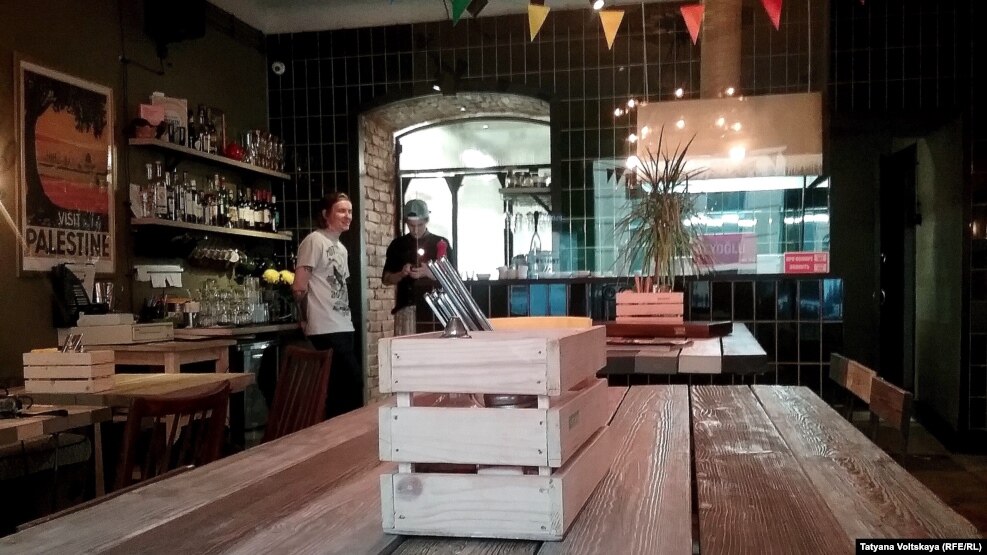
Inside the Café Beirut. Photo courtesy of Tatyana Voltskaya/RFE/RL
Criminal charges have been brought against the co-owner of the Café Beirut in Petersburg; on November 29, police searched her home. In September and October, the café was searched on several occasions by Investigative Committee, Rospotrebnadzor, and Emergencies Ministry officers.
The café believes the only cause of its woes is a casual patron who tried to use the establishment’s toilet last summer, but was turned away.
There is generally nothing wrong about popping into a café to use the toilet. The employees of the Café Beirut say they would never turn away polite, friendly visitors. But when an individual makes noise, swears, and might make a less than pleasant impression on diners, they do not see fit to let him in. Thus, this past July, they turned away a young man who, they say, behaved just this way.
On September 7, investigators, Rospotrebnadzor inspectors, and Emergencies Ministry officers raided the café and searched it. An employee recognized the young investigator leading the raid as the same young man who had unsuccessfully tried to use the Beirut’s toilet in summer.
Another search took place on September 23, resulting in the completely undocumented confiscation of the establishment’s cash register, computer server, order terminal, and charter documents, meaning everything they needed to stay in business. The café was closed for a whole week, but then it opened again, having suffered considerable losses, of course.
But that was not the end of the matter. On November 29, police searched the home of the café’s co-owner Elizaveta Izvozchikova, who has been charged with violating Article 238 of the Criminal Code (“Production, storage, transport or sale of goods and products, works or services that do not meet safety requirements”). According to Izvozchikova, the female investigator who led the search rang at her apartment at seven in the morning.
“She came to my apartment accompanied by an officer of the economic crimes department district office and two official witnesses. They served me with a search warrant, which made it clear to me that criminal charges had been filed against me under Article 238. The article says nothing about harming anyone, only about providing poor-quality services. To file charges under this article, it is sufficient to record violations of some kind, say, sanitation rules. We quickly fixed all the violations for which we had been cited and submitted a report to the Investigative Committee. After all, we opened just recently, in late February of this year. We did a major overhaul and replaced all the plumbing, sewerage, and electrical wires. The basement was in bad shape. Then we restored the historic storefront, made high-quality repairs inside, and installed new equipment in the kitchen. We wanted to do something good for people, feed them tasty food and give them good service. I am a designer by education, and I really wanted to make the café pretty. I am a responsibe person, so I tried to make sure everything was in order: that the fire extinguisher was certified, that the kitchen was clean, that we followed all the rules. But on September 7 we had our first inspection. The investigator from the Investigative Committee forced everyone outside and demanded we sign papers of some of kind without reading them. Otherwise, he threatened us with immediate closure and put a lot of pressure on my manager, who is fairly young.”
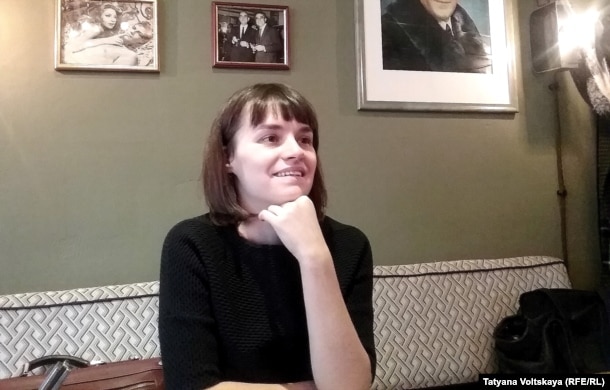
Café Beirut co-owner Elizaveta Izvozchikova. Photo courtesy of Tatyana Voltskaya/RFE/RL
I asked what the reason for the first inspection was.
“My internal investigation revealed that our manager had seen the young man who turned out to be an investigator: he had not let him use our toilet. We had guests, he had demanded to use the toilet in a rude way, waving his arms and cursing, so he was not allowed to use the toilet. The second inspection, headed by this investigator, took place on September 23. He confiscated the cash register and a bunch of other things. The investigation was then terminated. Later, however, the decision to terminate the investigation was annulled, the case file was submitted for an additional investigation, and another inspection was organized. Rospotrebnadzor and the Emergencies Ministry cited us for four violations. We immediately fixed two of the problems: we installed a missing washbasin and a germicidal lamp. But the other two violations were simply nonexistent. We were told our doors had to be at least one meter wide, and we had to have a second emergency exit. According to fire safety rules, however, wide doors and a second exit are obligatory only for premises larger than one hundred square meters, and if there are over fifty evacuees, but our place seats only thirty people. We explained everything to them and attached documents to our reports, including the cadastral passport, which shows we have only sixty-three square meters of space. We also requested that everything they had confiscated be returned to us, as they had nothing to do with the inspection. Instead of a response, however, criminal charges have been filed. The charges are based on those same two violations, turned up by the Emergencies Ministry, but I do not believe that the Emergencies Ministry officer was unfamiliar with the rules in question. The third violation consisted in the fact that, according to Rospotrebnadzor, we had no right to worked with unpeeled root vegetables; this requires a separate bath or even a whole room. So we ordered peeled root vegetables, meaning we started using prepared food, which we immediately reported to the authorities. But it made no difference at all. I was summoned for interrogation on November 29, but I refused to answer the questions in order to better familiarize myself with the charge sheet. So I will be going to the Investigative Committee on Monday, December 5. While the inspections were going on, we made huge losses. We were closed for an entire week, and many of our clients even now think we are still closed. Nothing like this has ever happened to any of my colleagues, and I continue to hope for justice. We have not violated any law. We are conscientious taxpayers and entrepreneurs who are trying to run a small business, and we do no harm to anyone,” says Elizaveta Izvozchikova.
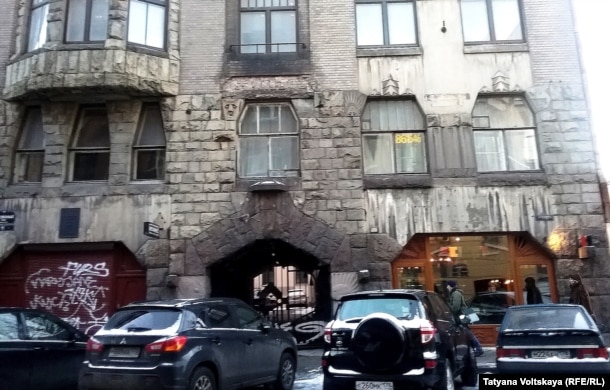
Restored historical storefront at the Café Beirut (right). Photo courtesy of Tatyana Voltskaya/RFE/RL
Lawyer Boris Gruzd argues that criminal prosecution has not been used for its intended purpose in this case.
“I think that criminal charges are sometimes filed on insufficient grounds and used for other purposes, as a means of revenge, for dealing with undesirable persons. I think this is one of those cases. It often happens that, even when criminal law has seemingly been violated, it is extremely hard to file criminal charges. An enormous amount of effort is made to turn even obvious crimes into criminal cases. But here criminal charges have been filed out of thin air, so to speak. Because, when criminal charges are filed, aside from violation of the law, another important element is danger to the public. In this case, however, they have found fault with a telegraph pole, as the saying goes. I am sure you could find a dozen such violations in any small business and major state company. What public good has been violated that it is necessary to resort to criminal prosecution? It is a last resort that should be used very selectively and carefully, when other tools do not work. This is a classic case of ‘nightmarizing business.'”
I asked Gruzd whether there was any hope of punishing those who spin such cases out of thin air.
“It is necessary to take steps in this direction. It produces a particularly sharp contrast with the notorious case of the women who was murdered although she called the police because her [ex-]partner had threatened her. But the dispatcher, the best beat cop in the city, told her that if and when she was killed, they would come and describe her corpse. Here, the Investigative Committee, whose remit is grave and especially grave crimes, has pounced on a café. So they have the time and the energy to deal with this nonsense?” notes Gruzd.
Alexander Kobrinsky, a member of the fifth convocation of the St. Petersburg Legislative Assembly, says the persecution of the Café Beirut’s co-owner is not something out of the ordinary in Russia.
“Recently, everyone watched the video in which security guards tried to keep a drunk man, who turned out to be a police officer, from entering a café. A while later, the riot cops arrived and detained the security guards, who were just doing their jobs. But the situation is understandable, because law enforcement officers consider themselves a superior caste, endowed with special rights, including the right to cook up criminal cases as a means of personal revenge. It is quite widespread, since the law allows them to file criminal charges, suspend business operations, and confiscate tools, computers, whatever. Maybe the charges will be dropped a year from now, but getting a business back up on its feet after such shocks is not always possible. That is why, by the way, prohibiting the detention of people involved in commerce and seizure of their property has now been actively discussed. What point have we reached to openly admit that the vast majority of criminal charges filed against businessmen in Russia is based on mercenary motives and revenge! Clearly there are thieves and con men, but it turns out that they constitute the minority of defendants in such cases. Such is the system and such is the law. We see that a completely peculiar set of circumstances has been established in Russia. I don’t know, maybe Putin was speaking sincerely about the investment climate, but there is no longer any way of manually managing hundreds of thousands of these minor strongmen. In Russia, every police capitan, assistant investigator, and junior assistanct prosecutor is a low-level power broker. They are used to living this way: they have been living this way for a quarter of a century. And they do not want to live any other way, no matter what Putin has said,” argues Kobrinsky.
According to Kobrinsky, this mindset—that I am a landlord, and you are my slaves—is very difficult to eradicate. One has the impression that the head of state seemingly has no leverage over Russia’s law enforcement system, that it must be completely dismantled and reassembled anew.
On November 29, Elizaveta Izvozchikova was released on her own recognizance.
Historian Alexey Petrov. Photo courtesy of Radio Svoboda
Historian Alexey Petrov Fired from Irkutsk State University Radio Svoboda
November 16, 2016
Alexey Petrov, deputy dean of the history department at Irkutsk State University has been fired from his job, allegedly for engaging in public activism to the detriment of his work as an educator. As Petrov reported on Facebook on Wednesday, his work book* was brought directly to his workplace.
Petrov heads the regional branch of Golos, a grassroots organization that combats electoral fruade. He is also renowned as organizer of the project Walks through Old Irkutsk.
The dismissal has come in the wake of an inspection of the university by the prosecutor’s office, which was instigated by the so-called Trade Union of Independent Citizens, our correspondent reports. Two complaints were sent to the prosecutor’s office. The first complaint, which was anonymous, states that Petrov, deputy dean of the ISU history department, publicly presents and promotes insufficiently patriotric views during his lectures. The second letter, signed by Sergei Poznikov, focuses on the historian’s absences from the deans’ offices at the university during working hours and his frequent trips overseas.
The complaints against the “excessively liberal-minded historian” were made to the prosecutor’s officer after the Russian Congress of University Vice Chancellors for Morale and Discipline, in October, at which a program for assessing the “protest potential” of students and professors was presented.
* “Every person working for an employer in Russia is issued a work book by the person’s original employer. A work book contains the record of a person’s employment history, dates of employment, as well as other information. Employers have the duty to keep and timely update an employee’s work book while the employee is working for the employer. On the employee’s final day of employment with an employer, the employer must complete and return the employee’s work book, against the employee’s signature.” Source: Multitran
Translated by the Russian Reader. Thanks to Comrade AT for the heads-up
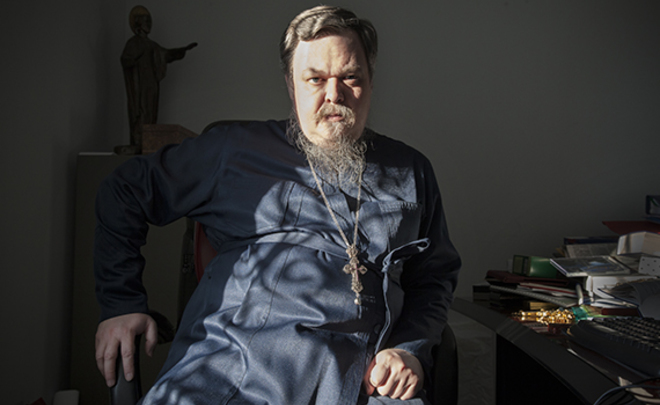
Father Vsevolod Chaplin, the Russian Orthodox priest who recently argued on Russian radio station Echo of Moscow that it was sometimes necessary and possible to “destroy” whole groups of people as “internal enemies.” Photo courtesy of Realnoye Vremya and Anna Artemieva (novayagazeta.ru)
“For the Church, Violence Is the Norm”
Valentin Baryshnikov Radio Svoboda
August 16, 2016
Father Vsevolod Chaplin, long-time head of the Moscow Patriarchate’s Synodal Department for Cooperation between Church and Society, made an appearance on Echo of Moscow radio in which he shocked many people by saying that some people “can and should be killed.”
Here is an excerpt of Father Chaplain’s appearance on Echo, which began with a discussion of erecting a monument to Ivan the Terrible in Oryol.
Presenter: Yes, but with that rationale you can also justify Stalin, for example. Sure, there were excesses, but he was an effective manager, they say.
Vsevolod Chaplin: He did a lot. Listen, at the end of the day what is wrong with destroying a certain number of internal enemies?
Presenter: “Destroying” people, that is what is wrong.
Vsevolod Chaplin: What is wrong with that?
Presenter: You cannot kill people!
Vsevolod Chaplin: Why not? Some people can and should be killed. That is for sure.
Presenter: “Some people”? Which ones are those?
Vsevolod Chaplin: So it is no accident that criminals are destroyed, and no accident—
Presenter: I would remind you the death penalty has been abolished in Russia.*
Vsevolod Chaplin: I am not sure that was the right decision. Look, even God, if we read the Old Testament, if we read the Apocalypse, that is, the New Testament, directly sanctioned and sanctions in the future the destruction of a huge number of people for the edification of others. For the edification of societies, it is sometimes necessary to destroy a certain number of people who deserve to be destroyed.
* In fact, capital punishment has not been abolished in the Russian Federation. President Yeltsin placed a moratorium on the death penalty in 1996 so that Russia could meet the requirements for joining the Council of Europe. The moratorium has remained in effect since then, but the death penalty is still listed in the law books as a legal punishment for certain crimes. TRR
When asked whether Chaplin’s statement was his personal opinion or a reflection of conversations within the Russian Orthodox Church (ROC), Nikolay Mitrokhin, a sociologist of religion and author of the book The Russian Orthodox Church: Its Current State and Challenges, confidently replied that church insiders think this way.
Nikolay Mitrokhin: The majority of rank-and-file clergy and the bishops are quite militantly minded. They do not rule out violence. Violence is the norm in ecclesiastical practice. Bishops hit priests who do something wrong on the altar. Its is a popular subject of stories told within the Church. In turn, priests are capable of hitting sacristans and subdeacons. The Church is now also the leading social institution that has come out against so-called juvenile justice, in other words, against bans on beating children. So for the Church, violence is the norm. The Church supports militarist rhetoric. The Church supports the numerous military-patriotic clubs operating under its auspices. If you chat with a rank-and-file priest, he will surely talk like Chaplin or worse. It is another question whether it was worth putting Chaplin on the radio and giving his cannibalistic ideas a platform. However, that is the stance of Echo of Moscow, which has given various kinds of fascists the chance to speak out on its airwaves. Let us not forget that several right-wing radicals have their own programs on the station. So it all fits, in the first place, not only the mindset of the ROC but also the mindset of Echo of Moscow.
Echo of Moscow actually plans not to publish the transcript of this speech and, as far as I can tell, will not be inviting Father Chaplin on the air again.
With Chaplin’s appearance, they have reached a point where a lot of people have wondered whether the prosecutor’s office is asleep at the wheel and whether they should not file a complaint against Echo of Moscow radio station. In this case, they face quite specific criminal charges. But the reason they invited Chaplin to appear on the air is itself quite obvious. Yet again they had to rile up the liberal public with harsh statements so that a discussion would emerge around them. They are not shy about inviting someone who on several occasions has voiced his tough and, quite frankly, fascist stance. So I think this was a big mistake on the part of Echo of Moscow, which is no less liable for the statements than the person who made them.
When Chaplin says this, when priests en masse within the ROC hold such positions, does this somehow link up in their minds, if I can put it is this way, with the concept of Jesus Christ, who spoke of love and non-violence?
As we know, there is no Christ in the ROC. There is Orthodoxy in the ROC, but there is no Christ in the Church in the sense in which the idea of Christ was shaped by the Russian intelligentsia in the early twentieth century. For centuries, the phrase that Jesus is love just did not make sense. It was not a subject the clergy considered. From that point of view, it is not clear why it should be considered now. The concepts that the liberal intelligentsia have been attempting to discuss are all seemingly variations on western Christianity, so-called post-Holocaust thought, which has nothing to do with what the majority of the ROC’s ordinary parishioners think and believe. They see Orthodoxy as the national religion, which provides them with spiritual strength to oppose the “godless” west, and so on. So Chaplin, who was driven from his post in the Church, deliberately shocked the audience by divulging what the conservative half of his brain thinks. The audience talked about it. Basically, though, any average Russian priest, whomever you approach, thinks exactly the same thing.
Does it come from the Church? Or does the Church trail behind its flock?
It comes from the Church, of course. Within the Church there has long existed a concept, which has been its main content, that has to do with Russian nationalism and militarism. The vast majority of the clergy espouse these ideas and communicate them to parishioners in one form or another. It is another matter to what extent the Church’s leadership controls all of this. To what extent are the clergy permitted to speak out or keep quiet about political issues? This is something that the Church’s leadership monitors. When it wanted the ROC to have a fairly decent image in Ukraine, priests were told they should not travel to Ukraine and help the separatists. A couple of people who violated the ban were banned from the ministry. The Russian clergy immediately began speaking carefully about Ukraine. The clergy can keep thinking as aggressively as it likes. The question is the things it will say in ordinary life. This is something that can be regulated both by society and the state.
Let us come back later to the question of regulation on the part of society and the sate. Let’s talk about the situation within the Church. Are there priests who follow the idea that God is love?
This is a concept common among a very narrow segment of Moscow and Petersburg intelligentsia, among university-educated intellectuals in the broad sense. The majority of clergymen have no secular education whatsoever (I mean higher education), and they have had a very average secondary education. Many of them either do not know about this concept or regard it as a bit of intellectualizing. There are individual priests (among the ROC’s 20,000 priests you might find several hundred, at best) who espouse this concept. But they are outside the mainstream of the Church and do not constitute a respected or influential minority.
Are they persecuted within the Church?
No, but these ideas are so remote from what priests really do it is impossible to say they in any way define the life of the Church. Especially because ideas of this sort are clearly articulated only by individual priests, priests who are closely associated, again, with liberal circles. One level down, in the provinces, a priest can very well tell his parishioners that Christ is love while running a military-patriotic club. It all gels perfectly in their minds depending on their personal views and the last book they read ten years ago. Nothing contradicts anything else. That is why priests with distinctly liberal views who are willing to say that God is love amount to a dozen. They are known to journalists, who turn to them all the time. Beyond the confines of this narrow circle, such concepts are not particularly popular, and they are not subjects of conversation.
The real life of the clergy and the real ideas in their minds are so diverse, so not amenable to systematization, that we can speak of a society, an ideology, that is in fact unknown to us. We can speak of their militarism. But for some priests this militarism is clearly defined—they wear camouflage all the time except during services—while other priests have these ideas in their heads, but they do not express them too publicly, because they think they should say something else to their parishes. In addition, there are the changes that come with age. When they are young, people’s blood runs hotter. As they age, they become smarter, but in old age, on the contrary, they lose their heads, senility sets in, and they can say things that completely contradict what they had said fifteen or twenty years earlier. For example, Father Dmitry Dudko became a communist in old age, although his whole life he was a harsh anti-communist. It is a dynamic environment of generally anti-liberal ideas, but certain noble notions can be found in what they think or say.
What about the natural objection that, in the twentieth century, a huge number of Russian Orthodox priests were murdered by the Bolsheviks on the same grounds that Father Chaplin cited? Does this objection just have no effect on these people? Do they not feel they are the successors to those priests, to the church that was destroyed by this massive crackdown?
They feel like this when it suits them. When they have to argue with the former collective farm chair and current local council head that the church needs paint, they remember the new martyrs. Generally, a person who is willing to remember the new martyrs was probably a Party or Communist Youth League member or even a political officer in the Soviet Army (that is a quite common case) or a local university graduate who wrote pro-Soviet articles. The fact is that there are very few people directly associated with the new martyrs in Russia, and there are fewer of them as the years go by. The bulk of the Church consists of former Soviet people who until 1991 believed in socialist ideas of some kind, were card-carrying Party members, were involved in political organizations, and did not give a second thought to anything religious. Ideas about the regime’s responsibility, ideas about the memory of the mass repressions, all had some importance in the late 1980s, but then quickly came to naught. In this case, what is urgent for the ROC is the question of so-called post-Holocaust thought that the intelligentsia has proposed, meaning the awareness of guilt and the needlessness of so many victims, but the Church has consistently rejected all this now. It believes you can kill, but you have to pick the right group to kill, as Chaplin said. This is the basis of the current ROC’s ideology.
The other day, a friend of mine who works with kids complained to me that kids in Russia had no real heroes. Like kids most everywhere, they are in love with the wretched, hyper-commercialized Spider-Man and Harry Potter, not with homegrown heroes.
It might be a bit of a reach (because how do you explain this stuff to kids?), but from where I sit there are lots of heroes in modern Russia. Prominent among them are all the people convicted as part of the shameful sham known as the Bolotnaya Square case.
One of those heroes is Sergei Krivov, recently released after serving over four years in prison for the nonexistent crimes of being beaten over the head with a truncheon by a policeman and attempting nonviolently to prevent policemen from doing the same to other peaceable demonstrators in Moscow on May 6, 2012.
In the country I would like to live in, I would go outside and see dozens of people wearing t-shirts with Krivov’s totally ordinary but heroic face emblazoned on them. Krivov’s birthday would be a minor holiday, celebrated with a rousing march down every town’s main thoroughfare, followed by hearty little picnics, to celebrate the fact that Krivov undertook two hunger strikes, nearly dying in the attempt, in order to defend the freedom of speech and assembly in Russia.
Needless to say, Krivov’s would be a household name. Kids would read comics about the adventures of Sergei Krivov, where the hard facts would be mixed with a light helping of fantasy to make them more palatable to childish fancy.
If you have never heard of Sergei Krivov or don’t understand why he is a modern-day Russian hero, you need to read this interview with him. TRR
Sergei Krivov, Nikulinsky District Court, Moscow, December 23, 2013. Photo courtesy of Radio Svoboda and TASS
“It Is Not Recommended to Live in This Country”
Natalia Dzhanpoladova and Nikita Tatarsky Radio Svoboda
July 26, 2016
Yet another person convicted in the so-called Bolotnaya Square case, Sergei Krivov, a 54-year-old with a Ph.D. in physics and mathematics, has been released. Krivov was released from a prison colony in Bryansk Region, having served his sentence in full. In 2014, a court found him guilty of involvement in rioting and using force against police officers during a May 6, 2012, opposition rally on Bolotnaya Square in Moscow.
Krivov received one of the harshest sentences in the case, three years and nine months imprisonment.
His allies explained this was because the authorities avenged Krivov for the uncompromising stand he had taken throughout the trial. Krivov went on two lengthy hunger strikes. The first, to protest his arrest, lasted over forty days. During the second, he did not eat for sixty days in order to secure transcripts of the court proceedings. Krivov suffered two heart attacks during the second hunger strike.
Krivov was arrested as part of the Bolotnaya Square investigation several months after the events, in October 2012. According to police investigators, on May 6, 2012, when the crowd broke through police lines, Krivov seized a rubber truncheon from a policeman and used it to deliver several blows to police officers. Krivov himself repeatedly claimed he had been beaten by police on Bolotnaya Square, but the Investigative Committee refused to investigate his complaint.
Krivov served his sentence in two penal colonies in Bryansk Region, first at a correctional facility in Starodub. He was then transferred to a penal colony in Klintsy. The wardens put him in solitary, because they felt his life was in danger.
In an interview with Radio Svoboda, Kriov admitted his sentence might have been shorter had he “kept [his] mouth shut.” He spoke in detail about the reasons for his uncompromising stance, what happened on Bolotnaya Square, and how much Russia has changed since 2012.
The changes have been quite huge, and for the worse, although I still cannot say I have figured out what is what. I had been gradually following these changes by watching TV and reading Novaya Gazeta newspaper and New Times magazine, so they did not happen all at once for me and were not news. Nevertheless, I am perfectly aware the country as it was in 2012 and the country as it is in 2016 are two fundamentally different countries. There are far fewer freedoms, naturally, and It is nearly impossible to do anything within this framework.
Do you feel you have changed over these years?
In fact, after I got out, changed my clothes, and bathed, I had the feeling everything was as it had been. Although I did have big problems during the middle of my sentence: lots of things happened. But when it is all behind me, when I have come back to the “free” world, I cannot say I have changed. I think I am the same person I was.
Have you managed to meet with friends and relatives since your release? What are your impressions from these meetings and conversations?
Of course I have managed to meet with them. Let me put it is this way: almost no has chewed me out, except my wife, of course. In general, the feelings have been positive, because everyone has been friendly. They all congratulate me and wish me the best.
Naturally, anyone would find this pleasant. I want to say thank you to all the people who wrote me letters, held pickets, and collected money through the Internet, and to the leaders of the PARNAS Party, who paid my lawyers and sent me care packages: Boris Nemtsov, Mikhail Kasyanov, Vladimir Ryzhkov, and Ilya Yashin. In addition, Lyudmila Alexeyeva was involved. Despite her age, she attended the court hearings. A big thank-you to everyone for their support.
Last Wednesday, you also met with activists in Sokolniki Park. You mentioned you had no hope of being paroled. [In March, the court turned down Krivov’s parole application — Radio Svoboda.] Did you pin any hopes on the court in this case, that is, the trial court that heard the Bolotnaya Square case?
No. We had no chance from the get-go. What would have been the point of cooking all this up and then releasing us later? Obviously, the authorities conceived a quite definite plan, and they have been carrying it out. From my point of view, there was no reason to change anything, and nothing changed. I had been detained on misdemeanor charges several times., and I knew perfectly well how such matters were decided. There were no doubts in this case.
And yet your tactics in court were quite different from those of the other fellows. You were one of the most active participants in all the court proceedings.
Yes, I was, because I felt it could not make things any worse. That is how it happened, if you look at the sentences handed down. Naturally, my sentence would have been shorter if I had kept my mouth shut. But here, you know, six months more, six months less do not matter. Naturally, we had to defend ourselves to the hilt. After all, we did not take to the streets only to snitch on the protest movement, to put it crudely. We did not do what we did to make the court rule in our favor. It was a continuation of the protest. Pavlensky said it: court is a continuation of my protest action. For me, it was simply a continuation of the opposition’s fight. It can happen anywhere: in court, outside of court, on Bolotnaya, away from Bolotnaya. It is like a way of thinking. It is as Solzhenitsyn put it: “Not living a lie.” Every single moment you do what you think is right. The situation changes, but the individual does not change in the situation.
Were your fairly long, serious hunger strikes also a continuation of this same story?
Basically, yes.
What prompted you to do it? Do you remember what you felt when you decided there were no other methods left?
During both hunger strikes, I was perfectly aware my demands would not be met. I got carried away with the second hunger strike: let’s put it that way. But retreating? Chapayev never retreated. So the only way was forward. The main objective was to attract attention, to shake up the situation somehow. Because getting results, especially in the first case, when it was a matter of custody measures, was totally unrealistic. All I was charged with (not what I did, but what I was charged with) was causing the bruise on the back of the hand of a policeman who in fact assaulted me. The policeman’s name is Alexander Ivanovich Algunov. He completely flagrantly hit me over the head with a truncheon. I had three lumps on my head, one of which clearly visible on my temple. It was both videotaped and photographed. And there were eyewitnesses who saw everything.
Sergei Krivov during a hunger strike, Nikulinsky District Court, Moscow, November 2013. Photo courtesy of TASS and Radio Svoboda
But when it was matter of conducting a judicial review or investigatining this conflict… The bruise I allegedly caused the policeman was investigated by the Investigative Committee of Russia, meaning the country’s top investigative body. But what he did to me (and they believe that these actions took place at the same time) has been investigated by another committee. When I filed a written complaint against the officer, the case was not just dropped down to the municipal level, but to a neighborhood precinct, where an investigator wrote there was nothing to investigate. The bruise on the policeman’s hand was investigated by the Investigative Committee of Russia, while beating a person with a truncheon was investigated by a completely different division, the lowest on the totem pole, and it said there was nothing to investigate. I am simply a victim in the Bolotnaya Square case. But I was really visible in the video footage. I was in a confrontation with a policeman who was assaulting me. I grabbed the truncheon with which he was beating me, because at one point I nearly fainted. He hit me so hard on the head it felt like I had been hit with a sharp nail, not a truncheon.
You were not the only victim on Bolotnaya Square, and yet the authorities investigated these incidents so unfairly. How do you explain this?
In the trial documents, for example, there is this bit of evidence. There were two ambulance crews on duty on Bolotnaya Square. They kept a record of injuries in which they wrote down the names and addresses of everyone whom they examined. As far as I remember, there are forty-eight civilians in this list, who suffered something like seventeen concussions and thirteen head injuries and injuries to the soft part of the skull, meaning they had mainly been beaten on the head. There were three policemen who sought medical attention on the square. Of the forty-eight civilians, only two people were deemed injured parties by the authorities. One was hit in the back with a stone, while the other person’s trousers caught fire, and he suffered burns on his leg from a Molotov cocktail. We do not know who threw the bottle or the stone. The authorities assume it was the protesters, so only two individuals were deemed victims. The rest were not recognized as victims, because these forty-six individuals were victims of the police. Who the heck is going to investigate injuries caused by the police? That is not how things are done.
The public commission who investigated the events on Bolotnaya Square came to the conclusion it was the Moscow authorities and police who provoked the confrontation? Do you share this point of view?
I also came to the same conclusion. Only I think it was not the Moscow authorities, but the federal authorities [who provoked the conflict]. Moscow, in this case, did not have the authority to decide these questions. There were provocateurs there. I saw a man in a mask step forward, chunks of asphalt in both hands. At the time, I wondered what was so black, because I was looking into the light. At first, I thought he was throwing black earth, because the asphalt everywhere was so clean. This guy stepped forward and tossed one stone. Then he shifted a second stone [to his throwing hand] and threw the second stone. A policeman was standing there. I was standing there looking back and forth between the two. Either I should have said, “Why are you tossing stones?” or I should have gone up to the policeman and said, “Why are you just standing and watching?” The policeman saw what he did, and then turned around and walked away. The police were completely uninterested in the people who were actually throwing stones, just as the people throwing the stones knew the police were not going to do anything to them.
Yes, and the most interesting thing is the authorities alleged the protesters shouted things about attacking the Kremlin and Red Square, and overthrowing someone. I was there. I heard no such cries. There are twenty-six hours of video footage in the case file. There are no such appeals in that footage. When the police cordon fell apart, people did not run to the bridge. This is clearly visible in the footage. People who were squeezed out of the crowd ran ten or fifteen meters away, because there was a crowd behind them and the danger of being crushed. Then, at a leisurely place, these people fixed their clothes or tied their shoelaces or something, and headed towards the square. This, too, is visible in the footage. Yet the investigators continue to claim, and the courts have not refuted it, but take it as a proven fact, that people were shouting to run across the bridge somewhere and were, allegedly, trying to escape.
So it transpires the whole thing was a planned provocation. How do you explain it? What goals was the regime pursuing via this case? Has it achieved them?
It was the first [opposition] rally after the elections. All the major protest rallies had taken place between the December [parliamentary] elections and the March [presidential] election. May 6, 2012, was the eve of the presidential inauguration: the regime no longer had anything to fear. If they had used force before the elections, naturally, it could have turned against them. But there was nothing to fear after the elections, so they were going to put the heat on people and arrest them. This was followed by the adoption of a series of repressive laws and amendments to the laws on elections, and pickets and demonstrations, not to mention the fact they introduced Criminal Code Article 212.1, which they used to put away [Ildar] Dadin.
You were not detained immediately after the events of May, but around five months later. Did you follow what was happening to the guys who were arrested first? Were you afraid you might become a defendant in the case?
Of course, I followed what was happening. I went and picketed outside the Investigative Committee building. I had this routine: one evening at home with the family, the next evening I would go picketing, and so on. At first, I did not take it very seriously. Why did they take so long to arrest me? First, they checked out everyone who had been detained on Bolotnaya. Despite the fact I had been detained, there was no arrest sheet on me; I had refused to sign some of the pages. They tossed out my arrest documents, and so it turned out I had not been detained. So, apparently, this was the reason it took so long to track me down. But the problem was that I was all over the footage. Despite the fact I inflicted no blows—I would like to emphasize I inflicted no blows, and I am absolutely certain I caused no physical pain to any policeman—I did try and prevent them from assaulting other people. I used my hands to restrain the police. Afterwards, when I found footage of myself on the Internet, I thought to myself: yeah, that was me in action. My emotional sense was that I had prevented beatings without resorting to violence. But when I watched the videos, I did think I had reasons to be worried. But I decided what was the point of worrying now? I should have thought about it then.
Sergei Krivov picketing the Investigative Committee, Moscow, summer 2012. His placard reads, “Prisoners of May 6: Russia will be free!” Photo courtesy of Natalia Dzhanopoladova (RFE/RL)
Four years have passed, but the authorities are still prosecuting people [as part of the Bolotnaya Square case], people whose cases have not even gone to trial, for example, Dmitry Buchenkov and Maxim Panfilov. Do you think this will go on for a long time?
No, I don’t think it will go on for long. They are just running on momentum. The case is not so interesting nowadays. There are many new, interesting articles [that have been added to the Criminal Code]. The authorities can charge people to their heart’s content: for slander, for incitement to hatred. The amended laws have now given them such possibilities they can put away any person who says anything the least bit negative or critical.
Basically, the alternatives are this: either just one opposition party will be seated in the parliament or it won’t. There are also the single-mandate districts, which also helps. A party might not get its list into parliament, but someone can get into the Duma by winning a single-mandate district. I have read that [Alexei] Navalny is inclined to boycott the elections. I understand his resentment: his party was not registered, and he himself was not admitted as a candidate. But there are other parties besides his, and they are also opposition parties. I think all fourteen percent [of Russians who, according to the country’s extremely problematic opinion polls, disapprove of President Putin’s performance] definitely have to go and vote. Anyone who can do it should be an election observer, because it is not enough just to go and vote; we also have to monitor the vote. In the current circumstances, the authorities just cannot do without electoral fraud. Maybe we have few opportunities to stop the fraud, but we have to record the incidents and talk about them. Of course, it is very unpleasant the Democratic Coalition was not able to pull it together, but the law is such that for this to happen, people would have had to join another party. Unforunately, the majority was unwilling to do this. I think they should have come to an agreement whatever the conditions, but they didn’t.
As I understand it, this is part of the old conversation about attempts to unite democratic forces, which have been going on since the 1990s.
First, the law is wrong, because it does not allow electoral coalitions. Second, in my opinion, there should be no minimum barrier [for being seated in the Duma] at all. Democracy is a regime in which decisions are taken by the majority, but the problem is the majority is quite often mistaken. For example, on the stock exchange, the majority always lets the big money get away. The minority turns out to be on the money. The majority differs from minorities in the sense that there is one majority, but there can be two, three, four, five minorities, and so on. The minority has to be allowed to speak its mind, and then, perhaps, the majority will reorient itself. So there should be no barriers. The only barrier should be each physical person. The current laws, naturally, are designed to monopolize power, which is convenient to those currently in power. So they have no need of any competitors. Competitors are harassed, persecuted, and forced off the road.
As far as I know, you were educated as a physicist and worked in science for a long time. How did it happen that you switched from science to grassroots activism and began following political events? What prompted you to do this?
A profession is a profession, but one’s own opinion is something else. I first served as an elections observer in 1989. I was still working at MEPhI (Moscow Engineering Physics Institute) then. One thing did not interfere with the other, and it even helped. I left science, because salaries in the field had completely dried up, and I completely lost interest in what I was working on at the time. There was no future in it. In 1989, I was a member of an election commission for the first time. I went and found the election commission myself. It was perestroika. People had serious doubts and asked what perestroika was all about. They said perestroika would rearrange everything, but everything would be the same, [the Soviet Communist Party] would again get 99.9% of the vote, and so on. Those were the first actual elections, when Sakharov was elected [to the All-Union Congress of People’s Deputies].
What pleasantly surprised me was that there was no electoral fraud at all. In the evening, MEPhI’s Communist Party organizer came to check out the polling station, to see how we were doing. I tensed up, thinking that now they would come up with something. Nothing of the sort! I kept my eyes peeled. Everything was clean. But in 2011, when I also worked as an observer, everything was dirty, beyond dirty. It so dirty that, for example, there was an old woman, an observer from United Russia, working at our polling station. She did not get up to any tricks herself, but she would come up to us and say, “What is she doing?! Imagine the insolence!” She was referring to the woman who chaired our election commission. The old woman was indignant, her blood was boiling, but it did not go beyond that. She was already quite old, but [the electoral fraud] itself was too much for her. I was very glad a United Russia party member was outraged by our chairwoman’s behavior.
During the four years you spent in custody, how hard was it to get information about what was happening in Russia? How did you find out about events? What events during this time amazed you the most?
I was given subscriptions to Novaya Gazeta and New Times, although they only started to come regularly when I was in the penal colony. I would read these periodicals and try and watch the news. In some places, this was easier; in some places, harder. For example, the last three months, I was basically without TV, because the guys did not want to watch any news. They would turn on MUZ-TV, which would be spinning a popular music video for the hundredth time. I could not stand to listen to it. But the TV, as you know, is a biased source of information. As for events, of course, the annexation of Crimea and the war in Donbass. Incidentally, there were lots of Ukrainians in the penal colony, because the border is nearby. There was a guy in there who was himself from Russia, but his wife was from over there: he had got married in Ukraine. There was fighting in Kramatorsk. I asked him, “When were you there last?” He said, “Five years ago. Everything there was fine.” “Are Russians harassed there?” I asked. “Are you kidding?” he said, “Everyone lived in perfect peace. There were no problems at all.” Meaning no one discriminated against anyone, neither Russians nor Ukrainians. Where did this all come from? Why does the TV tell us that certain people are in danger there, that there is hostility? Russian TV has been kindling hostility between two sister nations. You cannot just go to war for their “bright future,” if everything in their country is okay. They have to say that everything there is bad.
You served your sentence in two penal colonies. Is it true that there are totally different rules depending on the colony?
The rules are different. That is why they say there are “red” colonies and “black” colonies. But those are the extremes, as it were, because the spectrum is continuous. The penal code is one thing, the laws are another, and if they were all obeyed, then it would make no difference where you did your time, but in reality the differences are fundamental. There is constant trench warfare between the convicts and the wardens over wrestling themselves more rights or forbidding more things. Figuratively speaking, for example, in one colony, the convicts march in formation, while in another they don’t. Even on this primitive level, marching in formation or not, there is constant conflict. The convicts try not to march in formation, while the wardens try to force them to march. It turns out different in every colony. And that applies to everything else.
Considering you were convicted as part of the Bolotnaya Square case, how were you treated in these colonies? Was there any talk about the fact you were basically a political prisoner?
The majority could care less. But some talked about it, especially in the pretrial detention facility, where I would come across sensible people. We would talk about who had been convicted and was doing time for no reason at all. When I was in the pretrial detention facility, it seemed there were many such prisoners. First, this was Moscow. Second, I was told, roughly speaking, that the accountants were on that floor, members of some other profession were on some other floor, and so on. Seemingly around thirty percent of the prisoners were in there for nothing. But when I got to Bryansk Region, this figure was no longer thirty percent, but much lower, somewhere between five and ten percent. A lot of guys were in for petty theft and drugs. Over a third were doing time for drugs. Realistically, a maximum of ten percent were doing time for nothing, or even five percent. As for how I was treated, well, I was repeatedly on the verge of a conflict. There were conflicts.
With the convicts or the wardens?
With both the wardens and the convicts. It is just that the wardens foist their rules on you, and the convicts foist theirs. You are a free man, and you realize you cannot abide by either set of rule.s So you don’t want to carry out either set of orders, and you start weaving and dodging. I was involved in several conflicts of that sort. My age was my salvation. Basically, there are all sorts of kids in there, and they could not bring themselves to hurt old people. Or rather, they could: I saw sixty-year-olds get beaten up in there, but it was still much more complicated. They also look at what you have been sent down for, although I cannot say it is so meaningful. But in this case it was a factor that worked in my favor; it was meaningful. I did not conceal the fact I had not assaulted any policemen, but a conviction is a conviction.
Now you are free and in Moscow. What are your plans? Do you see a future for yourself in Russia? Have you had thoughts of leaving the country?
By and large, I realize it is not recommended to live in this country. If a person has the opportunity and the desire, it is in his or interests to emigrate. But I somehow feel inherently Russian. I am afraid in any other country I would feel like an immigrant, an alien, if not like a guest worker. I cannot imagine living somewhere else. I feel it is okay to emigrate, and some people should emigrate, but I am afraid I am incapable of it.
Sergei Krivov is the twelfth person convicted in the Bolotnaya Square case to have been released from prison. A total of thirty-five people were prosecuted as part of the case. Thirteen of them were amnestied. Eight people remain in prison or under investigation.
Trampled by the Madding Herd
Darina Shevchenko 16-year-old Gleb Astafiev is being tortured in a psychiatric hospital because of his picket in support of Pyotr Pavlensky Radio Svoboda
June 11, 2016
In late May, Gleb Astafiev, a 16-year-old resident of the village of Ketovo in Kurgan Region, held a solo picket in defense of artist Pyotr Pavlensky, then on trial in Moscow for setting fire to the doors of FSB headquarters. The young man sewed his mouth shut, grabbed a placard on which he had written the inscription “Pyotr Pavlensky’s action was a replay of Varg Vikernes‘s famous gesture,” and stood next to a store in downtown Kurgan. This was a reference to Pyotr Pavlensky’s first action, Seam (July 23, 2012), in which the artist sewed his mouth shut and took to the streets of Petersburg with a placard that read, “Pussy Riot’s action was a replay of the famous action by Jesus Christ.”
Astafiev was taken to a police station, and then sent to the Kurgan Regional Neuropsychiatric Hospital.
On the day Pavlensky was released, Astafiev was able to access the Internet for the first time during the thirteen days of his incarceration at the mental hospital and contact the outside world. He told Radio Svoboda how he had wound up in the hospital and what was happening to him.
Gleb, who sent you to the psychiatric hospital?
After the police detained me when the picket was over, my mother talked for two hours with them. I think they did a number on Mom, because she came back for me accompanied by an ambulance crew, and I was hauled off to the looney bin. My mom thinks I am crazy. She is convinced that normal people don’t sew their mouths shut and take to the streets bearing placards. Mom is a simple woman, and she doesn’t understand my action was an artistic metaphor. The closed mouth is a symbol of the absence of freedom of speech in Russia. My mom watches TV too much, so her mind has been warped by propaganda. It’s very hard to explain the message of my action to her. Mother did not support my creative experiments, but after the action she got angry at me. She doesn’t even bring food to the hospital. Grandmother, on the contrary, has been treating me better since the action. Now she sympathizes with me. The relatives are not planning to spring me from the nuthouse for the time being. The doctors have not said anything to me about the subject.
You sound very calm and confident. How do you feel? Have you been forced to take meds?
They tried to vegetate me with pills, but I spit them out. The first five days I was held in the special supervision ward. They tossed me in with the worst crazies, but I was forbidden to leave the ward. I was in there with eight oldsters. Three of them rarely showed any signs of life. The other five screamed at night, beat the floor with their fists, and raved. They tried to force me to kowtow: to wash the floor and clean up. I refused. I am currently under routine supervision, but I cannot leave the wing.
Do you know that Pyotr Pavlensky has been released? Do you regret you wound up in the mental hospital because of your action in support of the artist?
Of course not. I am very glad for Pavlensky! Maybe it was thanks to the support of different people, including me, that he was released. The regime really doesn’t like people like Pavlensky, because a real actionist is a free spirit and openly declares it. I think I did my bit for free speech with my action, which was, of course, a reference to Pavlensky’s actions.
What were your feelings when you were standing there alone holding a placard, surrounded by strangers who were probably aggressive to you? Did anyone support you during the action?
I thought up and did the whole thing myself. My action was entitled F.P.P. (an abbreviation for “Free Peter Pavlensky”). Passersby reacted differently. Mainly, people were surprised. There were lots of riffraff there. One creep swore at me at the top of his lungs for twenty minutes. Some people came up to me and had their pictures taken. There was an old couple who stood next to me the whole time. Once, the old woman came up to me and said, “You’re a fool. One man does not make an army.” The old man periodically yelled loudly, “Look, people! He is holding opposition placards!” I ignored all of it.
Around thirty minutes after I started the action, two grown louts in black vests (security guards, apparently) came out of the Pushkin Shopping and Entertainment Center. One of them jumped me and tried to grab the placard. I wouldn’t give it up. A dude who was around twenty saw the scene from the window of his car. The fellow jumped out of his ride and told the guard to leave me alone. It’s a pity that many people don’t understand the difference between art and hooliganism and madness. Actionism is lovely! I really love actionism, especially Viennese actionism.
Why are you able to see the difference?
Hard to say. I’m an ordinary schoolboy from a simple family. I read a lot, especially science fiction. I think a lot about what’s going on with my own head. I want to have a vivid, interesting life, not a life like the majority’s: home, work, and television. I can’t talk anymore. I see the medical staff coming.
Gleb Astafiev standing next to the door at FSB headquarters that Pyotr Pavlensky set on fire
Gleb Astafiev’s action has sparked a fierce debate among Kurgan Region residents on social media. Some Internet users have admired the young actionist’s audacity and honesty. Others have written that Astafiev is as abnormal as Pavlensky. Astafiev has said he is uninterested in the negative feedback of philistines. He is suffering from a lack of communication most of all now. A girlfriend has been visiting Gleb at the hospital. She asked that her name not be printed, because she did not want to attract any public attention.
“That hospital is a hellish place: closed, stuffy, and miserable. Gleb is now all alone there. He is very depressed: almost no one comes to visit him. He doesn’t even have anything to read. Gleb asked me to buy him science fiction books. Gleb’s pupils are dilated: apparently, they are medicating him. I don’t know Gleb that well. Before his incarceration in the hospital, we had seen each other only five times. We met by chance at a concert by a local band. He wanted to have his picture taken with me and my ex-boyfriend. Then Gleb seemed like a cheerful, carefree, very dear and open boy, a young idealist with a dream. He and my ex-boyfriend then traveled to a Krovostok concert. A bit later, I realized that Gleb was very independent and intelligent, and had a very strong spirit for his age. Even today at the hospital he didn’t complain and didn’t ask for anything special except a couple of books and a bit of food. I know nothing about Pavlensky, but Gleb had the right to support him. I am surprised his mother sent Gleb to the hospital, but he is definitely not a whacko, as the majority thinks. The opinion of the herd is often wrong.”
Pyotr Pavlensky is not the only artist whom Astafiev has tried to support. In November of last year, the team at the news website Mediazona shot a documentary film about Astafiev. The reporters there were touched by the story of a young man who had borrowed money to travel from his village to the trial of the band Krovostok. In November 2015, Yaroslavl Regional Court considered rescinding a district court’s decision to ban the group’s songs and block its website. The trial resembled a comedy with a happy ending: the court took the side of the musicians. The members of Krovostok liked Astafiev so much that when the trial was over they took him along with them to Moscow for a big concert.
Margarita Filippova, photo and video editor, Mediazona:
“We were making a series of documentaries about the Krovostok trial. I noticed a long commentary by Gleb on Instagram. He wanted to know when the next hearing was and whether he could come to Yaroslavl to get the autographs of the guys in Krovostok. The photographs in Instagram initially made him look too eccentric. But when we saw him at the train station, we realized he was a very modest, friendly guy. That was when it occurred to me to show this absurd trial through the eyes of a touching 16-year-old boy who made the long trip from Kurgan to support his idols. Gleb is like a kid from another world, a world distant from our reality where we lazily follow insane trials on our iPhones, sighing and voicing our dissent, at best, on Twitter.
“Gleb sees the world like an artist, but at the same time he has a very rational attitude to reality. He has a good sense of the country in which he lives, and he really wants to change his life. I’m sure it will work out for him. Gleb feels responsible and concerned about other people. When I was sixteen I wasn’t worried about protesting artists, and I sure didn’t know what a court trial was.”
Zarina Kodzayeva, camera woman, Mediazona:
“Gleb is a very independent and open person. It seemed to me that Gleb didn’t have a drop of the infantilism you would expect from a teenager. He argues things sensibly and behaves like an adult. He and I chatted a lot when we were shooting the film. I found it very interesting to listen to him. Gleb writes things himself. When he speaks, you can tell he loves the Russian language. I got the sense this kid believed in the power of deeds. It really was important to him to support Krovostok and Pavlensky. One of the most important questions in documentary filmmaking is who can be a main character, the hero, and who cannot. Aside from the context, which might turn into a story, there is always an intuitive understanding that probably has to do with a person’s energy. I think Gleb is an absolute hero. And now he continues to prove it with his actions.”
Translated by the Russian Reader. Thanks to Comrade AM for the heads-up. Photos courtesy of Radio Svoboda
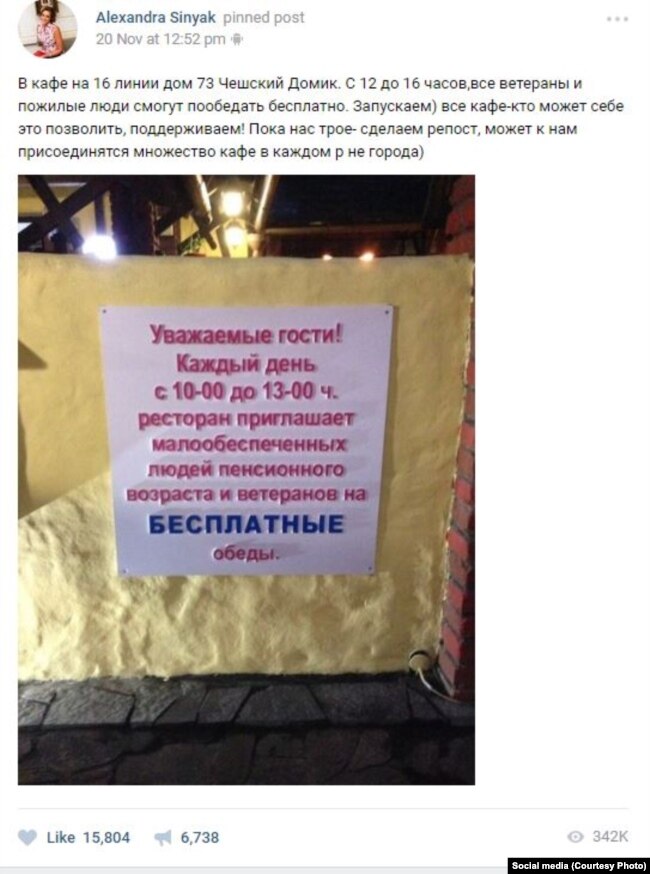
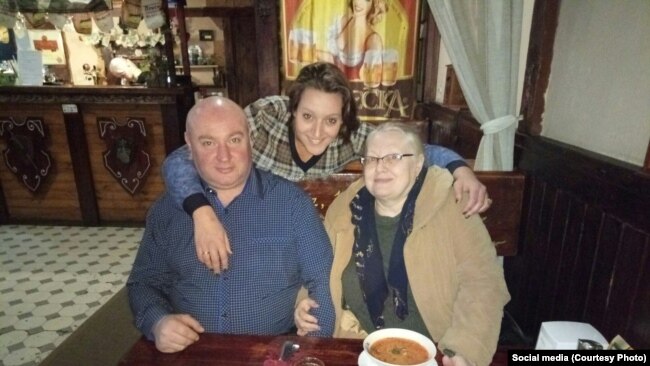
 Motorcycle rally on Palace Square, October 7, 2017
 Navalny supporter holding the Russian flag and sporting a humorous “Navalny 2018” t-shirt on the Field of Mars in Petersburg, October 7, 2017.
 Navalny supporters and anti-Putin protesters milling about on the Field of Mars, Petersburg, October 7, 2017.
 Protesters abandoning the Field of Mars, where on
  Anti-Putin protesters marching down Pestel Street, Petersburg, October 7, 2017
 Police forming a line on Liteiny Avenue
 Reporter David Frenkel during his arrest by police. He was later released from the paddy wagon.
 Protester outside Galereya shopping center: “No to Moscow Fascism. Putin, go away! We’re going in a different direction.”
 Fight outside Galereya shopping center between person unknown, some of whom were probably plainclothes policeman.
 Protester holds photo of President Putin aloft outside Galereya shopping center. In Russian tradition, the black ribbon indicates the person in the picture has just died.
 Protesters outside Galereya shopping center shouting slogans and waving flyers that read, “Navalny 2018.”