Moscow District Deputies Beaten as Constructivist Quarter Demolished

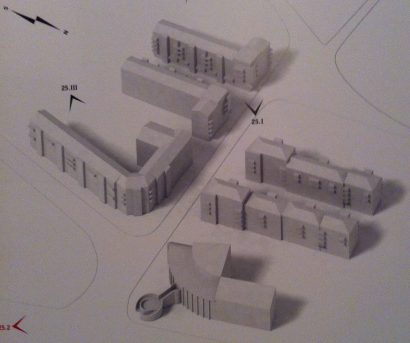
A scale model of the Pogodinskaya Quarter. Courtesy of Archnadzor

Moscow Municipal District Deputies Opposed to Demolition of Pogodinskaya Quarter Beaten
Radio Svoboda
June 6, 2016

Pogodinskaya was built in the 1920s and has been recognized as a constructivist landmark. 

On Monday, municipal district council deputies Alexandra Parushina and Andrei Voronkov were beaten in Moscow’s Khamovniki District while trying to prevent the demolition of several buildings in the Pogodinskaya Quarter, a recognized constructivist landmark. Radio Svoboda got the news from Parushina herself. She was forced to seek medical attention after the assault: her leg had been injured.
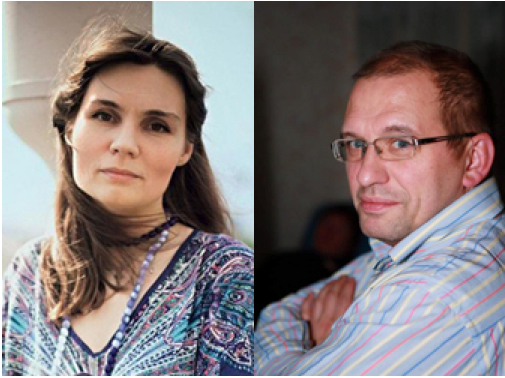
parushina-voronkov
Khamovniki Municipal District Council Deputies Alexandra Parushina and Andrei Voronkov. Courtesy of mo-hamovniki.ru

Parushina said the demolition of the buildings in the Pogodinskaya Quarter had begun on Monday without warning. According to here, when the deputies arrived at the scene and demanded that the company carrying out the works show them permits for the demolitions, they were assaulted by security guards.

At the same time, the demolition continued “literally right over the heads” of the deputies, Parushina added.

The authorization for demolition of the Pogodinskaya Quarter, built in the 1920s in the constructivist style by architects V.I. Bibikov and Ya.E. Ostrovsky, and engineer A.N. Volkov, was issued in late 2015. Donstroi plans to build luxury housing on the site. In January, architectural preservationists from Archnadzor demanded the authorization be rescinded.

___________

Vandalism’s Next Address: Pogodinskaya Street
Archnadzor
May 11, 2016

IMG_20160130_134857

There has been a strange media buzz around the constructivist Pogodinskaya Quarter (Pogodinskaya Street 2/3, blgs. 1–4). It is obvious Moscow public opinion is being prepared for the quarter’s demolition.

Articles about a shelter for homeless people and asocial elements having suddenly arisen in Pogodinskaya have been published one after another in the media and blogosphere, and the articles have all followed the same pattern. According to their authors, there is only one means of solving the problem: a speedy demolition and a foundation pit in place of the constructivist buildings. For some reason there is no talk about how it would make more sense to fix up the buildings and at least provide for their normal conservation, just as there as is no talk about a “flophouse” somehow emerging on premises strictly guarded by the developer, premises that journalists could not even infiltrate. If a landmark is turned into a trash heap, it is not the landmark’s fault.

The widespread practice of conversion, successful examples of which exist in Moscow as well (in particular, the recent and current restoration projects of the constructivist complexes on Suvorovskaya Street, Matrosskaya Tishina, and Preobrazhensky Val) show that constructivist residential developments can and should be saved. Where there’s a will there’s a way.

In January 2016, despite the decision by the Moscow Municipal Commission on Urban Development in Conservation Areas (the so-called Demolition Commission), recognizing Pogodinskaya’s historical and architectural value and  disallowing its demolition, the developer was suddenly issued authorization to prepare for the quarter’s demolition. Due to public outcry, a quick demolition did not come off. The Moscow Department of Cultural Heritage confirmed that the commission’s decision remained in force.

12669604_1264988933518243_3317230597239280582_n

The issue of Pogodinskaya’s conservation status has not resolved yet. We hope the decision will take into account the opinion of the members of Department of Cultural Heritage’s Research and Methodology Council, and the negative verdict on the Taganskaya Automatic Telephone Exchange building will not be repeated, a verdict publicly contested by the presidium of this esteemed advisory body.

12654238_1264989750184828_8147529781146430951_n

As long as the houses at Pogodinskaya 2/3 are not declared landmarks, they could be demolished in the near future, demolished despite the decision of the Commission on Urban Development in Conservation Areas, which can no longer reaffirm its verdict, as it was itself abolished by city authorities in early 2016, demolished due to the lack of venue for discussion in Moscow where the issue of historical architectural preservation could examined openly and with invited experts. In the legal vacuum formed in the wake of the Demolition Commission’s disbanding, destruction of Soviet avant-garde buildings, of which demolition of the Taganskaya Automatic Telephone Exchange was a flagrant instance, will proceed apace.

The Taganskaya Automatic Telephone Exchange was destroyed despite the protests of residents and experts. There was no dialogue among the authorities, the developer, and residents. This scenario must not be repeated in the case of Pogodinskaya. It is not possible to continue deciding the continue of whether to preserve or destroy historic buildings at the closed sessions of the Urban Planning and Land Commission. We need an open dialogue in which all stakeholders would be able to voice their arguments. The example of Saint Petersburg, which managed to resolve the issue of preserving the so-called Siege Substation, shows that such dialogue is possible as part of the Heritage Council.

12642601_1264989073518229_9182307887286721928_n

Archnadzor calls on the Moscow authorities to execute the president’s instructions and establish a Moscow Mayoral Council for the Preservation of Cultural Heritage, thus ensuring an open dialogue and discussion of the most important urban development issues, including the problem of preserving Moscow constructivism, with the broad involvement of experts on historical preservation. A similar appeal was made by leading experts and architects, outraged by the demolition of the Taganskaya Automatic Telephone Exchange. We fully share their position.

Translated by the Russian Reader. Photographs by Maria Korobova and Natalya Melikova. Courtesy of Archnadzor. For more on this latest bit of bad news, see Ola Cichowlas, “Deconstructing Moscow’s Constructivist Legacy,” Moscow Times, June 9, 2016. You can also read my numerous posts on what I have termed “catastrophic urban development” in Russia’s major cities. 
Good Riddance (Turkish Farmer Akçay Emer Deported)

Deported, but Hopes to Return
Igor Bubnov
Radio Svoboda
April 19, 2016

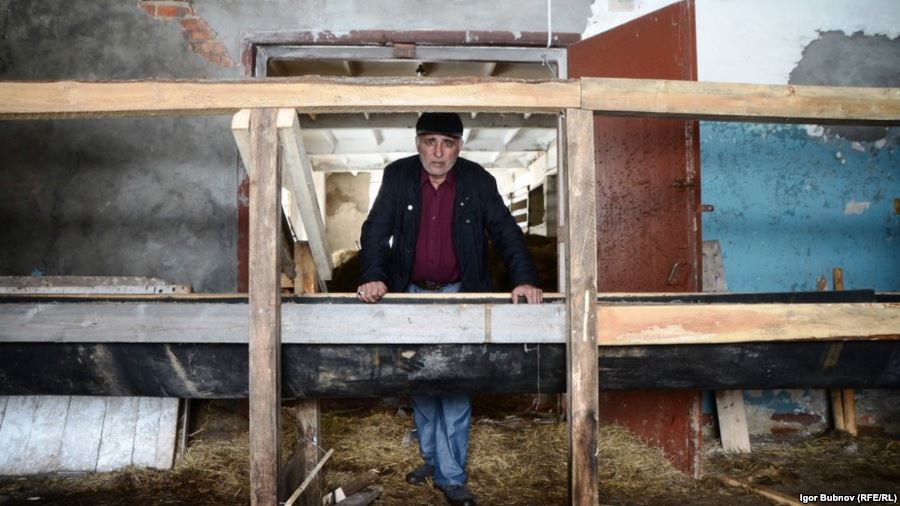
Turkish farmer Akçay Emer, who worked for over twenty years in Syktyvkar, has left Russia. He has been deported, although his Russian residence permit was valid until 2020. On the morning of April 19, Akçay Emer said goodbye to his wife, took his 16-year-old son to school as usual, put his bags in the car, and went to the airport. In Syktyvkar, he has given up his farm: he has been barred from entering Russia for the next two years. His family, friends, and job are here. Akçay Emer hopes to return. After the anti-Turkish campaign kicked off, the Federal Migration Service ordered the farmer to leave the country as he “posed a threat to Russia’s security.”

Akçay Emer
Akçay Emer

Translated by the Russian Reader. Thanks to Comrade VZ for the heads-up. Photo courtesy of RFE/RL and Azadliq Radiosu, where you can read about Akçay Emer’s case in slightly more detail (in Azeri).

No Peace for {NE MIR}

Police Detain Participants of Itinerant Anti-War Exhibition in Moscow
Mediazona
March 13, 2016

Police in downtown Moscow have detained participants of the itinerant pacifist exhibition {NE MIR} (NO PEACE), artist Ekaterina Nenasheva reports on her Facebook page.

According to Nenasheva, paddy wagons accompanied the artists from Kurskaya subway station to the Winzavod Centre for Contemporary Art.

{NE MIR} marchers pose with works before boarding police paddy wagon

“The exhibition ended at Baumanskaya subway station and continued in a paddy wagon,” the artist wrote.

12814400_1689312864656474_73356850244173103_n
Artist Ekaterina Nenasheva inside a police paddy wagon

She said it was the third {NE MIR} exhibition, featuring artists from Moscow, Petersburg, Murmansk, and Krasnodar, as well as Ukraine, Finland, and Austria.

OVD Info reports that fifteen people were detained outside Winzavod, including Nenasheva, Anna Bokler, Mikhail Oskarin, Ksenia Tretyushina, Alexandra Lavrova, Andrei Darklight, Angelina Trinten, Elvira Komarova, Tatyana Sushenkova, Ivan Karamnov, and Nikita Rasskazov.

The participants of the itinerant exhibition have been taken to Basmanny police precinct, where their papers are being checked. In addition, police are examining the artworks.

Nenasheva later informed Mediazona that thirteen artists are being held at the police station.

The police have not given any reasons for the arrests. According to Nenasheva, the artists will likely be charged with violating the rules for holding a public event (Article 20.2 of the Administrative Offenses Code).

Update. Nenasheva has informed Mediazona that the police have formally charged twelve artists with violating Article 20.2 of the Administrative Offenses Code. Their case will be heard in administrative court on March 16.

__________

Darja Serenko
Facebook
March 16, 2016

The judge refused to give my public defender access to the case file, forbade Gerchikov (who introduced himself as the head designer of the city of Moscow) from sketching in the courtroom (“if you don’t respect the court, then at least respect yourself”: how can you talk that way with the head designer of the city of Moscow), and found me guilty of unauthorized marching with photographic works from house no. 4 to house no. 8. The fine was 20,000 rubles [approx. 260 euros].

The whole day I was working on totally blacking out a little book called the Russian Federal Criminal Procedure Code: I discovered something almost therapeutic about this practice. The hearing was scary and I kept on shading in the book. I felt calmer that way. I did my best blacking out right when the sentence was announced. I am really grateful to everyone who came to draw and to support me (Vanya Simonov, Masha Menshikov, Marja Klinova, Dima the head designer of the city of Moscow, and everyone else), and I thank my civil rights defender.

1384359_998264126876221_5871183740003878684_n
Darja Serenko, Blacked-out page of the Russian Federal Criminal Procedure Code, March 16, 2016. The remaining words produce the phrase “Freedom / is conducted in Russian / or another language / depending on the character.”

Although there was nothing really scary about our case and now it has turned into a bloated media blip that will survive for a week in opposition media, I think it was worth it. And our self-existent exhibition inside the courtroom was also lovely and reminded me of Harald Szeemann and his exhibition project, in which everyone brought their works literally right off the street into the gallery, and the curator found a place for the works. Because of all the noise made by the media, everyone forgot about the pictures. In this case, they are only EVIDENCE. Everyone is interested in the court hearing and certain heroic artists. I am not an artist. I am a mini-curator, and I was stunned by certain works and their power. I would organize an exhibition like this in the well-known spaces where I work. The exhibition {NE MIR} is the best work with space (in the broad sense of the word) I have seen. I hope we will get our hands on the work and be able to show it.

What matters is not whether it is an anti-war exhibition or a protest rally or not, but the fundamental fact that in our country the classic format of the outdoor exhibition is still imagined almost as a terrorist act. In my opinion, everyone should have already had their fill of the format: the outdoor exhibition should be an art object invisible to everyone. But a renewed political discourse has updated the format as well.

After the court hearing, I took the subway and found myself in an exhibition car: the Russian Geographical Society and Miklouho-Maclay were on display. I laughed hysterically. It was also basically an itinerant exhibition. It moved almost by itself, wonder of wonders.

When we were still outside the courthouse smoking, a man came up to us. He said he had just been freed and asked us for money. When we gave him some, he told us our fortunes and recited psalms. I am going to have two husbands. The first one will cheat on me, the second will cheat on me, but the third won’t cheat on me, despite the fact that I am going to have two husbands all the same. While he was telling our fortunes, a policeman who worked at the courthouse came up to us and asked what sort of gathering we were having. I think someone known as the Director of the City of Moscow orchestrated this day.

Translated by the Russian Reader. Video courtesy of Radio Svoboda. Images courtesy of OVD Info, Ekaterina Nenasheva, and Darja Serenko. Thanks to Vadim F. Lurie for the heads-up.

Yelena Osipova: “Russia Is a Bird, Not a Bear”


OLYMPUS DIGITAL CAMERA
Russia wants to be a bird: peaceful, honest, kind.  Russia: kind and hardworking. 2011: The bear can no longer be cured. Vote for the bird. Although it is wounded, if it is treated well, it can fly high. Vote for the hardworking bird

“Russia is a bird, not a bear”
Tatyana Voltskaya
November 21, 2015
Radio Svoboda

Yelena Osipova’s “naïve” posters remind us of the link between politics and street protests

A cozy basement with uncomfortable pictures: that is how one might describe in a nutshell the exhibition of paintings and posters by Petersburg artist Yelena Osipova currently underway in the Petersburg office of Open Russia, which shares the space with the Petersburg office of the Parnas party.

Elena Osipova
Yelena Osipova

The exhibition marks a milestone—Osipova has turned seventy—but it is her debut exhibition. She has never been a member of any artist unions and groups, but she has stood outside in the rain, frost, and heat at nearly all the protest rallies that have taken place in Petersburg in recent years. The striking posters that Osipova holds at these rallies expose the latest injustices or crimes, warn of dangers, and empathize with the plight of others, whether they have been victims of terrorist attacks, natural disasters, dishonest elections or civil rights violations.

The exhibition was not easy to put together. The organizers set out to show not only Osipova’s best political posters but also her paintings, mainly portraits and landscapes. The show also includes two large genre scenes, the first featuring an ordinary Soviet beer hall, the second, a group of punks. Perhaps they are the link to the posters, which call to mind not only the tradition of political satire but also primitivist painting.

We are all hostages of violent, provocative imperialist politics.
We are all hostages of violent, provocative imperialist politics

“This exhibition is the first in my life,” says Yelena Osipova. “And I love the room and these vaulted ceilings and the fact you can see how my paintings segue into the posters. The latest poster, showing a mother with a dead infant, is about the dead Tajik boy Umarali Nazarov, while the first was prompted by the Nord-Ost tragedy in 2002. Then I went to the Mariinsky Palace [seat of the Saint Petersburg Legislative Assembly] with a simple lettered poster, handwritten on a sheet of wove paper. I just could not understand why no one took to the streets then, why everyone was silent. On the fortieth day after the deaths of the hostages, I made a poster in which I painted a picture in acrylics on fabric.

OLYMPUS DIGITAL CAMERA
In an Andersen story, a girl sold matches in Denmark in the nineteenth century: matches. (Read Andersen’s fairytales to children.) 2012, the twenty-first century. Children are commodities. This is the end of the world. Adoption should be free. Foster care should be free. In Russia, children sell narcotics: narcotics.

You are a professional artist. Where did you study?

“I graduated from an art school. It was then called the Tauride Art School, now it is the Roerich Art School. Marc Chagall had studied there in his day, though not for long. I had then wanted to apply to the monumental painting program at the Mukhina Academy. I had been influenced by the frescoes of Andrei Rublev and Dionisius, by the size of their figures and their schematic manner. But young women were just not admitted to the monumental painting program, and I have no regrets about it now. What would I have done? Painted murals in the subway? I am an artist and educator. I taught for over thirty years. We organized three art schools from scratch.”

Umarali
Umarali

So you mostly painted landscapes and posters, then Nord-Ost happened and you turned to posters. What exactly happened after Nord-Ost?

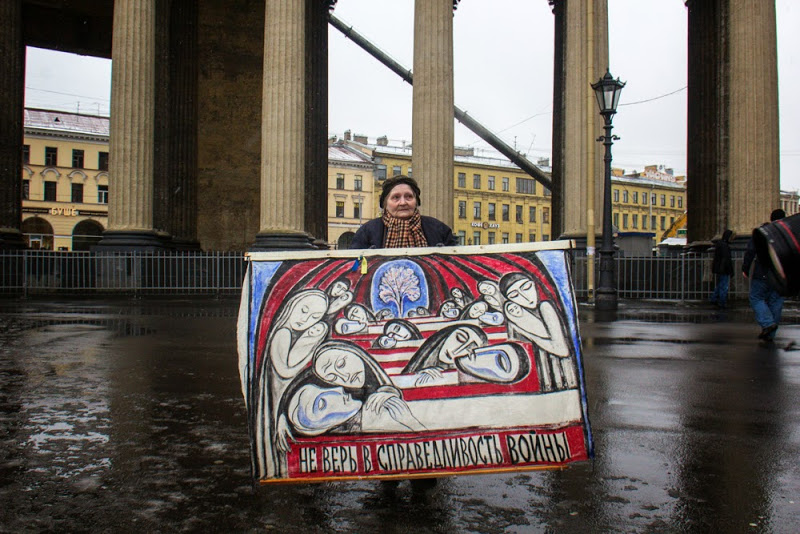
“An ever more horrible event: Beslan. No conclusions had been drawn! I had two posters: one was lost, while the other version is exhibited here. The lost version was two-sided. On the reverse side, the slogan “Moms of the world, give birth to little princes. They will save the world!” was written on a blue background. I made the next poster, “Don’t believe in the justice of war!” when the war in Iraq began. I stood outside the American consulate, the British consulate, outside the consulates of all the governments who had supported sending troops into Iraq. There was no reaction. When it was the anniversary of the Beslan tragedy, the mothers of the dead came to Petersburg and wanted to walk down Nevsky Prospect to the Russian Museum holding icons and candles. Ultimately, no one joined them. Just one other woman went with the Beslan moms, plus me with my poster. So we marched alone, amidst the general indifference.”

Anti-war-0089
Artist Yelena Osipova holds a poster that reads, “Don’t believe in the justice of war,” during an unauthorized anti-war protest outside Kazan Cathedral in Petersburg on March 15, 2014. Photo by Sergey Chernov

But this indifference has continued. Look how many people came to the rally protesting the death of the Tajik baby Umarali Nazarov, who was taken away from his mother.

“Yes, but more people are coming than before. Civil society is slowly emerging. We have had the Marches for Peace, and certain rallies have drawn a good number of people. It used to be that no one came to these things at all.”

OLYMPUS DIGITAL CAMERA
Yelena Osipova, Portrait of an Artist, 1975. Oil on canvas

Have you been detained at protests?

“Of course I have been detained. There was a G20 summit here one summer. I went there with two posters: Don’t believe in the justice of war! and another one about the disposal of nuclear waste. The police detained me then, and I have been detained many times since, sometimes quite roughly. There were unpleasant incidents outside the Mariinsky Palace on St. Isaac’s Square when the war with Ukraine began. Yet the people who go to these events think like you do, and that is quite important. You feel you are not alone with your thoughts, that there are other people who think the same way. Okay, so there are not so many of them, but they are out there.

Free political prisoners!

“Now, perhaps, it will become more difficult, and people will retreat to their apartments, as they did in Soviet times. The laws that have been passed [restricting public protests] are tough to deal with even financially. It used to be that the biggest fine I got was five thousand rubles. People collected the money on the web, and later I sent it on to the Bolotnaya Square prisoners. But the fines now are so high that you cannot pay them. It is too bad that society resigned itself from the outset and did not oppose these laws. After all, they could have resisted and taken to the streets, but, unfortunately, when people have begun to live better, they become indifferent.”

Are there any landmark works, works important to you at this exhibition?

“Yes, for example, Theater Entrance. I painted it during my fourth year at art school. I was really into the theater then, and my thesis painting had a theatrical motif. There are also three paintings here from my Vologda series, pictures of fields in Vologda. There is a landscape painting of Gurzuf, in Crimea. The big painting shows a beer hall that was behind the Nekrasov Market. It had these big round arches, and the beer was poured straight from a tap. You could meet professors and students and artists there. I have painted Russia there with a halo, looking sad. It was the nineties, a very complicated time. And my other painting on this subject is Punks in the Subway. I knew all those kids.

OLYMPUS DIGITAL CAMERA
The musical Nord-Ost, October 25, 2002. Stop the war, people! Learn the truth!

And what is Oh mania, oh mummy of war…, featuring two crows?

“It’s an anti-war poster. I drew it after Boris Nemtsov’s murder. I used a poem by Marina Tsvetayeva. She wrote it in Germany, and I saw the resemblance with our circumstances. The poster Not everyone who is naked is needy is about the death of Berezovsky. I play on the birch motif [Berezovsky’s name is derived from the Russian word for birch tree, berëza], and there are funereal crows.

OLYMPUS DIGITAL CAMERA
Artist Yelena Osipova at the opening of her exhibition on November 14, 2015. She stands next to posters that read, “August 6, 1945. August 9, 1945. Moms of the world against atomic energy,” and “Ukraine, forgive us: we let it happen.”

Do you appreciate some of your posters more than others?

Maybe this one, Don’t believe in the justice of war!, and the Beslan poster. In fact, the political posters about tragedies I always rendered in the three colors of the Russian flag.”

Will you continue to make new posters and freeze on the streets?

“At one point I though that maybe there was no need for this and I wanted to quit, but people said I should do it and told me I gave them hope.”

At the entrance to the exhibition is a small poster, Vote for the bird. At the bottom of the poster is a heavy United Russia, pumped full of oil; on the top is a bird.

“The bird has always been the symbol of Russia,” argues Yelena Osipova.

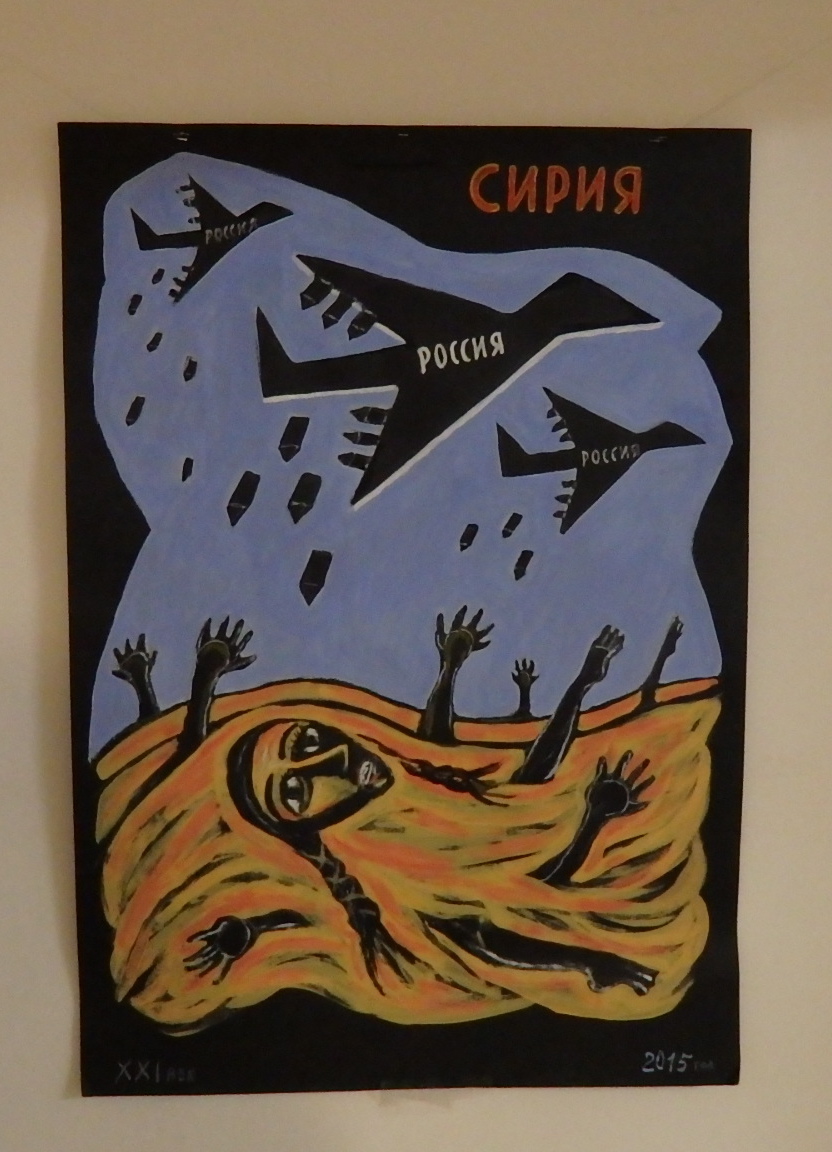
Syria. Russia
Syria, Russia, Russia (2015)

And to her mind, Russia’s color is blue, as in a certain painting by her beloved Wassily Kandinsky. True, Osipova now sees less and less of the color in her homeland’s plumage.

Translated by the Russian Reader. All photos by the Russian Reader except where otherwise indicated. Yelena Osipova’s work will be on view at 19 Fontanka Embankment until November 25, 2015.

Alexei Gaskarov: The Robin Hood of Zhukovsky

Alexei Gaskarov: The Robin Hood of Zhukovsky

Three years have passed since the opposition March of the Millions on Bolotnaya Square in Moscow ended in a physical confrontation with riot police, hundreds of arrests, and, later, dozens of criminal cases brought against protesters, who had engaged, allegedly, in “rioting” and “violence” against the police.

Although more than thirty defendants have been tried as part of the Bolotnaya Square Case, police investigators and prosecutors continue to unearth new suspects to this day.

This is the story of leftist social activist and antifascist Alexei Gaskarov, a 29-year-old economist from the Moscow suburb of Zhukovsky, as told by his family and close friends. Gaskarov, who is also an elected member of the Opposition Coordinating Council, was sentenced to three and a half years in prison on August 18, 2014.

gaskarov2_0
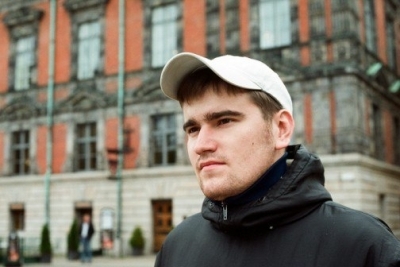
Alexei Gaskarov. Photo courtesy of avtonom.org