Nikolai Kuzmin during his solo picket outside the exhibition The Syrian Breakthrough, in Pskov. His placard reads, “Spend budget money on our own schools and hospitals, not on someone else’s war.” Photo by Lyudmila Savitskaya. Courtesy of Radio Free Europe/Radio Liberty
Yabloko Activist Detained in Pskov at “Syrian Breakthrough” Exhibition
Lyudmila Savitskaya Radio Svoboda
April 26, 2019
In Pskov, police have detained local Yabloko Party activist Nikolai Kuzmin, who held a solo picket outside an exhibition of military equipment entitled The Syrian Breakthrough. Kuzmin stood behind servicemen queued at the city’s train station to see the exhibition.
He held a placard that read, “Spend budget money on our own schools and hospitals, not on someone else’s war.”
Commenting on his actions, Kuzmin claimed over 25,000 schools had been closed in Russia over the past twenty years. The activist argued that, outside Moscow and Petersburg, it was nearly impossible to get an ambulance, and half of the men in Pskov Region did not live to retirement age.
“As in a dystopia, however, instead of being productive and saving the lives of Russians, we have raised war into a cult that we worship. Lacking reasons to feel proud, we are administered daily injections of patriotism. But patriotism does not mean fighting wars in someone else’s countries. It means building things in your own country and having a critical attitude toward the mania for military victory,” Kuzmin added.
Kuzmin’s picket lasted around ten minutes. During this time, members of the pro-regime organization Team 2018 managed to have their picture taken with him. Kuzmin was then surrounded by military police who asked him to leave. Kuzmin responded by asking them to identify themselves [as required by Russian laws regulating the police] and explain their grounds for wanting to remove him from a public event.
The military policemen were unable to fulfill Kuzmin’s request, so Sergei Surin, head of the Interior Ministry Directorate for Pskov [i.e., the local police chief] came to their aid. He personally detained Kuzmin while repeatedly refusing to explain the grounds for the arrest to Kuzmin and comment on it to reporters who were present.
Lev Schlosberg, leader of the Yabloko Party in Pskov, demanded Kuzmin’s immediate release and the removal from Pskov of The Syrian Breakthrough, which he dubbed a “propaganda scrap heap.”
“Russia must cease military operations in Syria, while government funds should be spent on peaceful goals that further the interests of Russia’s citizens,” Schlosberg said.
In February 2019, the Russian Defense Ministry launched a train containing weapons seized, it claimed, by Russian servicemen during combat in Syria. The train departed Moscow on an itinerary of sixty cities and towns. When it reaches Vladivostok, the train will head back to Moscow. It is scheduled to arrive there on the eve of Victory Day, May 9.
Thanks to Nikolai Boyarshinov for the heads-up. Translated by the Russian Reader
The courtyard of the Communist Party Regional Committee headquarters in Novosibirsk, where the monument to Stalin will be erected. Photo courtesy of Anton Barsukov and RFE/RL
Monument to Stalin to Be Unveiled in Novosibirsk by May 9
Anton Barsukov sibreal.org
March 13, 2019
Novosibirsk’s Artistic Expertise Board [Khudsovet] has finally approved installation of a monument to Stalin in the city’s downtown. Our correspondent reports that eleven of the sixteen experts present at the board meeting where the issue was decided voted in favor of the proposal.
The monument is slated for erection on the premises of the regional Communist Party headquarters on the eve of May 9 [Victory Day] of this year. According to the board’s chair, architect Alexander Lozhkin, the board’s decision was a compromise that would satisfy people who wanted to lay flowers at the monument while not insulting people who considered Stalin a tyrant.
Lozhkin implored his fellow board members not to engage in political debates, but to evaluate only the bust’s artistic merits. According to Lozhkin, there was no archival evidence that Stalin was involved in any crimes, and this was the official stance of the Russian government.
“We chose the least of two evils, but that doesn’t mean any good came of it. We are proud of the fact that we will not be putting it in a public place, but just now we voted for a tyrant,” Konstantin Golodyayev, a board member and local historian, told our correspondent.
The Novosibirsk Artistic Expertise Board in session. Photo courtesy of Anton Barsukov and RFE/RL
The bust of Stalin has already been produced: an action committee raised 500,000 rubles to pay for its manufacture. The city will pay for readying and beautifying the site where the bust is supposed to be installed. Novosibirsk Mayor Anatoly Lokot, who heads the regional committee of the Communist Party, said around one million rubles would be needed for this purpose.
In November of last year, the Artistic Expertise Board turned down the action committee’s request to install the monument in a public place, arguing it could cause distress to people who blamed Joseph Stalin for large-scale crackdowns and the deaths of millions of people.
Earlier, Novosibirsk city hall held a discussion on its official website of the best place for the monument. There were 155 positive reactions to the proposal to erect a bust of Stalin in the city, and 97 of them were worded completely identically. The proposal received a total of 243 reactions. Aside from the positive reactions, there were 85 negative reactions and three blank comments. Over 11,000 people signed a petition on Change.org opposing the monument.*
*When checked at 10:34 a.m. Central European Standard Time on March 14, 2019, the anti-Stalinist petition could not be accessed.
A stock photo of schoolchildren enjoying lunch in some place happier and more prosperous than Kemerovo Region and other parts of Russia that have been left to die by the country’s rapacious, neo-imperialist ruling class. Courtesy of Siber.Realii
Inspection Confirms Schoolchildren Fainting from Hunger in Kemerovo Region Radio Svoboda
February 5, 2019
An inspection has confirmed that schoolchildren in Kemerovo Region have been fainting from hunger. Dmitry Kislitsyn, the region’s children’s rights ombudsman, said schoolmasters and regional officials had attempted to hush up the incidents. He has written about the problem in a report to Kemerovo Governor Sergei Tsivilyov. REN TV has published a copy of the report.
In particular, the health worker at the school in the village of Pashkovo, in the region’s Yashkino District, reported three incidents of children fainting that officials had not bothered to register. They were caused by hunger. In the school itself, the water was unfit for drinking, and the cafeteria was in disrepair. At other schools, pupils were divided into those who paid for meals and those from impoverished families. In certain cases, the number of children receiving hot meals during the school day did not exceed a third of the total number of pupils, while the portions of food served were smaller than stated in the regulations.
Kislistyn said the majority of members of the inspection commission had tried to “paper over the incidents.” Nevertheless, the ombudsman had reported the outcome of the inspection to the Russian Investigative Committee, the prosecutor’s office, and the official national consumer watchdog Rospotrebnadzor.
On January 23, 2019, Kislitsyn told a session of the regional council that incidents of hunger-induced fainting had increased among children in the region’s schools. He claimed he had been contacted by homeroom teachers who had noticed the social stratification of their pupils in connection with school meals. Some children were not eating at school because their parents did not pay for meals. According to Kislitsyn, the parents also could not afford to feed their children in the mornings. The ombudsman said this was the case in village schools, as well as among children bused to school from the countryside. Regional officials, however, had denied Kislitsyn’s claims.
Thanks to Comrade Koganzon for the heads-up. Translated by the Russian Reader
Three Last Address plaques on the house at 27 Dostoevsky Street, in downtown Petersburg
Squealing on the Executed: Who Wants to Remove the Last Address Plaques?
Tatyana Voltskaya Radio Svoboda
December 6, 2018
Alexander Mokhnatkin, a former aide to Russian MP Vitaly Milonov, filed a complaint with the Petersburg authorities, claiming the plaques mounted on houses throughout the city by Last Address had been erected illegally.
The plaques are barely visible from only ten meters away.
Andrei Pivovarov, co-chair of the Petersburg branch of Open Russia, wrote about the complaint on his Facebook page.
The city’s urban planning and architecture committee has already reacted to the complaint. It said the plaques, which bear the names of victims of Stalin’s Great Terror and have been placed on the walls of the houses where they lived just before their arrests and executions, were illegal.
There are two more plaques right next door, in the gateway of the house at 27 Dostoevsky Street.
“The informer decided the plaques were illegal advertisements? I wonder what for. The Stalinist Terror? He thinks they should be taken down. The Smolny responds to the snitch by indicating there were no legal grounds for putting the plaques up, and special city services would deal with them. It is difficult to guess when the wheel of the bureaucratic machine will turn, but, as Solzhenitsyn wrote, the country should know its snitches. I introduce you to Alexander Mokhnatkin, a man who has denounced people long ago victimized by the state and executed, and who has denounced the memory of those people,” Pivovarov wrote.
Unaware of the Last Address plaque on the wall next to her, a woman walks down Poltava Street, just off Old Nevsky, on a sunny day in October.
MP Milonov argues his former aide’s opinion is his personal opinion. Milonov, on the contrary, welcomes memorial plaques, but he does not like the fact that, currently, ordinary citizens have taken the lead in putting them up. He believes it would be better to let officials take the lead.
“I don’t think it would be good if there were lot of plaques on every house, as in a cemetery. The right thing to do, probably, would be to adopt a government program. The plaques would be hung according to the rules of the program, and protected by the law and the state,” argues Milonov.
When you step back ten or fifteen meters, the same plaque is nearly invisible to the naked eye.
He argues what matters most is “remembering the grandfathers of the people who now call themselves liberals squealed on our grandfathers and shot our grandfathers. Our grandfathers did not squeal on anyone. They died on the Solovki Islands. They were shot in the Gulag and various other places.”
Milonov admits different people wrote denunciations, but he believes the International Memorial Society has deliberately politicized the topic, using the memory of those shot during the Terror for their own ends. The MP argues that erecting memorial plaques should not be a “political mom-and-pop store.” Milonov fears chaos: that today one group of people will put up plaques, while tomorrow it will be another group of people. To avoid this, he proposes adopting official standards.
A Last Address plaque in the doorway of the house at 36 Razyezhaya Street, in Petersburg’s Central District.
On the contrary, Evgeniya Kulakova, an employee of Memorial’s Research and Information Centre in Petersburg, stresses that Last Address is a grassroots undertaking. An important part of Last Address is the fact that the installation of each new plaque is done at the behest of private individuals, who order the plaques, pay for their manufacture, and take part in mounting them. Kulakova regards Milonov’s idea as completely unfeasible, since the municipal authorities have their own program in any case. The program has its own concept for commemorating victims of political terror, and the authorities have the means at their disposals to implement it. Last Address, however, is hugely popular among ordinary people who feel they can make their own contribution to the cause of preserving the memory of the people who perished during the Terror.
A Last Address plaque in the archway of the house at 6 Socialist Street, in central Petersburg.
Kulakov thinks it no coincidence Mokhnatkin has brought attention to the Last Address plaques, since previously he had taken an interest in the Solovetsky Stone in Trinity Square. Apparently, his actions are part of a campaign against remembering Soviet state terror and the campaign against Memorial.
Many Memorial branches in Russia have been having lots of trouble lately. In particular, Memorial’s large annual Returning the Names ceremony in Moscow was nearly canceled this autumn, while the Petersburg branch has been informed that the lease on its premises has been terminated. It has been threatened with eviction as of January 6, 2019.
Three Last Address plaques, barely visible from the middle of the street, on the house at 69 Chernyakhovsky Street, near the Moscow Station in Petersburg.
Historian Anatoly Razumov, head of the Returned Names Center, supports the concept of memorial plaques. He stressed they are installed only with the consent of building residents and apartment owners, and ordinary people welcome the undertaking. Moreover, people often put up the plaques not only to commemorate their own relatives but also to honor complete strangers whose lives have touched them. Razumov says people often find someone’s name in the Leningrad Martyrology. They then get written confirmation the person lived in a particular house. Only after collecting information about the person and obtaining the consent of the building’s residents do they erect a plaque.
“In Europe, such things are always under the protection of municipal authorities. I think we should also be going in the other direction: local district councils should do more to protect the plaques instead of saying they don’t meet the standards and they’re going to tear them down,” the historian argues.
Razumov argues that inquiries like the inquiry about the legality of the memorial plaques are served up under various attractive pretexts, but they are always based on the same thing: the fight against remembering the Terror. Some people want to preserve this memory forever, while others do everything they can to eradicate it by concocting hybrid or counter memories.
The plaques at 69 Chernyakhovsky Street commemorate Vasily Lagun, an electrician; Solomon Mayzel, a historian of the Arab world; and Irma Barsh. They were executed in 1937–1938 and exonerated of all charges in the late 1950s and early 1960s.
Boris Vishnevsky, a member of the St. Petersburg Legislative Assembly, argues that Last Address and Immortal Regiment are the most important popular undertakings of recent years. He is outraged by attempts of officials to encroach on them. He says he has written an appeal to the city’s urban planning and architecture committee.
Screenshot of the Safonovo Central District Hospital’s website
14-Year-Old Girl Writes Letter to Putin, Kills Herself Radio Svoboda
November 20, 2018
Identified only as Natasha, a fourteen-year-old girl who complained to Vladimir Putin about her mother’s low wages has committed suicide in the city of Safonovo in Smolensk Region.
According to local news media, the teenager also complained about bullying at school. She was visually impaired. Her classmates teased her by calling her “Cyclops.”
Shortly before her death, she posted the following message on her social network page: “Why are you all so mean?”
The newspaper Smolenskaya Narodnaya Gazeta writes that the fourteen-year-old girl’s mother worked as an orderly at the local hospital. After her daughter wrote a letter to Vladimir Putin and mailed it to the Kremlin, the women was summoned by hospital management and “scolded.”
As the newspaper writes, what happened to her mother was probably a huge blow to Natasha.
According to unconfirmed reports, a suicide note was found on the dead girl. She asked that no one be blamed for her death.
It is not known whether her letter reached the Russian president.
Translated by the Russian Reader. Thanks to Dmitry Kalugin for the heads-up.
I was riding tonight in a taxi driven by someone with a surprising name: Nasimjon. I was watching Solovyov’s show on my telephone. His guests were voicing the warmest feelings of devotion to the winner of the race.
“He got so many votes not because he had the administrative resource behind him, but because people love and respect him,” said Andrei Maximov, presenter of the program Duty Officer for the Country.
My [sic] Nasimjon was silently listening to this splendor with me. At some point, moved by the emotions of the people speaking, he voiced his own.
“I was so scared today.”
“What was wrong?”
“I typed the question, ‘How much did Putin get in Moscow?’ into Yandex. The answer I got was eleven percent for him, and seventy-three percent for Grudinin. I was frightened.”
“What’s wrong with that?”
“Because the situation in the world is such that where would be without Putin? Look what’s going on around us: England and America again. Who else can deal with them?”
“Why do we need to deal with America?”
“They dream of ripping us to shreds. They kill everybody. They occupy everybody and kill them.”
“Who have they killed?”
“Iraq, Afghanistan. They organized the coup in Ukraine.”
“Did you hear that on TV?”
“No, my passengers told me. Plus, the Americans think everyone else is stupid.”
“Who told you that?”
“My Armenian friend. He’s lived in America for twenty years. He says that in the textbooks over there it’s written that Americans are smart, and everyone else is stupid. But Putin has made everyone fear us.”
“That’s a good thing?”
“It is.”
“Maybe it would be better if we were respected and liked?”
“It doesn’t work that way with the Americans. We have to make them fear us.”
“So, how did this thing with Putin end? You believed the figures were real?”
“Yes, I did, and that’s why I got scared. But then I turned on Business FM Radio, and it turned out it was the other way around, that Putin had seventy-three percent, and Grudinin, eleven percent. So now everything here is going to be fine.”
“What’s going to be fine?”
“Putin’s friends have already had their fill of stealing. If new guys had come to power, it would have started all over again.”
Ugh.
P.S. “What the taxi driver told me” has long been a common genre in Russian social media, especially the Russophone segment of Facebook. In most such stories, whether true or fabricated, the taxi driver is a stand-in for (debased) popular wisdom, for the Russian folk (russkii narod), meaning “ordinary,” “rank-and-file” Russians, whom the Russian liberal intelligentsia have historically imagined as a benighted, homogeneous mass.
The twist in this particular variation on the yarn is that the taxi driver’s name, Nasimjon, indicates he is clearly not ethnically Russian, meaning he hales from the Caucasus or Central Asia, or he was born in Moscow, but his parents moved there from one or other of these regions.
Even with this “politically correct” update, the genre remains problematic. It is more a symptom of the liberal intelligentsia’s failure to account for its own role in generating and maintaining the successive tyrannies that have plagued Russia since the nineteenth century, when the intelligentsia per se could be said to have been born as a kind of social subclass or metaclass, than it is a window onto the world of the “common people.”
To put it less murkily, if you stop talking to “taxi drivers” and listen to what actual Russians of all shapes, sizes, colors, and classes have to say and find out how they have either adapted to the Putinist tyranny or resisted it, you are as likely to discover resistance and clear thinking among supposed members of the Russian folk, among the people whom liberal Russians contemptuously refer to as “philistines” (obyvateli), as you would among the self-identified liberal intelligentsia.
Over the last several years, this website has featured many such inspiring stories of grassroots, working-class and lower middle-class resistance to the current Russian despotism, including the saga of the country’s fiercely militant independent truckers and the tale of the so-called partisans of Suna, a group of pensioners in Karelia who camped out in their beloved local old-growth forest to protect it, its environment, and their own humble livelihoods from local officials and developers, who wanted to build a road through it and turn part of it into a sand quarry.
Of course, there have also been many tales of similarly fierce, thoughtful resistance by Russians who by virtue of their educations and professions could be classified as intelligentsia. It is just that the vast majority of such intelligenstia militants are too clear sighted to sink to the vulgar sociology and flagrant mythologeme that would blame uneducated, poor, downtrodden, disempowered, and mostly invisible Russians for the country’s problems and Putin’s long-lived and wholly engineered “popularity.”TRR
All that is left of the anti-Putin leaflets posted by Nikolai Korshunov
“We Are Racing into a Huge Pit”: The Businessman Who Spoke Out against Putin
Аlexander Valiyev Radio Svoboda
26 February 2018
In the town of Verkhny Ufaley, Chelyabinsk Region, police have torn down posters cataloguing the “brilliant” outcome of Putin’s reign from the outside walls of several shops. The posters were hung there by a local businessman, who has already had occasion to fight the authorities in this way.
Nikolai Korshunov owns six small shop in this company town 120 kilometers from Chelyabinsk. Police paid visits to Korshunov’s shops on the eve of Fatherland Defenders Day, February 23. The businessman told Radio Svoboda what happened.
Nikolai Korshunov (middle) with his son and another relative at the Voters Strike, Moscow, January 28, 2018. Photo courtesy of Nikolai Korshunov and Radio Svoboda
Nikolai Korshunov: I am very active civically. I always serve as an elections monitor during elections. I own six small shops. We sell the basics: bread, milk, etc. The stores are my venue for voicing my opinion about current events. This takes the shape of handmade posters, information leaflets.
My argument is that, since the stores are my property, I have the right to post any information whatsoever in them. The Constitution gives me that right. But I have run into opposition from law enforcement and the city hall in our town. It also happened before the 2016 Duma elections, in which Verkhny Ufaley famously voted only four of the twenty United Russia candidates into the local parliament. People read my posters very carefully. Naturally, they regard anything that is not propaganda as out of the ordinary. It is interesting because if they, say, live in one part of town and the neighborhood dairy plant has shut down, they still remember that, but if, say, a timber plant or infant feeding center has ben closed on the other side of town, they might not have heard about it at all, because it does not affect them. But when they read the entire list, they think to themselves, “What a lot of things have happened in our town over this time.” Even since the 2016 Duma elections there have been colossal changes for the worse in Verkhny Ufaley: total poverty, unemployment, and hopelessness.
An excerpt from one of Korshunov’s information leaflets. It lists by name the Verkhny Ufaley plants, companies, businesses, and services that have closed during Putin’s eighteen-year reign. Photo courtesy of Nikolai Korshunov and Radio Svoboda
Radio Svoboda: What was on the the posters?
I have lived in Verkhny Ufaley for a very long time. I was born and raised here. In the run-up to the presidential election I decided to make a list of things that have changed in our town during the eighteen years of Putin’s administration. What businesses and factories have closed? The town’s main employer, the Ufaley Nickel Plant closed [in December 2017]. The Metalworker Factory closed. The open hearth and wheel spring shops closed. Then all hell broke loose: the sausage plant, the dairy, the furniture factory, etc., closed. There are thirty-four items on the list, including the children’s hospital and the railroad’s inpatient clinic. Then there are the plants that are barely hanging on. I wrote about them, too, for example, the metallurgical plant where five thousand people once worked. Now it employs a maximum of five hundred to seven hundred people.
Do you think people have suddenly forgotten about what has been happening in town?
Of course they know, but it is just another reminder, a way of saying, Hey, guys, you say that Vladimir Putin has raised the country from its knees, but I don’t think that is the case. I think we are racing into a huge pit at enormous speed. I cannot answer for the entire country, but as a resident of a small industrial town, I see what has been shut down, what has been destroyed, what has been dismantled, what has been pilfered. When you go and vote, people, think a bit before making your choice.
The continuation of Korshunov’s list. Photo courtesy of Nikolai Korshunov and Radio Svoboda
How many votes do you think Putin will pick up in Verkhny Ufaley?
He will win for one simple reason. Our town is small: everyone knows everything about everyone else, and everyone tells everyone else about everything. I will give you an example. At the employment office—our town has terrible unemployment, by the way, because everything has shut down—the boss gathers his underlings and says, “God forbid you don’t go and vote. If you don’t, I won’t pay you bonuses.” This is more or less what goes throughout state sector. So a huge number of people, maybe even dissenters, will naturally go out and vote in order to keep their miserable jobs at places like the employment office. No one will buck against the bosses. So, Putin will definitely win. Because he has the administrative resource behind him, and huge numbers of people are incapable of thinking.
The administrative resource can compel people to turn out for an election, but people go into the voting booths alone.
They have their tricks. They can ask people to photograph their filled-out ballot paper on their telephones and send them the photos. We have been through it before. It happend during the 2016 Duma elections, and during the 2012 presidential election, when I was a polling station monitor. It’s all elementary. It’s not a problem at all. But most people have, of course, been hypnotized by television. They cannot reason, think or compare facts. When it comes to them, what the TV says definitely goes, although it is flagrant, mendacious, aggressive propaganda.
I am sure people have asked you, “If not Putin, then who?” People do not see an alternative. How do you counter them?
The wall of one of Korshunov’s shops looked like this after a visit from the local police. Photo courtesy of Nikolai Korshunov and Radio Svoboda
There is no alternative for one reason and one reason alone: all of politics has been purged by the administrative resource. Anyone who could compete against Putin would never be allowed to run in honest, alternative elections under any circumstances. That’s why there is no alternative. Putin’s only “opponents” are people who have definitely been appointed to the role. They stand for nothing and no one, and compared with them Putin looks like a superhero. On top of everything is the propaganda and hypnosis that reinforces the message that Putin is the most respected politician in the world, and we are the world’s mightiest country.
Do people in Verkhny Ufaley know about Alexei Navalny, his exposés, and his call to boycott the presidential election?
Most of them don’t know, of course. A particular segment knows, young people mainly, of course, because Navalny has access only to the internet, to YouTube, which is largely viewed by young people, by schoolchildren and university students. Elderly people know nothing about Navalny, naturally. They know only what the propagandists on TV tell them: that Navalny is an out-and-out thief, scoundrel, and so on.
What about middle-aged people?
Middle-aged people are probably more thoughtful, but not so very thoughtful at the end of the day. Our town is basically a village. We live in a kind of swamp. Middle-aged people are averse to risks. They work somewhere in the state sector, earn ten thousand rubles a month [approx. 142 euros], and are up to their necks in debt. When they sit around chatting in the kitchen, they support Navalny, of course. But they cannot voice their opinions actively, because they would be fired from their jobs in two seconds flat. People primarily think about themselves. Their political views come second.
A photograph of all thirty-four factory and other closures in Verkhny Ufaley during the Putin years, along with the message, “Think hard! What will become of the town between March 18, 2018, and March 2024? || March 18: Not an election, but a fraud. Don’t let yourself be fooled. Don’t go [and vote]. The Voters Strike.” Photo courtesy of Nikolai Korshunov and Radio Svoboda
How have the authorities reacted to your protests?
Our mayor is also secretary of the local United Russia party branch. During the 2016 election campaign, I hung up leaflets in my shops saying United Russia was the party of crooks and thieves. The United Russians came running and blatantly tore down the posters. Many locals approached me afterwards and said, well done, I had done the right thing, because the United Russians were high-handed, arrogant, and had lost all sense of measure. During this campaign, they have reacted differently. First, they sent young women who work in lowly positions at city hall to photograph the leaflets in my shops. Then city hall put pressure on the police, who showed up on the eve of Fatherland Defenders Day, February 23. The leaflet had been up for around two weeks by then, and from time to time I had added information to them. They showed up when I was not there and tore down everything. In one shop, they tore down a big piece of fiberglass along with the posters. There were five or six of them. They intimidated the cashiers. They took statements from them and drove away. That happened in five shops. They showed up at the sixth shop the next day. There, however, the cashier is a serious woman. She did not let them tear down the posters and called me. I arrived, and we hashed things out with them for two and a half hours. There were two neighborhood beat cops and an investigator. They were unable to tell me what laws I could have violated. I imagine they are quite unfamiliar with the Administrative Offenses Code. From time to time they would call the dispatch center for instructions. I know there is nothing illegal about my actions. Nothing will come of it, just like last time.
There was no pressure on you after the Duma elections? You were not tormented with surprise inspections of your shops?
No, there was nothing of the sort. I was written up for an administrative violation, but apparently the magistrates told the police there was no law covering leaflets. So nothing came of it, nor was any pressure put on me.
Are you planning to file a complaint against the police?
I did not complain last time, and I will not complain this time, either. It is a waste of time. There is honor among thieves.
Will you put the leaflets back up?
Yes, definitely, they are already up in some shops.
What are your plans for March 18? Will you vote?
I completely agree with Alexei Navalny. I’m going to boycott the vote. I even traveled to Moscow on January 28 for the Voters Strike. But I will definitely go to some polling station or another on election day to help prevent vote rigging.
Translated by the Russian Reader. Thanks to Comrade Uvarova for the heads-up
According to “‘Putin Loves Only His Own Dogs’: Animals Are Being Killed For the World Cup’s Sake,” an article by Dmitry Volchek, published yesterday, February 17, 2018, on the Radio Svoboda website, authorities in Samara, one of the host cities of the 2018 World Cup, have been paying to have homeless cats and dogs hunted down and killed in the city and the surrounding area.
Here is an excerpt from the article.
“As I understand it, there is fascism in Russia,” says Irina Yevdokimova. “Fascists run the country. It’s unequivocal to me. Problems are solved only by murder. We do not ask for much. We ask only that things be done as they are done abroad, so there is not this bloody mess.”
Samara will host World Cup matches in late June, and the municipal services have been tasked with exterminating homeless animals so that, god forbid, no fan is bitten by a dog. Cats do not attack football players and their fans, but money has been allocated from the budget to kill cats as well. Samara has decided to spend ₽9 million [approx. €128,600] solving the problem, while Togliatti will spend ₽2 million [approx. €28,000].
“A cull is taking place here in Samara Region and Togliatti,” says Yevdokimova. “The cheapest way is to up and shoot the animals, but often as not family pets are killed because they have adapted to interacting with people. There is Sergei Madyankin’s firm, which has been doing the cull. The authorities find it quite advantageous to collaborate with them. They charge ₽500 [approx. €7] for a dead animal. They shoot it, retrieve it, and drive away: quick and cheap.”
You can read the entire article (in Russian) on the Radio Svoboda website. I simply don’t have the heart or stomach to translate the rest of it. TRR
The Strange Investigation of a Strange Terrorist Attack
Leonid Martynyuk Radio Svoboda
February 3, 2018
The investigation of the April 2017 terrorist attack in the Petersburg subway continues. We have assembled thirteen facts that provoke questions and leave us bewildered.
Last year witnessed two major terrorist attacks in Russia’s so-called second capital: in the subway in April, and in a Perekrostok supermarket in late December. They claimed 16 lives and injured another 126 people. In addition, in December, two weeks before the New Year, a joint operation by the Russian Federal Security Service (FSB) and the Interior Ministry apprehended seven persons who, according to the security services, were planning a whole series of terrorist attacks in Petersburg, including a blast in Kazan Cathedral. According to the same sources, the CIA had assisted the Russian security services in uncovering the terrorists and their plans.
On December 17, “Vladimir Putin thanked Donald Trump for the intelligence shared by the CIA, which had assisted in detaining terrorists planning blasts in Petersburg’s Kazan Cathedral and other sites in the city. The intelligence received from the CIA was enough to track down and apprehend the criminals.”
Given the fact that last year no similar terrorist attacks or attempted terrorist attacks took place anywhere else in Russia, the activeness of terrorists in Petersburg was especially shocking. Why was Petersburg chosen by terrorists as the only target? However, the security services should first answer not this question, which is, perhaps, rhetorical, but questions about the ongoing investigation and its findings. While little time has passed since the December terrorist attack, and there has been little news about its investigation, it has been nearly nine months since the April attack in the Petersburg subway, and so we can sum up and analyze the available information.
Thus, on April 3, 2017, at 2:33 p.m., a terrorist attack occurred in the Petersburg subway that left 16 people dead and 49 people hospitalized. From the very first minutes, reports about the attack contradicted each other.
1. Fake Terrorists
The first person whom the media, citinglaw enforcement agencies, named as the possible terrorist was Ilyas Nikitin, a truck driver from Bashkortostan, who was returning home that day from St. Petersburg’s central mosque.
“A photo of the man whom the CID are seeking in connection with the blast.” Screenshot from the Twitter account of popular Petersburg news website Fontanka.ru
A few hours later, however, Nikitin himself went to the police to prove his innocence. He had planned to fly from Moscow’s Vnukovo Airport to Orenburg. He had gone through the security check, but the flight crew of the Rossiya Airlines plane refused to let him board the plane due to the protests of frightened fellow passengers, who had “identified” him from his photograph in the press.
In the early hours of April 4, the media, citing the security services, identified Maxim Arishev, who was “in the epicenter of the blast in the subway car” and “could be the alleged suicide bomber.”
“Channel Five has published photos of the person who allegedly planted the second bomb at Ploshchad Vosstaniya.” Screenshot from Twitter account of the Conflict Intelligence Team (CIT)
Arishev was identified as a “22-year-old Kazakhstani national.” An hour later, the Conflict Intelligence Team (CIT), a group of investigators, published a message stating Arishev was a victim of the terrorist attack, not the man who carried it out.
“We have concluded that Maxim Aryshev [sic] was among the victims of the terrorist attack, not a suicide bomber.” Screenshot from Twitter account of the Conflict Intelligence Team (CIT)
The third and final hypothesis as to the perpetrator’s identity during the immediate aftermath of the attack was that it was 22-year-old Russian national Akbarjon Jalilov, who also died in the blast. The Investigative Committee’s guess was based on genetic evidence and CCTV footage.
A photograph of Akbarjon Jalilov on his page on the Russian social media website Odnoklassniki (“Classmates”)
Djalilov’s neighbors in Osh, Kyrgyzstan, where he lived until 2011, described his family as secular.
“His family is not religious. Akbarjon did not pray five times a day or grow a beard. On the contrary, he liked wearing ripped bluejeans. He knew Russian well.”
An hour later, the concept had changed, and the Russian security services informed the public through the media there had been one blast, while a second explosive device, planted at the Ploshchad Vosstaniya subway station, had been disarmed in time.
The news chronicle of the terrorist attack in the Petersburg subway is still available on the internet news site Lenta.ru, which is now absolutely loyal to the regime.
Between 3:12 p.m. and 3:44 p.m., that is, over thirty minutes, Lenta.ru published several reports that two explosive devices had exploded at two subway stations.
3:12 p.m.: “There were two blasts. They thundered at Sennaya Ploshchad and Tekhnologicheskii Institut stations.”
3:17 p.m.: “Putin has been informed of the explosions in the Petersburg subway.”
3:44 p.m: The media report that “all stations of the Petersburg subway have been closed due to the blasts.”
After 3:49 p.m., only one blast is mentioned in every single one of Lenta.ru‘s dispatches.
3:49 p.m.: “The number of victims of the blast in the Petersburg subway has grown to thirty, reports Interfax.”
But at 3:55 p.m. Lenta.ru publishes a report of a second unexploded bomb.
3:55 p.m.: “Fontanka.ru reports that another, unexploded bomb has been found at the Ploshchad Vosstaniya station.”
The media’s interpreters of information supplied by the Investigative Committee and Emergency Situations Ministry were offered the following explanation of the false report of two blasts at two stations.
“The explosion occurred on the stretch of track between Petersburg subway stations Sennaya Ploshchad and Teknologicheskii Institut. At the time of the explosion, the subway train had only set out from Sennaya Ploshchad, but it did not stop, braking only at Tekhnologicheskii Institut. Therefore, reports of a bomb exploding arrived from both stations. At one station, the explosion and smoke were seen, while the exploded subway car, and the injured and the dead were seen at the second station.”
But this account contradicts reports about the time of the explosion.
“The explosion occurred at 2:40 p.m. in the third car of an electric train traveling on the Petersburg subway’s Blue Line. It happened a few minutes after the train had left Sennaya Ploshchad for Tekhnologicheskii Institut.”
The average speed of a train traveling in the Petersburg subway is 40 kilometers an hour. The train left Sennaya Ploshchad and had been traveling a few minutes before an explosion occurred in one of the cars. Let us assume that train had been under speed for a minimum of two minutes, and during the first minute the train traveled slowly due to the need to pick up speed. During the second minute, the train was already traveling at around 30 kilometers an hour. In one minute, an object moving at a speed of 30 kilometers an hour travels half a kilometer.
This means that at the time of the explosion the train was at least half a kilometer from the departure station. Most likely, however, the train was much farther than half a kilometer from Sennaya Ploshchad. Eyewitnesses reported that the “train was flying along” when the explosion occurred, that is, it was traveling at a good speed.
As TV Rain reported, “According to eyewitnesses, the explosion in the car occurred on the approach to Tekhnologicheskii Institut.”
Under the circumstances, the smoke seen by eyewitnesses, and the noise of the blast, which could be heard at Sennaya Ploshchad, could not have been perceived by witnesses and, much less, by Emergency Situations Ministry and Investigative Committee officers as a “blast at Sennaya Ploshchad station.” It could be identified, for example, as an “explosion in the tunnel” or “smoke on the stretch of track between the stations.”
Another explanation is that reporters mixed everything up. The Emergency Situations Ministry and Investigative Committee never reported an explosion at Sennaya Ploshchad subway station. This hypothesis is easily refuted by the stories filed by news agencies and TV channels, for example, the Federal News Agency. They clearly show that, within an hour of the blast, there were emergency vehicles, firefighters, Emergency Situations Ministry officers, seventeen ambulance brigades, and even an medevac helicopter outside the station. The entrance to the station was cordoned off, and police herded passersby away from the station.
Outside Sennaya Ploshchad subway station, April 3, 2017
Questions arise in this regard. How could professionals from the security services, whom many media quoted, confuse an explosion and a disarmed bomb? How could the Investigative Committee and Emergency Situations Ministry have known there should have been two explosions?
3. Confusion about the Time When the Explosive Device Was Found at Ploshchad Vosstaniya Station
The first report that an explosive device had been discovered at Ploshchad Vosstaniya station was filed at 2:21 p.m. on Motor Vehicle Accidents and Emergencies | Saint Petersburg | Peter Online | SPB, a popular page on the VK social network. (It has 800,000 subscribers.)
“A bag has been left at Ploshchad Vosstaniya subway. An inspector with a sniffing device has arrived. No police. The area has not been cordoned off.”
The post was read 509,000 times.
The post was published at 2:21 p.m, but a photograph was uploaded to VK even earlier, at 2:06 p.m. Reporters from the local business daily Delovoi Peterburgcalled the man who had taken the picture, Denis Chebykin, and asked him to check the exact time on his telephone when he snapped the photo.
“At 2:01 p.m. At any rate, my telephone displays more or less the right time,” he told them.
But in its official report, sent to all media, the FSB’s Petersburg and Leningrad Region Office said the bomb in the Ploshchad Vosstaniya subway station was found fifty-nine minutes later.
“Around 3:00 p.m., a homemade explosive device armed with projectiles was found in the Ploshchad Vosstaniya subway station. The device was promptly disarmed by explosives experts.”
Why did the Federal Security Service (FSB) not want to tell the truth: that the explosive device at Ploshchad Vosstaniya had been discovered at least 32 minutes before the explosion in the train headed to Tekhnologicheskii Institut? Are the security services concealing their own sluggishness?
4. Who Disarmed the Second Bomb?
The media supplied two completely different accounts of who prevented the second explosion. According to the account given at 12:10 p.m., April 4, on the website of Zvezda, the Defense Ministry’s TV channel, the bomb was disarmed by a Russian National Guard officer who happened to be in the subway at the time, was quite familiar with the particular type of explosive device, and thus quickly disarmed the bomb. This was also reported by Ren TV and Moskovsky Komsomolets newspaper.
Another account emerged later, after three o’clock on the afternoon of April 5.
“The explosive device in the Ploshchad Vosstaniya station of the Petersburg subway was defused by officers of the engineering and technical branch of the Russian National Guard’s riot police (OMON).”
The same day, April 5, NTV, known for its close ties to the Russian security services, aired a special report, in which a riot policeman, identified in the captions as “Maxim, senior explosives engineer,” says the riot police (OMON) discovered a black bag, containing a explosive device, which he and his colleagues defused.
The second account of how the bomb was defused was heavily spun by the media, while the original account, of the Russian National Guard officer who happened to be in the subway and defused the bomb, was dropped after April 4.
5. The Terrorist Attack Happened after Massive Opposition Protests
Eight days before the terrorist attack in the Petersburg subway, on March 26, 2017, one of the biggest protest rallies in the past five years took place in Moscow. The protesters, who had not coordinated the event with the mayor’s office, demanded the authorities respond to the charges made against Prime Minister Dmitry Medvedev in the Anti-Corruption Foundation’s investigative report “Don’t Call Him Dimon.”
The protest led to numerous arrests. According to official sources, over 600 people were packed into paddy wagons. Human rights defenders claim that over a thousand people were apprehended. Protests took place not only in Moscow but also in other Russian cities. A total of between 32,359 and 92,861 people [sic] took to the streets nationwide on March 26, 2017, and between 1,666 and 1,805 people were detained.
“The governors are getting called and told to make everyone go to the rallies,” a source close to the Kremlin told the newspaper Kommersant.
This information was also confirmed by a source in United Russia, the country’s ruling party.
6. Islamic State Did Not Claim Responsibility for the Terrorist Attack
At the outset of the investigation, the FSB claimed Jalilov had been a member of an Islamic State commando group. At first, it made this claim anonymously.
“According to Kommersant‘s trustworthy source, the security services knew an attack was planned in Petersburg, but their intelligence was incomplete. It was provided by a Russian national who had collaborated with Islamic State, an organization banned in our country, and detained after returning from Syria. The man knew several members of a commando group dispatched to Russia.”
“The terrorist attack in Petersburg was carried out by an Islamic State suicide bomber. […] FSB officers […] found out he had entered Russia via Turkey in 2014. Currently, the security services have been in contact with their colleagues in neighboring countries to find out the exact itinerary of Jalilov’s journey, but they are certain he visited Syria or, rather, Islamic State-controlled Syria.”
More than eight months have passed since the terrorist attack, but Islamic State never did claim responsibility for the explosion in the Petersburg subway, although Islamic State militants had claimed responsibility for a terrorist attack that happened ten days before the Petersburg attack: an attack on a Russian military base in Chechnya. The attack occurred in the early hours of March 24, 2017, leaving six Russian servicemen dead.
Islamic State also claimed responsibility for a terrorist attack carried out less than twenty-four hours after the attack in Petersburg: the murder of two policemen in Astrakhan in the early hours of April 4, 2017.
7. An Unknown Group Claimed Responsibility for the Terrorist Attack Only Three Weeks Later
On April 25, 2017, Russian and international media reported that an unknown group calling itself Katibat al-Imam Shamil, allegedly linked to Al Qaeda, had claimed responsibility for the attack in the Petersburg subway twenty-two days after the attack. However, there is no information about the group in public sources, and experts have never heard of it.
The long period of time that elapsed between the terrorist attack and this “confession” also raises doubts that the statement was really made by Islamic fundamentalists, rather than by people passing themselves off as Islamists.
8. The Terrorist’s Suspected Accomplices Kept a Bomb in Their Home for Two Days after the Attack
On the morning of April 6, 2017, FSB and Interiory Ministry officers detained six men in Petersburg, claiming they had been involved in the terrorist attack. All the detainees lived in a flat on Tovarishchesky Avenue, where, according to police investigators, a homemade explosive device was discovered during a search. It was similar in design to the devices used by the terrorist in the subway. Investigators had located the suspects by studying telephone calls made by Akbarjon Jalilov.
Let us assume that the suspects really were accomplices in planning the terrorist attack. In that case, it transpires that two days after the attack they were keeping an explosive device in their home. Moreover, they made no attempt to leave Petersburg, knowing that investigators would check people the suspected terrorist had called, and so they would definitely track them down. Meaning that either the arrested men are quite stupid people or, as they have claimed themselves, the FSB planted the bomb in their flat.
9. The Accused Were Provided with State-Appointed Defense Attorneys Who Worked for the Prosecution
A total of ten people were arrested as part of the terrorist attack investigation in Petersburg. All of them were provided with state-appointed attorneys, who have a very bad reputation among human rights activists in Russia. Many of them perform their duties in such a way that no prosecutor is necessary. Meaning they do not need his help to send their defendants to prison faraway and for a long time. This has been borne out in full in the Petersburg terrorist attack case.
Thus, on April 7, 2017, the court considered a motion, made by investigators and supported by the prosecutor, to remand Mahamadusuf Mirzaalimov in custody. The accused plainly stated he did not want to go to a remand prison.
“I object to the investigation’s motion to remand me in custody. I never saw this explosive device,” he said in the courtroom.
However, the defendant’s position was not supported by his lawyer, Nina Vilkina, who left the question of custody to the court’s discretion. Consequently, the court remanded Mirzaalimov in custody until June 2, 2018.
Mahamadusuf Mirzaalimov. Photo by Sergei Mihailichenko. Courtesy of Fontanka.ru
During suspect Abror Azimov’s remand hearing, which took place on April 18, 2017, in Moscow’s Basmanny District Court, his state-appointed defense lawyer cheerfully reported to the judge, “He pleads guilty in fully.”
The lawyere made this statement before the investigation was completed and before any trial had taken place.
The father of the accused brothers Abror and Akram Azimov would later say about the state-appointed lawyers, “These lawyers do not call me and do not say anything. They hide everything. It was only from the press I heard my sons had been detained.”
10. Police Reports and Videos of the Azimovs’ Detention Were Falsified
Since mid April 2017, investigators have regarded brothers Abror and Akram Azimov as the principal suspects in the Petersburg terrorist attack.
According to a statement issued by the FSB, Akram Azimov was detained in New Moscow on April 19. A RGD-5 combat grenade was allegedly found on his person when he was apprehended.
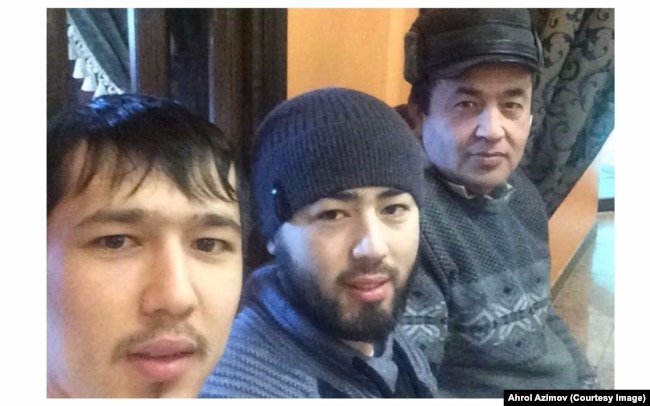
Akram and Abror Azimov, and their father Ahrol Azimov. Photo taken from Ahrol Azimov’s Facebook page
According to Akram Azimov’s mother Vazira Azimova, law enforcement officers snatched her son from a hospital in Osh, Kyrgyzstan, on April 15, the day after he had undergone an operation, and took him to an undisclosed location. The video recording released by the FSB on April 19, in which Akram Azimov is detained at a bus stop in New Moscow, was staged, she claims.
“He had no money for a ticket. He did not have his passport. It was obviously staged. I want justice,” Vazira Azimova said in a statement.
Akram’s father Ahrol Azimov provided RBCwith a photo of his son’s boarding pass for an S7 flight from Domodedovo Airport in Moscow to Osh, Kyrgyzstan, on March 27, 2017. The senior Azimov is convinced his son could not have traveled to Russia on his own: when he was hospitalized he had no money with him to buy a ticket.
The fact that Akram Azimov was snatched from a hospital in Osh by officers of the Kyrgyzstan State Committee for National Security (GKNB) on April 15, 2017, has been confirmed in writing by Zina Karimova, head doctor of the Hosiyat Clinic, a private facility, and Sanzharbek Tohtashev, the attending physician.
According to lawyer Anna Stavitskaya, illegal detentions are a common practice in the CIS countries.
“The security services in a number of post-Soviet countries cheerfully cooperate with the FSB when it comes to ‘unofficial’ exchanges of detainees. Practically speaking, it is often a matter of kidnapping. In my practice, there have been several cases when people were apprehended in Russia. The issue of whether to extradite them to Uzbekistan or Tajikistan, for example, was being decided, but the European Court of Human Rights forbade extradition. As soon as the people were released from custody, they were kidnapped with the assistance of the Russian security services and transported to these foreign countries. In this case, it is the other way round.”
Akram Azimov was transported by FSB officers from Kyrgyzstan to Moscow, where, his lawyer Olga Dinze claims, he was held for four days in an illegal prison, after which the FSB staged his apprehension.
“On April 19, the suspect, wearing a blindfold, was taken somewhere in a vehicle. He was told how to behave. He should sit with his hands in his pockets and keep quiet. The ‘officers’ would come up to him and take him to a car. This was the same staged video we all would see later on the internet. After his apprehension was staged, he was placed in the car. His hands were cuffed behind his back and a grenade was placed in his hand. He was ordered to squeeze it so he would leave his fingerprints on it.”
Something similar happened to Akram’s brother Abror Azimov. He was apprehended by FSB officers on April 4. After thirteen days in a secret FSB prison, he was apprehended a second time, for the video cameras, on April 17.
Abror Azimov claims that on April 17 he was taken from his cell, and a hood was pulled over his head and wrapped round with adhesive tape. His capture was then staged. Afterwards, he was put in a car, forced to leave fingerprints on a Makarov pistol, and taken to an investigator, who had already printed out his interrogation transcript.
Before Abror Azimov was officially apprehended on April 17, the house where he lived in Lesnoi Gorodok, Moscow Region, was searched. Investigators carried out the search without a judge’s warrant due to the urgency of the matter, as they explained. It was during this search that the Makarov pistol was allegedly found.
11. The Azimov Brothers Were Tortured After They Were Apprehended
The Azimov brothers were apprehended twice: first with no cameras present, and then for the cameras, so that FSB officers would have several days to illegally interrogate the accused men. The Azimovs claim they were tortured during these interrogations.
According to Olga Dinze, Akram Azimov’s attorney, her client was tortured with electrical shocks.
“He was brutally tortured. He was standing practically naked on a concrete floor. He was not fed or given any water. He was forced to memorize the testimony he would later give to the investigator. When he would give the wrong answer, they would shock him with an electrical current, counting to ten. Periodically, he fainted. He would be brought back to his senses and the torture would resume. The torture not only involved memorizing his testimony but also threats of violence against his wife and children. They threatened to rape his wife. Since Akram knows of such cases in his homeland, he took the threats seriously.”
After he was tortured, Akram Azimov was taken to the Russian Federal Investigative Committee, where he was interrogated in the presence of a state-appointed defense attorney. The FSB officers who had earlier tortured him told him what answers to give, but his state-appointed counsel said nothing, allowing the FSB officers and the investigator to coerce Azimov mentally.
The circumstances faced by the second accused man, Abror Azimov, have been similar. His defense attorney said his client was apprehended and jailed in a secret prison, where he was repeatedly tortured with electric shocks, dunked in water, humiliated in every possible way, and subjected to mental coercion. FSB officers spent two weeks forcing him to admit involvement in terrorist activities.
On April 18, 2017, during his custody hearing, Abror Azimov’s testimony was confused. At first, he stated he was not involved in the explosion, but after an Investigative Committee officer reminded him that he had earlier signed a confession, Azimov said, “I’m involved in this, but not directly.” When the judge asked whether the suspect wanted the court to assign non-custodial pretrial restrictions, Azimov answered in the negative. The question is what kind of person, if he has not been subjected beforehand to physical and mental coercion (torture and threats), would voluntarily agree to be jailed?
12. Their Lawyers Were Not Admitted to the Azimov Brothers
According to lawyers Olga and Dmitry Dinze, they could not begin defending the Azimov brothers for over a week.
“We could not start working on this criminal case, because neither the remand prison nor the investigator would let us see our clients, using whatever trick they could.”
The investigators from the Investigative Committee ignored the lawyers’ calls and conducted the investigation only in the presence of the state-appointed lawyers.
Investigators thus had nearly a month after the official arrest to pressure the accused without being distracted by the legitimate requests of real lawyers.
The Azimov brothers’ problems did not end with the refusal of authorities to let their lawyers see their clients. Since late June, according to their father, the Azimovs have been paid visits by FSB officers who have demanded they renounce their defense lawyers and employ the services of state-appointed lawyers.
13. The Justice Ministry Has Been Pressuring Olga Dinze, Akram Azimov’s Lawyer
On August 3, 2017, officials of Lefortovo Remand Prison in Moscow detained Olga Dinze, Akram Azimov’s lawyer, for three hours, demanding she hand over the notes she received from Azimov concerning the case of the terrorist attack in the Petersburg subway.
The prison wardens wanted to get their hands on documents Azimov had given to his lawyer. The wardens suggested Olga Dinze could sit in a cell for awhile, while her client was threatened with time in a punishment cell. According to Dinze, she had not done anything illegal. Before the visit, guards had searched Azimov and not found anything that could not be taken out of the prison.
In November 2017, the Justice Ministry requested Olga Dinze be barred from the case due to the conflict over obtaining her client’s written testimony. Ramil Akhmetgaliyev, a lawyer with the Agora International Human Rights Group, believes this was obvious coercion of the lawyer.
“Correspondence is one thing, but communication with your lawyer, including written communication, is something else altogether. Usually, the guards do not have a problem with it, but the FSB got involved. They are trying to establish total control over the accused.”
The current Russian regime, conceived in September 1999 amidst the smoke from the exploded residential buildings in Buynaksk, Moscow, and Volgodonsk, has a bad reputation when it comes to terrorist attacks. Any doubts, as a rule, are chalked up by independent observers as strikes against the authorities.
Taken separately, each of these thirteen points cannot serve as proof that the account of the explosion in the Petersburg subway on April 3, 2017, offered by state investigators, is falsified. Taken together, however, these facts do generate serious suspicions.
“I’ll Go All Out to Ensure Putin Loses”
Yelizaveta Mayetnaya Radio Svoboda
December 5, 2017
“Citizen Putin! If there is a clampdown on public liberties under the pretext of terrorists attacks, it will be clear to everyone who is behind them!”
“Putin is war. Say no to war!”
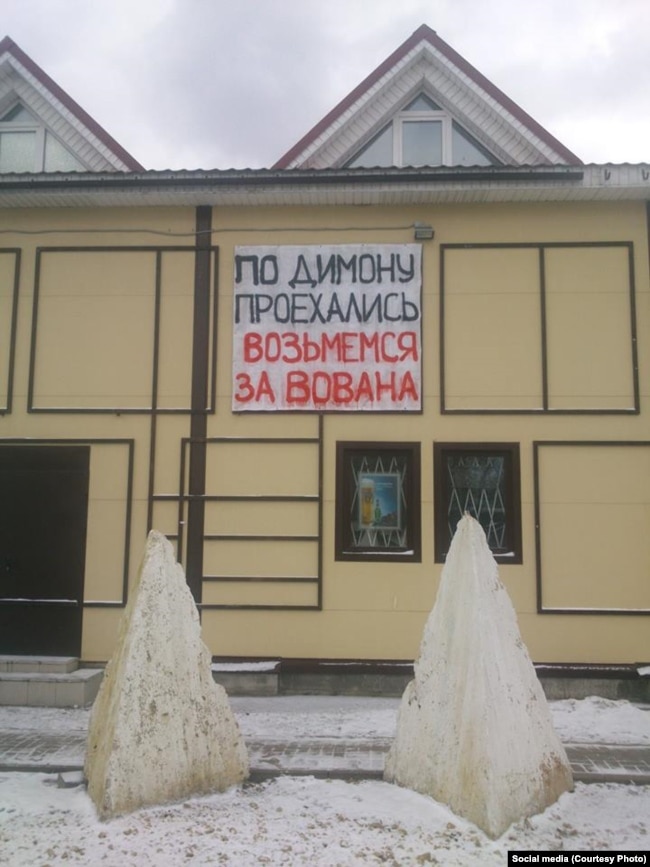
“Dimon got what was coming to him. Let’s go after Vovan.”
“We live the way we vote.”
Dmitry Skurikhin, owner of a store in the village of Russko-Vysotskoye, near Petersburg, reacts immediately and visually to every political event in Russia.
Skurikhin immediately hangs each new poster on the front of the store, a small, two-storey building, so it is readily visible from the nearby bus stop. They usually do not stay up for long, however. The record is held by the slogan “Peace to Ukraine,” which stayed up for two weeks.
Skurikhin at a pro-Navalvy rally on the Field of Mars in Petersburg
43-year-old Dmitry Skurikhin is a local businessman, whose family owns three village shops. By local standards, he is well off. His family owns several cars, and they have everything they need. However, Skurikhin says the incomes of villagers have taken a nosedive in the past year: “They buy almost nothing, because they barely have enough for food.” Around six thousand people live in Russko-Vysotskoye. Very few of them are holiday cottage dwellers. The majority commute to work in Petersburg. Skirukhin was the first businessman in the village to open self-service stores, but “then the Pyatyorochka and Magnit chains moved in, and we croaked, of course.” He now sells toys, newspapers, clothings, and sundries.
He has been hanging political posters on his store, situated along a road, for almost four years. Before that, he pasted homemade bumper stickers on his car. Skirukhin recalls that the first bumper sticker read, “No new taxes!” The year was 2005.
Skurikhin: They had decided to raise taxes on us local businessmen then. It was one of those taxes you couldn’t avoid paying. Either you worked and paid the tax or you didn’t work and didn’t pay the tax. We businessmen realized they were clamping down on us. We joined forces and beat back the tax. It made such an impression on me that since then I haven’t been able to stop going. There are at least some improvements in our lives, specifically in our village. I’m a local grassroots activist, not even a region-wide activist, but a village-level activist. I was born here, and I live and work here. My kids go to school and kindergarten here. I think I have helped improve life in our village.
Radio Svoboda: How exactly have you improved life in the village?
Skurikhin: As they call it now, I was a municipal district council member from 2009 to 2014. At the time, our district authorities were running this interesting scam. They were “milking” the villages. They would buy heat from the producer and sell it to residents. They marked up the price one hundred percent. When the situation had reached a deadlock, it transpired they were charging residents, but not paying the producer anything. They were getting heat for free. The chair of the district council was mixed up in the scam. Thanks in part to my efforts, the gentleman was conveyed directly from the district chairman’s office to prison. That was in May 2012. Since then we haven’t had any disasters with our supply of heat and water.
We still have problems sometimes, but we are now longer in that disastrous state when a group of people affiliated with district officials were just robbing people by latching onto the flow of payments for housing and utilities. Then we had problems with the road. I organized a decent protest rally. A lot of folks turned out for it: 165 people, which is a huge number for our village. We demanded the road be repaired. The road was repaired. So, by starting with small changes like that, stirring people up, I have been trying to bring them round to the idea that fair elections, free speech, and democracy mean improving the welfare of society. On May 1, we had a rally that wasn’t about the roads (we’ve had the roads fixed), but was about healthcare, fair elections, and responsible authorities. Those were the topics of our rally. 45 people showed up. The rally was authorized. I always try and authorize events with the authorities, but we rallied at the skating rink on the edge of the forest.
“Dimon got run over. Let’s go after Vovan.” This is a reference to Alexei Navalny’s film documentary exposé of Prime Minister Dmitry Medvedev and his untold riches, Don’t Call Him Dimon. “Vovan” is a humorous reference to Vladimir Putin.
In 2014, my time as district council member ended for a simple reason: our team doesn’t pay for votes. If you don’t buy yourself votes, meaning if you don’t pay off the right people during early voting, then you’re out of the race, because your opponents do pay for votes. United Russia paid 1,500 rubles per vote! All the other candidates lost.
Radio Svoboda: Did you prove in court they paid for votes?
Skurikhin: It’s impossible to prove in court, because the scam is quite competently organized. They don’t buy votes, but pay for the services of fake campaign workers, meaning they contract out their campaign. United Russia has a team of between ten and fifteen people, depending on the number of seats that are up for grabs in a specific municipal district, and they hire canvassers. But the canvassers don’t have to canvass. They just need to show up and vote ahead of time, for which they are paid 1,500 rubles a pop. That’s it. It’s perfectly legal. All the evidence is circumstantial. When I tried to get hired as a canvasser in a neighboring village, I was told I would not do, because I wasn’t registered in that precinct.
“How’s that?!” I said. “I’m a local resident. I have a store here. I know everyone in the village, and they all know me. I’ll canvass for you like nobody’s business.”
“No, no, you don’t fit us.”
“What’s the deal?”
“You’re registered somewhere else.”
It’s all clear, guys! You don’t need canvassers: you need voters, whom you buy off for 1,500 rubles apiece. I dubbed the technique “bribing a voter under the guise of paying a canvasser.” It works like a charm in all the villages, where the populace is not too savvy. The populace in general is not very savvy, but in the countryside it’s just unbelievable. The salary in these places is commonly 1,000 rubles a day [approx. 14 euros a day]. People who get a 1,000 rubles a day don’t suffer. I ran a counter-campaign against this.
When the villagers were going to vote, I would say to them, “Guys, are you really unaware that when they get seats on the council, they’ll shake a hundred times more out of your pockets?”
“I toss manure on a farm with a pitchfork for a 1,000 rubles a day. But here I’m getting 1,500 rubles for five minutes of my time. Maybe you’d like to go and pitch manure for me?” one guy told me.
That’s their whole rationale! There’s nothing more to say.
Radio Svoboda: When did you hang the first political banner on your store? How long did it stay up?
Skurikhin: It was the spring of 2014. My fifth daugther was born then. I decided to give my wife a present by building a politicized bus stop opposite the store. I fashioned the frame and the foundation. We didn’t have a stop there. People would always stand outside there, and the buses would stop to pick them up. I built a bus stop and draped it with posters. This was when the annexation of Crimea was happening. We had a couple of posters about Crimea: I demanded an end to the disgrace. Then there were posters demaning pay rises for ordinary doctors and school teachers. I was still a council member. I gathered information on how much doctors were paid in Russia. President Putin had literally just claimed that there were no doctors in Russia who were paid less than the average monthly salary in their regions. That was an outright lie. I wrote it on my poster, because I knew how much our doctors were paid. I had gathered the information in my capacity as a municipal district council member.
Radio Svoboda: How much did doctors really make then?
Skurikhin: The ophthalmologist in our village was paid 14,000 rubles, while the average monthly wage in Leningrad Region was 35,000 rubles. I think this as an absolutely proven lie. I hung it up on the bus stop. The local authorities were completely shocked by it. The stop had been turned into a shelter and was hung with banners and pasted with posters. They didn’t know what to do, so the posters stayed up for three weeks or so, I think. Then a major from Center “E” [the so-called anti-extremism police] in Petersburg came and had a long chat with me. That was April 1, 2014. I remembered the date, because it was the day the Russian State Duma issued a resolution condemning restrictions on freedom of speech in Ukraine. And I was sitting there chatting with this little vampire who was directly threatening me and my business.
“We will shut you down if you don’t stop it!” he told me.
The bus stop stood for a month, and then it had to be demolished. All that’s left is the concrete slab, where locals still wait to catch the bus.
Radio Svoboda: Who demolished it?
Skurikhin: I did, on orders from the local authorities. They told me either I had to demolish it and haul it away or they would do it themselves. Since then I have been hanging posters on the store.
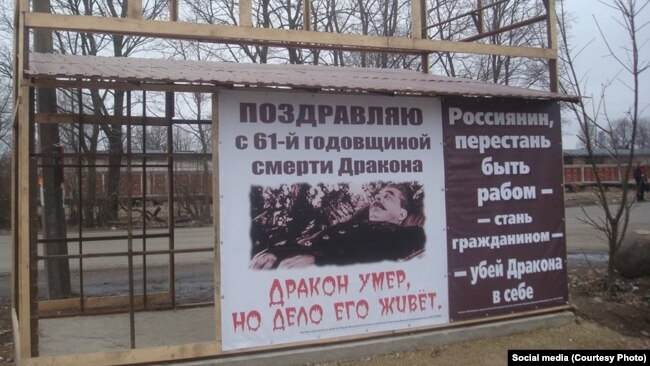
I hung up the poster “I congratulate you on the 61st anniversary of the Dragon’s death. The Dragon is dead, but his cause lives on. // Russian citizens, stop being slaves. Become citizens. Kill the dragon inside you.” The poster, which showed Stalin in his casket, used to be coupled with the second part, about citizens, which was swiped by the polizei. The poster “Peace to Ukraine” broke all the records: it hung for two weeks.
The second part of this poster, featuring a dead Stalin and a call to “kill the dragon inside you” and “become citizens” was “swiped by the polizei.”
The local authorities, by the way, didn’t know how to react. The poster was hanging on my building. It’s my property and my land, and the poster belongs to me. It hung there for quite a long time. Other events took place, for example, the 2014 elections. I hung my campaign posters there. As a municipal district council member, I was competing for votes. I would hang up a poster. It would become stale, and I would hang up a new one. And then, when I clearly campaigned against Putin. . . For example, I had posted a banner reading, “Putin should resign.” It was 9.4 meters by 2 meters. The banner caught everyone’s eye: my store stands next to the road. Well, they just came and swiped the banner. I decided to hang up another banner. Since it was forbidden to demand Putin’s resignation, I demanded Putin be freed. Since he considered himself a galley slave, I wrote, “Free Vladimir Putin! Let’s free this galley slave. Otherwise, he and his pals will row [rake in] too much.” This banner was also 9.4 meters by 2 meters.
Radio Svoboda: It was probably removed immediately, no?
Skurikhin: I don’t know why, but it stayed up for nearly two weeks. I saw policemen come and look at it. Maybe they didn’t get it? I can’t say how the authorities make decisions. But then they removed it anyway. I have been doing this on purpose. My goal is to ensure President Putin loses this election. During the last election, in 2012, I printed flyers and ensured that Putin got the least number of votes in our district in our precincts, although he won anyway, of course. Our precinct was among the ten worst precincts in Leningrad Region. Numbers decide everything in a democracy. I worked on the electorate the best I could.
Radio Svoboda: Do the security services often summon your for talks and try to reason with you?
Skurikhin: Earlier they did, but recently they have left me alone for some reason. I think they just realized, probably, that they should be talking to me in handcuffs, whereas talking to me just for the heck of it, what’s the point? Besides my chat with the major from Center “E,” a major from the FSB, a colonel from the FSO (Federal Protective Service), and the Investigative Committee summoned me. Each of my posters has been sent off for a forensic examination. Policemen photograph them, and the photos are sent to Center “E” and Saint Petersburg State University for analysis: they have this forensics examination center there. Their forensics experts study my posters and render their findings. If the findings are neutral, the posters are returned to me, accompanied by an official ruling refusing to file criminal charges against me. I’ve had around a hundred such posters. Each one is also accompanied by a description. The police also try to do everything by the book. In Nazi Germany, they incinerated Jews by the book. Here in Russia, they have been trying to shut me up by the book, to put it crudely.
Radio Svoboda: What grounds do the police have for removing posters from private property? How does it usually happen?
Skurikhin: First, they get a complaint either from the local council or from a resident: someone is unhappy with the poster hanging on my store. The police arrive and write me up for violating the regional law that all posters must be vetted with the local council. This little law was invented in Leningrad Region. I disagree with it, so I simply say it wasn’t so. They write me up, then they bring a slave from the local housing authority, whom they force to climb up and remove my poster. Then they leave. After which the situation proceeds as I’ve described it. Unfortunately, the forensics experts have concluded that two of my posters insulted the honor and dignity of the president and incited social discord. I try not to insult anyone. I think through all my posters and make sure that they are worded as properly as possible, because you don’t help things by insulting people. I want to persuade people to vote against Putin, persuade them we need democratic values, freedom, and liberalism. Yet two of my posters have been deemed insulting to Putin. They were the reason I was summoned to the Investigative Committee to talk with an investigator.
Radio Svoboda: Have criminal charges been filed in connection with the two posters?
Skurikhin: You know, I haven’t asked the police about it. But they did get me summoned to the Investigative Committee, where I was asked for an explanation. I was shown the findings of the forensics experts. The poster in question was “Putin is war. Say no to war.” As you remember, it was Anna Politkovskaya who said, “Putin is war.” The slogan was written with bloody smudges, so there was nothing in particular to interpret. It was clear as clear could be. The poster was deemed to have insulted Putin’s honor and dignity. I don’t think I insulted him, but the Investigative Committee does.
Radio Svoboda: What war did you have in mind when when you wrote the slogan?
Skurikhin: Any war. Because Putin is, in fact, war. We were flattening Ukraine at the time.
Radio Svoboda: Have they threatened to close your business?
Skurikhin: The major from Center “E” threatened me, but no one else has. It’s just I’ve been in business for twenty-one years, and all the agencies they could sick on me, I’ve been working with them for a long time. I have a good relationship with them. Most important, all of them are on my side. As they’re tearing down the posters, the policemen say to me, “Damn, what you write is true.” But they’ve taken an oath, they have their orders, they would immediately get hell from their commander, so they can’t say it that way. I can because I don’t have a commander. Firefighters, the guys at Health Inspection Services, they all understand what is happening in Russia. Most of them are smart people.
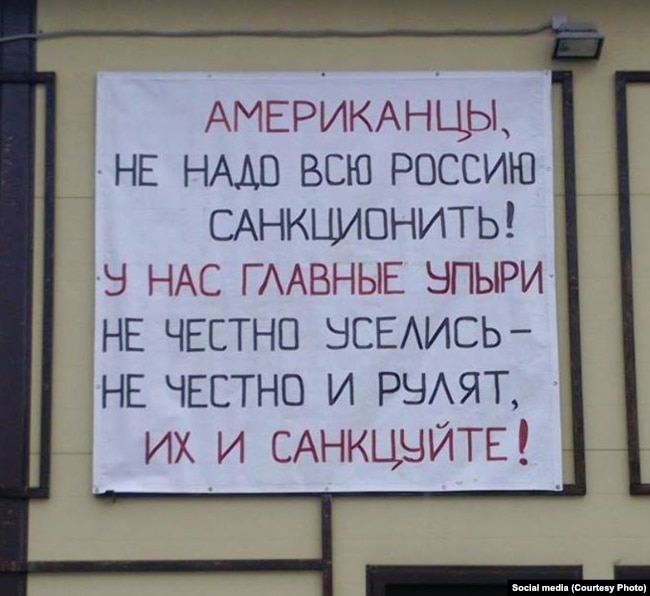
“Americans, don’t sanction all of Russia. Our head vampires got their jobs dishonestly and run things dishonestly. Sanction them!”
Radio Svoboda: Does your family support you?
Skurikhin: Yes, of course. Sure, they worry about me. The situation in Russia is such that the most active dissenters are shot down. My kids are aged nineteen, fourteen, seven, and four. All of them are girls: I live in a flower garden. If I’m arrested, my wife will feed the family: she’ll be like Vassa Zheleznova. I hope it doesn’t come to that, but we’ve talked it all throgh, of course. So that’s why I try and write slogans that are legal. I have studied a ton of material on the subject. What is an insult? It’s when you compare someone with an animal. The rest can be offensive and unpleasant, but it is not insulting in the criminal sense. You can say, “Skurikhin, you’re an idiot.” Yes, it’s possible for you to have this opinion. But I think differently. But if you say, “Skurikhin, you’re a jackass,” that is an insult.
Radio Svoboda: Have other businessmen put up similar posters?
Skurikhin: There were elections to the State Duma in 2016. As a member of Parnas (People’s Freedom Party), I ran in them in my own electoral district, the southwest district of Leningrad Region. Sergey Naryshkin, now our top spy, ran in the same district. I made the rounds of all my businessmen friends and asked them to support me. I made banners that read, “Skurikhin and Parnas are your only worthy choice.” In our part of the world, most of the shops are village shops, and they are on private property, so I was able to hang them up for free. No other candidate got that kind of support. The rest had to pay for billboards. I spent 150,000 rubles on my election campaign. My wife later gave me a piece of her mind about that. I took second place in the elections in my own village. Only Naryshkin got more votes. I got support for my posters and ideas, for saying “Putin should resign.” My fellow villagers gave me the number two spot. In my native Lomonosov District, I took sixth place, and I took eighth place in the entire electoral district, which has a population of 500,000. What does that tell you? I would argue the outcome shows that liberal and democratic ideas are popular in society, but they simply never get conveyed to the voters, since the media are totally blocked. I have no other way of telling people Putin should have been dismissed from the Kremlin long ago. I only have my posters. But, generally speaking, it’s very hard for a Parnas member to get around United Russia on the first try.
Radio Svoboda: Do you attend all protest rallies?
Skurikhin: Yes, I try to go to all of them. At the last pro-Navalny rally, in June, I was wearing a “Sick of Him” t-shirt and carrying a flag. I was taken to a police station, but I escaped. This year there were also primary elections—Naryshkin gave up his seat in the Duma when he was appointed head of the SVR (Foreign Intelligence Service) in October 2016—and this year there were reelections. We also held events that, in my opinion, were meaningful to our district. I couldn’t let my people down, so I had to hightail it from the police station.
Radio Svoboda: Are you following the presidential campaign?
Skurikhin: Yes, of course. I’ll go all out to ensure Mr. Putin loses the election, at least in my precinct. I support Navalny’s registration as a candidate and Ksenia Sobchak’s candidacy, because we need as many candidates as possible in the first round just to take votes away from Putin and get a second round. If there is a second round, that will be a significant victory in itself.
Thanks to Comrade Uvarova for the heads-up. Translated by the Russian Reader

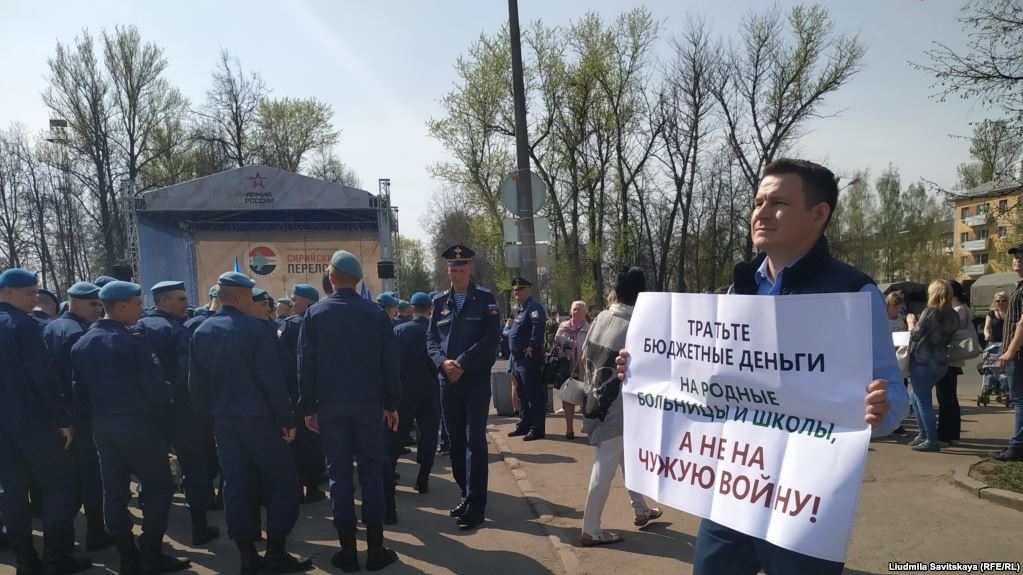 Nikolai Kuzmin during his solo picket outside the exhibition The Syrian Breakthrough, in Pskov. His placard reads, “Spend budget money on our own schools and hospitals, not on someone else’s war.” Photo by Lyudmila Savitskaya. Courtesy of Radio Free Europe/Radio Liberty
 The courtyard of the Communist Party Regional Committee headquarters in Novosibirsk, where the monument to Stalin will be erected. Photo courtesy of Anton Barsukov and RFE/RL
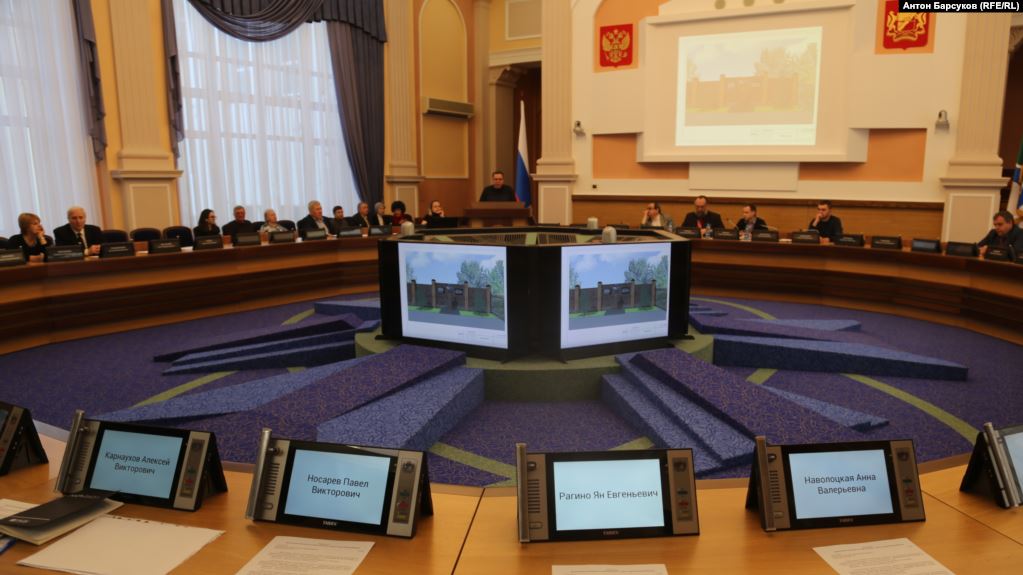 The Novosibirsk Artistic Expertise Board in session. Photo courtesy of Anton Barsukov and RFE/RL
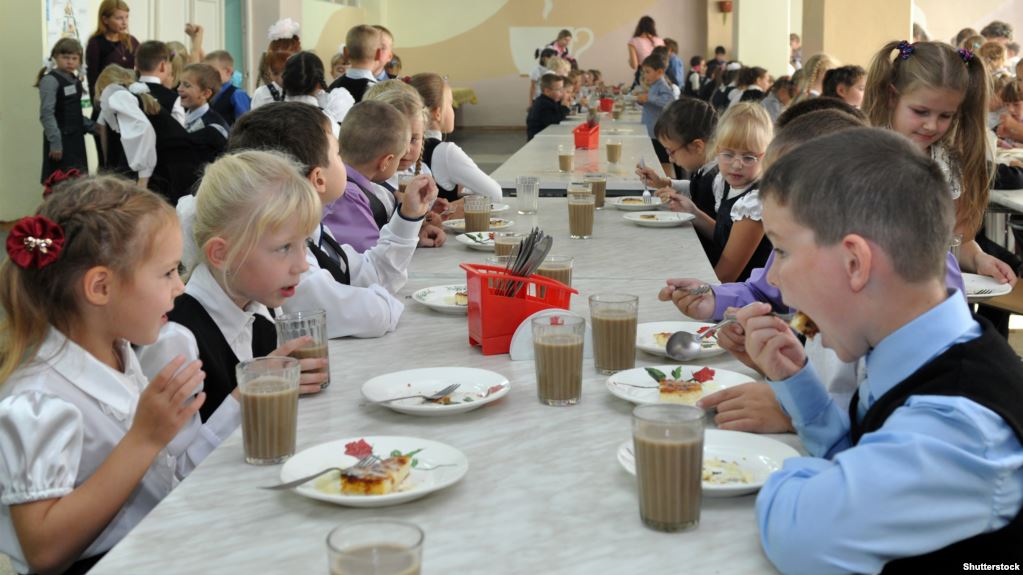 A stock photo of schoolchildren enjoying lunch in some place happier and more prosperous than Kemerovo Region and other parts of Russia that have been left to die by the country’s rapacious, neo-imperialist ruling class. Courtesy of
  Three Last Address plaques on the house at 27 Dostoevsky Street, in downtown Petersburg
 The plaques are barely visible from only ten meters away.
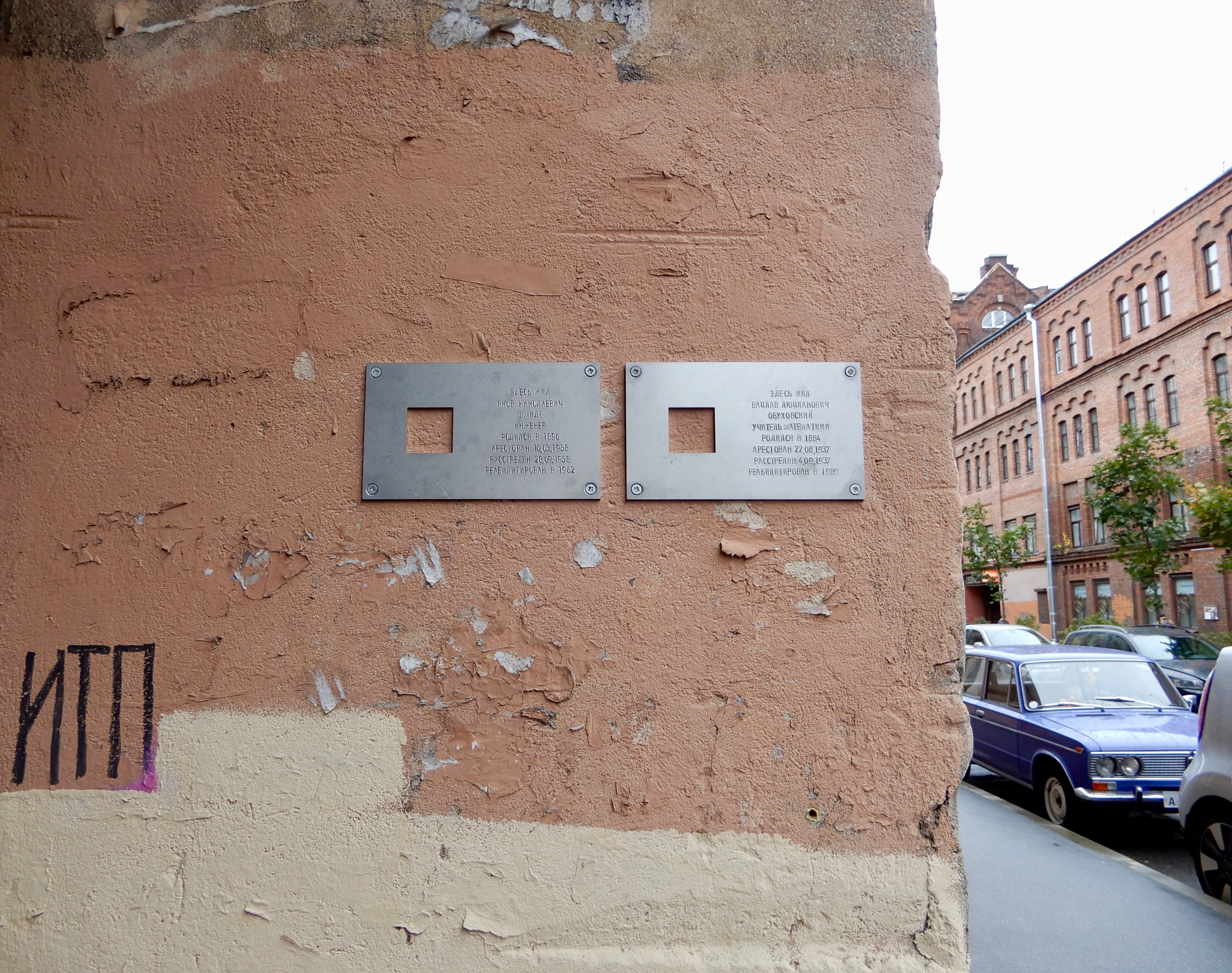 There are two more plaques right next door, in the gateway of the house at 27 Dostoevsky Street.
 Unaware of the Last Address plaque on the wall next to her, a woman walks down Poltava Street, just off Old Nevsky, on a sunny day in October.
 When you step back ten or fifteen meters, the same plaque is nearly invisible to the naked eye.
 A Last Address plaque in the doorway of the house at 36 Razyezhaya Street, in Petersburg’s Central District.
 A Last Address plaque in the archway of the house at 6 Socialist Street, in central Petersburg.
 Three Last Address plaques, barely visible from the middle of the street, on the house at 69 Chernyakhovsky Street, near the Moscow Station in Petersburg.
 The plaques at 69 Chernyakhovsky Street commemorate Vasily Lagun, an electrician; Solomon Mayzel, a historian of the Arab world; and Irma Barsh. They were executed in 1937–1938 and exonerated of all charges in the late 1950s and early 1960s.
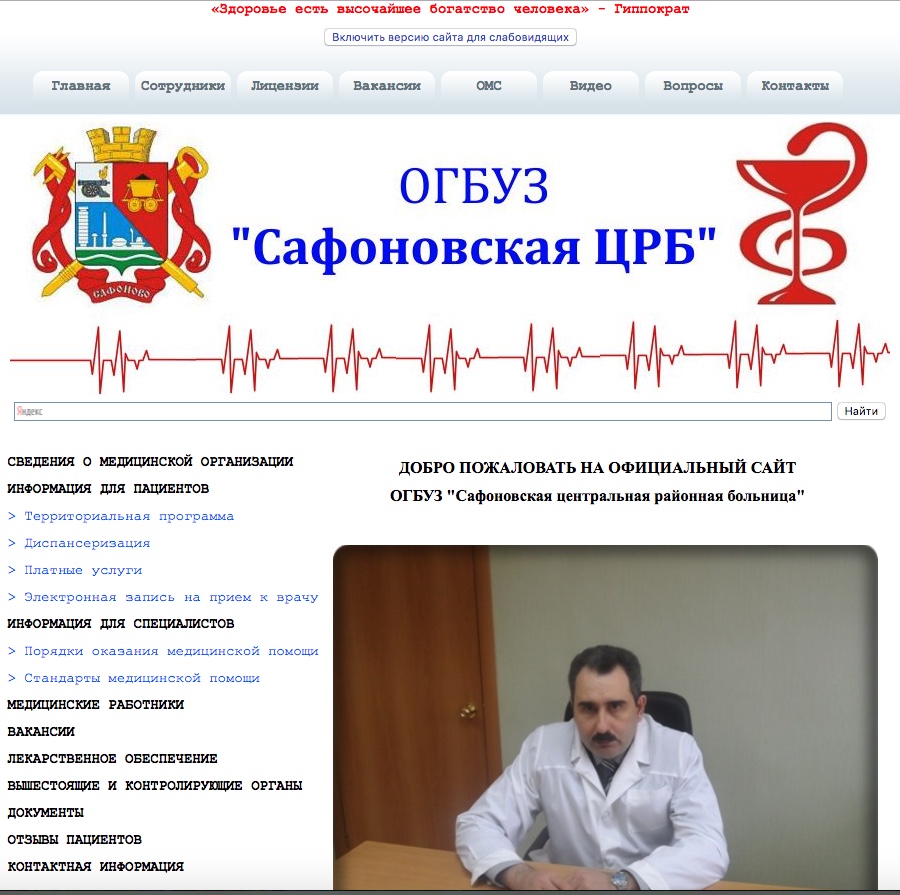 Screenshot of the Safonovo Central District Hospital’s
 All that is left of the anti-Putin leaflets posted by Nikolai Korshunov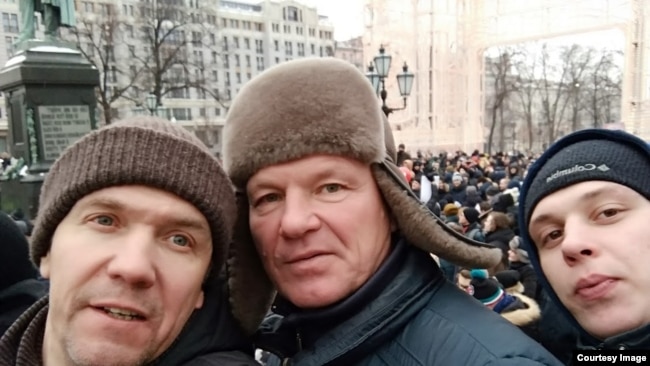




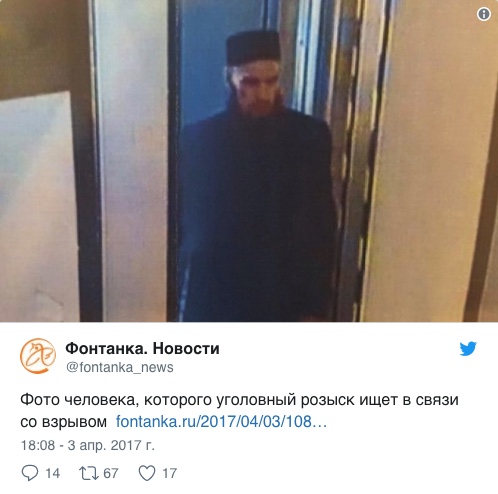
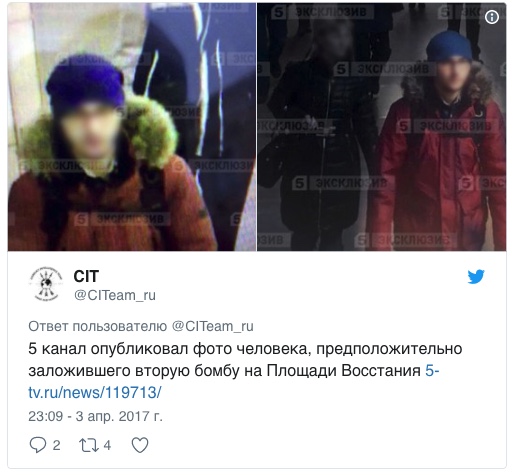
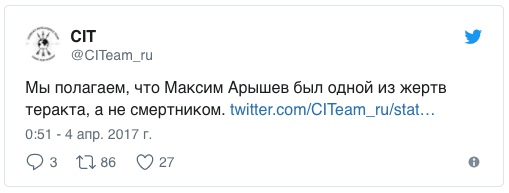

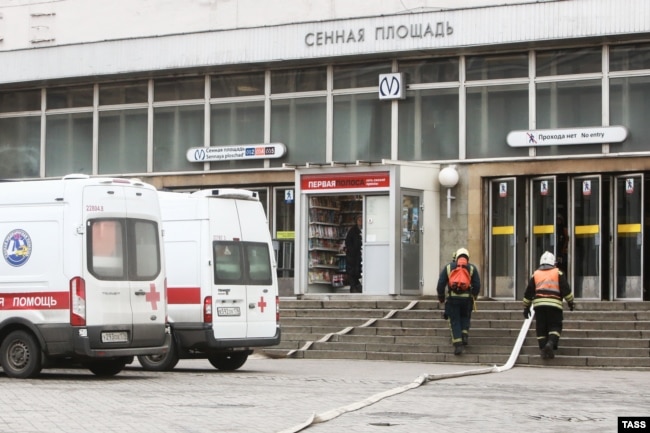
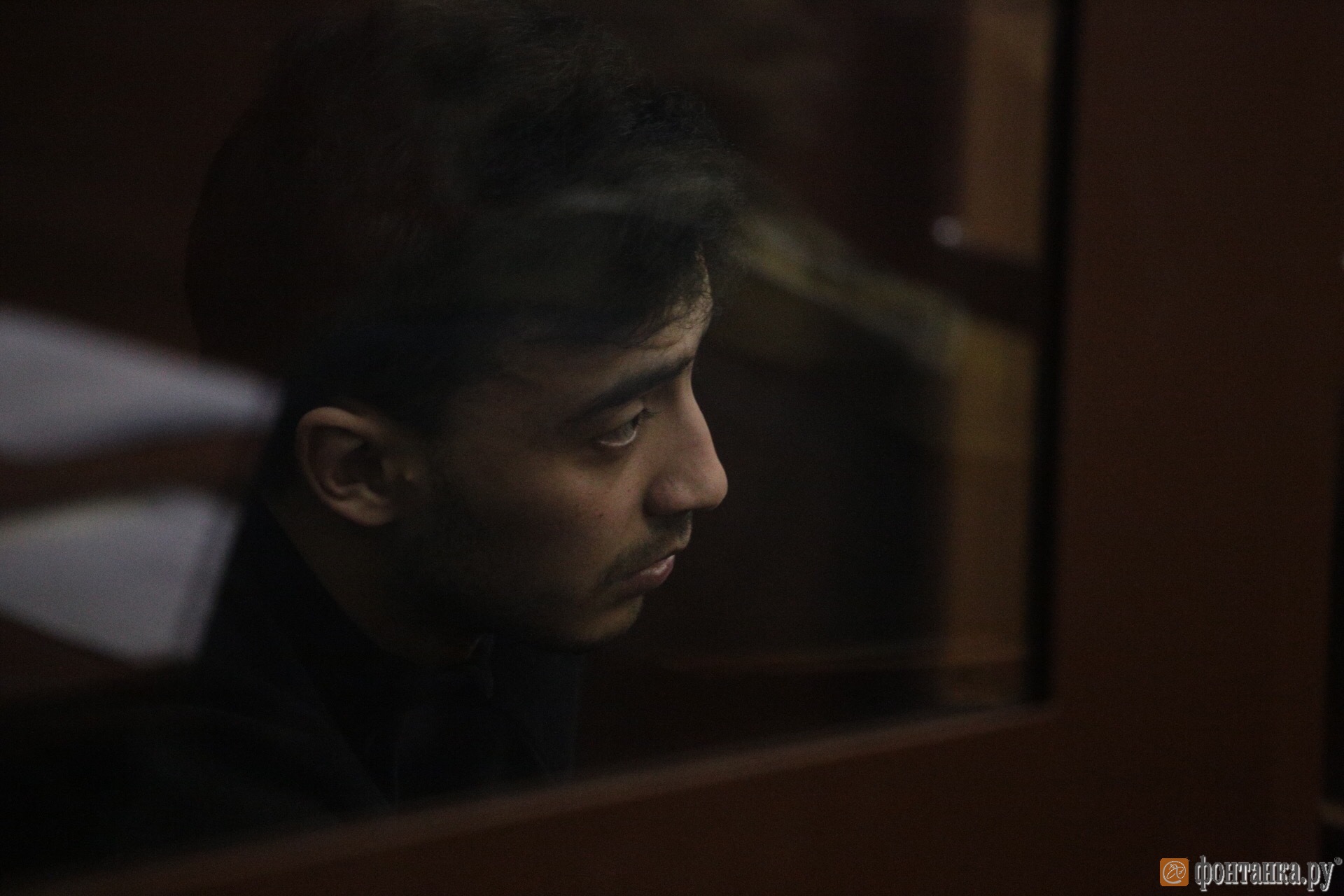 Mahamadusuf Mirzaalimov. Photo by Sergei Mihailichenko. Courtesy of