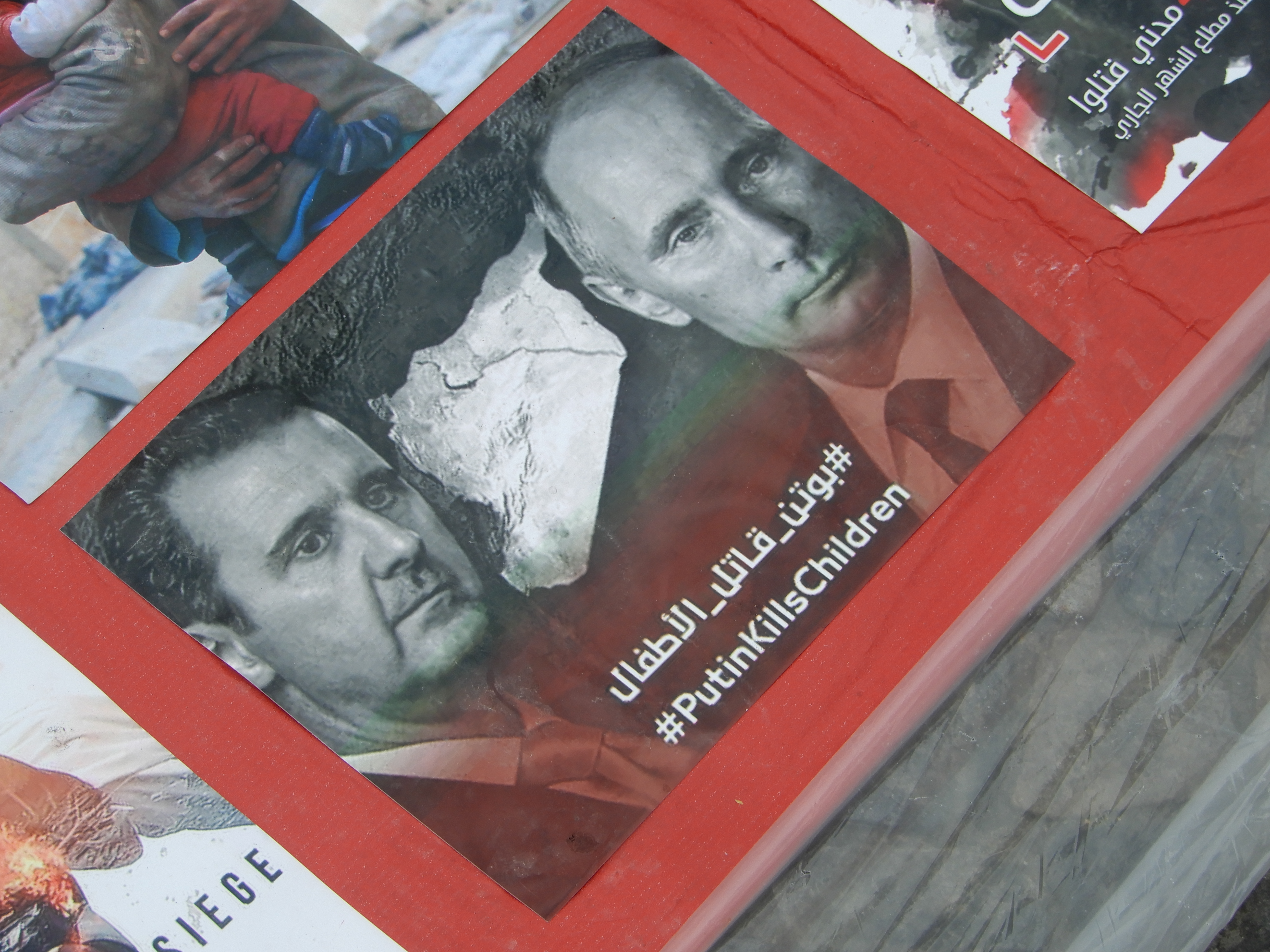
#PutinKillsChildren

putinkillschilren.JPGPoster at a rally in support of Idlib, 15 June 2019, Pariser Platz, Berlin. Photo by the Russian Reader

As the extraordinarily eloquent photographs a friend of mine took six days ago in Moscow show, another “look at us revolution” has been taking place there.

Like the previous “look at us revolution” of 2011–2012, staged almost exclusively for social media and international media consumption, the implicit message has been, “W are smart white people and we deserve better. Marvel at our clever placards. Look deeply into our educated white faces. In every single way that matters, we are just like you Herrenvolk in Europe and the US. The fact we live under a vicious tyranny is an unhappy accident for which we bear almost no responsibility.”

Beyond that, apparently, there is no plan, program or coordination, so it would be a mistake to imagine the detention of these protesters by the hundreds means the Putin regime is afraid of them. No, the regime is discouraging the protesters and potential protesters and, more importantly, it is gathering information on the detainees, information it can use in future crackdowns.

There will be a real revolution in Moscow when the super smart “white people” there not only learn how to get much larger numbers of people on the street, coordinate their movements, push back against the police’s attempts to detain them, and make real political demands but also discover the existence of the rest of the world and Moscow’s increasingly baleful effect on it.

If a hundred thousand people marched in the streets of Moscow demanding Putin immediately withdraw all Russian troops and mercenaries from Syria, this would not only signal the beginning of the end of Putin’s long reign but it would also mean anti-regime Russians had realized solidarity is a two-way street.

You cannot expect people in other parts of the world to empathize with your struggle for democracy and justice when your country’s armed forces, internet trolls, mercenaries, spies, and military proxies are fighting and fueling armed conflicts and political crises in dozens of other countries.

Russia might have more natural resources than any other country in the world, but the reserves of goodwill toward the country and its people will eventually dry up.

It has been said before by hundreds of activists and commentators, but if the US had allied itself with Assad to bomb the hell out of his opponents in Syria, the whole world, especially the leftist part, would be up in arms.

Russia has been bombing the hell out of Syria and doing lots of other nasty stuff elsewhere, including poisoning people in broad daylight and shooting down airliners, but it troubles almost no one, relatively speaking.

What is more, no one bothers to ask why it does not bother all the nice “white people” in Moscow, who would never think to demonstrate en masse against their country’s attacks on lesser folk in third-world countries. {TRR}

#PutinKillsChildren

An Islamophobic Witch Trial in Moscow Ends with Hefty Sentences for Swarthy Men Who Read Banned Books

KMO_169609_00017_1_t218_222045Defendants in the trial holding up a homemade placard that reads, “Oh people! Wake up. We’re not tourists.” Photo courtesy of Kristina Kormilitsyna and Kommersant. Thanks to Sergey Abashin for the heads-up

In Moscow, Hizb ut-Tahrir Defendants Sentenced to 11 to 16 Years in Prison
OVD Info
February 15, 2019

The Moscow District Military Court has sentenced defendants in the so-called Hizb ut-Tahrir case to eleven to sixteen years in medium security penal colonies, reports Moscow News Agency.

The men were found guilty of violating either Russian Federal Criminal Code Article 205.5 Part 1 or Part 2, which criminalizes involvement in the work of an organization deemed a terrorist organization. According to investigators, the accused men read “banned literature, including religious and ideological texts” in a rented apartment in Moscow from October 7, 2016.

The prosecutor had originally asked the court to sentence the accused men to thirteen to seventeen years in prison.

Interfax reports that Zafar Nodirov, the cell’s alleged leader, Farhod Nodirov, and Hamid Igamberdyev received the maximum sentences.

Sobirjon Burhoniddini, Alijon Odinayev, Muradjon Sattorov, Otabek Isomadinov, and Aziz Hidirbayev were sentenced to eleven to twelve years in maximum security penal colonies.

Four of them did not deny their involvement in Hizb ut-Tahrir. They claimed the organization was a political party whose members did not engage in prohibited activities.

The twelve natives [sic] of Central Asia were arrested in December 2016. Three defendants in the case pleaded guilty and were sentenced to ten to twelve years in maximum security penal colonies.

Hizb ut-Tahrir is an international pan-Islamist political organization. It is banned in a number of Muslim countries and Russia. It is also banned in Germany for not recognizing the state of Israel. The SOVA Center for Information and Analysis has argued the party has been wrongfully deemed a “terrorist” organization in Russia.

Thanks to Elena Zaharova for the heads-up and for caring. Translated by the Russian Reader

___________________________________________________

Why Ban Hizb Ut-Tahrir? They’re Not Isis—They’re Isis’s Whipping Boys
William Scates Frances
The Guardian
February 12, 2015

Another day, another Islamic State (Isis) meme. This one is a rather well done mimicry of the pamphlet style of Hizb ut-Tahrir. Its title reads “Hizb ut-Ta’khir”—translated roughly as the “party of delay”—and its bold headline reads, “Establishing the Khilafah since 1953.”

Beneath, the disclaimer reads: “I know, we have got nowhere so far, but we have lots of conferences and heaps of flags and are really good at sitting in cafes.”

This is not the first meme about Hizb ut-Tahrir to be spread around the oft deleted and resurrected pro-Isis Twitter handles. The Dawlah twittersphere (Dawlah meaning “state,” shorthand for Islamic State) is full of them, all of a similar theme, all targeting Hizb ut-Tahrir.

Reading much of the commentary in recent months, you would not expect Hizb ut-Tahrir to be the target of Isis supporters’ mockery. However, contrary to the common equivalency made between the two groups, the gap between Isis and the Hizb has never been wider. They are not only very different, but for some time have been in active opposition.

Hizb ut-Tahrir is a nonviolent political group that imagines itself as speaking truth to power from within the belly of the beast. Isis is a violent utopian movement that views staying in the west as inherently suspect. Hizb ut-Tahrir’s membership are generally inclined towards the classical Islamic sciences, while Isis affiliates are “Salafi-Jihadi” in approach.

Hizb ut-Tahrir has a party structure, with defined roles and official party lines. Isis is scattered, with isolated spokespeople of varied authority and rhetorical skill. The primary similarity between the two is their religion, but when their membership, approach, rhetoric and demographics are so utterly distinct, the comparison stops there.

In Australia, Hizb ut-Tahrir is something like the Muslim equivalent of a socialist student movement. Its prominent members are mostly tertiary-educated and imagine themselves as a sort of Muslim consulate to the west. They are avowedly nonviolent in their approach, but do not shy away from supporting specific “mujahedeen” groups in current conflicts, though this support has rarely been found to go beyond the rhetorical and is confined to wars within the Muslim world.

Like the aforementioned socialist student groups, their main form of communication comes through pamphlets and fiery speeches delivered by a small cadre of speakers from within their party structure.

Isis, on the other hand, is nothing like this. While in Raqqa and Mosul the group has something approaching a governance structure, in Australia the supporters of the group have no coherent hierarchy. Rather, “Dawlah fanboys,” as they are known to some, are scattered individuals confined to hidden Facebook groups, anonymous Twitter accounts and the occasional coy “spokesperson.”

They imagine the Islamic State as a sort of Muslim utopia, a land “free of humiliation.” They view themselves as destined to fight the good fight against the tyranny and disbelief which defines a postcolonial Muslim world. That they use memes is telling; they are a wholly different demographic from Hizb ut-Tahrir. Much of their membership seems to be both less educated and of a lower socioeconomic status. They deride the Hizb as all talk, and say as much often and publicly.

On the other side, Hizb ut-Tahrir has, in the few media releases in which they address Baghdadi directly, invoked verses of the Qur’an regarding the curse of God upon tyrants and their servants. This rhetoric has only increased since a senior member of the group was reportedly executed in Aleppo for “questioning Baghdadi’s self-proclaimed Caliphate.” Hizb ut-Tahrir called dibs on the Caliphate, and they view Baghdadi’s group and his title as wholly illegitimate.

Much was made of Wassim Dourehi’s refusal to denounce Isis during his Dateline interview with Emma Albarici. This was no show of support; Dourehi’s refusal was Hizb ut-Tahrir exposing the media’s ignorance of their movement. Further, it only takes a cursory look at Hizb ut-Tahrir’s website to see that they are embroiled in a bitter and ongoing feud with Isis.

While Tony Abbott has not confirmed whether the federal government will attempt to ban Hizb ut-Tahrir, it would be foolish to do so. Hizb ut-Tahrir thrives on bans. It is banned in a large number of the regimes of “taghout”—tyrants, as their language describes it—and they wear these bans as a mark of honor, as a sign of their legitimacy and the fear their truths inspire. Indeed, the lack of a ban is used by some Isis supporters to prop up a persistent rumor that Hizb ut-Tahrir is a government front.

As it stands, Hizb ut-Tahrir is a whipping boy. Whenever Isis does something bad, they are dragged out in public to get a flogging. The idea that banning the Hizb will somehow reign in Isis or stop the spread of their rhetoric shows just how much this ignorance pervades discussions of public policy.

“If It Were Up to Me, I Would Kill You”

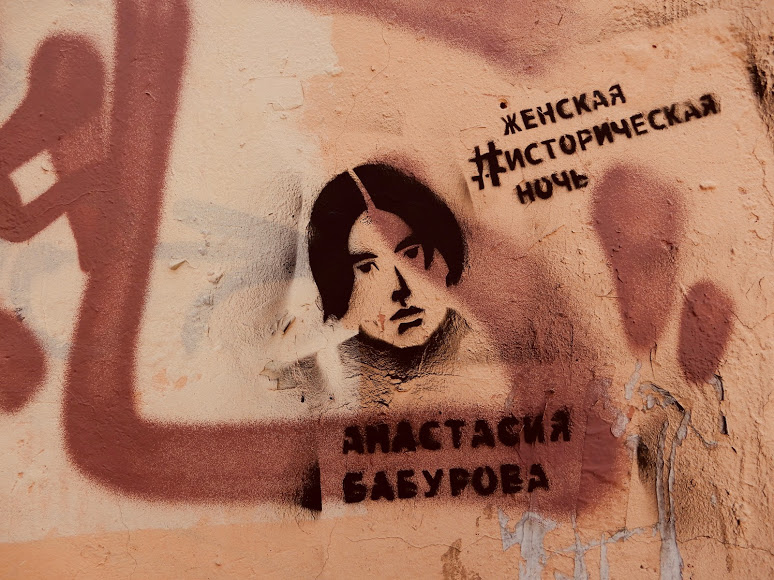
baburova-women's historical night“Anastasia Baburova. #Women’s History Night,” Central Petersburg, May 22, 2018. Photo by the Russian Reader

Marchers Detained at Markelov and Baburova Memorial Event in Moscow
Mediazona
January 19, 2019

Police have detained people attending a march in Moscow marking the tenth anniversary of the murders of human rights lawyer Stanislav Markelov and Novaya Gazeta reporter Anastasia Baburova, Kommersant reporter Alexander Chernykh has reported on his Telegram channel.

According to Chernykh, police have detained journalist Igor Yasin, who was carrying a rainbow-colored flag, and five other people. The reasons for their arrests are unknown. The march has been halted.

OVD Info has reported that four people have been detained. Aside from Yasin, the detainees include Nikolai Kretov, Dmitry Borisenko, and Mikhail Komrakov.

Komrakov told OVD Info that when he was detained, a policeman said to him, “If it were up to me, I would kill you.”

According to Kretov, policemen hit him after he was put in a paddy wagon.

The Markelov and Baburova memorial march began at two o’clock on Tverskaya Boulevard and was scheduled to end with the laying of flowers at the spot where they were murdered on Prechistenka Street.

On January 19, 2009, Nikita Tikhonov, a member of the Russian neo-Nazi organization BORN (Combat Organization of Russian Nationalists), shot and killed Markelov and Baburova in downtown Moscow in broad daylight. Tikhonov and his accomplice Yevgenia Khasis were subsequently convicted and sentenced to life imprisonment and eighteen years in prison, respectively.

Translated by the Russian Reader

“Anyone Can Become Homeless” (#quietpicket)

serenko-quiet picket-homeless“Anyone can become homeless. #quietpicket.” Photo courtesy of Darja Serenko

Darja Serenko
Facebook
November 23, 2018

#quietpicket

After the war waged by certain activists in a certain neighborhood against Nochlezhka,* after the things they said—”The homeless aren’t people,” “They have themselves to blame: let them croak,” “People are divided into castes, and each caste must live where it belongs”—and in the wake of other manifestations of social fascism, I am traveling today with a simple placard.

I wrote the slogan in all caps.

ANYONE CAN BECOME HOMELESS.

I had a brief chat with a man in the subway this morning.

“What, you pity the homeless?”

“It’s not about pity and not about my feelings, but about the fact that a homeless person needs help and that homelessness is a terrible condition in which a person ends up quite often due to a number of circumstances: he or she was conned, they are old, they were in prison, they grew up in an orphanage, they are in poor health, and so on.”

“They have themselves to blame. This is what they want themselves.”

One aspect of the “they have themselves to blame” argument struck me then. Even if someone is to blame (although we know how often the source of guilt cannot be determined or is hard to find), what of it? Does it push someone beyond the ranks of humanity? Does it strip a person of their right to ask for help? I tried to put this into words. My feelings were riled.

Translated by the Russian Reader. This post is dedicated to the blog’s first donor for believing in me and what I do.

_________________________

* When social entrepreneur Daria Alexeyeva joined forces with a charity to open Moscow’s first free laundry for the homeless, the last thing she expected were accusations of profiteering.

“We thought that we were bringing something (so special) to Moscow that the only reaction would be: ‘Wow, is this really happening here, in Russia?’” she told the Thomson Reuters Foundation.

Like any business, social enterprises want to make a profit but they are set apart by using that money to make a difference. The aim, she said, was to help vulnerable people who get little state or public support. But her experience shows the struggle social entrepreneurs can face in a country with scant experience of businesses that expressly set out to do social good.

Alexeyeva’s partner in the project, Nochlezhka charity, had launched a laundry in its home base of St. Petersburg. But in Moscow, the project got off on the wrong foot from the start.

When adverts started to run in August to advertise the laundry’s imminent arrival in an ordinary Moscow district, residents called for a campaign to block it.

In worried Facebook posts, locals feared “dirty,” “contagious” and “antisocial” homeless people would spread tuberculosis, fleas and crime through their neighborhood.

“After washing their clothes, the homeless may come to a children’s playground, and it will become a problem for those who live nearby and their children,” Ivan Polyakov, resident of the Savyolovsky, a quiet residential area in the north of Moscow, told the Thomson Reuters Foundation.

Protests, public arguments, complaints and threats followed.

In September, the confrontation peaked, when one local activist posted an anonymous “investigation” into Alexeyeva’s business, saying she only wanted to open the laundry so she could wash the clothes she sells in her own line of charity shops and so increase her personal profits.

“The only person who needs the laundry is (Alexeyeva),” the post read. “She knows how to count her money. […] Washing her clothes in a charitable laundry is very profitable. If she sells more than one third of it, it’s a gold mine. The homeless are merely there for PR (public relations) and as a cover story.”

Alexeyeva says she would have ignored it if the post had not received several hundreds of shares in one day.

“I started seeing it as a threat and decided to respond,” she said. “It is a weird place to be in, explaining myself after someone ‘exposed’ things I’ve been openly talking about.”

The 29-year-old launched her business in 2014, selling used clothes and donating the profits. The company’s monthly net profit is between 200,000 and 600,000 rubles ($3,000–$9,000).

Half of what the company earned over the past four years went to help the homeless and the poor, among others, and half was spent on developing the business.

[…]

Source: Daria Litvinova, “Laundry for the homeless reveals Russian suspicion over social enterprise,” Reuters, 25 October 2015

[sic]

sledkom-stampsA set of four 27-ruble stamps, celebrating the Russian Federal Investigative Committee, purchased at the Petersburg Central Post Office for 108 rubles on November 12, 2017.

After Dark, They Gonna Blow Up [sic]
Police Looking for Gang of Teenage Anarchists in Moscow
Yuri Syun
Kommersant
November 10, 2018

Kommersant has learned that FSB and police in Moscow are looking for a dozen young anarchists who could be involved in planning terrorist attacks and illegal trafficking of explosives. The chekists [sic] were made aware of the alleged underground organization as part of the investigation of the suicide bombing carried out by a second-year vocational school student [sic] at the FSB’s regional office in Arkhangelsk.

While checking the contacts of the vocational school student [sic], whose suicide bombing injured three FSB officers, investigators became aware of 14-year-old Kirill K., a student in the eighth form at School No. 1571 in Moscow. According to the chekists [sic], Kirill K. and the suicide bomber communicated by mobile phone over a long period and corresponded via Telegram, including the day the terrorist attack occurred in Arkhangelsk. Obviously [sic], it was his older comrade who had told Kirill one could manufacture explosives from ordinary household chemicals, including fertilizers, easily obtainable in hardware stores. During a search of the flat of the schoolboy’s parents, on Freedom Street, police discovered [sic] an improvised explosive device (IED) manufactured from ammonium nitrate, smokeless gunpowder, and bomb parts [sic]. According to investigators, the schoolboy could have assembled the IED for an attack during celebrations [sic] of National Unity and Harmony Day [sic].

The schoolboy was detained on November 2. Yesterday, the violent crimes and public safety case squad in the Russian Investigative Committee‘s Moscow office charged him with crimes under Articles 222.1 Part 3 and 223.1 Part of the Russian Federal Criminal Code (illegal purchase and possession of explosives or explosive devices, and illegal manufacture of explosives).

According to investigators, the suspect committed both crimes as part of an organized group. The group could have included the Arkhangelsk suicide bomber, as well as other, unidentifed persons. There could have been as many as ten people in this group, sources in law enforcement say. However, they have so far been unable to identify the vocational school student and schoolboy’s alleged accomplices. This may partly be due to the fact that Kirill, citing Article 51 of the Constitution, refused to testify and admit he manufactured explosives.

However, his lawyer, Sergei Ashanin, claims law enforcers did not find any explosive devices or parts of explosive devices at the flat of Kirill’s parents.

“Except for ten grams of saltpeter and gunpowder that fit in a glass yogurt jar, there was nothing else,” added the lawyer, refusing to comment on the case.

Ashanin plans to appeals the decision of the Presnya District Court, which remanded the schoolboy in custody. We should note the court’s decision was challenged not only by the suspect, his lawyer, and his legal guardian but also by the prosecutor. Consequently, the defense plans to insist in Moscow City Court that the schoolboy be placed under house arrest instead.

Translated by the Russian Reader

Friendship of Peoples

Elena Zaharova
Facebook
September 4, 2018

It’s impossible for non-Russians to live in the Russian Federation. They should leave the country. I know it’s complicated, but it’s more complicated than burying your children or having to nurse them back to health like this.

I know from my own experience. I’ve heard my fill of stories.

The harder life becomes in Russia, the tougher people will be on non-Russians. The blame here lies not with young, uneducated morons from troubled families, but with the ideologues of neo-Nazism and nationalism. And maybe the Kremlin will pick up the topic again when it needs to look for “enemies.”

Just don’t tell me the Soviet Union was a friendship of peoples. A friendship of people, sure, but the peoples were always pitted against each other.

nephew

Svetlana Choyzhinimayeva
Facebook

September 4, 2018

My nephew was beaten up on Sunday evening, just for the heck of it. Or, rather, not just for the heck of it, but because of his narrow eyes and the color of his skin. We spent all night at the hospital. The examination was brief, but the doctors said they had to wait another two to four days to be sure of the final diagnosis. My nephew’s left eye hurts, and he cannot open it. You can see for yourself.

Something similar happened to another nephew of mine around fifteen years ago, when he was in his sixth year at the Sechenov Medical Academy in Moscow. We had been returning from a concert by the beloved People’s Artist and singer Lyudmila Zykina, a concert to which she had invited us.

We took different trains in the subway. The boy was dozing in the train, his eyes half closed, when suddenly a boot smashed into his face with savage force. Although my nephew was a boxer, there was nothing he could do against a two-meter-tall, thickheaded lout. The result was a broken jaw, being fed through a tube for three months, and having to prepare for his thesis defense. The boy lost forty kilos.

How are non-Russians supposed to go on living?

Photo courtesy of Elena Zaharova and Svetlana Choyzhinimayeva. Translated by the Russian Reader

ЗОЖ (“Civic Activists” Assault and Detain Theater.Doc Members in Moscow)

zozh-1-sairon-ruThe newfangled promotion of ЗОЖ (a Russian acronym for “a healthy lifestyle”) has clear neofascist overtones in post-communist Russia. Image courtesy of Sairon.ru

Ten Theater.Doc Company Member Detained in Moscow
Anastasia Torop
Novaya Gazeta
July 5, 2018

Ten Theater.Doc employees have been detained on Chistoprudny Boulevard, actress Maria Chuprinskaya has informed our newspaper.

She said that, after a performance of the production Adults on the Outside, the actors had set off for the Chistye Prudy subway station and had stopped on the boulevard, when they were approached by a police officer and five men in plain clothes who introduced themselves as “civic activists.” They claimed the theater troupe was drinking alcoholic beverages.

“They said they were in favor of HLS [ЗОЖ, in Russian, an acronym for “a healthy lifestyle” promoted as a crypto-fascist post-Soviet cult] and were ready to testify to any of our crimes. Then they showed me, Lena Nosova, and Alisa Safina photos, from our Facebook pages, relating to Oleg Sentsov on their telephones. They knew our names and surnames, although we had not show them any IDs,” said Chuprinskya.

She added that when actress Tatyana Demidova was detained, one of the men punched her in the stomach.

Then a paddy wagon arrived, and ten members of the company were taken to the Basmanny District Police Station. According to Chuprinskya, Demidova stayed behind on the boulevard with three of the so-called civic activists.

On June 18, Chuprinskaya, Theater.Doc actor Grigory Gandlevsky, artist Alisa Safina, and activist Natalya Savoskina were detained in downtown Moscow for handing out leaflets, printed in English and Spanish, supporting Ukrainian filmmaker Oleg Sentsov.

[…]

UPDATE
OVD Info reports the Theater.Doc employees have begun to be released from the Basmanny District Police Station. Theater member Irina Vekshina writes that actress Tatyana Demidova, who was punched in the stomach, has made her way home.

Translated by the Russian Reader. Thanks to Askold Kurov for the heads-up.

Given that Putin’s machinery of repression has literally not let up for a second while the World Cup has been on, I would like to voice my personal shame that I know people who have not heeded the numerous calls by me and other, smarter people with a clearer, longer view of the Putinist police state to avoid the World Cup like the plague. This would have meant not writing about it on Facebook, not watching it on TV, having nothing to do with it whatsoever. I imagined this was not such a huge thing to ask of people who preach progressive politics and claim to practice international solidarity. I was completely wrong. Instead, foreign fans and reporters alike have been fooled by the unsurprising fact that the Russian police state has not targeted them during the World Cup, and that businesses that stand to make money off their presence in the country have welcomed them with open arms. As if any reasonable person would have expected anything else on this minor score, which means nothing in terms of the bigger picture: i.e., what is life in Russia like for Russians themselves, especially Russians not approved by the Putin regime—gays and lesbians, migrant workers, grassroots activists, religious minorities, ethnic minorities, independent trade unionists, independent activist truckers, small activist farmers from Krasnodar Territory, environmentalists, antifascists, anarchists, dissident bloggers, “foreign agents” (i.e., NGOs not approved by the Kremlin), Ukrainian political prisoners, torture victims, alternative theater directors and actors, and on and on and on. By plugging into World Cup “madness,” you have given the Putin regime a massive shot of self-confidence and swagger. You have sent a loud message to all the groups of “bad” Russians I have listed here that they can take a long walk off a short pier as far as the wider world is concerned. After the World Cup has ended in ten days, things will continue to degenerate under Putin’s misrule. But you will have missed your chance to put a sizable, palpable roadblock in front of an extraordinarily aggressive, mean-spirited, thuggish regime that cannot abide opposition of any kind. // TRR

Psychoactive

“It’s an Exhibitionist Move to Proclaim You Have an Illness”: Who Marched with the Psychoactivists on May Day
Ilya Panin
Takie Dela
May 2, 2018

At this year’s May Day demo in Moscow, almost three dozen people marched with placards inscribed with slogans on the harm caused by stigmatizing mental illnesses. Police detained the marchers at the head of the Bolshomoskvoretsky Bridge and took them to police stations. Only a few marchers in the group managed to avoid being detained. Takie Dela found out what the psychoactivists wanted to say by marching. 
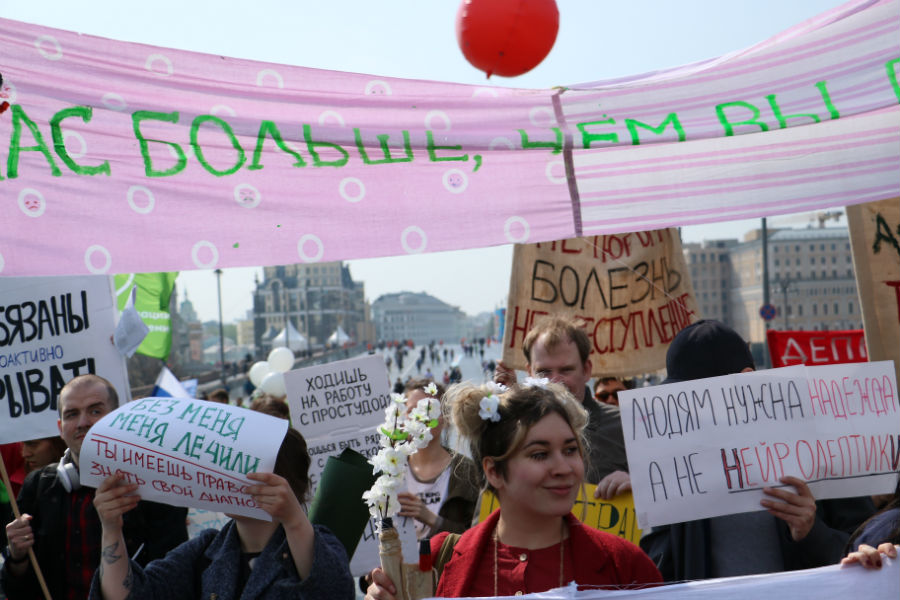

“I was treated without my knowledge: you have a right to know your diagnosis.” | “People need hope, not neuroleptics.” Psychoactivists at this year’s May Day march in Moscow. Photo by Ilya Panin. Courtesy of Takie Dela

This year, a group of psychoactivists—artists and human rights defenders, researching mental illnesses, mental quirks, and the boundaries between normal and abnormal—brought up the rear of the traditional procession organized by the Federation of Independent Trade Unions (FNPR). The marches carried placards inscribed slogans like “Antidepressants are a girl’s best friend,” “We’re coming out of the psycho-closet and expect acceptance, not a 100 years of solitude,” “I know my own diagnosis. Do you know yours?” “The affective class,” and “Stop romanticizing and depreciating us.” Ekaterina Nenasheva, an organizer of the Psychoactive Movement, leafleted passersby with flyers detailing how to behave if your loved one suffes from depression, anxiety or panic.

The group had managed to cross the Bolshoi Moskvoretsky Bridge, from the police checkpoint and the metal detectors to Basil’s Descent, when the activists were detained by regular police and riot police (OMON). As witnesses testified, the police roughed up the activists and ripped their placarads. The law enforcers could not settle on a reason for apprehending the activists. Some of them were told it was because of what written on the placards, while others were told it was because the march had not been authorized.

https://vimeo.com/267375166

The detainees were split up, loaded into paddy wagons, and taken to the Basmanny and Tagansky police stations. In the paddy wagons, policemen told the activists they should have vetted their placards with the rally’s organizer, the head of the Moscow Federation of Trade Unions. However, the rally’s website indicated all comers had been welcome to join the demonstration.

“We were asked to write statements and undergo preventive discussions. Each of us was assigned our own personal police officer, who said he was informing us that, by law, it was wrong to be involved in unauthorized rallies,” said Mikhail Levin.

The activists were released several hours later without having been charged with any offenses or fined. The detainees noted they had also been questioned by Center “E” (Extremism Prevention Center) officers, who photographed their placards.

Ekaterina Nenasheva
Artist, activist, organizer of the Psychoactive Movement and the May Day bloc
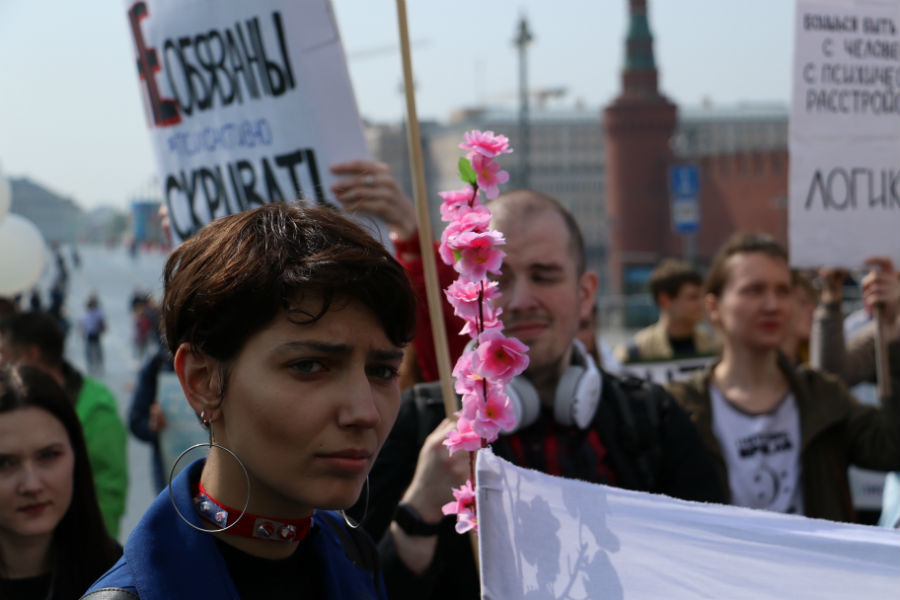

Katrin Nenasheva. Photo by Ilya Panin. Courtesy of Takie Dela

People who have mental illnesses still have no place to speak out and act. Organizing the May Day bloc was an attempt to create a discursive field for people who have mental illnesses or mental quirks. What does it do for them? According to the people who were with us yesterday, community gives them the important sense that they are not alone. There was a slogan to that effect on one of the placards: “You’re not the only one in the hood.”

It is believed that people with mental disorders can only be consumers of someone’s kindness, charity, tolerance, and pity. But they are completely capable of speaking out for themselves and being a social, political, and cultural force.

Mikhail Levin
Organizer of the Psychoactive Movement and the May Day bloc
It’s a slightly exhibitionist move to proclaim you have an illness. The guys and gals marched with very personal placards about their own quirks. We also want to demand reforms in psychiatric treatment and talk about the need for deinstitutionalizaton and our disagreement with plans to ban the import of certain medicines.

Marching with trade unions, with other workers, was an important statement. We wanted to say we also produce meaning, ideas, and work. This was the first attempt to do something like this, so it is fine that we are not a united fist, that we have different demands and opinions. What we wanted was just this: to bring together people with different mental makeups and show off this polyphony.

Sasha Starost
Artist, psychoactivist, organizer of the Psychoactive May Day bloc
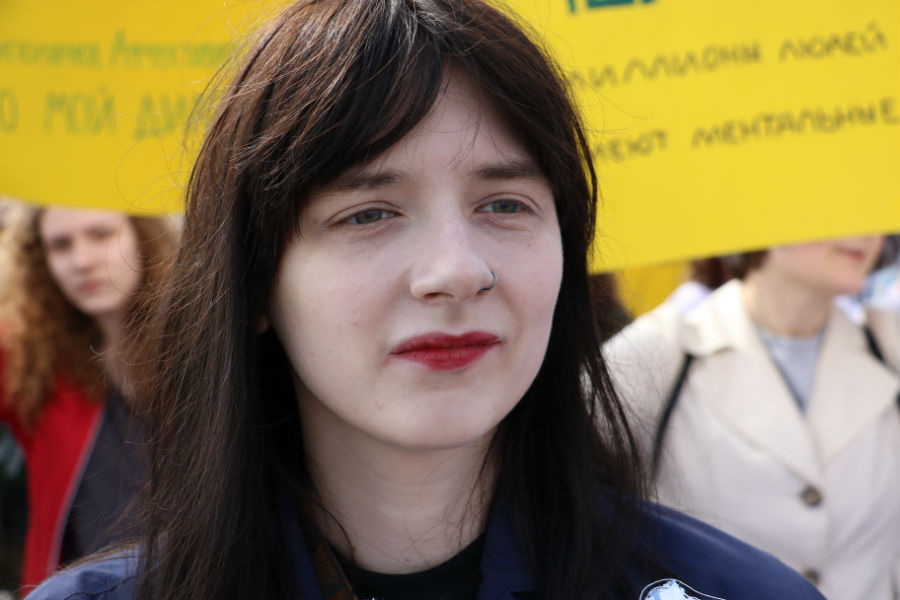

Sasha Starost. Photo by Ilya Panin. Courtesy of Takie Dela

I have paranoid schizophrenia. I have been hospitalized five time; three of those were involuntary. In the psychiatric field, I’m involved on an institutional level as a simultaneous interpreter and translator. Our May Day bloc was conceived as the Russian version of Mad Pride.  On the whole, however, we are more inclusive than Mad Pride, because in recent years they have shifted very hard towards antipsychiatry, and that is not for everyone. Yes, there is the system, and it is really poor organized. It contains neuropsychiatric residential care facilities and neuropsychiatric dispensaries in which nothing goes to plan and the rules are not followed, but this does not discredit the idea of psychiatry, the presence of illnesses, and the possiblity of treating them.

If we have taken the step of vetting our bloc, the demo’s organizers would have found excuses for not letting us march. I’m totally convinced that the cops saw a bloc of young people, some of them had tattoos, and they were carrying placards with slogans too boot. In their minds, there was a clear like with youth rebellions, and their immediate reaction was to remove us right away.

Alyona Agadzhikova
Media artist, journalist, photographer, organizer of the Psychoactive May Day bloc
Since childhood, I have had a few mental illnesses (OCD, agoraphobia accompanied by panic attacks, and  anxiodepressive disorder) and so for a long  time there was nowhere I could go and no one to go with me, because people’s awareness of mental health in Russia is somewhere around nil. So, I write and talk a lot about the visibility of people with similar quicks. I’m not afraid to say I have mental illnesses. I want the people in my life to pay attention to their own states of mind and offer help to people having trouble. I want the hate speech to disappear from the Russian language. People who do dumb or bad things should be not called psychos and schizos, and they do not need psychiatric treatment. All of these things have nothing to do with each other. Fortunately, things have been getting better lately, thanks to psychoactivists, journalists, and blogger doing outreach work on the rights of people with mental quirks and bringing the topic of psychiatry out of the gray zone.

What happened on May 1 was unprecedented, of course. It was the first Mad Pride in Russia, and it did not end the way everyone expected. We had come out to tell people that we people with mental illnesses existed. The people in our midst, the other marchers in the May Day demo, smiled at us, applauded us, and took our pictures. After reading our placards, several people decided to join our bloc. But then, twenty minutes or so later, a mob of riot police (OMON) and Russian National Guardsmen came running at us. They ripped our posters and our banner, confiscated all our placards, and dragged people away. Some people they practically dragged over the pavement, while they took other people by the arm. Many peole had severe panic attacks, including me. Fortunately, I always have my pills along. Otherwise, I simply would have passed out right there on the spot. That is how I react to unexpected, stressful circumstances.

My panic attack continued in the paddy wagon, but it was no longer so intense because I had taken a tranquillizer. But I suffer badly from claustrophobia, so I asked to be released from the cage, which opens from the outside. Fortunately, the riot  police immediately agreed. I think it had something to do with the fact that there have been precedents at the European Court of Human Rights, cases in which transporting claustrophobics in so-called cages and glasses has been deemed torture.

While we drove to the Basmanny police station, the law enforcers were keen to ask me why I was so nervous, what Psychoactive was about, who had diagnosed me, and why we had marched.

When I had described in detail how a panic attack works, one of the riot policemen  said, “Oh that’s nonsense. Try doing a five-kilometer cross-country run. Your heart is pumping so hard, it makes your head spin.”

I replied immediately.

“It’s the same feeling, only imagine you haven’t run five kilometers, that these feelings come on for no reason at all,” I snapped back.

The riot police exchanged glances and said, “Yeah, that’s harsh.”

Miroslava Podlesnykh
Ceramicist, animal rights advocate

Miroslava Podlesnykh. Photo by Ilya Panin. Courtesy of Takie Dela

Mental quirks and mental disorders are a topic means a lot to me, something I tried to live with for a long time without paying attention to it. Ultimately, however, I realized that living a full-fledged life meant accepting myself the way I was. I realized that if I wanted to changed the world I had to get a move on, to be around people who shared my values and views, to be part of a community.

The arrests were particularly hilarious when you could hear the announcers in the background talking about peace, labor, unity, and May, while the police were detaining a group that was just gaining the strength to assert itself, because this was an incredible effort for them. I know what a person who suffers from sociopathic disorders feels like in a crowd. Going on a demo is a huge effort, a big step towards a partial recovery.

**********

The psychoactivist community emerged in January 2018. Their projects have included Psychoactive, which focused on communication and creativity, and I’m Burnt Out, which dealt with emotional burnout. They also have their own brand of clothing and accessories.

Translated by the Russian Reader
“Anti-Americanism”

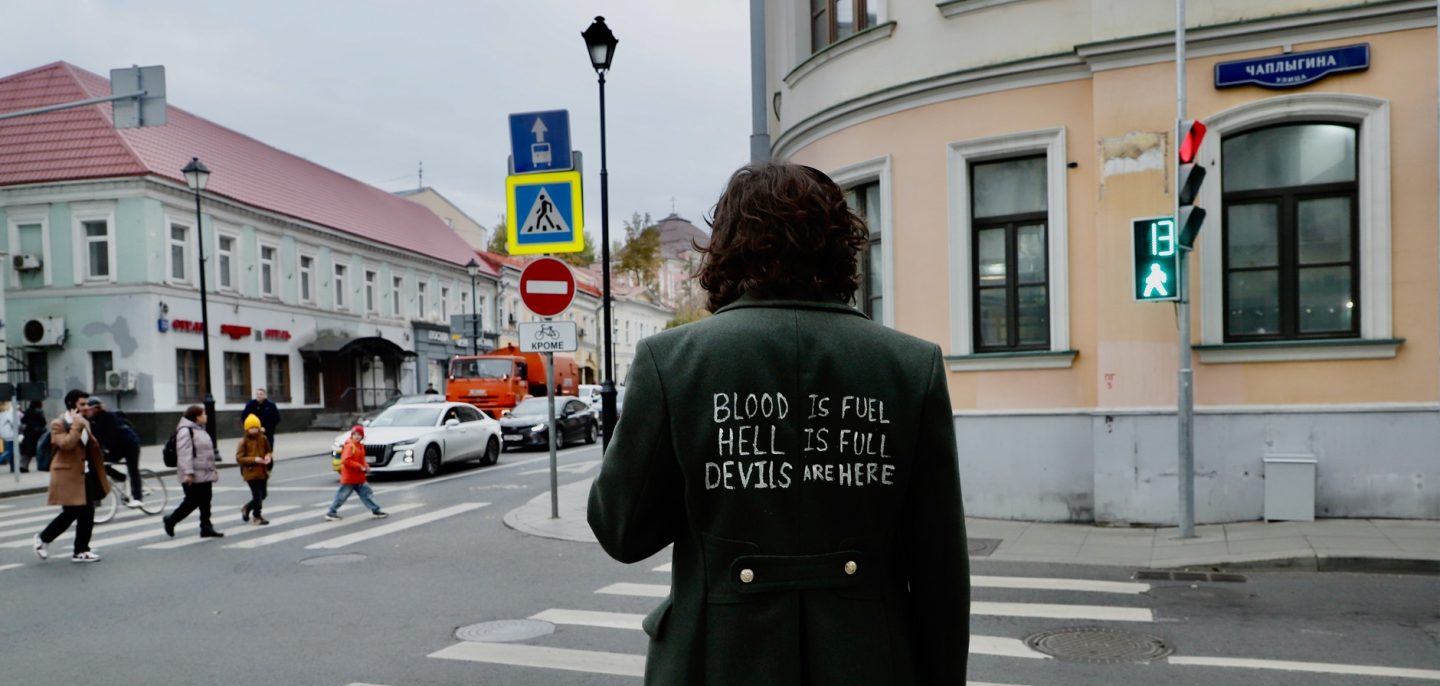
There are eleven Russian words in this poster for the April 29 St. Petersburg Craft Event at Art Play SPb, and twenty-one English words. Photo by the Russian Reader

Oh, how they hate the United States!

My boon companion was just chatting with a neighbor lady, a woman who has lived in our building her whole life and makes the best salt pickles I have ever tasted.

As it happens, our neighbor is friendly with a member of our municipal district council.

If you follow the news from Russia closely, you would know that the beleaguered united opposition, led by Dmitry Gudkov, made significant inroads in Moscow’s municipal district councils during the last elections to these entities. One of the people thus elected, the young, well-known liberal politician Ilya Yashin, has now announced plans to challenge the incumbent, Sergei Sobyanin, during the next Moscow mayoral election.

In reality, municipal district councils are the lowest rung on the political totem poll in Russia. They have very little power and are perpetually too underfunded to do the work they are supposed to do.

However, since Russia’s ruling party, United Russia, is power hungry and paranoid, they try and stack the lowly municipal district councils with their own members.

God knows what could happen otherwise.

The municipal district council member with whom our neighbor is friendly is one such United Russia Party placeholder.

“And she’s a real louse,” my boon companion would add.

The councilwoman recently got back from a trip to the United States. It turns out her daughter and son-in-law have lived there for a long time. They have a big, beautiful house in Silicon Valley.

The councilwoman told all this to our neighbor lady, explaining how much she had enjoyed the trip and how much she liked the United States.

“Why did she have to tell ME this?” the neighbor lady asked my boon companion, “Why couldn’t she have told someone else?”

Remember this little story the next time you see Foreign Minister Lavrov or President Putin or the Russian Ambassador to the United Nations or Russian Foreign Ministry spokeswoman Maria Zakharova huffing and puffing and blowing America’s house down.

Everything they say is meant for domestic consumption only. They don’t really hate the United States. They just need a Big Enemy to occupy the minds of the Russian people, to distract them from their own more serious crimes and misdemeanors.

The con seems to be working so far. // TRR

msmomovladimirskyokrug.jpgOur humble municipal district newspaper, as published by our municipal district council. This is the one of two spots in our municipal where I know one can read it. Maybe there are more, but otherwise the newspaper is not distributed to the municipal districts’s residents, because the less they know about our municipal district’s business, the better, I guess. Photo by the Russian Reader
Militarism Is Fascism

Vadim F. Lurie
Facebook
March 19, 2018

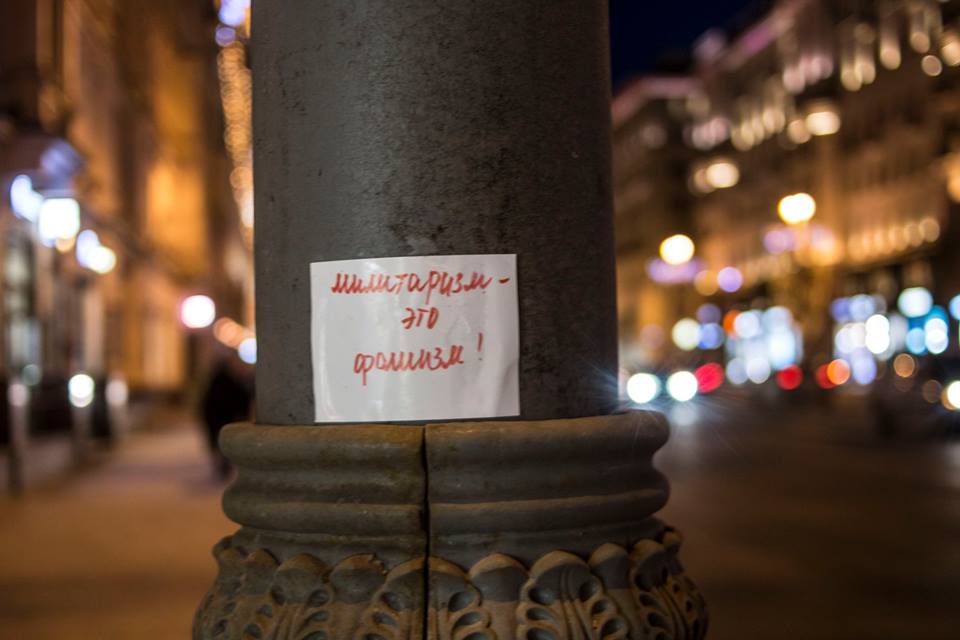
An endless stream of Muscovites and out-of-town visitors headed to the concert marking the anniversary of Crimea’s “annexation.” And only the lonely voice of a man, heard by a few and jotted on a piece of paper on Tverskaya, quietly resisted the general hysteria.

Photograph by Vadim F. Lurie. Thanks for his kind permission to reproduce it here and translate his annotation. Translated by the Russian Reader