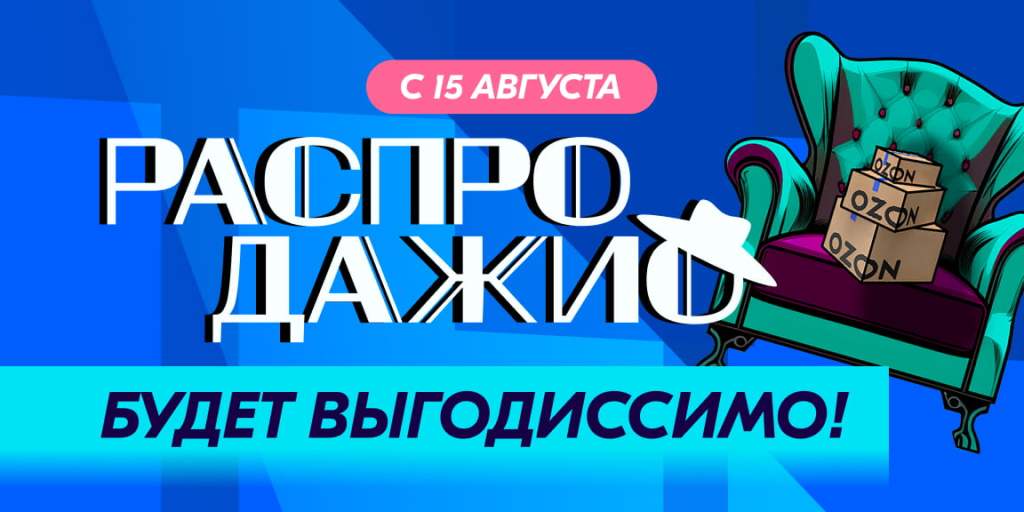
Clearance Sale

“From August 15. There’ll be bargains galore at the clearance sale!” Source: Email flyer from Russian e-commerce giant Ozon. In the original, the nouns meaning, roughly, “bargains galore” and “clearance sale” are written, unaccountably, with the Italian endings -ggio and -issimo.

Let’s think about who the beneficiaries are and what their profit is: this should explain why the regime is stable. The beneficiaries include not only the supreme leader, who of course wants to be “mistress of the seas” and has been trying consolidate the regime for himself and his entourage. The beneficiaries also include different groups among the elites, the security forces, officialdom, businessmen, and “intellectuals” at all levels. Material and symbolic resources are now funneled to these groups, and they are granted new powers to cause mayhem in their own bailiwicks. Many of them have taken advantage of this opportunity to quash rivals and take up new positions in their respective economic, political, and cultural markets. The beneficiaries also include different sectors of the populace—for example, people employed in the defense industry, people employed by law enforcement agencies, people who volunteer for the army as contract soldiers, and people engaged in producing different kinds of propaganda. They amount to millions of people, and the streams of financing that nourish them flow far and wide. In addition to power and material gain, there is a psychological benefit: one can now openly be proud of one’s country and hate its “enemies.” How many of the insulted and injured now feel joy and have made their own complexes the norm. This satisfaction also costs money, and it means millions more in new profits.

Source: Sergey Abashin (Facebook), 2 August 2023. Translated by the Russian Reader


“These amendments are written for a big war and general mobilisation. And the smell of this big war can already be scented,” Andrei Kartapolov, the head of the Duma’s defence committee, said this week as the Russian parliament rushed to adopt a new law. The legislation enabling the Kremlin to send hundreds of thousands more men into combat reveals a sad truth: that far from seeking an off-ramp from his disastrous war in Ukraine, Vladimir Putin is preparing for an even bigger war.

It is understandable that many in Ukraine and the west want to believe that Russia’s president is cornered. The Ukrainian army is gradually reconquering lands occupied by the Russians and has shown itself capable of striking deep into enemy territory — even into the Kremlin itself. The sanctions pressure on Russia is mounting.

For now, the west remains united in support of Kyiv, and streams of modern weaponry and money sustain the Ukrainian war effort. Finally, the mutiny staged by the Wagner mercenary boss Yevgeny Prigozhin and visible conflicts among senior Russian military commanders add to hopes that the Kremlin’s war machine will break down.

Things likely look very different to the Kremlin, which believes that it can afford a long war. The Russian economy is forecast to record modest growth this year, mostly thanks to military factories working around the clock. Critical components such as microchips needed for the defence industry are arriving from China and other sources.

Despite sanctions, the Kremlin’s war chest is still overflowing with cash, thanks to windfall energy profits last year and also to the adaptability of Russian commodities exporters, who have found new customers and who settle payments mostly in yuan. If budgetary pressures were to become more acute, Russia’s central bank could further devalue the rouble, making it easier to pay soldiers, defence industry workers and the internal security forces who keep the Russian elite and public repressed and largely in line with Putin’s disastrous course. 

When it comes to the war itself, the Kremlin still seems unperturbed by the Ukrainian counteroffensive. Even if Kyiv makes more advances, the Kremlin may brush them off as temporary. Putin is banking on the fact that the Russian manpower that can potentially be mobilised is three to four times bigger than Ukraine’s, and the only pressing task is to be able to tap into that resource at will: to mobilise many more men, arm them, train them and send them to fight. This is precisely the purpose of the new law, which should help the Kremlin to avoid another official mobilisation.

From now on, the government can quietly send draft notices to as many men as it deems necessary. The upper age limit for performing mandatory service will be increased from 27 to 30, and could be raised again in future. Once an electronic draft notice is issued, Russia’s borders will be immediately closed to its recipient in order to prevent a massive exodus of military-age men like the one Russia witnessed last autumn. The punishments for refusing to serve have also been ramped up. These moves, combined with massive state investment in expanding arms production, should help Putin to build a bigger and better equipped army.

A parallel tactic is the strangulation of Ukraine’s economy. Knowing that the Ukrainian budget is on life support provided by its western allies, the Kremlin wants to deny Kyiv all sources of revenue. Moscow has therefore not only pulled out of the grain deal that had enabled Ukrainian agricultural exports via the Black Sea, it has also launched massive air strikes against Ukrainian ports to destroy any possibility of reviving the agreement. The same logic underpins Russia’s air strikes against civilian infrastructure: they are aimed at making Ukrainian cities uninhabitable and preventing reconstruction efforts.

The Kremlin hopes that the rapid rebuilding of the Russian army and gradual decimation of the Ukrainian economy and armed forces will result in growing western frustration and a decline in material support for Kyiv. To speed up this process and break the west’s will, Moscow is using threats of escalation, including expansion of the conflict towards Nato territory via Belarus with the help of Wagner mercenaries based there. 

Putin has made plenty of fatal mistakes. But as long as he is in charge, Moscow will dedicate its still vast resources to achieving his obsession with destroying and subordinating Ukraine. As western leaders think about policies to support Ukraine into the third year of this ugly war, any long-term strategy must take this reality into account. 

Source: Alexander Gabuev, “Putin is looking for a bigger war, not an off-ramp, in Ukraine,” Financial Times, 30 July 2023. Thanks to Monique Camarra (EuroFile) for the heads-up.


Things like this also get written: “Is it just Putin’s war or a war on the part of all Russians? Perhaps neither one nor the other. Another sociological hypothesis is that the cynical elite has provided the real support for the military aggression, rather than a grassroots gone bad.” (This is a headline: you can google it.). Further, the authors define “the cynical elite” as “the mid-level and low-level officials who ensure the functioning of the Kremlin’s military-political machine; the para-state businesses engaged in import substitution and circumventing sanctions; the upper middle class and the leadership of so-called public sector entities, compelled in one way or another to demonstrate loyalty to the war”—that is, only a few million people. In other words, the Russian ruling class supports the foreign policy that the Russian state pursues in the interests of the Russian ruling class. This argument is tautological in the Marxist manner (although, as the authors of the article rightly point out, it occurs to very few people) and is not entirely true, because there are groups within the ruling class who do not benefit at all from this policy. But it certainly sounds more convincing than the theory of a “grassroots gone bad.”

Source: Grigorii Golosov (Facebook), 2 August 2023. Translated by the Russian Reader


I reread our interview with Dima Spirin [leader of the recently dissolved veteran Russian punk rock band Tarakany!], and one phrase cut me to the quick: “Our attempt to be free in an unfree country has failed.” An ordinary argument, seemingly, and it’s been made a hundred times. There were oases of freedom in Russia, but then they were destroyed and everything collapsed.

Such things are usually spoken of with regret, as of disappointed hopes. But oases of freedom in a poor dying country are not terribly moral, by and large. Do you know who was free in ancient Greece? That’s right, slaveholders. All the others were slaves.

Does this mean it isn’t worth fighting for freedom in an unfree country? It doesn’t mean that at all. But what’s worth fighting for is everyone’s freedom, not just one’s own. There is no separate freedom for fifteen percent of the population. That is called colonialism.

Some have it good, while others have it bad. Some are free, while others are slaves. Some are rich, while others are poor. There is no other way. Or rather, there is another way, but it ends exactly as it has now—in enormous bloodshed.

It’s either everyone or no one: freedom is not achieved piecemeal.

This is our collective fault. Our guilt is terrible and bloody. I don’t excuse myself either.

And the inner freedom that is the talk of the town nowadays is a lame excuse, like inner emigration. The madman and the drunkard are truly free. But neither meditation, nor reading Borges, nor listening to psychedelic rock will save you from hunger, cold, or getting smacked with a billy club. And they won’t cancel the fact that your neighbor has it bad.

A woman falls on the street, breaks her leg, and lies on the ground screaming. But you’re listening to Pink Floyd on your headphones: you’re free.

Source: Yan Shenkman (Facebook), 3 August 2023. Translated by the Russian Reader
Words and Deeds (577 People)

Yesterday, during a dinner conversation, I was asked why I’d been silent, why I hadn’t been writing anything about the war. Was it because I was afraid of going to jail, or was it something else? These questions were posed point blank albeit sympathetically.

I’ve been asking myself this question for many months. On the one hand, it’s stupid to deny that watching as my acquaintances are given devastating prison sentences does not affect me in any way. It makes an impression, of course.

On the other hand, I wonder what would I write or say now if the level of state terror had remained at least at pre-war levels. I realize that I would still write or say nothing. I can hardly squeeze this text out of myself. I’m just explaining myself because yesterday was not the first time I’ve been asked why I haven’t been writing anything about the war.

I feel that words have lost their meaning.

One of the ideologues of the war, who constantly makes allegations about the “genocide of the Russian language,” writes bezpilotnik, obezpechenie, na primer, and ne obezsud’te. [Instead of the correct spellings bespilotnik, obespechenie, naprimer, and ne obessud’te — meaning, respectively, “drone,” “provisions,” “for example,” and “don’t take it amiss.”] No one corrected him for a year. Compared to him, I’m a total expert on the Russian literary language, but I don’t have the words to stop cruise missiles or send soldiers home, while his bezpilotnik turns residential buildings into ruins in a second.

I do not know what words to find for a mother who, conversing with her POW son, regularly interjects “bitch” and “fuck.” Or for a mother who, as she sees off her son, smiles at the camera and says what actually matters is that she didn’t raise him to be a faggot, and basically, if push comes to shove, she has another child. Moreover, the supplies of such people are really endless.

Now, sadly, only the Ukrainian Armed Forces can “explain” anything. I am not trained in military affairs. So I am silent.

Source: Yevgeny Levkovich (Facebook), 2 March 2023. Translated by the Russian Reader


Separately on Friday, police briefly detained Yevgeny Levkovich, a reporter for Radio Svoboda, RFE/RL’s Russian service, at his home in Moscow, and charged him with “discrediting the army,” according to news reports and Facebook posts by Levkovich.

[…]

In Moscow, police detained Levkovich for about five hours at the Teply Stan police station and charged him under Article 20.3.3 of the Administrative code for allegedly discrediting the army; convictions for that offense can carry a fine of up to 50,000 rubles (US$613).

Levkovich wrote on Facebook that his trial was scheduled for Monday, but he did not plan to attend because he did not “see the point” in contesting the charge.

Radio Svoboda wrote that the charge was likely related to Levkovich’s posts on social media, but did not say whether authorities had specified any posts prompting the charge. On his personal Facebook page, where he has about 36,000 followers, Levkovich recently wrote about Russia’s war on Ukraine.

Source: “Russian journalists labeled as ‘foreign agents,’ detained, and attacked while reporting,” Committee to Protect Journalists, 11 April 2022


These are the numbers. I want to do something so that people don’t get caught, and even more actively support those who do get caught. But in the first case, it is unclear what these people are reading, and where the safety recommendations should be published so that they are accessible to such people. And we are already working on the second case, but we lack the human resources.

Those arrested for radical anti-war protest are heroes, although sometimes the charges are completely trumped-up. In any case, all of them deserve support. Solidarity Zone regularly writes about such political prisoners, publishes addresses where you can send them letters, and raises funds to pay their lawyers. Sign up to get news of what is happening to these people and, if possible, get involved in supporting them.

Source: Ivan Astashin (Facebook), 25 February 2023. Translated by the Russian Reader


Solidarity Zone: Numbers

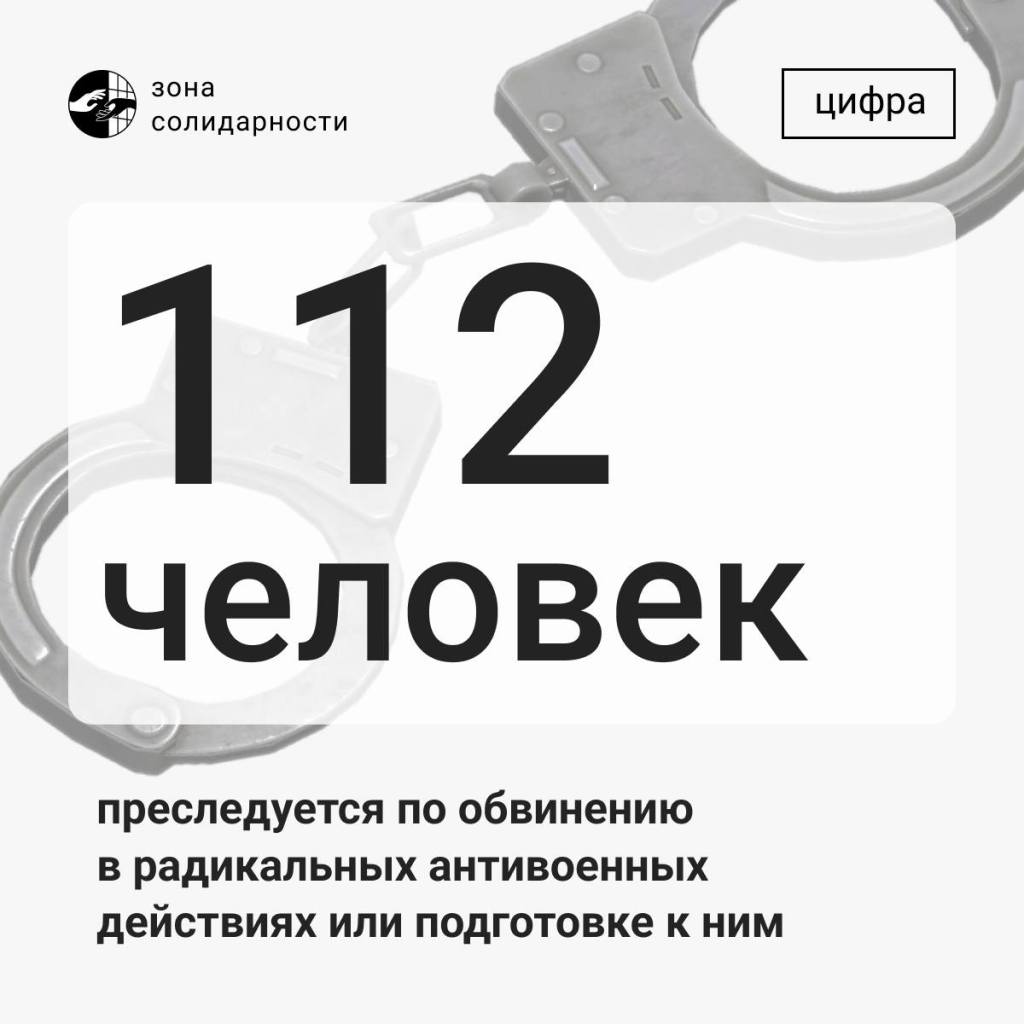
112 people are being prosecuted on charges of carrying out or planning radical anti-war acts.

Solidarity Zone counted how many people have been criminally charged with setting fire to military enlistment offices, sabotaging the railroads and other militant anti-war actions, or planning them, in the year following [Russia’s] full-scale invasion of Ukraine.

What police investigators allege these people have done to warrant criminal prosecution:

1 — “other”

7 — torched vehicles marked with the letter Z

17 — planned arsons of military enlistment or other government offices

36 — sabotaged the railways

51 — torched military enlistment or other government offices

Articles of the Russian criminal code under which these people have been charged:

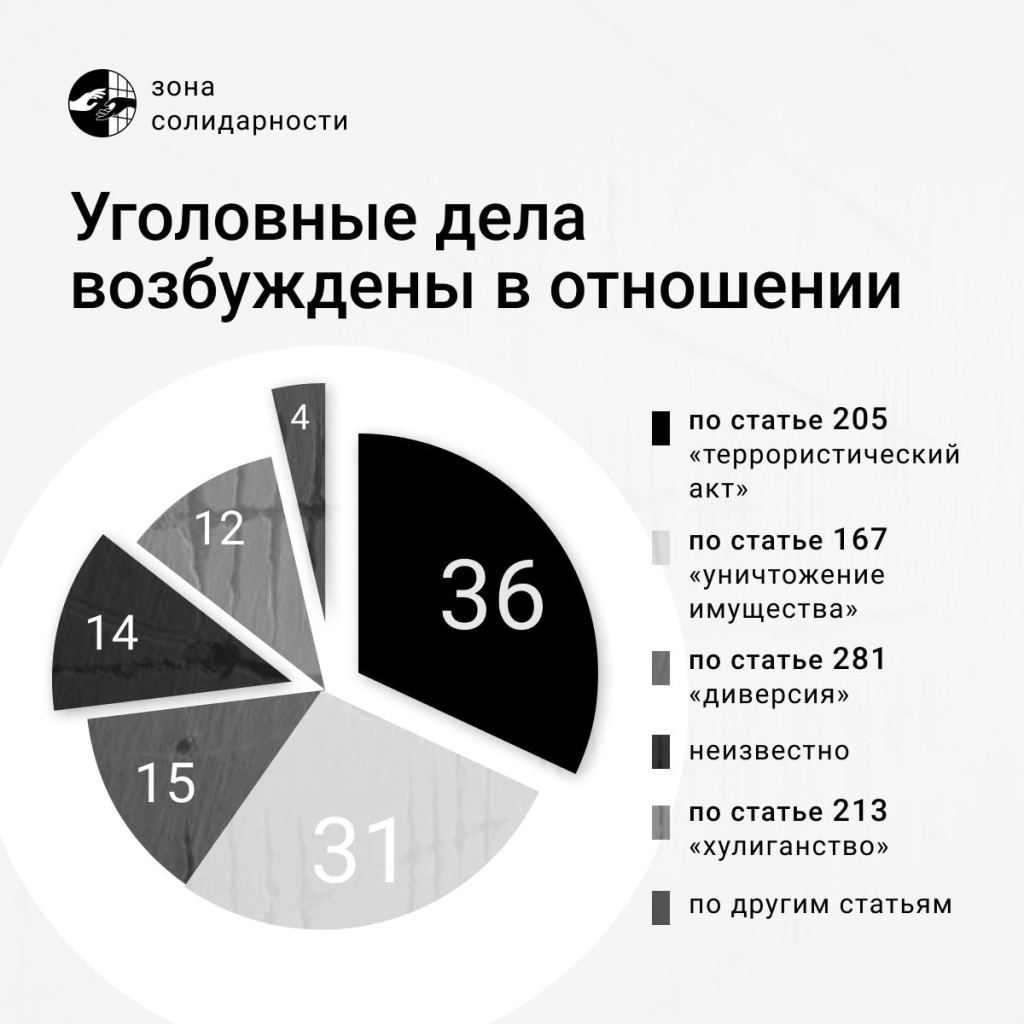
36 — Article 205: Terrorist Act

31 — Article 167: Destruction of Property

15 — Article 281: Sabotage

14 — Unknown

12 — Article 213: Disorderly Conduct

4 — Other Criminal Code Articles

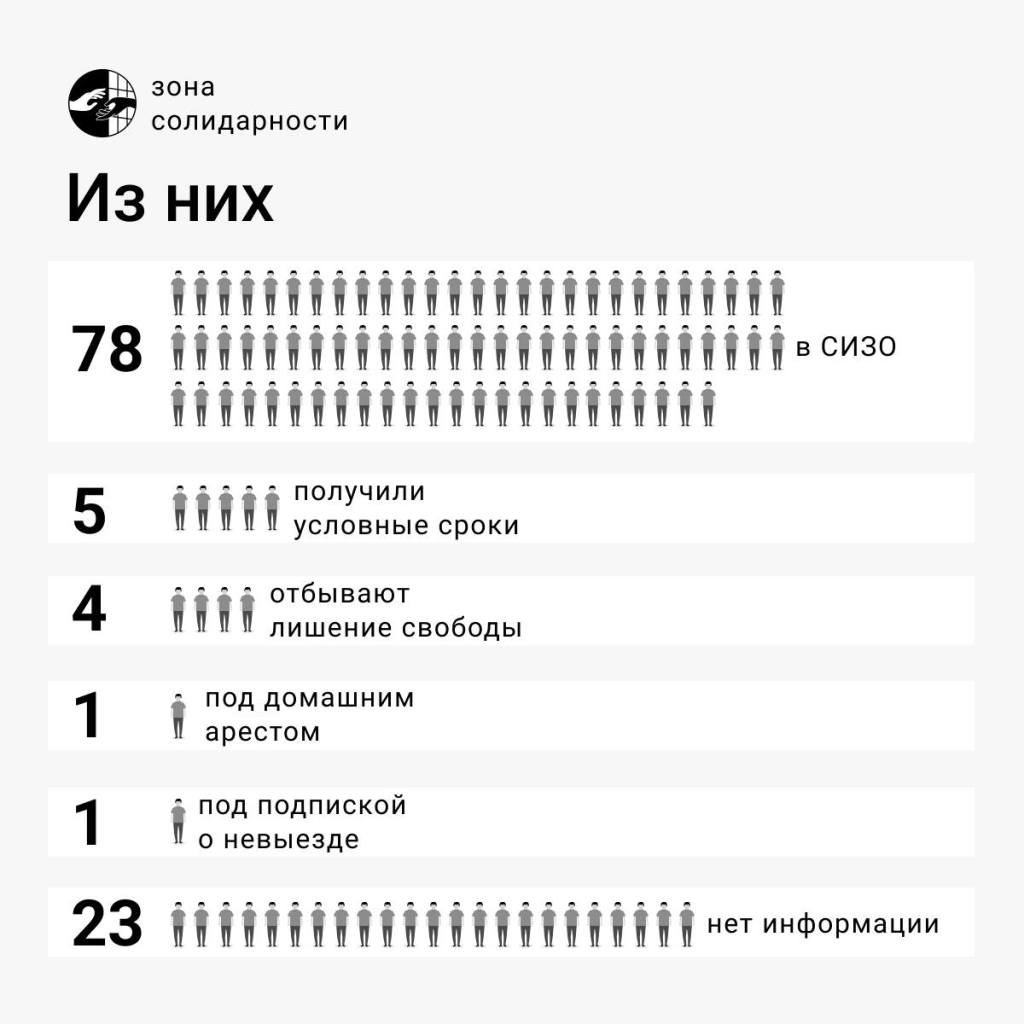
Of these people:

78 are being held pretrial detention centers (remand prisons).

5 have been sentenced to parole.

4 are serving prison sentences.

1 is under house arrest.

1 has been released on their own recognizance pending trial.

There is no information about 23 of them.

Our statistics are incomplete because the Russian authorities do not always report new criminal cases. Sometimes we only get reports that people have been detained, with no mention of their names or the charges against them, and these reports are thus extremely hard to verify.

Our statistics do not include people who were killed by the security forces during arrest or people prosecuted on administrative charges.

Source: Solidarity Zone (Facebook), 24 February 2023. Translated by the Russian Reader. Here, by way of comparison, are OVD Info’s statistics for numbers of people criminally (as opposed to administratively) prosecuted for “non-radical” anti-war actions since 24 February 2022:

Total defendants: 465 in 77 regions (we include occupied Crimea and Sevastopol in our data because we monitor activities of repressive Russian government authorities that operate there).

Women among the defendants: 90 (19%)

Minors among the defendants: 6 (1%)

(Section 3, Article 207.3 of the Criminal Code) Prosecuted for “spreading fakes about the Russian army” (ie talking about the war in an unsanctioned manner): 141 (30%)

(Section 3, Article 280.3 of the Criminal Code) Prosecuted for “discrediting the Russian army”: 54 (12%)

Convicted: 119 (26%)

Imprisoned upon conviction: 26 people

In pre-trial detention: 108 people

Under house arrest: 17 people

Convicted and given a non-custodial sentence: 62 people

It thus follows that a total of 577 Russians have faced criminal prosecution for anti-war actions of all kinds (violent and nonviolent) since the start of their country’s invasion of Ukraine. As Ivan Astashin, a former political prisoner himself, argues, above, all these people are, indeed, heroes. It’s another matter that they constitute a statistically insignificant segment of the world’s ninth most populous country. Again, by way of (invidious) comparison, at least 1,003 Americans have been charged with crimes for their alleged involvement in the 6 January 2020 riot at the US capitol.

Meanwhile, in Iran (population: approx. 87 million):

At least 522 people have been killed in four months of anti-government protests in Iran, said a report issued on January 15 by the U.S.-based Human Rights Activists News Agency (HRANA). Among the dead are 70 minors and 68 security forces, the agency reported. Nearly 20,000 people had been arrested, 110 on charges that could lead to a death sentence, it said. Four have been executed. Protests were triggered by the death in custody of Mahsa Amini, 22, an Iranian Kurdish woman who was arrested by morality police for allegedly not complying with Islamic dress codes. ||| TRR


Evgeny Krupitsky writes:

I would argue that those who were forced to leave Russia due to Putin’s unleashing of illegal aggression against Ukraine could file a class action lawsuit against the Russian Federation or the ruling elite of the Russian Federation demanding compensation for the moral anguish and economic harm suffered as a result of these events. The Russian federal authorities must fully compensate them for expenses incurred by forced relocation, such as the cost of airplane and other tickets, accommodation in hotels and rented accommodation abroad, and other expenses. Compensation could also include the irreparable losses suffered by citizens within the country due to forced relocation — for example, the loss of a job or a business. Compensation for emotional suffering is a separate issue.

Payments could be made from the Russian federal budget, through the sale of the property of officials directly responsible for unleashing the war, or at the expense of business income from entrepreneurs who have directly supported the illegal aggression. Naturally, compensation for this damage is possible only after full payment of the reparations necessary to restore Ukraine’s economy and civil infrastructure. What do you think about this? #nowar#netvoine

[two selected comments + one response by the author]

Zmey Gurevich A difficult question. It’s true that the monstrous war forced me to leave Russia. But to my incredible surprise, I have have become happy here [in emigration]. Perhaps it’s immoral to be happy when rivers of blood overflow their banks. It’s been eating at me. But the painful departure has led me a new happiness. Some vital knots have been untied… No, I have nothing to bill [the Russian authorities] for. My friends empathize with me and ask me how things are going here. I can’t tell them the truth. I am ashamed. But my departure has turned into a happy time for me. I don’t know what will happen next.

Vlad Shipitcyn Zhenya! Did you go to at least one protest rally against Putin in Russia over [the last] 22 years? No, you didn’t. Did you ever stand on the stand on the street holding a [protest] placard? No. So no one owes you anything, not a kopeck. You too are responsible for both the regime and the war. You let them happen. So calm down.

Evgeny Krupitsky Hi! Yes, I am responsible for this war: it happened due to my connivance, indifference and cowardice. And I said it right away: https://www.youtube.com/watch?v=GsAFChc2HSI And my protest was that on March 6, exactly a year ago, I left the Russian Federation having abandoned everything, because I felt sick and ashamed. Okay, maybe it’s not such a big deal in terms of significance and courage, but I am proud of my little protest. I know you went to the rallies long before the start of the war, that you were detained, beaten and fined, and I respect and admire you for that! But someone will say that they suffered more than you did, that they did more to prevent this war, etc. We need to consolidate, rather than argue about who is more to blame!

Source: Evgeny Krupitsky (Facebook), 3 March 2023. Translated by the Russian Reader
Evgeny Krupitsky, “My take on what’s happening (2 April 2022) #nowar #netvoine”

Some people in Russia are living a normal life, but they feel the lack of real normality, and this causes them discomfort. Others live with a sense of catastrophe, but they feel the absence of a real catastrophe, and this also causes discomfort. Consequently, everyone is on edge. The sensible approach is to live normally with a sense of disaster. But this useful attitude is hard to achieve, and if you don’t have it, then I do not even advise you to start. When it takes shape, it will no longer be relevant.

Source: Grigorii Golosov (Facebook), 4 March 2023. Translated by the Russian Reader

[…]

The four members of this “countryside hub” are among hundreds of Russian opposition activists of various political leanings who have fled their country to Georgia throughout the past year. Some left in the months prior to Moscow’s invasion of Ukraine last February as repression grew to unprecedented levels in the Putin era. Others came after the war began, realizing that with their dissenting opinions, they could no longer live in what they deem a fascist totalitarian state. 

In Tbilisi, they have created or joined new anti-war resistance organizations, which operate on Western grants and employ hundreds of volunteers. Working around the clock, these groups offer services in real time to Ukrainians refugees as well as Russian activists and military deserters fleeing their respective countries. The help comes in the form of evacuation routes, therapeutic services, legal guidance, shelters and resettlement plans.

[…]

From her volunteering as an election monitor in Russia’s 2011 elections to offering pro-bono legal support to activists arrested during protests in subsequent years, Burakova’s career followed a linear trajectory. Degrees in political science and law equipped her with the legal know-how to aid political opponents, and now exiles, over how to wrestle with and escape an authoritarian system that often invents new laws to persecute citizens. As of 2022, “discrediting the Russian army” is now an offense that has landed countless people in prison for sharing anti-war posts on social media.

[…]

“To conduct these types of congresses and host mock parliamentary votes on Russia’s future while in exile just looks a bit cringe-ova,” Burakova tells me, using the popular English word that has been appropriated into the Russian language. Her husband Egor Kuroptev shares the sentiment. 

Source: Aron Ouzilevski, “Russian activists in Tbilisi organize to resist Putin’s war,” Institute of Current World Affairs, 1 March 2023. Thanks to Sveta Voskoboinikova for the heads-up. The emphasis is mine. ||| TRR


M., one of my smartest interlocutors, arrived from Moscow Time. “Well, what is your final conclusion? Why?” he asked me. I told him that now I see three points that we simply missed, that ended up in our blind spot. The first point is that of course everyone worked hard during these years, enthusiastically; everyone had an articulated mission in life, etc. But it was seemingly taken as a natural given that each of us was the client of someone a few floors above us. Now everyone looks back and discovers that their mission has been burned for a long time, and their belonging to one or another Moscow (or regional) clan shines forth in their biography. For some reason, it was automatically believed that, in the nineties, we operated in a world in which, when difficulties arose, we should turn to “the man from Kemerovo” (in the words of Grebenshchikov’s song). In the noughties, however, all this was allegedly vanquished. In reality, nothing was “vanquished”: it was simply transformed into large-scale state clans. That is why now everyone who was engaged in charity, book publishing, media development, etc., has suddenly shifted the emphasis in their reflections on life: wait a second, I worked for Abramovich (or Gusinsky, or Potanin, etc.). The system consisted entirely of a network of clients.

The second point: the language of pragmatic communication. It was a completely abusive language. The smash-mouth jargon permeated everything. Roughly speaking, the country was governed in the language of American rappers (i.e., the Solntsevo mob). All communications! Not only the special communications among those in power, but also all communications in the liberal, academic realm, in civil society. The cynical jargon of abuse reigned everywhere, and it was absolutely acceptable even in highly cultured milieux. And we did not see what consequences this would have.

The third point: “populism.” The automatic perception of the “common people” [narod], which had its origins in the late-Soviet and perestroika periods, was a colossal mistake. It was tacitly assumed, first, that there was a “common people”; second, that the “common people” would determine their own fate; and third, that the “common people” naturally triumph over evil because they themselves are good. It was this “populism” that served as the basis for the compromise with the state when it began to take institutional shape in Yeltsin’s wake.

All three of these points were “organic” in some sense. They were a part of ontology: they were taken for granted without any reflection and criticism. And all three played a fatal role in the process of “slowly boiling the frog alive.”

Source: Alexander Morozov (Facebook), 5 March 2023. Translated by the Russian Reader


Aquarium, “The Man from Kemerovo” (2003)
I had problems,
I had gone way too far.
The lower depths of the deepest hell
Didn't seem so deep to me.
I called my mom,
And Mom was right.
She said, "Straightaway you've got to call
The man from Kemerovo."

He is a man of few words, like de Niro.
Only a wacko would argue with him.
You can't pull one over on him,
He knows all the insides and outs.
The sky could crash to the ground,
The grass could stop growing,
He would come and silently fix everything,
The man from Kemerovo.

Adam became a refugee,
Abel got on a mobile connection,
Noah didn't finish what he was building,
Got drunk and fell face down in the mud.
The history of humankind
Wouldn't be so crooked,
If they had thought to get in touch
With the man from Kemerovo.

I got a call from Kyiv,
I got a call from Kathmandu,
I got a call from the opening of the plenum —
I told them I would not come.
You have to drink two liters of water at night,
To have a fresh head in the morning.
After all, today I'm going to drink
With the man from Kemerovo.

Source: ezh108 (YouTube). Lyrics translated by the Russian Reader


Only one conclusion follows from Stalin’s death: woe is the country where tyrants die natural deaths while still in power.

Source: Roman Osminkin (Twitter), 5 March 2023. Translated by the Russian Reader. Mr. Osminkin’s remarks were occasioned by the social media commemoration of the anniversary of Stalin’s death, yesterday, which often as not consisted of replicating the meme “That one croaked, and this one will croak too.” This means, apparently, that the entire “plan” of the “Russian anti-war movement” and the “anti-Putin opposition” consists in waiting for the current Russian tyrant to die a natural death. It’s a frank admission to be sure. ||| TRR

Be Careful What You Wish For

“An Alt-future map where Russia is divided. Could be Post-WW3 or after collapse due to economic sanctions etc.” Source: Reddit

Re: the “volunteer battalions.” Many people, including me, have spoken out quite harshly here [on Facebook] about the irresponsible fools who have posted map[s] of a “collapsed Russia” on the web. The centripetal forces in the country will be more powerful than the centrifugal ones for a long time to come, and if Russia collapses, those daydreamers will definitely not be involved. Nevertheless, work on its collapse is in full swing in Russia itself, and the country’s authorities are leading the effort. Understand me correctly: I am sure that Putin and his friends do not want disintegration, because Russia has become and will forever remain their only available feeding trough. However, heedlessness, as always, trumps vested interest. As in the case of covid, what the center does not cope with, it sloughs off on the regions. But if this was relatively harmless when it came to covid, it is not so harmless when it comes to the “volunteer battalions” being formed on a regional basis. When the “volunteers” return — and some of them will return, inevitably — a small but cohesive and extremely angry force with combat experience and, most likely, access to weapons, will emerge in each region. Precisely due to its local identity, it will become a convenient tool for factions seeking local power. During a social and political crisis, this desire can be realized, but not without a local armed force. And such a force will be there for the taking. The infamous Girkin proved in practice in Sloviansk that even a small group like this can easily take power in a medium-sized city if it encounters no resistance. It will be both easy and pleasant for local security forces to negotiate with “veterans” if such agreements are sanctioned by the “elites” in the towns and villages, but especially in the ethnic republics. A scenario in which Russia will break up into 80+ independent countries cannot be precluded. These countries, however, will not be benevolent democracies in the European orbit, but gangster autocracies. And Russia is being pushed in this direction not by its real or imaginary enemies, but by its own authorities.

Source: Grigorii Golosov, Facebook, 11 August 2022. Translated by the Russian Reader. Professor Golosov’s most recent book is Authoritarian Party Systems: Party Politics in Autocratic Regimes, 1945–2019 (Singapore: World Scientific, 2022).


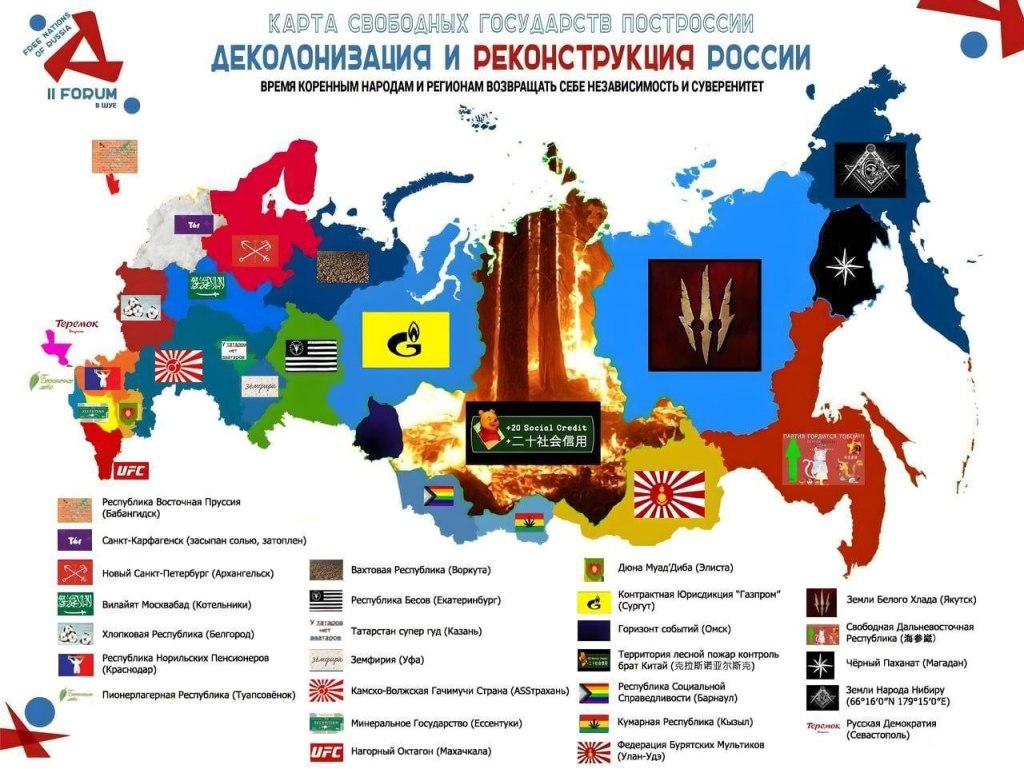
“A Map of the Free States of Post-Russia. Decolonizing and Restructuring Russia. It’s Time for Indigenous Peoples and Regions to Take Back Their Independence and Sovereignty.” Source: We Survived Mariupol, 25 July 2022, Telegram

Chechen head Ramzan Kadyrov meeting on 11 August 2022 with his military commanders. The meeting is conducted in Chechen with occasional infusions of isolated Russian words and phrases.

Western intelligence services have never really disguised their plans for our country. Their dream is Russia’s complete collapse and, in fact, the enslavement of its peoples. Our country has always been and remains the West’s number one target. The fact of the matter is that the Russian Federation’s multi-ethnic peoples have never accepted an alien ideology and have historically maintained their identity, mindset, and age-old principles.

And if at one time entire foreign institutions tried to achieve this goal by unleashing two wars in the Chechen Republic, later there were attempts to achieve it via South Ossetia and even Syria. Nothing came of them.

Now the West has played the Ukraine card. But here, too, all their efforts are doomed to utter failure. And I am very glad that the new tactical actions used by our combatants during the special military operation in the Donbass are bringing great success. I had no doubts about this initially. Today it is already obvious that the results have exceeded all expectations.

On Thursday, I met with the commanders and fighters of our detachments involved in the SMO. We once again had a warm conversation in an informal setting, discussing the successes we have achieved. We also discussed in detail the issue of improving the material resources for units from the Chechen Republic, of additionally supplying and equipping our fighters with modern weapons, equipment, and gear.

The most important thing is that [our] warriors are in great fighting spirit. The lads are clearly aware that they are fighting for the sake of all straight-thinking humanity and for the triumph of law, order, and justice. That is why, even after returning home, almost all SMO combatants are eager to go back. They have only one desire — to go all the way alongside their comrades. This is true patriotism, which means that victory will be ours! Absolutely! There is simply no other option.

Source: Ramzan Kadyrov, Telegram, 11 August 2022. Translated by the Russian Reader

Broken Glass Cake

At the request of the Comintern, a smaller counter-exhibition entitled The Truth on the Colonies, organized by the Communist Party and the CGTU, attracted very few visitors (5000 in 8 months). The first section was dedicated to abuses committed during the colonial conquests, and quoted Albert Londres and André Gide’s criticisms of forced labour in the colonies while the second one made a comparison of Soviet “nationalities policy” to “imperialist colonialism.”

Source: “Paris Colonial Exposition,” Wikipedia


Broken Glass Cake

Ingredients:
▫ sour cream 400 g
▫ condensed milk 300 g
▫gelatin 25 g + water 150 ml

For the jello:
▫ different flavors of gelatin
▫ hot water

DIRECTIONS:
1️⃣ Prepare the jello per the directions on the packet. Pour into a dish, add hot water, mix until cool and leave in the refrigerator for ~ 3 hours. You can already pull the condensed milk and sour cream from the icebox so they will be at room temperature.
2️⃣ When the jello has set up, cut it into cubes right in the dish.
3️⃣ Dissolve 25 g of gelatin in 150 ml of water.
4️⃣ Mix the sour cream, condensed milk and gelatin.
And then just assemble the parts as in the video. Dispatch it to the refrigerator for about 4 hours. I put a layer of cookies on the bottom, but you don’t have to add them if you don’t want to. Yes, it’s quick to prepare, but you will definitely like it :)

Translated by the Russian Reader

It is likely that in the autumn, or already in the summer, there will be tension in the country over a significant downturn in the incomes of people employed in production, in particular, due to layoffs (in some places, massive layoffs). There is the potential for protests here. [The authorities] won’t be able to contain them, as [they did] in the nineties. I think, however, that it will be difficult to translate this potential into political change. Apart from the fact that it has been organizationally routed, the liberal and democratic opposition has an agenda that is far removed from the problems of this social stratum. The left is mainly interested in theoretical discussions and, frankly speaking, they are not merely absent as a political factor in Russia, but represent something like a negative quantity. There is no Russian [Lech] Wałęsa even visible on the horizon. But might it not happen that, if and when he appears, he will turn out to be a nationalist, blaming the authorities not for what they did, but for what they failed to do?

Source: Grigorii Golosov, Facebook, 28 April 2022. Translated by the Russian Reader
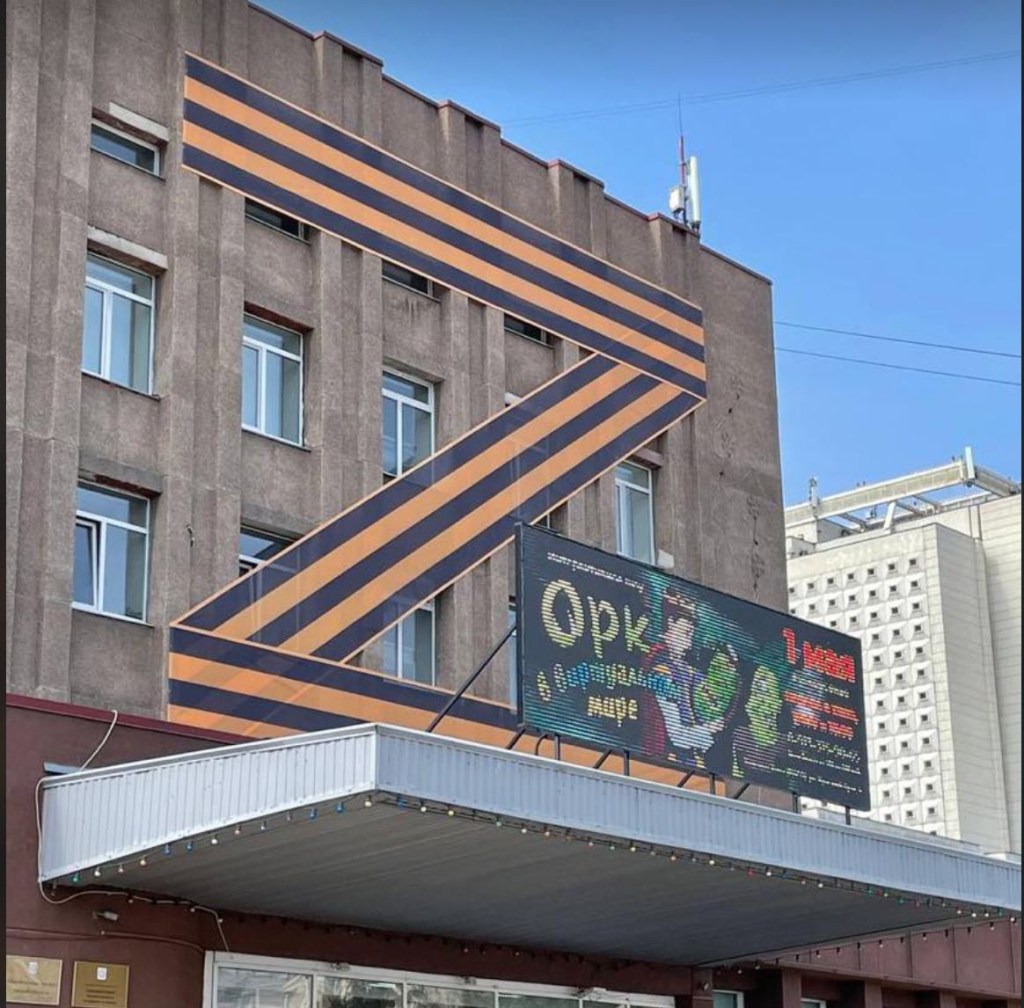

A huge St. George ribbon in the shape of the letter Z has been hung on the building housing the Omsk Public Chamber.

It serves as the backdrop for an announcement of the show “An Orc in the Virtual World.”

Source: Kholod, Facebook, 28 April 2022. Translated by the Russian Reader

Russia and the people who live in Russia are becoming more reactionary not by the day, but by the hour. The problem is that almost no one notices this. Every day Putin and his gang remain in power sends Russian society backwards another year in terms of how people think about politics, justice, religion, ethnicity, culture, industrial relations, war and peace, and the rest of the world.

At this rate, if and when the Putin regime does disappear from view, nearly everyone who lives in Russia will have to be reprogrammed to deal more or less ably with the world the rest of us inhabit.

This is not an endorsement of our world’s virtues. But you simply cannot imagine the depths and breadth of the black political reaction that has engulfed Russia until you have lived there a long time (preferably, starting well before the reaction ensued) and thus have the eyes to see and the ears to hear a country that it is well on its way to utterly rejecting progress in all its forms.

This is especially true of the so-called intelligentsia, even those of its members who imagine themselves to be liberals, leftists, scholars, artists or professionals.

Try explaining to them one little thing — for example, why the Putin regime’s crazed, full-fledged persecution of Russia’s Jehovah’s Witnesses, now involving hard prison time, torture, and early morning raids on the homes of these extraordinarily peaceable “extremists” — is a symptom of a fascist or proto-fascist state.

They won’t understand what you’re saying. At best, your discussion will end with them making a joke about the whole thing, as if being waterboarded for the “crime” of being a Jehovah’s Witness were a laughing matter.

That this Russian fascism has started to spill out into other parts of the world, and most educated Russians continue to have nothing to say about it, is alarming. ||| 28 April 2019, TRR

Terpily

Grigorii Golosov
Facebook
February 10, 2022

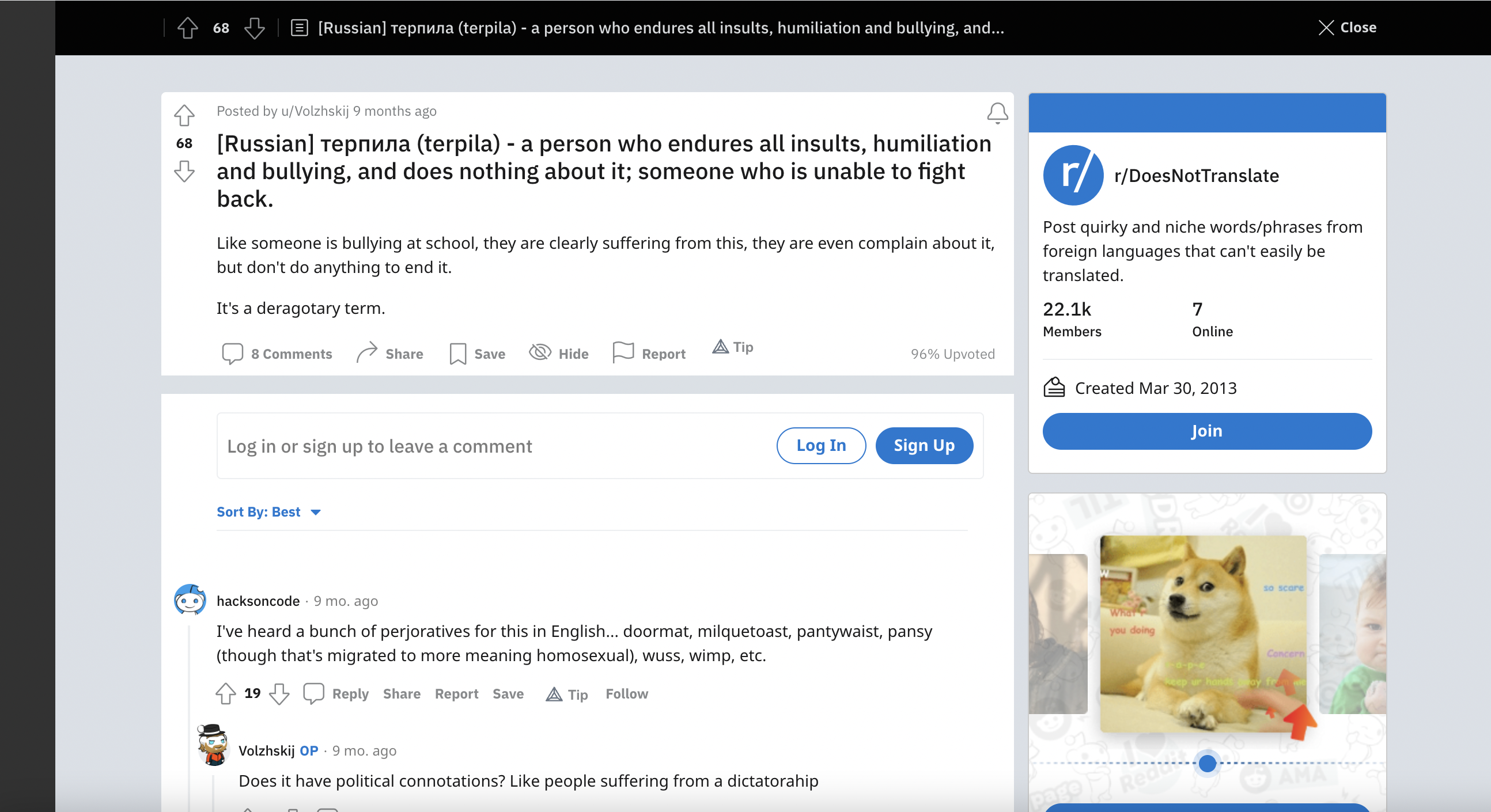
The sudden onset of winter has brought Petersburg to a state of ruin. The number of people crippled by black ice on pavements and ice floes falling from roofs is comparable to the number of victims of an international military conflict of medium intensity somewhere in Africa, and no terrorists could dream of having such an impact. I won’t even mention the regional authorities, whose only real task has long been to ensure “correct” election results, especially federal ones, but on occasion their own local elections as well. As for the federal authorities, they are even less interested in local problems. They prefer to spend hundreds of millions every day to senselessly drive tanks and other equipment along the southwestern borders. Geopolitical fantasies warm the soul, and their concern about security is quite sincere, because security for them is tantamount to maintaining power. The broken legs and broken heads of deadbeats are not included in this concept of security. Let them watch TV in a cast and rejoice in the country’s greatness, the doormats [terpily].

Screenshot from r/DoesNotTranslate

_______

Boris Vishnevsky
Facebook
February 10, 2022

A few sad takeaways from today.

A monstrous sentence was handed down to 15-year-old Nikita Uvarov: 5 years in prison for computer games.

In Chechnya, Zarema Musayeva, the wife of a federal judge, who was abducted from her home in Nizhny Novgorod, was denied a transfer to house arrest: she has been left in remand prison until April 1.

The arrest of journalist Ivan Safronov, who has never been told what kind of “high treason” he committed and what “state secrets” he gave out (secrets to which he never had access) had his arrest extended until April 7.

Ill and in need of medical care, Sergei Zuyev, the rector of the Shaninka [Moscow School of Social and Economic Sciences], was transferred from the medical unit of the capital’s Matrosskaya Tishina remand prison to a gen pop cell.

No, we can’t change these thing now. Just like we can’t change many other things.

But when change happens — and it certainly will happen — we can refuse to forget or forgive these things.

No matter how often people tell us “we were ordered”, “we were forced,” “we were low on the totem pole,” “we had families, children, and mortgages”, and, more generally, “well, you understand…,” our answer will be, “No, we don’t understand.”

_______

Excerpt from an email that a friend in Petersburg sent me this morning:

In fact, I haven’t fully recovered yet, although it all started three weeks ago, apparently, and now [I’m suffering] the consequences of the fact that I blamed the initial symptoms on fatigue and ran through snowdrifts until I fell down with a temperature around 40; only then did I realize that this was it. It was right at this time that the medical system collapsed. It’s true that everyone is sick. I left the house [for the first time] a couple of days ago: there [were] five times fewer people on the streets and in the shops than usual, and a couple of weeks ago everyone was coughing and sneezing everywhere, without masks mostly, I won’t even mention vaccinations. Basically, I highly recommend not getting sick with this thing, if possible.

All three texts translated by the Russian Reader

_______


Russian Teenager Gets Five Years In Prison In Minecraft ‘Terrorism’ Case
Siberia.Realities (RFE/RL)
February 10, 2022

KANSK, Russia — A court in Siberia has sentenced a 16-year-old boy to five years in prison in a high-profile terrorism case prompted by plans he had with two friends to add the building of Russia’s Federal Security Service (FSB) to the popular video game Minecraft to allow players to blow it up.

The First Eastern District Military Court in the Krasnoyarsk region sentenced Nikita Uvarov on February 10 after finding him guilty of illegal weapons possession and passing through training for implementation of a terrorist act, charges he has rejected since his arrest in fall 2020.

Two other defendants in the case were convicted of illegal weapons possession and handed suspended prison terms of three years and four years, Vladimir Ilkov, the lawyer for one of the two other defendants, told RFE/RL.

Prosecutors had sought nine years in prison for Uvarov and six years in prison for the other defendants.

The three boys were 14 when they were arrested in 2020 while distributing leaflets to support Azat Miftakhov, a mathematician, who was in custody at the time and later sentenced to six years in prison in January 2021 on terrorism charges that he and his supporters called politically motivated.

After their arrest, investigators confiscated their telephones and said later they found chats in the phone that “had proven” that the trio planned to add the FSB building to the Minecraft game and blow it up there.

The investigators also said that the boys criticized the FSB in the chats, read banned books, fabricated firecrackers, and blew them up in abandoned buildings in their native city of Kansk.

Uvarov refused to cooperate with investigators and spent 11 months in pretrial detention before he was released last year to finish the ninth grade at school, while his two co-defendants pleaded guilty and fully cooperated with the investigation.

In his final statement at the trial on February 9, Uvarov reiterated his previous comments rejecting the charges and added that if he is imprisoned, he “will serve the sentence with a clean conscience and dignity.”

“It was painful for me to see how my country oppresses people, civil rights activists, who want the best for the country and stand for its well-being. Now, unfortunately, I am experiencing myself the despotism of the unfair collaborators of the system,” Uvarov said.

Image credit: screenshot of a Google News search for “Minecraft,” February 10, 2022

_______

Julia Galkina
Facebook
February 10, 2022

It turns out that the joke about a pizza courier who arrives faster than the ambulance is not a joke. Yesterday, it took the ambulance two hours to get to me: I think that was very fast.

I get the feeling that, like organs in a body with terminal cancer, all services in the city are failing. The doctor has got sick, the janitor has been killed by a block of ice. It’s like we’re inside the quiet apocalypse from the movie Songs from the Second Floor.

And yet, I know people who, although they are probably infected (“oh, I only have a sore throat”), continue to ride the subway. And I know people whose ordeal with omicron has not been “three days on the couch and that’s it,” but has been quite hard.

I would like to say to people from the first category that they (and/or their employers) are fucked in the head — no matter what the assholes themselves say.

This text was added two hours after the original post. Translated by the Russian Reader
Solving Problems

Grigorii Golosov
Facebook
October 14, 2021

Yesterday, President Putin, driven mainly by the curiosity of journalists, publicly tried to solve problems. There are a lot of problems, he noted: they are literally “raining down.” He named only two: the decline in incomes among the population and the population’s rapid decline (the “demographic” problem). He promised to solve the first one non-linearly, i.e., not by growing incomes per se, but through economic growth. As you know, the Russian economy grows rarely and slowly, but when it does grow (which has happened over the past ten years), then for some reason this has no effect on the incomes of the population. However, it depends on whom we understand by “the population.” There is definitely a population of several thousand people constantly getting richer, although this population is more often outside of Russia than inside it. Putin did not elucidate his methods for solving the second problem, but he is certain that they will also be nonlinear. There are no other problems in Russia, however. There is no problem with political prisoners: they are all criminals. I would probably doubt that. But I totally agree with Putin that there is no problem with democracy in Russia. If there is no democracy, there is no problem with it. Verily, “if you don’t have an aunt, then you won’t lose her.”

Translated by the Russian Reader
President Vladimir Putin said Wednesday that Russia — one of the world’s biggest producers of oil and gas — is aiming for carbon neutrality by 2060.

“Russia in practice will strive for carbon neutrality of its economy,” he said at an energy forum in Moscow.

“And we set a benchmark for this — no later than 2060.”

Source: AFP/Moscow Times

Russia’s natural population underwent its largest peacetime decline in recorded history over the last 12 months, an analysis of official government statistics has shown.

Russia’s natural population — a figure which counts registered deaths and births, excluding the effects of migration — declined by 997,000 between October 2020 and September 2021, demographer Alexei Raksha calculated.

The stark drop comes as Russia, which has one of the world’s highest Covid-19 death tolls, continues to see record numbers of lives lost to the pandemic. The country has recorded at least 660,000 excess deaths since the start of the pandemic.

Russia’s total population of around 145 million is lower than it was when President Vladimir Putin came to power in 2000 despite Moscow’s annexation of Crimea in 2014 which added 2 million to Russia’s official population statistics.

Source: Moscow Times

Only 12 World Leaders Greet Putin on His 69th Birthday. In another sign of Putin’s isolation, only 12 world leaders sent him greetings on his birthday this year. None at all came from the US or from EU countries (business-gazeta.ru/article/524870).

Source: Window on Eurasia (Paul Goble)

Grigorii Golosov: Dissecting Dead Elections

What to Expect from Dead Elections
Grigorii Golosov
Proekt
June 7, 2021

In journalism, there is the well-worn cliché of “dissecting elections.” This is when experts explain to the general public how the electoral system works, how election campaigns are run, and how votes are tallied. In a democracy, this knowledge is ordinarily not in high demand, because voters, as a rule, don’t care about such subtleties. People who go to the polling stations have preferences and emotions that they express by voting. The fine points matter a narrow stratum of politicized intellectuals. Rank-and-file voters regard elections respectfully, as one of the foundations of the democratic state, which they value, but they are not keen about its anatomical details.

Under authoritarianism, it would seem that elections merit no interest at all. After all, they don’t make it possible to change the government, let alone influence it in any tangible way. Their impact on the make-up of representative political bodies is insignificant, and on politics, negligible.

They are dead elections. And yet they are anything but inconspicuous.

On the contrary, the most high-profile events of recent months in Russia have been related to elections indirectly (like the crackdown on opposition organizations and activists) or directly (like United Russia’s so-called primaries). They have gone unremarked only by people who have completely isolated themselves from the daily grind of the Russian state and the propaganda servicing it. This is, of course, quite a healthy thing to do, but not everyone has the luxury of doing it.

Naturally, the hype will only increase over the summer, because presidential spokesman Dmitry Peskov has already promised us a literally red-hot campaign. Indeed, elections — and just such dead elections — are vital to modern authoritarian regimes. Elections perform many useful functions for autocracies. I could list all of them, but it suffices to point out their main function: unless the regime triumphs at the ballot box, it is difficult to explain why the people in government occupy the high-ranking posts they do.

Their power is not warranted by the right of succession, nor by their outstanding personal qualities, nor by their crystal clear vision of the prospects for social development. Naturally, there are other contenders for power, ready to take it simply because they want to. So the common idea that elections will be canceled as unnecessary is mistaken. This means that there is some point in dissecting dead elections, just as there is a point in dissecting dead bodies.

The basic principle of election pathology is simple: dead elections should look like the real thing, but still keep those who already hold power in power, allowing only a minimal rotation of minor figures. In keeping with this principle, authoritarian elections involve four main areas of tampering: (1) voting systems; (2) voter behavior; (3) voter choice; (4) vote counting. Let’s examine each of these areas separately.

In Russia, messing with the electoral system in the narrow sense of the term is a thing of the past. Readers may remember that for a time we had a purely proportional electoral system, in which we could vote only for party lists, not for single candidates. Its introduction was no accident and no matter of good intentions: it was meant to facilitate the emergence of the United Russia party and eradicate independent MPs. However, the 2011 State Duma elections, in which United Russia nearly lost its parliamentary majority, showed that a mixed system was more convenient, so they went back to it.

There is nothing particularly innovative about this. If we do the numbers we see that that mixed systems are more popular among autocracies than among democratic countries. And we know from experience why: even if United Russia fails to gain a parliamentary majority via its party list, it will make it up for it by winning in the single-member districts. It was the single-member districts that gave United Russia a constitutional majority in the current State Duma. We know what the consequences for the Russian Constitution have been. But, admittedly, room for further tweaking of the pathological particulars has mostly been exhausted. Going any further would involve embracing electoral systems in which all semblance of democracy is forfeited.

But there is still room for creativity when it comes to manipulating voters. Take, for example, United Russia’s “primaries.” Many people ask why the powers that be must play this expensive game at all, if it is known in advance and has been repeatedly borne out by experience that, ultimately, only those candidates approved by the Kremlin end up on the party lists. I will answer this question with a question of my own. Is there a better way to test the ability of the regional authorities to get voters to an event that is not even an election, whose meaninglessness is obvious to everyone involved? Primaries are an ideal vehicle for turning out the segment of populace dependent on the authorities and thus doing a practice run before the parliamentary campaign kicks off in earnest.

Turning the dependent populace out to vote has been the primary tool of the authorities in recent years. I should stress that we are talking about a mobilization of voters that can be carried out regardless of a campaign’s particular circumstances and definitely produce the expected result. It’s a myth that people who vote under duress can give the authorities the finger behind their back. These people are forced to go to the polls in order to vote for United Russia and that’s exactly what they do.

Sometimes op-ed writers wonder why, since the authorities are so interested in voter turnout, they don’t introduce mandatory voting, which exists in many (mostly democratic) countries. The electoral forensic pathologist answers this question as follows: because the authorities are not interested in turning out all voters, only those who can be expected to vote “correctly.”

If you drive everyone to the polls, it will irritate the populace. Then, perhaps, the “giving them the finger” scenario could come to pass. No, the authorities have to facilitate the turnout only of the most reliable voters, and these are the voters who are forced to vote a certain way.

When such innovations of recent years as multi-day and electronic voting are discussed, attention is often paid to their role in falsifying the results. However, another thing is equally important. It is much easier to administratively enforce turnout and control the behavior of voters if the vote is held over several days. And we have heard a lot about the effectiveness of using screenshots in electronic voting following the results of United Russia’s “primaries.” Perhaps new tricks will also arrive in time for the September elections. The scope for creativity, I repeat, is still wide.

Manipulating voter choice, of course, mainly involves limiting the number of parties and candidates allowed to stand in elections. The conditions for this were created at the dawn of Russian electoral authoritarianism, in 2004–2006, and have been continuously perfected since then. At first, as you know, the authorities tightened the screws to such an extent that the remaining parties could literally be counted on the fingers of one hand. The 2011 campaign, in which the opposition pursued the “vote for any other party” strategy, showed that this was not the optimal path for the authorities.

There are a lot of registered parties this time round. Among them, there are no truly oppositional parties, completely independent of the authorities, nor can there be. However, careful work is being done to generation the illusion of choice, as exemplified by the comic rebranding of the Communist Party of Social Justice as the Russian Party of Freedom and Justice.

Of course, the “big three” parties (i.e., the LDPR, the CPRF, and a Just Russia) remain the favorites among the “legal opposition.” Even the half-forgotten Just Russia has been patched up for the elections: it has been renamed and strengthened with valuable new personnel. The calculation of the authorities is simple: United Russia’s administrative advantage + propaganda + the scattering of votes among “projects” and spoilers + the refusal of opposition-minded voters to go to the polls = a United Russia majority even on the party-list votes alone.

The problem has come from unexpected quarters: from the single-member districts. Again, the mixed electoral system does generally benefit the authorities. However, it generated an opportunity for so-called smart voting – that is, for strategically choosing to vote for candidates who have a chance of defeating United Russia candidates, rather than trying to elect candidates preferred by opposition voters.

Smart voting is bane to the authorities not only because it can achieve its immediate goal, but also because it encourages opposition voters to turn out for elections. And if they show up, they definitely won’t vote for United Russia on the party list ballots.

Crackdowns have been the main way of solving the problem this year. They enable the authorities to remove potentially strong and at the same time genuinely oppositional candidates from the elections. The efforts of the authorities on this front have been striking and attracted wide attention, but the principal target, in my opinion, is different. Smart voting is a complex strategy that requires organizational infrastructure and systematic guidance. The politicians who are currently targeted by crackdowns are vital not so much as potential candidates — the authorities could have prevented them from running using any number of tried and true methods — but as crucial figures in this infrastructure. The same applies to independent media, as well as (and especially) the few remaining opposition organizations in the political arena. Over the last year, they have been literally torn up by the roots.

Of course, the authorities cannot completely eliminate the threat posed by smart voting. It is a flexible strategy that relies on unconventional methods of political mobilization. Moreover, the impact made by the current scale of crackdowns on public sentiment and on the behavior of voters may go against expectations. In my opinion, hysteria about “foreign agents,” “undesirable organizations,” and other horrors is counterproductive in terms of the regime’s survival, since it erodes its claims to adhere to the democratic principles, driving it into the trap in which Alexander Lukashenko now finds himself. However, the authorities are trying their darndest to do just that, and if they break their own skulls in the process, you cannot blame them for their lack of diligence.

This zeal is fueled not so much by fears of losing, but rather by the well-founded notion that the desired outcome can be achieved only through fraud.

Let’s not harbor any illusions: the outcome will not be honest in any case.

Given the direct disciplinary responsibility of regional governors for getting the “correct” percentages at the ballot box (percentages that are known in advance), Russian elections generate irresistibly strong incentives for skewing the vote count. The federal authorities, in principle, have a stake in ensuring that the scale of the fraud is not off the charts and is not particularly conspicuous. But I don’t think that this is a matter of serious concern to them. Unlike in 2011, there is simply no one capable of recording violations due to the lack of independent monitoring.

The pathology of authoritarian elections is universal. Nothing special is happening in Russia compared to other regimes of this type, from Chad to Singapore. And yet, the current events, especially in terms of pre-election crackdowns, seem a bit too much. However, the cause of the overkill is clear. The parliamentary elections are quite important, but they would hardly be worth the effort if there were not a much more important event happening in 2024. The presidential election will complete the “reset” operation, extending Vladimir Putin’s term in office for at least six (and most likely twelve) years. The authorities must prepare for this in such a way as to completely rule out surprises.Grigorii Golosov is a political scientist, dean of the political science department at the European University in St. Petersburg, and author of the book Autocracy, or the Loneliness of Power. Photo courtesy of Proekt. Translated by the Russian Reader

“Foreign Agents”: Official Fearmongering Runs Amok in Russia

foreign agents piechartA pie chart, using information from November 2017, showing the numbers and kinds of NGOS designated as “foreign agents” by the Russian Justice Ministry. Moving clockwise, the chart shows that 24 Russian human rights organizations have been registered as “foreign agents,” along with 4 NGOs working on healthcare issues, 2 trade union associations, 6 analytical and social research organizations, 3 women’s organizations, 10 civic education organizations, 9 media support organizations, 3 ethnic minority organizations, 7 NGOs involved in defending democracy and democratic principles, 11 humanitarian and social welfare organizations, and 8 environmental organizations. Courtesy of Deutsche Welle. As of November 15, 2019, there were ten media outlets listed as “foreign agents” by the Russian Justice Ministry, including Voice of America (VOA), Radio Free Europe/Radio Liberty (RFE/RL), and eight RFE/RL affiliates.

Russian Duma Adopts Law on Designating Individuals “Foreign Agents”
Olga Demidova
Deutsche Welle
November 21, 2019

The Russian Duma has passed a law bill on designating private persons as “foreign agents” in its third and final reading. On Thursday, November 21, the bill was supported by 311 of the 315 MPs who voted. No one opposed the bill, although four MPs abstained.

Two days earlier, the Duma’s committee on information policy approved amendments to the bill in its second reading. The amendments make it possible to designate individuals as “performing the functions of a foreign agent” and thus on a par with legal entities. They can be deemed “foreign agents” if they create content for media outlets that have been designated “foreign agents” or distribute their content while receiving foreign funding.

Media outlets already registered as “foreign agents” will have to establish Russian legal entities in order to operate in the Russian Federation. In addition, they must mark their content as having been produced by a “foreign agent.” Leonid Levin, chair of the Duma’s information policy committee, promised the law would not been used against bloggers and current affairs commentators. Individuals would be designated “foreign agents” by the Justice Ministry and the Interior Ministry, which Levin argued would prevent “unreasonable” rulings.

In July 2012, the Duma amended several laws regulating the work of NGOs. The amendments obliged NGOs that engaged in political activities and received foreign funding to register as “foreign agents.” The NGOs were to indicate this designation on their websites, for example, and provide regular financial reports. There are currently over seventy organizations in Russia registered as “foreign agents.”

Thanks to Marina Bobrik for the heads-up. Translated by the Russian Reader

_________________________________

Grigorii Golosov
Facebook
November 24, 2019

The law on individual foreign agents is innovative in the sense that the people who drafted it and pushed it have not disguised the fact it is meant to be enforced selectively. Certain critics have even remarked that this is a good thing: only a few people will be affected. I think they are wrong, but I wanted to talk about something else. It is no secret that laws are enforced selectively in Russia, but so far none of the laws that have caused a public stir has been meant to be enforced selectively. Now that has changed. A law that is selectively enforced is clearly no law at all, but a specimen of lawlessness, and so the new law is anti-constitutional. Unfortunately, it is pointless to challenge the law in the Constitutional Court, and not only due to the court’s peculiarities. After all, the authorities have not hidden their intentions and motives, but nor have they admitted them aloud. It is their usual M.O., the old “you just try and prove it” gambit. In fact, a good response would be a barrage of lawsuits petitioning the authorities to designate as “foreign agents” public loyalists they would have no wish to hurt, but who are 100% guilty if the letter of this law were obeyed. However, the human rights movement, which could take up this cause, has been defeated, in particular, by the previous laws on “foreign agents.” The way to lawlessness is thus open.

Translated by the Russian Reader

Al Jazeera’s Love Affair with Militant Russian Orthodox Fascist Homophobe Vitaly Milonov

milonovRussian Orthodox fascist and homophobic terrorist Vitaly Milonov is Al Jazeera’s go-to commentator on Russian current affairs. Photo by Sergei Fadeichev. Courtesy of TASS and the Moscow Times
This is how the “progressive” media works.

I accidentally woke up at five o’clock this morning to discover Al Jazeera’s program The Stream wanted me to be on their panel discussing the Moscow elections and protests at 10 p.m. Moscow time this evening.

The only problem was that, aside from a young researcher at Columbia who seemed okay, the other two panelists Al Jazeera had invited were Vitaly Milonov and Maria Baronova.

I spent most of the morning and part of the afternoon persuading the producer who contacted me that inviting Milonov on their program was like inviting David Duke or Alex Jones.

Would she like to see them on her program? I asked her.

No, of course not, she said.

The problem was that she had no idea whom to invite nor did the young researcher from Columbia. (Which is kind of amazing, too, since the subject of her research is protests and civil society in Russia, but I won’t go there.)

The producer asked whether I could suggest people whom she could invite on the panel.

I could and I did. I sent her a long list that included Leonid Volkov, Grigorii Golosov, Alexander Bikbov, Greg Yudin, Elena Mukhametshina, Maxim Trudolyubov, and Ilya Matveev, along with their social media or email addresses.

Any of them, I explained, would make a great panelist, not because I necessarily agreed with them about everything, but because they knew the subject inside and out.

After that, the producer asked me to record a short “video commentary,” which as she explained, would be used in the show.

I choose to speak, briefly, about the Article 212 Case defendants, some of whom were sentenced to harsh prison terms today and yesterday, while some of them had all charges against them dropped and were set free.

When I sent the producer the video, I asked, since several hours had passed by then, who would be on the panel, finally.

Had she managed to invite any of the people I had suggested?

Almost five hours have gone by with no reply from the producer.

Only forty minutes ago did I look at the show’s page and discover that everything I said and wrote to the producer had been utterly pointless, to wit:

[…] Putin has been in power for 20 years and is due to step down as president in 2024. Many younger demonstrators have never experienced Russia under a different leader, and they and others are pushing to take their country in a more democratic direction. This backdrop helps explain why officials are working hard to contain Moscow’s protests. But whether what’s happening in the capital will spread to the rest of Russia remains up for debate.

In this episode we ask, will protests change anything in Russia? Join the conversation.

On this episode of The Stream, we speak with:

Vitaly Milonov @Villemilonov
Member of the Federal Assembly of Russia

Maria Baronova
Journalist at RT
rt.com

Yana Gorokhovskaia @gorokhovskaia
Researcher at Columbia University

In the midst of all that has been happening in Moscow, one of the world’s most respected news organizations has decided their viewers need to hear from a world-famous militant Russian Orthodox fascist homophobe and a certifiably crazy woman who went from working for Open Russia one day to working for Russia Today the next.

This is a complete travesty.

Oddly, the producer said that Gorokhovskaia, too, had “reservations” about appearing on the same panel with Milonov and Baronova.

She should have had them. // TRR

P.S. As I have also discovered, this was Milonov’s second appearance on the program.

___________________________________________

Anti-Gay Russian Lawmaker Disrupts Opening of LGBT Film Festival
Moscow Times
Oct. 25, 2018

State Duma deputy and notorious anti-gay crusader Vitaly Milonov reportedly attempted to shut down Russia’s only LGBT film festival on its opening night Wednesday.

Milonov, a lawmaker from the ruling United Russia party, has earned a reputation for his inflammatory anti-LGBT rhetoric and is best known for spearheading Russia’s ban on “gay propaganda.”

The St. Petersburg-based Fontanka news website reported that the deputy, accompanied by six men, physically blocked the entrance to the Side by Side film festival on Wednesday evening.

In footage posted online, the lawmaker is heard accusing festival-goers trying to get into the venue of participating in an unsanctioned demonstration.

“Dear citizens, you know yourselves that you are perverts; you need to disperse,” he is heard saying.

“We are Russian people who are on our home soil. And you’re not. Your motherland is Sodom and Gomorrah,” he adds.

According to the festival’s organizers, Milonov claimed that a hostage crisis had unfolded inside the cinema and called the police.

Prompted by Milonov’s call, police officers reportedly evacuated the building. According to Fontanka, around 400 filmgoers who bought tickets were unable to attend the screenings planned for Wednesday.

“The first day of Side by Side was interrupted in an outrageous manner and eventually disrupted by State Duma deputy Vitaly Milonov,” the festival organizers were cited as saying.

Milonov denied that he had alarmed the police about a possible hostage crisis, saying that he came to the event because he believed it may have been “violating Russian law.”

The festival organizers rejected Milonov’s claims that they had broken Russia’s “gay propaganda” law — which bans promoting LGBT values among minors — as minors were not allowed to attend the festival.

Side by Side, Russia’s only annual LGBT film festival — now in its 11th year — has in the past been threatened by government officials and nationalist activists.

The organizers said that the festival would continue as planned this week, despite what they described as Milonov’s “illegal actions.”

Two Russian Nationals Jailed in Tripoli

Two Russian Nationals Jailed in Prison in Tripoli Suburbs
RBC
July 6, 2019

Two Russian nationals, previously detained by Libyan authorities, have been jailed at Mitiga Prison in the suburbs of Tripoli, according to Alexander Malkevich, president of the National Values Defense Fund [sic], as reported to TASS.

Malkevich confirmed that two Russian nationals, sociologist [sic] Maxim Shugaley and interpreter Samer Hasan Ali, who is a  dual Russian-Jordanian national, had been jailed. There were a total of three people in their research group [sic]. Malkevich also claimed fund staff members had not meddled in election campaigns in Libya. Their work was limited to monitoring the situation there.

The Russia-based National Values Defense Fund (FZNTs) reported on July 5 that their staff members had been detained in Libya. It claimed they had only been carrying out sociological surveys and researching humanitarian, cultural, and political conditions in Libya.

According to Bloomberg, the Russian nationals were detained in May of this year. In particular, two of them had arranged a meeting with Saif al-Islam, son of former Libyan leader Muammar Gaddafi. Saif al-Islam is considered a possible Libyan presidential candidate.

As noted in a letter sent by the Libyan Prosecutor’s Office to PNE [sic], the information found on laptops and flash drives confiscated from the detainees proved both of them worked for a company “specializing in meddling in the elections scheduled in several African countries,” including Libya. The prosecutor’s office also noted a third Russian national had managed to leave Libya before the special services arrested the men.

Thanks to Grigorii Golosov for the heads-up. Translated by the Russian Reader

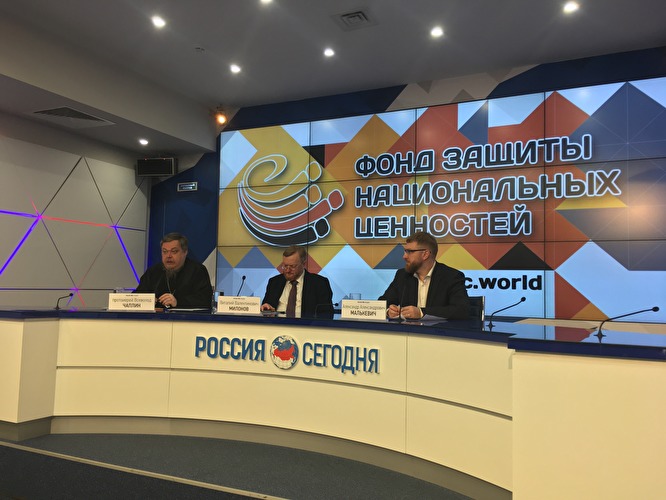
fundRussian Orthodox Archpriest Vsevolod Chaplin, Russian MP Vitaly Milonov, and Alexander Malkevich presenting the National Values Defend Fund at a press conference at Rossiya Segodnya News Agency in Moscow in April 2019. Photo courtesy of Znak.com

Grigorii Golosov
Facebook
July 7, 2019

As for the National Values Defense Fund, which sent a poor spin doctor (identified as a “sociologist”) to Libya, it is a new project, obviously run by [Yevgeny] Prigozhin. Its website makes it clear it is going to defend Russian national values primarily in Africa.

You can read more about the project here.

I realize Putin’s ex-chef Prigozhin has long been more than an errand boy for the man with whom he has been involved in the asymmetrical albeit profitable relationship of vassal and liege lord. Prigozhin has his own business interests in Africa. Russian foreign policy is now so arranged that Prigozhin’s business interests are Russia’s national interests.

So be it. China also has interests in Africa. They are backed by colossal investments that are gradually exchanged for political influence. This happens really slowly because the Africans are quite touchy about it: Chinese influence makes people unhappy. But the investments it makes go a long way toward containing the unhappiness.

Russia has taken a different route. It helps its cause to educate African army officers at the relevant Russian universities, but that is a long-term deal. The powers that be want things to happen quickly, hence the appearance on the continent of mercenaries [like Prigozhin’s Wagner GroupTRR] and spin doctors to aid dictators in fixing their so-called elections and squashing protests through trickery.

In other words, the Chinese approach involves spending money now to obtain influence later, while the Russian approach involves trying to gain influence now in order to make money later. I don’t need to tell you there is no better way to make “Russia” a swear word in Africa and elsewhere, and all Russian nationals into automatic personae non gratae.

Our current rulers will surely take pride in the fact they managed to make as many countries and regions as possible hate Russia. This how they imagine defending national values.

Thanks to Louis Proyect for the link to the article about Jane Goodall’s campaign against Chinese influence in Africa. Translated by the Russian Reader