Darya Apahonchich: The Accusative Case

Hi, everyone! The Russian Federation put me on the wanted list today. Why? Because first I taught Russian to foreign students and because of that I became a “foreign agent,” and then, apparently, because I didn’t fulfill the requirements of the law on “foreign agents”: I drew anti-war comics on [“foreign agent”] report forms to the Justice Ministry.

Oh well.

Source: Darya Apahonchich (Facebook), 7 February 2025. Translated by the Russian Reader


(A chapter from a forthcoming book)

To Accuse

(A story in the guise of a Russian language lesson)

“The accusative case is the object case: it answers the questions whom and what. For example, whom do we love? What do we love? A friend, mom, a city. Whom do we hate? What do we hate? The weather, the rain, the snow.”

I point out the window. A disgusting Petersburg sleet is coming down outside, and the class laughs. We often joke about the the city’s atrocious weather. All my students hail from warm countries: Uzbekistan, Tajikistan, and Azerbaijan. Adults between the ages of twenty and fifty, they are people who are commonly called migrant workers. Tired, in black jackets, they apologize verbosely. They know Russian slang because they learn it on the street, at the market, and at work, but they don’t know what a noun is, because they have had little schooling even in their native languages and have been working since they were children.

“Remember we were talking about the dative case, the case of the addressee? To whom do we give something? To whom do we say something? To a sister, to a friend.’

(Here I want to make an aside about the verticality and horizontality of Russian grammatical cases, but I stop myself because I realize it’s superfluous, although I find the explanation felicitous: the dative case is horizontal, while the accusative case is hierarchical and vertical.)

I say this to my students, but my dean is sitting at the back of the classroom, listening attentively, and next to him sits an FSB officer whom my rector dragged into my class. The FSB officer is also listening attentively. It’s hard to say whether I hate anything in my life more than this situation and those two.

“Unlike the dative case — the case of the second subject in an exchange, where I talk to someone, for example, to a person or to a friend (the person is involved in the exchange: they hear and understand me) — the accusative case indicates the object of an action: I eat a pizza, I read a book.”

A few days earlier, my rector had telephoned me and asked me to ask one of my students to come in, ostensibly for a test. I asked him why this was necessary, if the woman had already taken the entrance exam. He said that an FSB officer would come to my lesson, because the student was person of interest to him, but that she should not know the FSB officer would be there.

I said that it was not part of my job description, that I never lie and would never lie to a student. I also told the rector that my class was a class, not an FSB office, and that I was opposed to anyone being spied on in my class, to which the rector replied that he had the right to come to my class with whomever he saw fit and that he would telephone the student himself.

‘What endings can we use in the accusative case? For masculine nouns, we use the zero ending if it is an object (a what?), for example, ‘I know this film’, ‘I read the text’, or -a/-ia if it is a person (a whom?), for example, ‘I know the [male] teacher’ [uchitelia], ‘I see the [male] student’ [studenta]. For feminine nouns, the ending is always -u, for example, ‘I see the book [knigu], ‘I see the [female] student [studentku].

I don’t see the student in class. I haven’t seen her all week since that phone call and I don’t know what to do. Should I call her and tell her that the dean wants to talk to her and that the FSB is interested in her? If I called her on my mobile phone, then the FSB would be interested in me. All week I have been trudging round the city: it’s autumn, November, the weather is disgusting, my feet are wet, I’m working ten hours a day, I don’t see my children, I don’t see the sun. How come I took it all on myself, this job, this workload? Why do I have to bear it alone? Who’s to blame? I guess it’s my fault. But I can’t afford not to work even on my birthday. And then there’s this student. God, what am I going to say to her? Flee the country? Maybe they’ll just ask her questions. It’s not like they’re going to bring a paddy wagon to the university to arrest her…

“What? Yes, there’s no difference between objects and persons: sister [sestru], girlfriend [podrugu], teacher [uchitel’nitsu], street [ulitsu], hand [ruku].

Why are the two of us — two women in a patriarchy — again getting screwed over for everything? Men have invented the patriarchy, that drug for their delicate egos which comes with wars, exploitation, violence, and control. It messes with your head and then blames you for everything being wrong.

“Yes, that’s right. Oyatullo, please come up with sentences using the verbs ‘read,’ ‘write,’ and ‘see’ with nouns in the accusative case.”

When I came to work today, the dean and the FSB guy were already in the classroom. While I was still thinking what to do, everything had already happened, so I started the lesson. Why aren’t future language teachers warned that their profession will involve this? There was pogrom at my last job, a year ago. They came from the FSB, from the migration service. They blocked the doors from the inside, tore my folders with the students’ documents inside, yelled at me and at the students, and those courses were shut down. Then a year passed, and I found a new job: the cultural capital of Russia, beautiful St. Petersburg, Liteiny Prospekt, the Yusupov mansion, stucco, gold, chandeliers, cold, dust, red carpets, students in their jackets and hats. It was sad but mentally manageable. It seemed like things would be decent now, but no, the cops have shown up here too. Now things are just as they should be, the whole nine yards.

“Okay, great! Now let’s do some exercises from the textbook.”

The thing I hate, the vertical in the back row, is slowly segueing into a diagonal. The FSB guy is sitting next to the radiator. You can tell by his flushed mousey face that he’s spent a lot of time outside today and now, in this warm room, he’s gone limp and snuggled up against the wall.

“Page 218, exercise 8, Munisa, please!”

I’ve been working here for a few months now. I have been telling the students about grammar, and they have been telling me about nationalism. They’ve told me about a lot of things — for instance, about the cop who confiscated one’s student’s sack of apples when he realized she didn’t have the money to pay him a bribe; about how they hid in cement bags; about how the neighborhood beat cop visits them once a month to collect 3,000 rubles from each their flats, just because he can; about how landlords refuse to let flats to them; about what people say to them on the street.

“Okay, now let’s turn the page.”

The FSB guy at the back desk is asleep, while the dean sits with his eyes half closed. I think that’s probably what the peak of your career looks like: when you have an FSB officer asleep in your class. Or, depending on how you look at it, maybe it’s the bottom of your career. I also think that it would be good if he kept sleeping like that. Sleeping Beauty slept for a hundred years, so there are historical precedents. That would suit me just fine. I try to keep my voice down.

“Let’s use these same verbs now in the future tense and at the same time we’ll practice the perfect and imperfect aspects of the verb.”

On the wall of my shabby office, just opposite the blackboard, the phrase “Dasha is a rube” was written in black, but then corrected to “Dasha is a nube” in green.

The student for whom the ambush at the back desk was arranged enters the classroom. She is older than me, thin, and wears a hijab, and she has come with her grown-up son. I quickly think that this is better, that it is good she is not alone. The dean briskly rushes up and tells me and my students to move to another classroom and finish our lesson there.

We leave with our books and notebooks. We walk along the red carpet, past a portrait of the patriarch in a golden frame, past a poster against corruption (I remember how once a student tried to bribe me right under this poster), past some oil landscape paintings, past stands with pictures of the father the rector, his son the assistant rector, and his mother the dean. Then we pass the security guard who calls my students “blacks.”

How shameful.

“Okay, let’s finish this page.”

I stopped by the classroom after class. The student and her son were already leaving, and they looked very upset. I never found out what had happened there or what the FSB had wanted with her, and I never saw her again.

This job of mine ended a few months later because of the [2018] FIFA World Cup. Private universities were prohibiting from offering “pre-university” courses. Formally, this was done to reduce the number of students from Central Asia, but in fact it was done so that there would be fewer migrant workers from Central Asia in Russia’s capital cities during the World Cup, because the superpower Russia hinges not only on power but also on provincialism. What would foreigners from the first world see when they came to Russia? Other foreigners, but from the third world?

My lousy work schedule ended a little later, when I was able to find a normal job, that is, several jobs. A little later still, my quasi-marriage ended, because I couldn’t fool myself anymore, and later still my life in St. Petersburg ended in political persecution and emigration.

And only a prolonged feeling of guilt remained with me in the wake of it all: about how I should have behaved, where that woman is now, and whether she is doing well.

Source: Darya Apahonchich (Facebook), 5 August 2024. Translated by the Russian Reader


Dear friends, thank you for the words of support. Yesterday, I realized that, although I had know that sooner or later I might be put on [Russia’s] wanted list, I wasn’t ready for it.

I probably used to joke about it, and I still do. For example, there are my children: their parents are wanted because one of them insulted the feelings of religious believers, while the other taught foreign students and submitted incorrect reports to the Justice Ministry.

An illustration of Nikolai Chernyshevsky’s mock execution on Mytninskaya Square in Petersburg, 31 May 1864. Source: Istoriia.RF

But this grotesque discrepancy between the gravity of the “crimes” and the sanctions masks what I see as a modern Russian form of mock execution. Remember how Chernyshevsky was put through this? He had a signboard bearing the words “state criminal” hung on his chest, and his sword was broken above his head.

In addition to that, he was sent into exile, banned from publishing books and living in the capital cities, placed under constant surveillance, and so on.

It’s a pity I don’t have a sword to break.

You know, when it happens to you, the feelings which arise are complicated. If it were only about my relations with the authorities, it would be easier. But it automatically implies that I cannot go back to Russia, and although I had not planned on doing this in the near future, yesterday I realized that it hurts me a lot.

I was on the bus when I got the call from Varya.

“I have to tell you so you don’t find out about this on the new,” she says to me.

“So, what happened?”

“You’ve been put on the wanted list. Are you okay?

(I’m not okay: I’m crying. I forgot I could cry like that.)

“Dasha, where are you now?”

“I’m on the bus, Varya. I missed my bus and the driver of another bus has let me ride for free.”

“He let you on because you could explain everything so well in German?”

“No, because he found out I was Russian. He said he was Serbian and loved Russia.”

(Varya laughs.)

“You tell him that his beloved Russia has put you on the wanted list.”

“Varechka, I still don’t have a ticket and I have to get to my destination, so I won’t tell him about this.”

As I rode in the bus, I thought that I should write down this conversation and that I too, like my Serbian driver, love Russia. I love Kamchatka, Siberia, and St. Petersburg — all three of my homelands, and I miss the people dear to me and the places dear to me, the people and places which nourished me and brought me up, teaching me to be freedom-loving and independent.

So I am sorry that thing are like this, that my country does not want to see me but puts me on the wanted list as if it wanted to see me. I would like our friendship to be mutual.

Source: Darya Apahonchich (Facebook), 8 February 2025. Translated by the Russian Reader

Yevgeny Zhumabekov: Returning the Names

“Yevgeny Zhumabekov, 96 kilograms” is how he introduces himself. Yevgeny is the person who came up with the idea of replacing Last Address plaques that had been torn down with homemade copies and who did this work incognito for almost a year. Now he can identify himself.

Bumaga has detailed the struggle that erupted over the plaques in December 2023. They began to disappear en masse, but copies subsequently appeared in place of the ones that had been torn down. These copies were also removed, after which a plaque appeared on the 14th Line on Vasilyevsky Island bearing the following message: “Plaques [memorializing] people who had been politically repressed in this place were repressed eight times.”

Here you can read Yevgeny’s own account of how the [Stalinist] crackdowns touched his family, what shaped his views, how his wife and children got involved in the fight for historical justice, why the Zhumabekovs had to leave the country, and who continues to install the plaques in their wake.

How the repressions touched Yevgeny’s family

I was born in the Sverdlovsk Region, in the town of Kushva, which has gradually been turning into a village. It’s a depressing place. Two of the industrial enterprises that supported the town have shut down. People have been leaving, while the old people are dying off.

It so happened that my history teacher at school was a good friend of my grandfather’s. He would come to my grandfather’s house, and they would drink hard alcohol together, play chess, and talk a lot. I often visited my grandmother and grandfather and heard these conversations. That’s how I learned that my grandfather came from a family of a person who had been politically repressed.

His parents had come from the Perm Region. My great-grandmother and great-grandfather were completely ordinary peasants. It was forbidden in their house to drink alcohol, [and because they were teetotalers] they harvested large crops. In 1931 or 1932, they were dekulakized and exiled far beyond the Arctic Circle, while their children were sent to orphanages. After a while great-grandmother and great-grandfather managed to escape, but great-grandmother had fallen ill in exile and died soon after returning home, while great-grandfather had to hide out in remote villages all the rest of his life.

I know that my grandfather also had a hard time as a member of a politically repressed family, but he never told me about it, although I tried to find out. It was such a profound trauma for him that he could discuss it only when he got drunk with his sole friend.

How the FSB visited Yevgeny’s workplace

In 2006, I moved to St. Petersburg, where I worked for a time in the car business. I held various positions: sales manager, head of the customer engagement department, manager of a car showroom. Then, before the war, I transferred to a construction company, where I sold real estate.

In 2021, I went to a rally in support of Alexei Navalny after he had returned from Germany. Then there was the protest action with flashlights and others. Not only did I attend these events but I also talked about them with my colleagues at work. I was just sharing my pain, not encouraging them to do anything.

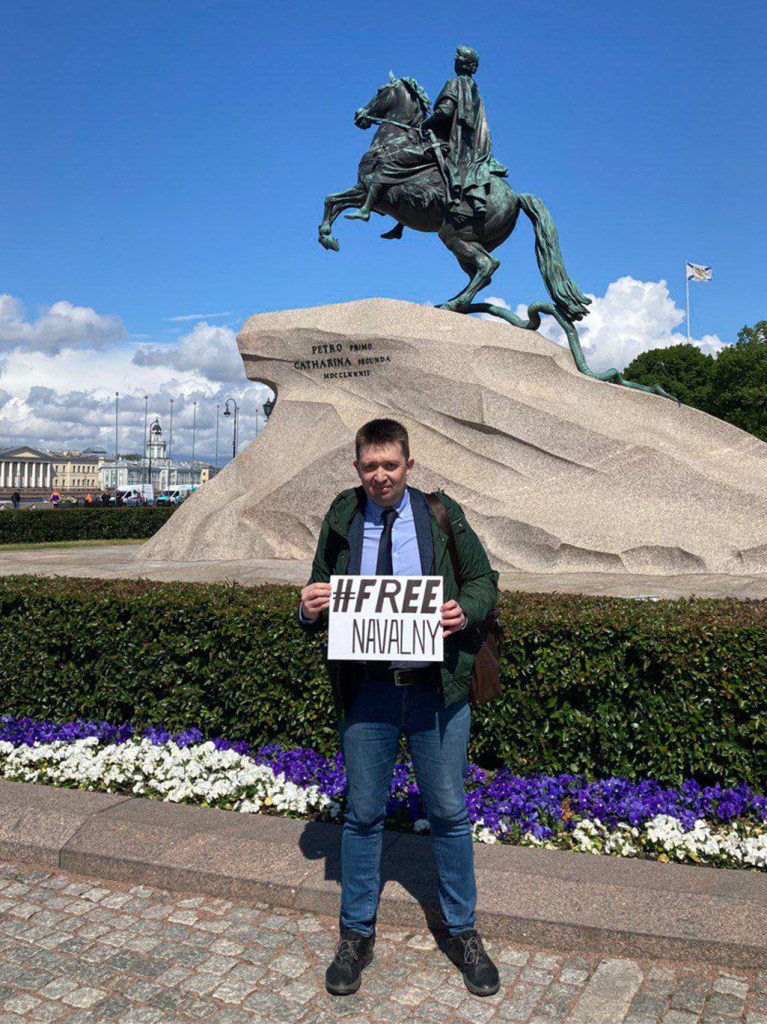
Zhumabekov protesting next to the Bronze Horseman in downtown Petersburg, date unknown.
Photo courtesy of Mr. Zhumabekov (via Bumaga)
Continue reading “Yevgeny Zhumabekov: Returning the Names”

Igor Paskar: The Case File

Igor Paskar has been sentenced to eight-and-a-half years’ imprisonment for two anti-war actions. In June 2022, in the centre of Krasnodar, Igor set fire to a “Z” banner [a symbol of support for the Russian military]. Two days later, he protested at the local office of the Federal Security Service (FSB), by throwing a Molotov cocktail at the stone porch of the building, while his face was painted with the colours of the Ukrainian flag. The FSB and the courts defined this as “vandalism” and an “act of terrorism.”

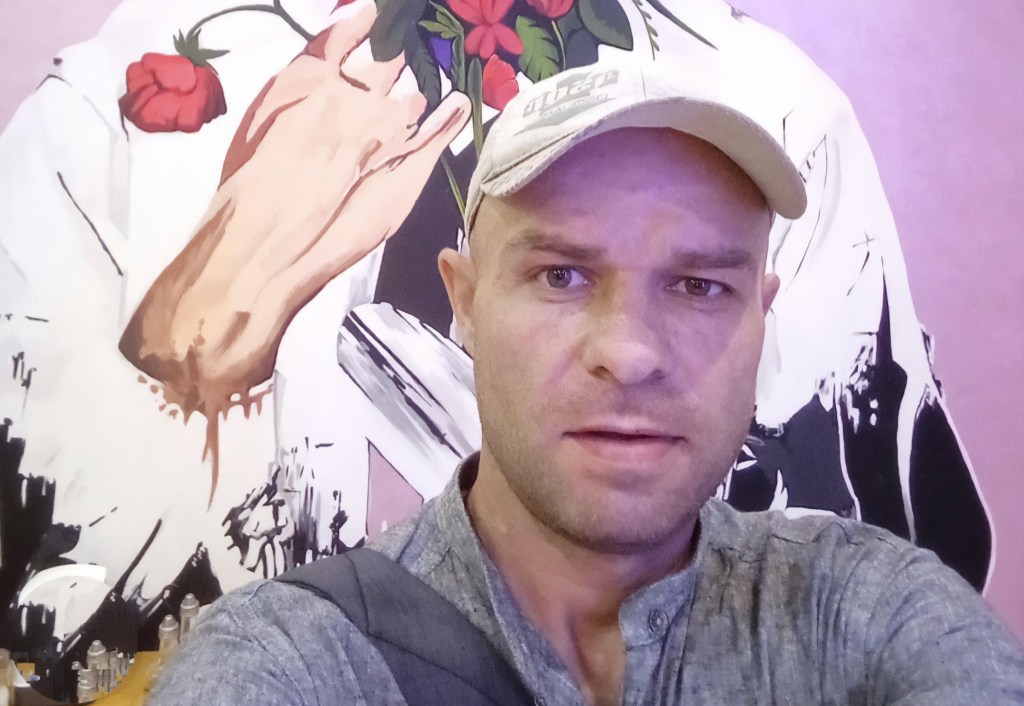
Igor Paskar

Igor Paskar was born in Nikolaevsky village, a working-class community in the northern part of Volgograd Region. He went to school there. After doing national service on building sites in Samara, he worked as a courier, and for haulage and construction companies.

Paskar had three previous convictions. The first time he went to court, at the age of 22, was for possession of a few grams of cannabis: he was given a five-year suspended sentence. “In the milieu in which I grew up, half of the people I knew – if not more than half – smoked cannabis. It was not considered to be asocial or objectionable. But the motherland has decided that, in contrast to drinking alcohol, that’s serious criminal behaviour,” Igor said. Three years later, Paskar was in court again, and this time was sentenced to two years in prison for the theft of, and possession of, drugs. He points out that, from the moment of his first time in court, the police searched him regularly, and said quite openly that they were looking for weed. Igor’s third time in court was in 2006, when he received a one-and-a-half year suspended sentence for possession of narcotics. “That’s how I came to the attention of our law enforcement agencies. And from then on, I didn’t have a life,” he recalled. Given these circumstances, in 2013 Igor moved to Moscow.

In the capital, Igor continued working in various jobs, and helping his mother, until she died in 2017. This was around the time his social conscience took shape.

“As far back as I remember, even when I was very young, I was always concerned about what was happening in our country. Our motherland, in the guise of the Russian state, always seemed like a stepmother to me, not a real mother. I was never indifferent to the pressure that the state brought to bear on those who dissented or disagreed,” Igor said in court.

In 2020 Igor went to the Belarusian embassy to express solidarity with those who protested after the blatant falsification of the results of the presidential election, in which Belarusian president Alyaksandr Lukashenko gave himself 93% of the votes. “That summer and autumn, in 2020, when Belarus’s tinpot dictator was pushing his people around, I was still hoping that here in Russia we would avoid that kind of thing,” Igor says.

In 2021 Igor participated in a big protest staged after the arrest of Alexei Navalny. He was detained, brought to court and fined 10,000 rubles.

The all-out Russian invasion of Ukraine in 2022 decided things for Igor once and for all. He decided to undertake a symbolic anti-war action, to support people in Ukraine. On 12 June 2022, the Russia Day national holiday, Igor set fire to a pro-war banner displaying the letter “Z” and the militarist slogan “We don’t abandon our own.” However, the action did not attract the attention Igor had hoped it would.

He decided on a second protest. On 14 June he threw an improvised Molotov cocktail at the stone porch of the FSB offices in Krasnodar. It set fire only to a plastic mat. As Igor later stated in court, his action was entirely symbolic and posed no threat to anyone’s life. For Paskar, the action was an expression of solidarity with people in Ukraine, and a signal to those in Russia who did not support the war that they were not alone. My action was peaceful, and aimed to show all who opposed this monstrous war that they were not isolated, and to show our Ukrainian neighbours, that we [in Russia] have not all been turned in to zombies by state propaganda,” he said in court.

Igor was arrested a few minutes after throwing the Molotov cocktail at the FSB building. “I stood outside the building and waited for them. I made no attempt to hide or to evade arrest,” Igor recalled in court. The police arrived, asked if it was him who had started the fire, and, when he confirmed that it was, they put him in handcuffs and took him in to the FSB premises.

“There were people in uniform, perhaps six to eight of them,” Igor said. “They snapped a photo of me on a phone: that picture is in the case file, and it shows that I had no injuries. Then they asked me what I wanted, why I did that. I answered that I wanted to make use of Article 51 of the Constitution, that gives you the right not to incriminate yourself. They obviously found that funny, because a split-second later a sack was put over my head. The next few hours were among the very worst of my life.”

Continue reading “Igor Paskar: The Case File”

Russia’s Fascist Meltdown: The Cliff Notes Version

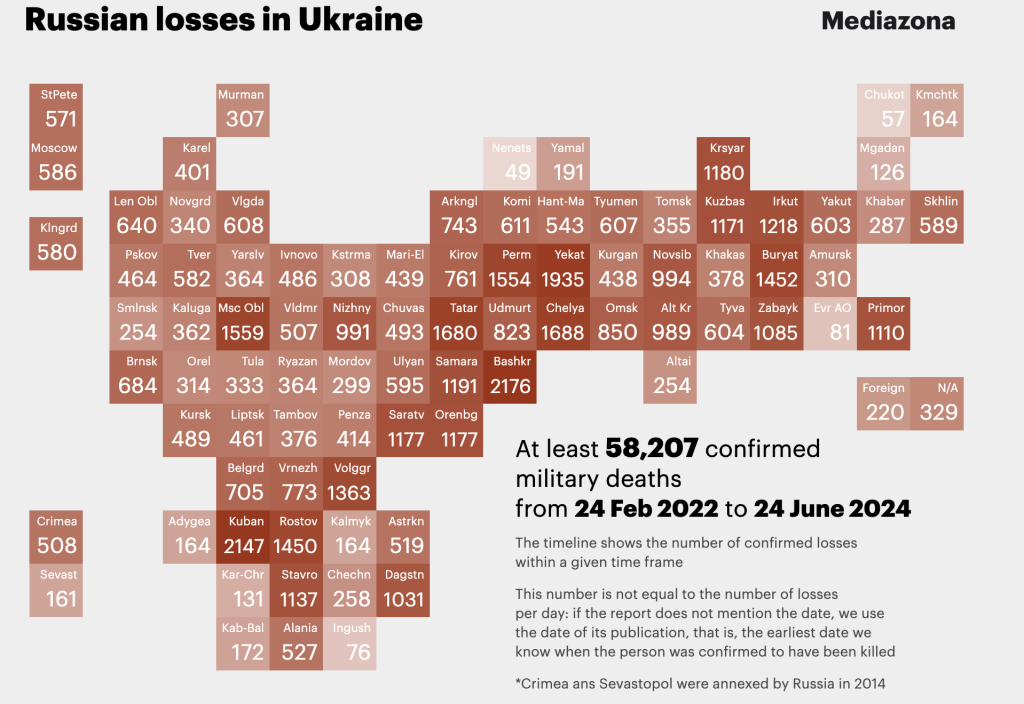
Screenshot of Mediazona infographic, as published here

Russia is losing more and more men in its war against Ukraine.

As of 5 July 2024, Mediazona and its partners in the casualty counting project have ascertained the names of more than 58,000 Russian soldiers killed in action.

The real losses are twice as many, however. Journalists have calculated the actual number of war dead based on information from the probate registry. How they did their work is described in this article by Mediazona. You can read here about how our methodology has been corroborated.

The real losses of the Russian army, including mercenaries, in the war against Ukraine, come to 120,000 dead. The Russian army’s casualties are thus already greater than both the number of US military deaths since the Second World War and all the losses of the Soviet and Russian armies since 1945. Most of the men killed were between the ages of twenty and forty. Those who were younger were usually draftees and prison inmates, while those who were older were “volunteers.”

Seventeen thousand prison inmates recruited by the Wagner Group perished at Bakhmut, according to the mercenary organization’s own documents, as examined by Mediazona. Meanwhile, journalists had estimated that Wagner had lost around sixteen thousand men, which is nearly the same number. Wagner has recruited a total of 48,366 men during the war, meaning that a third of them were killed in the so-called Bakhmut meat grinder.

Prison inmates, “volunteers,” and conscripts, if we judge only by confirmed deaths, have borne the brunt of the losses in the war. At 47.4 percent, they constitute almost half of those who have been killed.

In over two years of war, 3,700 officers of the Russian army and other security forces have been killed, 430 of them in the rank of lieutenant colonel and above.

Between 200 and 250 men are killed every day. This year, the Russian army’s losses have risen dramatically. In 2023, an average of about 120 men were killed every day.

Source: “Every day up to 250 Russians are killed in the war,” WTF? newsletter (Mediazona), 5 July 2024. Translated by the Russian Reader


There are two points of view on Russia during the full-scale war. The first is that Russia has turned into a fascist militaristic state in which everyone marches in step and sincerely hates Ukraine. The second is that cynicism and apathy have won the day in Russia: people don’t care about the war as long as it doesn’t affect them personally. Both of these views are mistaken, according to the authors of “We Have to Live Somehow,” a study from the Public Sociology Laboratory (PS Lab).

The researchers traveled to Krasnodar Territory, Buryatia, and the Sverdlovsk Region, living there for a month and interacting closely with the locals. What they tell us does not fit into either of the two common stereotypes about Russians and the war. Here are a few of the tendencies they observed.

The war is invisible in daily urban life. Residents in the Sverdlovsk Region town of Cheryomushkin (whose name was deliberately changed by the researchers) could not recall a single event in support of (or against) the war during the year. In Ulan-Ude, the capital of Buryatia, the pro-war agitprop consisted of a single poster on a Lenin monument. In Krasnodar, pro-war banners still hung on buildings, but people had long ago removed pro-war stickers from their cars. There is no institutional support for the war at the municipal level: such support is the bailiwick of ideological loners and small groups of pro-war volunteers.

Apolitical Russians justify the war, but arguments like “NATO soldiers” and “defending Donbas” are not of primary importance to them. Rather, they simply want to save face themselves, because they take the accusations directed at their country personally. For this reason, Russians have previously been inclined to justify the actions of the state, even when they do not understand or approve them.

The majority of the populace is not opposed to the war. They may disapprove of it in some respects, but they simultaneously defend the state. For example, in the Sverdlovsk Region, women were outraged by the deaths of young soldiers at the front (“They are sending children to fight! Why?!”) while also parroting the propagandists’ arguments about the war against the “collective West” (“Them United States are hammering civilians!”). Non-opponents of the war argue that Russia has been proactive, defending itself rather than attacking (“Now the Luhansk and Donetsk Republics are part of Russia, but our guys aren’t advancing any further—they’re defending all of it”).

Non-opponents of the war regard the residents of Donbas as Ukrainians, not Russians. They scold Ukrainians from the “Donetsk People’s Republic” and the “Luhansk People’s Republic” (“They don’t defend themselves. They’ll be coming here [to Russia], and what, I’ll have to go fight in their place? I don’t want that”) and do not regard these areas as “their own” (“They are not my blood relatives, they are not my own people”).

While opponents and supporters of the war initially had bitter conflicts, solidarity between them has emerged despite their differences of opinion. Those who generally condone the war are increasingly questioning the official version of events, while those who oppose the war are beginning to listen to their opponents (“I have to build a life and continue living with these people”).

Russians try to pretend that the war has not impacted their daily lives in any way, but its signs still permeate their everyday lives and conversations. In the Sverdlovsk Region, a woman is going to “go to great lengths” to prevent her son from serving as a contract serviceman. In Buryatia, a volunteer says mundanely, “I have eight grandchildren, all boys. And it just happened that four more died at the front.” In Krasnodar, a sociologist’s source says he is glad that the city is not being bombed and that the “Wagnerians” did not come their way, but then confesses in a low voice that the future is hazy and “let’s put it this way: things have become a bit tense.”

The big takeaway, however, is that Russians are pushing the war to the back of their minds. And this is bad news for the Kremlin: it has failed to convince the public, over the past two years, that the invasion was launched in pursuit of noble ends. Even as they justify Russia, its citizens don’t understand what good the war does for them personally.

Source: “How do Russians feel about the war? There seems to be an answer to this question,” WTF? newsletter (Mediazona), 10 July 2024. Translated by the Russian Reader


A week ago, a Moscow court sentenced fifteen-year-old Arseny Turbin to five years in prison after convicting him on charges of “involvement in a terrorist organization.” The security forces accused the schoolboy of aiding the Free Russia Legion, which has been officially banned in Russia.

Convicted 15-year-old “terrorist” Arseny Turbin in slightly happier times. Source: Mediazona

Arseny lived with his mother Irina in the small city of Livny in the Oryol Region. Although he was one of the most successful pupils at the local prep school, he was bullied by his classmates, and yet his teachers did not respond to his complaints. At the war’s outset, Turbin supported the Kremlin’s actions, but later became disillusioned with the government and took an interest in politics, even telephoning [exiled online news channel] TV Rain and telling them that the Conversations about Important Things lessons at school were “utter nonsense.”

In early June 2023, Arseny wrote an email to the Free Russia Legion (an organization we described in detail in a previous newsletter). He wanted to сampaign against the war, but they asked him for too much personal information and he did not send the application form to these strangers. Instead, he started distributing leaflets criticizing the authorities and taking pictures of himself in front of the white-blue-white flag. (The Russian authorities regard this flag as a symbol of the Legion, which has been fighting against Russian forces in Ukraine.)

Meanwhile, a strange thing happened. Turbin made the acquaintance of someone called Maxim, who immediately gave him access to the Telegram channel Occupy Slutophilia 14 (similar names have been used on the Web by the fans of the late Russian neo-Nazi activist Maxim “Tesak” Martsinkevich) and asked him to help with the channel’s content by editing videos. The channel had only a few subscribers, and it featured posts in support of Yevgeny Prigozhin and far-right content revolving around Tesak. Investigators then used Turbin’s involvement in the channel to accuse him of neo-Nazism, despite the fact that the schoolboy’s father was from the UAE, and Turbin himself had been bullied at school due to his dark skin.

At the end of the summer, FSB officers searched the Turbins’ home and summoned Arseny for questioning. It was a very strange conversation: for almost an hour and a half, in different ways, two investigators questioned the schoolboy about his connections with the Free Russia Legion. At the end of the conversation, as Mediazona discovered, they assured the teenager that it was “normal” and “not against the law” to send an application to the Legion, which has been declared a “terrorist organization” by the Russian authorities.

The court was not interested in this peculiar circumstance, however. It was interested in Turbin’s statement, allegedly made during the interrogation, that he had sent the application: this was the basis for the charge that he had “joined” the “terrorist organization.” The thing is that Turbin did not say this. Mediazona has in its possession a full transcript of the conversation, and it simply does not contain mention of Turbin’s sending off the application. The investigators inserted it for their own convenience.

Irina Turbina was present at the interrogation. She says that the investigators retyped the statement three times because of mistakes, and suggests that they could have discreetly amended it after lulling her into a false sense of security.

After seeing the transcript, the investigator, Trunov, had even wanted to close the case. In February 2024, however, the investigation was assigned to another investigator, Irina Simonova. She spun the line about Turbin’s alleged neo-Nazi views, obtaining testimony from the boy’s classmates, who assured her that his “idol was the so-called Tesak,” that he had advocated “exterminating the Ukrainians,” and had supported Alexei Navalny. Irina Turbina does not believe this testimony, producing correspondence in which her son called Tesak a “blockhead” and himself a “liberal.” Turbina argues that her son’s classmates testified against him in exchange for “excellent high school diplomas.”

Due to the increased harassment at school, Turbina transferred Arseny to home schooling. He managed to pass his year-nine exams before the verdict was handed down. On 21 June, the court sentenced Arseny to five years in prison, although the prosecution had requested an even longer sentence of eight years. After the sentence was read, he burst into tears, telling his mother, “Mom, I’m sorry—forgive me for letting you down. But I really didn’t know I was violating any laws.”

No one looked for the mysterious Maxim. The court was also uninterested in Turbin’s conversation with the FSB officers who openly provoked the schoolboy and falsified his statement.

Source: “The story of 15-year-old political prisoner Arseny Turbin,” WTF? newsletter (Mediazona), 27 June 2024. Translated by the Russian Reader


PROMPT: Make an illustration on the theme of “Russia’s Fascist Meltdown”

Creating an illustration on the theme “Russia’s Fascist Meltdown” involves capturing the essence of nationalism, authoritarianism, and geopolitical tension. Here’s a description of an illustration:

The illustration features a powerful and imposing figure symbolizing the Kremlin, with a stern-faced leader resembling Vladimir Putin at the forefront. Behind him, the Russian flag waves prominently, but instead of the usual tricolor, it blends with darker hues suggestive of authoritarian control. The background is a stark urban landscape, reminiscent of Moscow’s skyline, but with ominous shadows and smoke rising in the distance.

In the foreground, there are smaller figures representing dissenters and protestors, their faces obscured in shadows or masked to symbolize anonymity and resistance. They hold signs with slogans advocating for freedom and democracy, contrasting sharply with the dominant figure of Putin. The atmosphere is tense, with a palpable sense of division and discord.

To further emphasize the theme of “meltdown,” the illustration includes elements like cracked ice or fire, symbolizing internal turmoil and instability within Russian society. The color palette leans towards shades of red, black, and grey, evoking a sense of danger and crisis.

Overall, the illustration aims to visually convey the complex and contentious dynamics surrounding Russia’s shift towards authoritarian nationalism, capturing both the gravity of the situation and the resilience of those who oppose it.

Source: ChatGPT

Azat Miftakhov: “It’s Like They’re Telling Us, It’s No Trouble for Us to Put Anyone Away”

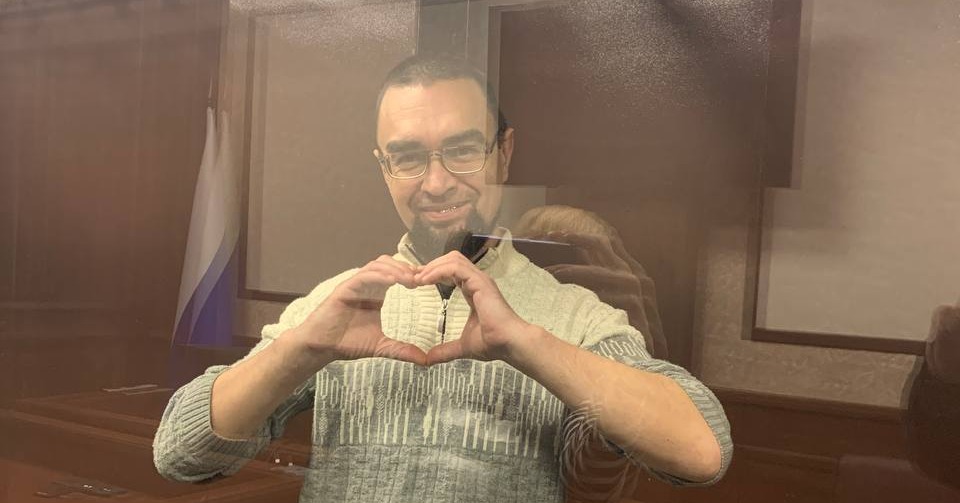
Azat Miftakhov in court. Photo: OVD Info

Anarchist and mathematician Azat Miftakhov has been sentenced to four years in a maximum security facility on criminal charges of “condoning terrorism.” The young man will spend the first two and a half years of his sentence in a closed prison. Miftakhov was detained in September 2023 as he was leaving the penal colony from which he had been released after completing his sentence on charges related to the breaking of a window at a United Russia party office. The next day he was remanded in custody in a pretrial detention center. According to the security forces, while watching TV with other inmates Miftakhov had spoken approvingly of the actions of Mikhail Zhlobitsky, who bombed the FSB’s Arkhangelsk offices [in 2018].

Why do I need to know this? Miftakhov’s wife, Yelena Gorban, argues that this criminal case was launched by members of the security forces who wanted to “extend Azat’s sentence for his past political activity.” In her statement to the court, she said that her husband was aware of the dangers of wiretapping in the penal colony, and so he had avoided discussing political topics in the company of inmates. “The conspicuousness and brazenness with which they fake evidence doesn’t embarrass them. It even plays into their hands. It’s like they’re telling us, ‘It’s no trouble for us to put anyone away,'” the anarchist himself said in [his closing statement at the trial].

Source: It’s Been That Kind of Week newsletter (OVD Info), 30 March 2024. Translated by the Russian Reader


A video and audio recording of Azat Miftakhov’s closing statement at his trial and his sentencing, 28 March 2024, Yekaterinburg. Source: FreeAzat (Telegram), 31 March 2024

During the years I was imprisoned on the charges in previous criminal case, I failed to fall head over heels in love with the state, and now I again find myself in the dock. I am now on trial for what the security forces have deigned to call “condoning terrorism” by faking the evidence, as they did five years ago. The conspicuousness and brazenness with which they fake evidence doesn’t embarrass them. It even plays into their hands. It’s like they’re telling us, “It’s no trouble for us to put anyone away.”

We see the same brazenness in the numerous incidents of barbarous torture perpetrated by the regime’s guardians, the FSB. These guardians don’t care that their shameful deeds are made public. On the contrary, these deeds are flaunted as a source of pride. In this way, the state shows its terrorist nature, as anarchists pointed out before the previous presidential election by taking to the streets with the slogan “The FSB are the main terrorists.”

What we were saying back then has now become obvious not only in our country but all over the world. We how see how the [Russian] state’s entire foreign and domestic policy has become a conveyor belt of murder and intimidation. While fake witnesses attempt to prove the charges that I “condoned terrorism,” national TV channels broadcast calls for the mass murder of people who disagree with state policy. We see that the state, while paying lip service to combating terrorism, in fact seeks to maintain its monopoly on terror.

No matter how the Chekists try to intimidate civil society, we see even in these dark times people who find the courage to resist the terror that has spilled over the state’s borders. Risking their freedom and their lives, their actions awaken our society’s conscience, whose lack we now feel so acutely, and their steadfastness to the bitter end stands as an example for us all.

One such example for me was my friend and comrade Dmitry Petrov (aka Dima the Ecologist), who died defending Bakhmut from soldiers who had become tools of imperialism. I knew him as a fiery anarchist who, amidst a dictatorship, did everything he could to lead us to a society based on the principles of mutual aid and direct democracy.

As a graduate of the history program at Moscow State University and a PhD in history, he was well versed in the structure of society and was able to argue his position well, something I had always lacked. And yet he was not limited to theorizing but was also heavily involved in organizing the guerrilla movement, which did not escape the FSB’s notice. Because of this, he was forced to continue his work as an anarchist in Ukraine.

When the grim events of the last two years kicked off, he could not stay on the sidelines. An enterprising comrade, he sought to create an association of libertarian-minded people who would fight for the freedom of the peoples of Ukraine and Russia. Unfortunately, no war is without casualties, and Dima was one of them. It would be unjustifiably selfish of me to admire the selflessness of strangers alone and not to acknowledge the sacrifice of those who are personally dear to me. I am well aware of this, despite my regret that all my fellowship with him is now irrevocably a thing of the past.

And yet I find it hard to accept this loss. Knowing that he was one of the best of us, and wanting to do my best to ensure his sacrifice was not in vain, I have to recognize that my contribution will be insignificant compared to what he was capable of.

What I’ve just said was perhaps unexpected for some people. I cannot rule out that some of my supporters could be disappointed, as I find it difficult, to my own regret, to speak out publicly. Perhaps someone will disagree with my beliefs, which are at odds with pacifism.

Striving to be rational about everything, however, I reject a belief in things whose existence has not been proven. Among other things, I do not believe in the world’s justice. I do not believe that all evil will be punished as a matter of course. That’s why I support vigorously resisting evil and fighting for a better world for all of us.

But even if some of my supporters do not share all of my beliefs, I am still grateful for all of their help.

I am grateful to everyone who has written me letters full of warmth and good wishes. Even amidst the desolation of the penal colony, I received stacks of them almost every week. I am certain that such great attention to me was borne in mind by the people who set out to make me submissive. I find it quite pleasant and touching that people share a part of their lives with me, whether the experiences are joyful or sad. Every letter is very dear to my heart, and I read every single one of them.

Many thanks to all those who have supported me financially. Thanks to them I have never lacked anything during all the years of my imprisonment. There have been times when I have run out of money to support me, but as soon as I put out a call for help, within a few days people who cared about me brought my budget back to a comfortable level. This is very pleasant and impossible to forget. Special thanks to Vladimir Akimenkov, who for more than ten years has been organizing fundraisers to support political prisoners, including me.

I am extremely grateful to the activists in the FreeAzat and Solidarité FreeAzat collectives, who have organized campaigns and events in solidarity with me on a scale which boggles my mind. Your recent “1001 Letters” campaign was one of them. After reading all those letters, I was pleasantly surprised to find out that people in dozens of different countries are concerned about me. Thank you very much to everyone who was involved in this campaign, thus showing me how much you support me.

I am extremely grateful to mathematicians all over the world, and specifically to the Azat Miftakhov Committee, for supporting me on behalf of the mathematical community. I am very touched that people to whom I look up, whose scholarly prowess I dream of achieving someday, know about me and voice their solidarity.

Thank you very much to everyone who has spoken publicly about me. And special thanks to Mikhail Lobanov, who was forced to emigrate to France for vigorously supporting me. But even there, despite all the difficulties of exile, his solidarity with me has been as strong as ever.

Many thanks to the Russian activists, including those who don’t belong to collectives mentioned above, who have risked their comfort by showing solidarity with me while living under a dictatorship. I am very grateful to all who came to support me with their presence by attending the trial. Some of you traveled hundreds of kilometers for this purpose, and some of you did it more than once and more than twice. I was once again pleasantly surprised by such a huge attention to me.

Many thanks to all the honest members of the press who, through their work, have been helping the public to follow my trial.

I thank my defense counsel, Svetlana Sidorkina, for her dedication in defending me at my trials. I never cease to admire her professionalism and I am convinced that I am very lucky to have her. Finally, I would like to thank Lena, my main support in my tribulations. She has helped me through her dedication to overcoming all the difficulties of my imprisonment. On top of that, I am blessed to be in love with her.

As I finish my acknowledgements, I am left with the feeling that someone may have been overlooked. This is a consequence of the tremendous, steady support I have received since the moment of my arrest. I am pleased to see I am not the only one who has been the object of your support—that, despite the dark events of recent years, your solidarity knows no territorial boundaries. This is what gives me hope for a bright future for all of us.

Source: “Azat Miftakhov’s Closing Statement in Court: Yekaterinburg, 28 March 2024,” Telegra.ph. The emphasis is in the original. Translated by the Russian Reader. Thanks to the Fabulous AM for the heads-up.

Pickleball, Octopus, Political Prisoner, Putin, Prigozhin, Pretty Girls


The Hustle, “The Economics of Pickleball and the Sport’s Sound Problems”

MBARI, “Scientists solve mystery of why thousands of octopus migrate to deep-sea thermal springs”

Sergei Okrushko

Solidarity Zone has begun supporting Sergei Okrushko

On July 28, an explosion occurred at the Kuibyshev Oil Refinery in Samara. The same day, 42-year-old Sergei Okrushko, who was born in Ukraine and worked as an electrician at the refinery, was detained at the border with Kazakhstan whilst trying to leave Russia. The FSB charged him with “sabotage” (per Article 281 of the Russian Federal Criminal Code of the Russian Federation “Sabotage”, and a court in Samara remanded him in custody to a pretrial detention center.

Okrushko confessed, and at his bail hearing he said that he held anti-war views and committed the action for political reasons.

It also transpired that Okrushko had earlier tried to enter Ukraine, but he was not admitted because of his Russian passport. During his stay in Moldova, he had repeatedly participated in anti-war protests.

No one was injured during the explosion at the refinery. According to the investigation, more than 30 million rubles in physical damage was caused, however.

The Kuibyshev Oil Refinery is the largest enterprise in the Samara Region, processing about seven million tons of oil per year. The plant specializes in the production of fuel for all types of transport from automobiles to ships.

On August 3, Okrushko refused the services of Solidarity Zone-affiliated lawyer Zakhar Lebedev, whom he had agreed to let defend him two days earlier. While Okrushko was writing the waiver of counsel, the lawyer noticed fresh injuries on Okrushko’s body: “I noticed that his left arm, namely most of his shoulder and forearm, was purple. It was clear that these were hematomas, which hadn’t been there on August 1 when I visited him at the pretrial detention center. When I asked Sergei where he had got such bruises, he said, without hesitating, “When they arrested me.” When I asked why they had not been there when I’d visited him at the pretrial detention center, Sergei hesitantly said that they’d shown up only now.”

We believe that the fresh bruises and his sudden and unmotivated waiver of counsel testify to the fact that Sergei Okrushko was tortured between August 1 and August 3.

Subsequently, the authorities stopped admitting any lawyers into the pretrial detention center, except for the court-appointed lawyer Vyacheslav Pavelkin. Later, it transpired that Okrushko was taken to the FSB several times without a lawyer.

Unfortunately, at this stage we have been unable to provide Sergei with defense counsel. But at the very outset of his ordeal, we sent him a care package and books, placed an order at the online Federal Penitentiary Service store, and transferred money to his personal account at the pretrial detention center. We recently learned that Sergei received all these things, which means that we were able to provide him with at least minimal humanitarian support. In the coming days, we will put together another care package for Sergei and continue to support him as much as possible.

Solidarity Zone’s mission is to support people imprisoned for anti-war direct-action protests and not let them face the system alone. We cannot always provide full-fledged support due to interference from the security forces, but we consider any reduction in the harm caused by the actions of the Russian state to be a decent outcome.

If you want to support us, you can find our details here.

💌📦 Address for letters and parcels:

Okrushko Sergei Aleksandrovich (born 01.03.1981)
22 Sadovyi proyezd, SIZO-1
Samara 443021 Russian Federation

You can also send letters via Zonatelecom.

#politicalprisoners #ukrainians #crackdown #torture #fsb #fsblawlessness #solidarity #nowar #wewriteletters #samara

Source: Solidarity Zone (Facebook), 24 August 2023. Translated by the Russian Reader. People living outside of Russia will find it difficult or impossible to send letters to Russian prisons via Zonatelecom or regular mail. In many cases, however, you can send letters (which must be written in Russian or translated into Russian) via the free, volunteer-run service RosUznik. Mr. Okrushko has not yet appeared on their list of supported addressees, however. You can write to me (avvakum@pm.me) for assistance and advice in sending letters to her and other Russian political prisoners.


Putin


Prigozhin


Recommended for ages 16 and up. This production contains sexually suggestive language, references to suicide, and depictions of drug use, extreme physical violence towards humans and animals, and self harm. This production also contains the use of herbal cigarettes, haze, and a brief flash of light.

Who Is Valeria Zotova?

Valeria Zotova
Photo courtesy of Solidarity Zone

Who is Valeria Zotova?

On June 28, Valeria Zotova, a 19-year-old woman from Yaroslavl, was found guilty of “plotting to commit a terrorist act” (per Article 30.1 and Article 205.1 of the Russian Federal Criminal Code). Zotova will spend six years in prison because of the “experiments” that the FSB (the Russian Federal Security Service) conducts on people.

According to police investigators, Zotova wanted to set fire to a warehouse where “aid” was collected for Russian servicemen fighting in the war against Ukraine.

In the video footage of her arrest, Zotova is pulled from the passenger seat of a car by masked men. However, the other people in the car were apparently not touched.

Prior to this, a certain “Andrei” had for a long time been writing to Valeria, claiming that he lived in Ukraine. In the letters, he asked Valeria to perform “missions” for him. She refused and showed the exchanges with “Andrei” to her mother. After some time, Andrei’s “girlfriend” “Karina” started writing to Valeria in VKontakte. According to Valeria’s mother, “Karina” harassed her daughter, constantly writing and calling her, and urging her to commit arson. When Valeria was detained, “Karina” was in the vehicle with her, but “Karina” was not charged in the case.

It transpired that “Andrei’s girlfriend” was an FSB officer and a secret witness. At one of the hearings in Valeria’s trial, “Karina” openly stated that it was all a “crime re-enactment” [sledstvennyi eksperiment, which translates literally as “investigative experiment”—TRR] Although the FSB chose not to conceal its actions, this had no effect on the verdict.

The defense provided the court with obvious evidence of Valeria’s innocence, namely, her correspondence with Karina, in which Valeria repeatedly refuses to commit arson.

Despite the fact that the court did admit this evidence into the case file and “weighed” it, Valeria was found guilty on the charges. Instead of the eight years of imprisonment requested by the prosecutor, the court sentenced Valeria to six years.

Valeria’s lawyer has appealed the verdict, so we can look forward to an appeals hearing in the future.

We wrote recently about why the appeals process is so important.

On the outside, Valeria worked very hard, almost seven days a week. In her spare time, she drew and beaded. In winter, she skated whenever possible. She adores doing crosswords and other such puzzles. She is an extraordinarily upbeat and resilient young woman who always succeeded at whatever she undertook.

A drawing that Valeria Zotova sent from the pretrial detention center in Yaroslavl
Courtesy of Solidarity Zone

Valeria is currently in custody at the Yaroslavl pretrial detention center. You can show your solidarity and support by sending her a letter. She is always glad to get them and expresses her gratitude for all the support.

💌📦 Address for letters and parcels:

Zotova Valeria Igorevna (born 2003)
10 ul. Portovaya nab., SIZO-1
Yaroslavl 150001 Russian Federation

You can also send her letters via FSIN-Pismo and Zonatelecom.

Solidarity Zone is supporting Valeria Zotova.

#wewriteletters

Source: Solidarity Zone (Telegram), 14 August 2023. Thanks to Simon Pirani for the heads-up. Translated by the Russian Reader. People living outside of Russia will find it difficult or impossible to send letters to Russian prisons via the FSIN-Pismo and Zonatelecom services or regular mail. In many cases, however, you can send letters (which must be written in Russian or translated into Russian) via the free, volunteer-run service RosUznik. Ms. Zotova has not yet appeared on their list of supported addressees, however. You can write to me (avvakum@pm.me) for assistance and advice in sending letters to her and other Russian political prisoners.

Valeria Zotova: Framed

Valeria Zotova

Defense appeals Valeria Zotova’s verdict

On June 28, the 2nd Western District Military Court sentenced nineteen-year-old Valeria Zotova to six years in prison in a criminal case fabricated by the FSB.

The court has not yet provided a copy of the verdict to either Valeria or her lawyer. Therefore, the lawyer could not prepare a full-fledged appeal. But he did file a brief complaint to meet the deadline: an appeal must be filed within fifteen days of the date of sentencing.

The appeals process is a very important component of legal proceedings. Until the appeals stage has been completed and the sentence comes into force, there is hope that the verdict will be reversed or changed and Valeria will not be sent to a penal colony at this time.

You can always support Valeria by writing her a letter or sending a parcel.

💌📦 Address for letters and parcels:

Zotova Valeria Igorevna (born 2003)
10 ul. Portovaya nab., SIZO-1
Yaroslavl 150001 Russian Federation

Solidarity Zone is supporting Valeria Zotova.

#politicalprisoners#crackdown#solidarity#fsb#fsblawlessness#provocation#yaroslavl#no war#wewriteletters

Source: Solidarity Zone (Facebook), 16 July 2023. Translated by the Russian Reader. People living outside of Russia will find it difficult or impossible to send parcels to Russian prisons or to use the FSIN-Pismo and Zonatelecom services to contact Russian political prisoners. In many cases, however, you can send letters (which must be written in Russian or translated into Russian) via the free, volunteer-run service RosUznik. As of this writing, Ms. Zotova has not appeared on their list of supported addressees. You can also ask me (avvakum@pm.me) for assistance and advice in sending letters to her and other Russian political prisoners.


Valeria Zotova, 19, from Russia’s Yaroslavl has been sentenced to six years behind bars for plotting to set a military aid collection point on fire, Solidarity Zone reports.

The woman was found guilty of attempted “terrorist attack”. The state prosecution wanted eight years in prison for Zotova.

“However, the case materials, correspondence received by the lawyer and Valeria’s own words indicate that the case was a provocation staged by the FSB, whose agents actively persuaded the woman to set the aid collection point for the Russian military ablaze. Zotova may have attracted the attention of the special services due to her anti-war stance,” human rights activists said.

A criminal case against Zotova was opened in February. The woman went for a walk with her friends in mid-February. Later that night, law enforcers showed up at her place for a search without any explanation. During the search, the detainee’s mother was threatened with promises to make her a suspect in her daughter’s case for “participating in anti-war rallies”. She denies these accusations: despite her anti-war views, she did not participate in rallies against the Ukraine war. The news emerged later that Valeria was held in a detention centre in Yaroslavl.

In April, Russian authorities placed Valeria’s mother Svetlana Zotova on the extremist list. The woman had previously been charged with “calls” to commit terrorist and extremist actions. The charges stemmed from comments allegedly posted by Svetlana Zotova on Telegram channels. The woman was prohibited from leaving the country. She could face up to ten years in prison on the charges.

Source: “Russian Valeria Zotova sentenced to six years in prison for attempting to set military aid collection point on fire,” Novaya Gazeta Europe, 28 June 2023

Igor Paskar: “What Did Each of Us Do to Stop This Nightmare?”

Igor Paskar in court. Photo courtesy of Solidarity Zone

On 31 May the Southern District Military Court in Rostov-on-Don sentenced Igor Paskar to eight-and-a-half years’ imprisonment on charges of “vandalism” and “terrorism”. He was found guilty of burning a Z-banner [a pro-war symbol] and the symbolic firebombing of the FSB [Federal Security Service] building in Krasnodar. The day before his sentencing, Igor gave his final statement in court. Here is a translation of his speech:

Almost a year has gone by since I carried out this action. During that year, I pictured this moment time and again, the moment when I would be given the opportunity to make my final statement. I agonised over the words I would say, and the motives that drove me to act as I did.

During the last sitting, your honour, you asked whether I regret my actions. I understood that the extent of my professed regret would influence the severity of the sentence. But if I renounced my beliefs, I would be acting against my conscience.

On the contrary, during the time I have been in prison, I have seen firsthand the injustices perpetrated against the people who we call our brothers: both prisoners of war who have served in the Ukrainian armed forces and ordinary Ukrainian citizens.

The war – or whatever term we use to label it – came to their homes, destroying their lives as they knew them. No matter what slogans and geopolitical interests we use to varnish this, in my eyes it cannot be justified.

Do I regret what has happened? Yes, perhaps I’d wanted my life to turn out differently – but I acted according to my conscience, and my conscience remains clear.

Rather than reflecting on who is right and who is guilty, I would like to pose this question: what did each of us do to stop this nightmare? What, ten or fifteen years from now, will we tell our children and grandchildren about these troubled times?

Unfortunately, God has not granted me the joy of fatherhood; the people who were closest to me have gone, and I am left alone with myself. It was easy for me to do what I did, even though I was well aware of the consequences. There was no-one to agonise about my fate, no-one to worry about me, or to cheer me on. But what I really did not expect was the huge number of letters and messages of support that I have received.

People have written from every corner of Russia, and not only Russia. Many were grateful for my position, so completely at odds with the notion of unanimous national support for what is being perpetrated. There were so many messages of encouragement: “stay strong”, “don’t despair”. So many warm words, so much sympathy.

But I’ll be so bold as to read just one part of a letter that I received in May, which really touched me, and pushed me to write this final statement to the court. Here it is:

“There is very little left of everyday life. It turns out that we can’t live everyday lives anymore. I am listening to the memoirs of prisoners from the 1930s, 40s and 50s. Right now, I’m on the breath-taking biography of [the actress] Tamara Petkevich [who spent seven years in a prison camp]. She was arrested in 1943 and lived until 2017. When they came for her, she was only 22 – just a girl, half the age I am now. I have not read Solzhenitsyn’s Gulag Archipelago, and I never got round to Shalamov’s Kolyma Tales either. But now I’m listening to Petkevich, and it’s making me realise that this is exactly what we must listen to, what we must read at school. As a country we are obsessed with the past, but we hardly ever think about the present or the future. The Americans have their American dream: something to strive for. We have nothing but a fixation on that which happened long ago, that which cannot return. But time and again we try to bring back what has passed, and these attempts are absolutely pointless. It’s as though the whole country is stuck in the mud. As individuals we are caught in our feelings. It’s terrible that even now, for as long as we stubbornly turn our heads back, we will never live happily, never the way we want to. Let’s hope people can find happiness in the little things.”

You can support Igor Paskar by sending letters:

□ Address: Russia 344022, Rostov-on-Don, 219 Maksim Gorky Street, SIZO-1, Igor Konstantinovich Paskar (d.o.b. 1976)

□ You can send letters online via the volunteer service RosUznik.

Solidarity Zone gives full support to Igor Paskar. His legal representative is Felix Vertegel. 

Note. Letters sent to Russian detention facilities that are not in Russian are unlikely to be delivered to prisoners, and RosUznik is also a Russian-language service. If you send short messages to Igor via Solidarity Zone supporters in the UK at 2022ukrainesolidarity@gmail.com, we will arrange for them to be translated and passed on.

□ More about Solidarity Zone on Facebook and Telegram. A report of the organisation’s work in May is here. Links to more information in English here. Russian original of Igor Paskar’s statement here.

Source: People and Nature, 8 June 2023. Thanks to Simon Pirani for the translation, the hard work, the heads-up, and his shining example of solidarity, which helps keep me going when times are tough. ||| TRR

A Hostage of the Putin Regime: The Case of Ekaterina Kishchak

The special detention center at Zakharyevskaya 6 in downtown Petersburg. Image courtesy of Yandex Maps via mr7.ru

Police have detained Ekaterina Kishchak, a 20-year-old resident of Crimea, a citizen of Ukraine and Russia, and the daughter of Yuri Kishchak, a suspect in the bombing of a power line in the Leningrad Region. The young woman is currently at a special detention center in St. Petersburg, said lawyer Vitaly Cherkasov.

Ekaterina’s relatives turned to the lawyer for help. They said that on May 4, the young woman and her boyfriend, Dilyaver Gafarov, were supposed to cross the Russian-Georgian border at Upper Lars to go on holiday in Georgia. At the border checkpoint, the young woman texted to her father, who is living in Belgium, that they were on the verge of crossing the border, after which she stopped answering his calls.

Only fifteen days later, on May 19, did Ekaterina get in touch with her family. In a conversation with her father, she said that she had been detained at the border with Georgia and jailed for fifteen days—that is, until May 21. After this conversation, Ekaterina’s father had a heart attack and underwent surgery.

Ekaterina’s sister, Anna Petrishina, wrote to the Russian Federal Prosecutor General Igor Krasnov asking that the lawyer be notified if the young woman faced criminal charges, or to place her on the federal wanted list if law enforcement agencies were not involved in her disappearance. The letter states that, over the phone, Ekaterina claimed that the police officers who detained her “only ask[ed] questions about her father,” and said that if he did not return to Russia, she and her boyfriend “[would] be tried for his deeds.”

Ekaterina Kishchak. Photo courtesy of Vitaly Cherkasov, as posted on his Facebook page on 5 June 2023

Later, Ekaterina wrote to her father again. According to the lawyer, the young woman said that she had been “taken to St. Petersburg to be arraigned in his criminal case.” Ekaterina’s message was answered by her father’s wife, who replied that she would not pass on her stepdaughter’s message because it would only worsen her husband’s condition.

A lawyer from the Krasnodar Territory who was first engaged by the young woman’s relatives went to Vladikavkaz and discovered that Ekaterina and Dilyaver had been jailed for fifteen days on charges of “disorderly conduct”(per Article 20.1 of the Russian Federal Administrative Offenses Code). It also transpired that the detained young man had telephone his father on May 23 and informed him that the couple had been jailed a second time.

Yesterday, June 3, Cherkasov learned that Ekaterina and her boyfriend were in custody in the special detention center at 6 Zakharyevskaya Street in St. Petersburg—again on charges of disorderly conduct, per the decision of the city’s Smolny District Court. The lawyer attempted to meet with the young woman, but Ekaterina filed a written refusal to communicate with the human rights advocate.

“What happened there made me realize that FSB officers had arrived at the special detention center. I was asked for my identity card again, although they had already made a photocopy of it. When I had waited an hour, I approached the officer on duty and asked why it was taking so long. He replied, ‘Wait, they’re writing a statement in there.’ I was surprised: who did he mean by ‘they’ if I was waiting only for Ekaterina?

“An hour and a half later, the same officer appeared in the visiting room and bashfully handed me a statement, written in Ekaterina’s hand, that she did not want to communicate with me until the end of her stay at the special detention center.

“I asked the on-duty officer the standard question: did he understand that she had been pressured into [writing the statement]? He looked down and said that he had nothing to do with it, thus letting me know that he was carrying out someone else’s instructions,” Cherkasov told mr7.ru.

The lawyer plans to familiarize himself with the administrative case against Ekaterina Kischak in the Smolny District Court. There is information on the court’s website that the young woman and her boyfriend were convicted on May 24 by decision of Judge Ekaterina Mezentseva under Article 20.1.2 of the Russian Federal Administrative Offenses Code (i.e., “disorderly conduct involving disobeying a legitimate demand by an officer of the state”).

Screenshots of the Smolny District Court’s website, showing that Kishchak and Gafarov were convicted on 24 May 2023 by Judge Ekaterina Mezentseva of violating Article 20.1.2 of the Russian Administrative Offenses Code and sentenced to “administrative punishment.” Courtesy of mr7.ru

“We need to understand how, having arrived in St. Petersburg involuntarily, in fact, under the escort of regional FSB officers, Ekaterina and her boyfriend could have engaged in disorderly conduct,” the lawyer said.

You will recall that, on May 25, the FSB reported that it had detained two Ukrainian nationals: 44-year-old Alexander Maystruk aka Mechanic, and 48-year-old Eduard Usatenko aka Max. Yuri Kishchak aka YBK, a 59-year-old Ukrainian and Russian national who is currently in Belgium, was put on the wanted list.

The FSB claims that, in September 2022, the Foreign Intelligence Service of Ukraine (SZRU) recruited the three suspects to sabotage upwards of thirty pylons on the high-voltage power lines running from the Leningrad and Kalinin nuclear power plants (the latter is located in the Tver Region).

According to the FSB, on the Leningrad NPP power line the saboteurs managed to blow up one pylon and rig four pylons with explosives, while on the Kalinin NPP power line they planted IEDs under seven pylons. One of the pylons in the Leningrad Region collapsed due to the blast, but no one was injured, and the power supply was not disrupted.

The high-voltage power line allegedly damaged by a bomb blast on 1 May 2023
Source: Leningrad Region Governor Alexander DroZdenko [sic] (Telegram), via mr7.ru

Source: “Daughter of suspect in bomb blast on power line in Leningrad Region sent twice to special detention center for ‘disorderly conduct,'” mr7.ru, 4 June 2023. Translated by the Russian Reader. Thanks to Vitaly Cherkasov for the heads-up. This post was updated on 5 June 2023 to include the photograph of Ms. Kishchak, above, which was not part of the original article on mr7.ru.