“Try Me for Treason”: Londoners Stand in Solidarity with Imprisoned Opponents of Russia’s War in Ukraine

“Try me for treason. I betrayed your deranged state”, the Russian anti-war protester Andrei Trofimov told the Second Western District Military Court in May.

In 2023, Trofimov was sentenced to ten years’ imprisonment, for opposing Russia’s war in Ukraine in social media posts, and trying to join the Free Russia Legion that fights on Ukraine’s side. At that hearing, Trofimov said he hoped for Ukraine’s victory, and called president Putin “a dickhead”.

On the basis of that statement alone, he was further accused of “justifying terrorism” and defaming the Russian army. For those “crimes”, the judge at the hearing in May this year, Vadim Krasnov, added three years to Trofimov’s sentence.

Before sentencing, Trofimov told the court that he had not justified terrorism, but supported the Ukrainian armed forces’ legitimate military actions against aggression, and had not defamed the Russian army whose actions were unconstitutional and illegal. He told the court that he considered himself guilty of a much more serious crime: treason – taking the enemy’s side in war.

Excerpts from the speeches by Trofimov and three other anti-war protesters were read out in London last month, at a launch event for the book Voices Against Putin’s War: Protesters’ Defiant Speeches in Russian Courts. I said a few words about the book, which I edited.

Here’s a film of the event.

Ukraine Information Group, “Try Me For Treason (readings from anti-war protesters’ speeches in Russian courts),” 7 December 2025

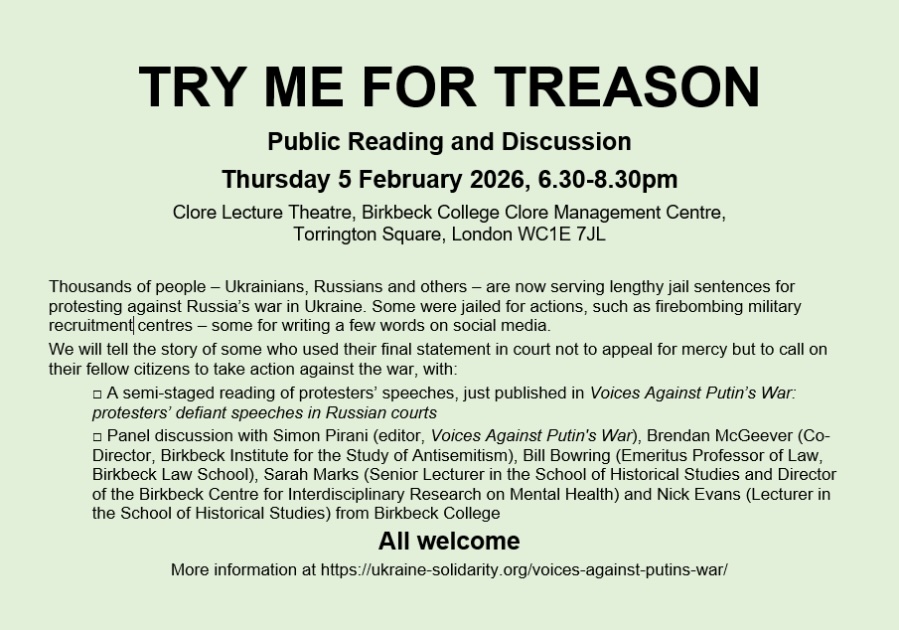
And there will be another chance to hear these powerful readings in London – on Thursday 5 February 2026, 6:30 p.m., at Birkbeck College. Here are the details.

You can order copies of Voices Against Putin’s War, or download a free pdf, here.

We published the book against the background of repeated claims that a peace agreement is about to be signed between Russia and Ukraine. These are louder than ever after this week’s talks in Berlin. At the time of writing this, it is not clear to me that the Kremlin is really interested in stopping the war, or what the “security guarantees” being offered to Ukraine actually mean.

I would recommend following the excellent arguments made about the peace process by Oleksandr Kyselov (most recently here, also here and here), Hanna Perekhoda (who writes on Facebook here), and other Ukrainian socialist writers.

If you want to know why the 20% of Donbas that Ukraine still controls matters so much, this comment by the Institute for the Study of War is worth reading. This speech by Valery Zaluzhny helps us understand what the Ukrainian political elite thinks.

Whatever the outcome of the talks now in progress, if any, the defence of victims of Russia’s military occupation of Ukrainian territory, and domestic political repression, will remain a central issue for our movement, right across Europe.

Source: Simon Pirani, “Try Me for Treason,” People and Nature, 21 December 2025

“We Wanted to Show the Whole Range of Anti-War Resistance in Russia”

Thursday 20 November, 7:00 p.m. UK time: TRY ME FOR TREASON – Readings from anti-war protesters’ speeches in Russian courts, and book launch for Voices Against Putin’s War.

You are welcome to attend in person at Pelican House, 144 Cambridge Heath Road, London E1. Or watch the livestream here on Facebook, or on Youtube.

Source: Ukraine Information Group (Facebook), 18 November 2025


What can courtroom speeches by imprisoned protesters tell us about the breadth of anti-war resistance in Russia? British historian Simon Pirani discusses his new book Voices Against Putin’s War with independent Russian journalist Ivan Rechnoy.

Simon Pirani is a British researcher and author who has written about energy and ecology, the history of the Russian Revolution, the labor movement, and post-Soviet Russia. His recent book Voices Against Putin’s War: Protesters’ Defiant Speeches in Russian Courts compiles and analyzes the courtroom speeches of twelve prisoners who were sentenced for resisting Russian aggression in Ukraine. 

— Today in Russia, hundreds of people are serving prison sentences for criticizing the invasion of Ukraine. Twelve of those people are the subjects of your book. How did you select them?

— We wanted to show that opposition to Putin’s war is widespread. What is striking about these people is their diversity. They come from different generations, have different life experiences, and hold different political views. This diversity demonstrates that, despite the absence of public demonstrations and the lack of any real possibility of organizing an open anti-war movement in Russia, an anti-war movement does exist there. It encompasses a very broad spectrum of Russian society as well as people from the occupied territories. For example, the book features the courtroom speech of Bohdan Ziza from Crimea.

We decided not to include some of the most well-known opponents of the war in the book — people who made brave and principled speeches in court, like Ilya Yashin, for example. Their statements had already been widely publicized in the media here. Instead our goal was to draw the attention of English-speaking readers to lesser-known figures. 

On the one hand, there are those who simply said something or posted statements on social media. For example, Darya Kozyreva, the youngest person featured in the book, was arrested for laying flowers at the Taras Shevchenko monument in Saint Petersburg. On the other hand, these are those who did something, such as throwing firebombs — not with the intention of hurting anyone, but to draw attention to the injustice of the war. Igor Paskar and Alexei Rozhkov are among them. These are people who live in smaller towns far from Moscow or Saint Petersburg, where young men are much more likely to receive draft notices from the conscription service. 

We also included the statement by Ruslan Siddiqi, who sabotaged a railway line to stop munitions from reaching Ukraine. 

The texts for the book were put together by a group of friends who, since the February 2022 invasion, had been translating the courtroom statements and some of the posts from the media or social networks. When we were already well into that process, a lot of new material appeared on the website Poslednee Slovo [author’s note: the project’s name translates as “the final statement”]. It’s a terrific project that does an excellent job of collecting and publishing a much broader range of cases than we could cover. 

We limited ourselves to people who have made explicit anti-war statements about the war in Ukraine. However, as you know, there are many other political prisoners who have appeared in court since the 2022 invasion, as well as many more from before that, especially among the Crimean Tatar political prisoners. They are all represented on the Poslednee Slovo website. Another remarkable thing about the website is that it goes back all the way to the Soviet period. They’ve included the 1966 speeches by Andrei Sinyavsky and Yulii Daniel, perhaps the first examples since Stalin’s time of people using the right for a final statement in court as a form of propaganda. 

Our book includes a chapter that lists seventeen additional cases of people who delivered anti-war speeches, beyond the twelve protagonists whose complete statements we published. We hope that either I or my colleagues will eventually translate all of those speeches as well. 

Unfortunately, the final courtroom speech has become something like a literary genre in its own right. This tells us a lot about the difficult and fearful times we are living through.

— How do you envision the audience for this book? Are they people in the West and elsewhere who already have some understanding of the situation in Russia and want to learn more? Or are they readers to whom you want to convey a political message — perhaps even to persuade them of something?

— The book is in English and is therefore intended for English-speaking readers rather than Russian-speaking readers. Only a small percentage of people in the UK, the US, and Europe can read Russian. Since 2022, many of us have been aware of the fate of the anti-war movement in Russia. As you know, it began with large demonstrations, but protesting soon became difficult and then almost impossible. Next came the firebomb attacks on military recruitment centers — actions not meant to harm people, but to draw attention to the anti-war cause. We then started reading, in Russia’s opposition media, the final statements of opposition figures — the courtroom having become, in effect, the last public forum in Russia where protest is still possible. 

However, I think that many people in English-speaking countries remain unaware of all this. 

So, to answer your question, our aim is to reach a wider audience in Western societies: not only those who have closely followed Russia’s attack on Ukraine and its consequences, but also those whose understanding of it comes only from what they have picked up incidentally through the media.

— One of the central figures in your book is Alexander Skobov. One might say he bridges two eras. He was a dissident in the Soviet Union and is once again among the persecuted today. There is another similar example that is not included in the book: Boris Kagarlitsky. How do people in the West perceive the difference between current repressions and the dissident movement during the Cold War? Also, how do they see the difference between the Russian and Western situations now?

— First, I would like to say a few words about Skobov. As someone who regularly travelled to Russia between 1990 and 2019, I was deeply affected by these courtroom speeches. The first one I came across was by Igor Paskar. I thought, “My God, these are such young people — not the youngest, but still much younger than me — who have entered this fight.” Alexander Skobov’s speech also affected me emotionally, perhaps because he is about my age — a year or two younger — and, as you said, he bridges two eras. 

I was particularly touched by the letter that he wrote to his partner, Olga Shcheglova. It was published in Novaya Gazeta Europe, and we also included it in the book. In the letter, Skobov explains that some of his friends and comrades urged him to leave Russia, but he refused. This made it inevitable that he would eventually face trial and imprisonment. In the letter, he explains that he wanted to communicate to the younger generation that the small group of dissidents he once belonged to — the socialist wing of the Soviet dissident movement — stands in solidarity with them in these difficult times. He wanted this message to be recorded in history. 

I think that is a very important statement, and we all owe Alexander Skobov gratitude for linking these two historical periods through his sacrifice. I hope that including his statements in our book will help people in the West understand this continuity more clearly. 

I will try to answer your question about how these movements are perceived. During the Soviet era, people in the West generally considered the dissident movement to be very small and marginal. Given how communication worked back then, it was very difficult for information to break through. Of course, there were large revolts against Soviet power, beginning with the Novocherkassk uprising in the 1960s and other violent revolts in the 1970s and 1980s. I have a friend in Ukraine who studied the major revolt that took place in Dniprodzerzhynsk. These movements were very short-lived, and we hardly knew about them in the West, even those of us who were interested in what was going on in the Soviet Union. 

Today, Russians — and Ukrainians, of course — have a much greater opportunity to have real conversations with people in Western Europe. I think the powers of that time really succeeded in dividing Europe; there really was an iron curtain. But that’s gone now. Millions of Ukrainians and Russians live in Western Europe, the UK, and the US. People are learning to communicate with each other and work together in new ways. 

We can already see examples of this in Germany, in the UK, and elsewhere. I think this conversation must continue — and our book, I think, is part of that ongoing dialogue. 

Of course, it’s not easy to communicate with someone who is literally in a Russian prison. However, through the friends, comrades, and families of the central figures in our book, I hope this conversation will begin and continue over a long period of time. 

— I wanted to ask specifically about the possibility of connecting the Russian-Ukrainian and Israeli-Palestinian agendas. We are, of course, impressed by the huge mobilization in support of Palestine. At the same time, many on the left are frustrated that active support for Ukraine — a country in a situation in some ways similar to that of Palestine — is far less widespread in Europe and the West. Have there been any positive developments in this regard recently? 

— Since October 2023, we have all watched with horror as Israel’s assault on Gaza has unfolded. It has been widely recognized as a genocide, and we now see a larger and more enduring anti-war movement in Western countries than we have seen in decades — comparable perhaps only to the protests against the US-UK invasion of Iraq in 2003, or even the movement against the Vietnam War in the 1970s. 

One of the reasons I felt it was important to translate these texts into English was to show Western audiences how much the Russian anti-war movement has in common with movements here. Of course, their enemies are different, standing on opposite sides of the geopolitical divide, and there are many other differences as well. Yet the similarities are striking — and deeply significant. The motivations of some of those who gave these courtroom speeches — whose statements we have translated — are very similar to those of activists in the UK who have been arrested for supporting Palestine Action, or of those who joined the flotilla recently stopped by Israeli forces as it attempted to reach Gaza. 

I spent much of last year attending the large British demonstrations against Israel’s assault on Gaza and calling for a ceasefire. Together with friends, we carried a banner stating: “From Ukraine to Palestine, occupation is a crime.” Our group wanted to show our fellow demonstrators that Ukraine’s struggle for national self-determination and the Palestinians’ struggle for freedom from Israeli occupation share something essential — the right to decide their futures, free from foreign interference and military threats. 

We received a very interesting response from other marchers. Those familiar with the politics of the so-called left and socialist movements will recognize the reaction we encountered from a small minority, mostly older people, who said things like: “Why are you siding with Ukraine? Ukraine is just a plaything of the Western powers, a puppet of NATO. Why even talk about this issue?” Yet the overwhelming majority — more than ninety percent — of those who approached us said, “Ah, yes, we hadn’t thought about it that way before, but there really is something in common between these struggles.”

Another major obstacle to unity comes not only from the “campism” of certain leftists — those who focus exclusively on American and British imperialism while downplaying or excusing Russian imperialism — but also from the state, the mainstream press, and government propaganda. The official narrative is consistently supportive of Ukraine and entirely condemnatory of Palestinian resistance. Ordinary people sense this imbalance — the racism and discrimination directed at the Palestinian cause, alongside the establishment’s favoritism toward Ukraine. There is some truth in that: the propaganda machinery of our ruling class here is largely sympathetic to Ukraine. Working-class people in the UK and across Europe notice this and grow suspicious. However, I believe that is a suspicion we can overcome — and that has been our experience. 

All of this is my personal opinion. The purpose of the book, however, is to bring to English-speaking readers the voices of our friends and comrades in Russia — those brave people who have found themselves in court and who, in some cases at the risk of additional years in prison, have chosen to exercise their constitutional right (though not always respected by judges) to deliver a final statement before the court. It is a remarkably courageous and difficult decision. 

— I wanted to thank you for the book, and I also wanted to ask you, since you have been interested in this topic for a long time: how did your interest in it arise, and why has Russia become so important to you?

— My connection with Russia began through the labour movement. I first went to Russia in 1990 — to Prokopyevsk, in western Siberia, where the miners’ strikes of 1989 had first broken out. At that time, I was working as a journalist for the mineworkers’ trade union here in the UK. We saw an opportunity to develop links of solidarity between Soviet miners and British miners. And we had some success. Our friends in the British miners’ union established a very close relationship with the Independent Miners’ Union of Western Donbas, based in Pavlograd. This friendship continues even today.

In those days, I was a member of a Trotskyist organisation, and in August 1990, we organised a meeting in Moscow to mark the 40th anniversary of Trotsky’s assassination. This, too, was part of a conversation between Western socialists and people in Russia and Ukraine that had been practically impossible during the “Cold War.”

I continued to follow what’s going on in Russia and Ukraine, and to write about it, and between 2007 and 2021, I worked at a research institute, writing about the energy sectors of those countries. 

Since the pandemic, I haven’t been back to Russia. On February 24th, 2022, when the invasion began, I was at home and was shocked. We were all shocked. The invasion has changed everything, both in Ukraine and Russia, for many years to come. Together with friends, we began translating these courtroom speeches and posting them online. Gradually, that work grew into the idea of making a book.

I hope your readers will read it. Later this year, we’re going to make the book freely available as a PDF, so that everyone can access it. 

If we do make any money — and I should say it is a very cheap book — all proceeds will go to Memorial and political prisoners. Nobody is making a profit from this project. The whole point is to share these voices with a much wider audience.

Source: Ivan Rechnoy, “We Wanted to Show the Whole Range of Anti-War Resistance in Russia,” Posle, 22 October 2025


 Sale! £15.00 £12.00

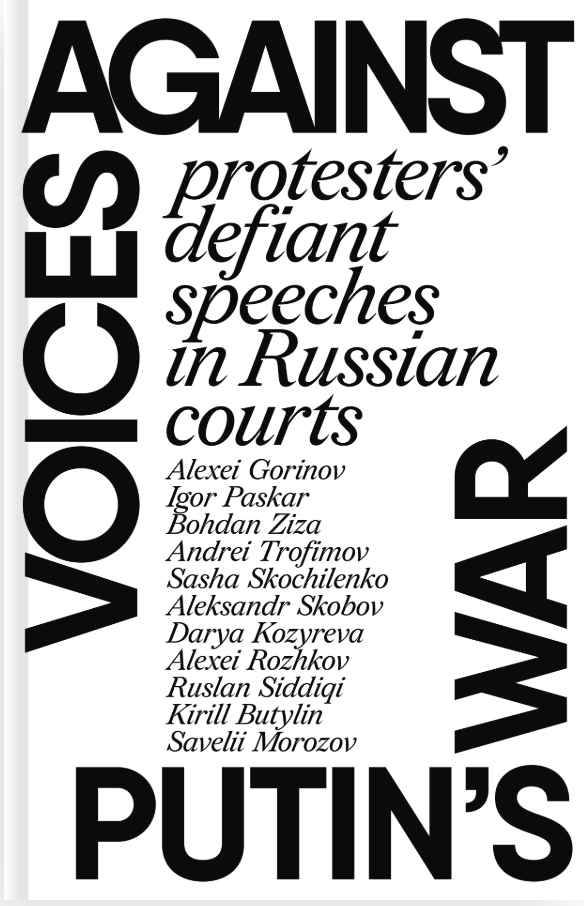
VOICES AGAINST PUTIN’S WAR
Protesters’ defiant speeches in Russian courts

Speeches by Alexei Gorinov, Igor Paskar, Bohdan Ziza, Mikhail Kriger, Andrei Trofimov, Sasha Skochilenko, Aleksandr Skobov, Darya Kozyreva, Alexei Rozhkov, Ruslan Siddiqi, Kirill Butylin and Savelii Morozov.

Foreword by John McDonnell, Member of UK Parliament

Edited by Simon Pirani

ISBN: 978-1-872242-45-3 (paperback)
e-ISBN: 978-1-872242-47-7 (e-book)
RRP: £15 (pbk)
e-RRP: £7 (Ebook)
196 pages; 140x216mm.
Publication date: September 2025

The E-book can be purchased at the usual online retailers
Any profits will be donated to Memorial: Support for Political Prisoners https://memohrc.org/en

Source: Resistance Books

Igor Paskar: The Case File

Igor Paskar has been sentenced to eight-and-a-half years’ imprisonment for two anti-war actions. In June 2022, in the centre of Krasnodar, Igor set fire to a “Z” banner [a symbol of support for the Russian military]. Two days later, he protested at the local office of the Federal Security Service (FSB), by throwing a Molotov cocktail at the stone porch of the building, while his face was painted with the colours of the Ukrainian flag. The FSB and the courts defined this as “vandalism” and an “act of terrorism.”

Igor Paskar

Igor Paskar was born in Nikolaevsky village, a working-class community in the northern part of Volgograd Region. He went to school there. After doing national service on building sites in Samara, he worked as a courier, and for haulage and construction companies.

Paskar had three previous convictions. The first time he went to court, at the age of 22, was for possession of a few grams of cannabis: he was given a five-year suspended sentence. “In the milieu in which I grew up, half of the people I knew – if not more than half – smoked cannabis. It was not considered to be asocial or objectionable. But the motherland has decided that, in contrast to drinking alcohol, that’s serious criminal behaviour,” Igor said. Three years later, Paskar was in court again, and this time was sentenced to two years in prison for the theft of, and possession of, drugs. He points out that, from the moment of his first time in court, the police searched him regularly, and said quite openly that they were looking for weed. Igor’s third time in court was in 2006, when he received a one-and-a-half year suspended sentence for possession of narcotics. “That’s how I came to the attention of our law enforcement agencies. And from then on, I didn’t have a life,” he recalled. Given these circumstances, in 2013 Igor moved to Moscow.

In the capital, Igor continued working in various jobs, and helping his mother, until she died in 2017. This was around the time his social conscience took shape.

“As far back as I remember, even when I was very young, I was always concerned about what was happening in our country. Our motherland, in the guise of the Russian state, always seemed like a stepmother to me, not a real mother. I was never indifferent to the pressure that the state brought to bear on those who dissented or disagreed,” Igor said in court.

In 2020 Igor went to the Belarusian embassy to express solidarity with those who protested after the blatant falsification of the results of the presidential election, in which Belarusian president Alyaksandr Lukashenko gave himself 93% of the votes. “That summer and autumn, in 2020, when Belarus’s tinpot dictator was pushing his people around, I was still hoping that here in Russia we would avoid that kind of thing,” Igor says.

In 2021 Igor participated in a big protest staged after the arrest of Alexei Navalny. He was detained, brought to court and fined 10,000 rubles.

The all-out Russian invasion of Ukraine in 2022 decided things for Igor once and for all. He decided to undertake a symbolic anti-war action, to support people in Ukraine. On 12 June 2022, the Russia Day national holiday, Igor set fire to a pro-war banner displaying the letter “Z” and the militarist slogan “We don’t abandon our own.” However, the action did not attract the attention Igor had hoped it would.

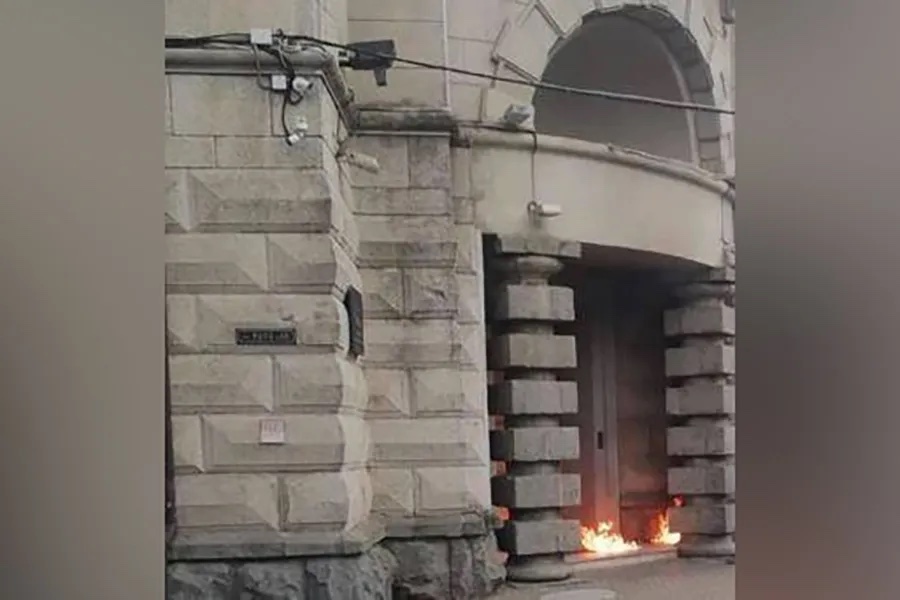
He decided on a second protest. On 14 June he threw an improvised Molotov cocktail at the stone porch of the FSB offices in Krasnodar. It set fire only to a plastic mat. As Igor later stated in court, his action was entirely symbolic and posed no threat to anyone’s life. For Paskar, the action was an expression of solidarity with people in Ukraine, and a signal to those in Russia who did not support the war that they were not alone. My action was peaceful, and aimed to show all who opposed this monstrous war that they were not isolated, and to show our Ukrainian neighbours, that we [in Russia] have not all been turned in to zombies by state propaganda,” he said in court.

Igor was arrested a few minutes after throwing the Molotov cocktail at the FSB building. “I stood outside the building and waited for them. I made no attempt to hide or to evade arrest,” Igor recalled in court. The police arrived, asked if it was him who had started the fire, and, when he confirmed that it was, they put him in handcuffs and took him in to the FSB premises.

“There were people in uniform, perhaps six to eight of them,” Igor said. “They snapped a photo of me on a phone: that picture is in the case file, and it shows that I had no injuries. Then they asked me what I wanted, why I did that. I answered that I wanted to make use of Article 51 of the Constitution, that gives you the right not to incriminate yourself. They obviously found that funny, because a split-second later a sack was put over my head. The next few hours were among the very worst of my life.”

Continue reading “Igor Paskar: The Case File”

Igor Paskar: “What Did Each of Us Do to Stop This Nightmare?”

Igor Paskar in court. Photo courtesy of Solidarity Zone

On 31 May the Southern District Military Court in Rostov-on-Don sentenced Igor Paskar to eight-and-a-half years’ imprisonment on charges of “vandalism” and “terrorism”. He was found guilty of burning a Z-banner [a pro-war symbol] and the symbolic firebombing of the FSB [Federal Security Service] building in Krasnodar. The day before his sentencing, Igor gave his final statement in court. Here is a translation of his speech:

Almost a year has gone by since I carried out this action. During that year, I pictured this moment time and again, the moment when I would be given the opportunity to make my final statement. I agonised over the words I would say, and the motives that drove me to act as I did.

During the last sitting, your honour, you asked whether I regret my actions. I understood that the extent of my professed regret would influence the severity of the sentence. But if I renounced my beliefs, I would be acting against my conscience.

On the contrary, during the time I have been in prison, I have seen firsthand the injustices perpetrated against the people who we call our brothers: both prisoners of war who have served in the Ukrainian armed forces and ordinary Ukrainian citizens.

The war – or whatever term we use to label it – came to their homes, destroying their lives as they knew them. No matter what slogans and geopolitical interests we use to varnish this, in my eyes it cannot be justified.

Do I regret what has happened? Yes, perhaps I’d wanted my life to turn out differently – but I acted according to my conscience, and my conscience remains clear.

Rather than reflecting on who is right and who is guilty, I would like to pose this question: what did each of us do to stop this nightmare? What, ten or fifteen years from now, will we tell our children and grandchildren about these troubled times?

Unfortunately, God has not granted me the joy of fatherhood; the people who were closest to me have gone, and I am left alone with myself. It was easy for me to do what I did, even though I was well aware of the consequences. There was no-one to agonise about my fate, no-one to worry about me, or to cheer me on. But what I really did not expect was the huge number of letters and messages of support that I have received.

People have written from every corner of Russia, and not only Russia. Many were grateful for my position, so completely at odds with the notion of unanimous national support for what is being perpetrated. There were so many messages of encouragement: “stay strong”, “don’t despair”. So many warm words, so much sympathy.

But I’ll be so bold as to read just one part of a letter that I received in May, which really touched me, and pushed me to write this final statement to the court. Here it is:

“There is very little left of everyday life. It turns out that we can’t live everyday lives anymore. I am listening to the memoirs of prisoners from the 1930s, 40s and 50s. Right now, I’m on the breath-taking biography of [the actress] Tamara Petkevich [who spent seven years in a prison camp]. She was arrested in 1943 and lived until 2017. When they came for her, she was only 22 – just a girl, half the age I am now. I have not read Solzhenitsyn’s Gulag Archipelago, and I never got round to Shalamov’s Kolyma Tales either. But now I’m listening to Petkevich, and it’s making me realise that this is exactly what we must listen to, what we must read at school. As a country we are obsessed with the past, but we hardly ever think about the present or the future. The Americans have their American dream: something to strive for. We have nothing but a fixation on that which happened long ago, that which cannot return. But time and again we try to bring back what has passed, and these attempts are absolutely pointless. It’s as though the whole country is stuck in the mud. As individuals we are caught in our feelings. It’s terrible that even now, for as long as we stubbornly turn our heads back, we will never live happily, never the way we want to. Let’s hope people can find happiness in the little things.”

You can support Igor Paskar by sending letters:

□ Address: Russia 344022, Rostov-on-Don, 219 Maksim Gorky Street, SIZO-1, Igor Konstantinovich Paskar (d.o.b. 1976)

□ You can send letters online via the volunteer service RosUznik.

Solidarity Zone gives full support to Igor Paskar. His legal representative is Felix Vertegel. 

Note. Letters sent to Russian detention facilities that are not in Russian are unlikely to be delivered to prisoners, and RosUznik is also a Russian-language service. If you send short messages to Igor via Solidarity Zone supporters in the UK at 2022ukrainesolidarity@gmail.com, we will arrange for them to be translated and passed on.

□ More about Solidarity Zone on Facebook and Telegram. A report of the organisation’s work in May is here. Links to more information in English here. Russian original of Igor Paskar’s statement here.

Source: People and Nature, 8 June 2023. Thanks to Simon Pirani for the translation, the hard work, the heads-up, and his shining example of solidarity, which helps keep me going when times are tough. ||| TRR

Giving Tuesday: Solidarity Zone & The White Helmets

Solidarity Zone is a new initiative, established by anti-authoritarian activists. Anarchist Black Cross Moscow is cooperating with the new initiative, and we encourage everyone to support it.

Solidarity Zone is a horizontal initiative supporting those persecuted for anti-war actions. We came together in the spring of 2022 to help those left without attention by human rights organizations.

Everyone is worthy of defense and solidarity. And we stand in solidarity with people who have spoken out in word and deed against state violence. We are against the existence of prisons, states and war — for self-organization, equality and the abolition of oppression.

We are ready to support those who speak out against war and resist militarism, with the exception of people who practice discrimination on national, gender, social and other grounds. At the same time, our project team consists of only a few people, and we do not have enough resources, so we are currently working on a small number of cases.

Right now we are providing support to:

Anton Zhuchkov
Vladimir Sergeev
Vladimir Zolotarev
Igor Paskar
Ruslan Zinin
Kirill Butylin
Vladlen Menshikov

We would like to point out that we don’t pay any fines or compensation for damages caused to the state. We also do not help people who voluntarily testify against others. Pleading or not pleading guilty is not a limiting factor.

Our objectives are: 

  • Establish and maintain contact with detainees and their loved ones; 
  • Find lawyers whom we trust; 
  • Arrange parcels or packages for prisoners;
  • Share information about the cases and addresses for letters with the consent of those who are persecuted.

You can share information about prisoners who need support by writing to us. You can also direct your questions about current cases that our initiative is already working on. E-mail: solidarity_zone@riseup.net

You can follow our work on social media: 
Telegram
Facebook
Instagram

DONATIONS REQUIRED
We have no permanent source of funding and do not get paid, so the support is being provided thanks to your donations. We encourage you to support our project financially, if you are in a position to do so.

Requisites for transfers:

PayPal: solidarity_zone@riseup.net

Bank account to donate outside of Russia:
Account: UGMR
IBAN: DE57 4306 0967 1216 4248 00
BIC: GENODEM1GLS
GLS GEMEINSCHAFTSBANK EG
Subject: Solidarity Zone

Cryptocurrency:
bitcoin: bc1qfzhfkd27ckz76dqf67t0jwm4gvrcug49e7fhry
monero: 86565hecMGW7n2T1ap7wdo4wQ7kefaqXVPS8h2k2wQVhDHyYbADmDWZTuxpUMZPjZhSLpLp2SZZ8cLKdJkRchVWJBppbgBK
ethereum: 0xD89Cf5e0B04b1a546e869500Fe96463E9986ADA3
other altcoins:
https://nowpayments.io/donation/solidarityzone

Source: “Solidarity Zone – a new initiative to support anti-war prisoners in Russia,” Anarchist Black Cross Dresden, 27 November 2022


This is a message from Obada Zekra, the team leader of the White Helmets center in Maret Mesrin in northwest Syria.

With winter fast approaching, my team in northwest Syria is working around the clock to tackle an outbreak of cholera that has already claimed 12 lives here and threatens tens of thousands of displaced families living in tent camps in dire conditions.

We are repairing camp water infrastructure and digging hundreds of drainage channels to prevent torrential winter floods mixing with sewage and spreading the deadly virus. White Helmets ambulances are transferring suspected cases to hospitals and women volunteers are making daily tours of tents to provide primary health care.

In the middle of the cholera outbreak, early on November 6, Russia and the regime bombed sleeping civilians in six overcrowded camps, including with internationally banned cluster munitions, turning their last refuge into a hell. Ten people were killed, including four children. Our team rushed to rescue the injured, but we felt totally helpless when our colleague, the White Helmets volunteer Hassan Bakir, lost his baby son Azzam in an attack on Maram camp where he has lived since he was displaced.

Today on Giving Tuesday 2022, the global day of generosity, will you support The White Helmets’ urgent work responding to aerial attacks, protecting displaced people in camps from cholera, and preparing for a freezing winter?

After the attack the White Helmets evacuated families to other camps as the area was littered with unexploded ordnance which our specialized UXO teams had to clear. But even on days when there are no Russian planes in the skies we are in a constant race against time to prepare for winter: building roads, making health visits to elderly residents, and conducting hundreds of public health information sessions as we predict a fresh wave of both COVID and cholera over winter.

Each of our 19 White Helmets centers responding to the cholera emergency needs $1100 worth of water chlorination equipment to reduce the risk of disease transmission.

• A $20 donation will contribute towards setting up field clinics in tents

• $100 would pay for a 100 liter plastic tank to store clean water

• $300 would buy a new water pump

Donations of any amount are urgently needed as our COVID response taught us how fast infectious diseases spread.

Nearly 1.8 million civilians, the majority of them women and children, have been displaced from their homes by years of attacks by Russia and the regime and now live in camps in northwestern Syria in desperate, cramped conditions where they continue to be targeted by bombs and missiles in violation of international law. The international community continues to fail them and every six months the UN even requires Russia’s approval to renew vital cross-border aid deliveries, which many rely on to survive. People here dream of the day they can return to their homes and towns. Instead, residents of Maram camp suffered a massacre this month that stole the lives of their children.

I myself was displaced by attacks, and I have lost many of my fellow volunteers since I joined the White Helmets in 2013. I overcome these tragedies when I witness day by day how the work of the White Helmets is improving people’s lives. With your support this Giving Tuesday, we can continue to protect displaced people in northwest Syria’s camps with life-saving humanitarian and rescue services.

With thanks,

Obada Zekra

Source: The Syria Campaign email newsletter, 29 November 2022

The Story of Igor Paskar, Who Threw a Molotov Cocktail at the FSB’s Offices in Krasnodar

Igor Paskar. Photo courtesy of Vot Tak (Belsat)

On October 28, the trial of Igor Paskar began in the Southern District Military Court in Rostov-on-Don. He is accused of throwing a Molotov cocktail at the FSB’s offices in Krasnodar, and also of setting fire to a [pro-war] “Z” banner. Paskar explains his actions as a protest against the war: after the alleged attempted arson at the FSB, he painted his face in the colors of the Ukrainian flag of Ukraine. The FSB has classified the protest as “terrorism,” and the burning of the banner as “vandalism.” Paskar faces ten to fifteen years in prison if convicted.

To Moscow and Back

Igor Paskar was born and lived until the age of thirty-five in a workers settlement in the Volgograd Region. He came of age in the 1990s, turning eighteen in 1994. After school, he enrolled in the administrative and industrial buildings maintenance program at the Volgograd Institute of Architecture and Civil Engineering, but had to quit his studies in his first year after he was drafted into the army. After two years in a construction battalion, Paskar returned to his native village and immediately began working odd jobs — on construction sites, as a loader, and as a courier.

In 1998, when Paskar was twenty-two, he was first sentenced to five years probation on charges related to drug trafficking. In 2001, he received two years of actual prison time for theft and possession of hashish. He was last convicted of a criminal offense — one and a half years probation for possession of marijuana — in 2006. The last ten years, Paskar told Vot Tak, he has been clean — he completely gave up using light drugs.

In 2013, Paskar moved to Moscow. At various times in the capital, he worked as a courier at Samokat, as a loader, and as a furniture assembler. He also sold rare items on Amazon.

He became interested in politics in 2018 — as his case investigator would later write, he became an “adherent of radical liberal opposition ideas.” In 2021, Paskar was detained in Moscow for taking part in a protest rally called by Team Navalny after the politician’s arrest.

In the summer of 2021, the activist returned to Volgograd, where he got a job as a courier. During one of the interrogations about this period, he said: “I was still interested in the work of the Anti-Corruption Foundation, and I supported Alexei Navalny. I publicly voiced my opinions among people I know, including at work, and I posted my opinions in messengers and chats.”

The FSB on Fire

In February of this year, before the start of the Russian invasion, Paskar responded to an ad and took in a lost dachshund. According to the activist, stray dogs tried to attack the pooch several times, so he bought a flare gun to scare them away. He soon left his village in the Volgograd Region with his dog for work: he had found an unusual vacancy on the internet — picking strawberries in Adygea. Paskar was unable to start the job, however. There was a conflict in the workers’ accommodations over the dachshund, and he fired the flare gun at the ceiling. Paskar himself called the police, and the court sentenced him to five days in jail. After his release from a special detention center, Paskar left for Krasnodar.

In a letter, he describes this period as follows: “I have had a whole series of failures in life over the last three months. When the special operation began, I was unable to transfer money from abroad after the SWIFT system was switched off. I had an Amazon account on which I traded rare items. After the start of the special operation, I lost my earnings. I could not get a job in Volgograd and decided to go to Krasnodar for seasonal work, but there were a number of failures. I was angry at my plight and decided to sacrifice myself for what I believe in — peace.”

Paskar held his first anti-war protest in downtown Krasnodar on June 12, Russia Day. It was then that he threw a lighted bottle of gasoline at a banner featuring the letter Z and the slogan “We do not abandon our own.” No one paid attention to his actions, the banner quickly went out, and Paskar was not detained.

Paskar then decided to carry out a protest action at the FSB’s Krasnodar offices. He did not plan to go into hiding and prepared for his arrest by selling his phone and packing a bag for the pretrial detention center. “My criminal experience has left its mark on me. When a person has [this experience], they are no longer afraid to go to prison. They already know that you can live there too — not very well, but you can do it. It is not hell. This has an impact not so much on radical decisions as on accepting one’s fate,” Paskar noted in a letter to your correspondent.

On June 14, Paskar went to the FSB’s offices on ulitsa Mira [“Peace Street”] in Krasnodar. A Molotov cocktail flew [sic] onto the building’s stone porch. The activist then painted his cheeks yellow and blue and waited for passersby to react and for the authorities to detain him. He hoped that someone would record the protest on their phone and post the video on the internet. Passersby avoided the scene, however. FSB officers came out of the building after a few minutes and detained the activist.

The moment when the fire flared on the porch of the FSB offices in Krasnodar: Source: Baza. Courtesy of Vot Tak (Belsat)

A Burnt Rug

Paskar calls his protest symbolic, emphasizing that his actions could not have caused serious damage — only a rug was burned on the stone porch. Despite this, a criminal case was immediately launched against Paskar under Article 205 (“Terrorism”) of the Russian Federal Criminal Code, which stipulates a penalty of ten to fifteen years in prison.

On October 28, the Southern District Military Court began considering the case — according to the amendments to the law adopted in 2014, only four district military courts [in Russia] can try terrorism cases. The court extended Paskar’s term in the pretrial detention center for six months, and ruled that the trial would be open to the public. The first hearing on the merits in the case was scheduled for November 10.

In 2016, for setting fire to the door of the FSB headquarters in Lubyanka Square [in Moscow], the performance artist Pyotr Pavlensky was sentenced to pay a fine of 500 thousand rubles under Article 243 of the Russian Federal Criminal Code (“Destruction or damage to objects of cultural heritage or cultural artefacts”). And yet, at the trial, the artist demanded that his actions be reclassified as terrorism.

Earlier, the [exiled opposition] politician Gennady Gudkov said that Paskar’s actions could be deemed disorderly conduct: “In any civilized country, such a thing is regarded as disorderly conduct and is punished with a warning or a fine.” And gallery owner Marat Guelman called Paskar’s act activism.

Paskar is being aided by the human rights initiative Solidarity Zone, which previously announced a fundraiser to pay for Paskar’s lawyer.

Source: Ivan Astashin, “‘He became an adherent of radical liberal ideas’: the story of Igor Paskar, who threw a Molotov cocktail building at an FSB building,” Vot Tak (Belsat), 31 October 2022. Translated by the Russian Reader


Vot Tak has published an article about Igor Paskar, who is accused of throwing a Molotov cocktail at the FSB offices in Krasnodar and setting fire to a “Z” banner. He did this to drawn attention to the war and voice support for the people of Ukraine.

On October 28, the Southern District Military Court began trying Paskar’s case.

Solidarity Zone has been providing comprehensive assistance to Paskar.

We are now raising funds to pay for Igor’s lawyer.

Fundraiser details:

💳 Sberbank card

4276 5500 2065 1710 (Zlatislava)

🪙 PayPal: solidarity_zone@riseup.net (marked “for Paskar”).

🥷 Cryptocurrency (be sure to email us at solidarity_zone@riseup.net if you transfer cryptocurrency to support Igor Paskar)

bitcoin: bc1qfzhfkd27ckz76dqf67t0jwm4gvrcug49e7fhry

monero: 86565hecMGW7n2T1ap7wdo4wQ7kefaqXVPS8h2k2wQVhDHyYbADmDWZTuxpUMZPjZhSLpLp2SZZ8cLKdJkRchVWJBppbgBK

ethereum: 0xD89Cf5e0B04b1a546e869500Fe96463E9986ADA3

other altcoins:

https://nowpayments.io/donation/solidarityzone

#solidarity#nowar#prisoners

Source: Solidarity Zone, Facebook, 31 October 2022. Translated by the Russian Reader