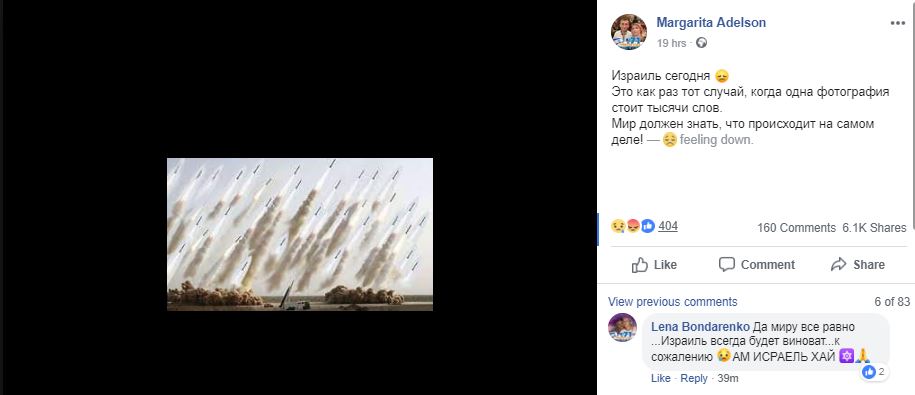
Here’s a great example of Israeli hasbara targeting Russian speakers.
I found the short post on a friend’s Facebook news feed. It consists of three sentences attached to a powerful image of at least thirty missiles or rockets fired simultaneously.
The message reads (in Russian), “Israel today [sad face emoji]. This is exactly the instance when one photo is worth a thousand words. The world needs to know what’s really going on! — feeling down [sad face emoji].”
The post has been shared 6,800 times, garnered 451 likes, and elicited 173 comments in the 20 hours since it was published.
We are meant to imagine, of course, that the “photo worth a thousand words” is a photo of a Hamas rocket installation in the Gaza Strip firing its deadly cargo towards the utterly innocent state of Israel.
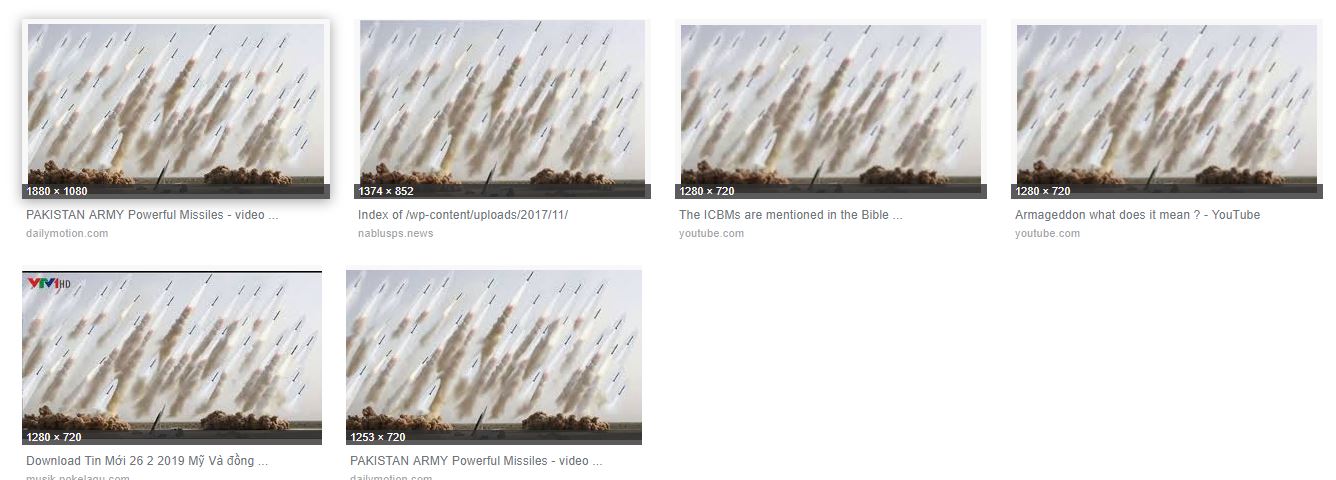
A simple Google image search turned up several instances of the same image, all of them bearing different dates and captions, none of which link the “photo” in question to Hamas or the current hostilities between Hamas and the IDF.
So, in fact, the photo is worthless, except to underscore something we already knew.
Zionist hasbaristas are utterly unscrupulous. They count on people not bothering to check any of their claims, but just to pass the “horrible truth” along, thus confusing more people about the real, complicated facts about the relationship between the state of Israeli and the stateless Palestinians. {TRR}
“May the unbreakable friendship and cooperation of the Soviet and Chinese peoples flourish and strengthen! // Always together!” Images courtesy of quora.com
If you are suffering from a post-National Unity Day hangover, the cure might be a little dose of Sino-Soviet friendship, as provided by Alexei Volin, Russia’s deputy communications minister.
There are lots of funny things in Russian officialdom’s latest rant against the evil west, not the least of which is the revival of the perennial cognitive disorder known as Sino-Russian friendship. I could be wrong, but Russia has as many good reasons not to cooperate with China and slavishly emulate its “success” as it does to turn around and run hard in the other direction.
This is not to mention the withering hatred of the Chinese among a good number of ordinary Russians, a hatred you can witness up close by reading the horrifying things Petersburg tour guides say, and Petersburg magazines and newspapers write about the Chinese tourists on which the city’s tourist economy has become increasingly dependent.
Finally, there is the nonsense, touted by Deputy Minister Volin, about the alleged lack of “alternative” social networks in Russia. Could it be that the good deputy doesn’t know the Russian government stole VK from its founder, Pavel Durov, just so it could have a social network its secret services surveil at will? Is it any coincidence that almost all of the utterly ordinary people the Russian security forces have lately charged with posting or, more often, reposting, “extremist” online have been caught doing it on VK? Hence, Facebook’s stable popularity and Telegram’s growing popularity among social and political activists, and people who merely want a safe space to say to other people what they think. {TRR}
________________________
Communications Ministry Says Creation of Alternative Social Networks and Instant Messaging Services Possible Novaya Gazeta
November 4, 2018
“If Twitter, YouTube or Facebook continue down the path of throwing Russian and Chinese media out of their environment, we will have no choice but to create new distribution channels, and to think about alternative social networks and instant messaging services. Although we really hope it does not come to this, we certainly should be ready for it,” said Volin.
Volin made this statement during the Fourth China-Russia Media Forum, in Shangai. According to Volin, Russia and China should develop means aimed “not at discriminating against mass media from neighboring countries, but aimed at delivering our viewpoint and our content to other regions and other people.”
Earlier, Volin said the authorities would eventually have to give up banning information, since such methods were becoming ineffective.
“Sooner or later, they will have to be abandoned, because more and more people are getting around them without even noticing they are dealing with technology allowing them to bypass [sic] blocked content,” he said.
As examples of ineffective blocking, Volin cited the instant messaging services Telegram and WhatsApp, which operate in China despite being officially banned.
Telegram was banned in Russia in April 2018 by decision of the Tagansky District Court in Moscow. The ruling was based on Telegram’s refusal to hand over the [nonexistent] keys for decrypting correspondence among its users to the Russian Federal Security Service (FSB). Despite the ban, most Russian users have continued to have access to Telegram.
The other day, I closed my Facebook accounts and pages, I hope for good.
Part of the reason I closed them was that a New York City writer whose books and opinions I admire greatly, and who has a huge following on Facebook, wrote a mean-spirited and divisive post on Facebook condemning “the Heartland,” meaning the middle part of the United States.
While the map she cited is certainly worth studying and full of surprises, I imagine the writer saw only red, literally and figuratively, and blew a fuse.
I doubted out loud, in the comments, whether the writer knew much about the “heartless, dangerous” Heartland. On the contrary, I know a great deal about it, since I was born and grew up there.
She did not respond to my petty, eminently ignorable objections nor did most of her thousands of self-satisfied, bien-pensant followers, certain that the “heartless, dangerous” (and completely imaginary) “Heartland” had irrevocably damaged their beautiful souls and beautiful lives in Clintonia.
But as reporter Issie Lapowsky and map expert Ken Field argue in an article published on July 26 by WIRED (“Is the US Leaning Red or Blue? It All Depends on Your Map”), there are maps, and then there are maps. For example, there is this map, devised by Mr. Field.
Ken Field, “Presidential election 2016: dasymetric dot density.” Courtesy of WIRED
Why do I bring this sad business up on a website dealing with “news and views from the other Russias”?
Over the last several years, I have been fighting a similarly invidious myth about Russia and Russians. To wit, Vladimir Putin is incredibly popular, as conclusively shown, allegedly, by dicey “public opinion polls” and rigged elections, and his “base” is in the “Russian heartlands,” which are, apparently, just as “heartless” and “dangerous” and stupid as the US “Heartland,” and similarly prone to throw their electoral weight behind a tyrant, unlike, we are meant to imagine, the smart sets in Russia’s two capitals, Moscow and Petersburg.
I have been at great pains to show a discursive apparatus I have dubbed the “pollocracy” produces the results that both Putin’s quasi-fascist supporters and faux-liberal detractors need to cling to their respective security blankets. In the case of the so-called liberals, the security blanket consists in the notion that the world’s largest country is largely inhabited by woefully ignorant yahoos who have laid waste to any chance at building a democracy in the Motherland. As viewed by their opponents, the fake “patriots” in Putin’s camp, the same heartland yahoos are the country’s “pious,” “conservative” core and the source of the Putin’s ruling elite’s self-produced mandate to rule the country till kingdom come and particularly badly.
Seventy percent of why I do this website is to show that Russia actually consists of lots of other Russians and lots of other Russias that belie the dodgy “findings” of pollsters and the lazy clichés reproduced ad nauseam by Russian and international reporters, “Russia experts” (nearly all of them resident somewhere other than Russia), politicos, and spin doctors to prove a self-serving conclusion they arrived at long ago without bothering to find out whether it was true or not.
It’s not true. Just as it is emphatically not true the US “Heartland” is “heartless” and “dangerous.” Or maybe it and its mythical Russian counterpart, the “Russian heartlands,” are heartless and dangerous part of the time, but not all of the time and everywhere and on the part of every single woman, child, man, dog, and cat who live there. Nor, vice versa, are the alleged oases of high intellect and liberalism where pollsters, reporters, and opinion leaders (such as the well-known New York writer who, railing and trembling like the Prophet Jeremiah, condemned the place where I was born and grew up to the fires of hell) congregate, cities like New York, Los Angeles, Moscow, and Petersburg, utterly free of meanness, menace, vice, crime, bad governance, popular indifference, ignorance, and support for tyrants.
What does this have to do with abandoning Facebook? First, I spent an inordinate amount of time trying to produce a quasi blog there that would complement and promote this website. Since I am nobody, however, more or less nobody was interested in what I wrote.
They did, however, hang on every word written by people like the New York writer, who, having achieved a modicum of fame, felt no compunction about compounding a rank prejudice about a huge part of her own country and all the people who live there.
So, I have found Facebook an incredibly dispiriting place to try get out my word, a word very few of my so-called friends, real and virtual, wanted to hear, much more wanted to share and spread with their own friends.
Second, the continuing crackdown on bloggers and social media users in Russia has meant that fewer and fewer Russians are willing to write anything interesting on Facebook and its Russian ripoff, VK. Judging by my own real friends, more and more of them have either been observing total radio silence or retreating into the little cubbyholes known as Telegram channels, where they are invisible and inaudible to all the world except their own clique. Since one important feature on this website has been translations of the pithy, thought-provoking things Russian activists and just plain Russians have posted publicly on Facebook and other social media, I was left staring at a once-overflowing well going drier by the minute.
Third, WordPress gives its bloggers some crude but decent tools to see where their readers are finding out about their blogs and blog posts. Over the last two years, as my readership here as continued to climb, the share of those readers who were turned onto my website or particular posts through Facebook has shrunk, meaning that my own friends, real and virtual, have been less likely to share my posts with their friends than complete strangers have been to look up Russia-related topics on the internet and find their way here.
So, rather than continue to pine for support from actually hostile liberal and leftist opinion leaders whose only interest in my Facebook posts and blog posts was to scavenge them for news and ideas they would instantly pass off as their own thoughts and finds without crediting me, I have decided to live without them in order to more fully embrace you, my anonymous, ever more numerous, faithful readers.
In any case, this website will continue to be promoted on Twitter, Google+, Tumblr, and Ello, as before, so it is not as if I am doing a disappearing act. I just wanted to stop pretending I had friends in places where I did not have them. {TRR}
Facebook Closes Account of Zapretno.Info Grani.ru
1 March 2018
Zapretno.info’s logo
Facebook has shut down the page of Forbidden in Russia (Zapretno.info), a project focused on the Russian government’s crackdowns on freedom of speech. As the project’s proprietor informed Grani.ru, its Facebook account was deleted without warning and without explanation. The site’s creator did not disclose his name for security reasons.
Zapretno.info publishes texts, images, and other content that, when published or posted in Russia, has led to the filing of administrative or criminal charges.
Zapretno.info’s website is blocked in Russia and is accessible only through Tor, anonymizers, and VPNs.
Translated by the Russian Reader. Thanks to Comrade Koganzon for the heads-up.
Readers of this website might be interested to learn the mighty Facebook blocked both my Russian Reader account and my personal account for most of the day on Wednesday, February 28. This message briefly flashed on the interface before I lost access to my news feeds:
“If you’re temporarily blocked from sharing posts on Facebook, it may be because you shared too much in a short amount of time, or shared posts that were marked as unwelcome. A few things to keep in mind about your block: Blocks are temporary and can last a few hours or a few days. We can’t lift this block for any reason. To avoid being blocked again, you should avoid sharing many posts or messages in a short amount of time. Otherwise, your account could be permanently disabled. Additionally, you can learn more about what we allow on Facebook and other policies in our Community Standards.”
I was later told by a friend he had heard of numerous cases of anarchists, antifascists, anti-Putinists, and anti-Assadists whose accounts had also been temporarily blocked for up to three days without warning and without explanation.
The only question is whether Facebook has been acting alone or encouraged by anonymous complaints from fascists, Putinists, and Assadists (“shared posts that were marked as unwelcome”).
It would be great if Facebook would issue a statement explaining its policy, especially in the wake of revelations about the signal role played by fake Facebook accounts in the 2016 US presidential debacle. TRR
This is my 1600th entry since I started translating and writing articles about modern Russian politics, society, economics, art and culture, history, social movements, grassroots endeavors, and everyday life on this website nearly ten years ago.
My first post, dated October 23, 2007, was a translation of an excerpt from Viktor Mazin and Pavel Pepperstein’s fantastic 2005 book The Interpretation of Dreams. Provocative and surprising as ever, Mr. Pepperstein argued that
[o]nly the interim between Soviet socialism and capitalism was ecological. It was a time of crisis: the factories stood idle, and the air became cleaner. It is a pity, but those days (the nineties) came to an end, and now (under cover of patriotic speeches) our country is becoming a colony of international capitalism. They try and persuade us this is success, but it is not true. We should (my dreams tell me, and I believe them) put our beautiful country to a different use, for example, by turning it into a colossal nature and culture reserve. (After all, our country, like Brazil, produces the most valuable thing on Earth: oxygen.) We should close the borders to foreigners (but let anyone leave as they like), carry out a program of deindustrialization, and limit the birth rate.
Shortly thereafter, I was offered the job of editing another website, Chtodelat News, where I volunteered for nearly five years, publishing 740 posts and slowly figuring out what I wanted to say with this hybrid of translation, editorializing, and media collage, and how I could say it.
After the long stint at Chtodelat News, I revived the Russian Reader, trying to make it as pluralistic, polyphonic and, occasionally, as paradoxical as I could, while also fulfilling the brief I have tried to keep to the fore from the very beginning: covering stories about Russia which no other Anglophone media would bother with (although they thus miss tiny but vital chunks of the big picture) and giving my readers access to Russian voices they would not otherwise hear.
I had meant to celebrate my 1500th post on this beat, but that make-believe anniversary came and went without my noticing it. It was all for the best, however, since now nearly ten years have passed since I set out on this unpredictable journey.
Like the very first post on this blog, my 1600th post is a glimpse into Russia’s possible futures, as imagined by Grey Dolphin (aka Vladimir Gel’man), his fellow scribbler Grim Reminder (yours truly), Russian rappers GROT, and my friends at the Moscow Times. TRR
__________________
Russia: It Can’t Be Improved So Destroy It, or It Can’t Be Destroyed So Improve It? Grey Dolphin
September 27, 2017
Grey Dolphin
The discussions about Russia’s prospects, currently underway among the conscious segment of Russian society, despite their public nature, in many respects resemble similar debates about the Soviet Union’s destiny, held in the kitchens of members of the intelligentsia and among politicized émigrés during the so-called stagnation. Relatively speaking, it was a debate between two parties. One party, the moderate optimists, grounded their expectations on hopes the country’s leadership would change course for one reason or another (or would itself change), and there would be a chance to change the Soviet Union for the better. (There were different opinions about what “better” meant and how to achieve it.) The other party, which included both moderate and radical pessimists, argued it was no longer possible or fundamentally impossible to improve the Soviet Union, and changes should be directed towards its total elimination. Time seemed to be on the side of the optimists, whose chances at success appeared realistic at perestroika’s outset, but in fact it was working inexorably on behalf of the pessimists. By the time the optimists seemingly got their chance, opportunities to improve the Soviet Union had largely been frittered away. History does not tolerate the subjunctive mood, and we do not know what turn events could have taken had perestroika been launched ten or fifteen years earlier. Those ten or fifteen years, however, passed only in conversations around kitchen tables, while the country’s leaders strove to prevent any change whatsoever. When the changes kicked off, the energies of both parties—the supporters of improving the Soviet Union, and the supporters of destroying the Soviet Union—had not exactly been exhaused in vain, but they had not been used very effectively.
Despite all the political and economic differences between the early 1970s and the late 2010s, the current conjuncture in Russia is not so remote from what it was then in the Soviet Union. Moderate optimists have proposed seemingly reasonable projects for improvements to the authorities and the public, but they themselves do not believe they can be realized “in this lifetime.” The moderate pessimists, if they had believed earlier in the possibility of improvement, have lost faith, while the radical pessimists never believed in improvements as a matter of principle. The optimists are waiting to see whether they will get the chance to improve at least something (and if so, when), while the pessimists are ready at a moment’s notice to exclaim, “Lord, let it burn!” For better or worse, however, so far there are no obvious “arsonists” in the vicinity who could and would want to demolish the current Russian political and economic order nor have any appeared on the distant horizon. Once again, as during the stagnation, time inexorably works on behalf of the pessimists. Sooner or later, yet another former optimist or, on the contrary, a person not involved in these debates will say something like, “Today’s Russia cannot be improved. It can only be destroyed.” (Essentially, this was what happened in the Soviet Union towards the end of perestroika. Of course, there were a different set of causes and other mechanisms in play then. What I have in mind is the rationale of transformation itself.) If and when the number of people supporting the verdict “destroy” reaches a critical mass, then the first of the questions posed in my post’s title will irreversibly be answered in the affirmative, occluding the second question altogether. The more news about events in Russia transpires every day, the more inevitable this outcome seems.
Translated by the Russian Reader
___________________________
GROT, “Fire”
If God wants to punish a man, He strips him of his reason.
I often think the whole country has been punished.
As in a fantasy story, I can see a light glowing over people’s heads.
This is not a sign of holiness.
It is a sign of moral decay,
Decay of beliefs, principles, and ideas.
The nostrils are already used to the rotting smell,
And there are cadaver spots on the faces of children and adults.
Self-destruction at the mental level,
The nation jumps into the abyss with a cry of “Keep off me!”
We will soon go extinct like the mammoths.
Young mothers with Jaguars and Parliaments.
People will have coming to them the trouble they stir up
Everyone will be punished according to their whims.
Fire!
Will purify gold from impurities.
Fire!
Those who believe in the truth will stand their ground.
Fire!
Will purify gold from impurities.
Fire!
Those who believe in the truth will stand their ground.
An ancient serpent lashes the sky with a crimson tongue,
Its breath ripples over the television networks.
Through TV screens it animates the golem and generates ghosts.
In the skulls of those who ate their souls
And vomited them out indifferently with counterfeit vodka
In the snow in winter or summer in the dust.
Two abused dudes filmed it on a mobile.
Look online, search for the tags “degenerates,” “masturbate,”
“Suck,” “come,” “sex with babies.”
I’m waiting for the last fire, but you better run.
Nothing can be fixed here now. Lord, let it burn!
Fire!
Will purify gold from impurities.
Fire!
Those who believe in the truth will stand their ground.
Russia could ban Facebook next year if it fails to comply with a 2015 law requiring companies to store Russian citizens’ personal data on local servers, the state media censor said on Tuesday.
The U.S. social network would follow in the footsteps of LinkedIn, the social platform for professionals that was banned in Russia last year after a September 2015 law requiring companies to store Russian users’ personal data on localized servers.
The head of Russia’s state media watchdog Roskomnadzor warned that “there are no exceptions” to compliance with the data storage law seen by some observers as unenforceable.
“We will either ensure that the law is implemented, or the company will cease to work in Russia,” Roskomnadzor chief Alexander Zharov was cited as saying by the Interfax news agency.
He said the watchdog is aware of Facebook’s popularity, with an estimated 14.4 million monthly and 6 million daily users in Russia as of last year.
“On the other hand, we understand that this is not a unique service. There are other social networks.”
Twitter, Zharov said, has agreed to transfer by mid-2018 its Russian users’ data to Russian servers.
“We have no plans to investigate Facebook in that regard until the end of 2017,” he added. “We will think about it in 2018. Maybe we will investigate.”
There are no technical or legal justifications for banning Facebook in 2018, only political considerations. The principal political consideration would be the need to find ways of “celebrating” Putin’s auto-reinstallation as president for “another six-year term” (i.e., for life).
As a tyrant who brooks no opposition to his illegimate rule, Putin would have to celebrate his hollow victory by instituting a series of crackdowns against his foes, as he did after formally returning to the presidency in 2012.
One of these crackdowns could involve banning Facebook in Russia, as is strongly suggested by the article I have quoted, above.
But that would be the least of everyone’s worries once Putin essentially crowned himself tsar as a gift to himself for his stunningly bad performance as the country’s leader for eighteen years.
Since his entire reign has orbited not around solving the country’s problems, but around imbricating himself and his clique of “former” KGB officers into every corporate and institutional nook and cranny in Russia (and beyond) while stealing everything he can get his hands on and rewarding his satraps with the booty “for a job well done,” he has not had much time to solve any real problems.
Hence the constant need to designate enemies and cripple, vanquish, jail, disappear or murder them, be they Facebook, Jehovah’s Witnesses or Boris Nemtsov.
Anyone who does not explicitly support Putin—and by definition only members of his clique really support him, in the sense that members of a mafia clan are loyal to their boss—is de facto opposed to him.
This might be especially true during the upcoming election, because, I would imagine, the majority of Russian voters are, at very least, quite weary of Putin and his oppositionless electoral “victories” by now and would be inclined to stay home on election day, even if they are not willing to march in the streets. (That might require too much effort.)
But a low turnout would still be a slap in the face to a man whose whole schtick the last eighteen years or so has been his alleged “wild” popularity, a schtick supported by the mainstream Russian press, corrupt Russian pollsters, foreign media covering Russia, and “Russia experts,” most of whom have no other gauge for measuring or probing “Russian public opinion,” so they rely on rigged, astronomically high popularity ratings.
If something around ten percent of voters in the two capitals (Moscow and Petersburg) and the non-ethnic regions showed up on polling day, the myth of Putin’s popularity would be dealt a near-fatal blow.
Putin would take his humiliation out on his treacherous non-constituency by unleashing a panoply of crackdowns, adopting a whole new raft of repressive laws at lightning speed, as happened in the wake of his 2012 re-election, and, perhaps, arresting a prominent figure from the opposition, such as Alexei Navalny, sending him down for hard time. Or worse.
Author photos courtesy of cetacea.ru and the Russian Reader
Football fans! You might want to know that this past Saturday, the monthly neighborhood collections of recyclables, organized by the Razdelnyi Sbor environmental movement, an entirely volunteer-run organization, were cancelled, apparently by the police or higher powers, in four of Petersburg’s districts (Central, Admiralty, Krasnoye Selo, and Kalinin), allegedly, because they were a “security threat” to the ongoing FIFA Confederations Cup.
Ironically, this same grassroots movement, which poses such a (non-)threat to national security in neighborhoods many kilometers away from the brand-new stadium on Krestovsky Island where some of the cup’s matches are being played, including the final—a stadium that was built at the cost of unbelievable cost overruns (i.e., kickbacks) and completion delays, precarious migrant labor (including slave laborers shipped in from North Korea, one of whom was killed in an accident on the site), and the demolition of the old Kirov Stadium, a nationally listed architectural landmark designed by the great constructivist architect Alexander Nikolsky—made a deal with cup organizers and FIFA to collect and process recyclable waste at the stadium after matches.
Meaning that, at the stadium itself, this same grassroots movement was seen not as a threat, but as a cynical means of showing fans that FIFA and the Russian government were all about “international best practices.”
This is a ridiculous, telltale story that someone other than lowly unread me and my crap blog should be reporting.
By the way, under normal circumstances, readers of my Facebook news feed would have got a message from Razdelnyi Sbor about Saturday’s collection points, a message I cut and paste and disseminate faithfully every month, because I want everyone I know to go the one-day collection points in their neighborhood with their recyclables, and because my partner and I go to our neighborhood spot in the Central District every month ourselves.
Last year, I even bought a Razdelnyi Sbor t-shirt, to support the cause and occasionally serve as a living, breathing, walking, talking advertisement for it.
I guess I’ll have to think hard about whether I want to wear the t-shirt again. I don’t understand how you can serve the authorities at their Big Event while letting down the ordinary people who support you in their neighborhoods with their volunteer labor and their recycling month in and month out.
A friend of mine was arguing on Facebook just yesterday that VK, the homegrown Russian social media where Razdelnyi Sbor has its community page, was where it was at, as opposed to snobby Facebook. But in the relevant recent posts on Razdelnyi Sbor’s VK page about the cancelled collections you won’t find word one criticizing the authorities for acting in such a brutal, stupid way towards a completely beneficial grassroots campaign. I would imagine the page’s moderators hastily scrubbed any such complaints, if there were any. I’m sure there were some.
This is the real Russia, about which I almost never read anything in the western media and, sometimes, in the Russian media, either. It’s a country where recycling enthusiasts (just like cycling enthusiasts, for that matter) are imagined as a threat to national security and as “agents of the west,” except in the one instance where they can make the authoritarian state’s Big Event seem more PC to foreign football fans, dishing out big euros for tickets, merchandise, food and drinks, and rooms. TRR
Théodore Géricault, The Raft of the Medusa, 1818-1819. Oil on canvas, 491 cm x 716 cm. Louvre Museum, Paris. Image courtesy of Wikipedia
My memories of kindergarten are fairly fuzzy by now, but I do seem to recall we did a lot of sharing. This, I think, explains why the dark satanic mill known as Facebook has become so indispensable and popular in our modern world. Like kindergarten, it’s all about sharing.
For instance, this morning I was feeling fairly glum about the ongoing slaughter in Aleppo, the apparently total indifference my Russian friends (and “friends”) feel about the role their armed forces have been playing in this massacre, and my inability to do anything about any of this, much less changing anyone’s mind.
Apparently, Facebook even has algorithms for detecting when you’re feeling blue, and like a cheery kindergarten minder in such circumstances, it gets you involved in some fun sharing to buck you up.
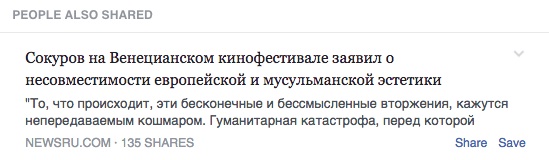
This was what Facebook decided to share with woebegone me this morning.
“At Venice Film Festival, Sokurov Says European and Muslim Aesthetics Incompatible,” reads the headline on Newsru.com, an alarmist Russophone news website based in Israel.
When I clicked on it, the item turned out to be old news, an article, dated September 8, 2015, quoting controversial statements made at last year’s Venice Film Festival by the Petersburg auteur Alexander Sokurov, who was in Venice to debut his latest indisputable masterpiece, Francofonia.
Presenting his film Francofonia at the Venice Film Festival, Russian filmmaker Alexander Sokurov said the European and Muslim aesthetics were incompatible. Calling for an end to “the endless and pointless incursions,” to immigration by an alien culture, Sokurov thus polemicized with the chair of the festival jury, Mexican filmmaker Alfonso Cuarón, who earlier had suggested solving Europe’s rampant immigration crisis by organizing entry for the immigrants. The Italian newspaper Corriere della Serra reported on Francofonia and Sokurov’s statements.
Presenting what the newspaper called “a brilliant allegorical tale about the Old Continent through its museum symbol, the Louvre,” Sokurov said, “History teaches us nothing. Prudence and compassion are alien to history.”
“Europe, which has attained supreme achievements in art and philosophy, keeps making one mistake after another,” said the Russian maître, as quoted by InoPressa.
“What is happening, these endless and pointless incursions [or, invasions], seem like an indescribable nightmare, a humanitarian catastrophe in the face of which ordinary people are powerless, and politicians do nothing. And no one thinks to protect our culture, which will cease to exist quite soon,” the filmmaker continued.
[…]
The Italian periodical described the action of the film as follows: a ship that must bring European culture to a safe haven sails into a storm. If it sinks, its precious cargo will be irrevocably lost to all Europeans.
“Europe finds itself on The Raft of the Medusa, as in the famous painting by Théodore Géricault, exhibited in the Louvre. Just like the frightening boats, crowded with desperate people making their way to our shores.”
The article here refers to the numerous cases of the illegal delivery [sic] by sea (sometimes ending in tremendous loss of life) of thousands of immigrants from the Middle East and North Africa.
During the presentation of his film, Sokurov called for “a stop to these migrations.”
“To really help these people, it is necessary to intervene in the countries from which they are escaping and try to solve the problems there. Instead, we pile them up together here, where they have no prospects, and try and impose our TV lifestyle on them,” he argued.
“The outcome will be catastrophic for both parties,” the filmmaker warned.
Sokurov was certain that “our aesthetic and the Muslim aesthetic are incompatible.”
“With all due respect, we must maintain a distance and protect our culture from the iconoclastic fury that is destroying it,” said the filmmaker.
He reminded the audience of the total destruction of unique landmarks in the ancient city of Palmyra, Syria, by militants from the terrorist group Islamic State, which is banned in the Russian Federation.
Recently, the extremists blew up three tombs of local patricians in the captured city. Earlier, they demolished the Temple of Baalshamin (2nd century BC) and the Temple of Bel, consecrated to the supreme Semitic deity [sic].
“Even the Nazis would have not dared to do what has happened in Palmyra,” said Sokurov.
I have quoted at length the day brightener Facebook chose for me, because it amply demonstrates a sad but irrefutable fact. Islamophobia is a perfectly common attitude and a perfectly respectable political “stance” in Russia, adopted and bruited loudly and publicly by well-read, highly educated members of the “liberal” Russian intelligentsia, as evinced here by one of their darlings, Alexander Sokurov.
This, in turn, explains the near-total silence of “liberal” and even “leftist” Russians on the destruction of Aleppo.
Let me put it as crudely as possible. Despite the court judgement handed down on popular blogger Anton Nosik the other day, a really large number of educated “white” Russians think Muslims are subhumans whom, if push comes to shove or your “civilizational project” has got bogged down and you cannot think of anything better to do, can be slaughtered with impunity and without blinking. In fact, it is better for one’s digestion, state of mind, and personal pursuit of high culture (per Sokurov) to put a mental wall between yourself and whatever is happening to the Muslims in your midst, or to the Muslim Crimean Tatars in Crimea, or to the Muslims in Grozny (back in the first years of Putin’s perpetual reign), or to the Muslims in Aleppo.
If you think I am exaggerating, I invite you to come to the Motherland and have heart-to-heart chats with a sampling of members of the so-called intelligentsia. In some cases (but not, happily, all cases) you will come away thinking you’ve just spent time with Trump supporters, UKIP cacklers, BNP bruisers or clowns from the KKK.
But the funny thing about Facebook is that it is not the only satanic mill on the oppressively vast World Wide Web. Nowadays, you can also ask something called Google whatever question your wicked heart can conceive—for example, how many Muslims are there in Russia?
Where did all those Russian Muslims come from? Did they immigrate to the Motherland from Syria and other majority Muslim countries?
No, despite the recent heavy influx of migrant workers from the Muslim Central Asian republics (once also part of Russia, in its guise as the Soviet Union), which has even more recently been waning due to the bad economy, among other factors, most of Russia’s Muslims were born and bred in the Russian Federation. Thus, to the outside world, they are “Russians,” if not to many of their fellow Russian citizens, who probably cannot get their heavily bookish heads around such funny facts as Moscow’s being the largest Muslim city in Europe.
You would think that, with so many Russian Muslims and post-Soviet Muslims sharing (there is our keyword again!) your cities, towns, and villages with you, you would not want to go out of your way to antagonize Muslims for no reason at all.
(Not because they are touchier than your average bear, but just because no one in this world enjoys being kicked around for years on end just because they’re different.)
But that is what the Russian government has been doing in Syria, and that is what significant numbers of Russia’s best and brightest have been doing for a long time now, if only rhetorically, if only at the Venice Film Festival, on Facebook or in their kitchens.
The consequences, both now and in the future, could not be more miserable, especially for the alleged “European” culture that only Russian intelligenty and European neo-Nazis seem to get so exercised about.
Thanks, Facebook, for cheering me up! I knew I could count on you. TRR
As expected, the reaction to the online flash mob #янебоюсьсказать #янебоюсьсказати [#IAmNotAfraidToSpeak] has got underway. It has been the classic reaction of a society in which there is an unspoken agreement to hush up violence. But now this approach has suddenly failed.
You can tell one, two, three or ten women they have only themselves to blame or they are all lying, but when thousands of women talk about it, it is much more difficult to hush up the problem. Especially when it is not only “crazy” feminists talking about the problem but ordinary, average women. So other gambits have come into play, for example, “Don’t talk or you will feel bad and ashamed later.” In fact, this painfully familiar gambit in circumstances of sexual violence is something women constantly hear individually.
But why should women feel ashamed? And who should be ashamed after acts of violence? The victim or the assailant? The point of the flash mob is that it is not shameful to suffer violence. It is shameful to rape, abuse, and commit violence. So that argument has been a nonstarter, and women have kept on writing.
Another fine example of illogic and lack of common sense is the argument that everyone who has been writing as part of the flash mob hates men. But let us take a look at what has happened. Thousands of women have written about the violence of men, which means that thousands of men have let themselves be violent toward women in one way or another. Who hates whom in this case? Such “logic” would suggest a completely opposite conclusion.
Then there is the favorite argument in all disputes recently: that Ukrainians and Americans are stirring things up to undermine Russia’s moral foundations. However, I haven’t figured out what to do with the fact that it has been not only Ukrainians and Americans attacking those foundations. The flash mob has spread to almost every part of the former Soviet Union.
Of course, it will not do to deny the obvious any longer. But why is there such a urge to do so? Because once you have said A, you have to say B. If you recognize the problem, you have to recognize all these stories have quite specific “heroes” who let themselves commit violence, meaning we have to turn from victims to assailants and take a hard look at them finally. We will see they are not only “sick” maniacs but often as not are average men. That means many of them will have to take a look at themselves and admit what they have done.
But there is no great urge to admit what they have done, of course. After all, life before was comfy. There were no dressing-downs and punishments for doing such things, but now suddenly they have to admit that what they did and probably have forgotten long ago is actually a crime. It is always hard to to reject the “privilege” to do as you like.
This means we have to recognize that male socialization encourages violence, justifies violence, and normalizes violence.
So, no matter how unpleasant it is to many people, we will have to have a serious talk about solving the problem legally and politically. (This is an answer to question of what the whole point was.)
But the first step has been taken, and women have successfully defended their right to speak, while a good number of decent men have already taken the second step.
Translated by the Russian Reader
___________________
I Am Not Afraid to Speak: Russian Online Flash Mob Condemns Sexual Violence
Katie Davies and Maria Evdokimova The Moscow Times
July 8, 2016
Thousands of women in Ukraine, Russia and Belarus have taken to social media to share their experiences of sexual violence in an online flash mob.
Women and girls began posting their stories under the hashtags #янебоюсьсказати and #янебоюсьсказать (“I am not afraid to speak”), following the example of Ukrainian social activist Anastasia Melnichenko.
“I want us— women—to speak today,” Melnichenko wrote in a Facebook post Tuesday detailing her experiences of harassment.
“We do not have to make excuses. We are not to blame. Blame always lies with the rapist.”
For many of the women taking part, it was the first time they had spoken about their ordeals.
“I’m so happy that women are starting to talk about this,” wrote one Facebook user, Anna.
“#IAmNotAfraidToSpeak that one day I went with my dad to visit some friends at their dacha, a decent and beautiful family. The father of my dad’s friend lived there and a few families would gather there to spend the summer weekends together.
“There were three children there—myself, and two other girls, one of whom was his granddaughter—aged around five to six years old. I woke up early in the morning, and that same grandfather was lying next to me, drunk, with his hand in my underwear. I ran from the room and hid. I’ve said nothing to my parents.”
Many of those taking part hope to change perceptions of sexual violence, with many arguing that society still finds the victim at fault. A number of prominent Russian women have also joined the flash mob to tell their stories, including Galina Timchenko, founder of the Meduza news website; singers Victoria Deineko and Anita Tsoi; actress Evelina Bledans; and journalist and business woman Alyona Vladimirskaya.
“Everyone who says, ‘Women bring it on themselves by wearing a short skirt,’ listen to my story,” Vladimirskaya wrote on her Facebook page Thursday.
“I was seven months pregnant. It was summer. A sunny day. I went to the shop by my house; I wasn’t feeling well. I was sick, and I looked it.
“When I came to the entrance of my building, there was a young man behind me. I didn’t think that I needed to be afraid of young men in such a state. He pushed me to the wall, took out a large kitchen knife, pointed it at my stomach and told me to undress.
“I was terrified that he would hurt my unborn child and I took off my blouse. He began to masturbate over my stomach then demanded that I turn around and bend over. I began to vomit. He did not care.
“A neighbor saved me. He came down the stairs and saw this and shouted. It was enough to make the rapist run.”
Others draw attention to abuse taking place within the family. Research by American charity RAINN has found that in cases of sexual violence, 72 percent of adults, and 93 percent of children know the perpetrator.
“I was six years old when my cousin asked me if I’d like to ride on his bike with him,” one Facebook user, Olya, wrote. “I couldn’t ride a bike without training wheels, of course I agreed. We rode to a wooded area, where he took off his shirt, lay on top of me and began masturbating. Then we rode home, and he acted as if nothing had happened.
“I was ten years old when another cousin, probably around 20, made sure there were no other adults in sight, took out his genitals and waved them in front of my face. I ran away from him.
“Both cousins were from a decent, stable family. They did not become criminals or murderers, they live quietly with their wives and raise their children.
“Violence isn’t in the papers or on the television, it is happening to the neighbors we meet on the staircase, our classmates, our close friends, sisters, the girls we sit next to on the metro.
“Everyday violence is the norm in the lives of all women.”
A number of men also hoped to break boundaries by sharing their stories on the issue.
“It was in the beautiful city of Saratov, and I was 12 years old. I was waiting for a trolleybus home, when a man in a gray jacket approached me,” one Facebook user, Andrei, wrote. He said, ‘Help me carry this stuff and I’ll pay you.’ It was hard to say no to an adult.
“We went under the bridge, passed two fences surrounding some shacks. We went another 30 meters. No one was around. The man stopped and unzipped his fly, and asked me to put it in my mouth. What happened next was instinctive—I hit the man with my both hands and ran away. I could not bring myself to leave the house for three days after that.”
Others offered a different perspective.
“When I was 15, I used to hide in the bushes near ponds and masturbate while girls changed their clothes,” a man called Nikolai admitted. “I also tried to get under womens’ skirts in crowded metro trains. I did not recognize it as a bad thing. I can no longer find those girls and ask their forgiveness, so I ask you. Please talk to your children [about this problem], help those in need.”
The flash mob has drawn widespread support from across the Russian Internet, with many hoping to start a larger discussion on the problem of sexual violence in society as a whole.
“This is an unprecedented and momentous event,” Maria Mokhova, a director at the Syostry, or Sisters, crisis center told the Moscow Times. “It is a big step forward for society as a whole to finally get rid of the taboo of talking about sexual abuse.
“I want to thank every one of these strong, beautiful women for their contribution. The flash mob turns all eyes on the problem that must be discussed. Society must support and protect its children and ensure their security.”
Katya Kermlin joined a kickstarter business to create a wearable panic button—formed in the shape of a ring—after she was attacked 16 years ago. She applauded the fact that more men and women were speaking out.
“This is stunning and goes beyond just statistics: every fifth woman … every third case of violence … 45 percent of people experienced harassment. Every time is the first time. Even if it happens several times in your life,” she said.
“Thousands of episodes of sexual abuse. Hundreds of flashbacks involving strangers, co-workers, boyfriends, relatives, family friends, bosses, tutors, doctors. And the mistrust, denial, understatement: you must have misinterpreted it, sweetie; he didn’t mean it; it was just a joke.”
“All this darkness turns out to be much closer than we believe,” said Russian artist Artyom Loskutov to the Afisha Daily website, one of many men sharing his shock with the hashtag. “I really did not expect that so many people I know—women and girls—have been victims of violence and harassment, many from a very young age. It is hard to imagine how anyone can live in silence with this kind of trauma.”
Not all reactions to the flash mob have been positive, and the flash mob continues to attract a backlash on social media and from some commentators.
Talking to the state-owned Vechernyaya Moskva newspaper, psychologist Olga Makhovskaya claimed that the flash mob was caused by desire for “cheap popularity and attention.”
“In this case, they [the flash mob’s participants] need psychologist’s assistance,” Makhovskaya said.
Sociologist Natalya Zorkaya from the Levada Center pollster said that Russian legislation’s vague definition of abuse left men “unable to see the line where their actions start to violate the law.”
“Victims of abuse should speak up and share with others to help them finally leave behind the fear they live with,” Zorkaya said.
A friend of mine, the headmaster of a private school in the Moscow Region, has received a written order to add the head of the municipal administration and the head of the education department to his Facebook friends. The order is obligatory for the headmaster, and advisable for the school’s teachers. He has to report back before January 14.
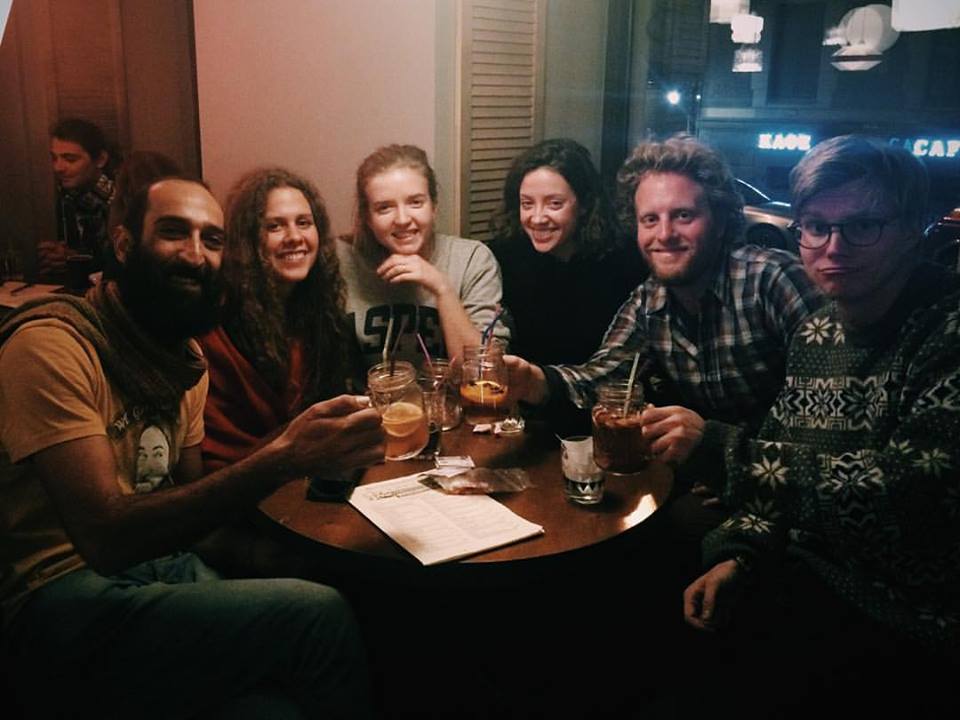
Sergey Abashin is British Petroleum Professor of Migration Studies at the European University in Saint Petersburg. His most recent book is Sovetskii kishlak: Mezhdu kolonializmom i modernizatsiei [The Soviet Central Asian village: between colonialism and modernization], Moscow: Novoe literaturnoe obozrenie, 2015. Translated by the Russian Reader. Photo filched from the Facebook page of some Petrograd cider house or burger bar where folks who look like the folks in the photo, above, go to pretend they are living in “Europe.”
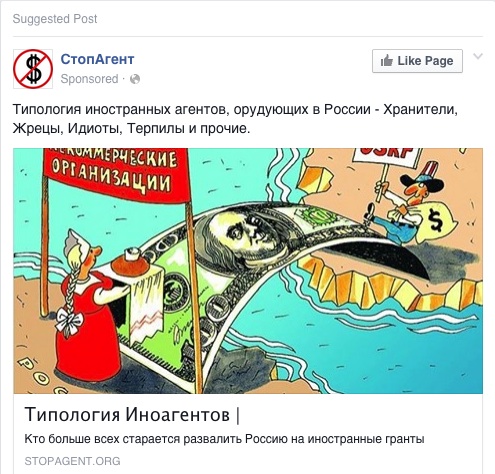
This is a little sample of the crap that Mark Zuckerberg and Company send your way for hard cash if you have the misfortune to live in the “post-Soviet space.”
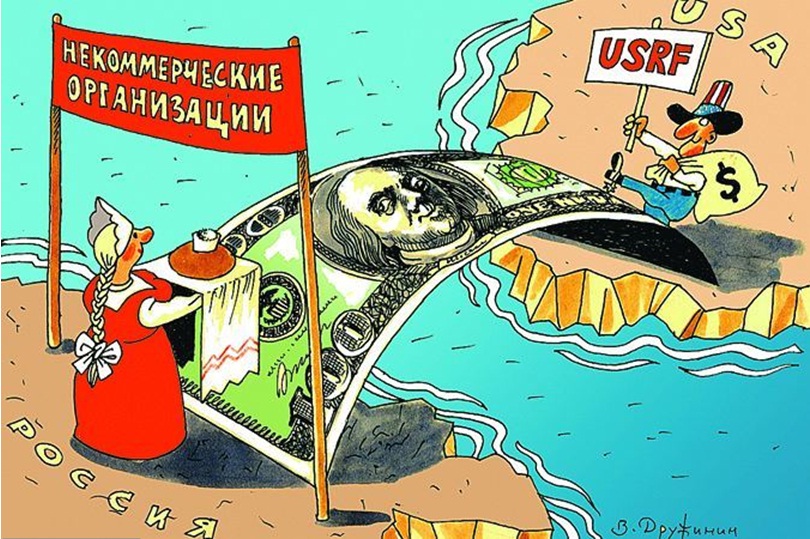
A typology of foreign agents operating in Russia: Watchdogs, Priests, Idiots, Underdogs, and others.
A Typology of Foreign Agents | Who is trying the hardest to destroy Russia on foreign grants
Here is what the full illustration looks like if you are a total moron (like me) and follow the link.
“Russia. NGOs. USRF [United States of the Russian Federation].” Source: stopagent.org



 “May the unbreakable friendship and cooperation of the Soviet and Chinese peoples flourish and strengthen! // Always together!” Images courtesy of
  Ken Field, “Presidential election 2016: dasymetric dot density.” Courtesy of WIRED
 Zapretno.info’s logo