Traitor(s)

Traitor by Dennis Potter. Source: Internet Archive

Traitor

First broadcast in 1981, this Hidden Treasure play by Dennis Potter stars Denholm Elliott as Harris and Ian Ogilvy as James. It has not been heard for over 40 years.

In a dingy flat in Moscow, he sits alone — a traitor to his family, his friends, his colleagues. Then the international press descend upon him and he gives his first interview — an interview which brings forth terrible, haunting memories.

Adapted for radio and directed by Derek Hoddinott
A BBC World Service Drama production

With thanks to Keith Wickham, Dr Steve Arnold, Ruby Churchill, Louisa Britton, Alison Hindell, Matthew Dodd, Claire Coss, Carl Davies, Helen Toland, Richard Culver, Andrew Jupp, James Peak, BBC Archives and the Radio Circle.

Remastering by Essential Radio.

Source: BBC


On Sunday, Representative Michael R. Turner (R-OH), chair of the House Intelligence Committee, said it is “absolutely true” that Republican members of Congress are parroting Russian propaganda. “We see directly coming from Russia attempts to mask communications that are anti-Ukraine and pro-Russia messages, some of which we even hear being uttered on the House floor,” he said on CNN’s State of the Union.

Turner was being questioned about an interview in which Representative Michael McCaul (R-TX), chair of the House Foreign Affairs Committee, told Russia specialist Julia Ioffe that “Russian propaganda has made its way into the United States, unfortunately, and it’s infected a good chunk of my party’s base.” McCaul blamed right-wing media. When asked which Republicans he was talking about, McCaul answered that it is “obvious.” 

Catherine Belton and Joseph Menn reviewed more than 100 internal Kremlin documents from 2022 and 2023 obtained by a European intelligence service and reported in the Washington Post today that the Russian government is running “an ongoing campaign that seeks to influence congressional and other political debates to stoke anti-Ukraine sentiment.” Kremlin-backed trolls write fake “news articles, social media posts and comments that promote American isolationism, stir fear over the United States’ border security and attempt to amplify U.S. economic and racial tensions” while claiming that “Biden’s policies are leading the U.S. toward collapse.”

Aaron Blake pointed out in the Washington Post that Republicans are increasingly warning that Russian propaganda has fouled their party. Blake notes that Russia specialist Fiona Hill publicly told Republicans during the 2019 impeachment inquiry into Trump that they were repeating “politically driven falsehoods that so clearly advance Russian interests,” but Republicans angrily objected. 

Now Senators Mitt Romney (R-UT), Thom Tillis (R-NC), and John Cornyn (R-TX) and a top aide to Senator Todd Young (R-IN), as well as former South Carolina governor Nikki Haley and even Trump’s vice president Mike Pence, have warned about the party’s ties to Russia. Former Representative Liz Cheney (R-WY) has said the Republican Party now has “a Putin wing.” 

Trump has hinted that he has a plan to end Russia’s war in Ukraine in 24 hours. Yesterday, Isaac Arnsdorf, Josh Dawsey, and Michael Birnbaum reported in the Washington Post on the details of that plan: he would accept Russian annexation of Ukraine’s Crimea and the Donbas region. He refuses to say how he would negotiate with Ukraine president Volodymyr Zelensky, who has been adamant that Ukraine will not give up its territory to an invader, or Russia president Vladmir Putin, who has claimed all of Ukraine, but after meeting with Trump last month, Hungarian prime minister Viktor Orbán said Trump told him he would accomplish “peace” by cutting off funds to Ukraine.

Trump’s team said Orbán’s comment was false, but it is worth noting that this plan echoes the one acknowledged by Trump’s 2016 campaign director Paul Manafort as the goal of Russian aid to Trump’s campaign.

Fiona Hill told the Washington Post reporters that Trump’s team “is thinking…that this is just a Ukraine-Russia thing…rather than one about the whole future of European security and the world order.”

Trump’s MAGA loyalists in the House of Representatives have held up funding for Ukraine for six months. Although a national security supplemental bill that would fund Ukraine has passed the Senate and would pass the House if it were brought to the floor, House speaker Mike Johnson (R-LA) refuses to bring it to the floor. The House returns to work tomorrow after a two-week recess but is so backed up on work that Johnson is not expected to bring up the Ukraine measure this week.  

Clint Watts, the head of Microsoft’s Threat Analysis Center, told the Washington Post’s Belton and Menn: “The impact of the Russian program over the last decade…is seen in the U.S. congressional debate over Ukraine aid…. They have had an impact in a strategic aggregate way.”

[…]

Source: Heather Cox Richardson, Letters from an American, 8 April 2024 

The Spirals of Silence in Wartime Russian Society and the US Republican Party

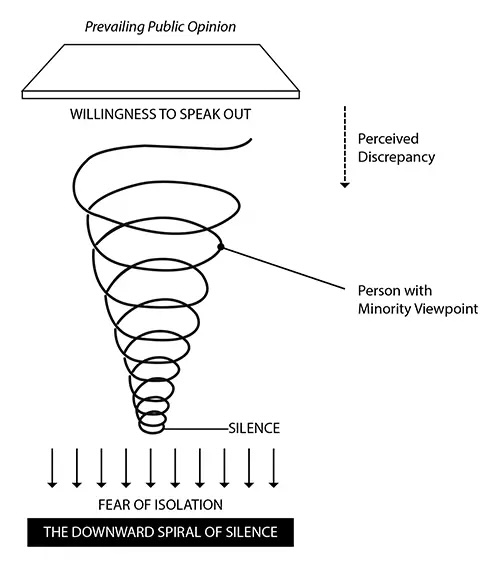
Popular opinion polls show that the majority of Russians support the military action in Ukraine. Researchers, however, continue to argue that society’s support for the war is much lower than these figures suggest. In their new study “Perception of the conflict with Ukraine among Russians: testing the spiral of silence hypothesis,” V.B. Zvonovsky and A.V. Khodykin, drawing on Elisabeth Noelle-Neumann’s “spiral of silence” model, argue that many opponents of the war are not willing to voice their opinion, believing that it is unpopular and fearing social disapproval.

Noelle-Neumann argues that before people with a “limited interest in politics” decide to voice their opinion on a politically significant matter, they assess the risk of being condemned by others. The spiral of silence “twists” as follows: people who are afraid of being isolated due to the unpopularity of their opinion refrain from voicing it → this opinion is thus heard less and less often in society → people thus increasingly think that their own opinion is not popular → they are thus even less likely to be willing to voicing it.

Zvonovsky and Khodykin discovered that the spiral of silence actually does have a great impact on discussion of the Russian-Ukrainian conflict in Russian society. They were able to verify this by doing a nationwide telephone survey (N = 1977) using Noelle-Neumann’s “train test.” The “train test” measures the willingness of “adherents of a particular stance on a socially significant matter to openly voice it by discussing it on a train with a random fellow passenger.” Supporters of the more popular stance, in their opinion, are more likely to openly voice it, believing that they are “in a stronger camp and less at risk of being judged by others.” Sometimes, their opponents are also encouraged to side with the “stronger” position.

Applying the “train test” to the Russian context showed that the topic of the war is highly sensitive both to its supporters and opponents, and that the spiral of silence affects both sides of the discussion. However, its impact on opponents of the war has proved to be much stronger than on its supporters. Thus, people who oppose the special military operation in Ukraine are less willing to discuss the Russian-Ukrainian conflict with those who support it.

Another important finding made by the researchers is the fact that a person’s willingness to speak out about the war is influenced most by the distribution of opinions about it in their immediate circle of acquaintances. So, the more people in the orbit of respondents who had shared a similar opinion with them, the more the respondents were willing to discuss the war, and vice versa. It can be assumed that the need to maintain social ties is stronger for Russians than the need to defend and disseminate their political views, as we noted in our analytical report “The war near and far.” Zvonovsky and Khodykin suggest another explanation, however: the “bad experience” of political discussions, which often end in conflict and frustration, also has an impact, since the opinions of interlocutors are not changed, and the desire to talk about the war with one’s political opponents thus simply disappears.

The last interesting finding of the authors about which we want to tell you is the following. If the environment of the respondents is divided approximately equally (~50% “for” the war and ~50% “against”), then the probability that those oppose the special military operation will discuss it does not decrease—unlike supporters of the war, who are much less likely under the same circumstances to discuss the military operation with strangers of opposite views. Thus, the opponents of the military conflict “have learned to resist the spiral of silence better than their opponents.” This means that if the distribution of opinions in Russia changes, “opponents of the military conflict will have greater opportunities than [their] opponents to promote their own narrative about the Russian-Ukrainian conflict.”

Source: PS Lab (Telegraph), “The spiral of silence and the war in Ukraine: review of a new sociological study,” 14 December 2023. Translated by the Russian Reader. Image, above, courtesy of Businesstopia


IOWA CITY, Iowa — Anti-Donald Trump Republicans know they are in the middle of a critical moment to stop the former president’s political comeback. But for some, the steep cost of voicing resistance to Trump often renders them silent.

“If you go against Trump, like — you’re over,” said Kyle Clare, 20, a member of the University of Iowa’s College Republicans.

“I don’t talk about Donald Trump a lot because I’m afraid of the backlash,” said Jody Sears, 66, a registered Republican from Grimes, Iowa.

“If you would say something negative about Trump, we had one person that would just go bang for your throat,” said Barbra Spencer, 83, a former Trump voter describing her experience living in senior apartments in Spillville, Iowa.

Trump still enjoys broad popularity in the Republican Party, and that’s driving his polling leads among Republicans in Iowa, New Hampshire and every other state ahead of the 2024 primaries. But he has also used that popularity to enforce unity. And the same impulse that has led Republican officeholders to avoid criticizing Trump because of potential threats to their safety and their jobs is also holding back rank-and-file voters from opposing the former president in public with the full strength of their personal convictions.

NBC News spoke to more than a half-dozen Iowa voters turned off by Trump — but some were anxious about talking on the record out of fear of being shunned by friends or family. One Iowan said they plan on saying they caucused for Trump when asked by members of their community but will actually caucus for Vivek Ramaswamy.

That adds up to signs going unplaced on front lawns, conversations with friends and family about other candidates avoided — and fewer opportunities for opposition to Trump to take hold in different Republican communities.

NBC News first spoke with Clare in a University of Iowa auditorium Aug. 23, the night of the first GOP presidential debate. Fellow College Republicans were reacting to the debate and voicing steadfast support for the GOP candidate who wasn’t on the stage: Trump.

Clare chose to wait until the end of the night, after the rest of his classmates left the auditorium, to share his thoughts.

“I’m just so scared of doing this right now,” he said, fighting back tears. “I want to be able to have my opinions on our politicians, and I want to be able to speak freely about them and people still understand I’m a conservative.”

Clare criticized Trump, particularly for his actions Jan. 6, 2021, saying, “The end of his administration was un-American.” He also said Trump’s supporters are in denial about losing the 2020 election.

“They don’t want to believe he lost the election. It’s hard to swallow. Losing is hard to swallow. But it’s important that when we lose, we recognize that we lost and we think, ‘What can we do better next time to win over Americans?’” Clare said.

Clare was right to expect backlash from speaking out on Trump. After NBC News published the interview with him on a “Meet The Press” social media account, hateful and homophobic comments poured in. Clare said later that a student came up to him at a university event, shoved a phone in his face with the video on it, and asked him why he’s “scared of Trump and not scared of getting AIDS from having gay sex.”

“Say something they disagree with, and they go after your sexuality,” said Clare, who added that he doesn’t regret doing the interview with NBC News. Many of the comments questioned if Clare — who holds a leadership role at the University of Iowa’s College Republican organization, interned for a Republican on Capitol Hill, and is heavily involved in the Johnson County, Iowa, GOP — was truly a Republican.

“I think it shouldn’t be a bad thing for me to say I am conservative and that I think there are other options, and I don’t think that this person is good for our country,” Clare said. But he’s worried those opinions will stunt his own long-term political ambitions.

“If people as powerful and as prominent as members of Congress can be taken down because of their criticisms of one man, what’s stopping that from happening to me?” Clare noted, referring to the Republicans ousted from Congress after voting to impeach Trump.

Trump’s criticism forced several senators and House members into retirement or primary defeat during his first years in office. Later, of the 10 House Republicans who voted to bring impeachment charges against Trump following the Jan. 6 Capitol riot, four retired before facing voters in 2022 and another four lost their next primaries. Only two remain in the House.

In the Senate, three of the seven Republicans who voted to convict Trump have since retired or resigned, and Sen. Mitt Romney of Utah is retiring next year.

Romney recounted to biographer McKay Coppins that Republican members of Congress confided to him they wanted Trump impeached and convicted but would vote against the charges because they were worried about threats to their families.

Former Rep. Liz Cheney of Wyoming, one of the Republicans who lost a 2022 primary after voting to impeach Trump, detailed similar conversations in her new memoir.

Cheney wrote about one colleague that she “absolutely understood his fear” about what would happen if he voted to impeach Trump. But, she continued, “I also thought, ‘Perhaps you need to be in another job.’”

‘It was easier to be quiet about it’

Rank-and-file voters are less prominent and thus less likely to be harassed or threatened, but some of the same worries and experiences remain. Sears, the Republican from Grimes, Iowa, feels Trump doesn’t reflect her values. But that’s an opinion she kept to herself until recently, because of the fear of being cast off by family and friends.

“Family and people I work with are Trump supporters,” said Sears, describing her hesitancy to speak out about her beliefs.

“I think Trump supporters tried to coerce or bully people into also being Trump supporters. And so it was easier to be quiet about it,” she said.

Spencer, a retiree now living in a nursing home in Decorah, Iowa, says Trump supporters at her previous retirement community created a toxic environment that stopped her and her friends from voicing opinions.

“We were afraid of arguments,” she said. “When you live with that many old people, sometimes they have very strange but very firm thoughts and you better think the way they do,” she said, explaining her silence.

Clare, Sears and Spencer are not the only people who feel this way.

And as Cheney and Romney’s stories demonstrate, social ostracization isn’t limited to just voters who speak out against Trump. Former Rep. Denver Riggleman, a Republican who represented a slice of Virginia from 2019 to 2021, says his mother texted him, “I’m sorry you were ever elected,” after he came out against Trump.

“It was so soul-crushing to have a family member choose Donald Trump over you,” Riggleman continued. He said evangelical Trump supporters in his life saw Trump as being blessed by God. “I was going directly against religious beliefs. And that’s a losing battle.”

It’s now been almost six months since a member of Congress endorsed a non-Trump candidate in the 2024 GOP primary, according to NBC News’ endorsement tracking.

The trend has popped up elsewhere on the 2024 campaign trail, too. When Iowa Gov. Kim Reynolds endorsed Ron DeSantis in November, the Florida governor mentioned in an interview with NBC News that he “had people come to me and say they endorsed [Trump] because of the threats and everything like that” during the campaign.

Trump quickly went after Reynolds after news of her DeSantis endorsement broke, posting on social media that it would “be the end of her political career.”

‘Vortex of controversy and vilification’

Charlie Sykes was a conservative radio show host in Wisconsin for more than 20 years before Trump burst onto the political scene. Sykes was skeptical and critical of Trump, eventually confronting him in a heated interview about insults Trump hurled at Texas Sen. Ted Cruz’s wife in 2016. But for Sykes, it began to become clear that there was no room anymore for anti-Trump conservatives on talk radio.

“The audience of conservative talk radio began to think that loyalty was required. They wanted conservative media to be a safe space for them,” Sykes said, describing how his role became untenable.

After leaving radio, Sykes didn’t let up on his Trump criticism, which he says got him booted from a think tank and led him to lose friends and become a self-described political orphan. He says his criticism was met with bullying — and he understands why people who don’t work in the public eye might be hesitant to voice their true feelings about Trump.

“I do understand why people in their normal lives don’t want to be caught up in this vortex of controversy and vilification — why they would step back from all of this,” Sykes said.

Another longtime Wisconsin Republican recently detailed one of the results of that pressure.

Former House Speaker Paul Ryan recently spoke on video at an event for Teneo, a global consulting firm where he serves as vice-chair. Ryan said the impulse to avoid getting on the wrong side of angry Trump supporters pushed former colleagues to vote against impeachment even though they wanted Trump gone — and now he thinks there are many who regret those votes.

“They figured, ‘I’m not gonna take this heat and I’m going to vote against this impeachment because he’s gone anyway,’” Ryan said. “But what’s happened is that he’s been resurrected.”

Source: Alex Tabet, “Trump’s secret weapon consolidating the GOP: fear,” NBC News, 15 December 2023

Mission of Burma

“The US risks repeating the fate of the Soviet Union. Currently, the greatest threat to America comes from within, argues Donald Tramp.” Screenshot from the TASS page on Telegram. Read the whole story on their website.


“Cooperation between Russia and Myanmar is based on a solid foundation and is not subject to political trends, Russian Foreign Minister Sergei Lavrov said at a meeting with Myanmar Foreign Minister Wunna Maung Lwin.” Source: TASS (Telegram), 3 August 2022


Kyaw Min Yu, a pro-democracy leader and writer in Myanmar widely known as Ko Jimmy, who rose to prominence in 1988 during protests that helped galvanize political forces opposing military-led regimes for decades to come, was executed with three other activists. He was 53.

In total, Ko Jimmy spent more than 20 years in prison. While detained by the state, which had been under absolute military rule for decades, he worked on literary projects. One surprise bestseller was his translation of a self-help book, which was seen as a manifesto of personal empowerment rare in a country known for its unyielding repression.

Myanmar’s military regime announced that it recently carried out the death sentences, but did not specify when the executions took place at the Insein Prison in Yangon. The junta was strongly denounced by rights groups and governments around the world. But the country’s rulers remained defiant as they seek to crush dissent and political allies of ousted civilian leader and Nobel Peace Prize laureate Aung San Suu Kyi.

[…]

Source: Brian Murphy, “Kyaw Min Yu, Myanmar activist known as Ko Jimmy, executed at 53,” Washington Post, 26 July 2022


Mission of Burma, “Academy Fight Song”

PSA (It’s Time to Start the Deprogramming)

Everything that the irresponsible Russian “Americanists” who have been producing prodigious amounts of utter verbal rubbish in their “analyses” of the events of January 6 on social networks have proven incapable of understanding is laid out in this nine-minute video.

Thanks to Mark Teeter for the link. || TRR

Wake up, Russian intelligentsia, before it’s too late!

Kalinka Malinka

Authentic Russian with Katya 2RU
September 23, 2019

Калинка-малинка is a Russian song that the whole world is singing! Learning this hit if you study Russian language is a must! Watch this video to know HOW TO PRONOUNCE THE LYRICS of Kalinka-Malinka!

Калинка, калинка, калинка моя!
В саду ягода малинка, малинка моя!
Ах! Под сосною под зеленою
Спать положите вы меня;
Ай, люли, люли, ай, люли, люли,
Спать положите вы меня.

Калинка, калинка, калинка моя!
В саду ягода малинка, малинка моя!
Ах! Сосенушка ты зеленая,
Не шуми же надо мной!
Ай, люли, люли, ай, люли, люли,
Не шуми же надо мной!

Калинка, калинка, калинка моя!
В саду ягода малинка, малинка моя!
Ах! Красавица, душа-девица,
Полюби же ты меня!
Ай, люли, люли, ай, люли, люли,
Полюби же ты меня!

Калинка, калинка, калинка моя!
В саду ягода малинка, малинка моя!

Little snowberry, snowberry, snowberry of mine!
Little raspberry in the garden, my little raspberry!
Ah, under the pine, the green one,
Lay me down to sleep,
Rock-a-bye, baby, rock-a-bye, baby,
Lay me down to sleep.

Little snowberry, snowberry, snowberry of mine!
Little raspberry in the garden, my little raspberry!
Ah, little pine, little green one,
Don’t rustle above me,
Rock-a-bye, baby, rock-a-bye, baby,
Don’t rustle above me.

Little snowberry, snowberry, snowberry of mine!
Little raspberry in the garden, my little raspberry!
Ah, you beauty, pretty maiden,
Take a fancy to me,
Rock-a-bye, baby, rock-a-bye, baby,
Take a fancy to me.

Little snowberry, snowberry, snowberry of mine!
Little raspberry in the garden, my little raspberry!

Like her compatriots, Katya 2RU has plenty of time nowadays to look great and teach foreigners a lesson, but at least she teaches them Russian folk songs instead of lessons about democracy and free speech. Image courtesy of her YouTube channel
The Capitol Storming Gives Russians an Escape From Their Reality
The great majority of Russians have no say over the future of their cities or regions and so resort to events outside the country.
Ilya Klishin
Moscow Times
January 14, 2021

Anyone following U.S. and Russian social networks in recent days might have had the impression that Russians were more upset by the recent siege of the Capitol building and the decision by Twitter and Co. to block Donald Trump than even the Americans themselves were.

Although CNN and the New York Times only sounded the alarm, popular and little-known bloggers on this side of the Atlantic absolutely went into hysterics.

Of course, many of the issues concerning this incident deserve deep and thoughtful discussion, such as, at what point should IT companies become accountable to society?

And, is there a difference between today’s Twitter and the telegraph and newspapers of 100 years ago? Here, however, I would like to focus not on the substance of the psychosis, but on its nature and origin.

Why did so many Russians go into a frenzy over the events in the U.S.?

To begin with, consider a popular Russian meme called “Barnaul, Altai Region.” In all of its iterations, the cartoon shows a young Russian woman voicing anxieties to her psychologist.

One day she’s worried about SJW, the next, BLM, and most recently, the Capitol siege. But whatever the problem, the psychologist always responds with the same words, “What the f—k do you care?! You live in Barnaul!”

Then he grabs a megaphone and shouts it again for emphasis: “IN BARNAUL, THE ALTAI REGION!!!”

Now, you might not have heard of this Siberian city, but that’s the whole point. Barnaul is so far from the problems dominating Western headlines that it is absurd for someone living there to lose any sleep over them.

Rude as it is, the meme remains popular because it touches on a very real but unspoken, almost intuitive aspect of the Russian psyche.

The great majority of Russians have no say over the future of their cities or regions, much less the country as a whole. This is especially depressing for young people who have grown up during the 20 years of President Vladimir Putin’s rule, and who have never experienced anything else. After all, they are naturally overflowing with youthful energy. They would like to change the world around them and contribute to society in some small way.

But they can’t. Everything is off limits. They can either violate their own principles by going along with the abominable, soul-crushing system, or else buck that system and risk paying a very high price, up to and including prison time.

Of course, most young people avoid that extreme, teetering on the edge of open disobedience without crossing the line.

Once a young person realizes that the authorities block every path for positive change, they subconsciously switch to the path of least resistance.

Like water flowing around a rock in its way, young Russians who find that they cannot change the fundamental picture shift their focus to concerns of secondary importance.

If you can’t raise the standard of living for the elderly in your economically depressed region, stop the police from torturing people or prevent the authorities from “calling in” verdicts to the courts, you can at least become a vegan activist or radical feminist and oppose the use of animal fur.

Don’t get me wrong — these are all worthwhile causes.

But in today’s Russia, they represent a form of escapism. A “fur fighter” poses no threat to Putin’s regime and comes off as more comical than menacing. Kremlin leaders simply laugh at them, saying, “Let them have their fun.”

The same is true of Russia’s homegrown BLM activists and surprisingly numerous Trump supporters. In fact, the whole lot of them is even more harmless than the activists are because they do nothing but sit on their couches and argue with each other online.

It is a pastime along the lines of watching football, Game of Thrones and reality TV. It is fun and brings the occasional rush of adrenaline during particularly intense arguments.

And so, the days and weeks pass with everyone arguing. Some are on the left, others on the right. One is a feminist, another an anti-feminist. This one is a tree hugger while that one ridicules environmentalists. But outside their windows is the same old Russia, ruled by the same old Vladimir Putin.

Ilya Klishin is the former Digital Director of the New York-based Russian-language RTVI channel. He is the founder of KFConsulting.

They Have Nothing Better to Do

Dmitry Gudkov
Facebook
January 9, 2021

I understand that Russians there is no problem more important than Trump’s showdown with Twitter. The precedent of blocking a social network account is not a very good one, of course, but the folks in the US will cope without us. I would venture to throw out a different topic for discussion.

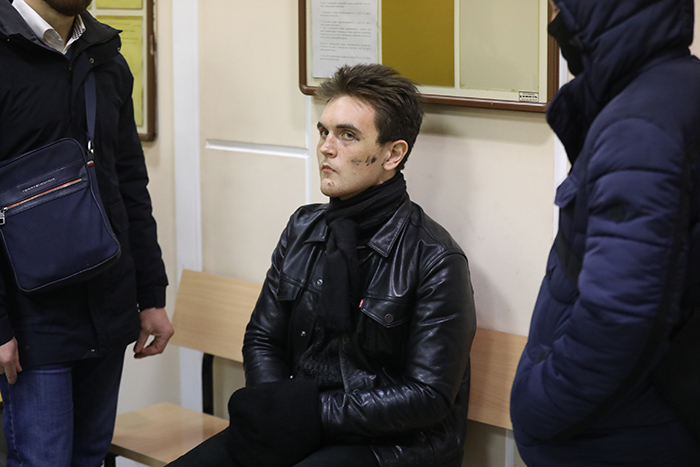
On Monday, January 11, the verdict in the case of Azat Miftakhov will be read out in the Golovinsky District Court in Moscow. Trump was banned on Twitter, but Azat, a graduate student in mathematics from Moscow State University, has been locked up in for allegedly breaking a window at United Russia party office. He has been in a pretrial detention center for two years, although there is no evidence of his guilt.

If you’re worried about freedom of speech, Azat’s case is also cause for worry. At the last court hearing in the case, people who came to support Azat were not only not allowed into the court building. They were simply locked up in the courtyard of the building. A paddy wagon was brought  in and shipped them out of there. The detainees included two journalists, with press cards, but that means nothing to our authorities.

If the Miftakhov case were given at least 1% of the attention that has been spent on Trump in Russia, the case would not have happened. And we’re not taking about a ban on Twitter here, but arrest, torture, and a [possible] imprisonment in a penal colony.

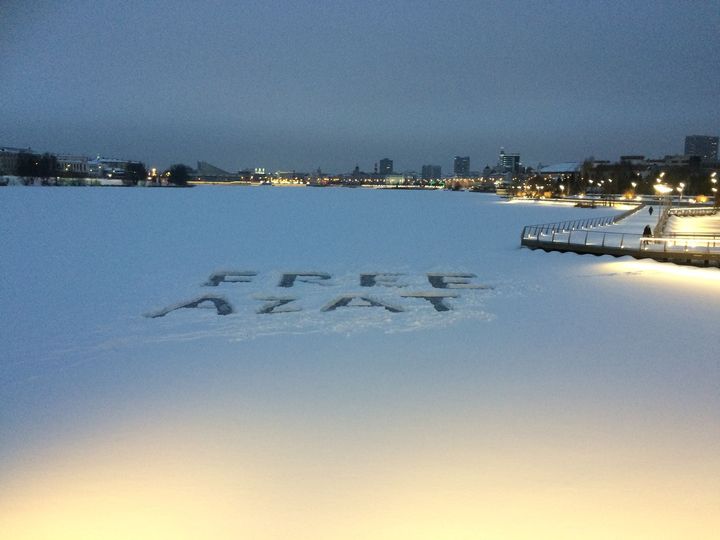
Today, someone spelled out the message “FREE AZAT” on Lake Kaban in Kazan. This was protest action in support of mathematician and anarchist Azat Miftakhov. On January 11, at 12:00 p.m., the Golovinsky District Court will announce the verdict. The prosecution has asked for six years in prison for the young academic. If you have the opportunity, be sure to come to the hearing!

Boris Vishnevsky
Facebook
January 9, 2021

In our country, Roskomnadzor can block any media outlet or website that tells truths that the authorities find unpleasant.

But this does not cause popular outrage.

In our country, people are put in jail for reposting things on the internet.

But this does not cause popular outrage.

In our country, hundreds of political prisoners are being held on falsified charges, starting with Yuri Dmitriev and ending with the defendants in the Ingush protest movement trial.

But this does not cause popular outrage, and rallies and pickets in support of these people attract almost no attention.

In our country, anyone who disagrees with the authorities can be declared a foreign agent.

But this does not cause popular outrage.

In our country, the president has been given lifelong immunity from prosecution for any and all crimes, and he does not even need to pardon himself in advance.

But this does not cause popular outrage.

But what an explosion of indignation there has been over the blocking of Trump’s Twitter account. It has been the main topic of discussion in Russia!

As long as this is the case, the Kremlin can rest easy.

__________________

Sergey Abashin
Facebook
January 9, 2021

It’s stunning. Russia has hundreds of political prisoners, political assassinations and political persecution, two ongoing wars involving tens of thousands of dead and the occupation of territory in several [foreign] countries, a personal dictatorship that has been de facto and legally established, and laws that permit total censorship in the mainstream media. And yet Russian intellectuals are hotly debating whether it is right or wrong to block the American president’s Twitter account two weeks before the end of his official term.

Translated by the Russian Reader

Trump’s Christmas Gift to Putin: The Case of Nikita Semyonov and Georgy Chernyshov

20191230143413-img-3898Georgy Chernyshov. Photo by David Frenkel. Courtesy of Bumaga

Kira Dolinina
Facebook
February 12, 2020

After the verdicts in the Network Case, I would imagine I don’t have to explain anything about our justice system and how it is consuming our children. So I  simply ask you to recall that we have been raising money to pay the lawyers defending 23-year-old Nikita Semyonov, who has been framed on “terrorism” charges. Thanks to you, we raised the first installment, 200,000 rubles. Thank you very much!

But the case is still ongoing. The investigators are investigating, Nikita is in remand prison, and only the lawyers can stand up for him. Prison officials wouldn’t give him a pen for several weeks so that he could write a complaint. I won’t even mention their failure to document his injuries from the beating investigators gave him.

Let’s not surrender this boy to them, okay?

Here is the number of the Sberbank account for paying Nikita Semyonov’s lawyers: 5336 6902 4491 0313.

The money is really needed. Please re-post this message.


“The Nikita Semyonov Case: The FSB Pins Failed Terrorist Attack on Orphan.” ROMB, February 6, 2020

Before the new year, Putin thanked Trump for helping prevent a terrorist attack, and the FSB demonstratively arrested two young men in Petersburg, Nikita Semyonov and [Georgy] Chernyshov. They said on TV that the young men were going to blow up Kazan Cathedral and the shopping center near Moscow Railway Station, although the only evidence in the case is a photo of the cathedral, download from the internet, and memes that the young men exchanged in a chat room.

Semyonov talked to his lawyer on January 25. On January 30, the investigator made both of his lawyers sign an agreement not to disclose evidence in the preliminary investigation, so they are unable to comment on the specifics of the case.

Suspects in Terrorist Attack Case Deny Wrongdoing
Marina Tsareva
Kommersant
February 4, 2020

Saint Petersburg City Court has left Georgy Chernyshov in police custody. He and Nikita Semyonov were detained by the Russian Federal Security Service (FSB) before the New Year’s holidays for, allegely, planning terrorist attacks. The men allegedly planned to set  off explosions in Kazan Cathedral and the Galereya Shopping Center. Both suspects have denied any wrongdoing, although the FSB reported they had confessed to the crimes after they where detained. Semyonov’s lawyers claim their defendant never made any such confession, although he was interrogated three times without defense counsel present and was subjected to coercion by FSB officers.

Nikita Semyonov, 22, and Georgy Chernyshov, 23, were detained on December 27 of last year at around nine in the evening on Gagarin Prospect. After the Kremlin’s press service reported that Russian President Vladimir Putin had thanked US President Donald Trump for information about the planned attack, as communicated via the special services, the FSB’s public relations center issued a press release about the arrests of two persons who had been planning to commit terrorist attacks in crowded places in Petersburg during the New Year’s holidays.

The same day, media outlets, citing sources in the FSB, reported that a criminal case involving violations of Russian Federal Criminal Code Articles 30 and 205 had been opened, although the first article was not mentioned during the subsequent remand hearing, held three days after the arrests. Investigators alleged that both suspects had communicated with adherents of the banned terrorist organization Islamic State (IS) via messenger services.

Chernyshov and Semyonov allegedly informed an IS member about their plan to engage in terrorist activities and recorded a video showing them swearing allegiance to the group. After that, according to investigators, the men began selecting places to carry out terrorist attacks, settling on two sites in downtown Petersburg, the Galereya Shopping Center and Kazan Cathedral. They allegedly photographed both buildings, sending the images to IS.

According to the Petersburg judicial press service, Chernyshov has denied any wrongdoing. Earlier, Leonid Krikun and Andrei Fedorkov, Semyonov’s attorneys, told Kommersant that their client had denied involvement in the terrorist organization’s activities and told them he had never been interested in the ideas of Islam in any way, nor did he speak Arabic. (The conversation took place on January; on January 30, the investigator made both lawyers sign an agreement not to disclose evidence in the preliminary investigation, so they are currently unable to comment on the specifics of the case.) According to them, Semyonov had not confessed either to involvement with IS or planning to commit terrorist attacks. On the contrary, on December 30, the FSB reported that both suspects had confessed, and the agency had “seized [physical] evidence confirming they were planning terrorist attacks.”

The lawyers told Kommersant that Semyonov was interrogated three times without a lawyer present, including at night, and the FSB “pressured”* him during the interrogations.

A video released by the FSB on December 30 focused on the knives and ammunition found in Semyonov’s apartment. His lawyers noted that the ammunition was for a hunting rifle that had been legally owned by his father, who died in 2017. Neither the knives nor the ammunition were ultimately confiscated by the FSB.


Vyacheslav Falkov, Chernyshov’s attorney, reported that he had also been forced to sign a non-disclosure agreement and thus would no longer be able to comment on the case.

*Meaning that the FSB tortured Semyonov. Thanks to Kira Dolinina for the heads-up. Translated by the Russian Reader

ahn-TEE-fuh?

foodwords.gif

“President Trump said he was considering designating [ahn-TEE-fuh] an organization of terror.”

What the hell is [ahn-TEE-fuh]?

And why is it suddenly an “organization”?

Trump’s magical touch is such that anyone who even reports his fake presidency is turned into a useful idiot, including, in this case, the BBC’s World Service.

_________________________________________________

The surge of popular interest in the United States in antifa (antifacism) in the past year has been disconcerting to me. Perhaps other researchers who became familiar with antifa in European contexts feel the same.

I haven’t yet thought through what the arrival of the antifa specter to my homeland means, but in the meantime I wanted to share a small piece from my dissertation that, I think, expresses why — despite personally holding more or less pacifist views — I sympathize to a great degree with those for whom antifa militancy feels like the only correct response to a rising white supremacist movement.

P.S. It is ahn-tee-FAH, maybe AHN-tee-fah, not an-TEE-fuh.

Source: “Why Antifa?” Processing Culture, 4 October 2017

GIF courtesy of So Yummy

It’s Official

It’s official: the British political establishment, Benjamin Netanyahu, Jay-Z, “Moscow” Mitch McConnell, and Greyhound totally suck.

But you knew that, right?

thevoima

The Brexit process has already claimed victims: communities such as Scunthorpe, which are suffering job losses and hardship due to Brexit-related industrial closures; migrant workers from EU countries who find their lives thrown into uncertainty and themselves and their families vilified. Their anger is more than justified. But, in addition to this, the Brexit process has produced a gloom, a feeling of powerlessness, of fear, of uncertainty, that is obviously affecting millions of people. I think this feeling is the product of an illusion that our enemies are powerful enough to decide our fate above our heads. It’s another version of the illusions of power that have engendered fear, obedience and subservience to elites for centuries. It’s an illusion, because they, too, are tormented by crisis. It makes them more ruthless, it throws up the zealots – but it doesn’t necessarily make them stronger. We – social movements, communities, workplace organisations, movements about climate change – can find, and are finding, ways to challenge these enemies. (The FcK Boris demonstration when the new government took office was a reminder of this.) This is not a plea for false hope. It’s a suggestion that we evaluate our enemies’ strengths and weaknesses carefully. And be prepared for surprises.
—Gabriel Levy, “Zealots and Ditherers,” People and Nature, 15 August 2019

Tlaib and Omar aren’t the first critics of Israel penalized by the 2017 law, but they are the most prominent. The law targets those who “actively, consistently and continuously” promote boycotts of Israel. It applies to those who hold senior-level positions in pro-boycott organizations, are key activists in the boycott movements, or are prominent public figures (members of Congress, for instance) who support a boycott. More than 20 groups have been blacklisted, including the Nobel Peace Prize–winning American Friends Services Committee. One notable case was the banning of Lara Alqasem, an American college student of Palestinian descent who received a visa to study human rights at Hebrew University but was ordered deported and detained for two weeks on suspicion of being a boycott supporter. Her deportation was later overturned.
—Joshua Keating, “Israel Banned Rashida Tlaib and Ilhan Omar Because They’re Anti-Trump, Not Anti-Israel,” Slate, 15 August 2019

In Mazur’s photo, Jay-Z’s right arm is pointed like an arrow. Goodell looks in the same direction, as does everyone else in the frame. It’s irresistible that way. What is Jay talking about, and why is everyone so rapt? Here’s a Brooklyn-born kid who made good, raised himself up from the projects, became one of the most recognizable names in pop music, and can now claim status as a self-made billionaire. It’s the kind of story you want to believe in. But then you stare a beat longer, holding your gaze, and the mirage begins to wither.

Illusion works both ways: It’s as much about who is in the photo as who isn’t. You ask yourself, Where is Kaepernick or Reid, the two players who sparked the protest? Why are other players who’ve since scrutinized the league, especially those who comprise the Players Coalition, absent from the meeting? That’s the danger in illusion, especially one cast by the NFL. Even though one might see through its hollow spectacle, there’s little to be done to break its spell. Jay-Z commands attention and everyone looks on, ghostly captivated. His arm stretches into an unknowable future. There are those who will follow, and others, who will rightly wonder: Is this the right direction?
—Jason Parham, “Depth of Field: Where Is Jay-Z Taking the NFL?” Wired, 15 August 2019

In January, as the Senate debated whether to permit the Trump administration to lift sanctions on Russia’s largest aluminum producer, two men with millions of dollars riding on the outcome met for dinner at a restaurant in Zurich.

On one side of the table sat the head of sales for Rusal, the Russian aluminum producer that would benefit most immediately from a favorable Senate vote. The U.S. government had imposed sanctions on Rusal as part of a campaign to punish Russia for “malign activity around the globe,” including attempts to sway the 2016 presidential election.

On the other side sat Craig Bouchard, an American entrepreneur who had gained favor with officials in Kentucky, the home state of Senate Majority Leader Mitch McConnell. Bouchard was trying to build the first new aluminum-rolling mill in the United States in nearly four decades, in a corner of northeastern Kentucky ravaged by job losses and the opioid epidemic — a project that stood to benefit enormously if Rusal were able to get involved.

The men did not discuss the Senate debate that night at dinner, Bouchard said in an interview, describing it as an amicable introductory chat.

But the timing of their meeting shows how much a major venture in McConnell’s home state had riding on the Democratic-backed effort in January to keep sanctions in place.

By the next day, McConnell had successfully blocked the bill, despite the defection of 11 Republicans.

Within weeks, the U.S. government had formally lifted sanctions on Rusal, citing a deal with the company that reduced the ownership interest of its Kremlin-linked founder, Oleg Deripaska. And three months later, Rusal announced plans for an extraordinary partnership with Bouchard’s company, providing $200 million in capital to buy a 40 percent stake in the new aluminum plant in Ashland, Ky. — a project Gov. Matt Bevin (R) boasted was “as significant as any economic deal ever made in the history of Kentucky.”

A spokesman for McConnell said the majority leader did not know that Bouchard had hopes of a deal with Rusal at the time McConnell led the Senate effort to end the sanctions, citing the recommendation of Treasury Secretary Steven Mnuchin.

McConnell “was not aware of any potential Russian investor before the vote,” spokesman David Popp said.

Bouchard said no one from his company, Braidy Industries, told anyone in the U.S. government that lifting sanctions could help advance the project. Rusal’s parent company, EN+, said in a statement that the Kentucky project played no role in the company’s vigorous lobbying campaign to persuade U.S. officials to do away with sanctions.

But critics said the timing is disturbing.

“It is shocking how blatantly transactional this arrangement looks,” said Michael McFaul, who served as the U.S. ambassador to Russia during the Obama administration and now teaches at Stanford University.

Democratic senators have called for a government review of the deal, prompting a Rusal executive in Moscow last week to threaten to pull out of the investment.
—Tom Hamburger and Rosalind S. Helderman, “How a McConnell-Backed Effort to Lift Russian Sanctions Boosted a Kentucky Project,” Washington Post, 14 August 2019

Throughout the country, people rely on Greyhound to get to work, visit family, or to simply travel freely. But Greyhound has been letting Border Patrol board its buses to question and arrest passengers without a warrant or any suspicion of wrongdoing. The company is throwing its loyal customers under the bus.

For more than a year, we’ve been urging Greyhound to stop letting Border Patrol board its buses, but the company is refusing to issue a policy protecting its customers. So now we’re taking our fight to the next level.

Greyhound is owned by FirstGroup plc, a multi-national transport group based in the UK, whose own Code of Ethics and Corporate Responsibility contradicts what its subsidiary has been doing to passengers.

“We are committed to recognising human rights on a global basis. We have a zero-tolerance approach to any violations within our company or by business partners.”

Greyhound’s complicity in the Trump deportation machine is a clear violation of the human rights values that FirstGroup professes to uphold. We must raise our voices: Sign the petition to demand that FirstGroup direct Greyhound to comply with its code of ethics. Greyhound must stop throwing customers under the bus.
—ACLU: Buses Are No Place for Border Patrol

Image courtesy of The Voima

A Putin-Trump Bot and Shill for Lyndon Larouche Has Something to Say to You

maga man.pngThis is what I look like in real life. Photo by Jonathan Ernst. Courtesy of Reuters and Business Insider Deutschland

Throughout the last presidential election campaign, I was verbally abused by a young art historian who was so determined to see Hillary Clinton win the race he attacked everyone who expressed the slightest uncertainties about her sterling character, political record, etc.

He did this to me on countless occasions, despite the fact I had already said I would vote for Clinton to prevent Trump from becoming president.

My ex-art historian friend pursued this social media campaign of abuse right up until election day. Although I tried several times to persuade him that verbally abusing people is not a very good way of making them do anything, he persisted in his vicious attacks on specific doubters like me and people who weren’t crazy about Clinton in general.

I’m not sure where he got his marching orders or whether he got them at all. Our political culture is suffused with violence, abuse, aggression, and stupidity, so it’s possible he set out on his perilous and, ultimately, futile course without any explicit prompting from the obnoxious Clinton campaign and the even more obnoxious Democratic National Committee (DNC).

Whatever the case, I’m already seeing signs the DNC faithful have started abusing doubters well in advance of the primaries, the convention, and the election.

Just today, in fact, one such fanatic labeled me a “Putin-Trump bot” and a “shill for Lyndon Larouche.”

Why did he attack me in this way? Only because I suggested—plausibly, I think—that there is no guarantee that if a Democrat grabbed the White House in January 2021, she or he would move to prosecute Trump.

I think it is likely that, instead, the new president would pardon Trump and only Trump in order to smooth the transition and also receive carte blanche to go after everyone else in Trump’s administration.

Two tenured professors who know for a fact I am neither a “Putin-Trump bot” and “Larouche shill” let this abusive comment stand without comment.

So, if that is how it’s going to be, I am going to make a promise to all of you.

I will not vote for the US Democratic Party in the 2020 US presidential election. They have broken their promises to working-class people, minorities, people of color, and pretty much their entire so-called base for as long as I have been following politics.

What our country needs is not a Democrat in the White House but a lot more democracy. It is clear the two “legal” parties have very odd ideas about democracy. One party has abandoned its conservative and liberal roots in pursuit of fascism. The other party does almost nothing to stop them while rapping the knuckles of the inspiring congresswomen of color who were elected in 2018 and are willing and able to take on a bully like Trump.

In short, if the Democratic Party could run an Ocasio-Cortez/Omar ticket in the 2020 presidential election, I would consider voting for it (and I’m sure millions of other people would, too), but the DNC would never let such a ticket make it onto the ballots even if Rep. Ocasio-Cortez were not too young to run, and Rep. Omar had not been born in another country.

What our country really needs, as an interim step toward real democracy, is a multi-party parliamentary republic without a president. I would argue this form of governance would make the nightmare of the last two and a half years a lot less feasible by diffusing power among parties more narrowly defined by class, ideological, and regional interests.

I don’t encourage anyone else to follow my example. After all, I have it on good authority that I am a Larouchian shill and a Trump-Putin bot.

I would, however, encourage you not to succumb to the “unity at any cost” campaign the DNC will unleash on the nation, using its millions of dupes around the country to viciously attack anyone who wavers from the party line.

When you’re verbally abused by a DNC fanatic, as I was today, explain as calmly as you can that this style of campaigning turns people off and encourages them to stay home rather than vote.

The latest issue of the Economist (July 6, 2019) had an interesting piece summarizing some research done by the newspaper itself. It claimed that, if everyone had voted in 2016, Clinton would have won.

In other words, if the US had mandatory voting like Australia has, for example, passive Clinton supporters would have been more or less forced to vote for her and she would have easily beaten Trump.

The Economist also argued Republicans would have to soften their hardline fascist message to appeal to fence-sitters, who also have a tendency not to vote.

What the article failed to point out is that the real Australia recently returned the governing Liberal-National coalition to power despite the fact all of the polls had predicted victory for the Australian Labor Party.

This means Scott Morrison was returned to his job as the country’s PM, despite the fact he presided belligerently over Australia’s own asylum-seeker concentration camps on Manus Island and Nauru before mounting a leadership challenge and taking over as the Liberal Party chair and, hence, the PM.

Scott Morrison is only slightly less odious than Donald Trump, by the way.

So, mandatory voting is no guarantee of happiness and sunshine in Australia, America or anywhere else.

The DNC is even less inclined to produce happiness and sunshine for ordinary Americans than the Australian Labor Party or even the Australian Liberal Party, not all of whose members are fascist pigs.

Don’t take the DNC’s abuse. I understand the desire to get rid of Trump, but it can’t happen at any price. If the price is Joe Biden, I would place a bet in any establishment willing to take it that he would pardon Trump the day after the inauguration.

If you must vote, then, a) don’t vote for a “compromise” ticket, and b) don’t take abuse from the DNC-inspired unity-at-all-costers.

When someone is willing to rain such mendacious filth on the head of a person he has never met and knows nothing about, this alleged unity is worthless.

All of you are smart and strong enough not to buckle under such pressure.

Who knows? If millions of you made pledges like the one I am making now it might make the DNC sit up and listen. {PUTIN-TRUMP BOT}