Policing the Polls

Elections observer who left message on ballot jailed for 5 days

Marina Popova served as an observer during the elections in St. Petersburg. On Sunday, she decided to vote herself. Prior to this, she specially had herself reassigned to Polling Station No. 2213 on Lomonosov Street [where she was working as an elections observer].

Popova told Rotunda that two other people voted after her. A police officer then noticed a ballot in the ballot box on which a pacifist message [“No war!”] had been written. According to Popova, a polling board member wrote out a statement saying that it was Popova who had dropped the ballot with the message into the ballot box.

Consequently, Popova was detained and taken to the police station. There, she was charged with “petty hooliganism” and, later, “discrediting the army.” The first charge sheet says that Popova disturbed the peace because she wrote a pacifist message in large letters in bright blue ink that was seen by people at the polling station.

Popova was taken to the police station on Sunday morning and never returned to the polling station. She was taken to court on Tuesday. When her detention period expired, she went home. She was taken back to court in handcuffs—the police collected her from her home.

At the court hearing, Popova’s lawyer Alyona Skachko told Rotunda, polling board members claimed that the ballot was state property, which the observer had spoiled. As a result, Popova was fined 30,000 rubles [approx. 300 euros] and jailed for five days.

📌 Marina’s husband Dmitry Popov and two people from the United Russia party were the only observers left at the polling station on Lomonosov Street after it closed on the last day of voting. During the vote tally, Popov was forcibly restrained by persons unknown who, as he claimed, tried to strangle him. Eventually, however, the police arrived and detained Popov. At the police station, he was charged with “petty hooliganism.” It is alleged that he used foul language.

Source: Rotunda (Telegram), 10 September 2024. Photo courtesy of Fontanka.ru. Translated by the Russian Reader


Residents of 81 federal subjects of Russia will vote in regional and municipal elections starting Friday. 

The elections mark the second time this year that Russians are heading to the polls following the March presidential election. That vote, which saw Vladimir Putin win a fifth term virtually unchallenged, was marred by widespread reports of vote tampering, restrictions on monitors and pressure on voters. 

But unlike the presidential campaign, Russian media coverage of this year’s regional elections has been scarce — likely the result of a deliberate government strategy of decreasing voter turnout to a bare minimum of loyal voters, an analysis published by independent election watchdog Golos suggests. 

Golos analysts believe that the Kremlin is betting on mobilizing a relatively small number of voters working in the government sector and demotivating all the rest to ensure a smooth victory for its candidates.

To help you understand what else is expected in the upcoming September elections, the Moscow Times has gathered everything known about the vote so far[.]

What will the voting look like? 

Multi-day voting, which was first introduced across Russia during the Covid-19 pandemic, will be implemented in most regions for the September 2024 elections. The majority of voters will have two or three days to cast their ballots depending on the region. 

Some regional electoral commissions, including in the republics of Chechnya, Tatarstan and Sakha (Yakutia), have chosen to hold voting on one day on Sunday. 

Twenty-five regions will allow residents to vote online via the state portal Gosuslugi, while election officials in Moscow have scrapped paper ballots altogether in favor of online voting.  

Independent observers have long argued that extended voting periods and online voting make voter fraud more likely, as it becomes harder for independent monitors and poll workers to do their jobs.

Meanwhile, the CEC advised authorities in six southern Russian regions near Ukraine and in occupied Crimea to limit access to online broadcasts from polling stations, citing public safety concerns. 

G[ubernatorial] elections 

Residents of 21 regions, including the city of St. Petersburg, will vote for their governors. 

Among these, the Far East Zabaikalsky region, the Siberian republic of Altai and the southern republic of Kalmykia stand out as some of the most “troublesome” regions for the Kremlin. 

The ruling United Russia party has struggled to secure strong wins for its candidates in these regions in the past and incumbents hoping for reelection remain largely unpopular among local populations and elites, according to Golos.

The Urals republic of Bashkortostan will also be under the Kremlin’s close watch as Moscow-backed incumbent Radiy Khabirov stands for reelection in the wake of the January protests in support of jailed activist Fayil Alsynov. 

Coupled with high numbers of war casualties in Ukraine and a slew of recent corruption scandals involving Khabirov’s inner circle, those protests forced the incumbent’s approval ratings to plummet. 

But as in most other regions, the Kremlin mitigated the possibility of a potential blow in Bashkortostan by not allowing a single independent candidate on the ballot. 

Regional parliament elections 

Members of regional parliaments will be chosen across 11 regions, including the capital Moscow, the republics of Tatarstan and Tyva and the Khabarovsk region. 

This year’s election will see the participation of a record-low number of political parties with an average of 6.2 parties represented on the ballot, according to Golos. 

Golos said this worrying statistic is a direct result of an unprecedented scale of repression faced by independent politicians regardless of their political views.

“[A politician] can be declared a foreign agent or convicted of extremism to be removed from the elections,” Golos wrote in an analytical report published last month. 

“And if they still [manage to] register and win, there is…the possibility of being declared a foreign agent and deprived of his mandate a couple of weeks after the elections,” the watchdog said. 

Municipal elections

Elections for city mayors and city parliaments will take place across 22 regions. 

Abakan, the capital of the Siberian republic of Khakassia, and Anadyr, the capital of the Chukotka autonomous district, are two of only four Russian cities where mayors are still chosen through direct election. 

Mayoral elections had also been set for Ulan-Ude, the capital of the Siberian republic of Buryatia, but the region’s parliament scrapped the procedure in favor of the council electors system in March. 

In St. Petersburg, where 1,560 seats in the city’s [municipal district councils] are up for grabs, candidates running from so-called “systemic opposition” parties — namely the Communist Party (CPRF) and the social-liberal Yabloko party — were barred from registering en masse.

And while CPRF managed to get 25% of its original pool of candidates onto the ballot, Yabloko will not have any representation in this year’s [m]unicipal [c]ouncil[s] race.   

Occupied Ukrainian and Russian territories 

In annexed Crimea, Kremlin-installed head Sergei Aksyonov will stand for reelection and members of the regional parliament and the legislative assembly of the Crimean port city of Sevastopol — its own federal subject — will be voted in. 

The Kremlin refused to cancel voting in the Kursk border region, where Ukrainian forces have been carrying out a bold incursion for more than a month, and where Putin appointee Alexei Smirnov is seeking to secure his mandate as governor.

The CEC instead extended the voting period to 10 days and is supplying local election officials with bulletproof vests and helmets. 

Kursk regional authorities announced Thursday that nearly 27% of eligible voters [had] already cast their ballots in the [gubernatorial] election.

Source: “The Roadmap to Russia’s 2024 Regional Elections,” Moscow Times, 6 September 2024.


[…]

GROSS: So Trump recently spoke to the Fraternal Order of Police, and he urged them to watch out for voter fraud. Let’s hear what he said.

(SOUNDBITE OF ARCHIVED RECORDING)

DONALD TRUMP: You’re in serious trouble if you get caught trying to find out what are the real results of an election. It’s an amazing thing. Do you ever see that? They go after the people that are looking at the crime, and they do terrible things to them. But the people that committed the voter fraud and everything, they can do whatever they want to do. It’s so crazy. And I hope you, as the greatest people – just as great as there is anybody in our country – I hope you watch for voter fraud.

So it starts early. You know, it starts in a week, but I hope you can watch, and you’re all over the place. Watch for the voter fraud because we win. Without voter fraud, we win so easily. Hopefully, we’re going to win anyway, but we want to keep it down. You can keep it down just by watching because, believe it or not, they’re afraid of that badge. They’re afraid of you people. They’re afraid of that.

GROSS: Nick, is that voter intimidation? He’s telling the police that these fraudulent voters are afraid of police, implying that the police should use that fear to find voter fraud so that Trump can win.

CORASANITI: I think it – certainly, were it to be carried out – would be challenged by voting rights groups, Democrats and probably even some Republicans – that that would amount to voter intimidation. It’s also pretty important to note that a couple states have very specific laws that, you know, outlaw uniformed police officers having a kind of patrolling presence in – at polling places during elections.

And, you know, there’s a very dark history in the Jim Crow South about uniformed police officers and voter suppression within the Black community. So a combination of history and state laws and then the kind of instruction that the former president was giving to these police officers could certainly amount to voter intimidation or possibly even more unlawful behavior.

[…]

Source: Terry Gross, “How Democrats and Republicans are gearing up for a post-election legal fight,” Fresh Air (NPR), 12 September 2024

Pride (and Shame)

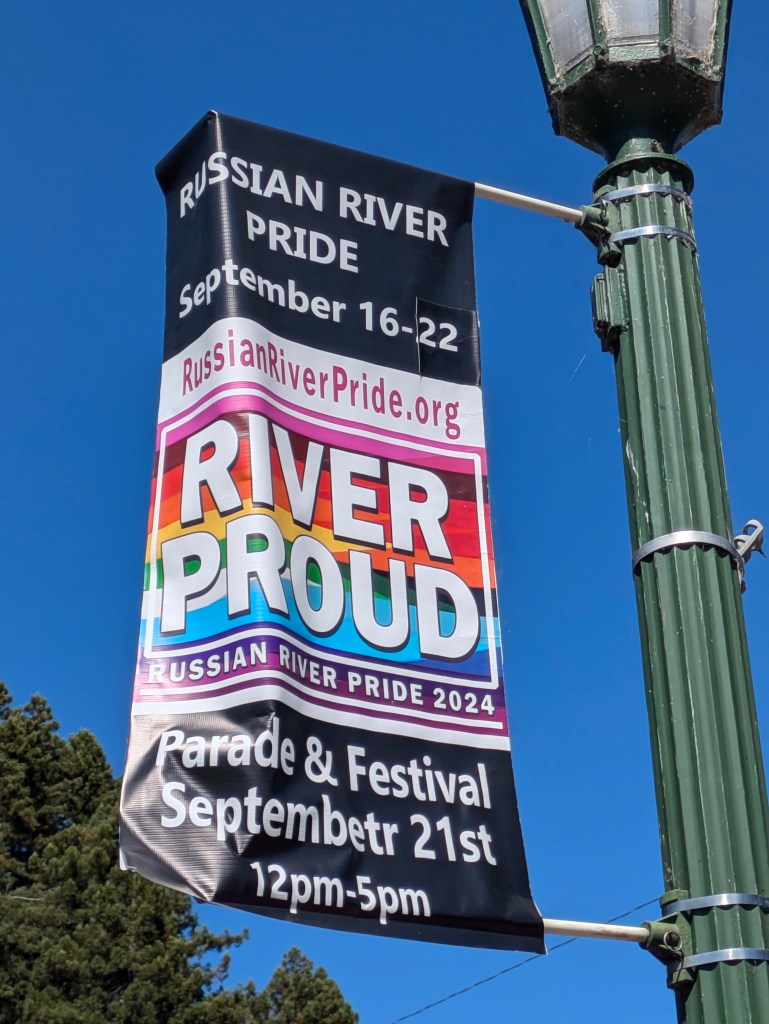
Guerneville, Calfornia, 11 August 2024. Photo by the Russian Reader

KOBLENZ, Germany (AP) — Sasha Skochilenko and Sofya Subbotina are planning to get married. That wasn’t an option in their native Russia, but it’s possible now that they live in Germany, which recognizes same-sex weddings.

“We don’t know how or in which city we will do it, but that’s the plan,” Skochilenko, 33, told the Associated Press, looking lovingly at Subbotina, who radiated happiness.

They reunited earlier this month in Germany, shortly after Skochilenko and other Russian prisoners were exchanged in a historic East-West swap — a happy if unlikely ending to an over two-year ordeal.

Skochilenko, an artist and musician, was jailed for speaking out against Russia’s war in Ukraine. Subbotina campaigned for her partner’s release while also trying to make her life behind bars as tolerable as possible.

They talked about marriage in Russia, too, but same-sex weddings have been effectively banned there. Laws restricting LGBTQ+ rights have been on the books for over a decade and intensified since the war began as part of the Kremlin’s campaign for “traditional values,” fueled by its anti-Western views and close ties to the Russian Orthodox Church.

Now, “I feel that I’m in a really free country,” Subbotina said, as they make plans for a life together in the quiet city of Koblenz in western Germany.

Skochilenko was arrested in her native St. Petersburg in 2022, just weeks after the invasion of Ukraine, for replacing price tags in a supermarket with anti-war messages like saying that Russia bombed civilian targets. She was charged with making false statements about the military, part of the massive crackdown on all dissent over the invasion.

She struggled in pre-trial detention, suffering from chronic illness, including celiac disease, requiring gluten-free meals. Subbotina commuted to Skochilenko’s jail at least twice a week, bringing food, medicine and other necessities. She and their friends made sure the case, which drew public outrage, stayed in the headlines.

Last year, Subbotina was diagnosed with cancer. “I just felt like I was giving up, and honestly, I was just ready to die,” she said.

The couple didn’t see each other for a year. Since they weren’t married, investigators made Subbotina a witness in the case and refused to allow her visits or to receive phone calls from Skochilenko.

“It is not a small thing, when a person you love can’t visit you,” Skochilenko said.

Subbotina added it was “very painful,” noting that she knows many women who married imprisoned men — often with the wedding held in pre-trial detention facilities or in penal colonies.

“It gives them the right for long visits, it gives them the right to get phone calls, short visits, because they have a certain status in the eyes of the authorities,” she said. “We’ve never had this opportunity.”

Subbotina says she eventually was allowed short visits.

They were always very open about their relationship, despite laws against any public endorsement of LGBTQ+ activities, driven by President Vladimir Putin’s close ties with the Russian Orthodox Church.

Skochilenko said it was clear in the early 2010s the Kremlin was headed in a “homophobic direction,” and some of the laws the authorities were adopting drove her to protest back then. In recent years, she said her openness was a form of activism.

People “often have distorted opinions about the LGBTQ+ community because they don’t know anyone” who loves someone of the same sex, and their views often change once they do, she said.

In November 2023, Skochilenko was convicted and sentenced to seven years in prison — an unusually harsh verdict.

This summer, while awaiting an appeal hearing at a detention center in St. Petersburg, she said there was a point when she reached a particular point of desperation about her long sentence. She said she was traumatized by the lack of freedom and privacy, the constant body searches, and the persisting hunger from being unable to eat prison food.

Subbotina visited her in July, and Skochilenko recalls bursting into tears for the first time in months.

“I told her, ‘Sonya, I’m tired of wanting to go home. Please tell me that I won’t have to serve the entire sentence, that some miracle will happen.’ And she said, ‘Yes, why don’t you hope for a miracle?’” Skochilenko said.

That same day, a prison official told Skochilenko to “urgently” apply for a presidential pardon, she said. The artist did not want to admit guilt, but the official said she could simply explain her health problems. She wrote the request and forgot about it, thinking that it would take a long time to even process.

Several days later, she was transferred to Moscow without explanation. In the same van was Andrei Pivovarov, an imprisoned opposition politician that she knew from years earlier. There was hardly any reason for them both to be transferred at the same time, so it suggested that perhaps something good was happening.

Skochilenko spent several long days in Moscow’s notorious Lefortovo Prison, where she was cold and hungry, unable to eat much of the food she was given.

Subbotina learned of the transfer and rushed to Moscow with a care package, visiting every detention center she could think of, without success.

The rest became what many Russians critical of the Kremlin describe as the first good news since the start of the war. On Aug. 1, Skochilenko and 15 others were put on a bus, driven to an airport and flown to Ankara, Turkey, where they were exchanged for eight Russians imprisoned in the West.

From Ankara, the former prisoners were flown to Germany, where Chancellor Olaf Scholz greeted them on the tarmac. The next day, Skochilenko was finally able to embrace Subbotina, who flew to Germany when she heard the news.

The days since then have been “euphoric,” Skochilenko said, filled with small pleasures like walking and buying the food she wants — but also spending time with the woman she loves.

Subbotina particularly enjoys being able to hold Skochilenko’s hand and kiss her in public without worry. In Germany, she says, it is something that is “just in the nature of things.”

They’ve settled for now in Koblenz but want to visit other cities in Germany before they decide where to live permanently. They’re eager to learn German and begin their new lives.

Skochilenko plans to return to making art, displaying sketches she drew about the prisoner swap -– a moment in history in which she became an unlikely participant. She also said she intends to seek treatment for post-traumatic stress disorder from her time in prison.

Subbotina, a nurse and a pharmacist whose cancer treatment was successful in Russia, hopes to work in the human rights field and help the hundreds of political prisoners in her former country.

Both admit that they never expected to leave Russia in the way they did.

“I don’t feel stressed about moving, because I’m very happy. I’m very happy that Sasha is with me,” Subbotina said with a smile.

Added Skochilenko: “My relationship with Russia is over. I need to accept that. I’m glad there’s a new life.”

Source: Dasha Litvinova, “Russian artist released in swap builds a new life in Germany, now free to marry her partner,” Press Democrat, 12 August 2024. (“The Press Democrat, with the largest circulation in California’s North Bay, is a daily newspaper published in Santa Rosa, California.” Santa Rosa is twenty miles from Guerneville, both of which are located in California’s Sonoma County, which I have had the pleasure of visiting three times this year.)


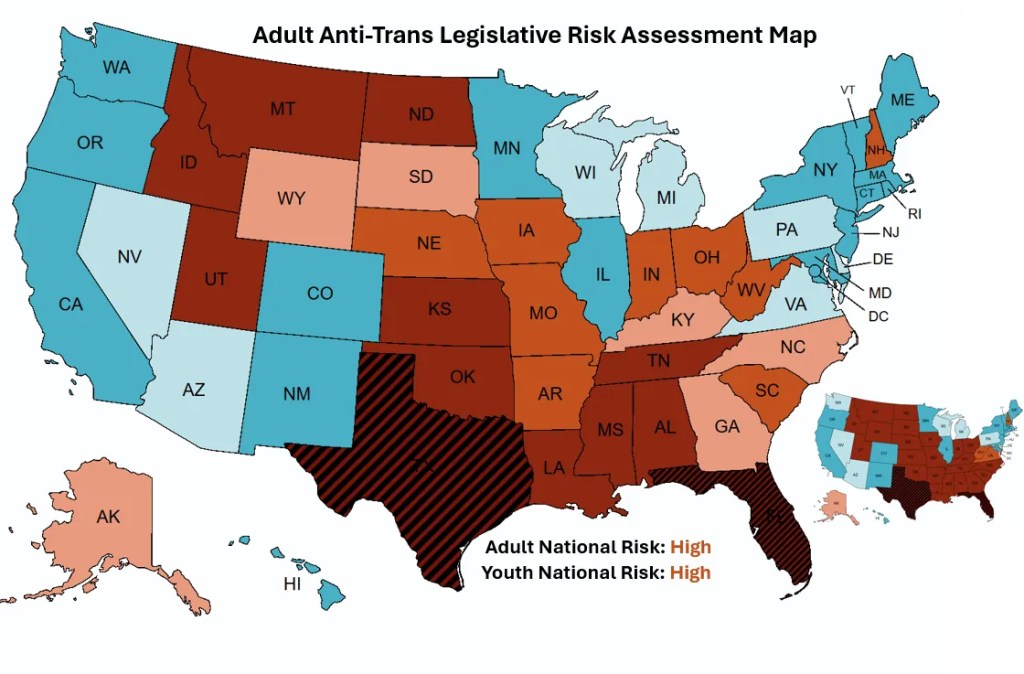
On Friday, Trump appeared in Bozeman, Montana, marking his first public appearance since Kamala Harris selected Tim Walz as her running mate. The former president took the stage later than scheduled, citing engine troubles on his plane. The event garnered significant attention from political pundits, especially in light of Trump’s declining poll numbers. Many speculated on how his campaign messaging might evolve. A noticeable shift emerged quickly: a heightened focus on attacking transgender people.

You can see a compilation of his attacks on transgender people here:

Erin in the Morning, “Trump Targets Trans People in Montana”

Trump’s initial attack targeted Imane Khelif, the Olympic athlete who was falsely accused by prominent right-wing figures of “being a man.” Trump commented on Khelif, saying, “I’d like to congratulate the young woman who transitioned from a man into a boxer. You saw he won—she won—the gold medal. How about the beautiful young Italian boxer? She got in there, didn’t know what was going on… she was a very good boxer, against other women. She didn’t count on this. She said, ‘OK, I had enough.’ It’s crazy what they are doing… this person won the gold medal. How crazy is this? And she wants it. She wants men to play in women’s sports.”

Imane Kehelif is not transgender, and has never transitioned. She was assigned female at birth, has always been cisgender, and was ruled out of competition by the International Boxing Association (IBA) after defeating an undefeated Russian boxer. Notably, the IBA is presided over by Umar Kremlev of Russia, and has been suspended by the International Olympic Committee due to corruption, judging scandals, and more.

Trump then shifted his focus to Tim Walz, declaring, “He signed a law letting the state kidnap children to change their gender so that they go home… I’m not talking about him, I’m talking about her. This is her ideology, this is why she picked him. And he signed a bill allowing pedophiles to claim human rights protections under the state law.”

The law Trump referenced is Minnesota’s legislation designating the state as a refuge for transgender individuals seeking care across state lines. The law does not permit the state to “kidnap children.” This misconception arises from a misinterpretation of a provision that allows Minnesota to “take jurisdiction” in cases involving youth transitions where one parent resides in a state that criminalizes such care and the other in a state where it is legal, particularly during divorce or custody disputes. As for the claim of “allowing pedophiles to claim human rights protections,” this is also false. The confusion stems from the removal of pedophilia from the definition of sexual orientation, but pedophilia remains illegal under Minnesota law.

Finally, Trump addressed schools, stating that he would “remove funding from any school pushing critical race theory, transgender insanity, and other inappropriate racial, sexual, or political content onto the lives of our children.” While this could be referring to book bans, which have proliferated in many states, Trump might also be threatening to use similar tactics against schools that allow transgender youth to use bathrooms matching their gender identity, change their names, or avoid forcibly outing trans youth to their parents.

Attacks on transgender people have little record of electoral success, with similar efforts failing in many campaigns over the last few elections. In elections where Republicans made trans people the major issue, the Republican Party faltered: 70% of Moms for Liberty and Project 1776 candidates lost their races in 2023. In Kentucky, the American Principles Project spent millions on anti-trans ads against Democratic Governor Andy Beshear, who won by a larger margin than his first election. Other losses Republicans have suffered on this issue occurred in the Virginia legislature elections, the Arizona Governor’s race, the Michigan legislature elections, the Wisconsin Supreme Court election, the Walker-Warnock Senate race, and in dozens more places. Furthermore, recent polling from GallupNavigator, and the LA Times indicates fading public support for such laws, with huge majorities of respondents seeing them as a distraction and opposing bans on trans youth care.

Despite a history of limited success with these tactics, Trump seems to be doubling down on the issue in a desperate bid to boost his poll numbers. If he succeeds and regains office, transgender individuals could face unprecedented threats as his administration intensifies its targeting of their rights and protections.

Source: Erin Reed, “Seeing Falling Poll Numbers, Trump Targets Trans People In Montana,” Erin in the Morning, 13 August 2024

Traitor(s)

Traitor by Dennis Potter. Source: Internet Archive

Traitor

First broadcast in 1981, this Hidden Treasure play by Dennis Potter stars Denholm Elliott as Harris and Ian Ogilvy as James. It has not been heard for over 40 years.

In a dingy flat in Moscow, he sits alone — a traitor to his family, his friends, his colleagues. Then the international press descend upon him and he gives his first interview — an interview which brings forth terrible, haunting memories.

Adapted for radio and directed by Derek Hoddinott
A BBC World Service Drama production

With thanks to Keith Wickham, Dr Steve Arnold, Ruby Churchill, Louisa Britton, Alison Hindell, Matthew Dodd, Claire Coss, Carl Davies, Helen Toland, Richard Culver, Andrew Jupp, James Peak, BBC Archives and the Radio Circle.

Remastering by Essential Radio.

Source: BBC


On Sunday, Representative Michael R. Turner (R-OH), chair of the House Intelligence Committee, said it is “absolutely true” that Republican members of Congress are parroting Russian propaganda. “We see directly coming from Russia attempts to mask communications that are anti-Ukraine and pro-Russia messages, some of which we even hear being uttered on the House floor,” he said on CNN’s State of the Union.

Turner was being questioned about an interview in which Representative Michael McCaul (R-TX), chair of the House Foreign Affairs Committee, told Russia specialist Julia Ioffe that “Russian propaganda has made its way into the United States, unfortunately, and it’s infected a good chunk of my party’s base.” McCaul blamed right-wing media. When asked which Republicans he was talking about, McCaul answered that it is “obvious.” 

Catherine Belton and Joseph Menn reviewed more than 100 internal Kremlin documents from 2022 and 2023 obtained by a European intelligence service and reported in the Washington Post today that the Russian government is running “an ongoing campaign that seeks to influence congressional and other political debates to stoke anti-Ukraine sentiment.” Kremlin-backed trolls write fake “news articles, social media posts and comments that promote American isolationism, stir fear over the United States’ border security and attempt to amplify U.S. economic and racial tensions” while claiming that “Biden’s policies are leading the U.S. toward collapse.”

Aaron Blake pointed out in the Washington Post that Republicans are increasingly warning that Russian propaganda has fouled their party. Blake notes that Russia specialist Fiona Hill publicly told Republicans during the 2019 impeachment inquiry into Trump that they were repeating “politically driven falsehoods that so clearly advance Russian interests,” but Republicans angrily objected. 

Now Senators Mitt Romney (R-UT), Thom Tillis (R-NC), and John Cornyn (R-TX) and a top aide to Senator Todd Young (R-IN), as well as former South Carolina governor Nikki Haley and even Trump’s vice president Mike Pence, have warned about the party’s ties to Russia. Former Representative Liz Cheney (R-WY) has said the Republican Party now has “a Putin wing.” 

Trump has hinted that he has a plan to end Russia’s war in Ukraine in 24 hours. Yesterday, Isaac Arnsdorf, Josh Dawsey, and Michael Birnbaum reported in the Washington Post on the details of that plan: he would accept Russian annexation of Ukraine’s Crimea and the Donbas region. He refuses to say how he would negotiate with Ukraine president Volodymyr Zelensky, who has been adamant that Ukraine will not give up its territory to an invader, or Russia president Vladmir Putin, who has claimed all of Ukraine, but after meeting with Trump last month, Hungarian prime minister Viktor Orbán said Trump told him he would accomplish “peace” by cutting off funds to Ukraine.

Trump’s team said Orbán’s comment was false, but it is worth noting that this plan echoes the one acknowledged by Trump’s 2016 campaign director Paul Manafort as the goal of Russian aid to Trump’s campaign.

Fiona Hill told the Washington Post reporters that Trump’s team “is thinking…that this is just a Ukraine-Russia thing…rather than one about the whole future of European security and the world order.”

Trump’s MAGA loyalists in the House of Representatives have held up funding for Ukraine for six months. Although a national security supplemental bill that would fund Ukraine has passed the Senate and would pass the House if it were brought to the floor, House speaker Mike Johnson (R-LA) refuses to bring it to the floor. The House returns to work tomorrow after a two-week recess but is so backed up on work that Johnson is not expected to bring up the Ukraine measure this week.  

Clint Watts, the head of Microsoft’s Threat Analysis Center, told the Washington Post’s Belton and Menn: “The impact of the Russian program over the last decade…is seen in the U.S. congressional debate over Ukraine aid…. They have had an impact in a strategic aggregate way.”

[…]

Source: Heather Cox Richardson, Letters from an American, 8 April 2024 

The Spirals of Silence in Wartime Russian Society and the US Republican Party

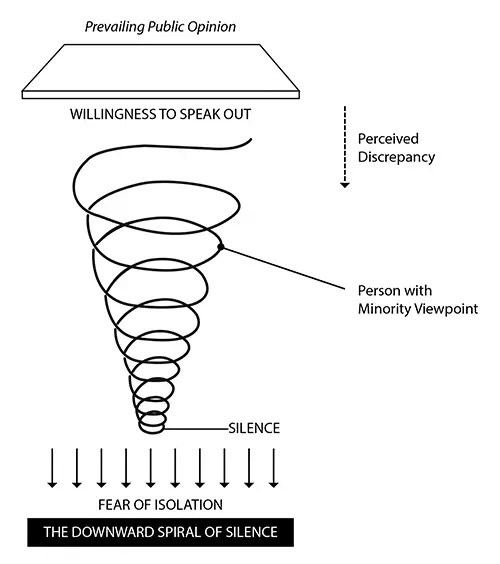
Popular opinion polls show that the majority of Russians support the military action in Ukraine. Researchers, however, continue to argue that society’s support for the war is much lower than these figures suggest. In their new study “Perception of the conflict with Ukraine among Russians: testing the spiral of silence hypothesis,” V.B. Zvonovsky and A.V. Khodykin, drawing on Elisabeth Noelle-Neumann’s “spiral of silence” model, argue that many opponents of the war are not willing to voice their opinion, believing that it is unpopular and fearing social disapproval.

Noelle-Neumann argues that before people with a “limited interest in politics” decide to voice their opinion on a politically significant matter, they assess the risk of being condemned by others. The spiral of silence “twists” as follows: people who are afraid of being isolated due to the unpopularity of their opinion refrain from voicing it → this opinion is thus heard less and less often in society → people thus increasingly think that their own opinion is not popular → they are thus even less likely to be willing to voicing it.

Zvonovsky and Khodykin discovered that the spiral of silence actually does have a great impact on discussion of the Russian-Ukrainian conflict in Russian society. They were able to verify this by doing a nationwide telephone survey (N = 1977) using Noelle-Neumann’s “train test.” The “train test” measures the willingness of “adherents of a particular stance on a socially significant matter to openly voice it by discussing it on a train with a random fellow passenger.” Supporters of the more popular stance, in their opinion, are more likely to openly voice it, believing that they are “in a stronger camp and less at risk of being judged by others.” Sometimes, their opponents are also encouraged to side with the “stronger” position.

Applying the “train test” to the Russian context showed that the topic of the war is highly sensitive both to its supporters and opponents, and that the spiral of silence affects both sides of the discussion. However, its impact on opponents of the war has proved to be much stronger than on its supporters. Thus, people who oppose the special military operation in Ukraine are less willing to discuss the Russian-Ukrainian conflict with those who support it.

Another important finding made by the researchers is the fact that a person’s willingness to speak out about the war is influenced most by the distribution of opinions about it in their immediate circle of acquaintances. So, the more people in the orbit of respondents who had shared a similar opinion with them, the more the respondents were willing to discuss the war, and vice versa. It can be assumed that the need to maintain social ties is stronger for Russians than the need to defend and disseminate their political views, as we noted in our analytical report “The war near and far.” Zvonovsky and Khodykin suggest another explanation, however: the “bad experience” of political discussions, which often end in conflict and frustration, also has an impact, since the opinions of interlocutors are not changed, and the desire to talk about the war with one’s political opponents thus simply disappears.

The last interesting finding of the authors about which we want to tell you is the following. If the environment of the respondents is divided approximately equally (~50% “for” the war and ~50% “against”), then the probability that those oppose the special military operation will discuss it does not decrease—unlike supporters of the war, who are much less likely under the same circumstances to discuss the military operation with strangers of opposite views. Thus, the opponents of the military conflict “have learned to resist the spiral of silence better than their opponents.” This means that if the distribution of opinions in Russia changes, “opponents of the military conflict will have greater opportunities than [their] opponents to promote their own narrative about the Russian-Ukrainian conflict.”

Source: PS Lab (Telegraph), “The spiral of silence and the war in Ukraine: review of a new sociological study,” 14 December 2023. Translated by the Russian Reader. Image, above, courtesy of Businesstopia


IOWA CITY, Iowa — Anti-Donald Trump Republicans know they are in the middle of a critical moment to stop the former president’s political comeback. But for some, the steep cost of voicing resistance to Trump often renders them silent.

“If you go against Trump, like — you’re over,” said Kyle Clare, 20, a member of the University of Iowa’s College Republicans.

“I don’t talk about Donald Trump a lot because I’m afraid of the backlash,” said Jody Sears, 66, a registered Republican from Grimes, Iowa.

“If you would say something negative about Trump, we had one person that would just go bang for your throat,” said Barbra Spencer, 83, a former Trump voter describing her experience living in senior apartments in Spillville, Iowa.

Trump still enjoys broad popularity in the Republican Party, and that’s driving his polling leads among Republicans in Iowa, New Hampshire and every other state ahead of the 2024 primaries. But he has also used that popularity to enforce unity. And the same impulse that has led Republican officeholders to avoid criticizing Trump because of potential threats to their safety and their jobs is also holding back rank-and-file voters from opposing the former president in public with the full strength of their personal convictions.

NBC News spoke to more than a half-dozen Iowa voters turned off by Trump — but some were anxious about talking on the record out of fear of being shunned by friends or family. One Iowan said they plan on saying they caucused for Trump when asked by members of their community but will actually caucus for Vivek Ramaswamy.

That adds up to signs going unplaced on front lawns, conversations with friends and family about other candidates avoided — and fewer opportunities for opposition to Trump to take hold in different Republican communities.

NBC News first spoke with Clare in a University of Iowa auditorium Aug. 23, the night of the first GOP presidential debate. Fellow College Republicans were reacting to the debate and voicing steadfast support for the GOP candidate who wasn’t on the stage: Trump.

Clare chose to wait until the end of the night, after the rest of his classmates left the auditorium, to share his thoughts.

“I’m just so scared of doing this right now,” he said, fighting back tears. “I want to be able to have my opinions on our politicians, and I want to be able to speak freely about them and people still understand I’m a conservative.”

Clare criticized Trump, particularly for his actions Jan. 6, 2021, saying, “The end of his administration was un-American.” He also said Trump’s supporters are in denial about losing the 2020 election.

“They don’t want to believe he lost the election. It’s hard to swallow. Losing is hard to swallow. But it’s important that when we lose, we recognize that we lost and we think, ‘What can we do better next time to win over Americans?’” Clare said.

Clare was right to expect backlash from speaking out on Trump. After NBC News published the interview with him on a “Meet The Press” social media account, hateful and homophobic comments poured in. Clare said later that a student came up to him at a university event, shoved a phone in his face with the video on it, and asked him why he’s “scared of Trump and not scared of getting AIDS from having gay sex.”

“Say something they disagree with, and they go after your sexuality,” said Clare, who added that he doesn’t regret doing the interview with NBC News. Many of the comments questioned if Clare — who holds a leadership role at the University of Iowa’s College Republican organization, interned for a Republican on Capitol Hill, and is heavily involved in the Johnson County, Iowa, GOP — was truly a Republican.

“I think it shouldn’t be a bad thing for me to say I am conservative and that I think there are other options, and I don’t think that this person is good for our country,” Clare said. But he’s worried those opinions will stunt his own long-term political ambitions.

“If people as powerful and as prominent as members of Congress can be taken down because of their criticisms of one man, what’s stopping that from happening to me?” Clare noted, referring to the Republicans ousted from Congress after voting to impeach Trump.

Trump’s criticism forced several senators and House members into retirement or primary defeat during his first years in office. Later, of the 10 House Republicans who voted to bring impeachment charges against Trump following the Jan. 6 Capitol riot, four retired before facing voters in 2022 and another four lost their next primaries. Only two remain in the House.

In the Senate, three of the seven Republicans who voted to convict Trump have since retired or resigned, and Sen. Mitt Romney of Utah is retiring next year.

Romney recounted to biographer McKay Coppins that Republican members of Congress confided to him they wanted Trump impeached and convicted but would vote against the charges because they were worried about threats to their families.

Former Rep. Liz Cheney of Wyoming, one of the Republicans who lost a 2022 primary after voting to impeach Trump, detailed similar conversations in her new memoir.

Cheney wrote about one colleague that she “absolutely understood his fear” about what would happen if he voted to impeach Trump. But, she continued, “I also thought, ‘Perhaps you need to be in another job.’”

‘It was easier to be quiet about it’

Rank-and-file voters are less prominent and thus less likely to be harassed or threatened, but some of the same worries and experiences remain. Sears, the Republican from Grimes, Iowa, feels Trump doesn’t reflect her values. But that’s an opinion she kept to herself until recently, because of the fear of being cast off by family and friends.

“Family and people I work with are Trump supporters,” said Sears, describing her hesitancy to speak out about her beliefs.

“I think Trump supporters tried to coerce or bully people into also being Trump supporters. And so it was easier to be quiet about it,” she said.

Spencer, a retiree now living in a nursing home in Decorah, Iowa, says Trump supporters at her previous retirement community created a toxic environment that stopped her and her friends from voicing opinions.

“We were afraid of arguments,” she said. “When you live with that many old people, sometimes they have very strange but very firm thoughts and you better think the way they do,” she said, explaining her silence.

Clare, Sears and Spencer are not the only people who feel this way.

And as Cheney and Romney’s stories demonstrate, social ostracization isn’t limited to just voters who speak out against Trump. Former Rep. Denver Riggleman, a Republican who represented a slice of Virginia from 2019 to 2021, says his mother texted him, “I’m sorry you were ever elected,” after he came out against Trump.

“It was so soul-crushing to have a family member choose Donald Trump over you,” Riggleman continued. He said evangelical Trump supporters in his life saw Trump as being blessed by God. “I was going directly against religious beliefs. And that’s a losing battle.”

It’s now been almost six months since a member of Congress endorsed a non-Trump candidate in the 2024 GOP primary, according to NBC News’ endorsement tracking.

The trend has popped up elsewhere on the 2024 campaign trail, too. When Iowa Gov. Kim Reynolds endorsed Ron DeSantis in November, the Florida governor mentioned in an interview with NBC News that he “had people come to me and say they endorsed [Trump] because of the threats and everything like that” during the campaign.

Trump quickly went after Reynolds after news of her DeSantis endorsement broke, posting on social media that it would “be the end of her political career.”

‘Vortex of controversy and vilification’

Charlie Sykes was a conservative radio show host in Wisconsin for more than 20 years before Trump burst onto the political scene. Sykes was skeptical and critical of Trump, eventually confronting him in a heated interview about insults Trump hurled at Texas Sen. Ted Cruz’s wife in 2016. But for Sykes, it began to become clear that there was no room anymore for anti-Trump conservatives on talk radio.

“The audience of conservative talk radio began to think that loyalty was required. They wanted conservative media to be a safe space for them,” Sykes said, describing how his role became untenable.

After leaving radio, Sykes didn’t let up on his Trump criticism, which he says got him booted from a think tank and led him to lose friends and become a self-described political orphan. He says his criticism was met with bullying — and he understands why people who don’t work in the public eye might be hesitant to voice their true feelings about Trump.

“I do understand why people in their normal lives don’t want to be caught up in this vortex of controversy and vilification — why they would step back from all of this,” Sykes said.

Another longtime Wisconsin Republican recently detailed one of the results of that pressure.

Former House Speaker Paul Ryan recently spoke on video at an event for Teneo, a global consulting firm where he serves as vice-chair. Ryan said the impulse to avoid getting on the wrong side of angry Trump supporters pushed former colleagues to vote against impeachment even though they wanted Trump gone — and now he thinks there are many who regret those votes.

“They figured, ‘I’m not gonna take this heat and I’m going to vote against this impeachment because he’s gone anyway,’” Ryan said. “But what’s happened is that he’s been resurrected.”

Source: Alex Tabet, “Trump’s secret weapon consolidating the GOP: fear,” NBC News, 15 December 2023

Mission of Burma

“The US risks repeating the fate of the Soviet Union. Currently, the greatest threat to America comes from within, argues Donald Tramp.” Screenshot from the TASS page on Telegram. Read the whole story on their website.


“Cooperation between Russia and Myanmar is based on a solid foundation and is not subject to political trends, Russian Foreign Minister Sergei Lavrov said at a meeting with Myanmar Foreign Minister Wunna Maung Lwin.” Source: TASS (Telegram), 3 August 2022


Kyaw Min Yu, a pro-democracy leader and writer in Myanmar widely known as Ko Jimmy, who rose to prominence in 1988 during protests that helped galvanize political forces opposing military-led regimes for decades to come, was executed with three other activists. He was 53.

In total, Ko Jimmy spent more than 20 years in prison. While detained by the state, which had been under absolute military rule for decades, he worked on literary projects. One surprise bestseller was his translation of a self-help book, which was seen as a manifesto of personal empowerment rare in a country known for its unyielding repression.

Myanmar’s military regime announced that it recently carried out the death sentences, but did not specify when the executions took place at the Insein Prison in Yangon. The junta was strongly denounced by rights groups and governments around the world. But the country’s rulers remained defiant as they seek to crush dissent and political allies of ousted civilian leader and Nobel Peace Prize laureate Aung San Suu Kyi.

[…]

Source: Brian Murphy, “Kyaw Min Yu, Myanmar activist known as Ko Jimmy, executed at 53,” Washington Post, 26 July 2022


Mission of Burma, “Academy Fight Song”

PSA (It’s Time to Start the Deprogramming)

Everything that the irresponsible Russian “Americanists” who have been producing prodigious amounts of utter verbal rubbish in their “analyses” of the events of January 6 on social networks have proven incapable of understanding is laid out in this nine-minute video.

Thanks to Mark Teeter for the link. || TRR

Wake up, Russian intelligentsia, before it’s too late!

Kalinka Malinka

Authentic Russian with Katya 2RU
September 23, 2019

Калинка-малинка is a Russian song that the whole world is singing! Learning this hit if you study Russian language is a must! Watch this video to know HOW TO PRONOUNCE THE LYRICS of Kalinka-Malinka!

Калинка, калинка, калинка моя!
В саду ягода малинка, малинка моя!
Ах! Под сосною под зеленою
Спать положите вы меня;
Ай, люли, люли, ай, люли, люли,
Спать положите вы меня.

Калинка, калинка, калинка моя!
В саду ягода малинка, малинка моя!
Ах! Сосенушка ты зеленая,
Не шуми же надо мной!
Ай, люли, люли, ай, люли, люли,
Не шуми же надо мной!

Калинка, калинка, калинка моя!
В саду ягода малинка, малинка моя!
Ах! Красавица, душа-девица,
Полюби же ты меня!
Ай, люли, люли, ай, люли, люли,
Полюби же ты меня!

Калинка, калинка, калинка моя!
В саду ягода малинка, малинка моя!

Little snowberry, snowberry, snowberry of mine!
Little raspberry in the garden, my little raspberry!
Ah, under the pine, the green one,
Lay me down to sleep,
Rock-a-bye, baby, rock-a-bye, baby,
Lay me down to sleep.

Little snowberry, snowberry, snowberry of mine!
Little raspberry in the garden, my little raspberry!
Ah, little pine, little green one,
Don’t rustle above me,
Rock-a-bye, baby, rock-a-bye, baby,
Don’t rustle above me.

Little snowberry, snowberry, snowberry of mine!
Little raspberry in the garden, my little raspberry!
Ah, you beauty, pretty maiden,
Take a fancy to me,
Rock-a-bye, baby, rock-a-bye, baby,
Take a fancy to me.

Little snowberry, snowberry, snowberry of mine!
Little raspberry in the garden, my little raspberry!

Like her compatriots, Katya 2RU has plenty of time nowadays to look great and teach foreigners a lesson, but at least she teaches them Russian folk songs instead of lessons about democracy and free speech. Image courtesy of her YouTube channel

The Capitol Storming Gives Russians an Escape From Their Reality
The great majority of Russians have no say over the future of their cities or regions and so resort to events outside the country.
Ilya Klishin
Moscow Times
January 14, 2021

Anyone following U.S. and Russian social networks in recent days might have had the impression that Russians were more upset by the recent siege of the Capitol building and the decision by Twitter and Co. to block Donald Trump than even the Americans themselves were.

Although CNN and the New York Times only sounded the alarm, popular and little-known bloggers on this side of the Atlantic absolutely went into hysterics.

Of course, many of the issues concerning this incident deserve deep and thoughtful discussion, such as, at what point should IT companies become accountable to society?

And, is there a difference between today’s Twitter and the telegraph and newspapers of 100 years ago? Here, however, I would like to focus not on the substance of the psychosis, but on its nature and origin.

Why did so many Russians go into a frenzy over the events in the U.S.?

To begin with, consider a popular Russian meme called “Barnaul, Altai Region.” In all of its iterations, the cartoon shows a young Russian woman voicing anxieties to her psychologist.

One day she’s worried about SJW, the next, BLM, and most recently, the Capitol siege. But whatever the problem, the psychologist always responds with the same words, “What the f—k do you care?! You live in Barnaul!”

Then he grabs a megaphone and shouts it again for emphasis: “IN BARNAUL, THE ALTAI REGION!!!”

Now, you might not have heard of this Siberian city, but that’s the whole point. Barnaul is so far from the problems dominating Western headlines that it is absurd for someone living there to lose any sleep over them.

Rude as it is, the meme remains popular because it touches on a very real but unspoken, almost intuitive aspect of the Russian psyche.

The great majority of Russians have no say over the future of their cities or regions, much less the country as a whole. This is especially depressing for young people who have grown up during the 20 years of President Vladimir Putin’s rule, and who have never experienced anything else. After all, they are naturally overflowing with youthful energy. They would like to change the world around them and contribute to society in some small way.

But they can’t. Everything is off limits. They can either violate their own principles by going along with the abominable, soul-crushing system, or else buck that system and risk paying a very high price, up to and including prison time.

Of course, most young people avoid that extreme, teetering on the edge of open disobedience without crossing the line.

Once a young person realizes that the authorities block every path for positive change, they subconsciously switch to the path of least resistance.

Like water flowing around a rock in its way, young Russians who find that they cannot change the fundamental picture shift their focus to concerns of secondary importance.

If you can’t raise the standard of living for the elderly in your economically depressed region, stop the police from torturing people or prevent the authorities from “calling in” verdicts to the courts, you can at least become a vegan activist or radical feminist and oppose the use of animal fur.

Don’t get me wrong — these are all worthwhile causes.

But in today’s Russia, they represent a form of escapism. A “fur fighter” poses no threat to Putin’s regime and comes off as more comical than menacing. Kremlin leaders simply laugh at them, saying, “Let them have their fun.”

The same is true of Russia’s homegrown BLM activists and surprisingly numerous Trump supporters. In fact, the whole lot of them is even more harmless than the activists are because they do nothing but sit on their couches and argue with each other online.

It is a pastime along the lines of watching football, Game of Thrones and reality TV. It is fun and brings the occasional rush of adrenaline during particularly intense arguments.

And so, the days and weeks pass with everyone arguing. Some are on the left, others on the right. One is a feminist, another an anti-feminist. This one is a tree hugger while that one ridicules environmentalists. But outside their windows is the same old Russia, ruled by the same old Vladimir Putin.

Ilya Klishin is the former Digital Director of the New York-based Russian-language RTVI channel. He is the founder of KFConsulting.

They Have Nothing Better to Do

Dmitry Gudkov
Facebook
January 9, 2021

I understand that Russians there is no problem more important than Trump’s showdown with Twitter. The precedent of blocking a social network account is not a very good one, of course, but the folks in the US will cope without us. I would venture to throw out a different topic for discussion.

On Monday, January 11, the verdict in the case of Azat Miftakhov will be read out in the Golovinsky District Court in Moscow. Trump was banned on Twitter, but Azat, a graduate student in mathematics from Moscow State University, has been locked up in for allegedly breaking a window at United Russia party office. He has been in a pretrial detention center for two years, although there is no evidence of his guilt.

If you’re worried about freedom of speech, Azat’s case is also cause for worry. At the last court hearing in the case, people who came to support Azat were not only not allowed into the court building. They were simply locked up in the courtyard of the building. A paddy wagon was brought  in and shipped them out of there. The detainees included two journalists, with press cards, but that means nothing to our authorities.

If the Miftakhov case were given at least 1% of the attention that has been spent on Trump in Russia, the case would not have happened. And we’re not taking about a ban on Twitter here, but arrest, torture, and a [possible] imprisonment in a penal colony.

Today, someone spelled out the message “FREE AZAT” on Lake Kaban in Kazan. This was protest action in support of mathematician and anarchist Azat Miftakhov. On January 11, at 12:00 p.m., the Golovinsky District Court will announce the verdict. The prosecution has asked for six years in prison for the young academic. If you have the opportunity, be sure to come to the hearing!

Boris Vishnevsky
Facebook
January 9, 2021

In our country, Roskomnadzor can block any media outlet or website that tells truths that the authorities find unpleasant.

But this does not cause popular outrage.

In our country, people are put in jail for reposting things on the internet.

But this does not cause popular outrage.

In our country, hundreds of political prisoners are being held on falsified charges, starting with Yuri Dmitriev and ending with the defendants in the Ingush protest movement trial.

But this does not cause popular outrage, and rallies and pickets in support of these people attract almost no attention.

In our country, anyone who disagrees with the authorities can be declared a foreign agent.

But this does not cause popular outrage.

In our country, the president has been given lifelong immunity from prosecution for any and all crimes, and he does not even need to pardon himself in advance.

But this does not cause popular outrage.

But what an explosion of indignation there has been over the blocking of Trump’s Twitter account. It has been the main topic of discussion in Russia!

As long as this is the case, the Kremlin can rest easy.

__________________

Sergey Abashin
Facebook
January 9, 2021

It’s stunning. Russia has hundreds of political prisoners, political assassinations and political persecution, two ongoing wars involving tens of thousands of dead and the occupation of territory in several [foreign] countries, a personal dictatorship that has been de facto and legally established, and laws that permit total censorship in the mainstream media. And yet Russian intellectuals are hotly debating whether it is right or wrong to block the American president’s Twitter account two weeks before the end of his official term.

Translated by the Russian Reader

Trump’s Christmas Gift to Putin: The Case of Nikita Semyonov and Georgy Chernyshov

20191230143413-img-3898Georgy Chernyshov. Photo by David Frenkel. Courtesy of Bumaga

Kira Dolinina
Facebook
February 12, 2020

After the verdicts in the Network Case, I would imagine I don’t have to explain anything about our justice system and how it is consuming our children. So I  simply ask you to recall that we have been raising money to pay the lawyers defending 23-year-old Nikita Semyonov, who has been framed on “terrorism” charges. Thanks to you, we raised the first installment, 200,000 rubles. Thank you very much!

But the case is still ongoing. The investigators are investigating, Nikita is in remand prison, and only the lawyers can stand up for him. Prison officials wouldn’t give him a pen for several weeks so that he could write a complaint. I won’t even mention their failure to document his injuries from the beating investigators gave him.

Let’s not surrender this boy to them, okay?

Here is the number of the Sberbank account for paying Nikita Semyonov’s lawyers: 5336 6902 4491 0313.

The money is really needed. Please re-post this message.


“The Nikita Semyonov Case: The FSB Pins Failed Terrorist Attack on Orphan.” ROMB, February 6, 2020

Before the new year, Putin thanked Trump for helping prevent a terrorist attack, and the FSB demonstratively arrested two young men in Petersburg, Nikita Semyonov and [Georgy] Chernyshov. They said on TV that the young men were going to blow up Kazan Cathedral and the shopping center near Moscow Railway Station, although the only evidence in the case is a photo of the cathedral, download from the internet, and memes that the young men exchanged in a chat room.

Semyonov talked to his lawyer on January 25. On January 30, the investigator made both of his lawyers sign an agreement not to disclose evidence in the preliminary investigation, so they are unable to comment on the specifics of the case.

Suspects in Terrorist Attack Case Deny Wrongdoing
Marina Tsareva
Kommersant
February 4, 2020

Saint Petersburg City Court has left Georgy Chernyshov in police custody. He and Nikita Semyonov were detained by the Russian Federal Security Service (FSB) before the New Year’s holidays for, allegely, planning terrorist attacks. The men allegedly planned to set  off explosions in Kazan Cathedral and the Galereya Shopping Center. Both suspects have denied any wrongdoing, although the FSB reported they had confessed to the crimes after they where detained. Semyonov’s lawyers claim their defendant never made any such confession, although he was interrogated three times without defense counsel present and was subjected to coercion by FSB officers.

Nikita Semyonov, 22, and Georgy Chernyshov, 23, were detained on December 27 of last year at around nine in the evening on Gagarin Prospect. After the Kremlin’s press service reported that Russian President Vladimir Putin had thanked US President Donald Trump for information about the planned attack, as communicated via the special services, the FSB’s public relations center issued a press release about the arrests of two persons who had been planning to commit terrorist attacks in crowded places in Petersburg during the New Year’s holidays.

The same day, media outlets, citing sources in the FSB, reported that a criminal case involving violations of Russian Federal Criminal Code Articles 30 and 205 had been opened, although the first article was not mentioned during the subsequent remand hearing, held three days after the arrests. Investigators alleged that both suspects had communicated with adherents of the banned terrorist organization Islamic State (IS) via messenger services.

Chernyshov and Semyonov allegedly informed an IS member about their plan to engage in terrorist activities and recorded a video showing them swearing allegiance to the group. After that, according to investigators, the men began selecting places to carry out terrorist attacks, settling on two sites in downtown Petersburg, the Galereya Shopping Center and Kazan Cathedral. They allegedly photographed both buildings, sending the images to IS.

According to the Petersburg judicial press service, Chernyshov has denied any wrongdoing. Earlier, Leonid Krikun and Andrei Fedorkov, Semyonov’s attorneys, told Kommersant that their client had denied involvement in the terrorist organization’s activities and told them he had never been interested in the ideas of Islam in any way, nor did he speak Arabic. (The conversation took place on January; on January 30, the investigator made both lawyers sign an agreement not to disclose evidence in the preliminary investigation, so they are currently unable to comment on the specifics of the case.) According to them, Semyonov had not confessed either to involvement with IS or planning to commit terrorist attacks. On the contrary, on December 30, the FSB reported that both suspects had confessed, and the agency had “seized [physical] evidence confirming they were planning terrorist attacks.”

The lawyers told Kommersant that Semyonov was interrogated three times without a lawyer present, including at night, and the FSB “pressured”* him during the interrogations.

A video released by the FSB on December 30 focused on the knives and ammunition found in Semyonov’s apartment. His lawyers noted that the ammunition was for a hunting rifle that had been legally owned by his father, who died in 2017. Neither the knives nor the ammunition were ultimately confiscated by the FSB.


Vyacheslav Falkov, Chernyshov’s attorney, reported that he had also been forced to sign a non-disclosure agreement and thus would no longer be able to comment on the case.

*Meaning that the FSB tortured Semyonov. Thanks to Kira Dolinina for the heads-up. Translated by the Russian Reader

ahn-TEE-fuh?

foodwords.gif

“President Trump said he was considering designating [ahn-TEE-fuh] an organization of terror.”

What the hell is [ahn-TEE-fuh]?

And why is it suddenly an “organization”?

Trump’s magical touch is such that anyone who even reports his fake presidency is turned into a useful idiot, including, in this case, the BBC’s World Service.

_________________________________________________

The surge of popular interest in the United States in antifa (antifacism) in the past year has been disconcerting to me. Perhaps other researchers who became familiar with antifa in European contexts feel the same.

I haven’t yet thought through what the arrival of the antifa specter to my homeland means, but in the meantime I wanted to share a small piece from my dissertation that, I think, expresses why — despite personally holding more or less pacifist views — I sympathize to a great degree with those for whom antifa militancy feels like the only correct response to a rising white supremacist movement.

P.S. It is ahn-tee-FAH, maybe AHN-tee-fah, not an-TEE-fuh.

Source: “Why Antifa?” Processing Culture, 4 October 2017

GIF courtesy of So Yummy