Petersburg Truckers Say No to Plato

Petersburg Truckers Say No to Plato
David Frenkel
Special to the Russian Reader
November 27, 2015

On November 24, Petersburg truckers joined protests against the new levies imposed heavy tonnage cargo trucks known as the Plato payment system, which have sparked unprecedented work stoppages and other protests by Russian truckers nationwide.

<br
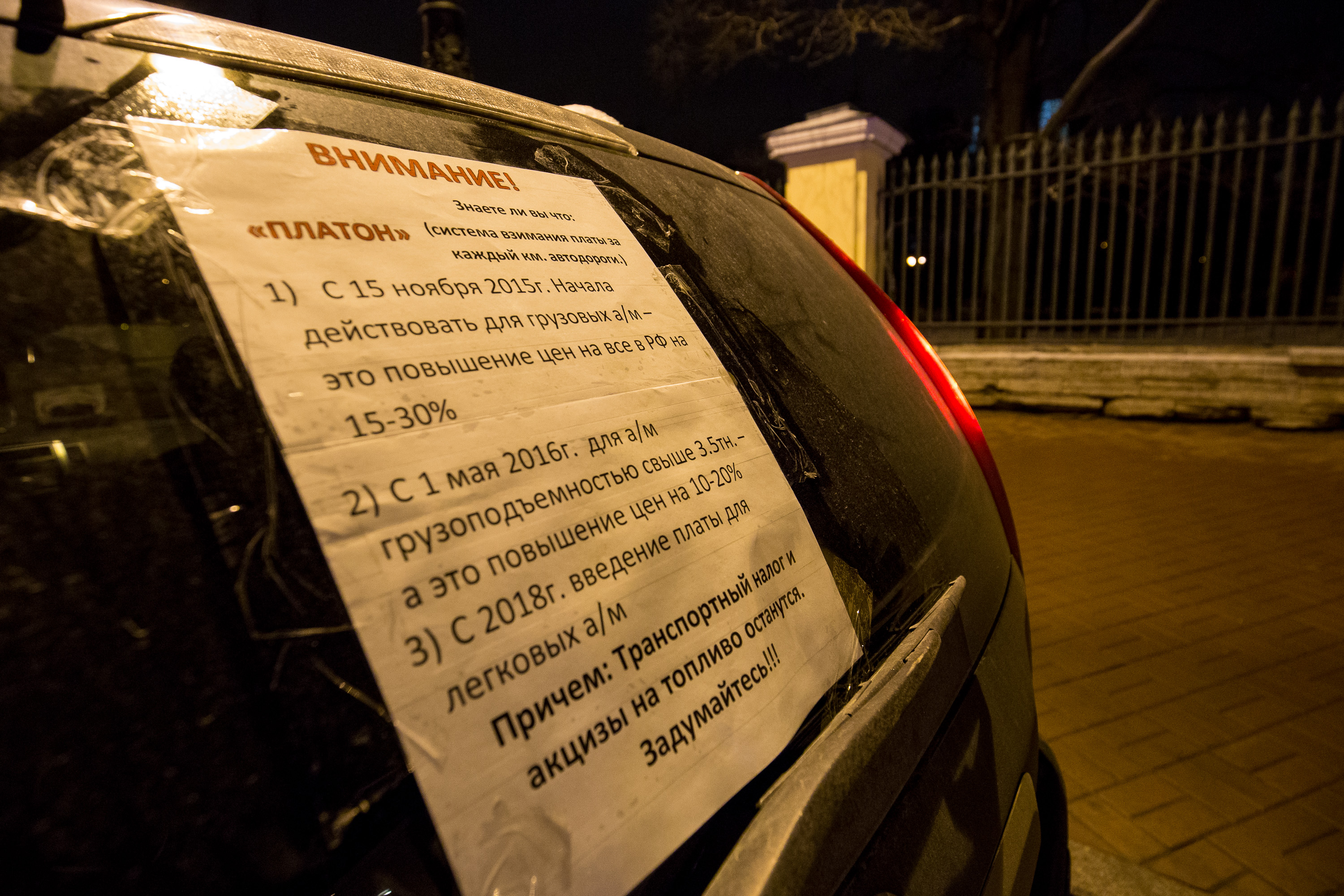
ATTENTION! PLATO (a system for charging a levy for every kilometer driven). Did you know that? 1) It went into effect for cargo vehicles on November 15, 2015. This means a 15-30% rise in prices for everything in the Russian Federation. 2) It goes into effect on May 1, 2016, for vehicles with a cargo capacity over 3.5 tones. This means a rise in prices of 10-20%. 3) It goes into effect for passenger vehicles in 2018. Moreover, the motor vehicle tax and fuel excise tax remain in effect. Think hard about this!

Alexander Rastorguyev, leader of the TIGR (Association of Go-Getting Russian Citizens) movement, and Sergei Gulyayev, an ex-deputy of the Saint Petersburg Legislative Assembly, both known for their opposition politics, inspired local truckers to launch a “snail” protest convoy.

gulyayev and rastorguyev
Sergei Gulyayev (left, in black) and Alexander Rastorguyev (right, in yellow vest)

The truckers took off in two separate convoys on parallel streets, Moscow Highway and Sofia Street, at 11 a.m. Shortly afterwards, another group of trucks joined them, increasing the number of slowly moving trucks to three hundred.

The truckers held a spontaneous rally on Sofia Street, where Rastorguyev urged them to keep driving to the Smolny, Petersburg city hall, where the authorities would “listen to them.”

During the rally, a tire was set on fire, an obvious reference to the Euromaidan protests.

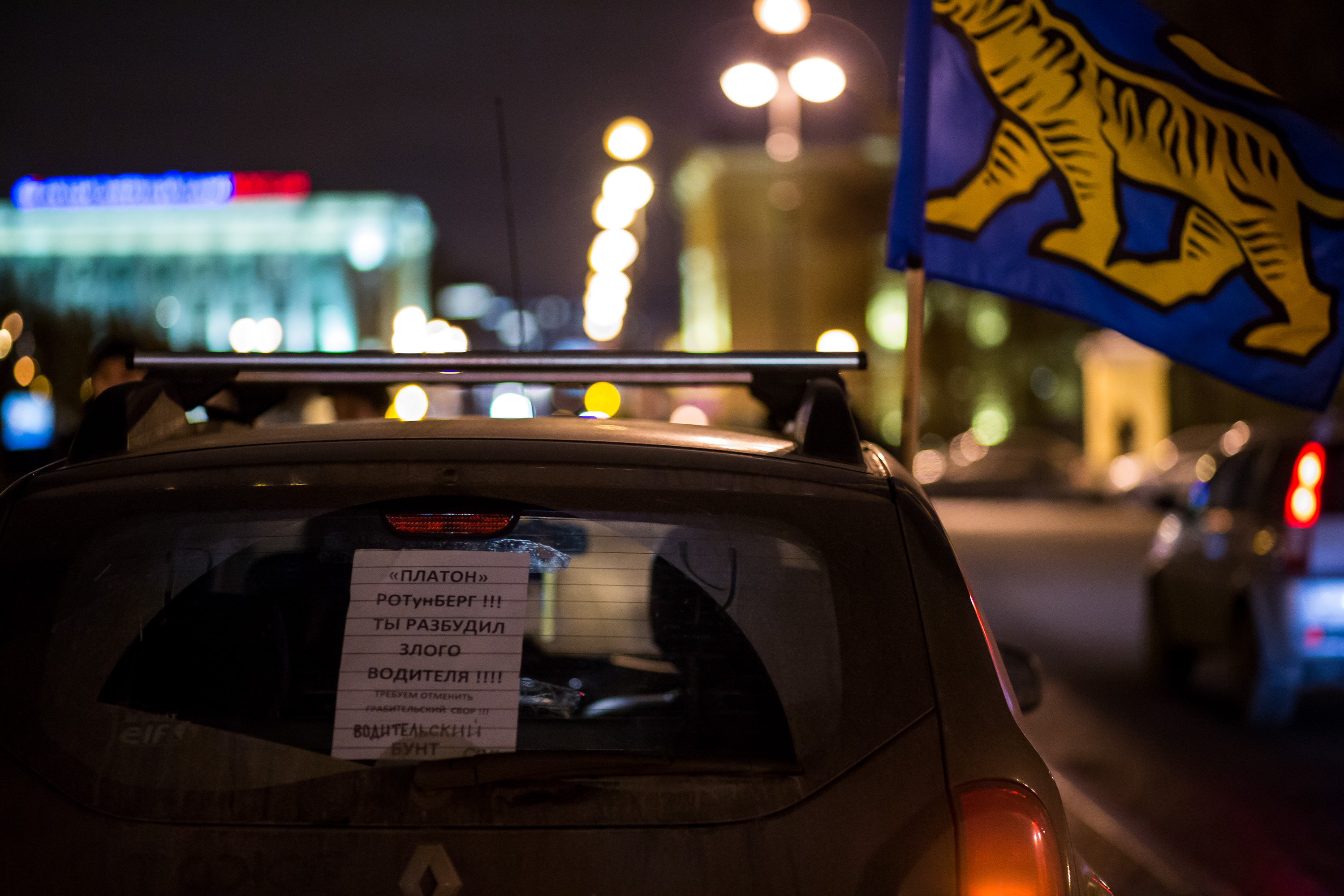
The truckers slowly moved onto the Petersburg Ring Road, paralyzing traffic in the streets. The convoy was led by a group of cars plastered with anti-Plato posters. Traffic police regularly stopped the drivers, although no one was detained.

IMG_2704
“‘Plato’ Rotenberg!!! You have aroused an angry driver!!! We demand that the extortionate levy be abolished!!! Driver mutiny”

While the truckers made their way to the Smolny, authorities negotiated with protest leaders. The authorities warned the trucks would paralyze the downtown and suggested that truckers choose six delegates to negotiate with a deputy governor in his office another part of the downtown.

The truckers, however, did not want to elect delegates. They wanted a meeting directly with authorities at the Smolny and as an entire group.

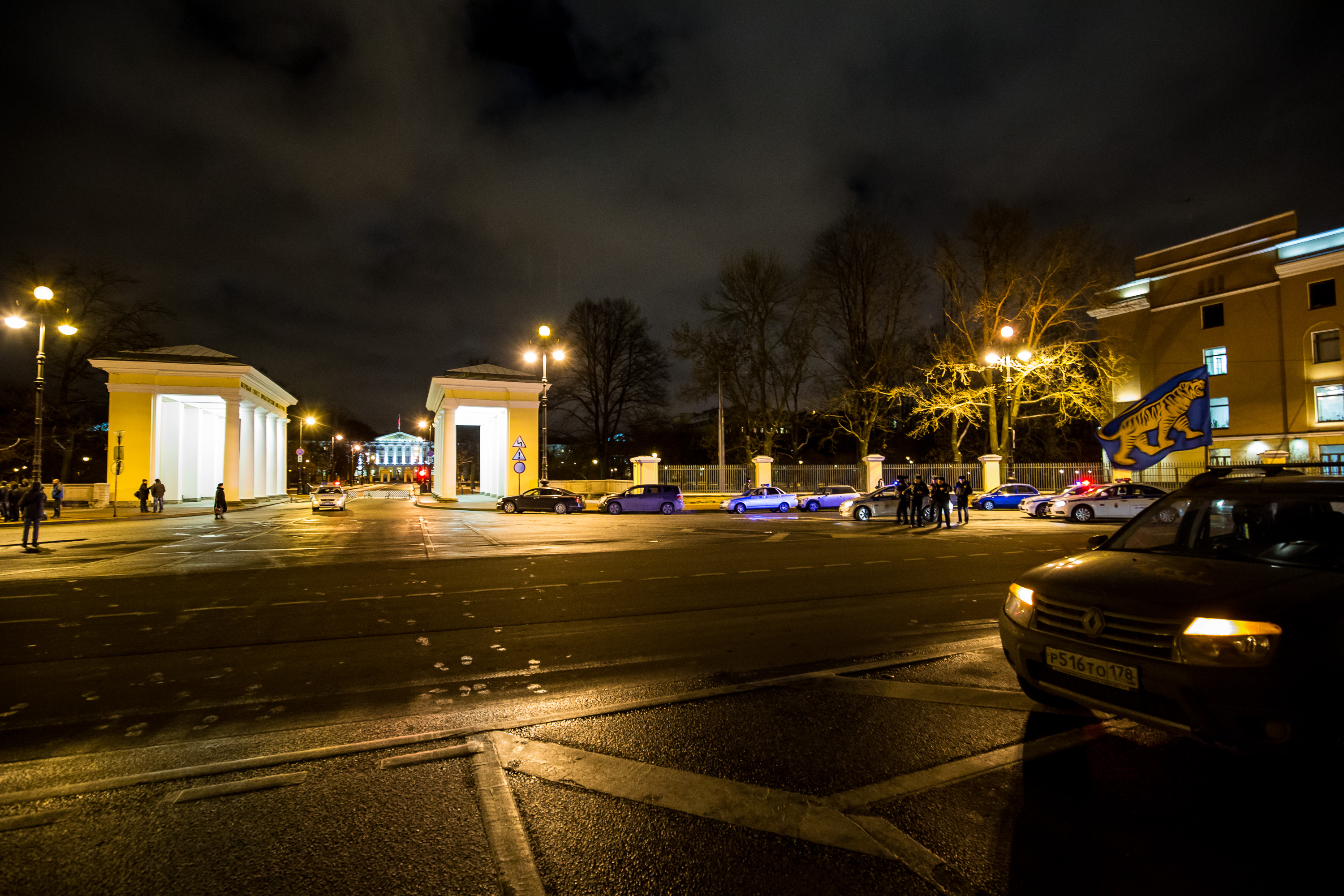
Around thirty truckers finally reached the gates to the Smolny, although they had to leave their trucks on the other side of the Neva River. They gathered around the entrance and waited for officials to come out and negotiate with them. They waited in vain.

The gates to the Smolny, Petersburg city hall

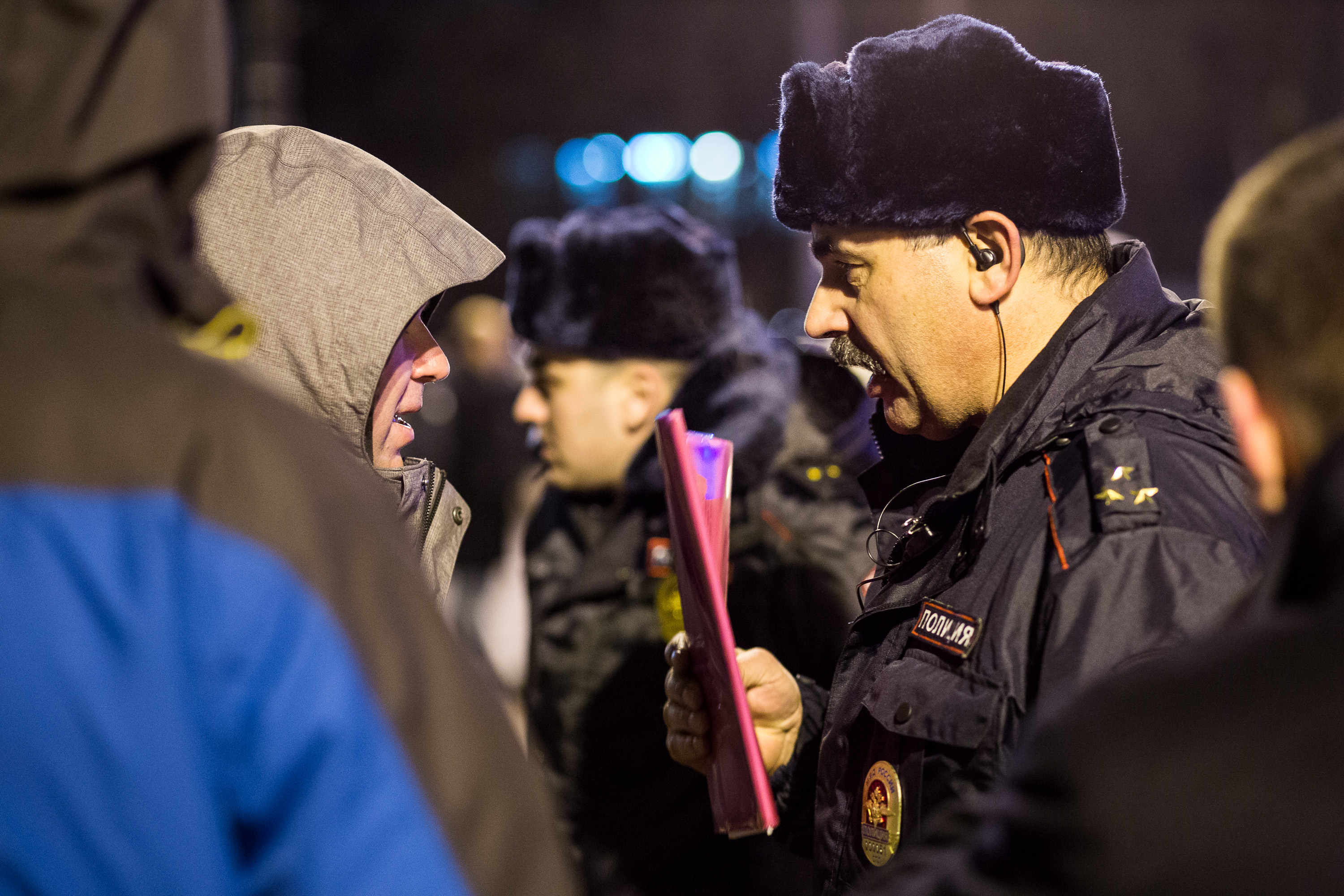
They stood and talked among themselves for about an hour until police arrived. A police officer demanded they disperse and organize a legal rally instead. Claiming they had not “come for a revolution,” they decided to give the authorities a chance, promising to organize a snail convoy to Moscow if their demands were not fulfilled in the coming days.

IMG_2834

All photos by and courtesy of David Frenkel

Read my previous posts on the new Plato cargo haulage levy system and protests by Russian truckers:

Remembering Timur Kacharava Ten Years Later

timur-1
Timur Kacharava, 1985-2005

Remembering Timur Kacharava Ten Years Later
David Frenkel
Special to the Russian Reader
November 17, 2015

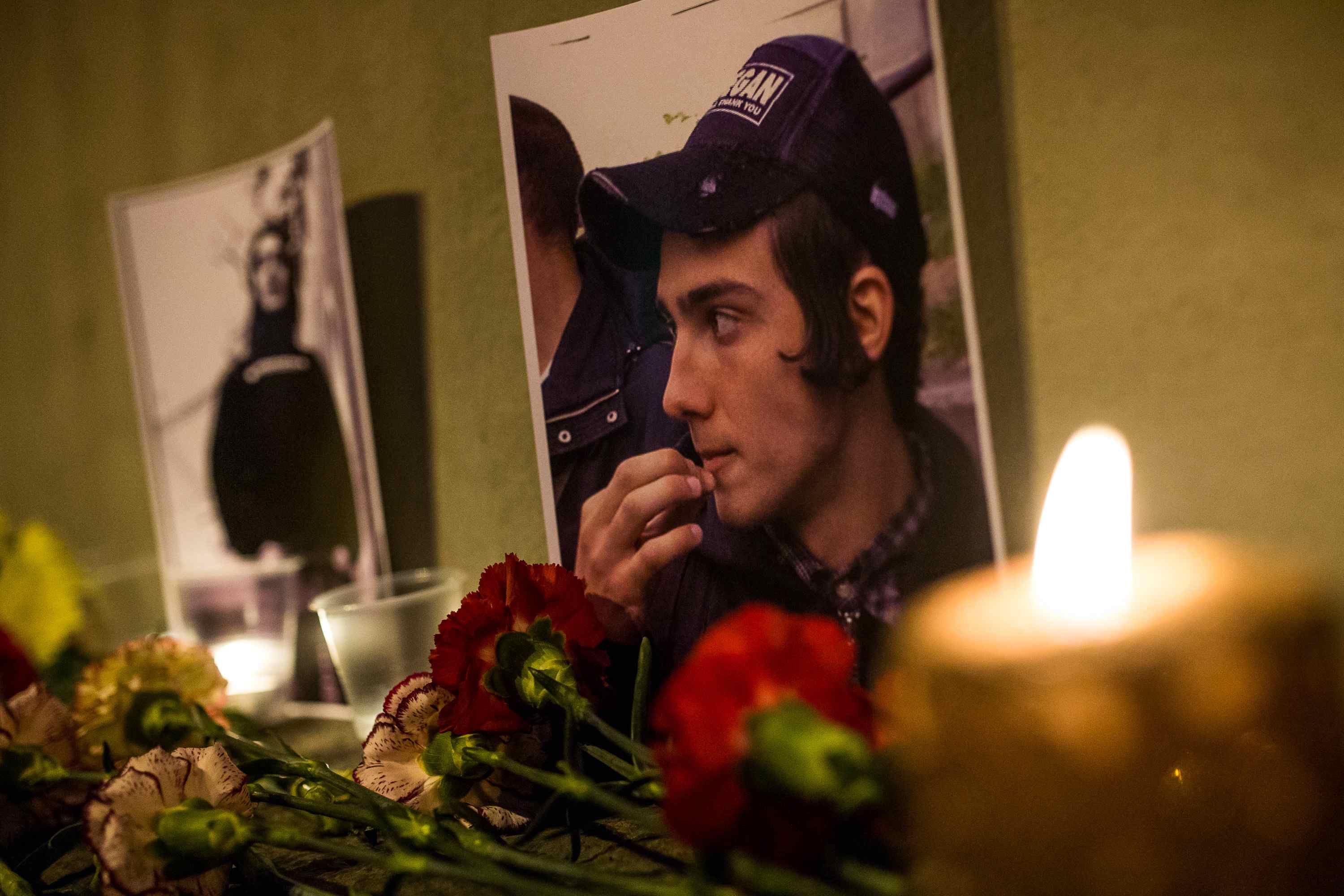
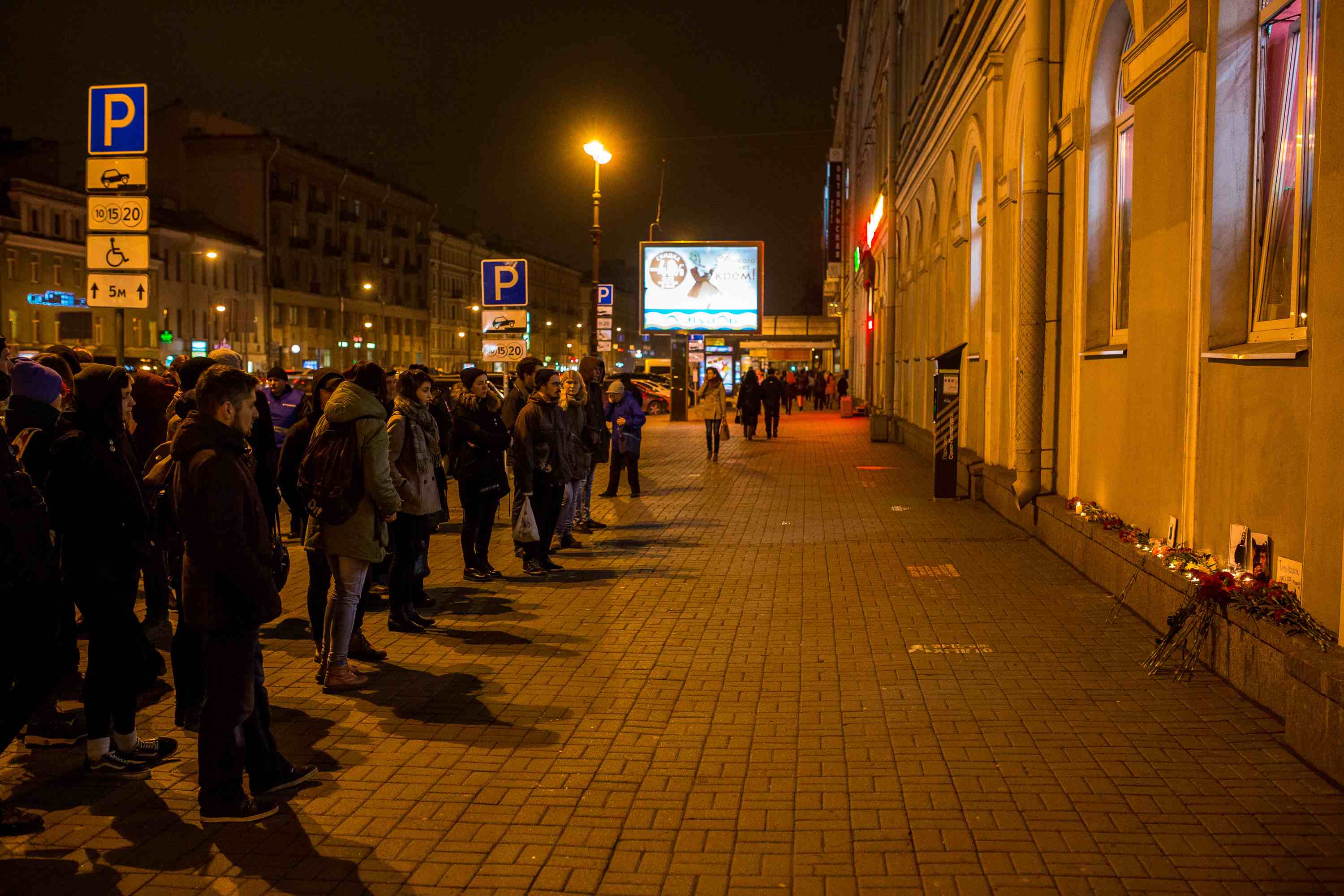
On the evening of November 13, 2015, more than fifty people gathered near the Bukvoyed bookstore on Ligovsky Prospect in the Vosstaniya Square area of downtown Petersburg to mourn anti-fascist and hardcore punk musician Timur Kacharava, who was murdered at the spot ten years earlier by Russian neo-Nazis.

Mourners gathered at the site of Kacharava's murder on Ligovsky Prospect
Mourners gathered at the site of Kacharava’s murder on Ligovsky Prospect

In 2005, Kacharava and a friend were attacked by a group of young men after participating in a Food Not Bombs action in another part of the downtown. Kacharava was stabbed in the neck five times and died at the scene.

Kacharava’s murder alarmed certain segments of Russian society. Over three thousand students at Saint Petersburg State University, where Kacharava had been majoring in philosophy at the time of his slaying, petitioned President Putin to find and punish the murderers.

timur-3

In December 2005, police arrested seven suspects who eventually confessed to the crime. In 2007, Alexander Shabalin was sentenced to twelve years in prison on charges of murder and incitement to ethnic or racial hatred. The other suspects were charged with inciting social hatred and sentenced to two or three years in prison. (Three of them were released on parole).

Since 2005, people have come to the crime scene every year on November 13 with flowers, candles, and pictures of Timur.

timur-4

This year, police did not interfere with the mourners, although they asked them to remove pictures from the parapet and not to shout out any slogans.

Photographs by and courtesy of David Frenkel

Remembering the Great Terror

gulag-1
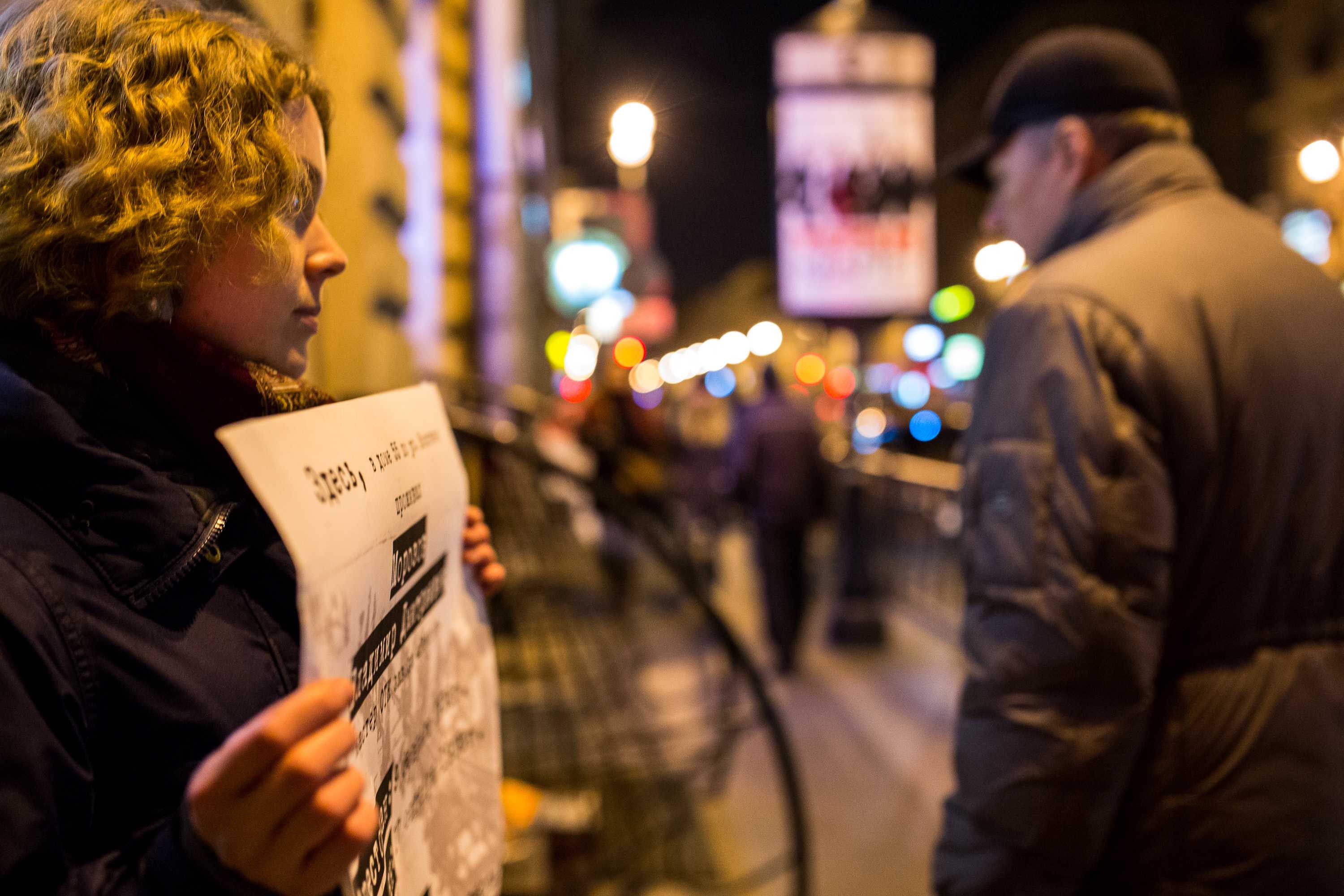
“Here, at Vosstaniya Street, 55, lived Vladimir Dmitrievich Morozov, a quality control inspector at the Etalon factory. Arrested February 9, 1938. Executed October 17, 1938.”

Remembering the Great Terror
David Frenkel
Special to the Russian Reader
November 1, 2015

On October 30, the Day of Remembrance of the Victims of Political Repressions, the Vesna (“Spring”) Movement organized a memorial event entitled Immortal Gulag, by analogy with the popular annual memorial event Immortal Regiment, held on Victory Day (May 9), during which crowds of people march through the streets of Russian cities bearing portraits of their relatives who fought in the Second World War.

As solo pickets are the only form of public protest in Russia that does not require prior permission from the authorities, and most people are reluctant to attend unsanctioned street protests, Vesna decided to held series of solo pickets on Vosstaniya Street in downtown Petersburg.

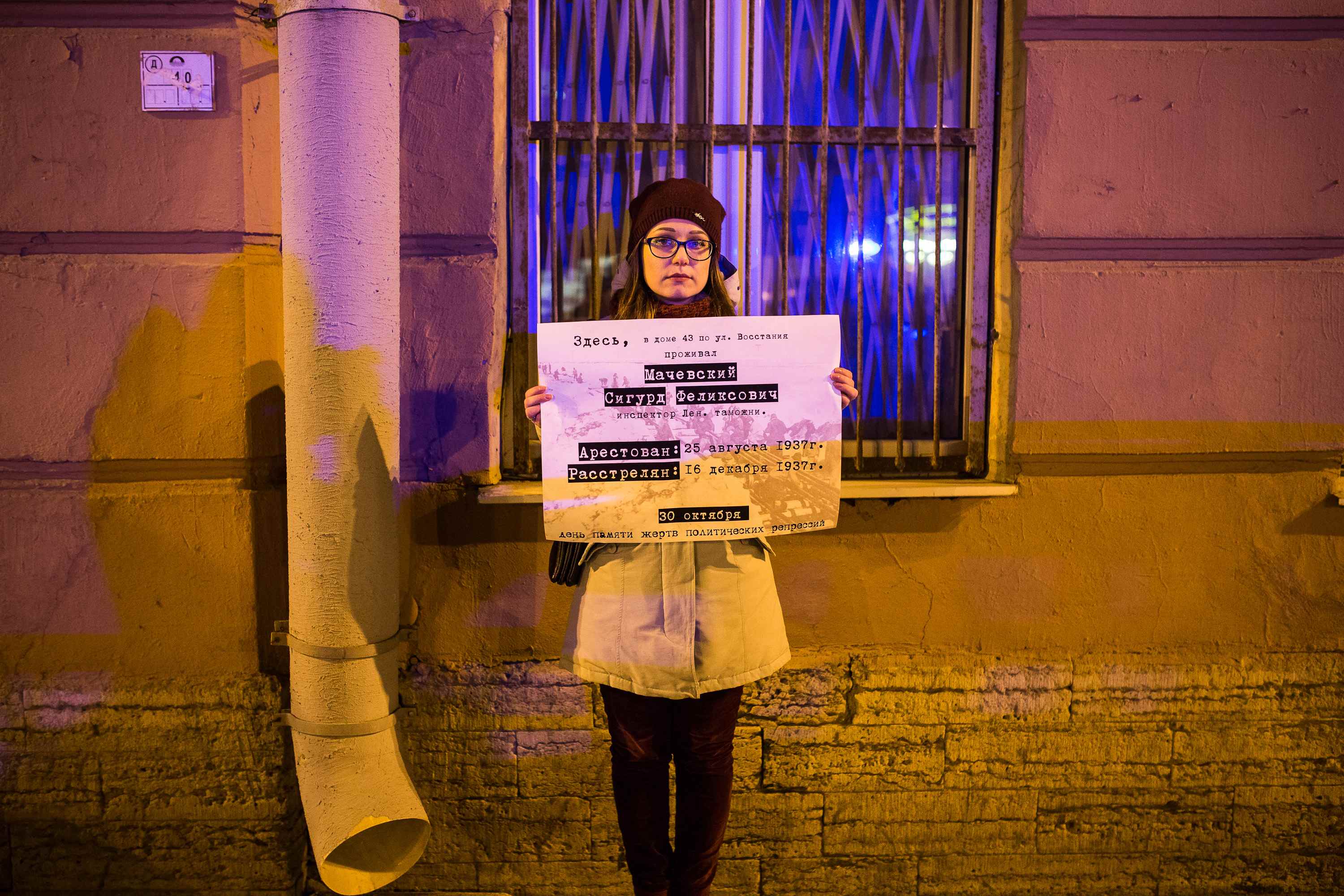
The activists stood in front of buildings holding posters bearing the name of somebody who had lived in the building and was arrested and executed during the Great Terror of 1936–1938.

gulag-2
“Here, at Vosstaniya Street, 21, lived Alexei Ivanovich Kirishev, a clerk at Bus Depot No. 3. Arrested September 14, 1937. Executed October 15, 1937.”

Earlier in the week, the website of the political party Velikoye Otechestvo (Great Fatherland), co-chaired by the notorious pro-Putin nationalist Nikolai Starikov, published an article dubbing the memorial event a “provocation”, and its organizers “a new generation of people willing to betray the interests of their Motherland for fine talk about democracy [a]nd green paper slips [printed] with portraits of American presidents.”

The article exhorted Petersburgers to avoid Vosstaniya Square on the evening of October 30. It reminded readers that “Russia [was] striking IS positions in Syria,” and there was thus “an extremely high risk of terrorist threats in major [Russian] cities,” they “should avoid large gatherings of people whenever possible.”

“Here, at Vosstaniya Street, 43, lived Sigurd Felixovich Machevsky, an inspector at the Leningrad Customs Service. Arrested August 25, 1937. Executed December 16, 1937.”

Despite the fact that the event had been heavily promoted, only thirty-some people took part, most of them Vesna activists and their friends.

Another disappointment was the fact that the posters contained the bare minimum of information about the Terror victims: their names, professions, and dates of birth and execution. There was only one line in small print at the bottom of each poster reminding passersby that October 30 was the Day of Remembrance of Victims of Political Repression.

A pack of torn-up posters found in a trash bin also raised eyebrows, triggering unpleasant associations with discarded “granddads on sticks” from certain Immortal Regiment events, which had provoked a storm of protest on Russia social networks.

gulag-3
“Here, at Vosstaniya Street, 2, lived Alexander Ivanovich Galanin, head of the special department at the Lepse Factory. Arrested August 4, 1938. Executed November 6, 1938.”

Most passersby who stopped to read the posters reacted positively. Some shared stories of their own families, while others nodded and said, “We support you.” One woman even handed out flowers to the activists.

As usual, other passersby sought to link the event with evil plots by the US State Department or the Ukrainian government, but there were few such people.

gulag-5

One standout among them, Andrey Yazov, posed as a journalist and attempted to “troll” the activists. He even subsequently posted a video on his page on the Russian social network VKontakte. In the video, entitled “Trolling Vesna,” he asks the activists whether the Terror victims had not, in fact, been criminals. He clearly loses his interest when he learns that Soviet authorities later exonerated all of them.

gulag-6
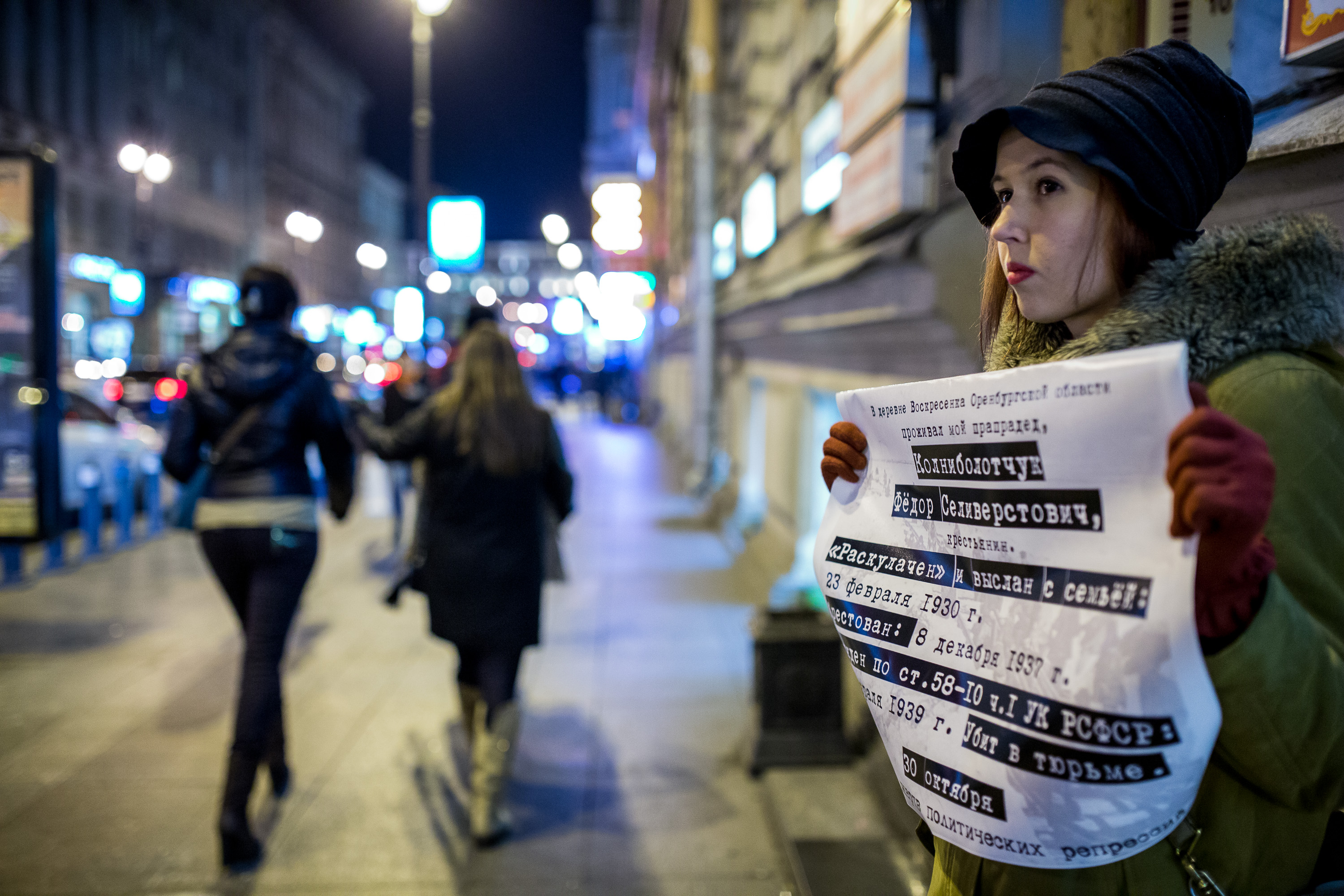
“My great-grandfather, Fyodor Seliverstovich Kolnibolotchuk, a peasant, lived in the village of Voskresenka, Orenburg Region. He was ‘dekulakized’ and exiled along with his family on February 23, 1930. Arrested December 8, 1937. Convicted under Article 58-10.1 of the RSFSR Criminal Code [anti-Soviet and counter-revolutionary propaganda and agitation] on February 10, 1939. Killed in prison.”

He does, however, reveal the sensitive fact that not all of the activists studied the biographies of the people whose posters they held. On the other hand, two participants held posters bearing the names of their own relatives.

gulag-7
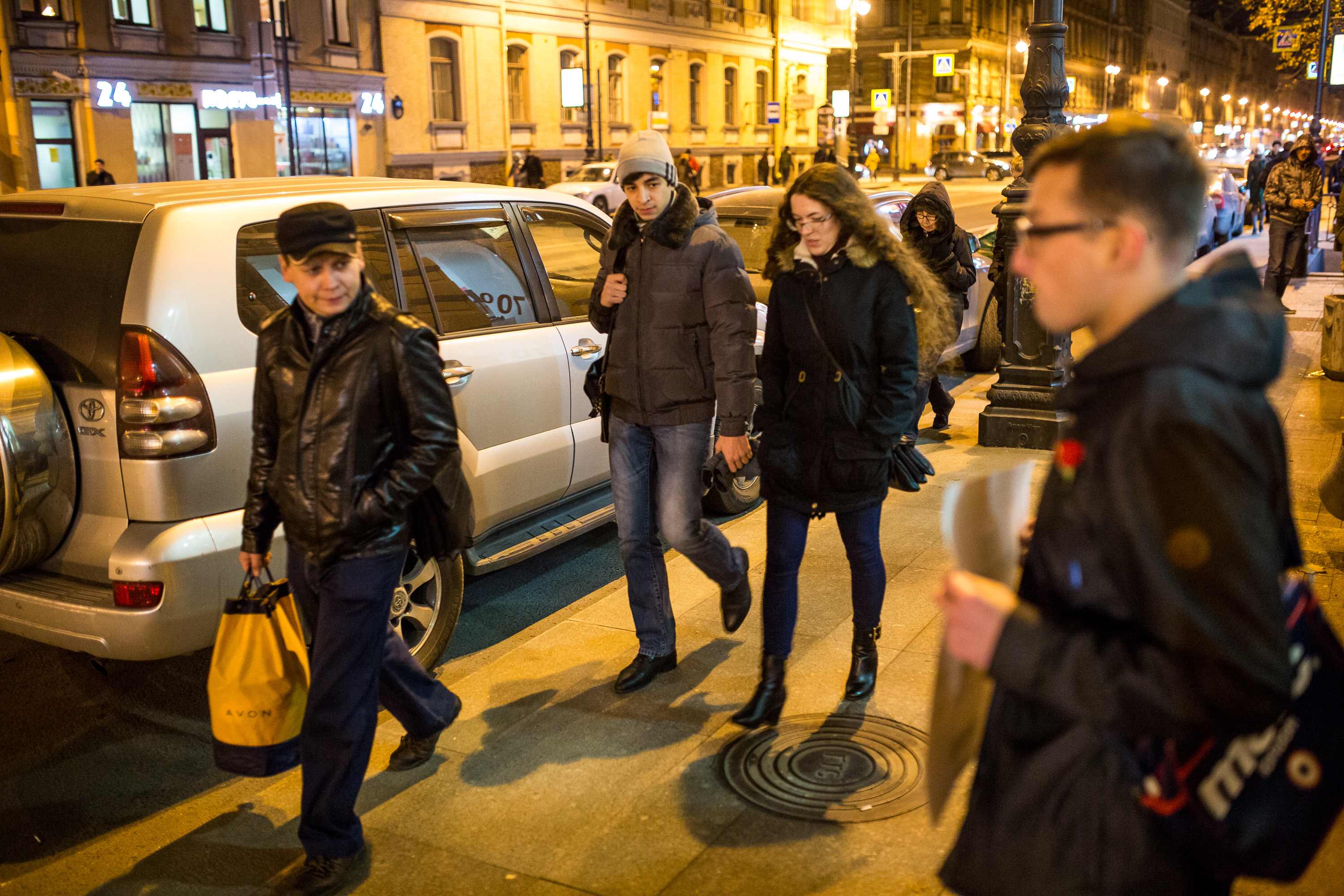
As during other such memorial events, most passersby sped past the activists without visibly paying any attention to them.

The police did not interfere. They merely asked the activists, “Why don’t you stay at home?”

All photos by and courtesy of David Frenkel. The Memorial Research and Information Centre in Petersburg has recently launched a searchable online version of its Leningrad Martyrologue, a catalogue of local victims of the Great Terror (in Russian), in concert with the Last Address project. Curious readers should also look at Laboratorium 1 (2015), Gulag Legacy: Spaces of Continuity in Contemporary Everyday Practices, ed. Olga Ulturgasheva (in Russian and English), published by the Centre for Independent Social Research (CISR), recently declared a “foreign agent” by the Russian Ministry of Justice.

Remembering (and Forgetting) Beslan

Remembering (and Forgetting) Beslan
David Frenkel
Special to the Russian Reader
September 9, 2015

On September 3, several dozen Petersburgers came to Malaya Sadovaya, a pedestrian street abutting the city’s main thoroughfare, Nevsky Prospect, to remember the victims of the September 2004 Beslan school siege.

beslan-1

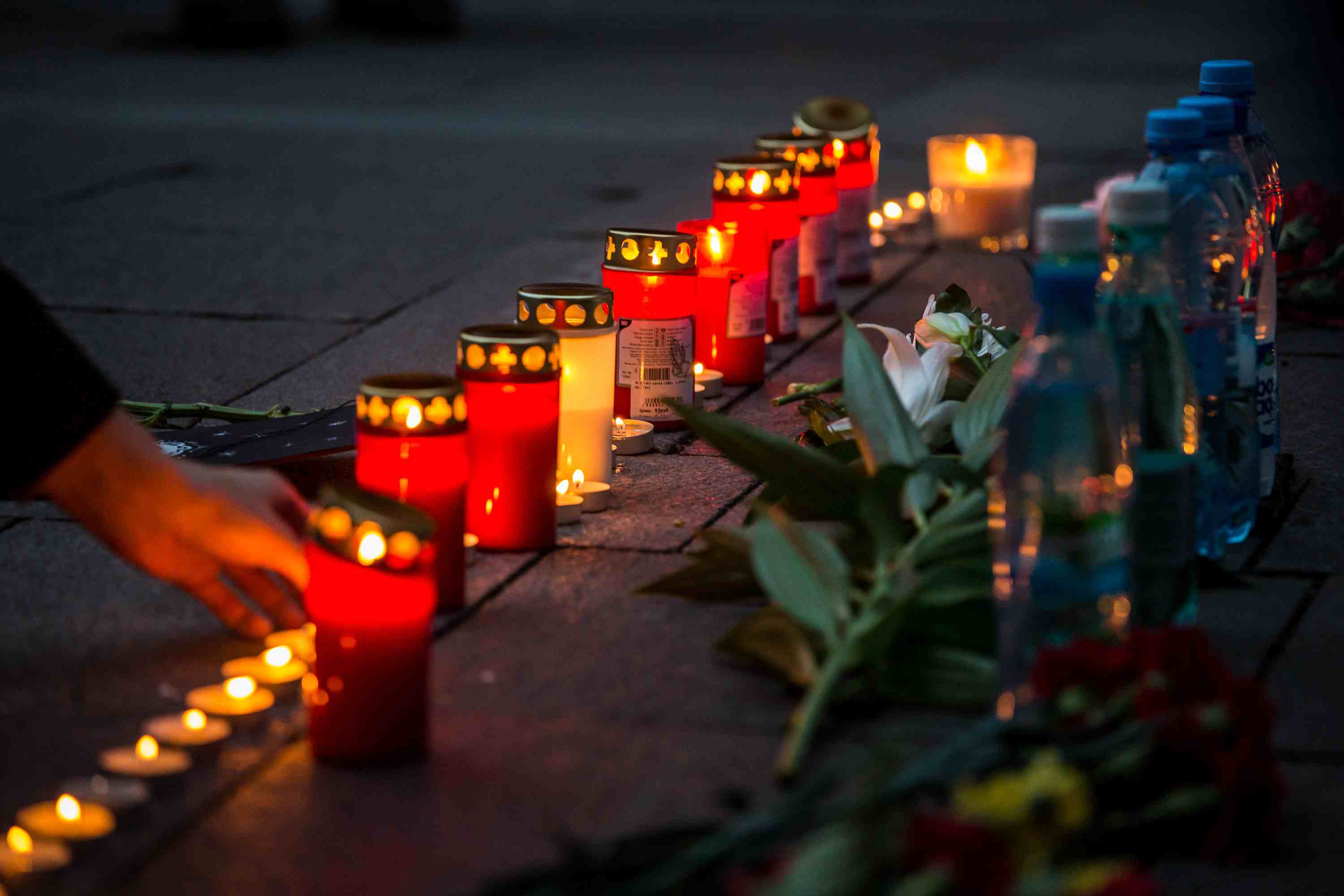
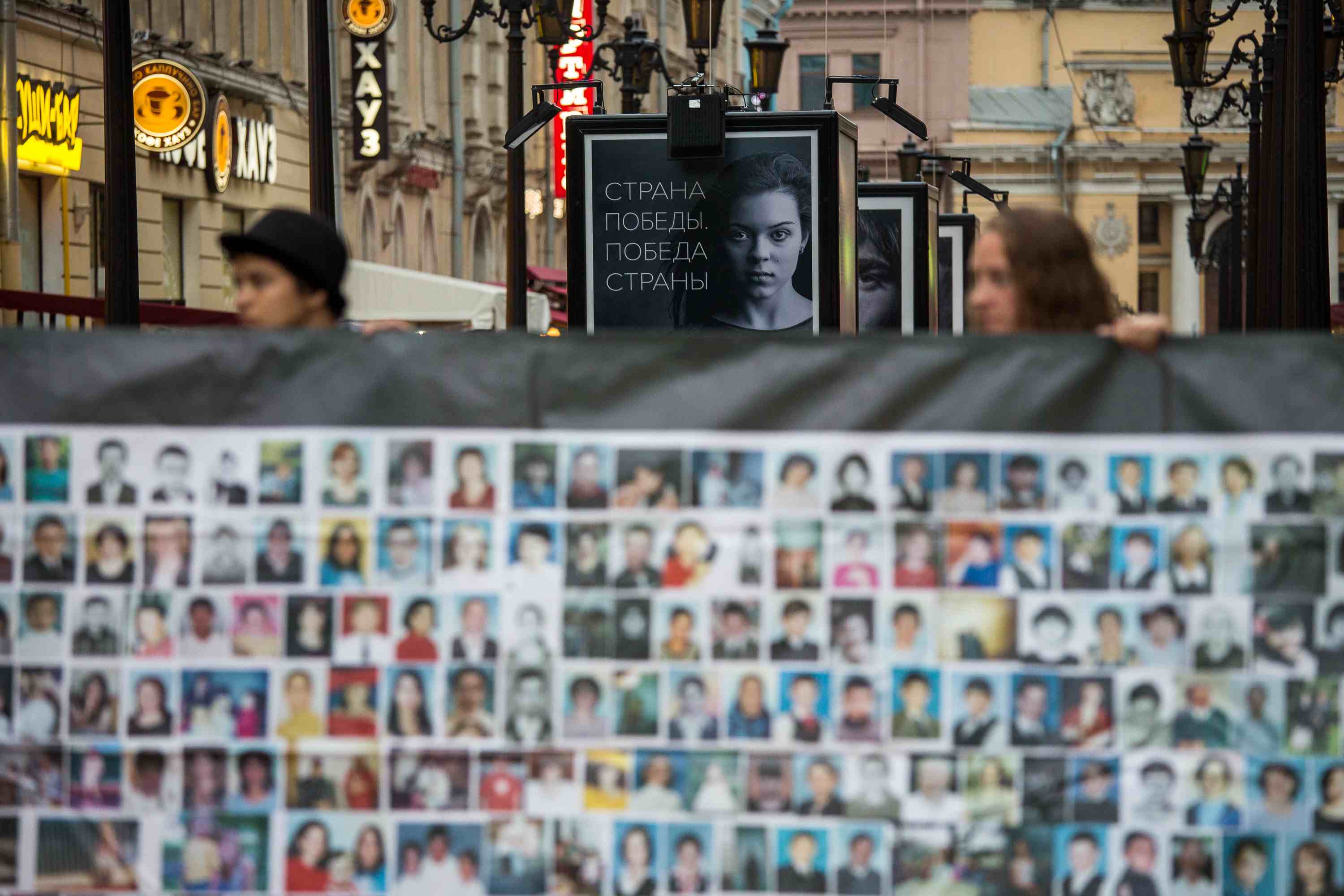
Activists lit candles and rolled out a banner featuring photographs of 334 victims. People who attended the event placed flowers and water bottles in front of the improvised memorial.

beslan-2

The number of people who came on purpose to remember the most devastating terrorist attack in Russian history was few. Most passersby who reacted to the memorial made scornful or indifferent comments such as “Again…” and “Ah, it’s Beslan.”

beslan-3

Though the event had not been coordinated with the authorities, police did not interfere.

beslan-4
Country of Victory, the Country’s Victory, the title of an open-air photo exhibition featuring portraits of Russian Olympic champions and Vladimir Putin, was visible behind the mourners.

All photos by and courtesy of David Frenkel

Petersburgers Rally Round Demolished Mephistopheles

Petersburgers Protest Destruction of Mephistopheles Bas-Relief
August 30, 2015
Yodnews.ru

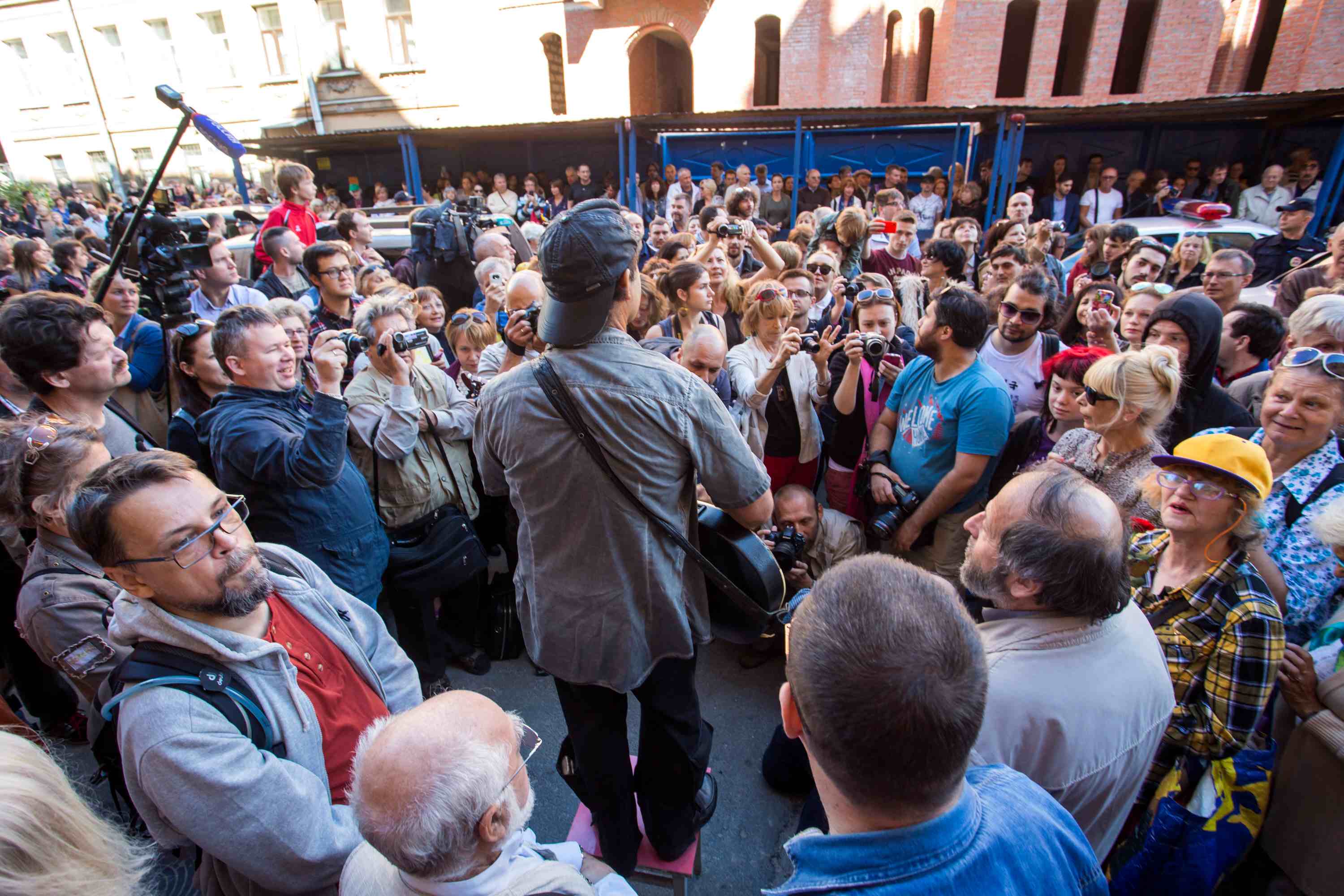
Novaya Gazeta reports that a popular assembly to protest the destruction of a bas-relief featuring an image of Mephistopheles took place today, August 30, on Lakhtinskaya Street.
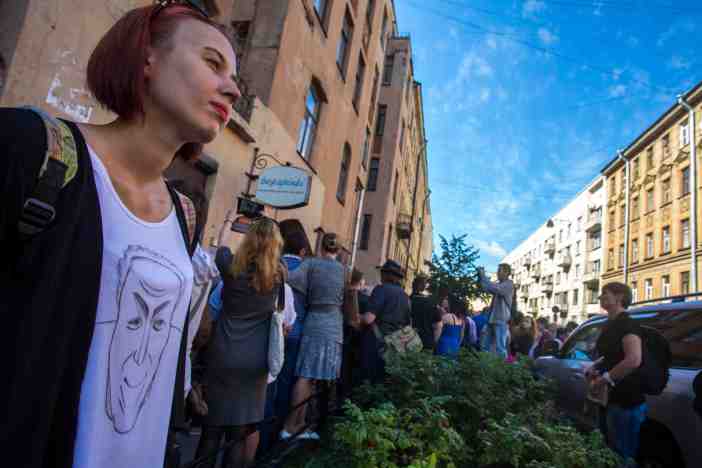
mef-1Protester with a handmade Mephistopheles t-shirt at Sunday’s rally

“This is not a rally; we are not using amplifiers and posters. People have just come out to show how they feel about vandalism,” said Alexander Kobrinsky, a deputy in the St. Petersburg Legislative Assembly.

About five hundred people attended the rally. They attached a temporary banner with a photo of the bas-relief to the facade of the building from which it had been knocked down.

The people who attended the assembly sang Mikhail Novitsky’s song, “This is our city, this is our city, / We will stand up for it! / This is our city, this is our city, / We will defend it from wild vandals!”
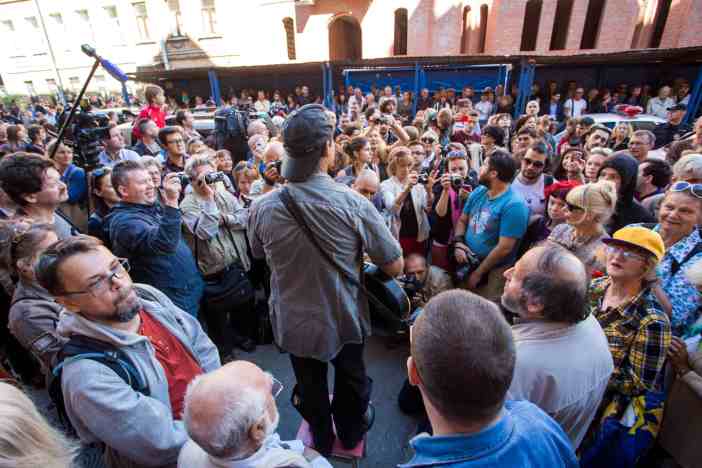
mef-nov crowdFolk singer and activist Mikhail Novitsky leads protesters in song

They also played a recording of Feodor Chaliapin’s rendition of the aria “Sérénade de Méphistophélès,” from Gounoud’s opera Faust, on their cell phones.

The Mephistopheles bas-relief on Lakhtinskaya was demolished on August 26. A petition has been posted on Change.org demanding that those involved in the sculpture’s destruction be brought to justice. It has gathered nearly 2,300 signatures of the necessary five thousand. [As of this writing, 4,887 people had signed the petition — TRR.]

__________

Mephistopheles Facade Facing Orthodox Church Taken Down In St. Petersburg
Anna Dolgov
August 27, 2015
The Moscow Times

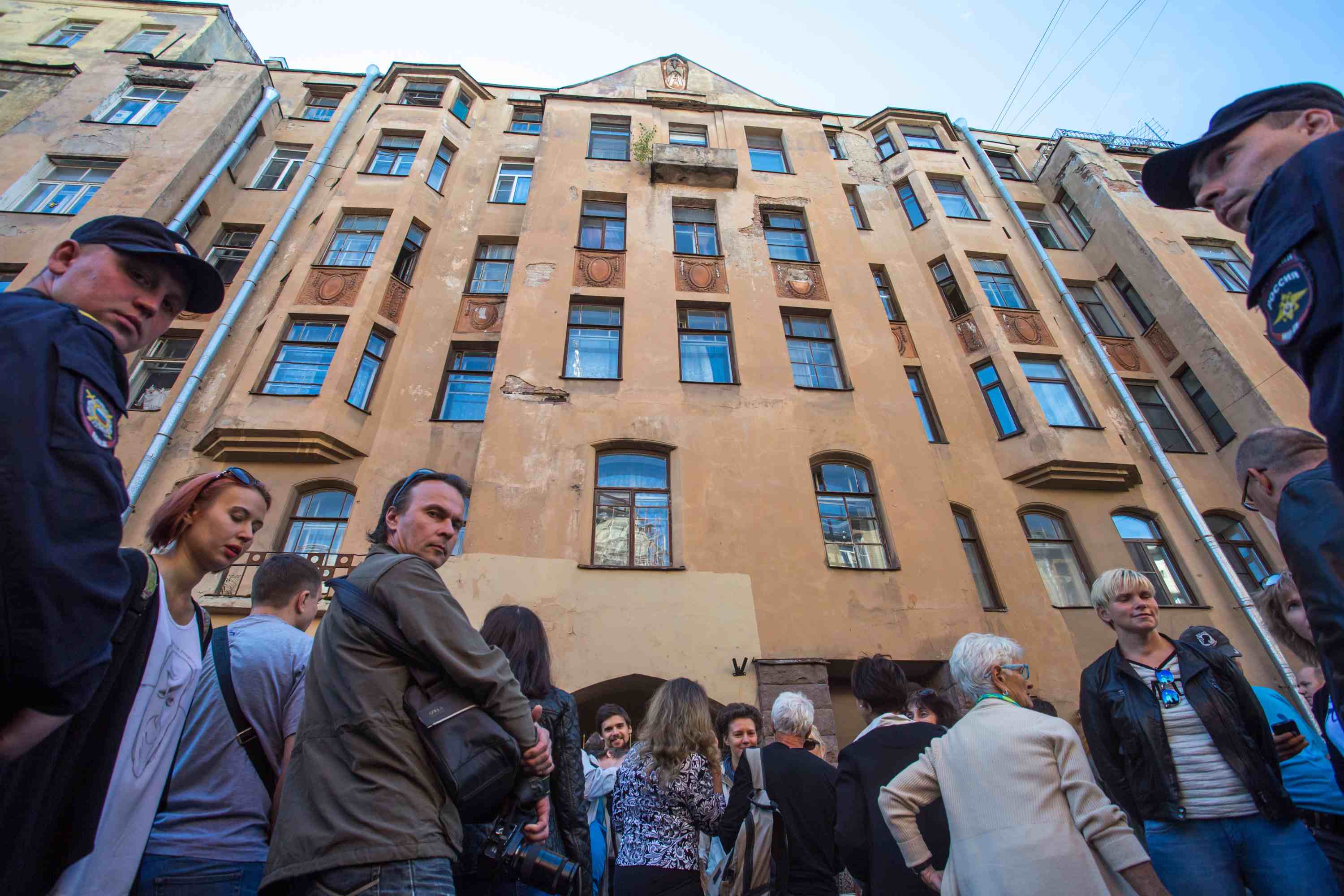
A 100-year-old bas-relief depicting the mythical demon Mephistopheles has been removed from the facade of a historical building in St. Petersburg overlooking the nearby construction site of a new Orthodox church, local inhabitants said.
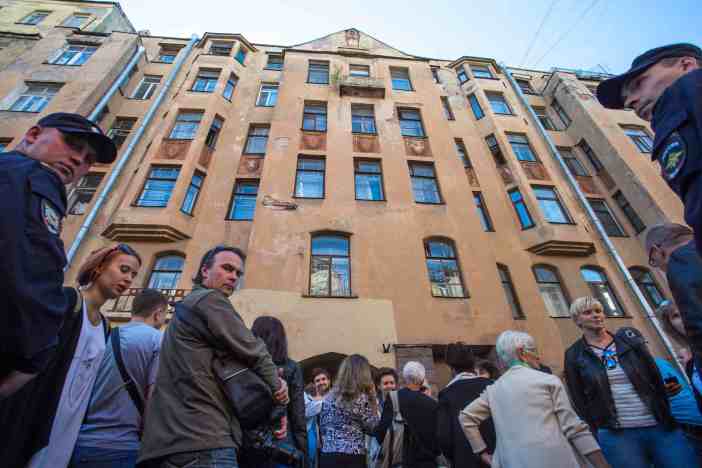
mef-houseMephistopheles House sans Mephistopheles

Mephistopheles is a mythical demon that appears as the devil in Johann Wolfgang von Goethe’s play Faust. The bas-relief of the character had been a feature of one of St. Petersburg’s minor landmarks, a building on Lakhtinksaya Street known as the House with Mephistopheles.

Local news outlets and social media users reported that the relief was removed from the building without explanation on Wednesday. According to one Facebook user, historian Dmitry Bratkin, the house was designed by 19th and early 20th century architect Alexander Lishnevsky.

“Naturally, the monument was under protection,” Bratkin said. “Or had been. Fifteen minutes ago, Mephistopheles was knocked off the facade.”

One resident of the building, Kirill Alexeyev, told independent newspaper Novaya Gazeta that “workers showed up at 10 in the morning, did not introduce themselves, and did not say who had sent them.”

Instead, the workers asked the building’s residents to move their cars away from the building to avoid being damaged by falling plaster, and then proceeded with the removal of Mephistopheles, Alexeyev said.

“I said: What have you done, this is after all a monument protected by the state,” he said, Novaya Gazeta reported. “They responded: Not to worry, it is old and dilapidated, and it will be restored in plaster.”

The promise of recreating a version of the bas-relief in plaster indicated that the demolition had been a “planned action,” supposedly approved by the authorities, instead of a grassroot stunt by activists displeased by the sight of a mythical demon, Alexeyev suggested.

However, a spokesperson for the city’s architectural monument preservation department, known by its Russian acronym KGIOP, denied any knowledge of the incident, Novaya Gazeta reported.

The removal of the historical bas-relief has also prompted protests by some local lawmakers. St. Petersburg municipal legislator Boris Vishnevsky has sent a complaint to KGIOP, while his fellow lawmaker Alexander Kobrinsky said he would ask police to open a criminal investigation on charges of destruction of cultural heritage sites, St. Perersburg’s Fontanka news agency reported.
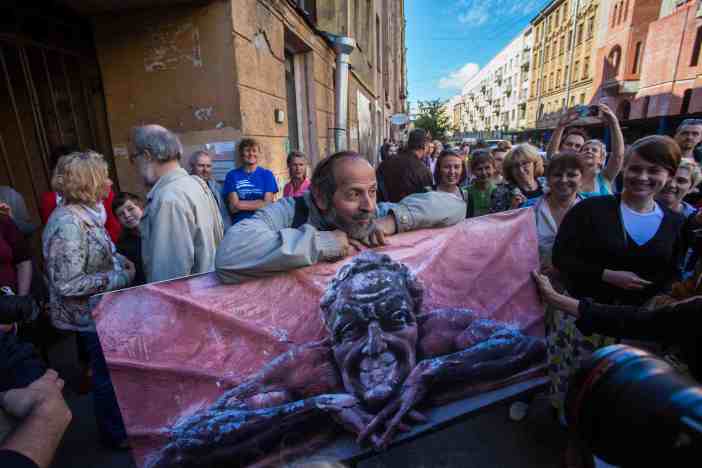
mef-vishPetersburg legislator Boris Vishnevsky poses with photo reproduction of Mephistopheles bas-relief

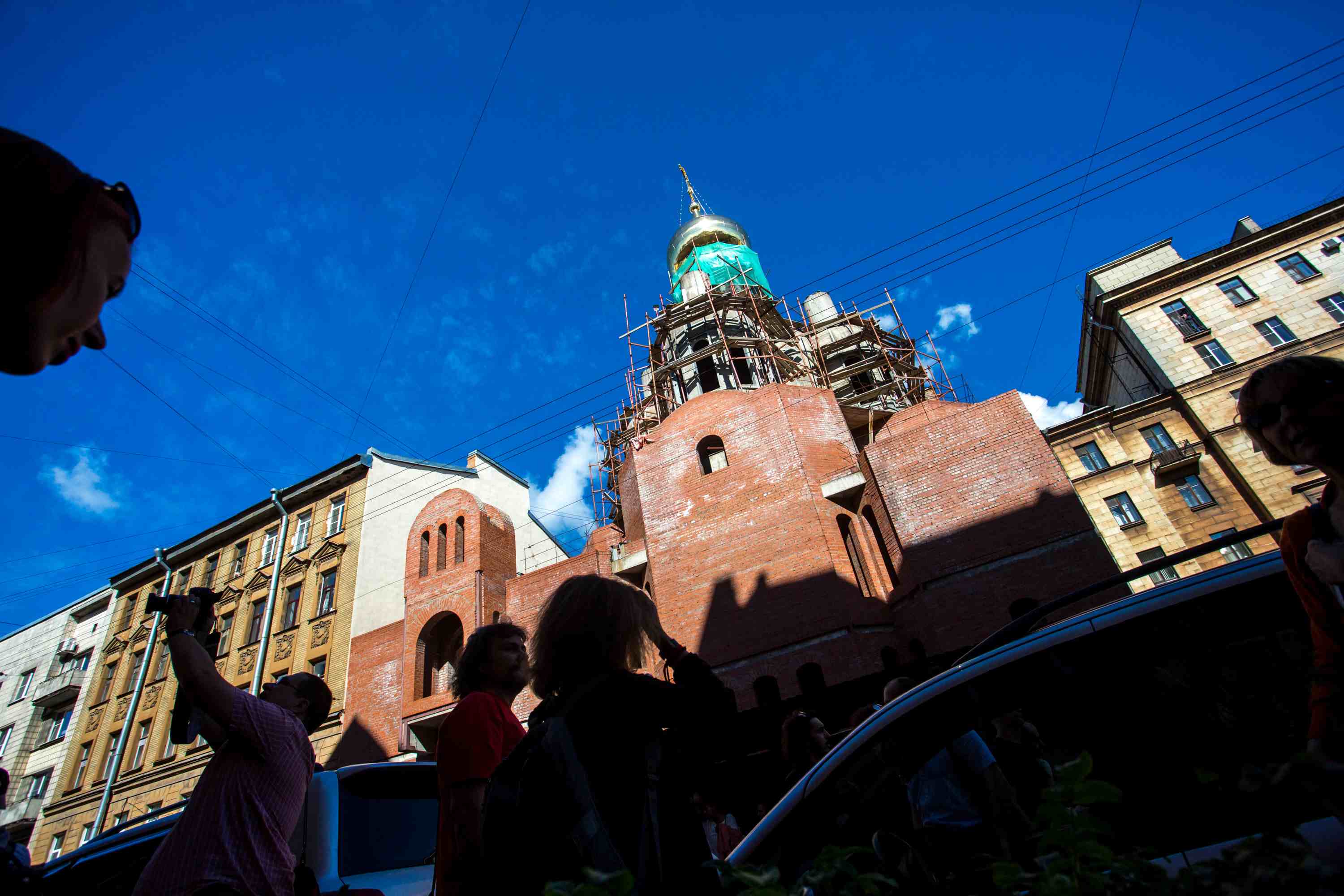
Some commentators also claimed that the removal of sculpture might be connected to the construction of an Orthodox church that would face the House with Mephistopheles.

“A couple of days ago, a cross was placed on the roof of the church that is under construction across [from the building],” Bratkin wrote on his Facebook page. “Yesterday, some sprightly people showed up and took photographs of the facade with the Mephistopheles, and today at 3 in the afternoon, a worker hung down from the roof and — whack, whack, whack.”
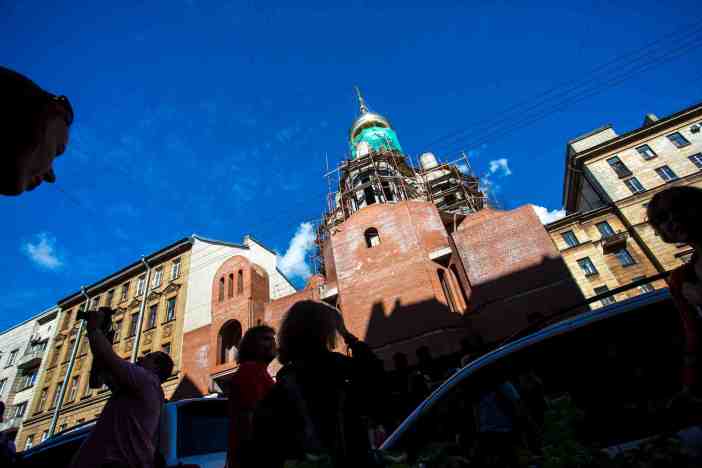
mef-churchRussian Orthodox church currently under construction opposite Mephistopheles House

Natalya Levina, another local woman, said her neighbors had spotted “people from the church” looking around and inquiring about the “demon,” the Metro news agency reported.

Historical preservation activists have asked police and the construction firm that is building the church about who had authorized removing the Mephistopheles image, Levina was quoted as saying. Both organizations denied having any knowledge of who authorized its removal, she said, according to the report.

Lishnevsky, the architect, died during World War II after being evacuated to a hospital in Yaroslavl — a historical city 250 kilometers to the northeast of Moscow. Much of his work survived the devastation of the war and the secular policies of the Soviet Union.

The Mephistopheles bas-relief was created in 1910-1911, Fontanka reported.

All photos by and courtesy of David Frenkel. First article translated by The Russian Reader

Paratroopers Day: LGBT Protest on Palace Square in Petersburg

LGBT Activists Protest on Palace Square on Paratroopers Day
David Frenkel
Special to The Russian Reader
August 5, 2015

Local LGBT activists bearing flags and posters took to Saint Petersburg’s Palace Square on Sunday, August 2, Russian Paratroopers Day, to defend their rights.

In August 2013 and 2014, young local LGBT activist Kirill Kalugin held solo protests on Palace Square on Paratroopers Day, but he left Russia in late November 2014, applying for political asylum in Germany.

This year, LGBT activists tried to get permission for an event but were turned down three times by city officials.

Yuri Gavrikov, leader of the local LGBT organization Ravnopravie (“Equal Rights”) thus decided to go to Palace Square alone with an LGBT flag. He was arrested in the morning, however, for “swearing in public” as he was riding his bicycle toward the city center.

Nevertheless, several of his comrades came to Palace Square sporting flags and posters, and demanding Gavrikov’s release.

palace-1

The first to take to the square was activist Olga Panova. She unfurled the LGBT rainbow flag before being arrested by the police a few minutes later.

palace-2

Panova managed to pass the flag to another activist, Valery Ugarov, who was immediately arrested as well.

Policemen claimed the arrests had been made at the “behest of citizens,” although at the time, around two o’clock in the afternoon, only a few paratroopers were still left on Palace Square celebrating their holiday. They paid no attention to the LGBT activists.

Journalists from state media outlets approached the paratroopers and asked them their opinion of the protest, making no secret of their own disgust and dubbing the activists “drunk.” The paratroopers, however, merely dubbed the protest a “provocation” and avoided engaging in any violence towards the activists.

The next activist to take to the square with the flag was Mikhail Gerasimov from the Alliance of Heterosexuals and LGBT for Equal Rights. Police also detained him.

palace-3

Police initially charged all the detained activists with “promoting homosexuality among minors,” but later dropped the charges for lack of evidence, claiming that a child who had been strolling through the square with his mother had taken no interest in the flag’s “meaning.”

Police released all the activists later in the day.

As Gerasimov was being arrested, activists Alexei Nazarov and Alexei Sergeyev emerged from the crowd holding posters that read, respectively, “Free Yuri Gavrikov,” “Three ‘rejections’ from the Smolny [Petersburg city hall]: lawlessness and discrimination of Russian citizens,” and “‘Let us fight to free the world, to do away with national barriers, to do away with greed, with hate and intolerance.’ Charlie Chaplin.” (The last is a quotation from the Jewish Barber’s speech in Chaplin’s 1940 film The Great Dictator.)

palace-4

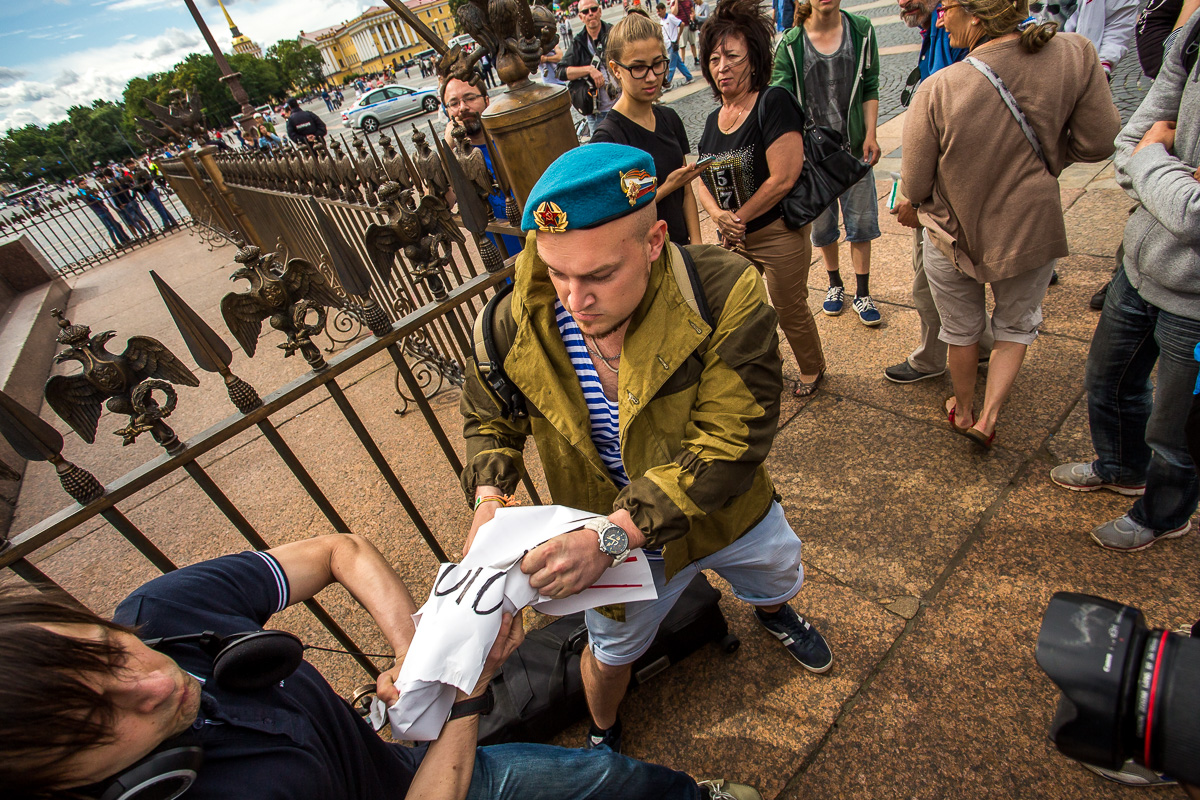
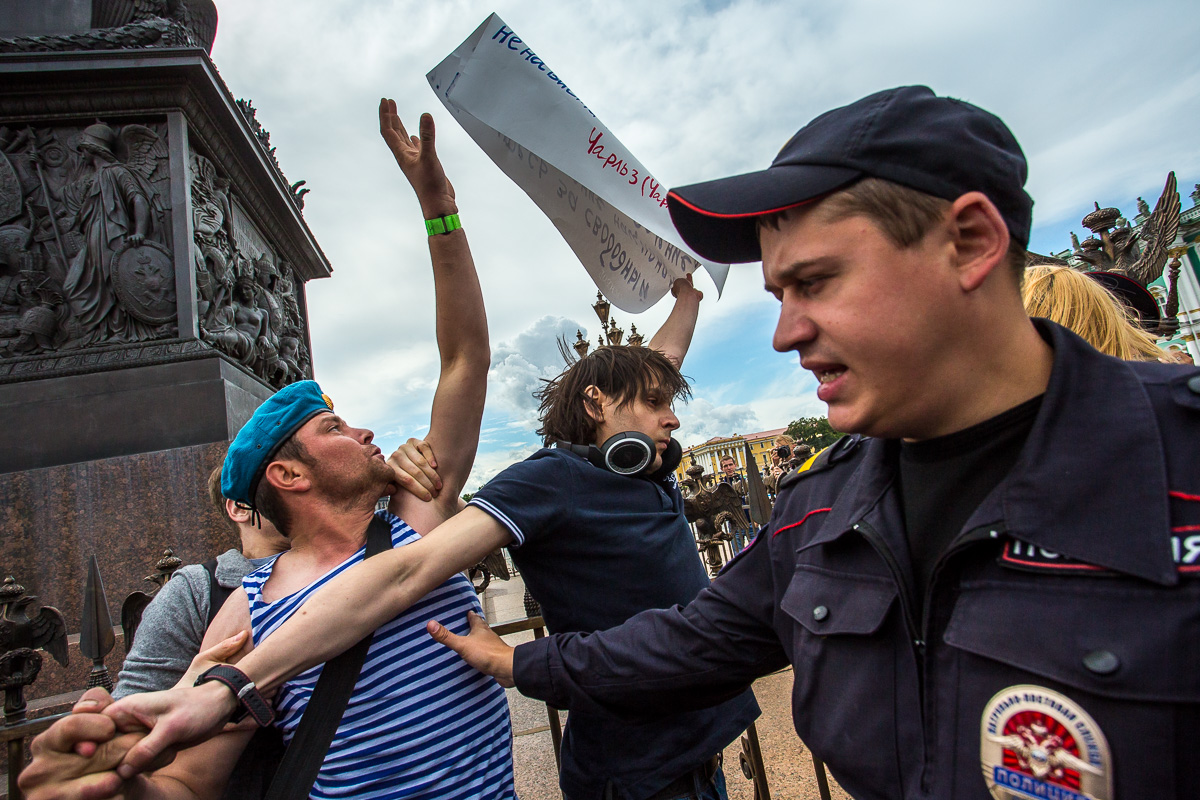
A few men wearing the trademark baby-blue berets and navy blue-and-white striped sleeveless t-shirts of the Russian paratroopers and casual clothing suddenly rushed Nazarov and Sergeyev, grabbing their posters and ripping them up.

palace-5

The LGBT activists kept producing new posters, and the would-be paratroopers ultimately tore up five posters.

palace-6

Police ignored the assaults on the activists, even laughing as they tried to defend themselves.

palace-7

No one from either party to the scuffle was arrested.

All photos by and courtesy of David Frenkel

“Forgive Us, Netherlands”: Petersburgers Remember MH17 Victims One Year On

Petersburgers Remember MH17 Victims One Year On
David Frenkel
Special to The Russian Reader
July 18, 2015

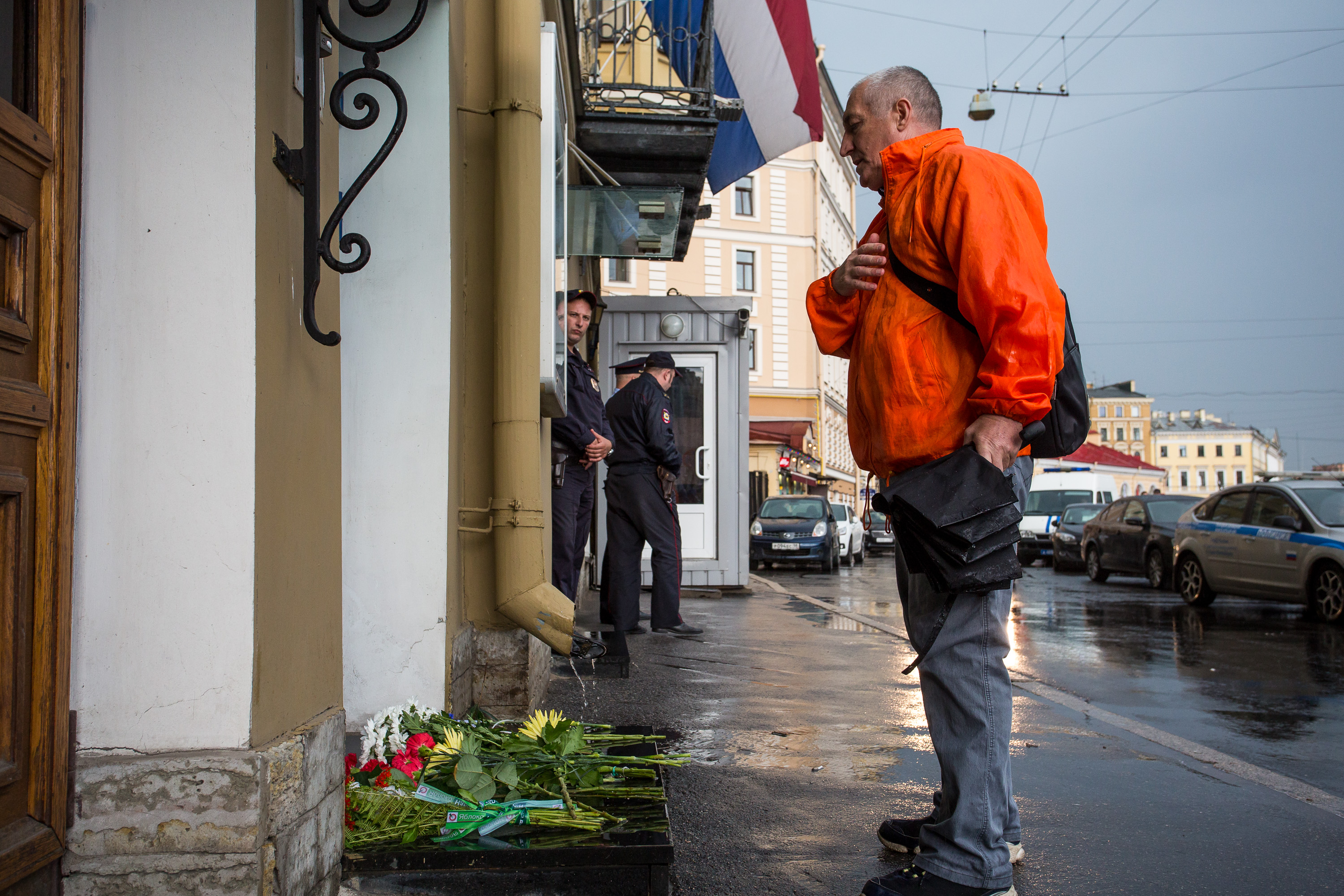
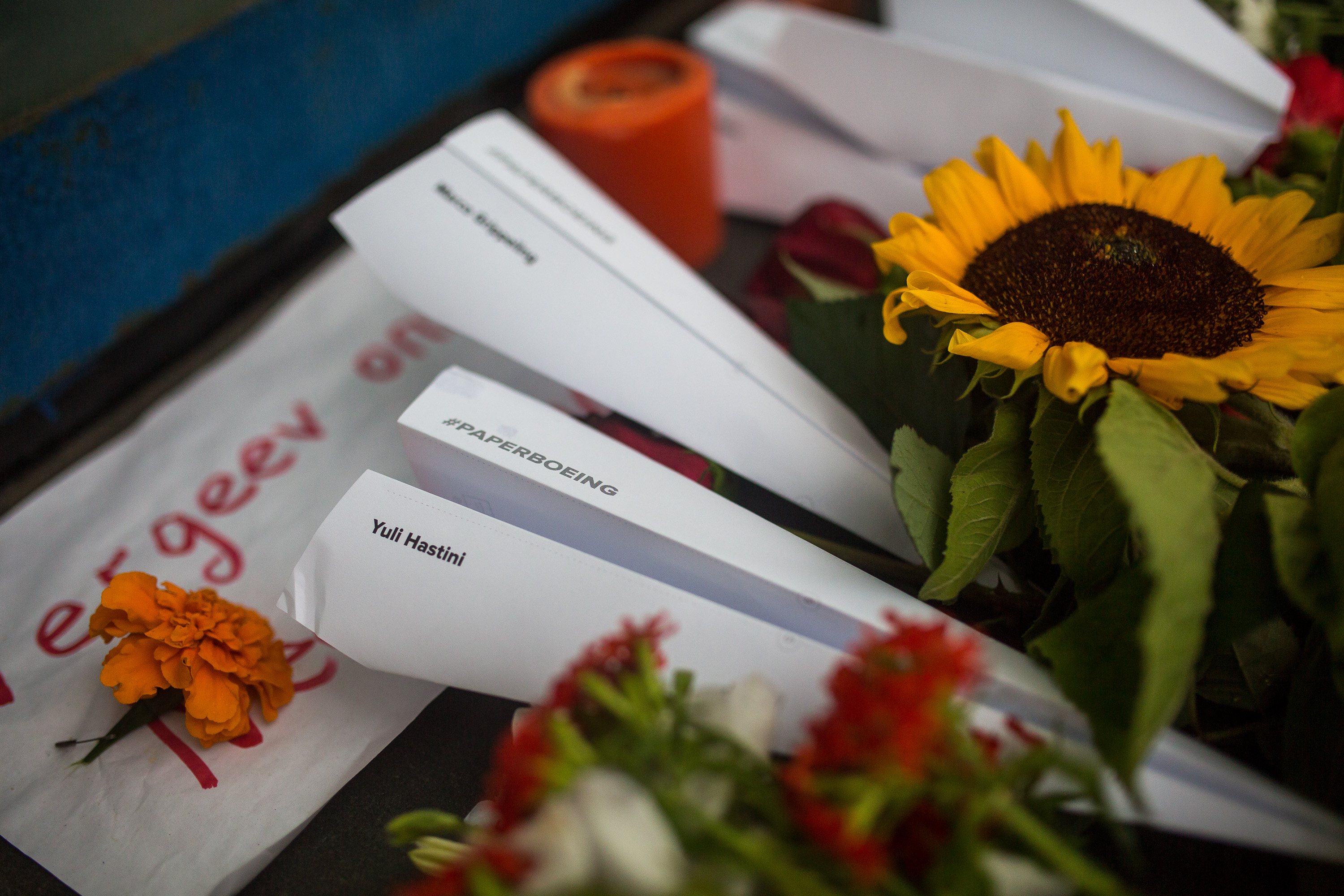
Despite heavy rain and hail, several dozen Petersburgers came to the Netherlands Consulate General in the city yesterday, July 17, to lay flowers and paper planes in memory of the victims of Malaysia Airlines Flight 17, which crashed near Torez in Donetsk Region, Ukraine, on July 17, 2014, after being shot down, killing all 283 passengers and fifteen crew members on board. Two thirds of the passengers were Dutch nationals. The plane was en route from Amsterdam to Kuala Lumpur.

IMG_5820A similar memorial took place in Moscow, where Foreign Affairs Minister Sergey Lavrov was the only Russian official to bring flowers.

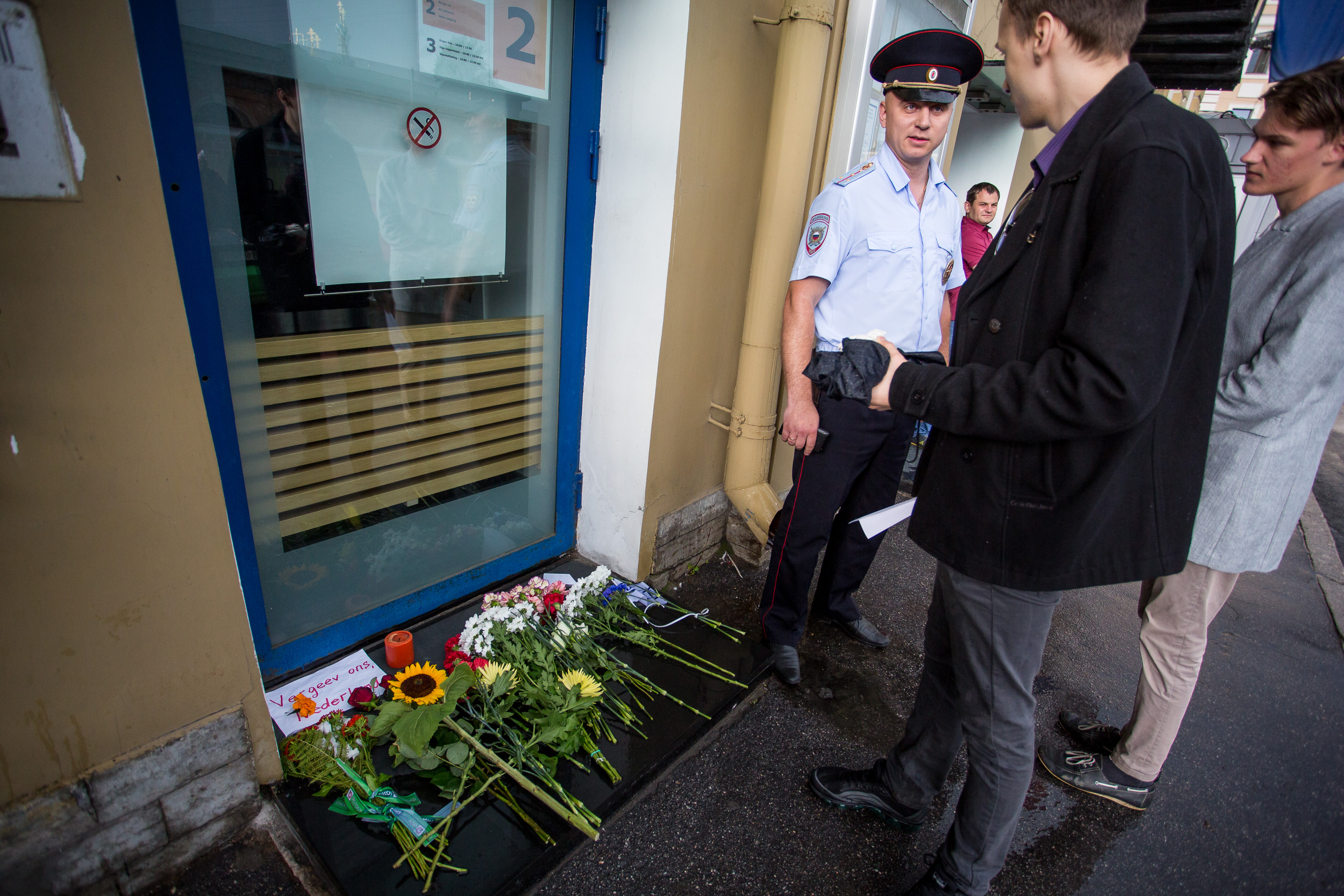
Despite the meager attendance in Petersburg, three regular police cars arrived to complement the usual consulate guards. Police tried to forbid the mourners from leaving the paper planes, printed with the names of the victims, dubbing them “garbage.”

IMG_5850The paper planes were part of an action, sponsored by Open Russia, entitled #PAPERBOEING. Eventually, the mourners got their way and were allowed to leave the planes.

IMG_5883Police also checked documents of an elderly man who came to the memorial wearing a handmade hat with the Dutch phrase “Vergeet ons, Nederland” (“Forgive us, Netherlands”) printed on it. They suspected him of attempting to hold a one-person picket.

IMG_5847

All photographs by and courtesy of David Frenkel

Petersburg Activists Protest Proposed Nuclear Waste Storage Facility

Petersburg Activists Protest Proposed Nuclear Waste Storage Facility
David Frenkel
Special to The Russian Reader
July 16, 2015

Yesterday, July 15, activists protested the proposed construction of Russia’s largest radioactive waste storage facility in Sosnovy Bor, a town eighty kilometers west of Petersburg that also hosts the Leningrad Nuclear Power Plant. A second plant, Leningrad Nuclear Power Plant–2, is also currently under construction in the town.

The protest took place outside the Mariinsky Palace, seat of the Saint Petersburg Legislative Assembly.

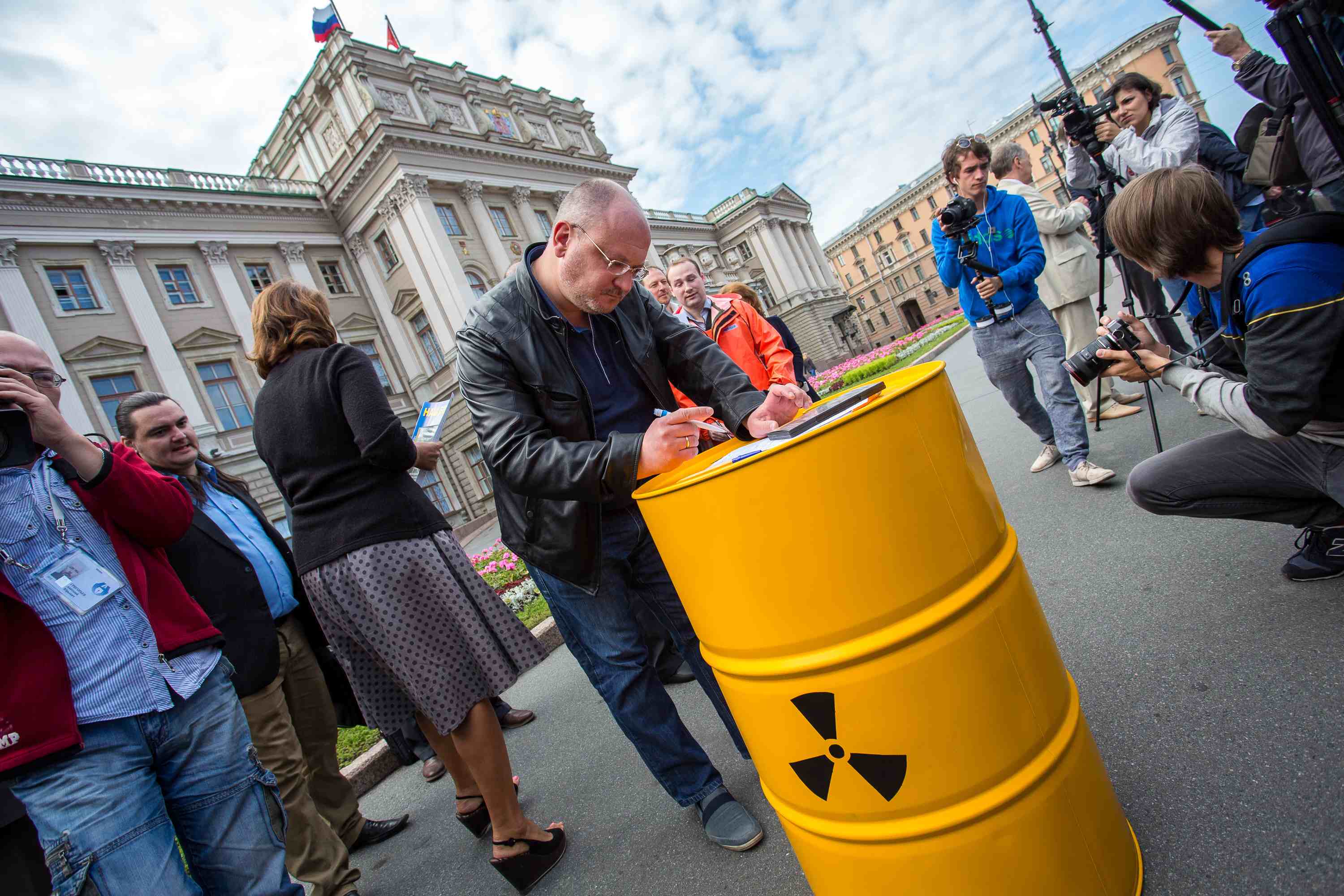
Garbed in hazmat suits, activists from the Beautiful Petersburg and Beautiful Leningrad Region movements brought a barrel to the steps of the palace. It was one of the 500,000 barrels of nuclear waste slated for burial in Sosnovy Bor.

david-nuke-1“#IOPPOSETHERWBF” (Radioactive Waste Burial Facility)

State Duma deputy Nikolai Kuzmin, Petersburg Legislative Assembly deputies Maxim Reznik and Irina Ivanova, and members of the organizations Green Front, Green World, and Native Shore joined the activists. They signed an appeal asking President Putin to halt construction of the storage facility.

david-nuke-3Petersburg Legislative Assembly Deputy Maxim Reznik signing appeal to president

The protest did not come off without a provocation. A man who identified himself as a journalist from the “president’s creative special forces” accused the activists, including Kuzmin, of “working on behalf of the west” and “receiving foreign grants.”

In June, the Russian Supreme Court approved the placement of the disposal facility in Sosnovy Bor. Opponents of the project have pointed to the fact that, according to Russian federal standards, such facilities should be built at a considerable distance from populated areas, bodies of water, and recreational areas.

Earlier in the day, Rosatom had announced that it would change the concept of the waste storage facility because it was economically unfeasible. It was not yet known what the new project would look like.

As of this writing, over 47,000 signatures have been collected on a petition against the waste facility posted on Change.org.

david-nuke-4The Leningrad Nuclear Plant has been in the news on two other occasions in recent weeks.

In early July, a building supervisor climbed a 110-meter-high construction crane and refused to come down until back wages owed to him and his colleagues were paid.

On July 4, a seventy-ton piece of equipment, a protective tube unit, fell while being lifted at the construction site of Leningrad Nuclear Power Plant–2 and was damaged beyond repair. In addition to increasing costs, the accident is likely to delay the project completion date. The plant was initially to be launched in 2013. Later, the launch date was postponed to late 2015. This latest accident may delay the launch even further.

All photographs by and courtesy of David Frenkel

Summer of Friendship Campaign Continues in Petersburg

Summer of Friendship Campaign Continues in Petersburg
David Frenkel
Special to The Russian Reader
June 29, 2015

The Vesna (“Spring”) Movement has continued its Summer of Friendship campaign for peace between Russia and Ukraine.
vesna-3

Summer of Friendship postcard

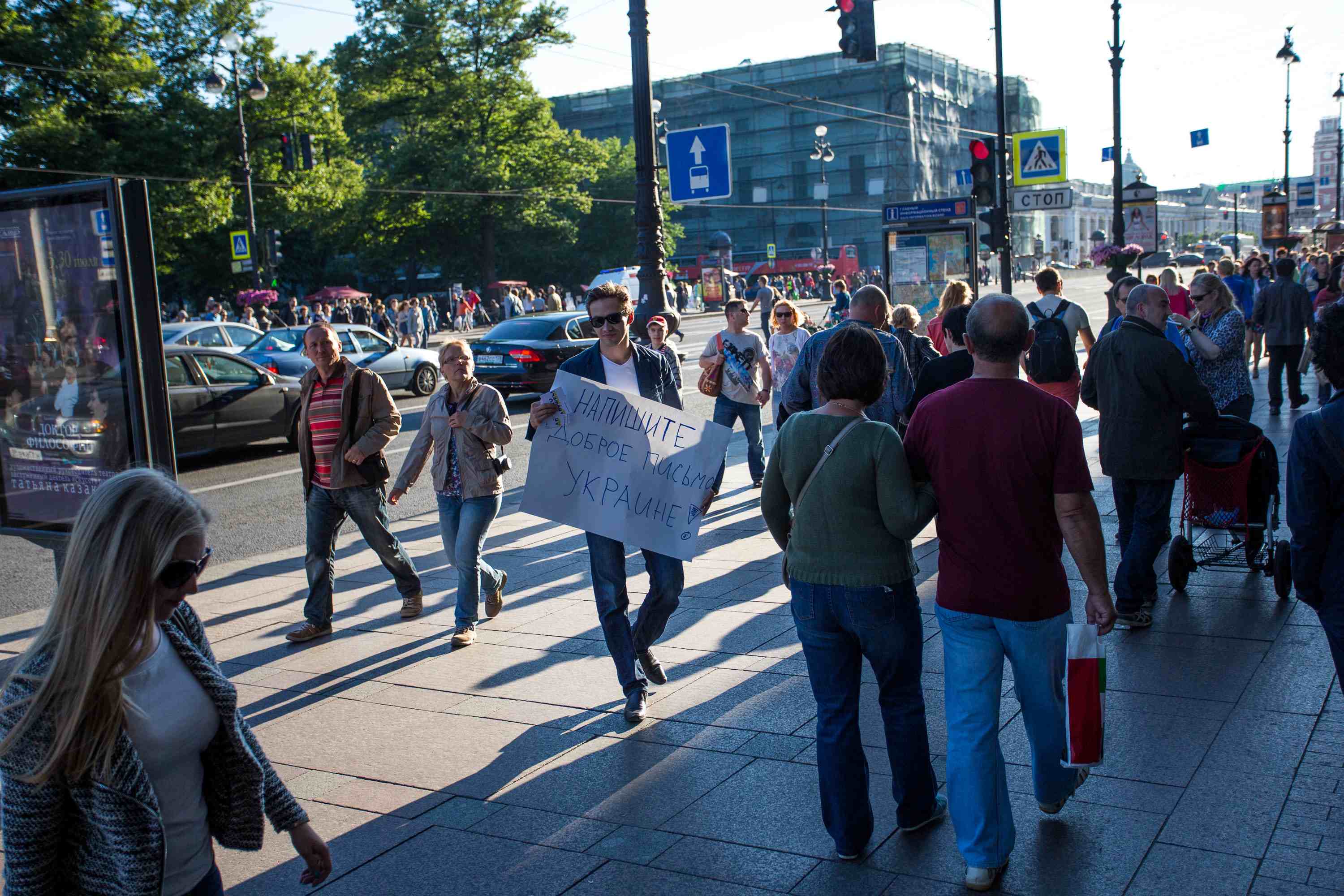
Yesterday, Sunday, June 28, Vesna activists handed out blank postcards on the corner of Nevsky Prospect and Malaya Sadovaya Street asking people to write kind messages to Ukrainians.

The organizers claimed that members of the public dropped over two hundred “freedom postcards” into a special mailbox during the event. Our correspondent estimated that the number of postcards submitted was closer to one hundred.

vesna-2

“Russian Post”

“All the letters will be sent shortly to the addressees. Our colleagues in Kyiv and other cities will help us deliver them. We want to remind both Russians and Ukrainians that we are a fraternal people and must remain this way. We have many things in common: history, culture, family connections—everything but politicians. And we must overcome hatred together!” Vesna’s press secretary Anton Gorbatsevich explained in a letter to our correspondent.

vesna-1

Similar actions took place in Krasnodar and Tomsk, and another such event has been planned for Voronezh in a few days.

vesna-5

All photographs by and courtesy of David Frenkel

Lenin, God of Water

Eight People Detained at Water Battle in Petersburg
June 7, 2015
Yodnews.ru

On June 6, Petersburg police detained eight people on suspicion of theft of personal belongings during the now-traditional mass “Water Battle,” reported online publication Fontanka.ru.

According to the publication, beat police, after chasing them around the yards of residential buildings, took eight young men, the oldest of whom was twenty, to a police station. They are suspected of large-scale theft at a public event. At present, six of the victims have filed reports of theft.frenkel-water god

“Water Battle” on Moscow Square in Petersburg, June 6, 2015. Photograph courtesy of David Frenkel

The flashmob lasted for four hours. Several hundred young people armed with buckets, water pistols, bottles, and basins met at the fountains on Moscow Square to celebrate the onset of summer.

Many came in costumes and masks, and the absent-minded risked being caught and dumped into a fountain. Those drying themselves on the sidelines performed circle dances and engaged in “free hugging.” The weather came through for the Petersburgers.