Tomb of the Unknown Soldier

Vesna (“Spring”) Movement | June 9, 2015 | vk.com

Vesna recalls the fate of Russian troops in the Donbas

Another grave appeared on the Field of Mars in Petersburg today.

Near the graves of the victims of revolutions and civil war there has appeared a tombstone in memory of the victims of a new fratricidal war, a war between Russia and Ukraine.

Set up by the Vesna Movement, the new Tomb of the Unknown Soldier is meant to remind people of the hundreds and thousands of our compatriots who have been sent by Putin to the war with Ukraine. They are lied about. It is said they are on leave or that they resigned from the service, but more and and more evidence points to the fact that Russian soldiers have been fighting in the Donbas, and have been coming back wounded or in coffins.

Their graves are concealed, they are not talked about, and their relatives, in return for promises of compensation, lie and say the soldiers died during training exercises. The graves do exist, however.  There is this one mock grave on the Field of Mars, and lots of real graves all over Russia.

We are protesting against Putin’s recent decree, making the military’s losses during “peacetime” a state secret. This hypocritical and cowardly decision is of a piece with the Russian regime’s policy of befuddling soldiers with propaganda, sending them off to war, and then lying that they had never existed. And instead of peacetime we have an undeclared war with a fraternal people.

Vladimir Putin has often been credited with the phrase, “We don’t abandon our own guys.” But we have recorded the correct version of the phrase on our memorial: “We don’t abandon our own guys, but those weren’t in fact our guys.” He easily sacrifices both his own and other people’s soldiers to achieve his political objectives.

Putin is a war criminal whose place is in the dock at the Hague Tribunal. That is certainly where he will end up, unless the fate of other dictators who fought with their own people does not catch up with him first.

Ub5yzKoHBeo“An unknown soldier who died in the Donbas during ‘peacetime.’” // “‘We don’t abandon our own guys, but those weren’t in fact our guys.’ V. Putin.” Photo by David Frenkel

Doctors Protest Cuts to Ambulance Services in Petersburg

Doctors Protest Cuts to Ambulance Services in Petersburg
David Frenkel
Special to The Russian Reader
June 8, 2015

On June 7, doctors working in the ambulance service at Municipal Clinic No. 4 on Petersburg’s Vasilyevsky Island organized a series of solo pickets against “optimizations” at the city’s medical facilities.

The pickets took place on Sunday afternoon on the pedestrian boulevard between the island’s Sixth and Seventh Lines. They were organized by Action (Deistvie), a nationwide trade union of healthcare workers that has also recently organized a work-to-rule strike by doctors in Moscow.

medicos-12 brigadesProtester holds a placard that reads, “Twelve ambulance crews for 210,00 residents. How is that?”

After recent staff layoffs, the number of ambulance brigades has been drastically reduced, and long delays in responding to emergency calls have become routine. In May, half of all calls resulted in delays of up to forty minutes, while in April the waiting time was as long as six hours. According to standards for ambulance crews, issued by the Ministry of Health in 2013, an ambulance should arrive at its destination no later than twenty minutes after being dispatched.

medicos-pediatric teamsProtester holds placard that reads, “No to the elimination of pediatric ambulance crews.” A police officer copies the slogan down in a notebook.

Another problem the protesters highlighted were plans to abolish pediatric ambulance crews. From now on, the same ambulance teams will treat both children and adult emergency patients. The protesting medics also demanded that the intensive care ambulance team be reestablished. This is especially important for Vasilyevsky Island, which is cut off from the mainland when the bridges are raised at night.

medicos-abdullyaev“Abdullayev: corruption and medicine are incompatible.”

Doctors are prepared to continue their protest campaign, expecting their demands to be heard and impact decisions made by the clinic’s management.

They had already organized protests against Municipal Clinic No. 4’s chief physician, Alisher Abdullayev. After clinic employees had their salary bonuses slashed, it transpired that Abdullayev had topped the list of Petersburg’s wealthiest chief physicians. In 2014, he declared an income of 21.86 million rubles (approximately 350,000 euros at current exchange rates), a two thousand square meter plot of land, a 109 square meter apartment, and a car.

Andrei Konoval, Action’s organizational secretary, argued that the pickets had been a success and called on the protesters not to give up. He cited counting delayed ambulance calls as a principal weapon in the campaign by medics to improve their working conditions, because such statistics impress health care officials the most.

medicos-56 delays“56 late arrivals per day is the result of optimizing the ambulance service.”

Maxim Reznik, a liberal member of the Saint Petersburg Legislative Assembly, was also on hand to support the protesting doctors. He promised to help them in their campaign.

All photographs by and courtesy of David Frenkel

Petersburg Activists Rally in Support of Saratov Antifascist Sergei Vilkov

Petersburg Activists Rally in Support of Saratov Antifascist Sergei Vilkov
David Frenkel
Special to The Russian Reader
June 1, 2015

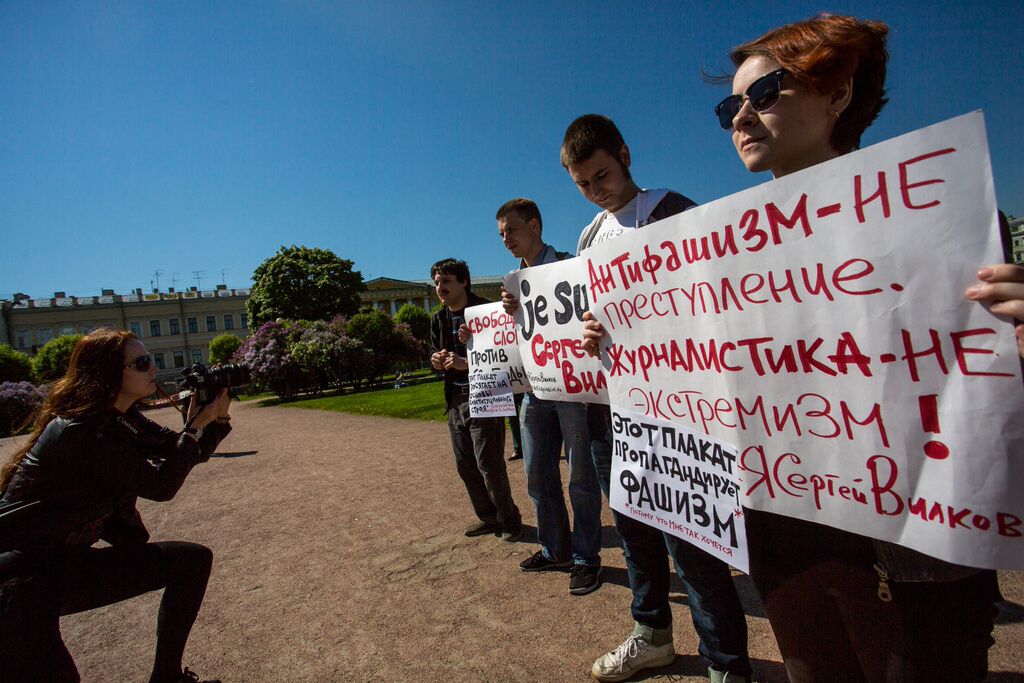
On Saturday, May 30, activists from the Russian Socialist Movement (RSD) organized a theatrical protest rally, entitled “#I Am Sergei Vilkov, or Pinning Labels,” on the Field of Mars in central Petersburg.

OcGK7I5KI2qAlMWt3NJlkWQM5OqzEtspCIMaIVL0MEsSocialist activists rallying in support of Saratov journalist Sergei Vilkov in Petersburg, May 30, 2015. The placard on the far right reads, “Antifascism is not a crime, journalism is not extremism. I am Sergei Vilkov.”

The activists demanded an end to the persecution of Sergei Vilkov, an independent journalist and antifascist in Saratov, who was physically assaulted in January of this year by two unknown assailants and has been accused by various local authorities of “extremism.” In one particular instance in April of this year, Vilkov was fined 1,000 rubles by a Saratov court for having posted, in November 2011, a caricature on his personal page on the VKontakte social network that fused the logo of the ruling United Russia party and a swastika.

Vilkov has blamed his troubles on Saratov businessman and Saratov Regional Duma deputy Sergei Kurikhin. Earlier, Vilkov had published articles in the local monthly news magazine Obshchestvennoe Mnenie (Public Opinion), exposing Kurikhin’s dubious political and business dealings.

Activists at the rally on the Field of Mars held placards demanding prosecution for the persons who, allegedly, assaulted Vilkov in January and decrying censorship.

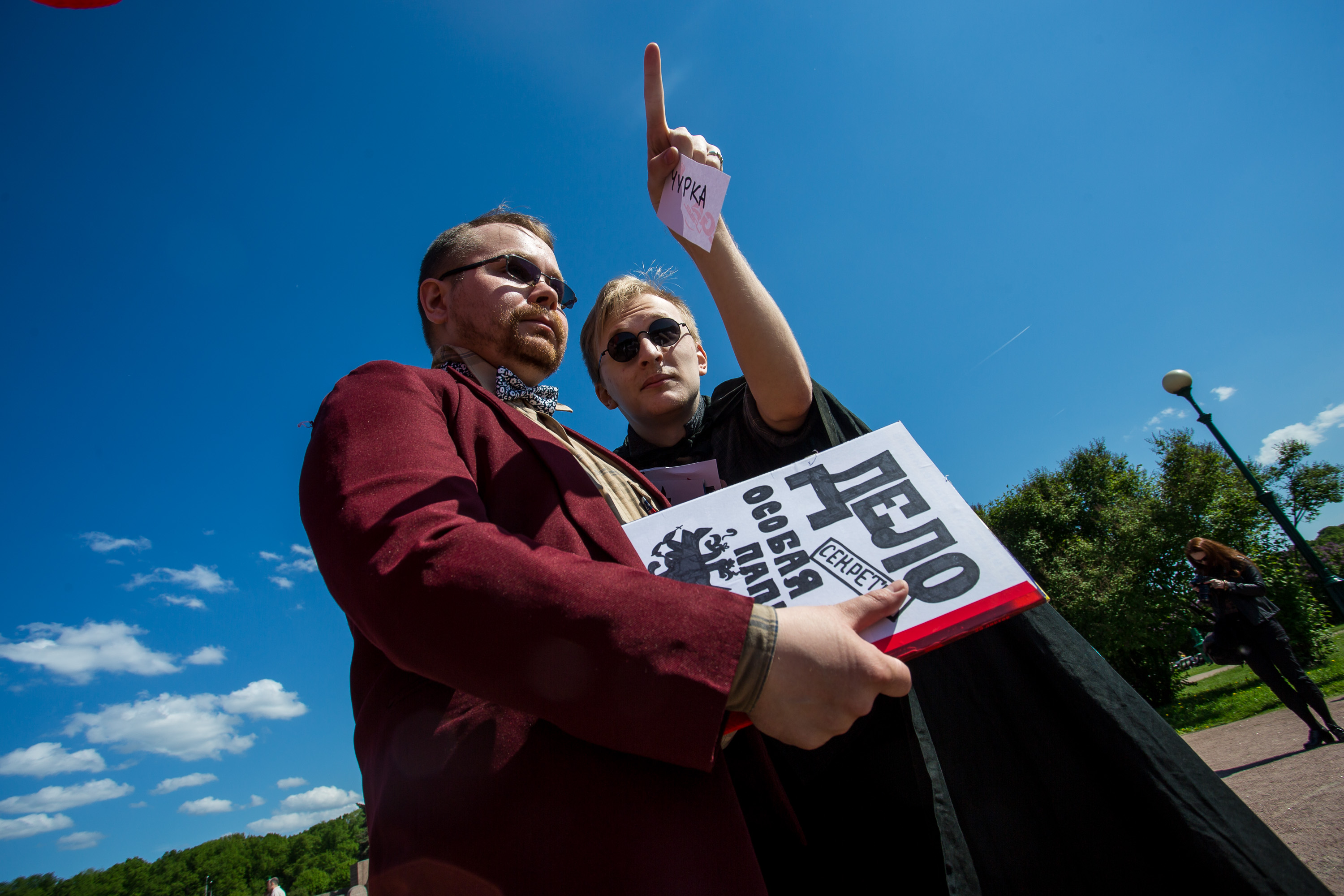
Symbolizing the alliance between the authorities and business, two activists were dressed as a judge and a “new Russian,” who wore a crimson jacket, popularly regarded as typical attire for gangster businessmen during the “wild nineties” in Russia.

IMG_0592“New Russian” and “Judge” at Saturday’s protest rally

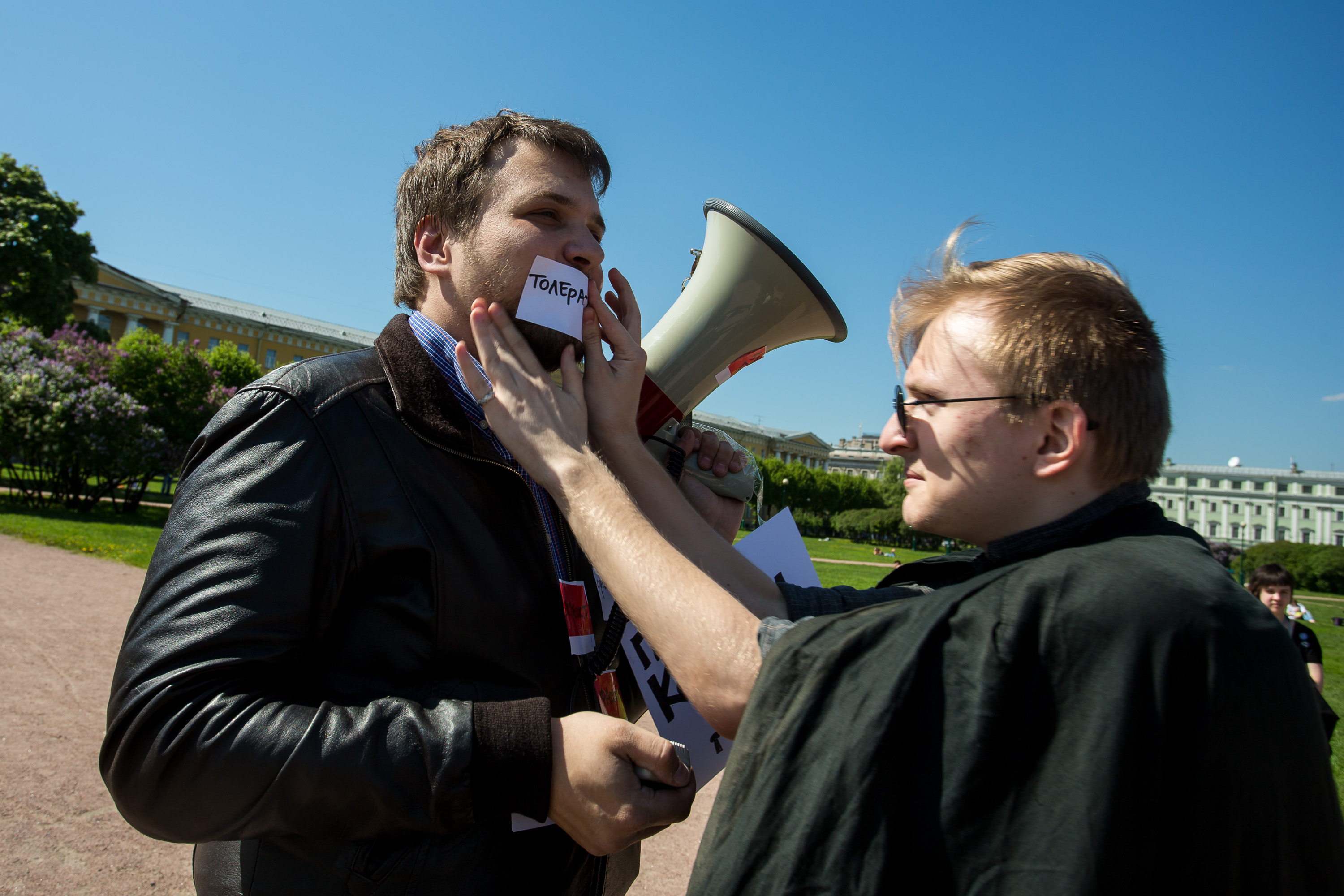
The “judge” and the “new Russian” brought with them a criminal case file full of labels, such as “foreign agent,” “atheist,” “fifth columnist, “tolerast” (an insulting slang term applied to people regarded as having excessively politically correct values), “forbidden by censorship,” and “offends religious sensitivities.” These labels and epithets are typically applied to critics and opponents of the current Russian authorities.

The two men hung and pinned these labels to the other activists who were present in order to “make them feel like Sergei Vilkov.”

IMG_0717“Judge” labels activist a “tolerast” at Saturday’s rally.

The socialist activists are convinced that Vilkov’s case is not an anomaly. Travesties of justice in the courts, political crackdowns against opposition activists, censorship, corruption, and the fusion of political authority and business are rather typical of Russia, they argue.

All photographs by and courtesy of David Frenkel

Deportation of Crimean Tatars Remembered in Petersburg

Deportation of Crimean Tatars Remembered in Petersburg
David Frenkel
Special to The Russian Reader
May 20, 2015

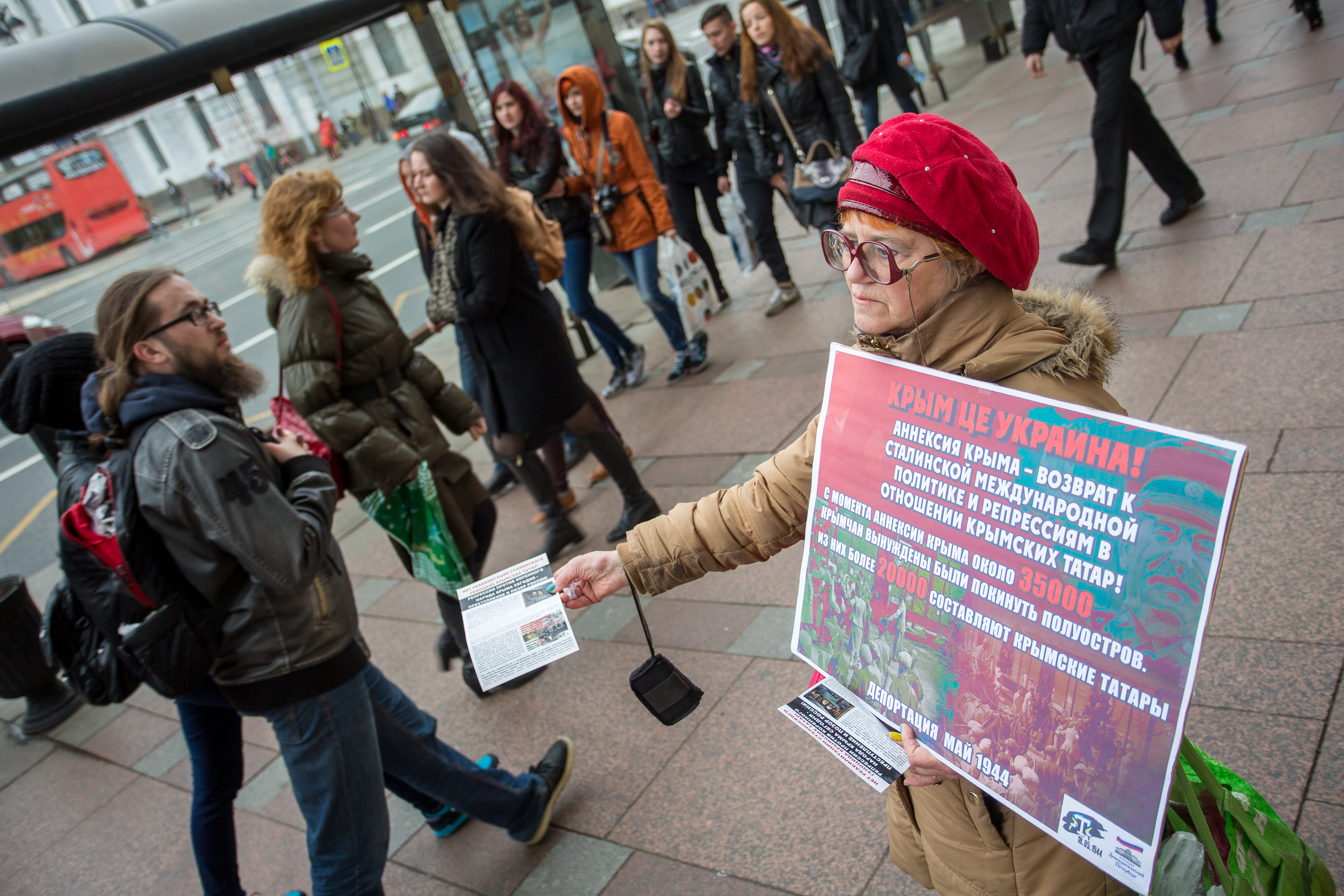
On May 19, Petersburg democracy activists commemorated the Soviet Stalinist government’s mass deportation of Crimean Tartars on May 18, 1944. Activists held a series of solo pickets on Nevsky Prospect before gathering for an evening event at Open Space, a co-working venue run by the organization St. Petersburg Election Observers.

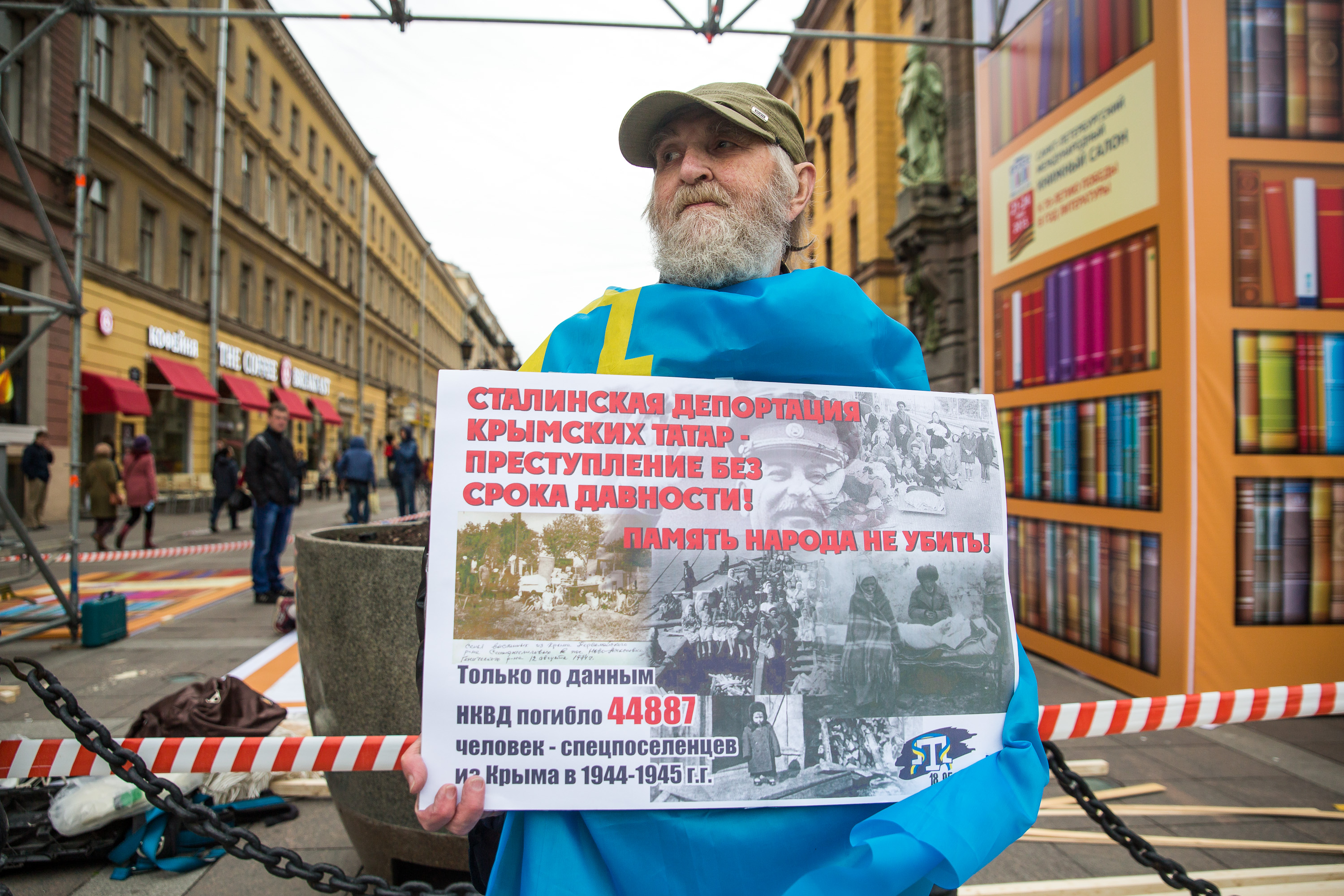
Several activists, including Vsevolod Nechayev, leader of the Democratic Petersburg coalition, Andrey Zyrkunov of the liberal-democratic party Yabloko, and Igor “Stepanych” Andreyev, a famous local activist, took to the city’s main street with placards calling on fellow citizens to remember the anniversary of the deportation and blaming the current Russian authorities for preventing commemorations in Crimea itself.

IMG_8818Local activist Igor “Stepanych” Andreyev picketing on Nevsky Prospect, May 19, 2015. His placard reads, “Stalin’s deportation of the Crimean Tatars is a crime with no statute of limitations! A people’s memory cannot be murdered! Even according to the NKVD’s statistics, 44,887 deportees from Crimea died in 1944–1945.”

Apparently inured to pickets and demonstrations of various kinds, passersby mostly exhibited indifference. A couple of young men attempted to harass the protesters, but most passersby merely glanced at the picketers before continuing on their way.

IMG_8836Picketer handing out leaflets on Nevsky Prospect, May 19, 2015

In the evening, activists gathered at Open Space to continue their commemorations. Alexandra Krylenkova, leader of St. Petersburg Election Observers, is field coordinator of the Crimean Field Mission on Human Rights.

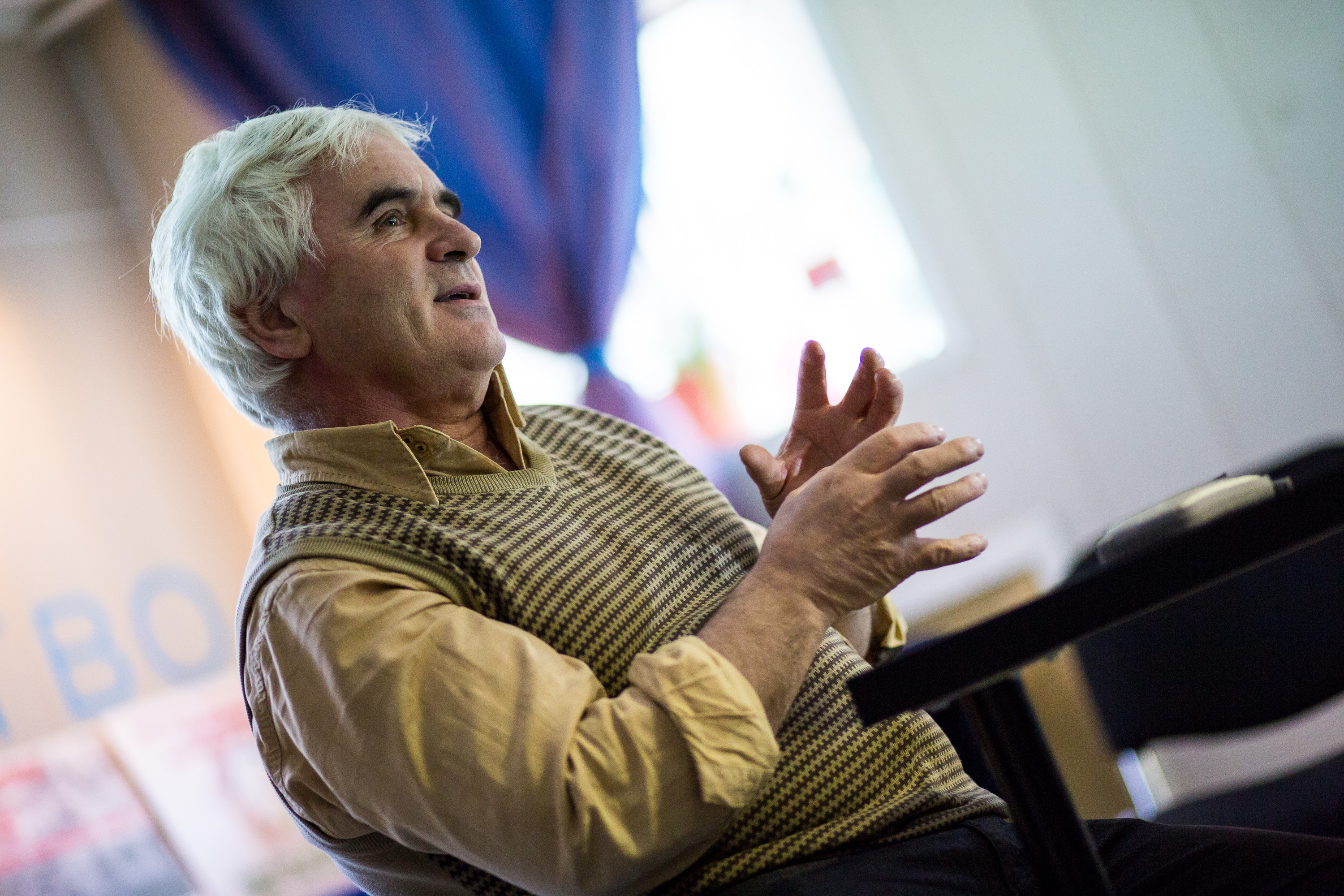
Activists viewed a documentary film about the deportation and chatted with Asan Mumdzhi, a member of the Crimean Tatar community in Petersburg.

They also talked via Skype with Zair Smedlya, head of the Qurultay of the Crimean Tatar People. Smedlya described the current situation in the Crimea. Police arrest protesters en masse even at authorized protests and auto rallies, but generally the authorities refuse to grant permission to hold such events.

“The same old story,” muttered someone in the audience.

The current Crimean authorities have tried to turn the commemoration of the 1944 deportation into a celebration of the fact that President Putin signed a decree “rehabilitating” the Crimean Tatars on April 21 of this year.

Mumdzhi compared this to Jews being “rehabilitated” by Germans.

IMG_8905Asan Mumdzhi

Smedlya also claimed that people had been arrested for carrying Ukrainian flags, which is not illegal.

“Crimean policemen didn’t know the Ukrainian laws. Now they do not know the Russian laws,” Smedlya quipped.

The gathering ended with a screening of the Crimean Tatar-language film Haytarma, which tells the story of the highly decorated Soviet fighter pilot Amet-khan Sultan, who accidentally witnessed the deportation and managed to keep his family in Crimea.

 All photographs by and courtesy of David Frenkel

The Bolotnaya Square Case: The Third Anniversary

Here are a few photographs, from a longer, excellent photo reportage by David Frenkel, of pickets in Petersburg held this past Wednesday, May 6, in support of the political prisoners now serving time in prison as part of the Bolotnaya Square case.

Three years ago, on May 6, 2012, a peaceful, permitted anti-Putin demonstration in Moscow was blocked and partly kettled by police, resulting in a scuffle between some marchers and police, hundreds of arrests and, in the years after the “riot,” dozens of convictions of people who were there that day.

Some of the defendants have been recognized by prisoners of conscience by Amnesty International, and many observers have argued that the police attack on the peaceful march was Putin’s deliberate revenge on those freethinking Russians who had the temerity to protest his “electoral victory” on the eve of his re-inauguration.

Bizarrely, three years later, the investigation and the arrests continue. Less than a month ago, for example, civil rights activist Natalya Pelevina was questioned as a suspect in the case and had her apartment searched.

frenkel-2“Renat Fatkhutdinov was a [Kazan] policeman who threatened to rape and torture arrestees. He got a three-year suspended sentence. Denis Lutskevich was a student who was beaten by the riot police for trying to defend a young woman. He got three years and six months in prison.”

frenkel-3

“Ten people are still serving prison terms for the fact that on May 6,  2012, they went to a peaceful demonstration that had been permitted by the authorities.”

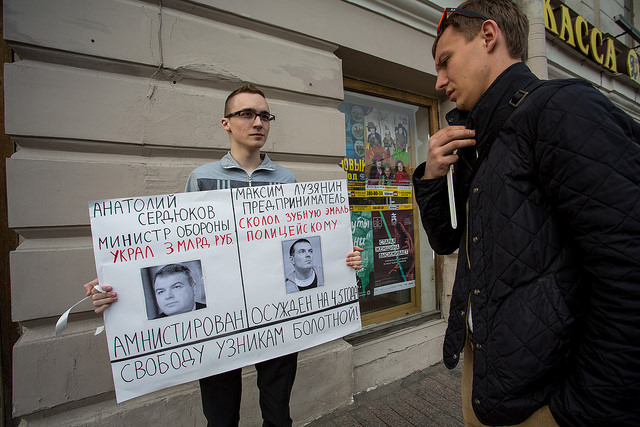
frenkel-4

Anatoly Serdyukov, the defense minister, embezzled 3 billion rubles and was amnestied. Maxim Luzyanin, an businessman, scratched the enamel on a policeman’s tooth an was sentenced to four and a half years in prison. Release the Bolotnaya Square prisoners!”

frenkel-5

Igor Aranson, head of the local council of deputies [in the Moscow Region town of Uvarovka] [and member of the ruling United Russia party] severally beat up two men he did not know [because they had crossed in front of his car on a crosswalk], but the court declared that Aranson had been the victim of the crime. Sergei Krivov, a Ph.D. in Mathematics and Physics, grabbed a police officer’s truncheon. He was sentenced to three years and nine months in prison. Release the prisoners of May 6!”

Thanks to David Frenkel for permission to reproduce these photographs here.