

Dear friends, colleagues, and allies!
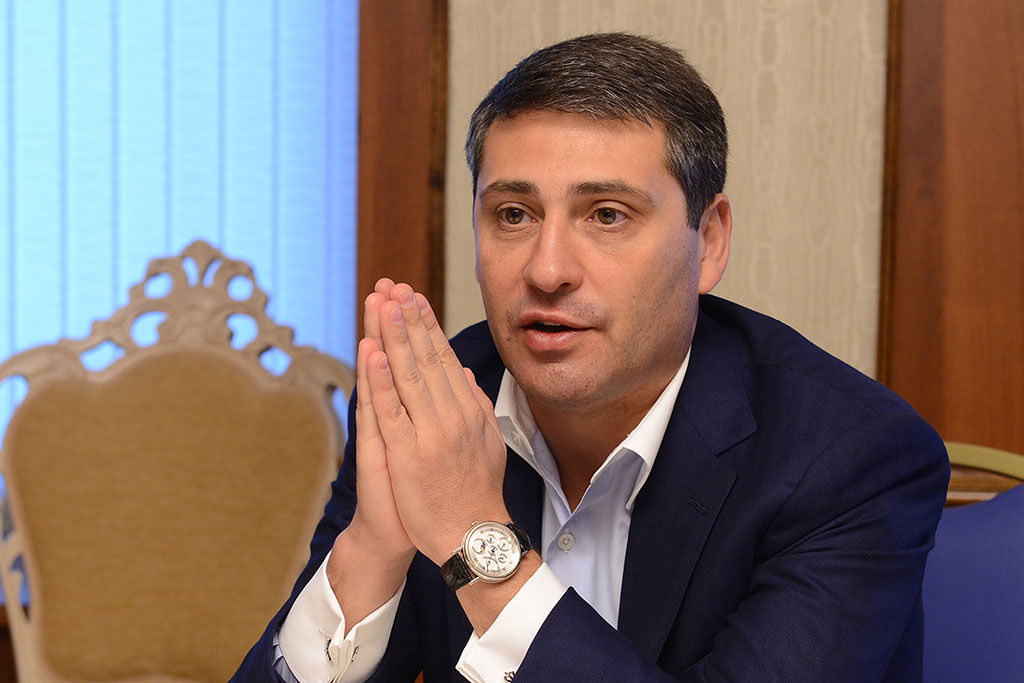
This is Ivan Pavlov.
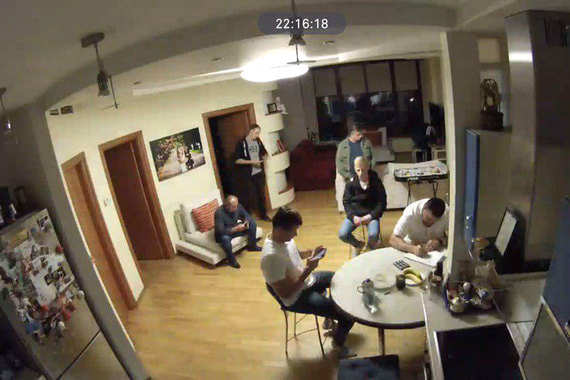
Yesterday was not an easy day for me, my family and the team. At 6 a.m., my friend Igor Dorfman had his door broken down. His apartment was searched for eight hours, and he was interrogated by the FSB. The Team 29 office was searched until nightfall.
But despite the fact that I have been restricted in my access to all means of communication, I am still with you.
My Facebook page has been temporarily blocked for security reasons. My Telegram channel will be run by my team. And this message has been written by Yevgeny Smirnov, who spent the whole day alongside me.
The team’s media resources will continue to function, publishing the latest news and features, because openness to the press and freedom of information have always been a priority for us. This, by the way, has always irritated our opponents a great deal.
The attack on me and my team is, of course, revenge for our work, for our principled stance, for our involvement in high-profile criminal cases run by the Russian FSB’s investigative department. And, of course, revenge for defending the Anti-Corruption Foundation, founded by Alexei Navalny, in court. But we are not going to stop. We will keep on working and fighting. Let’s not fall to the ground before shots are fired.
Especially since my team and I felt extraordinarily strong support from journalists, human rights defenders and the public on this day. And, most importantly, from our colleagues in the legal community, who came to the rescue without unnecessary formalities.
I am grateful for this difficult day because I learned how many people support me and Team 29. This inspires an optimism that cannot be diminished by interrogations, searches and court hearings.
Thanks!
Ivan Pavlov
(via Yevgeny Smirnov)
Source: weekly Team 29 emailing. Translated by the Russian Reader
____________________
Russia targets lawyer over media comments on treason case
Daria Litvinova
Associated Press
April 30, 2021
Russian authorities have launched a criminal probe against a lawyer representing a former Russian journalist accused of treason and the team of imprisoned opposition leader Alexei Navalny, accusing him of disclosing information related to a police investigation.
St. Petersburg-based lawyer Ivan Pavlov told reporters Friday he was formally charged with the criminal offense, punishable by a fine, community service or detention of up to three months, after his Moscow hotel room was raided on Friday morning and he was summoned to Russia’s Investigative Committee for interrogation.
Pavlov appeared in court later Friday and was ordered not to contact witnesses in the case or to use the Internet or a cellphone.
Pavlov’s colleague, Yevgeny Smirnov, had reported that the lawyer was detained. But Pavlov’s spokesperson, Yelizaveta Alexandrova-Zorina, later clarified to the Associated Press that Pavlov formally wasn’t arrested even though he was de-facto detained in his hotel room during the search.
The Team 29 association of lawyers that Pavlov heads said on social media that its office in St. Petersburg, the apartments of one of its employees and of Pavlov’s wife, and Pavlov’s house in the countryside were also raided Friday.
Opposition supporters, independent journalists and human rights activists have been facing increasing government pressure in Russia. Raids targeting Pavlov and his team elicited outrage in the Russian legal and human rights community, with prominent lawyers and legal aid groups calling on authorities to stop “using the law as a tool of pressure on lawyers.”
Pavlov said the accusations against him were connected to his defense of Ivan Safronov, a former Russian journalist charged with treason in a case that has been widely seen as retribution for his journalistic work. He said he was targeted because he shared information about the case with the media.
“The investigators maintain that I committed a crime when I told you, reporters, that your colleague is being unlawfully held in Lefortovo (pre-trial detention center) on absurd accusations,” the lawyer said.
Safronov, who wrote about military and security issues for a decade before becoming an adviser to Roscosmos head Dmitry Rogozin, was detained last year and accused of passing military secrets to Czech intelligence. Many journalists questioned the charges, and his former newspaper rejected them as “absurd.”
Safronov’s former colleagues alleged that authorities may have sought revenge for his reporting that exposed Russian military incidents and opaque arms trade deals. Safronov has remained in pre-trial detention since July.
Pavlov had been due to appear in a Moscow court on Friday at a hearing about extending Safronov’s pre-trial detention. The lawyer said police unlawfully seized “almost the entire dossier” of documents related to the case during the hotel raid, including those subject to attorney-client privilege.
According to his colleague Smirnov, Pavlov frequently received threats from investigators at Russia’s Security Service, or FSB, with an investigator involved in the case against the former journalist allegedly saying to the lawyer, “We’re going to do everything to put you behind bars.”
Pavlov maintained his innocence and said he considered the case against him “revenge” for his work on cases investigated by the FSB.
Smirnov told the AP that persecution of Pavlov sends a signal to all lawyers: “Don’t even think about working effectively on criminal cases. Don’t even think about speaking out. Don’t even think about defending people.”
In August, Russian media reported the FSB had lodged a complaint against Pavlov over his refusal to sign a non-disclosure statement in Safronov’s case. Pavlov said he had signed a statement not to disclose state secrets in connection with the case, but no one had asked him to sign a broader non-disclosure statement.
The case against Pavlov was opened shortly after he started representing the [Anti-Corruption Foundation], founded by President Vladimir Putin’s longtime foe, opposition leader Navalny.
This month, the Moscow prosecutor’s office petitioned the Moscow City Court to outlaw Navalny’s foundation and his network of regional offices as extremist groups. The case, expected to be heard May 17, is part of a sweeping crackdown on Navalny, his allies and his political infrastructure.
On Friday, the Rosfinmonitoring agency, which analyzes financial transactions to combat money laundering and terrorism financing, added “Public Movement of Navalny’s Headquarters” to its list of organizations involved in extremist activities or terrorism.
However, Navalny’s top strategist Leonid Volkov said no such organization exists. Rosfinmonitoring can freeze access to bank accounts and it is not clear how Friday’s move would affect Navalny’s foundation or other operations.
Navalny is currently serving time in a penal colony outside Moscow. He was arrested in January upon his return from Germany, where he had spent five months recovering from a Soviet nerve agent poisoning he blames on the Kremlin. Russian officials have rejected the accusations. European labs have confirmed he was poisoned.
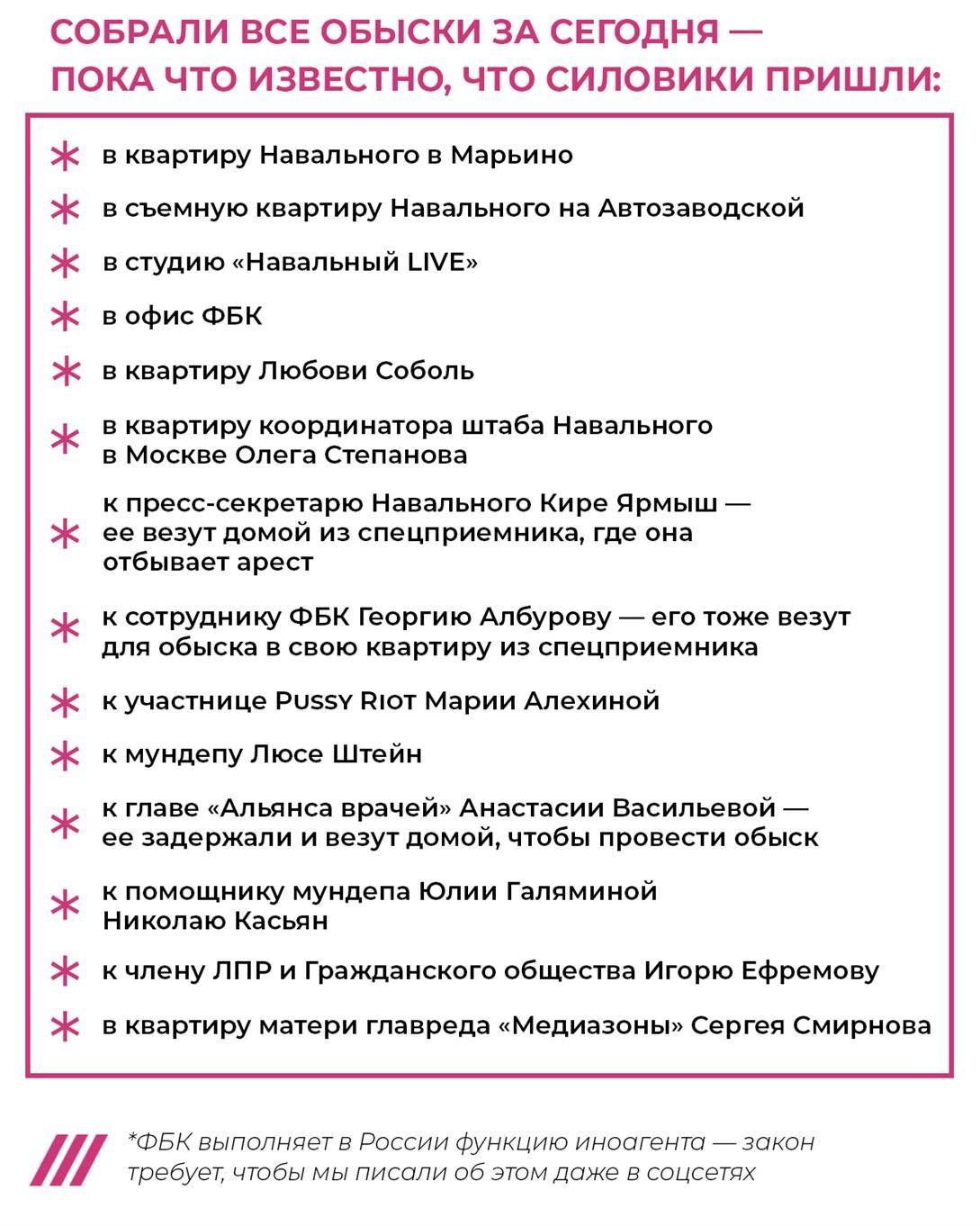

 “Should we go and search someone’s home, Piglet?” Cartoon by
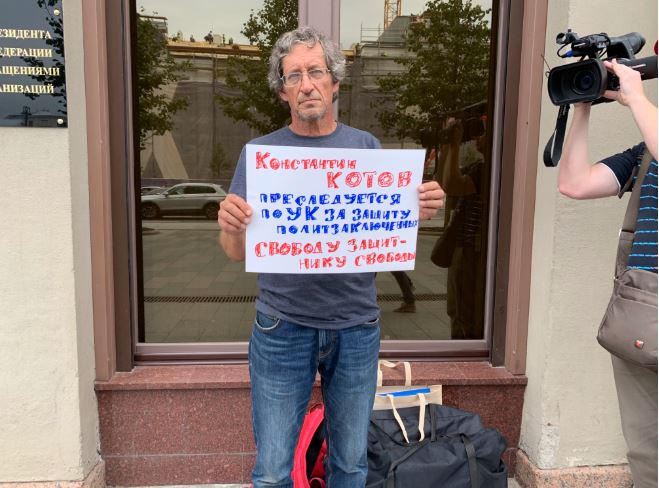
  Vladislav Barabanov during a
  Konstantin Kotov. Photo by Adik Zubcik. Courtesy of Facebook and Mediazona
 Illustration by Mike Ch. Courtesy of Mediazona
 Nikolai Rekubratsky. Photo by Dima Shvets. Courtesy of Mediazona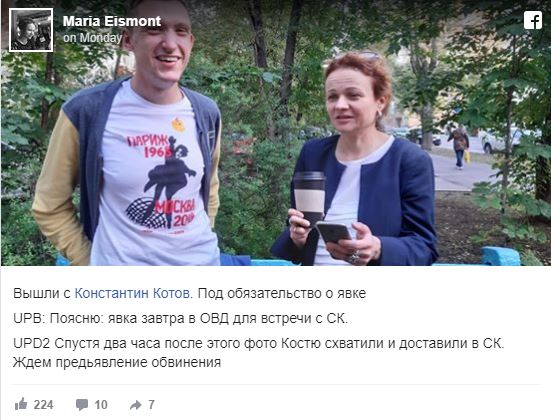

 Police searching Dmitry Gudkov’s apartment. Courtesy of Dmitry Gudkov’s Telegram channel and Vedomosti
 [Three] years ago, on November 15, 2015, Russian authorities launched the Plato system (“Plato” is an acronym for “payment for a ton” in Russian) to collect tolls from owners of heavy-duty trucks traveling on federal highways. The authorities claimed their goal was to compensate for the damage the trucks caused to roads. It was decided the toll would be applied to owners of trucks weighing over twelve tons. Photo courtesy of Maxim Stulov/Vedomosti and RBC
  The right to develop and implement Plato was awarded to
 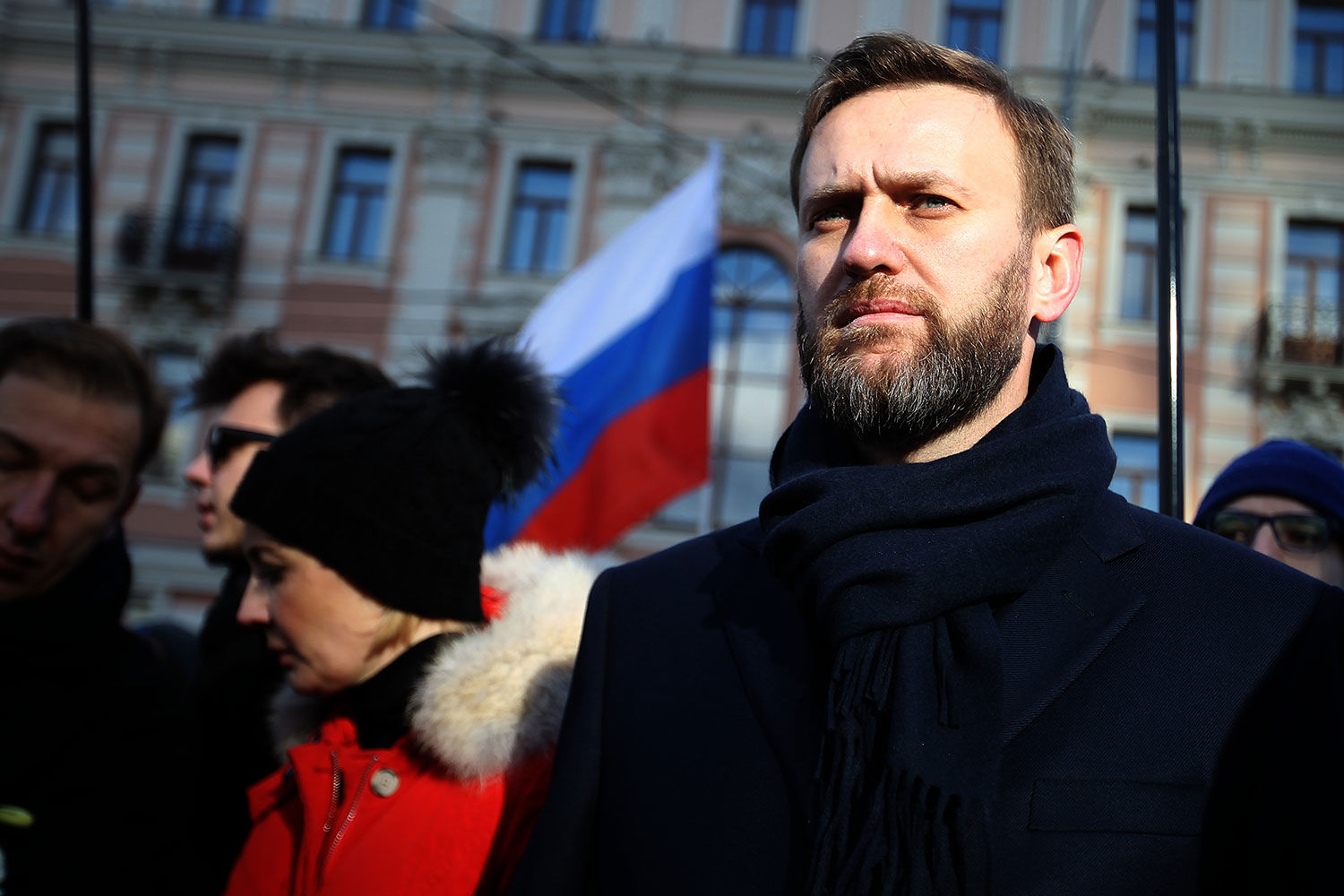 Opposition politician Alexei Navalny and Anti-Corruption Foundation (FBK) lawyer Ivan Zhdanov asked that the courts declare the government’s agreement with RT Invest Transport Systems null and void. Their lawsuit was rejected first by the Moscow Court of Arbitration, and later by the Russian Constitutional Court. Photo of Alexei Navalny courtesy of Yevgeny Razumny/Vedomosti and RBC
 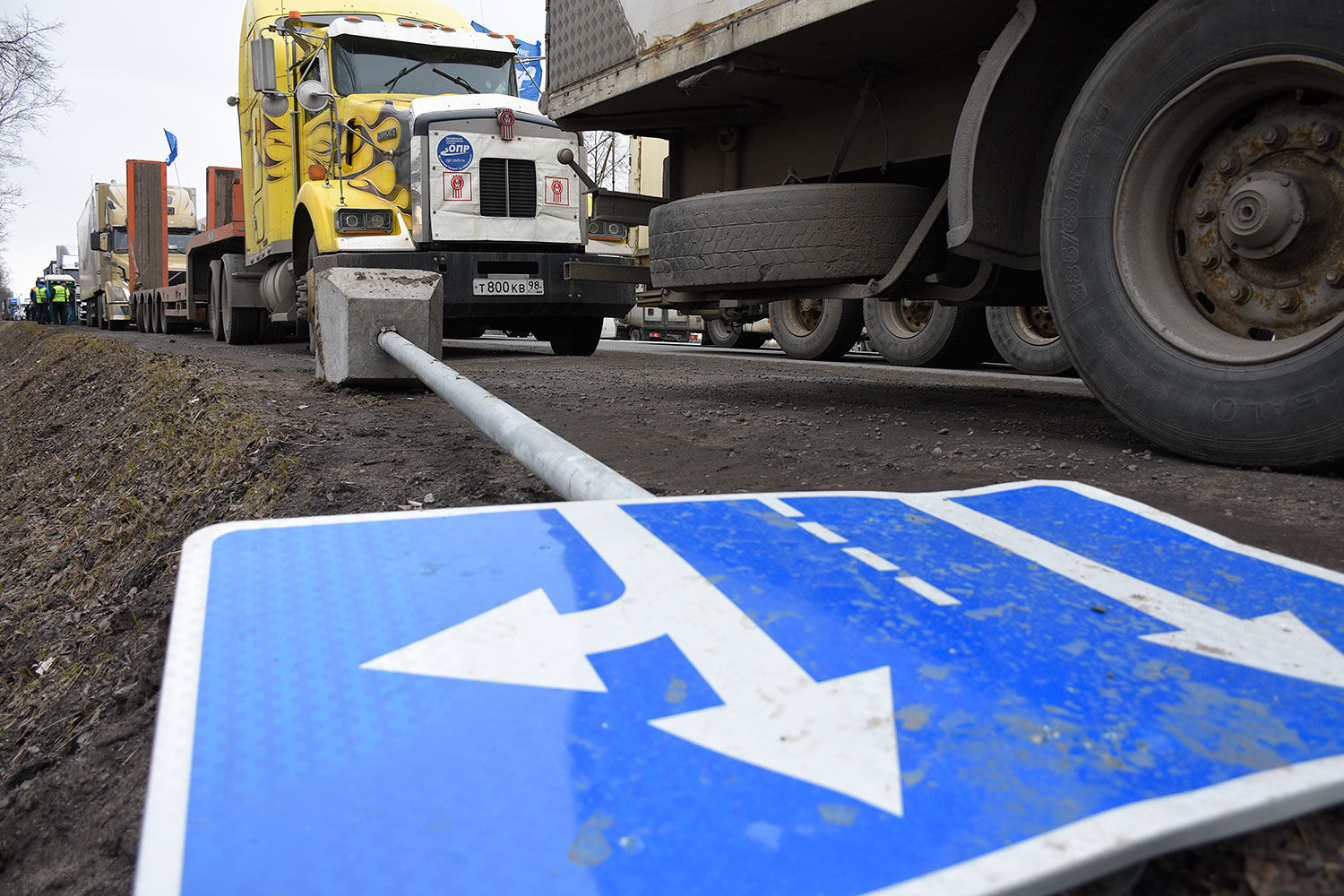 Truckers in forty Russian regions protested against Plato in November 2016. They demanded Plato be turned off, a three-year moratorium imposed on its use, and the system be tested for at least a year. Photo by Yevgeny Yegorov/Vedomosti and RBC
 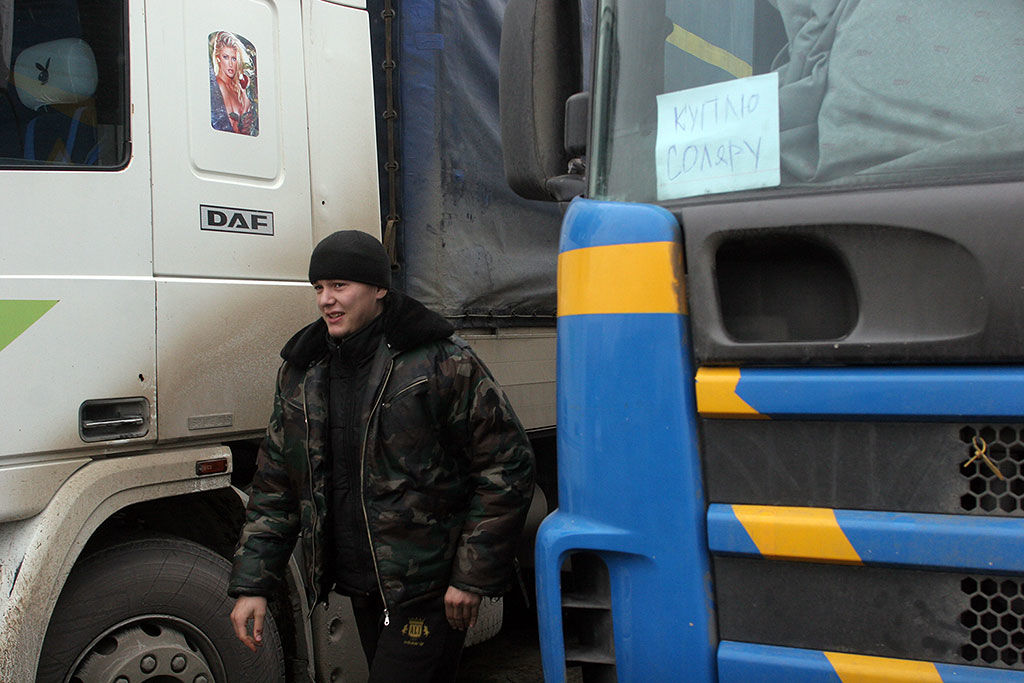 When Plato was launched in November 2015, truck drivers paid 1.53 rubles a kilometer. Four months later, the authorities planned to double the toll, but after negotiations with truckers they made concessions, reducing the toll increase to 25%. Since April 15, 2017, the authorities have charged trucks 1.91 rubles a kilometer. Photo courtesy of Sergei Nikolayev/Vedomosti and RBC
  However, even the discounted [sic] toll increase did not sit well with all truckers [sic]. On March 27, 2016, the OPR went on what it called an indefinite nationwide strike. Truckers protested the toll increases and demanded fairness and transparency at weight stations. Photo by Yevgeny Razumny/Vedomosti and RBC. [The slogans read, “Down with Plato!!! It’s Rotenberg’s Feeding Trough” and “We’re Against Toll Roads.”]
 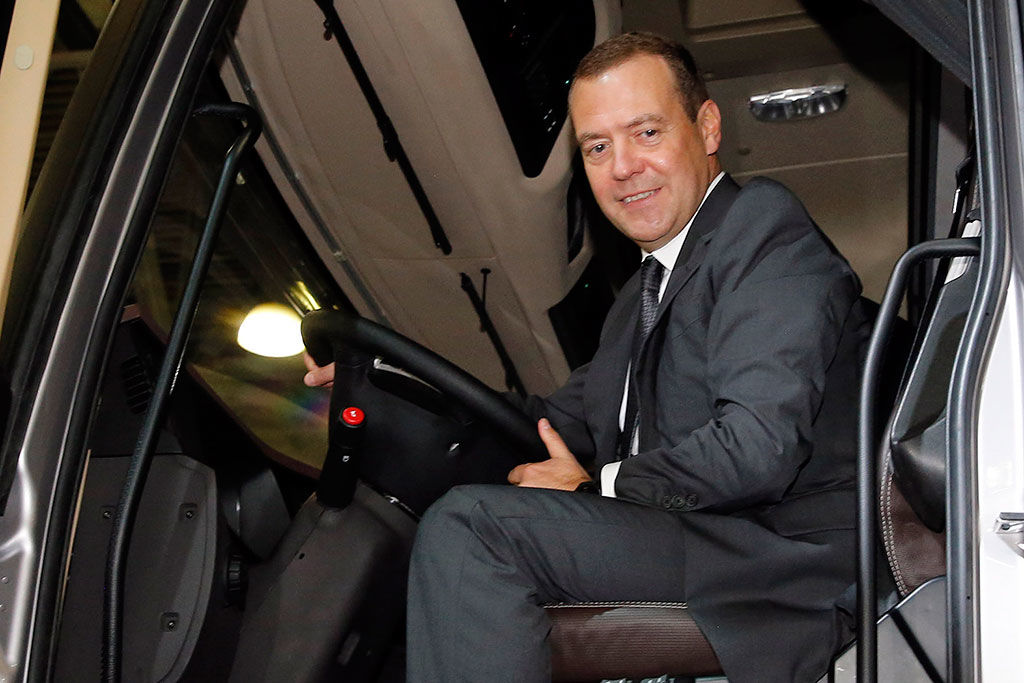 In October 2017, the government approved a bill increasing fines for nonpayment of Plato tolls from 5,000 rubles to 20,000 rubles. If passed, the law would make it possible to charge drivers for violations that occurred six months earlier. The new rules were set to take effect in 2018. Photo of Dmitry Medvedev courtesy of Dmitry Astakhov/TASS and RBC
 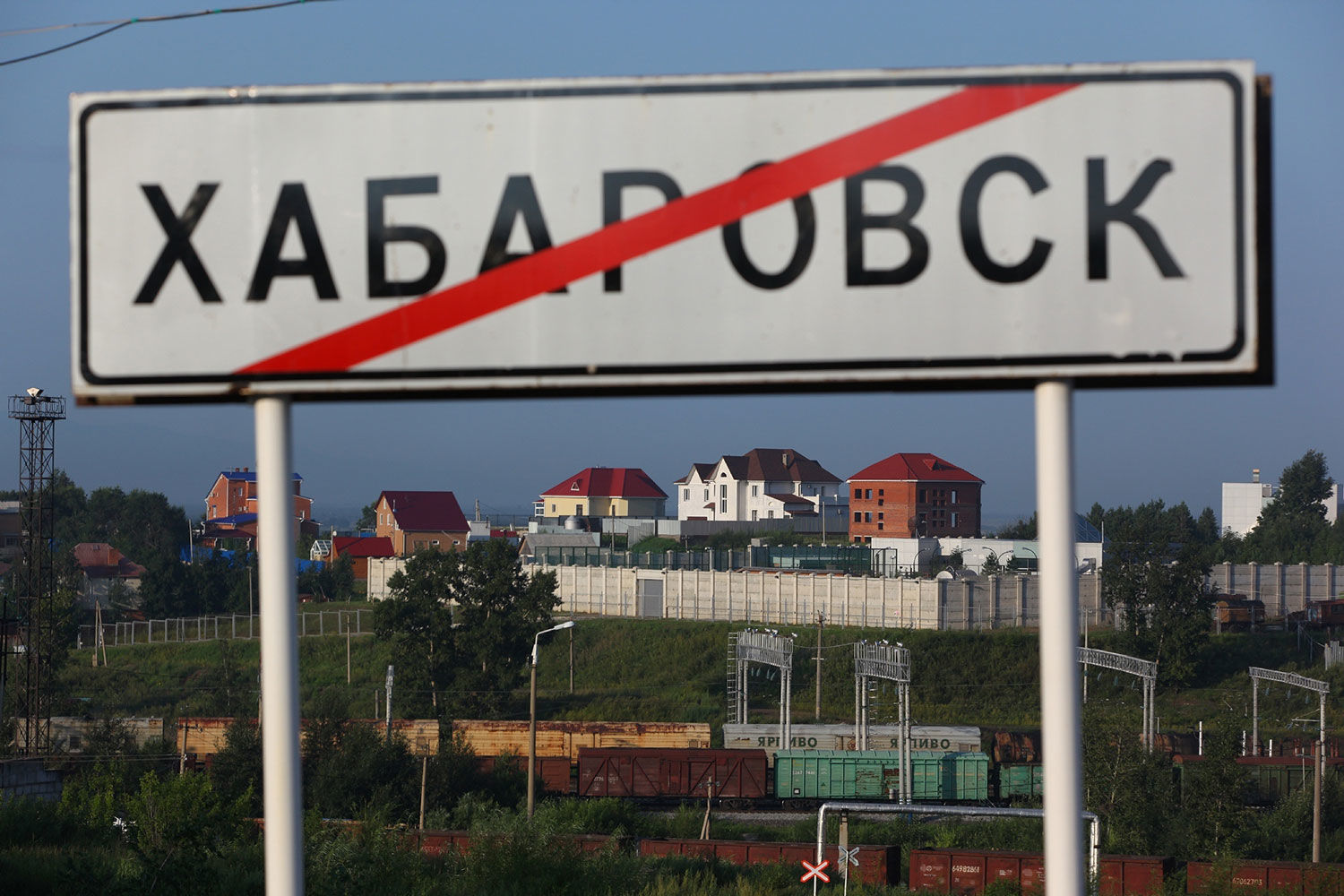 Plato’s database has registered 921,000 vehicles weighing over twelve tons. According to the Russian Transport Ministry, during its first two years of operation, Plato raised 37 billion rubles for the Federal Roads Fund. In the autumn of 2017, the government selected three projects that would be financed by the monies raised by Plato: a fourth bridge in Novosibirsk and bypasses around the cities of
 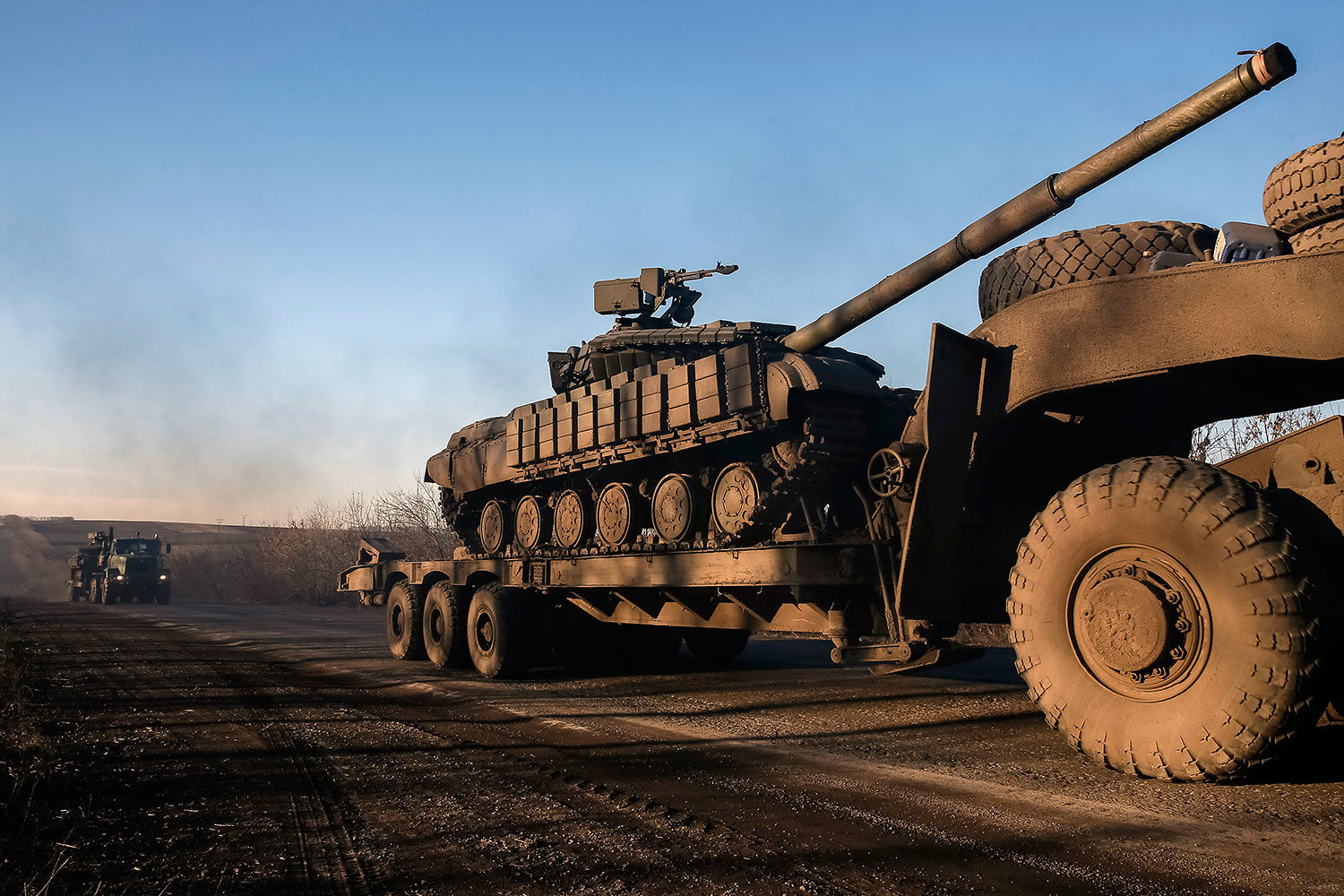 Vehicles that transport people are exempt from Plato tolls, as are emergency vehicles, including vehicles used by firefighters, police, ambulance services, emergency services, and the military traffic police. Vehicles used to transport military equipment are also exempt from the toll. Photo courtesy of Gleb Garanich/Reuters and RBC
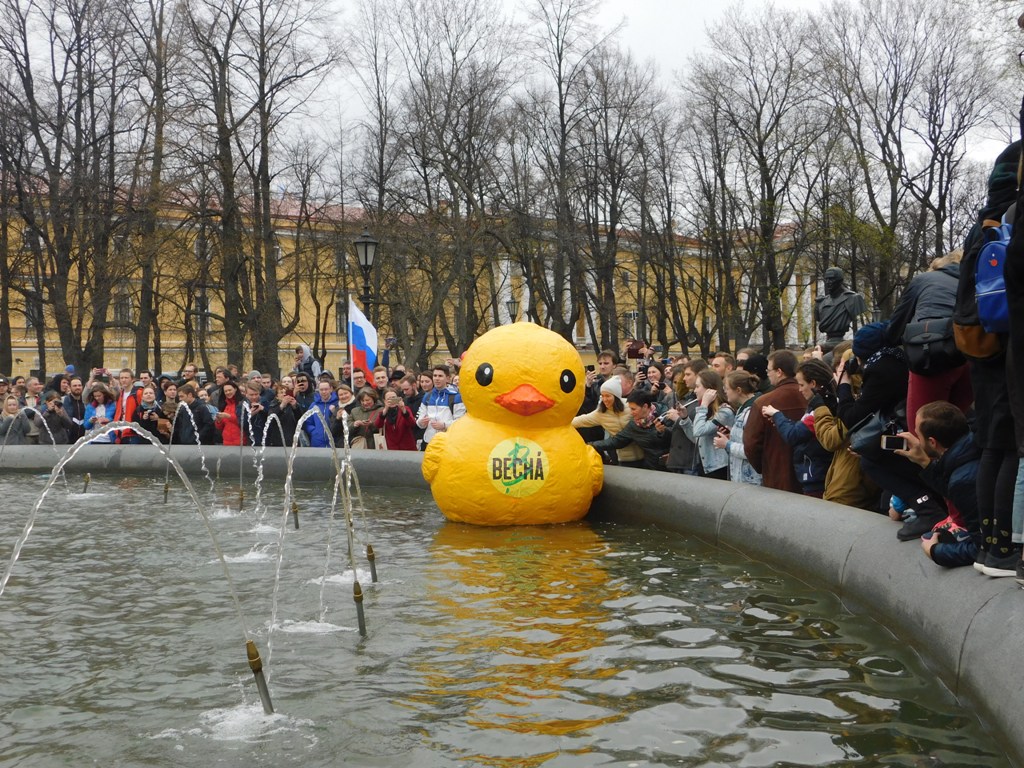 A giant rubber duck emblazoned with the logo of the Vesna (“Spring”) Movement floats in a fountain in the Alexander Garden on May 5, 2018.