If I were an MP in the Commons or a peer in the Lords, I would ask for a formal inquiry into how the BBC is wildly and, apparently, deliberately misreporting the so-called Russian presidential election campaign by constantly asserting that Vladimir Putin is incredibly popular, that his message of “strength and stability should be enough to persuade voters to give him another term” (I heard that gem on the late late news on Radio 4 last night) and that Alexei Navalny was not admitted to the race because of “previous corruption convictions.”
Only in every third or fourth report do BBC reporters and presenters even bother to hint vaguely that Navalny’s so-called corruption convictions were on trumped-up charges and explicitly meant to hobble and disable him at moments like this, when he is literally the only person in Russia with a political organization and campaign strategy capable of putting a serious dent in the myth of Putin’s popularity.
And it is a myth. A free and fair election—after a campaign run without assistance from the so-called law enforcement agencies (who now, apparently, are gearing up to go after Navalny for calling a boycott) and the other assorted thugs who have been routinely arresting and assaulting Navalny’s campaign workers and volunteers in large numbers all over Russia during the past year, and without a giant leg up from a mainstream media, especially the national TV channels, whose general demeanor gives you a sense of what television would have looked like had the Nazis had it in their agitprop arsenal—would return results that would surprise all the lazy reporters and “Russia experts” who have been aping the discredited pollsters at Levada-VTsIOM-FOM by perpetuating the Putin popularity myth these past seventeen years.
The fix was in from the moment the Family chose Petersburg’s incredibly corrupt ex-deputy mayor to succeed Yeltsin, and truly awful things for which lots of people should be serving life sentences were done to cement the succession in blood.
It’s only been downhill from here, including the period when oil prices were high, because they only discouraged whatever impulses for reform Putin may have had (although I see no evidence he had any such impulses).
There’s no reason to like Putin unless you’re a member of his inner circle, because the real economy has tanked long ago, rampant corruption has become the supreme governing principle, and the security services have launched a selective, targeted Great Terror Lite to remind anyone with a brain what “stability” really means: Putin and his criminal clique are determined to remain in power until they die of natural causes.
This stunning plan will have terrible consequences for Russia and the world. The very least honest news reporting organizations, supposedly devoted to balanced, objective journalism, can do is report the whole story I have just told in brief, instead of repeating the dangerous truisms and outright lies generated by the Kremlin and its minions. TRR
It’s hard to say why these alleged Russian doctors are so happy, since sixty percent of them make less than 360 euros a month. Maybe they’re not real doctors, but paid actors.
Survey: Sixty Percent of Doctors Make Less than 25,000 Rubles a Month Takie Dela
December 11, 2017
Over half of Russian doctors earn less than 25,000 rubles [approx. 360 euros] a month. Only 8.4% of them earn the nationwide average monthly salary of over 50,000 rubles a month.
RBC reports on a survey conducted by the Russian People’s Front and Zrodovye, a health services monitoring foundation, according to which 59.4% of doctors earned less than 25,000 rubles a month. 21.4% of respondents noted that their income from one salary [Russian doctors often work at more than one clinic or hospital to make ends meet—TRR] was less than 15,000 rubles a month. 21.7% of them reported they made between 15,000 and 20,000 rubles a month, while 16.3% reported a monthly income between 20,000 and 25,000 rubles.
13% of doctors reported that their salary varied between 35,000 and 50,000 rubles a month; 11%, between 25,000 and 30,000 rubles a month; and 8.5%, between 30,000 and 35,000 rubles a month. Only 8.4% made more than 50,000 rubles [approx. 720 euros] a month.
According to Rosstat, the current average salary for doctors is 53,100 rubles a month. Eduard Gavrilov, staff member at the Russian People’s Front and director of the Zdorovye Foundation, argues that the difference between reality and statistics has to do with the high amount of moonlighting among physicians. Due to low salaries, doctors are forced to work two jobs or a part-time job in addition to their full-time job.
Among medical support staff—nurses, midwives, paramedics, and others—nearly 80% of employees earn 25,000 rubles a month. Only two percent earn more 50,000 rubles a month.
According to President Putin’s May 2012 decrees, doctors would be receiving double the average monthly salary in their regions by 2018. Achieving this goal would require spending 266 billion rubles [approx. 3.85 billion euros], but officials do not know where to find the money.
In March, analysts at the Academy of Labor and Social Relations found that, as of the end of 2016, the average monthly salary of doctors at their main jobs was 21,700 rubles a month. When part-time jobs were figured in, doctors made 28,500 rubles a month on average.
Over the last four years, less than a third of medical workers have experienced pay growth, and only four percent have seen significant pay rises. A third of respondents said they had felt a drop in incomes, while a fifth of them reported a significant drop in wages.
P.S. When you read an article like the one above, you naturally imagine the incumbent president would have a hard time persuading voters to re-elect him to what amounts to a fifth term, given his pathetic record when it comes to improving people’s lives, including the incomes of highly educated professionals such as doctors.
But if you imagined that, you’d be forgetting a few things.
First of all, the fix is in, so Putin will be “re-elected” in March 2018 no matter how many promises he has broken during his first four terms or “decrees” he has failed to implement.
Second, despite the new school of unthought that argues Putin is not omnipotent, and we (whoever “we” are) should not be so afraid of him, attributing powers to him that he does not have even on the home front, the problem here has nothing to do with the old “good tsar vs. bad boyars” paradigm.
It’s much simpler than that. Putin and his cronies are gangsters, concerned only with enriching themselves and increasing what they regard as political power. For them, political power has nothing to do with making good things happen for as many people as possible or addressing more specific, urgent matters. They see political power as a means of disempowering ordinary people and all possible constituencies other than their own clique so they have a free hand to do with the country what they will.
To that end, Putin’s so-called May (2012) decrees were so much sand kicked in the face of Russians to blind them to the basic facts of life in their country, of which they could hardly be unaware.
At nearly the exact same time, the so-called Bolotnaya Square Case was launched to show the whole country what the Putin mob did to people who did not like having sand kicked in their face all the time.
She avoided the second question entirely, confessing only that she liked the good working relationships at the private clinic, where she had worked three years.
The takeaway message is that Vladimir Putin is a very powerful man indeed, perhaps the most powerful man in the world. But that will remain the case only until Russians decide they have had enough of the degradation to which Putin and his mob have subjected them and their country for seventeen years and do something about putting an end to it collectively. TRR
Diana Rudakova, Navalny’s Tambov Campaign Coordinator, after Seven Days in Jail: “I Wasn’t Afraid and Did My Best”
Yekaterina Ivanova 7X7
November 13, 2017
Diana Rudakova, Alexei Navalny’s campaign manager in Tambov, was released on November 8 after spending seven days in the police special detention center. Rudakov was detained on November 1 after holding a well-attended rally, featuring Navalny, on October 29. 7X7‘s correspondent caught up with Rudakova and found out what her court hearing was like, what violations she was accused of, and why she went on hunger strike at the detention center.
Diana, let’s start with the background. Tell us how Tambov got ready for the meeting with Navalny this time round. As far as I know, you again had problems with the venue and contractors.
Our preparations were long and thorough. We distributed over eight thousand invitations to the meeting with Alexei. We looked for contractors and equipment. It was quite complicated, of course: people are afraid to work with us, afraid of pressure from the mayor’s office. So we looked for contractors in neighboring towns, but even that doesn’t guarantee you will get a stage and sound equipment. For example, our contractor from Ryazan turned around at one in the morning when he was halfway to Tambov. He said they had put the squeeze on him. He couldn’t work with us even though it meant he didn’t work at all that day. So we found another contractor in the middle of the night. On the day of the meeting with Alexei, we noticed all the roads around the shopping center [the meeting took place at the Bashnya Shopping Center on the outskirts of Tambov] had been blocked. We immediately made up our minds that the stage could not be transported to the venue, so we were ready to physically drag it there.
Plus, there were the sudden KVN [Club of the Funny and Inventive] performances, meant to distract young people and compete against the meeting with Navalny?
We didn’t even bother with the KVN command performances. They were trifling compared to the problems we had to solve on the eve of the meeting. But the meeting took place. It had to take place. Navalny met with supporters in a field. He spoke standing atop a speaker case and a small table. So, the simplest recipe for a successful meeting is Alexei and a group of people.
How many people showed up? How many people did you count on?
I was really happy with how the meeting turned out. I had expected half as many people to show up. We got a quite accurate count of the attendees, because we had handed out invitations, keeping the stubs for ourselves. We also counted the number of people who signed up on our mobile app. We handed out tickets to 1,243 people, and 1,291 people signed up on the mobile app. So the real number was somewhere in the middle. Plus, lots of people stood outside the fence: they didn’t come in, because it was closer to the stage. This was about two or three hundred people. So, all in all, there were about 1,500 people. This makes it, of course, the largest such event in Tambov history, not counting United Russia “rallies,” where people were forced to attend.
Tell me all about your arrest. How did it happen? What were the charges? Why did they send you to jail?
Literally the day after the meeting, I came to work and saw policemen in our campaign headquarters. What was surprising was they had decided to arrest me for a solo picket I had held on October 7. Apparently, they had already written up the charge sheet and were holding onto the case file like a trump card, which they could pull out when it suited them and punish me. After detaining me at the office, they took me straight to the Soviet District Court. If a Navalny campaign volunteer is tried in the Soviet District Court, there’s a 100% likelihood of jail time. As we were approaching the court building, but hadn’t yet entered it, the policemen were already figuring out how they would drive me to the special detention center. I asked one of them to pretend to be lawful at least and wait until after the hearing. “Diana Borisovna,” he replied, “you’re an intelligent woman, and you know things work.”
You wrote on Facebook that the hearing was a pure formality.
The hearing lasted between ten and twelve minutes. The judge came into the courtroom with a pre-prepared ruling and commenced to read it out. He didn’t let my lawyer or me make a final statement. So I was sentenced to seven days in jail. I’m certain that the punishment had to do with the regime’s need to make an example of me to others. Because the authorities have stopped authorizing meetings with Navalny altogether. Holding meetings on private premises would have been a way out of this impasse. After our successful meeting, the federal campaign headquarters decided to focus on this format.
What prompted you to go on hunger strike?
After I found that my deputy coordinators and campaign office volunteers had been detained and sentenced to jail, I realized things could not go on this way and I went on hunger strike. [Leonid Yarygin was sentenced to 25 days in jail; Igor Slivin, to 20 days in jail and a fine of 300,000 rubles; and Margarita Zaitseva, to 5 days in jail.]
When you were in the detention center could you receive information from the outside? Did you know that many people tried to support you emotionally, that they handed out leaflets and circulated petitions?
A huge thanks to the folks and reporters, my friends and comrades who helped me on the outside by signing petitions, writing letters, reaching out to the independent media, and publicizing what happened to our campaign staff. After I went on hunger strike, a policeman immediately (ten minutes later) came to the detention center to write me up for violating Article 19.3 of the Russian Federal Administrative Code (“Disobeying a police officer’s lawful request”), because the day before I had refused to be fingerprinted and photographed, as was my right under the law. The next day, the policeman came again to write me up for something else. The deputy prosecutor and the prosecutor, all kinds of ombudsmen and overseers kept coming and going. A doctor constantly came to see me. Not a day went by when there wasn’t someone burning with the desire to talk to me about my hunger strike. So, if I hadn’t done it, my time in jail probably wouldn’t have been so rich.
Of course, I knew many of my friends and comrades on the outside were doing a lot to publicize the nasty things that happened to our campaign staff. If it hadn’t been for them, everything would have turned out differently. If it hadn’t been for them, I probably wouldn’t have made it out of the detention center, but would have immediately been dispatched to another court, where I would have been sentenced to another stint in jail.
I simply cannot thank people enough. A huge thanks to the campaign office volunteers who kept our office running, welcomed visitors, collected signatures on petitions, and plastered the entire city with leaflets defending Leonid, Igor, and me. They held solo pickets. When I was released and I was able to see all this, I was really touched. It’s quite hard to get information in the detention center, because you’re issued a mobile phone once a day for fifteen minutes and only to make calls.
How are things in the Tambov campaign headquarters now? What are your plans for the near future? Are you ready to throw in the towel after what has happened? You’re a young woman, after all, but now you’ve been arrested and spent time in a detention center.
Now we simply have to do what we need to do. I’m guided by the famous proverb, “Do what you must, and come what may.” I’m doing my best so that in the future, however it turns out, I can say I did everything I could, whether Russia becomes free or, on the contrary, remains unfree. In either case, I won’t have to be ashamed I was afraid. I wasn’t afraid and I did my best.
Diana Rudakova is 25 years old. She graduated from the architecture and construction program at Tambov Technical University in 2015. Her graduation project won third place in the Russian Nationwide Landscape Architecture Competition, which took place in Moscow at the Central House of Architects.
In 2012, Rudakova was co-organizer of a campaign opposing the merger of Tambov’s two universities, Tambov State and Tambov Technical, a campaign in which over 1,200 students were involved. From 2015 to 2017, Rudakova worked as a landscape designer in the Tambov Municipal Amenities and Landscaping Department while also being involved in the historical preservation movement. Since May 26, 2017, Rudakov has run Alexei Navalny’s campaign headquarters in Tambov.
Translated by the Russian Reader. Photo courtesy of 7X7 and Diana Rudakova
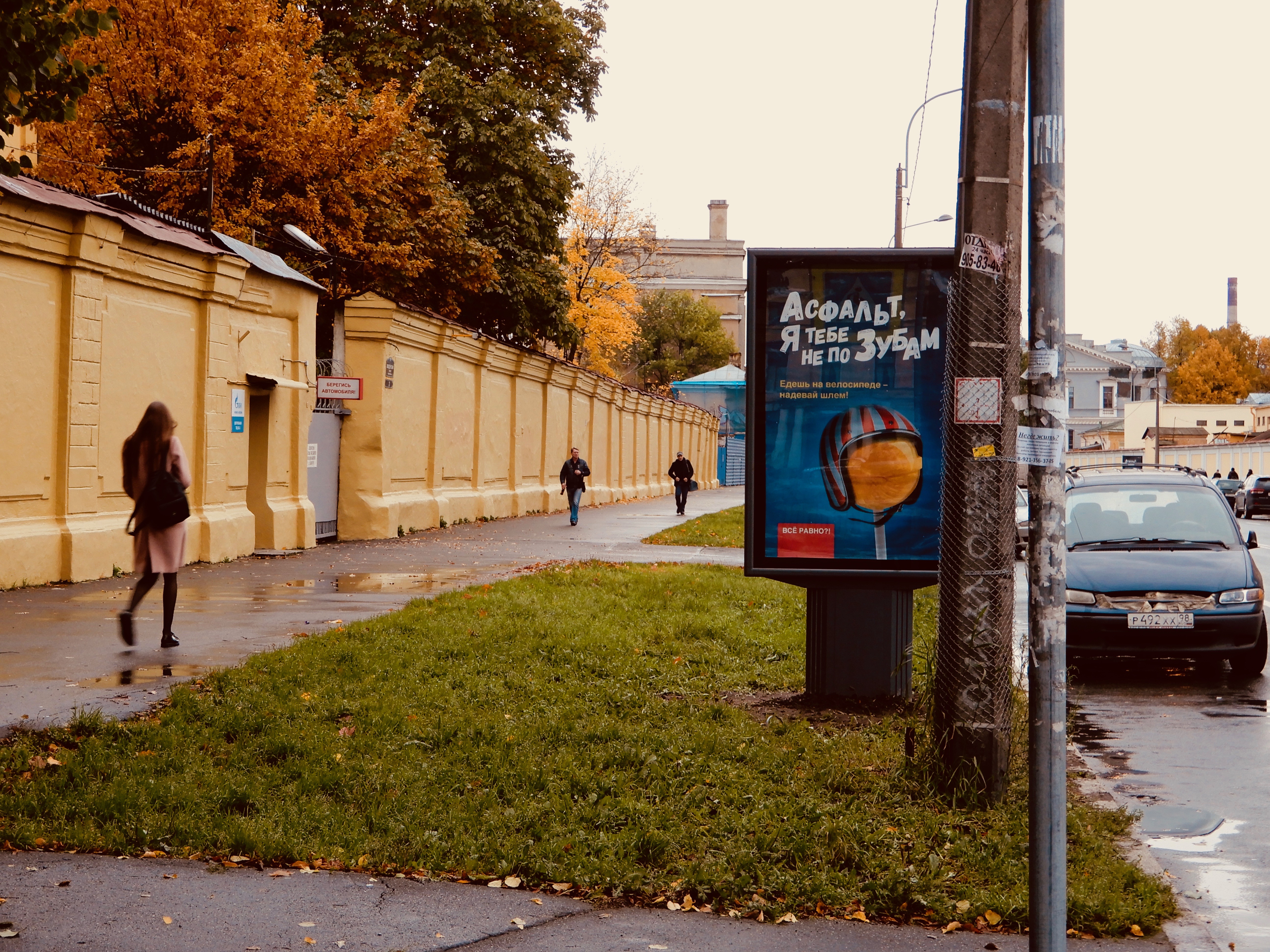
“I’m no match for you, pavement. If you ride a bike, wear a helmet.” Public service advertisement in central Petersburg, 13 October 2017. Photo by the Russian Reader
Rules for a Rotten Life Any of Us Can Be Detained by the Police and Should Be Prepared for It
Maria Eismont Vedomosti
November 8, 2017
Last weekend, Pavel Yarilin, a member of Moscow’s Airport District Municipal Council, and his colleagues spent several hours at a police station trying to secure the release of young auditors of the Higher School of Economics lecture program. The students had been taken to the police station after exiting their classes and finding themselves in the midst of a massive police crackdown on supporters of Vyacheslav Maltsev, fugitive leader of the Artpodgovotka (Artillery Bombardment) movement, banned in Russia by a court order. Police were detaining people who had shown up for the “revolution” Maltsev announced for November 5, 2017. The total number of detainees exceeded 300 people.
“This applies to any person walk downing the street. Any person, including your son and you yourself. It is a random inevitability, so you shouldn’t be afraid. You should prepare yourself for the eventuality that, if you are arrested, you must behave the right way,” warns the councilman.
His second conclusion: “You can be named a witness in a criminal case due to an event about which you heard nothing at all.”
His third conclusion follows from the first two. It is addressed to parents of young adults.
“Your child does not necessarily have to be guilty to end up where he or she has ended up,” he writes.
The number of grateful comments under Yarilin’s account and the number of reposts nicely illustrate the relevance of such texts, which explain the unwritten rules of life in Russia to those people who have only just become adults, as well as to those people who for whatever reason have never thought hard about how things really work or were confused about them.
“One is a bit horrified by the fact this affects all of us, and yet there are no absolute rules for defending ourselves from it, nothing that says, ‘Do such and such, and everything will definitely be fine,'” writes Yarilin.
Today there is no simple and clear recipe for counteracting the total vulnerability of individuals before the state. But if we still cannot change the circumstances, we can describe them completely accurately, calling things by their real names and using words in their original sense.
Proceedings for authorizing an illegal, groundless arrest cannot be called a court hearing, just as you cannot call it an illegal event when citizens take to the streets unarmed and peaceably. You cannot speak of defending the country while attacking another country. You cannot call five minutes of hate a lesson in patriotism, and real patriots “foreign agents.” Parliamentary parties from the “systemic opposition” who blindly adopt cannibalistic, absurd laws dropped in their laps by the powers that be cannot be called opposition parties, and the work they do cannot be identified as politics.
The only thing today that could be called an election campaign in the sense that elections involve a real struggle for power, a contest of platforms and ideas, is the campaign Alexei Navalny has been running in the regions. But the authorities have been hassling Navalny’s campaign every which way they can, sometimes using methods that are absolutely unacceptable and illegal: banning peaceable rallies, arresting activists for no reason, firing the relatives of activists from their jobs, and forcing school administrators to threaten schoolchildren. So, the number of people who can benefit from Yarilin’s advice is bound to grow.
Translated by the Russian Reader. Thanks to Comrade Koganzon for the heads-up
Member of HRC Describes Putin’s New Term: Everything Under the Sun Will Be Banned
Alexei Obukhov Moskovsky Komsomolets
October 10, 2017
Pavel Chikov argues Russia will become isolated internationally, and federalism and regional economies will be jettisoned.
Pavel Chikov, a member of the Russian Presidential Human Rights Council, has forecast what politics in Russia will be like if Vladimir Putin is re-elected to another term. According to Chikov, the situation in the country will deteriorate rapidly, and more and more areas of public life will be off limits.
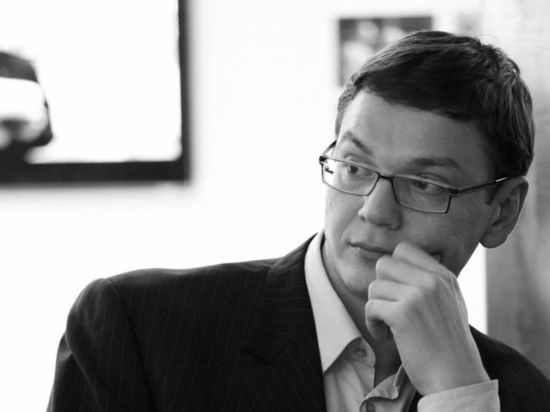
Pavel Chikov. Photo courtesy of Facebook/MK
Foreign mass media will be the first to be banned. This has been borne out, says the human rights activist, by the threat to shutter Radio Svoboda, which the media outlet received from the Justice Ministry last Monday.
In Chikov’s opinion, the country will also be stripped of religious freedom, as witnessed by “the huge criminal cases against and expulsion from the country” of members of various non-traditional religious movements, from Jehovah’s Witnesses, who have been declared “extremist” banned in the Russian Federation, to supporters of non-mainstream Buddhist and Muslim groups.
These measures, writes the human rights activist on his Telegram channel, will be paralleled by Russia’s renunciation of its international commitments. It will exit the Council of Europe and end its cooperation with the European Court of Human Rights. (Valentina Matviyenko, speaker of the Federation Council, said yesterday this was a probable scenario.) Russian’s relations with many European countries, from the Baltic states to Germany, will deteriorate, and their embassies will be closed. Restrictions will be placed on Russian nationals traveling outside the country, and the practice of stripping refugees and asylum seekers of their Russian citizenship and confiscating their property will be broadened.
Finally, Chikov writes, the country’s economy and domestic politics will deteriorate. The regions will lose the last remnants of their autonomy (Chikhov cites Vladimir Vasilyev’s recent appointment as acting head of Dagestan, although the United Russia MP has no experience in the republic), and the assets the regions have left will be placed under the control of Putin’s inner circle.
Translated by the Russian Reader. Thanks to Vasily Zharkov for the heads-up
This is my 1600th entry since I started translating and writing articles about modern Russian politics, society, economics, art and culture, history, social movements, grassroots endeavors, and everyday life on this website nearly ten years ago.
My first post, dated October 23, 2007, was a translation of an excerpt from Viktor Mazin and Pavel Pepperstein’s fantastic 2005 book The Interpretation of Dreams. Provocative and surprising as ever, Mr. Pepperstein argued that
[o]nly the interim between Soviet socialism and capitalism was ecological. It was a time of crisis: the factories stood idle, and the air became cleaner. It is a pity, but those days (the nineties) came to an end, and now (under cover of patriotic speeches) our country is becoming a colony of international capitalism. They try and persuade us this is success, but it is not true. We should (my dreams tell me, and I believe them) put our beautiful country to a different use, for example, by turning it into a colossal nature and culture reserve. (After all, our country, like Brazil, produces the most valuable thing on Earth: oxygen.) We should close the borders to foreigners (but let anyone leave as they like), carry out a program of deindustrialization, and limit the birth rate.
Shortly thereafter, I was offered the job of editing another website, Chtodelat News, where I volunteered for nearly five years, publishing 740 posts and slowly figuring out what I wanted to say with this hybrid of translation, editorializing, and media collage, and how I could say it.
After the long stint at Chtodelat News, I revived the Russian Reader, trying to make it as pluralistic, polyphonic and, occasionally, as paradoxical as I could, while also fulfilling the brief I have tried to keep to the fore from the very beginning: covering stories about Russia which no other Anglophone media would bother with (although they thus miss tiny but vital chunks of the big picture) and giving my readers access to Russian voices they would not otherwise hear.
I had meant to celebrate my 1500th post on this beat, but that make-believe anniversary came and went without my noticing it. It was all for the best, however, since now nearly ten years have passed since I set out on this unpredictable journey.
Like the very first post on this blog, my 1600th post is a glimpse into Russia’s possible futures, as imagined by Grey Dolphin (aka Vladimir Gel’man), his fellow scribbler Grim Reminder (yours truly), Russian rappers GROT, and my friends at the Moscow Times. TRR
__________________
Russia: It Can’t Be Improved So Destroy It, or It Can’t Be Destroyed So Improve It? Grey Dolphin
September 27, 2017
Grey Dolphin
The discussions about Russia’s prospects, currently underway among the conscious segment of Russian society, despite their public nature, in many respects resemble similar debates about the Soviet Union’s destiny, held in the kitchens of members of the intelligentsia and among politicized émigrés during the so-called stagnation. Relatively speaking, it was a debate between two parties. One party, the moderate optimists, grounded their expectations on hopes the country’s leadership would change course for one reason or another (or would itself change), and there would be a chance to change the Soviet Union for the better. (There were different opinions about what “better” meant and how to achieve it.) The other party, which included both moderate and radical pessimists, argued it was no longer possible or fundamentally impossible to improve the Soviet Union, and changes should be directed towards its total elimination. Time seemed to be on the side of the optimists, whose chances at success appeared realistic at perestroika’s outset, but in fact it was working inexorably on behalf of the pessimists. By the time the optimists seemingly got their chance, opportunities to improve the Soviet Union had largely been frittered away. History does not tolerate the subjunctive mood, and we do not know what turn events could have taken had perestroika been launched ten or fifteen years earlier. Those ten or fifteen years, however, passed only in conversations around kitchen tables, while the country’s leaders strove to prevent any change whatsoever. When the changes kicked off, the energies of both parties—the supporters of improving the Soviet Union, and the supporters of destroying the Soviet Union—had not exactly been exhaused in vain, but they had not been used very effectively.
Despite all the political and economic differences between the early 1970s and the late 2010s, the current conjuncture in Russia is not so remote from what it was then in the Soviet Union. Moderate optimists have proposed seemingly reasonable projects for improvements to the authorities and the public, but they themselves do not believe they can be realized “in this lifetime.” The moderate pessimists, if they had believed earlier in the possibility of improvement, have lost faith, while the radical pessimists never believed in improvements as a matter of principle. The optimists are waiting to see whether they will get the chance to improve at least something (and if so, when), while the pessimists are ready at a moment’s notice to exclaim, “Lord, let it burn!” For better or worse, however, so far there are no obvious “arsonists” in the vicinity who could and would want to demolish the current Russian political and economic order nor have any appeared on the distant horizon. Once again, as during the stagnation, time inexorably works on behalf of the pessimists. Sooner or later, yet another former optimist or, on the contrary, a person not involved in these debates will say something like, “Today’s Russia cannot be improved. It can only be destroyed.” (Essentially, this was what happened in the Soviet Union towards the end of perestroika. Of course, there were a different set of causes and other mechanisms in play then. What I have in mind is the rationale of transformation itself.) If and when the number of people supporting the verdict “destroy” reaches a critical mass, then the first of the questions posed in my post’s title will irreversibly be answered in the affirmative, occluding the second question altogether. The more news about events in Russia transpires every day, the more inevitable this outcome seems.
Translated by the Russian Reader
___________________________
GROT, “Fire”
If God wants to punish a man, He strips him of his reason.
I often think the whole country has been punished.
As in a fantasy story, I can see a light glowing over people’s heads.
This is not a sign of holiness.
It is a sign of moral decay,
Decay of beliefs, principles, and ideas.
The nostrils are already used to the rotting smell,
And there are cadaver spots on the faces of children and adults.
Self-destruction at the mental level,
The nation jumps into the abyss with a cry of “Keep off me!”
We will soon go extinct like the mammoths.
Young mothers with Jaguars and Parliaments.
People will have coming to them the trouble they stir up
Everyone will be punished according to their whims.
Fire!
Will purify gold from impurities.
Fire!
Those who believe in the truth will stand their ground.
Fire!
Will purify gold from impurities.
Fire!
Those who believe in the truth will stand their ground.
An ancient serpent lashes the sky with a crimson tongue,
Its breath ripples over the television networks.
Through TV screens it animates the golem and generates ghosts.
In the skulls of those who ate their souls
And vomited them out indifferently with counterfeit vodka
In the snow in winter or summer in the dust.
Two abused dudes filmed it on a mobile.
Look online, search for the tags “degenerates,” “masturbate,”
“Suck,” “come,” “sex with babies.”
I’m waiting for the last fire, but you better run.
Nothing can be fixed here now. Lord, let it burn!
Fire!
Will purify gold from impurities.
Fire!
Those who believe in the truth will stand their ground.
Russia could ban Facebook next year if it fails to comply with a 2015 law requiring companies to store Russian citizens’ personal data on local servers, the state media censor said on Tuesday.
The U.S. social network would follow in the footsteps of LinkedIn, the social platform for professionals that was banned in Russia last year after a September 2015 law requiring companies to store Russian users’ personal data on localized servers.
The head of Russia’s state media watchdog Roskomnadzor warned that “there are no exceptions” to compliance with the data storage law seen by some observers as unenforceable.
“We will either ensure that the law is implemented, or the company will cease to work in Russia,” Roskomnadzor chief Alexander Zharov was cited as saying by the Interfax news agency.
He said the watchdog is aware of Facebook’s popularity, with an estimated 14.4 million monthly and 6 million daily users in Russia as of last year.
“On the other hand, we understand that this is not a unique service. There are other social networks.”
Twitter, Zharov said, has agreed to transfer by mid-2018 its Russian users’ data to Russian servers.
“We have no plans to investigate Facebook in that regard until the end of 2017,” he added. “We will think about it in 2018. Maybe we will investigate.”
There are no technical or legal justifications for banning Facebook in 2018, only political considerations. The principal political consideration would be the need to find ways of “celebrating” Putin’s auto-reinstallation as president for “another six-year term” (i.e., for life).
As a tyrant who brooks no opposition to his illegimate rule, Putin would have to celebrate his hollow victory by instituting a series of crackdowns against his foes, as he did after formally returning to the presidency in 2012.
One of these crackdowns could involve banning Facebook in Russia, as is strongly suggested by the article I have quoted, above.
But that would be the least of everyone’s worries once Putin essentially crowned himself tsar as a gift to himself for his stunningly bad performance as the country’s leader for eighteen years.
Since his entire reign has orbited not around solving the country’s problems, but around imbricating himself and his clique of “former” KGB officers into every corporate and institutional nook and cranny in Russia (and beyond) while stealing everything he can get his hands on and rewarding his satraps with the booty “for a job well done,” he has not had much time to solve any real problems.
Hence the constant need to designate enemies and cripple, vanquish, jail, disappear or murder them, be they Facebook, Jehovah’s Witnesses or Boris Nemtsov.
Anyone who does not explicitly support Putin—and by definition only members of his clique really support him, in the sense that members of a mafia clan are loyal to their boss—is de facto opposed to him.
This might be especially true during the upcoming election, because, I would imagine, the majority of Russian voters are, at very least, quite weary of Putin and his oppositionless electoral “victories” by now and would be inclined to stay home on election day, even if they are not willing to march in the streets. (That might require too much effort.)
But a low turnout would still be a slap in the face to a man whose whole schtick the last eighteen years or so has been his alleged “wild” popularity, a schtick supported by the mainstream Russian press, corrupt Russian pollsters, foreign media covering Russia, and “Russia experts,” most of whom have no other gauge for measuring or probing “Russian public opinion,” so they rely on rigged, astronomically high popularity ratings.
If something around ten percent of voters in the two capitals (Moscow and Petersburg) and the non-ethnic regions showed up on polling day, the myth of Putin’s popularity would be dealt a near-fatal blow.
Putin would take his humiliation out on his treacherous non-constituency by unleashing a panoply of crackdowns, adopting a whole new raft of repressive laws at lightning speed, as happened in the wake of his 2012 re-election, and, perhaps, arresting a prominent figure from the opposition, such as Alexei Navalny, sending him down for hard time. Or worse.
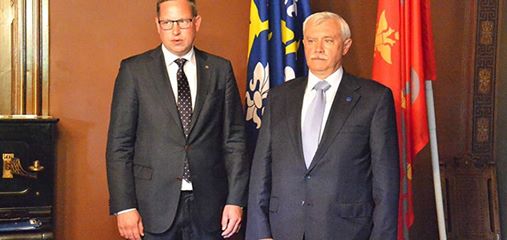
Author photos courtesy of cetacea.ru and the Russian Reader
I could not care less about all that as long as Putin leaves Petersburg Governor Georgy Poltavchenko alone. (Poltavchenko is the vaguely unhappy looking man on the right, in the picture above.)
Sure, Poltavchenko returned to his adopted hometown of Petersburg, after several years of bureaucratic carpetbagging, as an appointed satrap, who later obtained spurious legimitacy by winning a low-turnout, rigged election against a slate of astroturfed opponents. In a fit of uncharacteristic cynicism, Poltavchenko dubbed this farce “Democracy Day,” but we have forgiven him long ago for that outburst—by default, as it were, because 99.999% of us Petersburgers could give a hoot about local politics and have no clue about the Tammany Hall-style thuggery that once again covered the Cradle of Three Revolutions in shame on September 18, 2014. We are more the artsy, creative types here in the ex-capital of All the Russias. We go in for fo bo, hamburgers, craft beer, and conspicuous hipsterism.
In Petersburg, taking politics seriously is not cool.
But all the Sturm und Drang of 2014 matter less than Poltavchenko’s signal virtue, which consists in his striking tendency not to do or say much of anything, at least visibly or publicly. Unlike his colleague Ramzan Kadyrov, headman of the horrifying Chechen Republic, who is constantly running off at the mouth and scaring the bejeezus out of everyone, Poltavchenko has gone for whole weeks and months without saying or doing anything significant or noteworthy, much less frightening.
Whatever his other vices as a satrap and “former” KGB officer, it appears he would find it profoundly embarrassing to frighten anyone, especially just to show off, the way Kadyrov does it.
In an authoritarian political system in which making news means feigning to be a rabid, foaming-at-the-mouth nationalist fascist Orthodox maniac, tabling Nazi-like law bills in the Duma as fast as they can be typed up and printed out, there is something to be said for a guy who always looks as if he is always bored out of his mind, as if he would rather be home watching TV, fishing in the lake next to his dacha or tinkering with his car.
Which, of course, is an old Lada, not a Land Rover.
If you just get the “context” right, you can turn black into white, night into day.
“Context: The majority of U.S. Mission Russia employees are not Americans, and won’t be expelled: Of 1,200 people employed in 2013 in Mission Russia, 333 were U.S. citizens and 867 were Foreign National Staff, most of whom were probably Russian nationals. Using the 2013 numbers, if the U.S. Mission is forced to let go of 755 people, a majority of them would not be U.S. citizens, and probably would not be expelled from the country.”
—The Real Russia. Today, July 31, 2017, Meduza′s daily English-language email newsletter
No, but lots of those pesky Russian nationals, perhaps the majority, would be fired from their jobs thanks to Putin’s little presidential campaign stunt. They would be instantly unemployed and, perhaps, unemployable.
Is that cause for rejoicing in Connecticut or wherever the newsletter’s editor really lives?
And what reason could the current Russian government (not the Soviet government, which did such things) have for expelling its own citizens?
As a friend of mine who works at the Moscow embassy wrote in response to Meduza′s amazingly clueless and insensitive exercise in contextualizing, “I am speechless.” TRR
This is what is meant by ruchnoye upravlenie or “hands-on governance” in Russia.
“In a stage-managed gesture of benevolence a year ahead of a presidential election, Russia’s Vladimir Putin flew 1,200 km (750 miles) to call in on a woman living in squalor and ordered her to be rehoused immediately” (Gleb Stolyarov, “Eyeing election, Russia’s Putin stages visit to voter’s rundown home,” Reuters, June 28, 2017).
None of the other candidates (?), especially Alexei Navalny, who was officially sidelined by the Central Electoral Commission the other day, can hand out new houses and trips to Sochi to the needy. If they could and did, they would probably be brought up on charges for influence peddling or something like that.
But Putin can do it. The problem is that he cannot and will not do it for everyone, and certainly not in the systematic way implied by the clause in the 1993 Russian Federal Constitution that declares (emptily, as it would turn out) that the Russian Federation is a “social state,” i.e., a welfare state in the best sense of the word. That would mean bankrupting the current Russian state, i.e., the capitalist oligarchy run by Putin and his cronies in “manual mode” for their own benefit and one else’s.
I love the headline: “Eyeing election…” There are virtually no real elections in Russia, and in the few elections where a real, well-meaning person might, theoretically, be able to sneak past the watchful eyes of the elections boards—say, if she ran as a candidate in a lowly municipal district council (not even for city council or regional legislative assembly, where the winners do have nominal or real power and, at least, in Petersburg, personal discretionary budgets for spending on pet projects)—she would end up serving on a entity that has almost no budget (to hand out largesse, like Putin did in this case, or to do something that benefits all or many of her constituents) and no power whatsoever.
Putin will limit his campaigning to a few feel-good demonstrations of “manual control” like this one, where he unwittingly reproduces the role played more cheerfully and persuasively by Ty Pennington on ABC’s popular reality TV program Extreme Makeover: Home Edition, which probably did more for the needy than Putin has ever done and ever wants to do. TRR
June 12 is a public holiday, Russian Sovereignty Day [sic]. Certain people have been trying to use our national holiday to destabilize the situation in the country. Alexei Navalny has called for Russians to take to the streets of their cities in protest against the current regime.
The administration of Saint Petersburg State University of Film and Television asks you to approach the question of involvement in such events responsibly, not to yield to such calls and other provocative proposals whose objective is inveigle young people in unauthorized mass actions and marches aimed at destabilizing public order, calls and proposals that are transmitted via social networks and other sources of information. We cannot let these people achieve their political ambitions illegally.
Thanks to Comrade VS for the heads-up
“⚡️Gas sprayed on Pushkinskaya Square. Police in gas masks. If you smell gas, wet t-shirts and breathe through them. #12june.”
So, 658 people were detained [in Petersburg]. Minors whose parents were able to come and get them and people with disabilities have been released. Nearly everyone else will spend the night in jail.
There will be court hearings tomorrow. Everyone who can make it should come. The hearings will take place at the Dzerzhinsky District Court [in downtown Petersburg]. The first detainees are scheduled to arrive at the court at 9:30 a.m. Considering the number of detainees, we will probably be there into the night.
Field of Mars, Petersburg, June 12, 2017. Photo courtesy of Alexandra Polukeyeva/Rosbalt
Alexei Gaskarov
I was invited to speak at the rally on Sakharov Avenue. I planned to talk about why it was important to support the anti-corruption campaign despite our political differences. In short, in order to put a stop to reaction, dissenters need to be represented on a massive scale, so the elites would not even think about just trampling them or not noticing them. Everyone has the same goal right now: resurrecting political freedoms. The contradictions among people are secondary. Considering the scale of protests nationwide, things turned out quite well. You can see that people have stopped fearing crackdowns, and that intimidation no longer works. In Moscow, switching the rally to a stroll down Tverskaya was an absolutely apt response to the Kremlin’s behavior. Everyone who wanted to avoid arrest had the chance to do that. There were downsides as well, but given the colossal confrontation, they don’t seem important.
Ilya Budraitskis
Of course, one cannot help but welcome today’s protests on a nationwide scale. We are witnessing the continuing rise of a new protest movement that emerged on March 26. This movement is indivisible from Alexei Navalny’s presidential campaign and owes both its virtues and weaker aspects to that campaign. Despite the fact that Navalny’s campaign could have launched a broad grassroots movement, on the contrary, it has been built like a personalistic, vertical political machine in which decisions made by a narrow group of experts and approved by the leader are mandatory for the rank-and-file. This raises the majority’s political consciousness to the degree necessary at each specific moment of the campaign. The leader’s political strategy, his objectives, and the meaning of decisions are not up for discussion. Navalny must be believed like a charismatic CEO. What matters is that he is personally honest and “he has a plan.” On the eve of the protest rally, authorized for June 12 in Moscow, the rank-and-file found out a new particular in the plan: everyone had to go to an unauthorized protest march, which would predictably end in arrests and criminal charges along the lines of the March 26 protests. The rationale of the organizers is understandable. They have to pull out all the stops to keep the campaign moving at a fever pitch, keep it in the public eye, and use the threat of riots to pressure the Kremlin. Moreover, this radicalization in the media reduces the complicated picture presented by Russian society to a simple confrontation: the thieves in the Kremlin versus the honest leader who has united the nation. This set-up renders all forms of public self-organization and all social movements secondary and insignificant, and their real interest ultimately boils down to making Navalny president. However, even Navalny’s most dedicated supporters should pause to think today, the day after June 12. Would his campaign be weakened if it were opened up to internal criticism, if horizontal discussions of his political program and strategy were made possible, and the political machine, now steered by a few people, turned into a real coalition, where differences did not get in people’s way but helped them agree on common goals?
Anna Ivanova
“Sakharov Avenue is out,” Navalny said in his morning video message.
Navalny’s adviser Leonid Volkov put it more democratically.
“The hypocritical scum who dreamed up the ‘opposition rally on Sakharov’ will fry on a separate frying pan.”
The rally on Sakharov happened anyway. It was mainly attended by opponents of Moscow’s new law on the large-scale renovation of residential buildings: urban activists and residents of the buildings slated for demolition, as well as defrauded investors in residential building projects, foreign currency mortgage holders, and other victims of the construction sector. Many fewer of them came out, however, than on May 14, even considering that some of the outraged Muscovite anti-renovation protesters followed Navalny over to Tverskaya. Protests rise and ebb like the sea, and this time round the excitement was muted. These people—old women, families with children, old men—were not suitable for getting arrested at an unauthorized protest. Although they realize that Moscow’s problems are merely one logical outcome of the Russian political system, they are in no hurry to support Navalny and other inveterate oppositionists, for what is at stake are their housing and property, not supreme civil liberties.
“Day of Russian Cops” on Tverskaya in Moscow, June 12, 2017
Meanwhile, on Tverskaya, young folks realized that A.C.A.B. Around 700 people were detained in Moscow, and the social networks were flooded with even more photographs of derring-do amidst the so-called cosmonauts [riot cops]. The ultimate damage from the protest might be acknowledged only over time, when we know whether there will be new criminal cases, and if there are, what charges are laid against the protesters. But everyone loves looking at riot porn (and being involved in it), although this hobby devastates and dulls the senses as much as watching ordinary porn. This is the danger of protests “for all things good,” of protests focused on a certain political agenda or figure: neither fat nor thin, neither old nor young, neither socialist nor nationalist, but generally sweet and better than the old protest rallies. In this case, protest risks degenerating into a social order in which everything is decided by Sturm und Drang. Not the worse prospect, some would argue, but others would argue it would be a disaster. But whether you like it or not, “Russia has thousands of young people dreaming of revolution,” for the time abstractly encapsulated in the slogan “Dimon must answer for his actions,” and they have been taking to the streets.
Two worlds did not in fact meet in Moscow today. One world is the world of people who are mostly old, people whose property is threatened with eminent domain and who imagine politics as a way of building an urban environment. The second world is the world of bold young people (and their slightly older idols), who are hellbent on regime change. It would not be a bad thing if these worlds met and acted in concert. This is the only way for a democratic politics to emerge from this.
Notes from the field (the Field of Mars). Putting aside emotions:
1. It’s true there were lots of young people. And they are not afraid of anything.
2. There were many young families, who are likewise not afraid for their children.
3. “We’re fed up” is the key phrase.
4. There were slogans about healthcare, infrastructure, and pension. Well, and about corruption, too.
5. The out-of-town students came out because “it is wrong to drive the regions into a pit like this.”
6. There was a sense of support and public acceptance.
7) The people who came out were true patriots genuinely worried about the country’s future.
8) A spirit of freedom . . .
P.S. On the Six O’Clocks News last night, BBC Radio 4’s Moscow correspondent had the temerity to refer to yesterday’s protest march on Tverskaya as “illegal.” Is this the new tariff for keeping one’s press accreditation under Putin’s perpetual reign? TRR
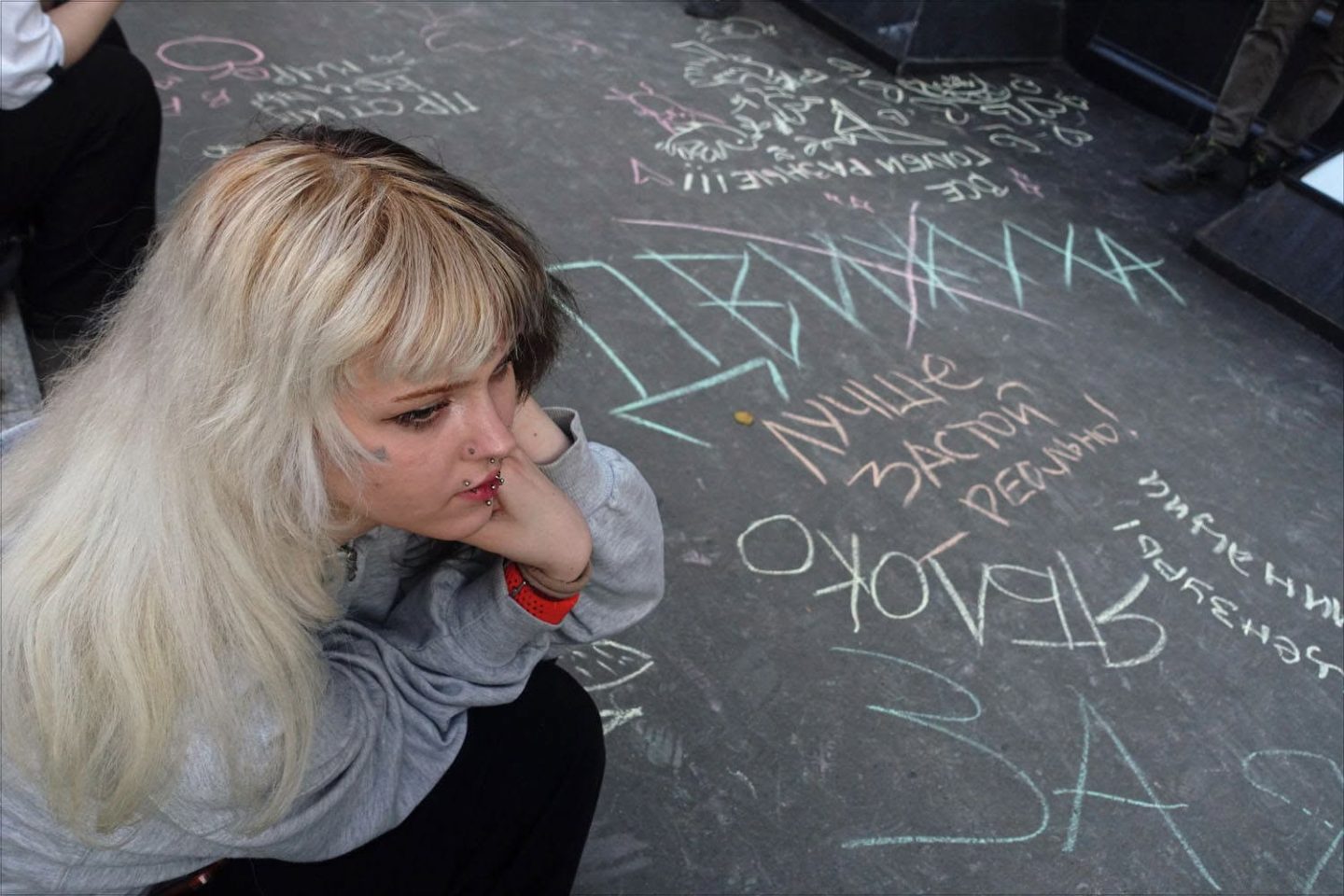

 It’s hard to say why these alleged Russian doctors are so happy, since sixty percent of them make less than 360 euros a month. Maybe they’re not real doctors, but paid actors.
 “I’m no match for you, pavement. If you ride a bike, wear a helmet.” Public service advertisement in central Petersburg, 13 October 2017. Photo by the Russian Reader
  Pavel Chikov. Photo courtesy of Facebook/MK