Getting Out the Vote in Arkhangelsk

Archangel LifePhoto published March 10, 2018, on the Archangelsk Life community page on the VK social network. “Photo of the Day. ‘We’re Going to Vote.’ *The common law wife of regional MP Alexander Dyatlov, chair of the regional committee of United Russia Party supporters, is in the middle.”

Darya Goloschapova
Facebook
March 11, 2018

A good illustration. Society has left women without pants and, apparently, taken the shirts off their backs. It has reduced them to sexualized objects whose sexual function is emphaized even in the civic act of voting, as remote from the bedrom as could be. But it’s cool: they are going to vote. Why are they naked? Are they going straight from the shower to vote? Then where did those ridiculous high heels come from? Did they just come down from the pole in a strip club? Why is this generally routine and uninteresting act decked out in Russia like a wedding in an archaic society? Men show off their power (see the campaign ads of “rich and successful” men supporting Putin), while women show off their naked bodies, sexual desire, submissiveness, and vulnerability.

Thanks to Bella Rappoport for the heads up. Translated by the Russian Reader

All in a Day’s Work

sdy_bxm7qd8Denis Mikhailov. Photo courtesy of the Navalny team’s VK page and OVD Info

Well-known Moscow activist Mark Galperin has been sentenced to two years probation for two videos. The videos, in which Galperin discusses a possible revolution, were deemed calls to extremism. The court forbade the activist frominvolvement in grassroots organizations for three years.

In Crimea, left-wing activist Alexei Shestakovich was transported after a police search with a plastic bag over his head. During the search, he lay on the floor in his underwear and handcuffs. Ultimately, Shestakovich was jailed for ten days.

At the same time, Crimean trade union activist Ivan Markov was detained and then jailed for ten days, but he was released ahead of schedule, as the appellate court overturned the decision to remand him in custody.

Denis Mikhailov was arrested twice for the same “crime.” The coordinator of Alexei Navalny’s presidential election boycott headquarters in Petersburg had just left the special detention center where he had spent thirty days for the January 28 Voters Strike protest rally, when he was detained, taken to court, and jailed for another twenty-five days, once again for the January 28 Voters Strike protest rally. Only in the first case, Mikhailov was tried as an organizer, while the second time he was tried as a participant.

An activist in Yekaterinburg was jailed for fifteen days after he was detained carrying a placard criticizing Putin. The placard was emblazoned with the slogan, “If you want another six years of lies and stealing, vote for Putin.” Sergei Tiunov was accused of a repeat violation of the rules for public events. He has gone on a dry hunger strike.

Source: OVD Info. The Week That Was, No. 45 (email newsletter). Translated by the Russian Reader

Leviathan

DSCN4214“Precinct Election Commission for Polling Station No. 2218.” This is the innocent-looking sign the leviathan that has strangled democracy, including free elections, in Russia puts out to signal its presence. It achieves victory over earnest voters and honest election observers, some of whom valiantly serve on such commissions, by killing them with a hundred thousand cuts. Writ large, the flagrant tricks and shady practices used by neighborhood and local election officials add up to national elections that are rigged from top to bottom. Although this trickery has been well documented by independent observers, Russian reporters, and researchers, the sheer weight of it somehow has never made an impression on western journalists, who continue to write as if Putin’s popularity were a scientifically proven fact instead of carefully crafted mixture of massive coercion and hoodwinking. Photo by the Russian Reader

Central Election Commission Does Not Accredit 4,500 Presidential Election Observers Affiliated with Navalny 
Mediazona
March 7, 2018

The Russian Central Election Commission (CEC) has refused to accredit 4,500 presidential election observers affiliated with the news website Leviathan, created by Alexei Navalny’s Anti-Corruption Foundation. Navalny has written about the incident on his Telegram channel.

“We were suddenly told today that [Leviathan] had been shut down by the court, and the CEC would not accredit it. Earlier we have received accreditation for 4,500 observers affiliated with Leviathan. Now they are left without accreditation. Even [Vladimir] Churov [the previous CEC chair, replaced in 2016 by Ella Pamfilova] didn’t do such things,” wrote Navalny.

In addition, the CEC has refused accrediate observers affiliated with the online publication Molniya (“Lightning”), which sponsors election observers from the Golos Movement for the Defense of Voters’ Rights.

Golos co-chair Grigory Melkonyants confirmed to Mediazona there were problems with accrediting election observers registered by Molniya. He said that 850 people who had signed contracts with Molniya in October 2017 were at issue.

Molniya submitted accreditation applications to the CEC two weeks ago. The CEC informed them that it had sent them a written reply by post. Melkonyants said that in the the past the CEC would always simply invite Golos to come to its offices and pick up the accreditation papers. Now, on the contrary, the commission’s decision is unknown: they would have to wait for the letter to arrive. Melkonyants believes this testifies to the likelihood the Molniya observers will have their accreditation requests rejected.

However, he noted it was still possible to register as an observer affiliated with a particular candidate, and Golos was now working on this.

Translated by the Russian Reader. Thanks to Comrade GMV for the heads-up

No Contest

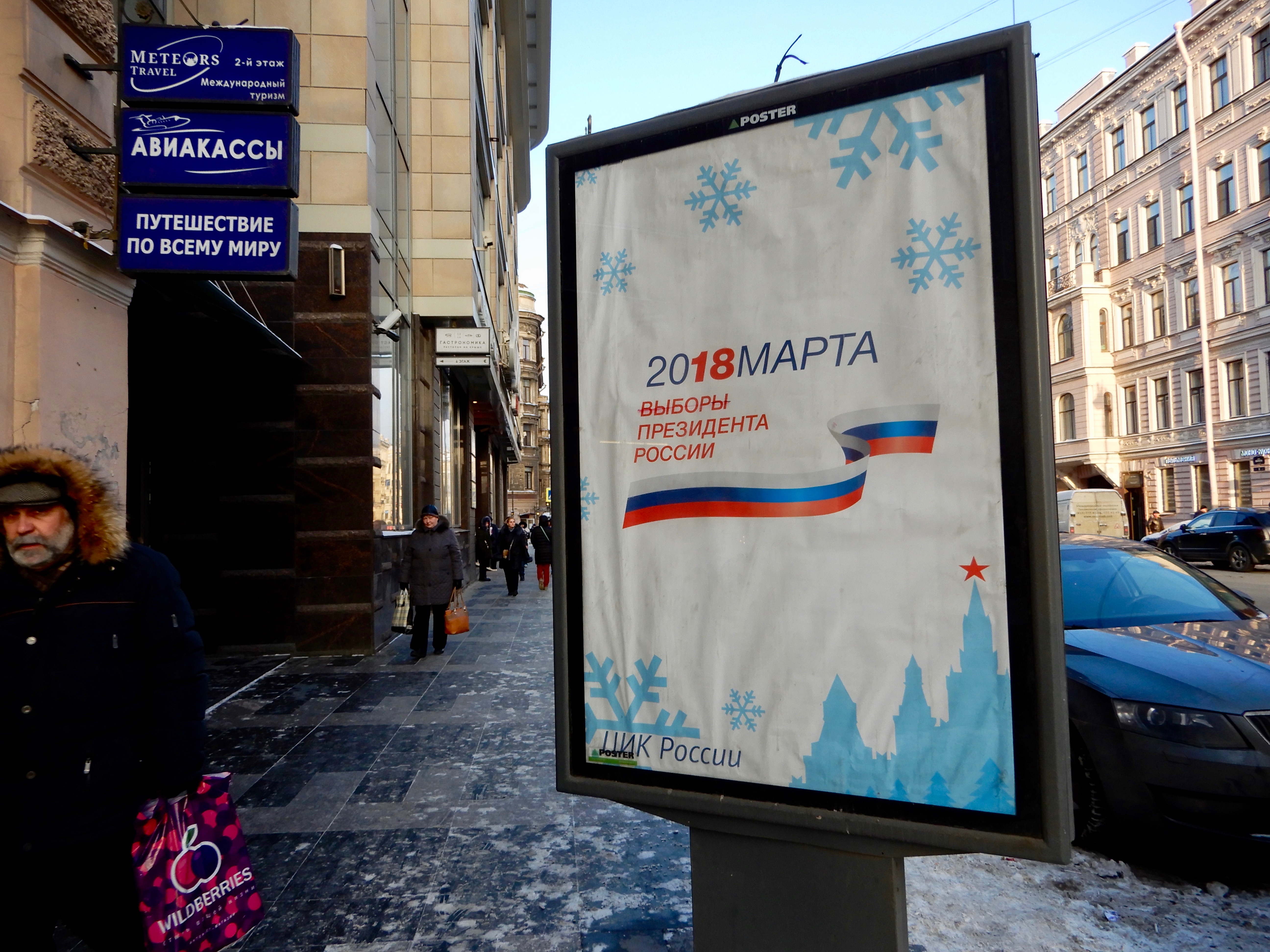
DSCN4290“March 18, 2018. Russian Presidential Election. Our Country, Our President, Our Choice! Russian Central Election Commission.” February 19, 2018, Ligovsky Prospect, Central Petersburg. Photo by the Russian Reader

Valery Dymshits
Facebook
March 4, 2018

I am somewhat surprised to see the ongoing discussion on whether to vote in the [Russian presidential] election or not. Some people write that if you don’t vote, your ballot will be used, and so on. Meaning it is assumed in advance the election commission is a band of brigands. If this is so, however, they can do whatever they want and, most important, at any level they can enter any figure they like in their official count. What difference does it make, then, if they use your ballot or not?

Actually, there is no election. Why be involved in something that does not exist? I think it is important not only to avoid attending this strange event oneself but also to explain to everyone why they should not attend, either.

DSCN2984On this “get out the vote” billboard, recently photographed somewhere in central Petersburg, a “vandal” has lightly crossed out the word “election.” Photo by the Russian Reader

Cities with populations over a million will have voter turnouts just over 50%, says a person close to the presidential administration.

All polling is a tool for actively shaping reality. Figures are used to try and suggest a particular interpretation of events, notes another source close to the administration. In his opinion, the downturn in Putin’s support rating can be explained by a lack of activity and mistakes during the campaign.

“In reality, the figure are much lower. The actual turnout is expected to be between 55% and 60%. Putin’s result will range, depending on the region, from 50% to 65%. It will be an accomplishment if the turnout in Moscow is over 50%.”

The difference between the turnout in major cities and the provinces could be as much as 20%. Usually, on the contrary, the turnout in the provinces is between 10% and 12% greater, says another person close to the presidential administration.

What happens next depends on the whether the mechanism for penciling in votes gets turned on or not. If the election is staged with the full use of the administrative resource, something I do not rule out, it does not matter who gets what in reality. If the elections are staged fairly, Putin’s result in cities with populations over a million will be lower, while his opponents’ will be slightly higher.”

The turnout in cities with populations over a million will be between 45% and 55%, the source believes.

Source: Yelena Mukhametshina and Olga Churakova, “Putin’s Rating Has Dropped Abruptly in the Major Cities,” Vedomosti, March 7, 2018

Translated by the Russian Reader. The emphasis, above, is mine.

Lev Schlosberg: The Veil of Public Opinion


Lev Schlosberg is a member of the Pskov Regional Assembly and the Yabloko Democratic Party’s national political committee. Photo courtesy of Pskovskaya Guberniya Online

The Veil of Public Opinion: Russian Opinion Polling Has Become Part and Parcel of State Propaganda 
Lev Schlosberg
Pskovskaya Guberniya Online
1 March 2018

Public opinion polls are constant companions of politics and national election campaigns. In democratic countries, polls are reflections of the public discourse surrounding politicians, ideas, political platforms, and conflicts. They echo public opinion in all its fullness and thus facilitate the public discourse itself regardless of who is involved in it: the authorities, the opposition or society at large. In twenty-first century Russia, political pollsters have a different job. They are tasked with persuading society the regime is terrific and everything (or nearly everything) is going great. During elections, they are supposed to generate the illusion of nationwide support for the authorities.

Polling is a tool of political manipulation in the hands of bureaucrats. Polling data is meant not merely to testify to broad support for the authorities but also to persuade dissidents they are few and far between, to discourage them and sap them of their will.

There is a whole set of techniques behind manipulating public opinion. The findings of public opinion polls, allegedly obtained scientifically, by means of formal research methods, are supposed to convince people of their objectivity and impartiality.

Honest political polling and sociological research is something that goes on in free, democratic societies. When answering questions on a questionnaire or taking part in a group or individual focused interview, a person should be sure she can speak openly and safely, even when she criticizes the authorities.

Fear is the enemy of honest polling. In authoritarian and, especially, totalitarian societies, people are afraid of making critical statements with their names attached to them, whether that entails filling out a standardized questionnaire or answering a question openly and at length. The classic set-up is when the interviewer knocks on someone’s door or comes up to someone on the street and asks, “How would you rate Vladimir Putin’s performance? Do you support him completely, partially or not at all? To ensure the quality of our poll you may get a follow-up telephone call. Please give me your name and telephone number.”

How do you think approximtely 86% of respondents would behave? Well, that is, in fact, how they behave: by giving the “right” answer.” There are many examples of this.

Now put yourself in the shoes of rank-and-file Russians, who are regaled round the clock with tales of Putin’s 86% popularity rating by all manner of mass media: TV, radio, newspaper, the internet.  People who do not agree with the authorities but are not experienced in the nitty-gritty of politics will imagine they belong to an obvious, hopeless political minority. They are social outcasts, virtually bereft of kindred spirits.

This is the impression the people behind such political pressure polling want to achieve. A picture of absolute political domination stifles a person’s will and reduces his willingness to voice his stance and take action. This extends to getting involved in politics and voting in elections.

When a person feels insignificantly small, she is made tired and exhausted by the very feeling of her smallness and insignificance. Thoughts of emigrating often occur to people who feel they are in the minority, trapped in a political ghetto.

Political pressure polling is a new means of combating dissent, of attacking the opposition.

VTsIOM recently reported that, according to the findings of an extensive telephone poll (one of the least reliable polling methods), 81% of voters plan to vote in the March 18 Russian presidential election.

Enthusiastic nationwide support is the dream of all dictators. As people who suffer from hypertrophied inferiority complexes, dictators compensate by demanding the entire nation love, adore, and admire them. This popular love must be constantly corroborated by public opinion polls and elections.

Under authoritarian regimes, all authentic democratic institutions are reduced to imitations and desecrations, and public opinion polls are very revealing instances of this.  The mirror of society is turned into a fake painted on a blank wall.

Political pressure polling performs another vital function by setting the bar for electoral fraud.  If the polls anticipate a voter turnout of 81%, officials at all levels will work to ensure an 81% turnout. If the polls say 70% of Russians support the so-called national leader, officials will encourage election commissions at all levels to ensure he takes home 70% of the popular vote.

A vicious circle is produced. One lies begets another, and the lies generate fear and violence. To top it all off, lies generate aggression. Public opinion research serves as a means of zombifying and corrupting public opinion.

Instead of a portrait of society, we see a caricature of society.

At the same time, the authorities lose society’s feedback. They do not know or understand what people think and want, sending themselves and the entire country into a dead end. In the absence of honest polling, the authorities and society are blinded. God knows where the road could lead if no one can see the road itself and no one understands where the country is headed.

Political pressure polling is a veil that conceals the truth of events from the authorities and from society. This is quite dangerous and can produce tremendous shocks.

Until the last minute, the dictator has no clue what people think about him. Then the moment of disaster dawns. On the eve of his overthow and execution, Nicolae Ceaușescu’s official popularity rating was 95%. It did not protect him, but rather hastened his terrible demise.

Currently, Russian society lacks a reliable map of public opinion, because fear has paralyzed many people, and because when the authorities pimp an honest profession, far from all of the people who practice it remain faithful to its standards. Doing so is difficult and takes great courage.

Enveloped in such darkness, we need to understand a few things.

First, it is impossible to stop the course of history. An unfree society will yield to a free society. Our responsibility is to go in the right direction.

Second, the less the authorities know the truth, the sooner the regime will come to an end. It takes time and patience.

Third, in order to know and understand the truth, it is enough to ask yourself, “What do I think? What do I believe? What are my convictions?” Under no circumstances should you give up on yourself.

The job of free people in today’s Russia is not to lose face.

Ultimately, it will change the face of the entire country.

Thanks to Comrade Preobrazhenskaya for the heads-up. Translated by the Russian Reader

This Russian Life

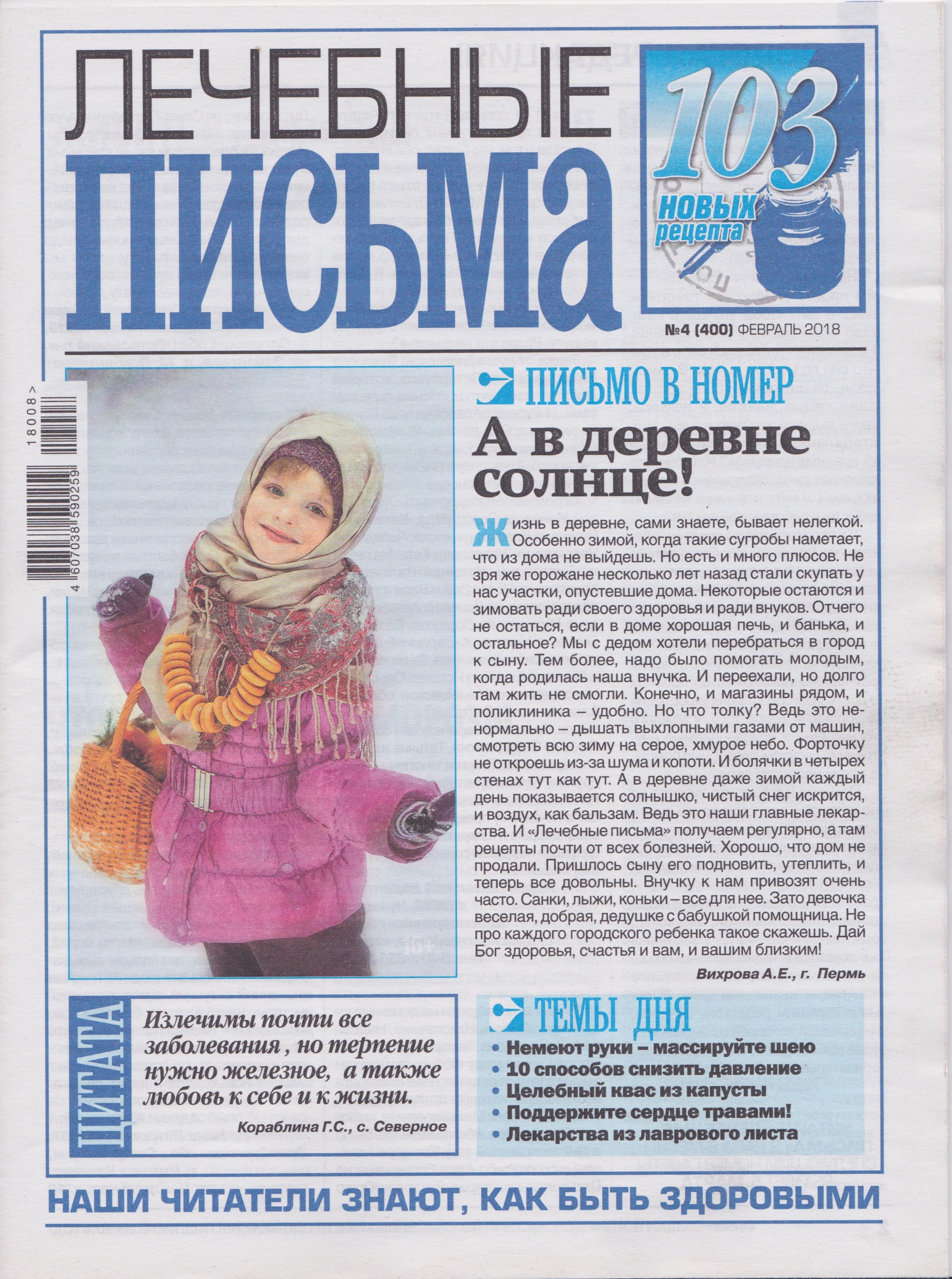
medicinal lettersFeatured Letter: But There Is Sun in the Countryside! ‘You know how hard life in the countryside can be, especially in the winter when the snow drifts so badly you cannot leave the house. All the more so because I needed to help the young folks when our granddaughter was born. We moved to the city, but we could not live there long. Of course, the stores and the clinic were nearby, and that was convenient, but what was the point? It’s abnormal to breathe exhaust fumes from cars and gaze all winter at a grey, gloomy sky. You cannot open the window because of the noise and soot. And the ailments you get when you are trapped between four walls are not slow in coming. In the countryside, the sun makes an appearance every day, even in the winter, the pure snow glitters, and the air is like a salve. And we get Medicinal Letters regularly, in which there are prescriptions for nearly any ailment. It was a good thing we didn’t sell the house. Our son had to fix it up and insulate it, and now everyone is happy. Our granddaughter comes for frequent visits. We have everything for her: a sled, skies, and skates. The girl is сheerful and kind, and Grandma and Grandpa’s little helper, not something you can say about every city kid. May God bless you and your loved ones with health and happiness. A.E. Vikhrova, Perm.’ Our Readers Know How to Be Healthy.” Cover page of Medicinal Letters 4 (400), February 2018
_________________________

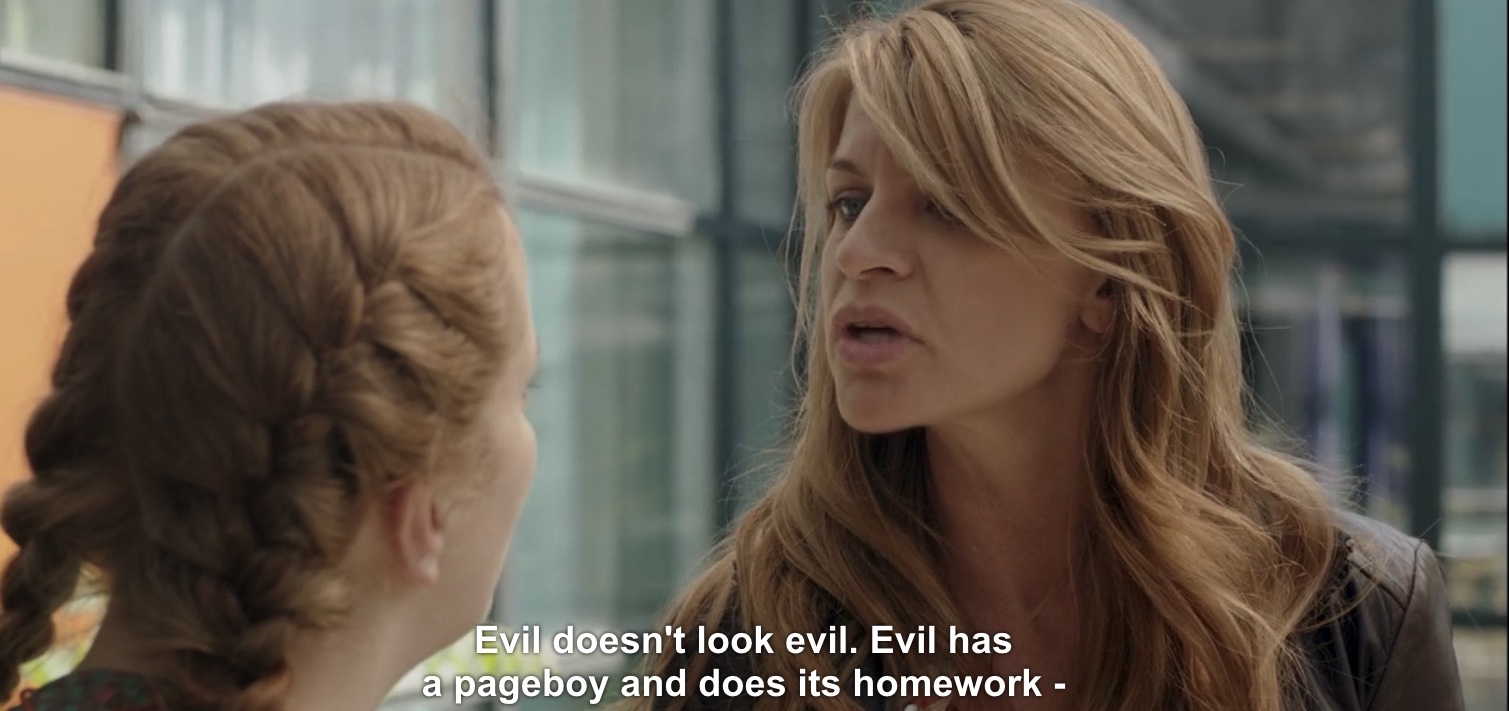
rita-evilScreenshot from Danish TV series Rita. Courtesy of Netflix
_________________________

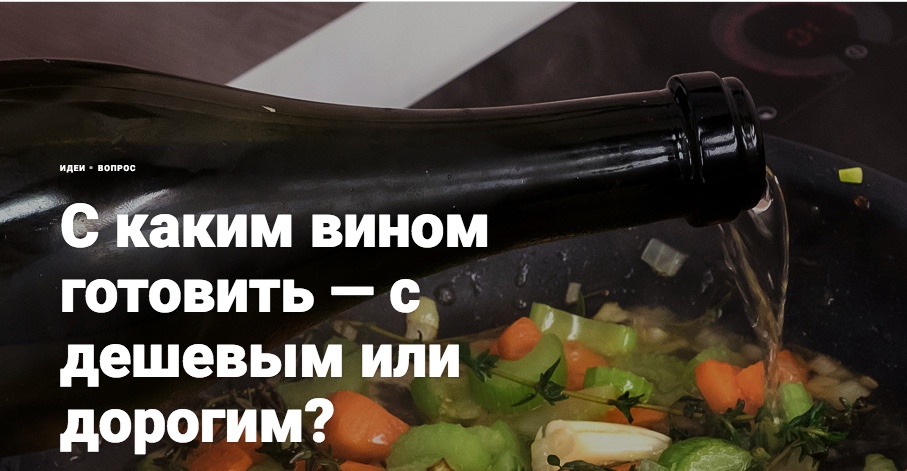
wine-dear or cheap“Should you cook with cheap wine or expensive wine?” Source unknown

_________________________

fridge magnet calendar2018 refrigerator magnet tear calendar. Published by Bronze Horseman Publishers (www.mvsadnik.ru) in an edition of 3,000 copies. Rated 0+
_________________________

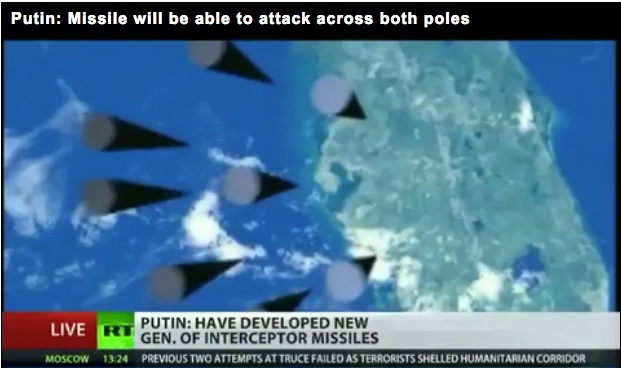
destroy floridaScreenshot of the imaginary obliteration of Florida by Russian missiles, as broadcast live on RT at 1:24 p.m. MSK, 1 March 2018. Video courtesy of the Daily Star,  1 March 2018
_________________________

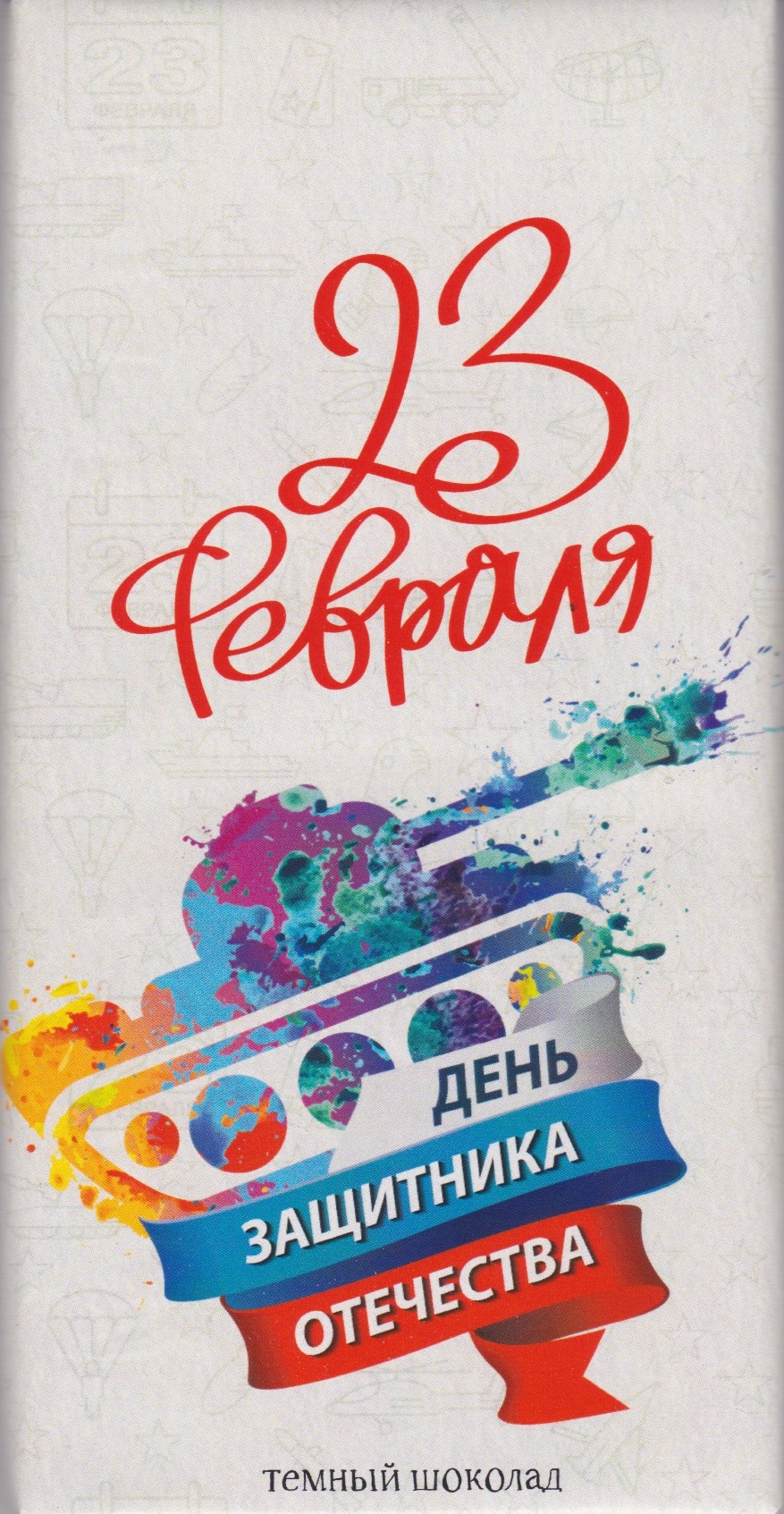
fdd choco bar.jpeg“February 23. Fatherland Defenders Day. Dark Chocolate.” Manufacturer unknown. Purchased at Bukvoyed Bookstore in Galeria Shopping Center, 30A Ligovsky Prospect, St. Petersburg, for ₽121 (approx. €1.73) on 23 February 2018
_________________________

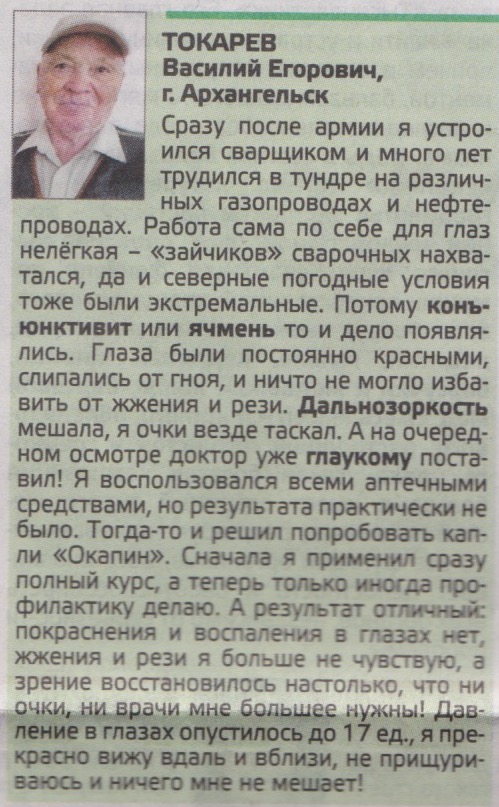
tokarev's eyesVasily Yegorovich Tokarev, Arkhangelsk. Right after the army I got a job as a welder. I worked for many years in the tundra on various gas and oil pipelines. The job was hard on the eyes in itself. There were the constant flashes from the welding equipment, and the weather conditions in the north were also extreme. So, I would get conjuctivitis and styes from time to time. My eyes were always red and caked with pus, and nothing could relieve the gritty feeling and smarting. Farsightedness became a problem, and I had to drag glasses with me everywhere. During a routine exam, the doctor diagnosed glaucoma! I went through all the drugs available at the chemist’s, but the payoff was practically nonexistent. That was when I decided to try Okapin drops. At first, I went through a whole course of treatment, but now I only use them sometimes as preventative. The results have been excellent. My eyes are not red and inflamed, I no longer have that feeling of burning and grittiness, and my eyesight has rebounded so that I no longer have any need of glasses or doctors. The pressure in my eyes has dropped to 17 mmHg. I see great both far and up close, I don’t squint, and nothing bothers me!” Excerpted from the front page of the Health Herald [March 2018], an advertising circular disguised as a newspaper.
_________________________

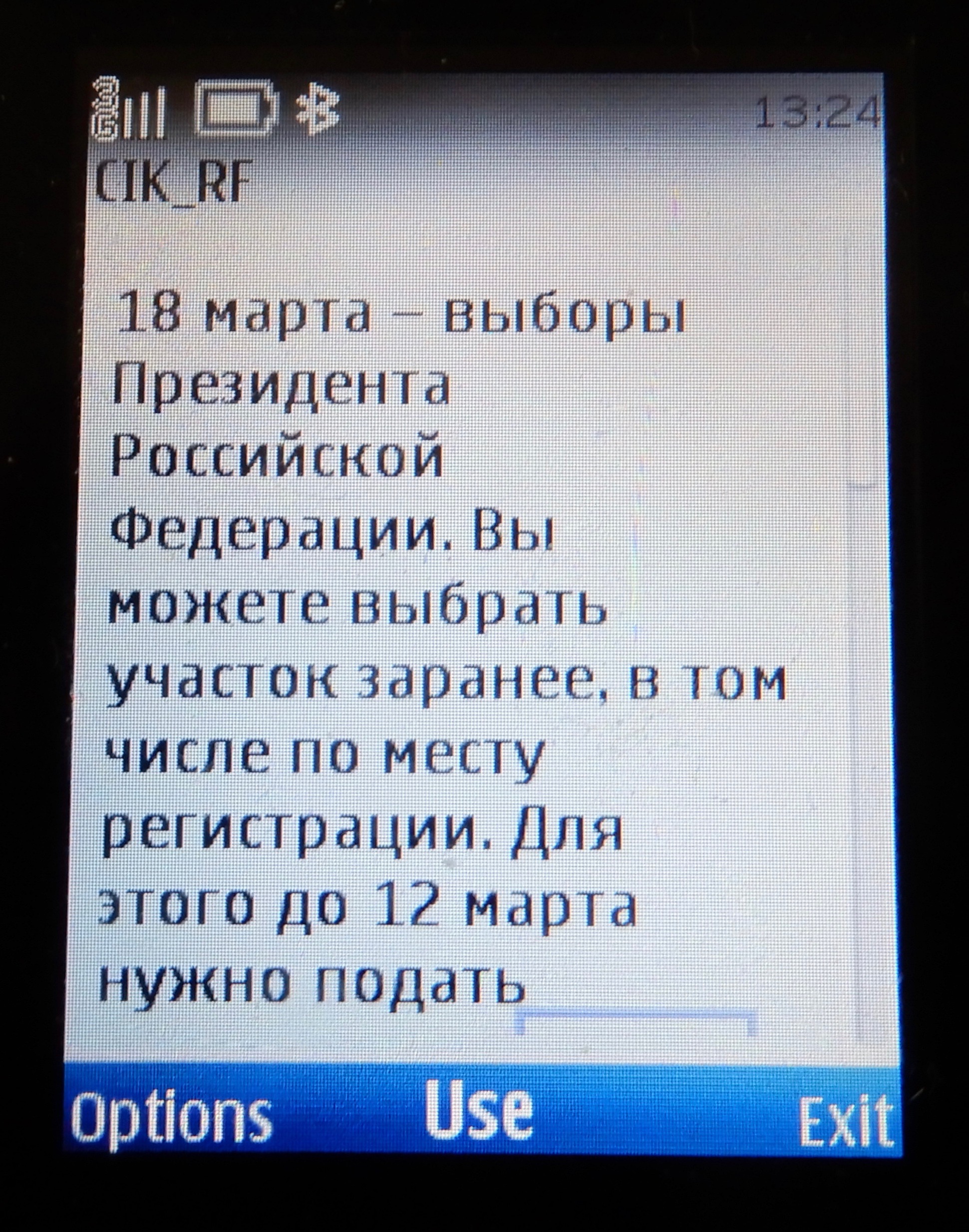
sms.jpg“March 18 is the election of the president of the Russian Federation. You can choose a voting station in advance, including the one assigned to your registered domicile. To do this, before March 12 you must submit—.” Excerpt from an SMS received on my mobile phone at 1:24 p.m. MSK, 3 March 2018.
_________________________

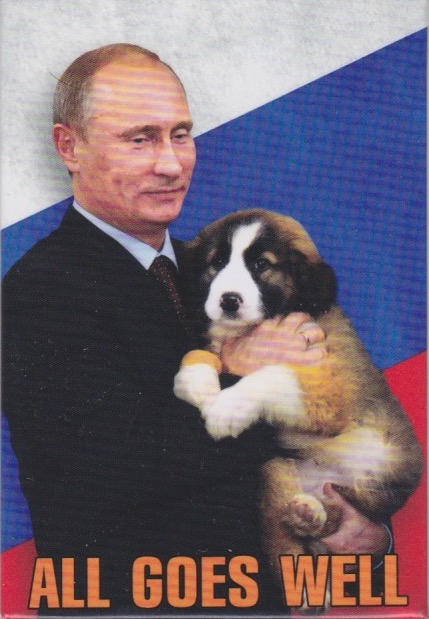
all goes well 1Refrigerator magnet “All Goes Well.” On the reverse side of the magnet, the human being is identified as “The President of the Russian Federation. Vladimir Putin.” The dog is not identified by name.
_________________________

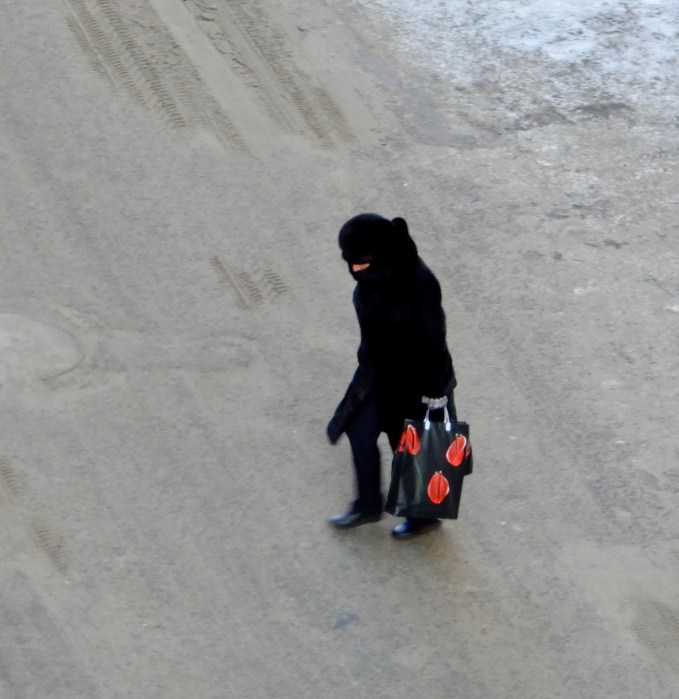
Old Woman Crossing Street on Cold Day in Petersburg, 27 February 2018. Photo by the Russian Reader
Assembled and translated by the Russian Reader. Dedicated to Comrade SG on his birthday

If Wishes Were Horses

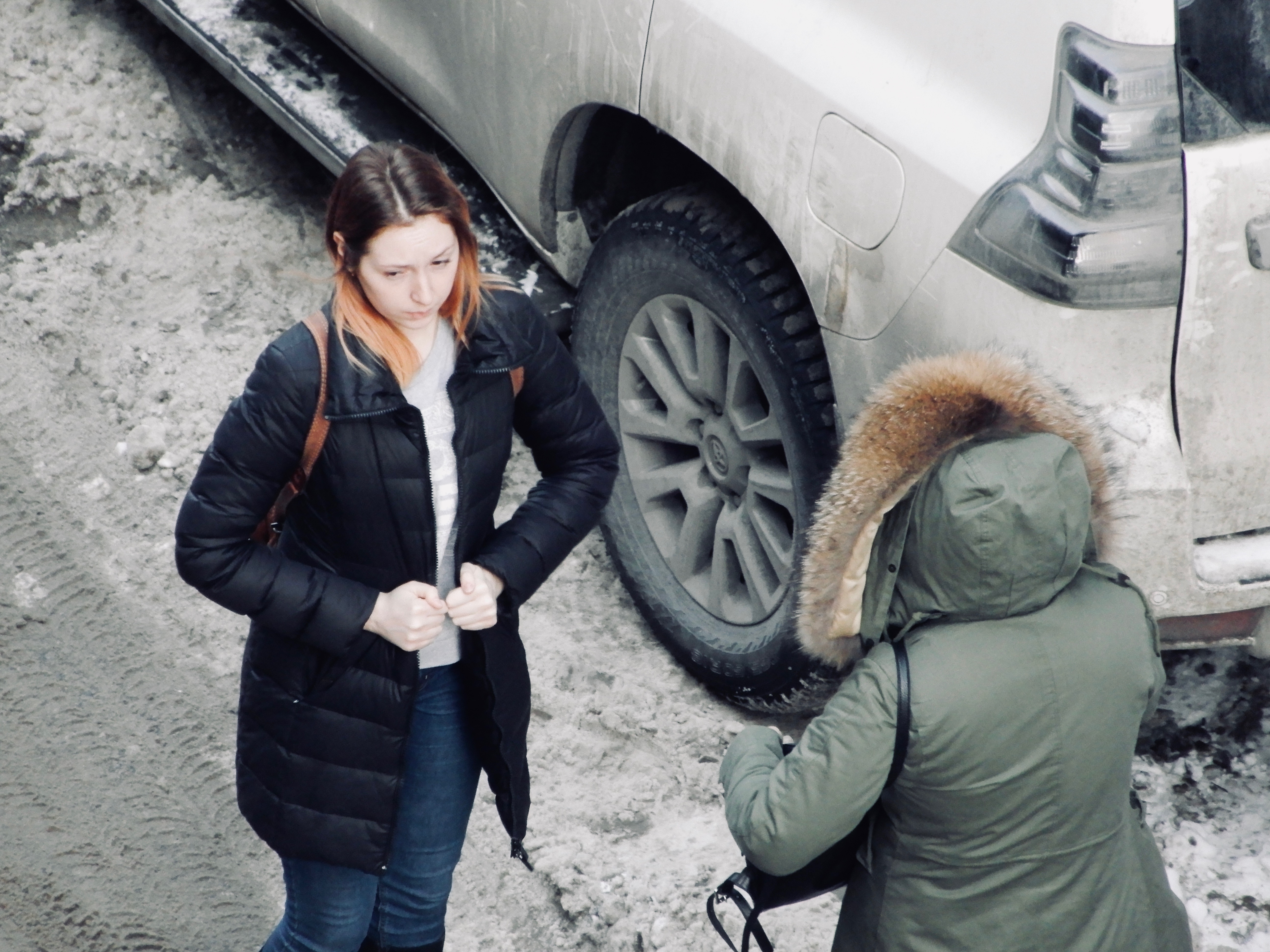
DSCN4101There is a good chance this ordinary young Russian woman will be middle-aged by the time Putin finally leaves office. Photo by the Russian Reader

“Syria is a shocking, baffling mess. For ordinary Russians, it is a waste of men and money. For a watching world, appalled by scenes of relentless brutality and cruelty in Ghouta, Aleppo, and a thousand other towns and cities, it is Putin’s mess. It’s up to him to fix it.

[…]

“Putin faces a presidential election on 18 March. If Russia were a functioning democracy, not a corrupt oligarchy, he could be out on his ear.”

I want to make one tiny correction to Simon Tisdall’s otherwise fine, correct sentiments, as published on February 25 in the Guardian. Syria means absolutely nothing to “ordinary Russians.” To be more precise, there is absolutely no empirical evidence whatsoever it means anything to them at all.

If it does mean anything, however, it may not mean what Mr. Tisdall would want it to mean, as evidenced by the 30,000 people who turned out in Voronezh on February 8 for Russian fighter pilot Roman Filippov’s funeral.

Except for singular voices like Igor Yakovenko’s, which I have linked to, above, Russian society and its famed intelligentsia have been ear-shatteringly silent about the Kremlin’s predations on behalf of the Syrian butcher Bashar Assad since they kicked off in September 2015. Although there were fairly large demonstrations, especially in Moscow, to protest the Kremlin’s criminal adventures in Ukraine, there has not been a single notable mass protest in Russia against the Kremlin’s war against ordinary, absolutely innocent Syrians.

The only protest against the Syrian massacre in Russia I know of was a picket that occurred somewhere in Moscow during the last two years, witnessed by almostno one, and attended by almost no one. A reader of my Facebook news feed told me he had heard about it or perhaps even attended it himself. He wrote about it to me by way of saying there were, in fact, protests in Russia against the Kremlin’s Syrian horrorshow.

Try not to laugh or cry after you have read the previous paragraph.

We should thus conclude that most “ordinary Russians” do not care a whit about ordinary Syrians and their hellish ordeal. Or they have bought hook, line, and sinker the Kremlin’s stinky lie that it has been targeting only “terrorist groups” in Syria. It’s one or the other. There isn’t a third option, as “ordinary Russians” like to say.

You should know, however, that the Kremlin enacts this same stinky lie (about “combating terrorists”) on the home front, yet only a few more “ordinary Russians” get worked up about it.

So, the problem is not just Putin and Syria, although were there ever an international tribunal on war crimes in Syria, he and his immediate Kremlin underlings and Russia’s top generals would be the only Russians legally liable to prosecution. Just as collective punishment is outlawed by international law, there really is no such thing as collective guilt.

It is equally true, however, that the vast majority of Russia’s 144 million people have been letting Putin and his satraps do as they please for the last eighteen years without so much as a peep.

You can put this down to state propaganda, the Soviet legacy or whatever you like, but it is a frightening, unmovable fact.

For now, the perennially hopeful would counter me, saying that someday, perhaps soon, things will change.

I would like to count myself among their number, but on March 18 Putin will have himself installed as Russia’s president for life de facto.

Why is this? Because Putin knows that, at this dreadful point in Russia’s history, even if he once again, after his new term as president runs out in 2024, handpicked a successor from his inner circle of loyalists to sub for him as president for six years, so he could reinstall himself as president in 2030, just as he once handpicked Dmitry Medvedev to do the same prestidigation act in 2008, that person probably would have to denounce him and his personality cult sheerly for reasons of political expediency, that is, if the “substitute” president wanted a freer hand in shaping his own administration for good or for ill, much as the Stalinist loyalist Krushchev did after Stalin’s death.

After twenty-four years of Putinism, the country would want the “substitute” president to denounce Putin and all his ways as fiercely as a drunkard wants a drink.

It is just too bad it does not have the will or the means to dismantle the Putinist tyranny now. The consequences of six more years of Putinism for Russia and the world will be dreadful. TRR

Getting (No) Satisfaction

fullscreen-rz

“How the European Court of Human Rights Did in 2017.” Romania, Russia, Turkey, Ukraine, Hungary, Azerbaijan, Georgia, Armenia, and Poland were the the leaders in terms of numbers of complaints the ECHR agreed to consider further, while Russia was number one in terms of rulings made against it. Among the most complaints from Russia were cases involving the right to liberty and security, the right to be protected from inhumane, humiliating treatment, the right to effective medical treatment, to right to a fair trial, and property rights. Source: ECHR. Courtesy of Vedomosti

Russia Leads in the Number of Human Rights Violations Confirmed by the European Court of Human Rights 
This Is Due to the Ineffectiveness of Russia’s Courts, One Expert Argues 
Anastasia Kornya
Vedomosti
January 26, 2018

Russia ranks second among Council of Europe member countries in numbers of complaints made to the European Court of Human Rights (ECHR) and ranks first in number of violations of the European Convention on Human Rights, according to a report on the court’s work in 2017, presented on Thursday by ECHR President Guido Raimondi. Last year, the ECHR rendered a total of 1,068 decisions: 305 of these decisions, or 29%, concerned complaints from Russia. In 293 of these cases, the court ruled that at least one article of the human rights convention had been violated. As of January 1, 2018, 7,747 cases from Russia were in proceedings at the ECHR. Only Romania has supplied the court with more cases: 9,920. In 2017, the 49% of complaints filed against Russia and deemed worthy of consideration amounted to nearly half of all cases accepted by the court for further review.

Pavel Chikov, head of the Agora International Human Rights Group, draws attention to the nature of the cases Russia has lost. They account for 66% of all of the ECHR’s rulings on the right to life, half of its rulings on torture, inhumane treatment or ineffective investigation of complaints of torture and inhumane treatment, and half of all rulings on the lack of “effective legal recourse” and groundless arrests. Finally, Russian plaintiffs won 38% of all cases involving the right to property. Chikov notes that not only has the number of rulings against Russia increased (by a third: from 222 to 305), but the number of complaints filed in Strasbourg has also experienced a sharp upturn. Chikov explains this both in technical terms (the ECHR has taken care of its backlog of cases and accelerated its document review process) and as due to the worsening overall human rights situation in Russia. The ineffectiveness of the country’s own tools for defending people’s rights has led to Russia’s becoming the most problematic country in Europe in this sense.

Russia consistently fulfills its international obligations, including implementing ECHR rulings, although some of them are flagrantly politicized, objects Andrei Klishas chair of the Federation Council Committee on Nation Building. Lately, there has been a tendency to endow the ECHR with the powers of a supranational body, but Russia acknowledges its powers only as an optional mechanism for protecting rights [sic]. National bodies remain the main mechanisms, including the Russian Constitutional Court, Klishas underscores.

The overall circumstances surrounding Russian cases in the ECHR is workaday: nothing overly worrisome has happened, argues Yuri Berestnev, editor in chief of the Bulletin of the European Court of Human Rights (in Russian). According to Berestnev, the growth of rulings in cases against Russia was to be expected, and the cause is purely technical. For three years, the court was completely focused on weeding out flagrantly unacceptable complaints from Russia. The Russian Justice Ministry dispatched a group of twenty Russian attorneys to help the ECHR clear up the logjam by filtering out several tens of thousands of complaints. [Sic!] The remaining complaints have good prospects. In late 2017, the court had accepted 3,000 complaints from Russia for further review, so the number of rulings went up from last year, explains Berestnev. He likewise notes that, in the autumn, the ECHR closed proceedings in 12,000 complaints from Ukraine, pointing out that the systematic problem of the non-fulfillment of decisions by national courts, due to the lack of financial means on the part of member states, should be discussed further by the Council of Europe’s Committee of Ministers. Russia has successfully managed to deal with the same problem, recalls Berestnev.

Translated by the Russian Reader

••••••••••

Opposition Leader Navalny Targets Kremlin in European Court
The Associated Press
January 24, 2018

STRASBOURG, France — Russian opposition leader Alexei Navalny on Wednesday appeared at a hearing at the European Court of Human Rights into whether Russian authorities violated his rights through numerous arrests.

The court ruled last year that seven of those arrests were unlawful and ordered Russia to pay 63,000 euros (about $67,000) in compensation, but the Russian government appealed.

Proving that Russian authorities had political motives in arresting him and not allowing his rallies to go ahead would set an important precedent for activists across Russia, Navalny told reporters outside the courtroom in the French city of Strasbourg Wednesday.

“This case is important not only for me but also for other people in Russia, especially in the regions because they are stripped of the freedom of assembly,” he said. “If the European Court for Human Rights sees political motives in those cases—and I think we have presented enough evidence for this today—it will make an important precedent in Russia.”

A final ruling is expected at a later date.

Russian President Vladimir Putin’s most serious political foe, Navalny wants to mount a boycott of the March presidential elections after he was barred from running.

Navalny has faced fraud charges viewed as political retribution for investigating corruption and leading protests. A Moscow court this week ordered the closure of a foundation that he used for his failed election campaign.

Navalny mounted a sprawling grassroots presidential campaign before he was officially barred from running in December. Navalny’s boycott campaign might cut the voter turnout, which would be an embarrassment for the Kremlin.

Valery Dymshits: What Boycotting the Presidential Election Would Mean

OLYMPUS DIGITAL CAMERA

Valery Dymshits
Facebook
January 7, 2018

Recently, discussions whether it makes sense to boycott the presidential election or, on the contrary, whether you should vigorously exercise your right to vote have been flaring up on the web ever more emphatically. I was involved in one such discrete discussion. Its instigator, Alexei Kouprianov, recommended I publish my comments as a separate post.

There are currently no presidential elections in our country, neither elections with alternative candidates nor elections with a single candidate, neither competitive elections nor non-competitive elections. There are no presidential elections at all. For the time being, there are regions in Russia that are electoral anomalies, while all other regions do the right thing, so to speak. In those regions, you need not worry how long ballot stuffing has been going on, and it is no problem to rewrite the final official vote tally reports. So, for all intents and purposes, elections have been abolished. What matters, therefore, is not Putin’s apparent impending victory. The procedure could not even be passed off as a sound sociopolitical survey, answering the question of how many folks in Russia are for the Reds, how many are for the Whites, how many are for apples, and how many are for pears.

Since no election will take place, this should tone down the debate to a certain extent. This is my call for peace and a peaceable tone among those debating involvement and non-involvement in the election. Those who will go to the polls and those who do not are in the same straits. Neither the former nor the latter will be taking part or not taking part in an election, whatever they imagine they are doing, because objectively, that is, regardless of subjective impressions, you cannot take part in something that does not exist.

You cannot take part in it, not in the sense it is forbidden to take part, but in the sense it is impossible to take part.

The only thing that remains to be seen is what behavior is preferable given the circumstances.

The people currently involved in the electoral process have never been able to get back the significant numbers of votes stolen from them nor have they been able to make this highway robbery the subject of a serious public debate. This is possibly not their fault, since the Russian judicial system is dysfunctional, but that is not my point. The existing parties and candidates will try and raise the turnout by campaigning for themselves. In this wise, the candidates and the Kremlin are pursuing the same end. Later, a final vote tally will be whipped up for them in keeping with deals made before the elections or, on the contrary, they will be conned. This is no concern of ours. That is, the well-known scenario, implemented many times before, will be reprised. In short, we have been through this before.

What we have not been through before is a serious, well-organized boycott, although they were some calls for boycotts in the past. At least there is chance to find out on the ground whether we have a chance of organizing an election boycott or not, whether it has an effect on anything or not. This, at least, would expand our experimental knowledge of the subject.

Simple mathematical calculations have shown a decreased turnout increases the percentage of votes cast for Putin. But do we care what percentage of votes are cast for him, whether it is 65% or 75%, if the final figures are knowingly false and dictated by the top bosses? In the extreme case, if only solid Putin supporters turned out to vote, he would take home 100% of the vote, and that would be utterly unacceptable, because a European leader cannot win 100% of the vote, and Putin is well aware of it.

A noticeable decrease in the turnout, one that was clearly distinguishable from the statistical margin of error, would be tantamount to saying a considerable segment of the Russian populace had concluded that elections in Russia were wanting, to say the least. This would be an important political outcome.

For the time being I leave aside additional moral perks, say, deliberate non-participation in a fictitious process, non-participation in events approved by the Kremlin, etc.

Translation and photo by the Russian Reader

P.S. Every reporter or “Russia expert” who has written or been tempted to write something like, “With an 80% approval rating, Putin should easily cruise to victory in March,” should be made to read multi-talented Valery Dymshits’s short but sweet piece on why there are no such beasts as elections in Russia and the possible political benefits of a more or less massive non-turnout to the non-election scheduled for March.

I would like to add that every such reporter and “Russia expert” should be made to read this short primer on what amounts to common knowledge in Russia right before they are fired and drummed out of the profession, but the angel in me reminds me that some people cannot help liking and supporting tyrants and imagining that lots of other people like them, especially in “inferior” countries.

That it’s accredited journalists and academics involved in this baseless condescension should not surprise you. It’s always easier to get along in life if you say and do what the majority of your so-called peers and colleagues are doing, especially if you’re mansplaining a place where you don’t actually live and about which you are really quite clueless, and you get paid to do this more or less harmful work.

I thought the attack on the Russian pollocracy that was mounted by me and several other people several years ago had begun to make a dent, that some journalists and “Russian experts” were coming to see the light that polls and elections are nearly always rigged in Putinist Russia and thus provide us with nearly zero knowledge of what “Russians really think.” But I had forgotten that most reporters are lazy and many academics are dazzled by tyrants and numbers as “scientific facts.” With Putin’s self re-election just around the bend, push has come to shove, and the unprovability of his actually nonexistent popularity has been shoved back under the rug. TRR

Persian Rugs

russian_carpet_on_the_wall

Antrr Ra
Facebook
January 2, 2018

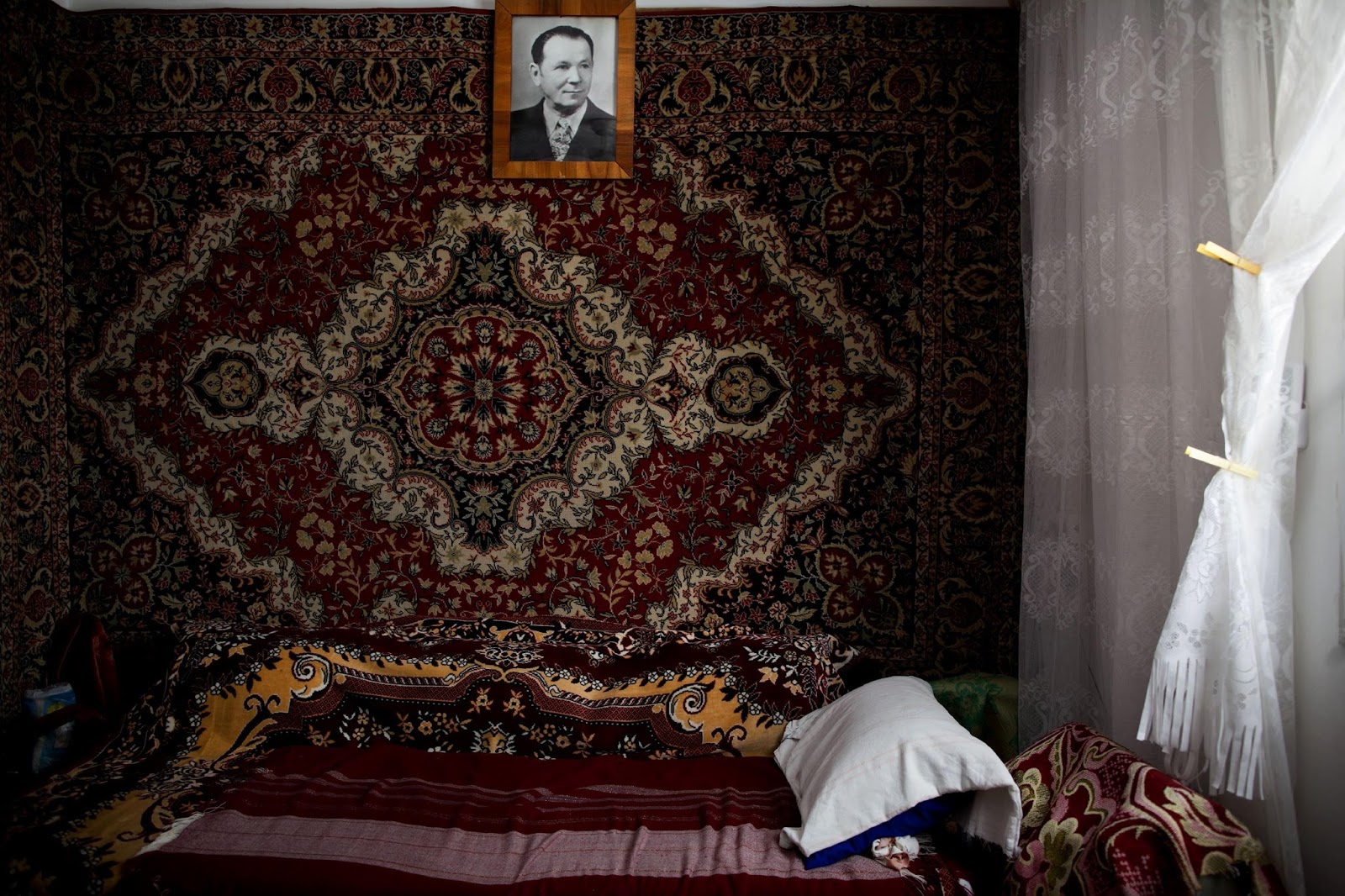
For several days, Iranians have been openly protesting the corrupt system in their country. They have been protesting not only in the capital Tehran but also in at least fifty other cities. They had been promised more freedom and openness in terms of how the country’s budget is spent, and prices for food have been skyrocketing.

In Russia, the authorities have not promised anyone anything for a long time, and people have been staying at home, looking forward to the upcoming presidential elections.

Translated by the Russian Reader. Thanks to Anatrr Ra for their kind permission to reproduce their remarks on my website. Photo courtesy of correctlydesign.com